1 Corinthians 16:6

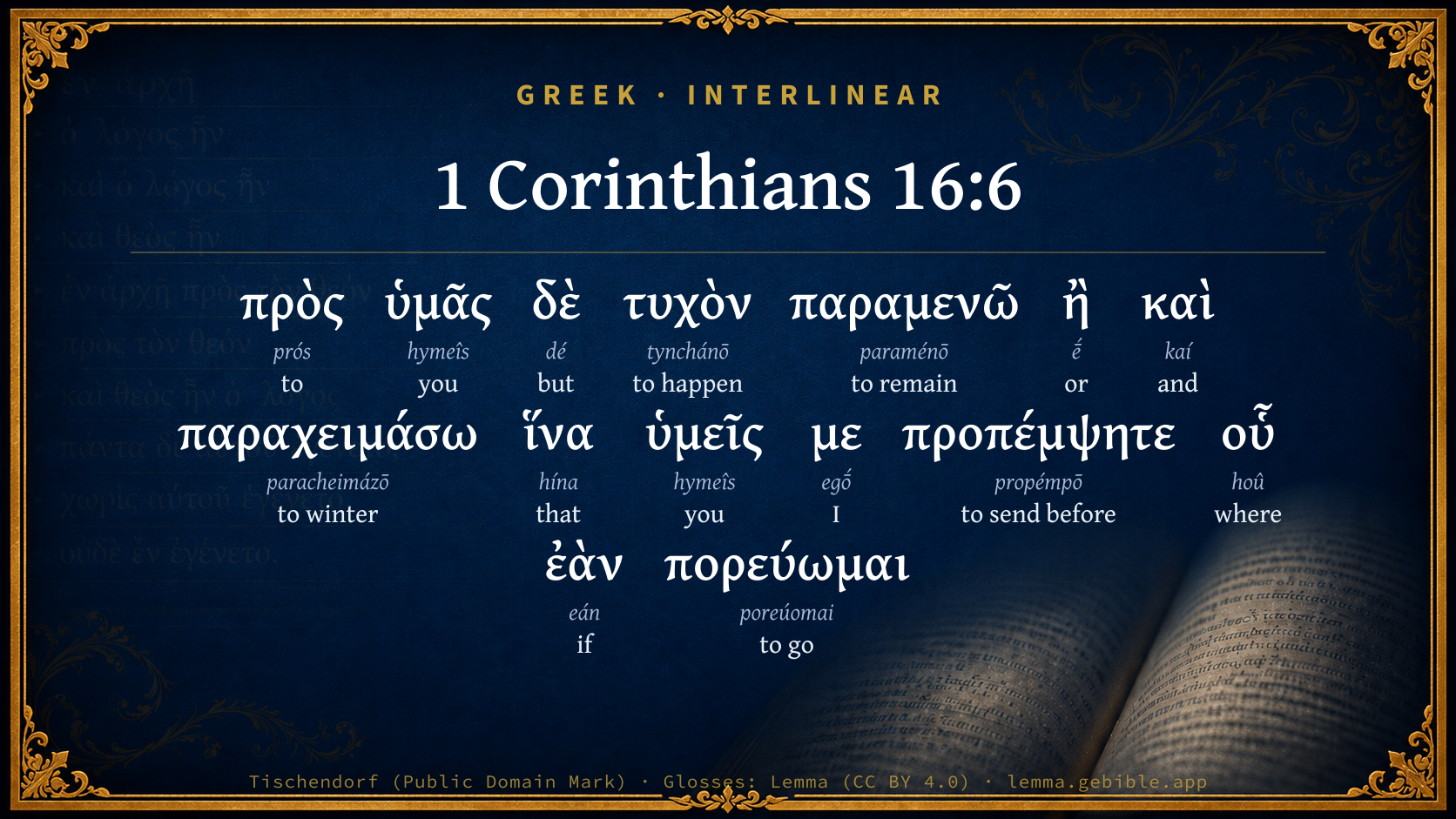
Greek (Tischendorf 8th ed.) 1 Corinthians 16:6 appears in the Greek New Testament. The text above is from the Tischendorf 8th edition. Each word links to its Strong’s number and a concise gloss. Click any word for its full Thayer’s Greek Lexicon entry.
Download image
Cite this verse

1 Corinthians 16:6 (World English Bible). Public Domain. Lemma interlinear Bible study tool, https://lemma.gebible.app/v/1-corinthians/16/6.

Show BibTeX & RIS
BibTeX
RIS
English Translation
But with you it may be that I will stay, or even winter, that you may send me on my journey wherever I go.
World English Bible · Public Domain
Highlights
  • 1 first appearance in the Greek New Testament
Full analysis ↓
Download a study sheet

One document with this verse’s original text, its word-by-word gloss line, the meaning frame, cross-references with their text, attributed commentary, and full source and license credits — printable, and it pastes into notes with its structure intact.

This verse Autodidact and up

Study sheet (.html) Plain text (.txt)

A passage Seminary Student

Up to 50 verses in one chapter. A passage sheet keeps up to 6 commentary sources and 12 cross-references per verse, in the order this page ranks them, and says so on the sheet whenever that leaves anything out. Ask for a single verse and you get the Autodidact verse sheet above.

Everything on this page stays free to read, with no account — the sheet is a download of what is already on screen, not access to it.

Want to remove ads? Support Godless Engineer
Compare translations 3

The same verse in 3 English versions, stacked beneath the original-language interlinear above. Click any original word for its lexicon entry.

Each is an independent rendering of the whole verse — the interlinear is not word-aligned to these translations.

Highlighted words mark where these versions differ — a whole-verse word diff, not a word-by-word alignment.

  • World English Bible Public Domain
    But with you it may be that I will stay, or even winter, that you may send me on my journey wherever I go.
  • King James Version Public Domain
    And it may be that I will abide, yea, and winter with you, that ye may bring me on my journey whithersoever I go.
  • unfoldingWord Literal Text CC BY-SA 4.0
    But perhaps I will stay with you, or even spend the winter, so that you may help me on my way wherever I might go.

unfoldingWord Literal Text — © unfoldingWord, licensed CC BY-SA 4.0. Word-aligned USFM3 via Door43 (git.door43.org/unfoldingWord/en_ult).

Versions to compare (up to 4)

3 of 4 selected

Show all 19 translations

Every available English version of this verse, each an independent rendering of the whole verse.

  • World English Bible Public Domain
    But with you it may be that I will stay, or even winter, that you may send me on my journey wherever I go.
  • Berean Standard Bible Public Domain
    Perhaps I will stay with you awhile, or even spend the winter, so that you can help me on my journey, wherever I go.
  • Majority Standard Bible Public Domain
    Perhaps I will stay with you awhile, or even spend the winter, so that you can help me on my journey, wherever I go.
  • King James Version Public Domain
    And it may be that I will abide, yea, and winter with you, that ye may bring me on my journey whithersoever I go.
  • American Standard Version (1901) Public Domain
    but with you it may be that I shall abide, or even winter, that ye may set me forward on my journey whithersoever I go.
  • Revised Version (1885) Public Domain
    but with you it may be that I shall abide, or even winter, that ye may set me forward on my journey whithersoever I go.
  • Geneva Bible (1599) Public Domain
    And it may be that I will abide, yea, or winter with you, that ye may bring me on my way, whither soeuer I goe.
  • Douay-Rheims (1899) Public Domain
    And with you perhaps I shall abide, or even spend the winter: that you may bring me on my way whithersoever I shall go.
  • Young's Literal Translation Public Domain
    and with you, it may be, I will abide, or even winter, that ye may send me forward whithersoever I go,
  • Literal Standard Version CC BY-SA 4.0
    and with you, it may be, I will abide, or even winter, that you may send me forward wherever I go,
  • Unlocked Literal Bible CC BY-SA 4.0
    Perhaps I may stay with you or even spend the winter, so that you may help me on my journey, wherever I go.
  • unfoldingWord Literal Text CC BY-SA 4.0
    But perhaps I will stay with you, or even spend the winter, so that you may help me on my way wherever I might go.
  • Darby Bible Public Domain
    But perhaps I will stay with you, or even winter with you, that *ye* may set me forward wheresoever I may go.
  • World Messianic Bible Public Domain
    But with you it may be that I will stay with you, or even winter with you, that you may send me on my journey wherever I go.
  • Webster's Bible Public Domain
    And it may be that I shall abide, and even winter with you, that ye may bring me on my journey whithersoever I go.
  • Free Bible Version CC BY-SA 4.0
    and I may stay with you for a while, perhaps spend the winter, and then you can send me on my way to wherever I'm headed.
  • Bible in Basic English Public Domain
    But I may be with you for a time, or even for the winter, so that you may see me on my way, wherever I go.
  • Text-Critical English NT CC BY 4.0
    and perhaps I will stay with you or even spend the winter, so that you may send me on my way wherever I may go.
  • Tyndale New Testament (1534) Public Domain
    With you paraveture I wyll abyde awhyle: or els winter that ye maye brynge me on my waye whyther soever I goo.

Literal Standard Version (2020), Covenant Press — licensed CC BY-SA 4.0. Text via the HelloAO Bible API (eBible.org). Unlocked Literal Bible (unfoldingWord) — licensed CC BY-SA 4.0. Text via the HelloAO Bible API (eBible.org). unfoldingWord Literal Text — © unfoldingWord, licensed CC BY-SA 4.0. Word-aligned USFM3 via Door43 (git.door43.org/unfoldingWord/en_ult). Free Bible Version, Dr. Jonathan Gallagher — licensed CC BY-SA 4.0. Text via the HelloAO Bible API (eBible.org).

Word by word

More ways to search: Search by grammar → Find every occurrence → Compare this word →

Practice this passage: Drill this verse → Learn its vocabulary →

παραμενῶ
paraménō
G3887
“to remain”
Verb, Future, Active, Indicative, 1st person, Singular
Part of Speech
Verb
Tense
Future
Voice
Active
Mood
Indicative
Person
1st person
Number
Singular
Full Thayer's Definition

Origin: from G3844 and G3306

TDNT: 13:37,6

1. to remain beside, continue always near 2. to survive, remain alive
  1. πρὸς prós G4314 “to” Preposition
  2. ὑμᾶς hymeîs G5210 “you” Personal pronoun, 2nd person, Accusative, Plural
  3. δὲ dé G1161 “but” Conjunction
  4. τυχὸν tynchánō G5177 “to happen” Verb, Aorist, Active, Participle, Accusative, Singular, Neuter
  5. ἢ ḗ G2228 “or” Particle
  6. καὶ kaí G2532 “and” Conjunction
  7. παραχειμάσω paracheimázō G3914 “to winter” Verb, Future, Active, Indicative, 1st person, Singular
  8. ἵνα hína G2443 “that” Conjunction
  9. ὑμεῖς hymeîs G5210 “you” Personal pronoun, 2nd person, Nominative, Plural
  10. με egṓ G1473 “I” Personal pronoun, 1st person, Accusative, Singular
  11. προπέμψητε propémpō G4311 “to send before” Verb, Aorist, Active, Subjunctive, 2nd person, Plural
  12. οὗ hoû G3757 “where” Adverb
  13. ἐὰν eán G1437 “if” Conditional
  14. πορεύωμαι poreúomai G4198 “to go” Verb, Present, Middle or Passive deponent, Subjunctive, 1st person, Singular

About this verse

These counts appear in no published source. They are computed here, from the morphology-tagged text and Lemma’s own curated glosses. What Lemma adds →

15
words
14
distinct lemmas
Pauline Epistles
section

Notable vocabulary

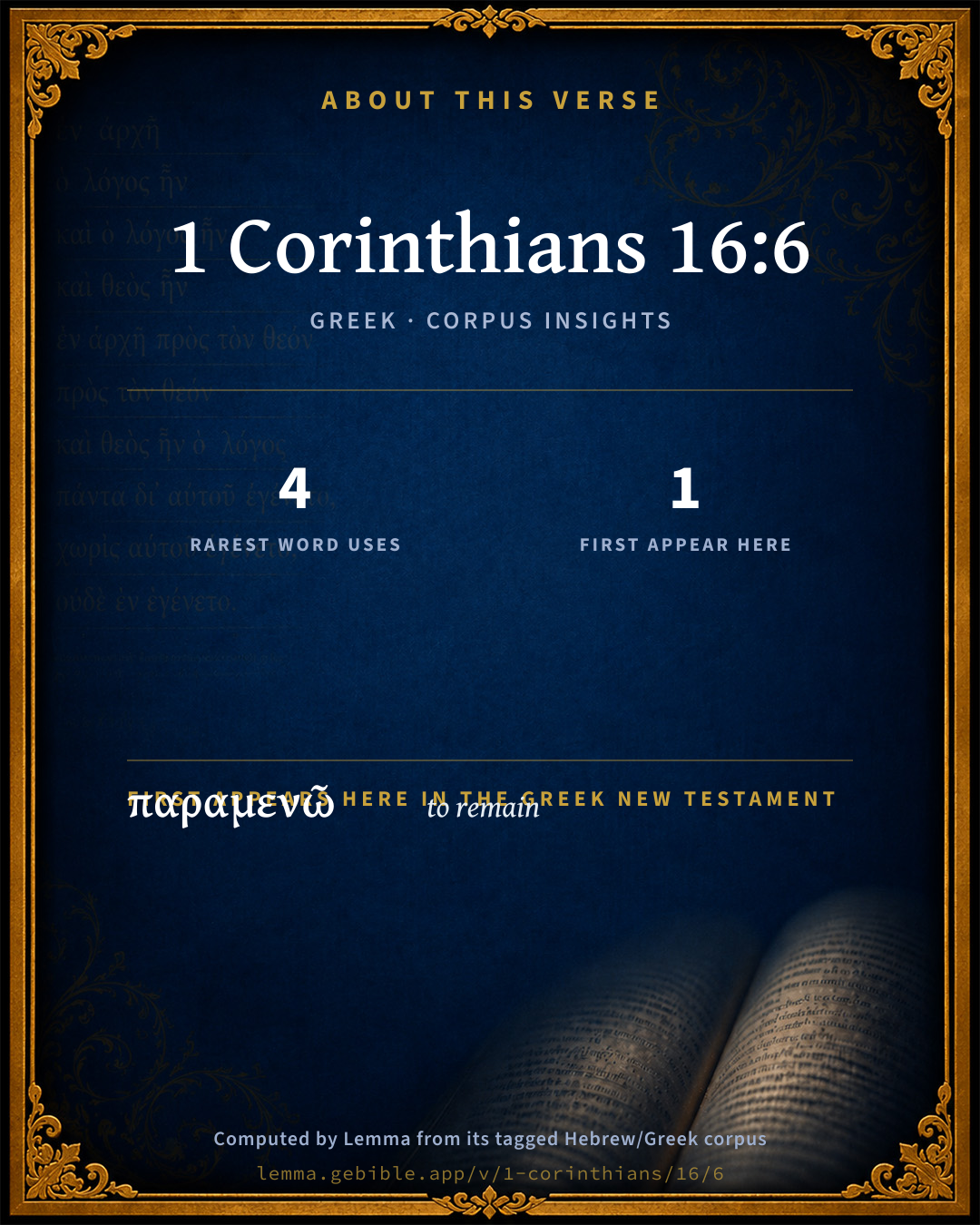
The rarest word here is παραμενῶ to remain G3887 — appearing just 4 times in the whole Greek New Testament.

First appearance in Scripture

This word makes its first canonical appearance in the Greek New Testament here:

  • παραμενῶ to remain G3887

Shared distinctive vocabulary

παραμενῶ to remain G3887 occurs in 4 verses of the Greek New Testament. Also found in:

Repetition

A word recurs within this verse:

  • ὑμᾶς you G5210 ×2

Cross-references

11

Topical passages linked to 1 Corinthians 16:6 in the Treasury of Scripture Knowledge — connected by theme and wording, ordered by reader-vote popularity; previews shown in the World English Bible.

  • Acts 15:3 They, being sent on their way by the assembly, passed through both Phoenicia and Samaria, declaring the conversion of the Gentiles. They caused great joy to all the brothers.
  • Romans 15:24 whenever I journey to Spain, I will come to you. For I hope to see you on my journey, and to be helped on my way there by you, if first I may enjoy your company for a while.
  • 3 John 1:6–7 They have testified about your love before the assembly. You will do well to send them forward on their journey in a manner worthy of God,
  • Acts 17:15 But those who escorted Paul brought him as far as Athens. Receiving a commandment to Silas and Timothy that they should come to him very quickly, they departed.
  • Acts 20:38 sorrowing most of all because of the word which he had spoken, that they should see his face no more. And they accompanied him to the ship.
  • Acts 21:5 When it happened that we had accomplished the days, we departed and went on our journey. They all, with wives and children, brought us on our way until we were out of the city. Kneeling down on the beach, we prayed.
  • Acts 27:12 Because the haven was not suitable to winter in, the majority advised going to sea from there, if by any means they could reach Phoenix, and winter there, which is a port of Crete, looking northeast and southeast.
  • Acts 28:11 After three months, we set sail in a ship of Alexandria which had wintered in the island, whose sign was "The Twin Brothers."
  • 1 Corinthians 16:11 Therefore let no one despise him. But set him forward on his journey in peace, that he may come to me; for I expect him with the brothers.
  • 2 Corinthians 1:16 and by you to pass into Macedonia, and again from Macedonia to come to you, and to be sent forward by you on my journey to Judea.
  • Titus 3:12 When I send Artemas to you, or Tychicus, be diligent to come to me to Nicopolis, for I have determined to winter there.

Cross-references courtesy of OpenBible.info (CC BY 4.0).

Commentary

Notes on 1 Corinthians 16:6 from classic Christian and Jewish commentators (each source and its license shown beneath its notes). The classic Christian expositions comment on the surrounding passage and are grouped to its opening verse, so a note may address several verses; the Jewish commentaries on the Tanakh (Rashi and others) are per-verse, so they appear only where the commentator wrote on this verse.

Lemma curates 59 commentaries, every one of them public domain or Creative Commons licensed, each selected and text-cleaned for this edition rather than reprinted as found. About our sources →

Tyndale Open Study Notes

Tyndale Open Resources

16:6-7 possibly all winter: Paul evidently made this visit (cp. Acts 20:2-3).

Tyndale Open Study Notes — © Tyndale Open Resources, licensed CC BY-SA 4.0. Text via the HelloAO Bible API.

Bengel's Gnomon

Johann Albrecht Bengel

1Co 16:6. Τυχὸν, perhaps) He speaks very familiarly.—οὗ ἐὰν, whithersoever) For the sake of modesty he does not express how far he may be thinking to go, Act 19:21.

Bengel's Gnomon of the New Testament — English translation (T&T Clark, Edinburgh, 1860) — public domain. Text from a community e-Sword module.

Hodge's Commentary on Romans, Ephesians & First Corinthians

Charles Hodge

1Co_16:6

And it may be that I will abide, yea, and winter with you, that ye may bring me on my journey whithersoever I go.

I pass through Macedonia, but I will abide with you. His visit to the former was to be transient, to the latter prolonged. In the second Epistle he speaks of himself as in Macedonia, and in Act_20:2, Act_20:3, we find that he left Ephesus after the uproar in that city and went to Macedonia, and thence to Greece, where he abode three months. The plan here sketched was therefore executed. He would remain with them for the winter, he says, in order that they might help him forward on his journey, i.e. attend him on his way, which was the customary mark of respect. Paul wished to receive this courtesy from the Corinthians rather than from others, as his affection for them, notwithstanding the trouble and anxiety they occasioned him was, as is evident from his second Epistle, peculiarly strong.

Charles Hodge — Commentary on Romans (1835), First Corinthians (1857), and Ephesians (1856) — public domain. Text from a community e-Sword module.

Jamieson, Fausset & Brown

Robert Jamieson, A. R. Fausset & David Brown

He did "abide and even winter" for the three WINTER months in Greece (Corinth), Act 20:3, Act 20:6; from which passage it seems that Paul probably left Corinth about a month before the "days of unleavened bread" or the Passover (so as to allow time to touch at Thessalonica and Berea, from which cities two of his companions were; as we read he did at Philippi); so that thus the three months at Corinth would be December, January, and February [BIRKS, Horæ Apostolicæ].

ye--emphatical in the Greek.

whithersoever I go--He purposed to go to Judea (Co2 1:16) from Corinth, but his plans were not positively fixed as yet (see on Co1 16:4; compare Act 19:21).

Jamieson, Fausset & Brown — Commentary Critical and Explanatory on the Whole Bible (1871) — public domain (CC PDM 1.0). Text via the HelloAO Bible API.

Adam Clarke's Commentary

Verse 6. Yea, and winter with you] He purposed to stay till pentecost at Ephesus; after that to go to Macedonia, and probably to spend the summer there; and come in the autumn to Corinth, and there spend the winter.

That ye may bring me on my journey] That ye may furnish me with the means of travelling. It appears that, in most cases, the different Churches paid his expenses to other Churches; where this was not done, then he laboured at his business to acquire the means of travelling.

Adam Clarke's Commentary on the Bible (1810–1826) — public domain. Text from a community e-Sword/MySword module.

Ellicott's Commentary for English Readers

(6) And it may be that I will abide . . .—His former plan had involved but a brief visit to the Church at Corinth, but the arrangement which he now contemplated would permit of a longer stay, and so he adds, with affectionate emphasis, “that you may send me on my journey.” Whither he would go from Corinth he had not yet determined; and, indeed, it was subsequently determined for him by a conspiracy against him, which was fortunately discovered in time (Act_20:3). He remained three mouths at Corinth, during winter, and, as that brought him to a time of year when a voyage would be safe, he resolved to sail into Syria. The conspiracy of the Jews caused this plan to be abandoned, and a different course, through Troas, &c., adopted. (See Act_20:6; Act_20:13; Act_20:17.) The phrase “that ye may send me on” implies not merely that Corinth should be the starting-point of his journey to Jerusalem, but that he should set out on that journey with the good wishes and blessing of his Corinthian friends (as in Act_20:38; Act_21:5).

A Bible Commentary for English Readers, edited by Charles John Ellicott (1878–1897) — public domain. Text from a community e-Sword module.

The Cambridge Bible for Schools and Colleges

gen. ed. J. J. S. Perowne

6. And it may be that I will abide] Better, that I shall abide. The Apostle (Act_20:3) was enabled to carry out this half promise.

and winter with you] The navigation of the Aegaean was dangerous in the winter (Act_27:9; Act_27:12).

bring me on my journey] Literally, send me forward. “The recognized word for helping forward on a journey or a mission.”—Stanley. See Act_15:3; Act_20:38; Act_21:5; Rom_15:24, &c also 1Co_16:11.

The Cambridge Bible for Schools and Colleges (gen. ed. J. J. S. Perowne; Cambridge University Press, 1878–1918) — public domain. Text from a community e-Sword module.

John Gill's Exposition

And it may be that I will abide,.... He could not be certain what calls in Providence he might have to some other places, where his presence would be necessary:

yea, and winter with you; stay all winter with them, for the space of three months, as we read he did in Greece, Act 20:1.

That ye may bring me on my journey whithersoever I go; both by accompanying him in person themselves, in token of honour and respect, and by providing things necessary for his journey; see Act 15:3.

John Gill's Exposition of the Whole Bible (1746–1763) — public domain (CC PDM 1.0). Text via the HelloAO Bible API.

Trapp's Complete Commentary

John Trapp

6 And it may be that I will abide, yea, and winter with you, that ye may bring me on my journey whithersoever I go.

Ver. 6. Yea, and winter with you] They had ill deserved such a favour of him; for the more he loved them the less he was beloved of them, 2Co 12:15; but sought he not theirs, but them. Discourtesies must not discourage us from God’s work. Calvin, though but coarsely used at his first coming to Geneva, brake through all.

John Trapp, A Commentary or Exposition upon All the Books of the Old and New Testament (1647–1656) — public domain. Text from a community e-Sword module.

Albert Barnes' Notes on the Bible

That ye may bring me on my journey - That you may accompany me, or aid me, and furnish me the means of going on my journey. It was customary for the apostles to be attended by some members of the churches and friends in their travels. See the note at Act 10:23.

On my journey ... - Probably to Judea. This was evidently his intention. But wherever he should go, it would be gratifying to him to have their aid and companionship.

Albert Barnes' Notes on the Bible (1834–1885) — public domain. Text from a community e-Sword/MySword module.

Matthew Poole's English Annotations

He did stay in Greece three months, Act 20:3, but it is believed some things hindered him, that he did not winter at Corinth. It was the custom for some members of the gospel churches, to accompany the apostles some part of their way when they went from them to any other places, in token of their kindness and respect to them, Act 15:3; 17:15; 20:38.

Matthew Poole's English Annotations on the Holy Bible (1683–1685) — public domain. Text from a community e-Sword/MySword module.

Whedon's Commentary on the Bible

Daniel D. Whedon

6. Winter with you—It was now approaching spring; he left Ephesus, went and spent the summer and fall in Macedonia and thereabouts, and really wintered at Corinth, whence he wrote his epistles to Galatia and Rome. Note, Act_20:1-3.

That ye—The ye is emphatic and honouring. You and no other Church.

Bring me on my journey—Aid in furnishing equipments, and honourably escorting him a part of the way.

Whithersoever—His plan beyond Corinth being unfixed.

Daniel D. Whedon (gen. ed.), Commentary on the Old and New Testaments (1874–1909) — public domain. Text from a community e-Sword module.

The Pulpit Commentary

Yea, and winter with you. This he did. (Act_20:3-6) That ye may bring me on my journey. The "ye" is emphatic. The acceptance of this favour at their hands was a proof of affection. It was the custom in ancient days to accompany a departing guest for a short distance (Rom_15:24; Act_15:3 Act_17:15) Whithersoever I go. St. Paul well knew that some uncertainty must attach to his plans. As it was, he had to change his plan at the last moment. He had meant to sail from Corinth, but, owing to a plot to assassinate him, he was obliged to go overland round by Macedonia. (Act_20:3)

Vers. 6-18.

St. Paul and his purposes; his friends; earnest exhortation.

If the apostle were before us in his Epistles as an inspired man of genius only, whose intellect teemed with great thoughts, and whose heart was absorbed in supplying fervency to those thoughts, his hold upon us would be weakened. The man has nothing about him of the intellectualist. Among the varieties of mind and character that have arisen from time to time in the development of humanity, turn for a moment to the ideal of an apostle, and tell us if the conception of such a person is not something unprecedented, an idea altogether original with Christianity. A new and most marvellous form of a public man not a representative man, not a typical man, in no sense either the one or the other, since the man antedated the Church and had no continuation in the Church after its opening century. Take your ideals of philosopher, poet, military chieftain, statesman, ruler, and tell us what resemblance these bear to the character St. Paul sustained and the office he filled. Or take the worthiest dignitaries of the Church, and follow the procession as it moves, now in splendour and then in gloom, from the hills of Rome, over the Alps, through the forests of Germany, by the Rhine and the Rhone, over England, Scotland, and America, and see how they compare with him who fought with beasts at Ephesus and died daily. Quite as remarkable as the conception of this ideal was its realization in St. Paul from his conversion to his death. Look at the matter in another connection. What is the final test of greatness viewed in relation to society? Is it not the ease and freedom of access to the common heart of humanity, the magical power to create sympathy and fellowship, the God-like capacity to pass through the shallow feelings of admiration and conventional honour often more of a tribute to our own vanity than to the worth of others and to gain entrance to the depths of truthful affection? Beyond doubt, this was St. Paul"s greatness. Just from an argument, that must have put an extraordinary pressure even on his great abilities, and which was well calculated, as all intellectual men know, to make him insensible, or at least indifferent, at the moment to the details of life, he is not forgetful of his brethren, but hopes to pass the winter in their midst. "A flying visit" (by the way) will not satisfy his love. But, for the present, he must "tarry at Ephesus." Why he would stay in this city, he states great and effectual door is opened unto me;" the field of usefulness is large and promises vast results. Stay he would, moreover, because "there are many adversaries." Adversaries were the men to convert; if not that, to silence; but, any way, he will not desert a post of duty to gratify his desire to see the Corinthian brethren. If the Lord will permit, he will refresh himself among them, but, for a time, he will face the worshippers of Diana and bear the brunt of persecution. Then he thinks of the young Timotheus. If he visit you according to his expectation, be thoughtful of his youth, be specially considerate of his modesty, and see that his stay among you is "without fear," disturbed by none of your rivalries and factions. Honour him for his work"s sake, for "he worketh the work of the Lord, as I also do." "Let no man therefore despise him;" on the contrary, "send him on without annoyance, with good understanding, and kindly affection," that he and his travelling companions may come unto me. Again, some of the partisans at Corinth might suspect him of jealousy as to Apollos. The name of the eloquent and holy man had become a watchword of strife. Lest they should do St. Paul this dishonour, he tells them of the affectionate relations between them; nor will he say my brother, but our brother Apollos," whom he wishes "greatly" to visit the Church at Corinth. But see! One of those sudden changes which originate in the soul, which pass from the soul into the nerves, and from the nerves into the muscles one of those quick escapes from memory and stored up emotion occurs, and what an intenser expression settles in the muscles about the eyes, and in the eyes themselves! There is a break in the thought. Two verses intervene before the main idea is resumed. And it could hardly have been otherwise. It is nature to the life; it is St. Paul in the very soul of his temperament. It was scarcely possible for the apostle to mention Apollos without being reminded of the unhappy divisions at Corinth, for we can neither think nor feel except by means of association and suggestion. Each faculty, each sensibility, is an individual centre of these activities. No wonder, then, that there is an abrupt transition, all the more true to the laws of mind because abrupt. "Watch ye." Ah! if there had been Christian watchfulness in the Corinthian Church, what criminations, what reproaches, what humiliations, had been averted! To be a man, one must be apprehensive of the dangers ever lurking in ambush; must have the sentinel spirit and habit, and must exert it every moment. "Stand fast in the faith." Occasional watching will not do; steadfastness must go along with watchfulness, and fortify you against the wiliest assault. "Quit you like men." No manhood can live without courage; be manful. Fighting is your safety, business, profession; fight like men, fight on, fight to the end. "Be strong," or as it is in Eph_3:16, "Strengthened with might by his Spirit in the inner man." But fight how? There are many sorts of fighting business fighting, professional fighting, legislative fighting, alas! even Church fighting. And there they are, each class of fighters with his particular weapons and his code of warfare. Only in this are they all alike, viz. the fighter gets the help of the animal soul. Beastly fighting he abhors; the fighting which brings hot blood and excited nerves and quick breathing into service, he admires, encourages, and depends upon for victory. Not so is St. Paul"s view. "Let all your things be done with charity love, and, after his grand discourse on "love," an allusion is enough. To have a gentlemanly intellect in our fighting is a rare thing and a great thing, but to have a loving intellect in fighting for what we believe to be truth is much rarer and infinitely greater. Christian fighting is a very unusual excellence. From this emotional digression, he returns to "the house of Stephanas." This family were "the firstfruits of Achaia." How he likes the figure! St. Paul had baptized this household. They have "addicted themselves to the ministry of the saints." What the precise ministry was, we know not, but we know that it was a kind, beautiful, noble service, fur it was rendered to the "saints. Think of the manifold ministries that Christianity set a going. It is Anno Domini, say, Christianity has in its Churches men of the generation that saw Christdie, that beheld him risen, that witnessed Pentecost. Jerusalem, though approaching her overthrow, still shows the temple where he taught, the spot where he was crucified, and the grave where he was buried. In this short space of time, what numerous workers have entered on careers of beneficence! From the apostles downward through all grades of kind and loving agencies, mark the variety, the diffusion, the heterogeneous civilizations, the unity, the accordant response, the consecration, pervading these Christian ministries. Mark it, we say; for it is a solitary phenomenon, up to this time, in human annals. Mark it, we repeat; for all the antagonistic forces of the world are in league to crush it, and they are reinforced and augmented by Satanic power. Take a single specimen, the household of Stephanas. No information is given as to his social position, no mention made of the sphere or spheres of usefulness filled. Enough to know, it was a "ministry and a blessed one, since it was "a ministry to the saints." Yet we may picture that Corinthian home in the midst of a mongrel and licentious population, keeping alive the fervour of its love and the purity of its private heart, watching, standing fast in the faith, courageous and strong, and abounding in the work of the Lord. We may be sure that the poor, the sick, the infirm, were duly cared for and helped, and that the home itself was devoted to hospitality. Now, says the apostle, "submit yourselves unto such." There are two kinds of submission one to authority, the other to influence. We need both. We need law, we need grace. Law and grace are coexisting constituents in modern civilization so far as Christianity has permeated, and, in our times, influence has assumed a very significant relation to government and society. We are governed much more by influence than authority. St. Paul urges that Stephanas and his household be respected and honoured, their wishes consulted, their judgments followed. And not only they, but "every one that helpeth with us and laboureth." Stephanas, Fortunatus, and Achaicus had come from Corinth and visited St. Paul at Ephesus, and "they have refreshed my spirit and yours." They had been sent as representatives of the Corinthian Church. The comfort and cheer were mutual; let them be acknowledged (valued, recognized) for these good offices. Wise instruction this; to be influenced by excellence in others, and submit our minds to such a gracious power, is the strongest of all evidences that we are on the path of culture and piety. For it has pleased God, our Father, not only to reveal himself in Jesus our Lord, but he manifests himself also in those who are Christ"s. Discipleship is a revelation and an inspiration. All the ministries are of God. They are his presence, his helpfulness, his glory, among the habitations of men. And whether it be the "ministering spirits sent forth to minister for them who shall be heirs of salvation," or the lowly ministrations that fall in the silent dew and breathe in the hidden violet, they are alike from him who "worketh all in all. L.

The Pulpit Commentary (1880–1919), ed. H.D.M. Spence-Jones & Joseph S. Exell — public domain. Text from a community e-Sword module.

McGarvey & Pendleton's Commentaries

J. W. McGarvey

ut with you it may be that I shall abide, or even winter, that ye may set me forward on my journey whithersoever I go .

J. W. McGarvey (with Philip Y. Pendleton), Commentaries on the New Testament (The Fourfold Gospel, 1914; Acts; and the epistles) — public domain. Text from a community e-Sword/MySword module.

The People's New Testament

B. W. Johnson

6. That ye may set me forward on my journey. Give him aid, and perhaps company in going elsewhere.

B. W. Johnson's The People's New Testament with Notes (1889–1891) — public domain. Electronic text from the Christian Classics Ethereal Library (CCEL) ThML edition.

Cambridge Greek Testament for Schools and Colleges

6. πρὸς ὑμᾶς. Observe the combination of two constructions. ‘I shall come to you and abide with you.’

τυχὸν παραμενῶ. Perhaps I shall abide. The Apostle (Act 20:3) was enabled to carry out this half promise.

παραχειμάσω. The navigation of the Aegaean was dangerous in winter (Act 27:9; Act 27:12).

προπέμψητε. ‘The recognized word for helping forward on a journey or on a mission.’ Stanley. See Act 15:3; Act 20:38; Act 21:5; Rom 15:24, and 1Co 16:16.

Cambridge Greek Testament for Schools and Colleges (Cambridge University Press, 1896; 21 vols, various authors incl. Carr, Maclear, Plummer, Farrar, Lumby, Moule, M. R. James, Simcox) — public domain. Text from a community e-Sword module.

Alford’s Greek Testament

Henry Alford

6. παραμενῶ] This, of which he speaks uncertainly, was accomplished; he spent (Act 20:3) three months, and those (ib. ver. 6) the three winter months, in Greece (at Corinth).

ὑμεῖς, Meyer justly remarks, is emphatic, and conveys an affectionate preference, in his present plan, for them.

οὗ, with a verb of motion. The account of this is that the ideas of motion and rest are both involved in the verb: rest, when the motion is accomplished. So Luk 10:1;—Soph. Trach. 40, κεῖνος δʼ ὅπου βέβηκεν οὐδεὶς οἶδε:—Xen. Hell. vii. 1. 25, ὅπου βουληθεῖεν ἐξελθεῖν. See Kühner, § 623, Anm. 2.

Whither he should go from Corinth, was as yet uncertain, see ver. 4.

Henry Alford, The Greek Testament (1849–1861) — public domain. Text from a community e-Sword module.

International Critical Commentary

6. πρὸς ὑμᾶς δὲ τυχὸν παραμενῶ. ‘But with you (first, in emphatic contrast to Macedonia) perchance I shall stay or even winter.’ With πρὸς ὑμᾶς comp. Gal 2:18; Mat 13:56; and see Westcott on Joh 1:1 and 1Jn 1:2. The πρός implies more than μετά or σύν, and means ‘in active intercourse with you.’ The acc. abs. τυχόν is not found elsewhere in Biblical Greek, but it occurs in Plato and Xenophon:* comp. the colloquial “happen I shall come.” In 14:10, εἰ τύχοι. His remaining at Corinth through the winter might be necessary, because navigation then would be perilous or impossible. After 14th Sept. navigation was considered dangerous; after IIth Nov. it ceased till 5th March: see Blass on Act 27:9; Ramsay, St Paul, p. 322; and Zahn, Introduction to N.T., i. p. 319. Orelli on Hor. Oba 1:4:2 quotes Vegetius, De re mil. 5:9, ex die 3. Id. Novembr. usque in diem vi. Id. Mart. maria claudi.

ἵνα ὑμεῖς με προπέμψητε κ.τ.λ.. ‘In order that you may be the people to set me forward on my journey, whithersoever I may go.’ He would rather have his ‘send-off’ from them. For this, προπέμπειν is the usual verb (2Co 1:16; Rom 15:24; Act 15:3, etc.). He is not asking for money or provisions; the verb does not necessarily mean more than good wishes and prayers. The last clause is purposely indefinite (οὗ ἐὰν π.). He may go to Jerusalem, but that depends upon various circumstances. With οὗ for οἷ comp. Luk 10:1, Luk 10:24:28; it is freq. in late Greek (Gen 20:13, 28:15; etc.).

WH., following B M 67, prefer καταμενῶ to παραμενῶ (א A C D E F G I2 P). There would be temptation to make the verb similar to παραχειμάσω, all the more so as παραμένειν is more common (Php 1:25; Heb 7:23; Jas 1:25) than καταμένειν (Act 1:13). Nevertheless the balance for παραμενῶ is considerable.

International Critical Commentary — older volumes (1896–1929), various authors — public domain. Text from a community e-Sword module.

Godet's Commentaries

Frédéric Louis Godet

Vv. 6. But if his presence among them should be thus somewhat retarded, it will probably be the more prolonged. To this agreeable thought he adds a second, which, if they love him, ought also to gladden them: that they will thus have the task of providing for the new journey, whatever it may be, which will follow his stay. The expression whithersoever I go refers to the uncertainty which he still feels as to whether he will start for Jerusalem or for the West.

The verb προπέμπειν signifies: to send on in company while providing for all the wants of the journey. At the time when Paul wrote—it was the Passover of the year 57—he proposed to remain a few weeks more at Ephesus, till Pentecost (1Co 16:8 and chap. 1Co 5:7-8). He thus reckoned on passing the following summer in Macedonia, and thence proceeding about autumn to Corinth, there to pass the winter of 57-58. It is commonly held that this plan was carried out. I do not think so. It seems to me, as to others, that the complications which arose immediately after this letter between the apostle and the Church of Corinth led in the course of things to much graver changes than is usually supposed. In any case, it seems to me impossible to connect with the simple change of plan here indicated the justification of his loyalty which the apostle is obliged to give in the first chapter of the Second Epistle (1Co 16:15-18). The change there referred to is evidently one of far greater importance; comp. 2Co 2:1-4.

The οὗ is often used for οἷ in the later Greek.

Frédéric Louis Godet — Commentaries on Luke, John, Romans, and 1 Corinthians — English translation (T&T Clark, Edinburgh, 1870s–1890s) — public domain. Text from a community e-Sword module.

Lesson kit

Teaching starters — assembled from the data on this page, not authored interpretation. Every prompt links to the verse data it draws on. Edit before teaching.

1 Corinthians, in the Pauline Epistles, opens this verse with 15 words (14 distinct Greek lemmas). Its most distinctive word is paraménō (“to remain”). A historical commentator’s framing appears above. Read the whole chapter for the surrounding context.

Discussion questions

  1. What does “to remain” (paraménō) contribute to the verse as a whole?
  2. The word “to remain” first appears here in Scripture. What is being introduced at this debut?
  3. Philippians 1:25 shares the word «to remain» with this verse. How do the two illuminate each other?
  4. “you” occurs 2× in this one verse. What is the effect of the repetition?
  5. The translations on this page render this verse differently — a whole-verse word diff, not a word-by-word alignment. What might account for the different wordings?
  6. Reading how Tyndale Open Study Notes and Bengel's Gnomon read this verse, where do the two commentators agree and where do they part?

Things to notice

  • 1 word makes its first canonical appearance in Scripture here.
  • These translations choose different wording for 14 words in this verse.
  • “you” occurs 2× in this single verse.
  • 14 distinct Greek lemmas span 15 words in this verse.

Reading settings

Reading text

Shown beneath each verse's original-language words.

Old Testament
Old Testament edition

Read the OT as the Masoretic Hebrew (MT) or the Greek Septuagint (LXX).

English shown for the Greek Septuagint (in the Hebrew ↔ Greek comparison).

Comparing translations? Open the Compare panel on any verse page to stack up to four side by side.