1 Corinthians 15:54

Greek (Tischendorf 8th ed.) 1 Corinthians 15:54 appears in the Greek New Testament. The text above is from the Tischendorf 8th edition. Each word links to its Strong’s number and a concise gloss. Click any word for its full Thayer’s Greek Lexicon entry.
Download image
Cite this verse

1 Corinthians 15:54 (World English Bible). Public Domain. Lemma interlinear Bible study tool, https://lemma.gebible.app/v/1-corinthians/15/54.

Show BibTeX & RIS
BibTeX
RIS
English Translation
But when this corruptible will have put on incorruption, and this mortal will have put on immortality, then what is written will happen: "Death is swallowed up in victory."
World English Bible · Public Domain
Download a study sheet

One document with this verse’s original text, its word-by-word gloss line, the meaning frame, cross-references with their text, attributed commentary, and full source and license credits — printable, and it pastes into notes with its structure intact.

This verse Autodidact and up

Study sheet (.html) Plain text (.txt)

A passage Seminary Student

Up to 50 verses in one chapter. A passage sheet keeps up to 6 commentary sources and 12 cross-references per verse, in the order this page ranks them, and says so on the sheet whenever that leaves anything out. Ask for a single verse and you get the Autodidact verse sheet above.

Everything on this page stays free to read, with no account — the sheet is a download of what is already on screen, not access to it.

Want to remove ads? Support Godless Engineer
Compare translations 3

The same verse in 3 English versions, stacked beneath the original-language interlinear above. Click any original word for its lexicon entry.

Each is an independent rendering of the whole verse — the interlinear is not word-aligned to these translations.

Highlighted words mark where these versions differ — a whole-verse word diff, not a word-by-word alignment.

  • World English Bible Public Domain
    But when this corruptible will have put on incorruption, and this mortal will have put on immortality, then what is written will happen: "Death is swallowed up in victory."
  • King James Version Public Domain
    So when this corruptible shall have put on incorruption, and this mortal shall have put on immortality, then shall be brought to pass the saying that is written, Death is swallowed up in victory.
  • unfoldingWord Literal Text CC BY-SA 4.0
    But when this perishable has put on incorruptibility, and this mortal has put on immortality, then will come about the word that is written, “Death is swallowed up in victory.”

unfoldingWord Literal Text — © unfoldingWord, licensed CC BY-SA 4.0. Word-aligned USFM3 via Door43 (git.door43.org/unfoldingWord/en_ult).

Versions to compare (up to 4)

3 of 4 selected

Show all 19 translations

Every available English version of this verse, each an independent rendering of the whole verse.

  • World English Bible Public Domain
    But when this corruptible will have put on incorruption, and this mortal will have put on immortality, then what is written will happen: "Death is swallowed up in victory."
  • Berean Standard Bible Public Domain
    When the perishable has been clothed with the imperishable and the mortal with immortality, then the saying that is written will come to pass: “Death has been swallowed up in victory.”
  • Majority Standard Bible Public Domain
    When the perishable has been clothed with the imperishable and the mortal with immortality, then the saying that is written will come to pass: “Death has been swallowed up in victory.”
  • King James Version Public Domain
    So when this corruptible shall have put on incorruption, and this mortal shall have put on immortality, then shall be brought to pass the saying that is written, Death is swallowed up in victory.
  • American Standard Version (1901) Public Domain
    But when this corruptible shall have put on incorruption, and this mortal shall have put on immortality, then shall come to pass the saying that is written, Death is swallowed up in victory.
  • Revised Version (1885) Public Domain
    But when this corruptible shall have put on incorruption, and this mortal shall have put on immortality, then shall come to pass the saying that is written, Death is swallowed up in victory.
  • Geneva Bible (1599) Public Domain
    So when this corruptible hath put on incorruption, and this mortall hath put on immortalitie, then shalbe brought to passe the saying that is written, Death is swallowed vp into victorie.
  • Douay-Rheims (1899) Public Domain
    And when this mortal hath put on immortality, then shall come to pass the saying that is written: Death is swallowed up in victory.
  • Young's Literal Translation Public Domain
    and when this corruptible may have put on incorruption, and this mortal may have put on immortality, then shall be brought to pass the word that hath been written, `The Death was swallowed up -- to victory;
  • Literal Standard Version CC BY-SA 4.0
    and when this corruptible may have put on incorruption, and this mortal may have put on immortality, then will be brought to pass the word that has been written: “Death was swallowed up—to victory;
  • Unlocked Literal Bible CC BY-SA 4.0
    But when this perishable body has put on what is imperishable, and when this mortal body has put on immortality, then will come about the saying that is written, “Death is swallowed up in victory.”
  • unfoldingWord Literal Text CC BY-SA 4.0
    But when this perishable has put on incorruptibility, and this mortal has put on immortality, then will come about the word that is written, “Death is swallowed up in victory.”
  • Darby Bible Public Domain
    But when this corruptible shall have put on incorruptibility, and this mortal shall have put on immortality, then shall come to pass the word written: Death has been swallowed up in victory.
  • World Messianic Bible Public Domain
    But when this perishable body will have become imperishable, and this mortal will have put on immortality, then what is written will happen: “Death is swallowed up in victory.”
  • Webster's Bible Public Domain
    So when this corruptible shall have put on incorruption, and this mortal shall have put on immortality, then shall be brought to pass the saying that is written, Death is swallowed up in victory.
  • Free Bible Version CC BY-SA 4.0
    When this perishable body has been clothed with a body that never perishes, and this mortal life has been clothed with immortality, then the Scripture will come true that says, “Death has been totally conquered and destroyed.
  • Bible in Basic English Public Domain
    But when this has taken place, then that which was said in the Writings will come true, Death is overcome by life.
  • Text-Critical English NT CC BY 4.0
    Now when this perishable body has put on imperishability, and this mortal body has put on immortality, then this saying that is written will be fulfilled: “Death has been swallowed up in victory.”
  • Tyndale New Testament (1534) Public Domain
    When this corruptible hath put on incorruptibilite and this mortall hath put on immortalite: then shalbe brought to passe the sayinge that is written. Deeth is consumed in to victory.

Literal Standard Version (2020), Covenant Press — licensed CC BY-SA 4.0. Text via the HelloAO Bible API (eBible.org). Unlocked Literal Bible (unfoldingWord) — licensed CC BY-SA 4.0. Text via the HelloAO Bible API (eBible.org). unfoldingWord Literal Text — © unfoldingWord, licensed CC BY-SA 4.0. Word-aligned USFM3 via Door43 (git.door43.org/unfoldingWord/en_ult). Free Bible Version, Dr. Jonathan Gallagher — licensed CC BY-SA 4.0. Text via the HelloAO Bible API (eBible.org).

Word by word

More ways to search: Search by grammar → Find every occurrence → Compare this word →

Practice this passage: Drill this verse → Learn its vocabulary →

ἀθανασίαν
athanasía
G110
“immortal”
Noun, Accusative, Singular, Feminine
Part of Speech
Noun
Case
Accusative
Number
Singular
Gender
Feminine
Full Thayer's Definition

Origin: from a compound of G1 (as a negative particle) and G2288

TDNT: 03:22,3

1. undying, immortality, everlasting
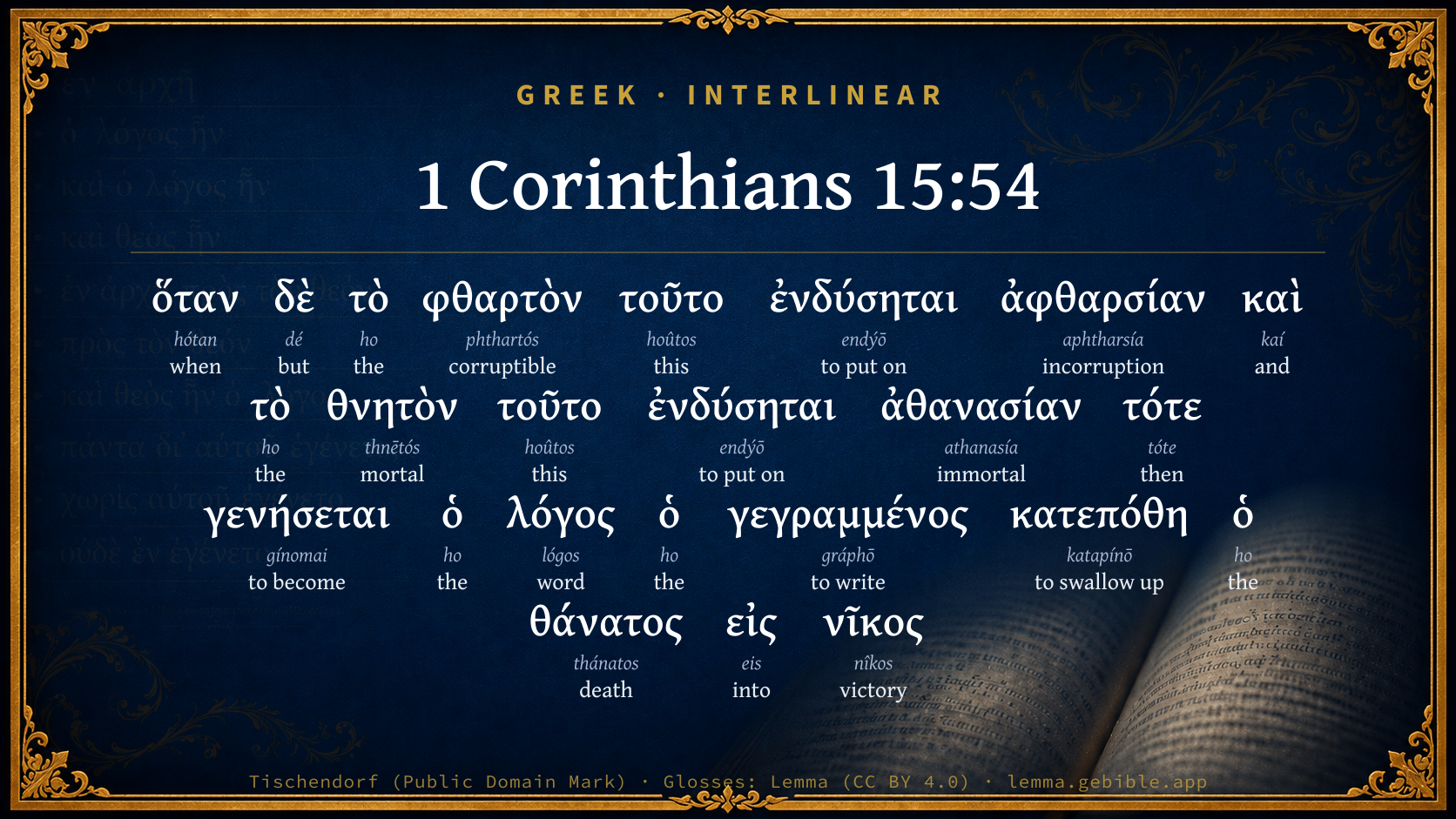
  1. ὅταν hótan G3752 “when” Conjunction
  2. δὲ dé G1161 “but” Conjunction
  3. τὸ ho G3588 “the” Article, Nominative, Singular, Neuter
  4. φθαρτὸν phthartós G5349 “corruptible” Adjective, Nominative, Singular, Neuter
  5. τοῦτο hoûtos G3778 “this” Demonstrative pronoun, Nominative, Singular, Neuter
  6. ἐνδύσηται endýō G1746 “to put on” Verb, Aorist, Middle, Subjunctive, 3rd person, Singular
  7. ἀφθαρσίαν aphtharsía G861 “incorruption” Noun, Accusative, Singular, Feminine
  8. καὶ kaí G2532 “and” Conjunction
  9. τὸ ho G3588 “the” Article, Nominative, Singular, Neuter
  10. θνητὸν thnētós G2349 “mortal” Adjective, Nominative, Singular, Neuter
  11. τοῦτο hoûtos G3778 “this” Demonstrative pronoun, Nominative, Singular, Neuter
  12. ἐνδύσηται endýō G1746 “to put on” Verb, Aorist, Middle, Subjunctive, 3rd person, Singular
  13. τότε tóte G5119 “then” Adverb
  14. γενήσεται gínomai G1096 “to become” Verb, Future, Middle deponent, Indicative, 3rd person, Singular
  15. ὁ ho G3588 “the” Article, Nominative, Singular, Masculine
  16. λόγος lógos G3056 “word” Noun, Nominative, Singular, Masculine
  17. ὁ ho G3588 “the” Article, Nominative, Singular, Masculine
  18. γεγραμμένος gráphō G1125 “to write” Verb, Perfect, Passive, Participle, Nominative, Singular, Masculine
  19. κατεπόθη katapínō G2666 “to swallow up” Verb, Aorist, Passive, Indicative, 3rd person, Singular
  20. ὁ ho G3588 “the” Article, Nominative, Singular, Masculine
  21. θάνατος thánatos G2288 “death” Noun, Nominative, Singular, Masculine
  22. εἰς eis G1519 “into” Preposition
  23. νῖκος nîkos G3534 “victory” Noun, Accusative, Singular, Neuter

About this verse

These counts appear in no published source. They are computed here, from the morphology-tagged text and Lemma’s own curated glosses. What Lemma adds →

24
words
18
distinct lemmas
Pauline Epistles
section

Notable vocabulary

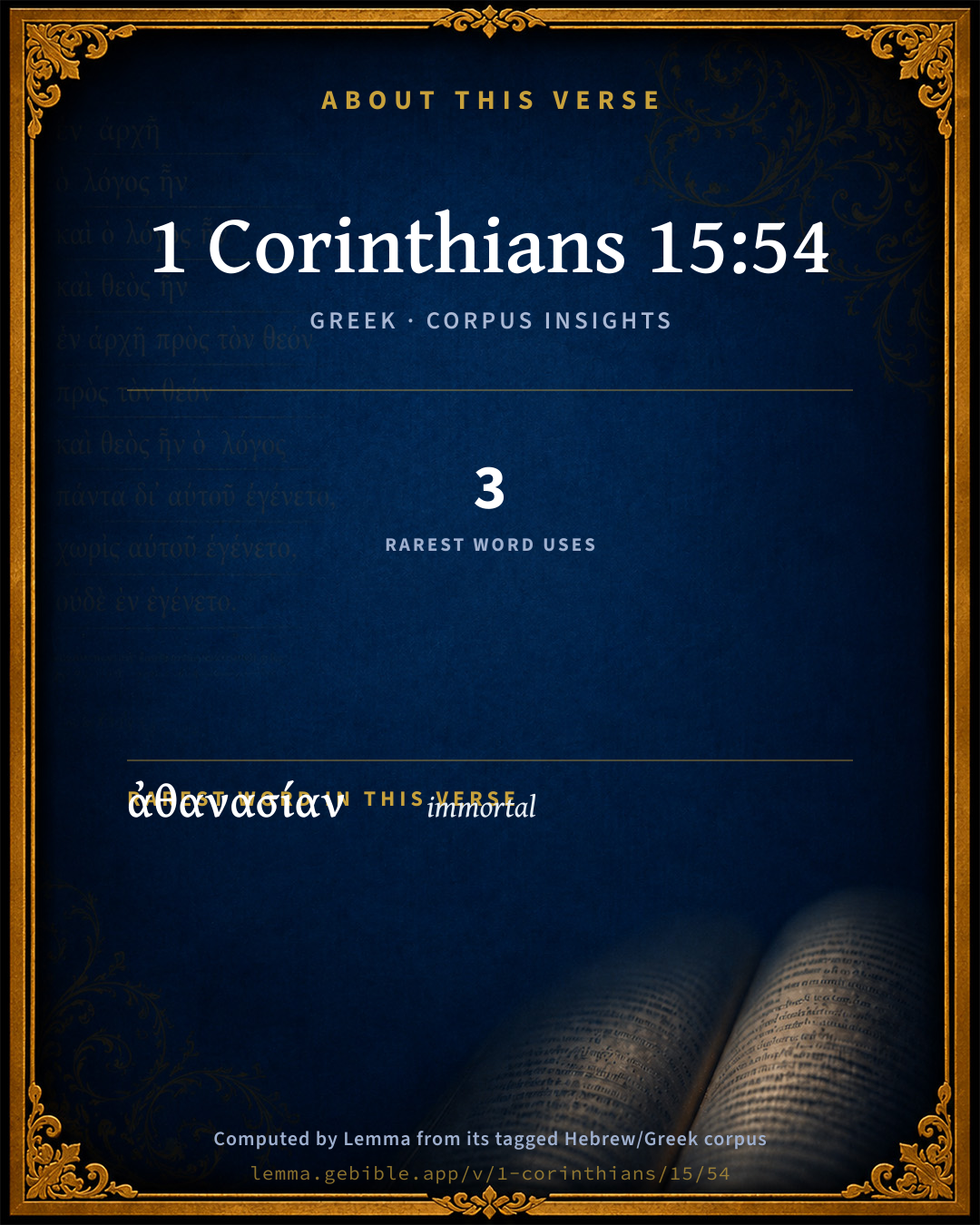
The rarest word here is ἀθανασίαν immortal G110 — appearing just 3 times in the whole Greek New Testament.

Shared distinctive vocabulary

ἀθανασίαν immortal G110 occurs in 3 verses of the Greek New Testament. Also found in:

Repetition

Words recur within this verse:

  • ἐνδύσηται to put on G1746 ×2
  • τὸ the G3588 ×5
  • τοῦτο this G3778 ×2

Cross-references

10

Topical passages linked to 1 Corinthians 15:54 in the Treasury of Scripture Knowledge — connected by theme and wording, ordered by reader-vote popularity; previews shown in the World English Bible.

  • Isaiah 25:8 He has swallowed up death forever; and the Lord Yahweh will wipe away tears from off all faces; and the reproach of his people will he take away from off all the earth: for Yahweh has spoken it.
  • Hebrews 2:14–15 Since then the children have shared in flesh and blood, he also himself in like manner partook of the same, that through death he might bring to nothing him who had the power of death, that is, the devil,
  • Revelation 20:14 Death and Hades were thrown into the lake of fire. This is the second death, the lake of fire.
  • Revelation 21:4 He will wipe away from them every tear from their eyes. Death will be no more; neither will there be mourning, nor crying, nor pain, any more. The first things have passed away."
  • Luke 20:36 For they can't die any more, for they are like the angels, and are children of God, being children of the resurrection.
  • Romans 8:11 But if the Spirit of him who raised up Jesus from the dead dwells in you, he who raised up Christ Jesus from the dead will also give life to your mortal bodies through his Spirit who dwells in you.
  • 2 Corinthians 4:11 For we who live are always delivered to death for Jesus' sake, that the life also of Jesus may be revealed in our mortal flesh.
  • 2 Thessalonians 1:10 when he comes to be glorified in his saints, and to be admired among all those who have believed (because our testimony to you was believed) in that day.
  • Romans 2:7 to those who by patience in well-doing seek for glory and honor and incorruptibility, eternal life;
  • Romans 6:12 Therefore don't let sin reign in your mortal body, that you should obey it in its lusts.

Cross-references courtesy of OpenBible.info (CC BY 4.0).

Commentary

Notes on 1 Corinthians 15:54 from classic Christian and Jewish commentators (each source and its license shown beneath its notes). The classic Christian expositions comment on the surrounding passage and are grouped to its opening verse, so a note may address several verses; the Jewish commentaries on the Tanakh (Rashi and others) are per-verse, so they appear only where the commentator wrote on this verse.

Lemma curates 59 commentaries, every one of them public domain or Creative Commons licensed, each selected and text-cleaned for this edition rather than reprinted as found. About our sources →

Tyndale Open Study Notes

Tyndale Open Resources

15:54 “Death is swallowed up in victory”: Resurrection defeats the ultimate enemy, death, just as the power of the Spirit enables believers to transcend sin here and now (see Rom 8:2, 11).

Tyndale Open Study Notes — © Tyndale Open Resources, licensed CC BY-SA 4.0. Text via the HelloAO Bible API.

Bengel's Gnomon

Johann Albrecht Bengel

1Co 15:54. Ὅταν δὲ—ἀθανασίαν, but when—immortality) The frequent repetition of these words is very delightful.—τότε, then) not before. The Scripture is sure, therefore the resurrection is sure.—κατεπόθη ὁ θάνατος εἰς νῖκος, death is swallowed up in victory) Isa 25:8, LXX.—κατέπιεν ὁ θάνατος ἰσχύσας, it was swallowed up at one instantaneous draught: comp. Rev 21:4.—εἰς νῖκος, Heb לנצח, which the LXX. not here but elsewhere often translate εἰς νῖκος, unto or in victory.

Bengel's Gnomon of the New Testament — English translation (T&T Clark, Edinburgh, 1860) — public domain. Text from a community e-Sword module.

Meyer's Critical & Exegetical Commentary

Heinrich August Wilhelm Meyer

1Co_15:54. Then, however, when this our change has taken place, shall the dominion of death cease; no one shall die any mor.

ὅταν δὲ … ἀθανασ.] an, as it were, triumphant repetition of the same weighty words. Comp. Bornemann, Schol. in Luc. p. xxxix. Theodoret calls the passage a song of victory. All the less is the first clause to be rejected, with Hofmann, on critical grounds. The first corrector of א has rightly restored i.

γενήσεται] shall come to pass (in respect of its contents) the word, i.e. it shall become actual,the written word shall become fact. Hofmann wrongly takes it: Men shall then say so, as it stands written. Where a λόγος or ῥῆμα goes forth, i.e. is spoken, there stands along with it the preposition of direction (as Joh_10:35, Luk_3:2, and frequently; comp. Gen_15:1, al.), or whence the word comes (as Jer_26:1), or through whom it goes forth (from God; as Hag_1:3). It may be added, that they are not things simultaneous which are announced in the protasis and apodosis (as Hofmann objects); but when that which is spoken of in the protasis shall have taken place, then, because from this time forward no one shall fall any more under the power of death, shall that be realized, etc. This is the happy consequence of that,the complete victory of the life, which will link itself to that change which shall thus take place in the twinkling of an eye, as to its signal and prelud.

ὁ λόγος] effatum, oraculum, 1Ma_7:16; Plato, Phaedr. p. 275 B; Pindar, Pyth. iv. 105. Comp. Rom_9:9; Joh_12:38; Joh_15:25.

κατεπόθη κ.τ.λ.] Isa_25:8, not according to the LXX.,[98] but according to the original text; in quoting which, however, בִּלַּע is rendered as passive, and לנצח is expressed in the way in which it is often rendered in other passages, e.g. 2Sa_2:26, Job_36:7, Jer_3:5 (but not here), by the LXX.: εἰς νῖκος. The meaning is: Death has been completely done away. Comp. 2Co_5:4. This being brought to nought is represented under the image of being swallowed up (namely, by God; see the original text). As regards the event itself, comp. Rev_21:4.

εἰς νῖκος] unto victory, i.e. so that thereby victorynamely, of the opposing power of eternal life in the future Aeonis established; ΕἸς, in the sense of the result.[99] Comp. Mat_12:20. Νῖκος is a later form, in place of the old νίκη. See Hermann, Diss. de Orph. p. 821.

Since the personified θάνατος is, according to the context, bodily death and nothing more, this passage also (comp. 1Co_15:26) is of no avail for the establishment of the doctrine of restoration (in opposition to Olshausen). Comp. on 1Co_15:22; 1Co_15:28. The passages from the Rabbins, who likewise, upon the ground of Isa. l.c., teach: in diebus ejus (Messiae) Deus S. B. deglutiet mortem, may be seen in Wetstein.

[98] Who here translate the words of the prophet incorrectly: κατέπιεν ὁ θάνατος ἰσχύσας.

[99] According to Osiander, εἰς is local; so that νῖκος is presented under the image of a wild beast, which swallows up its prey. Against this view there is, first, the absence of the article; secondly, εἰς (we should have expected ὑπό, comp. Polyb. ii. 41. 7); lastly, the τὸ νῖκος which follows vv. 55, 57.Luthers gloss puts it happily and graphically: Death lies undermost, and has now no strength left; but life lies uppermost, and says, Victory!

Meyer — Critical and Exegetical Commentary on the New Testament — English translation by Peter Christie, edited by Frederick Crombie (T&T Clark, 1880) — public domain. Text from a community e-Sword module.

Expositor's Greek Testament

ed. W. Robertson Nicoll

1Co 15:54 . This clothing of the saints with immortality fulfils a notable O.T. word respecting the Day of the Lord: “Then will be brought to pass the word that is written, Death has been swallowed up ( κατεπόθη , the vb [2571] adopted in 2Co 5:4 as above) unto victory !” ὅταν , with its double clause, recalls the double ὅταν of 1Co 15:24 and of 1Co 15:27 f. (see notes), which are parl [2572] to each other and to this, alike marking the great “when,” the epoch of the consummation. The destruction of the “last enemy” secures absolute “victory” for Christ and His own. Paul corrects the LXX txt. of Isa 25:8 , which makes Death the victor, κατέπιεν ὁ θάνατος ἰσχύσας ; he appears to have read the Heb. passively bulla ‘, for Massoretic billa ‘: Theodotion’s translation is identical with Paul’s. lanetsach ( for ever ) is often rendered εἰς νῖκος (later Gr [2573] form of νίκη ) by the LXX, according to the Aramaic sense of the noun; its Heb. sense implies a final and unqualified overthrow of the King of Terrors, and therefore admits of P.’s application. “This is the farthest reaching of all O.T. prophecies; it bears allusion to Gen 3 ” (Dillmann; see also Delitzsch, on the Isaianic txt.), and reverses the doom there pronounced.

[2571] verb

[2572] parallel.

[2573] Greek, or Grotius’ Annotationes in N.T.

The Expositor's Greek Testament, edited by W. Robertson Nicoll (1897–1910) — public domain. Text from a community e-Sword module.

Hodge's Commentary on Romans, Ephesians & First Corinthians

Charles Hodge

1Co_15:54

So when this corruptible shall have put on incorruption, and this mortal shall have put on immortality, then shall be brought to pass the saying that is written, Death is swallowed up in victory.

When the change above described has been accomplished, when once the resurrection has taken place, then, according to the language of Scripture, death shall be completely conquered. Not only shall those over whom he had triumphed, and whom he had so long detained in the prison of the grave, be delivered from his power, but there shall be no more death. The passage quoted is Isa_25:8, He will swallow up death in victory. In Hebrew the last words mean literally for ever. They are, however, frequently translated by the lxx. as they are here rendered by the apostle. The sense is the same. The victory over death is to be complete and final.

Charles Hodge — Commentary on Romans (1835), First Corinthians (1857), and Ephesians (1856) — public domain. Text from a community e-Sword module.

Geneva Bible (1599)

Geneva Bible translators

Hos. 13:14; Heb. 2:4

Geneva Bible (1599) marginal notes — public domain. Text via Bolls.life.

Jamieson, Fausset & Brown

Robert Jamieson, A. R. Fausset & David Brown

then--not before. Death has as yet a sting even to the believer, in that his body is to be under its power till the resurrection. But then the sting and power of death shall cease for ever.

Death is swallowed up in victory--In Hebrew of Isa 25:8, from which it is quoted, "He (Jehovah) will swallow up death in victory"; that is, for ever: as "in victory" often means in Hebrew idiom (Jer 3:5; Lam 5:20). Christ will swallow it up so altogether victoriously that it shall never more regain its power (compare Hos 6:2; Hos 13:14; Co2 5:4; Heb 2:14-15; Rev 20:14; Rev 21:4).

Jamieson, Fausset & Brown — Commentary Critical and Explanatory on the Whole Bible (1871) — public domain (CC PDM 1.0). Text via the HelloAO Bible API.

Adam Clarke's Commentary

Verse 54. Death is swallowed up in victory.] Κατεποθη ὁ θανατος εις νικος. These words are a quotation from Isa 25:8, where the Hebrew is בלע המות לנצח billa hammaveth lanetsach: He (God) hath swallowed up death in victory; or, for ever. These words in the Septuagint are thus translated: κατεπιεν ὁ θανατος ισχυσας· Death having prevailed, or conquered, hath swallowed up. But in the version of Theodotion, the words are the same with those of the apostle. The Hebrew לנצח lanetsach the Septuagint sometimes translate ειςνικος, in victory, but most commonly εις τελος, for ever; both, as Bishop Pearce observes, in such kind of phrases, signifying the same thing, because eternity conquers all things; and accordingly, in 2Sa 2:26, where the Septuagint have μη εις νικος καταφαγεται ἡ ῥομφαια, our English version has, Shall the sword devour FOR EVER? And the same may be seen in Job 36:7; La 5:20; Amo 1:11; Amo 8:7; from which authority the bishop translates the clause here, Death is swallowed up FOR EVER.

Death is here personified and represented as a devouring being, swallowing up all the generations of men; and by the resurrection of the body and the destruction of the empire of death, God is represented as swallowing him up; or that eternity gulps him down; so that he is endlessly lost and absorbed in its illimitable waste. How glorious a time to the righteous, when the inhabitant shall no more say, I am sick; when God shall have wiped away all tears from off all faces, and when there shall be no more death. This time must come. Hallelujah! The Lord God Omnipotent reigneth.

Adam Clarke's Commentary on the Bible (1810–1826) — public domain. Text from a community e-Sword/MySword module.

Ellicott's Commentary for English Readers

(54) So when this corruptible shall have put on incorruption.—The Apostle now transports himself in thought to the time when there shall be the actual accomplishment of that for which there then is this absolute and moral necessity. These words bring before us with vivid power the intensity of the Apostle’s own belief in what he is teaching.

Death is swallowed up in victory.—These words, originally referring to the Jewish people (Isa_25:8), are naturally applied here to the human race, of which they were the chosen type.

A Bible Commentary for English Readers, edited by Charles John Ellicott (1878–1897) — public domain. Text from a community e-Sword module.

The Cambridge Bible for Schools and Colleges

gen. ed. J. J. S. Perowne

54. Death is swallowed up in victory] The English version translates Isa_25:8, the passage here quoted, by ‘He will swallow up death in victory.’ But the literal meaning of the word so translated is ‘for ever,’ and the Vulgate here renders ‘in sempiternum,’ though the Septuagint frequently, but not here, renders it by victory, following the analogy of the Syriac and Chaldee, where a kindred word signifies victory. The verb also is in the perfect tense in the Hebrew, as speaking of the fixed purpose of God, and is here rendered by the aorist, and thus referred to the Death and Resurrection of Christ, in which, by ‘the determinate purpose and foreknowledge of God,’ death ‘was swallowed up unto victory.’

The Cambridge Bible for Schools and Colleges (gen. ed. J. J. S. Perowne; Cambridge University Press, 1878–1918) — public domain. Text from a community e-Sword module.

John Gill's Exposition

But thanks be to God which giveth us the victory,.... Over sin the sting of death, over the law the strength of sin, and over death and the grave; and which will be the ground and foundation of the above triumphant song in the resurrection morn, as it is now at this present time of praise and thankfulness to God: and it is all

through our Lord Jesus; he has got the victory over sin; he has put it away by the sacrifice of himself; he has finished and made an end of it; for though it reigns over his people before conversion, and dwells in them after it, yet in consequence of his atonement for it, it loses its governing power through the Spirit and grace of God in regeneration, and entirely its damning power over them, and in the resurrection morn will not be so much as in being in them; the view of which now fills them with joy, thanksgiving, and triumph. Christ has obtained a victory over the law; he has stopped its mouth, and answered all its demands; he has been made under, and subject to it; he has obeyed its precepts, and bore its penalty, and has delivered his from the curse and condemnation of it, so that they have nothing to fear from it; it is dead to them, and they to that: he has also abolished death by dying and rising again, so as that it shall have no more dominion over him; and he has abolished it as a penal evil to his saints; and though they die, they shall not always remain under the power of death, they shall live again, and with him for ever: he has conquered the grave by rising out of it himself, and living for evermore, having the keys of the grave in his hands; and will at the last day oblige it to give up its dead, when his victory over this, with respect to his people, will be abundantly manifest: now this victory, in all its branches, is given by God to believers; they are made to share in all the victories of Christ their head, and are more than conquerors through him; but this is not by merit, but by gift, the gift of God the Father, who gives his Son, and all things with him that are his; and this gift is a distinguishing one; it is given to us, and not to others; and which therefore calls aloud for praise and thankfulness. The title of the "ninth" psalm may be rendered, "to the conqueror over death", or "that is the author of victory over death, even to the Son, a psalm of David", Psa 9:1.

John Gill's Exposition of the Whole Bible (1746–1763) — public domain (CC PDM 1.0). Text via the HelloAO Bible API.

Trapp's Complete Commentary

John Trapp

54 So when this corruptible shall have put on incorruption, and this mortal shall have put on immortality, then shall be brought to pass the saying that is written, Death is swallowed up in victory.

Ver. 54. Death is swallowed up] As the fuel is swallowed up by the fire; as the sorcerers’ serpents were swallowed up by Moses’ serpent.

John Trapp, A Commentary or Exposition upon All the Books of the Old and New Testament (1647–1656) — public domain. Text from a community e-Sword module.

Albert Barnes' Notes on the Bible

So when ... - In that future glorious world, when all this shall have been accomplished.

Then shall be brought to pass - Then shall be fully accomplished; these words shall then receive their entire fulfillment; or this event shall meet all that is implied in these words.

The saying that is written - What is written, or the record which is made. These words are quoted from Isa 25:8; and the fact that Paul thus quotes them, and the connection in which they stand, prove that they had reference to the times of the gospel, and to the resurrection of the dead. Paul does not quote directly from the Hebrew, or from the Septuagint, but gives the substance of the passage.

Death - Referring here, undoubtedly, to death in the proper sense; death as prostrating the living, and consigning them to the grave.

Is swallowed up - Κατεπόθη Katepothē (from katapinō, to drink down, to swallow down) means to absorb Rev 12:16; to overwhelm, to drown Heb 11:29; and then to destroy or remove. The idea may be taken from a whirlpool, or maelstrom, that absorbs all that comes near it; and the sense is, that he will abolish or remove death; that is, cause it to cease from its ravages and triumphs.

In victory - (εἰς νῖκος eis nikos. Unto victory; so as to obtain a complete victory. The Hebrew Isa 25:8 is לנצח laanetsach, The Septuagint often renders the word נצח drow netsach which properly means “splendor, purity, trust, perpetuity, eternity, perfection,” by νῖκος nikos, “victory”; Job 36:7; Lam 3:18; Lam 5:20; Amo 1:1-15; Amos 2; Amo 8:7. The Hebrew word here may be rendered either “unto the end, that is,” to completeness or perfection, or unto victory, with triumph. It matters little which is the meaning, for they both come to the same thing. The idea is, that the power and dominion of death shall be entirely destroyed, or brought to an end.

Albert Barnes' Notes on the Bible (1834–1885) — public domain. Text from a community e-Sword/MySword module.

Haydock's Catholic Bible Commentary

Death is swallowed up in victory, in regard of the saints and the elect, so that it may be said, O death, where is thy victory? O death, where is thy sting? over which the saints shall triumph, and also over sin and hell. (Witham)

George Leo Haydock (1774–1849), Haydock's Catholic Family Bible and Commentary, 1859 edition — public domain. Excludes Psalms (Douay-Rheims chapter numbering differs from Protestant) and Deuterocanonical books (Catholic canon only).

Matthew Poole's English Annotations

That is, in an eternal and continuing victory; the saints shall die no more. The quotation which the apostle bringeth, is out of those two texts, Isa 25:8; Hos 13:14; which two texts, the apostle saith, at that day will have a more full, perfect, and eminent accomplishment, than ever they before had.

Matthew Poole's English Annotations on the Holy Bible (1683–1685) — public domain. Text from a community e-Sword/MySword module.

Whedon's Commentary on the Bible

Daniel D. Whedon

54. Brought to pass—In a more specific fact, yet justly to be included in the general saying of Isa_25:8. The words are the same as the Hebrew, with the active verb made passive. Yet Stanley maintains that the apostle probably still used some Greek translation; other, however, than the Septuagint.

Death… victory—The prophet is depicting a blessed future to be brought about by the Messiah; but his pencil does not distinguish in its strokes the hues that belong to the periods before, at, and after, the resurrection. Touches belonging to each separately are blended in the then blessed Messianic future. Isaiah says, that in the great coming time, death shall be swallowed up in victory; Paul says it will be completely done by the resurrection at the parousia. Isaiah says, in the same verse, that “God will wipe away tears from off all faces;” John (Rev_21:4) says, this shall be beyond the judgment and the casting the wicked into hell, even in the new heavens and earth of eternity.

Daniel D. Whedon (gen. ed.), Commentary on the Old and New Testaments (1874–1909) — public domain. Text from a community e-Sword module.

The Pulpit Commentary

Death is swallowed up in victory. A free citation from the Hebrew of Isa_25:8. The words "into victory" are the LXX rendering in other passages (Amo_1:11 Amo_8:8) for the Hebrew lanetsach, forever. The metaphor, "is swallowed up," implying "the swallowing of the all swallower," is found in the rabbis (comp. Heb_2:14, Heb_2:15)

Vers. 54-57.

The victory of immortality.

In this, as in some other passages of St. Paul"s writings, logic breaks into rhetoric, prose into poetry, reasoning into fervid exclamation. Anxious to convince, the apostle was nevertheless of a temperament too fervid to be restrained within the boundaries of argument. And when his soul was lifted up above the level of human thought, when inspiration carried him into the third heaven, then he could no longer discourse; but discourse kindled into song. If there is any passage in his writings fitted to fan the burning fire of feeling into the flame of enthusiasm, it is the sublime argument by which he seeks to give definiteness, point, certainty, and attractiveness to the life to come.

I THE GREAT CHANGE TO BE EXPERIENCED. Our earthly state is characterized by corruptibility and immortality. That this is so is indeed a rebuke to human vanity, yet it is unquestionable. An apostle terms our earthly vesture, "this body of our humiliation," and the designation is just. We live a dying life, carrying within us the seeds of our mortality. Vast and wonderful to contemplate is the change which shall take place in the passage from time to eternity. Incorruption and immortality shall be the vesture of the saved and glorified. The apostle, bearing about in his body the marks of the Lord. Jesus, must have anticipated with joy the promised release from earthly infirmities and sufferings, from all the troubles to which the burden of the body exposes the servant of Christ.

II THE GREAT VICTORY TO BE WON. According to the view of St. Paul, there are three great enemies with whom the Christian has to contend, and conflict with whom mars the happiness and breaks the peace of this earthly condition. They are the Law, sin, and death. Sin is the goad with which death makes a thrust at the Christian soldier, and it is the Law which makes sin so sharp, powerful, and formidable a weapon. Over all these the glorified Christian has obtained a victory, in the might and by the grace of the Lord Jesus Christ. Anticipating the conquest, the Christian, even here and now, rejoices in the assured defeat and discomfiture of his formidable foes. He seems already to drag them in triumph at his chariot-wheels, already to be more than conqueror through Christ who loved him.

III THE GREAT THANKSGIVING TO BE CELEBRATED.

1. The Source and Author of victory is God himself. No lower but his could have defeated foes so mighty, so malicious and so crafty.

2. The Mediator of victory is the Lord Jesus Christ, who first conquered for us, and then conquers in and with us. His crucifixion, followed by his resurrection, gave the death blow to our enemy. This conviction may well give us courage in carrying on the spiritual war, and in looking forward to its issue with confidence and hope.

Hell and thy sins resist thy course, But hell and sin are vanquished foes; Thy Jesus nailed them to the cross, And sang the triumph when he rose.

T.

Vers. 54-57.

Victory on the last battlefield.

I WE HAVE MANY BATTLES TO FIGHT, BUT THE ONE MOST DREADED IS THE LAST THE CONTEST WITH DEATH. Life is a series of contests. The battles of childhood are by no means insignificant, and they are many. In every succeeding stage of life contests continue. Life is a changing but unbroken fight. The final contest is usually the most feared. Then generally

(1) the body is very weak;

(2) in much pain;

(3) thoughts of separation from loved ones and familiar scenes rack the mind;

(4) life opportunities are seen to be at an end;

(5) a sense of loneliness is experienced;

(6) we stand upon the margin of another world;

(7) the time for rendering up the life account is nigh;

(8) we approach our final destiny;

(9) we meet God.

II IMPORTANCE OF THE ISSUE.

1. If we do not triumph, it is an evidence that we are still under the dominion of sin. Death is of sin, (Rom_5:12) and if death is not conquered, sin is not. "The sting of death is sin" (ver. 56). Death conquers only because sin conquers. If sin be slain, death will be powerless.

2. If we are "in sin," we are "without Christ.

3. If we are without Christ, we are without a Redeemer.

4. If we are without a Redeemer, we perish. The death-contest is a great test of our condition.

III THE CERTAIN TRIUMPH OF THE CHILD OF GOD.

1. Asserted. "I will ransom them from the power of the grave; I will redeem them from death: O death, I will be thy plagues; O grave, I will be thy destruction". (Hos_13:14) That which is so dreaded by many should not be feared by the believer. He has a Divine promise of victory.

2. Explained.

(1) The triumph comes "through our Lord Jesus Christ." It is not to be achieved by our prowess. We have no strength for the conflict; our sufficiency is of him. Like Mary, we shall meet Christ at the sepulchre. Through him we shall conquer. Well may we offer heartfelt thanks to God (ver. 57), for "God so loved the world," etc.

(2) He satisfied the demands of the Law. "Sin is of the Law;" the Law condemns. Christ passed under the Law for us bore the penalties of the broken Law; so that those in him are brought from under the Law. "There is therefore now no condemnation to them which are in Christ Jesus" (Rom_8:1) "The sting of death is sin; and the strength of sin is the Law; but we are not under the Law if we are m Christ. "Forasmuch then as the children are partakers of flesh and blood, he also himself likewise took part of the same; that through death he might destroy him that had the power of death, that is, the devil; and deliver them who through fear of death were all their lifetime subject to bondage". (Heb_2:14, Heb_2:15)

(3) He has risen from the grave. The power of his redemption is thus confirmed. His dominion over death is demonstrated.

1. Exulted in. Before the battle begins, the child of God may rejoice in coming victory. And well may he do so, for this will at the same time illustrate his faith in his Redeemer and brighten all his earthly course. That which was dreaded as a disastrous defeat is rejoiced in as a glorious and all important victory.

2. Often illustrated. Christian biography is rich in death triumphs. Thomas Rutherford in the last fight exclaimed, "He has indeed been a precious Christ to me; and now I feel him to be my Rock, my Strength, my Rest, my Hope, my Joy, my All in all." When Paul heard the bugle call to the last of his many battles, he cried, "I am now ready to be offered up," etc.

IV AN ARGUMENT FOR THE UNSAVED. Victory on the last battlefield comes alone through Christ. Without him our life will close in disaster and ruin. Suddenly the conflict may come upon us. H.

The Pulpit Commentary (1880–1919), ed. H.D.M. Spence-Jones & Joseph S. Exell — public domain. Text from a community e-Sword module.

John Wesley's Explanatory Notes

Death is swallowed up in victory - That is, totally conquered, abolished forever.

John Wesley, Explanatory Notes Upon the Whole Bible (1754–1765) — public domain. Text via the GEBible commentary corpus.

Burkitt's Expository Notes on the New Testament

William Burkitt

Here observe, 1. The happy condition of believers in the glorious morning of the resurrection, when their corruptible bodies shall be made by the power of Christ incorruptible and immortal: Then shall death be swallowed up in victory; that is, be overcome for ever, never to destroy or hurt any more, or to have the least power over the body for ever. The conqueror of all flesh is now fully conquered, and the spoiler of mankind finally spoiled.

O Death! thou wert once a victorious conqueror, an universal conqueror, slaying not thy thousands and ten thousands only, but beyond number; from the infant to the aged, from the dunghill to the throne, sparing neither age nor sex, neither great nor small, neither sacred nor profane.

But the Captain of our salvation having entered into the grave, the territories of death, the king of terrors, has there encountered, disarmed, and destroyed, this victorious conqueror: Death is swallowed up in victory.

Some read it, Death is swallowed down, death is drank up at a draught. Christ called his sufferings, by which he obtained victory over death, a cup; and as death is drank up, so mortality is swallowed up, 2Co 5:4. Blessed be God, beyond the grave there is neither death, nor any thing like death, neither death nor mortality. The one is abolished, the other swallowed up of life.

Observe, 2. How the apostle, in the name of all believers, triumphs and holily insults over death, the last conquered enemy. He laughs at it to the very face with a pious scorn and holy derision: O death, where is thy sting? O grave, where is thy victory? As if a man having disarmed his enemy should say, Now, sir, where’s your sword? where’s your pistol? Thus the believer: O death, thou thoughtest to pierce, to pain, to poison us with thy sting; but where is now thy sting? Thou thoughtest thyself a conqueror, but behold thou art conquered. Where is now thy victory?

Blessed be God for these songs of victory and triumph, which the Captain of our salvation has put into the mouths of all those that fight under his exalted banner.

William Burkitt's Expository Notes on the New Testament (1700–1703) — public domain. Text from a community e-Sword module.

Godbey's Commentary on the New Testament

William B. Godbey

54. “When this corruption may put on incorruption, and this mortal may put on immortality, then shall come to pass the word which has been written, “Death swallowed up in victory,” i. e., in the glorious ultimatum the victory of Christ is going to swallow up death, i. e., destroy him altogether, so that the grim monster will never again be heard of.

William B. Godbey, Commentary on the New Testament (1896–1900) — public domain. Text from a community e-Sword module.

McGarvey & Pendleton's Commentaries

J. W. McGarvey

But when this corruptible shall have put on incorruption, and this mortal shall have put on immortality, then shall come to pass the saying that is written [ Isa_25:8 ], Death is swallowed up in victory . [When the natural body shall be transformed into the spiritual, then shall be fulfilled that prophecy which describes death--the one who has swallowed up the human race, as being himself swallowed up in victory.]

J. W. McGarvey (with Philip Y. Pendleton), Commentaries on the New Testament (The Fourfold Gospel, 1914; Acts; and the epistles) — public domain. Text from a community e-Sword/MySword module.

The People's New Testament

B. W. Johnson

54. Then shall be brought to pass the saying. See Isaiah 25:8. This is the final victory, the victory over death.

B. W. Johnson's The People's New Testament with Notes (1889–1891) — public domain. Electronic text from the Christian Classics Ethereal Library (CCEL) ThML edition.

unfoldingWord translationNotes

Door43 World Missions Community

when this perishable body has put on what is imperishable

Here the body is spoken of as if it were a person, and becoming imperishable is spoken of as if being imperishable was clothing that a body would wear. AT: "when this perishable body has become imperishable" or "when this body that can rot can no longer rot" (See: Personification and Metaphor)

when this mortal body has put on immortality

Here the body is spoken of as if it were a person, and becoming immortal is spoken of as if being immortal was clothing that a body would wear. AT: "when this mortal body has become immortal" or "when this body that can die can no longer die" (See: Personification and Metaphor)

Death, where is your victory? Death, where is your sting?

Paul speaks as if death were a person, and he uses this question to mock the power of death, which Christ has defeated. AT: "Death has no victory. Death has no sting." (See: Apostrophe and Rhetorical Question)

your ... your

These are singular. (See: Forms of You)

translationWords

perish

die

written

unfoldingWord translationNotes — © Distant Shores Media and the Door43 World Missions Community, licensed CC BY-SA 4.0. Source: git.door43.org/Door43/en_tn.

Cambridge Greek Testament for Schools and Colleges

54. The concluding words of this chapter relate to the effects of the Resurrection, the destruction of death, the abolition of its attendant terrors, sin and the law, coupled with the assurance that our labours and toils while the conflict with evil was yet undecided shall not have been in vain.

κατεπόθη ὁ θάνατος εἰς νῖκος. Cf. 2Co 5:4. The literal translation of Isa 25:8, of which these words are a translation, is, ‘He hath swallowed up death for ever.’ The LXX. translates ἰσχύσας instead of εἰς νῖκος. But it frequently translates the Hebrew word by νῖκος, following the analogy of kindred Chaldee and Syriac words which have that meaning. The verb, in the perfect tense in the Hebrew, as speaking of the fixed purpose of God, is here rendered by the aorist, but probably as relating to the instantaneous nature of the change by which that purpose is to be realized.

Cambridge Greek Testament for Schools and Colleges (Cambridge University Press, 1896; 21 vols, various authors incl. Carr, Maclear, Plummer, Farrar, Lumby, Moule, M. R. James, Simcox) — public domain. Text from a community e-Sword module.

Alford’s Greek Testament

Henry Alford

54.] ὅταν δέ, &c. is a repetition, in a triumphant spirit, of the description of the glorious change.

γενήσεται] shall come to pass—really be.

The citation is from the Heb. with this difference, that the active, ‘He (Jehovah) abolishes,’ בִּלַּע, is made passive, and לָנֶצַח, ‘for ever,’ is rendered (as elsewhere by the LXX, e.g. ref. 2 Kings, but not here) εἰς νῖκος.

εἰς ν. ‘so as to result in victory. Wetst. quotes from the Babbis, ‘In diebus ejus (Messiæ) Deus S. B. deglutiet mortem.’

Henry Alford, The Greek Testament (1849–1861) — public domain. Text from a community e-Sword module.

International Critical Commentary

54. The Apostle dwells on the glorious change and repeats the details in full. As soon as it takes place, then, at that solemn moment and in this mysterious way, the prophetic utterance which stands written (Deissmann, Bible Studies, p. 112) will have its realization, and “the farthest-reaching of all O.T. prophecies” (Dillmann) will become an accomplished fact (γενήσεται). In Isa 25:8 it is said that God will swallow up death—the death which came by the hand of the Assyrian. * In the Prophet’s vision the deliverance from death is limited by the necessities of his own age. The Apostle’s view is much wider. He knows that all death will be swallowed up now that Christ has conquered death by rising again. The doom pronounced upon Adam (Gen 3:19) is removed; and the result (εἰς) is victory, absolute and everlasting triumph. Death is annihilated, and God is all in all. This thought makes the Apostle burst out into a song of triumph of death which is a free adaptation of another prophetic utterance. With the constr. compare v. 28.

It is not certain that τὸ φθαρτὸν τ. ἐνδ. ἀφθ. καὶ is part of the true test. A B D E K L P, Syrr., Chrys. support the reading; א* C* l M, Vulg. Copt. Aeth. Goth. Arm. omit. Accidental omission is possible. Deliberate insertion in conformity with the preceding v. is also possible. The balance seems to be in favour of retaining the words; and the rhythmical solemnity of the passage seems to require them.

In LXX, εἰ νῖκος = ‘for ever’ (2Sa 2:26; Job 36:7; Amo 1:11, Amo 1:8:7; etc.). Tertullian read νεῖκος: he renders in contentionem or in contentione (De res. carn. 51, 54). So also Cyprian (Test. iii. 58).

International Critical Commentary — older volumes (1896–1929), various authors — public domain. Text from a community e-Sword module.

Vincent's Word Studies in the New Testament

Marvin R. Vincent

Is swallowed up [κατεποθη] . From Isa 25:8. The quotation agrees with the Hebrew : He shall swallow up death forever, rather than with the Septuagint, Death has prevailed and swallowed men up, which reverses the meaning of the Hebrew. Compare 2Co 5:4.

In victory [εις νικος] . Lit., unto victory, so that victory is to be established.

Marvin R. Vincent, Word Studies in the New Testament (1887–1900) — public domain. Text from a community e-Sword/MySword module.

Godet's Commentaries

Frédéric Louis Godet

Vv. 54. The form of parallelism is continued. The word τότε, then, expresses the grandeur of the time. The participle: that which is written, is added to denote the certainty of fulfilment: Scripture cannot lie. — The saying quoted is Isa 25:8, the meaning of which is that the theocracy once restored, its members, dead and living, shall be all raised up together to the sphere of immortality. “God,” says the prophet (if God be understood as the subject), “hath swallowed up death for ever.” The LXX., probably following another reading, have translated altogether differently: “Death hath swallowed up triumphantly” (perhaps in the sense of: “It formerly swallowed up...”). Paul follows our Hebrew text, only changing the active into the passive: “Death is swallowed up.” The word which we translate victory, following Paul, is one of the most beautiful terms in the Hebrew language (nétsach). It denotes the state of perfect inward vigour which excludes all possibility of outward decay, and hence: eternal duration. The expression: in victory, seems to me to have the meaning: “Death is absorbed in imperishable life.” Such a life is victory gained for ever over death, its enemy. It is not the only time that the LXX. thus render the term lanétsach.

The feeling of gratitude and adoration here reaches its culminating point in the apostle’s heart:

Frédéric Louis Godet — Commentaries on Luke, John, Romans, and 1 Corinthians — English translation (T&T Clark, Edinburgh, 1870s–1890s) — public domain. Text from a community e-Sword module.

Lesson kit

Teaching starters — assembled from the data on this page, not authored interpretation. Every prompt links to the verse data it draws on. Edit before teaching.

1 Corinthians, in the Pauline Epistles, opens this verse with 24 words (18 distinct Greek lemmas). Its most distinctive word is athanasía (“immortal”). A historical commentator’s framing appears above. Read the whole chapter for the surrounding context.

Discussion questions

  1. The word athanasía carries the sense “immortal.” How does it shape the verse?
  2. 1 Corinthians 15:53 shares the word «immortal» with this verse. How do the two illuminate each other?
  3. “to put on” occurs 2× in this one verse. What is the effect of the repetition?
  4. These translations render this verse differently; the difference is in the English rendering, not the original. What questions does that raise?
  5. Reading how Tyndale Open Study Notes and Bengel's Gnomon read this verse, where do the two commentators agree and where do they part?

Things to notice

  • These translations choose different wording for 16 words in this verse.
  • “to put on” occurs 2× in this single verse.
  • 18 distinct Greek lemmas span 24 words in this verse.

Reading settings

Reading text

Shown beneath each verse's original-language words.

Old Testament
Old Testament edition

Read the OT as the Masoretic Hebrew (MT) or the Greek Septuagint (LXX).

English shown for the Greek Septuagint (in the Hebrew ↔ Greek comparison).

Comparing translations? Open the Compare panel on any verse page to stack up to four side by side.