1 Corinthians 7:2

Greek (Tischendorf 8th ed.) 1 Corinthians 7:2 appears in the Greek New Testament. The text above is from the Tischendorf 8th edition. Each word links to its Strong’s number and a concise gloss. Click any word for its full Thayer’s Greek Lexicon entry.
Download image
Cite this verse

1 Corinthians 7:2 (World English Bible). Public Domain. Lemma interlinear Bible study tool, https://lemma.gebible.app/v/1-corinthians/7/2.

Show BibTeX & RIS
BibTeX
RIS
English Translation
But, because of sexual immoralities, let each man have his own wife, and let each woman have her own husband.
World English Bible · Public Domain
Download a study sheet

One document with this verse’s original text, its word-by-word gloss line, the meaning frame, cross-references with their text, attributed commentary, and full source and license credits — printable, and it pastes into notes with its structure intact.

This verse Autodidact and up

Study sheet (.html) Plain text (.txt)

A passage Seminary Student

Up to 50 verses in one chapter. A passage sheet keeps up to 6 commentary sources and 12 cross-references per verse, in the order this page ranks them, and says so on the sheet whenever that leaves anything out. Ask for a single verse and you get the Autodidact verse sheet above.

Everything on this page stays free to read, with no account — the sheet is a download of what is already on screen, not access to it.

Want to remove ads? Support Godless Engineer
Compare translations 3

The same verse in 3 English versions, stacked beneath the original-language interlinear above. Click any original word for its lexicon entry.

Each is an independent rendering of the whole verse — the interlinear is not word-aligned to these translations.

Highlighted words mark where these versions differ — a whole-verse word diff, not a word-by-word alignment.

  • World English Bible Public Domain
    But, because of sexual immoralities, let each man have his own wife, and let each woman have her own husband.
  • King James Version Public Domain
    Nevertheless, to avoid fornication, let every man have his own wife, and let every woman have her own husband.
  • unfoldingWord Literal Text CC BY-SA 4.0
    But because of immorality, let each man have his own wife, and let each woman have her own husband.

unfoldingWord Literal Text — © unfoldingWord, licensed CC BY-SA 4.0. Word-aligned USFM3 via Door43 (git.door43.org/unfoldingWord/en_ult).

Versions to compare (up to 4)

3 of 4 selected

Show all 19 translations

Every available English version of this verse, each an independent rendering of the whole verse.

  • World English Bible Public Domain
    But, because of sexual immoralities, let each man have his own wife, and let each woman have her own husband.
  • Berean Standard Bible Public Domain
    But because there is so much sexual immorality, each man should have his own wife, and each woman her own husband.
  • Majority Standard Bible Public Domain
    But because there is so much sexual immorality, each man should have his own wife, and each woman her own husband.
  • King James Version Public Domain
    Nevertheless, to avoid fornication, let every man have his own wife, and let every woman have her own husband.
  • American Standard Version (1901) Public Domain
    But, because of fornications, let each man have his own wife, and let each woman have her own husband.
  • Revised Version (1885) Public Domain
    But, because of fornications, let each man have his own wife, and let each woman have her own husband.
  • Geneva Bible (1599) Public Domain
    Neuertheles, to auoide fornication, let euery man haue his wife, and let euery woman haue her owne husband.
  • Douay-Rheims (1899) Public Domain
    But for fear of fornication, let every man have his own wife, and let every woman have her own husband.
  • Young's Literal Translation Public Domain
    and because of the whoredom let each man have his own wife, and let each woman have her proper husband;
  • Literal Standard Version CC BY-SA 4.0
    and because of the whoredom let each man have his own wife, and let each woman have her proper husband;
  • Unlocked Literal Bible CC BY-SA 4.0
    But because of temptations for many immoral acts, each man should have his own wife, and each woman should have her own husband.
  • unfoldingWord Literal Text CC BY-SA 4.0
    But because of immorality, let each man have his own wife, and let each woman have her own husband.
  • Darby Bible Public Domain
    but on account of fornications, let each have his own wife, and each [woman] have her own husband.
  • World Messianic Bible Public Domain
    But, because of sexual immoralities, let each man have his own wife, and let each woman have her own husband.
  • Webster's Bible Public Domain
    Nevertheless, to avoid lewdness, let every man have his own wife, and let every woman have her own husband.
  • Free Bible Version CC BY-SA 4.0
    However, because of the temptation to sexual immorality, it is better that each man have his own wife, and each woman her own husband.
  • Bible in Basic English Public Domain
    But because of the desires of the flesh, let every man have his wife, and every woman her husband.
  • Text-Critical English NT CC BY 4.0
    But because of the cases of fornication, each man should have his own wife, and each woman should have her own husband.
  • Tyndale New Testament (1534) Public Domain
    Neverthelesse to avoyde fornicacion let every man have his wyfe: and let every woman have her husbande.

Literal Standard Version (2020), Covenant Press — licensed CC BY-SA 4.0. Text via the HelloAO Bible API (eBible.org). Unlocked Literal Bible (unfoldingWord) — licensed CC BY-SA 4.0. Text via the HelloAO Bible API (eBible.org). unfoldingWord Literal Text — © unfoldingWord, licensed CC BY-SA 4.0. Word-aligned USFM3 via Door43 (git.door43.org/unfoldingWord/en_ult). Free Bible Version, Dr. Jonathan Gallagher — licensed CC BY-SA 4.0. Text via the HelloAO Bible API (eBible.org).

Word by word

More ways to search: Search by grammar → Find every occurrence → Compare this word →

Practice this passage: Drill this verse → Learn its vocabulary →

πορνείας
porneía
G4202
“sexual immorality”
Noun, Accusative, Plural, Feminine
Part of Speech
Noun
Case
Accusative
Number
Plural
Gender
Feminine
Full Thayer's Definition

Origin: from G4203

TDNT: 15:39,9

1. illicit sexual intercourse a. adultery, fornication, homosexuality, lesbianism, intercourse with animals etc. b. sexual intercourse with close relatives; Lev. 18 c. sexual intercourse with a divorced man or woman; Mk. 10:11 , 2. metaph. the worship of idols a. of the defilement of idolatry, as incurred by eating the sacrifices offered to idols
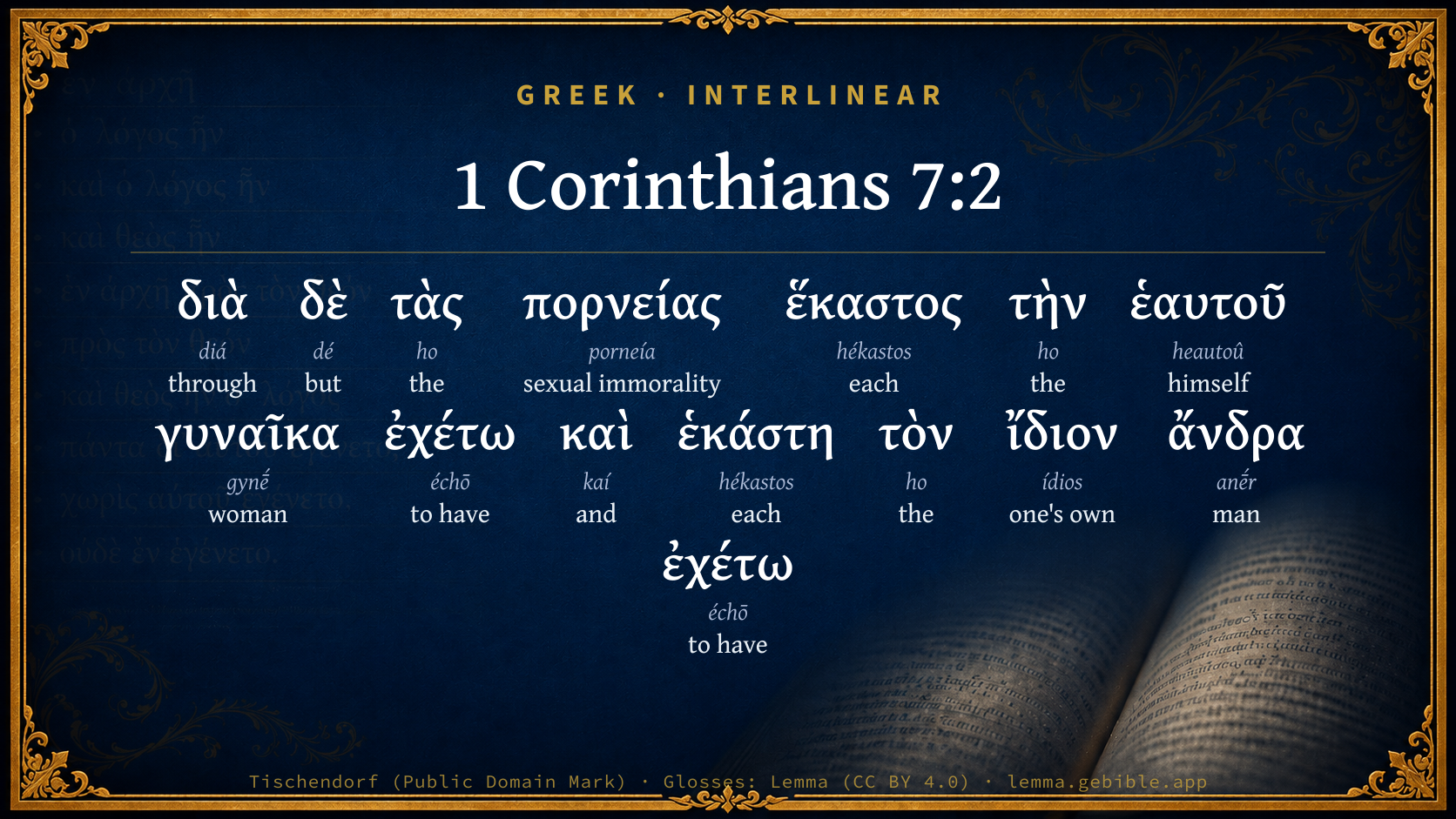
  1. διὰ diá G1223 “through” Preposition
  2. δὲ dé G1161 “but” Conjunction
  3. τὰς ho G3588 “the” Article, Accusative, Plural, Feminine
  4. ἕκαστος hékastos G1538 “each” Adjective, Nominative, Singular, Masculine
  5. τὴν ho G3588 “the” Article, Accusative, Singular, Feminine
  6. ἑαυτοῦ heautoû G1438 “himself” Reflexive pronoun, 3rd person, Genitive, Singular, Masculine
  7. γυναῖκα gynḗ G1135 “woman” Noun, Accusative, Singular, Feminine
  8. ἐχέτω échō G2192 “to have” Verb, Present, Active, Imperative, 3rd person, Singular
  9. καὶ kaí G2532 “and” Conjunction
  10. ἑκάστη hékastos G1538 “each” Adjective, Nominative, Singular, Feminine
  11. τὸν ho G3588 “the” Article, Accusative, Singular, Masculine
  12. ἴδιον ídios G2398 “one's own” Adjective, Accusative, Singular, Masculine
  13. ἄνδρα anḗr G435 “man” Noun, Accusative, Singular, Masculine
  14. ἐχέτω échō G2192 “to have” Verb, Present, Active, Imperative, 3rd person, Singular

About this verse

These counts appear in no published source. They are computed here, from the morphology-tagged text and Lemma’s own curated glosses. What Lemma adds →

15
words
11
distinct lemmas
Pauline Epistles
section

Notable vocabulary

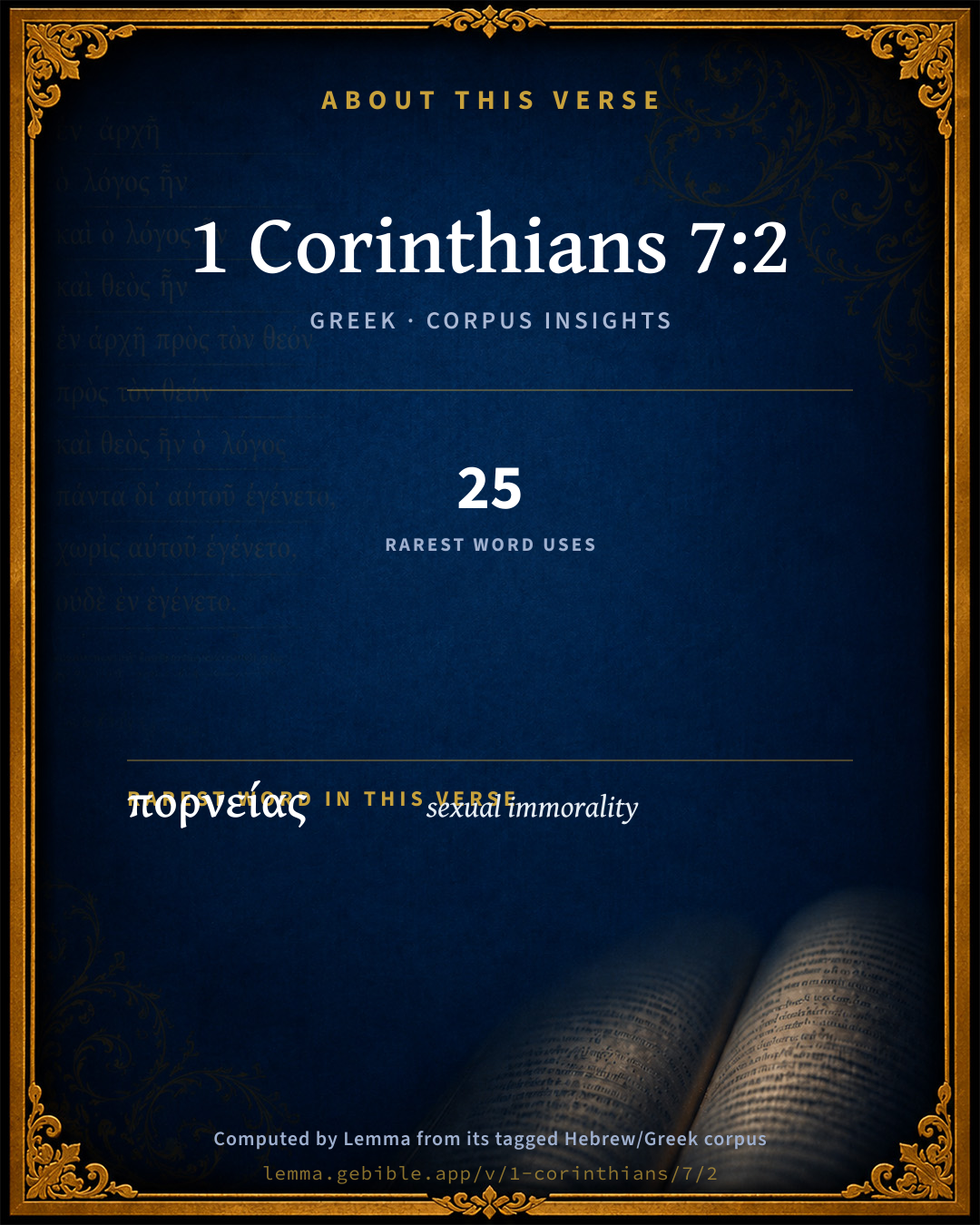
The rarest word here is πορνείας sexual immorality G4202 — appearing just 25 times in the whole Greek New Testament.

Shared distinctive vocabulary

πορνείας sexual immorality G4202 occurs in 24 verses of the Greek New Testament. Also found in:

Repetition

Words recur within this verse:

  • ἕκαστος each G1538 ×2
  • ἐχέτω to have G2192 ×2
  • τὰς the G3588 ×3

Cross-references

9

Topical passages linked to 1 Corinthians 7:2 in the Treasury of Scripture Knowledge — connected by theme and wording, ordered by reader-vote popularity; previews shown in the World English Bible.

  • Ephesians 5:28 Even so ought husbands also to love their own wives as their own bodies. He who loves his own wife loves himself.
  • Ephesians 5:33 Nevertheless each of you must also love his own wife even as himself; and let the wife see that she respects her husband.
  • 1 Corinthians 7:9 But if they don't have self-control, let them marry. For it's better to marry than to burn.
  • Proverbs 5:18–19 Let your spring be blessed. Rejoice in the wife of your youth.
  • Proverbs 18:22 Whoever finds a wife finds a good thing, And obtains favor of Yahweh.
  • 1 Corinthians 6:18 Flee sexual immorality! "Every sin that a man does is outside the body," but he who commits sexual immorality sins against his own body.
  • Proverbs 19:14 House and riches are an inheritance from fathers, But a prudent wife is from Yahweh.
  • Malachi 2:14 Yet you say, 'Why?' Because Yahweh has been witness between you and the wife of your youth, against whom you have dealt treacherously, though she is your companion, and the wife of your covenant.
  • 1 Timothy 4:3 forbidding marriage and commanding to abstain from foods which God created to be received with thanksgiving by those who believe and know the truth.

Cross-references courtesy of OpenBible.info (CC BY 4.0).

Commentary

Notes on 1 Corinthians 7:2 from classic Christian and Jewish commentators (each source and its license shown beneath its notes). The classic Christian expositions comment on the surrounding passage and are grouped to its opening verse, so a note may address several verses; the Jewish commentaries on the Tanakh (Rashi and others) are per-verse, so they appear only where the commentator wrote on this verse.

Lemma curates 59 commentaries, every one of them public domain or Creative Commons licensed, each selected and text-cleaned for this edition rather than reprinted as found. About our sources →

Tyndale Open Study Notes

Tyndale Open Resources

7:2 Because of widespread sexual immorality, Paul encourages most Christians to get married (7:9). He tempers the ideal of the celibate life with awareness of physical realities.

Tyndale Open Study Notes — © Tyndale Open Resources, licensed CC BY-SA 4.0. Text via the HelloAO Bible API.

Bengel's Gnomon

Johann Albrecht Bengel

1Co 7:2. Διὰ, on account of) comp. the for, 1Co 7:5.—τὰς πορνείας, fornications) constantly practised at Corinth [and not even considered to be sins by the heathens, and especially by the Greeks.—V.g.], to which unmarried persons might be easily allured. The plural denotes irregular lusts, and is on that account more opposed to the unity of the marriage relation [wherein there is but one consort].—τὴν ἑαυτοῦ, his own) the same as ἴδιον, her own, which immediately after occurs. The same variation occurs in Eph 5:22-23. ἑαυτοῦ, his own, indicates the rights of the husband. Both words exclude all community, in which polygamy consists, comp. 1Co 7:4. Now the reason, why a man should have a wife, is the same as that, for which he should retain her, namely, to avoid fornication. Hence also concubinage is refuted, for a concubine is either a wife or she is not; if she is not, there is sin, if she is, then she ought to continue, 1Co 7:10-11.

Bengel's Gnomon of the New Testament — English translation (T&T Clark, Edinburgh, 1860) — public domain. Text from a community e-Sword module.

Meyer's Critical & Exegetical Commentary

Heinrich August Wilhelm Meyer

1Co_7:2. In order, however, that offences in the way of fornication (see on this plural of the abstract, Kühner, II. p. 28; Maetzn. a[1065] Lycurg. p. 144 f.) may be avoided in practice, the rule holds good: Let every man have[1066] a wife of his own (properly belonging to himself in marriage), etc. On διά, comp Winer, p. 372 [E. T. 497]. Rückert, de Wette, and Maier are wrong in maintaining that ἐχέτω is permissive merely,

Rückert, indeed, making it so only to the extent of a mans retaining his wife. The latter is disproved by 1Co_7:9-10, and the former by the fact that the immediately following ἀποδιδότω in 1Co_7:3 is not to be taken as permissive, any more than the γαμησάτωσαν which answers to ἐχέτω in 1Co_7:9. It is opposed, further, by the consideration that διὰ τὰς πορνείας is a determining element of a moral kind, which must therefore necessarily lead not to a mere permissibility, but to a positive obligation (already noted by Erasmus). This injunction, however, is a moral rule, to which exceptions may occur from higher considerations in cases where no danger of fornication is apprehended and there is the donum continentiae, as Paul himself had shown by his own example,in which, nevertheless, no support whatever is given to any sort of celibacy enforced by law, a thing which, on the contrary, our text decidedly discountenances. Rückert thinks further that Paul exhibits here a very poor opinion of marriage; and Baur (in the theol. Jahrb. 1852, p. 15 ff.) has more fully developed this idea so as to assert that the apostles view of marriage is at variance with the moral conception of it which now prevails.[1068] Comp also Rothe, Ethik, III. p. 614. But can it be true, then, that he, who looked upon the union with Christ itself as the analogue of wedded life, valued marriage only as a temperamentum continentiae? No! what he does is this: out of all the different grounds on which marriage rested in his mind, he selects just that one which, in the first place, specially concerned his readers (remember the κορινθιάζεσθαι), and in the second place, had peculiar weight in connection with the nearness of the Parousia. That approaching catastrophe might furnish him with sufficient reasons for leaving unmentioned those higher ends of marriage which reached forth into a more remote future, and confining himself to the immediate practical relations of the brief, momentous present. See 1Co_7:26 ff. Keeping in view the present ἀνάγκη, the near approach of the Lord, and the necessity, therefore, of an undivided surrender to Him, Paul had, under these given circumstances, recognised in the state of single life what in and by itself was καλὸν ἀνθρώπῳ, if only no fornication and heat were conjoined therewith. It is from this point of view, which was presented to him by the then existing condition of things (and hence without at all contradicting Gen_2:18), that the apostle handles the subject, discussing it accordingly in a special aspect and from one particular side, while the wider and higher moral relations of marriage lie beyond the limits of what he has now in hand.

Observe, further, how sharply and decisively the expression in 1Co_7:2 (comp Eph_5:22; Eph_5:25) excludes not only concubinage and sexual intercourse apart from marriage generally, but also all polygamy.

[1065] d refers to the note of the commentator or editor named on the particular passage.

[1066] This ἔχειν is nothing else but the simple habere (to possess); it does not mean intercourse in marriage, which ought to be continued (Kling, Heydenreich, following Cameron and Estius). Paul comes to that only in ver. 3.

[1068] Comp. in opposition to this, Ernesti, Ethik des Ap. Paulus, p. 115 f.

Meyer — Critical and Exegetical Commentary on the New Testament — English translation by Peter Christie, edited by Frederick Crombie (T&T Clark, 1880) — public domain. Text from a community e-Sword module.

Expositor's Greek Testament

ed. W. Robertson Nicoll

1Co 7:2 a single life is good in itself, “but” is not generally expedient at Cor [1001] διὰ τὰς πορνείας , “because of the (prevalent) fornications” (the unusual pl [1002] indicating the variety and extent of profligacy: cf. 2Co 12:21 ); for this reason marriage, as a rule, is advisable here. It must be Christian marriage, as opposed to heathen libertinism and Jewish polygamy: “let each (man) have his own wife, and each (woman) her proper husband”. The pr [1003] impv [1004] , ἐχέτω ( sc. directive , not permissive), signifies “have and keep to” ( cf. 2Ti 1:13 ), The variation ἑαυτοῦ γυν .… ἴδιον ἄνδρα distinguishes the husband as head and principal (1Co 11:3 ); “if this passage stood alone, it would be unsafe to build upon it, but this diff [1005] of expression pervades the whole of the Epp.” (Lt [1006] : cf. 1Co 14:35 ; Eph 5:22 , etc.; Tit 2:5 ; 1Pe 3:1 ; 1Pe 3:5 ). Throughout the passage there is a careful balancing of the terms relating to man and wife, bringing out the equality of the Christian law. P. does not lay down here the ground of marriage, as though it were “ordained for a remedy against sin,” but gives a special reason why those should marry at Cor [1007] who might otherwise have remained single: see note on δέ , 1Co 7:1 .

[1001] Corinth, Corinthian or Corinthians.

[1002] plural.

[1003] present tense.

[1004] imperative mood.

[1005] difference, different, differently.

[1006] J. B. Lightfoot’s (posthumous) Notes on Epp. of St. Paul (1895).

[1007] Corinth, Corinthian or Corinthians.

The Expositor's Greek Testament, edited by W. Robertson Nicoll (1897–1910) — public domain. Text from a community e-Sword module.

Hodge's Commentary on Romans, Ephesians & First Corinthians

Charles Hodge

1Co_7:2

Nevertheless, (to avoid) fornication, let every man have his own wife, and let every woman have her own husband.

As a general rule, says the Apostle, let every man have his own wife, and every woman her own husband. Whatever exceptions there may be to this rule in particular cases, or in peculiar conditions of society or of the church, the rule itself stands. There is undoubtedly an increase of worldly care and anxiety connected with marriage, and therefore it may be expedient for those to remain single to whom freedom from such cares is specially important. This however does not alter the great law of God, that it is not good for man to be alone. Celibacy is to be the exception, not the rule.

Charles Hodge — Commentary on Romans (1835), First Corinthians (1857), and Ephesians (1856) — public domain. Text from a community e-Sword module.

Jamieson, Fausset & Brown

Robert Jamieson, A. R. Fausset & David Brown

Here the general rule is given

to avoid fornication--More literally, "on account of fornications," to which as being very prevalent at Corinth, and not even counted sins among the heathen, unmarried persons might be tempted. The plural, "fornications," marks irregular lusts, as contrasted with the unity of the marriage relation [BENGEL].

let every man have--a positive command to all who have not the gift of continency, in fact to the great majority of the world (Co1 7:5). The dignity of marriage is set forth by Paul (Eph 5:25-32), in the fact that it signifies the mystical union between Christ and the Church.

Jamieson, Fausset & Brown — Commentary Critical and Explanatory on the Whole Bible (1871) — public domain (CC PDM 1.0). Text via the HelloAO Bible API.

Adam Clarke's Commentary

Verse 2. To avoid fornication] Δια τας πορνειας· verto, propter exercendam libidinem, vel ut libidinem licite exercere liceat. Probo hanc notionem ex Hebraeo, ibi זנה, zanah, est libidinem exercere, Ho 4:10: For they shall eat and not have enough; they shall commit whoredom, תזנו, libidinem exercebunt, and shall not increase. Here the prophet certainly does not speak of whoredom in our sense of the word; for the persons he mentions expected to have children, which cannot be said of those who are addicted to improper connections: the prophet speaks concerning married persons, whom he threatens with a privation of children, notwithstanding libidinem exercebant in order to have numerous families. See Schoettgen. The following verse shows that this is the apostle's meaning.

Let every man have his own wife] Let every man have one woman, his own; and every woman one man, her own. Here, plurality of wives and husbands is most strictly forbidden; and they are commanded to marry for the purpose of procreating children.

In the Jewish constitutions there are some things not only curious, but useful, respecting marriage. "There are four causes which induce men to marry:

1. Impure desire;

2. To get riches;

3. To become honourable;

4. For the glory of God.

Those who marry through the first motive beget wicked and rebellious children. Those who marry for the sake of riches have the curse of leaving them to others. Those who marry for the sake of aggrandizing their family, their families shall be diminished. Those who marry to promote the glory of God, their children shall be holy, and by them shall the true Church be increased."

Adam Clarke's Commentary on the Bible (1810–1826) — public domain. Text from a community e-Sword/MySword module.

John Calvin's Commentaries

2. But to avoid fornication He now commands, that those who are liable to the vice of incontinency should have recourse to the remedy. For though it may seem that the statement is universal, it ought, nevertheless, to be restricted to those who feel themselves urged by necessity. As to this, every one must judge for himself. Whatever difficulty, therefore, is perceived to be in marriage, let all that cannot resist the promptings of their flesh, know that this commandment has been enjoined upon them by the Lord. But it is asked — “Is this the only reason for entering into matrimony, that we may cure incontinency?” I answer, that this is not Paul’s meaning; for as for those that have the gift of abstinence from marriage, he leaves them at liberty, while he commands others to provide against their infirmity by marrying. The sum is this — that the question is not as to the reasons for which marriage has been instituted, but as to the persons for whom it is necessary. For if we look to the first institution, it could not be a remedy for a disease which had as yet no existence, but was appointed for begetting offspring; but after the fall, this second purpose was added.

This passage is also opposed to (τολυγαμία) polygamy For the Apostle desires that every woman have her own husband, intimating that the obligation is mutual. The man, therefore, who has once pledged his fidelity to a woman as his wife, must not separate from her, as is manifestly done in case of a second connection.

John Calvin's Commentaries (1540-1563) — public domain. Text from the Calvin Translation Society English edition (1840s-50s) via the Christian Classics Ethereal Library (ccel.org). Calvin's coverage is partial (roughly two-thirds of the Bible); uncommented books and verses are honest gaps, never fabricated. The 19th-century editor's footnotes and remarks are omitted so the notes are faithfully Calvin's own voice.

Ellicott's Commentary for English Readers

(2) To avoid fornication.—Better, because of the (prevalent) fornication. This was so general in Corinth, and so little regarded as sin. that the unmarried were liable to be led into it.

It may at first sight appear as if the Apostle thus put marriage upon very low and merely utilitarian ground: but we must remember that he is here writing with a definite and limited aim, and does not enter into a general discussion of the subject. St. Paul gives a reason why those who wrote to him should marry, and the force of the argument does not extend beyond the immediate object in view. St. Paul’s view of the higher aspects of matrimony are fully set forth when he treats of that subject generally (2Co_11:2; Rom_7:4; Eph_5:25-32).

A Bible Commentary for English Readers, edited by Charles John Ellicott (1878–1897) — public domain. Text from a community e-Sword module.

The Cambridge Bible for Schools and Colleges

gen. ed. J. J. S. Perowne

2. Nevertheless, to avoid fornication] Literally, on account of the fornications, i.e. the habitual practice of this vice in the Church of Corinth. See note on ch. 1Co_6:13. We are not to suppose (see Meyer) that we have the whole of the Apostle’s view of marriage, but simply that which connects itself with the question that has been asked him. To understand the doctrine of marriage, as generally delivered in the Christian Scriptures, we must compare St John 2; Eph_5:23-30; 1Ti_5:14; Heb_13:4; 1Pe_3:1-7. “These are questions of casuistry, which depend upon the particular case, from which word the term casuistry is derived.” Robertson.

let every man have his own wife, and let every woman have her own husband] Calvin remarks that we have here a prohibition of polygamy.

The Cambridge Bible for Schools and Colleges (gen. ed. J. J. S. Perowne; Cambridge University Press, 1878–1918) — public domain. Text from a community e-Sword module.

John Gill's Exposition

Nevertheless, to avoid fornication,.... Or "fornications"; meaning either the frequent commission of that sin; or all sorts of uncleanness and pollution, which may be avoided by wedlock, and the proper use of the marriage bed, where the gift of continency is not bestowed: wherefore to prevent unlawful copulations, as of single persons with one another, or of a married person with a single one, the apostle advises, as being what is right and proper,

let every man have his own wife, and let every woman have her own husband; that is, let every man that has a wife enjoy her, and make use of her, and let every woman that has an husband, receive him into her embraces; for these words are not to be understood of unmarried persons entering into a marriage state, for the words suppose them in such a state, but of the proper use of the marriage bed; and teach us that marriage, and the use of it, are proper remedies against fornication; and that carnal copulation of a man with a woman ought only to be of husband and wife, or of persons in a married state; and that all other copulations are sinful; and that polygamy is unlawful; and that one man is to have but one wife, and to keep to her; and that one woman is to have but one husband, and to keep to him.

John Gill's Exposition of the Whole Bible (1746–1763) — public domain (CC PDM 1.0). Text via the HelloAO Bible API.

Trapp's Complete Commentary

John Trapp

2 Nevertheless, to avoid fornication, let every man have his own wife, and let every woman have her own husband.

Ver. 2. To avoid fornication] Gr. πορνειας, fornications, comprehending all lustful burnings, self-pollutions, and all other impurities of a single life. How many are there that enter into God’s ordinance (marriage) through the devil’s portal (fornication), that take such liberty before, that after marriage they rue it all the days of their lives.

Let every man have his own wife] Not many wives. Turks may have as many as they can keep. And some sensualists plead now for polygamy. See Mal 2:15. Scotorum natio uxores proprias non habet, saith Jerome of the old Scots. And too many among us are sick of a pleurisy. {a}

{a} Inflammation of the pleura, with or without effusion of fluid (serum, pus, blood, etc.) into the pleural cavity; a disease characterized by pain in the chest or side, with fever, loss of appetite, etc.; usually caused by chill, or occurring as a complication of other diseases (scarlatina, rheumatic fever, phthisis, etc.). ŒD

John Trapp, A Commentary or Exposition upon All the Books of the Old and New Testament (1647–1656) — public domain. Text from a community e-Sword module.

Albert Barnes' Notes on the Bible

Nevertheless - But (δὲ de). Though this is to be admitted as proper where it can be done, when a man has entire control of himself and his passions, and though in present circumstances it would be expedient, yet it may be proper also to enter into the marriage connection.

To avoid fornication - Greek On account of διὰ dia fornication. The word fornication is used here in the large sense of licentiousness in general. For the sake of the purity of society, and to avoid the evils of sensual indulgence, and the corruptions and crimes which attend an illicit contact, it is proper that the married state should be entered. To this vice they were particularly exposed in Corinth. See the introduction. Paul would keep the church from scandal. How much evil, how much deep pollution, how many abominable crimes would have been avoided, which have since grown out of the monastic system, and the celibacy of the clergy among the papists, if Paul’s advice had been followed by all professed Christians! Paul says that marriage is honorable, and that the relations of domestic life should be formed to avoid the evils which would otherwise result. The world is the witness of the evils which flow from the neglect of his advice. Every community where the marriage tie has been lax and feeble, or where it has been disregarded or dishonored, has been full of pollution, and it will always be. Society is pure and virtuous, just as marriage is deemed honorable, and as its vows are adhered to and preserved.

Let every man ... - Let the marriage vow be honored by all.

Have his own wife - And one wife to whom he shall be faithful. Polygamy is unlawful under the gospel; and divorce is unlawful. Let every man and woman, therefore, honor the institution of God, and avoid the evils of illicit indulgence.

Albert Barnes' Notes on the Bible (1834–1885) — public domain. Text from a community e-Sword/MySword module.

Haydock's Catholic Bible Commentary

But because of fornication, let every man have, and live with his own wife, [1] and not leave her, nor dismiss her. Take notice, that St. Paul speaks these words to those that are already married, and speaks not of the unmarried till the 8th verse. He does not then here exhort every one to marry, but admonishes married persons to live together, and not to refuse the marriage duty, which neither the husband nor the wife can do without mutual consent, because of the marriage engagement. Yet he advises them to abstain sometimes from what they may lawfully do, that they may give themselves to prayer,[2] and as it is added in the common Greek copies, to fasting. St. John Chrysostom observes, that the words of St. Paul, are not only, that they may pray, (which no day must be omitted) but that they may give themselves to prayer, that is, may be better disposed and prepared for prayer, contemplation, and for receiving the holy Sacrament, as we find the priest even of the ancient law, were to abstain from their wives, when they were employed in the functions of their ministry. But such kind of advice is not relished by all that pretend to be reformers. And return together again....yet I speak this by way of indulgence, of what is allowed to married persons, and not commanded them, unless when one of the married couple is not willing to abstain. (Witham)

===============================

[BIBLIOGRAPHY]

Suam uxorem, suam virum. Greek: eautou gunaika, ton idion andra.

George Leo Haydock (1774–1849), Haydock's Catholic Family Bible and Commentary, 1859 edition — public domain. Excludes Psalms (Douay-Rheims chapter numbering differs from Protestant) and Deuterocanonical books (Catholic canon only).

Matthew Poole's English Annotations

Nevertheless, to avoid fornication; in the Greek it is, Because of fornications; the sense of which can be no other than this which our translators give. The word is in the plural number, to signify that that which he meaneth by this term, is all sorts of impurities and uncleannesses, which are the products of the lusts of the flesh. These are sins of that nature and species, that if we cannot choose what in respect of some circumstances would be more convenient, we must balk it, rather than run into such a guilt. The apostle doth therefore determine, that in this case it was every man’s duty to marry, and every woman’s likewise; the reason of which must be, because God had ordained marriage as a means to bridle men, and restrain them from extravagant lusts.

His own wife, her own husband; a clear place against polygamy.

Matthew Poole's English Annotations on the Holy Bible (1683–1685) — public domain. Text from a community e-Sword/MySword module.

Whedon's Commentary on the Bible

Daniel D. Whedon

2. To avoid fornication—The translators have inserted to avoid, as the italics show; but incorrectly. The Greek means, Nevertheless, on account of the fornications; that is, the prevalent licentiousnesses, as in Corinth.

Own wife—A clear implication against polygamy. Indeed, through the whole chapter the Christian law of one with one is assumed. The present words of the apostle at once abolishes the ascetic view, which holds all sexual union as based in unholy corporeal matter to be unholy. Romish monasticism, which was really based in that view, is hereby invalidated from its very foundations. Stanley notes the different phrases of the apostle’s Greek for his own, την εαυτου, and her own, τον ιδιον. The former Greek phrase is not, in the New Testament, interchangeable with the latter; intimating, apparently, a deep difference between the proprietorship of the husband from that of the wife.

Daniel D. Whedon (gen. ed.), Commentary on the Old and New Testaments (1874–1909) — public domain. Text from a community e-Sword module.

The Pulpit Commentary

Nevertheless. In this single word St. Paul practically refutes all the dangerous and unwarrantable inferences drawn by St. Jerome and others from the previous clause. St. Jerome argues: "If it is good for a man not to touch a woman, it must be bad to do so, and therefore celibacy is a holier state than marriage." He also says, "I suspect the goodness of a thing which the greatness of another evil enforces as a lesser evil." Such reasoning shows:

1. The danger of pressing words to the full extent of the logical inferences which may be deduced from them.

2. The errors which always arise from arguing upon isolated texts dissevered from their context, and from all consideration of the circumstances under which they were written.

3. The necessity of following the guidance of the Holy Spirit when he shows, by history and experience, the need for altering precepts with reference to altered conditions. There is in celibacy a moral beauty it is kalon; there are cases in which it becomes a duty. But in most cases marriage, being no less a duty, as St. Paul proceeds to show, is even fairer and more excellent. Neither state, the wedded or the unwedded, is in itself more holy than the other. Each has its own honour and loveliness, and can only be judged of in connection with surrounding circumstances. Those who make St. Paul judge slightingly of marriage contradict his own express rules and statements (Eph_5:24, Eph_5:31, Eph_5:32; 1Ti_2:15) and make him speak the current heathen language of heathen epicures, who, to the great injury of morals, treated marriage as a disagreeable necessity, which was, if possible, to be avoided. If the "it is a good thing" of St. Paul in ver. 1 were to be taken absolutely, it would have to be corrected

(1) by the example of Christ, who beautified with his presence the marriage at Cana; (Joh_2:1, Joh_2:2)

(2) by the primeval law which said, "It is not good for man to be alone"; (Gen_2:18) and (3) by the fact that marriage is the chosen analogue of the relation between Christ and his Church. But the very phrase he uses, as will be seen by reference to 1Co_9:15; Mat_15:26; Rom_14:21, etc., is a relative not an absolute one, and St. Paul uses it here concessively, but with the object of pointing out limitations which almost reversed it. To avoid fornication; rather, because o f fornication; i.e. because of the many forms of impurity which were current every where, but especially at Corinth. Some have argued that St. Paul takes a "low" and "poor" view of marriage by regarding it only in the light of a remedy against fornication. The answer is:

1. That the reason which he assigns is a true reason in itself, and with reference to the masses of mankind; for which reason it is adopted by our Church in her Marriage Service.

2. He is addressing those who were living in a corrupt and semi-heathen atmosphere.

3. He is not here speaking of the idealized and spiritual aspect of marriage, but only of large practical necessities. When he speaks of marriage as a high Christian mystery (as in 2Co_11:2; Eph_5:22-33) he adopts a very different tone. Let every man have. A rule, not a mere permission. He here implies the truth that married love bears no analogy whatever to the vagae libidines of those who live like "natural brute beasts." In marriage the sensuous impulse, by being controlled and placed under religious sanctions is refined and purified from a degradation into a sacrament. Instead of being any longer the source of untold curses to mankind, it becomes the condition of their continuance and an element in their peace, because it is then placed under the blessing of God and of his Church.

HOMILIES BY J.R. THOMSON Ver. 2.

Christianity and marriage.

The human mind is influenced by the law of action and reaction, and hence human opinion tends to extremes. Corinth was a city famous, or rather infamous, for its licentiousness; not only was society corrupt; religion sanctioned and spread the prevalent moral corruption. No place was more remarkable for the union between splendour and impurity. When a Christian community was formed at Corinth, it was natural enough that some of the old leaven of sensuality should appear and threaten to corrupt the mass. Hence the tolerance of fornication and, in one case, even of adultery and incest. But what is remarkable is that in the very same society there should be a faction or a tendency of thought and sentiment in the direction of asceticism. There were those who represented all sexual intercourse as impure, and beneath the dignity and unworldliness of spiritual men. Paul himself, though his language was afterwards coloured by sectarian transcribers of his Epistle, was evidently somewhat inclined to severity in his judgment upon the relations between man and woman. Yet in this verse he honours and authorizes the estate of marriage.

I MARRIAGE IS AN INSTITUTION AND RELATIONSHIP BASED UPON THE DIVINE COMMAND. This cannot be questioned by those who accept the Scriptures as credible and authoritative. The primeval commandment stands upon record, and witnesses both against the unrestrained and licentious intercourse which some have defended as natural, but which is really unnatural and debasing, and also against the ascetic doctrine, to which now and again religious societies have inclined, that all sexual feeling is sinful. It is noticeable that our Lord Jesus himself repeats and sanctions the original commandment as to the lawfulness and inviolability of marriage.

II THE EXPRESS COMMAND IS IN HARMONY WITH THE CONSTITUTION AND NATURAL ADAPTATION OF THE SEXES. There is nothing arbitrary and meaningless in the provisions of the moral law. That law is written upon the heart and conscience, upon the very bodily frame of man, and is not simply uttered in the voice of the Divine Lawgiver. Whoever studies the human constitution in body and in mind cannot fail to recognize and admire the adaptation which is embodied in the sacred ordinance of matrimony.

III MARRIAGE IS PROMOTIVE OF SOME OF THE BEST AND PUREST AFFECTIONS OF HUMAN NATURE IN THOSE WHOM IT UNITES. There is no institution which so emphatically strikes at the very root of selfishness. The man is weaned away from the too common practice of self gratification; the woman has called forth all the latent affection and devotion of her being; and the family becomes the sphere of self denial and self sacrifice, of mutual forbearance and helpfulness. That such is always the case is not asserted; but such is the proper, and to a very large extent the actual, tendency of this institution. True, there are those among the unmarried who cherish love which animates them to many labours; but there is no room for comparison between the virtues of the married and the unmarried, inasmuch as, amongst men, those who shrink from marriage usually do so avowedly to escape serious obligations and to indulge unbridled desires.

IV MARRIAGE IS THE BEST PRESERVATIVE AGAINST VICE AND THE BEST AID TO VIRTUE. Paul seems to have admitted the contention of his Corinthian correspondents, that in some cases it was expedient to avoid marriage, and that such a course might be admirable in the passionless and peculiarly spiritual. But what in modern English is called "common sense" was very strong in the apostle, and he gives a very plain reason for a very plain precept. In the presence of the voluptuousness of Corinth there could be little need for many words; Paul"s words are few and pungent. And whilst human nature is what it is, his counsels will hold good, and those of superfine and ascetic moralists will be discredited by the facts of human life.

V BY MARRIAGE ARE SECURED THE WELFARE OF SOCIETY AND THE PROSPERITY OF THE CHURCH. The family is the true unit in human society, and the enemy of marriage is the enemy of humanity. It is in the family that virtuous and honourable citizens are bred and reared, and there principles are instilled which are at the foundation of national stability. And the old saying is equally true, that by marriage heaven itself is replenished. It is hence that the Church draws its members and its officers; it is here that the natural life anti the eternal life are alike commenced and nurtured. T.

Vers. 2-6, 10-17.

Marriage: its nature and duties.

I NATURE.

1. It is the union of one man and one woman. (Ver. 2.) Polygamy and polyandry are rigorously excluded from the sanction of the Christian faith.

2. The former was tolerated by God in early times, but never enjoined or commended. The first union, in Eden, was of the Christian order. The wisdom of the dictum of Christianity has been exemplified by universal experience. All other arrangements are prolific of evils.

3. It is a union for life. (Ver. 39.) No hint is given of temporary wedlock.

1. It is a bond not to be lightly severed.

(1) Not by difference of faith (vers. 12, 13). A converted husband or wile might plausibly argue that it was undesirable to further consort with a heathen. The prohibition illustrates the permanence of the marriage bond. Continuance in the marriage state is obligatory under such circumstances. "But to the rest speak I, not the Lord," does not signify that Paul is not speaking the mind of the Lord, but that he is conveying something which Christ did not communicate whilst among men. "Yet not I, but the Lord," in ver. 10 means that Paul was only repeating what Christ had previously taught. The apostle in ver. 14 advances an argument for the continuance of such a marriage. The unbelieving one is sanctified by the believing, i.e. brought within the covenant, within the pale of Christianity. Not saved or converted, for see ver. 16, but as all Jews were sanctified, brought under the old covenant, although "he is not a Jew which is one outwardly". (Rom_2:28) In this sense the children of Christian parents are "holy," and, according to the apostle"s statement, equally so when one parent is heathen.

(2) Not by taste or caprice (ver. 10).

(3) Not by temporal exigencies (ver. 27). These might very lawfully prevent marriage, as Paul teaches, but they could not annul it.

(4) Not by anything except wilful desertion (ver. 15) and adultery, as taught by Christ. (Mat_5:32) Paul"s teaching does not conflict with Christ"s. It is not lawful to put away except for adultery; the apostle adds that if the believing party be, without just cause, put away, he or she is free. But this meaning of ver. 15 is somewhat open to question. Note: There may be separation without the annulling of the marriage obligation. The apostle supposes such an ease (ver. 11), and enjoins that no second marriage be entered upon, since the first still remains in force.

1. It is an exclusive union. It is to avoid fornication (ver. 2).

2. Those who enter upon it must do so prudently. This is developed in the apostle"s argument as to the respective advantages of celibacy and marriage. And:

3. In the Lord (ver. 39) will apply to all cases. Marriages are to be continued with the ungodly, but not to be commenced. Of our choice we are not to be "unequally yoked." We are not to marry in order to convert. Many do this and, soon discover their mistake. They are like the woman who journeyed to Rome to convert the pope, but instead of converting his holiness, his holiness converted her!

II DUTIES.

1. The body of one is to be surrendered to the other. (Ver. 4.) Cohabitation may be suspended for a time by mutual consent, for special purposes, but with distinct recognition of speedy reunion. Care must here be exercised, lest temptation be occasioned. There is no command for this temporary separation; it is permitted, not enjoined or even recommended.

2. Mutual pleasing. (Vers. 33, 34.) This, referred to as a natural result, may be regarded as an implied injunction. Corroborated by Eph_5:21-25. It is evidently needful. But it has limits; we must not displease God in order to please husband or wife.

1. The highest spiritual interests of one to be sought by the other. (Ver. 16.) A special ease is supposed, which, however, opens up a wide question of home influences. How earnestly should we desire the salvation of those most closely united to us! How terrible the thought of final separation! The home presents the best opportunities of winning the ungodly to Christ. Not by words so much as by life. The influence is very continuous, and is exercised by those nearest and often dearest. Still, much grace is needed for such a ministry as this. Faults, jealously concealed in public, are often undisguised and freed from check in the household. We may do great harm as well as great good in the home; we may drive from Christ as well as draw towards him. The converted husband or wife is the pastor of the unconverted. Solemn responsibility! Care for the higher interests involve care for the lower. In all things those united in marriage should seek each other"s good. This will involve much

1. self. restraint,

2. self denial,

3. unselfishness,

4. patience,

5. true affection. H.

The Pulpit Commentary (1880–1919), ed. H.D.M. Spence-Jones & Joseph S. Exell — public domain. Text from a community e-Sword module.

John Wesley's Explanatory Notes

Yet, when it is needful, in order to avoid fornication, let every man have his own wife. His own - For Christianity allows no polygamy.

John Wesley, Explanatory Notes Upon the Whole Bible (1754–1765) — public domain. Text via the GEBible commentary corpus.

Burkitt's Expository Notes on the New Testament

William Burkitt

As if the apostle had said, "Such are the inclinations of human nature, that every man cannot always do that which is most for his own quiet and ease, but men find the strength of lust and the power of concupiscence so strong in themselves, that marriage, which is God’s ordinance for avoiding fornication, and for the propagation of mankind, is of absolute necessity to some persons; therefore for avoiding fornication, and all sorts of uncleanness, (which was so common at Corinth) let every man retain his own wife, and every woman her own husband."

Here observe, 1. The apostle’s expression: he says, Quisque et quaeque, not quidam et quaedam; let every man and every woman marry, not some men and some women only; he excepts none, neither priest nor nun, but every one is here permitted, yea, for avoiding fornication, commanded, to marry.

Observe farther, How the apostle directs every man to have his own wife, and every woman her own husband: more than one is forbidden; and polygamy, or the sin of having either more wives or more husbands at a time than one, is here condemned. To bridle and restrain men’s extravagant lusts, the wisdom of God has directed every man to enjoy his own wife, and every woman her own husband.

Let the church of Rome consider how she will answer at the bar of God, for spitting in the face of this ordinance of God, for denying the lawfulness of marriage to her priests and nuns, when God has told her, that marriage is honourable in all, and that all unclean persons God will judge; Heb 13:4 and such too often have their priests and nuns been one with another.

William Burkitt's Expository Notes on the New Testament (1700–1703) — public domain. Text from a community e-Sword module.

Godbey's Commentary on the New Testament

William B. Godbey

2. “But on account of fornication let each man have his own wife and each woman her own husband.

William B. Godbey, Commentary on the New Testament (1896–1900) — public domain. Text from a community e-Sword module.

McGarvey & Pendleton's Commentaries

J. W. McGarvey

But, because of fornications, let each man have his own wife, and let each woman have her own husband . [Paul does not discourage marriage, much less forbid it ( 1Ti_4:3 ; Heb_13:4 ). Moreover, while he begins by counseling the Corinthians to abstain from it under their present conditions ( 1Co_7:26 ), he tempers and practically countermands his counsel because of the prevalent licentiousness in Corinth, against which matrimony, being man's normal state, was a great safeguard.]

J. W. McGarvey (with Philip Y. Pendleton), Commentaries on the New Testament (The Fourfold Gospel, 1914; Acts; and the epistles) — public domain. Text from a community e-Sword/MySword module.

The People's New Testament

B. W. Johnson

2. To avoid fornication. To prevent this sin, and the temptations to it in an unmarried state, especially in a vicious community, it was best for each sex that they be married; the normal condition of the sexes.

B. W. Johnson's The People's New Testament with Notes (1889–1891) — public domain. Electronic text from the Christian Classics Ethereal Library (CCEL) ThML edition.

Cambridge Greek Testament for Schools and Colleges

2. διὰ δὲ τὰς πορνείας. Literally, on account of the fornications, i.e. the habitual practice of this vice in Corinth. See note on ch. 1Co 6:13. We are not to suppose (see Meyer) that we have the whole of the Apostle’s view of marriage, but simply that which connects itself with the question that has been asked him. To understand the doctrine of marriage, as generally delivered in the Christian Scriptures, we must compare Joh 2:1-11; Eph 5:23-33; 1Ti 5:14; Heb 13:4; 1Pe 3:1-7. ‘These are questions of casuistry, which depend upon the particular case, from which word the term casuistry is derived.’ Robertson.

ἕκαστος τὴν ἑαυτοῦ γυναῖκα ἐχέτω. Calvin remarks that we have here a prohibition of polygamy.

Cambridge Greek Testament for Schools and Colleges (Cambridge University Press, 1896; 21 vols, various authors incl. Carr, Maclear, Plummer, Farrar, Lumby, Moule, M. R. James, Simcox) — public domain. Text from a community e-Sword module.

Alford’s Greek Testament

Henry Alford

2.] Concession of the expediency (where possible) of celibacy, but assertion of the practical necessity of marriage, as a remedy against fornication.

2.] The former course is expedient—would avoid much trouble’ in the flesh:’ but as a general rule it may not be, seeing that for a more weighty reason the contrary course is to be recommended. But on account of [the] fornications (the many instances of fornication current. The plur. of an abstract noun implies repetition, or varieties of the occurrence: so Herod. vii. 158, ὑμῖν μεγάλαι ὠφελίαι τε κ. ἐπαυρέσεις γεγόνασι: iii. 40, ἐμοὶ δὲ αἱ σαὶ μεγάλαι εὐτυχίαι οὐκ ἀρέσκθυσι, see reff., and Kühner, Gramm. ii. 28 (§ 408, γ)) let each man possess her own wife, and let each woman possess his own husband. The ἐχέτω is (1) not concessive, but imperative; not ‘habere liceat,’ but ‘habeto.’ So the other expressions, γαμησάτωσαν ver. 9, μενέτω ver. 11, &c. (2) not here in the sense of ‘utatur, eigue commisceatur,’ as Estius, al., which does not come into consideration till the next verse. (3) not emphatic, let each retain, according to the mistaken idea mentioned on ver. 1, that he is speaking to the married, who though they are not to cohabit are yet to remain together.

Had either of the two latter senses been meant, the sentence would rather have stood ἐχέτω ἕκ. τ. ἑαυτ. γυναῖκα, κ. ἐχέτω ἑκάστη τ. ἴδ. ἄνδρ.

With regard to the assertion of Rückert, that the Apostle here gives a very low estimate of marriage, as solely a remedy against fornication, the true answer is, that Paul does not either here, or in this chapter at all, give any estimate of marriage in the abstract. His estimate, when he does, is to be found Eph 5:25-32.

3,

Henry Alford, The Greek Testament (1849–1861) — public domain. Text from a community e-Sword module.

International Critical Commentary

2. διὰ δὲ τὰς πορνείας. The plural (Mat 15:19; Mar 7:21) refers to the notoriously frequent cases at Corinth. Atto paraphrases ‘Neque enim ita volo prohibere licita, ut per illicita errent,’ and adds, Nota quia non dicitur, propter propaginem filiorum, sed propter fornicationem. To Christians who believed that the end of the world was very near, the necessity of preserving the human race from extinction would not have seemed a very strong argument.

This passage is sometimes criticized as a very low view of marriage. But the Apostle is not discussing the characteristics of the ideal married life; he is answering questions put to him by Christians who had to live in such a city as Corinth. In a society so full of temptations, he advises marriage, not as the lesser of two evils, but as a necessary safeguard against evil. So far from marriage being wrong, as some Corinthians were thinking, it was for very many people a duty. The man who wrote Eph 5:22, Eph 5:23, Eph 5:32, Eph 5:33 had no low view of marriage.

ἕκαστος … κ̔κάστη. This forbids polygamy, which was advocated by some Jewish teachers.

τὴν ὲαυτοῦ γυναῖκα … τὸν ἴδιον ἄνδρα. The Apostle seems always to use ἑαντοῦ, ἑαντῶν, or αὐτοῦ (Eph 5:28, Eph 5:31, Eph 5:33) of a man’s relation to his wife, but ἴδιος (14:35; Eph 5:22; Tit 2:5) of a woman’s to her husband (1Th 4:4 is doubtful). Does this show that he regarded the husband as the owner and the wife as being owned? Rom 14:4 somewhat encourages this. But the difference between ἑαντοῦ and ἴδιος was becoming blurred: see J. H. Moulton, Gr. 1. pp. 87 f.; Deissmann, Bible Studies, pp. 122 f. A few texts omit καὶ ἑκάστη κ.τ.λ.

ἐχέτω. ‘Have,’ not ‘keep,’ as is clear from the use of ἀνθρώπῳ and not ἀνδρί in v. 1, where we should have had τῆς γυναικός and not γυναικός, if married people were under consideration. In vv. 12, 13, ἔχει cannot mean ‘keeps,’ and ἐχέτω does not mean that married people are to continue to live together, but that unmarried people are to marry. The imperative is hortatory, not merely permissive.

International Critical Commentary — older volumes (1896–1929), various authors — public domain. Text from a community e-Sword module.

Lesson kit

Teaching starters — assembled from the data on this page, not authored interpretation. Every prompt links to the verse data it draws on. Edit before teaching.

1 Corinthians, in the Pauline Epistles, opens this verse with 15 words (11 distinct Greek lemmas). Its most distinctive word is porneía (“sexual immorality”). A historical commentator’s framing appears above. Read the whole chapter for the surrounding context.

Discussion questions

  1. How does “sexual immorality” (porneía) shape what this verse is saying?
  2. Matthew 5:32 shares the word «sexual immorality» with this verse. How do the two illuminate each other?
  3. “each” occurs 2× in this one verse. What is the effect of the repetition?
  4. These translations render this verse differently. What is at stake in choosing one wording over another?
  5. Reading how Tyndale Open Study Notes and Bengel's Gnomon read this verse, where do the two commentators agree and where do they part?

Things to notice

  • These translations choose different wording for 9 words in this verse.
  • “each” occurs 2× in this single verse.
  • 11 distinct Greek lemmas span 15 words in this verse.

Reading settings

Reading text

Shown beneath each verse's original-language words.

Old Testament
Old Testament edition

Read the OT as the Masoretic Hebrew (MT) or the Greek Septuagint (LXX).

English shown for the Greek Septuagint (in the Hebrew ↔ Greek comparison).

Comparing translations? Open the Compare panel on any verse page to stack up to four side by side.