1 Corinthians 15:37

Greek (Tischendorf 8th ed.) 1 Corinthians 15:37 appears in the Greek New Testament. The text above is from the Tischendorf 8th edition. Each word links to its Strong’s number and a concise gloss. Click any word for its full Thayer’s Greek Lexicon entry.
Download image
Cite this verse

1 Corinthians 15:37 (World English Bible). Public Domain. Lemma interlinear Bible study tool, https://lemma.gebible.app/v/1-corinthians/15/37.

Show BibTeX & RIS
BibTeX
RIS
English Translation
That which you sow, you don't sow the body that will be, but a bare grain, maybe of wheat, or of some other kind.
World English Bible · Public Domain
Download a study sheet

One document with this verse’s original text, its word-by-word gloss line, the meaning frame, cross-references with their text, attributed commentary, and full source and license credits — printable, and it pastes into notes with its structure intact.

This verse Autodidact and up

Study sheet (.html) Plain text (.txt)

A passage Seminary Student

Up to 50 verses in one chapter. A passage sheet keeps up to 6 commentary sources and 12 cross-references per verse, in the order this page ranks them, and says so on the sheet whenever that leaves anything out. Ask for a single verse and you get the Autodidact verse sheet above.

Everything on this page stays free to read, with no account — the sheet is a download of what is already on screen, not access to it.

Want to remove ads? Support Godless Engineer
Compare translations 3

The same verse in 3 English versions, stacked beneath the original-language interlinear above. Click any original word for its lexicon entry.

Each is an independent rendering of the whole verse — the interlinear is not word-aligned to these translations.

Highlighted words mark where these versions differ — a whole-verse word diff, not a word-by-word alignment.

  • World English Bible Public Domain
    That which you sow, you don't sow the body that will be, but a bare grain, maybe of wheat, or of some other kind.
  • King James Version Public Domain
    And that which thou sowest, thou sowest not that body that shall be, but bare grain, it may chance of wheat, or of some other grain:
  • unfoldingWord Literal Text CC BY-SA 4.0
    And what you sow, you do not sow the body that will be, but a bare seed—perhaps wheat or something else.

unfoldingWord Literal Text — © unfoldingWord, licensed CC BY-SA 4.0. Word-aligned USFM3 via Door43 (git.door43.org/unfoldingWord/en_ult).

Versions to compare (up to 4)

3 of 4 selected

Show all 19 translations

Every available English version of this verse, each an independent rendering of the whole verse.

  • World English Bible Public Domain
    That which you sow, you don't sow the body that will be, but a bare grain, maybe of wheat, or of some other kind.
  • Berean Standard Bible Public Domain
    And what you sow is not the body that will be, but just a seed, perhaps of wheat or something else.
  • Majority Standard Bible Public Domain
    And what you sow is not the body that will be, but just a seed, perhaps of wheat or something else.
  • King James Version Public Domain
    And that which thou sowest, thou sowest not that body that shall be, but bare grain, it may chance of wheat, or of some other grain:
  • American Standard Version (1901) Public Domain
    and that which thou sowest, thou sowest not the body that shall be, but a bare grain, it may chance of wheat, or of some other kind;
  • Revised Version (1885) Public Domain
    and that which thou sowest, thou sowest not the body that shall be, but a bare grain, it may chance of wheat, or of some other kind;
  • Geneva Bible (1599) Public Domain
    And that which thou sowest, thou sowest not that body that shalbe, but bare corne as it falleth, of wheat, or of some other.
  • Douay-Rheims (1899) Public Domain
    And that which thou sowest, thou sowest not the body that shall be; but bare grain, as of wheat, or of some of the rest.
  • Young's Literal Translation Public Domain
    and that which thou dost sow, not the body that shall be dost thou sow, but bare grain, it may be of wheat, or of some one of the others,
  • Literal Standard Version CC BY-SA 4.0
    and that which you sow, you do not sow the body that will be, but a bare grain, it may be of wheat, or of someone of the others,
  • Unlocked Literal Bible CC BY-SA 4.0
    What you sow is not the body that will be, but a bare seed. It may become wheat or something else.
  • unfoldingWord Literal Text CC BY-SA 4.0
    And what you sow, you do not sow the body that will be, but a bare seed—perhaps wheat or something else.
  • Darby Bible Public Domain
    And what thou sowest, thou sowest not the body that shall be, but a bare grain: it may be of wheat, or some one of the rest:
  • World Messianic Bible Public Domain
    That which you sow, you don’t sow the body that will be, but a bare grain, maybe of wheat, or of some other kind.
  • Webster's Bible Public Domain
    And that which thou sowest, thou sowest not that body that shall be, but bare grain; it may be of wheat, or of some other grain:
  • Free Bible Version CC BY-SA 4.0
    When you sow, you don't sow the plant it will grow into, just the bare seed, whether wheat or whatever you're planting.
  • Bible in Basic English Public Domain
    And when you put it into the earth, you do not put in the body which it will be, but only the seed, of grain or some other sort of plant;
  • Text-Critical English NT CC BY 4.0
    And what yoʋ sow is not the body that will be, but a bare kernel, perhaps of wheat or some other grain.
  • Tyndale New Testament (1534) Public Domain
    And what sowest thow? Thow sowest not that body that shalbe: but bare corne (I meane ether of wheet or of some other)

Literal Standard Version (2020), Covenant Press — licensed CC BY-SA 4.0. Text via the HelloAO Bible API (eBible.org). Unlocked Literal Bible (unfoldingWord) — licensed CC BY-SA 4.0. Text via the HelloAO Bible API (eBible.org). unfoldingWord Literal Text — © unfoldingWord, licensed CC BY-SA 4.0. Word-aligned USFM3 via Door43 (git.door43.org/unfoldingWord/en_ult). Free Bible Version, Dr. Jonathan Gallagher — licensed CC BY-SA 4.0. Text via the HelloAO Bible API (eBible.org).

Word by word

More ways to search: Search by grammar → Find every occurrence → Compare this word →

Practice this passage: Drill this verse → Learn its vocabulary →

κόκκον
kókkos
G2848
“grain”
Noun, Accusative, Singular, Masculine
Part of Speech
Noun
Case
Accusative
Number
Singular
Gender
Masculine
Full Thayer's Definition

Origin: apparently a primary word

TDNT: 16:30,5

1. a grain
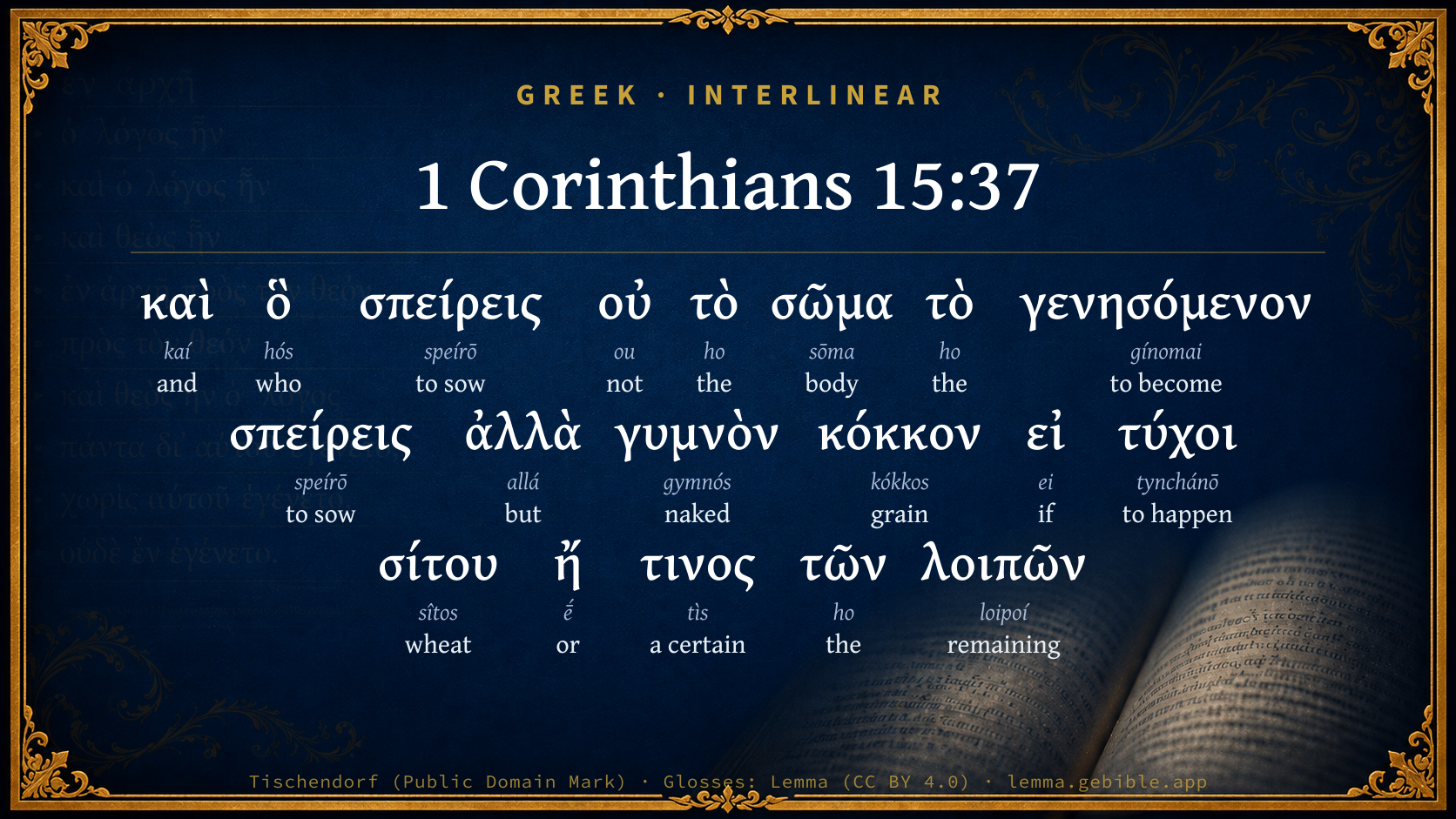
  1. καὶ kaí G2532 “and” Conjunction
  2. ὃ hós G3739 “who” Relative pronoun, Nominative, Singular, Neuter
  3. σπείρεις speírō G4687 “to sow” Verb, Present, Active, Indicative, 2nd person, Singular
  4. οὐ ou G3756 “not” Particle, Negative
  5. τὸ ho G3588 “the” Article, Accusative, Singular, Neuter
  6. σῶμα sōma G4983 “body” Noun, Accusative, Singular, Neuter
  7. τὸ ho G3588 “the” Article, Accusative, Singular, Neuter
  8. γενησόμενον gínomai G1096 “to become” Verb, Future, Middle deponent, Participle, Accusative, Singular, Neuter
  9. σπείρεις speírō G4687 “to sow” Verb, Present, Active, Indicative, 2nd person, Singular
  10. ἀλλὰ allá G235 “but” Conjunction
  11. γυμνὸν gymnós G1131 “naked” Adjective, Accusative, Singular, Masculine
  12. εἰ ei G1487 “if” Conditional
  13. τύχοι tynchánō G5177 “to happen” Verb, Aorist, Active, Optative, 3rd person, Singular
  14. σίτου sîtos G4621 “wheat” Noun, Genitive, Singular, Masculine
  15. ἤ ḗ G2228 “or” Particle
  16. τινος tìs G5100 “a certain” Indefinite pronoun, Genitive, Singular, Masculine
  17. τῶν ho G3588 “the” Article, Genitive, Plural, Masculine
  18. λοιπῶν loipoí G3062 “remaining” Adjective, Genitive, Plural, Masculine

About this verse

These counts appear in no published source. They are computed here, from the morphology-tagged text and Lemma’s own curated glosses. What Lemma adds →

19
words
16
distinct lemmas
Pauline Epistles
section

Notable vocabulary

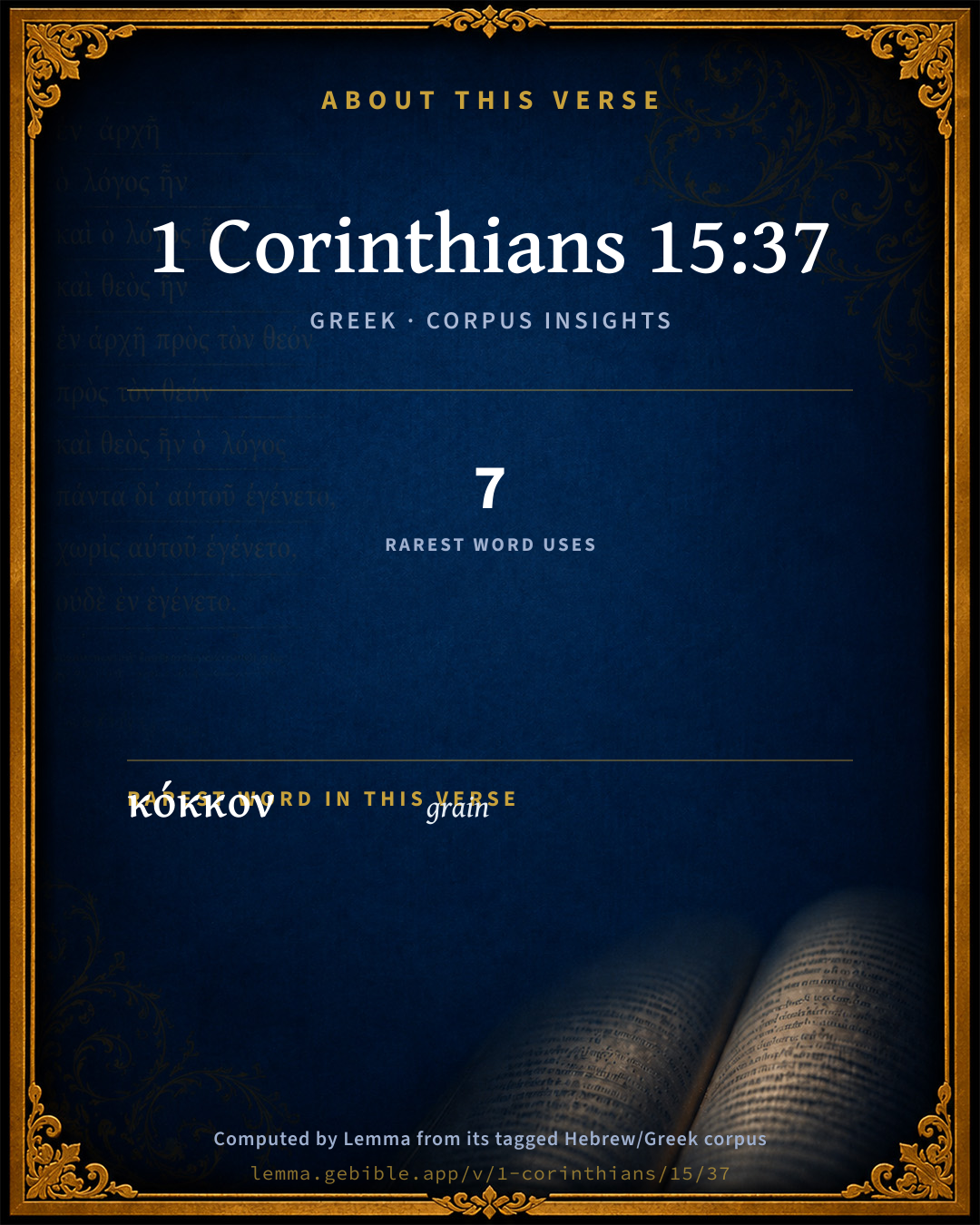
The rarest word here is κόκκον grain G2848 — appearing just 7 times in the whole Greek New Testament.

Shared distinctive vocabulary

κόκκον grain G2848 occurs in 7 verses of the Greek New Testament. Also found in:

Repetition

Words recur within this verse:

  • σπείρεις to sow G4687 ×2
  • τὸ the G3588 ×3

Commentary

Notes on 1 Corinthians 15:37 from classic Christian and Jewish commentators (each source and its license shown beneath its notes). The classic Christian expositions comment on the surrounding passage and are grouped to its opening verse, so a note may address several verses; the Jewish commentaries on the Tanakh (Rashi and others) are per-verse, so they appear only where the commentator wrote on this verse.

Lemma curates 59 commentaries, every one of them public domain or Creative Commons licensed, each selected and text-cleaned for this edition rather than reprinted as found. About our sources →

Tyndale Open Study Notes

Tyndale Open Resources

15:37-39 Just as the shape of a plant does not resemble the seed, yet the plant’s growth is determined by the kind of seed, so the resurrection body will be unlike the present body, yet identifiable as belonging to the same person.

Tyndale Open Study Notes — © Tyndale Open Resources, licensed CC BY-SA 4.0. Text via the HelloAO Bible API.

Bengel's Gnomon

Johann Albrecht Bengel

1Co 15:37. Οὐ τὸ σῶμα τὸ γενησόμενον, not the body that shall be) viz., the body that is beautiful, and no longer bare grain.

Bengel's Gnomon of the New Testament — English translation (T&T Clark, Edinburgh, 1860) — public domain. Text from a community e-Sword module.

Meyer's Critical & Exegetical Commentary

Heinrich August Wilhelm Meyer

1Co_15:37. Καὶ ὃ σπείρεις] And what thou sowest,not the body, which is to be, sowest thou. Ὃ σπείρεις makes the attention rest upon itself first in general, independently of what follows, which forms a complete sentence by itself. See on Mat_7:24; Mat_10:14; Luk_21:6. What shall spring out of the grain, the plant, Paul calls τὸ σῶμα τὸ γενησόμ., because he has it before his mind as the analogue of the resurrection-body. The emphasis, however, lies upon τὸ γενησ.

γυμνὸν κόκκον] a naked grain, which is not yet clothed, as it were, with a plant-body (see what follows). Comp. 2Co_5:3. To this future plant-body corresponds the future resurrection-body with which that, which is buried and decays, is clothed. That it is not the soul or the πνεῦμα of the departed which corresponds to the γυμνὸς κόκκος (Holsten), is shown by ὃ σπείρεις; comp. with 1Co_15:42 ff.

εἰ τύχοι σίτου] it may be of wheat. Here, too, εἰ τύχοι does not mean, for example, but, if it so happens (that thou art just sowing wheat). See on 1Co_14:10.

ἤ τινος τῶν λοιπῶν] neuter. We are to supply from the connection σπερμάτων. Comp. Nägelsbach on the Iliad, p. 304, ed. 3.

Meyer — Critical and Exegetical Commentary on the New Testament — English translation by Peter Christie, edited by Frederick Crombie (T&T Clark, 1880) — public domain. Text from a community e-Sword module.

Expositor's Greek Testament

ed. W. Robertson Nicoll

1Co 15:37-38 make answer to the second branch of the question of 1Co 15:35 , by the aid of the same profound analogy. καὶ ὃ σπείρεις , οὐ τὸ σῶμα τὸ γενησόμενον σπείρεις , “And what thou sowest not the body that will come to be dost thou sow”. It is the object of the sower to realise a new ποιότης in his seed. If any one interrupted him with the question, “What sort of a body can the grain take that you drop in the earth to rot?” the sower would dismiss him as a fool; he has seen in this case “the body that is to be”. Now the actuality of the lower resurrection vindicates the conceivability of the higher. τὸ γενησόμενον states not merely a future certainty ( that shall be; quod futurum sit , Vg [2486] ), but a normal process ( oriturum , Bz [2487] : quod nascetur , Cv [2488] , Bg [2489] ). ἀλλὰ γυμνὸν κόκκον , “but a naked grain” unclothed with any body, wanting the appearance and furnishing of life ( cf. 2Co 5:3 , ἐνδυσάμενοι , οὐ γυμνοί ). For εἰ τύχοι (“if it should chance, of wheat”), see note on 1Co 14:10 : the kind of grain is indiff. “or of any of the rest (of the seeds)”. The grain of wheat gives to the eye no more promise of the body to spring from it than a grain of sand. ὁ δὲ Θεὸς stands in opposition to σὺ ὃ σπείρεις God the lifegiver responding to the sower’s trustful act [2490] “But God gives it a body, according as He willed” ( ἠθέλησεν ) not “as He wills” (according to His choice or liking), but in accordance with His past decree in creation, by which the propagation of life on the earth was determined from the beginning (Gen 1:2 f.; for the vb [2491] , cf. note on 1Co 12:18 ). To allege an impossibility in the case is to impugn the power and resources of the Creator ( cf. Act 26:8 ), manifested in this very way every spring-time. The Divine will is the efficient nexus between seed and plant ( cf. 1Co 12:6 ). “And (He gives) to each of the seeds a body of its own ( ἴδιον )”. This added clause meets the finer point of the second question of 1Co 15:35 ; God will find a fit body for man’s redeemed nature, as He does for each of the numberless seeds vivified in the soil. “How unintelligent to think, as the Pharisees did, that the same body that was buried must be restored, if there is to be a resurrection! Every wheat-stalk contradicts thee!” (Mr [2492] )

[2486] Latin Vulgate Translation.

[2487] Beza’s Nov. Testamentum: Interpretatio et Annotationes (Cantab., 1642).

[2488] Calvin’s In Nov. Testamentum Commentarii .

[2489] Bengel’s Gnomon Novi Testamenti.

[2490] active voice.

[2491] verb

[2492] Meyer’s Critical and Exegetical Commentary (Eng. Trans.).

The Expositor's Greek Testament, edited by W. Robertson Nicoll (1897–1910) — public domain. Text from a community e-Sword module.

Hodge's Commentary on Romans, Ephesians & First Corinthians

Charles Hodge

1Co_15:37

And that which thou sowest, thou sowest not that body that shall be, but bare grain, it may chance of wheat, or of some other (grain):

The first clause of this verse stands, as it were, absolutely. And as to that which thou sowest thou sowest not the body that shall be. That is, you do not sow the plant, but the bare grain, i.e. the simple, naked grain it may be of wheat, or of some other grain. The point of the illustration is, that what comes up is very different from that which is deposited in the ground. You sow a seed, a plant appears. You sow a natural, corruptible body; a spiritual, incorruptible body appears. Nature itself therefore teaches that the objection that the future body must be like the present, is of no force.

Charles Hodge — Commentary on Romans (1835), First Corinthians (1857), and Ephesians (1856) — public domain. Text from a community e-Sword module.

Jamieson, Fausset & Brown

Robert Jamieson, A. R. Fausset & David Brown

not that body that shall be--a body beautiful and no longer a "bare grain" [BENGEL]. No longer without stalk or ear, but clothed with blade and ears, and yielding many grains instead of only one [GROTIUS]. There is not an identity of all the particles of the old and the new body. For the perpetual transmutation of matter is inconsistent with this. But there is a hidden germ which constitutes the identity of body amidst all outward changes: the outward accretions fall off in its development, while the germ remains the same. Every such germ ("seed," Co1 15:38) "shall have its own body," and be instantly recognized, just as each plant now is known from the seed that was sown (see on Co1 6:13). So Christ by the same image illustrated the truth that His death was the necessary prelude of His putting on His glorified body, which is the ground of the regeneration of the many who believe (Joh 12:24). Progress is the law of the spiritual, as of the natural world. Death is the avenue not to mere revivification or reanimation, but to resurrection and regeneration (Mat 19:28; Phi 3:21). Compare "planted," &c., Rom 6:5.

Jamieson, Fausset & Brown — Commentary Critical and Explanatory on the Whole Bible (1871) — public domain (CC PDM 1.0). Text via the HelloAO Bible API.

Adam Clarke's Commentary

Verse 37. Thou sowest not that body that shall be] This is decomposed, and becomes the means of nourishing the whole plant, roots, stalk, leaves, ear, and full corn in the ear.

Adam Clarke's Commentary on the Bible (1810–1826) — public domain. Text from a community e-Sword/MySword module.

Ellicott's Commentary for English Readers

(37, 38) God giveth it a body.—Here it is implied that, though the seed grows up, as we say, “in the ordinary course of Nature,” it is God who not only has originally established but continually sustains that order. Each seed rises with its own “body;” a corn seed grows up into corn, an acorn into an oak. All through this passage the word “body” is used in a general sense for “organism,” so as to keep strictly and vividly before the reader the ultimate truth to illustrate which these analogies are introduced. The points of analogy between the sowing and growth of seed and the life and resurrection of man are not, as some writers put it—(1) the seed is sown, and man is buried; (2) the seed rots, and man’s body decays; (3) the seed grows up, and man is raised. Such a series of analogies are misleading, for there is no necessity for the body of man to decay, but only a necessity for it to die (1Co_15:51-52). The points of analogy are these:—(1) The seed is sown in the earth, and man is born into the world; (2) the seed dies and decays—man dies; (3) the seed grows through its very decay—man rises through death.

A Bible Commentary for English Readers, edited by Charles John Ellicott (1878–1897) — public domain. Text from a community e-Sword module.

The Cambridge Bible for Schools and Colleges

gen. ed. J. J. S. Perowne

37. and that which thou sowest] “There are two parts in this similitude: first that it is not wonderful that bodies should arise again from corruption, since the same thing happens in the case of the seed; and next that it is not contrary to nature that our bodies should be endowed with new qualities, when from naked grain God produces so many ears clothed with a wonderful workmanship.” Calvin. Tyndale renders, And what sowest thou?

thou sowest not that body that shall be] “The same, yet not the same. The same, because the essence is the same; but not the same, because the latter is the more excellent.” Chrysostom. The identity of the body does not depend upon its material particles, because physicists tell us that these are in a continual flux, and that in the course of seven years every material particle in the body has been changed. Personal identity depends upon the principle of continuity. The risen body arises out of that which has seen corruption, in the same way as the plant out of its germ. The length of time that elapses is nothing to Him to Whom ‘a thousand years are but as one day.’ But as the seed is to all appearance very different to the plant which arises from it, although science tells us that it contains that whole plant in miniature, as the Body of Jesus after His Resurrection was endowed with many strange and new qualities (St Joh_20:19; Joh_20:26) so as often to be unrecognizable by His disciples (St Luk_24:16; Luk_24:31; Luk_24:37; St Joh_20:14; Joh_21:4) though yet it was the same body (St Luk_24:39-40; St Joh_20:20; Joh_20:27); so we learn that the body we sow in the grave is ‘not that body that shall be,’ but that the resurrection body—the spiritual body—while it exhibits visible and unequivocal signs of its connection with the body out of which it has arisen, will be possessed of many wondrous faculties which are denied to us here. See notes on next verse and on 1Co_15:42-44, and cf. Rom_8:11 (margin), Rev_21:4.

but bare grain] i.e. naked grain. A nakid corn, Wiclif. Our version follows Tyndale here, only substituting grain for corne.

The Cambridge Bible for Schools and Colleges (gen. ed. J. J. S. Perowne; Cambridge University Press, 1878–1918) — public domain. Text from a community e-Sword module.

John Gill's Exposition

There are also celestial bodies,.... Or bodies in the heavens, as the sun, moon, and stars:

and bodies terrestrial; or bodies on earth, animate and inanimate, men, beasts, trees, minerals, &c.

But the glory of the celestial is one, and the glory of the terrestrial is another: though both sorts are bodies, yet their qualities differ, and there is a greater glory in the one than in the other. This is another similitude, serving to help our ideas of this doctrine of the resurrection of the body; that though it is the same in substance, yet different in qualities; and does not design any difference between the bodies of good men and bad men, elect and reprobate; as if the one were intended by the celestial bodies, and the other by the terrestrial; and much less degrees of glory in the saints themselves, who, imagine them in as low a form as can be, can never be compared to terrestrial ones; but it shows the difference there will be between the raised bodies and the present ones; which will be as great as that which now is between celestial and terrestrial bodies.

John Gill's Exposition of the Whole Bible (1746–1763) — public domain (CC PDM 1.0). Text via the HelloAO Bible API.

Trapp's Complete Commentary

John Trapp

37 And that which thou sowest, thou sowest not that body that shall be, but bare grain, it may chance of wheat, or of some other grain:

Ver. 37. And that which thou sowest] This is an answer to the epicure’s second demand, 1Co 15:35, with what body do they come? with a dead, diseased, rotten body, &c.? No, no, saith the apostle. Sin is only rotted with its concomitancies, infirmities; but the rotting of the body is but as the rotting of a kernal under the clod, that it may arise incorruptible. Or as the melting of an old piece of plate in the fire, to bring it out of a better fashion. Christ was buried in a garden, to note that death doth not destroy our bodies, but only sow them: the dew of herbs will revive them again. {See Trapp on "1Co 15:18"}

John Trapp, A Commentary or Exposition upon All the Books of the Old and New Testament (1647–1656) — public domain. Text from a community e-Sword module.

Albert Barnes' Notes on the Bible

And that which thou sowest - The seed which is sown.

Not that body that shall be - You sow one kernel which is to produce many others. They shall not be the same that is sown. They will be new kernels raised from that; of the same kind, indeed, and showing their intimate and necessary connection with that which is sown. It is implied here that the body which will be raised will not be the same in the sense that the same particles of matter shall compose it, but the same only in the sense that it will have sprung up from that; will constitute the same order, rank, species of being, and be subject to the same laws, and deserve the same course of treatment as that which died; as the grain produced is subject to the same laws, and belongs to the same rank, order, and species as that which is sown. And as the same particles of matter which are sown do not enter into that which shall be in the harvest, so it is taught that the same particles of matter which constitute the body when it dies, do not constitute the new body at the resurrection.

But bare grain - Mere grain; a mere kernel, without any husk, leaf, blade, or covering of any kind. Those are added in the process of reproduction. The design of this is to make it appear more remarkable, and to destroy the force of the objection. It was not only not the grain that should be produced, but it was without the appendages and ornaments of blade, and flower, and beard of the new grain. How could anyone tell but what it would be so in the resurrection? How could any know but what there might be appendages and ornaments there, which were not connected with the body that died?

It may chance of wheat ... - For example; or suppose it be wheat or any other grain. The apostle adduces this merely for an example; not to intimate that there is any chance about it.

Albert Barnes' Notes on the Bible (1834–1885) — public domain. Text from a community e-Sword/MySword module.

Matthew Poole's English Annotations

And when it again riseth, or shooteth up, it is not bare grain, without either stalk or ear, which was the body by them sown.

Matthew Poole's English Annotations on the Holy Bible (1683–1685) — public domain. Text from a community e-Sword/MySword module.

Whedon's Commentary on the Bible

Daniel D. Whedon

37. Not… body that shall be—The planter does not sow it a plant and then have it come up a plant. But a seed is sown and a plant is grown. Just so you bury a putrid corpse, and it comes forth an angel-like body. But to the apostle’s legitimate conception the new plant is but a transfiguration of the old seed, and the new body is but a molecular rearrangement of the old corpse. The old corpse is the primitive material out of which the new body is made; just as in the change of 1Co_15:52, the old is the material for the new.

Bare grain—Naked kernel, not a living stalk, with fresh branches, foliage, and flower; as it is in its upspringing.

Daniel D. Whedon (gen. ed.), Commentary on the Old and New Testaments (1874–1909) — public domain. Text from a community e-Sword module.

The Pulpit Commentary

Not that body that shall be. This deep remark should have checked the idly and offensively materialistic form in which the doctrine of the resurrection is often taught. But bare grain. Wickliffe, "a naked corne." In this passage, almost alone in all his Epistles, St. Paul, who does not seem to have been at all a close observer of external phenomena, uses metaphors drawn from natural life. His usual metaphors are chiefly architectural and agonistic derived, that is, from buildings and games. That he was not a student of nature arose, no doubt, partly from his Semitic cast of mind, but chiefly from his being short sighted, and from his having spent most of his early life in large cities. It may chance; if it so happen,. (see note on 1Co_14:10) The English word "chance" occurs but four times in the whole Bible (1Sa_6:9; Ecc_9:11) In Luk_10:31 the words rendered "by chance" mean rather "by coincidence."

The Pulpit Commentary (1880–1919), ed. H.D.M. Spence-Jones & Joseph S. Exell — public domain. Text from a community e-Sword module.

John Wesley's Explanatory Notes

Thou sowest not the body that shall be - Produced from the seed committed to the ground, but a bare, naked grain, widely different from that which will afterward rise out of the earth.

John Wesley, Explanatory Notes Upon the Whole Bible (1754–1765) — public domain. Text via the GEBible commentary corpus.

McGarvey & Pendleton's Commentaries

J. W. McGarvey

and that which thou sowest, thou sowest not the body that shall be, but a bare [naked] grain, it may chance of wheat, or of some other kind ;

J. W. McGarvey (with Philip Y. Pendleton), Commentaries on the New Testament (The Fourfold Gospel, 1914; Acts; and the epistles) — public domain. Text from a community e-Sword/MySword module.

The People's New Testament

B. W. Johnson

37. And that which thou sowest, etc. We sow, not the plant that comes forth, but only a bare seed.

B. W. Johnson's The People's New Testament with Notes (1889–1891) — public domain. Electronic text from the Christian Classics Ethereal Library (CCEL) ThML edition.

unfoldingWord translationNotes

Door43 World Missions Community

What you sow is not the body that will be

Paul uses the metaphor of the seed again to say that God will resurrect the dead body of the believer, but that body will not appear as it was. (See: Metaphor)

What you sow

Paul is speaking to the Corinthians as if they were one person, so the word "you" here is singular. (See: Forms of You)

God will give it a body as he chooses

"God will decide what kind of body it will have"

flesh

In the context of animals, "flesh" may be translated as "body," "skin," or "meat."

translationWords

plant

body

seed

flesh

unfoldingWord translationNotes — © Distant Shores Media and the Door43 World Missions Community, licensed CC BY-SA 4.0. Source: git.door43.org/Door43/en_tn.

Cambridge Greek Testament for Schools and Colleges

37. καὶ ὃ σπείρεις. ‘There are two parts in this similitude: first that it is not wonderful that bodies should arise again from corruption, since the same thing happens in the case of the seed; and next that it is not contrary to nature that our bodies should be endowed with new qualities, when from naked grain God produces so many ears clothed with a wonderful workmanship.’ Calvin. Tyndale renders, And what sowest thou?

οὐ τὸ σῶμα τὸ γενησόμενον. ‘The same, yet not the same. The same, because the essence is the same; but not the same, because the latter is the more excellent.’ Chrysostom. The identity of the body does not depend upon its material particles, because physicists tell us that these are in a continual flux, and that in the course of seven years every material particle in the body has been changed. Personal identity depends upon the principle of continuity. The risen body arises out of that which has seen corruption, in the same way as the plant out of its germ. The length of time that elapses is nothing to Him to Whom ‘a thousand years are but as one day.’ But as the seed is to all appearance very different to the plant which arises from it (although science tells us that it contains that whole plant in miniature); as the Body of Jesus after His Resurrection was endowed with many strange and new qualities (Joh 20:19; Joh 20:26) so as often to be unrecognizable by His disciples (Luk 24:16; Luk 24:31; Luk 24:37; Joh 20:14; Joh 21:4) though yet it was the same body (Luk 24:39-40; Joh 20:20; Joh 20:27); so we learn that the body we sow in the grave is ‘not that body that shall be,’ but that the resurrection body—the spiritual body, as St Paul calls it—while it exhibits visible and unequivocal signs of its connection with the body out of which it has arisen, will be possessed of many wondrous faculties which are denied to us here. See notes on next verse and on 1Co 15:42-44, and cf. Rom 8:11; Rev 21:4.

Cambridge Greek Testament for Schools and Colleges (Cambridge University Press, 1896; 21 vols, various authors incl. Carr, Maclear, Plummer, Farrar, Lumby, Moule, M. R. James, Simcox) — public domain. Text from a community e-Sword module.

Alford’s Greek Testament

Henry Alford

37.] Before, the death of the seed was insisted on: now, the non-identity of the seed with the future plant. There is a mixture of construction, the words ὃ σπείρεις being pendent, as the sentence now stands. The two constructions as De W. observes are, εἴ τι σπείρεις, οὐ τὸ σ. τὸ γεν. σπείρεις,—and ὃ σπείρεις, οὐ τὸ σ. τὸ γεν. ἐστιν.

He names the plant τὸ σῶμα τὸ γενησόμενον, having already in his eye the application to the Resurrection.

εἰ τύχοι] if it should so happen,—peradventure: not, ‘for example.’ See on ch. 14:10.

τῶν λοιπῶν, scil. σπερμάτων.

Henry Alford, The Greek Testament (1849–1861) — public domain. Text from a community e-Sword module.

International Critical Commentary

37. καὶ ὃ σπείρεις κ.τ.λ. This is the answer to the second question, introduced by καί. The grain, before being sown, is stripped of all the sheaths which protected it on the plant, as the human body, before burial, is stripped of its usual clothing. The γυμνόν has no reference to the soul stripped of the body, an idea which is quite alien to the passage. The epithet, which is emphatic, looks forward rather than backward: τὸ σῶμα τὸ γενησόμενον, quod futurum sit (Vulg.), quod nascetur (Calv. Beng.), oriturum (Beza), will be clothed with green coverings, as the resurrection-body (2Co 5:2) with glory.* As in 16:10, εἰτύχοι indicates an indefiniteness which is unimportant. For the argument there, the exact number of γένη φωνῶν was of no consequence: here the particular kind of grain is of no moment,—‘wheat, if you like, or anything else.’

International Critical Commentary — older volumes (1896–1929), various authors — public domain. Text from a community e-Sword module.

Vincent's Word Studies in the New Testament

Marvin R. Vincent

Not that body that shall be. Or, more literally, that shall come to pass. Meeting the objector's assumption that either the raised body must be the same body, or that there could be no resurrection. Paul says : "What you sow is one body, and a different body arises;" yet the identity is preserved. Dissolution is not loss of identity. The full heads of wheat are different from the wheat - grain, yet both are wheat. Clement of Rome, in his first Epistle to the Corinthians, arguing for the resurrection of the body, cites in illustration the fable of the phoenix, the Arabian bird, the only one of its kind, and which lives for a hundred years. When the time of its death draws near it builds itself a nest of frankincense, myrrh, and other spices, and entering it, dies. In the decay of its flesh a worm is produced, which, being nourished by the juices of the dead bird, brings forth feathers. Then, when it has acquired strength, it takes up the nest with the bones of its parent and bears them to Heliopolis in Egypt.

Bare [γυμνον] . Naked. The mere seed, without the later investiture of stalk and head.

It may chance [ει τυχοι] . Lit., if it happen to be : i e., whatever grain you may chance to sow.

Marvin R. Vincent, Word Studies in the New Testament (1887–1900) — public domain. Text from a community e-Sword/MySword module.

Godet's Commentaries

Frédéric Louis Godet

Vv. 37, 38. “And when thou sowest, thou sowest not that body that shall be, but bare grain, it may chance of wheat, or of some other grain: 38. but God giveth it a body as it hath pleased Him, and to every seed a body of its own.”

The καί, and, marks the transition to the second question. The answer to it will be much more developed. The first question implied an inexplicable mystery, and the answer could only be given by means of a not less mysterious analogous fact, borrowed from the life of nature. Here it is otherwise, for the point in question is the nature of the new body, which will result from this unfathomable operation, in contrast to the nature of the present body.

In translating: when thou sowest, we have tried to render more exactly the meaning of the construction used by the apostle than when it is translated: as to what thou sowest. Literally, the meaning is this: “What thou sowest, thou dost not sow it (as being) the body which is to spring up...” This singular form, in which the expression: that body that shall be, is the grammatical apposition of: what thou sowest, is intended to express very forcibly the essential identity of the present and the future body.

The expression bare grain tacitly contrasts the grain stripped of all covering or ornament with that wealth of organs (leaves, calyx, corolla), which forms the beauty of the developed plant. By making use of this expression, the apostle no doubt means to suggest the nakedness of the human body when it is laid in the earth. Holsten applies the term bare [naked] to the soul divested of its body in Hades. But the subject in question is the body, and not the soul. The phrase εἰ τύχοι signifies neither perhaps, nor for example, as some translate, but: if so be, that is to say: according to the kind of grain thou hast in hand, at the time when thou sowest.

Frédéric Louis Godet — Commentaries on Luke, John, Romans, and 1 Corinthians — English translation (T&T Clark, Edinburgh, 1870s–1890s) — public domain. Text from a community e-Sword module.

Lesson kit

Teaching starters — assembled from the data on this page, not authored interpretation. Every prompt links to the verse data it draws on. Edit before teaching.

1 Corinthians, in the Pauline Epistles, opens this verse with 19 words (16 distinct Greek lemmas). Its most distinctive word is kókkos (“grain”). A historical commentator’s framing appears above. Read the whole chapter for the surrounding context.

Discussion questions

  1. What does “grain” (kókkos) contribute to the verse as a whole?
  2. How does Matthew 13:31, which shares the word «grain», read alongside this verse?
  3. What does the repetition of “to sow” (2× in this one verse) do in this verse?
  4. These translations render this verse differently. What is at stake in choosing one wording over another?
  5. Compare how Tyndale Open Study Notes and Bengel's Gnomon read this verse. Where do they agree or differ?

Things to notice

Reading settings

Reading text

Shown beneath each verse's original-language words.

Old Testament
Old Testament edition

Read the OT as the Masoretic Hebrew (MT) or the Greek Septuagint (LXX).

English shown for the Greek Septuagint (in the Hebrew ↔ Greek comparison).

Comparing translations? Open the Compare panel on any verse page to stack up to four side by side.