
1 Corinthians 4:6

Greek (Tischendorf 8th ed.) 1 Corinthians 4:6 appears in the Greek New Testament. The text above is from the Tischendorf 8th edition. Each word links to its Strong’s number and a concise gloss. Click any word for its full Thayer’s Greek Lexicon entry.
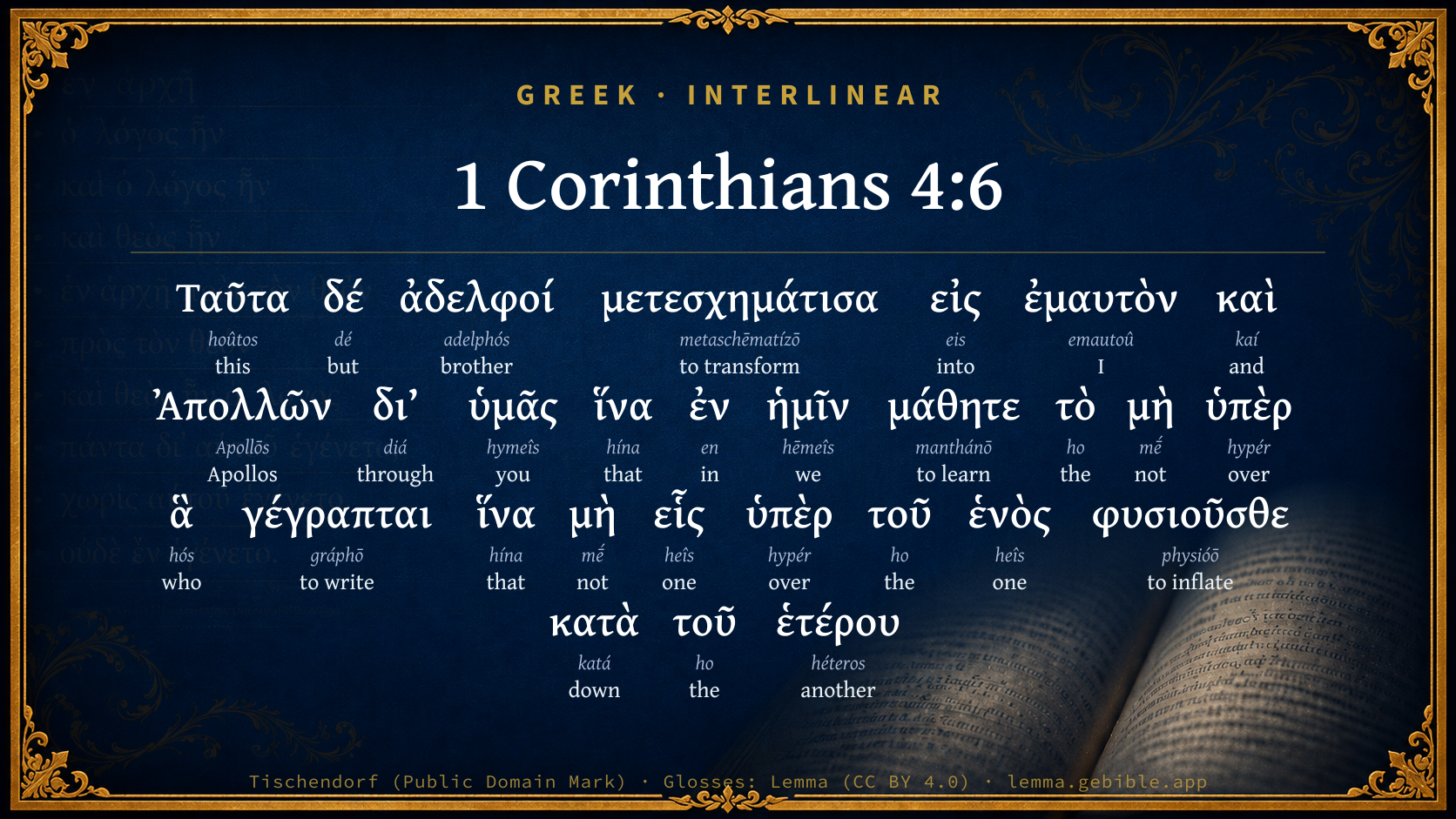
Download image
Cite this verse

1 Corinthians 4:6 (World English Bible). Public Domain. Lemma interlinear Bible study tool, https://lemma.gebible.app/v/1-corinthians/4/6.

Show BibTeX & RIS
BibTeX
RIS
English Translation
Now these things, brothers, I have in a figure transferred to myself and Apollos for your sakes, that in us you might learn not to think beyond the things which are written, that none of you be puffed up against one another.
World English Bible · Public Domain
Highlights
  • 2 first appearances in the Greek New Testament
Full analysis ↓
Download a study sheet

One document with this verse’s original text, its word-by-word gloss line, the meaning frame, cross-references with their text, attributed commentary, and full source and license credits — printable, and it pastes into notes with its structure intact.

This verse Autodidact and up

Study sheet (.html) Plain text (.txt)

A passage Seminary Student

Up to 50 verses in one chapter. A passage sheet keeps up to 6 commentary sources and 12 cross-references per verse, in the order this page ranks them, and says so on the sheet whenever that leaves anything out. Ask for a single verse and you get the Autodidact verse sheet above.

Everything on this page stays free to read, with no account — the sheet is a download of what is already on screen, not access to it.

Want to remove ads? Support Godless Engineer
Compare translations 3

The same verse in 3 English versions, stacked beneath the original-language interlinear above. Click any original word for its lexicon entry.

Each is an independent rendering of the whole verse — the interlinear is not word-aligned to these translations.

Highlighted words mark where these versions differ — a whole-verse word diff, not a word-by-word alignment.

  • World English Bible Public Domain
    Now these things, brothers, I have in a figure transferred to myself and Apollos for your sakes, that in us you might learn not to think beyond the things which are written, that none of you be puffed up against one another.
  • King James Version Public Domain
    And these things, brethren, I have in a figure transferred to myself and to Apollos for your sakes; that ye might learn in us not to think of men above that which is written, that no one of you be puffed up for one against another.
  • unfoldingWord Literal Text CC BY-SA 4.0
    Now, these things, brothers, I applied to myself and Apollos for your sakes, so that through us you might learn this: “Not beyond what is written,” so that no one would be puffed up in favor of the one against the other.

unfoldingWord Literal Text — © unfoldingWord, licensed CC BY-SA 4.0. Word-aligned USFM3 via Door43 (git.door43.org/unfoldingWord/en_ult).

Versions to compare (up to 4)

3 of 4 selected

Show all 19 translations

Every available English version of this verse, each an independent rendering of the whole verse.

  • World English Bible Public Domain
    Now these things, brothers, I have in a figure transferred to myself and Apollos for your sakes, that in us you might learn not to think beyond the things which are written, that none of you be puffed up against one another.
  • Berean Standard Bible Public Domain
    Brothers, I have applied these things to myself and Apollos for your benefit, so that you may learn from us not to go beyond what is written. Then you will not take pride in one man over another.
  • Majority Standard Bible Public Domain
    Brothers, I have applied these things to myself and Apollos for your benefit, so that you may learn from us not to think beyond what is written. Then you will not take pride in one man over another.
  • King James Version Public Domain
    And these things, brethren, I have in a figure transferred to myself and to Apollos for your sakes; that ye might learn in us not to think of men above that which is written, that no one of you be puffed up for one against another.
  • American Standard Version (1901) Public Domain
    Now these things, brethren, I have in a figure transferred to myself and Apollos for your sakes; that in us ye might learn not `to go' beyond the things which are written; that no one of you be puffed up for the one against the other.
  • Revised Version (1885) Public Domain
    Now these things, brethren, I have in a figure transferred to myself and Apollos for your sakes; that in us ye might learn not to go beyond the things which are written; that no one of you be puffed up for the one against the other.
  • Geneva Bible (1599) Public Domain
    Nowe these things, brethren, I haue figuratiuely applied vnto mine owne selfe and Apollos, for your sakes, that ye might learne by vs, that no man presume aboue that which is written, that one swell not against another for any mans cause.
  • Douay-Rheims (1899) Public Domain
    But these things, brethren, I have in a figure transferred to myself and to Apollo, for your sakes; that in us you may learn, that one be not puffed up against the other for another, above that which is written.
  • Young's Literal Translation Public Domain
    And these things, brethren, I did transfer to myself and to Apollos because of you, that in us ye may learn not to think above that which hath been written, that ye may not be puffed up one for one against the other,
  • Literal Standard Version CC BY-SA 4.0
    And these things, brothers, I transferred to myself and to Apollos because of you, that in us you may learn not to think above that which has been written, that you may not be puffed up one for one against the other,
  • Unlocked Literal Bible CC BY-SA 4.0
    Now, brothers, I applied these principles to myself and Apollos for your sakes, so that from us you might learn the meaning of the saying, “Do not go beyond what is written.” This is so that none of you may be puffed up in favor of one against the other.
  • unfoldingWord Literal Text CC BY-SA 4.0
    Now, these things, brothers, I applied to myself and Apollos for your sakes, so that through us you might learn this: “Not beyond what is written,” so that no one would be puffed up in favor of the one against the other.
  • Darby Bible Public Domain
    Now these things, brethren, I have transferred, in their application, to myself and Apollos, for your sakes, that ye may learn in us the [lesson of] not [letting your thoughts go] above what is written, that ye may not be puffed up one for [such a] one against another.
  • World Messianic Bible Public Domain
    Now these things, brothers, I have in a figure transferred to myself and Apollos for your sakes, that in us you might learn not to think beyond the things which are written, that none of you be puffed up against one another.
  • Webster's Bible Public Domain
    And these things, brethren, I have in a figure transferred to myself, and to Apollos, for your sakes; that ye may learn in us not to think of men above that which is written, that no one of you on account of one, may be puffed up against another.
  • Free Bible Version CC BY-SA 4.0
    Now, brothers and sisters, I have applied this to Apollos and myself as an example for you. That way you will learn not to go beyond what has been written, and not in arrogance prefer one over the other.
  • Bible in Basic English Public Domain
    My brothers, it is because of you that I have taken Apollos and myself as examples of these things, so that in us you might see that it is not wise to go farther than what is in the holy Writings, so that no one of you may be lifted up against his brother.
  • Text-Critical English NT CC BY 4.0
    Now, brothers, I have applied these things to myself and Apollos for your sake, so that through us you may learn not to think beyond what is written, so that you may not be puffed up, with each one of you supporting one man against another.
  • Tyndale New Testament (1534) Public Domain
    These thinges brethren I have described in myn awne person and Apollos for youre sakes that ye myght learne by vs that no man counte of him selfe beyonde that which is above written: that one swell not agaynst another for eny mans cause.

Literal Standard Version (2020), Covenant Press — licensed CC BY-SA 4.0. Text via the HelloAO Bible API (eBible.org). Unlocked Literal Bible (unfoldingWord) — licensed CC BY-SA 4.0. Text via the HelloAO Bible API (eBible.org). unfoldingWord Literal Text — © unfoldingWord, licensed CC BY-SA 4.0. Word-aligned USFM3 via Door43 (git.door43.org/unfoldingWord/en_ult). Free Bible Version, Dr. Jonathan Gallagher — licensed CC BY-SA 4.0. Text via the HelloAO Bible API (eBible.org).

Word by word

More ways to search: Search by grammar → Find every occurrence → Compare this word →

Practice this passage: Drill this verse → Learn its vocabulary →

μετεσχημάτισα
metaschēmatízō
G3345
“to transform”
Verb, Aorist, Active, Indicative, 1st person, Singular
Part of Speech
Verb
Tense
Aorist
Voice
Active
Mood
Indicative
Person
1st person
Number
Singular
Full Thayer's Definition

Origin: from G3326 and a derivative of G4976

TDNT: 22:57,1

1. to change the figure of, to transform
  1. Ταῦτα hoûtos G3778 “this” Demonstrative pronoun, Accusative, Plural, Neuter
  2. δέ dé G1161 “but” Conjunction
  3. ἀδελφοί adelphós G80 “brother” Noun, Vocative, Plural, Masculine
  4. εἰς eis G1519 “into” Preposition
  5. ἐμαυτὸν emautoû G1683 “I” Reflexive pronoun, 1st person, Accusative, Singular, Masculine
  6. καὶ kaí G2532 “and” Conjunction
  7. Ἀπολλῶν Apollōs G625 “Apollos” Noun, Accusative, Singular, Masculine
  8. δι’ diá G1223 “through” Preposition
  9. ὑμᾶς hymeîs G5210 “you” Personal pronoun, 2nd person, Accusative, Plural
  10. ἵνα hína G2443 “that” Conjunction
  11. ἐν en G1722 “in” Preposition
  12. ἡμῖν hēmeîs G2249 “we” Personal pronoun, 1st person, Dative, Plural
  13. μάθητε manthánō G3129 “to learn” Verb, Aorist, Active, Subjunctive, 2nd person, Plural
  14. τὸ ho G3588 “the” Article, Accusative, Singular, Neuter
  15. μὴ mḗ G3361 “not” Particle, Negative
  16. ὑπὲρ hypér G5228 “over” Preposition
  17. ἃ hós G3739 “who” Relative pronoun, Nominative, Plural, Neuter
  18. γέγραπται gráphō G1125 “to write” Verb, Perfect, Passive, Indicative, 3rd person, Singular
  19. ἵνα hína G2443 “that” Conjunction
  20. μὴ mḗ G3361 “not” Particle, Negative
  21. εἷς heîs G1520 “one” Adjective, Nominative, Singular, Masculine
  22. ὑπὲρ hypér G5228 “over” Preposition
  23. τοῦ ho G3588 “the” Article, Genitive, Singular, Masculine
  24. ἑνὸς heîs G1520 “one” Adjective, Genitive, Singular, Masculine
  25. φυσιοῦσθε physióō G5448 “to inflate” Verb, Present, Passive, Subjunctive, 2nd person, Plural
  26. κατὰ katá G2596 “down” Preposition
  27. τοῦ ho G3588 “the” Article, Genitive, Singular, Masculine
  28. ἑτέρου héteros G2087 “another” Adjective, Genitive, Singular, Masculine

About this verse

These counts appear in no published source. They are computed here, from the morphology-tagged text and Lemma’s own curated glosses. What Lemma adds →

29
words
23
distinct lemmas
Pauline Epistles
section

Notable vocabulary

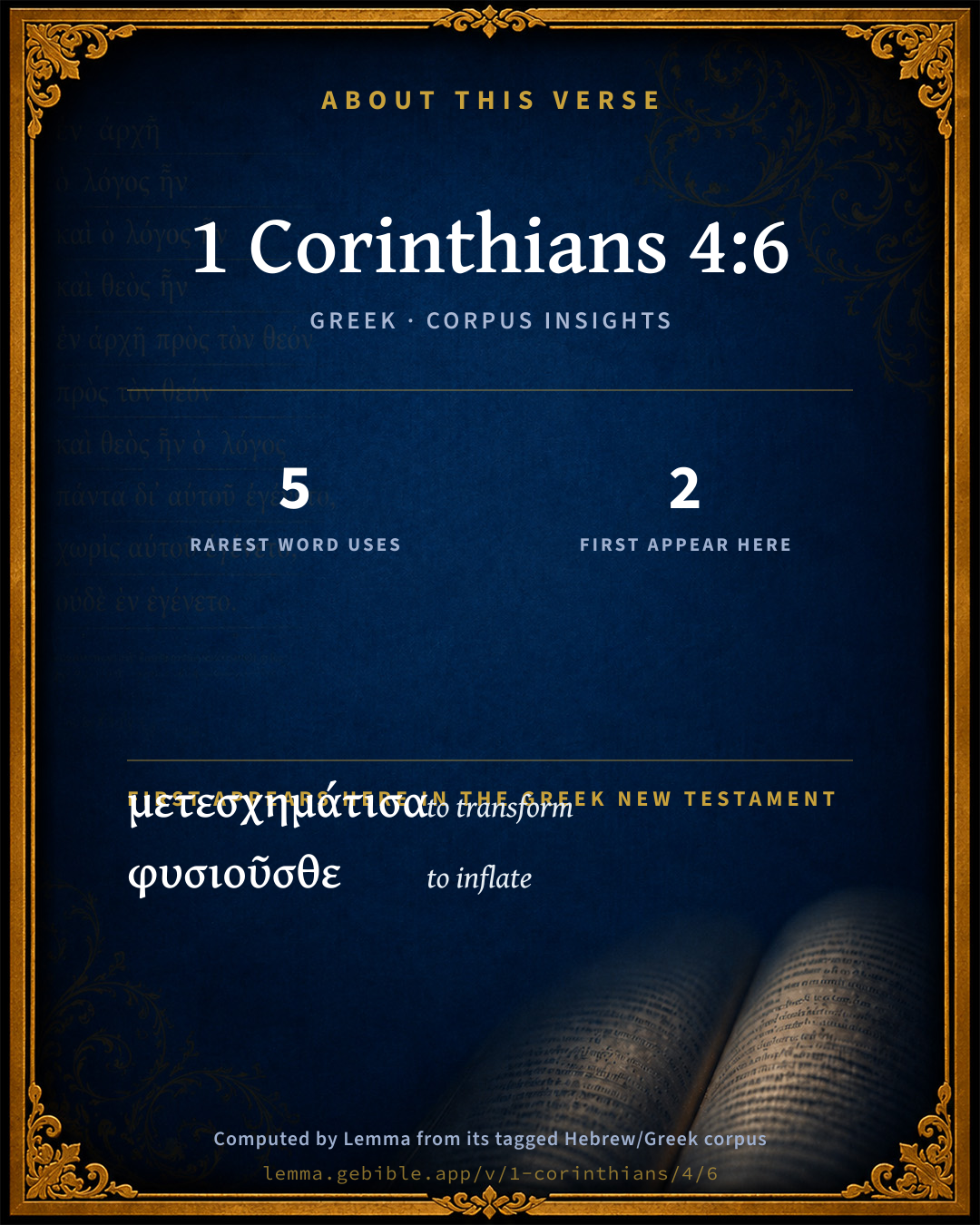
The rarest word here is μετεσχημάτισα to transform G3345 — appearing just 5 times in the whole Greek New Testament.

First appearance in Scripture

These words make their first canonical appearance in the Greek New Testament here:

  • μετεσχημάτισα to transform G3345
  • φυσιοῦσθε to inflate G5448

Shared distinctive vocabulary

μετεσχημάτισα to transform G3345 occurs in 5 verses of the Greek New Testament. Also found in:
Repetition

Words recur within this verse:

Cross-references

32

Topical passages linked to 1 Corinthians 4:6 in the Treasury of Scripture Knowledge — connected by theme and wording, ordered by reader-vote popularity; previews shown in the World English Bible.

  • 2 Corinthians 11:4 For if he who comes preaches another Jesus, whom we did not preach, or if you receive a different spirit, which you did not receive, or a different gospel, which you did not accept, you put up with that well enough.
  • 2 Corinthians 12:6 For if I would desire to boast, I will not be foolish; for I will speak the truth. But I forbear, so that no man may account of me above that which he sees in me, or hears from me.
  • 2 Corinthians 12:19 Again, do you think that we are excusing ourselves to you? In the sight of God we speak in Christ. But all things, beloved, are for your edifying.
  • Romans 12:3 For I say, through the grace that was given me, to every man who is among you, not to think of himself more highly than he ought to think; but to think reasonably, as God has apportioned to each person a measure of faith.
  • Colossians 2:18 Let no one rob you of your prize by a voluntary humility and worshipping of the angels, dwelling in the things which he has not seen, vainly puffed up by his fleshly mind,
  • 1 Thessalonians 1:5 and that our Gospel came to you not in word only, but also in power, and in the Holy Spirit, and with much assurance. You know what kind of men we showed ourselves to be among you for your sake.
  • John 3:26–27 They came to John, and said to him, "Rabbi, he who was with you beyond the Jordan, to whom you have testified, behold, the same baptizes, and everyone is coming to him."
  • Psalms 8:4 What is man, that you think of him? The son of man, that you care for him?
  • 1 Corinthians 1:31 that, according as it is written, "He who boasts, let him boast in the Lord."
  • 1 Corinthians 3:4–7 For when one says, "I follow Paul," and another, "I follow Apollos," aren't you fleshly?
  • 1 Corinthians 3:19 For the wisdom of this world is foolishness with God. For it is written, "He has taken the wise in their craftiness."
  • 1 Corinthians 3:21 Therefore let no one boast in men. For all things are yours,
  • 1 Corinthians 5:6 Your boasting is not good. Don't you know that a little yeast leavens the whole lump?
  • 1 Corinthians 8:1 Now concerning things sacrificed to idols: We know that we all have knowledge. Knowledge puffs up, but love builds up.
  • 1 Corinthians 9:23 Now I do this for the Gospel's sake, that I may be a joint partaker of it.
  • 2 Corinthians 4:15 For all things are for your sakes, that the grace, being multiplied through the many, may cause the thanksgiving to abound to the glory of God.
  • 2 Corinthians 10:7 Do you look at things only as they appear in front of your face? If anyone trusts in himself that he is Christ's, let him consider this again with himself, that, even as he is Christ's, so also we are Christ's.
  • Numbers 11:28–29 Joshua the son of Nun, the minister of Moses, one of his chosen men, answered, My lord Moses, forbid them.
  • Job 11:11–12 For he knows false men. He sees iniquity also, even though he doesn't consider it.
  • Psalms 146:3 Don't put your trust in princes, Each a son of man in whom there is no help.
  • Isaiah 2:22 Stop trusting in man, whose breath is in his nostrils; For of what account is he?
  • Jeremiah 17:5–6 Thus says Yahweh: Cursed is the man who trusts in man, and makes flesh his arm, and whose heart departs from Yahweh.
  • Matthew 23:8–10 But don't you be called 'Rabbi,' for one is your teacher, the Christ, and all of you are brothers.
  • 1 Corinthians 1:12 Now I mean this, that each one of you says, "I follow Paul," "I follow Apollos," "I follow Cephas," and, "I follow Christ."
  • 1 Corinthians 1:19 For it is written, "I will destroy the wisdom of the wise, I will bring the discernment of the discerning to nothing."
  • 1 Corinthians 4:18–19 Now some are puffed up, as though I were not coming to you.
  • 1 Corinthians 5:2 You are puffed up, and didn't rather mourn, that he who had done this deed might be removed from among you.
  • 2 Corinthians 10:12 For we are not bold to number or compare ourselves with some of those who commend themselves. But they themselves, measuring themselves by themselves, and comparing themselves with themselves, are without understanding.
  • 2 Corinthians 10:15 not boasting beyond proper limits in other men's labors, but having hope that as your faith grows, we will be abundantly enlarged by you in our sphere of influence,
  • 2 Corinthians 11:12–15 But what I do, that I will do, that I may cut off occasion from them that desire an occasion, that in which they boast, they may be found even as we.
  • 2 Timothy 2:10 Therefore I endure all things for the chosen ones' sake, that they also may obtain the salvation which is in Christ Jesus with eternal glory.
  • 1 Corinthians 13:4 Love is patient and is kind; love doesn't envy. Love doesn't brag, is not proud,

Cross-references courtesy of OpenBible.info (CC BY 4.0).

Commentary

Notes on 1 Corinthians 4:6 from classic Christian and Jewish commentators (each source and its license shown beneath its notes). The classic Christian expositions comment on the surrounding passage and are grouped to its opening verse, so a note may address several verses; the Jewish commentaries on the Tanakh (Rashi and others) are per-verse, so they appear only where the commentator wrote on this verse.

Lemma curates 59 commentaries, every one of them public domain or Creative Commons licensed, each selected and text-cleaned for this edition rather than reprinted as found. About our sources →

The Biblical Illustrator

Joseph S. Exell

1Co_4:6

And these things, brethren, I have in a figure transferred to myself and to Apollos for your sakes.

Apostolic delicacy and tact

St. Paul means that in the preceding passage (from 1Co_3:5) he has presented, while applying them to himself and Apollos, the principles regarding the ministry which he was concerned to remind them of, in view of certain preachers of the Church which misunderstood them. He did not wish to designate those preachers by name, lest he should shock susceptibilities already awakened. He explains this method, which he felt called to use in the delicate circumstances, by the words for your sakes, which here signify the more easily to gain your acceptance of the truth thus presented. Expressions like Paul is nothing, Apollos is nothing, applied to other leading persons at Corinth, would have seemed injurious, while in the form used by Paul the truth declared lost all character of personal hostility. Hence it follows that these things applies solely to the last passage concerning the ministry, and not at all to the previous passages regarding the nature of the gospel. It is therefore a mistake to find here a proof in favour of applying to Apollos or his partisans the polemic against human wisdom in chaps, 1. and 2. The passage rather shows how thoroughly Paul felt himself one with Apollos, seeing he could treat him as a second self, and distinguish him so pointedly from teachers who opposed him at Corinth. (Prof. Godet.)

How the apostle reproves the pride of the Corinthian Church

I. By example (1Co_4:6).

II. By argument (1Co_4:7).

III. By sarcasm (1Co_4:8),

IV. By the consideration of gods procedure (1Co_4:9).

V. By contrast (1Co_4:10).

VI. By an enumeration of apostolic humiliations and sufferings (Verses 11-13). (Prof. Godet.)

That ye might learn in us not to think of men above that which is written.--

The true standard of the gospel ministry

The apostle means by what is written, the Scriptures of the Old Testament; not that he refers to any particular passage, but to the general spirit and point of view of the Divine revelation. The facts which he has delivered to the Corinthians are according to the Scriptures (1Co_15:3). He claims the same allegiance to the Old Testament on behalf of Apollos, who was strong in the Scriptures. The words are another undesigned vindication of himself and Apollos from the charge of being party leaders. Both kept close to the teaching of Scripture. The faithfulness of the steward (1Co_4:2) turns out to be loyalty to the Word of God; and, as the faithful servant fears not the judgment of men, so also the pride of his self-conceit is quelled by the subjection of his spirit to Gods revelation. Both qualities are the opposite of the tortuous intellectual cleverness of the Corinthians. Both are the surest safeguard of transparent, direct, honest simplicity of character, which, in turn, is the best preservative of Church order, and the only remedy against faction. (Principal Edwards.)

That not one of you be puffed up for one against another.--

Puffed up

Be not puffed up one above another (comp. in the Greek 1Th_5:11). The followers of Apollos exalted themselves over those of Paul, and those of Paul over those of Cephas. One exalted himself above another and against him. He not only thought himself better than his brother, but assumed a hostile attitude towards him. This view is confirmed by the next verse, which is directed against the self-conceit of the Corinthians and not against their zeal for their teachers. (C. Hodge, D. D.)

The evil of pride exhibited

I. By direct exposure.

1. It is an over-estimation of self (1Co_4:6).

2. Ignores its dependence upon God (1Co_4:7).

3. Is inflated with imaginary superiority (1Co_4:8).

II. By contrast with apostolic example.

1. Apostles esteemed themselves the least, the proud think themselves the greatest (1Co_4:9-10).

2. Apostles willingly endured for Christs sake, the proud shun all self-sacrifice (1Co_4:11-12).

3. Apostles maintained under their afflictions a spirit of forbearance and love, the proud are easily offended, &c. (1Co_6:13). (Family Churchwoman.)

The Biblical Illustrator, edited by Joseph S. Exell (c. 1880s–1900s) — public domain. Text from a community e-Sword module.

Joseph Benson's Commentary

1Co 4:6-7. And these things — Mentioned 1Co 1:10, &c., 1Co 3:4, &c.; I have in a figure very obviously transferred to myself and Apollos — And Cephas, instead of naming those particular preachers at Corinth, to whom you are so fondly attached; that ye might learn in us — From what has been said concerning us; not to think of any man above what is written — Here or elsewhere, in God’s word; that is, above what Scripture warrants; not to set a higher value upon any of your teachers, or their gifts and abilities, than what I have expressed, 1Co 3:6-8, agreeable to Scripture; namely, that they are only instruments in God’s hand, and that all the success of their labours depends on his blessing. Thus this great apostle, by stripping himself of all honour, and by taking to himself the simple character of a servant of Christ, taught the heads of the faction to lay aside their boasting, and behave with modesty, especially as all the teachers at Corinth did nothing but build upon the foundation which he had laid, and exercised no spiritual gift but what they had received, either through him or through some other apostle. That none of you be puffed up for one against another — That you should not value yourselves by reason of your relation to, or dependance upon, one teacher more than another, thereby magnifying one, and vilifying another. For who maketh thee to differ — Either in gifts or graces; or who has so far advanced thee in point of wisdom and judgment above all other believers, as that thou canst, by thy own authority, set up any one teacher above another? What hast thou that thou didst not receive — From God, who has given as much to others also? Why dost thou glory — Or boast in the unmerited gift of his liberal goodness; as if thou hadst not received it? — As if thou hadst it originally from thyself?

Joseph Benson's Commentary on the Old and New Testaments (1811–1818) — public domain. Text from a community e-Sword module.

Whedon's Commentary on the Bible

Daniel D. Whedon

b. Apostles not to be treated with arrogance, 1Co_4:6-8.

6. In a figure—By way of illustration.

Transferred—Applied. Though the same things or utterances might be well predicated of other apostles and apostolic men, nay, even of all true ministers in all times, yet he had spoken them of Apollos and himself as representative cases.

Your sakes—That you might understand the position in which, as your apostles, we stand.

Might learn in us—By taking the example of Paul and Apollos they might learn that these true leaders shared not their strifes, and so return to unity and peace.

Above… written—In the Scriptures of the Old Testament, the only Scripture perhaps then known to Corinth. The Scripture standard according to which they should think of men, is suggested by Paul in his quotations 1Co_3:20-21.

Daniel D. Whedon (gen. ed.), Commentary on the Old and New Testaments (1874–1909) — public domain. Text from a community e-Sword module.

The Preacher's Complete Homiletical Commentary

Joseph S. Exell (gen. ed.)

CRITICAL NOTES

1Co_4:6.—From 1Co_3:5 he has discussed what applied to all the factions and their leaders, and even more to the others than to the so-called Pauline and Apollonian factions, in connection with himself and Apollos alone. “For their sakes” he has done so, to avoid arousing personal feeling or giving avoidable pain, content if, “in himself and Apollos” as sample cases, the question might be more calmly discussed and its conclusion more dispassionately arrived at. And the one lesson emerging from the discussion is, Not to think of themselves, or of teachers they were tempted to idolise, without taking account of what is written in such Scriptures as, e.g., he had quoted in 1Co_1:19; 1Co_1:31, 1Co_3:19; and therefore not to be, in any overweening conceit of themselves or their own judgment, such strong partisans for one teacher as against another teacher. Puffed up.—1Co_4:18-19; 1Co_5:2; 1Co_8:1; 1Co_13:4.

1Co_4:7.—Transition to the self-esteem which really underlay their party zeal for this or that leader. Who?—Certainly not yourself, nor the man to whom you attach yourself.

1Co_4:8.—Note the tenses in Sharply—not bitterly, but sadly—ironical. As if the Master’s “judgment” (1Co_4:4) were over, the rewards distributed, and they were already on their thrones (Luk_22:29-30; Rev_3:21; Rev_1:6; Rev_5:10). Apart from Paul and Apollos! And yet to them, if to anybody, the Corinthian Church owed its very existence (1Co_3:6). “Would that the day for your thrones had really come! We should then be on our thrones too, and all this weary life of labour, suffering, obloquy, would be done with! But it is not done with yet!”

1Co_4:9.—The last batch of criminals doomed (say) to the lions, kept back as the climax of the show in the amphitheatre, where the Corinthians sit in comfort and royal state as spectators. As to the angel spectators, see Eph_3:10. The whole story of God’s revelation in Christ had been through the ages unfolding itself before the eagerly interested gaze of the watching, studying “principalities and powers in heavenly places.” Paul’s career was a small incident in the history which was being wrought out under their eyes; and they studied him and his fortunes, like everything else, with closest attention. [Like his Master, he was “seen of angels.” Cf. “set forth,” Rom_3:25, as if uplifted and exhibited upon the cross, “appointed to death,” to the gaze of heaven, and earth, and (perhaps) hell.] Apostles.—Whole reference is so vague, whilst mainly starting from himself and his career, that this does not necessarily include Apollos, or make him “an apostle.” Paul is “numbering himself with the eleven apostles.” (See also 1Co_9:1.)

1Co_4:10.—Note the ascending climax. All ironical, except that perhaps “Ye are wise in Christ” may not only be “You think you are,” but also “You really are; and do not forget that you owe that indirectly to us who by the derided ‘message of the Cross’—‘such folly!’—led you to Christ.” (The “folly,” 1Co_1:18; 1Co_1:21; 1Co_1:23; 1Co_2:1-5. Their very real “wisdom,” 1Co_1:5.)

1Co_4:11. This present hour.—Paul in Ephesus was still sustaining himself by manual labour (Act_20:33-34), which often left him (as it did in Corinth, 2Co_11:9) in real want. We.—True of apostles in general. Yet these, and Paul pre-eminently, were, of all men then living, of greatest worth to and importance for the world’s interests and life. They were the little lump of leaven with which God was revolutionising the world! What a picture of Apostolic life is suggested! Naked.—Insufficiently clad (cf. 2Ti_4:13). Buffeted.—His Master was, literally (Mat_26:67); perhaps he himself may have been (2Co_11:7-12 [1Pe_2:20; 2Co_12:7]). No … dwelling-place.—Partakers with Christ again (Mat_8:20), and with the Old Testament saints (Heb_11:37). “A peculiar grief in the ancient world” (Stanley).

1Co_4:12.—“We use only the Christian weapons of resistance” (Mat_5:44; Luk_6:27). Paul’s is “the earliest instance of such language being used” (Stanley).

1Co_4:13. Entreat.—Usually men who have been in the wrong do this, and who deprecate punishment. Or perhaps, more generally, “We give good words back in exchange for calumny.” Offscouring.—E.g. Act_22:22. [So they cried of his Lord, “Away with Him!”] Not only did Israel cast him out, but the very Corinthians seemed to have less than no esteem for him; and the world outside, of course, counted him as vile and offensive. There seems to be some evidence that at Athens human sacrifices were cast into the sea as offerings to Neptune, with the words, “Be thou our ‘offscouring’ ” [the same word as the second here]; as procuring “salvation” or “redemption” in times of famine or plague.

HOMILETIC ANALYSIS.—1Co_4:6-13

Kings; Real and False.

I. Where to look for the true kings.—“How it strikes a stranger” used to be the title of a pleasant bit of thinly veiled satire on many of the commonest facts and customs of our daily life, familiarity with which has dulled in us the perception of their absurdity or their unrighteousness. Had one of the “principalities and powers” from “the heavenly places” been told off, in the days of our Epistle, to guide through the Roman world a “stranger” from some other planet, and had been asked to show his planetary charge the men of that age who were destined to stand forth in all future ages as its greatest, and to leave their work most deeply on the centuries “after Christ,” he would have conducted him to no philosophers or statesmen, but to a scattered dozen or so of Galilean country-people, who were beginning to be distinguished in their own obscure circle of friends as “the apostles”! “Find me, let me see,” says the visitant from the distant sphere, “the greatest man of the time, the man who will be seen by-and-by to count for most in the story of your race, the man whose influence and example and teaching are going to live and grow and govern your world’s life after he is gone. Where is the king of the world?” Certainly not within any then recent, or any then coming years, upon the throne of the Cæsars. The Stoics said more worthily, “The wise man is king”; but could hardly just then have found our inquirer a wise man of the first rank. As the verdict of the ages has pronounced, as the eliminating process of the oblivion of history has left names emergent from the general obscurity and forgetfulness of the remote past, our visitor would have needed conducting to a humble lodging in the city of Ephesus, to see a by no means striking-looking Jew sitting at work, with roughened, dirty hands, making goat-hair tent-cloth; perhaps, as he does so, dictating a letter to a friendly amanuensis who sits beside him, taking down from his lips, in only moderately good Greek, thoughts which are often sadly broken in their grammatical expression—sentences which, what with the pauses to allow for the writing down and with the impetuousness of the thinker’s heart, not seldom get very disjointed in their logical form. Or they might happen to find him on the Jewish Sabbath, a private person in some synagogue, taking what opportunity he can get of discussing the story and the claims of one Jesus of Nazareth, to whom he seems greatly devoted. And he has a strangely unroyal story of persecution from his own friends and countrymen, of repeated scourgings from Roman lictor and Jewish synagogue officers, of shipwrecks and hunger and cold, and want of necessary clothing. Yet that man’s name is going to stand forth as the foremost name of the age, as the most influential ruler of the thoughts and morals and activities and destinies of that and all after-ages. Our visitor might well wonder at the topsy-turveydom of the world where such things can be; where the kings are “fools” and “weak,” “despised,” “hungry,” “naked,” “buffeted” the “refuse” of the world, and where the “puffed-up” Corinthians, “full” of nothing but self-esteem, are kings and “judges,” forsooth, of apostles; where “the world knows nothing of its greatest man.” [

1. A commonplace of the cynical moralist in all ages. The age is past, the men are dead, before the sorting-out process of history relegates to their real obscurity many who lived loudest to the public ear and most obtrusive to the public eye in their own generation, and leaves the really great and strong and good and helpful to stand forth, like the temples of some ancient city amidst the wreck of the common buildings or the waste from which the very traces of other slighter edifices have disappeared.

2. The men of thought are really the kings of the race. Man is, in the last analysis of things, ruled by Mind; and, still more, by Mind plus Character. The royalty of Mind apart from principle has indeed the golden head, but the feet are of clay, and it cannot permanently stand the shocks and tests of time.

3. Paul would have said—and it is after all the Truth—“Jesus Christ is King; I am only king ‘in Him.’ ” And if in the year 27 A.D. our visitor from some other sphere had sought for the Man, the Name, the Ruler of the world, he must indeed have seen a Tiberius on the Imperial throne, the absolute ruler of the lives of millions of men, a monster of cruelty and vice, surfeited to utter nausea with the banquet of his own vicious pleasures, but must have turned away from him to far-away Judæa, to a desolate district amongst its most rugged mountain region, to find a peasant Carpenter, alone, hungry, tempted to help Himself to miraculous bread, seeing that His Father in heaven seemed to have left Him in a wilderness to starve. And yet earlier, though Magi from the East aimed more nearly true, when they sought the King, not in Rome or Athens, but in Jerusalem, yet even they missed the mark. The King was a Babe in a manger in a village khan in Bethlehem. And later they would have found Him on a cross.

4. The law of disturbed, topsy-turveyed order holds good of the King, and of His apostles, and of His people. The “meek are the heirs of the earth” (Mat_5:5). The world is “out of joint.” The Problem of Evil faces us, sooner or later, in every path of thought and inquiry we pursue, no matter what direction we take. For “God hath appointed” (1Co_4:9).

5. One thing, then, and one only, is clear: that Paul, or any other servant of God, should, and can afford to, go simply, directly forward day by day, doing duty, doing right, speaking all the message of God which is given him, bearing to be called a “fool” and “weak,” to be buffeted whilst he only “entreats,” to be “persecuted” etc. (as 1Co_4:10-13), and leaving all question of the effect of his life, and of the estimate man forms of him (1Co_4:3 above), and of the rank he will by-and-by take before God and man. It will take care of itself. God will take care of it and of him. Once Paul stood at the bar of Felix. Soon after, Felix sat trembling before the arraignment of the man of conscience (Act_24:16-25). And which to-day does all the world count the greater, nobler man? But meanwhile:]

II. What a “royal” life! (1Co_4:10-13).—

1. The greatest man of the time is the “filth” and “offscouring” of the world! The World—and even the Church of Corinth—are holding continually their “day” of judgment (1Co_4:3). And, as though in petty mimicry of that greater “Day” the sequel of whose sentence shall be that out of the kingdom of the Son of Man shall be gathered “all things that offend” (Mat_13:41), they are sweeping out into the Gehenna of their condemnation and rejection Paul and his fellow-apostles.

2. Yet the kings, God’s true kings, do come to their kingdom (1Co_4:8). Their Lord has received His throne. He was cast out and rejected as though He had been the “off-scouring” of all kings. But His vindication and glory have come. And it is the pledge and foretaste of their vindication and glory and enthronement in the day when “the righteous shine forth as the sun in the kingdom of their Father” (Mat_13:43). When their Lord comes in His glory, they come into theirs.

3. A “royal” life! Why, it is hardly the life of common, peaceable, happy citizens! Rather call it the death-in-life of gladiators or criminals. Year after year it is one battle with forces and men, wholly evil, before which it seems certain they must succumb. [Yet they conquer by dying; as did their Lord. “It is finished!” is the cry of a Conqueror. Every one “that falleth on this stone shall be broken.” Let the hard-pressed, persecuted Christian be patient. The victory is with the dying ones of the amphitheatre. How often has a dying Stephen pricked deeply the conscience of a Paul! And not only are the “angels” looking on. The Lord Himself is amongst the deeply interested spectators.] The world’s kings are in the arena, gazed at, scoffed at, buffeted, slain. But one touch transforms it all! God has appointed it, has thus exhibited them in the world’s great amphitheatre; and as they fall one after another, by the sword, the cross, the scourge, the fire, they cry, dying, “It is for Christ’s sake!”

III. “We apostles, doomed to die, salute you!” Who are these human spectators whom the Apostolic band salutes from the arena? Those who sit complacently there criticising this Paul so confidently, as good judges might appraise the points of a good gladiator or a criminal down there in the sand; setting up, playing off one against another, of the dying band exhibited there; with lofty superiority of wisdom and strength shouting at them their taunts of “Weak!” and “Fools!” Who are these who are so “full” of knowledge that a Paul can teach them nothing more? Such judges of an apostle that they can weigh up and measure off and ticket with the exact bulk and size and value they have determined, a Paul, or a Cephas, or an Apollos? Why, one would think that they were “full” and needed hardly any more of God and His bounty; or, at least, that the Judgment was indeed over, and that they had already entered into the glory and the triumph of the “Kingdom of God,” in its eternal and supreme form! These sit and talk and judge like kings! Yet every rag of their royal robe of wisdom and strength and Christian standing they owe to another. What is their own? And how nearly all do they, under Christ, owe to those very men, Paul and Apollos! To whom, moreover, do they owe it that there ever came a Paul into their city to bring the “glad tidings” of the King and the Kingdom? The premier Church in European Christianity? Perhaps; but if they sit upon the spectators’ benches, in quasi-royal state, whilst apostles struggle and suffer and die down below, observed of angels and scorned of men, who seated them there? Yes, one thing is their own. God who, mediately or immediately, gave them all besides, never gave them the self-conceit which puffs them up. And, little as they suspect it, their inflated notion of their ability to judge between teacher and teacher, and their overweening, swelling self-centering of thought, make them the easy, willing bondmen of any party leader who will flatter their judgment and say “Yes” to their opinions. These inflated, “windbag” “kings” of Corinth are really subjects after all; but they have made their own yoke, and, in the vain wisdom of their foolish heart, have chosen their party-leaders for their lords. The servant of his own vain, darkened heart (Rom_1:21) readily becomes the “servant of man” (1Co_7:23). If only a man may be honoured and flattered in the choosing of his own tyrant, he will wear any yoke. The sham king easily becomes the real slave! [Much of the revolt of unbelief against “orthodoxy” means only a change of masters. Free-thought is often entirely under the yoke of great names. Much in the same way as some nations have thrown off the yoke of an ancient, native dynasty of kings, only to put themselves under the yoke of a dictator or a despot, perhaps an alien. But then it is something to have chosen your own despot and your own bondage! “Heresy” originally meant only “choice”; but moral conditions and evil so constantly mingle with and colour and direct choice, that the evil connotation early attached itself to the word (beginning to appear even in Tit_3:10). There are schools of unbelief as well as of belief, where learners obediently take in the master’s principles. Self-will doubts on authority as certainly as many Christians must needs believe on authority.]

[NOTE on 1Co_4:13.—Readers of this Commentary, on both sides of the Atlantic, who are interested in the Evangelical Revival in England in the eighteenth century, may find an apposite and helpful parallel to this verse in the following words of a prominent helper of John Wesley in the early days of the movement: “There was law for us, but we could not find a magistrate who had courage or honesty enough to put it in force. [No Gallio to drive the persecutors from the judgment seat.] Men of all ranks used their power and influence to stop the blessed work of God. They spoke all manner of evil against the work and the instruments employed therein. They dispensed with two or three awakened clergymen tolerably well; these were regularly ordained, men of learning, gentlemen, and divines; but to see a ploughman or an honest mechanic stand out to preach the Gospel, it was insufferable. Hell was roused from beneath.… Layman and ecclesiastic joined heart and hand to suppress these pestilent fellows; not with acts of kindness, Scripture, or reason, but with invectives and lies. Dirt, rotten eggs, brickbats, stones, cudgels—these were Satan’s arguments in vindication of his own cause. It was the common cry in town and country: ‘Press them for soldiers, send them on board a man of war, transport them, beat them, stone them, send them to prison, or knock out their brains, and despatch them at once, for there is no law for them.’ ” (Christopher Hopper, Lives of Early Methodist Preachers, i. 191 sq.). The early history of the Friends in England abounds in many parallel stories of sufferings. In fact, such persecution is the opprobrium of no one Church, nor of “The Church” in any true sense. The persecutors may in name be Christians, but it is the work of the evil heart in man, in every age and Church, expressing in the like violence its hatred of good. Paul should be pictured, not as a prince-apostle, but as a working, tent-maker evangelist, and a Jew to boot; often roughly handled; and always, by the educated and high-placed of his day, when they happened to hear of such an obscure person, taken at the world’s valuation of an early Methodist lay evangelist or a Quaker preacher.]

APPENDED NOTES

1Co_4:11 sqq. Since it was by preaching and teaching that Paul laid the foundation of the Church of Corinth, the builders must be different kinds of teachers. Since the matter taught is the material the teacher uses, this must be the gold, silver, wood, straw, etc. The results produced by the teacher in the hearts and lives of his hearer are the building he erects. He may produce good results which will last for ever and be to him an eternal joy and glory. Since these results are altogether the work of God, and are revealed in their grandeur only in the great day, they are a “reward” given by God in that day for work done on earth. But a teacher may produce results which now appear great and substantial, but which will then be found utterly worthless. He may gather round him a large number of hearers, may interest them, and teach them much that is elegant and for this life useful, and yet fail to produce in or through them results which will abide for ever. If so, the great day will destroy his work and proclaim its worthlessness. But he may be said to build upon the one foundation, Jesus Christ. For he is a professed Christian teacher, and people go to hear him as such. He may be a sincere, though mistaken Christian believer, and therefore be himself saved. But his work, as a teacher, is a failure. Now the permanence of a teacher’s work depends upon the matter taught. The soul-saving truths of the Gospel enter into men’s hearts and lives, and produce abiding results. All other teaching will produce only temporary results. We understand, therefore, by the wood and straw whatever teaching does not impart or nourish spiritual life. The three terms suggest the various kinds of such teaching. It may be clever or foolish, new or old, true or false; but not subversive of the “foundation,” or it would come under the severer censure of 1Co_4:16 sq.… We have Christian examples in many of the trifling and speculative discussions which have been frequent in all ages. We also learn that even of the teaching which produces abiding results there are different degrees of worth; in proportion, no doubt, to the fulness and purity with which the teaching of Christ is reproduced. In both cases the results are the results, lasting or transitory, produced in the hearers’ hearts by the use of these materials; results which are in some sense a standing embodiment of the teaching.—Dr. Beet.

“By Fire.”—

1. It may be homiletically useful to cast into orderly shape the Bible use of “Fire.” Needless to say that the Bible is not pledged to any such unscientific piece of obsolete antiquity as that Fire is an Element—one of four. It is content to take the visible fact, and its palpable effects, as a serviceable illustration, apprehended readily by the child or the heathen, and perfectly good as an illustration, whatever be the scientific revision of our knowledge of the state of the case. For teaching purposes Fire is Heat and, still more, Flame. Flame is now understood to be gas so highly heated as to become in some degree luminous, and generally made more luminous by being loaded with incandescent particles, whether of carbon or other matter. That is nothing new to the Divine Author of Scripture and of Nature; nor was it unworthy of Him, or untrue, that what was to be the popularly apprehensible phenomenon should in the original planning of Nature be so adjusted and adapted as to lend itself well to teach moral truth. Indeed, the devout students of Nature find that both the superficial, phenomenal facts and the deep scientific “laws” are alike parabolic and didactic Nature is full of man, and of truth which man wants. Creation is didactic. “Creation is redemptive.”

2. A convenient starting-point is Heb_12:29 : “Our God is a consuming fire.” Closely connected with “God is Light.” The difference is here: Light is what God is in Himself; fire what He is in relation to (sinful) mankind. Hence frequently the chosen symbol of His self-manifestation,: the Bush, Exo_3:2; the Pillar, Exo_40:38; Tongues of Pentecost, Act_2:3; Sinai, Exo_19:8; Exo_24:17; Deu_4:36; Vision of God’s glory, Eze_1:4; Exo_24:9-11 (N.B. Nadab and Abihu), Dan_7:9; Rev_4:2. In Isa_4:5 we have three manifesting symbols of God combined—light, radiant splendour, burning fire. Still more frequently the accompaniment of His self-manifestation: e.g. “After the earthquake a fire,” 1Ki_19:12; “fire goeth before Him,” Psa_97:8. Loosely connected with all this are the fiery Chariot and Horses sent for Elijah, 2Ki_2:11; fiery Chariots round about Elisha, 2Ki_6:17. This last and the Pillar over Israel, or the Shekinah in its midst, are gathered up in Zec_2:5.

3. Hence when He accepted, “took,” “ate,” appropriated, a sacrifice, it was by a fiery manifestation. E.g. at the Ordination of Aaron and the Inauguration of the priestly system and ritual, Lev_9:24. So at the Dedication of Solomon’s Temple, 2Ch_7:1-3. And in less important instances: Carmel, 1 Kings 18; on Araunah’s threshing floor, 1Ch_21:26; Gideon’s sacrifice, Jdg_6:21. The Burnt Offering, as distinguished from the Sin and Peace Offerings, and as symbol of an entire surrender on man’s part and an entire appropriation on God’s part, was (as its name says) burnt with fire. And this links on the foregoing to the twofold employment of the symbol as exhibiting the active relation of a Holy God to sinful man.

4. All that could, so to say, be volatilised went up purified and in perfect acceptance; all that was gross and earthly was left behind, to be cast out. Hence, “Baptized with … fire,” Mat_3:11; Mal_3:2 brings out the action of the refiner’s fire upon metals. So Isa_4:4, “Purged Jerusalem by the Spirit of Judgment and the Spirit of Burning”; “in that day,” primarily the return of a purified remnant from Babylon, then the setting up of a Christian Zion, perhaps, by-and-by, a restored and purified Israel once more. Isa_30:23, and more remotely still Isa_29:6, perhaps may better come in later on. The same Holiness which is purifying to the man who desires to be purified, burns as a consuming fire against sin and the sinner who will not be parted from his sin. Hence fire frequently sets forth the holy, active antagonism to evil and evil men, in defence of His people. Isa_30:27, “His tongue a devouring fire; lips full of indignation.” “Fury like a fire,” Jer_4:4 (against unfaithful Judah and Jerusalem), Jer_21:2. So it proved, Lam_3:3. So against the heathen and Idumæa, Eze_36:5; against Gog, Eze_38:18-19. [Psa_83:14; Psa_140:10; Eze_24:9; Amo_5:6.] God and His people are so identified that they become a fire too, Oba_1:18; Zec_12:6. So in Isa_30:27-33 we have it again. Fire purging the faithful from the unfaithful, sifting the nations, then burning up the pile of Tophet. [But “the King” may (as Talmud) be the Eternal King, and Tophet the burning-place outside the purified, ideal Jerusalem, where all the refuse is to be cast (Mat_13:50).] Certainly the twofold action is seen in Isa_31:9, “Fire in Zion; furnace in Jerusalem”; Isa_33:14. As the Assyrian invasion approached, and the denunciations of holy wrath against sinners in and enemies of Zion, “sinners in Zion are afraid.” “Who can dwell with devouring fire?” cry they, “… with everlasting burnings?” i.e. with a God whose holy antagonism to sin never relaxes, never spares, never ends. 1Co_4:15 is the answer. But the principle is here which has occasioned and justified a very frequent use made of this text. God’s fierce, fiery antagonism to sin cannot cease unless sin cease—must last everlastingly if sinners live on everlastingly sinners still. Same connection appears in Nah_1:6. Indeed, the whole cycle of events connected with the Assyrian invasion seems the foundation of much Bible language concerning the punishment of wicked. Not only such as Psa_46:9 (usually [not in Speaker] connected with these events), but Isa_9:5, bring up the fires with which the dead bodies and the wreck of the host were cleared away (1Co_9:5 = no fighting, no blood, but simply burning of the litter and refuse and the dead), with, by the usual analogy, a future fulfilment. Isa_66:24 (foundation of Mar_9:44-46 [cf. Stier, Words of L. J., i. 156]; rather the figure of a holy Jerusalem with its Gehenna, its burning-place for all the refuse of the city [Mat_13:50]); here also the fires on the battle-field after Sennacherib’s defeat are evidently in the mind of the writer. The battle-field is one vast Gehinnom outside the city walls.

5. Many actual examples of God’s vengeance in which fire is the agent of punishment. N.B. these are all examples of sins very directly against His holiness and unique position and claims. Nadab and Abihu, Lev_10:2; Taberah, Num_11:2; Achan, Jos_7:25; Korah, Num_16:35; Elijah and the captains, 2Ki_1:10 (unless, indeed, this be, first and chiefly, God’s manifestation of Himself, appealing both to Elijah and to the witnesses and hearers of the event). Above all Sodom, Gen_19:24; referred to in Luk_17:29; and at least shaping the language of Psa_11:6; Eze_38:22; Rev_21:18. [Imagery of Mal_4:1-2 is anticipated by Gen_19:24; Gen_19:23.]

6. So, coming to the New Testament, we find three great cycles of type: (a) Sodom, (b) Gehinnom, (c) Assyrian invasion.

NEW TESTAMENT

1. General.—God’s vengeance against sin is fiery, Mat_3:10 (? primarily the Jewish nation), “Tree hewn down and cast into the fire”; Heb_6:8, the doom of the persistently barren ground. Also of individuals, Mat_7:19; Luk_3:9; Heb_10:27, “Judgment and fiery indignation; 2 These. 1Co_1:8, “In flaming fire taking vengeance.”

2. God’s holiness is testing.—1Co_3:13 [though there is here very little of all this typology; hardly more than the commonly observed action of fire]; 2Pe_3:7 (Luk_12:49-52 is connected).

3. Sodom.—Jud_1:7, “Suffering the vengeance of eternal fire.” Rev_19:20; Rev_20:10, “Lake of fire and brimstone, where the Beast and the False Prophet are” [Rev_18:9, Babylon; cf. Abraham beholding the ascending smoke of Sodom]; the Devil; Gog and Magog deceived by him (obvious ref. to Eze_38:22); who-soever “not found written in the book of life.” Rev_14:10, worshippers of the beast and his image, who have received his mark.

4. Gehenna.—Mat_18:9, “Worm dieth not,” etc.; Mar_9:44-46, referring to Isaiah 66. “Furnace of fire,” Mat_13:42; Mat_13:50, where the latter verse, having nothing in the parable connected with it to suggest it—the fish are cast into the water—shows that the phrase had become, or was now first made by Christ, a customary equivalent for the doom of the wicked.

5. The battle-field.—Linked with Mark 9, as above, but originating the phrase “everlasting burnings.” In Mat_25:41; figure (almost?) lost. So completely the revelation of the future that we must say: “Whatever be the nature of the punishment of a lost, embodied spirit, if we might ask him what he suffered, he would say, ‘Fire,’ as the only earthly analogy available.”

6. Mar_9:47. A difficult verse. Every man shall—must—come into contact with the holiness of God. Will a man let it (Him) burn away all impurity, and himself thus become a sacrifice salted with grace, and so accepted? Or, refusing this, will he simply meet and feel the fire which never burns itself out?

1Co_4:16-17. There were Hebrew converts in Corinth, and such would easily catch St. Paul’s allusion … to the national Temple. This national Temple in the Apostle’s mind clearly enlarges and transfigures itself into a Temple spiritual. This living Temple of the Catholic Church is one Temple; it is one, yet elastic; it grows and expands, associating to itself and assimilating, so to speak, many lateral chapels. It is, in fact, an organic unity of several organs, each it itself a unity; it is, in brief, a unity of many contained unities. Each several Church, therefore, of the Catholic Church is the Catholic Church in miniature, so that of the whole all the several parts are themselves wholes; each branch of the Tree is a tree planted in Christ.—Evans, in “Speaker.”

SEPARATE HOMILIES

1Co_4:7. Human Differences; their Origin and Design.

I. Some modern scientific thought is tending to an over-emphatic assertion of the principle of Paul’s appeal. According to it, there is nothing—not even conscience—which is not simply the special and most recent result in the individual of processes, or of a conflict of processes, and, so to speak, of interests, acting and interacting and reacting through long ages and issuing in man. Thinking, willing, desiring, even the moral judgments—all are the necessary and quasi-mechanical outcome of the unbrokenly continuous past of man’s natural antecedents. Nothing is his own; he has so utterly “received” everything he has and is, that nothing is ever really begun de novo in his life; nothing is ever in any real sense originated within the man himself; there is no true independence, nor creative power in the will, no freedom. The natural heart over-does its protest, and in the opposite direction would tend to claim everything, except of course the obviously derived physical part of manhood and some features and degrees of capacity and inclination which are part of the original draught of that “character” in which plainly the individual has no choice. Man feels that he is not the mere creature of, at any rate, his present-day and personal environment. He is made by circumstances, but he is the master of circumstances; indeed, he is often first, and intentionally, the maker of the circumstances and conditions which then make him. He will not believe that it is only an illusion when he seems to find an independent power of origination and creation in his will. The man made by “self-help” is apt indeed to be so much his ideal; any help from the outside, and above all from God, is so apt to be, to all intents and purposes, out of his calculations and thanks; that he is his own maker, his own god. The little street Arab, in the mission school belonging to a London chapel, whose minister gave me the fact, refused point-blank to say, “Give us this day our daily bread.” “I shan’t ask nobody; I can get my own bread” (H. J. F., from W. J. H.). He is typical of the natural heart. The Corinthian heart is “rich,” is “full,” and “reigns” royally, not only without Paul, but without God. It is the danger of wealth; of high intellectual endowment, conscious of its own nobility of powers and exulting in every conquest of a new field; of all strong character, which cannot help but know its own force, finding its judgment sound, its business instincts sure and correct, other men’s will obedient and plastic before its volitions. “Our lips are our own; who is Lord over us?” (Psa_12:4) is no abnormal or isolated independence. It is the very antithesis of “the little child,” in his readiness to believe and to do what he is told, and in his simple and natural and acknowledged dependence upon “father” for all he has and wants. But because it is so hard for the man—the manlier the harder—to “show himself the man amongst men” (1Ki_2:2) and to be notwithstanding only “a little child before God,” it is therefore reputed “easier” for women and children to be religious than for men to be. Man’s nobility, his Godlikeness, is his snare. He tends to deny any higher, any God, but himself. Paul appeals to such: “What hast thou that thou didst not receive?” etc.

II.

1. Natural character and constitution.—“From my parents?” Yes. “From my physical tempering together and make?” Yes. But all these only spell: “G-O-D.” To a Christian man of science what is or may be proved of (popularly so-called) Evolution is only so much more ascertained detail about the method of God in creation, the processes and instrumentalities He has employed. We are continually putting more and more numerous links into the chain of physical antecedents and consequents which links the will of God to the finished product; we find links almost innumerable where our fathers neither knew nor suspected any. But to the Christian thinker the chain still begins at God, and God is still as really in every link as when they were fewer. Our fathers believed God in immediate and direct contact with the created thing. If we are to be compelled to interpose a complex physical process between the Creator and, e.g., the finished individual man, yet He will be as really the Creator as ever. [The little child says, “God made me.” The parent, or the physician, or the modern physiologist, armed with all microscopic and other implements of the minutest observation and research, if he be a Christian, still says as simply as the little child, “God made me”; although, where the ignorance of the child or the uninstructed adult knows and dreams of nothing, he has watched a curious and highly complex physical process. To reconcile all that may emerge as proved fact in the evolutionary sketch of the history of creation, with a belief in a personal Creator, is only the “God made me” example on a larger scale.] “Tell me what your natural constitution is, what your inherited mental characteristics are. Tell me how the most recent scientific men settle questions of heredity and the like. I say God made you all that, and just that and no other sort of man. They are only ascertaining and exhibiting better than could ever be done before how He made you. You have nothing but what He put into you: your capacities and faculties are His gifts.” “But I have worked hard for my bit of money; I was up whilst other lazy people were lying in bed; I kept my eyes open, whilst other men were dreaming and let the chances slip, or never saw chances which I seized.” And so on. “True; and much of it—all the patient industry, the ungrudging labour, the diligent cultivation of natural powers, the honest thrift that watched every penny—all these and more are credit to the successful man. But remember that the original force of sense and business sagacity, the robust physical basis which made all this successful activity possible, where so many others were handicapped by sickness or other physical disability, are in the last analysis of all thought, God. He gave these as your capital, and in a score of ways He might have spoiled your returns from it, if He had pleased.” “Thou receivedst.”

2. The original surroundings and home.—No man chooses his own parents or birthplace, important factors as these are in all his after-career. “Chance!” is meaningless; it is no account of the matter at all; it is only a way of avoiding giving an account of it. It is only the baffled mind making its escape from the problem, covering its retreat—cuttle-fish fashion—with a dense wordy cloud. The sovereignty of God in election had in it this much of truth, evident in both Scripture and experience, that a thousand circumstances and conditions of life, all of which had some connection with, and influence upon, a man’s final salvation, nearly or more remotely, were beyond his control, and from the first were settled, quite outside his own choice. Whether he should see the light in a heathen or in a Christian land, for example, is in vitally close connection with the question of a man’s ultimate salvation, and, meanwhile, with his degree of moral responsibility, his standing and career and the influence of his life; this and numberless other elements in the case are ordered by rules which lie quite out of our sight, and are ordered by God. “Election” doctrine did not take sufficient account of a grace which held every man accountable for only the light and advantages he actually enjoyed, and which, on the other hand, made it possible for a man to be saved in any circumstances and with even a very limited measure of light. But, plainly, these things men “received.” Men should be thankful for, not vulgarly or proudly boastful of, the social advantages of birth and station. These are no mean elements, when consecrated, in conspicuous success for God. The “gentleman” born, or the man of inherited wealth, is so much the more debtor to God to use these for the glory of Him who gave them, apart from all choice or merit in their possessor.

3. All “natural” goodness is grace, the gift of God.—All points of “natural” beauty of character—unselfishness, generosity, truthfulness; and, much more, all early tenderness of conscience, all early disposition towards good and towards God; such early “goodness” as makes some say, “They were naturally religious from their childhood,”—all are of God. The “natural” is all grace; the preliminary gift of the Holy Spirit. “Man received it.” [The old theologians who drew stern pictures of human nature in its “total depravity” and its utter ruin and its entireness of evil, were dealing rather with a necessary conception of clear theological thought than with actual human nature. It was needful to state, as precisely and exactly as Scripture language, interpreted and verified by observation and experience—these being in their turn lighted up and explained by Scripture statements—would make it possible and would require, what human nature would have been, and would be again, without the grace of God. And no man, who knows his own heart, can doubt that, if that grace were wholly withdrawn, and himself were simply left to temptation, there is no depth to which he might not sink, no length to which he might not depart from God. But the old sketch of human nature wanted its hard, true outlines softening, and the whole picture transfusing, with the glow and life and tenderness of the grace of God shown in Christ to every man. Mere human nature, wholly evil, unrelieved by grace, has never been anything but a theological conception. In fact, there is good in every man; very much, and very early, good in very many. “But ‘thou hast received’ it. It is not thyself, but God, not nature, but grace, even before any conversion, or the desire to be converted. ‘Why dost thou glory?’ etc.”

4. Never will right hearts fells this more deeply and wholly true than when they stand, “saved,” in heaven’s eternal security. All their crowns of holiness, happiness, earthly sainthood, heavenly service, all will be cast before Him who gave them all. There at last “No flesh will glory in His presence!”

The Preacher's Complete Homiletical Commentary (gen. ed. Joseph S. Exell; Funk & Wagnalls, c. 1892) — public domain (pre-1929). A full-Bible homiletical/sermon-outline anthology covering 65 of 66 books (2 John is absent from the source module). Text from a community e-Sword module.

Lange's Commentary on the Holy Scriptures

VIII.—APPLICATION OF THE FOREGOING CONTRAST BETWEEN THE SELF-SUFFICIENCY OF THE CORINTHIANS AND THE ACTUAL CONDITION AND DEPORTMENT OF THE APOSTLES

1Co_4:6-13

6And these things, brethren, I have in a figure transferred to myself and to Apollos for your sakes; that ye might learn in us not to think of men [om. to think of men6] above that which [the things which7] is [are] written, that no one of you be puffed up for one against another. 7For who maketh thee to differ from another? and what hast thou that thou didst not receive? now if thou didst receive it, why dost thou glory, as if thou hadst not received it? 8Now ye are full, now ye are rich, ye have reigned as kings without us: and I would to God [om. to God, and insert indeed, etc.] ye did reign, that we also might reign with you. 9For I think that God hath set forth us the apostles last, as it were appointed to death: for we are made a spectacle 10unto the world, and to angels, and to men. We are fools for Christ’s sake, but ye are wise in Christ; we are weak, but ye are strong; ye are honorable, but we are despised. 11Even unto this present hour we both hunger, and thirst, and are naked,8 12and are buffeted, and have no certain dwellingplace; and labor, working with our own hands: being reviled, we bless; being persecuted, we suffer it: 13Being defamed, we entreat: we are made as the filth of the world, and are the offscouring of all things unto this day.

EXEGETICAL AND CRITICAL

1Co_4:6. [Having laid down certain principles in regard to the Church and its relations to its teachers, and illustrated them in the case of Apollos and himself, Paul now proceeds to show their more general scope and bearing].—And.—δέ, [in the sense of now], indicates that he is approaching the close of what he has to say on party strifes.—these things.—ταῦτα, refers back to 1Co_3:5.—It is from that point that he has spoken of himself and Apollos. [So Hodge, de Wette, Meyer and others. But Alford says: “There is surely no reason for limiting its reference within that point.” He accordingly extends the reference back to 1Co_1:12, and infers that all the names mentioned there were only used “as samples,” behind which the real persons intended were hid].—brethren,—addressed to the Church as a whole, but primarily (de Wette) to the party leaders and their followers. “By this title he lays hearty hold upon the Corinthians, who had been showing themselves very un-brotherly.” Besser.—I have transferred in a figure,—μετεθχημάτισα. There is some difficulty in determining the sense of this word. It elsewhere appears with the meaning: to transform, to change, Php_3:21. The simple σχηματιζειν is used to denote that form of speech, where a person, instead of saying directly what he means, hints it in ways for his hearers to reflect upon and puzzle out the meaning of—allegorizes. It is used also of transformations, false movements, feint attacks, disguises (comp. 2Co_11:13). Neander explains it: “to transfer something to any one by a figure of speech. The μετεσχηματισμός here consists in this, that Paul develops in reference to himself and Apollos what holds good also of all the Corinthian teachers.” Hence arose the old interpretation, that Paul had only by supposition represented in himself and Apollos what really belonged to others who were the actual party leaders, putting his own name and that of his friend for theirs. But this is a groundless assumption, irreconcilable with i. 12.—Still less admissible is the idea that the word refers to the figures of “planting” and “watering,” under which he had exhibited the nature of his work (1Co_3:6); for these were used only for vividly illustrating his point, and had nothing to do with the main object in hand.—Undoubtedly he means “a transfer” of such a sort,—that, what was true of teachers in general, and so was calculated to bring down the pride of the party leaders at Corinth, he had applied especially to Apollos and himself. It was in fact a transforming of the general into the specific, the relation of which to the parties concerned is expressed by εἰς.—unto myself and Apollos, for your sakes,—Why he did this is at once explained,—in order that in us ye may learn.—By exhibiting himself and Apollos of so small account (suitably no doubt to the feelings of the latter also), he would by example teach them that modesty which does not seek to exalt itself.—not above what is written.—τὸ μὴ ὑπὲρ ἅ γέγραπται. Were φρονεῖν genuine [see under the text], then it would read: “not to think of yourselves above,” etc. But, as it is, the brief clause, converted into a substantive by the article τό, is very forcible, and is to be rendered imperatively: “not beyond what is written;” i.e., exceed not this measure, hold to the Scripture rule both in your inward judgments and in your pretensions. Thus this short expression, so abruptly brought in, conveys more than the gloss, “to think.” [“The ellipsis of the verb is significant as giving greater largeness and general comprehensiveness to the proverb, which would be limited by the insertion of a particular verb with a special idea. Compare a similar ellipse in Terence, ut nequid nimis, and in Milton: ‘Observe the rule of, not too much, by Temperance taught.’ ” Words.].—But what does he mean by ἅ γέγραπται: “what things are or have been written?” Does he allude here to his own previous declarations? [as Luther and Calov. assert, and Calvin allows]. Hardly; for then it would have been προέγραψα, I have before written (comp. Eph_3:3). According to Paul’s usage, the formula: “it is written,” refers to the Holy Scriptures, especially to the Old Testament: since we find no allusion to any New Testament, or to any life of Christ in any of Paul’s writings, [“though indeed, as Chrysostom supposes, St. Matthew’s Gospel had been written at this time, and there the Corinthians would find cautions from Christ himself against the sin of calling and being called, Rabbi.” Words.]. Undoubtedly Paul here has in mind, not individual expressions of Holy Writ, but its collective tenor, which all points to this truth: that all honor belongs to God; and that all self-boasting, all cleaving to men, and priding oneself in men, must be given up. This doctrine we find summed up in apophthegms like Jer_9:23, to which reference has already been made. The sense, therefore, cannot be doubtful. This is exhibited more clearly in what follows:—that ye be not puffed up one for one against another.—The Ind. φυσιοῦσθε after ἵνα occasions no little difficulty. The Ind. after ἵνα first appears in the later Greek, nowhere else in the New Testament. [Winer, however, adopts the view that it is the Ind. and is to be regarded as an impropriety of the later Greek, § 41:1. b.; and so does Jelf, Gr. Gram., § 806, 4:2.] Some (Bengel, Osiander) assume here a peculiar or mistaken form of contraction for φυσιῶσθε (as in ζηλοῦε, Gal_4:17); others (Fritzche [Origen and Theod.] change ἵνα into ἕνα; others give to ἵνα a local signification: where, whereby, under which circumstances, and render the clause: “in which case, i.e., while acting according to Scripture rule, ye are not puffed up,” (present for the future). So Meyer. Since the correction, which was designed to restore the supposed original text, is untenable,—for the reason that the change of ἕνα into ἵνα would have drawn the subjective after it (but which nowhere appears, save in one MS. of Chrysostom); and since the use of ἵνα, in the sense proposed by Meyer, does not reach back to the prose of this period, we must in consequence decide for Bengel’s view, and all the more, for the reason, that ἵνα stands just before in its telic sense. The second clause with ἵνα stands either coördinate with the first, or subordinate to it. The latter can be understood as denoting, equally with the former, the purpose of the Apostle, yet so as to be included in it—defining the point more exactly. [To avoid the appearance of solecism, Wordsworth suggests that φυσιοῦσθε be taken as imperative, thus involving a change from the indirect to the direct style. Examples of this sudden transition he finds in Act_1:4; Act_22:3; Act_23:32; Luk_5:14; Mar_6:9; also in this very Epistle, 1Co_1:31.—Accordingly he would translate: “in order that—(you may practice this precept)—be not ye puffed up.” This is ingenious, but harsh, especially as we have ἵνα with the subj. in the clause immediately preceding, and we would naturally look for the same construction here. Instead of “liveliness,” we should have “raggedness,” of style as the result.] The meaning, however, is plain. We have here a striking exhibition of the partisan spirit. “It is the definition of a sect, where individuals admire individuals.” Bengel. The adherents of one party are here represented as seeking mutually to exalt each other to the prejudice of those of another party (comp. ὐπὲρ ἀλλήλων, 1Th_5:11). ὐπέρ: to the advantage of, in favor of (not [as Winer] “above the one,” both on account of the Gen. and of the contrast in Κατὰ, against). Τοῦ ἑνός, the one, denotes a person belonging to the same party; τοῦ ἑτέρον, the other, a person belonging to another party. Interpreting, however, in the light of facts, we must suppose that the leaders and not private members are particularly intended. Ὑπέρ then would stand as in 2Co_7:4. It implies that party pride which would prompt a person to puff his own chief and look down with contempt upon the chief of another party. De Wette, without sufficient grounds, insists on referring this to the Christ-party, who also had exalted their leaders above the others.

1Co_4:7. For.—Paul goes on to give the reason for his protest against their emulation, in the most energetic style, addressing a series of questions to those who were “puffed up.” The first,—Who maketh thee to differ?—“This has been commonly taken to imply distinction of some sort; either actual distinction, by office and the like, in which case the answer would be: ‘not thyself, but the Lord;’ or assumed distinction by a claim to preëminence, in which case he would imply: ‘no one does this, but thyself; it is an arbitrary self-promotion;’ or at least: ‘there is no judge qualified for doing this.’ But thus interpreted, the Apostle would be regarded as addressing properly the party leaders [so Words.], while it is clear that he was just before addressing the partisan followers. Besides, in the construction, first suggested above, the second question would be already anticipated. Finally, these interpretations would transcend the demonstrable use of διακρίνειν, whether in the New Testament or elsewhere. The rendering best suited to usage and to the connection is: ‘Who separates you?’ This, then, would refer to the party position which the person spoken to assumed, and in which he proudly stood aloof from other parties and their leaders. What the Apostle means to ask is: ‘What is the reason you say’—or ‘Who justifies you in saying: “I am of Paul, and I of Apollos,” and in priding yourself in such partisanship? This party separation, in which you boast, is altogether arbitrary and unwarrantable.’ [Bengel, Words., Alf., Calv. give the meaning: ‘Who distinguisheth thee,’ as if by reason of some excellence which is supposed to exist. And for this use of διακρίνω Words, refers to Act_15:9. The propriety of this, also, Hodge concedes. And it was the construction on which Augustine proceeded in his argument with Pelagius, and in his maintenance of the doctrine of sovereign grace. It seems better, therefore, to abide by the ordinary interpretation given in the text].—In the second question,—What hast thou which thou didst not receive?—he alludes to the advantages which a person might possess, and which stood connected in some way with the quickening and informing influence of this or that teacher. [But is not this limiting the scope of the question too much? which plainly bears upon the leaders also]. ‘These advantages,’ he implies, ‘could only be the ground of pride in case they had been self-attained. But thou hast only what thou didst receive. All thine insight, thy gifts for speaking, etc., are a bestowment from God, even though imparted through human instrumentalities.’—To this question the next directly joins, since it presupposes that something has been received; and this not problematically, but as actually existing,—and yet it designates the boasting as something contradictory to this supposition, and therefore wholly unsuitable. Its import is,—if—as I grant—thou really didst receive—something—why dost thou boast, as if thou hadst not received it?—but all were due to thine own exertions or to thy connection with this or that teacher?’ The καί here belongs, as usual (Passow II p. 1540), not to the entire hypothetical clause, but to ἕλαβες, and may be translated, actually, indeed, really.—But may we not obtain a fuller meaning, and one more comporting with the words and aim of the Apostle, if we suppose the Apostle to imply in the second question that nothing had been received, by punctuating it, either so that τι δὲ ἕχεις shall be taken alone: ‘and what hast thou?’—or so that τί δὲ shall stand separately: ‘how now?’ or: ‘what then? hast thou that which thou didst not receive?’ He would thus be pointing to their vain conceit, their empty boasting, their pride in the gifts of their teachers, in which they had no part themselves. The third question would then first treat of a case wherein they were supposed to have received something, and which as such excluded boasting. So Bengel: “There are many things, which thou has not received, and therefore thou hast not these things, and canst not boast of them; either thou hast received, or hast not received; if thou hast not received, thou possessest not; if thou hast received, thou possessest it not, except as received, and so without cause for glorying. The latter sense renders the meaning of καί, even, which immediately follows, more expressive, and shows the antanaclasis (repetition in a modified form) in the clauses: ‘thou hast not received’ and ‘hadst not received.’ ”

1Co_4:8. Already ye are full, already ye are rich; ye have reigned as kings without us.—[Having before rebuked, he here proceeds to deride, as Calvin says,] their false contentment, vain self-sufficiency and lofty bearing, as if they had already reached the goal of all Christian hope and effort. Especially has he in mind certain persons who always aspired to pitch the tune, and the parasites, who were ever ready to strike in. The clauses here are not questions, but declarations charged with keenest irony. Only when so understood do the words carry their proper emphasis. To deny him the right to use such irony, and to impute lordly desires to Paul in consequence, is one of Rückert’s false assumptions. And to this Meyer fairly replies, that the Apostle must have been the best judge as to the mode in which it was necessary to discipline the Corinthians, and that it was precisely because of his very purity of conscience that he was able to yield to his justly roused feelings without rendering himself liable to suspicion. Neander says: “The conceit of a narrow-minded bigotry can best be attacked with irony and sarcasm;” and Besser: “The servant of Christ need not be ashamed of any outburst of indignation that springs from a hearty love, and the biting salt of derision, which spices his language, does not detract from his amiability;” [and Hodge: “The prophets especially employ these weapons freely in their endeavors to convince the people of the folly of idols”]: In what precedes, Paul has just exhorted them to modesty in accordance with the pattern set by himself and Apollos, and reminded them of their dependence on God for all their endowments—a dependence which excluded boasting. Now he reminds them, not only that they were unmindful of this dependence, but that they were also cradling themselves in the vain conceit of their own perfection—they, the very persons whom he had just before convicted of great imperfection and moral perversity.—Ἤδη, already, i. e., so long before the proper time for it. It points to a goal remote, and hints that all true satisfaction, and true riches, and true kingship, belonged not to the present period of the world; and hence it implies that they were vainly anticipating the glory which was to come hereafter. The word is put first for the sake of the emphasis.

The three verbs following form a climax: “ye have enough;” “ye enjoy a superfluity;” “you have attained to lordship.” κεκορεσμένοι ἐστέ=ἐπλου ήσατε (comp. Rev_3:17); the former implies the full possession and enjoyment of salvation; the latter, that they had this in superabundance. We have here a picture of that self-conceit, that sense of sufficiency and fulness which the sectarian spirit generally engenders, and by which all disposition to receive spiritual good from any quarter outside of the party circle, is entirely destroyed. The sectarian always feels himself perfectly supplied in all respects, and in no time or way needful of any thing further.—It must be acknowledged, indeed, that the Corinthians were enriched by God’s grace, “in all knowledge and in all spiritual gifts” (1Co_1:5-7), yet the consciousness of this fact was disfigured by their pride; and that sense of their poverty in themselves, and of their manifold defects, which ought to have kept them humble, was in like manner suppressed.—In the verbs επλουτήσατε and εβασιλεύσατε, the Aorist form leads us out of the idea of simple being into that of becoming (having become) comp. 2Co_8:9. By the word “reign” we are not to understand either the enjoyment of any high degree of knowledge, authority, safety and happiness [as Calvin and Barnes]; nor yet the supremacy attained by party leaders [as Billroth]; nor yet the preëminence of one party over another. Paul here refers to that regal state which Christians were to enjoy under the future reign of the Messiah, and which is alluded to in 2Ti_2:12; Rom_8:17; Joh_17:24; Rev_5:10; Rev_20:4;—a state in which they should be delivered from all the restraints of this life, and introduced into the full possession of all the gifts and powers of the heavenly kingdom. This it is which he says the Corinthians had begun to assume already, so prematurely. [So Alf., Stanley, Words., Hodge]. “That which afterwards developed itself in the Papacy on the one side, and in the fanatical sects, like that of the Anabaptists, on the other, had already begun to prevail in the Corinthian Church. When both the bottomless depths of sin and the glory of divine grace are alike uncomprehended, then people dream themselves into a supremacy, whose kingdom, with all its show of spirituality, is of this world, and where the holy Apostles enter not.” Besser.

There remains to be considered the cutting expression—without us—i.e. without our presence or coöperation. He does not here mean to charge them with having given him any personal affront; but he only states with emphasis the fact as it was, viz., that in all their boasting, and in all their supposed attainment of their goal, himself and associates, [“who had been looking forward to present them on that day as their glory and joy” Alf.], had no part, and were not needed.

From this point he turns to speak in another tone [“and with solemnity” Alf.].—I would—ὄφελον, according to later usage, a particle with the Indicative. [The addition “to God” found in our version, is not authorized, or at least not demanded by the original. The Scriptures do not authorize such appeals to God as seem to be in common, when our version was made” Hodge].—indeed;—γε strengthens the wish—that ye did reign.—The irony can hardly be supposed to continue here, as if he insinuated as the object of his wish: “that you might give us some share in your kingdom, [and that we might be of some account among you.” So Lightfoot, who interprets this as a “bitter taunt”]. This would have been indeed too bitter. Bather we must take it as the expression of a glorious and sincere wish, that they had already reached the goal; so that the Apostles, their teachers, might enjoy their glory with them, inasmuch as both parties were inseparable in their final fruition of glory when this was actually obtained. “When you shall be perfected, then we shall have ease, and the end of Apostolic trouble.” Bengel. This is implied in the clause—that we might reign with you.—In thus speaking of them as the original possessors of glory, and of the Apostles as only partners with them, he adopts a humble phraseology, which at the same time conveys an indirect rebuke at their pride (comp. Osiander in loco).

1Co_4:9. For.—He here proceeds to state what reason he had for the wish just expressed, and how closely it lay on his heart. This reason might be seen in the miserable condition which he and his fellow Apostles were in. The connection may be stated thus: ‘for we, the Apostles, (“founders of churches, which these high-swelling pseudo-apostles are not,” Osi.), are so persecuted and afflicted, that this fellowship in the kingdom cannot but be greatly desired by us.’ This is a more simple interpretation than to insert a parenthesis here, implying: ‘but this cannot happen until the kingdom of God is revealed; for I think,’ etc. Ruckert is mistaken in supposing that the irony is still continued, as if it meant: ‘very probably God has appointed us last; you naturally go in first, then, after all the rest, we follow suit.’ This interpretation (which supposes that what immediately precedes is ironical likewise) presents the Apostle in a too ignoble aspect for even the utmost candor to admit. There is no implication of this sort in the opening word:—I think—δοκῶ—God has exhibited.—ἀπέδειξεν, as in 2Th_2:4, comp. θέατρον—us.—To interpret this of Paul alone [as Calvin, Beza] is forbidden by the article before ἀποστόλους—the Apostles.—And in case any would wish to translate: ‘God has appointed us, the last Apostles, unto death [as Calvin, Chrys.], an objection arises to this, apart from all other reasons, in the fact, that then the article would have been put before ἐσχάτους:—last.—In this word [which is here a predicate, attached to the verb defining its operation] there is expressed in a general manner what is after-wards stated more definitely—last, not in point of time, but in grade of society (homines infirnæ sortis).—as appointed unto death.—ὠς ἐπιθανατίους , Chrys.: καταδίκους; Suid.: προσδοκίμους τοῦ ἀποθανεῖν, comp. 2Co_11:23-27. No allusion is here made to bestiarii, or to gladiators [as Stanley after Tertullian, Chrys., Calvin and others]. That they, as malefactors condemned to death, were also exposed to public contempt, is still further set forth in a causal sentence—for we are become a spectacle.—θέατρον, which is elsewhere called θέαμα. So θεατριζεσθαι, Heb_10:33—to the world.—[“not to a single city, but to the whole world” Chrys.],—corresponding to the range of the Apostles’ labors, which embraced all nations and lands (see Col_1:6; Col_1:23; Rom_10:18).—But this general term is so specialized as to include also the dwellers in heaven, the angels; and so he seems here to pass, in thought, beyond the direct sphere of his personal activity.—As well to angels as to men.—By “angels” does he mean good or evil angels? Undoubtedly the former, since no epithet is applied; and, according to New Testament usage (with but one exception—1Co_6:3), the term denotes good angels, never the bad only, nor yet the two classes together. Only in case we take the word “spectacle” in a bad sense, indicating an object for mocking and malicious enjoyment, can we suppose bad angels to be intended. We should then be compelled to take the term “world” as a designation of the entire realm of beings hostile to tie Gospel. This, however, would be an arbitrary interpretation (see Meyer). While then by “men” we understand all on earth, of every sort, who observe the Apostles’ wants and suffering, the “angels” can only mean those who from above look down in loving sympathy and wonder at the Apostles’ steadfastness. Such are the cloud of witnesses in the midst of which Paul feels that he and his associates are exhibited for a spectacle. Comp. Osi., and passages like Luk_22:43; Mat_4:11; Heb_12:22; 1Pe_1:12. On the contrary, Luther, Neander, Bisping, Besser, interpret the word, of angels and men, both good and evil. Besser says: “So the world, both angels and men, are divided in respect to the Apostles and their ministry. It is a spiritual battle, to which the Gospel trumpet summons the hosts in heaven and on earth, in the atmosphere and the whole visible circuit. The scene presented to the eyes of men, is but an image of that which goes on behind the curtain.”

1Co_4:10. [“Again the bitterest irony: ‘how different our lot from yours! How are you to be envied—we to be pitied!’ Alford]. He begins with a contrast lying nearest his thought.—We, fools for Christ’s sake.—“Are” is understood. He means: ‘we pass for fools, because we preach Christ crucified, and propose to know nothing else.’ Osiander’s explanation transcends the simple meaning of the words: ‘I am content out of love for Christ and his cause to pass for a fool.’—but ye, wise in Christ,—i.e., they, in their union with Christ (not, “in the Church,” nor, “in the doctrine” of Christ), are very knowing, full of insight. This is ironical. They fancy themselves such, and seek to pass for such, in their efforts to combine Christianity and secular wisdom.—we, weak,—ἀσθενεῖς signifies a lack of energy, which any superficial observer might suppose to characterize the Apostle, by reason of his modest reserve on the one hand, and of his suffering condition on the other. (Comp. 2Co_13:4; 2Co_10:10). “The word expresses the prevailing tone of the Apostle’s mind—a consciousness of weakness, by virtue of which he was the better able to receive strength from God.” Neander. (See 1Co_2:3).—but ye, strong.—Ἰσχυροι suggests the idea of a bold, energetic forth-putting, which carried the appearance of assumption, and “a proud parade of abilities that were derived from the Lord.” With this, there is closely connected the condition, which, by reversing the order of the contrast, is presented first.—ye, glorious,—Ἔνδοξοι i.e., in honor and authority, by reason of your wisdom and power.—but we, despised.—Ἅτιμοι, i.e., void of esteem, in disgrace, as seen in the shameful treatment received. To supply the words: “on account of Christ,” and: “in Christ,” in the second and third antithesis, is unnecessary, although it would yield fitting sense.

1Co_4:11-13.—He here leaves the antithesis, and goes on to enlarge upon the destitution and ignominy endured by the Apostles. [His irony, too, gives way to deep, earnest feeling, awakened in view of all he had encountered for Christ and for the Church; and his spirit mellows to the kindlier mood which speaks in 1Co_4:14].—unto this present hour.—The designation stands in contrast with the “already” of 1Co_4:8. [While they seemed to have got through trials into triumphs, he was still in the midst of trouble].—we both hunger and thirst and are in want of clothing.—Γυμνιτεύειν, 2Co_11:27; Mat_25:36; Jam_2:15; Isa_58:7. [On the form of this verb see Winer, § xvi. “From γυμνός one would expect γυμνίτης and accordingly the best codd. have in this place, γυμνίτευομεν, which we must not, with Fr. and Meyer, take for an orthographical error.”]:—and are buffetted.—Κολαφιζεσθαι, to be beaten with fists (comp. Mat_26:67; 1Pe_2:20.—and have no certain dwelling place.—ἀστατοῦμεν. The word occurs only here,—lit., are without fixed abode—and points to flights amid persecutions [such as Paul often was obliged to make; and why not also to his perpetual journeyings, having given up home to be the continual missionary that he was?]—and we labor,—From pains he turns to toils. (Comp. 1Co_9:6; 2Co_11:7; 1Th_2:9; Act_18:3).—working,—i.e., as a hired person,—with our own hands.—According to Greek notions, this involved a sort of disgrace (ἀτιμία).—Being reviled we bless.—He here goes on to exhibit his self-denial in still other forms, as shown in his deportment under ill usage. ‘In requital for wicked words of execration (λοιδορεῖν), we give good words of benediction (εὐλογεῖν).’—Being persecuted we suffer it.—i.e., under a persistent and active hostility (διωκειν) we exhibit a patience, which refrains from retaliation or resistence, and lets all pass (ἀνεχἐσθαι).—being defamed, we entreat.—For slanderous speeches (δυσφημεῖν) we return dissuasions (παρακαλεῖν), entreaties that such things may not happen, not intercessions before God [as Calvin; but Stanley says: (1) ‘we offer consolation,’ or (2) as in 1Co_4:16, ‘we entreat men to follow our example,’ comp. 2Co_1:3]. The reading βλασφημούμενοι, is indeed well supported [see under the text], and it means essentially the same thing.—Whether godless cursings are also therein implied, is at least doubtful, since this idea comes in only when God is the object of the blasphemy. [But why should not this idea enter here as well, when Paul carried on himself the name of Christ which was blasphemed in him? This was the sorest spot on which a true Apostle could be attacked. Hence in this word his statements reach a climax]. In these declarations Paul gives us to understand, not (as Meyer) that the Apostles were so very destitute of honor among men, that they did not care to vindicate themselves against their villifiers (as persons do who have honor to maintain), but that they sought honor itself by thus requiting and overcoming evil with good. (Comp. Mat_5:44; Luk_23:34; Act_7:60; Rom_7:14; Rom_7:17; 1Pe_3:9).

Finally, he returns to the simple exhibition of the dishonor into which they were cast, and seta it forth in deepest colors and at the extremest point.—as the refuse of the world have we become.—Mey.: ‘It is as if we were the scum, the vilest dregs of mankind.’ This idea, however, would not be lost if, with Luther and others, we were to translate the word περικαθάρματα: sin offerings, in allusion to an ancient custom (the continuance of which, however, to the time of the Apostle cannot be confidently asserted, or that it was so far held in popular remembrance that the expression would be readily understood in this sense), viz., that of devoting to death the vilest men, such as slaves and malefactors, in seasons of public calamity, for the purpose of conducting off from the rest the wrath of the Deity. These homines piaculares were indeed designated by the simpler word κάθαρμα; but in Pro_21:18, the LXX. gives περικάθαρμα for the Hebrew כֹּפֶר; sin offering. It denotes purification, remotely, expiation; but also, that which is purged away, filth, refuse, offal; in Arrian, a reprobate man, an outcast. [Calvin says that “Paul, in adding the preposition περὶ, seems to have had an eye to the expiatory rite itself, inasmuch as those unhappy men, who were devoted to execrations, were led around through the streets, that they might carry away with them whatever there was of evil in any corner, that the cleansing might be more complete.” Hodge thinks any such allusion improbable, in consequence of the uncommonness of the custom. “Paul,” he says, “certainly did not consider himself or his sufferings as a propitiation for other men. The point of comparison, if there be any allusion to the custom in question, is to the vileness of the victims which were always chosen from the worthless and the despised.”] Luther’s interpretation, given above, accords well with what follows.—and of all things the off-scouring unto this day.—περίψημα, that which is wiped off (περιψᾷν) in cleansing, scrapings and filings. This word also occurs in the formula with which the human victims, who were put under the curse, were ordinarily consecrated: περίψημα ἡμων γίνου.—ἥτοι σωτηρία καὶ ἀπολύτρωσις: be thou our expiation, that which by us is set apart for the purification of the rest (Suidas). Meyer’s objection that in this case the plural, περιψήματα, would be required, because each individual would be regarded as a separate sin-offering, hardly suffices to set aside this objection, since all the Apostles may be taken collectively as composing one such offering. The Genitives, κόσμου,—πάνοων: the world’s,—of all (which stand first as emphatic) by this explanation, denote those whose curse lights on them, and in behalf of whom they are sacrificed. [In the second edition, which is posthumous, the editor adds], nevertheless without the περι, in περικάθαρμα, having anything to do with this (analogously with the phrase περὶ τῆς ἀμαρτίας), or without any support being given to the assumption of any expiatory virtue in the Apostle’s sufferings. But although the idea of expiation and deliverance through another’s sufferings, especially of the guilty party, comes elsewhere prominently forward, and this is the strongest designation of fellowship in the sufferings of Christ, who was reckoned among the transgressors; and although the Apostle speaks of his official sufferings in images drawn from the sacrificial phraseology, in order to express the greatness and sanctity of the end they furthered, viz., blessing for the Church and the world: yet this thought is foreign to our context, and, all things considered, the explanation given in the translation deserves the preference.—Here we have a description of the deepest disgrace. [Wordsworth ingeniously argues for the sacrificial idea].

DOCTRINAL AND ETHICAL

[1. The promised glory of believers not to be realized here on earth, as the Corinthians seemed to imply by their conduct]. The true view of Christ and of Christianity combines an Idealism and a Realism. On the one hand, in Christ old things have passed away and all things become new. (2Co_5:17). He who believes in Christ has eternal life (Joh_3:36); God has quickened us in Christ, and has raised us up together, and made us to sit together in heavenly places in Christ (Eph_2:5 ff.). But on the other hand, it doth not yet appear what we shall be (1Jn_3:2); our life is hid with Christ in God (Col_3:3); we here walk by faith, not by sight (2Co_5:7); we are indeed saved, but it is in hope (Rom_8:24).—This latter side of Christianity, which is betokened in the very cross-bearing character of Christ’s kingdom, is utterly, misapprehended by a false idealism, which would anticipate in this life the glory of Christ’s kingdom, shrinks from all manner of sufferings and trials, loves to luxuriate in self-satisfaction and in the enjoyment of the riches and the glory which are in Christ, and seeks to make an impression abroad with the show of higher learning and science, so that Christianity shall attain to honor and authority and influence in the world, in accordance with the truth that Christ is the Lord to whom all power in heaven and upon earth belongs—a truth, which it is claimed, must manifest itself more and more in the outward condition of those who are his. This idealism is the fruitful source of various forms of fanaticism, from the anticipation of the regal glory of Christ by the Romish hierarchy, and from the grossest Chiliasm which aims to set up a sort of secularized kingdom of God (as seen in the Anabaptists of the 16th century), down to the most refined theories of a progressive spiritual transformation, according to which Christianity is gradually to pervade the whole human race in all spheres of life, and to overcome all opposition, until at last it get possession of, and assimilate to itself, all governments and social customs, and art and science, and thus appear in full glory. In all this we see a Pelagianizing ignoring of the sharp contrast, which exists between the present condition of the world, rooted as it is the life of nature, and the spirit of Christ; also, a vain self-sufficiency, which hopes to find in the attainment of certain results, in the relative improvement of our earthly conditions, in the glow which the sun of truth and righteousness may cast over human affairs, in the reformation effected by the Gospel in all departments of human society,—in short, in the modification of the natural by the spiritual, a form of life springing out of, and developing itself from the spiritual unto the natural, and so dreams of a progressive realization of the kingdom of God on earth. Of an apostasy, of a fearful catastrophe, of antichrist and his overthrow, of a new heavens and a new earth following upon the destruction of the old, it evinces no knowledge. All this it quietly ignores. Hence all that glory which the promises of God’s Word exhibit to our hope, and reserve for a future age altogether different from the present, it assumes to have already in this, by a gradual, ceaseless, progressive development. The beginnings of such notions were already discernible in the Corinthian Church during the life of Paul, and with great soberness he encounters it by an exhibition of the actual state of things with the Apostles themselves—a state of things which was of a far different sort. According to the mind and precedent of Christ, he shows them that the passage to glory lies through sufferings. (Luk_14:27; Act_14:22; Joh_12:24). But this the worldly-minded would fain overleap, passing round the vale of humiliation, trouble, persecution and self-denial, to enter at once into the full possession of glory. They shrink from the cross. Hence when it comes to hard conflicts and severe tests, they are readily shaken, and are scandalized, and seduced into error, and exposed to apostasy.

2. A spectacle to angels. An encouraging thought, rooted in the idea of a one all-embracing kingdom of God. As in Christ and through Him and to Him all things were created, which are in heaven and on earth (Col_1:16 ff.), so has it pleased God to gather together in Him all things, which are in heaven and upon earth (Eph_1:10),—in Him, through whom the angelic as well as the human world shall be restored to their original harmony with God (comp. Meyer on Col_1:20),—and through whose church unto principalities and powers in heaven shall be made known the manifold wisdom of God (Eph_3:8; comp. 1Pe_1:12). Hence these heavenly spirits are full of liveliest interest in God’s redemptive work on earth. Those very beings, who have by God’s grace, been set in such close relations with earth’s little ones as to be called “their angels,” who have been sent “to minister for them who should be heirs of salvation,” and who “rejoice over the sinner that repenteth,” are also sympa thizing witnesses of the conflicts and sufferings of God’s co-laborers in the work of redemption. And while human observers are differently impressed with these same scenes, yet in this heavenly host there is felt nothing but astonishment and joy in view of the steadfastness and patience exhibited. Moreover, as an angel from heaven was seen to strengthen our Lord in the hour of His agony, so in the darkest hour of the conflict will angels be near to quicken and strengthen the soldiers of the cross. The encouragement and confirmation accruing to these oppressed sufferers and fighters of the good fight, from the consciousness of sympathy from such witnesses, corresponds to that which is said in Heb_12:1, in reference to the great cloud of witnesses, composed of the ancient heroes of the faith, and of the believers looking to Jesus the author and finisher of our faith.

HOMILETICAL AND PRACTICAL

[1. Spiritual pride, self-sufficiency, vain-glorying, assumption of superiority, are so unbecoming and absurd as to be the: fit objects not only of severe rebuke, but also of ridicule; for: 1. they are contrary to a Christian’s dependence on God for what he is and has (1Co_4:7); 2. they proceed upon the false assumption, that the glory and the crown belong to the present age, whereas they are only to be enjoyed after Christ comes, and the whole church can possess them together (1Co_4:8); 3. they are contrary to apostolic example. The Apostles were cross-bearers all their lives through, and looked for the crown hereafter. (1Co_4:9-13)].

[2. Indignant reproof, irony, sarcasm, satire, are legitimate means for correction and discipline. But like the instruments of a surgeon, they are as dangerous as they are keen and useful, and can be safely employed only by skilful hands and loving hearts. When badly managed they kill rather than cure. Let none attempt to handle them, unless like Paul they are conscious only of the sincerest paternal affection towards those on whom they are used. Malice in the heart is sure to poison their edge, while love conveys healing balm through the wounds they make].

Starke:

1Co_4:7. Whose is the fine plumage? Hast thou borrowed it? How then, supposing the wind should carry it away? Where is thy boasting then? Give then to God his own, and do not serve either thyself or the devil with thy gifts. (Hed.).

1Co_4:8. Desire not here in time what is only to be had yonder in Eternity. Here is strife; there alone is perfect rest and glory.

1Co_4:9. They who are adorned with greatest gifts, have the greatest trials for their humiliation.

1Co_4:10. External influence, happiness, glory, are no signs of a true Church. Who are the best Christians? The wise, the strong, the lordly? No. They are the weak, the despised, those who for Christ’s sake are willing to be as fools.

1Co_4:11. Thou complainest of persecution in thy office? Consider, has it come to hunger, thirst, nakedness, blows? Hast thou “resisted unto blood?” The crown is given to the soldier who has ‘endured hardness.’

1Co_4:12. A person is not required to preach without pay. Yet be content. Do not desert thy office because of a small salary. To do good and to suffer evil are the peculiar tokens of a true servant of Christ. The Christian’s proper weapons in persecution are patience and prayer.

1Co_4:13. The true children of God understand well the greatness of their spiritual nobility, and that this, so far from being sullied by the base treatment of the world, is only made more illustrious thereby.

Rieger:—Instead of courting admiration for Christianity, and admiring in turn those who admire us and our cause, it becomes us to root ourselves more deeply in a self-denying spirit. One chief characteristic of godlessness is lowliness of mind, which gives to God all the praise, and counts men for nothing.—When we are willing to rend the bond of peace for the sake of aught we prize, we act not as if we had received it from the Lord whose gifts are to be appropriated in love, but as if we were at liberty to turn it all to our own selfish uses and advantage.—Where danger is greatest, there oftentimes presumption and self-confidence are at the height. The faithful performance of duty in the midst of shame, and detraction, and persecution, is a spectacle which angels cannot but admire, and men regard with honor. How many are disposed to leave cross-bearing to the Apostles and early Christians, and to maintain a Christianity in which the world will find nothing to hate.

Heubner:

1Co_4:7. True humility springs from a sense of our absolute dependence on God. This guards from pride. With this there belongs also a clear recognition of God’s greatness and glory; we must feel that God is every thing, and we nothing. Only an exalted nature can be truly humble. How foolish our pride over advantages that we did not procure. The more gifts received from God, the greater the cause to be humble. Pride is not mere folly; it is wickedness also, because it robs God of His glory.

1Co_4:8. Judging from their outward condition, God appears often to treat believers, not as if they were His children, but as if they were the vilest of the race. But the more He puts on us, the more we are observed. The holy angels, unseen, rejoice when they see us victorious. Devils look on, hoping that we may succumb.

1Co_4:10. Christians, when most deserving, are often the most derided. The dishonor put upon the primitive believers is a mortifying rebuke to our pride. What a contrast between the cross-bearing Apostles and the later clergy, with their costly tables, splendid array, their pomp, and retinues, and palaces!

1Co_4:12. Paul an example of noble independence. He earned his own bread.

Gossner:

1Co_4:6. We were made to be humble, and should be kept short. Too much honor should not be shown us in this life. If you see a person exalting himself above others, look for no further evidence of his folly.

1Co_4:8. Even in our time, there are among the awakened some, who feel already perfect, and satisfied, and rich, from mere knowledge, while their fellowship with the Saviour and love for Him has grown cold.

1Co_4:11. The disciple of Jesus moves through this world always a stranger, nowhere tolerated, nowhere at home; and even should he settle any where, it is uncertain how long the world and his foes would allow him to remain. In such a case comfort comes from Christ.

1Co_4:13. It is better to be the offscouring, than the honored of the world; better a castaway, than the bosom-child of a wicked race. The Saviour chose shame, the Apostles also, and we should arm ourselves with the same mind.

W. T. Besser:

1Co_4:7. Nothing is mine but my sin; nothing, not saving knowledge and sanctifying wisdom, not repentance, not faith, nor love; in short, nothing Christian, have I from myself. It is all grace received—a gift from God (Jam_1:17). To have received and then to boast is a hateful inconsistency. Gratitude and praise alone are becoming to recipients—accordant praise from all recipients of the manifold grace of God. In scorning thy brother less gifted, take heed that thou findest not fault with God.

1Co_4:8. What, already satisfied! This is self-deception. Satisfaction, without hungering and thirsting, comes only when we behold God’s face in righteousness and awake in His likeness (Psa_17:15).

1Co_4:11. Christian fasting is of two kinds—one when a person fasts voluntarily for the sake of serving the Lord with lighter spirit; the other when one is compelled to it as a Christian for Christ’s sake (2Co_11:27).

1Co_4:12. If we cannot stop the mouths of our defamers with soft words of entreaty, we have still one resort: we can pray that God will ‘not lay the sin to their charge.’ The prosperity which the Corinthians sought upon earth was then, and is now, to be had only at the cost of separating from the Apostles and from the true Gospel.—While all the Corinthian glory is but as stubble, the crown of honor will rest ever fresh and green upon the heads of the despised Apostles, both in Heaven and upon earth.

Footnotes:

[6]1Co_4:6.—The φρονεῖν of the received text is an old supplement, which is not to be found in good authorities [A. E. D.* E.* F. G. Cod. Sin., nor in the Vulgate, and is omitted by Lach., Tisch, Mey., Alf., Words, and Stanley].

[7]1Co_4:6.—The Rec. has ὅ [according to D. F. L.]. The better authorities [A. B. C. Cod. Sin.] have ἄ, which reading is adopted by Lach. Tisch. [Words. Alf.]. Mey. thinks that ἄ is a correction to suit the ταν͂τα preceding.

[8]1Co_4:11.—[The Rec. has γυμνητεύομεν, with B.2 but A2. C. D. F. Cod. Sin. all have γυμνιτεν́ομεν. And this is the reading of all good editions now. See note].

Lange's Commentary on the Holy Scriptures (Critical, Doctrinal, and Homiletical), ed. John Peter Lange, English translation edited by Philip Schaff (1864–1880) — public domain. Text from a community e-Sword module.

Tyndale Open Study Notes

Tyndale Open Resources

4:6-21 Paul again rebukes the Corinthian Christians for their arrogance (4:6-13) and then admonishes them as a father (4:14-21).

Tyndale Open Study Notes — © Tyndale Open Resources, licensed CC BY-SA 4.0. Text via the HelloAO Bible API.

Bengel's Gnomon

Johann Albrecht Bengel

1Co 4:6. Ταῦτα) these things, which are found from c. 1Co 1:10 and onward.—μετεσχημάτισα, I have transferred) Comp. 2Sa 14:20. The figure [Schema] consists in this, that Paul wrote those things with a view to admonish the Corinthians, not only in the second, but chiefly in the first person, 1Co 4:3-4: so that the reasons for moderate sentiments [φρονεῖν], by which Paul and Apollos were actuated, might also actuate the Corinthians, 1Co 4:16, and the Corinthians might think of Paul, as Paul thought of himself.—μάθητε, ye might learn) By this word Paul calms the puffed-up Corinthians.—γέγραπται,[33] is written) Comp. ככחוכ, 2Ch 30:5. Written, i.e. in the whole of Scripture, from which some quotations, 1Co 3:19-20, have just been made: for we ought not to entertain any sentiment (ΦΡΟΝΕῖΝ) beside [i.e. in disagreement with] it, and beyond it, Rom 12:3; Rom 15:4. This is our rule in respect to all spiritual sentiments, and we are not allowed to depart from this rule, 2Co 10:13. In Scripture, the archetype of which is in heaven, the general principle in relation to all believers is described, by which the Lord will judge each man, and by which every man ought to look up to Christ alone, and by which each ought to estimate himself, rather than by those gifts, wherein he excels, or thinks he excels, others (Luk 10:20.) [Add, that Scripture ascribes glory to GOD alone; to man no glory whatever, 1Co 1:31: and therefore human glorying is contrary to Scripture and its universal feeling (sentiments), Luk 16:15-18; Luk 16:29; Isa 66:2.—V. g.] In accordance with this is the expression presently after, one [puffed up] for one. In this manner all good and bad men (Jude, 1Co 4:4) have long ago been respectively distinguished in Scripture.—ΕἹς ὙΠῈΡ ΤΟῦ ἙΝῸς, one for the one) The definition of a sect, where individuals admire and follow individuals. The article τοῦ adds emphasis. A single minister is not the only one.—φυσιοῦσθε) The subjunctive, for φυσιῶσθε, as ζηλοῦτε for ζηλῶτε, Gal 4:17. But that is an irregular form of the subjunctive, which some call the indicative. The mode of contraction is singular. For it is not credible, that, in these verbs only, the indicative is put for the subjunctive.—ἑτέρου, another) for example against Apollos.

[33] The author has omitted in the Germ. Vers. the verb φρονεῖν after γέγραπται, everywhere met with, but left as it were undecided by the margin of both editions.—E. B.

ABD corrected later, Gfg Vulg. omit φρονεῖν. Rec. Text reads it, in which it has the support only of C (as is probable, though not certain) of ancient authorities.—ED.

Bengel's Gnomon of the New Testament — English translation (T&T Clark, Edinburgh, 1860) — public domain. Text from a community e-Sword module.

Meyer's Critical & Exegetical Commentary

Heinrich August Wilhelm Meyer

1Co_4:6. Δέ] pursuing the subject; the apostle turns now to the final remonstrances and rebukes which he has to give in reference to the party-division among them; in doing so, he addresses his readers generally (not the teachers) as ἀδελφοί with a winning warmth of feeling, as in 1Co_1:11.

ταῦτα] from 1Co_3:5 onwards, where he brings in himself and Apollos specially and by name, assigning to both their true position and its limits to be observed by them with all humility, and then appending to this the further instructions which he gives up to 1Co_4:5. Ταῦτα is not to be made to refer back to 1Co_1:12, where Paul and Apollos an not named alone (so Baur, following older expositors).

μετεσχημ. εἰς ἐμαυτ. κ. Ἀπολλώ] I have changed the form of it into myself and Apollos, i.e. I have, instead of directing my discourse to others, upon whom it might properly have been moulded, written in such fashion in an altered form, that what has been said applies now to myself and Apollos. It is on account of the contrast with others which floats before the apostles mind, that he writes not simply εἰς ἐμέ, but εἰς ἐμαυτόν; εἰς, again, denotes the reference of this change of form to the parties concerned. Respecting μετασχηματίζειν, to transform, comp 2Co_11:14, Php_3:21; Symm. 1Sa_28:8; 4Ma_9:21; Plato, Legg. x. p. 903 E, 906 C (ῥῆμα μετεσχηματισμένον); Lucian, Imag. 9, Halc. 5; Heliodorus, ii. p. 93. The σχῆμα, to which the word here refers, is the form in which the foregoing statements have been presented, which has been other than the concrete state of the case at Corinth would properly have involved; for he has so moulded it as to make that bear upon himself and Apollos, which more properly should have applied to others. Now, who are those others? Not the order of teachers generally (Calovius, Billroth, de Wette, Neander, et al[619]), also my own former view), for in that case we should have no change of form, but only a specializing; but rather: the instigators of parties in Corinth, with their self-exaltation and jealousy, as is clear from the following clause stating the design in view, and from 1Co_4:7 ff. It was they who split up the church and infected it with their own evil qualities. But from Paul and Apollos the readers were to learn to give up all such conduct,from those very men, who had respectively founded and built up the church, but who by these partisans had been stamped with the character of heads of sects and so misused, to the grievous hurt of the Christian community. Baurs explanation is contrary to the notion of μετεσχημ., but in favour of his own theory about the Christ-party: what has been said of me and Apollos holds also of the other parties; this not applying, however, to τοὺς τοῦ Χριστοῦ, who are to be regarded as forming a peculiar party by themselves. Lastly, it is also a mistake (see Introd. § 1) to interpret it with Chrysostom, Erasmus, Beza, Vatablus, Cornelius a Lapide, and others: I have put our names as fictitious in place of those of the actual leaders of parties;[620] or to hold, with Pareus and Mosheim, that μετασχ. refers to the homely figures which Paul has used of himself and Apollos (gardeners, husbandmen, builders, house-rewards), from which the steaders were to learn humility. These figures were surely lofty enough, since they represented the teachers as Θεοῦ συνεργούς! Moreover, the figures in themselves mainly could not teach the Corinthians humility; the lesson must lie in the intrinsic tenor of the ideas conveyed.

ἈΠΟΛΛΏ] the same form of the accusative as in Act_19:1. A B א* have ἈΠΟΛΛΏΝ. See regarding both forms, Buttmanns ausf. Gr. I. p. 207 f.; Kühner, § 124, ed. 2.

διʼ ὑμᾶς] not in any way for our own sakes.

ἽΝΑ ἘΝ ἩΜῖΝ Κ.Τ.Λ[621]] more precise explanation of the διʼ ὑμᾶς (instructionis vestrae causa, Estius): in order that ye might learn on us (Winer, p. 361 [E. T. 483]), that is to say, by having us before you as an example of shunning undue self-exaltation, in accordance with what I have stated regarding our official position, duty, responsibility, etc.

τὸ μὴ ὑπὲρ ὃ γέγρ.] The elliptical: not above what is written, is made to rank as a substantive by the τό (Matthiae, § 280); for φρονεῖν is spurious (see the critical remarks). The suppression of the verb after μή in lively discourse is common in the classics. See Hartung, Partikell. II. p. 153; Kühner, II. p. 607; Klotz, a[622] Devar. p. 607. The short, terse μὴ ὑπὲρ ὃ γέγρ. may have been an old and familiar saying of the Rabbins (Ewald); only Paul never quotes such elsewhere.

ὃ γέγρ. is by Luther and most expositors (including Storr, Rosenmüller, Flatt, Heydenreich, Pott, Billroth, Neander) made to refer to what Paul has written in the preceding section. But Grotius hits the truth in the matter when he says: γέγραπται in his libris semper ad libros V. T. refertur. Only Grotius should not have referred it to a single passage (Deu_17:20; comp also Olshausen) which the readers could not be expected to divine. It denotes generally the rule written in the O. T., which is not to be transgressed; and this means here, according to the context, the rule of humility and modesty, within the bounds of which a man will not be vainly puffed up, nor will presume to claim anything that lies beyond the limits of the ethical canon of the Scriptures. Comp Rückert, Reiche, Ewald. And Paul could the more readily express himself in this general way, inasmuch as all the quotations hitherto made by him from the O. T. (1Co_1:19; 1Co_1:31, 1Co_3:19) exhorted to humility. It is against the context to suppose, with Cajetanus and Beza, that the reference is to the dogmatic standard of the O. T., which was not to be transcended by pretended wisdom. Chrysostom, Theodoret, and Theophylact went so far as to refer it to sayings of Christ (such as Mar_10:44; Mat_7:1; Theodoret even adds to these 1Co_7:24), which neither Paul nor his readers could think of in connection with the habitually used γέγρ.

Without having the slightest support in the use and wont of the language (for in passages like Pindar, Nem. vi. 13, Eur. Ion. 446 [455], γράφειν has just the ordinary force of to write), and wholly in the face of the N. T. usage of γέγραπται, Hofmann brings in here the general notion of the definite measure which is ascribed, adjudged to each by God (Rom_12:3). Nor is any countenance lent to this interpretation by γράμμα in Thuc. v. 29, 4; for that means a written clause (see Krüger). What Paul means is the objective sacred rule of the Scriptures, the presumptuous disregard of which was the source of the mischief at Corinth; ulcus aperit, Beza.

ἵνα μὴ εἷς ὑπὲρ κ.τ.λ[625]] For one another against the other, is a telling description of the partisan procedure! The members of a party plumed themselves to such an extent on their own advantages, that one did so in behalf of the other (ὑπέρ, comp 2Co_9:2), seeking thereby mutually among themselves to maintain and exalt their own reputation (ΕἿς ὙΠῈΡ ΤΟῦ ἙΝΌς), and that with hostile tendency towards the third person, who belonged to another party (ΚΑΤᾺ ΤΟῦ ἙΤΈΡΟΥ). Olshausen understands ὙΠῈΡ ΤΟῦ ἙΝΌς of their outbidding each other in pretensions, which, however, would require the accusative with ὑπέρ; and Winer, p. 358 [E. T. 478], renders: so that he deems himself exalted above the other; against whichapart from the fact that ὑπέρ with the genitive does not occur in this sense in the N. T. (see, moreover, Matthiae, p. 1360)the immediate context is conclusive, according to which it is he only who is despised by the ΦΥΣΙΟΎΜΕΝΟς, who can be the ἝΤΕΡΟς (the different one); and just as εἷς stands in antithetic correlation with τοῦ ἑτέρου, so ὙΠΈΡ also does with ΚΑΤΆ; comp Rom_8:31; Mar_9:40. The ordinary interpretation is: On account of the teacher, whom he has chosen to be his head, Rückert; comp Reiche, Ewald, Hofmann. But like ΕἾς, so ὙΠῈΡ ΤΟῦ ἙΝΌς also must refer to the collective subject of ΦΥΣΙΟῦΣΘΕ, and consequently both of them together convey the same sense as ὙΠῈΡ ἈΛΛΉΛΩΝ, only in a more concrete way. Comp 1Th_5:11; Susann. 52; Sir_42:24 f.; 1Ma_13:28; often, too, in Greek writers.

The ΦΥΣΙΟῦΣΘΑΙ of a ΕἿς ὙΠῈΡ ΤΟῦ ἙΝΌς takes place ΚΑΤᾺ ΤΟῦ ἙΤΈΡΟΥ in the jealous wranglings of mutually opposing parties reciprocally, so that each has always full room for the κατὰ τοῦ ἑτέρου (against Hofmanns objection).

ΦΥΣΙΟῦΣΘΕ] the present indicative after ἵνα occurs only here and in Gal_4:17. The instances of it, wont to be adduced from classical writers, have been long since given up. See Hermann, a[630] Viger. p. 851 f.; Schneider, a[631] Xen. Ath. i. 11. The passages, again, in Kypke and Valckenaer, where ἽΝΑ is found with the past indicative, were wholly inapplicable here. Comp on Gal_4:17, note; Stallbaum, a[633] Plat. Symp. p. 181 E. On these grounds Billroth and Rückert assume that Paul had meant to form the subjunctive, but had formed it wrongly; so too, before them, Bengel characterized the form as a singularis ratio contractionis; and Reiche also, in his Comment. crit. I. p. 152, satisfies himself with the notion of an erroneously formed contraction. As if we were warranted in taking for granted that the most fluent in language of the apostles could not be safely trusted with forming the mood of a verb in οω! Winer finds here an improper usage of the later Greek.[634] But, apart from the absence of all proof for this usage in the apostolic age (it can only be proved in much later writings, as also in modern Greek; see Winer, p. 272 [E. T. 362]), had Paul adopted it, he would have brought it in oftener, and not have written correctly in every other case;[635] least of all, too, would he have put the indicative here, when he had just used the correct subjunctive immediately before it (μάθητε). Fritzsche (a[636] Matth. p. 836) took ἽΝΑ as ubi, and explained: ubi (i.e. qua conditione, quando demisse de vobis statuere nostra exemplo didiceritis) minime alter in alterius detrimentum extollitur. At a later date (in Fritzschiorum opusc. p. 186 ff.) he wished to resort to emendation, namely: ἵνα ʼν ἡμῖν μάθητε τὸ μὴ ὑπὲρ ὃ γέγραπται φρονεῖν, ἕνα μὴ ὑπὲρ τοῦ ἑνὸς φυσιοῦσθαι κατὰ τοῦ ἑτέρου (so, too, very nearly Theodoret). But although it might easily enough have happened that ἽΝΑ ΜΉ should be written by mistake in place of ἝΝΑ ΜΉ, the consequence of that mistake would in that case necessarily have been the alteration of ΦΥΣΙΟῦΣΘΑΙ,[637] not into φυσιοῦσθε, but into φυσιῶσθε, and the subjunctive, not the indicative, must therefore have had the preponderance of critical evidence in its favour (but it is found, in point of fact, only in 44, Chrys. ms.). The only explanation of ἽΝΑ which is in accordance with the laws of the language, and therefore the only admissible one, is that given by Fritzsche, a[638] Matth. l.c[639]; ἵνα cannot be the particle of design, because it is followed by the indicative; it must, on the contrary, be the local particle, where, and that in the sense of whereby, under which relation, so that it expresses the position of the case (Homer, Od. vi. 27; Plato, Gorg. p. 484 E; Sophocles, Oed. Col. 627, 1239; Eur. Hec. ii. 102, 711, Andoc. vi. 9, al[640]; also Schaefer, a[641] Soph. O. C. 621; and Baeumlein, Partik. p. 143 f.). What Paul says then is this: in order that ye may learn the ne ultra quod scriptum est, whereby (i.e. in the observance of which rule) ye then (φυσιοῦσθε is the future realized as present) do not puff up yourselves, etc. Suitable though it would be, and in accordance with the apostles style (Rom_7:13; Gal_3:14; Gal_4:5; 2Co_9:3), that a second telic ἵνα should follow upon the first, still the linguistic impossibility here must turn the scale against it. To put down the indicative to the account of the transcribers, has against it the almost unanimous agreement of the critical evidence in excluding the subjunctive (which would be inexplicable, on the supposition of the indicative not being the original). Again, to trace it back to the origin of the Epistle by assuming that Paul made a slip in dictating, or his amanuensis in taking down his words, is all the more unwarranted, seeing that the self-same phenomenon recurs in Gal_4:17, while the clause here, as it stands, admits of a rendering which gives a good sense and is grammatically correct.

The subjective form of the negation μή, in the relative clause, has arisen from the design cherished by Paul, and floating before his mind. Comp e.g. Sophocles, Trach. 797: μέθες ἐνταῦθʼ ὅπου με μή τις ὄψεται βροτῶν; and see Baeumlein, ut supra, p. 290; Winer, p. 447 [E. T. 603].

[619] t al. and others; and other passages; and other editions.

[620] Michaelis: I know quite well that no sect among you calls itself after myself Apollos …; the true names I rather refrain from giving, in order to avoid offence, etc. But, as Calovius justly observes, the μετασχηματισμός is here not per fictionis, sed per figurationis modum.

[621] .τ.λ. καὶ τὰ λοιπά.

[622] d refers to the note of the commentator or editor named on the particular passage.

[625] .τ.λ. καὶ τὰ λοιπά.

[630] d refers to the note of the commentator or editor named on the particular passage.

[631] d refers to the note of the commentator or editor named on the particular passage.

[633] d refers to the note of the commentator or editor named on the particular passage.

[634] So, too, Wieseler on Gal. p. 378; Hofmann on Gal. p. 138. Barnab. 7 : ἵνα … δεῖ, is an earlier example than any adduced by Winer and Wieseler. But how easily δεῖ might have been written here by mistake for δῇ, which is so similar in sound! (comp. Dressel, p. 17). Should δεῖ, however, be the original reading, then ἵνα may just as well be ubi, as in our passage. The readings ἄδετε and μετέχετε in Ignatius, ad Ephesians 4, are dubious (Dressel, p. 124).Buttmanns conjecture (neut. Gr. p. 202 [E. T. 235]), that the contracted presents, on account of the final syllable having the circumflex, represent the futures, is totally destitute of proof.

[635] 1Th_4:13 included (against Tischendorf).In Col_4:17, πληροῖς is subjunctive.As respects Lachmanns erroneous reading, 2Pe_1:10, Wieseler, p. 379, is right.In Joh_17:3, Gal_6:12, Tit_2:4, Rom_13:14, the indicative readings are to be rejected (in opposition to Tischendorf).

[636] d refers to the note of the commentator or editor named on the particular passage.

[637] The א, too, has φυσιουσθαι. But how often does that codex interchange αι and ε! Immediately before it has γεγραπτε instead of γεγραπται.

[638] d refers to the note of the commentator or editor named on the particular passage.

[639] .c. loco citato or laudato.

[640] l. and others; and other passages; and other editions.

[641] d refers to the note of the commentator or editor named on the particular passage.

1Co_4:6-13. Now, what I have hitherto given utterance to in a manner applicable to myself and Apollos, has for its object to wean you from party-pride (1Co_4:6). Rebuke of this pride (1Co_4:7-13).

Meyer — Critical and Exegetical Commentary on the New Testament — English translation by Peter Christie, edited by Frederick Crombie (T&T Clark, 1880) — public domain. Text from a community e-Sword module.

Expositor's Greek Testament

ed. W. Robertson Nicoll

1Co 4:6-13 . § 13. DISCIPLES ABOVE THEIR MASTER. What the Ap. has written, from 1Co 3:3 onwards, turns on the relations between himself and Apollos; but it has a wide application to the state of feeling within the Church (1Co 4:6 f.). To such extravagance of self-satisfaction and conceit in their new teachers have the Cor [670] been carried, that one would think they had dispensed with the App., and entered already on the Messianic reign (1Co 4:8 ). In comparison with them, P. and his comrades present a sorry figure, as victims marked for the world’s sport famished, beaten, loaded with disgrace, while their disciples flourish! (1Co 4:9-13 .)

[670] Corinth, Corinthian or Corinthians.

1Co 4:6 . Ταῦτα δὲ κ . τ . λ . ( δὲ metabatikon , of transition): “Now these things I have adapted (in the way I have put them) to myself and Apollos”. μετα - σχηματίζω (see parls.), to change the dress , or form of presentment ( σχῆμα ), of anything. P. has put in a specific personal way speaking in concrete, exempli gratia what he might have expressed more generally; he has done this διʼ ὑμᾶς , “for your better instruction,” not because he and Ap. needed the admonition. The rendering “I have in a figure transferred ” (E.V [671] ), suggests that the argument of 1Co 3:3 to 1Co 4:5 had no real connexion with P. and A., and was aimed at others than their partisans an erroneous implication: see Introd. to Div. I. P. writes in the σχῆμα κατʼ ἐξοχήν , aiming through the Apollonian party at all the warring factions, and at the factious spirit in the Church; his reproaches fall on the “puffed up” followers, not upon their unconsenting chiefs (1Co 4:4 ). We found certain other teachers , active at Cor [672] in the absence of P. and A., rebuked in 1Co 3:11-17 ; the Cor [673] will easily read between the lines. This μετασχηματισμὸς is “id genus in quo per quandam suspicionem quod non dicimus accipi volumus” (Quintilian, In stit. , ix., 2). Απολλών , the preferable reading here and in Tit 3:13 , like the gen [674] of 1Co 1:12 , 1Co 3:4 , is acc [675] of Attic 2nd decl.; Ἀπολλώ (3rd) is attested in Act 19:1 .

[671] English Version.

[672] Corinth, Corinthian or Corinthians.

[673] Corinth, Corinthian or Corinthians.

[674] genitive case.

[675] accusative case.

ἵνα ἐν ἡμῖν μάθητε τὸ Μὴ ὑπὲρ ἅ γέγραπται : “that in our case you may learn the (rule), Not beyond the things that are written ”; cf. the cl [676] Μηδὲν ἄγαν . The art [677] τὸ seizes the Μὴ ὑπὲρ clause for the obj [678] of μάθητε ; for the construction, cf. Gal 5:14 , Luk 22:37 , and see Wr [679] , pp. 135, 644; the elliptical form (“Not” for “Do not go,” or the like) marks the saying as proverbial, though only here extant. Ewald suggests that it was a Rabbinical adage as much as to say, Keep to the rule of Scripture, Not a step beyond the written word! “ γέγραπται in his libris semper ad V. T. refertur” (Grotius); but in a general maxim it is superfluous to look for particular passages intended. In 1Co 3:19 f., and indirectly in 1Co 4:4 f. above, P. has shown the Cor [680] how to keep their thoughts about men within the lines marked out in Scripture. The 1st ἵνα is definitely applied by the second, apposed ἵνα : “that you be not puffed up, each for his individual (teacher) against the other”. Scripture teaches the Cor [681] both not to “glory in men” and not to “judge” them (1Co 3:21 , 1Co 4:4 f.). φυσιοῦσθε ( φυσιόω , older Gr [682] φυσάω or φυσιάω , to inflate ) is best explained as irreg. pr [683] sbj [684] ( cf. ζηλοῦτε , Gal 4:17 ); Joh 17:3 is the only clear ex [685] of ἵνα with ind [686] in N.T. see however Wr [687] , pp. 362 f. Mr [688] obviates the difficulty by rendering ἵνα where , against Bibl. and later Gr [689] use. Fritzsche read ὅ (T. R.) for ἅ in the previous clause; then, by a double itacism, ἕνα for ἵνα and φυσιοῦθαι for φυσιοῦσθε , thus getting ingeniously an inf [690] clause in 1Co 4:6 c , standing in apposition to the ὅ of 1Co 4:6 b “Not beyond what is written, i.e. , that one be not puffed up for the one,” etc.). εἷς ὑπὲρ τ . ἑνός , a reciprocal phrase ( cf. 1Th 5:11 ), “one for the one (teacher), another for the other” (see 1Co 1:12 ), zeal “for the one” admired master generating an animus “against the other” ( κατὰ τοῦ ἑτέρου , the second ) correspondingly despised. Those who cried up Apollos cried down Paul, and vice versâ .

[676] classical.

[677] grammatical article.

[678] grammatical object.

[679] Winer-Moulton’s Grammar of N.T. Greek (8th ed., 1877).

[680] Corinth, Corinthian or Corinthians.

[681] Corinth, Corinthian or Corinthians.

[682] Greek, or Grotius’ Annotationes in N.T.

[683] present tense.

[684] subjunctive mood.

[685] example.

[686] indicative mood.

[687] Winer-Moulton’s Grammar of N.T. Greek (8th ed., 1877).

[688] Meyer’s Critical and Exegetical Commentary (Eng. Trans.).

[689] Greek, or Grotius’ Annotationes in N.T.

[690] infinitive mood.

The Expositor's Greek Testament, edited by W. Robertson Nicoll (1897–1910) — public domain. Text from a community e-Sword module.

Godet's Commentaries

Frédéric Louis Godet

4. Pride the first cause of the evil. 4:6-21.

Here is the final and general application of the whole first part, relating to the divisions which had arisen in the Church. The apostle, after reminding the Corinthians of the true nature of the gospel, and deducing as a consequence that of the Christian ministry, makes palpable the vice which is eating into them: spiritual pride. He passes here from the defensive to the offensive; he has justified himself against the frivolous and rash criticisms of the Corinthians; he proceeds now to their judgment.

Ver. 6 is the transition from the foregoing exposition to the practical conclusion.

Vv. 6. “Now these things, brethren, I have presented, by way of applying them to myself and to Apollos for your sakes; that ye might learn in us not to go beyond this limit: that which is written; that no one of you be puffed up for one against another.”

By the address, brethren, Paul puts himself by the side of his readers. The verb μετασχηματίζειν properly signifies: to present a thing or person in a form different from its natural figure, to transform, disguise. It is in this sense that it is applied to Saul in the LXX., 1Sa 28:8 (Heinrici); comp. also 2Co 11:13-14. St. Paul means that in the preceding passage (from 1Co 3:5) he has presented, while applying them to himself and Apollos, the principles regarding the ministry which he was concerned to remind them of, in view of certain preachers and of the Church, which misunderstood them. He did not wish to designate those preachers by name, lest he should shock susceptibilities already awakened. He explains this method, which he thought himself called to use in the delicate circumstances, by the words δἰ ὑμᾶς, for your sakes, which here signify: “the more easily to gain your acceptance of the truth thus presented.” Expressions like these: “Paul is nothing, Apollos is nothing” (1Co 3:7), applied to other leading persons at Corinth, would have seemed injurious, while in the form used by Paul the truth declared lost all character of personal hostility. Hence it follows that the word ταῦτα, these things, applies solely to the last passage concerning the ministry, and not at all to the previous passages regarding the nature of the gospel. It is therefore a mistake to find here a proof in favour of applying to Apollos or his partisans the polemic against human wisdom in the first two chapters. The passage rather shows how thoroughly Paul felt himself one with Apollos, seeing he could treat him as a second self, and distinguish him so pointedly from the teachers who opposed him at Corinth.

After explaining the method used by him in the previous statement of doctrine, he points out the object of this teaching. In speaking thus of himself and his friend, he meant to indicate a limit they should never cross in estimating preachers whom the Lord gives them. All glory is to be refused to man in the spiritual work of which he is the agent. The T. R. gives as the object of μάθητε, that ye may learn, the infinitive φρονεῖν, to think of, aspire: “that ye may learn not to go in your thinking beyond...” But, according to the authority of the MSS., this word is probably a gloss; Hofmann thinks it borrowed from Rom 12:3. Rejecting it, the meaning remains the same; but the turn of expression is briefer and more pointed: that ye may learn the: not going beyond what is written (Greco-Lat. and Byz.), or the things which are written (Alex.). But of what is the apostle thinking in this ὃ or ἃ γέγραπται? The words might relate to what Paul himself has just written in the foregoing passage. In this case we must adopt the Alex. reading, ἅ, the things which; for the form, what (ὅ) is written, would naturally apply to the Old Testament. But even with the Alexandrine form the application of the words to the preceding passage is far from probable. Would not Paul rather have said: ἃ προέγραψα or ἃ προεγράφη, what I have, or what has been written before? comp. Eph 3:3.

Or it has been thought that Paul was here referring to the words of Scripture which he had quoted above (1Co 3:19-20; 1Co 1:31). But those quotations were too remote to lead the readers to understand such an allusion. Bengel, Meyer, Kling, Edwards refer the words, what is written, to the Old Testament in general, that supreme law of human thought, which takes all glory from man and ascribes all success to God. But a quotation so vague and general is far from probable. It seems to me, as to several modern commentators, that we must here see a proverbial maxim, in use perhaps in the Rabbinical schools: “Not beyond what is written!” The article τό, the, which precedes the words, seems in fact to give them this quasi-technical character; comp. the article τό, Rom 13:9 and Gal 5:14, thus used before well-known formulas. The meaning would then be: that ye may all retrace your steps in connection with what I have just told you of ourselves (Apollos and me), within the limit of a healthy appreciation: “Not beyond what Scripture says (Scripture which everywhere teaches the nothingness of man)!” This meaning thus amounts to the same as the previous explanation.

This first that, which is the explanation of for your sakes, must be a means in relation to a second more remote end. The meaning of the last proposition seems to me to come out clearly from the contrast between the two prepositions, ὑπέρ, in favour of, and κατά, against. The apostle has in view those members of the Church who were captivated by one teacher to the disparagement of another. The apostle calls this infatuation a being puffed up, because in exalting another man, one takes credit to himself for the admiration which he feels; one glories in being able to appreciate a superiority which others fail to know; the pride of the head of the party thus becomes the pride of the whole. The last words, against another, may refer either to this or that other teacher who is despised, or this or that other member of the Church who does not share the same infatuation, or who feels a quite different one. The contrast between the two adjuncts, for the one and against the other, seems to me to decide in favour of the first meaning. The pronoun εἷς, one, is used instead of τίς, anyone, with the view of isolating more completely the individual who poses as judge, and thereby breaks the unity of the body. And when this one is each one, what becomes of the Church?

It is difficult to explain the form of the word φυσιοῦσθε. If it is the indicative, this mood does not agree with the conjunction ἵνα, that; and if it is the subjunctive, the regular contraction would be φυσιῶσθε. This dilemma has driven Fritzsche and Meyer to give to ἵνα the meaning of where; which would signify, “a state of things in which.” But this meaning would be superfluous, and the word ἵνα is nowhere used in this way in the New Testament; even in classic Greek this use is found only in poetry. It must therefore be held either that in this case the apostle used an incorrect contraction, but one which might be common in later Greek or in the spoken language, or that he used the indicative mood with the conjunction ἵνα. This takes place often enough with verbs in the future, when it is wished to emphasize the reality of the action dependent on the that. By applying this construction here in the present, Paul would remind them forcibly that the fact, which ought not to be, is really passing at the time at Corinth. The same form reappears, Gal 4:17 (ζηλοῦτε for ζηλῶτε), and again in the case of a verb in οω; this circumstance might incline us to the first explanation.

The following verse proceeds to show all there is to be condemned in such a puffing up.

Frédéric Louis Godet — Commentaries on Luke, John, Romans, and 1 Corinthians — English translation (T&T Clark, Edinburgh, 1870s–1890s) — public domain. Text from a community e-Sword module.

Hodge's Commentary on Romans, Ephesians & First Corinthians

Charles Hodge

1Co_4:6

And these things, brethren, I have in a figure transferred to myself and (to) Apollos for your sakes; that ye might learn in us not to think (of men) above that which is written, that no one of you be puffed up for one against another.

These things refers to what was said in the preceding chapter of preachers, especially to what is said from 1Co_3:5 and onwards. These things he had in a figure transferred to himself and Apollos. That is, instead of teaching in an abstract, general form, that ministers were mere servants, he had presented the truth in a concrete form, saying that he and Apollos were servants, mere instruments in the hand of God. This was the (μετασχηματισμός), the change of form which he had adopted. He did this, he says, that they might learn in us, i.e. by what I have said of Apollos and myself, not to think above that which is written. That is, not to estimate ministers above the scriptural standard. As Paul had been treating of this subject, above that which is written, might seem naturally to refer to what he himself had just written. But as the phrase always elsewhere refers to the Old Testament, which were the writings recognized as of divine authority, such is probably the reference here. He does not appeal to any one passage, but to the doctrine taught in the Scriptures concerning ministers of religion. The Corinthians were not to think of their ministers more highly man the Bible authorized them to think. Comp. Jer_9:23, Jer_9:24. The particle (ἵνα), rendered that, has its ordinary force, in order that, although the following verb (φυσιοῦσθε) is in the indicative, a combination which occurs nowhere else except in Gal_4:17. The connection is with the preceding clause, That ye may learn to think correctly, in order that, etc.

That no one be puffed up for one against another; literally, that ye be not puffed up one for one against another. This admits of two interpretations. It may mean, That ye be not inflated one on account of one teacher, and against another. The Corinthians were proud of their connection one with one teacher, and another with another. And this led to the strifes and divisions which existed among them. Paul taught them that ministers were servants, in order that they might not thus contend about them. This, although it gives a good sense, is neither consistent with the structure of the passage nor with what follows. The meaning is, Be not puffed up one above another, (εἷς ὑπὲρ τοῦ ἐνὸς), comp. in the Greek 1Th_5:11. The followers of Apollos exalted themselves over those of Paul, and those of Paul over those of Cephas. One exalted himself above another and against him. He not only thought himself better than his brother, but assumed a hostile attitude towards him. This view is confirmed by the next verse, which is directed against the self-conceit of the Corinthians and not against their zeal for their teachers.

Charles Hodge — Commentary on Romans (1835), First Corinthians (1857), and Ephesians (1856) — public domain. Text from a community e-Sword module.

Geneva Bible (1599)

Geneva Bible translators

Having rejected their judgment, he setteth forth himself again as a singular example of modesty, as one which concealing in this Epistle those factious teacher’s names, doubted not to put down his own name and Apollos’ in their place, and took upon him, as it were, their shame: so far was he from preferring himself to any.

By our example, which chose rather to take other men’s faults upon us, than to carpe any by name.

Geneva Bible (1599) marginal notes — public domain. Text via Bolls.life.

Jamieson, Fausset & Brown

Robert Jamieson, A. R. Fausset & David Brown

And--"Now," marking transition.

in a figure transferred to myself--that is, I have represented under the persons of Apollos and myself what really holds good of all teachers, making us two a figure or type of all the others. I have mentioned us two, whose names have been used as a party cry; but under our names I mean others to be understood, whom I do not name, in order not to shame you [ESTIUS].

not to think, &c.--The best manuscripts omit "think." Translate, "That in us (as your example) ye might learn (this), not (to go) beyond what is written." Revere the silence of Holy Writ, as much as its declarations: so you will less dogmatize on what is not expressly revealed (Deu 29:29).

puffed up for one--namely, "for one (favorite minister) against another." The Greek indicative implies, "That ye be not puffed up as ye are."

Jamieson, Fausset & Brown — Commentary Critical and Explanatory on the Whole Bible (1871) — public domain (CC PDM 1.0). Text via the HelloAO Bible API.

Adam Clarke's Commentary

Verse 6. These things] Which I have written, 1Co 3:5, c.

I have in a figure transferred to myself and: to Apollos] I have written as if myself and Apollos were the authors of the sects which now prevail among you although others, without either our consent or knowledge, have proclaimed us heads of parties. Bishop Pearce paraphrases the verse thus: "I have made use of my own and Apollos' name in my arguments against your divisions, because I would spare to name those teachers among you who are guilty of making and heading parties; and because I would have you, by our example, not to value them above what I have said of teachers in general in this epistle; so that none of you ought to be puffed up for one against another." Doubtless there were persons at Corinth who, taking advantage of this spirit of innovation among that people, set themselves up also for teachers, and endeavoured to draw disciples after them. And perhaps some even of these were more valued by the fickle multitude than the very apostles by whom they had been brought out of heathenish darkness into the marvellous light of the Gospel. I have already supposed it possible that Diotrephes was one of the ringleaders in these schisms at Corinth. 1Co 1:14.

Adam Clarke's Commentary on the Bible (1810–1826) — public domain. Text from a community e-Sword/MySword module.

John Calvin's Commentaries

6. I have in a figure transferred. Hence we may infer, that it was not those who were attached to Paul that gave rise to parties, as they, assuredly, had not. been so instructed, but those who had through ambition given themselves up to vain teachers. But as he could more freely and less invidiously bring forward his own name, and that of his brethren, he preferred to point out in his own person the fault that existed in others. At the same time, he strikes a severe blow at the originators of the parties, and points his finger to the sources from which this deadly divorce took its rise. For he shows them, that if they had been satisfied with good teachers, they would have been exempted from this evil.

That is us. Some manuscripts have it “that in you.” Both readings suit well, and their is no difference of meaning; for what Paul intends is this — “I have, for the sake of example, transferred these things to myself and Apollos, in order that you may transfer this example to yourselves.” “Learn then in us,” that is, “in that example which I have placed before you in our person as in a mirror;” or, “Learn in you,” that is, “apply this example to yourselves.” But what does he wish them to learn? That no one be puffed up for his own teacher against another, that is, that they be not lifted up with pride on account of their teachers, and do not abuse their names for the purpose of forming parties, and rending the Church asunder. Observe, too, that pride or haughtiness is the cause and commencement of all contentions, when every one, assuming to himself more than he is entitled to do, is eager to have others in subjection to him.

The clause above what is written may be explained in two ways — either as referring to Paul’s writings, or to the proofs from Scripture which he has brought forward. As this, however, is a matter of small moment, my readers may be left at liberty to take whichever they may prefer.

John Calvin's Commentaries (1540-1563) — public domain. Text from the Calvin Translation Society English edition (1840s-50s) via the Christian Classics Ethereal Library (ccel.org). Calvin's coverage is partial (roughly two-thirds of the Bible); uncommented books and verses are honest gaps, never fabricated. The 19th-century editor's footnotes and remarks are omitted so the notes are faithfully Calvin's own voice.

Ellicott's Commentary for English Readers

(6) These things—i.e., all that he has written about the factions. He only mentioned himself and Apollos (and not the other heads of parties), so that his motive in rebuking this schismatic spirit may not be misunderstood—which possibly it might have been had he written strongly and directly regarding Cephas and his admirers—and that those who read the Epistle might learn a lesson of humility. All that was said in condemnation of the spirit which exalted the Apostle and Apollos into party leaders, would apply with equal or greater force to all others; for they, as the planter and the waterer of the Corinthian vineyard, the layer of the foundation and the builder up of the Corinthian spiritual temple, were certainly the two whose exaltation by their followers might have seemed most pardonable.

That ye might learn in us . . .—i.e., “by our examples” you should learn not to go beyond what is written in the Scriptures—not to be found in any one particular passage, but in the general tone and scope of the Old Testament writings, which ever ascribe glory to God alone (as found in the passages referred to in 1Co_1:19; 1Co_1:31; 1Co_3:19)—that none of you be puffed up on behalf of one (i.e., Apollos) against another (i.e., Paul), and vice versâ. The Apostle here touches on the fact that this exaltation of teachers was really a gratification of their own pride. It was not that they “puffed up” the teacher, but themselves.

A Bible Commentary for English Readers, edited by Charles John Ellicott (1878–1897) — public domain. Text from a community e-Sword module.

The Cambridge Bible for Schools and Colleges

gen. ed. J. J. S. Perowne

6. And these things, brethren, I have in a figure transferred] The word in the Greek translated in a figure transferred signifies to change the shape of. The Vulgate renders transfiguravi, Wiclif transfigured, Tyndale described in mine own person, the Geneva version, I have figuratively described in mine own person. St Paul changes the names of the persons, substituting himself and Apollos for the teachers most in repute at Corinth, that he might thus avoid personality. But the principles laid down in the preceding chapters were to be applied universally.

not to think of men above that which is written] The words to think are not to be found in many ancient copies. In that case we must translate, that ye may learn in us the precept, Not above what is written. Wordsworth quotes in illustration of the construction:

“Observe

The rule of not too much, by Temperance taught.”

Paradise Lost, Bk. xi. l. 528.

is written] i.e. in the Old Testament Scriptures. We have no certainty that any part of the New Testament was written at this time, save the two Epistles to the Thessalonians, and probably that to the Galatians. The only place in the New Testament where the term Scripture is applied to the books of the New Testament is 2Pe_3:16. See ch. 1Co_9:10; 1Co_10:11; 1Co_15:3-4; 1Co_15:45; 1Co_15:54. St Paul either refers to Jer_9:23-24, or to passages which speak of God as the source of all knowledge, such as Deu_17:19-20; Jos_1:8; Psa_1:2; Psa_119:99-100; Pro_8:9., &c.

The Cambridge Bible for Schools and Colleges (gen. ed. J. J. S. Perowne; Cambridge University Press, 1878–1918) — public domain. Text from a community e-Sword module.

John Gill's Exposition

And these things, brethren, I have in a figure transferred,.... Not what he had said concerning the different factions at Corinth, one being for Paul, and another for Apollos, and another for Cephas, as if these several parties did not really go by those names, but by those of others, the false teachers; only the apostle, to decline everything that looked like reflection, put these, as the Syriac version renders it, "upon" his own "person", and Apollos's, the sooner and better to put an end to such divisions; for it is certain, from his way of arguing and reasoning, that these are not fictitious names, but they were really divided, and were quarrelling among themselves about himself, Apollos, and Cephas: but his meaning is, when he says,

I have in a figure transferred to myself and Apollos these things; that he had "brought these comparisons", as the Arabic version reads it, concerning himself and Apollos; namely, that one was a planter, and another a waterer; that they were both labourers and builders, ministers or servants, and stewards: and these similes, and such a figurative way of speaking he had made use of, as he says,

for your sakes; for the sake of the members of this church, that they might have right notions of them, and accordingly account of them, and behave towards them: or, as he adds,

that ye might learn in us not to think of men above that which is written: meaning, either in the word of God in general; or in some particular passages of Scripture he might have respect to; or rather in the above places in this, and the foregoing chapter, where he gives the fore mentioned characters of ministers; where, in the apostles themselves, in their own words, from their own account, they might learn, on the one hand, not to ascribe too much to them, nor, on the other hand, to detract from their just character and usefulness: and also,

that no one of you be puffed up for one against the other; speak great swelling words of vanity, and envy, for one minister against another; when they are all one, bear the same character, are in the same office, and are jointly concerned in the same common cause of Christ and the good of immortal souls.

John Gill's Exposition of the Whole Bible (1746–1763) — public domain (CC PDM 1.0). Text via the HelloAO Bible API.

Trapp's Complete Commentary

John Trapp

6 And these things, brethren, I have in a figure transferred to myself and to Apollos for your sakes; that ye might learn in us not to think of men above that which is written, that no one of you be puffed up for one against another.

Ver. 6. I have in a figure, &c.] i.e. I have represented and reprehended your partialities under our names, when I brought you in saying, "I am of Paul, and I of Apollos," &c., 1Co 1:12. For the heads of your factions were your own ambitious doctors, whose names I yet spared, and took the business upon myself and Apollos, for your sakes.

John Trapp, A Commentary or Exposition upon All the Books of the Old and New Testament (1647–1656) — public domain. Text from a community e-Sword module.

Albert Barnes' Notes on the Bible

And these things - The things which I have written respecting religious teachers 1Co 2:5-6, 1Co 2:12, and the impropriety of forming sects called after their names.

I have in a figure transferred to myself and Apollos - The word used here μετεσχημάτισα meteschēmatisa denotes, properly, to put on another form or figure; “to change” (Phi 3:21, “who shall change our vile body”); to “transform” (2Co 11:13, “transforming themselves into the apostles of Christ”); and then to apply in the way of a figure of speech. This may mean that neither Paul, Apollos, or Peter, were set up among the Corinthians as heads of parties, but that Paul here made use of their names to show how improper it would be to make them the head of a party, and hence, how improper it was to make any religious teacher the head of a party; or Paul may mean to say that he had mentioned himself and Apollos particularly, to show the impropriety of what had been done; since, if it was improper to make them heads of parties, it was much more so to make inferior teachers the leaders of factions.

Locke adopts the former interpretation. The latter is probably the true interpretation, for it is evident from 1Co 1:12-13, that there were parties in the church at Corinth that were called by the names of Paul, and Apollos, and Peter; and Paul’s design here was to show the impropriety of this by mentioning himself, Apollos, and Peter, and thus by transferring the whole discussion from inferior teachers and leaders to show the impropriety of it. He might have argued against the impropriety of following other leaders. He might have mentioned their names. But this would have been invidious and indelicate. It would have excited their anger. He therefore says that he had transferred it all to himself and Apollos; and it implied that if it were improper to split themselves up into factions with them as leaders, much more was it improper to follow others; that is, it was improper to form parties at all in the church. “I mention this of ourselves; out of delicacy I forbear to mention the names of others” - And this was one of the instances in which Paul showed great tact in accomplishing his object, and avoiding offence.

For your sakes - To spare your feelings; or to show you in an inoffensive manner what I mean. And particularly by this that you may learn not to place an inordinate value on people.

That ye might learn in us - Or by our example and views.

Not to think ... - Since you see the plan which we desire to take; since you see that we who have the rank of apostles, and have been so eminently favored with endowments and success, do not wish to form parties, that you may also have the same views in regard to others.

Above that which is written - Probably referring to what he had said in 1Co 3:5-9, 1Co 3:21; 1Co 4:1. Or it may refer to the general strain of Scripture requiring the children of God to be modest and humble.

That no one of you be puffed up - That no one be proud or exalted in self-estimation above his neighbor. That no one be disposed to look upon others with contempt, and to seek to depress and humble them. They should regard themselves as brethren, and as all on a level. The argument here is, that if Paul and Apollos did not suppose that they had a right to put themselves at the head of parties, much less had any of them a right to do so. The doctrine is:

That parties are improper in the church; That Christians should regard themselves as on a level; and, That no one Christian should regard others as beneath him, or as the object of contempt.

Albert Barnes' Notes on the Bible (1834–1885) — public domain. Text from a community e-Sword/MySword module.

Haydock's Catholic Bible Commentary

These things, brethren, I have in a figure transferred to myself, and to Apollo. Literally, these things have I transfigured in me and Apollo, that is, I have represented the divisions and disputes among you, as if it were by your contending, whether I, or Apollo, or Cephas were the best preachers, without naming those, as I might do, who are the true causes of these divisions, by striving who should be thought men of the greatest and brightest parts. --- That in us, and by our example, who have no such proud disputes, you might learn that one be not puffed up against the other, and above that which is written, against the admonitions given in the holy Scriptures of being humble: or against what I have now written to you, that we must strive for nothing, but to be the faithful ministers of God, and not seek the esteem of men. (Witham) --- It is the opinion of St. Thomas Aquinas and likewise of Estius, that St. Paul, Apollo, and Cephas were not the real causes of the divisions that existed amongst the new converts at Corinth, but that in making use of these names, he wished to teach them, that if it was unlawful to keep up these divisions even for the sake of the apostles, how far should they be from doing any thing of this kind for those whose authority was much less in the Church. But Calmet is of opinion, that the divisions amongst the Corinthians were certainly on account of Paul, Apollo, Cephas, and perhaps some others, whose names are not mentioned.

George Leo Haydock (1774–1849), Haydock's Catholic Family Bible and Commentary, 1859 edition — public domain. Excludes Psalms (Douay-Rheims chapter numbering differs from Protestant) and Deuterocanonical books (Catholic canon only).

Matthew Poole's English Annotations

And these things, brethren, I have in a figure transferred to myself and to Apollos for your sakes: by these words the apostle lets us know, that though he had said, 1Co 1:12, that some of them said: We are of Paul, and others: We are of Apollos; yet the names of Paul and of Apollos were but used to represent other of their teachers, which were the heads of those factions which were amongst them. In very deed there were none of them that said, We are of Paul or of Apollos, (for those that were the disciples of Paul and Apollos were better taught), but they had other teachers amongst them as to whom they made factions, whom Paul had a mind to reprove, with their followers; and to avoid all odium, that both they and their hearers might take no offence at his free reproving of them, he makes use of his own name, and that of Apollos, and speaketh to the hearers of these teachers, as if they were his own and Apollos’s disciples; that those whom the reproof and admonition concerned properly, might be reproved under the reproof of others.

That you might learn in us not to think of men above that which is written; and that (as the apostle saith) all the church of Corinth, as well ministers as people, might learn to have humble opinions and thoughts of themselves, not to think of themselves above what, by the rules of God’s word, was written in the Old Testament they ought to think; or above what he had before writen in this Epistle, or to the Romans, Rom 12:3.

That no one of you be puffed up for one against another; and that none of them, whether ministers or private Christians, might be puffed up. The word signifieth to be swelled or blown up as a bladder or a pair of bellows, which is extended with wind: it is used in 1Co 4:18,19; 8:1; Col 2:18.

Matthew Poole's English Annotations on the Holy Bible (1683–1685) — public domain. Text from a community e-Sword/MySword module.

The Pulpit Commentary

Vers. 6-13. Contrast between the inflated self sufficiency of the Corinthians and the earthly humiliation of the apostles.

Brethren. The occasional use of this and similar expressions ("beloved," etc.) often serves to strengthen an appeal, or, as here, to soften the sternness of a rebuke. I have in a figure transferred to myself and to Apollos. The meaning seems to be that St. Paul has prominently transferred to himself and to Apollos, or rather to the parties who chose their names as watchwords, the proof as to the sin and futility of partisanship which applied equally well to the parties which ranged themselves under other names. (For the verb "transfer more often "transform" see 2Co_11:13, 2Co_11:14, 2Co_11:15; Php_3:21) He abstains purposely and generously from publicly naming the fuglemen of the antagonistic factions. For your sakes. By rebuking party spirit in his own partisans and those of the teacher who was most closely allied to himself, he robbed his remarks of all semblance of personality or bitterness. It showed his generous delicacy not to allude rather to the adherents of Cephas and the Judaean emissary. Than ye might learn in us. I made Apollos and myself instances of the undesirability of over exalting human teachers, that by our case you might learn the general principle. Not to think of men above that which is written. The true reading is merely, not above the things which have been written, as though the words were a sort of proverb, like Ne quid nimis or Milton"s "The rule of not too much" (mhden agan). The word "to think" is omitted in the best manuscripts.

The phrase, "which have been written," is of very uncertain meaning. It may refer generally to "the scriptural rule" that all boasting is wrong, (Jer_9:23) or to the humble estimate of teachers which he has just been writing down for them. All his Old Testament quotations so far (ch. 1:19, 31; 3:19) have referred to humility. Some see in it a reference to Mat_23:8 "Be not ye called Babbi;" but it is uncertain whether St. Matthew"s Gospel was yet written; and St. Paul never refers so directly to any written Gospel. Perhaps it is a sort of proverb," Keep always to strict evidence;" "Say nothing which cannot be proved in black and white." The text, like so many others, has only a very remote connection with the sense in which it is usually quoted. That no one of you he puffed up. St. Paul was painfully impressed by this inflation of the Corinthians, and he often recurs to this word as a description of their vain conceit. (1Co_4:18, 19 5:2 8:1 13:4; 2Co_12:20) In other Epistles the word is only found once. (in Col_2:18) For one against another. The expression is a profound one. The glorying in men, (1Co_3:21) undesirable in any circumstances, becomes the more pernicious because the exaltation of one set of teachers is almost invariably accompanied by mean and unjust depreciation of any who could be supposed to be their rivals. The Corinthian who was "for Cephas" would be almost certain to be, to some extent, against Paul.

Vers. 6-13.

Against self conceit.

Party spirit leads to the undue exaltation of men. The head of a faction becomes a hero in the eyes of those that belong to it. Two evil consequences follow pride, self sufficiency, conceit, on the one hand; undue depreciation of others and boasting against them, on the other hand. Against this hateful spirit the apostle has already presented a variety of arguments; and while speaking chiefly of himself and Apollos, he has in reality been teaching us how to regard all the ministers of Christ. They are not to be exalted beyond the position assigned them in Scripture, nor are they to suffer themselves to be puffed up with pride one against another.

I A COGENT ARGUMENT. "For who maketh thee to differ?" If we are better than our neighbours, or possess gifts which they do not possess, we have God to thank for it. This question should be asked in view of all earthly privileges health, wealth, position, education. More especially with regard to spiritual benefits. Who maketh thee to differ from that reeling drunkard, that erring sister, that condemned felon, that poor imbecile, that blind heathen? "By the grace of God I am what I am". (1Co_15:10) The thoughts awakened by such an inquiry should silence all boastfulness, and call forth praise to him to whom we owe all. Spiritual pride robs God of his glory.

II AN IRONICAL PICTURE. "Already are ye filled, already ye are become rich, ye have reigned without us." You speak as if you had already attained perfection and participated in the millennial glory. You are not only rich, but seated as kings upon the throne. I would it were really so, for then we also might share in your glory; but alas! ye reign without us. You fortunate ones are exalted, but we poor apostles are still suffering on the earth. Thus does Paul hold up the self conceit of the Corinthians to derision. A warning for all time to those who run off with a part of the truth as if it were the whole. Like the perfectionists of our day, these Corinthians had fallen into the delusion that they had reached the goal. Spiritual pride is very subtle and very dangerous. This picture is suggestive when viewed in connection with the low morality prevalent in the Christian community at Corinth. Note here the legitimate use of irony, as in the case of Elijah (1Ki_18:27) and Isaiah. (Isa_44:9, etc.) Evil has itsludicrous side, and the exhibition of this is sometimes more effective than plain argument. Irony, however, is a dangerous weapon, and needs to be handled with skill. The anger that pours ridicule upon an opponent must have behind it a heart of love, if its wounds are to prove wholesome.

III A PATHETIC CONTRAST. With the proud position of the Corinthians, Paul contrasts the suffering condition of himself and his brother apostles. Consider:

1. The general picture. "For, I think, God hath set forth us the apostles last of all, as men doomed to death." He seems to have in view the exhibitions given in the amphitheatre, at the close of which criminals condemned to death were brought in to fight with wild beasts or with one another. The sufferings of the apostles were a spectacle to the world, men and angels beholding them with interest. And what was true of these servants of Christ is true in part of every believer. We are wrestlers in the arena, fighting for dear life, with a myriad eyes upon us. (comp Heb_12:1)

2. The details of the picture. Very touching is this description of apostolic life, supplemented by the fuller details in the Second Epistle. (2Co_11:23-33) Follow the steps of the homeless evangelist as he goes from place to place, earning his own bread while preaching the gospel, suffering many privations, exposed to many perils, and treated as the refuse of the world. No wonder if men called him a fool. Looked at from the outside, scarcely any life could appear more miserable; but all is changed when we know that it was lived "for Christ"s sake." Love to him made the fellowship of his sufferings a matter to boast of. Are we willing to endure hardship for the Lord"s sake? Are we taking up the cross he lays athwart our path?

IV A CHRIST LIKE SPIRIT. Suffering for Christ is also suffering with Christ. He too was despised and rejected of men; and where he is there must also his servant be. In addition to this we have here suffering endured in the Spirit of Christ. "Being reviled, we bless; being persecuted, we endure, being defamed, we entreat." This was according to the Lord"s commandment, (Mat_5:44) and after his example. (1Pe_2:23) How really noble is such a life! The truly strong man is he who can rise above the reproach and hate of men, and regard them with Christ like compassion. Contrast this humble following of Jesus with the proud boasting of the Corinthians. B.

Differences according to grace received.

One can but be struck with the prudence and delicacy of the apostle in not mentioning the actual names of the party leaders at Corinth, but illustrating his principle from such more prominent names as his own, that of St. Peter, and that of Apollos. He avoids any charge of personality; and names only the greater leaders, that the Corinthians might learn not to be puffed up for any minister. All teachers are but men, and all are to be esteemed for the Divine gifts that may be entrusted to their charge. We may not "glory in man, only in God, who distributeth to each man severally as he wills, using this man and that for whatever service he may please. F.W. Robertson, speaking of the Christian ministry, well says, "The qualities which are requisite for the higher part of the ministry are great powers of sympathy; a mind masculine in its power, feminine in its tenderness; humbleness; wisdom to direct; that knowledge of the world which the Bible calls the wisdom of the serpent; and a knowledge of evil that comes rather from repulsion from it than from personal contact with it. But those qualifications which adapt a man for the merely showy parts of the Christian ministry are of an inferior order fluency, self confidence, tact, a certain histrionic power of conceiving feelings, and expressing them. Now, it was precisely to this class of qualities that Christianity opened a new field in places such as Corinth. Men who had been unknown in their trades suddenly found an opportunity for public addresses, for activity, and for leadership. They became fluent and ready talkers; and the more shallow and self sufficient they were, the more likely it was that they would become the leaders of a faction." The correction of this evil is indicated in our text. The humble sense of grace received, and the burden of responsibility in so high a trust, should keep all Christian teachers in their right place. Recognizing the differences of men"s gifts according to the grace they have received, we should value each man for what gift and grace he may have; but we should take care never to make contrasting estimates, nor allow ourselves to be "puffed up for one against another." The following points may receive illustration from other portions of St. Paul"s Epistles, especially from the two to the Corinthians, and from those known as the "Pastoral Epistles" (1 and 2 Timothy and Titus):

I THE DIVERSITY OF GIFTS ENTRUSTED TO CHRISTIAN TEACHERS, The work to which they are called is very various in its forms and demands. In the family there must be a variety of services, and ability for each; and in the state a variety of offices, and a fitness for each. So in the Christian Church. For its upbuilding there is needed the gift of architect, and carver, and mason, and labourer, and carpenter. The gift of the preacher differs from that of the teacher, and that again from the gift of the organizer. If we once fully admit that all gifts are of grace, and each an unspeakable honour and an overwhelming responsibility for him to whom it is entrusted, envy of each other would pass for ever away, and we should thankfully use each man for the service God has fitted him to render.

II ALL DIVINE GIFTS ARE UNTO EDIFICATION. God never bestows anything on any man that he may get praise of men or worldly honour for it. All God"s gifts are for use. All are entrusted to us for the sake of others. All bear upon the "fully furnishing of our fellow men unto all good works.

III ALL, TOGETHER, WILL BE FOUND TO MAKE UP A COMPLETE CIRCLE OF THE MEANS OF GRACE. We fail in:

1. The effort to bring out the various gifts of men into use. The Church is everywhere rich with the gifted unknowns, and the gifted idler.

2. In the due recognition of the spiritual completeness which God, in his providential leadings, brings to our Churches.

3. In the consequent freeing of men from duties for which they are unfitted, that they may fully cultivate and use their special gift. Impress that the thankful recipiency and use of the Divine provisions for our spiritual needs should master all personal feeling towards individuals. We should honour the Master who arranges the gifts, and honour the servants only for his sake. R.T.

The Pulpit Commentary (1880–1919), ed. H.D.M. Spence-Jones & Joseph S. Exell — public domain. Text from a community e-Sword module.

John Wesley's Explanatory Notes

These things - Mentioned, chap. i, 10, &c. I have by a very obvious figure transferred to myself and Apollos - And Cephas, instead of naming those particular preachers at Corinth, to whom ye are so fondly attached. That ye may learn by us - From what has been said concerning us, who, however eminent we are, are mere instruments in God's hand. Not to think of any man above what is here written - Or above what scripture warrants. chap. iii, 7

John Wesley, Explanatory Notes Upon the Whole Bible (1754–1765) — public domain. Text via the GEBible commentary corpus.

Kretzmann's Popular Commentary

Paul E. Kretzmann

All spiritual gifts from God:

v. 6. And these things, brethren, I have in a figure transferred to myself and to Apollos for your sakes, that ye might learn in us not to think of men above that which is written, that no one of you be puffed up for one against another.

v. 7. For who maketh thee to differ from another? And what hast thou that thou didst not receive? Now, if thou didst receive it, why dost thou glory as if thou hadst not received it?

In order to make the illustration more concrete, and to bring it home to his readers with greater force, Paul purposely made reference principally to the relations between him and Apollos on the one side and the congregation on the other. In the way in which he had put the entire matter before them, it was adapted to the situation as it concerned these two teachers. And this he had done on their account, for their better instruction, since they might not have gotten his meaning so readily if he had spoken in a more general way. His rebuke is directed to the people that manifested the disagreeable and sinful party spirit, and in no way implicates the men that had been made the heads of the Corinthian factions without their knowledge and consent. And his purpose was that his readers, from the very teachers whom they were dishonoring by their wranglings, should learn a different rule and method of procedure, namely, not to go beyond that which is written. They should observe the rule of Scripture, they should follow the injunction which is repeated so often, that all honor be given to God. And from that it follows that none of them should be puffed up each for his own teacher, against the other. That was the disagreeable, the objectionable feature of the entire movement in Corinth, that everyone prided himself in his own teacher and leader at the expense of all the others. Ostensibly for the glorification of Paul those that called themselves after his name bragged against those that did the same thing with reference to Apollos. But in the final analysis the boasting of every party was of itself, of its own cleverness in choosing such a learned and gifted champion. If we appreciate the servants of Christ in our midst rightly, if we always keep in mind the revealing light of the great day that is coming, then all such manifestations of carnal-mindedness will vanish in our congregations and we shall hesitate to require more in our pastors than that they are assistants of God for the edification of the congregation.

The folly of their conceited behavior is brought home to the Corinthian Christians by three pointed questions: For who distinguishes thee, sets thee in a class or party by thyself? Who gave them the right and warrant to observe such foolish distinctions, to form cliques and brotherhoods in this fashion? Also: Moreover, what hast thou that thou didst not receive? All the spiritual gifts in the possession of the congregation at Corinth, including that of having had faithful pastors, were merciful presents at the hand of God, and there was nothing in themselves that merited any consideration from God. They had no work of which they could boast before God, no divine wisdom, no regeneration, no faith, no love, nothing at all as their own performance and product: it was all God’s grace. And therefore finally: If, however, thou didst indeed receive all these gifts by the mercy of God, why boast as one that had not received them? What vain conceit, what empty boasting, what unwarranted pride in the gift of their teachers, in which they themselves had no part! To have received everything out of free grace and mercy and still to boast is a most offensive contradiction. Only the most humble prayer, praise, and thanksgiving should at all times be found in the mouth of all Christians. "He can have little acquaintance with his own heart who is not aware of the possibility of pride lurking under the exclamation, Why me! when comparing his own gracious state with the unregenerate state of another."

Paul E. Kretzmann, Popular Commentary of the Bible (1921–1924) — public domain. Text from a community e-Sword module.

Burkitt's Expository Notes on the New Testament

William Burkitt

Here the apostle prosecutes his former argument afresh, that neither the Corinthians, nor any other Christians, should so overvalue and magnify some ministers of the gospel, as to undervalue and despise others, making men of eminency the heads of factions and parties; but that they esteem all ministers as instruments only in Christ’s hand, doing nothing of themselves, but assisted by the grace and strength of God, to whom therefore the success and entire praise of all their labours is due. This is to think of them according to what is written, Who then is Paul, and who is Apollos, but ministers? 1Co 3:6; 1Co 3:8.

Learn hence, That it is too usual when people have a very great and high esteem of the ministers of Christ, to overvalue themselves by reason of their relation to them and dependence upon them; and whilst they honour and magnify some, to vilify and disesteem others. This is the fault which all along our apostle has been condemning since he began this epistle, and he has not yet done with it; for thus he proceeds:

William Burkitt's Expository Notes on the New Testament (1700–1703) — public domain. Text from a community e-Sword module.

Godbey's Commentary on the New Testament

William B. Godbey

6-8. Here for a matter of mere convenience he applies the controversy to himself and Apollos, shaming those partisans who had been disposed to focalize around a favorite apostle, instead of receiving all possible good from each one of them, and giving God the glory. “In order that you may not be puffed up one in behalf of one against another.” Well does he impute the party spirit manifested to pride, that old mother sin down in the deep interior of the heart, which nothing but the sanctifying fire of the Holy Ghost can exterminate, substituting for it perfect humility. Paul knew that if they were perfectly humble they would simply love all their preachers with perfect love, and praise God for all the good they saw in each one, and go ahead, following Jesus only. He now indulges in some withering irony, castigating them severely for their party spirit. While the Aegean Sea rolled between them, he does his best to correct their errors, follies and apostasies before he meets them face to face.

William B. Godbey, Commentary on the New Testament (1896–1900) — public domain. Text from a community e-Sword module.

McGarvey & Pendleton's Commentaries

J. W. McGarvey

Now these things, brethren, I have in a figure transferred to myself and Apollos for your sakes; that in us ye might learn not to go beyond the things which are written; that no one of you be puffed up for the one against the other . [Though neither Paul nor Apollos had headed a faction in Corinth, Paul has spoken in this Epistle as though they had done this, and that he might spare the feelings of the real leaders in faction he had put himself and Apollos in their places, and had shown the heinousness of their supposed conduct as reproved by many passages of Scripture. He had done this that the Corinthians, seeing the evil of such a thing even in an apostle, might see it more plainly in their little local party leaders, and might not boast themselves of any one leader to the disparagement of another. We may be sure that those who were puffing themselves up in one, were correspondingly busy traducing the other.]

J. W. McGarvey (with Philip Y. Pendleton), Commentaries on the New Testament (The Fourfold Gospel, 1914; Acts; and the epistles) — public domain. Text from a community e-Sword/MySword module.

The People's New Testament

B. W. Johnson

6–9. These things, brethren, I have in a figure transferred to myself and to Apollos. I have used the names of Paul and Apollos to illustrate lessons that I wished to impress upon; especially the lesson not to think of men too highly. Be puffed up for one against another. Exalting one preacher and making him a leader, while seeking to pull down another.

B. W. Johnson's The People's New Testament with Notes (1889–1891) — public domain. Electronic text from the Christian Classics Ethereal Library (CCEL) ThML edition.

unfoldingWord translationNotes

Door43 World Missions Community

brothers

Here this means fellow Christians, including both men and women.

for your sakes

"for your welfare"

between you ... do you have that you did not ... you have freely ... do you boast ... you had not

Paul is speaking to the Corinthians as if they were one person, so all instances of "you" here are singular. (See: Forms of You)

For who sees any difference between you and others?

Paul is rebuking the Corinthians who think they are better than those who heard the gospel from someone else. AT: "For there is no difference between you and others." or "For you are not superior to other people." (See: Rhetorical Question)

What do you have that you did not freely receive?

Paul uses this question to emphasize that they did not earn the things they have. AT: "Everything that you have is what you have freely received." or "God gave to you everything that you have for free!" (See: Rhetorical Question)

why do you boast as if you had not done so?

Paul was rebuking them for boasting in what they had. AT: "you should not boast as if you had not done so." or "you have no right to boast!" (See: Rhetorical Question)

as if you had not done so

The phrase "done so" refers to freeling receiving what they had. AT: "as you you had not freely received it" or "as if you had earned it"

translationWords

written

boast

unfoldingWord translationNotes — © Distant Shores Media and the Door43 World Missions Community, licensed CC BY-SA 4.0. Source: git.door43.org/Door43/en_tn.

Cambridge Greek Testament for Schools and Colleges

6. ἃ אABC. ὃ rec. with DEFG some copies of Vetus Lat. and Peshito. [φρονεῖν] added after γέγραπται to complete the sentence with Syriac, and correctors of the older MSS. Omit אABDEFG Vetus Lat. and Vulg. Also Origen.

6. μετεσχημάτισα. Literally, I changed the form of. The Vulgate renders transfiguravi, Wiclif transfigured, Tyndale described in mine own person, the Geneva version, I have figuratively described in mine own person. St Paul changes the names of the persons, substituting himself and Apollos for the teachers most in repute at Corinth, that he might thus avoid personality. But the principles laid down in the preceding chapters were to be applied universally.

τὸ μὴ ὑπὲρ ἃ γέγραπται. Translate, that ye may learn in our persons the precept, Not above what is written. Bp Wordsworth quotes in illustration of the construction:

‘Observe

The rule of not too much, by Temperance taught.’

Paradise Lost, Bk XI. l. 528.

See Critical Note.

γέγραπται refers to the Old Testament Scriptures. We have no certainty that any part of the New Testament was written at this time, save the two Epistles to the Thessalonians, and perhaps that to the Galatians; but see Bp Lightfoot’s Commentary on this last Epistle, p. 40. The only place in the New Testament where the term Scripture is applied to any of the books of the New Testament is 2Pe 3:16. See ch. 1Co 9:10, 1Co 10:11, 1Co 15:3-4; 1Co 15:45; 1Co 15:54. St Paul either refers to Jer 9:23-24, or to passages which speak of God as the source of all knowledge, such as Deu 17:19-20; Jos 1:8; Psa 1:2; Psa 119:99-100; Pro 8:9, &c.

ἵνα μὴ … φυσιοῦσθε. Here we have ἵνα with the present indicative, an unusual construction. Winer, § 41, note, says that this construction is ‘quite common’ in modern Greek. But this appears to be an exaggeration. It is found again in Gal 4:17. A better explanation has, however, been given by Professor Hort, in the Notes on Orthography appended to Westcott and Hort’s Gr. Test. p. 167. The N. T. form of the conjunctive in the case of verbs in -όω, it is suggested, coincides with that of the indicative.

εἷς ὑπὲρ τοῦ ἑνός. Literally ‘That ye may not be puffed up, one man for the one,’ against the other.

Cambridge Greek Testament for Schools and Colleges (Cambridge University Press, 1896; 21 vols, various authors incl. Carr, Maclear, Plummer, Farrar, Lumby, Moule, M. R. James, Simcox) — public domain. Text from a community e-Sword module.

Alford’s Greek Testament

Henry Alford

6-13.] He explains to them (ver. 6) that the mention hitherto of himself and Apollos (and by parity of reasoning, of Cephas and of Christ, in ch. 1:12) has a more general design, viz. to abstract them from all party spirit and pride: which pride he then blames, and puts to shame by depicting, as a contrast, the low and afflicted state of the Apostles themselves.

6.] But (transeuntis: he comes to the conclusion of what he has to say on their party divisions) these things (De Wette, Meyer, al., limit ταῦτα to what has been said since ch. 3:5. But there surely is no reason for this. The Apostle’s meaning here must on all hands be acknowledged to be, ‘I have taken our two names as samples that you may not attach yourselves to and be proud of any party leaders, one against another.’ And if these two names which had been last mentioned, why not analogously, those four which he had also alleged in ch. 1:12? There can be no reason against this, except the determination of the Germans to regard their Paulus-parthei, and Apollos-parthei, and Petrus-parthei, and Christus-parthei, as historical facts, and consequent unwillingness to part with them here, where the Apostle himself by implication repudiates them as such) I transferred (the epistolary aorist) to myself and Apollos (i.e. when I might have set them before you generally and in the abstract as applying to all teachers, I have preferred doing so by taking two samples, and transferring to them what was true of the whole. This is far more probable than the explanation of Chrys., al., that he put in his own name and that of Apollos instead of those of the real leaders of sects, concealing them on purpose. On μετασχ., see reff. and cf. Plato, Legg. x. p. 903, μετασχηματίζων τὰ πάντα οἷον ἐκ πυρὸς ὕδωρ,—and p. 906, τοῦτο τὸ ῥῆμα μετεσχηματισμένον, Meyer) on your account, that ye by us (as your example: by having our true office and standing set before you) might learn this, “Not above those things which are written” (i.e. not to exceed in your estimate of yourselves and us, the standard of Scripture,—which had been already in part shewn to them in the citations ch. 1:19, 31; 3:19. To refer γέγραπται to what has been written in this Epistle, as Luth., Calov., Calv. (altern.), is quite inadmissible, for, as Grot. remarks, “γέγραπται in his libris semper ad libros Veteris Testamenti refertur.” But he (and Olsh.) refer the words to Deu 17:20,—whereas it is far better to give them a perfectly general reference. Chrys., Theodoret, and Theophyl. refer it to words of our Lord in the N. T., such as Mat 7:1, Mat 7:3; Mat 23:12; Mar 10:43, Mar 10:44, but these could not be indicated by γέγραπται,—cf. ch. 7:10 and note.

The ellipsis, as here, of the verb in prohibitory clauses, with μή, is common enough: thus, Aristoph. Vesp. 1179, μή μοί γε μύθους. Soph. Antig. 577, μὴ τριβὰς ἔτι, ἀλλά νιν κομίζετʼ εἴσω. Demosth. phil. i. p. 46, μή μοι μυρίους μηδὲ δισμυρίους ξένους. Hartung, Partikellehre ii. 153, where see more examples), that ye may not one on behalf of another be puffed up against a third (i.e. ‘that you may not adhere together in parties to the detriment of disparagement of a neighbour who is attached to a different party’). There is a grammatical difficulty here, the occurrence of ἵνα with an indic. pres. This is variously explained. see winer, edn. 6, § 41. b. 1. c. Some suppose that here, and in ref. Gal. st. Paul has commited a philogical error in the formation of the subjunctive, and written the indic. for it. It is at least remarkable, that that other instance, ἵνα αὐτοὺς ζηλοῦτε, is also in the case of a contracted syllable in ου,—so that we might almost suppose that there was some provincial usage of forming the subj. of constracted verbs in οω, which our Apostle followed. At all events (especially considering that we have two other cases of ἵνα with an indic., see reff.) it is better to suppose a solecism or peculiar usage, than with Meyer to give ἵνα a local sense,—‘where,’ i.e. ‘in which case ye are not (pres. for the future) puffed up,’—i.e. if you keep to the Scripture measure: the double ἵνα of the purpose being, as he himself observes, according to Paul’s usage, Rom 7:13; Gal 3:14; Gal 4:5, al., and here being absolutely demanded by the sense.

Henry Alford, The Greek Testament (1849–1861) — public domain. Text from a community e-Sword module.

International Critical Commentary

6. Ταῦτα δέ. ‘Now these things,’ viz. the whole of the remarks from 3:5 onwards, the δέ introducing the conclusion and application of the whole.

ἀδελφοί. As in 1:10, 3:1.

μετεσχημάτισα. ‘I put differently,’ ‘transferred by a figure’; lit. ‘altered the arrangement’ (σχῆμα). The Apostle means that he used the names of Apollos and himself to illustrate a principle which might, but for reasons of tact, have been more obviously illustrated by other names. In LXX the verb is found once (4 Mac. 9:22), in N.T. in Paul only; of false apostles fashioning themselves into Apostles of Christ, like Satan fashioning himself into an angel of light (2Co 11:13-15); and of the glorious change of our body of humiliation (Php 3:21). The meaning here is different from both these, and the difference of meaning in the three passages turns upon the implied sense of σχῆμα in each case. See Lightfoot ad loc. and also on Php 2:7 and 3:21; Trench, Syn. § lxx.; Hastings, DB. 11. p. 7. In the present passage there seems to be a reference to the rhetorical sense of σχῆμα (= figura) to denote a veiled allusion. The meaning here will be, ‘I have transferred these warnings to myself and Apollos for the purpose of a covert allusion, and that for your sakes, that in our persons you may get instruction.’ The μετασχηματισμός, therefore, consists in putting forward the names of those not really responsible for the στάσεις instead of the names of others who were more to blame.*

ἐν ἡμῖν μάθητε. ‘May learn in us as an object-lesson,’ ‘in our case may learn.’ They could read between the lines.

τὸ μὴ ὑπὲρ ἃ γέγραπται. The article, as often, has almost the effect of inverted commas; ‘the principle’ or ‘the lesson’— “Never go beyond,” etc. The maxim is given in an elliptical form without any verb, as in ne sutor ultra crepidam: cf. 5:1, 11:24; 2Pe 2:22. Here, as elsewhere, some texts insert a verb in order to smooth the ellipse. By ἃ γέγραπται the Apostle means passages of Scripture such as those which he has quoted, 1:19, 31, 3:19, 20. It is possible that there was a maxim of this kind current among the Jews, like μηδὲν ἄγαν among the Greeks. It is strange that any one should suppose that ἃ γέγραπται can refer to what St Paul himself has written or intends to write, or to the commands of our Lord.† It was perhaps a Rabbinical maxim.

ἵνα μὴ κ.τ.λ. This second ἵνα introduces the consequence expected from μάθητε, and so the ultimate purpose of μετεσχημάτισα, viz. to avoid all sectarian divisions. The proposal to take ἵνα in the local sense of ‘where,’ ‘in which case,’ ‘wobei,’ may be safely dismissed. Even in class. Grk. this sense of ἵνα is chiefly poetical, and it is quite out of keeping with N.T. usage and with the context here. It is less easy to be certain whether φυσιοῦσθε is the present indicative, which would be very irregular after ἵνα, or an irregularly contracted subjunctive. Gal 4:17 is the only certain instance in N.T. of ἵνα with the present indicative; but some of the best editors admit it in Joh 17:3; Tit 2:4; 1Jn 5:20. The double ἵνα is Pauline; Gal 3:14, Gal 4:5.

The sense is an expansion of ‘glorying in men’ (3:21): party-spirit, essentially egoist, cries up one leader at the expense of another leader. Some take ἑνός and ἑτέρου not as leaders, but as members, of the respective parties. This is not the probable meaning. To cry up a favourite leader of your own choosing is to betray an inflated self-conceit. See on v. 18. With εἷς ὑπὲρ τοῦ ἑνός may be contrasted οἰκοδομεῖτε εἷς τὸν ἕνα (1Th 5:11), where the opposite cause and effect are indicated, the union, which results from mutual edification. Here ὑπέρ means ‘on behalf of’ or ‘in favour of.’ We have a similar use of ὑπέρ and κατά in Rom 8:31. See Blass, § 45. 2.

For ἐν ἡμῖν, D 17, Copt. read ἐν ὑμῖν. ὑπὲρ ἅ(א A B C P 17) is to be preferred to ὑπὲρ ὅ (D E F G L). After γέγραπται, א3 D3 L P, Syrr. Copt. Arm. AV. insert φρονεῖν to avoid the elipse: א* A B D* E F G, Vulg. RV. omit. Some efitors propose to omit τὸ μὴ ὑπὲρ ἃ γέγραπται as a marginal gloss. The sentence is intelligible without these words, but a gloss would have taken some other form. The φρονεῖν may come from Rom 12:3.

International Critical Commentary — older volumes (1896–1929), various authors — public domain. Text from a community e-Sword module.

Vincent's Word Studies in the New Testament

Marvin R. Vincent

I have in a figure transferred [μετασχηματισασ] . From meta, denoting exchange, and schma outward fashion. Here the fashion in which Paul expresses himself. See on transfigured, Mt 17:2.

Not to go beyond the things which are written [το μη υπερ α γεγραπται] . Lit. (that ye might learn) the not beyond what stands written. The article the introduces a proverbial expression. The impersonal it is written is commonly used of Old - Testament references.

Be puffed up [φυσιουσθε] . Used only by Paul in Corinthians and Colossians. From fusa a pair of bellows.

Marvin R. Vincent, Word Studies in the New Testament (1887–1900) — public domain. Text from a community e-Sword/MySword module.

Lesson kit

Teaching starters — assembled from the data on this page, not authored interpretation. Every prompt links to the verse data it draws on. Edit before teaching.

1 Corinthians, in the Pauline Epistles, opens this verse with 29 words (23 distinct Greek lemmas). Its most distinctive word is metaschēmatízō (“to transform”). A historical commentator’s framing appears above. Read the whole chapter for the surrounding context.

Discussion questions

  1. What does “to transform” (metaschēmatízō) contribute to the verse as a whole?
  2. 2 words make their first appearance in Scripture here. What does this debut establish?
  3. How does 2 Corinthians 11:13, which shares the word «to transform», read alongside this verse?
  4. What does the repetition of “over” (2× in this one verse) do in this verse?
  5. These translations render this verse differently; the difference is in the English rendering, not the original. What questions does that raise?
  6. Compare how The Biblical Illustrator and Joseph Benson's Commentary read this verse. Where do they agree or differ?

Things to notice

  • 2 words make their first canonical appearance in Scripture here.
  • These translations choose different wording for 19 words in this verse.
  • “over” occurs 2× in this single verse.
  • 23 distinct Greek lemmas span 29 words in this verse.

Reading settings

Reading text

Shown beneath each verse's original-language words.

Old Testament
Old Testament edition

Read the OT as the Masoretic Hebrew (MT) or the Greek Septuagint (LXX).

English shown for the Greek Septuagint (in the Hebrew ↔ Greek comparison).

Comparing translations? Open the Compare panel on any verse page to stack up to four side by side.