
1 Corinthians 10:8

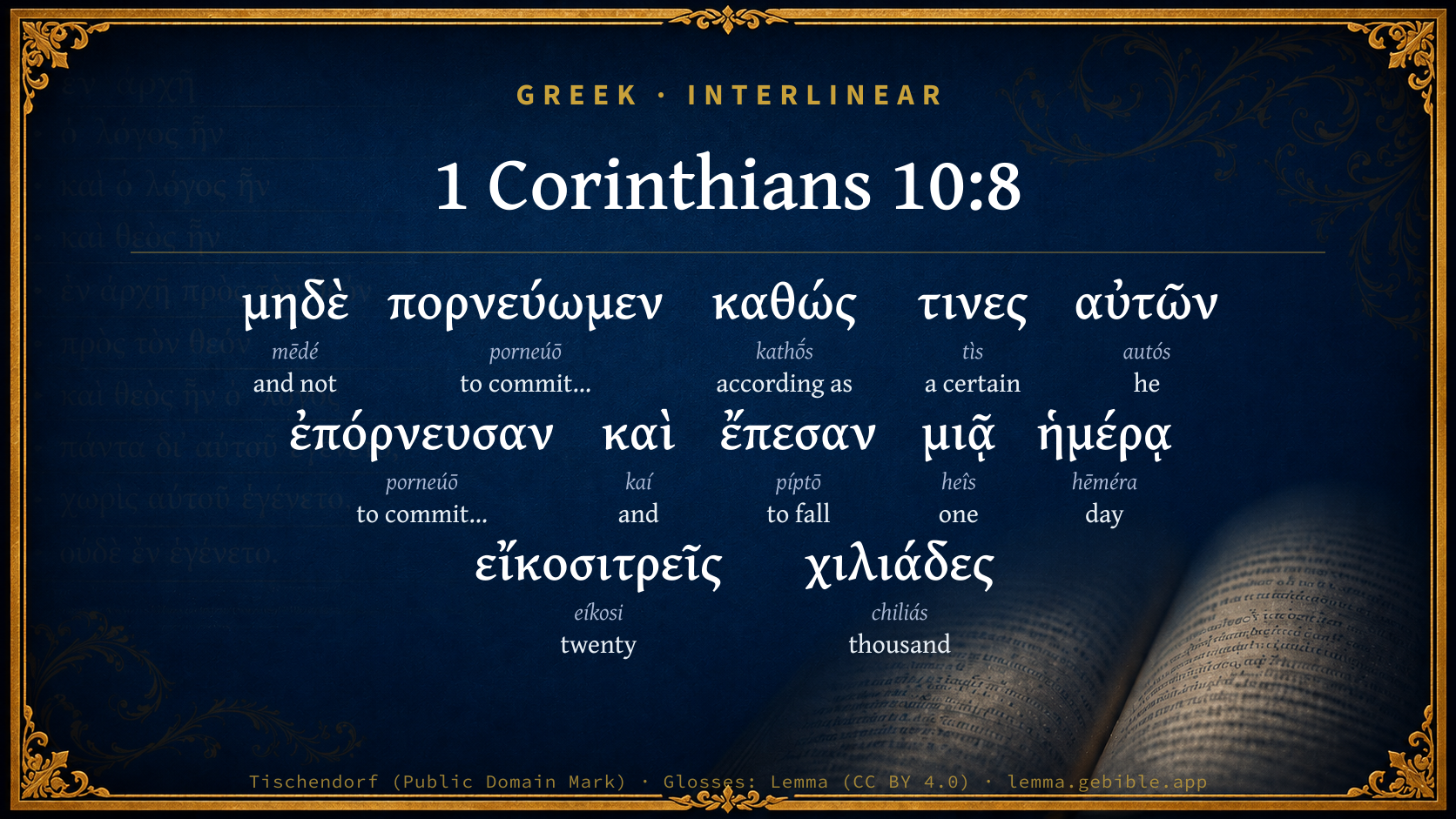
Greek (Tischendorf 8th ed.) 1 Corinthians 10:8 appears in the Greek New Testament. The text above is from the Tischendorf 8th edition. Each word links to its Strong’s number and a concise gloss. Click any word for its full Thayer’s Greek Lexicon entry.
Download image
Cite this verse

1 Corinthians 10:8 (World English Bible). Public Domain. Lemma interlinear Bible study tool, https://lemma.gebible.app/v/1-corinthians/10/8.

Show BibTeX & RIS
BibTeX
RIS
English Translation
Neither let us commit sexual immorality, as some of them committed, and in one day twenty-three thousand fell.
World English Bible · Public Domain
Download a study sheet

One document with this verse’s original text, its word-by-word gloss line, the meaning frame, cross-references with their text, attributed commentary, and full source and license credits — printable, and it pastes into notes with its structure intact.

This verse Autodidact and up

Study sheet (.html) Plain text (.txt)

A passage Seminary Student

Up to 50 verses in one chapter. A passage sheet keeps up to 6 commentary sources and 12 cross-references per verse, in the order this page ranks them, and says so on the sheet whenever that leaves anything out. Ask for a single verse and you get the Autodidact verse sheet above.

Everything on this page stays free to read, with no account — the sheet is a download of what is already on screen, not access to it.

Want to remove ads? Support Godless Engineer
Compare translations 3

The same verse in 3 English versions, stacked beneath the original-language interlinear above. Click any original word for its lexicon entry.

Each is an independent rendering of the whole verse — the interlinear is not word-aligned to these translations.

Highlighted words mark where these versions differ — a whole-verse word diff, not a word-by-word alignment.

  • World English Bible Public Domain
    Neither let us commit sexual immorality, as some of them committed, and in one day twenty-three thousand fell.
  • King James Version Public Domain
    Neither let us commit fornication, as some of them committed, and fell in one day three and twenty thousand.
  • unfoldingWord Literal Text CC BY-SA 4.0
    Nor should we commit sexual immorality, just as many of them committed sexual immorality, and 23,000 people fell in one day.

unfoldingWord Literal Text — © unfoldingWord, licensed CC BY-SA 4.0. Word-aligned USFM3 via Door43 (git.door43.org/unfoldingWord/en_ult).

Versions to compare (up to 4)

3 of 4 selected

Show all 19 translations

Every available English version of this verse, each an independent rendering of the whole verse.

  • World English Bible Public Domain
    Neither let us commit sexual immorality, as some of them committed, and in one day twenty-three thousand fell.
  • Berean Standard Bible Public Domain
    We should not commit sexual immorality, as some of them did, and in one day twenty-three thousand of them died.
  • Majority Standard Bible Public Domain
    We should not commit sexual immorality, as some of them did, and in one day twenty-three thousand of them died.
  • King James Version Public Domain
    Neither let us commit fornication, as some of them committed, and fell in one day three and twenty thousand.
  • American Standard Version (1901) Public Domain
    Neither let us commit fornication, as some of them committed, and fell in one day three and twenty thousand.
  • Revised Version (1885) Public Domain
    Neither let us commit fornication, as some of them committed, and fell in one day three and twenty thousand.
  • Geneva Bible (1599) Public Domain
    Neither let vs commit fornication, as some of them committed fornication, and fell in one day three and twentie thousand.
  • Douay-Rheims (1899) Public Domain
    Neither let us commit fornication, as some of them committed fornication, and there fell in one day three and twenty thousand.
  • Young's Literal Translation Public Domain
    neither may we commit whoredom, as certain of them did commit whoredom, and there fell in one day twenty-three thousand;
  • Literal Standard Version CC BY-SA 4.0
    neither may we commit whoredom, as certain of them committed whoredom, and there fell in one day twenty-three thousand;
  • Unlocked Literal Bible CC BY-SA 4.0
    Let us not commit sexual immorality, as many of them did. In one day, twenty-three thousand people died because of it.
  • unfoldingWord Literal Text CC BY-SA 4.0
    Nor should we commit sexual immorality, just as many of them committed sexual immorality, and 23,000 people fell in one day.
  • Darby Bible Public Domain
    Neither let us commit fornication, as some of them committed fornication, and fell in one day three and twenty thousand.
  • World Messianic Bible Public Domain
    Let’s not commit sexual immorality, as some of them committed, and in one day twenty-three thousand fell.
  • Webster's Bible Public Domain
    Neither let us commit lewdness, as some of them committed, and fell in one day three and twenty thousand.
  • Free Bible Version CC BY-SA 4.0
    We must not commit sexual sins, as some of them did, and as a result 23,000 died in one day.
  • Bible in Basic English Public Domain
    Again, let us not give way to the desires of the flesh, as some of them did, of whom twenty-three thousand came to their end in one day.
  • Text-Critical English NT CC BY 4.0
    We must not commit fornication as some of them did, and in a single day twenty-three thousand of them died.
  • Tyndale New Testament (1534) Public Domain
    Nether let vs comit fornicacion as some of them committed fornicacion and were destroyed in one daye.xxiii. thousande.

Literal Standard Version (2020), Covenant Press — licensed CC BY-SA 4.0. Text via the HelloAO Bible API (eBible.org). Unlocked Literal Bible (unfoldingWord) — licensed CC BY-SA 4.0. Text via the HelloAO Bible API (eBible.org). unfoldingWord Literal Text — © unfoldingWord, licensed CC BY-SA 4.0. Word-aligned USFM3 via Door43 (git.door43.org/unfoldingWord/en_ult). Free Bible Version, Dr. Jonathan Gallagher — licensed CC BY-SA 4.0. Text via the HelloAO Bible API (eBible.org).

Word by word

More ways to search: Search by grammar → Find every occurrence → Compare this word →

Practice this passage: Drill this verse → Learn its vocabulary →

πορνεύωμεν
porneúō
G4203
“to commit immorality”
Verb, Present, Active, Subjunctive, 1st person, Plural
Part of Speech
Verb
Tense
Present
Voice
Active
Mood
Subjunctive
Person
1st person
Number
Plural
Full Thayer's Definition

Origin: from G4204

TDNT: 15:39,9

1. to prostitute one's body to the lust of another 2. to give one's self to unlawful sexual intercourse a. to commit fornication 3. metaph. to be given to idolatry, to worship idols a. to permit one's self to be drawn away by another into idolatry
  1. μηδὲ mēdé G3366 “and not” Conjunction, Negative
  2. καθώς kathṓs G2531 “according as” Adverb
  3. τινες tìs G5100 “a certain” Indefinite pronoun, Nominative, Plural, Masculine
  4. αὐτῶν autós G846 “he” Personal pronoun, Genitive, Plural, Masculine
  5. ἐπόρνευσαν porneúō G4203 “to commit immorality” Verb, Aorist, Active, Indicative, 3rd person, Plural
  6. καὶ kaí G2532 “and” Conjunction
  7. ἔπεσαν píptō G4098 “to fall” Verb, Aorist, Active, Indicative, 3rd person, Plural
  8. μιᾷ heîs G1520 “one” Adjective, Dative, Singular, Feminine
  9. ἡμέρᾳ hēméra G2250 “day” Noun, Dative, Singular, Feminine
  10. εἴκοσιτρεῖς eíkosi G1501 “twenty” Adjective, Nominative, Plural, Feminine
  11. χιλιάδες chiliás G5505 “thousand” Noun, Nominative, Plural, Feminine

About this verse

These counts appear in no published source. They are computed here, from the morphology-tagged text and Lemma’s own curated glosses. What Lemma adds →

12
words
11
distinct lemmas
Pauline Epistles
section

Notable vocabulary

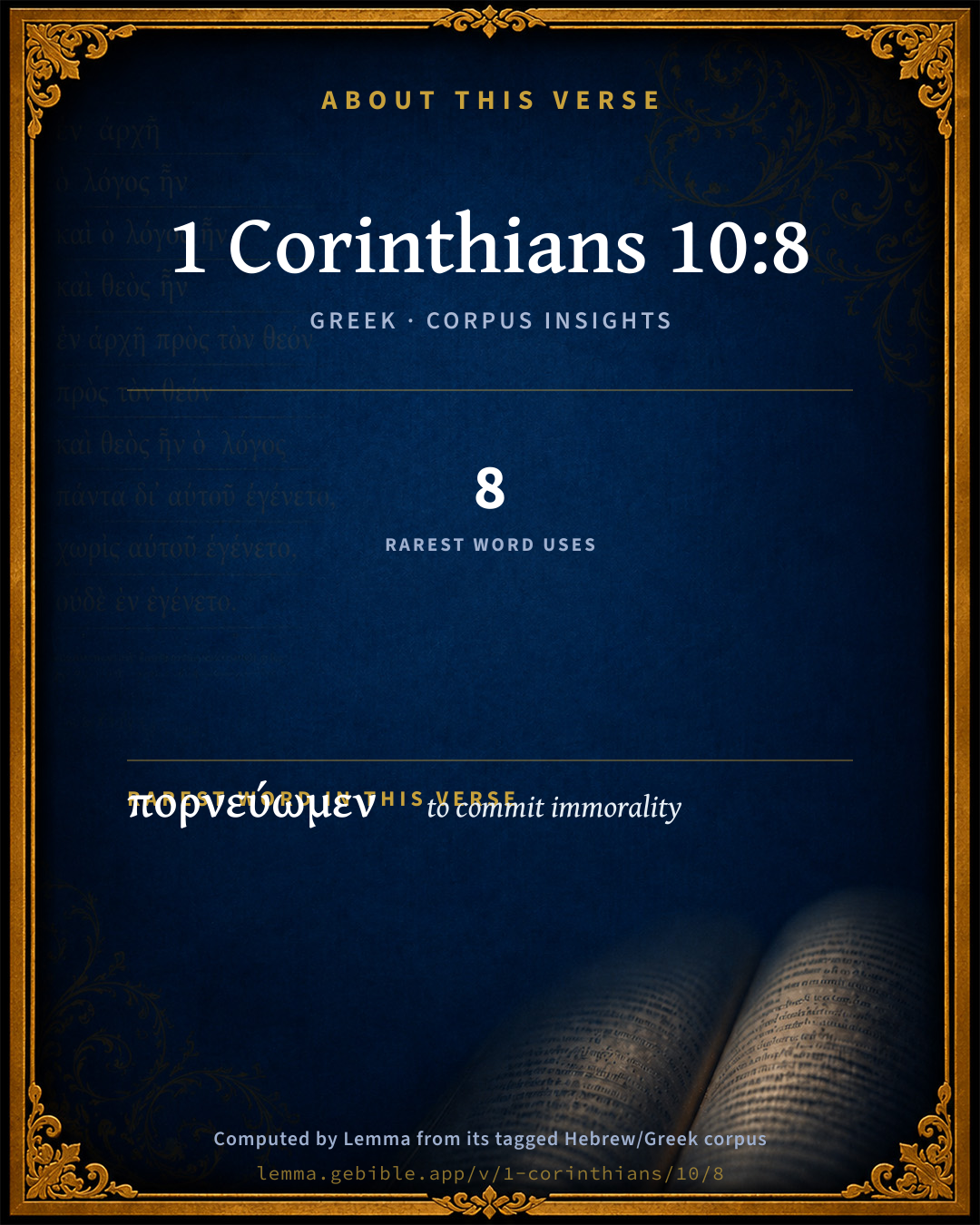
The rarest word here is πορνεύωμεν to commit immorality G4203 — appearing just 8 times in the whole Greek New Testament.

Shared distinctive vocabulary

πορνεύωμεν to commit immorality G4203 occurs in 7 verses of the Greek New Testament. Also found in:

Repetition

A word recurs within this verse:

  • πορνεύωμεν to commit immorality G4203 ×2
Cross-references

5

Topical passages linked to 1 Corinthians 10:8 in the Treasury of Scripture Knowledge — connected by theme and wording, ordered by reader-vote popularity; previews shown in the World English Bible.

  • Numbers 25:1–9 Israel abode in Shittim; and the people began to play the prostitute with the daughters of Moab:
  • 1 Corinthians 6:18 Flee sexual immorality! "Every sin that a man does is outside the body," but he who commits sexual immorality sins against his own body.
  • Psalms 106:29 Thus they provoked him to anger with their deeds. The plague broke in on them.
  • 1 Corinthians 6:9 Or don't you know that the unrighteous will not inherit the Kingdom of God? Don't be deceived. Neither the sexually immoral, nor idolaters, nor adulterers, nor male prostitutes, nor homosexuals,
  • Revelation 2:14 But I have a few things against you, because you have there some who hold the teaching of Balaam, who taught Balak to throw a stumbling block before the children of Israel, to eat things sacrificed to idols, and to commit sexual immorality.

Cross-references courtesy of OpenBible.info (CC BY 4.0).

Commentary

Notes on 1 Corinthians 10:8 from classic Christian and Jewish commentators (each source and its license shown beneath its notes). The classic Christian expositions comment on the surrounding passage and are grouped to its opening verse, so a note may address several verses; the Jewish commentaries on the Tanakh (Rashi and others) are per-verse, so they appear only where the commentator wrote on this verse.

Lemma curates 59 commentaries, every one of them public domain or Creative Commons licensed, each selected and text-cleaned for this edition rather than reprinted as found. About our sources →

Scofield Reference Notes

C. I. Scofield

fell in one day

Cf. Num 25:9. A discrepancy has been imagined. 1Co 10:8. gives the number of deaths in "one day"; Num 25:9, the total number of deaths "in the plague." Some discrepant statements concerning numbers are, however, found in the existing manuscripts of the Hebrew Scriptures. These are most naturally ascribed to the fact that the Hebrews used letters in the place of numerals. The letters for Koph to Tau express hundreds up to four hundred. Five certain Hebrew letters, written in a different form, carry hundreds up to nine hundred, while thousands are expressed by two dots over the proper unit letter: e.g. the letter Teth, used alone, stands for 9; with two dots it stands for nine thousand. Error in transcription of Hebrew numbers thus becomes easy, preservation of numerical accuracy difficult.

The Scofield Reference Bible (1917 edition), notes by C. I. Scofield — public domain. Text from a community e-Sword module.

Tyndale Open Study Notes

Tyndale Open Resources

10:8 See Num 25:1-9.

Tyndale Open Study Notes — © Tyndale Open Resources, licensed CC BY-SA 4.0. Text via the HelloAO Bible API.

Bengel's Gnomon

Johann Albrecht Bengel

1Co 10:8. Ἐπόρνευσαν, committed fornication) Num 25:1.—εἴκοσι τρεῖς χιλιάδες, twenty-three thousand) They are said to have been twenty-four thousand, Num 25:9. A stroke from God swept them away; but besides, the princes [“the heads of the people,” Num 25:4] were hanged, and the judges were commanded to put to death their men, over whom they presided, who had been joined to Baal-peor. Moses as well as Paul gives the number of them, whom the plague itself of that day destroyed. Why then does Paul subtract a thousand? The precise number of the dead, we may suppose, was between the round numbers, 23,000, and 24,000, say 23,600, and had been known by tradition. We do not follow the subtilties of other interpreters.

Bengel's Gnomon of the New Testament — English translation (T&T Clark, Edinburgh, 1860) — public domain. Text from a community e-Sword module.

Meyer's Critical & Exegetical Commentary

Heinrich August Wilhelm Meyer

1Co_10:8. Ἐπόρνευσαν] Num_25:1 ff.

εἴκοσι τρεῖς] According to Num_25:9, there were 24,000. So too Philo, de vit. Mos. 1, p. 694 A; de fortit. p. 742 D; and the Rabbins in Lightfoot, Horae, p. 205; also Josephus, Antt. iv. 6. 12. A slip of memory on the apostles part, as might easily take place, so that there is no need of supposing a variation in the tradition (Bengel, Pott), or an error in his copy of the LXX. (Ewald). Among the arbitrary attempts at reconciliation which have been made are the following: that Paul narrates only what happened on one day, Moses what happened on two (Grotius); that Moses gives the maximum, Paul the minimum (Calvin, Bengel); that 23,000 fell vi divina, and 1000 gladio zelotarum (Krebs, after Bernard and Havercamp on Josephus, loc. cit.); that Paul states merely what befell the tribe of Simeon (Michaelis). Cajetanus and Surenhusius would have us read εἴκοσι τέσσαρες, as, in point of fact, is given in a few codd[1601], but manifestly by way of correction. Osiander too leans to this; comp Valckenaer.

[1601] odd. codices or manuscripts. The uncial manuscripts are denoted by the usual letters, the Sinaitic by א.

Meyer — Critical and Exegetical Commentary on the New Testament — English translation by Peter Christie, edited by Frederick Crombie (T&T Clark, 1880) — public domain. Text from a community e-Sword module.

Expositor's Greek Testament

ed. W. Robertson Nicoll

1Co 10:8 . μηδὲ πορνεύωμεν : here P. comes closer to his readers, adopting the communicative 1st pl [1438] For the prevalence of this vice at Cor [1439] and its connexion with Cor [1440] idolatry, see 1Co 7:2 , 1Co 6:11 , and Introd ., p. 734 ( cf. Num 25:1 f. also Rev 2:14 ); for its existence in the Cor [1441] Church, ch. 5. above, and 2Co 12:21 . Wis 14:12 affirms, of idolatry at large, ἀρχὴ πορνείας ἐπίνοια εἰδώλων ; see the connexion of Rom 1:24 with the foregoing context. “23,000” is a curious variation from the figure given in Num 25:9 for the slain of Baal-Peor, which is followed by other Jewish authorities, vix., 24,000. It is more respectful to credit the Ap. with a trifling inadvertence than to suppose, with Gd [1442] , that he makes a deliberate understatement to be within the mark. Ev [1443] gives no evidence for his alleged “Jewish tradition” in support of the reduced estimate. Possibly, a primitive error of the copyist, substituting γʹ for δʹ (Hn [1444] ).

[1438] plural.

[1439] Corinth, Corinthian or Corinthians.

[1440] Corinth, Corinthian or Corinthians.

[1441] Corinth, Corinthian or Corinthians.

[1442] F. Godet’s Commentaire sur la prem. Ép. aux Corinthiens (Eng. Trans.).

[1443] T. S. Evans in Speaker’s Commentary .

[1444] C. F. G. Heinrici’s Erklärung der Korintherbriefe (1880), or 1 Korinther in Meyer’s krit.-exegetisches Kommentar (1896).

The Expositor's Greek Testament, edited by W. Robertson Nicoll (1897–1910) — public domain. Text from a community e-Sword module.

Hodge's Commentary on Romans, Ephesians & First Corinthians

Charles Hodge

1Co_10:8

Neither let us commit fornication, as some of them committed, and fell in one day three and twenty thousand.

Idolatry and fornication have always been so intimately connected that the former seldom fails to lead to the latter. This was illustrated in the case of the Israelites. Num_25:1-9, And the people began to commit whoredom with the daughters of Moab; and they called the people unto the sacrifices of their gods …. And Israel joined himself unto Baal-peor. This was a God of the Moabites, who was worshipped by the prostitution of virgins. Idolatry and fornication were in that case inseparable. In Corinth the principal temple was dedicated to Venus, and the homage paid to her was almost as corrupt as that rendered to Baal-peor. How could the Corinthians escape this evil if they allowed themselves to attend the sacrificial feasts within her temple under the pretense that an idol is nothing?

And were slain in one day three and twenty thousand. In the Hebrew Scriptures, the Septuagint, by Philo, Josephus and the Rabbis, the number is given as twenty-four thousand. Both statements are equally correct. Nothing depended on the precise number. Any number between the two amounts may, according to common usage, be stated roundly as either the one or the other. The infallibility of the sacred writers consists in their saying precisely what the Spirit of God designed they should say; and the Spirit designed that they should speak after the manner of men and call the heavens solid and the earth flat, and use round numbers, without intemen in their circumstances would have spoken and written, and yet under such an influence as to make every thing they said correspond infallibly with the mind of the Spirit. When the hand of a master touches the organ we have one sound, and when he touches the harp we have another. So when the Spirit of God inspired Isaiah we had one strain, and when he inspired Amos, another. Moses and Paul were accustomed, like most other men, to use round numbers; and they used them when under the influence of inspiration just as they used other familiar forms of statement. Neither intended to speak with numerical exactness, which the occasion did not require. What a wonderful book is the Bible, written at intervals during a period of fifteen hundred years, when such apparitions of inaccuracy as this must be seized upon to impeach its infallibility!

Charles Hodge — Commentary on Romans (1835), First Corinthians (1857), and Ephesians (1856) — public domain. Text from a community e-Sword module.

Jamieson, Fausset & Brown

Robert Jamieson, A. R. Fausset & David Brown

fornication--literally, Fornication was generally, as in this case (Num. 25:1-18), associated at the idol feasts with spiritual fornication, that is, idolatry. This all applied to the Corinthians (Co1 5:1, Co1 5:9; Co1 6:9, Co1 6:15, Co1 6:18; Co1 8:10). Balaam tempted Israel to both sins with Midian (Rev 2:14). Compare Co1 8:7, Co1 8:9, "stumbling-block," "eat . . . thing offered unto . . . idol."

three and twenty thousand--in Num 25:9 "twenty and four thousand." If this were a real discrepancy, it would militate rather against inspiration of the subject matter and thought, than against verbal inspiration. The solution is: Moses in Numbers includes all who died "in the plague"; Paul, all who died "in one day"; one thousand more may have fallen the next day [KITTO, Biblical Cyclopædia]. Or, the real number may have been between twenty-three thousand and twenty-four thousand, say twenty-three thousand five hundred, or twenty-three thousand six hundred; when writing generally where the exact figures were not needed, one writer might quite veraciously give one of the two round numbers near the exact one, and the other writer the other [BENGEL]. Whichever be the true way of reconciling the seeming discrepant statements, at least the ways given above prove they are not really irreconcilable.

Jamieson, Fausset & Brown — Commentary Critical and Explanatory on the Whole Bible (1871) — public domain (CC PDM 1.0). Text via the HelloAO Bible API.

Adam Clarke's Commentary

Verse 8. Fell in one day three and twenty thousand.] In Nu 25:9, the number is 24,000; and, allowing this to be the genuine reading, (and none of the Hebrew MSS. exhibit any various reading in the place,) Moses and the apostle may be thus reconciled: in Nu 25:4, God commands Moses to take all the heads (the rulers) of the people, and hang them up before the Lord against the sun; these possibly amounted to 1000, and those who fell by the plague were 23,000, so that the whole amounted to 24,000. Instead of εικοσιτρεις χιλιαδες, 23,000, two MSS., with the later Syriac and the Armenian, have εικοσιτεσσαρες χιλιαδες, 24,000; but this authority is too slender to establish a various reading, which recedes so much from the received text. I think the discordance may be best accounted for by supposing, as above, that Phineas and his companions might have slain 1000 men, who were heads of the people, and chief in this idolatry; and that the plague sent from the Lord destroyed 23,000 more; so an equal number to the whole tribe of Levi perished in one day, who were just 23,000. See Nu 26:62; and see Lightfoot.

Adam Clarke's Commentary on the Bible (1810–1826) — public domain. Text from a community e-Sword/MySword module.

John Calvin's Commentaries

8. Neither let us commit fornication Now he speaks of fornication, in respect of which, as appears from historical accounts, great licentiousness prevailed among the Corinthians, and we may readily infer from what goes before, that those who had professed themselves to be Christ’s were not yet altogether free from this vice. The punishment of this vice, also, ought to alarm us, and lead us to bear in mind, how loathsome impure lusts are to God, for there perished in one day twenty-three thousand, or as Moses says, twenty-four. Though they differ as to number, it is easy to reconcile them, as it is no unusual thing, when it is not intended to number exactly and minutely each head, to put down a number that comes near it, as among the Romans there were those that received the name of Centumviri, (The Hundred,) while in reality there were two above the hundred. As there were, therefore, about twenty-four thousand that were overthrown by the Lord’s hand — that is, above twenty-three, Moses has set down the number above the mark, and Paul, the number below it, and in this way there is in reality no difference. This history is recorded in Numbers 25:9

There remains, however, one difficulty here — why it is that Paul attributes this punishment to fornication, while Moses relates that the anger of God was aroused against the people on this account — that they had initiated themselves in the sacred rites of Baalpeor. But as the defection began with fornication, and the children of Israel fell into that impiety, not so much from being influenced by religious considerations, as from being allured by the enticements of harlots, everything evil that followed from it ought to be attributed to fornication. For Balaam had given this counsel, that the Midianites should prostitute their daughters to the Israelites, with the view of estranging them from the true worship of God. Nay more, their excessive blindness, in allowing themselves to be drawn into impiety by the enticements of harlots, was the punishment of lust. Let us learn, accordingly, that fornication is no light offense, which was punished on that occasion by God so severely and indeed in a variety of ways.

John Calvin's Commentaries (1540-1563) — public domain. Text from the Calvin Translation Society English edition (1840s-50s) via the Christian Classics Ethereal Library (ccel.org). Calvin's coverage is partial (roughly two-thirds of the Bible); uncommented books and verses are honest gaps, never fabricated. The 19th-century editor's footnotes and remarks are omitted so the notes are faithfully Calvin's own voice.

Ellicott's Commentary for English Readers

(8) And fell in one day three and twenty thousand.—In Num_25:9 the statement is that twenty-four thousand perished. Various and ingenious attempts have been made to reconcile these two accounts of the actual numbers. The explanation most in harmony with the character of the writer, and the utterly unessential nature of the point historically, is, I venture to think, that either the Apostle quoted from memory a fact of no great importance, or else that he referred for his figures to some copy of the LXX., in which the numbers might be specified as here.

A Bible Commentary for English Readers, edited by Charles John Ellicott (1878–1897) — public domain. Text from a community e-Sword module.

The Cambridge Bible for Schools and Colleges

gen. ed. J. J. S. Perowne

8. Neither let us commit fornication] i.e. the natural result of joining in the impure worship of Ashtaroth, or Astarte, the Syrian Venus. The temple of Aphrodite, on the Acro-Corinthus, contained a thousand priestesses devoted to the same licentious worship. See Introduction. The warning in the text was, therefore, by no means needless. The occasion referred to is that related in Num_25:1-6.

three and twenty thousand] In Num_25:9 we find 24,000. The actual number would no doubt be between the two, so that both here and in the book of Numbers only round numbers are given. “Our Apostle saith not definitely three and twenty thousand perished, but three and twenty thousand at the least.” Lightfoot.

The Cambridge Bible for Schools and Colleges (gen. ed. J. J. S. Perowne; Cambridge University Press, 1878–1918) — public domain. Text from a community e-Sword module.

John Gill's Exposition

Neither let us commit fornication,.... To which the Corinthians were much addicted: hence the apostle elsewhere, in this epistle, makes use of arguments, to dissuade from it, as he does here, they judging it to be no evil:

as some of them committed; i.e. fornication; as they did at Shittim, with the daughters of Moab, Num 25:1 which was a stratagem of Balaam's, and the advice he gave to Balak king of Moab, to draw them into that sin, which made way for their commission of idolatry, which they committed by eating the sacrifices of their gods, and bowing down unto them; particularly they joined themselves to Baal Peor, the same with Priapus, one part of whose religious rites lay in acts of uncleanness, and this brought the divine displeasure on them:

and fell in one day three and twenty thousand; in Num 25:9 the number said to be "twenty and four thousand": and so say all the three Targums on the place (w), and both the Talmuds (x) and others (y); on the other hand, all the Greek copies of this epistle, and the Oriental versions, agree in the number of twenty and three thousand; so that it does not appear to be any mistake of copies, in either Testament. To reconcile this matter, or at least to abate the difficulties of it, let the following things be observed; as that the apostle does not write as an historian, and so not with that exactness as Moses did; besides, he does not say that there fell "only" three and twenty thousand, and this beings lesser number than is contained in his, and so a certain truth; moreover, Moses and the apostle use different words in their account; Moses says there died so many, including the heads of the people that were hanged up against the sun, and all that perished by the sword; the apostle says, that there fell such a number, referring only to the latter, who only could be properly said to fall, and not those that were hanged up: now the heads of the people that suffered the first kind of death, might, as is very probable, be a thousand; and they that died in the other way, three and twenty thousand, which make the sums to agree, and both are expressed by Moses, under the general name of a plague or stroke; to all this, that the apostle uses a limiting clause, which Moses does not, and says that these three and twenty thousand fell in one day. So that it is very likely that the heads of the people, supposed to be a thousand, were hanged up in one day; and the three and twenty thousand that fell by the sword died the next, which the apostle only takes notice of. Hence the Jew (z) has no reason to charge the apostle with an error.

(w) Targum Onkelos, Jon. ben Uzziel & Jerusalem in Numb, xxv. 9. (x) T. Hieros Sota, fol. 21. 4. T. Bab. Sanhedrin, fol. 106. 1. (y) Midrash Kohelet, fol. 68. 4. Tzeror Hammor, fol. 127. 3. (z) R. Isaac Chizzuk Emuna, par. 2. c. 36. p. 468.

John Gill's Exposition of the Whole Bible (1746–1763) — public domain (CC PDM 1.0). Text via the HelloAO Bible API.

Trapp's Complete Commentary

John Trapp

8 Neither let us commit fornication, as some of them committed, and fell in one day three and twenty thousand.

Ver. 8. And fell in one day] The apostle, instead of the cloak of heat of youth, puts upon fornication a bloody cloak, bathed in the blood of twenty-three thousand. (Knewstub. on Com. 7.)

Three and twenty thousand] Moses mentions 24,000, whereof one thousand were the chief princes, the others inferiors, provoked to sin by their example. But why doth the apostle insist in the special punishment of the people? To show (saith learned Junius) how frigid and insufficient their excuse is, that pretend for their sins the examples of their superiors.

John Trapp, A Commentary or Exposition upon All the Books of the Old and New Testament (1647–1656) — public domain. Text from a community e-Sword module.

Albert Barnes' Notes on the Bible

Neither let us commit fornication ... - The case referred to here was that of the licentious contact with the daughters of Moab, referred to in Num 25:1-9.

And fell in one day - Were slain for their sin by the plague that prevailed.

Three and twenty thousand - The Hebrew text in Num 25:9, is twenty-four thousand. In order to reconcile these statements, it may be observed that perhaps 23,000 fell directly by the plague, and 1,000 were slain by Phinehas and his companions (Grotius); or it may be that the number was between 23,000 and 24,000, and it might be expressed in round numbers by either - Macknight. At all events, Paul has not exceeded the truth. There were at least 23,000 that fell, though there might have been more. The probable supposition is, that the 23,000 fell immediately by the hand of God in the plague, and the other thousand by the judges; and as Paul’s design was particularly to mention the proofs of the immediate divine displeasure, he refers only to those who fell by that, in illustration of his subject - There was a particular reason for this caution in respect to licentiousness:

(1) It was common among all idolaters; and Paul in cautioning them against idolatry, would naturally warn them of this danger.

(2) It was common at Corinth. It was the prevalent vice there. To “Corinthianize” was a term synonymous among the ancients with licentiousness.

(3) So common was this at Corinth, that, as we have seen (see the introduction), not less than 1,000 prostitutes were supported in a single temple there; and the city was visited by vast multitudes of foreigners, among other reasons on account of its facilities for this sin. Christians, therefore, were in a special manner exposed to it; and hence, the anxiety of the apostle to warn them against it.

Albert Barnes' Notes on the Bible (1834–1885) — public domain. Text from a community e-Sword/MySword module.

Matthew Poole's English Annotations

The story to which this verse relates is that, Num 25:1-9. When Balaam could not curse the Israelites, he advised the debauching of them by the Moabitish women, first enticing them to fornication and adultery, then to idolatry: and they were enticed, which caused a plague amongst them, which destroyed amongst them

in one day three and twenty thousand, saith our apostle: Moses saith, that there died twenty and four thousand. There are many guesses for the clearing of that seeming contradiction. Some say, that Moses mentioneth not one day, there might in all die twenty-four thousand, but not all the same day, nor possibly by the same death. But nothing is in Scripture more ordinary, than to speak of things or persons in round numbers, though something over or under; and also to speak according to the common reckoning of people, who also may talk variously. Some might report twenty-three, some twenty-four thousand: or possibly Paul chose to mention the lesser rather than the greater round number. The sense of Moses might be, about twenty-four thousand, or near up to that number, all of which probably had not been guilty of adultery or fornication. Paul saith, there died twenty-three thousand. If there did die twenty-four thousand, there must needs die twenty-three thousand.

Matthew Poole's English Annotations on the Holy Bible (1683–1685) — public domain. Text from a community e-Sword/MySword module.

Whedon's Commentary on the Bible

Daniel D. Whedon

8. Let us—Paul, perhaps, reverts here to the first person from delicacy.

Fornication—Any illicit sexual connexion. This caution well follows next after that against idolatry; for the idol rites consisted largely of debauchery, as is illustrated by the case to which Paul now refers.

Committed—While the Israelites yet sojourned on the east side of the Jordan, the Moabite women first invited them to their sacrificial banquets, and thereby seduced them to whoredom. Numbers 25. The worship of the Corinthian Venus was of precisely the same kind; in which debauchery was consecrated as a religious rite. How liable the Corinthian Christians were to that sort of seduction the case of the incestuous man indicates.

Three and twenty thousand—The Old Testament (Num_25:9) says, four and twenty thousand. Scholars generally admit that Paul wrote as this present text stands; and many, as Alford and Kling, treat it as a failure of apostolic memory. Alford considers it discreditable to maintain any other view. Grotius reconciles the contradiction by supposing that the twenty-three thousand were slain by the plague and one thousand by Phinehas and his fellows. Wordsworth supposes that Paul gives the number who fell in the single day, while Numbers gives all that fell in consequence of the crime. Bengel supposes, that both accounts giving only the round numbers, the exact count might be between the two, and so both numbers be equally correct. Of course no moral truth is affected by the variance.

Daniel D. Whedon (gen. ed.), Commentary on the Old and New Testaments (1874–1909) — public domain. Text from a community e-Sword module.

The Pulpit Commentary

Commit fornication. This sin was not only an ordinary accompaniment of idolatry, but often a consecrated part of it, as in the case of the thousand hierodouloi, or female attendants, in the temple of Aphrodite on Acro-Corinthus. Three and twenty thousand. The number given in Num_25:9 is twenty-four thousand. We cannot give any account of the discrepancy, which is, however, quite unimportant.

The Pulpit Commentary (1880–1919), ed. H.D.M. Spence-Jones & Joseph S. Exell — public domain. Text from a community e-Sword module.

John Wesley's Explanatory Notes

And fell in one day three and twenty thousand - Beside the princes who were afterwards hanged, and those whom the Judges slew so that there died in all four and twenty thousand. Num. xxv, 1, 9.

John Wesley, Explanatory Notes Upon the Whole Bible (1754–1765) — public domain. Text via the GEBible commentary corpus.

Godbey's Commentary on the New Testament

William B. Godbey

8. “Neither let us commit fornication, as some of them committed fornication, and fell in one day twenty-three thousand.” All deflection from God after the world is spiritual fornication, whose sweeping spiritual ruin is here vividly symbolized by twenty-three thousand in one day dropping dead. When churches reject sanctification, they always go after worldly gods, i. e., side-track away into spiritual fornication, as sanctification is simple holy wedlock with Jesus, which the Holy Ghost wants to celebrate, every recusant of course deciding in favor of rival lovers inimical to Jesus. The reason why we see the wholesale apostasy in all denominations is because God has brought on them the test of the Holiness gospel. Hence they are bound to receive it or backslide. Perhaps the Jews would have remained loyal to Jehovah many centuries if He had not sent to them His Son, who became to them an immediate stumbling block, because they rejected Him, then and there apostatizing and becoming a hiss and by-word in all the earth, rejected of God and reprobated.

William B. Godbey, Commentary on the New Testament (1896–1900) — public domain. Text from a community e-Sword module.

McGarvey & Pendleton's Commentaries

J. W. McGarvey

Neither let us commit fornication, as some of them committed, and fell in one day three and twenty thousand . [ Num_25:1-9 . While Paul gives the number as twenty-three thousand, Moses gives it as twenty-four. Alford and Kling think the discrepancy is due to a failure in Paul's memory, but why should the Spirit of God let him thus forget? Grotius says that a thousand were slain by Phinehas and his followers, and the rest were destroyed by the plague. Kitto varies this a little by saying that Paul gives the number that fell on one day, as his words show, while Moses gives the full number that perished on both days. But Bengel's solution is a sufficient one. The Hebrews habitually dealt in round numbers, so that a number between twenty-three and twenty-four thousand could be correctly stated by either figure. Moses gave the maximum and Paul the minimum. The sin mentioned was not only an ordinary accompaniment of idolatry, but often a consecrated part of it, as in the rites of Baal-peor among the Moabites and those of Venus among the Corinthians. Sins are gregarious.]

J. W. McGarvey (with Philip Y. Pendleton), Commentaries on the New Testament (The Fourfold Gospel, 1914; Acts; and the epistles) — public domain. Text from a community e-Sword/MySword module.

The People's New Testament

B. W. Johnson

8. Neither let us commit fornication, etc. The fornication with the Midianites (Num. 25:1–9). It is stated that 24,000 lost their lives. Paul names 23,000 as the number who lost their lives by the plague. The number was no doubt between 23,000 and 24,000, and is stated in each place by a round sum, according to Jewish custom, Paul naming the smaller. Fornication was also one of the besetting sins of Corinth.

B. W. Johnson's The People's New Testament with Notes (1889–1891) — public domain. Electronic text from the Christian Classics Ethereal Library (CCEL) ThML edition.

Cambridge Greek Testament for Schools and Colleges

8. πορνεύωμεν, i.e. the natural result of joining in the impure worship of Ashtaroth, or Astarte, the Syrian Venus. The temple of Aphrodite, on the AcroCorinthus, contained a thousand priestesses devoted to the same licentious worship. See Introduction. The warning in the text was, therefore, by no means needless. The occasion referred to is that related in Num 25:1-6.

εἰκοσιτρεῖς χιλιἀδες. In Num 25:9 we find 24,000. The actual number would no doubt be between the two, so that both here and in the book of Numbers only round numbers are given. ‘Our Apostle saith not definitely three and twenty thousand perished, but three and twenty thousand at the least.’ Lightfoot.

Cambridge Greek Testament for Schools and Colleges (Cambridge University Press, 1896; 21 vols, various authors incl. Carr, Maclear, Plummer, Farrar, Lumby, Moule, M. R. James, Simcox) — public domain. Text from a community e-Sword module.

Alford’s Greek Testament

Henry Alford

8.] Another prominent point in the sins of the Corinthian church.

εἰκοσιτρεῖς χ.] The number was twenty-four thousand, Num 25:9, and is probably set down here from memory. The subtilties of Commentators in order to escape the inference, are discreditable alike to themselves and the cause of sacred Truth. Of the principal ancient Commentators, Chrysostom and Theophyl. do not notice the discrepancy: Œcum. notices it, and says that some ancient copies εἰκοσιτέσσαρας ἔθεσαν here (so m tol syr-txt arm), but passes it without comment.

Although the sin of Baal-peor was strictly speaking idolatry, yet the form which it exhibited was that of fornication, as incident to idolatrous feasting, see Num 25:1, Num 25:2. Thus it becomes even more directly applicable to the case of the Corinthians.

Henry Alford, The Greek Testament (1849–1861) — public domain. Text from a community e-Sword module.

International Critical Commentary

8. The relationship of idol-worship and fornication is often very close, and was specially so at Corinth (Jowett, ‘On the Connexion of Immorality and Idolatry,’ Epp. of St Paul, 2. p. 70). Hence fornication is taken as the second instance of lusting after evil things. In the matter of Baal-Peor (Num 25:1-9), to which allusion is made here, it was the intimacy with the strange women which led to participation in the idolatrous feasts, not vice versa as the RV. suggests; ‘the people began to commit whoredom with the daughters of Moab: for they called the people unto the sacrifices of their gods.’ It is remarkable that precisely at this point the Apostle changes the form of this exhortation and passes from the 2nd pers. (γίνεσθε) to the 1st (πορνεύωμεν), thus once more putting himself on a level with his readers. But there is nothing in the brief reference to the sins of the Israelites to show that, when the Moabite women invited the Israelites to the sacrifices of their gods, immoral intercourse had preceded the invitation.† In Wisd. 14:12 the connexion between idolatry and fornication and the consequent destruction are pointed out; Ἀρχὴ γὰρ πορνείας ἐπίνοια εἰδώλων, εὐρὲσεις δὲ αὐτῶν φθορὰ ζωῆς, where the rendering ‘spiritual fornication’ (AV.) is unnecessary, and probably incorrect.

ἔπεσαν μιᾷ ἡμέρᾳ εἴκοσι τρεῖς χιλιάδες. Here we have, in the most literal sense, φθοραὶ. ζωῆς. In Num 25:9 the number Isa_24. St Paul quotes from memory, without verifying, the exact number being unimportant. But harmonizers suggest that 1000 were slain by the judges; or that 23,000 and 24,000 are round numbers for a figure which lay between the two; or that, of the 24,000 who died of the plague, 23,000 died on one day.* All these suggestions are the result of a ‘weak’ (8:9 f., 9:22) theory of inspiration; and the first does not avoid the charge of error, for we are told that ‘those that died by the plague were 24,000.’ For ἔπεσαν see 1Ch 21:14.

For πορνεύωμεν (א A B D3 E) and ἐπόρνευσαν (ibid. D* F G have ἐκπορνεύωμεν and εξεπόρνευσαν from LXX of Num 25:1. Excepting Jud 1:7, the compound is not found in N.T. ἔπεσαν (א A B C D* F G P 17) is to be preferred to ἔπεσον (D3 K L): see W. H. 11. Notes p. 164. א3 A C D2 K L P insert ἐν before μιᾷ: א* B D* F G, Latt. omit. ‘In one day’ augments the terror of the punishment.

International Critical Commentary — older volumes (1896–1929), various authors — public domain. Text from a community e-Sword module.

Lesson kit

Teaching starters — assembled from the data on this page, not authored interpretation. Every prompt links to the verse data it draws on. Edit before teaching.

1 Corinthians, in the Pauline Epistles, opens this verse with 12 words (11 distinct Greek lemmas). Its most distinctive word is porneúō (“to commit immorality”). A historical commentator’s framing appears above. Read the whole chapter for the surrounding context.

Discussion questions

  1. The word porneúō carries the sense “to commit immorality.” How does it shape the verse?
  2. 1 Corinthians 6:18 shares the word «to commit immorality» with this verse. How do the two illuminate each other?
  3. “to commit immorality” occurs 2× in this one verse. What is the effect of the repetition?
  4. The translations on this page render this verse differently — a whole-verse word diff, not a word-by-word alignment. What might account for the different wordings?
  5. Reading how Scofield Reference Notes and Tyndale Open Study Notes read this verse, where do the two commentators agree and where do they part?

Things to notice

  • These translations choose different wording for 17 words in this verse.
  • “to commit immorality” occurs 2× in this single verse.
  • 11 distinct Greek lemmas span 12 words in this verse.

Reading settings

Reading text

Shown beneath each verse's original-language words.

Old Testament
Old Testament edition

Read the OT as the Masoretic Hebrew (MT) or the Greek Septuagint (LXX).

English shown for the Greek Septuagint (in the Hebrew ↔ Greek comparison).

Comparing translations? Open the Compare panel on any verse page to stack up to four side by side.