
1 Corinthians 5:4

Greek (Tischendorf 8th ed.) 1 Corinthians 5:4 appears in the Greek New Testament. The text above is from the Tischendorf 8th edition. Each word links to its Strong’s number and a concise gloss. Click any word for its full Thayer’s Greek Lexicon entry.
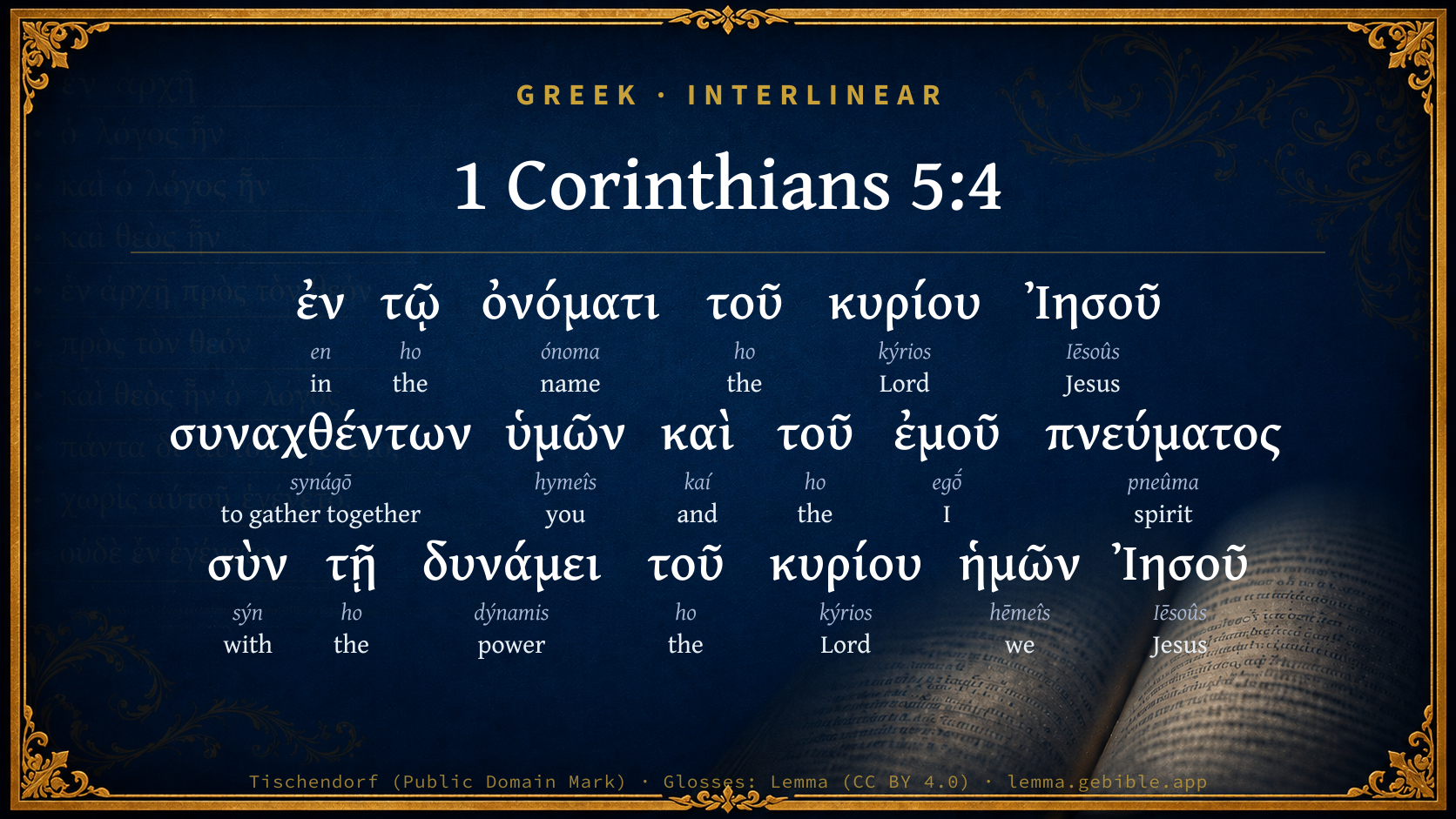
Download image
Cite this verse

1 Corinthians 5:4 (World English Bible). Public Domain. Lemma interlinear Bible study tool, https://lemma.gebible.app/v/1-corinthians/5/4.

Show BibTeX & RIS
BibTeX
RIS
English Translation
In the name of our Lord Jesus Christ, you being gathered together, and my spirit, with the power of our Lord Jesus Christ,
World English Bible · Public Domain
Download a study sheet

One document with this verse’s original text, its word-by-word gloss line, the meaning frame, cross-references with their text, attributed commentary, and full source and license credits — printable, and it pastes into notes with its structure intact.

This verse Autodidact and up

Study sheet (.html) Plain text (.txt)

A passage Seminary Student

Up to 50 verses in one chapter. A passage sheet keeps up to 6 commentary sources and 12 cross-references per verse, in the order this page ranks them, and says so on the sheet whenever that leaves anything out. Ask for a single verse and you get the Autodidact verse sheet above.

Everything on this page stays free to read, with no account — the sheet is a download of what is already on screen, not access to it.

Want to remove ads? Support Godless Engineer
Compare translations 3

The same verse in 3 English versions, stacked beneath the original-language interlinear above. Click any original word for its lexicon entry.

Each is an independent rendering of the whole verse — the interlinear is not word-aligned to these translations.

Highlighted words mark where these versions differ — a whole-verse word diff, not a word-by-word alignment.

  • World English Bible Public Domain
    In the name of our Lord Jesus Christ, you being gathered together, and my spirit, with the power of our Lord Jesus Christ,
  • King James Version Public Domain
    In the name of our Lord Jesus Christ, when ye are gathered together, and my spirit, with the power of our Lord Jesus Christ,
  • unfoldingWord Literal Text CC BY-SA 4.0
    You and my spirit, having been assembled in the name of our Lord Jesus Christ, with the power of our Lord Jesus,

unfoldingWord Literal Text — © unfoldingWord, licensed CC BY-SA 4.0. Word-aligned USFM3 via Door43 (git.door43.org/unfoldingWord/en_ult).

Versions to compare (up to 4)

3 of 4 selected

Show all 19 translations

Every available English version of this verse, each an independent rendering of the whole verse.

  • World English Bible Public Domain
    In the name of our Lord Jesus Christ, you being gathered together, and my spirit, with the power of our Lord Jesus Christ,
  • Berean Standard Bible Public Domain
    When you are assembled in the name of our Lord Jesus and I am with you in spirit, along with the power of the Lord Jesus,
  • Majority Standard Bible Public Domain
    When you are assembled in the name of our Lord Jesus Christ and I am with you in spirit, along with the power of our Lord Jesus Christ,
  • King James Version Public Domain
    In the name of our Lord Jesus Christ, when ye are gathered together, and my spirit, with the power of our Lord Jesus Christ,
  • American Standard Version (1901) Public Domain
    in the name of our Lord Jesus, ye being gathered together, and my spirit, with the power of our Lord Jesus,
  • Revised Version (1885) Public Domain
    in the name of our Lord Jesus, ye being gathered together, and my spirit, with the power of our Lord Jesus,
  • Geneva Bible (1599) Public Domain
    When ye are gathered together, and my spirit, in the Name of our Lord Iesus Christ, that such one, I say, by the power of our Lord Iesus Christ,
  • Douay-Rheims (1899) Public Domain
    In the name of our Lord Jesus Christ, you being gathered together, and my spirit, with the power of our Lord Jesus;
  • Young's Literal Translation Public Domain
    in the name of our Lord Jesus Christ -- ye being gathered together, also my spirit -- with the power of our Lord Jesus Christ,
  • Literal Standard Version CC BY-SA 4.0
    in the Name of our Lord Jesus Christ—you being gathered together, also my spirit—with the power of our Lord Jesus Christ,
  • Unlocked Literal Bible CC BY-SA 4.0
    When you are assembled in the name of our Lord Jesus and I am with you in spirit, and the power of our Lord Jesus is present,
  • unfoldingWord Literal Text CC BY-SA 4.0
    You and my spirit, having been assembled in the name of our Lord Jesus Christ, with the power of our Lord Jesus,
  • Darby Bible Public Domain
    [to deliver,] in the name of our Lord Jesus Christ (ye and my spirit being gathered together, with the power of our Lord Jesus Christ), him that has so wrought this:
  • World Messianic Bible Public Domain
    In the name of our Lord Yeshua the Messiah, when you are gathered together with my spirit with the power of our Lord Yeshua the Messiah,
  • Webster's Bible Public Domain
    In the name of our Lord Jesus Christ, when ye are assembled, and my spirit, with the power of our Lord Jesus Christ,
  • Free Bible Version CC BY-SA 4.0
    When you meet together in the name of the Lord Jesus, I'll be there with you in spirit and with the power of our Lord Jesus.
  • Bible in Basic English Public Domain
    In the name of our Lord Jesus, when you have come together with my spirit, with the power of our Lord Jesus,
  • Text-Critical English NT CC BY 4.0
    So when you are gathered together in the name of our Lord Jesus Christ and I am with you in spirit, along with the power of our Lord Jesus Christ,
  • Tyndale New Testament (1534) Public Domain
    in the name of oure Lorde Iesu Christ when ye are gaddered togedder and my sprete with the power of the Lorde Iesus Christ

Literal Standard Version (2020), Covenant Press — licensed CC BY-SA 4.0. Text via the HelloAO Bible API (eBible.org). Unlocked Literal Bible (unfoldingWord) — licensed CC BY-SA 4.0. Text via the HelloAO Bible API (eBible.org). unfoldingWord Literal Text — © unfoldingWord, licensed CC BY-SA 4.0. Word-aligned USFM3 via Door43 (git.door43.org/unfoldingWord/en_ult). Free Bible Version, Dr. Jonathan Gallagher — licensed CC BY-SA 4.0. Text via the HelloAO Bible API (eBible.org).

Word by word

More ways to search: Search by grammar → Find every occurrence → Compare this word →

Practice this passage: Drill this verse → Learn its vocabulary →

συναχθέντων
synágō
G4863
“to gather together”
Verb, Aorist, Passive, Participle, Genitive, Plural, Masculine
Part of Speech
Verb
Tense
Aorist
Voice
Passive
Mood
Participle
Case
Genitive
Number
Plural
Gender
Masculine
Full Thayer's Definition

Origin: from G4862 and G71

TDNT: None

1. to gather together, to gather a. to draw together, collect 1. of fishes 2. of a net in which they are caught 2. to bring together, assemble, collect a. to join together, join in one (those previously separated) b. to gather together by convoking c. to be gathered i.e. come together, gather, meet 3. to lead with one's self a. into one's home, i.e. to receive hospitably, to entertain
  1. ἐν en G1722 “in” Preposition
  2. τῷ ho G3588 “the” Article, Dative, Singular, Neuter
  3. ὀνόματι ónoma G3686 “name” Noun, Dative, Singular, Neuter
  4. τοῦ ho G3588 “the” Article, Genitive, Singular, Masculine
  5. κυρίου kýrios G2962 “Lord” Noun, Genitive, Singular, Masculine
  6. Ἰησοῦ Iēsoûs G2424 “Jesus” Noun, Genitive, Singular, Masculine
  7. ὑμῶν hymeîs G5210 “you” Personal pronoun, 2nd person, Genitive, Plural
  8. καὶ kaí G2532 “and” Conjunction
  9. τοῦ ho G3588 “the” Article, Genitive, Singular, Neuter
  10. ἐμοῦ egṓ G1473 “I” Personal pronoun, 1st person, Genitive, Singular
  11. πνεύματος pneûma G4151 “spirit” Noun, Genitive, Singular, Neuter
  12. σὺν sýn G4862 “with” Preposition
  13. τῇ ho G3588 “the” Article, Dative, Singular, Feminine
  14. δυνάμει dýnamis G1411 “power” Noun, Dative, Singular, Feminine
  15. τοῦ ho G3588 “the” Article, Genitive, Singular, Masculine
  16. κυρίου kýrios G2962 “Lord” Noun, Genitive, Singular, Masculine
  17. ἡμῶν hēmeîs G2249 “we” Personal pronoun, 1st person, Genitive, Plural
  18. Ἰησοῦ Iēsoûs G2424 “Jesus” Noun, Genitive, Singular, Masculine

About this verse

These counts appear in no published source. They are computed here, from the morphology-tagged text and Lemma’s own curated glosses. What Lemma adds →

19
words
13
distinct lemmas
Pauline Epistles
section

Shared distinctive vocabulary

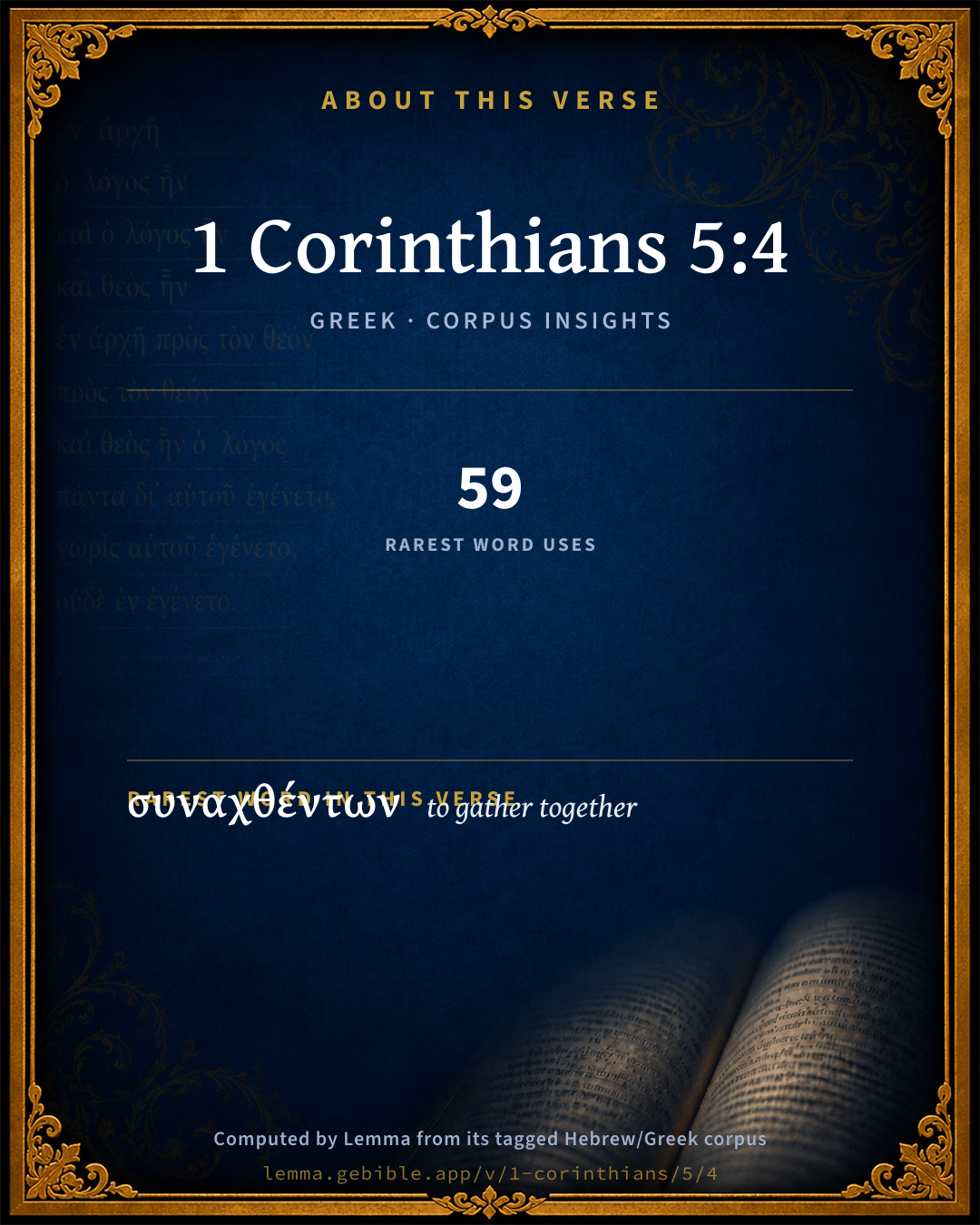
συναχθέντων to gather together G4863 occurs in 59 verses of the Greek New Testament. Also found in:
Repetition

Words recur within this verse:

  • κυρίου Lord G2962 ×2
  • Ἰησοῦ Jesus G2424 ×2
  • τῷ the G3588 ×5

Cross-references

16

Topical passages linked to 1 Corinthians 5:4 in the Treasury of Scripture Knowledge — connected by theme and wording, ordered by reader-vote popularity; previews shown in the World English Bible.

  • John 20:23 Whoever's sins you forgive, they are forgiven them. Whoever's sins you retain, they have been retained."
  • Matthew 16:19 I will give to you the keys of the Kingdom of Heaven, and whatever you bind on earth will be bound in heaven; and whatever you release on earth will be released in heaven."
  • Matthew 18:16–18 But if he doesn't listen, take one or two more with you, that at the mouth of two or three witnesses every word may be established.
  • 2 Corinthians 13:3 seeing that you seek a proof of Christ who speaks in me; who toward you is not weak, but is powerful in you.
  • Colossians 3:17 Whatever you do, in word or in deed, do all in the name of the Lord Jesus, giving thanks to God the Father, through him.
  • 2 Thessalonians 3:6 Now we command you, brothers, in the name of our Lord Jesus Christ, that you withdraw yourselves from every brother who walks in rebellion, and not after the tradition which they received from us.
  • Matthew 18:20 For where two or three are gathered together in my name, there I am in the midst of them."
  • Matthew 28:18 Jesus came to them and spoke to them, saying, "All authority has been given to me in heaven and on earth.
  • Matthew 28:20 teaching them to observe all things that I commanded you. Behold, I am with you always, even to the end of the age." Amen.
  • Acts 16:18 She was doing this for many days. But Paul, becoming greatly annoyed, turned and said to the spirit, "I charge you in the name of Jesus Christ to come out of her!" It came out that very hour.
  • 2 Corinthians 2:9–10 For to this end I also wrote, that I might know the proof of you, whether you are obedient in all things.
  • 2 Corinthians 13:10 For this cause I write these things while absent, that I may not deal sharply when present, according to the authority which the Lord gave me for building up, and not for tearing down.
  • Acts 3:6 But Peter said, "Silver and gold have I none, but what I have, that I give you. In the name of Jesus Christ of Nazareth, get up and walk!"
  • Acts 4:7–12 When they had stood them in the middle of them, they inquired, "By what power, or in what name, have you done this?"
  • Acts 4:30 while you stretch out your hand to heal; and that signs and wonders may be done through the name of your holy Servant Jesus."
  • Ephesians 5:20 giving thanks always concerning all things in the name of our Lord Jesus Christ, to God, even the Father;

Cross-references courtesy of OpenBible.info (CC BY 4.0).

Where the printed editions differ

2 variants

Places in this verse where the major printed Greek editions disagree on the wording in a way that affects the translation — a comparison of editions, not a manuscript-by-manuscript collation. The editions are the modern critical texts (Nestlé-Aland 28/27, SBL, Westcott-Hort, Tregelles, Tyndale House) and the traditional texts behind the KJV (the Textus Receptus and the Byzantine/Majority text). It is not a claim about which reading is original.

  1. Extra text
    Χριστοῦ

    “Christ”

    In TynTRByz Not in NA28NA27SBLWHTreg

    Χριστοῦ (Christou) 'Christ' is only in traditional manuscripts (Tyn+TR+Byz)

  2. Extra text
    Χριστοῦ

    “Christ”

    In TRByz Not in NA28NA27TynSBLWHTreg

    Χριστοῦ (Christou) 'Christ' is only in traditional manuscripts (TR+Byz)

Textual data: Translators Amalgamated Greek New Testament (STEPBible TAGNT) · CC BY 4.0.

Commentary

Notes on 1 Corinthians 5:4 from classic Christian and Jewish commentators (each source and its license shown beneath its notes). The classic Christian expositions comment on the surrounding passage and are grouped to its opening verse, so a note may address several verses; the Jewish commentaries on the Tanakh (Rashi and others) are per-verse, so they appear only where the commentator wrote on this verse.

Lemma curates 59 commentaries, every one of them public domain or Creative Commons licensed, each selected and text-cleaned for this edition rather than reprinted as found. About our sources →

Bengel's Gnomon

Johann Albrecht Bengel

1Co 5:4. Ἐν τῷ ὀνόματι, in the name) It is construed with, to deliver.—τοῦ ἐμοῦ πνεῦματος, and my spirit) 1Co 5:3.—σὺν τῇ δυνάμει, with the power) The spirit and power are almost synonymous. Paul, speaking of himself, uses the word, spirit; of Christ, power, 2Co 13:3; Mat 28:20; Mat 18:20. A Hypotyposis,[39] i.e. so that the power of the Lord may immediately exert itself.

[39] A vivid presenting of a thing in words, as if before one’s very eyes. See Append.

Bengel's Gnomon of the New Testament — English translation (T&T Clark, Edinburgh, 1860) — public domain. Text from a community e-Sword module.

Meyer's Critical & Exegetical Commentary

Heinrich August Wilhelm Meyer

1Co_5:4. Four different ways of dividing the verse are possible: either ἐν τῷ ὀνόμ. belongs to συναχθ. and σὺν τῇ δυν. to παραδοῦναι (Beza, Justiniani, Calovius, Heydenreich, Billroth, Olshausen, Ewald, Hofmann), or both belong to συναχθ. (Chrysostom, Theodoret, Theophylact, Calvin, Grotius, Rückert), or both belong to παραδοῦναι (Mosheim, Pott, Flatt, Schrader, comp also Osiander); or ἐν τ. ὀνόμ. belongs to παραδοῦναι, and σὺν τ. δυνάμ. to the participial clause. Against the second and third of these views, there is the fact that the symmetry of the address would be needlessly destroyed by bringing in the authority of Christ twice over in the one division, and not at all in the other; against the first, again, there is this, that ἐν τῷ ὀνόμ. κ.τ.λ[773], as a solemn formula of apostolic enactment (2Th_3:6; Act_3:6; Act_16:18), links itself more suitably to the sense with παραδοῦναι Κ.Τ.Λ[774] than with συναχθ. κ.τ.λ[775] (to the latter of which Mat_18:20, ΕἸς ΤῸ ὌΝ., might seem to offer not exactly a parallel, but still a similar representation). There remains therefore, as worthy of preference, the fourth method of connecting the words (Luther, Castalio, Estius, Bengel, Maier, al[776]; Neander with hesitation). Against this, Hofmann objects that ἘΝ Τῷ ὈΝΌΜΑΤΙ Κ.Τ.Λ[777] ought not to have come in until after the participial clause; but quite under a misapprehension, for it is plainly of set purpose, and with all reason and propriety, that the apostolic sentence bears, so to speak, on its very front the seal of his high and plenary authority.

συναχθέντων … Ἰησοῦ] after ye are assembled, and my spirit (note the emphatic τ. ἐμοῦ), with the power of Jesus (qui nostram sententiam sua potentia reddet efficacem, Erasmus, Paraphr.). The substance of the thought, namely, which this whole statement sets before us with concrete vividness and solemnity, is the following: I have already resolved that ye hold an assembly of the church, in which ye shall consider me as present furnished with the power of Christ, and in this assembly shall declare: Paul, in the name of Christ, with whose power he is here spiritually in the midst of us, hereby delivers over the incestuous man unto Satan. Φρίκης μεστὸν συνεκρότησε δικαστήριον, Theodoret.

σύν] denotes in efficient connection therewith, that is to say, the spirit of the apostle is present in the assembly, not in virtue of his own independent power (comp Act_3:12), but clothed with the authority of Christ, Winer, p. 366 [E. T. 458]. Thus the power of Christ is not conceived as the third party in the assembly,a view in behalf of which Mat_18:20; Mat_28:20 are cited; so Chrysostom, Theodoret, Theophylact, Erasmus, Luther, Estius, and others, including Rückert and Maier.[779] For Paul bore this power in himself, being as an apostle its official possessor and organ, and could not therefore imagine himself meeting with other persons and with it in the third place, but: as being present in immanent union with it as Christs apostle at the eventual act of judgment. It was just as the depositary of this power that he could give over the sinner to Satan in the name of the Lord, and be assured that the sentence would take effect. According to Hofmann, by σὺν τ. δυν. Κ.Τ.Λ[780] Paul means only to express this, that he would rely upon the aid of the power of Christ. Comp the classic σὺν θεοῖς, deorum ope (Reisig, Enarr. p. lxiv.; Kühner, a[782] Xen. Anab. iii. 2. 8). But the thought thus yielded, after the ἐν τῷ ὀνόματι κ.τ.λ[783] which has gone before it, would be far too weak.

[773] .τ.λ. καὶ τὰ λοιπά.

[774] .τ.λ. καὶ τὰ λοιπά.

[775] .τ.λ. καὶ τὰ λοιπά.

[776] l. and others; and other passages; and other editions.

[777] .τ.λ. καὶ τὰ λοιπά.

[779] Chrysostom and Theophylact, however, leave the choice open between the two renderings: ἤ ὅτι ὁ Χριστὸς δύναται τοιαύτην ὑμῖν χάριν δοῦναι, ὥστε δύνασθκι τῷ διαβόλῳ παραδιδόναι, ἤ ὅτι καὶ αὐτός μεθʼ ὑμῶν κατʼ αὐτοῦ φέρει τὴν ψῆφον. According to Theodoret, Christ is viewed as the presiding authority. Had the apostle, however, represented Christ to himself as forming the third in their meeting, he would hardly have used so abstract an expression (δυνάμει), but would have written at least σὺν τῷ πνεύματι τοῦ Κυρίου. Comp. Act_15:28.

[780] .τ.λ. καὶ τὰ λοιπά.

[782] d refers to the note of the commentator or editor named on the particular passage.

[783] .τ.λ. καὶ τὰ λοιπά.

Meyer — Critical and Exegetical Commentary on the New Testament — English translation by Peter Christie, edited by Frederick Crombie (T&T Clark, 1880) — public domain. Text from a community e-Sword module.

Geneva Bible (1599)

Geneva Bible translators

Calling upon Christ his Name.

There is no doubt but that judgment is ratified in heaven, wherein Christ himself sitteth as Judge.

Geneva Bible (1599) marginal notes — public domain. Text via Bolls.life.

Jamieson, Fausset & Brown

Robert Jamieson, A. R. Fausset & David Brown

In the name of our Lord Jesus Christ--By His authority and as representing His person and will (Co2 2:10). Join this with "to deliver such a one unto Satan" (Co1 5:5). The clause, "When ye have been gathered together and my spirit (wherein I am 'present,' though 'absent in body,' Co1 5:3), with the power of our Lord Jesus," stands in a parenthesis between. Paul speaking of himself uses the word "spirit"; of Christ, "power." Christ's power was promised to be present with HIS Church "gathered together in His name" (Mat 18:18-20): and here Paul by inspiration gives a special promise of his apostolic spirit, which in such cases was guided by the Holy Spirit, ratifying their decree passed according to his judgment ("I have judged," Co1 5:3), as though he were present in person (Joh 20:21-23; Co2 13:3-10). This power of infallible judgment was limited to the apostles; for they alone had the power of working miracles as their credentials to attest their infallibility. Their successors, to establish their claim to the latter, must produce the former (Co2 12:2). Even the apostles in ordinary cases, and where not specially and consciously inspired, were fallible (Act 8:13, Act 8:23; Gal 2:11-14).

Jamieson, Fausset & Brown — Commentary Critical and Explanatory on the Whole Bible (1871) — public domain (CC PDM 1.0). Text via the HelloAO Bible API.

Adam Clarke's Commentary

Verse 4. In the name of our Lord Jesus] Who is the head of the Church; and under whose authority every act is to be performed.

And my spirit] My apostolical authority derived from him; with the power, συν δυναμει, with the miraculous energy of the Lord Jesus, which is to inflict the punishment that you pronounce:-

Adam Clarke's Commentary on the Bible (1810–1826) — public domain. Text from a community e-Sword/MySword module.

John Calvin's Commentaries

4. When you are gathered together and my spirit — that is, when ye are gathered together with me, but in spirit, for they could not meet together as to bodily presence. He declares, however, that it would be all one as though he were personally present. It is to be carefully observed, that Paul, though an Apostle, does not himself, as an individual, excommunicate according to his own pleasure, but consults with the Church, that the matter may be transacted by common authority. He, it is true, takes the lead, and shows the way, but, in taking others as his associates, he intimates with sufficient plainness, that this authority does not belong to any one individual. As, however, a multitude never accomplishes anything with moderation or seriousness, if not governed by counsel, there was appointed in the ancient Church a Presbytery, that is, an assembly of elders, who, by the consent of all, had the power of first judging in the case. From them the matter was brought before the people, but it was as a thing already judged of. Whatever the matter may be, it is quite contrary to the appointment of Christ and his Apostles — to the order of the Church, and even to equity itself, that this right should be put into the hands of any one man, of excommunicating at his pleasure any that he may choose. Let us take notice, then, that in excommunicating this limitation be observed — that this part of discipline be exercised by the common counsel of the elders, and with the consent of the people, and that this is a remedy in opposition to tyranny. For nothing is more at variance with the discipline of Christ than tyranny, for which you open a wide door, if you give one man the entire power.

In the name of our Lord For it is not enough that we assemble, if it be not in the name of Christ; for even the wicked assemble together for impious and nefarious conspiracies. Now in order that an assembly may be held in Christ’s name, two things are requisite: first, that we begin by calling upon his name; and secondly, that nothing is attempted but in conformity with his word. Then only do men make an auspicious commencement of anything that they take in hand to do, when they with their heart call upon the Lord that they may be governed by his Spirit, and that their plans may, by his grace, be directed to a happy issue; and farther, when they ask at his mouth, as the Prophet speaks, (Isaiah 30:2,) that is to say, when, after consulting his oracles, they surrender themselves and all their designs to his will in unreserved obedience. If this is becoming even in the least of our actions, how much less ought it to be omitted in important and serious matters, and least of all, when we have to do with God’s business rather than our own? For example, excommunication is an ordinance of God, and not of men; on any occasion, therefore, on which we are to make use of it, where shall we begin if not with God. In short, when Paul exhorts the Corinthians to assemble in the name of Christ, he does not simply require them to make use of Christ’s name, or to confess him with the mouth, (for the wicked themselves can do that,) but to seek him truly and with the heart, and farther, he intimates by this the seriousness and importance of the action.

He adds, with the power of our Lord, for if the promise is true,

As often as two or three are gathered together in my name, I am in the midst of them, (Matthew 18:20,)

it follows, that whatever is done in such an assembly is a work of Christ. Hence we infer, of what importance excommunication, rightly administered, is in the sight of God, inasmuch as it rests upon the power of God. For that saying, too, must be accomplished,

Whatsoever ye shall bind on earth shall be bound in heaven. (Matthew 18:18.)

As, however, this statement ought to fill despisers with no ordinary alarm, so faithful pastors, as well as the Churches generally, are by this admonished in what a devout spirit they should go to work in a matter of such importance. For it is certain that the power of Christ is not tied to the inclination or opinions of mankind, but is associated with his eternal truth.

John Calvin's Commentaries (1540-1563) — public domain. Text from the Calvin Translation Society English edition (1840s-50s) via the Christian Classics Ethereal Library (ccel.org). Calvin's coverage is partial (roughly two-thirds of the Bible); uncommented books and verses are honest gaps, never fabricated. The 19th-century editor's footnotes and remarks are omitted so the notes are faithfully Calvin's own voice.

Ellicott's Commentary for English Readers

(4, 5) In the name of our Lord Jesus Christ. . . . and my spirit.—These two verses contain the apostolic sentence on the offender, and may read thus: “I have already myself decided, in the name of our Lord Jesus, you being gathered together, and my spirit (as in 1Co_5:3), in the power of our Lord Jesus, to deliver such a one,” &c.

The opening words are probably the form used in all public acts of the Church as a body, and “the power of our Lord Jesus” refers to that continual presence which Christ had promised His Church, and particular power which He had delegated to the Apostles to punish (Mat_16:19; Mat_18:18; Mat_18:20; Mat_28:20). In this sentence we recognise, not merely a formal excommunication from church-fellowship, but a more severe punishment, which could only be inflicted by apostolic authority and power. Satan was regarded as the origin of all physical evil—hence the afflicted woman, in Luk_13:16, is spoken of as one “whom Satan hath bound these eighteen years.” St. Paul’s own bodily suffering is a “messenger of Satan” (2Co_12:7). The blindness of Elymas (Act_13:8), and the death of Ananias and Sapphira (Act_5:5), are instances of the infliction of bodily-suffering by the Apostles. The deliverance of an offender unto Satan would therefore mean the expulsion of such a one from the Christian communion, and if that failed the actual infliction of some bodily suffering such as would destroy the flesh (not the body, but the flesh, the source and origin of the evil). Explicit directions for the excommunication by the Church of an offender, are given in 1 Corinthians 7, but there is no direct instruction to inflict the further punishment spoken of here. It is, indeed, probable that the lesser punishment had the desired effect (see Note on 2Co_2:6), and we subsequently find St. Paul pleading for the loving re-admission of the offender into all the privileges of Christian communion.

A Bible Commentary for English Readers, edited by Charles John Ellicott (1878–1897) — public domain. Text from a community e-Sword module.

The Cambridge Bible for Schools and Colleges

gen. ed. J. J. S. Perowne

4. in the name of our Lord Jesus Christ] This may be taken (1) with ‘I have judged’ in 1Co_5:3; (2) with when ye are gathered together, or (3) with to deliver such a one unto Satan. Of these (1) and (3) are preferable to (2), which would involve an awkward inversion in the order of the words. It implies either (1) the solemn promulgation of the sentence by St Paul, in the name and with the authority of Christ, or (2) the equally solemn delivery of the offender over to Satan. All assemblies of the Christian Church were gathered together in the Name of Christ

with the power of our Lord Jesus Christ] This has been taken (1) with when ye are gathered together, and (2) with to deliver such a one unto Satan. The former is preferable. The Corinthian Church, when assembled in the Name of Christ, and acting under the authority of its chief pastor, one of Christ’s Apostles, was armed with a spiritual power from Jesus Christ to pronounce and carry out the awful sentence which follows.

The Cambridge Bible for Schools and Colleges (gen. ed. J. J. S. Perowne; Cambridge University Press, 1878–1918) — public domain. Text from a community e-Sword module.

John Gill's Exposition

In the name of our Lord Jesus Christ,.... These words contain an account of the several things and circumstances, that should attend the awful act of the apostle, in delivering this man to Satan; it would be done "in the name of our Lord Jesus Christ"; by his command, power, and authority, and for his glory; in whose name all miraculous actions, as this was one, were performed:

when ye are gathered together; as a church, in a public manner, in one place; not to do this business, for this was purely apostolical; but to be witness of this wonderful operation, to acknowledge the justice of God in it, and that they might fear and take warning by it:

and my spirit; meaning that though he was absent in body, he should be present in spirit; and that the extraordinary gift of the Spirit of God bestowed on him would be visibly exercised upon this man before them all, as if he himself was in the midst of them; and this not by any power of his own, but

with the power of our Lord Jesus Christ; to which all such miraculous effects, as this hereafter related, are to be ascribed.

John Gill's Exposition of the Whole Bible (1746–1763) — public domain (CC PDM 1.0). Text via the HelloAO Bible API.

Trapp's Complete Commentary

John Trapp

4 In the name of our Lord Jesus Christ, when ye are gathered together, and my spirit, with the power of our Lord Jesus Christ,

Ver. 4. With the power of our Lord] Promised, Mat 18:18-20. This makes it to be a heavy case to be rightly excommunicated. Indeed it may happen that Jonah shall be cast out of the ship, when Ham shall be reserved in the ark. "Your brethren that hated you, that cast you out for my name’s sake said (for a pretence), Let the Lord be glorified; but he shall appear to your joy, and they shall be ashamed," Isa 66:5. When the sentence of excommunication began with, In nomine Domini, In the name of God, to be read against a certain martyr, he cried out, as well he might, You begin in a wrong name. And another of them, together with his five fellow sufferers, did formally excommunicate their persecutors. It grew to a common proverb, by the abuse of this ordinance in those corrupt times, In nomine Domini incipit omne malum. In the name of God all evel matters start.

John Trapp, A Commentary or Exposition upon All the Books of the Old and New Testament (1647–1656) — public domain. Text from a community e-Sword module.

Albert Barnes' Notes on the Bible

In the name ... - By the authority; or in the behalf; or acting by his commission or power. 2Co 2:10. See the note at Act 3:6. This does not refer to Paul alone in declaring his opinion, but means that they were to be assembled in the name of the Lord Jesus, and that they were to proceed to exercise discipline by his authority. The idea is, that the authority to administer discipline is derived from the Lord Jesus Christ, and is to be exercised in his name, and to promote his honor.

When ye are gathered together - Or, “You being assembled in the name of the Lord Jesus.” This is to be connected with the previous words, and means:

(1) That they were to be assembled for the purpose of administering discipline; and,

(2) That this was to be done in the name and by the authority of the Lord Jesus.

And my spirit - 1Co 5:3. As if I were with you; that is, with my declared opinion; knowing what I would advise, were I one of you; or, I being virtually present with you by having delivered my opinion. It cannot mean that Paul’s soul would be really present with them, but that, knowing his views and feelings, and what he would do, and knowing his love for them, they could act as if he were there. This passage proves that discipline belongs to the church itself; and so deep was Paul’s conviction of this, that even he would not administer it, without their concurrence and action. And if Paul would not do it, and in a case too where bodily pains were to be inflicted by miraculous agency, assuredly no other ministers have a right to assume the authority to administer discipline without the action and the concurrence of the church itself.

(The general doctrine of the New Testament is that the government of the church is invested, not in the people or church members at large, but in certain rulers or office-bearers, 1Co 12:28; Eph 4:11-12; 1Th 5:12-13; Heb 13:7; 1Ti 5:17. We find these elders or rulers existing in every church to which our attention is directed, while the people are continually exhorted to yield a willing submission to their authority. Now the passage under review must be explained in consistency with the analogy of truth, or the general scope of Scripture on the subject. It is unwise to build our conclusion on an insulated text. But, in reality, the language of the apostle, in this place, when fairly examined, gives no countenance to the idea that the judicial power of the church resides in the people. The case of the incestuous man was “judged by the apostle himself” previous to the transmission of his letter to the Corinthian church, which was therefore enjoined, not to adjudicate on the matter, but simply to give effect to the decision of Paul. “I verily ‘have judged already’ concerning him who hath done this deed; in the name of our Lord Jesus Christ,” etc. If it be still demanded why then were the people to assemble? the answer is obvious. It was necessary that the sentence should be published, where the crime had been committed, that the members of the church might concur in it, and withdraw from the society of the guilty person. The simple fact of the people being assembled is no proof that they were judges.

Yet candor requires us to state that the words in the third verse, ἤδη κεκρίκα ēdē kekrika (I have already judged) are supposed by some to intimate, not the delivering of an authoritative sentence, but the simple expression of an opinion in regard to what ought to be done. This, however, seems neither consistent with the scope of the passage, nor with just ideas of apostolical authority. The apostles had “the care of all the churches, with power to settle matters of faith and order, to determine controversies, and exercise the rod of discipline on all offenders, whether pastors or flock; 1Co 5:3-6; 2Co 10:8; 2Co 13:10.”)

With the power ... - This phrase is to be connected with the following verse. “I have determined what ought to be done. The sentence which I have passed is this. You are to be assembled in the name and authority of Christ. I shall be virtually present. And you are to deliver such a one to Satan, ‘by the power of our Lord Jesus Christ.’” That is, it is to be done by you; and the miraculous power which will be evinced in the case will proceed from the Lord Jesus. The word “power” δύναμις dunamis is used commonly in the New Testament to denote some miraculous and extraordinary power; and here evidently means that the Lord Jesus would put forth such a power in the infliction of pain and for the preservation of the purity of his church.

Albert Barnes' Notes on the Bible (1834–1885) — public domain. Text from a community e-Sword/MySword module.

Matthew Poole's English Annotations

In the name of our Lord Jesus Christ; either having solemnly called upon the name of the Lord Jesus Christ for his counsel and direction, or blessing your action, that it may be of spiritual advantage to the party concerned; or according to the command of Christ, or by his authority, or for his glory. It may be referred either to what went before, I have judged or determined by the authority of Christ; or to what follows after.

When ye are gathered together, and my spirit; when you are gathered together by the authority, or according to the institution, of Jesus Christ, and my spirit with you, you having my judgment in the case. With the power of our Lord Jesus Christ; and the power and authority of Christ committed to me, and to you, as a church of Christ.

Matthew Poole's English Annotations on the Holy Bible (1683–1685) — public domain. Text from a community e-Sword/MySword module.

Whedon's Commentary on the Bible

Daniel D. Whedon

4. In name… Christ—This severance of the guilty from the Church is performed, 1.) By the divine authority of Christ; 2.) By the declaratory authority of the apostle; and 3.) By the executive authority of the collective Church, in whom the normal authority permanently resides after the miraculous apostolic authority is withdrawn.

When—When ye and my spirit are gathered together.

This power of excommunication was first exercised by the Jewish Church. There was a “cutting off from the people,” as in Exo_30:33; Exo_30:38; Exo_31:14; Lev_17:4; and there was an exclusion of the leprous from the camp, Lev_13:46; Num_12:14. So Christ commands that he who will not hear the Church becomes as a “heathen man and a publican;” that is, his Christian character and brotherhood are no longer to be recognised, and he is no longer of the Church but of the world.

In the primitive and persecuted Church, when men, “lapsed” through fear from Christianity became pagans, anathematized Christ, and sacrificed to idols, their apostasy had an awful aspect to the eyes of the faithful. The communion of the Church became unspeakably valuable, and excommunication from it a terror to the soul. And then, when Christianity became the religion of the State, this prerogative of excommunication became a weighty power in the hands of the hierarchy. The ecclesiastical ban pronounced upon the victim isolated him from society like a leper. It deprived him of all rights in court or in Church; made it criminal to pray with him, feed him, give him drink, or even speak to him. When the pope assumed this power, he could ban kings and absolve their subjects from all obedience to them as sovereigns, and all duty or kindness to them as persons. The most appalling form of excommunication was that of “bell, book, and candle.” By the solemn sound of the tolling bell the bishop and twelve priests, each with a lighted candle, marched in solemn procession, while the people assembled, to the cathedral. The bishop, attended by the twelve, sitting before the grand altar, read in solemn voice from the book to the congregation the most direful curses that language could frame; and when he had finished, the candles were at once dashed down, the bell recommenced to toll, and the people departed, filled with supernatural terror and an awful abhorrence of the victim accursed. According to Protestantism, excommunication being the means of securing the purity of the Church, is simply the severance of the guilty from the sacraments and from all membership of the Church.

Daniel D. Whedon (gen. ed.), Commentary on the Old and New Testaments (1874–1909) — public domain. Text from a community e-Sword module.

The Pulpit Commentary

In the Name of our Lord Jesus Christ. The word "Christ" is probably an addition. The clause may either be taken with "when ye are gathered together," or with "to deliver". (comp 1Ti_5:21) With the power of our Lord Jesus. Each clause adds solemnity to the scene in which St. Paul imagines himself as standing with them in the spirit, and joining with the assembly of the Church, and armed with the authority of Christ, while he pronounces on the offender the sentence on which he had already determined. That he could claim "the power of the Lord" resulted from his possession of the Holy Spirit. and the special commission to bind and to loose, to remit and to retain, on earth, which Christ had entrusted to the apostles. (Mat_18:18, Mat_18:20; Joh_20:23)

The Pulpit Commentary (1880–1919), ed. H.D.M. Spence-Jones & Joseph S. Exell — public domain. Text from a community e-Sword module.

John Wesley's Explanatory Notes

And my spirit - Present with you. With the power of the Lord Jesus Christ - To confirm my sentence.

John Wesley, Explanatory Notes Upon the Whole Bible (1754–1765) — public domain. Text via the GEBible commentary corpus.

Godbey's Commentary on the New Testament

William B. Godbey

4. “In the name of the Lord Jesus your and my spirit being assembled with the power of the Lord Jesus.

William B. Godbey, Commentary on the New Testament (1896–1900) — public domain. Text from a community e-Sword module.

McGarvey & Pendleton's Commentaries

J. W. McGarvey

in the name of our Lord Jesus, ye being gathered together, and my spirit, with the power of our Lord Jesus ,

J. W. McGarvey (with Philip Y. Pendleton), Commentaries on the New Testament (The Fourfold Gospel, 1914; Acts; and the epistles) — public domain. Text from a community e-Sword/MySword module.

The People's New Testament

B. W. Johnson

4. In the name of our Lord Jesus Christ. The solemn act of excommunication must be in the name, that is, by the authority, of the Lord. When ye are gathered together. The act is to be administered in full assembly. It must be the act of the whole church. Compare 2 Cor. 2:6. And my spirit. He will be present in spirit, since the act will be carrying out his command. With the power of our Lord Jesus Christ. The act of excommunication for misdeeds, when administered according to the will of the Lord, is not merely man's decision, but will be executed by the power of the Lord.

B. W. Johnson's The People's New Testament with Notes (1889–1891) — public domain. Electronic text from the Christian Classics Ethereal Library (CCEL) ThML edition.

Cambridge Greek Testament for Schools and Colleges

4. ἐν τῷ ὀνόματι. This may be taken (1) with κέκρικα in 1Co 5:3; (2) with συναχθέντων ὑμῶν, or (3) with παραδοῦναι τὸν τοιοῦτον τῷ Σατανᾷ. Of these (1) and (3) are preferable to (2), which would involve an awkward inversion in the order of the words. It implies either (1) the solemn promulgation of the sentence by St Paul, in the name and with the authority of Christ, or (2) the equally solemn delivery of the offender over to Satan. All assemblies of the Christian Church were gathered together in the Name of Christ.

συναχθέντων ὑμῶν. Not, as A.V. when, but after ye have been gathered together.

σὺν τῇ δυνάμει τοῦ κυρίον ἡμῶν Ἰησοῦ. This has been taken (1) with συναχθέντων ὑμῶν, and (2) with παραδοῦναι, κ.τ.λ. The former is preferable. The Corinthian Church, when assembled in the name of Christ, and acting under the authority of its chief pastor, one of Christ’s Apostles, was armed with a spiritual power from Jesus Christ to pronounce and carry out the awful sentence which follows.

Cambridge Greek Testament for Schools and Colleges (Cambridge University Press, 1896; 21 vols, various authors incl. Carr, Maclear, Plummer, Farrar, Lumby, Moule, M. R. James, Simcox) — public domain. Text from a community e-Sword module.

Alford’s Greek Testament

Henry Alford

4.] We may arrange this sentence in four different ways: (1) ἐν τῷ ὀν. may belong to συναχθέντων, and σὺν τῇ δυν. to παραδοῦναι,—so Beza, Calov., Billroth, Olsh., al.: (2) both ἐν τῷ ὀν. and σὺν τῇ δυν. may belong to συναχθέντων,—so Chrys., Theophyl. (altern.), Calvin (quoting for σὺν τῇ δυν. Mat 18:20), Grot., Rückert: (3) both may belong to παραδοῦναι,—so Mosheim, Schrader, al.: or (4) ἐν τῷ ὀν. belongs to παραδοῦναι, and σὺν τῇ δυν. to συναχθέντων,—so Luther, Castal., Estius, Bengel, De Wette, Meyer, al. And this, I am persuaded, is the right arrangement. For according to (2) and (3), the balance of the sentence would be destroyed, no adjunct of authority being given to one member of it, and both to the other: and (1) is hardly consistent with the arrangement of the clauses, the parenthetical portion beginning far more naturally with the participle than with ἐν τῷ ὀν.,—not to mention that the common formula of the Apostles’ speaking authoritatively, is ἐν τῷ ὀνόματι Ἰησοῦ χρ. or the like: see Act 3:16; Act 16:18; 2Th 3:6. The sentence then will stand:—(I have decreed),—in the name of our Lord Jesus (when ye have been assembled together and my spirit with the power of our Lord Jesus), (i.e. ‘I myself, in spirit, endowed by our Lord Jesus with apostolic power:’ σὺν τῇ δυν. belongs to τοῦ ἐμοῦ πνεύμ., and is not, as in Chrys.,—see above—merely an element in the assembly) to deliver such an one (reff.) to Satan for the destruction of his flesh, that his spirit may be saved in the day of the Lord. What does this sentence import? Not, mere excommunication, though it is doubtless included. It was a delegation to the Corinthian church of a special power, reserved to the Apostles themselves, of inflicting corporeal death or disease as a punishment for sin. Of this we have notable examples in the case of Ananias and Sapphira, and Elymas, and another hinted at 1Ti 1:20. The congregation itself could αἴρειν ἐκ μέσου,—but it could not παραδοῦναι τῷ σατανᾷ εἰς ὄλεθρον τῆς σαρκός, without the authorized concurrence of the Apostle’s πνεύματος, σὺν τῇ δυν. τ. κυρ. ἡμ. Ἰησοῦ.

What the ὄλεθρος τ. σαρκός was to be, does not appear: certainly more than the mere destruction of his pride and lust by repentance, as some (Estius, Beza, Grot., al.) suppose: rather, as Chrys., ἵνα μαστίξῃ αὐτὸν ἕλκει πονηρῷ ἢ νόσῳ ἑτέρᾳ. Hom. xv. p. 127. Estius’s objection to this, that in 2Co_2. and 7. we find no trace of such bodily chastisement, is not to the point,—because we have no proof that this παράδοσις was ever inflicted,—nor does the Apostle command it, but only describes it as his own determination, held as it were in terrorem over the offender. See note on ver. 13.

Obs., σαρκός, the offending element, not σώματος. Paul could not say ὄλεθρον τοῦ σώματος, seeing that the body is to partake of the salvation of the spirit;—but not the σάρξ, see ch. 15:50.

Henry Alford, The Greek Testament (1849–1861) — public domain. Text from a community e-Sword module.

International Critical Commentary

4. ἐν τῷ ὀνόματι κ.τ.λ. Here we have choice of four constructions. Either, take ἐν τῷ ὀνόματι with συναχθέντων and σὺν τῇ δυνάμει with παραδοῦναι, or both with συναχθέντων, or both with παραδοῦναι, or ἐν τῷ ὀνόμ. with παραδοῦναι, and σὺν τῇ δυν. with συναχθέντων. If the order of the words is regarded as decisive, the first of these will seem to be most natural, and it yields good sense. Lightfoot adopts it. The Greek commentators mostly prefer the second construction, but neither it nor the third is as probable as the first and the fourth. It is not likely that either συναχθέντων or παραδοῦναι is meant to have both qualifications, while the other has none. The fourth constructicn is the best of the four. The solemn opening, ἐν τῷ ὀνόματι τοῦ Κυρίου Ἰησοῦ, placed first with emphasis, belongs to the main verb, the verb which introduces the sentence that is pronounced upon the offender, while σὺν τῇ δυνάμει τ. Κ. ἡμῶν Ἰ. supplies a coefficient that is essential to the competency of the tribunal. The opening words prepare us for a sentence of grave import, but we are kept in suspense as to what the sentence will be, until the conditions which are to give it validity are described. Graviter suspensa mane et vibrat oratio (Beng.). We translate, therefore; ‘With regard to the man who has thus perpetrated the deed, In the name of our Lord Jesus Christ—you being assembled and my spirit with the power of our Lord Jesus Christ—to deliver such an one to Satan.’ The τὸν τοιοῦτον is not rendered superfluous by the preceding τὸν … κατεργασάμενον: it intimates that the Apostle is prepared to deal in a similar way with any similar offender.

After ὀνόματι τ. Κυρίου, B D E F G L P have ἡμῶν, and it is probably genuine, but א A and other witnesses omit, and it might easily be inserted from the next clause. P and some other witnesses omit the second ἡμῶν. After first Ἰησοῦ, א D 3 E F G L P, Vulg. Syrr. add Χριστοῦ: A B D*, Am. omit. After second Ἰησοῦ, D 3 F L add Χριστοῦ: א A B D* P, Vulg. omit, AV. inserts ‘Christ’ in both places; RV. omits in both.

International Critical Commentary — older volumes (1896–1929), various authors — public domain. Text from a community e-Sword module.

Godet's Commentaries

Frédéric Louis Godet

Vv. 4, 5. “Ye and my spirit being gathered together in the name of the Lord Jesus Christ, 5. to deliver with the power of our Lord Jesus such an one unto Satan for the destruction of the flesh, that the spirit may be saved in the day of the Lord Jesus.”

The tribunal is formed of the Christians of Corinth assembled in Paul’s spiritual presence; his competency is the name of Jesus Christ, under whose authority the sentence is given; his ability to execute is the power of Jesus Christ.

There are four ways of connecting the two subordinate clauses, in the name of...and with the power of, with the two verbs, being gathered together and delivering. The first two make the two clauses bear on the same verb, either on being gathered together (Chrysostom, Theodoret, Calvin, Rückert, Holsten), or on delivering (Mosheim, etc.). According to the last two, they are distributed between the two verbs; some ascribing the first clause, in the name of, to the last verb deliver, and the second clause, with the power of, to the first verb, being gathered together (Luther, Bengel, de Wette, Meyer, Kling, Edwards); the others making each clause bear on the verb which immediately follows it: in the name of on being gathered together, and with the power of on delivering (Beza, Olshausen, Ewald, Hofmann, Heinrici). I have no hesitation in preferring this last construction. Independently of the position of the words, which suits this meaning better than it does any of the others, the decisive reason seems to me to be the conformity of the notion of each clause with that of the verb it qualifies. Is it a judicial assembly which is in question, the important thing is its competency; and this is what is indicated by the ἐν ὀνόματι..., in the name of..., as qualifying being gathered together. Is it, on the contrary, the execution of the sentence which is in question, what is important is force, power de facto; and this is exactly what is expressed by the ἐν δυνάμει, with the power of..., as qualifying to deliver. This construction seems to me also to be confirmed by the striking parallel Mat 18:18-20, a saying which must have been present to Paul’s mind in this case: “Verily I say unto you, whatsoever ye shall bind on earth shall be bound in heaven....Again I say unto you, that whatever two or three of you shall agree to ask on the earth, it shall be done for them of My Father. For where two or three are gathered together in My name (συνηγμένοι εἰς τὸ ἐμὸν ὄνομα), there am I in the midst of them.” This promise certainly served as a ground for the actual conduct of the apostle. The moment has come for the Church to do what Jesus called binding; it has to judge. This judgment is to be pronounced by the faithful gathered together in His name, as many of them as will be found to agree in view of an interest of this kind, should there be only two or three.

The name denotes the person of the Lord in so far as it is revealed to the hearts of believers, recognised and adored by them.

Perhaps we should, with the documents, reject the word Christ, and preserve only the name Jesus, which calls up the historical personality of Him who has promised to be invisibly present at such an act. It is on this promised presence that the authority of the assembly which does it rests. The pronoun ye does not necessarily embrace the whole of the Church, for the matter in question here is not a vote by a majority of voices; it is a spiritual act in which, from the very nature of things, only the man takes part who feels impelled to it, and each in the measure in which he is capable of it. Two or three suffice for this, in case of need, Jesus Himself says; for the means of action in such discipline is agreement in prayer. How could all this apply to a decree of excommunication, pronounced after contradictory debating, and by a majority of voices, perhaps a majority of one? The things of God do not admit of being thus treated.

The most mysterious expression in this so mysterious passage is the following: καὶ τοῦ ἐμοῦ πνεύματος, and my spirit. At this assembly, which is to take place at Corinth, Paul will be present by his spirit (1Co 5:3). It would seem that what Paul here affirms of himself ought to be applied to Jesus. But it must not be forgotten that if Jesus is the Head of the Church in general, Paul is the founder and father of the Church of Corinth, and that in virtue of his personal union to Jesus, the spiritual presence of the Lord (Mat 18:20) may become also that of His servant. In chapter xii. of the Second Epistle to the Corinthians, Paul does not himself know whether it was with or without his body that he was present at a scene in paradise.

The words σὺν τῇ δυνάμει, with power, cannot be connected with the participle συναχθέντων, being gathered together, whether we make Christ’s power a sort of third member of the assembly, or whether we regard this power of Christ as sharing in the judgment in so far as it must carry it into execution. The first meaning needs no refutation; the second is an over-refinement. This regimen, on the contrary, is quite naturally connected with παραδοῦναι: “to deliver with the power of Christ Himself.” There is nothing here opposed, as Edwards thinks, to the natural meaning of σύν. Certainly this preposition does not denote the means by which (διά, ἐν); but it can perfectly denote a co-operating circumstance, as in the phrases σὺν θεῷ or σὺν θεοῖς πράττειν, to do with the help of God; comp. Heinrici, ad h. l. Human action does not become efficacious except in union with Divine power.

The repetition of the words, of our Lord Jesus (or Jesus Christ), at the end of the verse, belongs to the forms of language used by the ancients in their formulas of condemnation or consecration (devotio). The object of deliver is briefly repeated by the τὸν τοιοῦτον, such an one, a form which brings out once more the odious character of his conduct.

The obscure expression παραδοῦναι τῷ Σατανᾷ, to deliver to Satan, is found only elsewhere in 1Ti 1:20: “Hymenaeus and Alexander, whom I have delivered unto Satan, that they may learn not to blaspheme.”

It has been understood in three ways. Some have found in it the idea of excommunication pure and simple (Calvin, Beza, Olshausen, Bonnet, Heinrici, etc.). Calvin thus briefly justifies this sense “As Christ reigns in the Church, so Satan outside the Church...He then, who is cast out of the Church, is thereby in a manner delivered to the power of Satan, in so far as he becomes a stranger to the kingdom of God.” But the insufficiency of this sense has been generally felt. Why use an expression so extraordinary to designate a fact so simple as that of exclusion from the Church, especially if, as those commentators hold, Paul had just designated the same act by a wholly different term (1Co 5:3)? Still, if the use of the term had a precedent in the forms of the synagogue! But Lightfoot has proved that this formula was never in use to denote Jewish excommunication. We have besides already called attention to the fact that the δύναμις, the power, of the Lord was not necessary to the execution of a sentence of excommunication. And how could this punishment have prevented Hymenaeus and Alexander from blaspheming? Is it not possible to blaspheme, and that more freely, outside than within the Church? Finally, it remains to explain the following words: for the destruction of the flesh; we do not think it is possible on this explanation to give them a natural meaning.

Moreover, from the earliest times of exegesis down to our own day, the need has been felt of adding another idea to that of excommunication, viz. bodily punishment, regarded either as the proper consequence of excommunication (Calov), or as a chastisement over and above, added to excommunication by the Apostle Paul. To the Church it belongs to exclude from its membership; to the apostle to let loose on the excommunicated one the disciplinary power of Satan to punish him in his body (so nearly Chrysostom, Theodoret, Rückert, Olshausen, Osiander, Meyer). This sense certainly is an approach to the truth; but why seek to combine the idea of excommunication with that of bodily punishment? The former is taken from 1Co 5:3, from the αἴρειν ἐκ μεσοῦ; we have seen that it is not really there. But what is graver still is, that it would follow from this explanation that the second chastisement, bodily punishment, would be inflicted on the incestuous person in consequence of the Church’s neglecting to inflict on him the first. In fact, it follows from 1Co 5:3 that the apostle’s intervention in this matter was rendered necessary by the lax toleration of the Christians of Corinth. In these circumstances the apostle could no doubt inflict the penalty which the Church should have pronounced, but he could not decree an aggravation of punishment; for the fault of the Church added nothing to that of the culprit. In this respect the first explanation would still be preferable to this second. The latter nevertheless contains an element of truth which we should preserve, and which will constitute the third (Lightfoot, Hofmann, Holsten): the idea of a bodily chastisement, of which Satan is to be the instrument. Such is the punishment which Paul inflicts at his own hand, and in virtue of his apostolic power, and which corresponds to the αἴρειν ἐκ μέσου, taking away from among, to the cutting off which the Church had not sought to obtain from God. Satan is often represented as having the power to inflict physical evils. It is he who is God’s instrument to try Job when he was stricken with leprosy. It is he, says Jesus, who for eighteen years holds bound the poor woman who was bent double, and whom He cured on the Sabbath day (Luk 13:6). Paul himself ascribes to a messenger of Satan the thorn in the flesh, of which God makes use to keep him in humility (2Co 12:7). It is Satan who is the murderer of man in consequence of the first sin (Joh 8:44), and he has the dominion of death (Heb 2:14). It is not hard to understand how a painful, perhaps mortal, punishment of this kind might bring the blasphemy on the lips of a heretic to an end. It is obvious how it might bring back to himself and to God a man who was led away by the seduction of the senses. Suffering in the flesh is needed to check the dominion of fleshly inclinations. The only difference between this chastisement decreed by the apostle, and that which the Corinthians should have asked from above, is, that the Church would have referred the mode of execution to God, while Paul, in virtue of his spiritual position superior to that of the Church, feels at liberty to determine the means of which the Lord will make use. For “he knows the mind of the Lord” (1Co 2:16). It will perhaps be asked how Satan can lend himself to an office contrary to the interests of his own kingdom. But we know not the mysteries of that being, in which the greatest possible amount of blindness is united to the most penetrating intelligence. “Malignity,” says M. de Bonald, “sharpens the mind and kills sound sense.” Was it not the messenger of Satan whom God used to preserve Paul from pride, and who kept him in that consciousness of his weakness by means of which the Divine power could always anew manifest itself in him?

The apostle adds: εἰς ὄλεθρον τῆς σαρκός, for the destruction of the flesh. Those who apply the foregoing expression to excommunication are embarrassed by these words. Calvin takes them as a softening introduced into the punishment, a carnal condemnation importing simply a temporal and temporary condemnation, in opposition to eternal damnation. This interpretation of the genitive σαρκός is its own refutation. Others think of the ruin of the worldly affairs of the excommunicated person, in consequence of his rupture with his former customers, the other members of the Church. How is it possible to ascribe such a thought to the apostle! The only tenable explanation is that which is found already in Augustine, then in Grotius, Gerlach, Bonnet: the destruction of the flesh, in the moral sense of the word, that is to say, of the sinful tendencies, in consequence of the pain and repentance which will be produced in the man by his expulsion from the Church. But,—1. Might not this measure quite as well produce the opposite effect? Thrown back into the world, the man might easily become utterly corrupt. 2. The term ὄλεθρος, destruction, perdition, would here require to denote a beneficent work of the Holy Spirit; that is impossible; see the threatening sense in which the word is always taken in the other passages of the New Testament: 1Th 5:3 and 2Th 1:9 (ὄλεθρος αἰφνίδιος, αἰώνιος, destruction sudden, eternal); 1Ti 6:9 (ὄλεθρος καὶ ἀπώλεια, destruction and perdition). Paul means here to speak of a real loss for the man, according to the uniform meaning of the word ὄλεθρος. The matter in question is the destruction of one of the elements of his being with a view to the salvation of the other, which is the more precious. When Paul wishes to express the moral idea of the destruction of sin, he uses quite other terms: to reduce to impotence, καταργεῖν (Rom 6:6); to cause to die, kill, νεκροῦν, θανατοῦν (Col 3:3; Rom 8:13); to crucify, σταυροῦν (Gal 5:24); terms which have a different shade from ὄλεθρος. 3. The opposite of σάρξ, the flesh, in the following words, is πνεῦμα, the spirit. Now this second term cannot simply denote spiritual life, to which the expression being saved would not apply; it can only denote the substratum of that life, the spirit itself, as an element of human existence. Hence it follows that neither does the flesh denote fleshly life, but the flesh itself, the substratum of the natural life.

The flesh must therefore be taken in the sense of the earthly man, or, as Hofmann observes, of the outward man, in Paul’s phrase (2Co 4:16: “If our outward man perish...”). It is in this sense that the word flesh itself is taken a few verses before (1Co 5:11), in the saying: “That the life of Jesus may be manifested in our mortal flesh;” so Php 1:22 (τὸ ζῆν ἐν σαρκί) and Gal 2:20 (ὃ νῦν ζῶ ἐν σαρκί). The apostle might have two reasons for using the term flesh here rather than body; in the first place, σάρξ expresses the natural life in its totality, physical and psychical; and next, the body in itself is not to be destroyed (chap. 15). It is therefore the destruction of the earthly existence of the man which Paul meant to designate by the words ὄλεθρος τῆς σαρκός; and M. Renan is not wrong in saying: “There can be no doubt of it; it is a condemnation to death that Paul pronounces.” The sudden death of Ananias and Sapphira offers an analogy to the present case, not that Paul is thinking of so sudden a visitation; the expression he uses rather indicates a slow wasting, leaving to the sinner time for repentance.

This destruction of the flesh has in view the saving of the spirit, in the day of Christ. Some versions translate: “that the soul may be saved...,” as if the soul and spirit were in Paul’s eyes one and the same thing. The passage 1Th 5:23 proves the contrary. “The soul is, in man as in the lower animals, the breath of life which animates his organism; but the spirit is the sense with which the human soul is exclusively endowed to experience the contact of the Divine and apprehend it.” This higher sense in the soul once destroyed by the power of the flesh, connection is no longer possible between the soul and God. This is undoubtedly what Scripture calls the second death. As the first is the body’s privation of the soul, the second is the soul’s privation of the spirit. This is why the apostle wishes at any cost to save the spirit in this man, in which there resides the faculty of contact with God and of life in Him throughout eternity. It need not be said that the spirit, thus understood as an element of human life, can only discharge its part fully when it is open to the working of the Divine Spirit.

The words, in the day of the Lord Jesus, transport us to the time when Jesus glorified will appear again on the earth to take to Him His own (1Co 15:23); then will be pronounced on each Christian the sentence of his acceptance or rejection. These last words appear to me to confirm the explanation given of the phrase, destruction of the flesh. For if this denoted the destruction of the fleshly inclinations in the incestuous person, the awaking of spiritual life which would follow would not take place only at Christ’s coming, it would make itself felt in him in this present life.

Rückert has very severely judged the apostle’s conduct on this occasion. He is disposed, indeed, to make good as an excuse in his favour the impetuosity of his zeal, the purity of his intention, and a remnant of Judaic prejudice. But he charges him with having given way to his natural violence; with having compromised the salvation of the guilty person by depriving him, perhaps, if his sentence came to be realized, of time for repentance; and finally, with having acted imprudently towards a Church in which his credit was shaken, by putting it in circumstances to disobey him. We do not accept either these excuses or these charges for the apostle. The phrase deliver to Satan, being foreign to the formulas of the synagogue, was consequently, also, foreign to the apostle’s Jewish past. The alleged violence of his temperament does not betray itself in the slightest in the severity of his conduct. The apostle here rather resembles a mother crying to God for her prodigal son and saying to Him: My God, strike him, strike him even to the death, if need be, if only he be saved! As to the Church, Paul no doubt knew better than the critic of our day how far he could and ought to go in his conduct toward it.

Another critic, Baur, has taken up and developed the observations of Rückert, confirming them by the Second Epistle. In the passage 2Co 2:5-11, he sees the proof that the apostle’s injunctions had not been executed, that the sentence pronounced by him against the incestuous person had not been followed with any effect, and that the apostolical power which he claimed was consequently nothing but an illusion; that after all, in short, nothing remained to the apostle but piteously to beat a retreat, “presenting as his desire what was done without his will,” and putting on the appearance of pardoning and asking favour for the guilty one from the Corinthians, who pardoned the delinquent in spite of him.

This entire deduction assumes one thing: to wit, that the passage 2Co 2:5-11 refers to the affair of the incestuous person. But the close relation between this passage and that of 1Co 7:12 demonstrates that it is nothing of the kind, and that all that Paul writes in chap. 2 refers to an entirely different fact, to a personal insult to which he had been subjected at Corinth, and which had taken place posterior to the sending of the first letter. And supposing even that the passage of chap. 2 related to the incestuous person, what would it tell us? That the majority of the Church (οἱ πλείονες, the larger number) had entered into the apostle’s views as to the punishment of the culprit; and that the latter had fallen into such a disheartened state that his danger now was of allowing himself to be driven by Satan from carnal security to despair. If such was the meaning of the passage, what would it contain that was fitted to justify the conclusions of Baur, and the awkward light in which they would place the conduct and character of the apostle?

The apostle has terminated what concerns the particular case of the incestuous person. From this point onwards the subject broadens; he shows in the general state of the Church the reason why it has so badly fulfilled its obligations in this particular case (1Co 5:6-8).

Frédéric Louis Godet — Commentaries on Luke, John, Romans, and 1 Corinthians — English translation (T&T Clark, Edinburgh, 1870s–1890s) — public domain. Text from a community e-Sword module.

Hodge's Commentary on Romans, Ephesians & First Corinthians

Charles Hodge

1Co_5:3-5

For I verily, as absent in body, but present in Spirit, have judged already, as though I were present, (concerning) him that hath so done this deed, in the name of our Lord Jesus Christ; when ye are gathered together, and my Spirit, with the power of our Lord Jesus Christ, to deliver such an one unto Satan for the destruction of the flesh, that the Spirit may be saved in the day of the Lord Jesus.

These verses constitute one sentence, and must be taken together in order to be understood. The construction of the principal clauses is plain. Paul says, I have determined to deliver this man unto Satan. All the rest is subordinate and circumstantial. The connection of the subordinate clauses is doubtful. Perhaps the best interpretation of the whole passage is the following: I, though absent as to the body, yet present as to the Spirit, have determined as though present, in the name of the Lord Jesus, ye being gathered together, and my Spirit being with you, with the power (i.e. clothed or armed with the power) of our Lord Jesus Christ, to deliver this man to Satan. There was to be a meeting of the church, where Paul, spiritually present, would, in the name of Christ, and in the exercise of the miraculous power with which he was invested, deliver the offender to the power of Satan. The connection with what precedes is indicated by the particle for. I would ye were in a state of mind to remove this offender for I have determined to cut him off. I verily (μέν), or I at least. Whatever you do or leave undone, I at least will do my duty. Absent in body, but present in Spirit. Neither Pauls capacity nor his authority to judge, nor his power to execute his judgment, depended on his bodily presence. He was present in Spirit. This does not mean simply that he was present in mind, as thinking of them and interested in their welfare; but it was a presence of knowledge, authority, and power. Have judged already. That is, without waiting either for your decision in the matter, or until I can be personally present with you.

Him that hath so done this deed. This is one of the clauses, the construction of which is doubtful. Our translators insert the word concerning, which has nothing to answer to it in the text, unless it be considered a part of the translation of the preceding verb, (κέκρικα) I have judged concerning, i.e. I have judged or passed sentence upon him. This, however, creates embarrassment in the explanation of the fifth verse. The best explanation is to make this clause the object of the verb to deliver, in 1Co_5:5. I have already determined to deliver him who did this deed. As, however, so much intervenes between the object and the verb, the object (such an one) is repeated in 1Co_5:5.

In the name of Christ, means by the authority of Christ, acting as his representative. The phrase includes, on the one hand, the denial that the thing done was done in virtue of his own authority; and on the other, the claim of the right to act as the organ and agent of Christ. This clause may be connected with what follows. Ye being gathered in the name of Christ. Against this construction, however, it may be urged,

1. That the words would in that case most naturally have been differently placed. That is, it would be more natural to say Assembled in the name of Christ, than In the name of Christ assembled.

2. It is a common formula for expressing apostolical authority, to say, In the name of Christ.

3. The sense and parallelism of the clauses are better if these words are connected with the main verb, I have determined in the name of Christ to deliver, etc. Paul was acting in the consciousness of the authority received from Christ. Compare 2Th_3:6; Act_16:18.

When ye are gathered together, and my Spirit. The church was to be convened, and Paul spiritually present. The sentence was not to be passed or executed in secret, but openly. It was to have the solemnity of a judicial proceeding, and, therefore, the people were convened, though they were merely spectators. With the power of our Lord Jesus Christ. This may be connected with the immediately preceding words, My Spirit invested with the power of Christ being present. Or with what follows, I have determined to deliver such an one with the power of Christ to Satan. The sense is substantially the same. The sentence was to be passed and carried into effect in the name of Christ and by his power.

To deliver such an one unto Satan. There have from the earliest times been two prevalent interpretations of this expression. According to one view, it means simply excommunication; according to the other, it includes a miraculous subjection of the person to the power of Satan. Those who regard it as merely excommunication, say that to deliver to Satan answers to might be taken away from you, in 1Co_5:2, and therefore means the same thing. The Corinthians had neglected to excommunicate this offender, and Paul says he had determined to do it. Besides, it is argued that excommunication is properly expressed by the phrase to deliver to Satan, because, as the world is the kingdom of Satan, to cast a man out of the church, was to cast him from the kingdom of Christ into the kingdom of Satan. Comp. Col_1:13. In favor of the idea of something more than excommunication, it may be argued,

1. That it is clearly revealed in scripture, that bodily evils are often inflicted on men by the agency of Satan.

2. That the apostles were invested with the power of miraculously inflicting such evils, Act_5:1-11; Act_13:9-11; 2Co_10:8; 2Co_13:10;

3. That in 1Ti_1:20 the same formula occurs probably in the same sense. Paul there says, he had delivered Hymeneus and Alexander unto Satan, that they might learn not to blaspheme.

4. There is no evidence that the Jews of that age ever expressed excommunication by this phrase, and therefore it would not, in all probability, be understood by Pauls readers in that sense.

5. Excommunication would not have the effect of destroying the flesh, in the sense in which that expression is used in the following clause.

Most commentators, therefore, agree in understanding the apostle to threaten the infliction of some bodily evil, when he speaks of delivering this offender to Satan. For the destruction of the flesh. This is by many understood to mean, for the destruction of his corrupt nature, so that the end contemplated is merely a moral one. But as flesh here stands opposed to spirit, it most naturally means the body. The man was delivered to Satan that his body might be afflicted, in order that his soul might be saved. In the day of the Lord Jesus. That is, the day when the Lord Jesus shall come the second time without sin unto salvation. It appears from 2Co_7:9-12 that this solemn exercise of the judicial power of the apostle, had its appropriate effect. It led the offender himself, and the whole church, to sincere and deep repentance.

Charles Hodge — Commentary on Romans (1835), First Corinthians (1857), and Ephesians (1856) — public domain. Text from a community e-Sword module.

Lesson kit

Teaching starters — assembled from the data on this page, not authored interpretation. Every prompt links to the verse data it draws on. Edit before teaching.

1 Corinthians, in the Pauline Epistles, opens this verse with 19 words (13 distinct Greek lemmas). Its most distinctive word is synágō (“to gather together”). A historical commentator’s framing appears above. Read the whole chapter for the surrounding context.

Discussion questions

  1. The word synágō carries the sense “to gather together.” How does it shape the verse?
  2. Matthew 2:4 shares the word «to gather together» with this verse. How do the two illuminate each other?
  3. “Lord” occurs 2× in this one verse. What is the effect of the repetition?
  4. The translations on this page render this verse differently — a whole-verse word diff, not a word-by-word alignment. What might account for the different wordings?
  5. Reading how Bengel's Gnomon and Meyer's Critical & Exegetical Commentary read this verse, where do the two commentators agree and where do they part?

Things to notice

  • These translations choose different wording for 8 words in this verse.
  • “Lord” occurs 2× in this single verse.
  • 13 distinct Greek lemmas span 19 words in this verse.

Reading settings

Reading text

Shown beneath each verse's original-language words.

Old Testament
Old Testament edition

Read the OT as the Masoretic Hebrew (MT) or the Greek Septuagint (LXX).

English shown for the Greek Septuagint (in the Hebrew ↔ Greek comparison).

Comparing translations? Open the Compare panel on any verse page to stack up to four side by side.