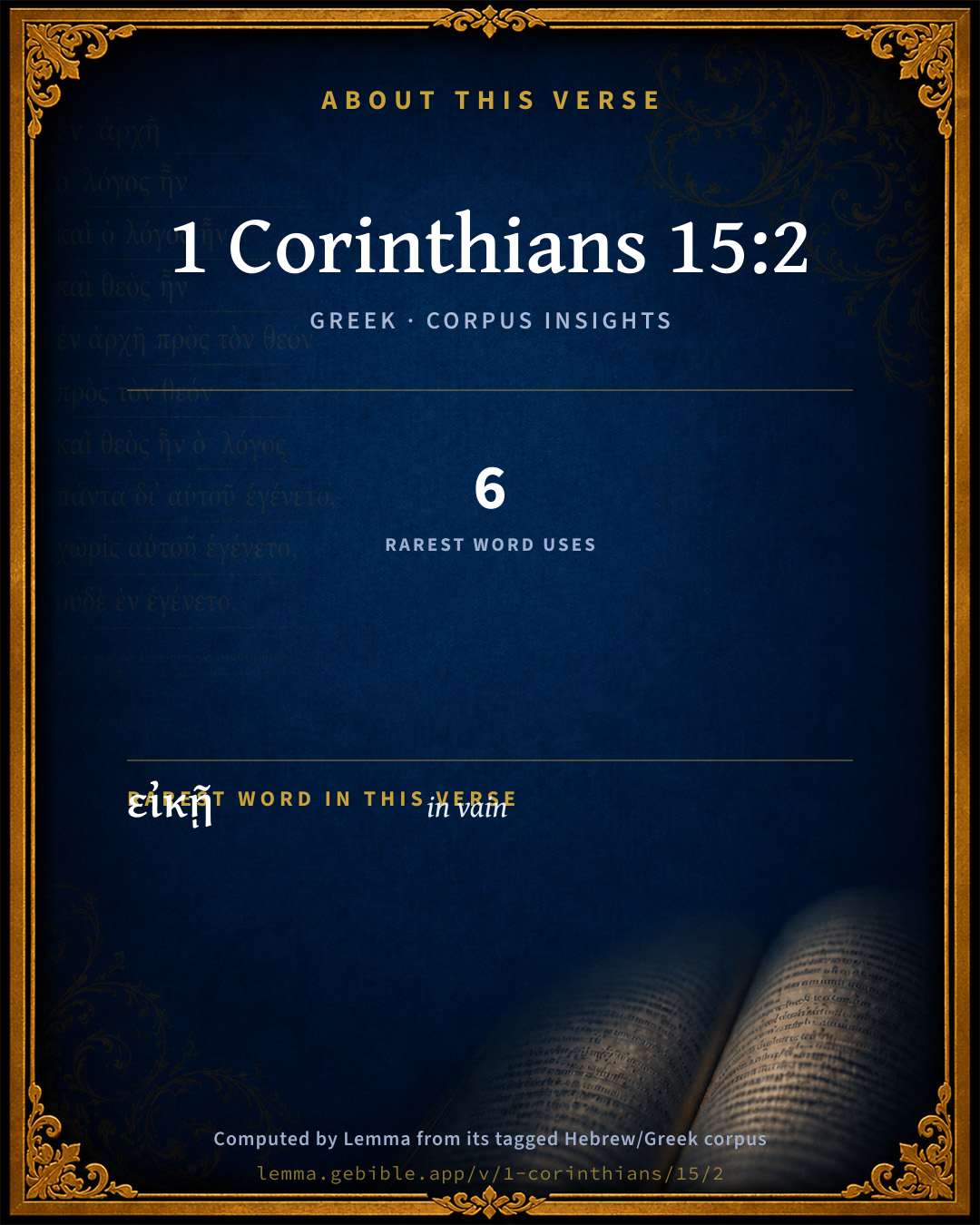
1 Corinthians 15:2

Greek (Tischendorf 8th ed.) 1 Corinthians 15:2 appears in the Greek New Testament. The text above is from the Tischendorf 8th edition. Each word links to its Strong’s number and a concise gloss. Click any word for its full Thayer’s Greek Lexicon entry.
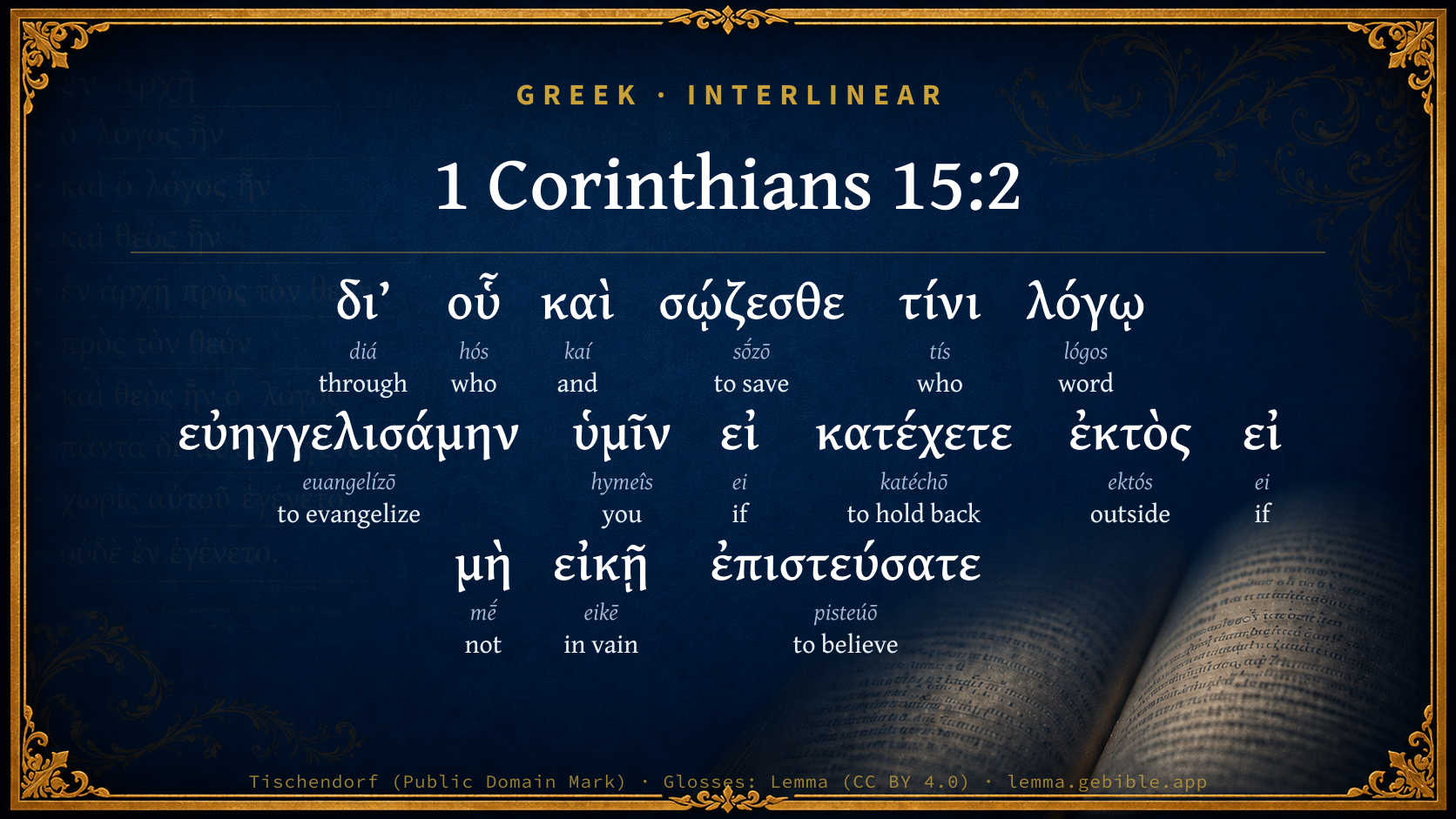
Download image
Cite this verse

1 Corinthians 15:2 (World English Bible). Public Domain. Lemma interlinear Bible study tool, https://lemma.gebible.app/v/1-corinthians/15/2.

Show BibTeX & RIS
BibTeX
RIS
English Translation
by which also you are saved, if you hold firmly the word which I preached to you--unless you believed in vain.
World English Bible · Public Domain
Download a study sheet

One document with this verse’s original text, its word-by-word gloss line, the meaning frame, cross-references with their text, attributed commentary, and full source and license credits — printable, and it pastes into notes with its structure intact.

This verse Autodidact and up

Study sheet (.html) Plain text (.txt)

A passage Seminary Student

Up to 50 verses in one chapter. A passage sheet keeps up to 6 commentary sources and 12 cross-references per verse, in the order this page ranks them, and says so on the sheet whenever that leaves anything out. Ask for a single verse and you get the Autodidact verse sheet above.

Everything on this page stays free to read, with no account — the sheet is a download of what is already on screen, not access to it.

Want to remove ads? Support Godless Engineer
Compare translations 3

The same verse in 3 English versions, stacked beneath the original-language interlinear above. Click any original word for its lexicon entry.

Each is an independent rendering of the whole verse — the interlinear is not word-aligned to these translations.

Highlighted words mark where these versions differ — a whole-verse word diff, not a word-by-word alignment.

  • World English Bible Public Domain
    by which also you are saved, if you hold firmly the word which I preached to you--unless you believed in vain.
  • King James Version Public Domain
    By which also ye are saved, if ye keep in memory what I preached unto you, unless ye have believed in vain.
  • unfoldingWord Literal Text CC BY-SA 4.0
    by which also you are being saved, if you hold firmly to what word I proclaimed to you, unless you believed in vain.

unfoldingWord Literal Text — © unfoldingWord, licensed CC BY-SA 4.0. Word-aligned USFM3 via Door43 (git.door43.org/unfoldingWord/en_ult).

Versions to compare (up to 4)

3 of 4 selected

Show all 19 translations

Every available English version of this verse, each an independent rendering of the whole verse.

  • World English Bible Public Domain
    by which also you are saved, if you hold firmly the word which I preached to you--unless you believed in vain.
  • Berean Standard Bible Public Domain
    By this gospel you are saved, if you hold firmly to the word I preached to you. Otherwise, you have believed in vain.
  • Majority Standard Bible Public Domain
    By this gospel you are saved, if you hold firmly to the word I preached to you. Otherwise, you have believed in vain.
  • King James Version Public Domain
    By which also ye are saved, if ye keep in memory what I preached unto you, unless ye have believed in vain.
  • American Standard Version (1901) Public Domain
    by which also ye are saved, if ye hold fast the word which I preached unto you, except ye believed in vain.
  • Revised Version (1885) Public Domain
    by which also ye are saved; I make known, I say, in what words I preached it unto you, if ye hold it fast, except ye believed in vain.
  • Geneva Bible (1599) Public Domain
    And whereby ye are saued, if ye keepe in memorie, after what maner I preached it vnto you, except ye haue beleeued in vaine.
  • Douay-Rheims (1899) Public Domain
    By which also you are saved, if you hold fast after what manner I preached unto you, unless you have believed in vain.
  • Young's Literal Translation Public Domain
    through which also ye are being saved, in what words I proclaimed good news to you, if ye hold fast, except ye did believe in vain,
  • Literal Standard Version CC BY-SA 4.0
    through which you are also being saved, if you hold fast [to] the word—what I proclaimed as good news to you—unless you believed in vain.
  • Unlocked Literal Bible CC BY-SA 4.0
    It is by this gospel that you are being saved, if you hold firmly to the word I preached to you, unless you believed in vain.
  • unfoldingWord Literal Text CC BY-SA 4.0
    by which also you are being saved, if you hold firmly to what word I proclaimed to you, unless you believed in vain.
  • Darby Bible Public Domain
    by which also ye are saved, (if ye hold fast the word which I announced to you as the glad tidings,) unless indeed ye have believed in vain.
  • World Messianic Bible Public Domain
    by which also you are saved, if you hold firmly the word which I preached to you—unless you believed in vain.
  • Webster's Bible Public Domain
    By which also ye are saved, if ye keep in memory what I preached to you, unless ye have believed in vain.
  • Free Bible Version CC BY-SA 4.0
    It is through this good news that you are saved if you hold on to the message that I gave you. Otherwise you trusted for nothing!
  • Bible in Basic English Public Domain
    By which you have salvation; that is to say, the form in which it was given to you, if it is fixed in your minds, and if your faith in it is not without effect.
  • Text-Critical English NT CC BY 4.0
    and by which you are being saved, if you hold fast to the message that I preached to you—unless you believed in vain.
  • Tyndale New Testament (1534) Public Domain
    by which also ye are saved: I do you to wit after what maner I preached vnto you yf ye kepe it except ye have beleved in vayne.

Literal Standard Version (2020), Covenant Press — licensed CC BY-SA 4.0. Text via the HelloAO Bible API (eBible.org). Unlocked Literal Bible (unfoldingWord) — licensed CC BY-SA 4.0. Text via the HelloAO Bible API (eBible.org). unfoldingWord Literal Text — © unfoldingWord, licensed CC BY-SA 4.0. Word-aligned USFM3 via Door43 (git.door43.org/unfoldingWord/en_ult). Free Bible Version, Dr. Jonathan Gallagher — licensed CC BY-SA 4.0. Text via the HelloAO Bible API (eBible.org).

Word by word

More ways to search: Search by grammar → Find every occurrence → Compare this word →

Practice this passage: Drill this verse → Learn its vocabulary →

εἰκῇ
eikē
G1500
“in vain”
Adverb
Part of Speech
Adverb
Full Thayer's Definition

Origin: probably from G1502 (through the idea of failure)

TDNT: 08:20,2

1. inconsiderably, without purpose, without just cause 2. in vain a. without success or effort
  1. δι’ diá G1223 “through” Preposition
  2. οὗ hós G3739 “who” Relative pronoun, Genitive, Singular, Neuter
  3. καὶ kaí G2532 “and” Conjunction
  4. σῴζεσθε sṓzō G4982 “to save” Verb, Present, Passive, Indicative, 2nd person, Plural
  5. τίνι tís G5101 “who” Interrogative pronoun, Dative, Singular, Masculine
  6. λόγῳ lógos G3056 “word” Noun, Dative, Singular, Masculine
  7. εὐηγγελισάμην euangelízō G2097 “to evangelize” Verb, Aorist, Middle, Indicative, 1st person, Singular
  8. ὑμῖν hymeîs G5210 “you” Personal pronoun, 2nd person, Dative, Plural
  9. εἰ ei G1487 “if” Conditional
  10. κατέχετε katéchō G2722 “to hold back” Verb, Present, Active, Indicative, 2nd person, Plural
  11. ἐκτὸς ektós G1622 “outside” Adverb
  12. εἰ ei G1487 “if” Conditional
  13. μὴ mḗ G3361 “not” Particle, Negative
  14. ἐπιστεύσατε pisteúō G4100 “to believe” Verb, Aorist, Active, Indicative, 2nd person, Plural

About this verse

These counts appear in no published source. They are computed here, from the morphology-tagged text and Lemma’s own curated glosses. What Lemma adds →

15
words
14
distinct lemmas
Pauline Epistles
section

Notable vocabulary

The rarest word here is εἰκῇ in vain G1500 — appearing just 6 times in the whole Greek New Testament.

Shared distinctive vocabulary

εἰκῇ in vain G1500 occurs in 5 verses of the Greek New Testament. Also found in:

Repetition

A word recurs within this verse:

Cross-references

30

Topical passages linked to 1 Corinthians 15:2 in the Treasury of Scripture Knowledge — connected by theme and wording, ordered by reader-vote popularity; previews shown in the World English Bible.

  • Hebrews 3:6 but Christ is faithful as a Son over his house; whose house we are, if we hold fast our confidence and the glorying of our hope firm to the end.
  • Hebrews 2:1 Therefore we ought to pay greater attention to the things that were heard, lest perhaps we drift away.
  • John 8:31–32 Jesus therefore said to those Jews who had believed him, "If you remain in my word, then you are truly my disciples.
  • 1 Corinthians 1:18 For the word of the cross is foolishness to those who are dying, but to us who are saved it is the power of God.
  • Ephesians 2:8 for by grace you have been saved through faith, and that not of yourselves; it is the gift of God,
  • Colossians 1:23 if it is so that you continue in the faith, grounded and steadfast, and not moved away from the hope of the Gospel which you heard, which is being proclaimed in all creation under heaven; of which I, Paul, was made a servant.
  • 2 Timothy 1:9 who saved us and called us with a holy calling, not according to our works, but according to his own purpose and grace, which was given to us in Christ Jesus before times eternal,
  • Hebrews 3:14 For we have become partakers of Christ, if we hold fast the beginning of our confidence firm to the end:
  • Luke 8:13 Those on the rock are they who, when they hear, receive the word with joy; but these have no root, who believe for a while, then fall away in time of temptation.
  • Hebrews 10:23 let us hold fast the confession of our hope unyieldingly. For he who promised is faithful.
  • James 2:14 What good is it, my brothers, if a man says he has faith, but has no works? Can faith save him?
  • James 2:26 For as the body apart from the spirit is dead, even so faith apart from works is dead.
  • Psalms 106:12–13 Then they believed his words. They sang his praise.
  • Proverbs 3:1 My son, don't forget my teaching; But let your heart keep my commandments:
  • Proverbs 4:13 Take firm hold of instruction. Don't let her go. Keep her, for she is your life.
  • Proverbs 6:20–23 My son, keep your father's commandment, And don't forsake your mother's teaching.
  • Romans 1:16 For I am not ashamed of the Gospel of Christ, for it is the power of God for salvation for everyone who believes; for the Jew first, and also for the Greek.
  • 1 Corinthians 15:11–12 Whether then it is I or they, so we preach, and so you believed.
  • 2 Corinthians 6:1 Working together, we entreat also that you not receive the grace of God in vain,
  • Galatians 3:4 Did you suffer so many things in vain, if it is indeed in vain?
  • 2 Thessalonians 2:15 So then, brothers, stand firm, and hold the traditions which you were taught by us, whether by word, or by letter.
  • Hebrews 4:14 Having then a great high priest, who has passed through the heavens, Jesus, the Son of God, let us hold tightly to our confession.
  • James 2:17 Even so faith, if it has no works, is dead in itself.
  • Proverbs 23:23 Buy the truth, and don't sell it: Get wisdom, discipline, and understanding.
  • Acts 2:47 praising God, and having favor with all the people. The Lord added to the assembly day by day those who were being saved.
  • Acts 8:13 Simon himself also believed. Being baptized, he continued with Philip. Seeing signs and great miracles occuring, he was amazed.
  • Romans 11:22 See then the goodness and severity of God. Toward those who fell, severity; but toward you, goodness, if you continue in his goodness; otherwise you also will be cut off.
  • 1 Corinthians 1:21 For seeing that in the wisdom of God, the world through its wisdom didn't know God, it was God's good pleasure through the foolishness of the preaching to save those who believe.
  • 1 Corinthians 15:14 If Christ has not been raised, then our preaching is in vain, and your faith also is in vain.
  • 2 Corinthians 2:15 For we are a sweet aroma of Christ to God, in those who are saved, and in those who perish;

Cross-references courtesy of OpenBible.info (CC BY 4.0).

Commentary

Notes on 1 Corinthians 15:2 from classic Christian and Jewish commentators (each source and its license shown beneath its notes). The classic Christian expositions comment on the surrounding passage and are grouped to its opening verse, so a note may address several verses; the Jewish commentaries on the Tanakh (Rashi and others) are per-verse, so they appear only where the commentator wrote on this verse.

Lemma curates 59 commentaries, every one of them public domain or Creative Commons licensed, each selected and text-cleaned for this edition rather than reprinted as found. About our sources →

The Biblical Illustrator

Joseph S. Exell

1Co_15:2

By which also ye are saved, if ye keep in memory what I preached unto you.

Hindrances and helps to memory in spiritual things

In these words we have a discovery--

1. Of mens utmost happiness--salvation.

2. Of the only means for the attaining of it--the gospel.

3. Of the special grace necessary in respect of this gospel--believing.

4. Of the particular faculty that is requisite for this end--the memory.

5. The relation, or influence, which this last hath upon all the rest.

And this expressed--

(1) By way of condition, Ye are saved, if ye keep in memory.

(2) By way of exception, Unless ye have believed in vain. Note--

I. What the memory is. It is that faculty of the soul wherein are reserved the things we know. Its office, however, is--

1. To receive such things as are presented to it. Wherin it is fitly enough compared to soft wax, which is prepared to receive any impression made upon it.

2. To retain and preserve what is laid up therein. There is a little kingdom in the soul of man. The king, or rather viceroy, is the will, the privy council is the understanding, the judge is the conscience, and the great treasurer is the memory.

3. To recall or recover what was out of mind.

II. The excellence of this faculty. The soul of man is a subject of wonder, and nothing more wonderful in it than the memory. It hath power to make things that are in themselves absent and past to be present. We may see the worth of this faculty by those that are deprived of the use of it, that can remember nobody, nor the last question that they did ask. All a mans past life would be lost if his memory were lost; so are the comforts of the soul lost so far as they are forgotten.

III. The corruption or depravation of this faculty. This stands--

1. In remembering those things which we should forget. As--

(1) Things unprofitable; like as if one should crowd waste-paper, rags, and broken pitchers into a cabinet, which should be stored with things of value.

(2) Things hurtful. To wit, injuries; these usually stick in the memory when better things slip out.

(3) Things sinful. We can remember a filthy story seven years when we do forget a saving sermon in seven hours. The depraved memory is herein fitly compared to a sieve that lets the good corn fall through and reserves only the chaff. Themistocles said to Simonides, when he offered to teach him the art of memory, Rather, says he, teach me the art of forgetfulness, for the things which I would not I remember, and cannot forget the things I would.

2. In forgetting those things which we should remember.

(1) Our Creator, and what He hath done especially for us (Ecc_12:1; Jer_2:32). This is most inexcusable (Act_17:27-28). And then the great things which He hath done, to wit, in the works of creation and providence, especially for His Church, these we easily forget, but should remember (Psa_77:11); and particularly what He hath done for us (Deu_8:2).

(2) Our Redeemer and what He hath suffered for us. Else He had never instituted the Lords Supper on purpose to keep up the remembrance thereof.

(3) The truths of religion, especially the most weighty (2Pe_1:12-15).

(4) The duties of religion (Exo_20:8; Heb_13:2-3; Heb_13:16). All which, as they show our duty, so do they imply our defectiveness herein.

(5) Our sins (Eze_36:31; Deu_9:7).

(6) Our vows and obligations to God.

(7) The Church of God (Psa_137:5-6).

(8) Our latter end (Isa_47:7; Lam_1:9).

IV. The sanctification of the memory. Which is the restoring of this faculty to its former integrity and to its proper objects. This is done--

1. By purging the faculty. And so conversion is said to begin here (Psa_22:27; Rev_2:5).

2. By strengthening it. For as sin weakens, so grace strengthens, the faculty (Joh_14:26).

3. By reconciling it to good things, and setting it against evil (Psa_119:16).

4. By filling it with good things (Mat_12:35).

5. By fitting things laid up in memory for use and practice (Num_15:39-40; Psa_103:17-18).

V. The ordinary impediments of a good memory, or the causes of a bad one.

1. A weak or dark understanding.

2. A carnal, careless heart. Such a heart can retain abundance of a play or a song, but of a chapter or sermon next to nothing, for everything keeps what is connatural to itself. Nay, a good mans memory in a remiss, negligent frame, quite differs from what it was in a religious frame.

3. A darling sin. Any bosom sin, as it fills and employs every faculty, so it debauches, monopolises, and disorders them all. Grace, though it rule every faculty, yet ruffles none; it composes the mind, and employs the memory in a rational manner.

4. Excess of worldly cares. The memory is but finite, though capacious, and a superabundance of worldly thoughts within must needs shoulder out better things that should be there.

5. Surfeiting and drunkenness. These disorder the brain and disable it from its functions (Pro_31:4-5).

6. Violent passions.

7. A multitude of indigested notions. If a man have a stock of methodical and digested knowledge, it is admirable how much the memory will contain; but many read or hear too much for their capacities, they have not stowage for it (2Ti_3:7). He who rides post can never draw maps of the country.

VI. The proper helps to it.

1. Natural.

(1) A sober diet. For if excesses in meat and drink do disturb the brain, temperate diet, together with a good air, is a certain help to the memory (Luk_21:34).

(2) A quiet mind. For if all passions that are violent weaken, then a sedate and quiet mind greatly strengthens, the memory.

2. Artificial or outward.

(1) The repetition of those things which we would remember (Deu_11:18-19).

(2) Writing what we would remember (Deu_11:20).

(3) Custom, or using your memories. We say, Use legs, and have legs; and so, Use the memory, and thou wilt have a memory.

3. Spiritual.

(1) Repentance for forgetfulness.

(2) Bewail your forgetfulness.

(3) Prayer. For every good gift and every perfect gift, whereof this is one, is from above.

(4) Diligent attention. If the mind wander in hearing the memory will be weak in remembering.

(5) Due estimation. The more we love and admire anything the better we remember it (Psa_119:16).

(6) Serious meditation. When people read or hear, and presently plunge themselves in foreign business, then generally all is lost (Jam_1:24-25; Psa_119:11).

VII. And so I come to application.

1. Magnify God for your memories.

2. Let ministers consult peoples memories, and to that end observe some proper method in their books and sermons.

3. Labour to improve your memories.

4. Store your memories in the time of youth (Ecc_12:1). A new ship is free from leaks, but time and travel will batter it. (R. Steele, A.M.)

Memory

Aristotle calls it the scribe of the soul; and Bernard the stomach of the soul, because it hath a retentive faculty, and turns heavenly food into blood and spirits. (T. Watson.)

Memory, Christian

It was the remark of John Newton, when his memory had almost completely gone, that he could never forget two things.

1. That he was a great sinner.

2. That Jesus Christ was a great and mighty Saviour.

Memory, cultivation of

If you have learned to look under your feet every day while young, and to cull the treasures of truth which belong to geology, natural history, and chemistry; if every fly has furnished you a study; if the incrustation of the frost is a matter, of interest; if the trees that come in spring, and the birds that populate them, the flowers of the meadow, the grass of the field, the fishes that disport themselves in the water--if all these are to you so many souvenirs of the working hand of your God, you will find, when you come into old age, that you have great stores of enjoyment therein. Let me therefore recommend you to commit much to memory. When a man is blind his memory is not blind. I have seen many a man who in youth had committed much to memory from the Scriptures and hymns and poems, who was able, in old age, to recall and recite what he had learned, and to fall back upon those treasures, his own head having thus become to him a library. Oh, how much a man may store up against old age! What a price is put into the hands of the young wherewith to get wisdom! What provisions for old age do they squander and throw away! It is not merely that you may be keen and strong now; it is not for the poor ambition of being esteemed learned that I urge you now to lay such treasures up; but because it is just and right and noble that you should be intelligent, and because your whole life is interested in it, and your old age pre-eminently so. (H. W. Beecher.)

Unless ye have believed ill vain.--

Believing in vain

1. A terrible peradventure to have believed in vain. To have spent a week, to have risked money, to have loved or chosen a profession in vain, is dreadful, and has driven many to despair, crime, and suicide. What shall we say, then, of having believed in vain; of having staked eternity on a delusion and a lie?

2. There are four phrases in the Greek thus rendered in A.V.

(1) In vain do they worship Me,--i.e., idly, foolishly, falsely--because their heart is far from Me.

(2) Then Christ is dead in vain, i.e., gratuitously, wantonly, without return.

(3) That ye receive not the grace of God in vain--unto emptiness.

(4) Have ye suffered so many things in vain--are all your endurances for Christ to be forfeited or stultified by departure from the truth? Lest I should have bestowed upon you labour in vain.

3. The word may have had in it, originally, the idea of seeming, as opposed to reality. But in its use it carries the sense of a thing done by chance, at haphazard, not deliberately. Here are two possibilities in one.

I. A defect in the thing believed.

1. To believe in vain may be to believe a lie. There are those who say that sincerity is everything. If a man be but sincere he must be in the right. His opinion may be false, his hope a dream, his faith a fable, yet if he is sincere he cannot have believed in vain. St. Paul was of another mind. Truth as well as sincerity went with his religion. With him the text meant primarily, Unless the object of your faith be a nullity. I transmitted to you, he says, a definite body of doctrine based on a series of fact--is it true? Some parts no one doubts--the death and burial. The miraculous part is the resurrection, which can only be proved by evidence--the evidence of eye-witnesses. Those who knew Christ saw Him alive after certain proof of His death.

2. Those who reject this evidence tell us to be of good cheer, for there is nothing lost. The resurrection is spiritual, and Christ risen means Christ immortal, successful, progressive, influencing the world by His pure ethics or bright example. But Paul is not satisfied with these airy nothings, and says that if the resurrection of Christ be not true those who believe in Him have believed in vain. Their faith is a random faith--they have not waited to see that its foundation is strong (verses 12-15).

II. A defect in the believer. The faith may be true and yet the belief of it unsound.

1. You may have taken for granted the faith of your family or your country, like the Samaritans, who believed because of the saying of another. If you had been born amongst Hindoos for the same reason you would have been such still. There is nothing of conviction, will, soul in your belief. It is no tribute to the truth. There needs in you just that step which was expressed in the Samaritans who said, Now we believe … for we have heard Him ourselves.

2. You may have believed in vain because you have walked carelessly and never sought to, reproduce the mind of Christ in your lives. Why call ye Me Lord, and do not the things which I say? How foolish that invention of our times which would apply the microscope to the feeling and the telescope to the life! which would hang all the hope on the warmth with which we can say, Jesus is all, and divert every anxiety from consistency of conduct! There is a random believing which has made haste after safety, and has forgotten to fight. Take seriously your besetting sin, and count nothing done till in the name of the risen Jesus you are victorious over that. (Dean Vaughan.)

The Biblical Illustrator, edited by Joseph S. Exell (c. 1880s–1900s) — public domain. Text from a community e-Sword module.

Tyndale Open Study Notes

Tyndale Open Resources

15:2 if you continue to believe: Those who continue firm in their faith will be saved (cp. Matt 10:22; 24:13; John 15:6; Gal 5:4; Col 1:23; Heb 6:4-6; contrast 1 Cor 1:8; Rom 8:38-39; Phil 1:6; Heb 6:9).

Tyndale Open Study Notes — © Tyndale Open Resources, licensed CC BY-SA 4.0. Text via the HelloAO Bible API.

Bengel's Gnomon

Johann Albrecht Bengel

1Co 15:2. Σώζεσθε, ye are saved) The future in sense, 1Co 15:18-19.—εἱ κατέχετε, if ye keep) If here implies a hope, as is evident from what follows, unless, etc.

Bengel's Gnomon of the New Testament — English translation (T&T Clark, Edinburgh, 1860) — public domain. Text from a community e-Sword module.

Hodge's Commentary on Romans, Ephesians & First Corinthians

Charles Hodge

1Co_15:1, 1Co_15:2

Moreover, brethren, I declare unto you the gospel which I preached unto you, which also ye have received, and wherein ye stand; by which also ye are saved, if ye keep in memory what I have preached unto you, unless ye have believed in vain.

There is no connection between this and the preceding chapter. The particle δέ, rendered moreover, indicates the introduction of a new subject. I declare unto (γνωρίζω), literally, I make known to you, as though they had never heard it before. Moreover, brethren, I proclaim to you the gospel. This interpretation is more consistent with the signification of the word, and more impressive than the rendering adopted by many, I remind you. Comp. however, 1Co_12:3; 2Co_8:1. Of this gospel Paul says,

1. That he had preached it.

2. They had received it, i.e. embraced it as true.

3. That they then professed it. They still stood firm in their adherence to the truth. It was not the Corinthians as a body, but only some among them, 1Co_15:12, who denied the doctrine of the resurrection.

4. That by it they are saved. The present tense is used to express either the certainty of the event, or the idea that believers are in this life partakers of salvation. They are already saved. There is to them no condemnation. They are renewed and made partakers of spiritual life.

Their salvation, however, is conditioned on their perseverance. If they do not persevere, they will not only fail of the consummation of the work of salvation, but it becomes manifest that they never were justified or renewed. Ye are saved (εἰ κατέχετε) if ye hold fast. The word does not mean, if ye keep in memory. It simply means, if ye hold fast; whether that be by a physical holding fast with the hand, or a retaining in the memory, or a retaining in faith, depends on the connection. Here it is evident that the condition of salvation is not retaining in the memory, but persevering in the faith. The gospel saves you, says the apostle, if you hold fast the gospel which I preached unto you.

The only difficulty in the passage relates to the words τίνι λόγῳ, literally, with what discourse; which in our version is expressed by the word what. This may express the true sense. The idea is, If you hold fast to the gospel as I preached it to you. The principal objection to this interpretation is the position of the words. The order in which they stand is, With what discourse I preached unto you if ye hold fast. The interpretation just mentioned reverses this order. This clause is therefore by many connected with the first words of the chapter. I bring to your knowledge, brethren, the gospel which I preached unto you, which ye received, wherein ye stand, by which ye are saved, (I bring to your knowledge, I say,) how, qua ratione, I preached, if ye hold fast. This, however, breaks the connection. It is, therefore, better to consider the words τίνι λόγῳ as placed first for the sake of emphasis. You are saved if you hold fast (the gospel) as I preached it to you. Unless ye have believed in vain. The word εἰκῆ, in vain, may mean either without cause, Gal_2:18, or without effect, i.e. to no purpose, Gal_3:4; Gal_4:11; If the former, then Paul means to say, Unless ye believed without evidence, i.e. had no ground for your faith. If the latter, the meaning is, Unless your faith is worthless. The clause may be connected with the preceding words, If ye hold fast, which ye do, or will do, unless ye believed without cause. The better connection is with the words ye are saved, etc. Ye are saved, if ye persevere, unless indeed faith is worthless. If, as the errorists in Corinth taught, there is no resurrection, Paul says, 1Co_15:14, our faith is vain; it is an empty, worthless thing. So here he says, the gospel secures salvation, unless faith be of no account.

Charles Hodge — Commentary on Romans (1835), First Corinthians (1857), and Ephesians (1856) — public domain. Text from a community e-Sword module.

Geneva Bible (1599)

Geneva Bible translators

Which is very absurd, and cannot be, but that they believe, must reap the fruit of faith.

Geneva Bible (1599) marginal notes — public domain. Text via Bolls.life.

Jamieson, Fausset & Brown

Robert Jamieson, A. R. Fausset & David Brown

ye are saved--rather, "ye are being saved."

if ye keep in memory what I preached unto you--Able critics, BENGEL and others, prefer connecting the words thus, "I declare unto you the Gospel (Co1 15:1) in what words I preached it unto you." Paul reminds them, or rather makes known to them, as if anew, not only the fact of the Gospel, but also with what words, and by what arguments, he preached it to them. Translate in that case, "if ye hold it fast." I prefer arranging as English Version, "By which ye are saved, if ye hold fast (in memory and personal appropriation) with what speech I preached it unto you."

unless--which is impossible, your faith is vain, in resting on Christ's resurrection as an objective reality.

Jamieson, Fausset & Brown — Commentary Critical and Explanatory on the Whole Bible (1871) — public domain (CC PDM 1.0). Text via the HelloAO Bible API.

Adam Clarke's Commentary

Verse 2. By which also ye are saved] That is, ye are now in a salvable state; and are saved from your Gentilism, and from your former sins.

If ye keep in memory] Your future salvation, or being brought finally to glory, will now depend on your faithfulness to the grace that ye have received.

Adam Clarke's Commentary on the Bible (1810–1826) — public domain. Text from a community e-Sword/MySword module.

Ellicott's Commentary for English Readers

(2) If ye keep in memory what I preached unto you.—Better, if ye hold fast with what word I preached the gospel to you, unless you believed in vain. The idea here is not, as implied in the English version, that they were converted, and yet that heretofore no results have followed from their belief; it is the same thought which comes out more fully in 1Co_15:17. They are saved by their faith in the gospel as preached by St. Paul, unless (which is impossible) the whole gospel be false, and so their faith in it be vain and useless.

A Bible Commentary for English Readers, edited by Charles John Ellicott (1878–1897) — public domain. Text from a community e-Sword module.

The Cambridge Bible for Schools and Colleges

gen. ed. J. J. S. Perowne

2. by which also ye are saved] i.e. are in a state of safety, the verb being in the present tense. The idea includes safety from sin as well as its punishment. See St Mat_1:21.

if ye keep in memory what I preached unto you] Literally, if ye hold fast the discourse with which I proclaimed good tidings to you.

The Cambridge Bible for Schools and Colleges (gen. ed. J. J. S. Perowne; Cambridge University Press, 1878–1918) — public domain. Text from a community e-Sword module.

John Gill's Exposition

By which also ye are saved,.... It was the means of their salvation, and had been made the power of God unto salvation to them. Salvation is inseparably connected with true faith in Christ as a Saviour, and with a hearty belief of his resurrection from the dead, which is the earnest and pledge of the resurrection of the saints; and because of the certainty of it in the promise of God, through the obedience and death of Christ, and in the faith and hope of believers, which are sure and certain things, they are said to be saved already. To which the apostle puts in the following provisos and exceptions; the one is,

if ye keep in memory what I preached unto you; or rather, "if ye hold fast, or retain"; that is, by faith, the doctrine preached to you, and received by you, particularly the doctrine of the resurrection of the dead; for the salvation that is connected with it does not depend upon the strength of the memory, but upon the truth and steadfastness of faith: it is the man that perseveres in the faith and doctrine of Christ that shall be saved; and everyone that has truly believed in Christ, and cordially embraced his Gospel, shall hold on, and out to the end; though the faith of nominal believers may be overthrown by such men, as Hymenaeus and Philetus, who asserted, that the resurrection was past already; but so shall not the faith of real believers, because the foundation on which they are built stands sure, and the Lord has perfect knowledge of them, and will keep and save them. The other exception is,

unless ye have believed in vain: not that true faith can be in vain; for that is the faith of God's elect, the gift of his grace, the operation of his Spirit; Christ is the author and finisher of it, and will never suffer it to fail; it will certainly issue in everlasting salvation: but then as the word may be heard in vain, as it is by such who are compared to the wayside, and to the thorny and rocky ground; and as the Gospel of the grace of God may be received in vain; so a mere historical faith may be in vain; this a man may have, and not the grace of God, and so be nothing; with this he may believe for a while, and then drop it: and since each of these might possibly be the case of some in this church, the apostle puts in these exceptions, in order to awaken the attention of them all to this important doctrine he was reminding them of.

John Gill's Exposition of the Whole Bible (1746–1763) — public domain (CC PDM 1.0). Text via the HelloAO Bible API.

Trapp's Complete Commentary

John Trapp

2 By which also ye are saved, if ye keep in memory what I preached unto you, unless ye have believed in vain.

Ver. 2. By which also ye are saved] Eternal life is potentially in the word, as the harvest is potentially in the seed, or as the tree is in the kernel or scion, Jas 1:21.

If ye keep in memory] He limiteth the promise of salvation to the condition of keeping in memory what they had heard. Tantum didicimus, quantum meminimus, said Socrates; many have memories like nets, that let go the fair water, retain the filth only; or like sieves, that keep the chaff, let go the corn. If God come to search them with a candle, what shall he find but old songs, old wrongs, &c.? not a promise of any word of God hidden there: for things of that nature they are like Sabinus in Seneca, that never in all his life could remember those three names of Homer, Ulysses, and Achilles. But the soul should be as a holy ark, the memory like the pot of manna, preserving holy truths.

John Trapp, A Commentary or Exposition upon All the Books of the Old and New Testament (1647–1656) — public domain. Text from a community e-Sword module.

Albert Barnes' Notes on the Bible

By which also ye are saved - On which your salvation depends; the belief of which is indispensable to your salvation; see the note on Mar 16:16. The apostle thus shows the “importance” of the doctrine. In every respect it demanded their attention. It was that which was first preached among them; that which they had solemnly professed; that by which they had been built up; and that which was connected with their salvation. It does not mean simply that by this they were brought into a salvable state (Clarke, Macknight, Whitby, Bloomfield, etc.), but it means that their hopes of eternal life rested on this; and by this they were then “in fact” saved from the condemnation of sin, and were in the possession of the hope of eternal life.

If ye keep in memory - Margin, as in the Greek, “if ye hold fast.” The idea is, that they were saved by this, or would be, if they faithfully retained or held the doctrine as he delivered it; if they observed it, and still believed it, notwithstanding all the efforts of their enemies, and all the arts of false teaching to wrest it from them. There is a doubt delicately suggested here, whether they did in fact still adhere to his doctrine, or whether they had not abandoned it in part for the opposite.

Unless ye have believed in vain - You will be saved by it, if you adhere to it, unless it shall turn out that it was vain to believe, and that the doctrine was false. That it was “not” false, he proceeds to demonstrate. Unless all your trials, discouragements, and hopes were to no purpose, and all have been the result of imposture; and unless all your profession is false and hollow, you will be saved by this great doctrine which I first preached to you.

Albert Barnes' Notes on the Bible (1834–1885) — public domain. Text from a community e-Sword/MySword module.

Matthew Poole's English Annotations

By which also ye are saved; by the believing, receiving, of which doctrine, you are already in the way to salvation (as it is said, Joh 3:18; He that believeth on him is not condemned; and Joh 3:36; He hath everlasting life, and shall be eternally saved): but not unless ye persevere (for that is meant by keeping in memory the doctrine which I have preached unto you); and this you must do, or your believing will signify nothing, but be in vain to your souls.

Matthew Poole's English Annotations on the Holy Bible (1683–1685) — public domain. Text from a community e-Sword/MySword module.

Whedon's Commentary on the Bible

Daniel D. Whedon

2. Saved—It is by holy truth, received and kept in memory, that we are saved.

Daniel D. Whedon (gen. ed.), Commentary on the Old and New Testaments (1874–1909) — public domain. Text from a community e-Sword module.

The Pulpit Commentary

By which also ye are saved; literally, ye are being saved. It is as if some surprise was expressed at the necessity for again making known to them a gospel which

(1) he had preached and

(2) they also received; and

(3) in which they now stood fast (Rom_5:2; Eph_6:13) and

(4) by means of which they were now in a state of safety, they were of the class of sozomenoi. (Act_2:47) If ye keep in memory what I preached unto you. The order, which is peculiar, is, "In what words I preached to you, if ye hold it fast." Possibly the "in what discourse" depends on "I make known to you." The duty of "holding fast" what they had heard is often impressed on the early converts (1Co_11:2; 2Co_6:10; 1Th_5:21; Heb_10:23) Ye have believed; rather, ye believed; i.e. ye became believers. In vain. The word may either mean "rashly," "without evidence," as in classical Greek; or "to no purpose," "without effect," as in Rom_13:4; Gal_3:4 Gal_4:11. In this case they would have received the seed in stony places. (Mat_13:21)

Salvation a present process.

Precisely rendered, the first sentence of this verse would read, "By which also ye are being saved." St. Paul applies, in his writings, the best corrective to the imperfect, and indeed false, notion that human redemption is a thing completed, a thing done outside of and separate from men, a something which they are to receive as if it were a mere gift provided for them apart from their own exertions. St. Paul clearly saw that redemption is a moral work; its proper sphere is a man"s mind and heart and life. It is a process, and it has to be carried on right through a man"s earthly history. There is a sense in which it may be said that we are saved, but there is a much truer and deeper sense in which it may be said that we are being saved. One of the most striking expressions of the Pauline idea of salvation as a present process, carried on within us, is found in Rom_5:10: "For if, when we were enemies, we were reconciled to God by the death of his Son, much more, being reconciled, we shall be saved by his life." Some adequate notion of the Pauline thought of salvation may be obtained by dwelling on the following three representations:

I THE BEGINNING OF SALVATION IS THE RECEPTION OF THE GOSPEL. Observe how the Christian teachers first demanded faith in the person of the Lord Jesus Christ. That is the beginning. We must accept of Jesus as the Sent of God, the Son of God, and the Saviour from sin. That beginning may be

(1) intellectual, a persuasion, upon due evidence, that Christ is the Saviour; or it may be

(2) emotional, a constraint of love to him who condescended, bore, and suffered so much for us, and whose personal history is such a fascination. Here is the initial stage, "Dost thou believe that Jesus is the Son of God?" You cannot be on the Christian platform at all unless you can give to that question a simple and hearty affirmative. But this is only a beginning. A man is not saved upon such a faith as that. There must be advance to spiritual apprehension of the relation in which Jesus stands to the individual and the individual may stand to him.

II THE STATE OF SALVATION IS STANDING IN THE GOSPEL. It is apprehending that the Lord Jesus Christ has, by the perfection of his obedience and the sublime merit of his sacrifice, made a new standing ground before God for us. That he represents us. That he wins a place before God, and a relation with God, for us. That his personal rights are not exclusively personal, but are rights which he shares with us, or allows us to share with him, and we are "accepted in the Beloved." In the presence of law claim, we stand as "justified." In the presence of God"s claim to perfect obedience, we stand, in Christ, as righteous. In the anticipations of a judgment day, we stand as already acquitted; for us "there is now no condemnation.

III THE PROCESS OF SALVATION IS GIVING THE GOSPEL FREE ROOM TO WORK IN MIND, AND HEART, AND RELATIONS, AND LIFE. The gospel being conceived, not primarily as a set of principles, and duties, and counsels, but primarily as the spiritual and abiding presence of the Lord Jesus Christ with us, using truths, principles, experiences, duties, thoughts, and counsels, as need be, for the carrying on of his gracious work of moral perfecting. "This is the will of God, even your sanctification;" and we lose the holiest interest in that sanctification when we fail to realize that the Lord Jesus Christ is now actually present with us, carrying on and presiding over this work. We are being saved; and the exceeding solemnity of our common everyday life lies in this Christ is in it, working at our salvation. The apostle therefore urges upon us that we must hold in quick and living memory the gospel of the present, working Saviour risen that he might carry on to its full completion his redemptive work and that to believe in vain is to profess belief, but give the faith no power to open our soul and life to the redeemings of the risen, living, and ever-present Saviour. R.T.

The Pulpit Commentary (1880–1919), ed. H.D.M. Spence-Jones & Joseph S. Exell — public domain. Text from a community e-Sword module.

John Wesley's Explanatory Notes

Ye are saved, if ye hold fast - Your salvation is begun, and will be perfected, if ye continue in the faith. Unless ye have believed in vain - Unless indeed your faith was only a delusion.

John Wesley, Explanatory Notes Upon the Whole Bible (1754–1765) — public domain. Text via the GEBible commentary corpus.

Scofield Reference Notes

C. I. Scofield

saved

(See Scofield "Rom 1:16").

The Scofield Reference Bible (1917 edition), notes by C. I. Scofield — public domain. Text from a community e-Sword module.

McGarvey & Pendleton's Commentaries

J. W. McGarvey

by which also ye are saved, if ye hold fast the word which I preached unto you, except ye believed in vain . [or without cause. In these two verses Paul reminds them of many important facts, as follows: that they had already heard the gospel, weighed, tested and received it, and that they now stood as a church organized under it, and that their hopes of salvation depended upon their holding fast to it, unless they had believed inconsiderately, under the impulse of a mere fitful admiration. His correlative appeal to them to think more deeply and steadfastly will be found in the last verse of the chapter.]

J. W. McGarvey (with Philip Y. Pendleton), Commentaries on the New Testament (The Fourfold Gospel, 1914; Acts; and the epistles) — public domain. Text from a community e-Sword/MySword module.

The People's New Testament

B. W. Johnson

2. By which, also, ye are saved. Are in a saved state unless you have forgotten the gospel preached and departed from it; that is, unless their faith is vain, which he shows would be the case if there was no resurrection. Observe the tact with which he first presents facts conceded by all the disciples, and upon these builds an impregnable argument. He next states those facts.

B. W. Johnson's The People's New Testament with Notes (1889–1891) — public domain. Electronic text from the Christian Classics Ethereal Library (CCEL) ThML edition.

Cambridge Greek Testament for Schools and Colleges

2. σώζεσθε. Observe the change of tense. The others refer to past acts, this to a present condition. The A.V. ‘are saved’ is equivalent to the Greek perfect. Cf. σωζόμενος in ch. 1Co 1:18; Act 2:47; 2Co 2:15.

τίνι λόγῳ εὐηγγελισάμην ὑμῖν εἰ κατέχετε. ‘That is to say, provided you are holding fast what I taught you.’ For τίς in the place of the relative see Act 10:29 and Buttm. Neu-Test. Gr., p. 216. He remarks that this construction is usually found with ἔχω, and that the underlying thought is always more or less indirectly interrogative. λόγῳ is the dative of attraction in dependence on εὐηγγελισάμην, ‘if you retain firmly in memory with what discourse (or matter) I brought you good tidings,’ i. e. if you hold fast the subject-matter of my message. Some (2) regard the τίνι λόγῳ as marking more distinctly the nature of the εὐαγγέλιον, ‘if you hold fast the Gospel I have proclaimed to you, of what sort it is.’ And (3) the Revisers of our version have preferred to connect τίνι λόγῳ with γνωρίζω ‘I make known, I say, with what words I preached the gospel to you.’ We cannot translate here, as in Act 10:29, ‘for what reason.’

ἐκτὸς εἰ μή. See note on ch. 1Co 14:5.

ἐπιστεύσατε. Not ‘have believed,’ as A.V., but believed, i.e. professed yourselves disciples of Christ.

Cambridge Greek Testament for Schools and Colleges (Cambridge University Press, 1896; 21 vols, various authors incl. Carr, Maclear, Plummer, Farrar, Lumby, Moule, M. R. James, Simcox) — public domain. Text from a community e-Sword module.

Alford’s Greek Testament

Henry Alford

2.] δέ transitional.

γνωρίζω, not, as most Commentators, aft. Œ, οἷον ὑπομιμνήσκω, nor as Rück., ‘I direct your attention to’ (both which meanings are inadmissible, from the usage of the word: see reff.),—but as E. V. I declare: i.e. ‘declare anew:’ not without some intimation of surprise and reproach to them.

τὸ εὐαγγ.] the (whole) Gospel: not merely the Death and Resurrection of Christ, which were ἐν πρώτοις parts of it; the reproach still continues; q. d. ‘I am constrained to begin again, and declare to you the whole gospel which I preached to you.’

ὃ καὶ παρ.] The thrice repeated καί indicates a climax:—which ye also received (see especially ref. John), in which moreover ye stand, by means of which ye are even being saved (in the course of salvation).

τίνι λόγ.] if ye hold fast, with what discourse (not, as Moulton supposes me to interpret (in his Winer, Gr. Gr. p. 211, note 2,) = the discourse with which) I preached to you: the clause τίνι λόγ. being prefixed for emphasis’ sake. λόγος, of the import, not the grounds of his preaching: for of this he reminds them below, not of the arguments. Some Commentators take τίνι λόγῳ κ.τ.λ. as a mere epexegesis of εὐαγγέλιον,—‘the gospel.…, with what discourse I preached to you,’ as οἶδά σε, τίς εἶ. But as Meyer has remarked, in that case,—(1) σώζεσθε and εἰ κατέχετε being altogether severed from one another, εἰ κατέχετε becomes the conditional clause to γνωρίζω ὑμῖν, with which it has no logical connexion: (2) εἰ κατέχετε would be inconsistent with ἐν ᾧ καὶ ἑστήκατε, which would thus be an absolute assertion: (3) the words ἐκτὸς εἰ μὴ εἰκῆ ἐπιστ. would have to be referred as a second conditional clause to εἰ κατέχετε (see below).

ἐκτὸς εἰ μὴ εἰκῆ ἐπιστ.] The only chance, if you hold fast what I have taught you, of your missing salvation, is the hardly supposable one, that your faith is vain, and the gospel a fable; see ver. 14, of which this is an anticipation:—unless (perchance) ye believed (not as E. V. ‘have believed,’ which confuses the idea: it is, ‘became believers,’ see reff.) in vain (εἰς κενόν, as ver. 14). So Chrys., who remarks: νῦν μὲν ὑπεσταλμένως αὐτό φησι, προϊὼν δὲ καὶ διαθερμαινόμενος· γυμνῇ λοιπὸν τῇ κεφαλῇ βοᾷ καὶ λέγει Εἰ δὲ χριστὸς οὐκ ἐγήγερται, κ.τ.λ., ver. 14. Hom. xxxviii. p. 352. This explanation of the words appears to me the only tenable one. Meyer, and in the main De W., understand them of a vain and dead faith, which the Apostle will not suppose them to have. But surely if the previously expressed condition of κατέχετε were fulfilled, their faith could not be vain or dead; and again the aorist is against this interpretation: unless ye became believers in vain, not, ‘unless your faith has been a vain one.’ A still further reason is, the parallelism of εἰκῆ ἐπιστεύσατε here and οὕτως ἐπιστεύσατε, ver. 11: leading to the inference that εἰκῆ here relates, not to the subjective insufficiency of their faith, but to the (hypothetical) objective nullity of that on which their faith was founded. Œc., Theophyl., Theodoret, Luther, Calv., Estius, and De W. connect ἐκτὸς εἰ μή (see above) as a second conditional clause to εἰ κατέχετε, supplying between, κατέχετε δὲ πάντως (Theophyl.): but this is arbitrary and unnatural.

Henry Alford, The Greek Testament (1849–1861) — public domain. Text from a community e-Sword module.

International Critical Commentary

2. The reference is to some abnormal baptismal rite known to the Corinthians, which would be meaningless without a belief in the resurrection. This hypothesis, when left quite indefinite, is admissible. But when it is defined as vicarious baptism, i.e. of baptizing living proxies in place of those who had died unbaptized, it becomes highly improbable. This practice existed in some quarters in Tertullian’s day (De Resur. 48; Adv. Marcion. v. 10), but perhaps only among heretics. There is no evidence that this vicarious baptism was practised anywhere in St Paul’s time; and if it had been, would he have used such a superstitious rite as an argument? Granted that such an argument does not necessarily imply approval of the rite, yet it would have laid him open to the retort, “But we do not practise anything of the kind; what is that to us?”

International Critical Commentary — older volumes (1896–1929), various authors — public domain. Text from a community e-Sword module.

Vincent's Word Studies in the New Testament

Marvin R. Vincent

If ye keep in memory what, etc. I see no good reason for departing from the arrangement of the A. V., which states that the salvation of the readers depends on their holding fast the word preached. 125 Rev. reads : through which ye are saved; I make known, I say, in what words I preached it unto you, if ye hold it fast, etc. This is certainly very awkward, making Paul say that their holding it fast was the condition on which he preached it. American Rev. as A. V.

Marvin R. Vincent, Word Studies in the New Testament (1887–1900) — public domain. Text from a community e-Sword/MySword module.

Lesson kit

Teaching starters — assembled from the data on this page, not authored interpretation. Every prompt links to the verse data it draws on. Edit before teaching.

1 Corinthians, in the Pauline Epistles, opens this verse with 15 words (14 distinct Greek lemmas). Its most distinctive word is eikē (“in vain”). A historical commentator’s framing appears above. Read the whole chapter for the surrounding context.

Discussion questions

  1. The word eikē carries the sense “in vain.” How does it shape the verse?
  2. How does Romans 13:4, which shares the word «in vain», read alongside this verse?
  3. What does the repetition of “if” (2× in this one verse) do in this verse?
  4. The translations on this page render this verse differently — a whole-verse word diff, not a word-by-word alignment. What might account for the different wordings?
  5. Compare how The Biblical Illustrator and Tyndale Open Study Notes read this verse. Where do they agree or differ?

Things to notice

Reading settings

Reading text

Shown beneath each verse's original-language words.

Old Testament
Old Testament edition

Read the OT as the Masoretic Hebrew (MT) or the Greek Septuagint (LXX).

English shown for the Greek Septuagint (in the Hebrew ↔ Greek comparison).

Comparing translations? Open the Compare panel on any verse page to stack up to four side by side.