1 Corinthians 10:27

Greek (Tischendorf 8th ed.) 1 Corinthians 10:27 appears in the Greek New Testament. The text above is from the Tischendorf 8th edition. Each word links to its Strong’s number and a concise gloss. Click any word for its full Thayer’s Greek Lexicon entry.
Download image
Cite this verse

1 Corinthians 10:27 (World English Bible). Public Domain. Lemma interlinear Bible study tool, https://lemma.gebible.app/v/1-corinthians/10/27.

Show BibTeX & RIS
BibTeX
RIS
English Translation
But if one of those who don't believe invites you to a meal, and you are inclined to go, eat whatever is set before you, asking no questions for the sake of conscience.
World English Bible · Public Domain
Download a study sheet

One document with this verse’s original text, its word-by-word gloss line, the meaning frame, cross-references with their text, attributed commentary, and full source and license credits — printable, and it pastes into notes with its structure intact.

This verse Autodidact and up

Study sheet (.html) Plain text (.txt)

A passage Seminary Student

Up to 50 verses in one chapter. A passage sheet keeps up to 6 commentary sources and 12 cross-references per verse, in the order this page ranks them, and says so on the sheet whenever that leaves anything out. Ask for a single verse and you get the Autodidact verse sheet above.

Everything on this page stays free to read, with no account — the sheet is a download of what is already on screen, not access to it.

Want to remove ads? Support Godless Engineer
Compare translations 3

The same verse in 3 English versions, stacked beneath the original-language interlinear above. Click any original word for its lexicon entry.

Each is an independent rendering of the whole verse — the interlinear is not word-aligned to these translations.

Highlighted words mark where these versions differ — a whole-verse word diff, not a word-by-word alignment.

  • World English Bible Public Domain
    But if one of those who don't believe invites you to a meal, and you are inclined to go, eat whatever is set before you, asking no questions for the sake of conscience.
  • King James Version Public Domain
    If any of them that believe not bid you to a feast, and ye be disposed to go; whatsoever is set before you, eat, asking no question for conscience sake.
  • unfoldingWord Literal Text CC BY-SA 4.0
    If any of the unbelievers invite you, and you want to go, eat everything being set before you, without asking questions for the sake of the conscience.

unfoldingWord Literal Text — © unfoldingWord, licensed CC BY-SA 4.0. Word-aligned USFM3 via Door43 (git.door43.org/unfoldingWord/en_ult).

Versions to compare (up to 4)

3 of 4 selected

Show all 19 translations

Every available English version of this verse, each an independent rendering of the whole verse.

  • World English Bible Public Domain
    But if one of those who don't believe invites you to a meal, and you are inclined to go, eat whatever is set before you, asking no questions for the sake of conscience.
  • Berean Standard Bible Public Domain
    If an unbeliever invites you to a meal and you want to go, eat anything set before you without raising questions of conscience.
  • Majority Standard Bible Public Domain
    If an unbeliever invites you to a meal and you want to go, eat anything set before you without raising questions of conscience.
  • King James Version Public Domain
    If any of them that believe not bid you to a feast, and ye be disposed to go; whatsoever is set before you, eat, asking no question for conscience sake.
  • American Standard Version (1901) Public Domain
    If one of them that believe not biddeth you `to a feast', and ye are disposed to go; whatsoever is set before you, eat, asking no question for conscience' sake.
  • Revised Version (1885) Public Domain
    If one of them that believe not biddeth you to a feast, and ye are disposed to go; whatsoever is set before you, eat, asking no question for conscience sake.
  • Geneva Bible (1599) Public Domain
    If any of them which beleeue not, call you to a feast, and if ye wil go, whatsoeuer is set before you, eate, asking no question for conscience sake.
  • Douay-Rheims (1899) Public Domain
    If any of them that believe not, invite you, and you will be willing to go; eat of any thing that is set before you, asking no question for conscience' sake.
  • Young's Literal Translation Public Domain
    and if any one of the unbelieving do call you, and ye wish to go, all that is set before you eat, nothing inquiring, because of the conscience;
  • Literal Standard Version CC BY-SA 4.0
    and if anyone of the unbelieving calls you, and you wish to go, eat all that is set before you, inquiring nothing, because of the conscience;
  • Unlocked Literal Bible CC BY-SA 4.0
    If an unbeliever invites you to eat a meal, and you wish to go, eat whatever is set before you without asking questions of conscience.
  • unfoldingWord Literal Text CC BY-SA 4.0
    If any of the unbelievers invite you, and you want to go, eat everything being set before you, without asking questions for the sake of the conscience.
  • Darby Bible Public Domain
    But if any one of the unbelievers invite you, and ye are minded to go, all that is set before you eat, making no inquiry for conscience sake.
  • World Messianic Bible Public Domain
    But if one of those who don’t believe invites you to a meal, and you are inclined to go, eat whatever is set before you, asking no questions for the sake of conscience.
  • Webster's Bible Public Domain
    If any of them that believe not invites you to a feast, and ye are disposed to go; whatever is set before you, eat, asking no question on account of conscience.
  • Free Bible Version CC BY-SA 4.0
    If a non-Christian invites you to a meal, and you feel like going, eat whatever you are served, without asking questions because of your conscience.
  • Bible in Basic English Public Domain
    If a Gentile makes a feast for you, and you are pleased to go as a guest, take whatever is put before you, without question of right or wrong.
  • Text-Critical English NT CC BY 4.0
    If one of the unbelievers invites you to dinner and you want to go, eat whatever is set before you, questioning nothing for the sake of conscience.
  • Tyndale New Testament (1534) Public Domain
    Yf eny of them which beleve not bid you to a feest and yf ye be disposed to goo what soever is seet before you: eate axinge no question for conscience sake.

Literal Standard Version (2020), Covenant Press — licensed CC BY-SA 4.0. Text via the HelloAO Bible API (eBible.org). Unlocked Literal Bible (unfoldingWord) — licensed CC BY-SA 4.0. Text via the HelloAO Bible API (eBible.org). unfoldingWord Literal Text — © unfoldingWord, licensed CC BY-SA 4.0. Word-aligned USFM3 via Door43 (git.door43.org/unfoldingWord/en_ult). Free Bible Version, Dr. Jonathan Gallagher — licensed CC BY-SA 4.0. Text via the HelloAO Bible API (eBible.org).

Word by word

More ways to search: Search by grammar → Find every occurrence → Compare this word →

Practice this passage: Drill this verse → Learn its vocabulary →

ἀνακρίνοντες
anakrínō
G350
“to examine”
Verb, Present, Active, Participle, Nominative, Plural, Masculine
Part of Speech
Verb
Tense
Present
Voice
Active
Mood
Participle
Case
Nominative
Number
Plural
Gender
Masculine
Full Thayer's Definition

Origin: from G303 and G2919

TDNT: 18:43,5

1. examine or judge a. to investigate, examine, enquire into, scrutinise, sift, question 1. specifically in a forensic sense of a judge to hold an investigation 2. to interrogate, examine the accused or witnesses b. to judge of, estimate, determine (the excellence or defects of any person or thing
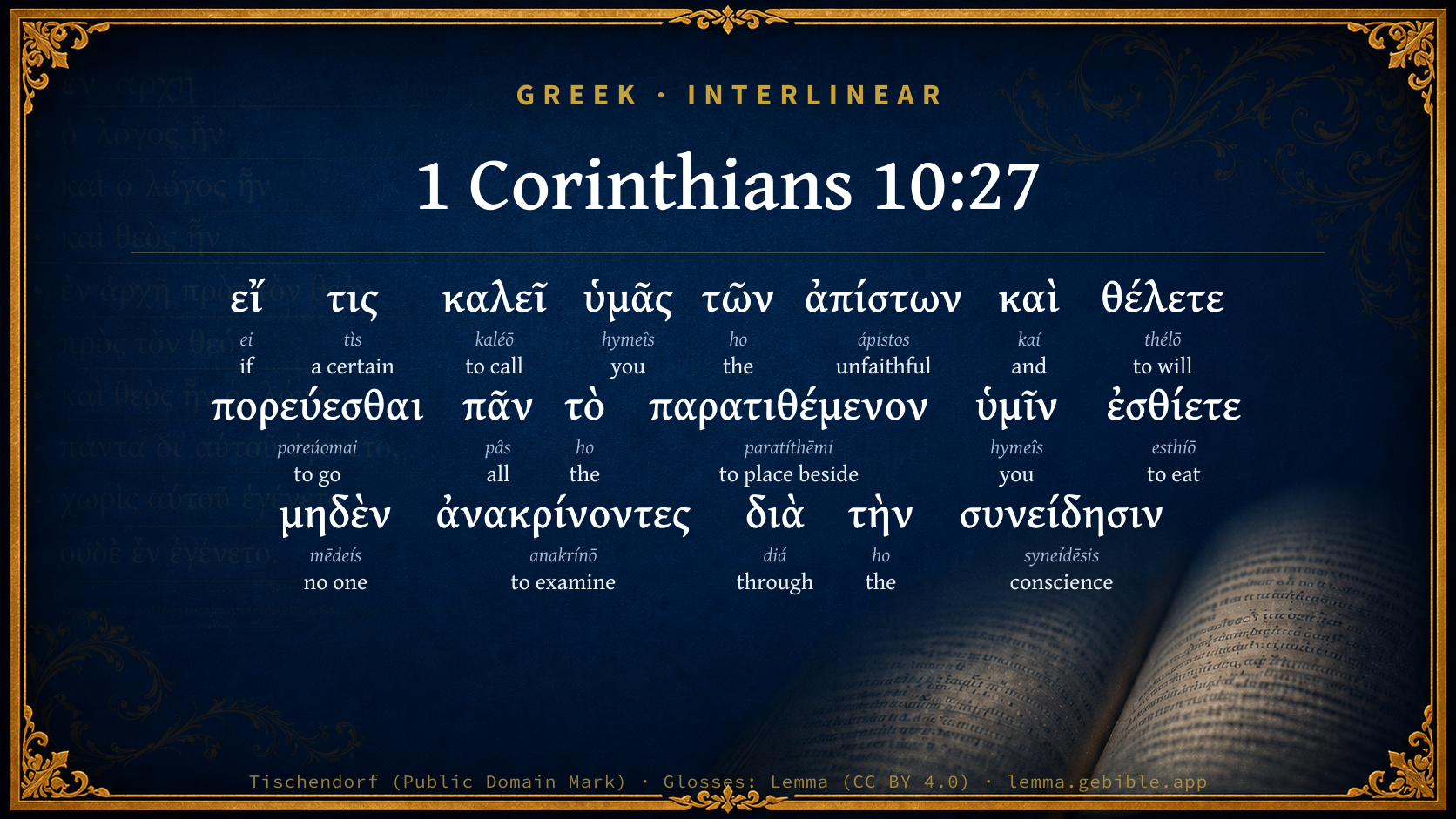
  1. εἴ ei G1487 “if” Conditional
  2. τις tìs G5100 “a certain” Indefinite pronoun, Nominative, Singular, Masculine
  3. καλεῖ kaléō G2564 “to call” Verb, Present, Active, Indicative, 3rd person, Singular
  4. ὑμᾶς hymeîs G5210 “you” Personal pronoun, 2nd person, Accusative, Plural
  5. τῶν ho G3588 “the” Article, Genitive, Plural, Masculine
  6. ἀπίστων ápistos G571 “unfaithful” Adjective, Genitive, Plural, Masculine
  7. καὶ kaí G2532 “and” Conjunction
  8. θέλετε thélō G2309 “to will” Verb, Present, Active, Indicative, 2nd person, Plural
  9. πορεύεσθαι poreúomai G4198 “to go” Verb, Present, Middle or Passive deponent, Infinitive
  10. πᾶν pâs G3956 “all” Adjective, Accusative, Singular, Neuter
  11. τὸ ho G3588 “the” Article, Accusative, Singular, Neuter
  12. παρατιθέμενον paratíthēmi G3908 “to place beside” Verb, Present, Passive, Participle, Accusative, Singular, Neuter
  13. ὑμῖν hymeîs G5210 “you” Personal pronoun, 2nd person, Dative, Plural
  14. ἐσθίετε esthíō G2068 “to eat” Verb, Present, Active, Imperative, 2nd person, Plural
  15. μηδὲν mēdeís G3367 “no one” Adjective, Accusative, Singular, Neuter, Negative
  16. διὰ diá G1223 “through” Preposition
  17. τὴν ho G3588 “the” Article, Accusative, Singular, Feminine
  18. συνείδησιν syneídēsis G4893 “conscience” Noun, Accusative, Singular, Feminine

About this verse

These counts appear in no published source. They are computed here, from the morphology-tagged text and Lemma’s own curated glosses. What Lemma adds →

19
words
16
distinct lemmas
Pauline Epistles
section

Notable vocabulary

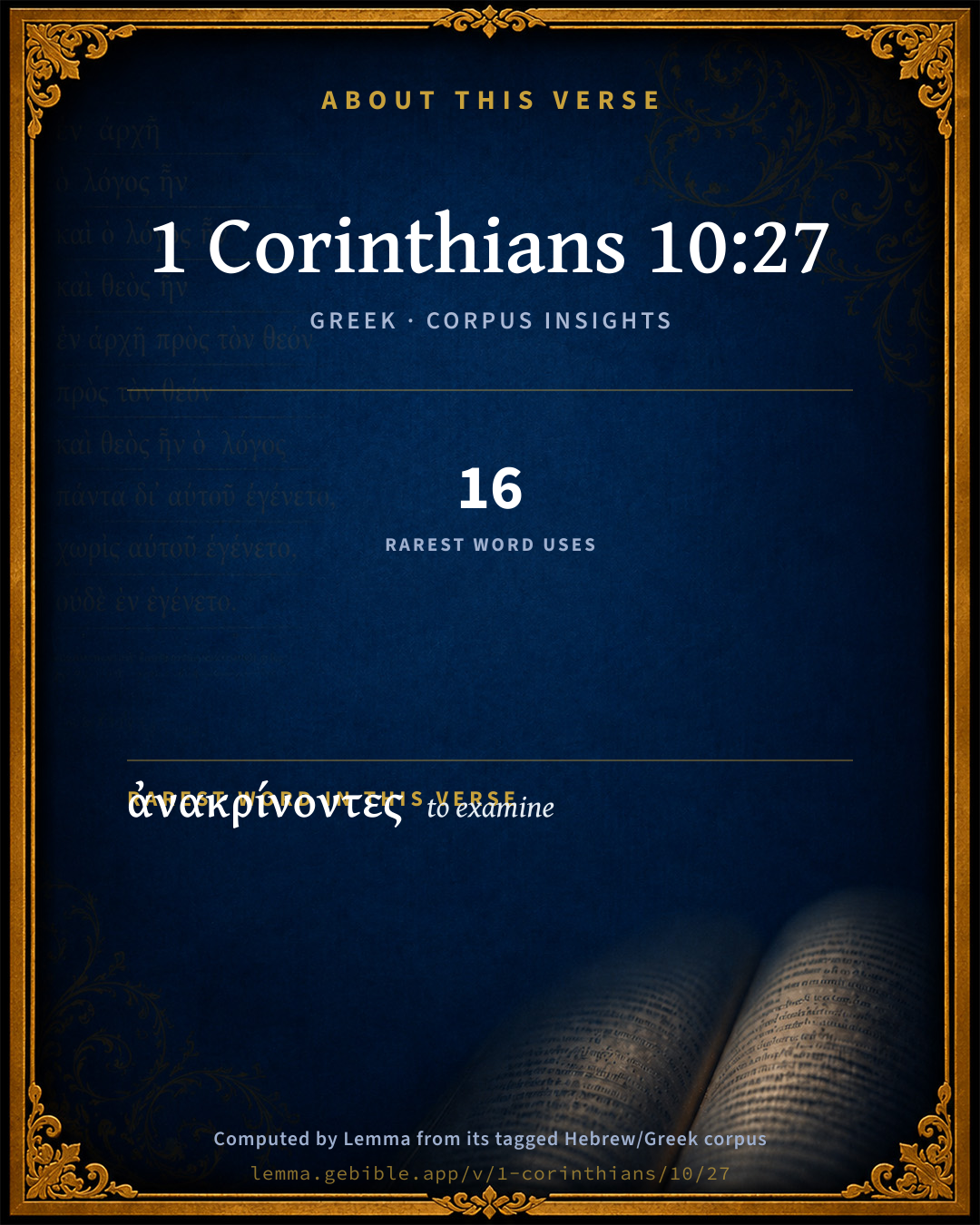
The rarest word here is ἀνακρίνοντες to examine G350 — appearing just 16 times in the whole Greek New Testament.

Shared distinctive vocabulary

ἀνακρίνοντες to examine G350 occurs in 14 verses of the Greek New Testament. Also found in:

Repetition

Words recur within this verse:

Cross-references

9

Topical passages linked to 1 Corinthians 10:27 in the Treasury of Scripture Knowledge — connected by theme and wording, ordered by reader-vote popularity; previews shown in the World English Bible.

  • 1 Corinthians 10:25 Whatever is sold in the butcher shop, eat, asking no question for the sake of conscience,
  • Luke 10:7–8 Remain in that same house, eating and drinking the things they give, for the laborer is worthy of his wages. Don't go from house to house.
  • 1 Corinthians 5:9–11 I wrote to you in my letter to have no company with sexual sinners;
  • Luke 5:29–30 Levi made a great feast for him in his house. There was a great crowd of tax collectors and others who were reclining with them.
  • Luke 15:23 Bring the fattened calf, kill it, and let us eat, and celebrate;
  • Luke 19:7 When they saw it, they all murmured, saying, "He has gone in to lodge with a man who is a sinner."
  • 2 Corinthians 1:13 For we write no other things to you, than what you read or even acknowledge, and I hope you will acknowledge to the end;
  • 2 Corinthians 4:2 But we have renounced the hidden things of shame, not walking in craftiness, nor handling the word of God deceitfully; but by the manifestation of the truth commending ourselves to every man's conscience in the sight of God.
  • 2 Corinthians 5:11 Knowing therefore the fear of the Lord, we persuade men, but we are revealed to God; and I hope that we are revealed also in your consciences.

Cross-references courtesy of OpenBible.info (CC BY 4.0).

Commentary

Notes on 1 Corinthians 10:27 from classic Christian and Jewish commentators (each source and its license shown beneath its notes). The classic Christian expositions comment on the surrounding passage and are grouped to its opening verse, so a note may address several verses; the Jewish commentaries on the Tanakh (Rashi and others) are per-verse, so they appear only where the commentator wrote on this verse.

Lemma curates 59 commentaries, every one of them public domain or Creative Commons licensed, each selected and text-cleaned for this edition rather than reprinted as found. About our sources →

Joseph Benson's Commentary

1Co 10:27-30. If any of them that believe not — Any heathen who lives in your neighbourhood; bid you to a feast — Invite you to his house; and ye be disposed — To accept the invitation; whatever is set before you — At the entertainment; eat, asking no question — About its having been sacrificed to idols; for conscience’ sake. See on 1Co 10:25. But receiving it, whatever it may be, as that supply which Divine Providence has then been pleased to send you. But if any man say, This food is part of what hath been offered in sacrifice unto idols, eat not, for his sake that showed it — Whether he be a heathen, who might thereby be confirmed in his idolatry, or a brother, who might otherwise be insnared by thy example, and tempted to violate the dictates of his own mind; and for conscience’ sake — For the sake of his weak conscience, lest it should be wounded by seeing thee do what he judged to be unlawful. To explain this further, “The heathen often, in their own houses, made an ordinary feast of a part of the sacrifice, see on chap. 1Co 8:1; to these entertainments, the apostle told the Corinthian brethren, they might lawfully go when invited. But on such occasions, if a Christian domestic or slave, by informing them that this or that dish consisted of things which had been sacrificed to an idol, signified that they considered their eating these things as sinful, they were to abstain from them, for the reasons mentioned in the text.” For the earth is the Lord’s, &c. — This clause, inserted in our copies, is omitted in the Alex. Clermont, and other manuscripts, and the Syriac, Arabic, and Vulgate versions; and some other critics think it disturbs the sense. “But,” says Macknight, “it renders the argument more complete; for the meaning is, The Lord, to whom the earth and all its fulness belong, having allowed men a sufficiency of other wholesome food, no one is under any necessity of offending those who are either ignorant or scrupulous, by eating a particular kind.” Conscience, I say, not thine own — I speak of his conscience, not thine, lest it be troubled, and his mind be disquieted; for why is my liberty judged by another’s conscience — I ought not to use my liberty so as to do that which another man thinks in his conscience to be evil, and so judges me a transgressor for it. Or, as Dr. Doddridge paraphrases the verse, “I mean not thine own conscience immediately, but that of another person; for how indifferent soever thou mayest esteem the matter, thou art obliged in duty to be very cautious that thou dost not wound and grieve that of thy brother: but you will observe, that I here speak only of acts obvious to human observation; for, as to what immediately lies between God and my own soul, why is my liberty to be judged, arraigned, and condemned at the bar of another man’s conscience? I am not, in such cases, to govern myself by the judgment and apprehension of others; nor have they any authority to judge or censure me for not concurring with them in their own narrow notions and declarations.” Others think it is an objection in the mouths of the Corinthians, and to be thus understood: “But why should I suffer myself to be thus imposed on, and receive law from any, where Christ has left me free?” But the above interpretation seems more probable, which supposes that this and the following verse come in as a kind of parenthesis, to prevent their extending the former caution beyond what he designed by it. For if I, by grace — The divine favour; be a partaker — Of the common gifts of Providence; why am I evil spoken of for my free and cheerful use of that for which I give thanks — As tracing it up to the hand of the great Supreme Benefactor?

Joseph Benson's Commentary on the Old and New Testaments (1811–1818) — public domain. Text from a community e-Sword module.

Tyndale Open Study Notes

Tyndale Open Resources

10:27-29 When Christians are invited for a meal with an unbeliever, the Christians are free to eat what is set before them unless warned that the meat has been offered to an idol. In that case, the Christian should refrain from eating it out of consideration for the conscience of the other person, who might misinterpret it or be hurt by believing that such eating honors the god to whom the meat has been sacrificed (see 8:7, 9-10; cp. Rom 14:13-15, 20-23).

Tyndale Open Study Notes — © Tyndale Open Resources, licensed CC BY-SA 4.0. Text via the HelloAO Bible API.

Bengel's Gnomon

Johann Albrecht Bengel

1Co 10:27. Θέλετε πορεύεσθαι, you wish to go) Paul does not much approve of this, nor does he forbid it.

Bengel's Gnomon of the New Testament — English translation (T&T Clark, Edinburgh, 1860) — public domain. Text from a community e-Sword module.

Meyer's Critical & Exegetical Commentary

Heinrich August Wilhelm Meyer

1Co_10:27. Δέ] of continuation. In the matter of invitations too the same principle holds good, only with the incidental limitation adduced in 1Co_10:28. Note the emphasis conveyed by the unusual place of the καλεῖ, in contrast to the τὸ ἐν μακέλλῳ πωλούμ. which has been already spoken of. Attention is thus called to the fact that a second and a new situation is now to be discussed; before, the reader was in the fleshmarket; now, he is a guest at a feast.

It is plain, at the same time, from 1Co_10:28, that what is meant is not the invitation to festivals in express connection with sacrifice, but to other heathen feasts, at which, however, flesh offered to idols might occur; for in the case of a sacrificial feast the ἱερόθυτόν ἐστι was a matter of course.

καὶ θέλετε πορ.] Admonet tacite, melius forte facturos, si non eant, ire tamen non prohibet, Grotius.

Meyer — Critical and Exegetical Commentary on the New Testament — English translation by Peter Christie, edited by Frederick Crombie (T&T Clark, 1880) — public domain. Text from a community e-Sword module.

Hodge's Commentary on Romans, Ephesians & First Corinthians

Charles Hodge

1Co_10:27

If any of them that believe not bid you (to a feast), and ye be disposed to go; whatsoever is set before you, eat, asking no question for conscience sake.

As the sacrifices lost their religious character when sold in the market, so also at any private table they were to be regarded not as sacrifices, but as ordinary food, and might be eaten without scruple. The apostle did not prohibit the Christians from social intercourse with the heathen. If invited to their tables, they were at liberty to go.

Charles Hodge — Commentary on Romans (1835), First Corinthians (1857), and Ephesians (1856) — public domain. Text from a community e-Sword module.

Jamieson, Fausset & Brown

Robert Jamieson, A. R. Fausset & David Brown

ye be disposed to go--tacitly implying, they would be as well not to go, but yet not forbidding them to go (Co1 10:9) [GROTIUS]. The feast is not an idol feast, but a general entertainment, at which, however, there might be meat that had been offered to an idol.

for conscience' sake--(See on Co1 10:25).

Jamieson, Fausset & Brown — Commentary Critical and Explanatory on the Whole Bible (1871) — public domain (CC PDM 1.0). Text via the HelloAO Bible API.

Adam Clarke's Commentary

Verse 27. If any - bid you to a feast] The apostle means any common meal, not an idol festival; for to such no Christian could lawfully go.

Whatsoever is set before you, eat] Do not act as the Jews generally do, torturing both themselves and others with questions, such as those mentioned in 1Co 10:26.

Adam Clarke's Commentary on the Bible (1810–1826) — public domain. Text from a community e-Sword/MySword module.

John Calvin's Commentaries

27. If any one of them that believe not invites you. Here follows an exception, to this effect, that if a believer has been warned, that what is set before him has been offered to an idol, and sees that there is a danger of offense being given, he sins against the brethren if he does not abstain. He shows then, in short, that care must be taken not to hurt weak consciences.

When he says — and you are willing to go, he intimates indirectly, that he does not altogether approve of it, and that it would be better if they declined, but as it is a thing indifferent, he does not choose to forbid it absolutely. And, certainly, there could be nothing better than to keep at a distance from such snares — not that those are expressly to be condemned, who accommodate themselves to men only in so far as conscience permits, but because it becomes us to proceed with caution, where we see that we are in danger of falling.

John Calvin's Commentaries (1540-1563) — public domain. Text from the Calvin Translation Society English edition (1840s-50s) via the Christian Classics Ethereal Library (ccel.org). Calvin's coverage is partial (roughly two-thirds of the Bible); uncommented books and verses are honest gaps, never fabricated. The 19th-century editor's footnotes and remarks are omitted so the notes are faithfully Calvin's own voice.

Ellicott's Commentary for English Readers

(27) If any of them that believe not. . . .—How should a Christian act if a heathen friend invited him to a feast? Should he inquire whether there was any sacrificial meat at the feast, and so avoid eating it? No. The same principle applies here—no question need be asked.

A Bible Commentary for English Readers, edited by Charles John Ellicott (1878–1897) — public domain. Text from a community e-Sword module.

The Cambridge Bible for Schools and Colleges

gen. ed. J. J. S. Perowne

27. If any of them that believe not bid you] i.e. to a feast in a private house. Although some of the Corinthians had gone so far as to declare that a Christian might innocently sit at meat in the idol temple, confident in his conviction that an idol was ‘nothing in the world’ (ch. 1Co_8:10), yet the Christian religion could not permit them thus to abuse their freedom. To sit at meat in the idol temple was directly to countenance idol worship, and thus to become ‘partaker’ of the ‘table of devils.’

The Cambridge Bible for Schools and Colleges (gen. ed. J. J. S. Perowne; Cambridge University Press, 1878–1918) — public domain. Text from a community e-Sword module.

John Gill's Exposition

But if any man say unto you,.... Either a weak believer, to prevent the doing of what he thought to be sinful; or the unbeliever, that invites to try the integrity of his Christian guest, and to draw him into a snare:

this is offered in sacrifice unto idols; the meat that is in that dish, or that portion of food which stands in such a part of the table, came out of an idol's temple, and was sacrificed to idols; which with the Jews were forbidden (o): for

"everything that came out of an idol's temple was forbidden, and was reckoned as the sacrifices of the dead; for it was not thought possible it could be there, and not offered to idols:''

now when any at the feast, either believer or unbeliever, should thus point at any particular dish, and affirm this of it; then the apostle's advice is,

eat not for his sake that showed it: who, if a weak believer, will be grieved and wounded; and if an infidel, will be hardened in his impiety, and be furnished with an opportunity of reproaching the Christians, as variable, insincere, and unfaithful in their religion:

and for conscience sake; which is explained in the following verse:

the earth is the Lord's, and the fulness thereof; which words are neither in the Syriac version, nor in the Vulgate Latin, nor in the Alexandrian copy, and some others, and are thought by some to be added, from Co1 10:26 though the repetition of them is far from being impertinent; since they contain a very good reason why such a man should abstain from things sacrificed to idols, seeing there is such a plenty and variety of creatures for his use, which he has a right to eat of; and therefore is under no necessity to eat of such sacrifices, nor is it any hardship upon him to forbear the use of them.

(o) T. Bab. Avoda Zara, fol. 32. 2.

John Gill's Exposition of the Whole Bible (1746–1763) — public domain (CC PDM 1.0). Text via the HelloAO Bible API.

Trapp's Complete Commentary

John Trapp

27 If any of them that believe not bid you to a feast, and ye be disposed to go; whatsoever is set before you, eat, asking no question for conscience sake.

Ver. 27. And ye be disposed to go] Our Saviour, when he saw that John’s austerity was censured, took his liberty in the use of creatures, and convenient company keeping, Luk 7:33-34. I do not find where ever he was bidden to any table and refused. Not for a pleasure of the dishes, but for the benefit of so winning a conversation.

John Trapp, A Commentary or Exposition upon All the Books of the Old and New Testament (1647–1656) — public domain. Text from a community e-Sword module.

Albert Barnes' Notes on the Bible

If any of them that believe not - That are not Christians; that are still pagans.

Bid you to a feast - Evidently not a feast in the temple of an idol, but at his own house. If he asks you to partake of his hospitality.

And ye be disposed to go - Greek, “And you will to go.” It is evidently implied here that it would be not improper to go. The Saviour accepted such invitations to dine with the Pharisees (see the note at Luk 11:37); and Christianity is not designed to abolish the courtesies of social life; or to break the bonds of contact; or to make people misanthropes or hermits. It allows and cultivates, under proper Christian restraints, the contact in society which will promote the comfort of people, and especially that which may extend the usefulness of Christians. It does not require, therefore, that we should withdraw from social life, or regard as improper the courtesies of society; see the note at 1Co 5:10.

Whatsoever is set before you ... - Whether it has been offered in sacrifice or not; for so the connection requires us to understand it.

Eat - This should be interpreted strictly. The apostle says “eat,” not “drink;” and the principle will not authorize us to “drink” whatever is set before us, asking no questions for conscience sake; for while it was matter of indifference in regard to eating, whether the meat had been sacrificed to idols or not, it is not a matter of indifference whether a man may drink intoxicating liquor. That is a point on which the “conscience” should have much to do; and on which its honest decisions, and the will of the Lord, should be faithfully and honestly regarded.

Albert Barnes' Notes on the Bible (1834–1885) — public domain. Text from a community e-Sword/MySword module.

Haydock's Catholic Bible Commentary

Eat of any thing, &c. Here at length St. Paul prescribes them a rule by which they were to govern themselves, as to meats that they met with. Buy and eat any thing sold in the market, or of any thing that you meet with at the table of infidels, when they invite you, for all are the Lord’s creatures, and may be taken with thanksgiving, as we ought to take whatsoever we eat. --- But if any man say, this hath been sacrificed to idols, do not eat of it for his sake, &c. And why must they not then eat of it? because either he is an infidel that says it: and then by saying so, he may mean that they who eat it, ought to eat it in honour of their gods. Or if a weak brother says so, he thereby signifies, that his conscience judges it not lawful to be eaten; so that in one case, you seem to consent that things are to be taken in honour of idols: in the other, you give offence to your weak brother: and I would have you to be without offence, both to Jews and Gentiles; and not to think it enough that you can eat such things with thanksgiving. It may be asked here why the apostle should not absolutely for bid them ever any thing offered to idols, as this seems a thing absolutely forbidden in the council of Jerusalem? (Acts xv. 23.) To this some answer, that the apostle here expounds the true sense of that decree, which was only to be understood, when eating such meats gave scandal. Others say, the prohibition was only for a short time, and now was out of date. Others take notice, that the prohibition was not general, nor for all places, but only for the new converted Gentiles that were at Antioch, or in Syria and Cilicia, as specified in the decree. (Witham)

George Leo Haydock (1774–1849), Haydock's Catholic Family Bible and Commentary, 1859 edition — public domain. Excludes Psalms (Douay-Rheims chapter numbering differs from Protestant) and Deuterocanonical books (Catholic canon only).

Matthew Poole's English Annotations

The apostle puts another case, in which they might lawfully enough eat of meat offered to an idol; that was in case any of their neighbours, that were heathens, invited them to dinner or supper in a private house (some add, or in the idol’s temple, if it were a feast of friendship, not a feast upon a sacrifice; but I doubt that, and also whether in the idol-temples there were any feasts but upon sacrifices): he determineth it lawful for them to go and eat whatsoever was set before them; but in this case he would also have them

ask no questions for conscience sake.

Matthew Poole's English Annotations on the Holy Bible (1683–1685) — public domain. Text from a community e-Sword/MySword module.

Whedon's Commentary on the Bible

Daniel D. Whedon

27. If—St. Paul has thus far stated the rule for the market; now comes the rule for the table.

Bid… feast—A Christian is invited by a pagan friend, not to a temple banquet, but to a feast at the latter’s residence.

Disposed to go—Though a pagan, he may still be a dear friend, and Christianity requires not that the innocent tie be broken.

Daniel D. Whedon (gen. ed.), Commentary on the Old and New Testaments (1874–1909) — public domain. Text from a community e-Sword module.

The Pulpit Commentary

Bid you to a feast. It is assumed that the feast is to take place in a private house, not an idol temple. (1Co_8:10) Ye be disposed to go; rather, ye wish to go, with an emphasis on the "wish," which, as Grotius says, perhaps implies that the wish is not particularly commendable, although the apostle, in his large-hearted tolerance, does not actually blame it. The rabbis decided very differently. "If," said Rabbi Ishmael, "an idolater makes a feast in honour of his son, and invites all the Jews of his town, they eat of the sacrifices of the dead, even though they eat and drink of their own" ("Avodah Zarah," fol. 18, 1). There are many passages of the Talmud which raise the suspicion that the rabbis are purposely running counter to the teaching of the New Testament.

The Pulpit Commentary (1880–1919), ed. H.D.M. Spence-Jones & Joseph S. Exell — public domain. Text from a community e-Sword module.

Burkitt's Expository Notes on the New Testament

William Burkitt

Our apostle here puts another case: "Suppose an unbeliever, an infidel or heathen, did invite a believer, a Christian, to a feast of civil friendship in his private house, (not to a feast upon a sacrifice in the idol-temple, which was absolutely unlawful,) what was to be done in this case?" He declares they may warrantably go and eat whatever is set before them without scruple, but would have them ask no questions about the lawfulness of it; nevertheless, if the master of the feast, or any present at the feast, shall suggest that some part of the meat has been offered to an idol, in that case he would have them forbear, lest they should encourage any man to idolatry; adding his reason as before, For the earth is the Lord’s, and the fulness thereof: that is, there is plenty and variety of other meat to be had, which God, the Creator of all things, the Lord of the whole earth, has allowed us the free use of; so that we may well let the idol sacrifices alone.

Here we see, that an action lawful in itself becomes sinful, and is condemned as such, when there is a breach of charity in the doing of it.

William Burkitt's Expository Notes on the New Testament (1700–1703) — public domain. Text from a community e-Sword module.

McGarvey & Pendleton's Commentaries

J. W. McGarvey

If one of them that believe not biddeth you to a feast, and ye are disposed to go; whatsoever is set before you, eat, asking no question for conscience' sake .

J. W. McGarvey (with Philip Y. Pendleton), Commentaries on the New Testament (The Fourfold Gospel, 1914; Acts; and the epistles) — public domain. Text from a community e-Sword/MySword module.

The People's New Testament

B. W. Johnson

27–33. If any of them that believe not, etc. If invited to an unbeliever's house, go, if you wish, and eat what is set before you without question on account of conscience.

B. W. Johnson's The People's New Testament with Notes (1889–1891) — public domain. Electronic text from the Christian Classics Ethereal Library (CCEL) ThML edition.

Expositor's Greek Testament

ed. W. Robertson Nicoll

[1568] parallel.

[1569] classical.

[1570] Greek, or Grotius’ Annotationes in N.T.

[1571] idd. Liddell and Scott’s Greek-English Lexicon.

[1572] Grimm-Thayer’s Greek-English Lexicon of the N.T.

[1573] English Version.

[1574] Bengel’s Gnomon Novi Testamenti.

[1575] C. J. Ellicott’s St. Paul’s First Epistle to the Corinthians .

The Expositor's Greek Testament, edited by W. Robertson Nicoll (1897–1910) — public domain. Text from a community e-Sword module.

Cambridge Greek Testament for Schools and Colleges

27. εἴ τις καλεῖ ὑμᾶς τῶν ἀπίστων, i.e. to a feast in a private house, not in an idol temple. See ch. 1Co 8:9. To sit at meat in the idol temple was clearly to be a partaker of the ‘table of daemons.’

Cambridge Greek Testament for Schools and Colleges (Cambridge University Press, 1896; 21 vols, various authors incl. Carr, Maclear, Plummer, Farrar, Lumby, Moule, M. R. James, Simcox) — public domain. Text from a community e-Sword module.

Alford’s Greek Testament

Henry Alford

27.] The same maxim applied to their conduct at a banquet given by a heathen. A miscellaneous banquet, and not a sacrificial feast, is meant. At such, there might be meat which had been offered to idols. Grot, says well on θέλετε πορεύεσθαι, “Admonet tacite, melius forte facturos, si non eant: ire tamen non prohibet: supra, cap. 5:10.”

On (διὰ τ. συνείδ., see above, ver. 25.

Henry Alford, The Greek Testament (1849–1861) — public domain. Text from a community e-Sword module.

International Critical Commentary

27. καλεῖ ὑμᾶς. The pronoun here has a slight change of meaning. He has been addressing all the Corinthian Christians, but this ὑμᾶς can only mean ‘some of you.’ All of them had heathen acquaintances, one of whom might invite several of them. And the emphasis is on καλεῖ: he suggests that without an express invitation they surely would not go.

καὶ θέλετε πορεύεσθαι. ‘And you care to go’: an intimation that he does not advise their going, though he does not forbid it; satius fore si recusarent (Calv.).

πᾶν τὸ παρατιθέμενον. Placed first with emphasis, like πᾶν τὸ ἐν μ. πωλ.: ‘Anything that is put before you’; ‘Anything that is for sale,’ etc. Cf. Luk 10:8.

εἴ τις (א A B D* F G P, Latt.) is to be preferred to εἰ δέ τις (C D 3 E H K L, Syrr.).

International Critical Commentary — older volumes (1896–1929), various authors — public domain. Text from a community e-Sword module.

Godet's Commentaries

Frédéric Louis Godet

Vv. 27. “If any of them that believe not bid you, and ye be disposed to go; whatsoever is set before you, eat, asking no question for conscience sake.” — The reading δέ, but, may be supported as contrasting this new case with the foregoing; but the two cases may also be simply put in juxtaposition without particle, according to the reading of the Alex.

There is much delicacy in the: and ye be disposed...Paul does not forbid acceptance of the invitation; for family bonds ought to be respected; they may even become, in the case of the believer, a means of advancing God’s kingdom. But, while speaking as he does, and expressly referring the decision to the Christian’s conscience, he yet makes him feel the need of reflection; for many dangers might accompany such invitations to heathen houses, even in a private dwelling, where the meal was always accompanied with certain religious ceremonies. The words εἰς δεῖπνον, to a feast, in the Greco-Lat. reading, are certainly a gloss. For the διὰ τὴν συνείδησιν, see on 1Co 10:25. Holsten gives to these words the meaning: “The strong believer need not make inquiry, and that because of the conscience of the weak brother, present or not present, who might be offended if it turned out as the result of the inquiry that the meat had been offered to idols.” The same reasons as we have given at 1Co 10:25 seem to us to exclude this meaning.

The second alternative, 1Co 10:28-30 : the case in which the question is raised as to the origin of the meats offered at a feast.

Frédéric Louis Godet — Commentaries on Luke, John, Romans, and 1 Corinthians — English translation (T&T Clark, Edinburgh, 1870s–1890s) — public domain. Text from a community e-Sword module.

Lesson kit

Teaching starters — assembled from the data on this page, not authored interpretation. Every prompt links to the verse data it draws on. Edit before teaching.

1 Corinthians, in the Pauline Epistles, opens this verse with 19 words (16 distinct Greek lemmas). Its most distinctive word is anakrínō (“to examine”). A historical commentator’s framing appears above. Read the whole chapter for the surrounding context.

Discussion questions

  1. What does “to examine” (anakrínō) contribute to the verse as a whole?
  2. How does Luke 23:14, which shares the word «to examine», read alongside this verse?
  3. What does the repetition of “the” (3× in this one verse) do in this verse?
  4. These translations render this verse differently. What is at stake in choosing one wording over another?
  5. Compare how Joseph Benson's Commentary and Tyndale Open Study Notes read this verse. Where do they agree or differ?

Things to notice

Reading settings

Reading text

Shown beneath each verse's original-language words.

Old Testament
Old Testament edition

Read the OT as the Masoretic Hebrew (MT) or the Greek Septuagint (LXX).

English shown for the Greek Septuagint (in the Hebrew ↔ Greek comparison).

Comparing translations? Open the Compare panel on any verse page to stack up to four side by side.