1 Corinthians 14:27

Greek (Tischendorf 8th ed.) 1 Corinthians 14:27 appears in the Greek New Testament. The text above is from the Tischendorf 8th edition. Each word links to its Strong’s number and a concise gloss. Click any word for its full Thayer’s Greek Lexicon entry.
Download image
Cite this verse

1 Corinthians 14:27 (World English Bible). Public Domain. Lemma interlinear Bible study tool, https://lemma.gebible.app/v/1-corinthians/14/27.

Show BibTeX & RIS
BibTeX
RIS
English Translation
If any man speaks in another language, let it be two, or at the most three, and in turn; and let one interpret.
World English Bible · Public Domain
Download a study sheet

One document with this verse’s original text, its word-by-word gloss line, the meaning frame, cross-references with their text, attributed commentary, and full source and license credits — printable, and it pastes into notes with its structure intact.

This verse Autodidact and up

Study sheet (.html) Plain text (.txt)

A passage Seminary Student

Up to 50 verses in one chapter. A passage sheet keeps up to 6 commentary sources and 12 cross-references per verse, in the order this page ranks them, and says so on the sheet whenever that leaves anything out. Ask for a single verse and you get the Autodidact verse sheet above.

Everything on this page stays free to read, with no account — the sheet is a download of what is already on screen, not access to it.

Want to remove ads? Support Godless Engineer
Compare translations 3

The same verse in 3 English versions, stacked beneath the original-language interlinear above. Click any original word for its lexicon entry.

Each is an independent rendering of the whole verse — the interlinear is not word-aligned to these translations.

Highlighted words mark where these versions differ — a whole-verse word diff, not a word-by-word alignment.

  • World English Bible Public Domain
    If any man speaks in another language, let it be two, or at the most three, and in turn; and let one interpret.
  • King James Version Public Domain
    If any man speak in an unknown tongue, let it be by two, or at the most by three, and that by course; and let one interpret.
  • unfoldingWord Literal Text CC BY-SA 4.0
    If anyone speaks in a tongue, by two or at most three, and in turn, and one must interpret.

unfoldingWord Literal Text — © unfoldingWord, licensed CC BY-SA 4.0. Word-aligned USFM3 via Door43 (git.door43.org/unfoldingWord/en_ult).

Versions to compare (up to 4)

3 of 4 selected

Show all 19 translations

Every available English version of this verse, each an independent rendering of the whole verse.

  • World English Bible Public Domain
    If any man speaks in another language, let it be two, or at the most three, and in turn; and let one interpret.
  • Berean Standard Bible Public Domain
    If anyone speaks in a tongue, two, or at most three, should speak in turn, and someone must interpret.
  • Majority Standard Bible Public Domain
    If anyone speaks in a tongue, two, or at most three, should speak in turn, and someone must interpret.
  • King James Version Public Domain
    If any man speak in an unknown tongue, let it be by two, or at the most by three, and that by course; and let one interpret.
  • American Standard Version (1901) Public Domain
    If any man speaketh in a tongue, `let it be' by two, or at the most three, and `that' in turn; and let one interpret:
  • Revised Version (1885) Public Domain
    If any man speaketh in a tongue, let it be by two, or at the most three, and that in turn; and let one interpret:
  • Geneva Bible (1599) Public Domain
    If any man speake a strange tongue, let it be by two, or at the most, by three, and that by course, and let one interprete.
  • Douay-Rheims (1899) Public Domain
    If any speak with a tongue, let it be by two, or at the most by three, and in course, and let one interpret.
  • Young's Literal Translation Public Domain
    if an `unknown' tongue any one do speak, by two, or at the most, by three, and in turn, and let one interpret;
  • Literal Standard Version CC BY-SA 4.0
    if anyone speaks an [unknown] tongue, by two, or at the most, by three, and in turn, and let one interpret;
  • Unlocked Literal Bible CC BY-SA 4.0
    If anyone speaks in a tongue, let there be two or at most three, and each one in turn, then someone should interpret what is said.
  • unfoldingWord Literal Text CC BY-SA 4.0
    If anyone speaks in a tongue, by two or at most three, and in turn, and one must interpret.
  • Darby Bible Public Domain
    If any one speak with a tongue, [let it be] two, or at the most three, and separately, and let one interpret;
  • World Messianic Bible Public Domain
    If any man speaks in another language, let there be two, or at the most three, and in turn; and let one interpret.
  • Webster's Bible Public Domain
    If any man speaketh in an unknown language, let it be by two, or at the most by three, and that by course; and let one interpret.
  • Free Bible Version CC BY-SA 4.0
    If anyone wants to speak in a tongue, make it just two, or three at the most, taking turns, and someone should interpret what is said.
  • Bible in Basic English Public Domain
    If any man makes use of a tongue, let it not be more than two, or at the most three, and in turn; and let someone give the sense:
  • Text-Critical English NT CC BY 4.0
    If any speak in a tongue, only two, or at the most three, should speak; they should each speak in turn, and someone must interpret.
  • Tyndale New Testament (1534) Public Domain
    If eny man speake with tonges let it be two at once or at the most thre at once and that by course: and let another interprete it.

Literal Standard Version (2020), Covenant Press — licensed CC BY-SA 4.0. Text via the HelloAO Bible API (eBible.org). Unlocked Literal Bible (unfoldingWord) — licensed CC BY-SA 4.0. Text via the HelloAO Bible API (eBible.org). unfoldingWord Literal Text — © unfoldingWord, licensed CC BY-SA 4.0. Word-aligned USFM3 via Door43 (git.door43.org/unfoldingWord/en_ult). Free Bible Version, Dr. Jonathan Gallagher — licensed CC BY-SA 4.0. Text via the HelloAO Bible API (eBible.org).

Word by word

More ways to search: Search by grammar → Find every occurrence → Compare this word →

Practice this passage: Drill this verse → Learn its vocabulary →

πλεῖστον
pleîstos
G4118
“most”
Adjective, Accusative, Singular, Neuter, Superlative
Part of Speech
Adjective
Case
Accusative
Number
Singular
Gender
Neuter
Degree
Superlative
Full Thayer's Definition

Origin: irregular superlative of G4183

TDNT: None

1. most 2. at the very most
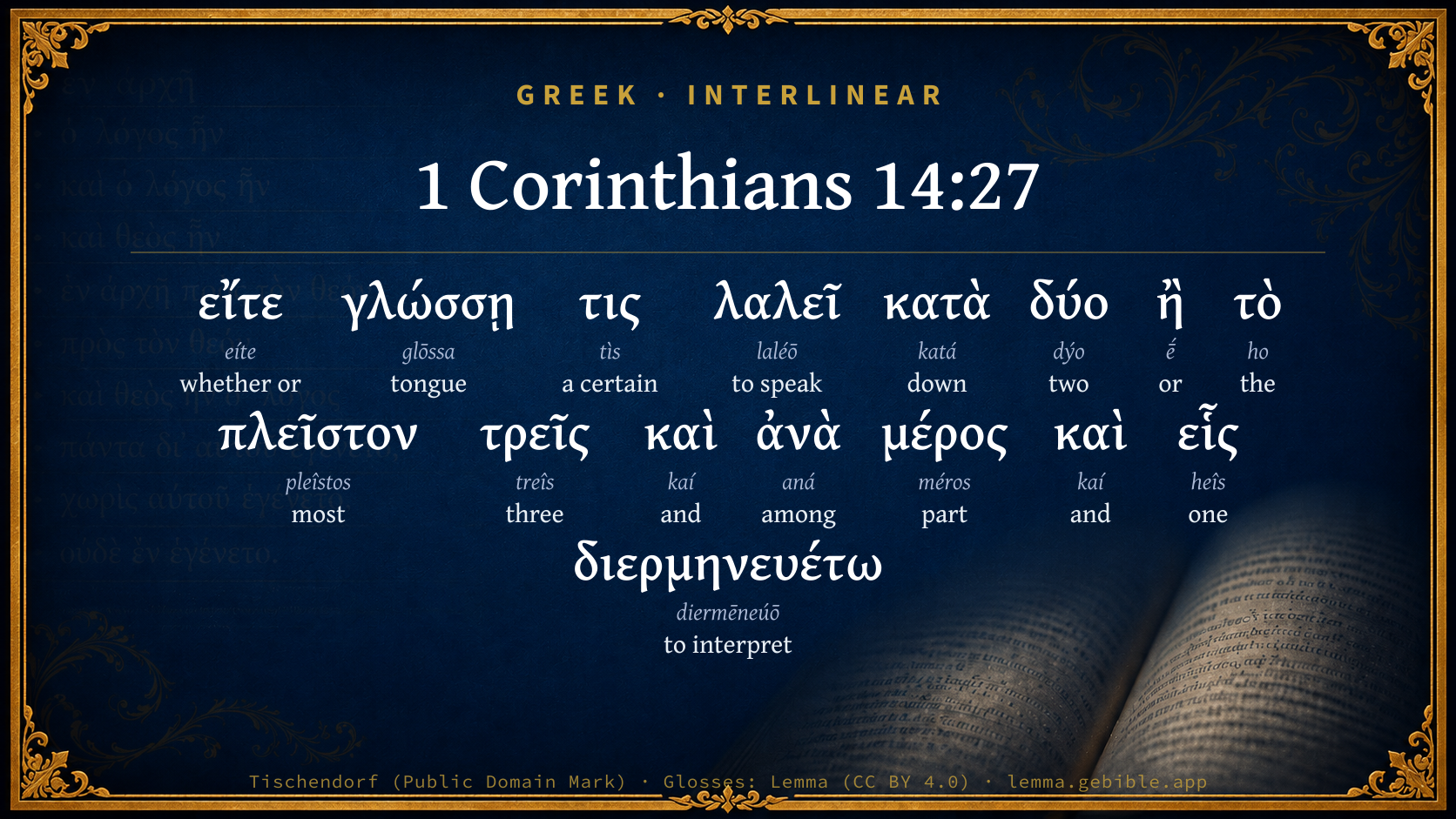
  1. εἴτε eíte G1535 “whether or” Conjunction
  2. γλώσσῃ glōssa G1100 “tongue” Noun, Dative, Singular, Feminine
  3. τις tìs G5100 “a certain” Indefinite pronoun, Nominative, Singular, Masculine
  4. λαλεῖ laléō G2980 “to speak” Verb, Present, Active, Indicative, 3rd person, Singular
  5. κατὰ katá G2596 “down” Preposition
  6. δύο dýo G1417 “two” Adjective, Numeral (indeclinable)
  7. ἢ ḗ G2228 “or” Particle
  8. τὸ ho G3588 “the” Article, Accusative, Singular, Neuter
  9. τρεῖς treîs G5140 “three” Adjective, Accusative, Plural, Masculine
  10. καὶ kaí G2532 “and” Conjunction
  11. ἀνὰ aná G303 “among” Preposition
  12. μέρος méros G3313 “part” Noun, Accusative, Singular, Neuter
  13. καὶ kaí G2532 “and” Conjunction
  14. εἷς heîs G1520 “one” Adjective, Nominative, Singular, Masculine
  15. διερμηνευέτω diermēneúō G1329 “to interpret” Verb, Present, Active, Imperative, 3rd person, Singular

About this verse

These counts appear in no published source. They are computed here, from the morphology-tagged text and Lemma’s own curated glosses. What Lemma adds →

16
words
15
distinct lemmas
Pauline Epistles
section

Notable vocabulary

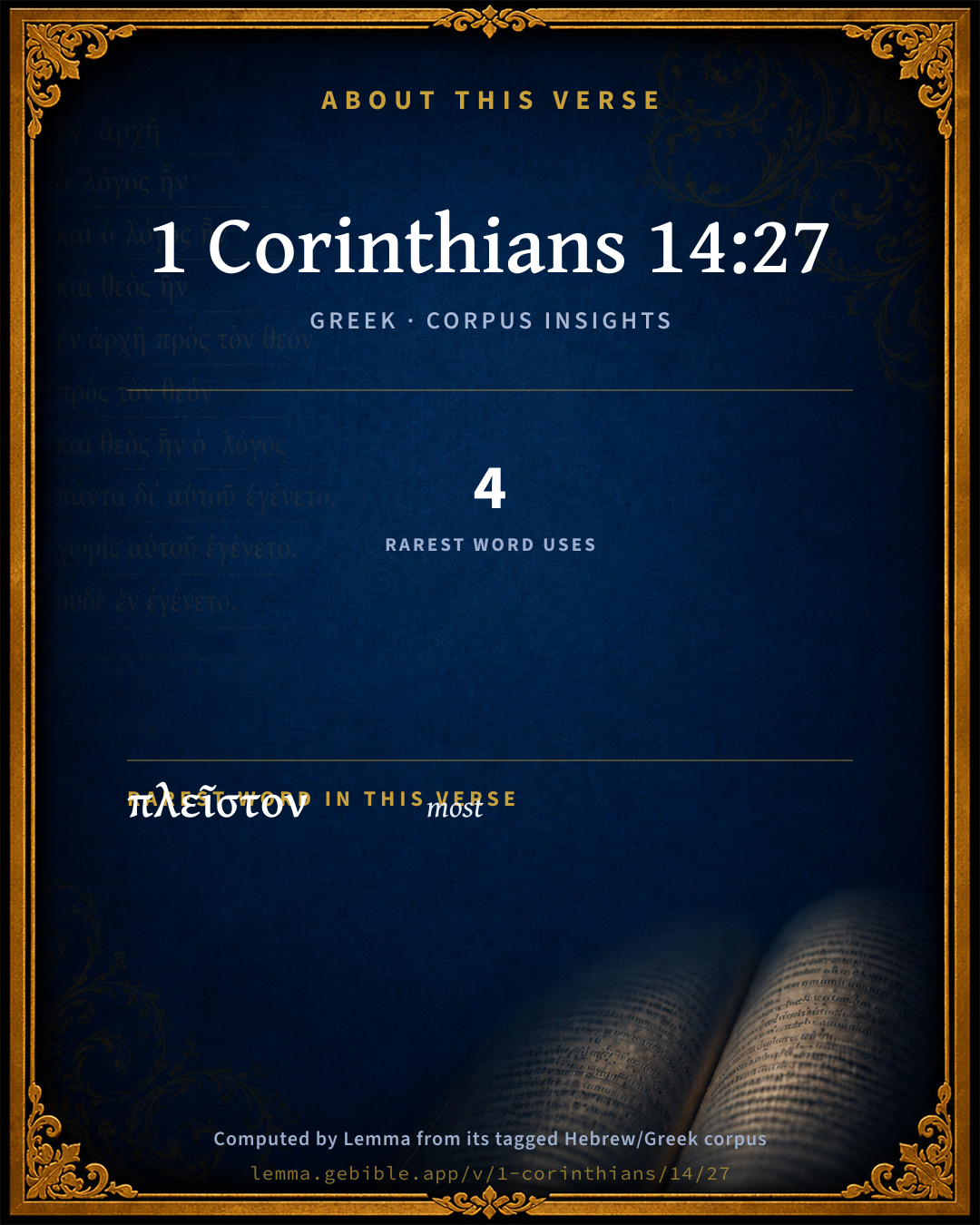
The rarest word here is πλεῖστον most G4118 — appearing just 4 times in the whole Greek New Testament.

Shared distinctive vocabulary

πλεῖστον most G4118 occurs in 4 verses of the Greek New Testament. Also found in:

Repetition

A word recurs within this verse:

Cross-references

1

Topical passages linked to 1 Corinthians 14:27 in the Treasury of Scripture Knowledge — connected by theme and wording, ordered by reader-vote popularity; previews shown in the World English Bible.

  • 1 Corinthians 14:26 What is it then, brothers? When you come together, each one of you has a psalm, has a teaching, has a revelation, has another language, has an interpretation. Let all things be done to build each other up.

Cross-references courtesy of OpenBible.info (CC BY 4.0).

Commentary

Notes on 1 Corinthians 14:27 from classic Christian and Jewish commentators (each source and its license shown beneath its notes). The classic Christian expositions comment on the surrounding passage and are grouped to its opening verse, so a note may address several verses; the Jewish commentaries on the Tanakh (Rashi and others) are per-verse, so they appear only where the commentator wrote on this verse.

Lemma curates 59 commentaries, every one of them public domain or Creative Commons licensed, each selected and text-cleaned for this edition rather than reprinted as found. About our sources →

Joseph Benson's Commentary

1Co 14:27-28. If any man speak — That is, be moved to speak; in an unknown tongue, let it be by two, or, at the most, three — Let not above two or three speak at one meeting; and that by course — That is, one after another; and let one interpret — What is said, into the vulgar tongue. It seems, the gift of tongues was an instantaneous knowledge of a tongue, till then unknown, which he that received it could afterward speak when he thought fit, without any new miracle. But if there be no interpreter present, let him — The person speaking in a foreign language; be silent in the church — Where he can do no manner of service by uttering what none but himself can understand; and let him speak in that tongue to himself and to God — Make use of his gift in his own private devotions, if he find it profitable so to do. From its being here ordered that, if no interpreter were present, the person who spoke in a foreign language must be silent, Macknight infers that, even if the inspired person were able to interpret the foreign language in which a revelation was given to him, he was not permitted to do it; “because, to have delivered the revelation first in the foreign language, and then in a known tongue, would have been an ostentation of inspiration, of which the church would not approve; not to mention that it would have wasted much time to no purpose. Whereas, when one spake a revelation in a foreign language, and another interpreted what he spake, the church was edified, not only by the things spoken, thus made known to them, but also by having an undoubted proof of the inspiration of the person who spake, given them in the inspired interpretation of what he spake.’

Joseph Benson's Commentary on the Old and New Testaments (1811–1818) — public domain. Text from a community e-Sword module.

Tyndale Open Study Notes

Tyndale Open Resources

14:27-28 For a church overly eager for the gift of tongues (see 12:10), Paul places limits on its public expression so it would be most helpful to the church: no more than two or three, . . . one at a time, and only if there is someone present who can interpret the message.

Tyndale Open Study Notes — © Tyndale Open Resources, licensed CC BY-SA 4.0. Text via the HelloAO Bible API.

Bengel's Gnomon

Johann Albrecht Bengel

1Co 14:27. Εἴτε, If) He now more particularly explains how all things may be done for edification.—τὶς, any man) Merely one person ought never to have spoken in an unknown tongue; but if one did speak, one or two should have followed to vindicate the abundance of the Spirit.—τρεῖς, three) may speak.—ἀνὰ μέρος) by a division of the times or even of the places of speaking.

Bengel's Gnomon of the New Testament — English translation (T&T Clark, Edinburgh, 1860) — public domain. Text from a community e-Sword module.

Meyer's Critical & Exegetical Commentary

Heinrich August Wilhelm Meyer

1Co_14:27. After this general rule come now particular precepts: suppose that one wishes to speak with a tongue; comp. γλῶσσαν ἔχει, 1Co_14:26. There is no other εἴτε to correspond to this εἴτε (sive, Vulgate); but the plan of sentence first thought of and begun is so disturbed by the apodosis and 1Co_14:28, that it is quite abandoned, and 1Co_14:29, instead of commencing with a new εἴτε, is not even continued in hypothetic form at all. See Maetzner, ad Antiph. p. 194. Comp. Klotz, ad Devar. p. 538. According to Hofmann (who writes εἴ τε separately), τέ is annexive, namely, to πάντα π. οἰκ. γ. In that case εἴ τε would be: in like manner if (Hartung, Partik. I. p. 106 f.), which, however, would be logically suitable only on the supposition that γλῶσσα did not already occur also in 1Co_14:26.

κατὰ δύο κ.τ.λ.] sc. λαλείτωσαν (comp. 1Pe_4:11), and this is to be taken declaratively (as in 1Co_11:16): let him know that they should speak by two, or at most by three; in each assembly not more than two, or at most three, speakers with tongues should come forward. As to the supplying of λαλείτ., see Kühner, II. p. 603; Fritzsche, ad Rom. III. p. 65.

τὸ πλεῖστον] adverbially. See Matthiae, p. 1000.

Καὶ ἀνὰ μέρος, and that according to order, one after the other, not several together. See Valck. ad Phoen. 481; Schweigh. Lex. Polyb. p. 380. Doubtlessand this seems to have given occasion for this additionthe case had often occurred in Corinth, that those who spoke with tongues had so little controlled their impulse that several came to speak togethe.

Καὶ εἷς διερμ.] and let one (not several) give the interpretation, of that, namely, which the said two or three speakers with tongues have spoken in succession. Grotius puts it rightly: unus aliquis, qui id donum habet; and it is plain from 1Co_14:5; 1Co_14:13 (in opposition to Ewald) that the speaker with tongues himself might also be the interpreter. Paul will not allow several interpreters to speak, because that would have been unnecessary, and would only have shortened the time for the more useful prophetic and other addresses.

Meyer — Critical and Exegetical Commentary on the New Testament — English translation by Peter Christie, edited by Frederick Crombie (T&T Clark, 1880) — public domain. Text from a community e-Sword module.

Expositor's Greek Testament

ed. W. Robertson Nicoll

1Co 14:27-28 . The maxim πρὸς τ . οἰκοδομὴν κ . τ . λ . is applied to Tongues and Prophecy, as the two main competing gifts: “Whether any one speaks with a tongue (let them speak: sc . λαλείτωσαν ) to the number of two ( κατὰ δύο ), or at the most three” (at one meeting) “fiat per binos, aut ad plurimum ternos” (Bz [2151] ). καὶ ἀνὰ μέρος , “and in turn,” idque vicissim (Cv [2152] ) not all confusedly speaking at once. Ed [2153] ingeniously renders the κατὰ and ἀνὰ clauses “by two or at most three together, and in turns” (antiphonally), as though the Tongues could be combined in a duet “the beginning of Church music and antiphonal singing amongst Christians”: but this does not comport with the ecstatic nature of the Glossolalia; moreover, the sense thus given to the second clause would be properly expressed by ἐν μέρει , not ἀνὰ μέρος (Hn [2154] ). “And let one person interpret”: whether one of the γλωσσολαλοῦντες (1Co 14:13 ), or someone else present ( ἄλλος , 1Co 12:10 ); the use of several interpreters at the same meeting might occasion delay or confusion. “If however there be no interpreter (present), let him (the speaker with the Tongue) keep silence in the Church, but let him talk to himself and to God”: unless his utterance can be translated, he must refrain in public, and be content to enjoy his charism in solitude and in secret converse with God ( cf. 1Co 14:2 ff.); the instruction to “speak in his heart, noiselessly ” (so Cm [2155] , Est., Hf [2156] ) would be contrary to λαλεῖν , and indeed to the nature of a tongue . “ ᾖ for cl [2157] παρῇ , sit for adsit ; cf. Luk 5:17 ; Iliad ix. 688” (Ed [2158] ).

[2151] Beza’s Nov. Testamentum: Interpretatio et Annotationes (Cantab., 1642).

[2152] Calvin’s In Nov. Testamentum Commentarii .

[2153] T. C. Edwards’ Commentary on the First Ep. to the Corinthians . 2

[2154] C. F. G. Heinrici’s Erklärung der Korintherbriefe (1880), or 1 Korinther in Meyer’s krit.-exegetisches Kommentar (1896).

[2155] John Chrysostom’s Homiliœ († 407).

[2156] J. C. K. von Hofmann’s Die heilige Schrift N.T. untersucht , ii. 2 (2te Auflage, 1874).

[2157] classical.

[2158] T. C. Edwards’ Commentary on the First Ep. to the Corinthians . 2

The Expositor's Greek Testament, edited by W. Robertson Nicoll (1897–1910) — public domain. Text from a community e-Sword module.

Hodge's Commentary on Romans, Ephesians & First Corinthians

Charles Hodge

1Co_14:27

If any man speak in an (unknown) tongue, (let it be) by two, or at the most (by) three, and (that) by course; and let one interpret.

As to the use of the gift of tongues, the directions were that only two or three having that gift should speak; that they were not to speak together, but in succession; and that one should interpret what the others said.

Charles Hodge — Commentary on Romans (1835), First Corinthians (1857), and Ephesians (1856) — public domain. Text from a community e-Sword module.

Geneva Bible (1599)

Geneva Bible translators

The manner how to use the gift of tongues. It may be lawful for one or two, or at the most three, to use the gift of tongues, one after another in an assembly, so that there be some to expound the same: but if there are none to expound, let him that hath that gift, speak to himself alone.

Geneva Bible (1599) marginal notes — public domain. Text via Bolls.life.

Jamieson, Fausset & Brown

Robert Jamieson, A. R. Fausset & David Brown

let it be by two--at each time, in one assembly; not more than two or three might speak with tongues at each meeting.

by course--in turns.

let one interpret--one who has the gift of interpreting tongues; and not more than one.

Jamieson, Fausset & Brown — Commentary Critical and Explanatory on the Whole Bible (1871) — public domain (CC PDM 1.0). Text via the HelloAO Bible API.

Adam Clarke's Commentary

Verse 27. Speak in an unknown tongue] The Hebrew, as has already been conjectured.

Let it be by two; or at the most by three, and that by course] Let only two or three in one assembly act in this way, that too much time may not be taken up with one exercise; and let this be done by course, the one after the other, that two may not be speaking at the same time: and let one interpret for all that shall thus speak.

Adam Clarke's Commentary on the Bible (1810–1826) — public domain. Text from a community e-Sword/MySword module.

John Calvin's Commentaries

27. If any one speak in another tongue He now describes the order and limits the measure. “If you have a mind to speak with other tongues, let only two speak, or, at most, not more than three, and let there be at the same time an interpreter sitting by Without an interpreter, tongues are of no advantage: let them, therefore be dispensed with.” It is to be observed, however, that he does not command, but merely permits; for the Church can, without any inconvenience, dispense with tongues, except in so far as they are helps to prophecy, as the Hebrew and Greek languages are at this day. Paul, however, makes this concession, that he may not seem to deprive the assembly of believers of any gift of the Spirit.

At the same time, it might seem as if even this were not agreeable to reason, inasmuch as he said before, (1 Corinthians 14:22,) that tongues, in so far as they are for a sign, are suited to unbelievers. I answer, that, while a miracle may be performed more particularly with a view to unbelievers, it, nevertheless, does not follow, that it may not be of some advantage to believers also. If you understand, that an unknown tongue is a sign to unbelievers in the sense that Isaiah’s words bear, the method of procedure, which Paul here prescribes, is different. For he allows of other tongues in such a way that, interpretation being joined with them, nothing is left obscure. He observes, therefore, a most admirable medium in correcting the fault of the Corinthians. On the one hand, he does not at all set aside any gift of God whatever, in order that all his benefits may be seen among believers. On the other hand he makes a limitation — that ambition do not usurp the place that is due to the glory of God, and that no gift of inferior importance stand in the way of those that are of chief moment; and he adds the sauce — that there be no mere ostentation, devoid of advantage.

John Calvin's Commentaries (1540-1563) — public domain. Text from the Calvin Translation Society English edition (1840s-50s) via the Christian Classics Ethereal Library (ccel.org). Calvin's coverage is partial (roughly two-thirds of the Bible); uncommented books and verses are honest gaps, never fabricated. The 19th-century editor's footnotes and remarks are omitted so the notes are faithfully Calvin's own voice.

Ellicott's Commentary for English Readers

(27) If any man speak in an unknown tongue.—Better, If any man speak in a tongue. Here is the practical application of the general rule just laid down to the exercise of the gift of tongues. Those who had that gift were not all to speak together, and so cause confusion; only two, or at the most three, were to speak in each assembly, and each of such group was to speak in turn, one at a time. There was to be with each group one who had the gift of interpretation, and he was to interpret to the listeners.

A Bible Commentary for English Readers, edited by Charles John Ellicott (1878–1897) — public domain. Text from a community e-Sword module.

The Cambridge Bible for Schools and Colleges

gen. ed. J. J. S. Perowne

27. let it be by two, or at the most by three] Because the long utterance in an unknown tongue would weary the Church without a sufficient corresponding benefit.

and that by course] Literally, and in turn.

and let one interpret] Let there be one, and only one, interpreter of each speech; for if the second interpretation were the same as the first it were unnecessary; if different, it would be perplexing.

The Cambridge Bible for Schools and Colleges (gen. ed. J. J. S. Perowne; Cambridge University Press, 1878–1918) — public domain. Text from a community e-Sword module.

John Gill's Exposition

But if there be no interpreter,.... None that has the gift of interpretation of divers tongues, and he that speaks with them has not that, which was sometimes the case:

let him keep silence in the church; let him not make use of his gift publicly before the whole congregation, since without an interpreter it will be entirely useless:

and let him speak to himself, and to God; he may make use of his gift to his own edification, and to the glory of God, by speaking with a low voice, or in his heart, which he himself may be conscious of, and God the searcher of hearts, and that knows all languages, fully understands; and so may be edified himself, and God may be glorified by him; whereas, if he was to use it openly and publicly, it would not only be unprofitable, but an hinderance to others: or he might retire to his own house, and there exercise it by himself, and in the presence of God, when it might be of some use and advantage to himself, but would be highly improper to bring it into the church, or public congregation; for instead of assisting, it would but dampen their devotion, and therefore it was very reasonable he should be silent there.

John Gill's Exposition of the Whole Bible (1746–1763) — public domain (CC PDM 1.0). Text via the HelloAO Bible API.

Trapp's Complete Commentary

John Trapp

27 If any man speak in an unknown tongue, let it be by two, or at the most by three, and that by course; and let one interpret.

Ver. 27. Or at the most by three] Lest the hearers be tired out. Our infirmity will not suffer any long intention, either of body or mind. Long services can hardly maintain their vigour, as in tall bodies the spirits are diffused. Erasmus hath observed that Origen never preached above an hour, often but half an hour: Consultius iudicabat crebro docere, quam diu, saith he. He held it better to preach often, than long. (Eras. Praefat. ad Orig. Opera.)

John Trapp, A Commentary or Exposition upon All the Books of the Old and New Testament (1647–1656) — public domain. Text from a community e-Sword module.

Albert Barnes' Notes on the Bible

Let it be by two, or at the most by three - That is, two, or at most three in one day, or in one meeting. So Grotius, Rosenmuller, Doddridge, Bloomfield, and Locke, understand it. It is probable that many were endowed with the gift of tongues; and it is certain that they were disposed to exercise the gift even when it could be of no real advantage, and when it was done only for ostentation. Paul had shown to them 1Co 14:22, that the main design of the gift of tongues was to convince unbelievers; he here shows them that if that gift was exercised in the church, it should be in such a way as to promote edification. They should not speak at the same time; nor should they regard it as necessary that all should speak at the same meeting. It should not be so as to produce disorder and confusion nor should it be so as to detain the people beyond a reasonable time. The speakers, therefore, in any one assembly should not exceed two or three.

And that by course - Separately; one after another. They should not all speak at the same time.

And let one interpret - One who has the gift of interpreting foreign languages, (Note, 1Co 12:10), so that they may be understood, and the church be edified.

Albert Barnes' Notes on the Bible (1834–1885) — public domain. Text from a community e-Sword/MySword module.

Matthew Poole's English Annotations

Concerning the use of their gift of tongues, he directeth three things:

1. That every one that had it should not be ambitious to show it at all times, but

two or three at most at a time.

2. That they should do it

by course, not together, confusedly.

3. Not without

one to interpret, that people might understand. For though these were extraordinary gifts, flowing from a more than ordinary influence of the Spirit of God, yet they were abiding habits, not coming upon them at some certain times, by an impulse; for then they would not have been under human government, as it is apparent this gift of tongues was, else Paul could not have so governed himself in the use of it, as he lets us know he did, 1Co 14:19.

Matthew Poole's English Annotations on the Holy Bible (1683–1685) — public domain. Text from a community e-Sword/MySword module.

Whedon's Commentary on the Bible

Daniel D. Whedon

27. By two… three—That is, let but two or three exercise the unknown tongue at a single meeting; and not even that unless one, either the speaker himself or another, interpret.

By course—One at a time; neither two together, nor one eagerly interrupting the other.

Daniel D. Whedon (gen. ed.), Commentary on the Old and New Testaments (1874–1909) — public domain. Text from a community e-Sword module.

The Pulpit Commentary

And that by course; rather, and that in turn. He does not allow more than one glossolalist to speak at a time, and not more than three at the most in any one service. This rule alone tended to extinguish the disorderly exhibition of" tongues." To control the passion which leads to it is, sooner or later, to stop the manifestation a result which St. Paul would probably have been the last to regret, when its purpose had been accomplished.

The Pulpit Commentary (1880–1919), ed. H.D.M. Spence-Jones & Joseph S. Exell — public domain. Text from a community e-Sword module.

John Wesley's Explanatory Notes

By two or three at most - Let not above two or three speak at one meeting. And that by course - That is, one after another. And let one interpret - Either himself, ver. 13; or, if he have not the gift, some other, into the vulgar tongue. It seems, the gift of tongues was an instantaneous knowledge of a tongue till then unknown, which he that received it could afterwards speak when he thought fit, without any new miracle.

John Wesley, Explanatory Notes Upon the Whole Bible (1754–1765) — public domain. Text via the GEBible commentary corpus.

Burkitt's Expository Notes on the New Testament

William Burkitt

Our apostle’s next advice for the church’s edification, is this, That such as had the gift of tongues should not speak all together, but two or three successively, one after another; and that one interpret what was so spoken, to the benefit and edifying of the church.

But if there were no interpreter present, let him, says the apostle, that only speaks with tongues, keep silence in the church; and let him only speak mentally to himself and to God, in prayer and thanksgiving.

The same advice he gives to them that prophesied; to wit, that only two or three of them should prophesy successively, in order to the church’s edification, and that the rest of the prophets should sit still and judge, examining their doctrines by the rule of the word: for says he, the spirits of the prophets are subject to the prophets; that is, the doctrines which the prophets deliver are apt to be judged and examined by other prophets, whether they be agreeable to the word of God or not: or the instinct by which the prophets pretend to be moved at that time to prophesy, is subject to the judgment and censure of other prophets who are endowed with the same gift.

And thus he declares, that all that are prophets, and prophetically inspired, may prophesy, provided it be done orderly and successively, without occasioning disorder and confusion in the church; and so managed as to answer the great end of the institution; namely, the instruction, edification, and consolation, of the church; For God \is not the author of confusion, but of peace.

Confusion is so far from being of divine inspiration, that it is hateful to God, who requires that peace and order should be kept and maintained, not only in the church of Corinth, but in all the churches of the saints.

That which breaks order, doth also break peace: for there can be no true peace without order; and God is not the author of disorder and confusion in the churches, but of peace.

Here by the way let us observe and note, That speaking and preaching in the public assemblies is limited all along, by the apostle, to the prophets. Let the prophets speak; not the common people; they were to sit by, it was no part of their business to speak, but to examine what was spoken by the rule of the word.

The authoritative preaching of the gifted brethren, at the call of a private congregation, was no more permitted by St. Paul, than his suffering of women to speak in the church; none but prophets, or persons in office, appointed for the work of preaching, were ever suffered to undertake it in the primitive times, and downwards, till very lately.

Let such as first gave, and still give, encouragement to the contrary, consider how they will answer it at the bar of God, who is not the author of such confusion and disorder, but of peace.

William Burkitt's Expository Notes on the New Testament (1700–1703) — public domain. Text from a community e-Sword module.

McGarvey & Pendleton's Commentaries

J. W. McGarvey

If any man speaketh in a tongue, let it be by two, or at the most three, and that in turn; and let one interpret:

J. W. McGarvey (with Philip Y. Pendleton), Commentaries on the New Testament (The Fourfold Gospel, 1914; Acts; and the epistles) — public domain. Text from a community e-Sword/MySword module.

The People's New Testament

B. W. Johnson

27. If any man speaketh in a tongue. He must speak two, or at the most three sentences (by two, or at the most three) in succession (by course), and another, who has the gift of interpretation (12:10), must interpret. Most commentators refer two or three to persons speaking. I follow Macknight.

B. W. Johnson's The People's New Testament with Notes (1889–1891) — public domain. Electronic text from the Christian Classics Ethereal Library (CCEL) ThML edition.

Cambridge Greek Testament for Schools and Colleges

27. κατὰ δύο. There must not be more than two, or at the utmost three discourses, because the long utterance in an unknown tongue would weary the Church without a sufficient corresponding benefit.

ὀνὰ μέρος. Literally, in turn.

εἷς διερμηνευέτω. Let there be one, and only one, interpreter of each speech; for if the second interpretation were the same as the first it were unnecessary; if different, it would be perplexing.

Cambridge Greek Testament for Schools and Colleges (Cambridge University Press, 1896; 21 vols, various authors incl. Carr, Maclear, Plummer, Farrar, Lumby, Moule, M. R. James, Simcox) — public domain. Text from a community e-Sword module.

Alford’s Greek Testament

Henry Alford

27.] κατὰ δύο (scil. let it take place), by two (at each time, i.e. in one assembly: not more than two or three might speak with tongues at each meeting) or at the most three, and by turn (one after another, not together): and let one (some one who has the gift,—and not more than one) interpret (what is said in the tongue).

Henry Alford, The Greek Testament (1849–1861) — public domain. Text from a community e-Sword module.

International Critical Commentary

27. εἴτε γλώσσῃ τις λαλεῖ. As in 12:28 (οὓς μέν) a construction is begun and left unfinished. This is the first member of a distributive sentence, which ought to have gone on εἴτε … εἴτε. But there. is no second member: at v. 29, where it might have come, a new construction is started, perhaps because the εἴτε is forgotten, or perhaps deliberately, because the presence of prophets in the assembly is assumed as certain. Moreover, there is no verb with κατὰ δύο κ.τ.λ., but λαλείτωσαν is readily understood (1Pe 4:11). There might be many ready to speak with Tongues, but the number was to be limited down to (distributive use of κατά) two, or at most three, who were to speak in turn. The insertion of ἀνὰ μέρος perhaps implies that sometimes two tried to speak at once.* One, and one only (εἷς not τις), was to interpret; there was to be no interpreting in turn, which might lead to profitless discussion. Moreover, this would be a security against two speaking with Tongues at the same time, for one interpreter could not attend to both. Possibly the gift of interpretation was more rare, for the possibility of there being no interpreter present is contemplated.

International Critical Commentary — older volumes (1896–1929), various authors — public domain. Text from a community e-Sword module.

Vincent's Word Studies in the New Testament

Marvin R. Vincent

By two, etc. That is, to the number of two or three at each meeting. 123 By course [ανα μερος] . Rev., correctly, in turn. Edwards' explanation, antiphonally, is quite beside the mark.

Marvin R. Vincent, Word Studies in the New Testament (1887–1900) — public domain. Text from a community e-Sword/MySword module.

Godet's Commentaries

Frédéric Louis Godet

Vv. 27, 28. “If any man speak in a tongue, let it be by two, or at the most by three, and each in his course; and let one interpret. 28. But if there be no interpreter, let him keep silence in the Church; and let him speak to himself, and to God.”

In Greek this verse begins with the word εἴτε, whether, to which there should be a corresponding εἴτε applied to prophecy (1Co 14:29). This form very pointedly betrays the accidental (by no means indispensable) character of glossolalia in worship.

The apostle gives three rules regarding this gift. The first relative to number: two or at most three; as if two were quite sufficient. The κατά is distributive: two or three each meeting. Edwards thinks that what is referred to here is an antiphony, expressed by ἀνὰ μέρος, in turn, as if a duet of glossolaletes was intended. It was this style of performance, in his view, which gave rise to the later antiphonic chants, such as those of which Pliny speaks in his letter to Trajan. How far will the imagination go! Certainly Paul would never have approved of the simultaneous utterance of several discourses, the one hindering the effect of the other. Besides, ἐν μέρει would have been required to express the sense given by Edwards (see Passow).

The second rule relates to order: ἀνὰ μέρος, each in course, consequently: one at a time. The contrary, no doubt, sometimes happened at Corinth. The form ἀνὰ μέρος signifies, like ἐν τῷ μέρει: in determinate order, in his turn, but not: answering one another.

The third rule fixes the mode; the tongue ought to be followed by an interpretation. The expression εἷς, one, seems to signify that one and the same interpreter ought to act for the two or three discourses in tongues; no doubt to prevent discussions as to the meaning of any one of the discourses. The apostle does not say whether this interpreter is himself one of the glossolaletes, as might be held in accordance with 1Co 14:5; 1Co 14:13, or if he is some other inspired one, as might be supposed from 1Co 14:28 and 1Co 12:10. Both cases might occur. Holsten alleges that interpretation took place only in the case of one of the three tongues, and by the same man who had spoken in it. But this meaning is contrary to 1Co 14:5; 1Co 14:28, which expressly exclude the use of a tongue without interpretation.

Vv. 28. The first words have sometimes been translated: “But if he is not an interpreter.” But it would be impossible to say to which of the two or three glossolaletes the words should be applied, and the position of the verb ᾖ before the predicate shows that it is the idea of being which is emphasized. The simple ᾖ is therefore for παρῇ; comp. Luk 5:17; and the translation must be: But if there be no interpreter. Holsten objects that it was impossible to know beforehand the absence of all interpreters, because interpretation was not an office invariably attached to this or that person. But, on the contrary, the necessary conclusion from the passage is that the gift was more or less permanent, whether it belonged as a rule to one of the glossolaletes or to some other of the members of the Church. This view is confirmed by 1Co 12:10.

If every believer known to be endowed with this faculty is absent, and the glossolalete does not himself interpret, he is to keep silence in the congregation. But the apostle would not have him to suppress the moving of the Spirit; for himself he may yield to the impulse to thanksgiving and mental prayer which has taken possession of him and raises him to God.

There follow the rules regarding the exercise of prophecy.

Frédéric Louis Godet — Commentaries on Luke, John, Romans, and 1 Corinthians — English translation (T&T Clark, Edinburgh, 1870s–1890s) — public domain. Text from a community e-Sword module.

Lesson kit

Teaching starters — assembled from the data on this page, not authored interpretation. Every prompt links to the verse data it draws on. Edit before teaching.

1 Corinthians, in the Pauline Epistles, opens this verse with 16 words (15 distinct Greek lemmas). Its most distinctive word is pleîstos (“most”). A historical commentator’s framing appears above. Read the whole chapter for the surrounding context.

Discussion questions

  1. The word pleîstos carries the sense “most.” How does it shape the verse?
  2. How does Matthew 11:20, which shares the word «most», read alongside this verse?
  3. What does the repetition of “and” (2× in this one verse) do in this verse?
  4. The translations on this page render this verse differently — a whole-verse word diff, not a word-by-word alignment. What might account for the different wordings?
  5. Compare how Joseph Benson's Commentary and Tyndale Open Study Notes read this verse. Where do they agree or differ?

Things to notice

Reading settings

Reading text

Shown beneath each verse's original-language words.

Old Testament
Old Testament edition

Read the OT as the Masoretic Hebrew (MT) or the Greek Septuagint (LXX).

English shown for the Greek Septuagint (in the Hebrew ↔ Greek comparison).

Comparing translations? Open the Compare panel on any verse page to stack up to four side by side.