1 Corinthians 14:29

Greek (Tischendorf 8th ed.) 1 Corinthians 14:29 appears in the Greek New Testament. The text above is from the Tischendorf 8th edition. Each word links to its Strong’s number and a concise gloss. Click any word for its full Thayer’s Greek Lexicon entry.
Download image
Cite this verse

1 Corinthians 14:29 (World English Bible). Public Domain. Lemma interlinear Bible study tool, https://lemma.gebible.app/v/1-corinthians/14/29.

Show BibTeX & RIS
BibTeX
RIS
English Translation
Let the prophets speak, two or three, and let the others discern.
World English Bible · Public Domain
Download a study sheet

One document with this verse’s original text, its word-by-word gloss line, the meaning frame, cross-references with their text, attributed commentary, and full source and license credits — printable, and it pastes into notes with its structure intact.

This verse Autodidact and up

Study sheet (.html) Plain text (.txt)

A passage Seminary Student

Up to 50 verses in one chapter. A passage sheet keeps up to 6 commentary sources and 12 cross-references per verse, in the order this page ranks them, and says so on the sheet whenever that leaves anything out. Ask for a single verse and you get the Autodidact verse sheet above.

Everything on this page stays free to read, with no account — the sheet is a download of what is already on screen, not access to it.

Want to remove ads? Support Godless Engineer
Compare translations 3

The same verse in 3 English versions, stacked beneath the original-language interlinear above. Click any original word for its lexicon entry.

Each is an independent rendering of the whole verse — the interlinear is not word-aligned to these translations.

Highlighted words mark where these versions differ — a whole-verse word diff, not a word-by-word alignment.

  • World English Bible Public Domain
    Let the prophets speak, two or three, and let the others discern.
  • King James Version Public Domain
    Let the prophets speak two or three, and let the other judge.
  • unfoldingWord Literal Text CC BY-SA 4.0
    But let two or three prophets speak, and let the others evaluate.

unfoldingWord Literal Text — © unfoldingWord, licensed CC BY-SA 4.0. Word-aligned USFM3 via Door43 (git.door43.org/unfoldingWord/en_ult).

Versions to compare (up to 4)

3 of 4 selected

Show all 19 translations

Every available English version of this verse, each an independent rendering of the whole verse.

  • World English Bible Public Domain
    Let the prophets speak, two or three, and let the others discern.
  • Berean Standard Bible Public Domain
    Two or three prophets should speak, and the others should weigh carefully what is said.
  • Majority Standard Bible Public Domain
    Two or three prophets should speak, and the others should weigh carefully what is said.
  • King James Version Public Domain
    Let the prophets speak two or three, and let the other judge.
  • American Standard Version (1901) Public Domain
    And let the prophets speak `by' two or three, and let the others discern.
  • Revised Version (1885) Public Domain
    And let the prophets speak by two or three, and let the others discern.
  • Geneva Bible (1599) Public Domain
    Let the Prophets speake two, or three, and let the other iudge.
  • Douay-Rheims (1899) Public Domain
    And let the prophets speak, two or three; and let the rest judge.
  • Young's Literal Translation Public Domain
    And prophets -- let two or three speak, and let the others discern,
  • Literal Standard Version CC BY-SA 4.0
    And prophets—let two or three speak, and let the others discern,
  • Unlocked Literal Bible CC BY-SA 4.0
    Let two or three prophets speak, and let the others listen with discernment to what is said.
  • unfoldingWord Literal Text CC BY-SA 4.0
    But let two or three prophets speak, and let the others evaluate.
  • Darby Bible Public Domain
    And let two or three prophets speak, and let the others judge.
  • World Messianic Bible Public Domain
    Let two or three of the prophets speak, and let the others discern.
  • Webster's Bible Public Domain
    Let the prophets speak two or three, and let the others judge.
  • Free Bible Version CC BY-SA 4.0
    Similarly, have two or three of those who give God's prophetic message speak, and let everyone else think about what was said.
  • Bible in Basic English Public Domain
    And let the prophets give their words, but not more than two or three, and let the others be judges of what they say.
  • Text-Critical English NT CC BY 4.0
    Two or three prophets should speak, and the others should evaluate what they say.
  • Tyndale New Testament (1534) Public Domain
    Let the Prophetes speake two at once or thre at once and let other iudge.

Literal Standard Version (2020), Covenant Press — licensed CC BY-SA 4.0. Text via the HelloAO Bible API (eBible.org). Unlocked Literal Bible (unfoldingWord) — licensed CC BY-SA 4.0. Text via the HelloAO Bible API (eBible.org). unfoldingWord Literal Text — © unfoldingWord, licensed CC BY-SA 4.0. Word-aligned USFM3 via Door43 (git.door43.org/unfoldingWord/en_ult). Free Bible Version, Dr. Jonathan Gallagher — licensed CC BY-SA 4.0. Text via the HelloAO Bible API (eBible.org).

Word by word

More ways to search: Search by grammar → Find every occurrence → Compare this word →

Practice this passage: Drill this verse → Learn its vocabulary →

διακρινέτωσαν
diakrínō
G1252
“to distinguish”
Verb, Present, Active, Imperative, 3rd person, Plural
Part of Speech
Verb
Tense
Present
Voice
Active
Mood
Imperative
Person
3rd person
Number
Plural
Full Thayer's Definition

Origin: from G1223 and G2919

TDNT: 18:46,5

1. to separate, make a distinction, discriminate, to prefer 2. to learn by discrimination, to try, decide a. to determine, give judgment, decide a dispute 3. to withdraw from one, desert 4. to separate one's self in a hostile spirit, to oppose, strive with dispute, contend 5. to be at variance with one's self, hesitate, doubt
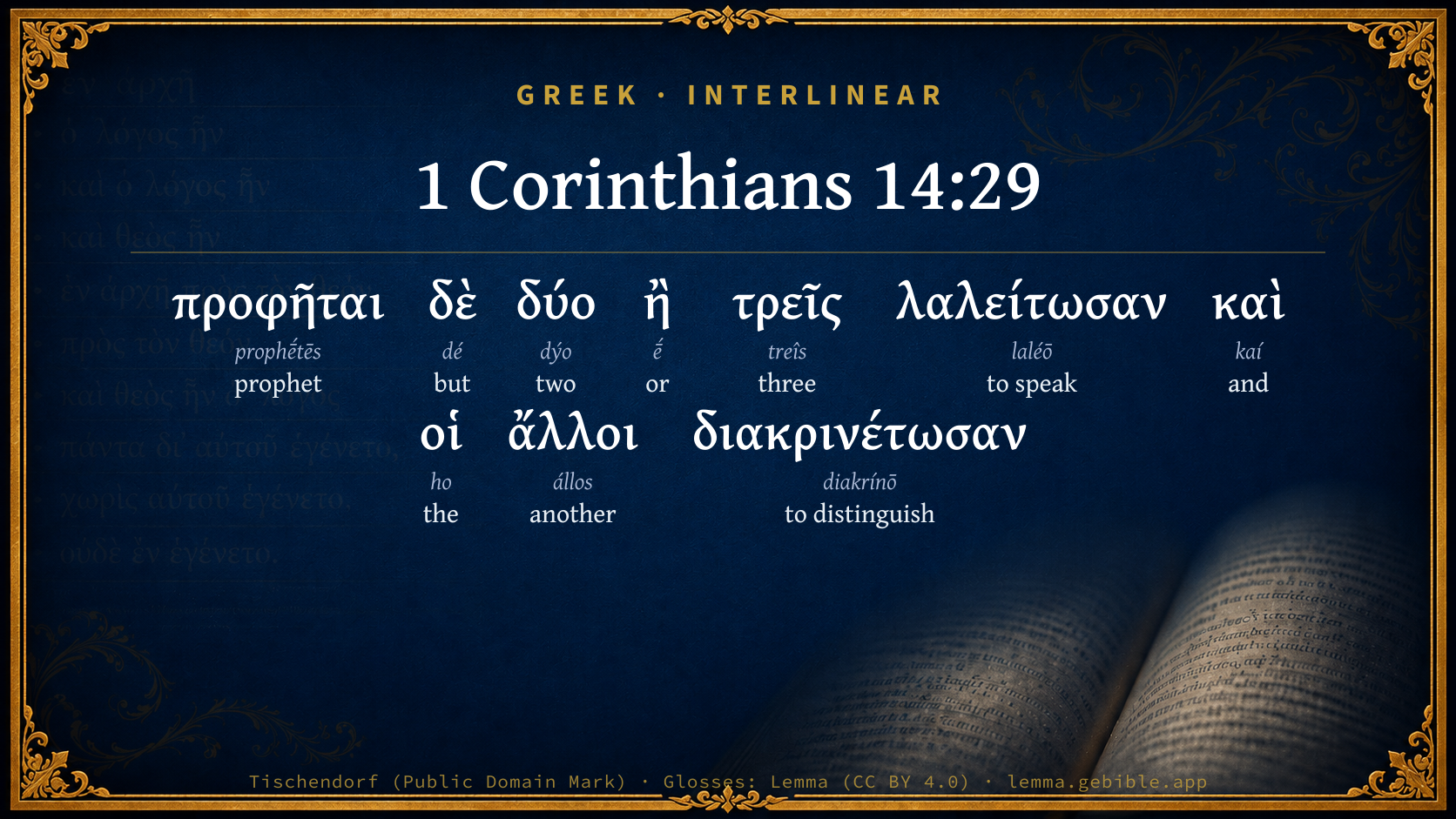
  1. προφῆται prophḗtēs G4396 “prophet” Noun, Nominative, Plural, Masculine
  2. δὲ dé G1161 “but” Conjunction
  3. δύο dýo G1417 “two” Adjective, Numeral (indeclinable)
  4. ἢ ḗ G2228 “or” Particle
  5. τρεῖς treîs G5140 “three” Adjective, Nominative, Plural, Masculine
  6. λαλείτωσαν laléō G2980 “to speak” Verb, Present, Active, Imperative, 3rd person, Plural
  7. καὶ kaí G2532 “and” Conjunction
  8. οἱ ho G3588 “the” Article, Nominative, Plural, Masculine
  9. ἄλλοι állos G243 “another” Adjective, Nominative, Plural, Masculine

About this verse

These counts appear in no published source. They are computed here, from the morphology-tagged text and Lemma’s own curated glosses. What Lemma adds →

10
words
10
distinct lemmas
Pauline Epistles
section

Notable vocabulary

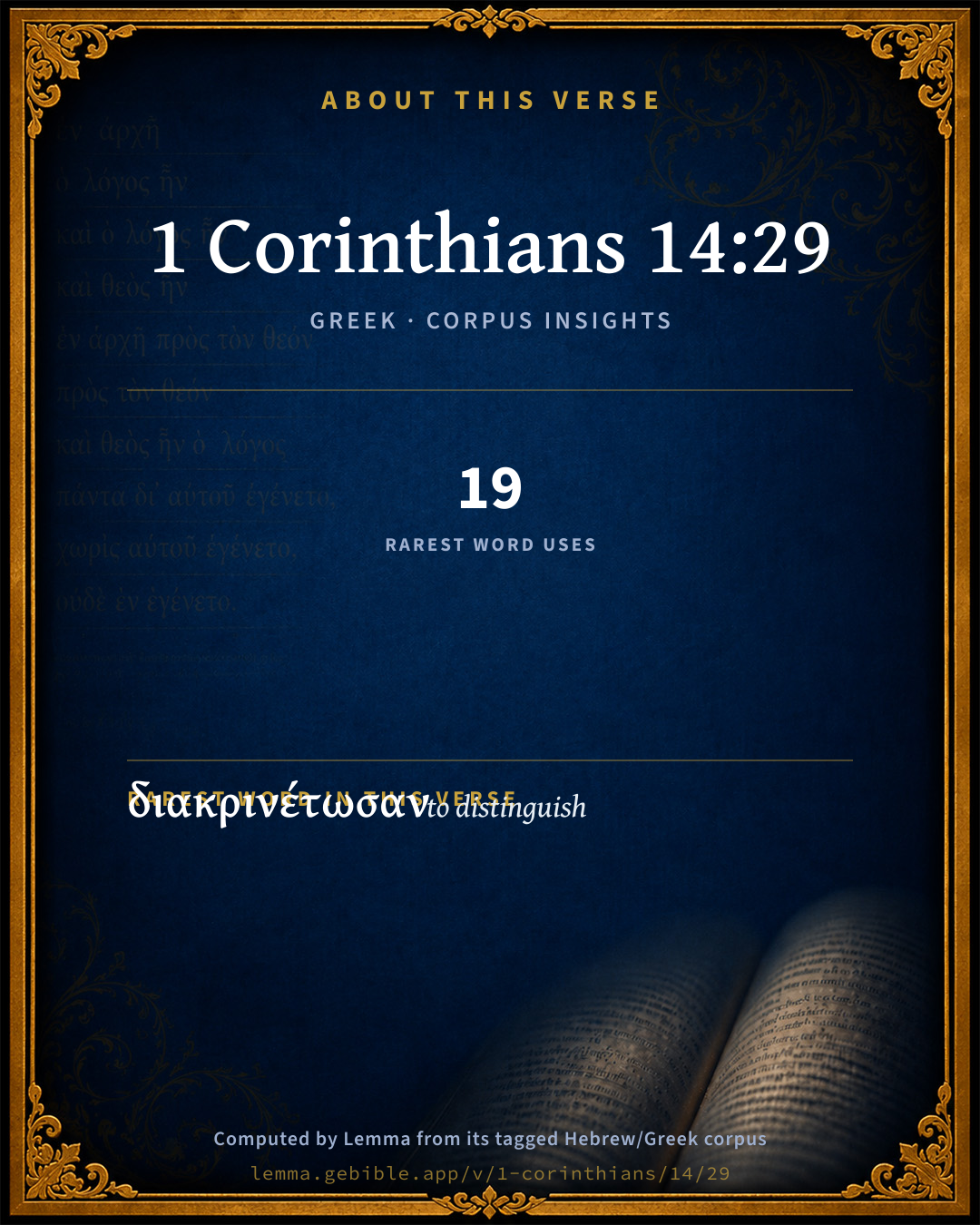
The rarest word here is διακρινέτωσαν to distinguish G1252 — appearing just 19 times in the whole Greek New Testament.

Shared distinctive vocabulary

διακρινέτωσαν to distinguish G1252 occurs in 18 verses of the Greek New Testament. Also found in:

Cross-references

4

Topical passages linked to 1 Corinthians 14:29 in the Treasury of Scripture Knowledge — connected by theme and wording, ordered by reader-vote popularity; previews shown in the World English Bible.

  • 1 Corinthians 12:10 and to another workings of miracles; and to another prophecy; and to another discerning of spirits; to another different kinds of languages; and to another the interpretation of languages.
  • 1 Thessalonians 5:19–21 Don't quench the Spirit.
  • 1 John 4:1–3 Beloved, don't believe every spirit, but test the spirits, whether they are of God, because many false prophets have gone out into the world.
  • 1 Corinthians 14:39 Therefore, brothers, desire earnestly to prophesy, and don't forbid speaking with other languages.

Cross-references courtesy of OpenBible.info (CC BY 4.0).

Commentary

Notes on 1 Corinthians 14:29 from classic Christian and Jewish commentators (each source and its license shown beneath its notes). The classic Christian expositions comment on the surrounding passage and are grouped to its opening verse, so a note may address several verses; the Jewish commentaries on the Tanakh (Rashi and others) are per-verse, so they appear only where the commentator wrote on this verse.

Lemma curates 59 commentaries, every one of them public domain or Creative Commons licensed, each selected and text-cleaned for this edition rather than reprinted as found. About our sources →

Joseph Benson's Commentary

1Co 14:29-33. Let the prophets speak — In succession; two or three — And not more, at one meeting; and let the others judge — And compare one doctrine with another for the further improvement of all. Or, the sense may be, Let the others, who have the gift of discerning spirits, διακρινετωσαν, discern whether they have spoken by inspiration or by private suggestion. If any thing be revealed to another — If to another, who sitteth by, hearing a prophet speak, any thing be revealed, let the first finish his discourse and be silent, before the other attempts to speak. For in this way ye may all prophesy — Who have that gift; one by one — That is, one after another; that all may learn — Both by speaking and by hearing; which you could not do if many were speaking at once. The apostle supposes here, that when a spiritual man was speaking in the church by inspiration, something relating to the same, or to a different subject, might be revealed to another prophet who was sitting by, hearing him. In such a case, the rule to be observed was, the first was to be silent, that is, was to finish what he had to say before the other began to speak, as is plain from the reason of the rule given in the next verse. For the spirits of the prophets — Or the spiritual gifts bestowed on them, as the word

πνευματα is rendered, 1Co 14:12, and ought certainly to have been rendered here; are subject to the prophets — the meaning of the apostle is, that the impulses of the Holy Spirit, even in men really inspired, so suited themselves to their rational faculties, as not to divest them of the government of themselves, as was the case with the heathen priests and priestesses under their diabolical possessions; whom evil spirits often threw into such ungovernable ecstasies, as forced them to speak and act like mad persons. “Few of them,” says Bishop Potter, (Antiq., 1Co 2:12,) “that pretended to inspiration, but raged after this manner, foaming and yelling, and making a strange, terrible noise, sometimes gnashing their teeth, shivering and trembling, with a thousand antic motions. In short these rapti and Deo pleni, (persons enrapt and full of the god,) were beside themselves, and absolutely mad during the time of their inspirations.” But the Spirit of God left his prophets the clear use of their judgment, when and how long it was fit for them to speak, and never hurried them into any improprieties, either as to the matter, manner, or time of their speaking. Let all enthusiasts consider this! For God is not the author of confusion — Greek, ακαταστασιας, of disorder and disturbance; but of peace — And regularity; as in all the churches of the saints — As is practised in all the churches elsewhere. “How often,” says Dr. A. Clarke, “is the work of God marred and discredited by the folly of men! for nature will always, and Satan too, mingle themselves, as far as they can, in the genuine work of the Spirit, in order to discredit and destroy it. Nevertheless, in great revivals of religion, it is almost impossible to prevent wild fire from getting in among true fire: but it is the duty of the ministers of God to watch against and prudently check this; but if themselves encourage it, then there will be confusion and every evil work.”

Joseph Benson's Commentary on the Old and New Testaments (1811–1818) — public domain. Text from a community e-Sword module.

Tyndale Open Study Notes

Tyndale Open Resources

14:29-32 Public prophesying is to be expressed in an orderly way, sensitive to the guidance of the Spirit, so that everyone may benefit from it. The others are then to evaluate what is said to assess whether it is indeed a word from God (1 Thes 5:19-21). Those with a word of prophecy are to take turns—prophecy is a divinely given word, but it is still subject to the control of the speaker.

Tyndale Open Study Notes — © Tyndale Open Resources, licensed CC BY-SA 4.0. Text via the HelloAO Bible API.

Bengel's Gnomon

Johann Albrecht Bengel

1Co 14:29. Προφῆται δὲ, but let the prophets) An Antithesis to those who speak in an unknown tongue. Prophecy, strictly so called, is opposed to revelation, 1Co 14:6; prophecy, used in a wider sense, (as well as revelation) is opposed to knowledge: ibid. Again, comprehending knowledge, it is opposed to tongues, 1Co 14:4.—λαλείτωσαν, let them speak) supply ἀνὰ μέρος, one by one, 1Co 14:27.—οἱ ἄλλοι, the rest) viz., of the prophets.—διακρινέτωσαν, decide [judge]) even by word of mouth.

Bengel's Gnomon of the New Testament — English translation (T&T Clark, Edinburgh, 1860) — public domain. Text from a community e-Sword module.

Meyer's Critical & Exegetical Commentary

Heinrich August Wilhelm Meyer

1Co_14:29. Δέ] marks the transition to the rule regarding the prophets.

The ἀνὰ μέρος (1Co_14:27) is emphasized in a special way, 1Co_14:30; yet Paul does not add a τὸ πλεῖστον here, thereby limiting the gift of prophecy less sharply, and tacitly also conceding a plurality of speakers, when the circumstances might perhaps involve an exception from the rule. Still we are not (with Hofmann) to read δύο ἢ τρεῖς as meaning rather three than two.

Καὶ οἱ ἄλλοι διακρ.] and the other prophets, who do not take part in speaking, are to judge: whether, namely, what has been said proceeds really from the Spirit or not. We see from this that the charisma of judging the spirits was joined with that of prophecy, so that whoever could himself speak prophetically was qualified also for the διάκρισις; for οἱ ἄλλοι (comp. ἄλλῳ, 1Co_14:30) cannot be taken (with Hofmann) universally, without restriction to the category of prophets, seeing that in fact the διάκρισις was no universal χάρισμα. The article is retrospective, so that it is defined by προφήται. At the same time, however, it must not be overlooked that even such persons as were not themselves prophets might still be endowed with the διάκρισις (1Co_12:10), although not all were so.

Meyer — Critical and Exegetical Commentary on the New Testament — English translation by Peter Christie, edited by Frederick Crombie (T&T Clark, 1880) — public domain. Text from a community e-Sword module.

Expositor's Greek Testament

ed. W. Robertson Nicoll

1Co 14:29-30 . προφῆται δὲ δύο ἢ τρεῖς κ . τ . λ .: “But in the case of prophets, let two or three speak, and let the others discern” ( dijudicent , Vg [2159] ). In form this sentence varies from the parl [2160] clause respecting the Tongues (1Co 14:27 ); see Wr [2161] , p. 709, on the frequency of oratio variata in P., due to his vivacity and conversational freedom; the anarthrous προφῆται is quasi-hypothetical, in contrast with γλώσσῃ τις λαλεῖ not “the prophets,” but “supposing they (the speakers) be prophets, let them speak, etc.” The number to prophesy at any meeting in limited to “two or three,” like that of the Tongue-speakers; the condition ἀνὼ μέρος (1Co 14:27 ) is self-evident, where edification is consciously intended (1Co 14:3 , etc.). “The others” are the other prophets present, who were competent to speak (1Co 14:31 ); these silent prophets may employ themselves in the necessary “discernment of spirits” (see 1Co 12:10 ) διακρινέτωσαν , acting as critics of the revelations given through their brethren. The powers of προφητεία and διάκρισις appear to have been frequently combined, like those of artist and art-critic. It is noticed that in the Didaché a contrary instruction to this (and to 1Th 5:20 f.) is given: πάντα προφήτην λαλοῦντα ἐν πνεύματι οὐ πειράσετε οὐδὲ διακρινεῖτε . The above regulation implies pre-arrangement amongst the speakers; but this must not hinder the free movement of the Spirit; if a communication be made ex tempore to a silent prophet, the speaker should give way to him: “But if anything be revealed to another seated” (the prophesier stood , as in Synagogue reading and exhortation: Luk 4:1 , Act 13:16 ), “let the first be silent”. σιγάτω does not command (as σιγησάτω might) an instant cessation; “some token would probably be given, by motion or gesture, that an ἀποκάλυψις had been vouchsafed to another of the προφῆται ; this would be a sign to the speaker to close his address, and to let the newly illumined succeed to him” (El [2162] ). Even inspired prophets might speak too long and require to be stopped!

[2159] Latin Vulgate Translation.

[2160] parallel.

[2161] Winer-Moulton’s Grammar of N.T. Greek (8th ed., 1877).

[2162] C. J. Ellicott’s St. Paul’s First Epistle to the Corinthians .

The Expositor's Greek Testament, edited by W. Robertson Nicoll (1897–1910) — public domain. Text from a community e-Sword module.

Hodge's Commentary on Romans, Ephesians & First Corinthians

Charles Hodge

1Co_14:29, 1Co_14:30

Let the prophets speak two or three, and let the others judge. If (any thing) be revealed to another that sitteth by, let the first hold his peace.

The number of prophets who were to speak at any one meeting was also limited to two or three. The others were to judge, i.e. exercise the gift of the discerning of spirits, 1Co_12:10. From this passage it may be inferred that this latter gift was a concomitant of the gift of prophecy; for the other prophets, i.e. those who did not speak were to sit in judgment on what was said, in order to decide whether those claiming to be prophets were really inspired. The case, however, might occur that a communication from the Spirit might be made to one prophet while another was speaking. What was to be done men? As it was contrary to order for two to speak at the same time, the one speaking must either at once stop, or the receiver of the new revelation must wait until his predecessor had concluded his discourse. The imperative form of the expression (ὁ πρῶτος σιγάτω), let the first be silent, is in favor of the former view. This would suppose that the fact of a new communication being made, indicated that it was entitled to be heard at once. There are two reasons, however, which may be urged for the second view. The interruption of a speaker was itself disorderly, and therefore contrary to the whole drift of the apostles directions; and secondly, what follows is most naturally understood as assigning the reason why the receiver of the new revelation should wait. The meaning may be, Let the first be silent before the other begins.

Charles Hodge — Commentary on Romans (1835), First Corinthians (1857), and Ephesians (1856) — public domain. Text from a community e-Sword module.

Geneva Bible (1599)

Geneva Bible translators

The manner of prophesying: Let two or three propound, and let the other judge of that that is propoundeth, whether it be agreeable to the word of God or no: If in this examination the Lord give any man nought to speak, let them give him leave to speak. Let every man be admitted to prophesy, severally and in his order, so far forth as it is required for the edifying of the Church. Let them be content to be subject to each other’s judgment.

Geneva Bible (1599) marginal notes — public domain. Text via Bolls.life.

Jamieson, Fausset & Brown

Robert Jamieson, A. R. Fausset & David Brown

two or three--at one meeting (he does not add "at the most," as in Co1 14:27, lest he should seem to "quench prophesyings," the most edifying of gifts), and these "one by one," in turn (Co1 14:27, "by course," and Co1 14:31). Paul gives here similar rules to the prophets, as previously to those speaking in unknown tongues.

judge--by their power of "discerning spirits" (Co1 12:10), whether the person prophesying was really speaking under the influence of the Spirit (compare Co1 12:3; Jo1 4:13).

Jamieson, Fausset & Brown — Commentary Critical and Explanatory on the Whole Bible (1871) — public domain (CC PDM 1.0). Text via the HelloAO Bible API.

Adam Clarke's Commentary

Verse 29. Let the prophets] Those who have the gift of speaking to men to edification, and exhortation, and comfort; 1Co 14:3.

Two or three] As prophesying implied psalmody, teaching, and exhortation, Dr. Lightfoot thinks that the meaning of the place is this: Let one sing who has a psalm; let another teach who has a doctrine; and let a third exhort, or comfort, who has a gift of that kind.

And let the other judge.] The other prophets, or qualified persons, judge of the propriety of what had been spoken; or let them discern, διακριντωσαν, how the revelation under the new covenant confirmed and illustrated the revelation granted under the Old Testament. It appears to have been taken for granted, that a man might pretend to this spirit of prophecy who was not sent of God; and therefore it was the duty of the accredited teachers to examine whether what he spoke was according to truth, and the analogy of faith. For the spirits of the prophets are subject to the prophets; every man's gift was to be judged of by those whose age, experience, and wisdom, gave them a right to decide. Besides, though the person who did speak might do it from an impulse of God, yet, if he was not sufficiently known, his testimony ought to be received with caution; and therefore the aged prophets should judge of his gift, lest false doctrines should slide into the Church.

But all these provisions, as Schoettgen justly observes, were in imitation of the practice in the Jewish synagogues; for there it was customary for them to object, interrogate, judge, refute, &c.

Adam Clarke's Commentary on the Bible (1810–1826) — public domain. Text from a community e-Sword/MySword module.

John Calvin's Commentaries

29. Prophets, two or three. As to prophecy, too, he prescribes limits, because “multitude,” as they commonly say, “breeds confusion.” This is true, for we know it by every day’s experience. He does not, however, restrict the number so definitely, as when he was treating of tongues, for there is less danger, in the event of their applying themselves for a longer time to prophesyings, nay more, continued application would be the most desirable thing of all; but Paul considered what the weakness of men could bear.

There still remains, however, a question — why it is that he assigns the like number to prophesyings and to tongues, except that, as to the latter, he adds particularly — at the most, for if tongues are less useful, there ought assuredly to be a more sparing use of them? I answer, that even in tongues, as he takes the term, prophecy is included; for tongues were made use of either for discourses, or for prayers. In the former department, the interpreter was in the place of the prophet: thus it was the principal and more frequent exercise of it. Only he limits the measure of it, lest it should fall into contempt through a feeling of disgust, and lest those who were less skillful should prevent those that were better qualified from having time and opportunity of speaking; for he would, undoubtedly, have those to whom he assigns the duty of speaking, to be of the more select class, and appointed by their common suffrages. None, however, are more inclined to push themselves forward, than those who have but a slight smattering of learning, so that the proverb holds good, “Ignorance is pert.” Paul had it in view to remedy this evil, by assigning the office of speaking to two or three

Let the others judge. Lest he should give any occasion to the others to complain — as though he were desirous that the gift of God should be suppressed among them and buried, he shows in what way they may lawfully make use of it for the benefit of the Church, even by keeping silence — if they set themselves to judge of what is said by others. For it is of no small advantage, that there should be some that are skillful in judging, who will not allow sound doctrine to be perverted by the impostures of Satan, or to be otherwise corrupted by silly trifles. Paul, accordingly, teaches that the other prophets will be useful to the Church, even by keeping silence.

It may seem, however, to be absurd that men should have liberty given them to judge of the doctrine of God, which ought to be placed beyond all controversy. I answer, that the doctrine of God is not subjected to the scrutiny of men, but there is simply permission given them to judge by the Spirit of God, whether it is his word that is set before them, or whether human inventions are, without any authority, set off under this pretext, as we shall have occasion to notice again ere long.

John Calvin's Commentaries (1540-1563) — public domain. Text from the Calvin Translation Society English edition (1840s-50s) via the Christian Classics Ethereal Library (ccel.org). Calvin's coverage is partial (roughly two-thirds of the Bible); uncommented books and verses are honest gaps, never fabricated. The 19th-century editor's footnotes and remarks are omitted so the notes are faithfully Calvin's own voice.

Ellicott's Commentary for English Readers

(29) Let the prophets speak.—Here follows the application, to those who had the gift of prophecy, of the general principle, Let all be done to edification. Only two or three prophets are to speak in each assembly on each occasion; the others (not “other,” as in English version) who had the gift are to sit by silent and judging, i.e., determining whether the utterances were from the Spirit of God. (See 1Co_12:3, and 1Jn_4:1-3.) If, however, while one prophet was standing speaking there came a sudden revelation of truth to some other prophet who was sitting by, the speaker would pause, and the other prophet give utterance to the inspiration which had come to him. The suddenness of the revelation would show that it was a truth needed there and then, and so should find utterance without delay.

A Bible Commentary for English Readers, edited by Charles John Ellicott (1878–1897) — public domain. Text from a community e-Sword module.

The Cambridge Bible for Schools and Colleges

gen. ed. J. J. S. Perowne

29. Let the prophets speak two or three] The same rule was to hold good of preaching. Those who felt that they had something to communicate must notwithstanding be governed by the desire to edify their brethren. The Church was not to be wearied out by an endless succession of discourses, good indeed in themselves, but addressed to men who were not in a condition to profit by them. It would seem that two or three short discourses, either in the vernacular, or, if there were any one present who could interpret, in some foreign tongue, took the place in Apostolic times of the modern sermon. “Let the presbyters one by one, not all together, exhort the people, and the Bishop last of all, as the commander.” Apostolical Constitutions (circ. a.d. 250) ii. 57.

and let the other judge] Either (1) the other prophets, or (2) the whole congregation. If the former be the correct interpretation, it refers to the gift of discerning of spirits (ch. 1Co_12:10). The latter may be defended on the ground that St Paul constantly (ch. 1Co_10:15, 1Co_11:13) appeals to the judgment of his disciples, and that he considered (ch. 1Co_12:1-3, cf. 1Jn_2:20; 1Jn_2:27) that all the people of God had the faculty of discerning the spiritual value to themselves of what they heard in the congregation. For the word translated judge see ch. 1Co_11:29; 1Co_11:31, and note.

The Cambridge Bible for Schools and Colleges (gen. ed. J. J. S. Perowne; Cambridge University Press, 1878–1918) — public domain. Text from a community e-Sword module.

John Gill's Exposition

If anything be revealed to another that sitteth by,.... To another prophet that sits, and hears, and tries, and judges what he hears; if he has a clearer revelation made to him of what the other is speaking of, and has a more distinct knowledge of it, and is capable of removing any difficulty that attends it, and of expressing it more plainly, and of proving it more largely, and of setting it in an easier light to the understandings of men:

let the first hold his peace; be that was speaking, upon such an intimation being made to him, let him stop, and give way to him that has the revelation, that the church may receive the benefit of it: hence it may be observed, that the custom of the primitive churches was to hear the word sitting, and the prophet or preacher stood, or sat, as he thought fit; See Gill on Mat 5:1, and that sometimes a revelation was made, and light conveyed to these prophets in a very sudden and extraordinary manner, when it was proper that it should be at once communicated for the good of the whole society: but this is to be understood only of those prophets or preachers, not of the common people; for it must not be thought that any that rose up, and pretended to a revelation, might be indulged to deliver it, and the speaker give way to him, which might be attended with much confusion, and many bad consequences; but only such who were known to have gifts, and who at certain times had peculiar revelations made unto them.

John Gill's Exposition of the Whole Bible (1746–1763) — public domain (CC PDM 1.0). Text via the HelloAO Bible API.

Trapp's Complete Commentary

John Trapp

29 Let the prophets speak two or three, and let the other judge.

Ver. 29. Let the other judge] But is not this a disparagement to the prophets? may some say: no, but an honour. 1Th 5:20-21, after "despise not prophesying," he subjoineth, "try all things."

John Trapp, A Commentary or Exposition upon All the Books of the Old and New Testament (1647–1656) — public domain. Text from a community e-Sword module.

Albert Barnes' Notes on the Bible

Let the prophets - See the note at 1Co 14:1.

Speak two or three - On the same days, or at the same meeting; see the note at 1Co 14:27.

And let the other judge - The word “other” (οἱ ἄλλοι hoi alloi, “the others”), Bloomfield supposes refers to the other prophets; and that the meaning is, that they should decide whether what was said was dictated by the Holy Spirit, or not. But the more probable sense, I think, is that which refers it to the rest of the congregation, and which supposes that they were to compare one doctrine with another, and deliberate on what was spoken, and determine whether it had evidence of being in accordance with the truth. It may be that the apostle here refers to those who had the gift of discerning spirits, and that he meant to say that they were to determine by what spirit the prophets who spoke were actuated. It was possible that those who claimed to be prophets might err, and it was the duty of all to examine whether that which was uttered was in accordance with truth. And if this was a duty then, it is a duty now; if it was proper even when the teachers claimed to be under divine inspiration, it is much more the duty of the people now. No minister of religion has a right to demand that all that he speaks shall be regarded as truth, unless he can give good reasons for it: no man is to be debarred from the right of canvassing freely, and comparing with the Bible, and with sound reason, all that the minister of the gospel advances. No minister who has just views of his office, and a proper acquaintance with the truth, and confidence in it, would desire to prohibit the people from the most full and free examination of all that he utters. It may be added, that the Scripture everywhere encourages the most full and free examination of all doctrines that are advanced; and that true religion advances just in proportion as this spirit of candid, and earnest, and prayerful examination prevails among a people; see the note at Act 17:11; compare 1Th 5:21.

Albert Barnes' Notes on the Bible (1834–1885) — public domain. Text from a community e-Sword/MySword module.

Haydock's Catholic Bible Commentary

Two or three, who have the gift of prophecy, may speak by turns in one of these assemblies, and the rest of the prophet shall judge, whether he be truly inspired, and speak good doctrine. --- If any thing be revealed to another sitting by, let the former, who was standing and speaking, hold his peace, which they can do; for the spirits of the prophets are subject to the prophets, that is, they are not like men possessed with evil spirits, who have not power to desist, or to be silent; but these who are moved by an impulse of the holy Spirit, have it in their power either to speak or to be silent, as they judge convenient; for the true God is not the God of dissension and confusion, but the God of peace and order. (Witham)

George Leo Haydock (1774–1849), Haydock's Catholic Family Bible and Commentary, 1859 edition — public domain. Excludes Psalms (Douay-Rheims chapter numbering differs from Protestant) and Deuterocanonical books (Catholic canon only).

Matthew Poole's English Annotations

That is, two or three successively, the one beginning to speak when the others have done, and two or three at the same church assembly; and if there be more present, let them sit still and judge of the truth of what he saith.

Matthew Poole's English Annotations on the Holy Bible (1683–1685) — public domain. Text from a community e-Sword/MySword module.

Whedon's Commentary on the Bible

Daniel D. Whedon

29. Two or three—At a single meeting, in order to secure variety. He does not add at the most, as in regard to tongues, because he would not make the limitation so positive.

Daniel D. Whedon (gen. ed.), Commentary on the Old and New Testaments (1874–1909) — public domain. Text from a community e-Sword module.

The Pulpit Commentary

Two or three. If more than two or three preached, the congregation would get weary. Let the other judge; rather, let the rest discriminate the value of what is said. "Prophesyings" are not to be despised, but we are only to hold fast what is good, (1Th_5:20, 1Th_5:21) and we are "to try the spirits". (1Jn_4:1) St. Paul is not encouraging the Corinthians to the consoriousness of conceited and incompetent criticism, but only putting them on their guard against implicit acceptance of all they hear; which was a very necessary caution at a place where so many teachers sprang up.

Vers. 29-33. Paul"s idea of the Christian Church in assembly. "Let the prophets speak two or three, and let the other judge," etc. From these words we may infer that Paul considered

I That the Christian Church in assembly, on the SAME OCCASION, MIGHT HAVE SEVERAL SPEAKERS TO ADDRESS THEM. "Let the prophets or, "teachers speak two or three." "For ye may all prophesy one by one." If this be so:

1. Should Christian teaching be regarded as a profession? It is so now: men are brought up to it, trained for it, and live by it, as architects, lawyers, doctors. Surely preaching the gospel should no more be regarded as a profession than the talk of loving parents to their children.

2. Is the Church justified in confining its attention to the ministry of one man? In most modern congregations there are some Christian men who, by natural ability, by experimental knowledge and inspiration, are far more qualified to instruct and comfort the people than their professional and stated minister. Surely official preaching has no authority, either in Scripture, reason, or experience, and it must come to an end sooner or later. Every Christian man should be a preacher. Were the half hour allotted in Church services for the sermon to be occupied by three or four Christly men, thoughtful and reverent, with the capability of expression withal, it would not only be far more interesting, but more profitably spent than now.

II That the Christian Church in assembly might ALLOW ONE OF ITS GODLY MEN TO RISE AND SPEAK ON THE INSPIRATION OF THE MOMENT. "If anything be revealed to another that sitteth by, let the first hold his peace." This does not mean, I presume, that the one who is speaking is to be interrupted, but that after he has delivered his message another, if he felt truly inspired to do so, might rise and address the audience. May it not be that under every discourse there might be some one or more in the audience so divinely excited with a rush of holy thought, that he craves for an utterance, not for his own sake, but for the sake of others; and why should he not have the opportunity? What an interest such an event would add to a religious service!

III That the Christian Church in assembly SHOULD SUBMIT THE UTTERANCES OF ITS TEACHERS TO A DEVOUT CRITICAL JUDGMENT. "Let the other judge," or, as the New Version has it, "Let the others discern or, "discriminate." The people were not to accept as a matter of course all that the prophets or teachers spake to them; for even were they inspired, they were not infallible. They were to act as it is said the Bereans did, who "searched the Scriptures daily whether those things were so." Ah me! if congregations were so to act, there would soon come an end to the crudities, the assumptions, and the dogmas of modern pulpits.

IV That the Christian Church in assembly SHOULD IN ALL ITS SERVICES MAINTAIN ORDER. "And the spirits of the prophets are subject to the prophets. For God is not the author of confusion, but of peace, as in all Churches of the saints." It is a characteristic of a true teacher that, however full of inspiration, he can so master his impulses as to prevent confusion. This should always be done, "for God is not the author of confusion, but of peace." Notwithstanding all the liberty of teaching, all the enthusiasm of the new life, where Christianity reigns there will be no disorder; all will be peace. There is an order in dead mechanism, and there is order, too, in the roar of ocean and in the thunderstorm. All that is Divine is under law.

The Pulpit Commentary (1880–1919), ed. H.D.M. Spence-Jones & Joseph S. Exell — public domain. Text from a community e-Sword module.

John Wesley's Explanatory Notes

Let two or three of the prophets - Not more, at one meeting. Speak - One after another, expounding the scripture.

John Wesley, Explanatory Notes Upon the Whole Bible (1754–1765) — public domain. Text via the GEBible commentary corpus.

Godbey's Commentary on the New Testament

William B. Godbey

29. “Let the prophets speak, twos or threes, and let the others listen.” So profusely and copiously were many of the members in that vast Corinthian church filled, flooded and endowed, not only with the sanctified Spirit of the Lord, but with the extraordinary gifts of the Holy Ghost — the glorious nine above described — that they were swept away on the tide of an impetuous Niagara. The result of this peculiar and wonderful state of things was a very serious development of confusion in their meetings, quite impedimental to the edification of the people attending these gospel meetings. Amid this universal swelling tide of spiritual gifts of graces, every time they came together a great host of them had something special to deliver: a new tongue had been given; to another the power to serve as an interpreter of unknown language, as God was preparing them wonderfully for missionary work; another has a special burning message to deliver; another a thrilling exhortation which he can carry no longer; another a sweet, new and inspiring song to sing. The result is their meetings are unduly prolonged, wearing out the people. Consequently Paul forbids that more than three should speak in an unknown tongue at any one meeting, and that the messages so delivered must in every case be interpreted, and thus rendered edifying to the people. As he is more favorable to prophesying, i. e., preaching and exhorting, which is the more productive of edification to the audience, he specifies that two or three prophets may speak in one meeting, and does not forbid even more, as he had the prohibition on more than three speaking with tongues.

William B. Godbey, Commentary on the New Testament (1896–1900) — public domain. Text from a community e-Sword module.

McGarvey & Pendleton's Commentaries

J. W. McGarvey

And let the prophets speak by two or three, and let the others discern .

J. W. McGarvey (with Philip Y. Pendleton), Commentaries on the New Testament (The Fourfold Gospel, 1914; Acts; and the epistles) — public domain. Text from a community e-Sword/MySword module.

The People's New Testament

B. W. Johnson

29. Let the prophets speak two or three. Let two or three prophets speak at a meeting. In the Greek, “two or three” are in the nominative. In verse 27, in which speaking with tongues is treated, the numerals are in the accusative case with a preposition. Hence there, with Macknight, I have referred to them to the sentences spoken. If the persons speaking were meant the construction would be as in verse 29. Let the others discern. Let them discern whether they speak by inspiration.

B. W. Johnson's The People's New Testament with Notes (1889–1891) — public domain. Electronic text from the Christian Classics Ethereal Library (CCEL) ThML edition.

unfoldingWord translationNotes

Door43 World Missions Community

Let two or three prophets speak

Possible meanings are 1) only two or three prophets speak at any one meeting or 2) only two or three prophets take turns speaking at any one time.

to what is said

This can be stated in active form. AT: "to what they say" (See: Active or Passive)

if an insight is given to one

This can be stated in active form. AT: "if God gives someone insight" (See: Active or Passive and Assumed Knowledge and Implicit Information)

translationWords

prophet

discern

unfoldingWord translationNotes — © Distant Shores Media and the Door43 World Missions Community, licensed CC BY-SA 4.0. Source: git.door43.org/Door43/en_tn.

Cambridge Greek Testament for Schools and Colleges

29. προφῆται δὲ δύο ἢ τρεῖς. The same rule was to hold good of preaching. Those who felt that they had something to communicate must notwithstanding be governed by the desire to edify their brethren. The Church was not to be wearied out by an endless succession of discourses, good indeed in themselves, but addressed to men who were not in a condition to profit by them. It would seem that two or three discourses, either in the vernacular, or if there were any one present who could interpret, in some foreign tongue, took the place in Apostolic times of the modern sermon. ‘Let the presbyters one by one, not all together, exhort the people, and the Bishop last of all, as the commander.’ Apostolical Constitutions (circ. A.D. 250), II. 57.

καὶ οἱ ἄλλοι διακρινέτωσαν. See 1Co 11:29; 1Co 11:31, notes. Either (1) the other prophets, or (2) the whole congregation. If the former be the correct interpretation, it refers to the gifts of discerning of spirits (ch. 1Co 12:10). The latter may be defended on the ground that St Paul constantly (ch. 1Co 10:15, 1Co 11:13) appeals to the judgment of his disciples, and that he considered (ch. 1Co 12:1-3, cf. 1Jn 2:21-27) that all the people of God had the faculty of discerning the spiritual value to themselves of what they heard in the congregation. But 1Co 14:30 supports (1), as does also the fact that ἄλλος and not ἕτερος is used. See 1Co 14:18.

Cambridge Greek Testament for Schools and Colleges (Cambridge University Press, 1896; 21 vols, various authors incl. Carr, Maclear, Plummer, Farrar, Lumby, Moule, M. R. James, Simcox) — public domain. Text from a community e-Sword module.

Alford’s Greek Testament

Henry Alford

29-33.] Similar regulations for prophecy.

29.] δέ, transitional.

δύο ἢ τρεῖς, viz. at one assemblings;—not together; this is plainly prohibited, ver. 30. There is no τὸ πλεῖστον as in the other case, because he does not wish to seem as if he were limiting this most edifying of the gifts.

οἱ ἄλλοι, scil. προφῆται,—or perhaps, any person possessing the gift of διακρίσεις πνευμάτων, mentioned ch. 12:10 in immediate connexion with προφητεία. Such would exercise that gift, to determine whether the spirit was of God: see ch. 12:3; 1Jn 4:1-3.

Henry Alford, The Greek Testament (1849–1861) — public domain. Text from a community e-Sword module.

International Critical Commentary

29. The directions with regard to prophesying are much the same as those with regard to Tongues, but are less explicit. Not more than three are to prophesy on any one occasion, and of course only one at a time; but ἢ τὸ πλεῖστον is here omitted. Of those who speak with Tongues, three in one assembly, with one interpreter, is an absolute maximum; of those who prophesy, three would generally be a convenient limit.

οἱ ἄλλοι διακρινέτωσαν. ‘Let the others discern,’ caeteri dijudicent; let them discriminate whether what is being said is really inspired. This ‘discerning of spirits,’ διάκρισις πνευμάτων (12:10), was a gift, and it is assumed that an inspired preacher would possess it. There was the possibility that ἑαντῷ τις λαμβάνει τὴν τιμήν of prophesying, without being καλούμενος ὑπὸ τοῦ Θεοῦ (Heb 5:4). The listening prophets are therefore to use this gift: they are etiam tacendo utiles Ecclesiae (Calv.) by preserving the congregation from being misled by one who is not really guided by the Spirit, but “by some evil spirit fashioning himself into an angel of light,” as Origen puts it. It is a mistake to say that in the Didache a contrary instruction to this is given. There the command is: πάντα προφήτην λαλοῦτα ἐν πνεύματι οὐ πειράσετε οὐδὲ διακρινεῖτε· πᾶσα γὰρ ἁμαρτία ἀφεθήδεται, αὕτη δὲ ἡ ἁμαρτία οὐκ ἀφεθήδεται (11:7). The prophet has been tested, and found to be a true prophet, and it is expressly stated that he is speaking ἐν πνεύματιͅ: therefore to question his utterances would be ἡ τοῦ Πνεύματος βλασφημία (Mat 12:31).

As in Php 2:3 (άλλήλους) and 4:3 (τῶν λοιπῶν), ‘the other’ (AV.) is here plural: comp. Jos 8:22; 2Ch 32:32; Job 24:24. But ‘let the other judge’ now seems to apply to only one of the listening prophets: comp. v.17.

οἵ ἀλλοι (א A B E K, Vulg.) is to be preferred to ἄλλοι (D* F G L), and διακρινέτωσαν (א A B E K L) to ἀνακρινέτωσαν (D* F G), ‘examine’ (Arm.).

International Critical Commentary — older volumes (1896–1929), various authors — public domain. Text from a community e-Sword module.

Vincent's Word Studies in the New Testament

Marvin R. Vincent

Judge. See on ch. 1Co 11:29. Referring to the gift of the discernment of spirits. See on ch. 1Co 12:10.

Marvin R. Vincent, Word Studies in the New Testament (1887–1900) — public domain. Text from a community e-Sword/MySword module.

Godet's Commentaries

Frédéric Louis Godet

Vv. 29, 30. “As to the prophets, let them speak two or three, and let the others judge. 30. And if anything be revealed to another that sitteth by, let the first hold his peace.”

The εἴτε, whether, which we expect to correspond to the εἴτε of 1Co 14:27, changes into a simple δέ, but or as to, and that no doubt because, if the presence of glossolaletes is accidental and uncertain, that of prophets is a fact which does not seem doubtful.

Paul again lays down three rules: The first, as to number. By saying simply two or three, suppressing the τὸ πλεῖστον, at most (comp. 1Co 14:27), Paul shows that he accepts the number three, in the case of prophets, more easily than in the case of tongues.

The second rule relates to mode; prophecy, like tongues, has its necessary complement: discernment, that judgment by which any impure elements, which might have found their way into it, were to be described as such and removed. It should be borne in mind that as yet there was neither a written Word nor a body of doctrine strictly formulated. All was in course of formation; it belonged to prophecy itself to bring the new elements which were afterwards to be elaborated and ordered by διδασκαλία, teaching. How important, then, was it that no strange mixture should be cast, if one may so speak, into the molten mass! Hence the importance of a διάκρισις, discernment, a trial of the ideas expressed in the prophecies which were addressed to the congregation.

By whom was this judgment exercised? Some have thought that the term οἱ ἄλλοι, the others, could only designate the other prophets; but in that case should we not rather have οἱ λοιποί, the rest of the prophets? Melanchthon thought that the word applied to all the members of the Church, and the view seems to me to be in a certain measure correct. Of course in practice such an office, in which every one had the right to take part, could only be carried out by means of the most capable, especially the teachers. The passage 1Th 5:20-21, seems to confirm this wider meaning of the word the others. Meyer objects that διάκρισις was a gift (1Co 12:10), and that consequently every believer did not possess it. It is needless to say that the meaning of the others is limited by the possession of this gift. Only there is nothing to prove that the gift belonged only to the prophets themselves.

What was the standard of this judgment? It is not without reason, certainly, that the apostle began his whole exposition regarding spiritual gifts (1Co 12:1-3), by indicating the precise character which distinguishes true and false inspirations, mentioning that the first have for their common characteristic and essence the cry of adoration: Jesus Lord! while the others tend to the abasement and rejection of Jesus. It was enough, then, to bring every prophecy into connection with this centre of all Christian revelation, the person of Christ, and to see what was the tendency of the prophecy that had been heard, to disparage or to glorify Him. It is no doubt to this standard that Paul’s expression Rom 12:6 applies, the analogy of faith. This judgment must consequently have mainly set aside everything in a prophetic discourse which could compromise the Divine sovereignty of Jesus over the world, the Church, and the individual soul. This is in harmony with the saying of Jesus, Joh 16:13-14: “When the Spirit is come, He will glorify Me.”

Vv. 30. The third rule relates to order: If, while a prophet is speaking, another receives a revelation, both should not speak simultaneously; the first should keep silence. But, it will be asked, why should not the second rather wait till the first finished? Assuredly, because the freshest revelation will also produce the purest prophecy. It is by lengthening his discourse that the prophet is in danger of mixing what is his own with the Divine communication. The apostle’s injunction is well fitted to set aside empty amplifications and verbiage.

The expression: to another that sitteth by, shows that the prophet speaking was standing, and that he to whom the new revelation is addressed testifies his intention to speak by rising. There is something strange in the impersonal and passive form ἀποκαλυφθῇ, it is revealed to him; it seems as if the cloud of Divine revelation were seen passing from over the one to the other.

It might be thought that the verb σιγᾷν, to keep silence, is used here in the sense of σιωπᾷν, to become silent; but it can have its natural meaning: “Let him from that moment keep silence.”

It might seem presumptuous thus to regulate the manifestations of the prophetic spirit; hence the apostle in the following verses expressly justifies the liberty he takes of fixing a rigorous mode of procedure in such a domain, where everything seems to be given up to the incalculable breathing of the Spirit.

Frédéric Louis Godet — Commentaries on Luke, John, Romans, and 1 Corinthians — English translation (T&T Clark, Edinburgh, 1870s–1890s) — public domain. Text from a community e-Sword module.

Lesson kit

Teaching starters — assembled from the data on this page, not authored interpretation. Every prompt links to the verse data it draws on. Edit before teaching.

1 Corinthians, in the Pauline Epistles, opens this verse with 10 words (10 distinct Greek lemmas). Its most distinctive word is diakrínō (“to distinguish”). A historical commentator’s framing appears above. Read the whole chapter for the surrounding context.

Discussion questions

  1. What does “to distinguish” (diakrínō) contribute to the verse as a whole?
  2. How does Matthew 16:3, which shares the word «to distinguish», read alongside this verse?
  3. These translations render this verse differently; the difference is in the English rendering, not the original. What questions does that raise?
  4. Compare how Joseph Benson's Commentary and Tyndale Open Study Notes read this verse. Where do they agree or differ?

Things to notice

Reading settings

Reading text

Shown beneath each verse's original-language words.

Old Testament
Old Testament edition

Read the OT as the Masoretic Hebrew (MT) or the Greek Septuagint (LXX).

English shown for the Greek Septuagint (in the Hebrew ↔ Greek comparison).

Comparing translations? Open the Compare panel on any verse page to stack up to four side by side.