1 Corinthians 9:5

Greek (Tischendorf 8th ed.) 1 Corinthians 9:5 appears in the Greek New Testament. The text above is from the Tischendorf 8th edition. Each word links to its Strong’s number and a concise gloss. Click any word for its full Thayer’s Greek Lexicon entry.
Download image
Cite this verse

1 Corinthians 9:5 (World English Bible). Public Domain. Lemma interlinear Bible study tool, https://lemma.gebible.app/v/1-corinthians/9/5.

Show BibTeX & RIS
BibTeX
RIS
English Translation
Have we no right to take along a wife who is a believer, even as the rest of the apostles, and the brothers of the Lord, and Cephas?
World English Bible · Public Domain
Download a study sheet

One document with this verse’s original text, its word-by-word gloss line, the meaning frame, cross-references with their text, attributed commentary, and full source and license credits — printable, and it pastes into notes with its structure intact.

This verse Autodidact and up

Study sheet (.html) Plain text (.txt)

A passage Seminary Student

Up to 50 verses in one chapter. A passage sheet keeps up to 6 commentary sources and 12 cross-references per verse, in the order this page ranks them, and says so on the sheet whenever that leaves anything out. Ask for a single verse and you get the Autodidact verse sheet above.

Everything on this page stays free to read, with no account — the sheet is a download of what is already on screen, not access to it.

Want to remove ads? Support Godless Engineer
Compare translations 3

The same verse in 3 English versions, stacked beneath the original-language interlinear above. Click any original word for its lexicon entry.

Each is an independent rendering of the whole verse — the interlinear is not word-aligned to these translations.

Highlighted words mark where these versions differ — a whole-verse word diff, not a word-by-word alignment.

  • World English Bible Public Domain
    Have we no right to take along a wife who is a believer, even as the rest of the apostles, and the brothers of the Lord, and Cephas?
  • King James Version Public Domain
    Have we not power to lead about a sister, a wife, as well as other apostles, and as the brethren of the Lord, and Cephas?
  • unfoldingWord Literal Text CC BY-SA 4.0
    Do we certainly not have a right to take along a believing wife, even as the rest of the apostles and the brothers of the Lord and Cephas?

unfoldingWord Literal Text — © unfoldingWord, licensed CC BY-SA 4.0. Word-aligned USFM3 via Door43 (git.door43.org/unfoldingWord/en_ult).

Versions to compare (up to 4)

3 of 4 selected

Show all 19 translations

Every available English version of this verse, each an independent rendering of the whole verse.

  • World English Bible Public Domain
    Have we no right to take along a wife who is a believer, even as the rest of the apostles, and the brothers of the Lord, and Cephas?
  • Berean Standard Bible Public Domain
    Have we no right to take along a believing wife, as do the other apostles and the Lord’s brothers and Cephas?
  • Majority Standard Bible Public Domain
    Have we no right to take along a believing wife, as do the other apostles and the Lord’s brothers and Cephas?
  • King James Version Public Domain
    Have we not power to lead about a sister, a wife, as well as other apostles, and as the brethren of the Lord, and Cephas?
  • American Standard Version (1901) Public Domain
    Have we no right to lead about a wife that is a believer, even as the rest of the apostles, and the brethren of the Lord, and Cephas?
  • Revised Version (1885) Public Domain
    Have we no right to lead about a wife that is a believer, even as the rest of the apostles, and the brethren of the Lord, and Cephas?
  • Geneva Bible (1599) Public Domain
    Or haue we not power to lead about a wife being a sister, as well as the rest of the Apostles, and as the brethren of the Lord, and Cephas?
  • Douay-Rheims (1899) Public Domain
    Have we not power to carry about a woman, a sister, as well as the rest of the apostles, and the brethren of the Lord, and Cephas?
  • Young's Literal Translation Public Domain
    have we not authority a sister -- a wife -- to lead about, as also the other apostles, and the brethren of the Lord, and Cephas?
  • Literal Standard Version CC BY-SA 4.0
    Do we not have authority to lead about a sister—a wife—as also the other apostles, and the brothers of the LORD, and Cephas?
  • Unlocked Literal Bible CC BY-SA 4.0
    Do we not have the right to take along with us a wife who is a believer, as do the rest of the apostles, and the brothers of the Lord, and Cephas?
  • unfoldingWord Literal Text CC BY-SA 4.0
    Do we certainly not have a right to take along a believing wife, even as the rest of the apostles and the brothers of the Lord and Cephas?
  • Darby Bible Public Domain
    have we not a right to take round a sister [as] wife, as also the other apostles, and the brethren of the Lord, and Cephas?
  • World Messianic Bible Public Domain
    Have we no right to take along a wife who is a believer, even as the rest of the emissaries, and the brothers of the Lord, and Kefa?
  • Webster's Bible Public Domain
    Have we not power to lead about a sister, a wife, as well as other apostles, and as the brethren of the Lord, and Cephas?
  • Free Bible Version CC BY-SA 4.0
    Don't we have a right to be accompanied by a Christian wife, like the rest of the apostles, the Lord's brothers, and Peter?
  • Bible in Basic English Public Domain
    Have we no right to take about with us a Christian wife, like the rest of the Apostles, and the brothers of the Lord, and Cephas?
  • Text-Critical English NT CC BY 4.0
    Do we not have a right to take along a wife who is a sister in Christ, as do the other apostles, the brothers of the Lord, and Cephas?
  • Tyndale New Testament (1534) Public Domain
    Ether have we not power to leade about a sister to wyfe as wel as other Apostles and as the brethren of the lorde and Cephas?

Literal Standard Version (2020), Covenant Press — licensed CC BY-SA 4.0. Text via the HelloAO Bible API (eBible.org). Unlocked Literal Bible (unfoldingWord) — licensed CC BY-SA 4.0. Text via the HelloAO Bible API (eBible.org). unfoldingWord Literal Text — © unfoldingWord, licensed CC BY-SA 4.0. Word-aligned USFM3 via Door43 (git.door43.org/unfoldingWord/en_ult). Free Bible Version, Dr. Jonathan Gallagher — licensed CC BY-SA 4.0. Text via the HelloAO Bible API (eBible.org).

Word by word

More ways to search: Search by grammar → Find every occurrence → Compare this word →

Practice this passage: Drill this verse → Learn its vocabulary →

περιάγειν
periágō
G4013
“to lead around”
Verb, Present, Active, Infinitive
Part of Speech
Verb
Tense
Present
Voice
Active
Mood
Infinitive
Full Thayer's Definition

Origin: from G4012 and G71

TDNT: None

1. to lead around, to lead about with one's self 2. to go about, walk about
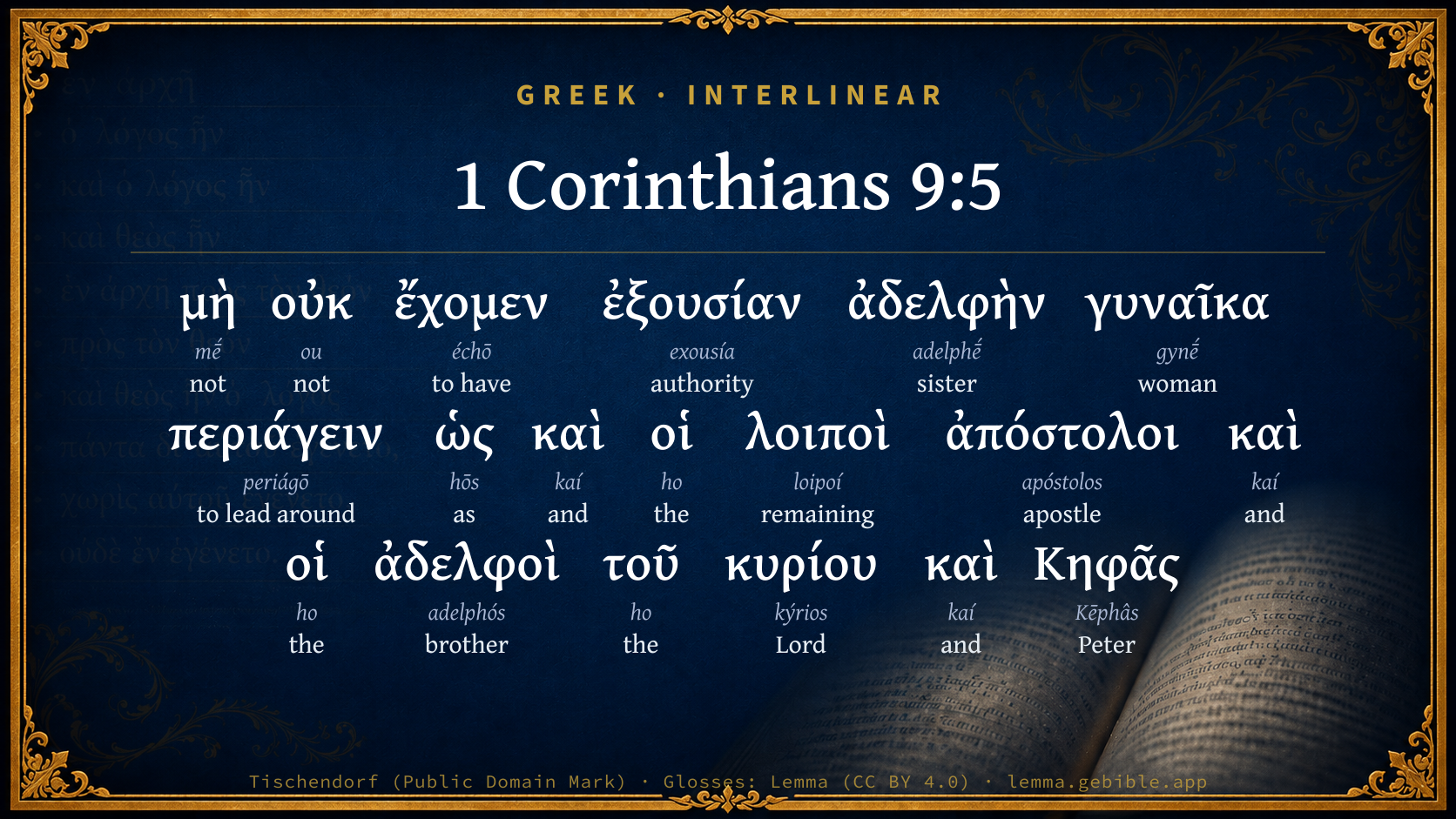
  1. μὴ mḗ G3361 “not” Particle, Negative
  2. οὐκ ou G3756 “not” Particle, Negative
  3. ἔχομεν échō G2192 “to have” Verb, Present, Active, Indicative, 1st person, Plural
  4. ἐξουσίαν exousía G1849 “authority” Noun, Accusative, Singular, Feminine
  5. ἀδελφὴν adelphḗ G79 “sister” Noun, Accusative, Singular, Feminine
  6. γυναῖκα gynḗ G1135 “woman” Noun, Accusative, Singular, Feminine
  7. ὡς hōs G5613 “as” Adverb
  8. καὶ kaí G2532 “and” Conjunction
  9. οἱ ho G3588 “the” Article, Nominative, Plural, Masculine
  10. λοιποὶ loipoí G3062 “remaining” Adjective, Nominative, Plural, Masculine
  11. ἀπόστολοι apóstolos G652 “apostle” Noun, Nominative, Plural, Masculine
  12. καὶ kaí G2532 “and” Conjunction
  13. οἱ ho G3588 “the” Article, Nominative, Plural, Masculine
  14. ἀδελφοὶ adelphós G80 “brother” Noun, Nominative, Plural, Masculine
  15. τοῦ ho G3588 “the” Article, Genitive, Singular, Masculine
  16. κυρίου kýrios G2962 “Lord” Noun, Genitive, Singular, Masculine
  17. καὶ kaí G2532 “and” Conjunction
  18. Κηφᾶς Kēphâs G2786 “Peter” Noun, Nominative, Singular, Masculine

About this verse

These counts appear in no published source. They are computed here, from the morphology-tagged text and Lemma’s own curated glosses. What Lemma adds →

19
words
15
distinct lemmas
Pauline Epistles
section

Notable vocabulary

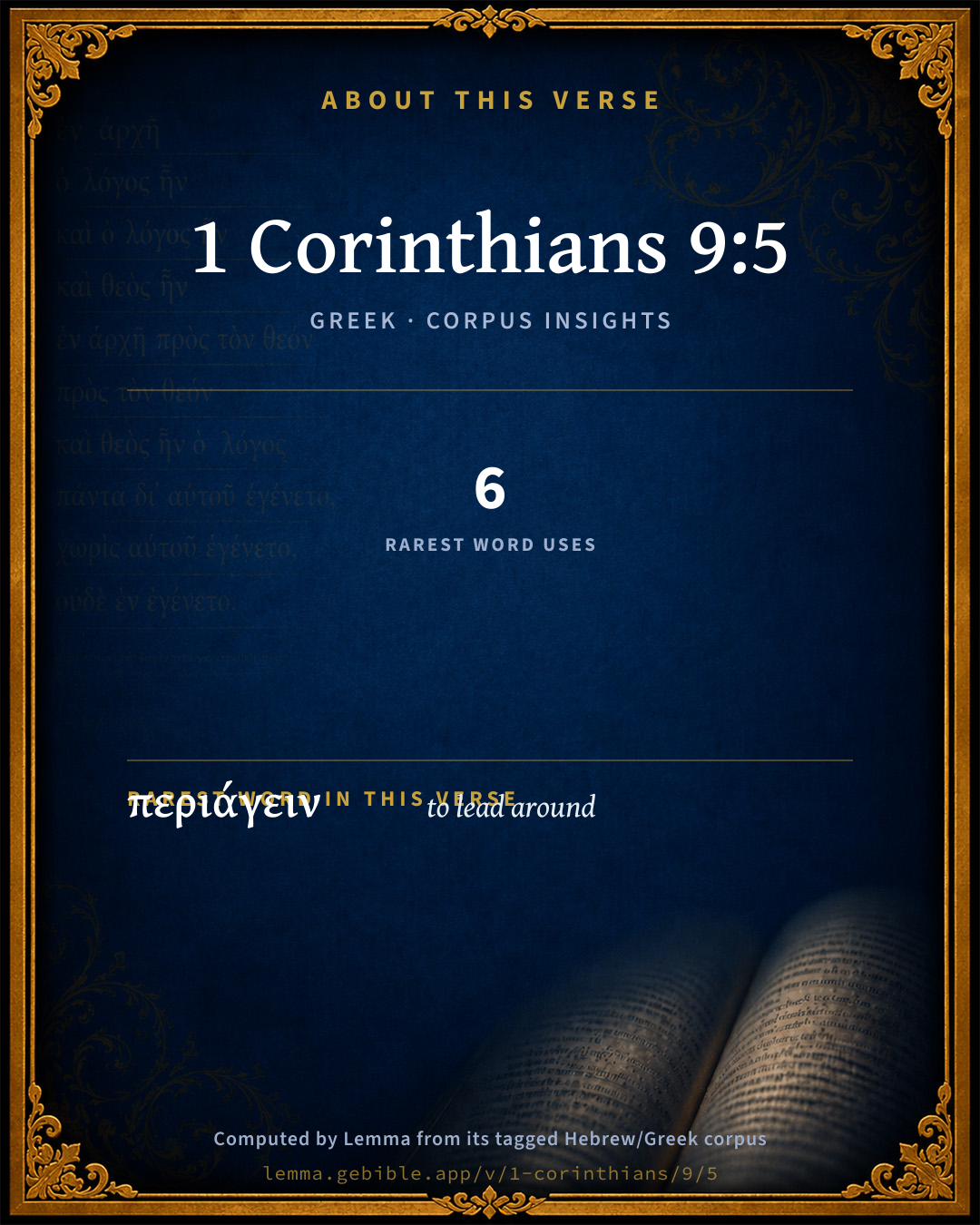
The rarest word here is περιάγειν to lead around G4013 — appearing just 6 times in the whole Greek New Testament.

Shared distinctive vocabulary

περιάγειν to lead around G4013 occurs in 6 verses of the Greek New Testament. Also found in:

Repetition

Words recur within this verse:

Cross-references

23

Topical passages linked to 1 Corinthians 9:5 in the Treasury of Scripture Knowledge — connected by theme and wording, ordered by reader-vote popularity; previews shown in the World English Bible.

  • John 1:42 He brought him to Jesus. Jesus looked at him, and said, "You are Simon the son of Jonah. You shall be called Cephas" (which is by interpretation, Peter).
  • Matthew 8:14 When Jesus came into Peter's house, he saw his wife's mother lying sick with a fever.
  • Acts 1:14 All these with one accord continued steadfastly in prayer and supplication, along with the women, and Mary the mother of Jesus, and with his brothers.
  • 1 Corinthians 7:7 Yet I wish that all men were like me. However each man has his own gift from God, one of this kind, and another of that kind.
  • 1 Corinthians 7:39 A wife is bound by law for as long as her husband lives; but if the husband is dead, she is free to be married to whoever she desires, only in the Lord.
  • Galatians 1:19 But of the other apostles I saw no one, except James, the Lord's brother.
  • Hebrews 13:4 Let marriage be held in honor among all, and let the bed be undefiled: but God will judge the sexually immoral and adulterers.
  • Song of Solomon 4:12 A locked up garden is my sister, my bride; A locked up spring, A sealed fountain.
  • Song of Solomon 5:1–2 I have come into my garden, my sister, my bride. I have gathered my myrrh with my spice; I have eaten my honeycomb with my honey; I have drunk my wine with my milk. Friends Eat, friends! Drink, yes, drink abundantly, beloved. Beloved
  • Matthew 12:46–50 While he was yet speaking to the multitudes, behold, his mother and his brothers stood outside, seeking to speak to him.
  • Matthew 13:55 Isn't this the carpenter's son? Isn't his mother called Mary, and his brothers, James, Joses, Simon, and Judas?
  • Mark 1:30 Now Simon's wife's mother lay sick with a fever, and immediately they told him about her.
  • Mark 6:3 Isn't this the carpenter, the son of Mary, and brother of James, Joses, Judas, and Simon? Aren't his sisters here with us?" They were offended at him.
  • Luke 6:15 Matthew; Thomas; James, the son of Alphaeus; Simon, who was called the Zealot;
  • John 2:12 After this, he went down to Capernaum, he, and his mother, his brothers, and his disciples; and they stayed there a few days.
  • Romans 16:1 I commend to you Phoebe, our sister, who is a servant of the assembly that is at Cenchreae,
  • 1 Corinthians 1:12 Now I mean this, that each one of you says, "I follow Paul," "I follow Apollos," "I follow Cephas," and, "I follow Christ."
  • 1 Corinthians 7:15 Yet if the unbeliever departs, let there be separation. The brother or the sister is not under bondage in such cases, but God has called us in peace.
  • 1 Timothy 3:2 The overseer therefore must be without reproach, the husband of one wife, temperate, sensible, modest, hospitable, good at teaching;
  • 1 Timothy 5:2 the elder women as mothers; the younger as sisters, in all purity.
  • Titus 1:6 if anyone is blameless, the husband of one wife, having children who believe, who are not accused of loose or unruly behavior.
  • Song of Solomon 4:9–10 You have ravished my heart, my sister, my bride. You have ravished my heart with one of your eyes, With one chain of your neck.
  • 1 Timothy 4:3 forbidding marriage and commanding to abstain from foods which God created to be received with thanksgiving by those who believe and know the truth.

Cross-references courtesy of OpenBible.info (CC BY 4.0).

Commentary

Notes on 1 Corinthians 9:5 from classic Christian and Jewish commentators (each source and its license shown beneath its notes). The classic Christian expositions comment on the surrounding passage and are grouped to its opening verse, so a note may address several verses; the Jewish commentaries on the Tanakh (Rashi and others) are per-verse, so they appear only where the commentator wrote on this verse.

Lemma curates 59 commentaries, every one of them public domain or Creative Commons licensed, each selected and text-cleaned for this edition rather than reprinted as found. About our sources →

Tyndale Open Study Notes

Tyndale Open Resources

9:5 the Lord’s brothers: See Mark 6:3 for their names. • Peter: Mark 1:30 also speaks of Peter as married.

Tyndale Open Study Notes — © Tyndale Open Resources, licensed CC BY-SA 4.0. Text via the HelloAO Bible API.

Bengel's Gnomon

Johann Albrecht Bengel

1Co 9:5. Ἀδελφὴν γυναῖκα, a sister, a wife) Expressed in the nominative case this is the proposition implied, this sister is my wife; wherefore the name, sister, does not prevent marriage.—περιάγειν, to lead about) an abbreviated expression[73] for to have and to lead about; for he had no wife. Expense was laid upon the Churches, not from having, but from leading about a wife.—ὡς, as well as) this word also refers to 1Co 9:4.—οἱ λοιποὶ, the others) The article shows that all the others had done so. We may presume the same of John.—καὶ οἱ ἀδελφοὶ τοῦ Κυρίου, and the brethren of the Lord) Act 1:14; Gal 1:19.—καὶ Κηφᾶς, and Cephas) There is a gradation here; comp. 1Co 3:22, note.

[73] See Appendix, “locutio concisa.”

Bengel's Gnomon of the New Testament — English translation (T&T Clark, Edinburgh, 1860) — public domain. Text from a community e-Sword module.

Godet's Commentaries

Frédéric Louis Godet

Vv. 5. The right of Paul and Barnabas, as apostles of the Lord, is demonstrated down to 1Co 9:14 by a series of arguments, the first of which, 1Co 9:5-6, is taken from the example of the other apostles and of the Lord’s brothers. Not only were these personally maintained by the Churches they visited, but each of them had his wife with him, who shared in this advantage. The Greek text signifies: “a sister as wife.” The Vulgate translates: “a wife as sister;” it is obvious in what interest. “Clement of Alexandria, at the end of the second century, makes no difficulty about recognising the fact that all the apostles were married (Strom. iii. p. 448); Ambrosiaster (probably the Roman deacon Hilary in the fourth century) declares (2Co 11:2) that all the apostles, except John and Paul, had wives” (see Heinrici, p. 240).

The term περιάγειν, to lead about, can apply only to habitual missionary journeys. This little word dissipates to some extent the obscurity in which the book of Acts leaves the career of most of the Twelve. It reveals to us also what an important part the brothers of Jesus played in the early propagation of Christianity. They must have occupied the first rank among the evangelists, who came immediately after the apostles (Eph 4:11). These brothers of Jesus were, according to the Gospels, four in number: James, Joses, Simon, and Jude (Mat 13:55 and parallels). An ancient tradition makes them elder brothers of Jesus, the issue of a first marriage of Joseph. Later it was sought to identify two or even three of them with the apostles of the same name; they were held to be cousins of Jesus, sons of a brother of Joseph, called Alphaeus. After his death, Joseph and Mary took them into their house to bring them up with Jesus; this is what led to their being called His brothers. The eldest, James, was the Apostle James, son of Alphaeus (Mat 10:3); Simon, the last but one, was the Apostle Simon Zelotes (Mat 10:4; Luk 6:15); and the youngest, Jude, was the Apostle Jude Lebbaeus, or Thaddaeus (Mat 10:3; Luk 6:16). This ingenious combination falls to pieces before the two sayings, Joh 7:5, where, some months before the Passion, it is said of the brothers of Jesus, “that they did not believe in Him,”—they were not therefore of the number of the Twelve,—and Act 1:13-14, where, even after the Ascension, they are still placed outside the circle of the apostles. Our passage, too, has been relied on to identify them with the Twelve. For, it is said, since Peter is mentioned along with the apostles, though he was one of them, it may well be so with the brothers of Jesus. But it is not necessary to give to the two καί, and, in our verse an identical meaning. We may explain it: “the other apostles, as well as (first καί) the brothers of Jesus, and specially (second καί) Cephas.” As to the brothers of Jesus, therefore, there are only two suppositions possible: either that they were, according to a tradition already quoted, brothers of Jesus by the father, or that they were his later-born brothers. It is well known what an ascendancy in the Church was given to the eldest of them, James, by the fact of his being the Lord’s brother; comp. Gal 1:19; Gal 2:1-10; Acts 15.

The Gospels positively inform us that Peter was married (Mat 8:14). Tradition calls his wife sometimes Concordia, sometimes Perpetua. Peter is expressly mentioned, because he occupied the first rank among the apostles and evangelists; his was the example par excellence.

Frédéric Louis Godet — Commentaries on Luke, John, Romans, and 1 Corinthians — English translation (T&T Clark, Edinburgh, 1870s–1890s) — public domain. Text from a community e-Sword module.

Hodge's Commentary on Romans, Ephesians & First Corinthians

Charles Hodge

1Co_9:5

Have we not power to lead about a sister, a wife, as well as other apostles, and (as) the brethren of the Lord, and Cephas?

This is an amplification of the preceding verse. Have we not the power, i.e. the right. To lead about, a form of expression chosen because the apostles were not stationary ministers, each with his own parish or diocese, but were constantly traveling from place to place. A sister, i.e. a Christian woman. A wife, this determines the relation which this traveling companion sustained. It is as much as saying, A sister who is a wife. Many of the Fathers explain this passage as referring to the custom of rich women attending the apostles on their journeys in order to minister to their support. In this interpretation they are followed by many Romanists in order to avoid the sanction which the ordinary and only legitimate interpretation gives to the marriage of the clergy. As other apostles; literally, the other apostles. This does not necessarily imply that all the other apostles were married; but the implication is that as a body they were married men. Olshausen and others understand the apostle, in the 1Co_9:4-6, as asserting his liberty as to three points;

1. As to meats, Have I not the same liberty that you claim as to eating and drinking?

2. As to marriage, Have I not the right to marry?

3. As to support.

But this introduces more into the text than the connection warrants. There is no question about the right of marriage alluded to in the context; and what follows is a defense neither of his liberty to disregard the Jewish laws about meats and drinks, nor of his right to be married.

And the brethren of the Lord. Whether these were the children of Joseph and Mary, or the children of Mary, the sister of our Lords mother, is a point very difficult to determine. Tradition, or the general voice of the church, is greatly in favor of the latter opinion. The former, however, is probably the opinion embraced by a majority of modern commentators. The discussion of this question belongs properly to the evangelical history.‹11› The following passages may be compared on this subject: Mat_1:25; Mat_12:46; Mat_13:55. Luk_2:7. Joh_2:12. Act_1:14. Gal_1:19. And Cephas; this is the name by which Peter is called whenever he is mentioned by Paul, except in the epistle to the Galatians; and Lachmann reads Cephas instead of Peter in Gal_1:18; Gal_2:11, Gal_2:14, leaving Gal_2:8, Gal_2:9 the only exception. That Peter was married is clear from Mat_8:14. Mar_1:30.

Charles Hodge — Commentary on Romans (1835), First Corinthians (1857), and Ephesians (1856) — public domain. Text from a community e-Sword module.

Geneva Bible (1599)

Geneva Bible translators

One that is a Christian and a true believer?

Geneva Bible (1599) marginal notes — public domain. Text via Bolls.life.

Jamieson, Fausset & Brown

Robert Jamieson, A. R. Fausset & David Brown

lead about a sister, a wife--that is, "a sister as a wife"; "a sister" by faith, which makes all believers brethren and sisters in the one family of God: "a wife" by marriage covenant. Paul implies he did not exercise his undoubted right to marry and "lead about" a believer, for the sake of Christian expediency, as well to save the Church the expense of maintaining her in his wide circuits, as also that he might give himself more undistractedly to building up the Church of Christ (Co1 7:26, Co1 7:32, Co1 7:35). Contrast the Corinthians' want of self-sacrifice in the exercise of their "liberty" at the cost of destroying, instead of edifying, the Church (Co1 8:9, Margin; Co1 8:10-13).

as other apostles--implying that some of them had availed themselves of the power which they all had, of marrying. We know from Mat 8:14, that Cephas (Peter) was a married man. A confutation of Peter's self-styled followers, the Romanists, who exclude the clergy from marriage. CLEMENT OF ALEXANDRIA [Miscellanies, 7.63] records a tradition that he encouraged his wife when being led to death by saying, "Remember, my dear one, the Lord." Compare EUSEBIUS [Eccleiastical History, 3.30].

brethren of the Lord--held in especial esteem on account of their relationship to Jesus (Act 1:14; Gal 1:9). James, Joses, Simon, and Judas. Probably cousins of Jesus: as cousins were termed by the Jews "brethren." ALFORD makes them literally brothers of Jesus by Joseph and Mary.

Cephas--probably singled out as being a name carrying weight with one partisan section at Corinth. "If your favorite leader does so, surely so may I" (Co1 1:12; Co1 3:22).

Jamieson, Fausset & Brown — Commentary Critical and Explanatory on the Whole Bible (1871) — public domain (CC PDM 1.0). Text via the HelloAO Bible API.

Adam Clarke's Commentary

Verse 5. Have we not power to lead about a sister, a wife] The word εξουσιαν is to be understood here, as above in 1Co 9:4, as implying authority or right; and authority, not merely derived from their office, but from Him who gave them that office; from the constitution of nature; and from universal propriety or the fitness of things.

When the apostle speaks of leading about a sister, a wife, he means first, that he and all other apostles, and consequently all ministers of the Gospel, had a right to marry. For it appears that our Lord's brethren James and Jude were married; and we have infallible evidence that Peter was a married man, not only from this verse, but from Mt 8:14, where his mother-in-law is mentioned as being cured by our Lord of a fever.

And secondly, we find that their wives were persons of the same faith; for less can never be implied in the word sister. This is a decisive proof against the papistical celibacy of the clergy: and as to their attempts to evade the force of this text by saying that the apostles had holy women who attended them, and ministered to them in their peregrinations, there is no proof of it; nor could they have suffered either young women or other men's wives to have accompanied them in this way without giving the most palpable occasion of scandal. And Clemens Alexandrinus has particularly remarked that the apostles carried their wives about with them, "not as wives, but as sisters, that they might minister to those who were mistresses of families; that so the doctrine of the Lord might without reprehension or evil suspicion enter into the apartments of the women." And in giving his finished picture of his Gnostic, or perfect Christian, he says: εσθιει, και πινει, και γαμει - εικονας εχει τους Αποστολους, He eats, and drinks, and marries - having the apostles for his example. Vid. Clem. Alex. Strom., lib. vii., c. 12.

On the propriety and excellence of marriage, and its superiority to celibacy, see the notes on chap. 7.

Adam Clarke's Commentary on the Bible (1810–1826) — public domain. Text from a community e-Sword/MySword module.

John Calvin's Commentaries

5. Even as the other Apostles. In addition to the Lord’s permission, he mentions the common practice of others. And with the view of bringing out more fully the waiving of his right, he proceeds step by step. In the first place, he brings forward the Apostles He then adds, “Nay, even the brethren of the Lord themselves also make use of it without hesitation — nay more, Peter himself, to whom the first place is assigned by consent of all, allows himself the same liberty.” By the brethren of the Lord, he means John and James, who were accounted pillars, as he states elsewhere. (Galatians 2:9.) And, agreeably to what is customary in Scripture, he gives the name of brethren to those who were connected with Him by relationship.

Now, if any one should think to establish Popery from this, he would act a ridiculous part. We confess that Peter was acknowledged as first among the Apostles, as it is necessary that in every society there should always be some one to preside over the others, and they were of their own accord prepared to respect Peter for the eminent endowments by which he was distinguished, as it is proper to esteem and honor all that excel in the gifts of God’s grace. That preeminence, however, was not lordship — nay more, it had nothing resembling lordship. For while he was eminent among the others, still he was subject to them as his colleagues. Farther, it is one thing to have pre-eminence in one Church, and quite another, to claim for one’s self a kingdom or dominion over the whole world. But indeed, even though we should concede everything as to Peter, what has this to do with the Pope? For as Matthias succeeded Judas, (Acts 1:26,) so some Judas might succeed Peter. Nay more, we see that during a period of more than nine hundred years among his successors, or at least among those who boast that they are his successors, there has not been one who was one whit better than Judas. This, however, is not the place to treat of these points. Consult my Institutes. (Volume 3.)

One thing farther must here be noticed, that the Apostles had no horror of marriage, which the Papal clergy so much abominate, as unbecoming the sanctity of their order. But it was after their time that that admirable discovery was made, that the priests of the Lord are polluted if they have intercourse with their lawful wives; and, at length matters came to such a pitch, that Pope Syricius did not hesitate to call marriage “a pollution of the flesh, in which no one can please God.” What then must become of the poor Apostles, who continued in that pollution until death? Here, however, they have contrived a refined subtilty to effect their escape; for they say that the Apostles gave up the use of the marriage bed, but led about their wives with them, that they might receive the fruits of the gospel, or, in other words, support at the public expense. As if they could not have been maintained by the Churches, unless they wandered about from place to place; and farther, as if it were a likely thing that they would run hither and thither of their own accord, and without any necessity, in order that they might live in idleness at the public expense! For as to the explanation given by Ambrose, as referring to other persons’ wives, who followed the Apostles for the purpose of hearing their doctrine, it is exceedingly forced.

John Calvin's Commentaries (1540-1563) — public domain. Text from the Calvin Translation Society English edition (1840s-50s) via the Christian Classics Ethereal Library (ccel.org). Calvin's coverage is partial (roughly two-thirds of the Bible); uncommented books and verses are honest gaps, never fabricated. The 19th-century editor's footnotes and remarks are omitted so the notes are faithfully Calvin's own voice.

Ellicott's Commentary for English Readers

(5) To lead about a sister, a wife—i.e., to take with us on our journeys a Christian woman as a wife. Roman divines have interpreted this as referring to “the custom of Christian matrons attending as sisters upon the Apostles.” But as the Apostle illustrates his meaning by a reference to Peter, who we know had a wife, such an interpretation is inadmissible. St. Paul, in this verse, carries his statement of apostolic right to support one step further. Not only had he a right to be supported himself, but the support of the married Apostles and their wives by the Church implied the same right on the part of all. A practice which grew out of a misapprehension of the real meaning of this passage, led to grave scandal, and was finally condemned by the first Council of Nicæa (A.D. 325).

The brethren of the Lord, and Cephas.—These are mentioned specially, not as distinct from the Apostles (for Cephas, of course, was one), but as examples which would have great weight with the particular Jewish faction to whom this argument was adduced. James was Bishop of Jerusalem (Act_15:13; Act_21:18). The other brethren of our Lord were Joses, Simon, and Judas (Mat_13:55). They were not of the twelve Apostles, even after their conversion being mentioned as distinct from the Twelve (Act_1:14), although James subsequently occupied an apostolic position (Gal_2:9). Various and ingenious suggestions have been made as to who these “brethren of the Lord” were; amongst others, that they were cousins, or that they were children of Joseph by a former marriage. These views grew out of a desire to establish the perpetual virginity of Mary. The natural conclusion from a study of the mention of their names in the Gospels, without preconceived prejudice, would be that Joseph and Mary lived together after the miraculous birth of Christ, and that these were their children. This, too, is supported by the use of the word “first-born” in reference to our Lord (Mat_1:25; Luk_2:7), and the word “till” (Mat_1:25), and “before they came together” (Mat_1:18), and the repeated mention of them as brethren in connection with His mother Mary. (See Note on Mat_12:46.)

A Bible Commentary for English Readers, edited by Charles John Ellicott (1878–1897) — public domain. Text from a community e-Sword module.

The Cambridge Bible for Schools and Colleges

gen. ed. J. J. S. Perowne

5. Have we not power to lead about a sister, a wife] The ordinary interpretation of this passage is (1) that St Paul here asserts his right, if he pleased, to take with him a wife who was a member of the Christian body, and to have her maintained at the expense of the community. The word sister, like the words brother, brethren, is equivalent to ‘member of the Christian Church’ in Rom_16:1; St Jas_2:15; 2Jn_1:13 (perhaps) and ch. 1Co_7:15 of this Epistle. This privilege was claimed by the other Apostles with a view, as Stanley suggests, of obtaining access to the women, who in the East usually dwelt apart. But there is (2) another interpretation which would translate the word here rendered wife by woman (as in the margin of our version), and suppose that the tie which connected St Paul with the Christian woman he claimed to ‘lead about’ with him was nothing but that of their common Christianity. In support of this view St Luk_8:2-3, is quoted. This opinion can be traced back as far as Tertullian in the second century. But St Paul speaks of only one such person, and it is improbable that in a society so corrupt as the heathen society of that age everywhere was, the Apostles of Christ would have run so serious a risk of misconstruction as would have been involved in such a practice. The conduct of Simon Magus, who led about with him a woman of scandalous character, the misinterpretations so common in the Apostolic age of the innocent affection of the Christians for each other, and of their nightly meetings, shew how necessary prudence was. Besides, this interpretation misses the point of the argument, which was, that the original twelve Apostles claimed the right to throw not only their own maintenance, but that of the members of their families, upon the Church. The various readings found in this passage would seem to have been introduced to support the view that a wife could not here be intended.

the brethren of the Lord] These have been regarded (1) as the children of Joseph and Mary, (2) the children of Joseph by a former wife, (3) as the kinsmen of our Lord, the word brother having been used in Hebrew to denote any near relation. See Gen_13:8; Gen_29:12; Lev_10:4. The question has been hotly debated. (1) or (2) seem the more obvious interpretation of the words; but in support of (3) we find from Scripture and ecclesiastical history that the names of our Lord’s brethren James and Joses and Simon and Judas were also the names of the sons of Alphæus, who were our Lord’s cousins. See St Mat_13:55; Mat_27:56; St Luk_24:10; St Joh_19:25. Also St Mat_10:3; St Mar_3:18; St Luk_6:16; and Eusebius, Eccl. Hist. iii. 11, 32. See Professor Lightfoot on the Epistle to the Galatians. Also Professor Plumptre on St James, in the present series.

The Cambridge Bible for Schools and Colleges (gen. ed. J. J. S. Perowne; Cambridge University Press, 1878–1918) — public domain. Text from a community e-Sword module.

John Gill's Exposition

Or I only and Barnabas,.... Who were for a great while companions and fellow travellers; are we alone? are we exempted from those rights and privileges, common to others?

have not we power to forbear working? that is, with their hands, at their trades and occupations, to get their living by: Paul worked at his trade, and so it seems Barnabas did likewise: Paul wrought with his hands at Corinth, in company with Aquila and Priscilla, they being tentmakers as he, Act 18:3 and so he did in other places; he appeals for the truth of this to the elders of the church at Ephesus, Act 20:34 and to the church of the Thessalonians, Th1 2:9 not but that he had a right and power to leave off business, to forbear working, and require a maintenance from those to whom he ministered; but for some reasons he chose not to make use of this his power and liberty, because he would not be chargeable to them; and lest that upon his first preaching the Gospel to them, they should think he had worldly selfish ends in view, and not the good of souls, and glory of Christ; however, he hereby lets them know, that though Barnabas and he continued to get their bread by their own hand labour, they had a right to quit their trades, and throw themselves upon them for a maintenance. The apostle seems, in this, to imitate the ancient, wise, and holy men of his nation, who taught the law freely, and took nothing for it; not that they thought it was unlawful, or that they had no right to a maintenance on account of it, but for the honour of religion, and that piety they professed; and lest the law should be thought to be made a trade of, they chose not to insist upon it (d).

(d) Maimon. & Bartenora in Pirke Abot, c. 4. sect. 5.

John Gill's Exposition of the Whole Bible (1746–1763) — public domain (CC PDM 1.0). Text via the HelloAO Bible API.

Trapp's Complete Commentary

John Trapp

5 Have we not power to lead about a sister, a wife, as well as other apostles, and as the brethren of the Lord, and Cephas?

Ver. 5. To lead about a sister] At the Church’s charge likewise. The Papists that deny the lawfulness of ministers’ marriage, are condemned and cursed by their own canon law (Distinct 29 and 31.) See Acts and Monuments, fol. 1008. Paphnutius opposed this proposition in the Nicene Council, and prevailed.

John Trapp, A Commentary or Exposition upon All the Books of the Old and New Testament (1647–1656) — public domain. Text from a community e-Sword module.

Albert Barnes' Notes on the Bible

Have we not power? - Have we not a right? The objection here seems to have been, that Paul and Barnabas were unmarried, or at least that they traveled without wives. The objectors urged that others had wives, and that they took them with them, and expected provision to be made for them as well as for themselves. They therefore showed that they felt that they had a claim to support for their families, and that they were conscious that they were sent of God. But Paul and Barnabas had no families. And the objectors inferred that they were conscious that they had no claim to the apostleship, and no right to support. To this Paul replies as before, that they had a right to do as others did, but they chose not to do it for other reasons than that they were conscious that they had no such right.

To lead about - To have in attendance with us; to conduct from place to place; and to have them maintained at the expense of the churches amongst which we labor.

A sister, a wife - Margin, “or woman.” This phrase has much perplexed commentators. But the simple meaning seems to be, A wife who should be a Christian, and regarded as sustaining the relation of a Christian sister.” Probably Paul meant to advert to the fact that the wives of the apostles were and should be Christians; and that it was a matter of course, that if an apostle led about a wife she would be a Christian; or that he would marry no other; compare 1Co 3:11.

As well as other apostles - It is evident from this that the apostles generally were married. The phrase used here is οἱ λοιποὶ ἀπόστολοι hoi loipoi apostoloi (“the remaining apostles,” or the other apostles). And if they were married, it is right and proper for ministers to marry now, whatever the papist may say to the contrary. It is safer to follow the example of the apostles than the opinions of the papal church. The reasons why the apostles had wives with them on their journeys may have been various. They may have been either to give instruction and counsel to those of their own sex to whom the apostles could not have access, or to minister to the needs of their husbands as they traveled. It is to be remembered that they traveled among pagans; they had no acquaintance and no friends there; they therefore took with them their female friends and wives to minister to them, and sustain them in sickness, trial, etc. Paul says that he and Barnabas had a right to do this; but they had not used this right because they chose rather to make the gospel without charge 1Co 9:18, and that thus they judged they could do more good. It follows from this:

(1) That it is right for ministers to marry, and that the papal doctrine of the celibacy of the clergy is contrary to apostolic example.

(2) It is right for missionaries to marry, and to take their wives with them to pagan lands. The apostles were missionaries, and spent their lives in pagan nations as missionaries do now, and there may be as good reasons for missionaries marrying now as there were then.

(3) Yet there are people, like Paul, who can do more good without being married. There are circumstances, like his, where it is not advisable that they should marry, and there can be no doubt that Paul regarded the unmarried state for a missionary as preferable and advisable. Probably the same is to be said of most missionaries at the present day, that they could do more good if unmarried, than they can if burdened with the cares of families.

And as the brethren of the Lord - The brothers of the Lord Jesus, James and Joses, and Simon and Judas, Mat 13:55. It seems from this, that although at first they did not believe in him Joh 7:5, and had regarded him as disgraced Mar 3:21, yet that they had subsequently become converted, and were employed as ministers and evangelists. It is evident also from this statement that they were married, and were attended with their wives in their travels.

And Cephas - Peter; see the note at Joh 1:42. This proves:

(1) As well as the declaration in Mat 8:14, that Peter had been married.

(2) That he had a wife after he became an apostle, and while engaged in the work of the ministry.

(3) That his wife accompanied him in his travels.

(4) That it is right and proper for ministers and missionaries to be married now.

Is it not strange that the pretended successor of Peter, the pope of Rome, should forbid marriage when Peter himself was married? Is it not a proof how little the papacy regards the Bible, and the example and authority of those from whom it pretends to derive its power? And is it not strange that this doctrine of the celibacy of the clergy, which has been the source of abomination, impurity, and licentiousness everywhere, should have been sustained and countenanced at all by the Christian world? And is it not strange that this, with all the other corrupt doctrines of the papacy, should be attempted to be imposed on the enlightened people of the United States, or of Great Britain, as a part of the religion of Christ?

Albert Barnes' Notes on the Bible (1834–1885) — public domain. Text from a community e-Sword/MySword module.

Haydock's Catholic Bible Commentary

It appears certain, from the testimony of the fathers, that St. Paul was not in the state of wedlock. St. Jerome informs us that the apostle is here speaking of such holy women who, according to the Jewish custom, supplied their teachers with the necessaries of life, as we see was done to Christ himself. It is evident from ancient records that this was a very prevalent custom in Judea, and therefore a cause of no scandal; but to the Gentiles this custom was unknown, and therefore lest it might prove a cause of scandal to any, St. Paul did not allow any woman to follow him as a companion. Tertullian denies, with St. Augustine and St. Jerome, that St. Paul is here speaking of his wife. (Estius; Calmet) --- A woman, a sister.[2] Some erroneous translators have corrupted this text, by rendering it, a sister, a wife; whereas it is certain, St. Paul had no wife, (chap. vii. ver. 7. 8.) and that he only speaks of such devout women, as according to the custom of the Jewish nation, waited upon the preachers of the gospel, and supplied them with necessaries. (Challoner) --- And to what end could he talk of burthening the Corinthians with providing for his wife, when he himself clearly affirmeth that he was single? (Chap. vii. v. 7. and 8.) This all the Greek fathers affirm, with St. Augustine, do op. Monach. chap. iv.; St. Jerome, adv. Jovin. chap. xiv. &c. &c. [Also see annotations on ver. 25, below]

===============================

[BIBLIOGRAPHY]

Mulierem sororem, Greek: adelphen gunaika. Sororem mulierem, where Estius brings examples to shew that it is the same sense and construction, whether we read mulierem sororem, or sororem mulierem. Tertullian, the most ancient of the Latin fathers, read: mulieres circumducendi, not uxores. De pudicitia, chap. xiv. p. 566. Ed. Rig. and lib. de monogam. chap. viii. p. 519. he first says, Petrum solum invenio maritum. And on this place, non uxores demonstrat ab Apostolis circumductas....sed simpliciter mulieres, quæ, illos eodem instituto, quo et Dominum comitantes, ministrabant. St. Jerome. Ubi de mulieribus sororibus infertur, perspicuum est, non uxores debere intelligi, sed eas, ut diximus, quæ de sua substantia ministrabant. St. Augustine. Hoc quidam non intelligentes, non sororem mulierem, sed uxorem interpretati sunt, fefellit illos verbi græci ambiguitas....quanquam hoc ita posuerit, ut falli non debuerint, quia neque mulierem tantummodo ait, sed sororem mulierem, neque ducendi, sed circumducendi: verum alios Interpretes non fefellit hæc ambiguitas, et mulierem, non uxorem interpretati sunt.

====================

George Leo Haydock (1774–1849), Haydock's Catholic Family Bible and Commentary, 1859 edition — public domain. Excludes Psalms (Douay-Rheims chapter numbering differs from Protestant) and Deuterocanonical books (Catholic canon only).

Matthew Poole's English Annotations

Have we not power to lead about a sister, a wife? Those that by those terms, αδελφην, γυναικα, understand, not (as we translate it) a sister, a wife, but a woman, that should out of her estate have contributed to the apostle’s maintenance, (as Joanna the wife of Chuza Herod’s steward, and Susanna, and many others, followed Christ, and ministered to him of their substance, Luk 8:3), seem not to consider:

1. That such women would have been no burden, but a help to the church (which is quite contrary to the apostle’s sense).

2. That the term lead about, imports a conjugal relation to the woman.

3. That if this had been the sense, it had been enough to have said, to lead about a woman; he should not need have said, a sister, a woman.

4. That such leading about a woman, not their wife, had been scandalous.

5. That the very phrase, a sister, a wife, answers the phrase, Act 23:1, Men, brethren, which signifies no more than, O ye Christian men; as a sister, a wife, signifies here a Christian wife.

6. That we no where read, that Peter, James, John, Judas, (here called the brethren of the Lord), or any of the other apostles, ever in their travels carried about with them any such rich matrons, not their wives, who (as those, Luk 8:3) ministered to them of their substance. Our interpreters have therefore justly translated it, a sister, a wife; and the sense is: Have I not power to marry? Yet the phrase teaches us two things:

a) That Christians have no power, that is, no lawful power, to marry such as are no Christians, their wives must be their sisters also in Christ.

b) That husbands and wives ought to be undivided companions one to another.

As well as other apostles, and as the brethren of the Lord, and Cephas: he instanceth in several apostles that were married, Peter, (called Cephas), James, John, and Judas the son of Alpheus, Christ’s kinsmen. Whence we may observe, that ministers may lawfully marry, no law of God hath restrained them more than others. The popish doctrine forbidding to marry, is by the apostle determined to be a doctrine of devils, 1Ti 4:1,3.

Matthew Poole's English Annotations on the Holy Bible (1683–1685) — public domain. Text from a community e-Sword/MySword module.

Whedon's Commentary on the Bible

Daniel D. Whedon

5. Lead about—Implying an itinerancy, not a settled pastorate.

A sister, a wife—A sister of the Church, who is a wife of the apostle. The English version gives the exact verbal Greek, except that the latter word may signify either wife or woman. That here, however, the word does not mean woman is plain, for a sister is of course a woman, and the latter word would be superfluous. If sister express a relation, so must the latter term. Dr. Wordsworth, however, renders it, as do some of the Greek and Roman fathers, a Christian woman. But the word sister alone would express that meaning. Wordsworth’s rendering assumes that the apostles took upon their circuits female attendants of suitable character, who should perform those Christian offices, such as baptism for females, who were in that age inaccessible to the male minister. But of this practice there is no trace in the New Testament or earliest Church history. Nor is the case of those women who upon occasions ministered to our Lord at all parallel. This erroneous view of the text was probably the occasion of the later introduction into the Church of an order of women called after this passage συνεισακται, which led to such immoralities that it was abolished by the Council of Nicea. The Rhemish (Romanistic) version unscrupulously transposes the terms, and reads a woman, a sister, which would give the same sense as Wordsworth, liable to the same objection. Tradition (which Romanism usually presses upon us as a binding authority) asserts, as this passage also implies, that several of the apostles were married, and Mat_8:14 asserts that Peter (claimed as the first pope) was. Paul declares that “a bishop must be the husband of one wife.” When Orientalism became more fully developed in the Church, about the middle of the second century, virginity began to become an exaggerated virtue. As the popedom developed itself, the celibacy of the clergy, contrary to the above quoted express Scripture, was found to be a powerful aid to the central despotism. Separated from all other ties, the clergy became, as now, the devotees of absolute ecclesiastic power. Hence the pope has been the most violent advocate of celibacy, and the late enactment of the infallibility of the pope renders the dogma of clerical celibacy absolutely immutable.

The brethren of the Lord—Who were not of the twelve apostles, but who, after the Lord’s resurrection, became apostolic men. See note on Mat_13:55.

Cephas—Mentioned here specially as the high authority with the Judaizers whom Paul is answering.

Daniel D. Whedon (gen. ed.), Commentary on the Old and New Testaments (1874–1909) — public domain. Text from a community e-Sword module.

The Pulpit Commentary

To lead about a sister, a wife. There can be no doubt that this represents the true reading, and that the meaning is, "We have power to lead about, that is, to travel in company with, some Christian sister to whom we are married, and who is supported at the expense of the Church." This plain meaning, however, involving the assertion that the apostles and desposyni ("the Lord"s brethren") were married men, was so distasteful to the morbid asceticism which held celibacy in a sort of Manichaean reverence, that the scribes of the fourth, fifth, and later centuries freely tampered with the text, in the happily fruitless attempt to get rid of this meaning. They endeavoured, by putting the word in the plural or by omitting "wife," to suggest that the women whom the apostles travelled with were "deaconesses." Augustine, Tertullian, Ambrose, and others explain the verse of "ministering women". (Luk_8:2, Luk_8:3) The false interpretation avenged itself on the bias which led to it. Valla adopts the wilful invention that the apostles, though married, travelled with their wives only as sisters. Such subterfuges have eaten away the heart of honest exegesis from many passages of Scripture, and originated the taunt that it is a "nose of wax," which readers can twist as they like. It was the cause of such shameful abuses and misrepresentations that at last the practice of travelling about with unmarried women, who went under the name of "sisters," "beloved," "companions," was distinctly forbidden by the third canon of the first Council of Nice. Simon Magus might unblushingly carry about with him a Tyrian woman named Helena; but apostles and true Christians would never have been guilty of any conduct which could give a handle to base suspicions. They travelled only with their wives. A sister. A Christian woman. (1Co_7:15; Rom_16:1; Jam_2:15, etc.) A wife; i.e. as a wife. Other apostles. This is a positive mistranslation for the rest of the apostles." It might be too much to infer positively from this that every one of the apostles and desposyni were married; but there is independent evidence and tradition to show that at any rate most of them were. The brethren of the Lord. They are clearly and undeniably distinguished from the apostles. According to the Helvidian theory (to which the plain language of the Gospels seems to point), they were sons of Joseph and Mary. This is the view of St. Clement of Alexandria in ancient times, and writers so different from each other as De Wette, Neander, Osiander, Meyer, Ewald, and Alford, in modern. The theory of Jerome, that they were cousins of Jesus, being sons of Alphseus and Mary, a sister of the Virgin, is on every ground absolutely untenable, and it was half dropped even by St. Jerome himself, when it had served his controversial purpose. The theory of Epiphanius, that they were sons of Joseph by a previous marriage, is possible, but incapable of proof. It comes from a tainted source the apocryphal Gospels (see my "Early Days of Christianity," 2). Cephas. St. Paul also uses the Aramaic name in Gal_2:9. Peter"s wife is mentioned in Mat_8:14 and in the tradition of her martyrdom (Clem. Alex., "Strom.," 7.

The Pulpit Commentary (1880–1919), ed. H.D.M. Spence-Jones & Joseph S. Exell — public domain. Text from a community e-Sword module.

John Wesley's Explanatory Notes

Have we not power to lead about with us a sister, a wife - And to demand sustenance for her also? As well as the other apostles - Who therefore, it is plain, did this. And Peter - Hence we learn,

1. That St. Peter continued to live with his wife after he became an apostle:

2. That he had no rights as an apostle which were not common to St. Paul.

John Wesley, Explanatory Notes Upon the Whole Bible (1754–1765) — public domain. Text via the GEBible commentary corpus.

Scofield Reference Notes

C. I. Scofield

sister

a wife who is a sister.

The Scofield Reference Bible (1917 edition), notes by C. I. Scofield — public domain. Text from a community e-Sword module.

McGarvey & Pendleton's Commentaries

J. W. McGarvey

Have we no right to lead about [in our constant journeyings] a wife that is a believer [i. e., a lawful wife; it was unlawful to marry an unbeliever-- 2Co_6:14-16 ], even as the rest of the apostles [this passage creates a fair presumption that at least the majority of the apostles were married], and the brethren of the Lord [For their names see Mat_13:55 . For their relation to Jesus, see "Fourfold Gospel," pp. 119, 224-226], and Cephas? [This apostle was married ( Mat_8:14 ); yet Catholics claim him as the first pope. If all these apostles were allowed maintenance for themselves and their wives, Paul had equal right to demand that the church support his wife had he chosen to marry.]

J. W. McGarvey (with Philip Y. Pendleton), Commentaries on the New Testament (The Fourfold Gospel, 1914; Acts; and the epistles) — public domain. Text from a community e-Sword/MySword module.

The People's New Testament

B. W. Johnson

5. Have we not power to lead about a sister, etc.? Peter (Cephas) was a married man. Other apostles had wives. Had Paul no right to have a wife? The answer is that he had this liberty as well as others if he had chosen to use it. Brethren of the Lord. Luke 6:15; Gal. 1:19.

B. W. Johnson's The People's New Testament with Notes (1889–1891) — public domain. Electronic text from the Christian Classics Ethereal Library (CCEL) ThML edition.

Cambridge Greek Testament for Schools and Colleges

5. ἀδελφὴν γυναῖκα περιάγειν. The ordinary interpretation of this passage is (1) that St Paul here asserts his right, if he pleased, to take with him a wife who was a member of the Christian body, and to have her maintained at the expense of the community. The word sister, like the words brother, brethren, is equivalent to ‘member of the Christian Church’ in Rom 16:1; Jas 2:15; 2Jn 1:13 (perhaps) and ch. 1Co 7:15 of this Epistle. This privilege was claimed by the other Apostles with a view, as Stanley suggests, of obtaining access to the women, who in the East usually dwelt apart. But there is (2) another interpretation which would translate the word here rendered wife by woman (as in the margin of our version), and suppose that the tie which connected St Paul with the Christian woman he claimed to ‘lead about’ with him was nothing but that of their common Christianity. In support of this view Luk 8:2-3, is quoted. This opinion can be traced back as far as Tertullian in the second century. But it is most improbable that in a society so corrupt as the heathen society of that age everywhere was, the Apostles of Christ would have run so serious a risk of misconstruction as would have been involved in such a practice. The conduct of Simon Magus, who led about with him a woman of scandalous character, the misinterpretations so common in the Apostolic age of the innocent affection of the Christians for each other, and of their nightly meetings, shew how necessary prudence was in those times. Besides, this interpretation misses the point of the argument, which was, that the original twelve Apostles claimed the right to throw not only their own maintenance, but that of their wives, upon the Church. The various readings found in this passage would seem to have been introduced to support the view that a wife could not here be intended.

οἱ ἀδελφοὶ τοῦ κυρίου. These have been regarded (1) as the children of Joseph and Mary, (2) the children of Joseph by a former wife, (3) as the kinsmen of our Lord, the word brother having been used in Hebrew to denote any near relation. See Gen 13:8; Gen 29:12; Lev 10:4. The question has been hotly debated. (1) or (2) seem of course to suit the more obvious meaning of the word ἀδελφοί; but in support of (3) we find from Scripture and ecclesiastical history that the names of our Lord’s brethren James and Joses and Simon and Judas were also the names of the sons of Alphaeus, who were our Lord’s cousins. See Mat 13:55; Mat 27:56; Luk 24:10; Joh 19:25. Also Mat 10:3; Mar 3:18; Luk 6:16; and Eusebius, Eccl. Hist. III. 11, 32. See Bp Lightfoot on the Epistle to the Galatians, Dissertation II. Also Dean Plumptre on St James, in the present series, Introduction pp. 12–18.

Cambridge Greek Testament for Schools and Colleges (Cambridge University Press, 1896; 21 vols, various authors incl. Carr, Maclear, Plummer, Farrar, Lumby, Moule, M. R. James, Simcox) — public domain. Text from a community e-Sword module.

Alford’s Greek Testament

Henry Alford

5.] Have we not the power to bring about with us (also to be maintained at the cost of the churches, for this, and not the power to marry, is here the matter in question) as a wife, a (believing) sister (or, ‘to bring with us a believing wife:’ these are the only renderings of which the words are legitimately capable. Augustine, De Opere Monachorum, 4 (5), vol. vi. p. 552, explains it thus: “Ostendit sibi licere quod ceteris Apostolis, id est ut non operetur manibus suis, sed ex Evangelio vivat:.… ad hoc enim et fideles mulieres habentes terrenam substantiam ibant cum eis, et ministrabant eis de substantia sua,” &c., and similarly Jerome adv. Jovin. 1:26, vol. ii. p. 277. So likewise Tertull., Theodoret, Œcum., Pelus., Theophylact, Ambrose, and So too Corn.-a-Lap. and Estius. See Estius, and Suicer, γυνή, II. And from this misunderstanding of the passage grew up a great abuse, and such women are mentioned with reprobation by Epiphan. Hær. 78, vol. i. (ii. Migne), p. 1043, under the name of ἀγαπηταί. They were also called ἀδελφαί: and were forbidden under the name of συνείσακτοι by the 3rd Canon of the 1st Council of Nicæa. See these words in Suicer), as also the other Apostles (in the wider sense, not only the twelve, for ver. 6, Barnabas is mentioned. It does not follow hence that all the other Apostles were married: but that all had the power, and some had used it) and the brethren of the Lord (mentioned not because distinct from the ἀπόστολοι, though they were absolutely distinct from the Twelve, see Act 1:14,—but as a further specification of the most renowned persons, who travelled as missionaries, and took their wives with them. On the ἀδ. τοῦ κυρ. see note, Mat 13:55. They were in all probability the actual brethren of our Lord by the same mother, the sons of Joseph and Mary. The most noted of these was James, the Lord’s brother (Gal 1:19; Gal 2:9, Gal 2:12, compare Act 12:17; Act 15:13; Act 21:18), the resident bishop of the Church at Jerusalem: the others known to us by name were Joses (or Joseph), Simon, and Judas, see note on Matt, ib.), and Cephas (Peter was married, see Mat 8:14. A beautiful tradition exists of his encouraging his wife who was led to death, by saying μέμνησο, ὦ αὕτη, τοῦ κυρίου, Alex. Strom. vii. § 11 (63), p. 868 P. Euseb. H. E. iii. 30. Clem. Alex. Strom, iii. § 6 (52), p. 535 P., relates that he had children)? On a mistake which has been made respecting St. Paul’s (supposed) wife, see note on ch. 7:8.

Henry Alford, The Greek Testament (1849–1861) — public domain. Text from a community e-Sword module.

International Critical Commentary

5. ἀδελφὴν γυναῖκα περιάγειν. ‘Do you mean to say that we have no right to take about (with us on our missionary journeys) a Christian person as a wife?’ ‘A sister (= Christian woman) as wife’ is right. Even if γυναῖκα in this construction could mean ‘woman’, it would be superfluous. The Vulgate encourages the mistranslation ‘woman’ with mulierem sororem. The Apostle is not contending that a missionary had a right to take about with him a woman who was not his wife. The fact that a group of women ministered to Christ could not be supposed to justify such indiscretion. But there is an early tradition that very few of the Apostles were married, and hence the temptation to make γυναῖκα mean ‘woman’ rather than ‘wife.’ Tertullian (Exhort. Cast. 8) translates rightly, licebat et apostolis nubere et uxores circumducere, and again (Monogam. 8), potestatem uxores circumducendi; but in the latter passage he suggests that only mulieres, such as ministered to the Lord, may be meant. This misinterpretation is followed by Augustine, Jerome, Ambrose, and others. It led to a great abuse, not confined to the clergy, in the early ages of the Church. Some Christians contracted a sort of spiritual union with unmarried persons, and the two lived together, without marriage, for mutual spiritual benefit. The women in such cases were known as ἀδελφαί, ἀγαπηταί, and συνείσακτοι. Under the last name they are strictly forbidden, in the case of any cleric, by the third Canon of the first Council of Nicaea (Hefele, Councils, p. 379; Suicer, Thesaurus, under all three words and under γυνή).

St Paul is not here claiming that Apostles had a right to marry; no one in that age would be likely to dispute that. He is claiming that they have a right to maintenance at the cost of the Church, and that, if they are married, the wife who travels with them shares this privilege. The whole of this passage (5-18) is concerned with the privilege (of which he refused to make use in his own case) of being maintained at the charges of the congregations. But here, as in Gal 1:19 and elsewhere, we are left in doubt as to the exact meaning of ἀπόστολοι: see on 15:5, 7.

The Sophists blamed Socrates and Plato for teaching gratuitously, thus confessing that their teaching was worth nothing (Xen. Mem. i. 6; Plat. Gorg. 520, Rev_20; Arist. Eth. Nic. ix. i. 5). This kind of charge may have been made by the Judaizers at Corinth. Other Apostles accepted maintenance. Why did Paul refuse it? Because he knew that he was no true Apostle; or, because he set up for being better than the Twelve; or, because he was too proud to accept hospitality.*

For περιάγειν transitive see 2 Mac. 6:10.

ὡς καὶ οἱ λοιποὶ ἀπόστολοι. It is probably on this that the interpolator of the Ignatian Epistles (Philad. 4) bases his statement that Peter and Paul and οἱ ἀλλοι ἁπόστολοι were married; where the words et Paulus are omitted in some Latin texts. See on 7:8. The only Apostles of whose marriage we have direct evidence on good authority are Peter and Philip (Papias in Eus. H.E. iii. 39): see Lightfoot, Colossians, p. 45. This passage would certainly lead us to suppose that most of the Apostles were married men; it contends that all had the privilege of having themselves and their wives maintained by the Church, and it implies that some used the privilege, and therefore were married. The exact meaning of λοιποί is not clear: it may distinguish those who are included from ‘the brethren of the Lord and Kephas,’ or from Paul and Barnabas (v. 6). In the former case ‘the brethren of the Lord’ are Apostles, for the Apostolic body is divided into three parts; ‘Kephas,’ ‘the brethren, of the Lord,’ and ‘the rest of the Apostles.’ * But it is possible that, without any strictly logical arrangement, he is mentioning persons in high position in the Church who availed themselves of the privilege of having their wives maintained as well as themselves, when they were engaged in missionary work. See Lightfoot, Galatians, p. 95. In dictating, he mentions Peter, by himself, at the end, as a specially telling instance; but we cannot safely infer from this that Peter had been in Corinth with his wife. 1:12 does not prove it. See Harnack, Mission and Expansion, i. p. 323, ii. 99.

οἱ ἀδελφοὶ τοῦ Κυρίου. Here only does St Paul mention them, though he tells us (Gal 1:19) that James was one. The question of their exact relation to Christ has produced endless discussion, and the question remains undecided. There is nothing in Scripture which forbids the natural interpretation, that they were the children of Joseph and Mary born after the birth of Christ. To some students of the problem, Mat 1:25 seems to be decisive for this interpretation: see Plummer, S. Matthew, pp. 9, 10, and the literature there cited. There is wide agreement that Jerome’s theory, that they were our Lord’s first cousins, children of a Mary who was sister to His Mother, cannot be maintained. But see Chapman, JTS. April 1906, pp. 412 f. The choice lies between the Helvidian and the Epiphanian theories. The decision does not affect the argument here. In any case they were persons whose close relationship to the Lord gave them distinction in the primitive Church: what they did constituted a precedent. Κηφᾶς, as almost always in Paul (1:12, 3:22, 15:5).

International Critical Commentary — older volumes (1896–1929), various authors — public domain. Text from a community e-Sword module.

Vincent's Word Studies in the New Testament

Marvin R. Vincent

A sister, a wife. Wrong Sister means a christian woman, a fellow - member of the Church, as Rom 16:1; 1Co 7:15; Jas 2:15. It is in apposition with wife : A wife that is a sister on believer. So Rev. Such an one has also the right, like her husband, to be maintained by the Church. Some of the fathers claimed that not a wife was meant, but a female attendant, serviens mantrona, who contributed to the maintenance of the apostles as certain women ministered to Christ. There is no foundation for this. It is contradicted by the example of Peter cited at the end of this verse; compare Mt 8:14; and besides, the point of the argument is that these companions should be maintained. Such a practice, however, did grow up in the Church, but was abolished by the Council of Nicaea on account of its abuses. Stanley remarks that the fact of these women accompanying their husbands, may be explained by the necessity of females to gain access to and to baptize the female converts in Greece and in oriental countries; the same necessity which gave rise to the order of deaconesses.

Marvin R. Vincent, Word Studies in the New Testament (1887–1900) — public domain. Text from a community e-Sword/MySword module.

Lesson kit

Teaching starters — assembled from the data on this page, not authored interpretation. Every prompt links to the verse data it draws on. Edit before teaching.

1 Corinthians, in the Pauline Epistles, opens this verse with 19 words (15 distinct Greek lemmas). Its most distinctive word is periágō (“to lead around”). A historical commentator’s framing appears above. Read the whole chapter for the surrounding context.

Discussion questions

  1. The word periágō carries the sense “to lead around.” How does it shape the verse?
  2. How does Matthew 4:23, which shares the word «to lead around», read alongside this verse?
  3. What does the repetition of “and” (3× in this one verse) do in this verse?
  4. The translations on this page render this verse differently — a whole-verse word diff, not a word-by-word alignment. What might account for the different wordings?
  5. Compare how Tyndale Open Study Notes and Bengel's Gnomon read this verse. Where do they agree or differ?

Things to notice

Reading settings

Reading text

Shown beneath each verse's original-language words.

Old Testament
Old Testament edition

Read the OT as the Masoretic Hebrew (MT) or the Greek Septuagint (LXX).

English shown for the Greek Septuagint (in the Hebrew ↔ Greek comparison).

Comparing translations? Open the Compare panel on any verse page to stack up to four side by side.