
1 Corinthians 7:38

Greek (Tischendorf 8th ed.) 1 Corinthians 7:38 appears in the Greek New Testament. The text above is from the Tischendorf 8th edition. Each word links to its Strong’s number and a concise gloss. Click any word for its full Thayer’s Greek Lexicon entry.
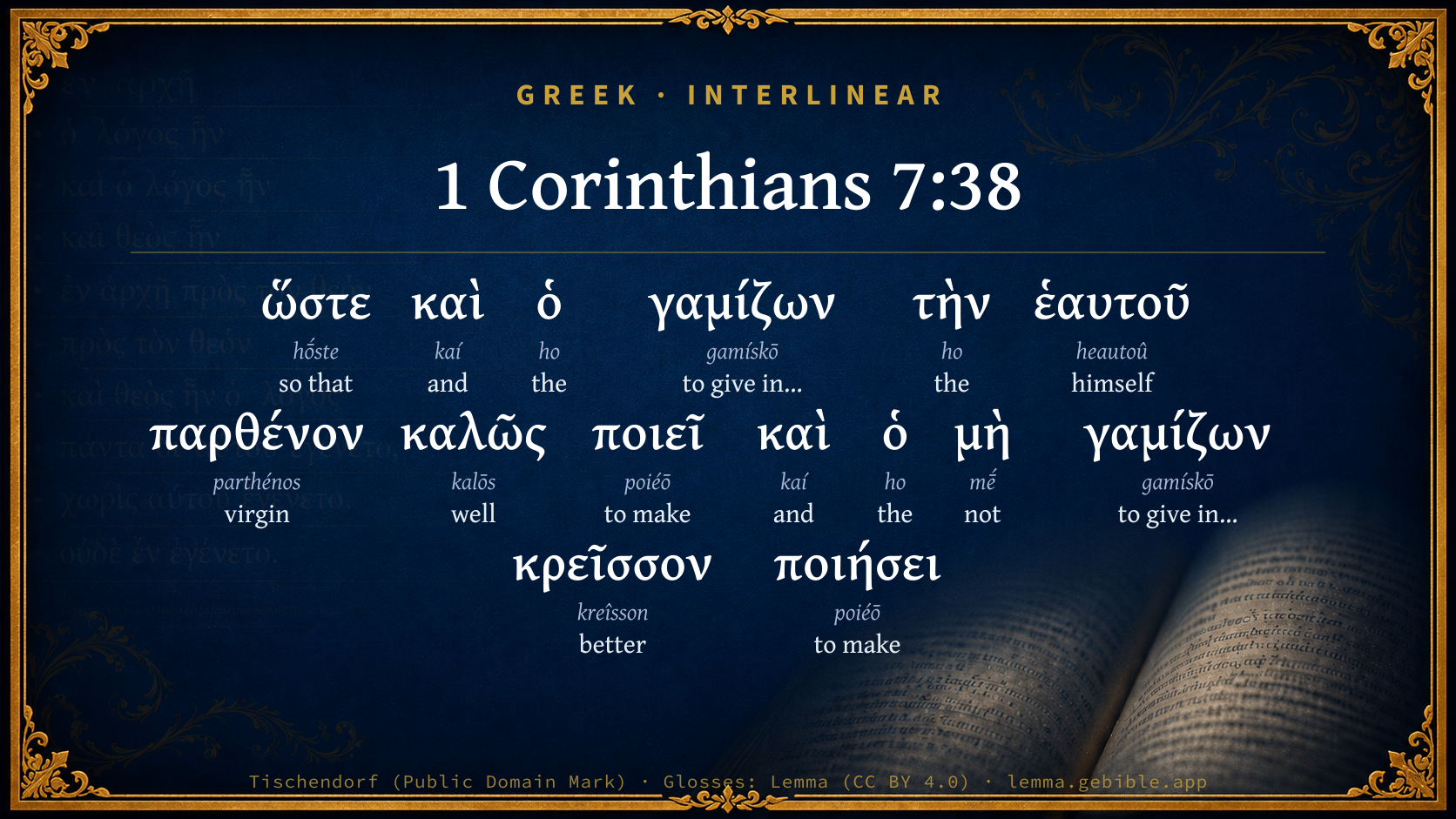
Download image
Cite this verse

1 Corinthians 7:38 (World English Bible). Public Domain. Lemma interlinear Bible study tool, https://lemma.gebible.app/v/1-corinthians/7/38.

Show BibTeX & RIS
BibTeX
RIS
English Translation
So then both he who gives his own virgin in marriage does well, and he who doesn't give her in marriage does better.
World English Bible · Public Domain
Highlights
  • 1 first appearance in the Greek New Testament
Full analysis ↓
Download a study sheet

One document with this verse’s original text, its word-by-word gloss line, the meaning frame, cross-references with their text, attributed commentary, and full source and license credits — printable, and it pastes into notes with its structure intact.

This verse Autodidact and up

Study sheet (.html) Plain text (.txt)

A passage Seminary Student

Up to 50 verses in one chapter. A passage sheet keeps up to 6 commentary sources and 12 cross-references per verse, in the order this page ranks them, and says so on the sheet whenever that leaves anything out. Ask for a single verse and you get the Autodidact verse sheet above.

Everything on this page stays free to read, with no account — the sheet is a download of what is already on screen, not access to it.

Want to remove ads? Support Godless Engineer
Compare translations 3

The same verse in 3 English versions, stacked beneath the original-language interlinear above. Click any original word for its lexicon entry.

Each is an independent rendering of the whole verse — the interlinear is not word-aligned to these translations.

Highlighted words mark where these versions differ — a whole-verse word diff, not a word-by-word alignment.

  • World English Bible Public Domain
    So then both he who gives his own virgin in marriage does well, and he who doesn't give her in marriage does better.
  • King James Version Public Domain
    So then he that giveth her in marriage doeth well; but he that giveth her not in marriage doeth better.
  • unfoldingWord Literal Text CC BY-SA 4.0
    So then, the one marrying his own virgin does well, and the one not marrying will do even better.

unfoldingWord Literal Text — © unfoldingWord, licensed CC BY-SA 4.0. Word-aligned USFM3 via Door43 (git.door43.org/unfoldingWord/en_ult).

Versions to compare (up to 4)

3 of 4 selected

Show all 19 translations

Every available English version of this verse, each an independent rendering of the whole verse.

  • World English Bible Public Domain
    So then both he who gives his own virgin in marriage does well, and he who doesn't give her in marriage does better.
  • Berean Standard Bible Public Domain
    So then, he who marries the virgin does well, but he who does not marry her does even better.
  • Majority Standard Bible Public Domain
    So then, he who marries her does well, but he who does not marry her does even better.
  • King James Version Public Domain
    So then he that giveth her in marriage doeth well; but he that giveth her not in marriage doeth better.
  • American Standard Version (1901) Public Domain
    So then both he that giveth his own virgin `daughter' in marriage doeth well; and he that giveth her not in marriage shall do better.
  • Revised Version (1885) Public Domain
    So then both he that giveth his own virgin daughter in marriage doeth well; and he that giveth her not in marriage shall do better.
  • Geneva Bible (1599) Public Domain
    So then hee that giueth her to mariage, doeth well, but he that giueth her not to mariage, doeth better.
  • Douay-Rheims (1899) Public Domain
    Therefore, both he that giveth his virgin in marriage, doth well; and he that giveth her not, doth better.
  • Young's Literal Translation Public Domain
    so that both he who is giving in marriage doth well, and he who is not giving in marriage doth better.
  • Literal Standard Version CC BY-SA 4.0
    so that both he who is giving in marriage does well, and he who is not giving in marriage does better.
  • Unlocked Literal Bible CC BY-SA 4.0
    So the one who marries his fiancée does well, and the one who chooses not to marry will do even better.
  • unfoldingWord Literal Text CC BY-SA 4.0
    So then, the one marrying his own virgin does well, and the one not marrying will do even better.
  • Darby Bible Public Domain
    So that he that marries himself does well; and he that does not marry does better.
  • World Messianic Bible Public Domain
    So then both he who gives his own virgin in marriage does well, and he who doesn’t give her in marriage does better.
  • Webster's Bible Public Domain
    So then he that giveth her in marriage doeth well; but he that giveth her not in marriage doeth better.
  • Free Bible Version CC BY-SA 4.0
    So the man who marries the woman he's engaged to does well, while the one who does not get married does better.
  • Bible in Basic English Public Domain
    So then, he who gets married to his virgin does well, and he who keeps her unmarried does better.
  • Text-Critical English NT CC BY 4.0
    So then, he who gives her in marriage does well, but he who does not give her in marriage does better.
  • Tyndale New Testament (1534) Public Domain
    So then he that ioyneth his virgin in maryage doth well. But he that ioyneth not his virgin in mariage doth better.

Literal Standard Version (2020), Covenant Press — licensed CC BY-SA 4.0. Text via the HelloAO Bible API (eBible.org). Unlocked Literal Bible (unfoldingWord) — licensed CC BY-SA 4.0. Text via the HelloAO Bible API (eBible.org). unfoldingWord Literal Text — © unfoldingWord, licensed CC BY-SA 4.0. Word-aligned USFM3 via Door43 (git.door43.org/unfoldingWord/en_ult). Free Bible Version, Dr. Jonathan Gallagher — licensed CC BY-SA 4.0. Text via the HelloAO Bible API (eBible.org).

Word by word

More ways to search: Search by grammar → Find every occurrence → Compare this word →

Practice this passage: Drill this verse → Learn its vocabulary →

κρεῖσσον
kreîsson
G2908
“better”
Adjective, Accusative, Singular, Neuter
Part of Speech
Adjective
Case
Accusative
Number
Singular
Gender
Neuter
Full Thayer's Definition

Origin: neuter of an alternate form of G2909

TDNT: None

1. better
  1. ὥστε hṓste G5620 “so that” Conjunction
  2. καὶ kaí G2532 “and” Conjunction
  3. ὁ ho G3588 “the” Article, Nominative, Singular, Masculine
  4. γαμίζων gamískō G1061 “to give in marriage” Verb, Present, Active, Participle, Nominative, Singular, Masculine
  5. τὴν ho G3588 “the” Article, Accusative, Singular, Feminine
  6. ἑαυτοῦ heautoû G1438 “himself” Reflexive pronoun, 3rd person, Genitive, Singular, Masculine
  7. παρθένον parthénos G3933 “virgin” Noun, Accusative, Singular, Feminine
  8. καλῶς kalōs G2573 “well” Adverb
  9. ποιεῖ poiéō G4160 “to make” Verb, Present, Active, Indicative, 3rd person, Singular
  10. καὶ kaí G2532 “and” Conjunction
  11. ὁ ho G3588 “the” Article, Nominative, Singular, Masculine
  12. μὴ mḗ G3361 “not” Particle, Negative
  13. γαμίζων gamískō G1061 “to give in marriage” Verb, Present, Active, Participle, Nominative, Singular, Masculine
  14. ποιήσει poiéō G4160 “to make” Verb, Future, Active, Indicative, 3rd person, Singular

About this verse

These counts appear in no published source. They are computed here, from the morphology-tagged text and Lemma’s own curated glosses. What Lemma adds →

15
words
10
distinct lemmas
Pauline Epistles
section

Notable vocabulary

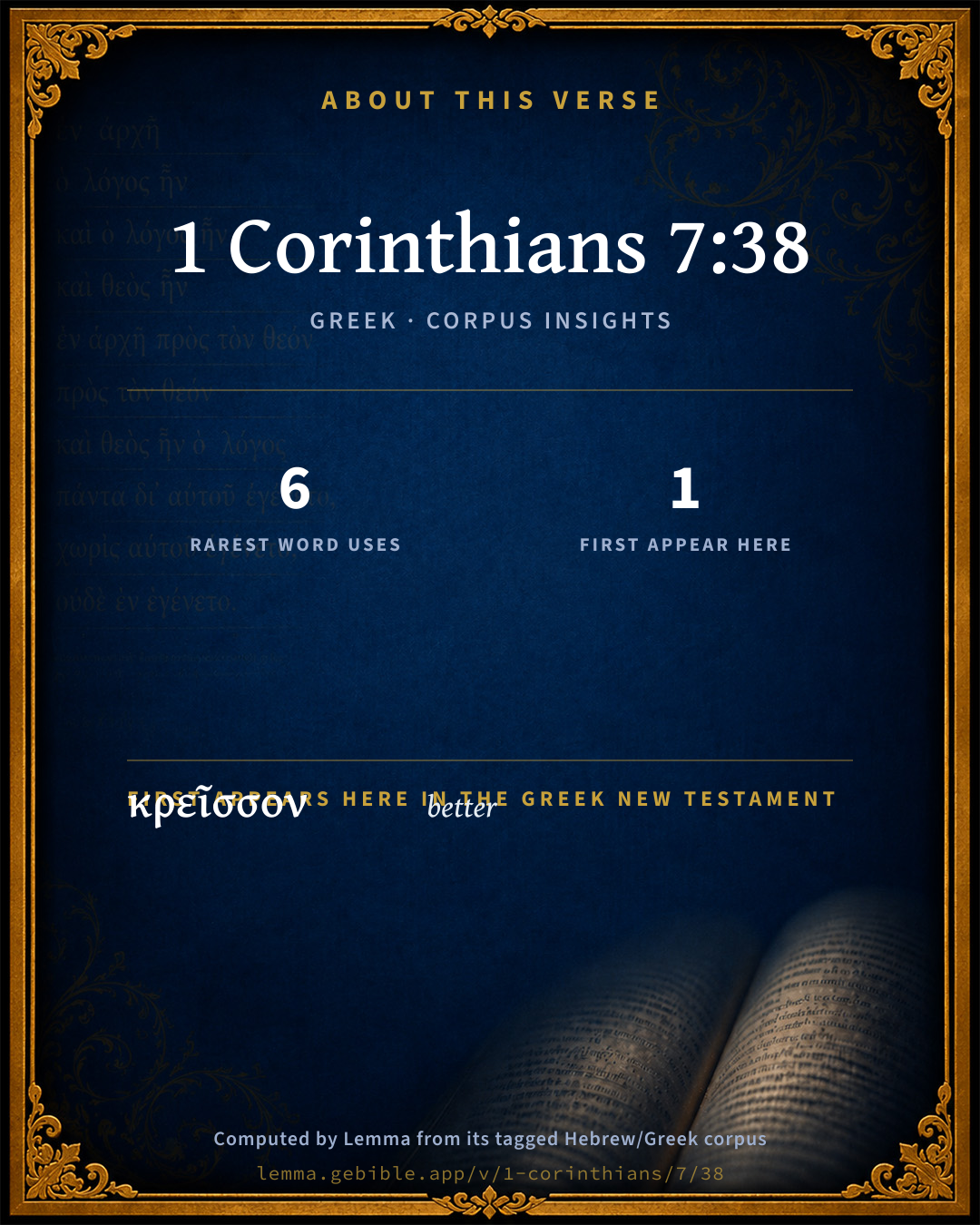
The rarest word here is κρεῖσσον better G2908 — appearing just 6 times in the whole Greek New Testament.

First appearance in Scripture

This word makes its first canonical appearance in the Greek New Testament here:

  • κρεῖσσον better G2908

Shared distinctive vocabulary

κρεῖσσον better G2908 occurs in 6 verses of the Greek New Testament. Also found in:
Repetition

Words recur within this verse:

  • γαμίζων to give in marriage G1061 ×2
  • ποιεῖ to make G4160 ×2
  • ὁ the G3588 ×3
  • καὶ and G2532 ×2

Cross-references

6

Topical passages linked to 1 Corinthians 7:38 in the Treasury of Scripture Knowledge — connected by theme and wording, ordered by reader-vote popularity; previews shown in the World English Bible.

  • Hebrews 13:4 Let marriage be held in honor among all, and let the bed be undefiled: but God will judge the sexually immoral and adulterers.
  • 1 Corinthians 7:1–2 Now concerning the things about which you wrote to me: it is good for a man not to touch a woman.
  • 1 Corinthians 7:8 But I say to the unmarried and to widows, it is good for them if they remain even as I am.
  • 1 Corinthians 7:32–34 But I desire to have you to be free from cares. He who is unmarried is concerned for the things of the Lord, how he may please the Lord;
  • 1 Corinthians 7:37 But he who stands steadfast in his heart, having no necessity, but has power over his own heart, to keep his own virgin, does well.
  • 1 Corinthians 7:26 I think that it is good therefore, because of the distress that is on us, that it is good for a man to be as he is.

Cross-references courtesy of OpenBible.info (CC BY 4.0).

Where the printed editions differ

3 variants

Places in this verse where the major printed Greek editions disagree on the wording in a way that affects the translation — a comparison of editions, not a manuscript-by-manuscript collation. The editions are the modern critical texts (Nestlé-Aland 28/27, SBL, Westcott-Hort, Tregelles, Tyndale House) and the traditional texts behind the KJV (the Textus Receptus and the Byzantine/Majority text). It is not a claim about which reading is original.

  1. Extra text
    τὴν

    “<the>”

    In NA28NA27TynSBLWHTreg Not in TRByz
  2. Extra text
    ἑαυτοῦ

    “his own”

    In NA28NA27Tyn»1SBL»1WHTreg»1Byz Not in TynSBLTregTR
  3. Extra text
    παρθένον

    “virgin”

    In NA28NA27TynSBLWHTreg Not in TRByz

    τὴν ἑαυτοῦ παρθένον (tēn he'autou parthenon) 'his own virgin' is only in older manuscripts (NA28+NA27+Tyn+SBL+WH+Treg)

Textual data: Translators Amalgamated Greek New Testament (STEPBible TAGNT) · CC BY 4.0.

Commentary

Notes on 1 Corinthians 7:38 from classic Christian and Jewish commentators (each source and its license shown beneath its notes). The classic Christian expositions comment on the surrounding passage and are grouped to its opening verse, so a note may address several verses; the Jewish commentaries on the Tanakh (Rashi and others) are per-verse, so they appear only where the commentator wrote on this verse.

Lemma curates 59 commentaries, every one of them public domain or Creative Commons licensed, each selected and text-cleaned for this edition rather than reprinted as found. About our sources →

Bengel's Gnomon

Johann Albrecht Bengel

1Co 7:38. Ὣστε, therefore) We must observe, with how great earnestness, fidelity, and fulness, Paul dwells on this passage.—καὶ) also.

Bengel's Gnomon of the New Testament — English translation (T&T Clark, Edinburgh, 1860) — public domain. Text from a community e-Sword module.

Meyer's Critical & Exegetical Commentary

Heinrich August Wilhelm Meyer

1Co_7:38. Result of 1Co_7:36-37, καὶ … καί, as well … as also. Paul had thought of saying καλῶς ποιεῖ in the second clause also, but thereupon strengthens his expression (κρεῖσσον) so as to correspond with the relations of the two predicates, οὐχ ἁμαρτ. in 1Co_7:36, and καλῶς ποιεῖ in 1Co_7:37.

ὁ ἐκγαμ.] he who marries her (his virgin, 1Co_7:37) out (gives her out of his family in marriage). This going out is not taken into account in the second clause.

κρεῖσσον] for see 1Co_7:34. Regarding ἐκγαμ., comp Mat_24:38; it is not preserved in Greek writers.

Meyer — Critical and Exegetical Commentary on the New Testament — English translation by Peter Christie, edited by Frederick Crombie (T&T Clark, 1880) — public domain. Text from a community e-Sword module.

Expositor's Greek Testament

ed. W. Robertson Nicoll

1Co 7:38 , the sum of the matter: either to marry one’s daughter or refuse her in marriage is, abstractly viewed, an honourable course; the latter, in Paul’s judgment, and for Christians in the present posture of things, is better . “Ce bien et mieux résument tout le chapitre” (Gd [1213] ).

[1213] F. Godet’s Commentaire sur la prem. Ép. aux Corinthiens (Eng. Trans.).

The Expositor's Greek Testament, edited by W. Robertson Nicoll (1897–1910) — public domain. Text from a community e-Sword module.

Hodge's Commentary on Romans, Ephesians & First Corinthians

Charles Hodge

1Co_7:38

So then he that giveth (her) in marriage doeth well; but he that giveth (her) not in marriage doeth better.

As there is no sin in marriage, and no superior virtue in celibacy, it is a there question of expediency, to be determined by the circumstances of each particular case. All Paul says is that, other things being equal, it is better (i.e. wiser) not to marry than to marry; on account, as he before said, of impending calamities.

Charles Hodge — Commentary on Romans (1835), First Corinthians (1857), and Ephesians (1856) — public domain. Text from a community e-Sword module.

Geneva Bible (1599)

Geneva Bible translators

Provideth more commodiously for his children, and that not simply, but by reason of such conditions as are before mentioned.

Geneva Bible (1599) marginal notes — public domain. Text via Bolls.life.

Jamieson, Fausset & Brown

Robert Jamieson, A. R. Fausset & David Brown

her--The oldest manuscripts have "his own virgin daughter."

but--The oldest manuscripts have "and."

Jamieson, Fausset & Brown — Commentary Critical and Explanatory on the Whole Bible (1871) — public domain (CC PDM 1.0). Text via the HelloAO Bible API.

John Calvin's Commentaries

38. Therefore he that giveth in marriage. Here we have the conclusion from both parts of the statement, in which he states, in a few words, that parents are free from blame if they give away their daughters in marriage, while he at the same time declares that they do better if they keep them at home unmarried. You are not, however, to understand that celibacy is here preferred to marriage, otherwise than under the exception which was a little before expressed. For if power be wanting on the part of the daughter, the father acts an exceedingly bad part if he endeavors to keep her back from marriage, and would be no longer a father to her, but a cruel tyrant. The sum of the whole discussion amounts to this — that celibacy is better than marriage, because it has more liberty, so that persons can serve God with greater freedom; but at the same time, that no necessity ought to be imposed, so as to make it unlawful for individuals to marry, if they think proper; and farther, that marriage itself is a remedy appointed by God for our infirmity, which all ought to use that are not endowed with the gift of continency. Every person of sound judgment will join with me in acknowledging and confessing, that the whole of Paul’s doctrine on this point is comprehended in these three articles.

John Calvin's Commentaries (1540-1563) — public domain. Text from the Calvin Translation Society English edition (1840s-50s) via the Christian Classics Ethereal Library (ccel.org). Calvin's coverage is partial (roughly two-thirds of the Bible); uncommented books and verses are honest gaps, never fabricated. The 19th-century editor's footnotes and remarks are omitted so the notes are faithfully Calvin's own voice.

Ellicott's Commentary for English Readers

(38) So then . . .—Better, So then he that gives his daughter in marriage does well, and (not “but”) he that giveth her not shall do better. It is worth noticing how, in the case of the one who gives his daughter in marriage, we have the present tense “does well”—as if the good he did began and ended there; and, in the other case, the future “shall do” (in 1Co_7:37 also)—the good result of his action continuing while the girl remains with her parent. This passage clearly shows how St. Paul has not been contrasting right and wrong: but comparative degrees of what is expedient.

All throughout this passage the Apostle takes for granted the absolute control of the parent over the child, in accordance with the principles of both Greek and Jewish jurisprudence. Hence, no advice is given to the young maiden herself, but only to her father.

A Bible Commentary for English Readers, edited by Charles John Ellicott (1878–1897) — public domain. Text from a community e-Sword module.

John Gill's Exposition

So then he that giveth her in marriage doth well,.... Does that which is in its own nature good; that which is agreeable to the will of God, is of his institution and appointment, and therefore must be good, and answer many good ends and purposes. Such an one that marries his daughter, he seeing a necessity for it, and a propriety in it, does a very good thing; secures her chastity, and his own credit; prevents fornication, and other evils that might follow; consults the good of mankind, and the honour of religion.

But he that giveth her not in marriage doth better; not a better action in itself, simply considered; but more profitable and advantageous under such and such circumstances, with such and such conditions and consequences; since hereby a single person is more fit to encounter with and endure persecutions, is freer from the cares of life, and more at liberty to wait upon the Lord, and give up himself to his service.

John Gill's Exposition of the Whole Bible (1746–1763) — public domain (CC PDM 1.0). Text via the HelloAO Bible API.

Trapp's Complete Commentary

John Trapp

38 So then he that giveth her in marriage doeth well; but he that giveth her not in marriage doeth better.

Ver. 38. Doth better] 1. For the better waiting upon God’s work without distraction. 2. For the better bearing of persecution.

John Trapp, A Commentary or Exposition upon All the Books of the Old and New Testament (1647–1656) — public domain. Text from a community e-Sword module.

Albert Barnes' Notes on the Bible

Doeth well - Does right; violates no law in it, and is not to be blamed for it.

Doeth better - Does that which is on the whole to be preferred, if it can be done. He more certainly, in the present circumstances, consults her happiness by withholding her from the marriage connection than he could by allowing her to enter it.

Albert Barnes' Notes on the Bible (1834–1885) — public domain. Text from a community e-Sword/MySword module.

Haydock's Catholic Bible Commentary

He that giveth her not, doth better. And more blessed shall she be, if she so remains, according to my counsel. It is very strange if any one, who reads this chapter without prejudices, does not clearly see, that St. Paul advises, and prefers the state of virginity to that of a married life. --- I think that I also have the spirit of God. He puts them in mind, by this modest way of speaking, of what they cannot doubt of, as to so great an apostle. (Witham) --- It is worthy our notice, that St. Paul on every occasion avoids the least appearance of vanity, and frequently when delivering his own opinion, gives us only a hint, hoping that we shall supply the rest. Of this apostle’s modesty in this particular, we have many instances in his writings, as in ver. 26. "I think, therefore, that this is good;" and likewise in chap. iv. ver. 9. "For I think that God." (Estius)

George Leo Haydock (1774–1849), Haydock's Catholic Family Bible and Commentary, 1859 edition — public domain. Excludes Psalms (Douay-Rheims chapter numbering differs from Protestant) and Deuterocanonical books (Catholic canon only).

Matthew Poole's English Annotations

So then he that giveth her in marriage doeth well: there is no general rule for all parents in this case, where the duty or sin of parents may arise from their or their children’s different circumstances. But supposing that a parent, having duly weighed all circumstances, be fully resolved, and he finds the child’s will concurring, that she can forbear, and is willing to do in the case what her parent desires; in such a case as this, if the parent disposeth her in marriage, I cannot say he sinneth, but he doth what he may do.

But he that giveth her not in marriage doeth better; but with reference to the present state of things in the church and in the world, and with reference to the young woman’s liberty for the service of God, he doth better, if he doth not so dispose her. The thing is in itself indifferent, and Christians must be in it ruled and inclined one way or another from circumstances.

Matthew Poole's English Annotations on the Holy Bible (1683–1685) — public domain. Text from a community e-Sword/MySword module.

Whedon's Commentary on the Bible

Daniel D. Whedon

38. Doeth well—For he avoids the evils of celibacy, though he incurs the evils of matrimony.

Doeth better—For he is secure from the evils both of celibacy and matrimony.

Daniel D. Whedon (gen. ed.), Commentary on the Old and New Testaments (1874–1909) — public domain. Text from a community e-Sword module.

The Pulpit Commentary

Doeth well. Because" marriage is honourable in all." Doeth better. Obviously not morally, because, if one course be morally better than another, we are bound to take it; but "better" with reference to expediency in "the urgent necessity" which rested on the Christian world in that day. It is quite clear that, if these words are meant to disparage matrimony in comparison with celibacy, or to treat celibacy in the abstract as a holier state that marriage, they have been set aside by the universal practice and theory of the Christian world. But, as we have seen, they are expressed by St. Paul only as a relative and diffident opinion. It is remarkable that not one word is said as to the choice of the virgin herself in the matter, which is one of the most essential points on which the decision must turn. St. Paul, no doubt, assumes the acquiescence or preference of the maiden as one of the elements in the absence of any "need" for her marriage; but also he writes after lifelong familiarity with the all but absolute control exercised by Jewish parents over their youthful daughters.

The Pulpit Commentary (1880–1919), ed. H.D.M. Spence-Jones & Joseph S. Exell — public domain. Text from a community e-Sword module.

John Wesley's Explanatory Notes

Doeth better - If there be no necessity.

John Wesley, Explanatory Notes Upon the Whole Bible (1754–1765) — public domain. Text via the GEBible commentary corpus.

Godbey's Commentary on the New Testament

William B. Godbey

38. “So both he that marries his virgin does well, and he that marries her not will do better.” This verse covers the ground of the two contrastive cases in the two preceding verses. The father in 1Co 7:36 gives his daughter in wedlock, while the father in 1Co 7:37 retains his in celibacy for the Lord’s work. Paul decides that the former, marrying his daughter to a good man, “does well,” but the latter not marrying his daughter to a man “will do better.” Why? Because the single woman will be the more efficient preacher of the two, and win more souls for God.

William B. Godbey, Commentary on the New Testament (1896–1900) — public domain. Text from a community e-Sword module.

McGarvey & Pendleton's Commentaries

J. W. McGarvey

So then both he that giveth his own virgin daughter in marriage doeth well; and he that giveth her not in marriage shall do better . [Marriages in the East were then, as now, arranged by the parents. If a parent saw fit to marry his daughter he had a perfect right to do so and was guilty of no sin, but if he heeded the apostle's warning as to the coming trials and kept his daughter free from alliances he acted more wisely. Fourth question: Should widows remarry? is answered thus:]

J. W. McGarvey (with Philip Y. Pendleton), Commentaries on the New Testament (The Fourfold Gospel, 1914; Acts; and the epistles) — public domain. Text from a community e-Sword/MySword module.

Cambridge Greek Testament for Schools and Colleges

38. καὶ ὁ γαμίζων. The idea in the Apostle’s mind is that both do well. But whether we read καί or δέ in the apodosis, the sentence involves an anacolouthon. The difference between the rec. ἐκγαμίζων and the text is that the former emphasizes the parting with the daughter, ‘marrying her off,’ as we say, while the latter signifies the simple giving in marriage. The reading ποιήσει implies that the practice the Apostle is recommending is not a common one at present but that he hopes it will become so. It was the failure to discern this which led to the correction into the more obvious ποιεῖ.

Cambridge Greek Testament for Schools and Colleges (Cambridge University Press, 1896; 21 vols, various authors incl. Carr, Maclear, Plummer, Farrar, Lumby, Moule, M. R. James, Simcox) — public domain. Text from a community e-Sword module.

Alford’s Greek Testament

Henry Alford

38.] The latter καί has been altered to δέ because a contrast seemed to be required between καλῶς and κρεῖσσον. One account might be (as and De W.) that Paul had intended to write καλῶς ποι. twice, but currente calamo, intensified the expression to κρεῖσσον ποιῆσει. Perhaps a better one will be found by referring the καὶ—καί to that which καλῶς and κρεῖσσον have in common: ‘both he who gives in marriage does well, and he who gives not in marriage shall do well, even in a higher degree.’ I need hardly remind the tiro that ‘both—and’ here does not, as Bloomf. objects, represent τε καί,—each subject being accompanied by its own predicate. Observe the ποιήσει—ποιεῖ—ποιήσει; the pres., of the mere act itself, the fut., of its enduring results.

39,

Henry Alford, The Greek Testament (1849–1861) — public domain. Text from a community e-Sword module.

International Critical Commentary

38. καὶ ὁ γαμίζων … καὶ ὁ μή. This probably means ‘Both he who does and he who does not’: they both act well. Or, ‘It is equally true that A. acts well, and that B. will act better.’ By a dexterous turn, which perhaps is also humorous, the Apostle gives the preference to the one who does not give his daughter in marriage. The change from ποιεῖ to ποιήσει is also effective: the one ‘does well,’ the other ‘will be found to do better,’ for experience will confirm his decision. This καλῶς and κρεῖσσον may be said to sum up the results of the whole chapter.

γαμίζων (א A B D E 17) rather than ἐκγαμίζων (K L P). τὴν ἑαυτοῦ παρθένον (א A P) is perhaps preferable to τ. π. ἑαυτοῦ (B D E, Vulg. virginem suam): K L, AV. omit the words. καλῶς ποιεῖ (א A D E K L P, Vulg.) rather than Κ. ποιήσει (B); and κρεῖσσον ποιήσει (א A B 17, Copt.) rather than κρ. ποιεῖ (D E F G K L P, Vulg.). Copyists thought that both verbs must be in the same tense; some changed ποιεῖ to ποιήσει, and others ποιήσει to ποιεῖ, as in AV.

International Critical Commentary — older volumes (1896–1929), various authors — public domain. Text from a community e-Sword module.

Godet's Commentaries

Frédéric Louis Godet

Vv. 38. “So then he that giveth in marriage doeth well, but he that giveth not in marriage will do better.”

We again find here one of those ὥστε, so that, with which Paul, in this Epistle, loves to formulate his final judgment on a question which he has finished treating.

There is in Greek, before the words he that giveth in marriage, καί, both, which serves to coordinate the subjects of the two parallel propositions: “both...and...” This particle was suggested to Paul, on beginning his sentence, by his feeling of the equality of the two subjects in their doing well, their καλῶς ποιεῖν. But as he proceeds in the expression of his thought, the idea of equality gives place to that of superiority in the second father, and he substitutes at the head of the second proposition, as we have it in the received reading, the δέ, but, which expresses a contrast or a gradation, for the καί, and, which was in his original intention. It is easy to see how the reading of the Byz., notwithstanding its apparent incorrectness, corresponds better with the movement of the apostle’s thought than the Alex. and Greco-Latin reading.

There is room for hesitation between the received reading, ἐκγαμίζων, and the Alex. reading, γαμίζων. But there can be little doubt that the words τὴν ἑαυτοῦ παρθένον (א A) or τὴν παρθένον ἑαυτοῦ (B D), his virgin, which are omitted by the T. R., are a gloss. It was easy to add them to fill in the ellipsis of the object, but there was not the slightest reason for rejecting them, if they had existed in the text. Meyer therefore rightly judges that here again the Alex. text is corrupt. There is thus room for supposing that ἐκγαμίζων is the true reading. In any case, it better expresses the feeling of self-deprivation on the part of the father.

The reading of the Vatic. alone, ποιήσει, will do, in the first proposition, is certainly a mistake. On the other hand, the future may well be held to be the true reading in the second proposition, since two other Alex. here agree with the Vatic. It was, no doubt, to complete the parallelism that the future was introduced into this MS. in the preceding member of the sentence, and even by some into 1Co 7:37. The present was preferable in 1Co 7:37, which contained a general maxim. But here there is something prophetic, and consequently encouraging, in the future: “This father will see that he has taken the better course.”

This well and better sum up the whole chapter. The well proves that in the eyes of Paul there is neither defilement nor even inferiority of holiness in marriage, and that the better is uttered by him from the prudential point of view, either as to the sufferings avoided or as to the more complete personal liberty for the service of Christ. St. Paul could speak of this position from experience. What would have become of his ministry among the Gentiles on the day when he should have exchanged his independence as a celibate for the duties and troubles of family life? It may be objected, no doubt, that if Paul’s principle became a generally observed maxim, the existence of the race would be compromised. But the apostle knew well that Christians will always be a minority in human society, and that among Christians themselves there will not be more than a minority possessing the special gift of which he spoke in 1Co 7:7.

Frédéric Louis Godet — Commentaries on Luke, John, Romans, and 1 Corinthians — English translation (T&T Clark, Edinburgh, 1870s–1890s) — public domain. Text from a community e-Sword module.

Lesson kit

Teaching starters — assembled from the data on this page, not authored interpretation. Every prompt links to the verse data it draws on. Edit before teaching.

1 Corinthians, in the Pauline Epistles, opens this verse with 15 words (10 distinct Greek lemmas). Its most distinctive word is kreîsson (“better”). A historical commentator’s framing appears above. Read the whole chapter for the surrounding context.

Discussion questions

  1. How does “better” (kreîsson) shape what this verse is saying?
  2. This is the first place “better” appears in Scripture (first appears here). What does its debut here establish?
  3. How does 1 Corinthians 11:17, which shares the word «better», read alongside this verse?
  4. What does the repetition of “to give in marriage” (2× in this one verse) do in this verse?
  5. The translations on this page render this verse differently — a whole-verse word diff, not a word-by-word alignment. What might account for the different wordings?
  6. Compare how Bengel's Gnomon and Meyer's Critical & Exegetical Commentary read this verse. Where do they agree or differ?

Things to notice

  • 1 word makes its first canonical appearance in Scripture here.
  • These translations choose different wording for 16 words in this verse.
  • “to give in marriage” occurs 2× in this single verse.
  • 10 distinct Greek lemmas span 15 words in this verse.

Reading settings

Reading text

Shown beneath each verse's original-language words.

Old Testament
Old Testament edition

Read the OT as the Masoretic Hebrew (MT) or the Greek Septuagint (LXX).

English shown for the Greek Septuagint (in the Hebrew ↔ Greek comparison).

Comparing translations? Open the Compare panel on any verse page to stack up to four side by side.