
1 Corinthians 9:10

Greek (Tischendorf 8th ed.) 1 Corinthians 9:10 appears in the Greek New Testament. The text above is from the Tischendorf 8th edition. Each word links to its Strong’s number and a concise gloss. Click any word for its full Thayer’s Greek Lexicon entry.
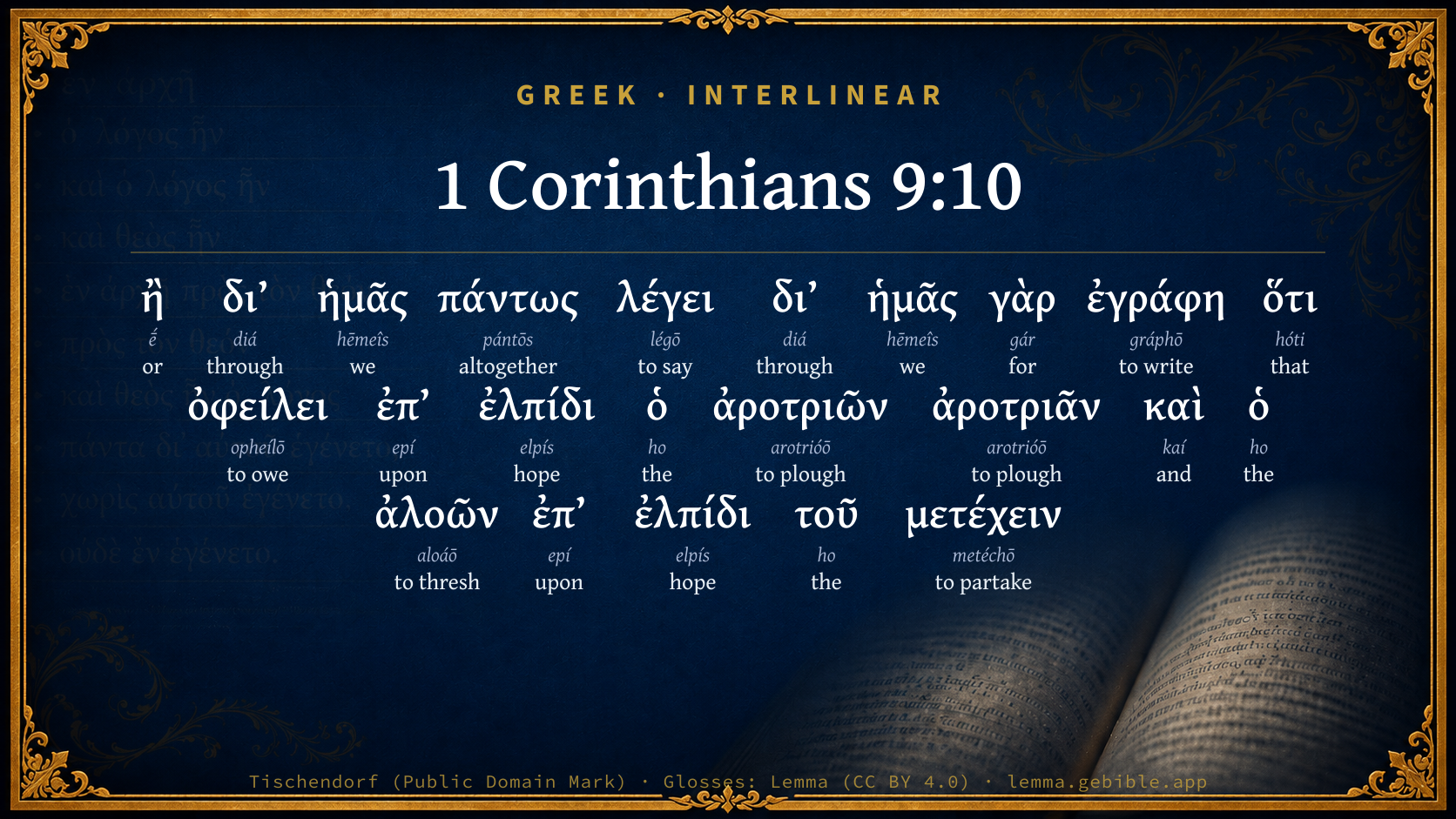
Download image
Cite this verse

1 Corinthians 9:10 (World English Bible). Public Domain. Lemma interlinear Bible study tool, https://lemma.gebible.app/v/1-corinthians/9/10.

Show BibTeX & RIS
BibTeX
RIS
English Translation
or does he say it assuredly for our sake? Yes, it was written for our sake, because he who plows ought to plow in hope, and he who threshes in hope should partake of his hope.
World English Bible · Public Domain
Highlights
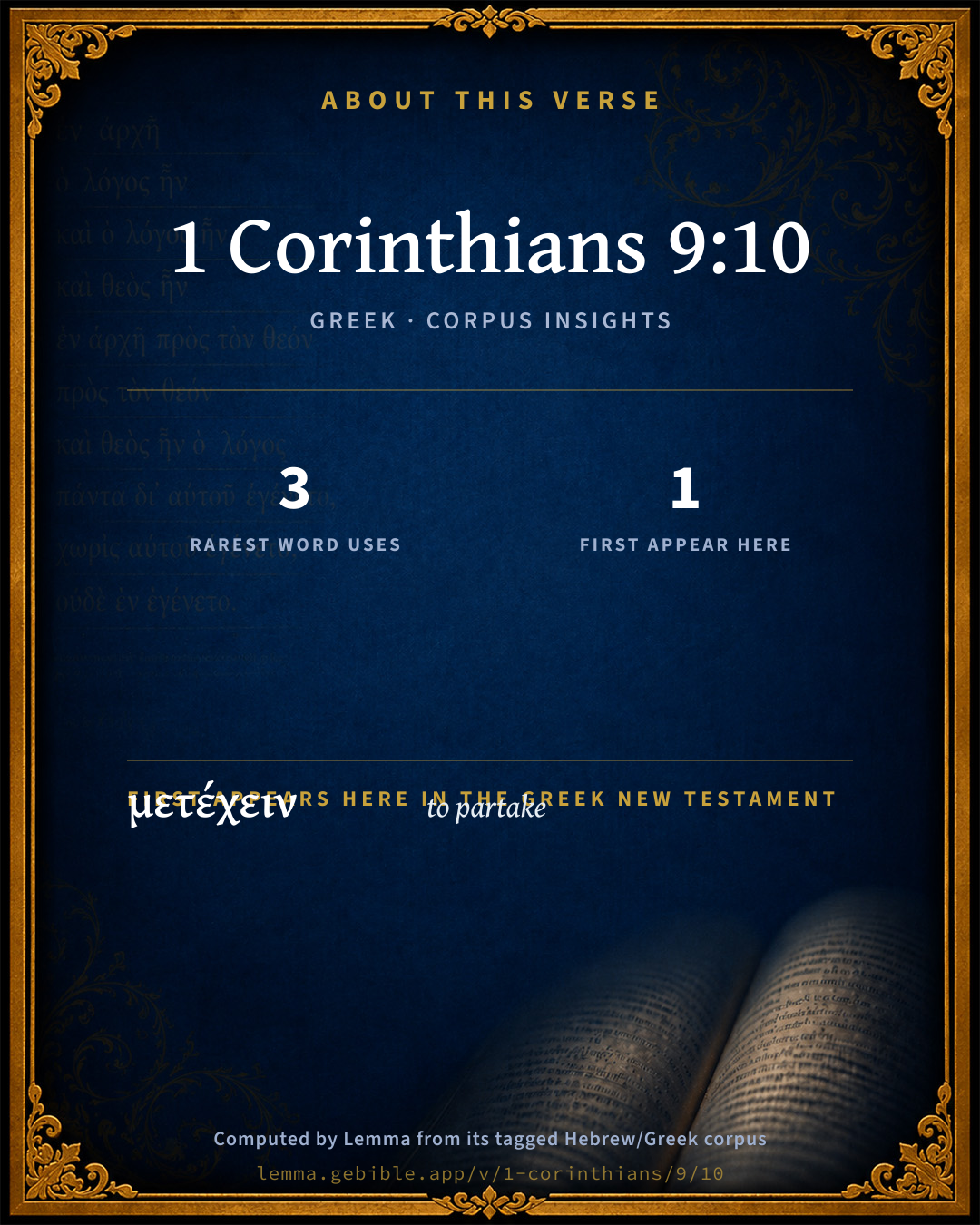
  • 1 first appearance in the Greek New Testament
Full analysis ↓
Download a study sheet

One document with this verse’s original text, its word-by-word gloss line, the meaning frame, cross-references with their text, attributed commentary, and full source and license credits — printable, and it pastes into notes with its structure intact.

This verse Autodidact and up

Study sheet (.html) Plain text (.txt)

A passage Seminary Student

Up to 50 verses in one chapter. A passage sheet keeps up to 6 commentary sources and 12 cross-references per verse, in the order this page ranks them, and says so on the sheet whenever that leaves anything out. Ask for a single verse and you get the Autodidact verse sheet above.

Everything on this page stays free to read, with no account — the sheet is a download of what is already on screen, not access to it.

Want to remove ads? Support Godless Engineer
Compare translations 3

The same verse in 3 English versions, stacked beneath the original-language interlinear above. Click any original word for its lexicon entry.

Each is an independent rendering of the whole verse — the interlinear is not word-aligned to these translations.

Highlighted words mark where these versions differ — a whole-verse word diff, not a word-by-word alignment.

  • World English Bible Public Domain
    or does he say it assuredly for our sake? Yes, it was written for our sake, because he who plows ought to plow in hope, and he who threshes in hope should partake of his hope.
  • King James Version Public Domain
    Or saith he it altogether for our sakes? For our sakes, no doubt, this is written: that he that ploweth should plow in hope; and that he that thresheth in hope should be partaker of his hope.
  • unfoldingWord Literal Text CC BY-SA 4.0
    Or is he speaking entirely for our sake? For it was written for our sake that the one plowing ought to plow in hope, and the one threshing, in hope of sharing the harvest.

unfoldingWord Literal Text — © unfoldingWord, licensed CC BY-SA 4.0. Word-aligned USFM3 via Door43 (git.door43.org/unfoldingWord/en_ult).

Versions to compare (up to 4)

3 of 4 selected

Show all 19 translations

Every available English version of this verse, each an independent rendering of the whole verse.

  • World English Bible Public Domain
    or does he say it assuredly for our sake? Yes, it was written for our sake, because he who plows ought to plow in hope, and he who threshes in hope should partake of his hope.
  • Berean Standard Bible Public Domain
    Isn’t He actually speaking on our behalf? Indeed, this was written for us, because when the plowman plows and the thresher threshes, they should also expect to share in the harvest.
  • Majority Standard Bible Public Domain
    Isn’t He actually speaking on our behalf? Indeed, this was written for us, because when the plowman plows and the thresher threshes, they should also expect to share in the harvest.
  • King James Version Public Domain
    Or saith he it altogether for our sakes? For our sakes, no doubt, this is written: that he that ploweth should plow in hope; and that he that thresheth in hope should be partaker of his hope.
  • American Standard Version (1901) Public Domain
    or saith he it assuredly for our sake? Yea, for our sake it was written: because he that ploweth ought to plow in hope, and he that thresheth, `to thresh' in hope of partaking.
  • Revised Version (1885) Public Domain
    or saith he it altogether for our sake? Yea, for our sake it was written: because he that ploweth ought to plow in hope, and he that thresheth, to thresh in hope of partaking.
  • Geneva Bible (1599) Public Domain
    Either saith hee it not altogether for our sakes? For our sakes no doubt it is written, that he which eareth, should eare in hope, and that he that thresheth in hope, should be partaker of his hope.
  • Douay-Rheims (1899) Public Domain
    Or doth he say this indeed for our sakes? For these things are written for our sakes: that he that plougheth, should plough in hope; and he that thrasheth, in hope to receive fruit.
  • Young's Literal Translation Public Domain
    or because of us by all means doth He say `it'? yes, because of us it was written, because in hope ought the plower to plow, and he who is treading `ought' of his hope to partake in hope.
  • Literal Standard Version CC BY-SA 4.0
    Or by all means does He say [it] because of us? Yes, because of us it was written, because in hope ought the plower to plow, and he who is treading [ought] of his hope to partake in hope.
  • Unlocked Literal Bible CC BY-SA 4.0
    Is he not speaking about us? It was written for us, because the one who plows should plow in hope, and the one who threshes should thresh in the expectation of sharing in the harvest.
  • unfoldingWord Literal Text CC BY-SA 4.0
    Or is he speaking entirely for our sake? For it was written for our sake that the one plowing ought to plow in hope, and the one threshing, in hope of sharing the harvest.
  • Darby Bible Public Domain
    or does he say [it] altogether for our sakes? For for our sakes it has been written, that the plougher should plough in hope, and he that treads out corn, in hope of partaking of [it].
  • World Messianic Bible Public Domain
    or does he say it assuredly for our sake? Yes, it was written for our sake, because he who plows ought to plow in hope, and he who threshes in hope should partake of his hope.
  • Webster's Bible Public Domain
    Or saith he this altogether for our sakes? for our sakes, no doubt, this is written: that he that ploweth should plow in hope; and that he that thresheth in hope should be partaker of his hope.
  • Free Bible Version CC BY-SA 4.0
    Wasn't he directing this at us? Surely this was written for us—for anyone who plows should plow in hope and anyone who threshes should hope to share in the harvest.
  • Bible in Basic English Public Domain
    Or has he us in mind? Yes, it was said for us; because it is right for the ploughman to do his ploughing in hope, and for him who is crushing the grain to do his work hoping for a part in the fruits of it.
  • Text-Critical English NT CC BY 4.0
    Or does he speak entirely for our sake? Yes, this was written for our sake, because he who plows ought to plow in hope, and he who threshes in hope ought to partake of his hope.
  • Tyndale New Testament (1534) Public Domain
    Ether sayth he it not all to gedder for oure sakes? For oure sakes no doute this is written: that he which eareth shuld eare in hope: and that he which thressheth in hope shuld be parttaker of his hope.

Literal Standard Version (2020), Covenant Press — licensed CC BY-SA 4.0. Text via the HelloAO Bible API (eBible.org). Unlocked Literal Bible (unfoldingWord) — licensed CC BY-SA 4.0. Text via the HelloAO Bible API (eBible.org). unfoldingWord Literal Text — © unfoldingWord, licensed CC BY-SA 4.0. Word-aligned USFM3 via Door43 (git.door43.org/unfoldingWord/en_ult). Free Bible Version, Dr. Jonathan Gallagher — licensed CC BY-SA 4.0. Text via the HelloAO Bible API (eBible.org).

Word by word

More ways to search: Search by grammar → Find every occurrence → Compare this word →

Practice this passage: Drill this verse → Learn its vocabulary →

ἀροτριῶν
arotrióō
G722
“to plough”
Verb, Present, Active, Participle, Nominative, Singular, Masculine
Part of Speech
Verb
Tense
Present
Voice
Active
Mood
Participle
Case
Nominative
Number
Singular
Gender
Masculine
Full Thayer's Definition

Origin: from G723

TDNT: None

1. to plough
  1. ἢ ḗ G2228 “or” Particle
  2. δι’ diá G1223 “through” Preposition
  3. ἡμᾶς hēmeîs G2249 “we” Personal pronoun, 1st person, Accusative, Plural
  4. πάντως pántōs G3843 “altogether” Adverb
  5. λέγει légō G3004 “to say” Verb, Present, Active, Indicative, 3rd person, Singular
  6. δι’ diá G1223 “through” Preposition
  7. ἡμᾶς hēmeîs G2249 “we” Personal pronoun, 1st person, Accusative, Plural
  8. γὰρ gár G1063 “for” Conjunction
  9. ἐγράφη gráphō G1125 “to write” Verb, Aorist, Passive, Indicative, 3rd person, Singular
  10. ὅτι hóti G3754 “that” Conjunction
  11. ὀφείλει opheílō G3784 “to owe” Verb, Present, Active, Indicative, 3rd person, Singular
  12. ἐπ’ epí G1909 “upon” Preposition
  13. ἐλπίδι elpís G1680 “hope” Noun, Dative, Singular, Feminine
  14. ὁ ho G3588 “the” Article, Nominative, Singular, Masculine
  15. ἀροτριᾶν arotrióō G722 “to plough” Verb, Present, Active, Infinitive
  16. καὶ kaí G2532 “and” Conjunction
  17. ὁ ho G3588 “the” Article, Nominative, Singular, Masculine
  18. ἀλοῶν aloáō G248 “to thresh” Verb, Present, Active, Participle, Nominative, Singular, Masculine
  19. ἐπ’ epí G1909 “upon” Preposition
  20. ἐλπίδι elpís G1680 “hope” Noun, Dative, Singular, Feminine
  21. τοῦ ho G3588 “the” Article, Genitive, Singular, Neuter
  22. μετέχειν metéchō G3348 “to partake” Verb, Present, Active, Infinitive

About this verse

These counts appear in no published source. They are computed here, from the morphology-tagged text and Lemma’s own curated glosses. What Lemma adds →

23
words
16
distinct lemmas
Pauline Epistles
section

Notable vocabulary

The rarest word here is ἀροτριῶν to plough G722 — appearing just 3 times in the whole Greek New Testament.

First appearance in Scripture

This word makes its first canonical appearance in the Greek New Testament here:

  • μετέχειν to partake G3348

Shared distinctive vocabulary

ἀροτριῶν to plough G722 occurs in 2 verses of the Greek New Testament. Also found in:
Repetition

Words recur within this verse:

  • δι’ through G1223 ×2
  • ἐπ’ upon G1909 ×2
  • ἐλπίδι hope G1680 ×2
  • ἀροτριῶν to plough G722 ×2
  • ὁ the G3588 ×3
  • ἡμᾶς we G2249 ×2

Cross-references

8

Topical passages linked to 1 Corinthians 9:10 in the Treasury of Scripture Knowledge — connected by theme and wording, ordered by reader-vote popularity; previews shown in the World English Bible.

  • Romans 15:4 For whatever things were written before were written for our learning, that through patience and through encouragement of the Scriptures we might have hope.
  • 2 Timothy 2:6 The farmers who labor must be the first to get a share of the crops.
  • Romans 4:23–24 Now it was not written that it was accounted to him for his sake alone,
  • John 4:35–38 Don't you say, 'There are yet four months until the harvest?' Behold, I tell you, lift up your eyes, and look at the fields, that they are white for harvest already.
  • 1 Corinthians 3:9 For we are God's fellow workers. You are God's farming, God's building.
  • 2 Corinthians 4:15 For all things are for your sakes, that the grace, being multiplied through the many, may cause the thanksgiving to abound to the glory of God.
  • Matthew 24:22 Unless those days had been shortened, no flesh would have been saved. But for the sake of the chosen ones, those days will be shortened.
  • Luke 17:7–8 But who is there among you, having a servant plowing or keeping sheep, that will say, when he comes in from the field, 'Come immediately and sit down at the table,'

Cross-references courtesy of OpenBible.info (CC BY 4.0).

Where the printed editions differ

1 variant

Places in this verse where the major printed Greek editions disagree on the wording in a way that affects the translation — a comparison of editions, not a manuscript-by-manuscript collation. The editions are the modern critical texts (Nestlé-Aland 28/27, SBL, Westcott-Hort, Tregelles, Tyndale House) and the traditional texts behind the KJV (the Textus Receptus and the Byzantine/Majority text). It is not a claim about which reading is original.

  1. Extra text
    τῆς ἐλπίδος αὐτοῦ

    “of the hope of him”

    In TRByz Not in NA28NA27TynSBLWHTreg

    τῆς ἐλπίδος αὐτοῦ (tēs elpidos autou) 'of the hope of him' is only in traditional manuscripts (TR+Byz)

Textual data: Translators Amalgamated Greek New Testament (STEPBible TAGNT) · CC BY 4.0.

Commentary

Notes on 1 Corinthians 9:10 from classic Christian and Jewish commentators (each source and its license shown beneath its notes). The classic Christian expositions comment on the surrounding passage and are grouped to its opening verse, so a note may address several verses; the Jewish commentaries on the Tanakh (Rashi and others) are per-verse, so they appear only where the commentator wrote on this verse.

Lemma curates 59 commentaries, every one of them public domain or Creative Commons licensed, each selected and text-cleaned for this edition rather than reprinted as found. About our sources →

Bengel's Gnomon

Johann Albrecht Bengel

1Co 9:10. Πάντως, altogether) The word, ‘saying,’ is put into the question itself.—ὃτι) namely, that—ἐπʼ ἐλπίδι), לבטח, which the LXX. always render ἐπʼ ἐλπίδι: comp. Act 2:26.—ὀφείλει, ought) There is a change of person. The obligation [implied in ὀφείλει] is with them that remunerate, not with them that labour; otherwise the latter would commit sin by not receiving. So also regarding the precept, 1Co 9:14: comp. I ought, 2Co 12:11.—ὁ ἀροτριῶν, that [animal] which ploweth [or he that ploweth]) This also is the labour of oxen. It seems to be an adage, something like this; hope supports the husbandman.—τῆς ἐλπίδος ἀυτοῦ,[74] of his hope) The abstract for the concrete: of the fruits, in the hope of which he, who now threshes, plowed,—μετέχειν, to become partaker) viz. ought. To become partaker of his hope is a periphrasis for the verb to thresh. Namely, he who plows, plows in the hope of threshing and eating; he, who threshes, possesses that hope, which he had in plowing, and threshes in the hope of eating.

[74] The margin of the 2d Ed. prefers the shorter reading, ἐπʼ ἐλπίδι τοῦ μετέχειν, of which there is not a vestige, either in the older Ed., or in the Gnomon, or in the Germ. Vers.—E. B.

ἐπʼ ἐλπίδι τοῦ μετέχειν is the reading of ABC both Syr. (Memph.) Theb. Vulg. (in spe fructus percipiendi) Orig. 1,170; 541 c. But D (Λ) corrected later, G fg read τῆς ἐλπίδος αὐτοῦ μετέχειν: to which Rec. Text adds ἐπʼ ἐλπίδι.—ED.

Bengel's Gnomon of the New Testament — English translation (T&T Clark, Edinburgh, 1860) — public domain. Text from a community e-Sword module.

Meyer's Critical & Exegetical Commentary

Heinrich August Wilhelm Meyer

1Co_9:10. Orsince that cannot be supposedis this the true state of the case, that He saith it altogether for our sakes?

πάντως] in the sense of in any case, wholly, absolutely, as in 1Co_5:10, 1Co_9:22; see the remarks there. Comp Act_18:21; Act_21:22; Act_28:4, also Rom_3:9. The rendering: of course, certainly, is equally admissible as in Luk_4:23, but would suit an affirmative statement better. Theophylact says well (following Chrysostom): ὡς ἐπὶ ὁμολογουμένου τέθεικεν, ἵνα μὴ συγχωρήση μηδʼ ὁτιοῦν ἀντειπεῖν τῷ ἀκροατῇ.

διʼ ἡμᾶς] cannot mean men in general (so most expositors, Hofmann, too, concurring), but must refer to the Christian teachers (Chrysostom, Theophylact, Estius, Rückert, Neander, al[1429]); this necessarily follows both from the whole connection of the argument and from the ἩΜΕῖς in 1Co_9:11, since it is an entirely arbitrary assumption to make the latter word have a different subject from our ἩΜᾶς.

ΛΈΓΕΙ] sc[1430] ὁ Θεός supplied from the foregoing clause, not Ἡ ΓΡΑΦΉ (Olshausen).

ΓΆΡ as in 1Co_9:9.

ἙΓΡΆΦΗ] namely, the utterance of the law cited in 1Co_9:9.

ὍΤΙ] cannot have an argumentative force (Luther, Beza, Calvin, and others, among whom is Neander); nor is it the simple that of quotation (Rückert, who indeed looks upon what follows as cited from some apocryphal book, in which Ewald concurs with him), so that ἐγράφη would refer to the next clause,but it is explicative merely (Castalio, Pott, de Wette, Osiander, al[1431], comp also Hofmann), setting forth the typico-allegorical contents of these words of the law in so far as they were written διʼ ἡμᾶς, that is, for the Christian teachers: namely, that the plougher is bound to plough in hope, and the thrasher (is bound to thrash) in hope of having his share. The ἀλοῶν and the ἈΡΟΤΡΙῶΝ is thus no other than the gospel teacher, as necessarily follows from διʼ ἡμᾶς; the passage of the law now under consideration gives occasion to his being figuratively designated (see as early expositors as Chrysostom and Theophylact) in accordance with the idea of the γεώργιον θεοῦ (1Co_3:9), without, however, the two words being intended to signify different departments of teaching,a notion which receives no countenance from the context. It is teaching in general that is here represented by two analogous figures. Figure apart, therefore, the meaning is: that the teacher, namely, is bound[1433] to exercise his office of teaching, in hope to have profit therefrom. Οὐδὲν οὖν ἕτερον τὸ στόμα ἀκήμωτον ὂν τοῦ ζώου τούτου βοᾶ ἢ ὅτι τοὺς διδασκάλους τοὺς πονοῦντας δεῖ καὶ ἀμοιβῆς ἀπολαύειν, Chrysostom. It is a mistake to apply the words, as is commonly done, to the literal plougher and thrasher. Such a maxim of ordinary life would, it is plain, be wholly foreign to the typico-allegorical character of the argument, and generally to the nature of the mystical interpretation of Scripture, which Paul follows here; the result would be something unsuitably trivial. Nor is it simply an application of the moral idea of the precept to the spiritual work that the apostle would have his readers make; there is not the slightest trace of this in his words, but the material work serves directly as the foil to the spiritual. Theophylact puts it rightly: ὁ διδάσκαλος ὀφείλει ἀροτριᾶν κ. κοπιᾶν ἐπʼ ἐλπίδι ἀμοιβῆς κ. ἀντιμισθίας.

ἐπʼ ἐλπίδι] has the chief emphasis, and belongs to ὈΦΕΊΛΕΙ, being its conditioning basis (as in Rom_4:18; Rom_8:21; Tit_1:2). What hope the plougher is to cherish, is self-evident, namely, to enjoy with others the fruits of his ploughing; the reference of the figure is obvious from the context.

τοῦ μετέχειν] to wit, of the grain thrashed. As to the genitive, see Rom_5:2, al[1434]

[1429] l. and others; and other passages; and other editions.

[1430] c. scilicet.

[1431] l. and others; and other passages; and other editions.

[1433] Ὀφείλει, debet (Vulgate). Hofmann goes against linguistic usage in turning it into the sense of being entitled, as if he read δίκαιός ἐστι, or something to that effect.

[1434] l. and others; and other passages; and other editions.

Meyer — Critical and Exegetical Commentary on the New Testament — English translation by Peter Christie, edited by Frederick Crombie (T&T Clark, 1880) — public domain. Text from a community e-Sword module.

Godet's Commentaries

Frédéric Louis Godet

Vv. 10. “Or saith He it not altogether for our sakes? Yea, for our sakes, no doubt, this is written: that he that plougheth should plough in hope; and that he that thresheth should partake of the object hoped for.”

The meaning of the ἤ, or, is this: “Or, if it cannot be for the sake of oxen that God has spoken thus, is it not absolutely for us, that is to say, with a view to man’s heart to train it to generous feelings?” The πάντως may signify entirely, absolutely (not at all on account of oxen); but it may also, as in Luk 4:13, have the meaning of certainly.

The sequel shows that the understood answer is strongly affirmative: “Yea, absolutely for us! for it is for us that it was written that...” The δἰ ἡμᾶς, for us, signifies that in thus legislating, it was man’s moral good, and not the satisfying of oxen, that God had in view. The ἡμᾶς, us, has sometimes been taken as referring to the ministers of the gospel. There is nothing to justify this restricted application. In this case we should have required ὑπὲρ ἡμῶν, in our favour. The opposite of oxen is men, and not apostles. Paul does not, therefore, in the least suppress the historical and natural meaning of the precept, as is thought by de Wette, Rückert, Meyer, Reuss, Edwards, and so many others. He recognises it fully, and it is precisely by starting from this sense that he rises to a higher application. In the conduct which God prescribes to man toward this animal, which serves him as a faithful worker, Paul finds the proof of the conduct which man should with stronger reason observe toward his human servants, and with still stronger reason the Church toward its ministers. This entire gradation would crumble instantly were the lowest step of the scale suppressed, that which was directly present to the mind of Moses; a fact which was understood by the apostle as well as by those who criticize him. Far from arbitrarily allegorizing, he applies, by a well-founded a fortiori, to a higher relation what God had prescribed with reference to a lower relation.

The for [yea] bears, as it does so often, on the understood affirmative answer. And the reasoning is this: “The precept has not its full sense except when applied to a reasonable being. For it is not oxen that can be encouraged during the toil of ploughing by foreseeing the joy of harvest. The human workman, on the contrary, can calculate beforehand the share in the result of his labour which will be granted to him, and be sustained by this hope. This is what God would have His people understand by forbidding them to deprive the ox of enjoying the result of his labour on the happy day of harvest.”

It is possible, as many do, to explain the ὅτι in the sense of because: “It was written, because this is how it is just that the case should be in all relations;” or we may translate by the simple that, which makes the following clause the subject of ἐγράφη, it was written. In this sense Paul would regard the clause dependent on ὅτι as the simple paraphrase of the word: Thou shalt not muzzle..., in Deuteronomy; but this, 1Co 9:10, contains a wholly new idea. In any case, it would be very forced to give to this ὅτι the meaning of: “to demonstrate that...,” as Edwards proposes.

This apostolic paraphrase of the Mosaic command is generally ill understood, and that because the two acts of ploughing and treading out are regarded as two parallel examples; they are taken to mean two works, of which Paul declares that both should be done with the expectation of recompense. With such an idea it becomes impossible to understand the words and reasoning of the apostle. According to a view common in the Scriptures, the act of ploughing is a hard and painful labour, and consequently the man who gives himself to it needs encouragement. This encouragement is the hope that he shall one day participate in the produce of harvest. There is nothing painful, on the contrary, in the act of treading out; it belongs to the harvest day, and consequently to the hour of joy, to the festival by which the ploughman is recompensed for his toil. On this entire order of ideas, comp. Psa 126:5-6 : “They that sow in tears shall reap in joy. He that goeth forth and weepeth, bearing precious seed, shall come again with rejoicing, bringing his sheaves.” And if this is true in regard to man, it ought to be so also in regard to the being of an inferior order who shares his labour and pain. But it cannot be so with the ox which has ploughed with him, except on condition that no muzzle is applied to deprive it of its portion at the time of the festival, hindering it from tasting the fruit which it has contributed to produce.

The two acts, then, of ploughing and treading out are so far from being related as two examples in juxtaposition, though they are constantly regarded in this light, that the former alone is considered as a labour; the latter is the recompense rightly expected by the workman who has done the former. The understanding of this suffices to make it plain that the reading preserved by the Greco-Latin Mjj. is the only one which corresponds to the apostle’s thought: “He that plougheth should plough with hope (this is what sustains him in his painful toil), and (when the day of harvest has come) at the time when he treads out, he ought not to be cheated of the hoped-for boon (as would be the case if he were muzzled on that day).” Having been at the toil, he ought also to be at the recompense, enjoying the harvest. The Alexandrine copyists having, like the commentators in general, understood the two acts of ploughing and treading as two equally painful labours, which are both entitled to the expected recompense, thought that they should apply the notion of hope also to the act of treading, whereas it applied only to ploughing; hence their reading: “And he that treadeth out [should tread], with the hope of partaking.” The Byzantines, after beginning like the Westerns, were led astray by the already corrupted Alexandrine text, and added, like them, to the end of the second proposition the words: ἐπ᾿ ἐλπίδι, in hope, which, as we have seen, have no meaning when applied to him who threshes. The application to the relation between the apostle and the Church which he founded is thus perfectly clear. The time comes when the apostle, after painfully ploughing and sowing, is entitled to partake of the harvest, by receiving from the community once formed what is needful for his maintenance. To refuse him this fruit of his painful labour at this time would be to act contrary to the spirit of the Mosaic precept, to convert the rightful expectation of the faithful workman into a deception.

This passage rightly understood is singularly instructive. It is difficult to suppress a smile when listening to the declamations of our moderns against the allegorizing mania of the Apostle Paul, or when we find even an Edwards imagining that he who ploughs is the labourer who founds a church, and he who threshes represents the subsequent labourers who build it up! Paul does not in the least allegorize either in the sense of Edwards or in any other. From the literal and natural meaning of the precept he disentangles a profound moral truth, a law of humanity and equity, and drawing from its temporary wrapping this permanent lesson, he applies it with admirable exactness to the case in hand.

Moreover, we have to gather from the study of this passage a very important lesson as to the preservation of the text. All our great modern critics, Lachmann, Tischendorf, Tregelles, Westcott and Hort, think the preference should be given as a rule to the readings of the ancient Alex. Mjj., and one is thought lagging behind the age if he does not follow them with docility in this path. Now here is a case where the corruption of the text in these documents is patent, and where it is easy to discover the false idea which produced the corruption. Is exegesis to be held bound, as Westcott and Hort would demand, to close its eyes to the light, and hold by a decidedly corrupt text, because it has on its side the Vaticanus and the Sinaïticus? The interpreter of the Holy Scriptures is not at liberty to subordinate his common sense to the arbitrariness, the ignorance, or the negligence of the ancient copyists.

The two following verses do not so much contain new arguments in favour of the apostolic right established by Paul, as subsidiary reflections, intended to show better how the precept founded on human analogies (1Co 9:7) and on biblical right (1Co 9:8-10) applies still more rigorously to the apostle and his fellow-labourers than would at first sight appear.

Frédéric Louis Godet — Commentaries on Luke, John, Romans, and 1 Corinthians — English translation (T&T Clark, Edinburgh, 1870s–1890s) — public domain. Text from a community e-Sword module.

Hodge's Commentary on Romans, Ephesians & First Corinthians

Charles Hodge

1Co_9:10

Or saith he (it) altogether for our sakes? For our sakes, no doubt, (this) is written: that he that plougheth should plough in hope; and that he that thresheth in hope should be partaker of his hope.

He sayeth it altogether. This is not the meaning here; for this would make the apostle assert that the command in question had exclusive reference to men. The word (πάντως) should be rendered assuredly, as in Luk_4:43. Act_18:21; Act_21:22 and frequently elsewhere. This command was assuredly given, says the apostle, for our sakes, i.e. for the sake of man not, for us ministers, or us apostles. It was intended to enforce the principle that labor should have its reward, so that men may labor cheerfully. That (ὅτι); because. It is written on our account, because he that ploughs should (ὀφείλει, 2Co_12:11) plough in hope, i.e. of being rewarded. And he that threshes should thresh in hope of partaking of his hope, i.e. of what he hoped for. The text is here doubtful. The reading preferred by most editors gives a simpler form to the passage‹12› He that thresheth (should thresh) in hope of partaking, (ἐπ ̓ ἐλπίδι τοῦ μετέχειν). The sense is the same. Some of the ancient, and not a few of the most distinguished modern commentators assume that Paul gives an allegorical interpretation to the passage in Deuteronomy. They understand him to say that the passage is not to be understood of oxen, but of us, ministers. This command was given on account of us ministers, that we ploughers might plough in hope, and we threshers might thresh in hope. But this is entirely foreign from the manner of the New Testament writers.‹13› They never argue except from the true historical sense of Scripture. Gal_4:21-31 is no exception to this remark; for that passage is an illustration and not an argument.

Charles Hodge — Commentary on Romans (1835), First Corinthians (1857), and Ephesians (1856) — public domain. Text from a community e-Sword module.

Jamieson, Fausset & Brown

Robert Jamieson, A. R. Fausset & David Brown

altogether--Join this with "saith." "Does he (the divine lawgiver) by all means say it for our sakes?" It would be untrue, that God saith it altogether (in the sense of solely) for our sakes. But it is true, that He by all means saith it for our sakes as the ultimate object in the lower world. GROTIUS, however, translates, "mainly" or "especially," instead of altogether.

that--"meaning that" [ALFORD]; literally, "because."

should plough--ought to plough in hope. The obligation rests with the people not to let their minister labor without remuneration.

he that thresheth in hope should be partaker of his hope--The oldest manuscript versions and Fathers read, "He that thresheth (should or ought to thresh) in the hope of partaking" (namely, of the fruit of his threshing). "He that plougheth," spiritually, is the first planter of a church in a place (compare Co1 3:6, Co1 3:9); "he that thresheth," the minister who tends a church already planted.

Jamieson, Fausset & Brown — Commentary Critical and Explanatory on the Whole Bible (1871) — public domain (CC PDM 1.0). Text via the HelloAO Bible API.

Adam Clarke's Commentary

Verse 10. And he that thresheth in hope should be partaker of his hope.] Instead of ὁ αλοων της ελπιδος αυτου μετεχειν, επ' ελπιδι, many of the best MSS. and versions read the passage thus: ὁ αλοων επ' ελπιδι του μετεχειν· And he who thresheth in hope of partaking. "The words της ελπιδος, which are omitted by the above, are," says Bp. Pearce, "superfluous, if not wrong; for men do not live in hope to partake of their hope, but to partake of what was the object and end of their hope. When these words are left out, the former and latter sentence will be both of a piece, and more resembling each other: for μετεχειν may be understood after the first επ ελπιδι, as well as after the last." Griesbach has left the words in question out of the text.

Adam Clarke's Commentary on the Bible (1810–1826) — public domain. Text from a community e-Sword/MySword module.

John Calvin's Commentaries

10. Because he that ploweth ought to plow in hope. There is a twofold reading in this passage, even in the Greek manuscripts, but the one that is more generally received is — He that thrasheth, in hope of partaking of his hope At the same time, the one that does not repeat the term hope twice in the second clause appears simpler, and more natural. Hence, if I were at liberty to choose, I would prefer to read it thus: He that ploweth should plow in hope, and he that thrasheth in hope of participating As, however, the most of the Greek manuscripts agree in the former reading, and as the meaning remains the same, I have not ventured to make change upon it. Now he expounds the preceding injunction, and hence he says, that it is an unjust thing that the husbandman should lay out his pains to no purpose in plowing and thrashing, but that the end of his labor is the hope of receiving the fruits. As it is so, we may infer, that this belongs to oxen also, but Paul’s intention was to extend it farther, and apply it principally to men. Now, the husbandman is said to be a partaker of his hope, when he enjoys the produce which he has obtained when reaping, but hoped for when plowing.

John Calvin's Commentaries (1540-1563) — public domain. Text from the Calvin Translation Society English edition (1840s-50s) via the Christian Classics Ethereal Library (ccel.org). Calvin's coverage is partial (roughly two-thirds of the Bible); uncommented books and verses are honest gaps, never fabricated. The 19th-century editor's footnotes and remarks are omitted so the notes are faithfully Calvin's own voice.

Ellicott's Commentary for English Readers

(10) That he that ploweth should plow in hope.—There is considerable variation in the MSS. here. The best rendering of the text is, that the plougher is bound to plough in hope, and the thresher (to thresh) in the hope of having his share. It has been much discussed whether this passage is to be taken literally as referring to actual ploughing and threshing, or whether we are to give them a spiritual significance. I think it is, perhaps, best to take them literally, as expressing the sanction given by God in the legal provision previously mentioned to the divine principle which unites earthly labour and reward; and the argument, of course, is that this principle applies à fortiori to the higher work of a spiritual nature; and this application is brought out clearly in the next verse.

A Bible Commentary for English Readers, edited by Charles John Ellicott (1878–1897) — public domain. Text from a community e-Sword module.

The Cambridge Bible for Schools and Colleges

gen. ed. J. J. S. Perowne

10. he that thresheth in hope should be partaker of his hope] In this verse we may observe (1) that the word translated treadeth out in 1Co_9:9 is here rendered threshing, because the usual Eastern mode of threshing corn was by means of oxen. See Art “Agriculture” in Smith’s Dictionary of the Bible, and Kitto’s Biblical Cyclopædia. The flail appears to nave been occasionally used for the lighter kinds of grain (Rth_2:17), and threshing instruments are occasionally mentioned in the later books of the Old Testament, e.g. 2Sa_24:22; 1Ch_21:23; Isa_41:15. And (2) we find in many MSS. the reading ‘that he that thresheth may do so in hope of partaking.’ The text is in some confusion here.

The Cambridge Bible for Schools and Colleges (gen. ed. J. J. S. Perowne; Cambridge University Press, 1878–1918) — public domain. Text from a community e-Sword module.

John Gill's Exposition

If we have sown unto you spiritual things,.... The preachers of the Gospel are compared to sowers of seed; the seed they sow is the word of God, which is like to seed, for its smallness and despicableness in the eyes of carnal men; and yet as the seed is the choicest which is laid by for sowing, the Gospel is most choice and excellent to true believers; like seed, it has a generative virtue through divine influence; and whereas unless sown into the earth, it brings forth no fruit, so neither does the word, unless it has a place in the heart, where, as seed in the ground, its operation is secret, its increase gradual, and its fruitfulness different. The ground they sow upon is, very various; some of their hearers are like the wayside, careless, ignorant, and on whom no impression is made; others are like the stony ground, who though for a while they express some affection and liking, yet not having the root of grace in them, whenever persecution arises, forsake the hearing of it; others are like the thorny ground, which are at first very promising, and greatly reformed, but inwardly full of the cares and lusts of the world, which choke the word, and make it unfruitful; and others are like the good ground, who are made good by the grace of God, understand the word, receive it, hold it fast, and in whom it is fruitful: sowing requires skill and art, and so preaching the Gospel does, and that more than human; and is constantly in its returning season to be attended to, notwithstanding the winds and clouds, and so the ministry of the word, notwithstanding all reproaches, persecutions, and afflictions; and as the same sort of seed, without mixture, and in plenty, is to be cast into the earth, so the same pure and unmixed Gospel of Christ is to be preached, and that without keeping back any thing that is profitable: and once more, as the sower, when he has cast his seed into the earth, waits long and with patience for its springing up and increase, so do the faithful dispensers of the Gospel: and what they sow or minister is of a spiritual nature; it comes from the Spirit of God, he is the dictator of it; he by his gifts qualifies men to preach it, and by his power makes it effectual to the souls of men; and through it conveys himself to them, as a spirit of regeneration and sanctification: the matter of the Gospel is spiritual; it contains spiritual doctrines, such as justification, pardon of sin, adoption, regeneration, &c. and are what concern the souls and spirits of men, and their spiritual and eternal welfare:

is it a great thing if we shall reap your carnal things? meaning temporal ones, what concern the flesh, the body, the outward man, and the support thereof. The argument is from the greater to the less, and much the same with that in Rom 15:27. The difference between carnal and spiritual things is very great; the one has a vastly superior excellency to the other; and therefore if for carnal things men receive spiritual ones, they can be no losers thereby, but must be gainers; nor should it be thought any hardship or burden upon them, or any great and wonderful thing done by them, to support and maintain such who are so useful to their souls, and the spiritual welfare of them.

John Gill's Exposition of the Whole Bible (1746–1763) — public domain (CC PDM 1.0). Text via the HelloAO Bible API.

Trapp's Complete Commentary

John Trapp

10 Or saith he it altogether for our sakes? For our sakes, no doubt, this is written: that he that ploweth should plow in hope; and that he that thresheth in hope should be partaker of his hope.

Ver. 10. Should plough in hope] Of maintaining his life by his labour, which is therefore called "the life of our hands," because it is upheld by the labour of our hands: Ludit, qui sterili semina mandat humo. (Propert.)

John Trapp, A Commentary or Exposition upon All the Books of the Old and New Testament (1647–1656) — public domain. Text from a community e-Sword module.

Albert Barnes' Notes on the Bible

Or saith he it altogether for our sakes? - The word “altogether” (πάντως pantōs) cannot mean that this was the “sole” and “only” design of the law, to teach that ministers of the gospel were entitled to support; for:

(1) This would be directly contrary to the law itself, which had some direct and undoubted reference to oxen;

(2) The scope of the argument here does not require this interpretation, since the whole object will be met by supposing that this settled a “principle” of humanity and equity in the divine law, according to which it was “proper” that ministers should have a support; and,

(3) The word “altogether” (πάντως pantōs) does not of necessity require this interpretation. It may be rendered “chiefly, mainly, principally, or doubtless;” Luk 4:23, “Ye will ‘surely’ (πάντως pantōs certainly, surely, doubtless) say unto me this proverb,” etc.; Act 18:21, “I must ‘by all means’ (πάντως pantōs, certainly, surely) keep this feast; Act 21:22, “The multitude ‘must needs’ (πάντως pantōs, will certainly, surely, inevitably) come together,” etc.; Act 28:4, “‘No doubt’ (πάντως pantōs) this man is a murderer,” etc. The word here, therefore, means that the “principle” stated in the law about the oxen was so broad and humane, that it might “certainly, surely, particularly” be regarded as applicable to the case under consideration. An important and material argument might be drawn from it; an argument from the less to the greater. The precept enjoined justice, equity, humanity; and that was more applicable to the case of the ministers of the gospel than to the case of oxen.

For our sakes ... - To show that the laws and requirements of God are humane, kind, and equitable; not that Moses had Paul or any other minister in his eye, but the “principle” was one that applied particularly to this case.

That he that ploweth ... - The Greek in this place would be more literally and more properly rendered, “For (ὅτι hoti) he that ploweth ought (ὀφείλει opheilei) to plow in hope;” that is, in hope of reaping a harvest, or of obtaining success in his labors; and the sense is, “The man who cultivates the earth, in order that he may be excited to industry and diligence, ought to have a reasonable prospect that he shall himself be permitted to enjoy the fruit of his labors. This is the case with those who do plow; and if this should be the case with those who cultivate the earth, it is as certainly reasonable that those who labor in God’s husbandry, and who devote their strength to his service, should be encouraged with a reasonable prospect of success and support.”

And that he that thresheth ... - This sentence, in the Greek, is very elliptical and obscure; but the sense is, evidently, “He that thresheth ‘ought’ to partake of his hope;” that is, of the fruits of his hope, or of the result of his labor. It is fair and right that he should enjoy the fruits of his toil. So in God’s husbandry; it is right and proper that they who toil for the advancement of his cause should be supported and rewarded.” The same sentiment is expressed in 2Ti 2:6, “The husbandman that laboreth must be first partaker of the fruits.”

Albert Barnes' Notes on the Bible (1834–1885) — public domain. Text from a community e-Sword/MySword module.

Matthew Poole's English Annotations

Not that the law, Deu 25:4, did primarily reveal God’s will for the maintenance of ministers; for undoubtedly it did primarily oblige them, according to the letter of it, not to deal cruelly and unmercifully with the beasts they made use of; but as they took them off from getting their food, by taking them up to tread out corn for them; so, while they did it, they should not starve them, but give thent leave moderately to eat of it. But (saith the apostle) the reason of it doth much more oblige with respect to men, especially such men as are employed in a ministry for your souls.

That he that plougheth should plough in hope; that as he who plougheth for another, plougheth in hope to get bread for himself, from the wages for which he covenanteth;

and that he that thresheth in hope should be partaker of his hope: and so also doth the thresher thresh in hope: so we that are the Lord’s ploughmen, working together with him (though in a far inferior degree of causation) in the ploughing up the fallow grounds of men’s hearts, and sowing the seed of righteousness in men’s souls; and the Lord’s threshers, by our labours, exhortations, arguments, &c., beating the fruits of good works, to the glory of God, out of those amongst whom we labour; might also labour in some hope of a livelihood for ourselves, while we are doing the Lord’s work and his people’s.

Matthew Poole's English Annotations on the Holy Bible (1683–1685) — public domain. Text from a community e-Sword/MySword module.

Whedon's Commentary on the Bible

Daniel D. Whedon

10. Altogether—Παυτως, wholly; not meaning that the law speaks exclusively for men, but completely, and without defect of application.

Plougheth—In God’s spiritual husbandry, as appears from the following verse. In hope—Sustained by the Church, the minister is cheered in hope of a blessed result of his labours.

Thresheth—Both the earlier and the later labourer in the spiritual field.

In hope—Cheered by the same anticipation as the plougher, the thresher should be partaker of his, the plougher’s, hope—namely, the crop.

Daniel D. Whedon (gen. ed.), Commentary on the Old and New Testaments (1874–1909) — public domain. Text from a community e-Sword module.

The Pulpit Commentary

Altogether. It is probable that St. Paul only meant the word to be taken argumentatively, and not au pied de la lettre. This application (he says) is so obviously the right application, that the other may be set aside as far as our purpose is concerned. In the margin of the Revised Version it is rendered "Saith he it, as he doubtless doth, for our sake?" In hope. St. Paul"s large experience of life, and his insight into character, sufficed to show him that despairing work must be ineffectual work. The spring and elasticity of cheerful spirits is indispensable to success in any arduous undertaking.

Life without hope draws nectar in a sieve, And hope without an object cannot live.

The Pulpit Commentary (1880–1919), ed. H.D.M. Spence-Jones & Joseph S. Exell — public domain. Text from a community e-Sword module.

John Wesley's Explanatory Notes

He who ploweth ought to plow in hope - Of reaping. This seems to be a proverbial expression. And he that thresheth in hope - Ought not to be disappointed, ought to eat the fruit of his labours. And ought they who labour in God's husbandry. Deut. xxv, 4

John Wesley, Explanatory Notes Upon the Whole Bible (1754–1765) — public domain. Text via the GEBible commentary corpus.

McGarvey & Pendleton's Commentaries

J. W. McGarvey

or saith he it assuredly for our sake? Yea, for our sake it was written: because he that ploweth ought to plow in hope, and he that thresheth, to thresh in hope of partaking . [Those fond of carping and caviling have attempted to use this passage to prove that Paul asserts that God does not care for animals. Such a view is abundantly contradicted by Scripture ( Job_38:41 ; Psa_147:9 ; Mat_6:26 ; Luk_12:24 ). Paul's meaning is clear. In giving the law, God's proximate design was to care for oxen, but his ultimate design was to enforce the principle that labor should not go unrewarded; that each workman might discharge his task in cheerful expectation that he would receive wages for his employment. Paul asserts that God does not legislate for oxen and forget men. It is an argument a minori ad magnus, such as Christ himself employed ( Mat_6:26-30 ) Third argument: The law of exchange demands an equivalent for value received.]

J. W. McGarvey (with Philip Y. Pendleton), Commentaries on the New Testament (The Fourfold Gospel, 1914; Acts; and the epistles) — public domain. Text from a community e-Sword/MySword module.

Cambridge Greek Testament for Schools and Colleges

10. ἐπ’ ἐλπίδι τοῦ μετέχειν אABC Peshito. And so (with fructus added) Vulg. Rec. τῆς ἐλπίδος αὐτοῦ μετέχειν ἐπ’ ἐλπίδι with E.

10. δι’ ἡμᾶς. ‘On account of us preachers of the Gospel.’

γάρ. ‘Yes, for on our account was written what follows, that he who plougheth,’ &c.

ὁ ἀλοῶν ἐπ’ ἐλπίδι τοῦ μετέχειν. He who thresheth in hope of partaking. In this verse we may observe that the word here translated threshing in A.V. is rendered treadeth out in 1Co 9:9, because the usual Eastern mode of threshing corn was by means of oxen. See Art. ‘Agriculture’ in Smith’s Dictionary of the Bible, and Kitto’s Biblical Cyclopaedia. The flail appears to have been occasionally used for the lighter kinds of grain (Rth 2:17), and threshing instruments are occasionally mentioned in the later books of the Old Testament, e.g. 2Sa 24:22; 1Ch 21:23; Isa 41:15.

Cambridge Greek Testament for Schools and Colleges (Cambridge University Press, 1896; 21 vols, various authors incl. Carr, Maclear, Plummer, Farrar, Lumby, Moule, M. R. James, Simcox) — public domain. Text from a community e-Sword module.

Alford’s Greek Testament

Henry Alford

10.] Or (the other alternative being rejected) on our account (διʼ ἡμᾶς, emphatic—not on account of men generally, but as Estius, “propter nos evangelii ministros:” cf. the ἡμεῖς of vv. 11, 12, with which this ἡμᾶς is inseparably allied) altogether (τὸ πάντως προσθείς,.… ἵνα μὴ συγχωρήσῃ μηδʼ ὁτιοῦν ἀντειπεῖν τῷ ἀκροατῇ. Chrys. p. 183) does it (ὁ νόμος: or perhaps ὁ θεός, but better the former, as above, τῷ θεῷ being only incidentally introduced as the confessed Author of the law, and ὁ νόμος remaining the subject of the sentence) say (this)? (on our account): for on our account it (viz. οὐ κημώσεις κ.τ.λ., not, that which follows, q. esset γέγραπται) was written: because (argumentative, as the ground of ἐγράφη,—not, as in some of my earlier editions, containing the purpose of ἐγράφη, expressed in its practical result) the plougher (not literal but spiritual, see below) ought to plough in hope, and the thresher (to thresh, see var. readd.) in hope of partaking (of the crop). The words used in this sentence are evidently spiritual, and not literal. They are inseparably connected with διʼ ἡμᾶς which precedes them: and according to the common explanation of them as referring to a mere maxim of agricultural life, would have no force whatever. But spiritually taken, all coheres. “The command (not to muzzle, &c.) was written on account of us (Christian teachers) because we ploughers (in the γεώργιον θεοῦ, ch. 3:9) ought to plough in hope,—and we threshers (answering to the βοῦς ἀλοῶν) ought to work in hope of (as the ox) having a share.” So Chrys. and Theophyl.: τουτέστιν, ὁ διδάσκαλος ὀφείλει ἀροτριᾷν, καὶ κοπιᾷν ἐπʼ ἐλπίδι ἀμοιβῆς κ. ἀντιμισθίας. So also Meyer and De Wette: but by far the greater part of interpreters (also Stanley) take it literally; understanding ἡμᾶς of mankind in general, and ὁ ἀροτριῶν and ὁ ἀλοῶν of labourers in agriculture. No minute distinction must be sought between the ἀροτριῶν and the ἀλοῶν. The former is perhaps mentioned on account of the process answering to the breaking up the fallow ground of Heathenism:—the latter on account of its occurrence in the precept.

Henry Alford, The Greek Testament (1849–1861) — public domain. Text from a community e-Sword module.

International Critical Commentary

10. μὴ τῶν βοῶν μέλει τῷ Θεῷ; ‘Do you suppose that it is for the oxen that God cares?’ St Paul does not mean that God has no care for the brutes (Psa 104:14, Psa 104:21, Psa 104:27, 145:9, Psa 104:15; Mat 6:26, Mat 10:30). Nor does he mean that in forbidding the muzzling, God was not thinking of the oxen at all. He means that the prohibition had a higher significance, in comparison with which the literal purport of it was of small moment. Jewish interpreters sometimes abandoned the literal meaning of Scripture, and turned it entirely into allegory. They not merely allegorized the words, but said that the literal meaning was untrue. In some cases they urged that the literal meaning was incredible, and that therefore the words were intended to be understood symbolically and in no other way. Thus Philo (De Somn. i. 16) says that Exo 22:27 cannot be supposed to be meant literally, for the Creator would not be interested about such a trifle as a garment: and elsewhere (De Sacrif. 1) he says that the Law was not given for the sake of irrational animals, but for the sake of those who have mind and reason. Cf. Ep. Barn. x. 1, 2, xi. 1. St Paul elsewhere allegorizes the O.T., as Hagar and Sarah (Gal 4:24), and the fading of the light on Moses’ face (2Co 3:13), but in neither case does he reject the literal meaning. It is not probable that he does so here; even if πάντως be rendered ‘entirely,’ it need not be pressed to mean that the oxen were not cared for at all. Weinel, St Paul, p. 59.

ἢ διʼ ἡμᾶς πάντως λέγει; ‘Or is it for our sakes, as doubtless it is, that He saith it?’ See RV. marg. For πάντως Vulg. has utique; Beza, omnino: utique is probably right. It emphasizes the truth of this second suggestion ‘assuredly’; cf. Luk 4:23; Act 18:21, Act 21:22, Act 28:4. In Rom 3:9, οὐ πάντως means ‘entirely not,’ ‘not at all,’ rather than ‘not entirely,’ ‘not altogether.’ See Thackeray, pp. 193 f. The ἡμᾶς probably means Christians;* but it may mean the Jewish nation, or mankind, to teach them to be just and humane. Origen prefers the former interpretation; οὐκοῦν διʼ ἡμᾶς τοὺς τὴν καινὴν διαθήκην παρειληφότας εἴρηται ταῦτα, καὶ περὶ ἀνθρώπων γέγραπται, πνευματικῶς τοῦ ῥητοῦ νοουμένου κατὰ τὸν θεῖον ἀπόστολον. Among Christians, Christian missionaries are specially meant. We might expect οὐ λέγει, as in v. 8. B. Weiss makes the sentence categorical; ‘Rather for our sakes absolutely (5:10) He says it.’

δἰ ἡμᾶς γὰρ ἐγράφη. The γάρ, asin1 Thess. 2:20, implies an affirmative answer to the previous question. ‘Yes indeed for our sakes it was written.’ It was with an eye to men rather than to oxen that this prohibition was laid down. Weinel, St Paul, P. 53; Resch, Agrapha, pp. 30, 152, 336.

ὅτι ὀφείλει ἐπʼ ἐλπίδι. The ὅτι is explanatory: ‘to show that it is in hope that the plougher ought to plough and the thresher (ought to thresh) in the hope of having a share (of the produce).’ The sentence is condensed, but quite intelligible: ἐπʼ ἐλπίδι is emphatic by position, and is then repeated for emphasis when the thing hoped for is stated. RV. renders ὅτι ‘because,’ as if the meaning were that the prohibition must have an eye to men, because it is in accordance with common notions of what is fair: which is unlikely. The ‘that’ of AV. is too indefinite. “Few particles in the N.T. give greater difficulty to the interpreter than ὅτι” (Ellicott). Retaining ‘Christian teachers’ or ‘Apostles’ as the meaning of ἡμᾶς, we must understand the ploughing and threshing as metaphors for different stages of missionary work. Such work, and indeed teaching of any kind, is often compared to agriculture. Some of the processes of agriculture represent mission-work better than others, and St Paul would perhaps have taken reaping rather than threshing, had not the quotation about threshing preceded. But threshing may represent the separation of the true converts from the rest.* To take ἐγράφη as referring to what follows, and introducing another quotation, is a most improbable construction: there is no such Scripture.

ὀφείλει ἐπʼ ἐλπίδι ὁ ἀρ. ἀρ. (א A B C P 17, Vulg., Orig. Eus.) is to be preferred to ἐπʼ έλπίδι ὀφ. ὁ ἀρ. ἀρ. (א 3 D 2 K L, Chrys. Thdrt.), where the desire to make ἐπʼ έλπίσι still more emphatic has influenced the order. Other texts are much confused.

καὶ ὁ ἀλοῶν ἐπʼ ἐλπίδι τοῦ μετέχειν (א* A B C P 17, Syrr. Copt. Arm. Aeth., Orig. Eus.) is to be preferred to κ. ὁ ἀλ. τῆς ἐλπίδος αὐτοῦ μετέχειν ἐπʼ ἐλπίδι (א 3 D 3 E K L, Chrys. Thdrt.) and to κ. ὁ ἀλ. τῆς ἐλπίδος αὐτοῦ μετέχειν (D* F G, Ambst.). Some scribe did not see that ἀλοᾷν must be understood, and thus took μετέχειν to be the verb after ὀφείλει, making alterations to suit this construction.

International Critical Commentary — older volumes (1896–1929), various authors — public domain. Text from a community e-Sword module.

Vincent's Word Studies in the New Testament

Marvin R. Vincent

Altogether [παντως] . Better, as Rev., in margin, as He doubtless doth, or, as American Rev., assuredly.

In hope [επ ελπιδι] . See on Rom 8:21. Resting on hope. Compare Aeschylus : "When hope has raised me up on strength [επ αλκας] ; i e. elated me with confidence" (" Choephoroe, " 407).

He that thresheth in hope should be partaker of his hope. The text is in error here. The true reading is oJ ajlown ejp' ejlpidi tou metecein and; he that thresheth to thresh in hope of partaking.

Marvin R. Vincent, Word Studies in the New Testament (1887–1900) — public domain. Text from a community e-Sword/MySword module.

Lesson kit

Teaching starters — assembled from the data on this page, not authored interpretation. Every prompt links to the verse data it draws on. Edit before teaching.

1 Corinthians, in the Pauline Epistles, opens this verse with 23 words (16 distinct Greek lemmas). Its most distinctive word is arotrióō (“to plough”). A historical commentator’s framing appears above. Read the whole chapter for the surrounding context.

Discussion questions

  1. How does “to plough” (arotrióō) shape what this verse is saying?
  2. This is the first place “to partake” appears in Scripture (first appears here). What does its debut here establish?
  3. How does Luke 17:7, which shares the word «to plough», read alongside this verse?
  4. What does the repetition of “through” (2× in this one verse) do in this verse?
  5. The translations on this page render this verse differently — a whole-verse word diff, not a word-by-word alignment. What might account for the different wordings?
  6. Compare how Bengel's Gnomon and Meyer's Critical & Exegetical Commentary read this verse. Where do they agree or differ?

Things to notice

  • 1 word makes its first canonical appearance in Scripture here.
  • These translations choose different wording for 25 words in this verse.
  • “through” occurs 2× in this single verse.
  • 16 distinct Greek lemmas span 23 words in this verse.

Reading settings

Reading text

Shown beneath each verse's original-language words.

Old Testament
Old Testament edition

Read the OT as the Masoretic Hebrew (MT) or the Greek Septuagint (LXX).

English shown for the Greek Septuagint (in the Hebrew ↔ Greek comparison).

Comparing translations? Open the Compare panel on any verse page to stack up to four side by side.