
1 Corinthians 1:5

Greek (Tischendorf 8th ed.) 1 Corinthians 1:5 appears in the Greek New Testament. The text above is from the Tischendorf 8th edition. Each word links to its Strong’s number and a concise gloss. Click any word for its full Thayer’s Greek Lexicon entry.
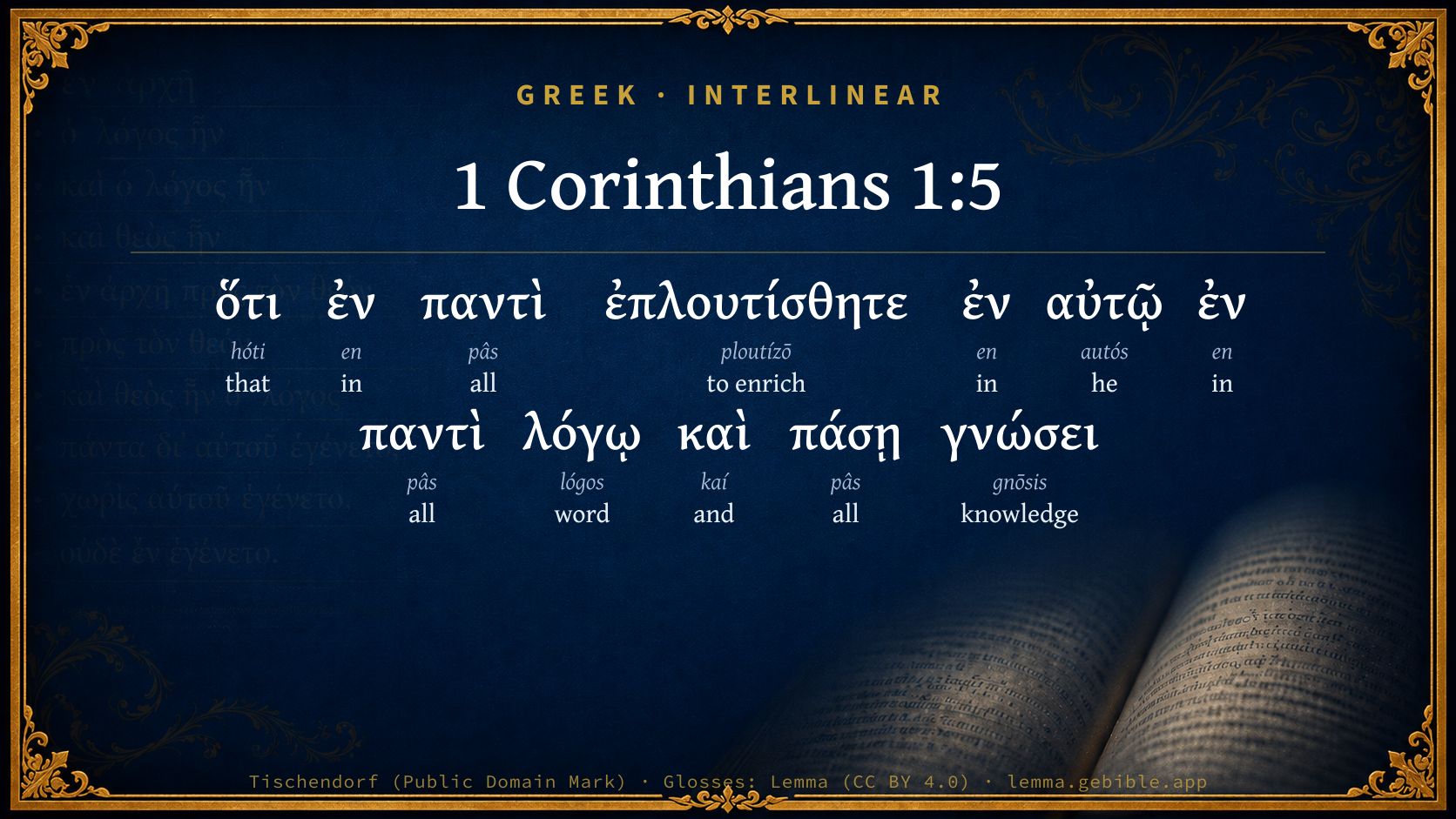
Download image
Cite this verse

1 Corinthians 1:5 (World English Bible). Public Domain. Lemma interlinear Bible study tool, https://lemma.gebible.app/v/1-corinthians/1/5.

Show BibTeX & RIS
BibTeX
RIS
English Translation
that in everything you were enriched in him, in all speech and all knowledge;
World English Bible · Public Domain
Highlights
  • 1 first appearance in the Greek New Testament
Full analysis ↓
Download a study sheet

One document with this verse’s original text, its word-by-word gloss line, the meaning frame, cross-references with their text, attributed commentary, and full source and license credits — printable, and it pastes into notes with its structure intact.

This verse Autodidact and up

Study sheet (.html) Plain text (.txt)

A passage Seminary Student

Up to 50 verses in one chapter. A passage sheet keeps up to 6 commentary sources and 12 cross-references per verse, in the order this page ranks them, and says so on the sheet whenever that leaves anything out. Ask for a single verse and you get the Autodidact verse sheet above.

Everything on this page stays free to read, with no account — the sheet is a download of what is already on screen, not access to it.

Want to remove ads? Support Godless Engineer
Compare translations 3

The same verse in 3 English versions, stacked beneath the original-language interlinear above. Click any original word for its lexicon entry.

Each is an independent rendering of the whole verse — the interlinear is not word-aligned to these translations.

Highlighted words mark where these versions differ — a whole-verse word diff, not a word-by-word alignment.

  • World English Bible Public Domain
    that in everything you were enriched in him, in all speech and all knowledge;
  • King James Version Public Domain
    That in every thing ye are enriched by him, in all utterance, and in all knowledge;
  • unfoldingWord Literal Text CC BY-SA 4.0
    For in everything you were made rich in him, in all word and all knowledge,

unfoldingWord Literal Text — © unfoldingWord, licensed CC BY-SA 4.0. Word-aligned USFM3 via Door43 (git.door43.org/unfoldingWord/en_ult).

Versions to compare (up to 4)

3 of 4 selected

Show all 19 translations

Every available English version of this verse, each an independent rendering of the whole verse.

  • World English Bible Public Domain
    that in everything you were enriched in him, in all speech and all knowledge;
  • Berean Standard Bible Public Domain
    For in Him you have been enriched in every way, in all speech and all knowledge,
  • Majority Standard Bible Public Domain
    For in Him you have been enriched in every way, in all speech and all knowledge,
  • King James Version Public Domain
    That in every thing ye are enriched by him, in all utterance, and in all knowledge;
  • American Standard Version (1901) Public Domain
    that in everything ye were enriched in him, in all utterance and all knowledge;
  • Revised Version (1885) Public Domain
    that in everything ye were enriched in him, in all utterance and all knowledge;
  • Geneva Bible (1599) Public Domain
    That in all things ye are made rich in him, in all kinde of speach, and in all knowledge:
  • Douay-Rheims (1899) Public Domain
    That in all things you are made rich in him, in all utterance, and in all knowledge;
  • Young's Literal Translation Public Domain
    that in every thing ye were enriched in him, in all discourse and all knowledge,
  • Literal Standard Version CC BY-SA 4.0
    that in everything you were enriched in Him, in all discourse and all knowledge,
  • Unlocked Literal Bible CC BY-SA 4.0
    He has made you rich in every way, in all speech and with all knowledge,
  • unfoldingWord Literal Text CC BY-SA 4.0
    For in everything you were made rich in him, in all word and all knowledge,
  • Darby Bible Public Domain
    that in everything ye have been enriched in him, in all word [of doctrine], and all knowledge,
  • World Messianic Bible Public Domain
    that in everything you were enriched in him, in all speech and all knowledge—
  • Webster's Bible Public Domain
    That in every thing ye are enriched by him, in all utterance, and in all knowledge;
  • Free Bible Version CC BY-SA 4.0
    Through him you have been made rich in everything, in all that you say and every aspect of what you know.
  • Bible in Basic English Public Domain
    So that in him you have wealth in all things, in word and in knowledge of every sort;
  • Text-Critical English NT CC BY 4.0
    For you have been enriched in him in every way, in all speech and all knowledge,
  • Tyndale New Testament (1534) Public Domain
    that in all thinges ye are made riche by him in all lerninge and in all knowledge

Literal Standard Version (2020), Covenant Press — licensed CC BY-SA 4.0. Text via the HelloAO Bible API (eBible.org). Unlocked Literal Bible (unfoldingWord) — licensed CC BY-SA 4.0. Text via the HelloAO Bible API (eBible.org). unfoldingWord Literal Text — © unfoldingWord, licensed CC BY-SA 4.0. Word-aligned USFM3 via Door43 (git.door43.org/unfoldingWord/en_ult). Free Bible Version, Dr. Jonathan Gallagher — licensed CC BY-SA 4.0. Text via the HelloAO Bible API (eBible.org).

Word by word

More ways to search: Search by grammar → Find every occurrence → Compare this word →

Practice this passage: Drill this verse → Learn its vocabulary →

About this verse

These counts appear in no published source. They are computed here, from the morphology-tagged text and Lemma’s own curated glosses. What Lemma adds →

12
words
8
distinct lemmas
Pauline Epistles
section

Notable vocabulary

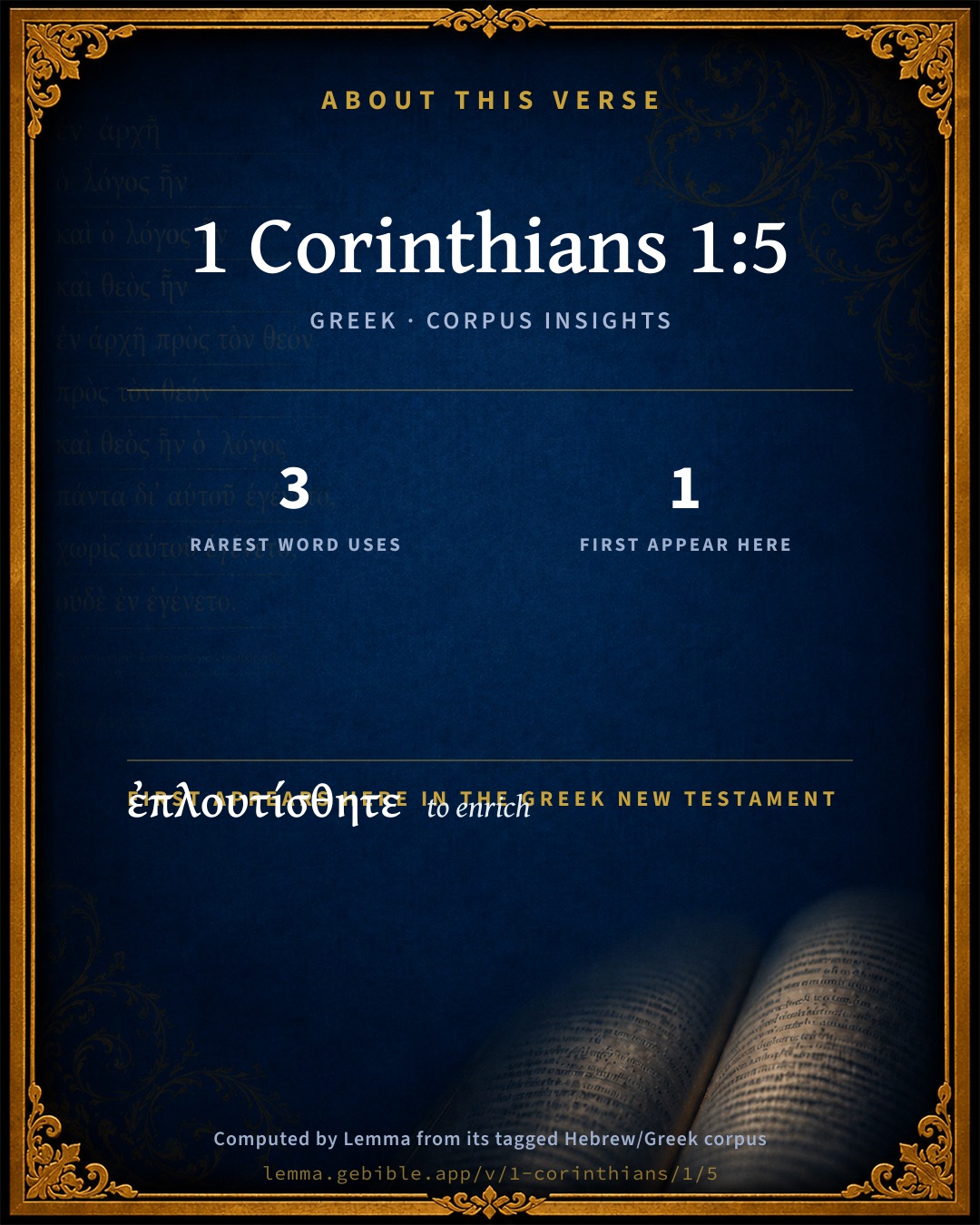
The rarest word here is ἐπλουτίσθητε to enrich G4148 — appearing just 3 times in the whole Greek New Testament.

First appearance in Scripture

This word makes its first canonical appearance in the Greek New Testament here:

  • ἐπλουτίσθητε to enrich G4148

Shared distinctive vocabulary

ἐπλουτίσθητε to enrich G4148 occurs in 3 verses of the Greek New Testament. Also found in:
Repetition

Words recur within this verse:

Cross-references

26

Topical passages linked to 1 Corinthians 1:5 in the Treasury of Scripture Knowledge — connected by theme and wording, ordered by reader-vote popularity; previews shown in the World English Bible.

  • 2 Corinthians 9:11 you being enriched in everything to all liberality, which works through us thanksgiving to God.
  • 2 Corinthians 8:7 But as you abound in everything, in faith, utterance, knowledge, all earnestness, and in your love to us, see that you also abound in this grace.
  • Colossians 2:3 in whom are all the treasures of wisdom and knowledge hidden.
  • Philippians 1:9 This I pray, that your love may abound yet more and more in knowledge and all discernment;
  • Romans 15:14 I myself am also persuaded about you, my brothers, that you yourselves are full of goodness, filled with all knowledge, able also to admonish others.
  • 1 Corinthians 12:8 For to one is given through the Spirit the word of wisdom, and to another the word of knowledge, according to the same Spirit;
  • James 3:13 Who is wise and understanding among you? Let him show by his good conduct that his deeds are done in gentleness of wisdom.
  • Ephesians 1:17 that the God of our Lord Jesus Christ, the Father of glory, may give to you a spirit of wisdom and revelation in the knowledge of him;
  • Ephesians 6:19 on my behalf, that utterance may be given to me in opening my mouth, to make known with boldness the mystery of the Gospel,
  • Colossians 3:10 and have put on the new man, that is being renewed in knowledge after the image of his Creator,
  • 2 Peter 3:18 But grow in the grace and knowledge of our Lord and Savior Jesus Christ. To him be the glory both now and forever. Amen.
  • Ephesians 3:8 To me, the very least of all saints, was this grace given, to preach to the Gentiles the unsearchable riches of Christ,
  • Romans 11:12 Now if their fall is the riches of the world, and their loss the riches of the Gentiles; how much more their fullness?
  • 1 Corinthians 13:2 If I have the gift of prophecy, and know all mysteries and all knowledge; and if I have all faith, so as to remove mountains, but don't have love, I am nothing.
  • Ephesians 2:7 that in the ages to come he might show the exceeding riches of his grace in kindness toward us in Christ Jesus;
  • Colossians 1:9–10 For this cause, we also, since the day we heard this, don't cease praying and making requests for you, that you may be filled with the knowledge of his will in all spiritual wisdom and understanding,
  • Acts 2:4 They were all filled with the Holy Spirit, and began to speak with other languages, as the Spirit gave them the ability to speak.
  • 1 Corinthians 8:11 And through your knowledge, he who is weak perishes, the brother for whose sake Christ died.
  • 1 Corinthians 13:8 Love never fails. But where there are prophecies, they will be done away with. Where there are various languages, they will cease. Where there is knowledge, it will be done away with.
  • 1 Corinthians 14:5–6 Now I desire to have you all speak with other languages, but rather that you would prophesy. For he is greater who prophesies than he who speaks with other languages, unless he interprets, that the assembly may be built up.
  • 1 Corinthians 14:26 What is it then, brothers? When you come together, each one of you has a psalm, has a teaching, has a revelation, has another language, has an interpretation. Let all things be done to build each other up.
  • 2 Corinthians 4:6 seeing it is God who said, "Light will shine out of darkness," who has shone in our hearts, to give the light of the knowledge of the glory of God in the face of Jesus Christ.
  • Romans 15:4 For whatever things were written before were written for our learning, that through patience and through encouragement of the Scriptures we might have hope.
  • 1 Corinthians 4:7–10 For who makes you different? And what do you have that you didn't receive? But if you did receive it, why do you boast as if you had not received it?
  • 1 Corinthians 12:10 and to another workings of miracles; and to another prophecy; and to another discerning of spirits; to another different kinds of languages; and to another the interpretation of languages.
  • Colossians 4:3–4 praying together for us also, that God may open to us a door for the word, to speak the mystery of Christ, for which I am also in bonds;

Cross-references courtesy of OpenBible.info (CC BY 4.0).

Commentary

Notes on 1 Corinthians 1:5 from classic Christian and Jewish commentators (each source and its license shown beneath its notes). The classic Christian expositions comment on the surrounding passage and are grouped to its opening verse, so a note may address several verses; the Jewish commentaries on the Tanakh (Rashi and others) are per-verse, so they appear only where the commentator wrote on this verse.

Lemma curates 59 commentaries, every one of them public domain or Creative Commons licensed, each selected and text-cleaned for this edition rather than reprinted as found. About our sources →

Tyndale Open Study Notes

Tyndale Open Resources

1:5 God had enriched the Corinthian church spiritually, specifically in eloquent words and knowledge. This probably refers to the spiritual messages and understanding (see 1:7) on which the church prided itself. Word and knowledge occur frequently in this letter: Paul acknowledges the abundant spiritual gifts that God has given the church in Corinth. Later, he corrects their distorted perspectives on these gifts (see 1:18–2:5; 3:18-20; 12:1–14:40).

Tyndale Open Study Notes — © Tyndale Open Resources, licensed CC BY-SA 4.0. Text via the HelloAO Bible API.

Bengel's Gnomon

Johann Albrecht Bengel

1Co 1:5. Λόγῳ—γνώσει, in word (utterance)—in knowledge) The word (utterance) follows knowledge, in point of fact: and it is by the former that the latter is made known. He shows, that the Corinthians ought to be such in attainments, that it should be unnecessary to write to them. Moreover they were admirers of spiritual gifts; therefore by mentioning their gifts, he gains over to himself their affections, and makes a way for reproof.

Bengel's Gnomon of the New Testament — English translation (T&T Clark, Edinburgh, 1860) — public domain. Text from a community e-Sword module.

Expositor's Greek Testament

ed. W. Robertson Nicoll

1Co 1:5 . ὅτι κ . τ . λ . stands in explicative apposition to the foregoing τ . χάριτι τ . δοθείσῃ , bringing out the matter of thanksgiving eminent in the conversion of the Cor [75] “(I mean), that in everything you were enriched,” etc. For this defining ὅτι after a vbl [76] noun, cf. 1Co 1:26 and 2Co 1:8 . The affluence of endowment conferred on the Cor [77] stirred the Apostle’s deep gratitude ( cf. 1Co 1:7 , 2Co 8:9 ): this wealth appears in another light in 1Co 4:6-10 , 1Co 5:2 , 1Co 8:1-3 ; see also Introd. , p. 730 f. The Church doubtless dwelt upon this distinction in its recent letter, to which P. is replying. ἐν παντὶ is defined, and virtually limited, by ἐν παντὶ λόγῳ καὶ πάσῃ γνώσει (kindred gifts, linked by the single prp [78] ): the exuberance of grace in the Cor [79] shone “in all (manner of) utterance and all (manner of) knowledge”. λόγος in this connexion signifies not the thing said (as in 18), but the saying of it, loquendi facultas (Bz [80] ). “Relatively to γνῶσις , λόγος is the ability and readiness to say what one understands; γν . the power and ability to understand ” (Hn [81] ). “Knowledge” would naturally precede; but the Cor [82] excelled and delighted in “speech” above all: see 1Co 2:1-4 ; 1Co 2:13 , 1Co 4:19 f., 1Co 13:1 .

[75] Corinth, Corinthian or Corinthians.

[76] verbal.

[77] Corinth, Corinthian or Corinthians.

[78] preposition.

[79] Corinth, Corinthian or Corinthians.

[80] Beza’s Nov. Testamentum: Interpretatio et Annotationes (Cantab., 1642).

[81] C. F. G. Heinrici’s Erklärung der Korintherbriefe (1880), or 1 Korinther in Meyer’s krit.-exegetisches Kommentar (1896).

[82] Corinth, Corinthian or Corinthians.

The Expositor's Greek Testament, edited by W. Robertson Nicoll (1897–1910) — public domain. Text from a community e-Sword module.

Hodge's Commentary on Romans, Ephesians & First Corinthians

Charles Hodge

1Co_1:5

That in every thing ye are enriched by him, in all utterance, and (in) all knowledge.

This verse is explanatory of the preceding. Paul gives thanks for the grace which they had received, i.e. that in every thing they were enriched. In every thing (ἐν παντί), in every respect they were richly endowed with the gifts of the Spirit. In all utterance and in all knowledge; that is, with all the gifts of utterance and knowledge. Some were prophets some were teachers, some had the gift of tongues. These were different forms of the gift of utterance. In all knowledge, that is, in every kind and degree of religious knowledge. This interpretation gives a good sense, and is the one very generally adopted. The word (λόγος) translated utterance, may however be taken in the sense of doctrine, and the word (γνῶσις) translated knowledge, in the sense of insight. The meaning would then be, that the church in Corinth was rightly endowed with divine truth, and with clear apprehension or understanding of the doctrines which they had been taught. They were second to no other church either as to doctrinal knowledge or spiritual discernment. Λόγος, according to this view, is the truth preached; γνῶις, the truth apprehended. Meyer.

Charles Hodge — Commentary on Romans (1835), First Corinthians (1857), and Ephesians (1856) — public domain. Text from a community e-Sword module.

Geneva Bible (1599)

Geneva Bible translators

He toucheth that by name, which they most abused.

Seeing that while we live here, we know but in part and prophesy in part, this word (All) must be refrained to the present state of the faithful: and by speech he meaneth not a vain kind of babbling, but the gift of holy eloquence, which the Corinthians abused.

Geneva Bible (1599) marginal notes — public domain. Text via Bolls.life.

Jamieson, Fausset & Brown

Robert Jamieson, A. R. Fausset & David Brown

utterance--ALFORD from MENOCHIUS translates, "doctrine." Ye are rich in preachers or the preaching of the word, and rich in knowledge or apprehension of it: literally "(the) word (preached)." English Version (as in Co2 8:7) is better: for Paul, purposing presently to dwell on the abuse of the two gifts on which the Corinthians most prided themselves, utterance (speech) and knowledge (Co1 1:20; Co1 3:18; Co1 4:19; 1Co. 13:1-14:40), previously gains their goodwill by congratulating them on having those gifts.

Jamieson, Fausset & Brown — Commentary Critical and Explanatory on the Whole Bible (1871) — public domain (CC PDM 1.0). Text via the HelloAO Bible API.

Adam Clarke's Commentary

Verse 5. Ye are enriched - ye abound - in all utterance] εν παντι λογω, In all doctrine; for so the word should certainly be translated and understood. All the truths of God relative to their salvation had been explicitly declared to them; and they had all knowledge; so that they perfectly comprehended the doctrines which they had heard.

Adam Clarke's Commentary on the Bible (1810–1826) — public domain. Text from a community e-Sword/MySword module.

Ellicott's Commentary for English Readers

(5) Ye are enriched.—Literally, ye were enriched. “Utterance” is the power of outward expression of that “knowledge” which dwells within.

A Bible Commentary for English Readers, edited by Charles John Ellicott (1878–1897) — public domain. Text from a community e-Sword module.

The Cambridge Bible for Schools and Colleges

gen. ed. J. J. S. Perowne

5. in every thing ye are enriched] Rather, Ye were enriched, i.e. at your baptism, when you entered into the covenant-union with Christ. The gifts of utterance, knowledge and the like, were the result of the favour of God towards you. It appears evident from the rest of the Epistle that the Apostle was thinking rather of the powers conveyed to the Corinthians by their translation into Christ, than of the use they had made of them. The Corinthians as a body were not as yet remarkable for their Christian knowledge, though many individuals had no doubt made great spiritual progress.

in all utterance] Literally, speech, discourse.

The Cambridge Bible for Schools and Colleges (gen. ed. J. J. S. Perowne; Cambridge University Press, 1878–1918) — public domain. Text from a community e-Sword module.

John Gill's Exposition

That in everything ye are enriched by him,.... This is still a continuation of the thanksgiving for this church, that they were "enriched", or plentifully and abundantly provided for by Christ, with all grace, with all the riches of grace; with his own unsearchable riches, of which they were made partakers, and the riches of glory, to which they were entitled by him; and all which come to them through his poverty, which makes his grace in the donation of these riches the more illustrious: and particularly the apostle is thankful, that they were enriched by Christ

in all utterance, and in all knowledge; that not only they had the knowledge of the truths and doctrines of the Gospel, concerning the person, offices, grace, and righteousness of Christ in the theory of them, or a speculative notion of them; but for the most part had a spiritual experimental knowledge of these things; and many of them had such large gifts of knowledge, elocution, and utterance, that they were richly qualified to preach the Gospel to others; nay, even had the extraordinary gifts of the Spirit, so as to speak with divers tongues, as the Spirit gave them utterance.

John Gill's Exposition of the Whole Bible (1746–1763) — public domain (CC PDM 1.0). Text via the HelloAO Bible API.

Trapp's Complete Commentary

John Trapp

5 That in every thing ye are enriched by him, in all utterance, and in all knowledge;

Ver. 5. Ye are enriched] See here what is the Christian’s riches. And so David reckons of his wealth, Psa 119:32. He cannot be poor in whom the word of God dwells richly, Col 3:16, especially if he be free of discourse, able and willing to communicate. A dumb Christian is to be blamed, as well as a dumb minister.

John Trapp, A Commentary or Exposition upon All the Books of the Old and New Testament (1647–1656) — public domain. Text from a community e-Sword module.

Albert Barnes' Notes on the Bible

That in every thing - In every respect, or in regard to all the favors conferred on any of his people. You have been distinguished by him in all those respects in which he blesses his own children.

Ye are enriched by him; - compare the note at Rom 2:4. The meaning of this expression is, “you abound in these things; they are conferred abundantly upon you.” By the use of this word, the apostle intends doubtless to denote “the fact” that these blessings had been conferred on them abundantly; and also that this was a “valuable endowment,” so as to be properly called “a treasure.” The mercies of God are not only conferred abundantly on his people, but they are a bestowment of inestimable value; compare 2Co 6:10.

In all utterance - With the power of speaking various languages ἐν παντὶ λόγῳ en panti logō. That this power was conferred on the church at Corinth, and that it was highly valued by them, is evident from 1 Cor. 14; compare 2Co 8:7. The power of speaking those languages the apostle regarded as a subject of thanksgiving, as it was a proof of the divine favor to them; see 1Co 14:5, 1Co 14:22, 1Co 14:39.

And in all knowledge - In the knowledge of divine truth. They had understood the doctrines which they had heard, and had intelligently embraced them. This was not true of all of them, but it was of the body of the church; and the hearty commendation and thanksgiving of the apostle for these favors, laid the foundation for the remarks which he had subsequently to make, and would tend to conciliate their minds, and dispose them to listen attentively, even to the language of reproof.

Albert Barnes' Notes on the Bible (1834–1885) — public domain. Text from a community e-Sword/MySword module.

Haydock's Catholic Bible Commentary

Rich in him in all knowledge. The apostles never addressed any epistle, except to persons who had been previously converted to the faith. Nor is it reasonable to expect, that infidel and pagan nations, merely by reading the inspired writings, will be able, by the light that is in them, to elicit from the said book the truths of religion. Would they not be tempted to worship the wily serpent, that succeeded in deceiving Eve? and how will they know that this serpent is the devil? (Haydock)

George Leo Haydock (1774–1849), Haydock's Catholic Family Bible and Commentary, 1859 edition — public domain. Excludes Psalms (Douay-Rheims chapter numbering differs from Protestant) and Deuterocanonical books (Catholic canon only).

Matthew Poole's English Annotations

In every thing; in every grace and in every good gift, (for he is manifestly speaking of spiritual things), so as this general particle must not be extended to the things of this life, but restrained either to spiritual gifts, or spiritual, sanctifying habits. Thus we read of the riches of grace, Eph 1:7, and of the riches of Christ, Eph 3:8; nor is the metaphor improper, whether we consider riches as signifying plenty or abundance, or that which accommodateth a man in this life, and is fitted to men’s wants, to give them a supply.

In all utterance; the word may be translated, in everything, or, in all speech; but the first having been said before, it seems more proper here to translate it, in all word or speech, or in all utterance, as we translate it. If it be taken in the first sense, the gospel is by it understood, the doctrine of the gospel preached amongst them by Paul and Apollos, who preached among the Gentiles the riches of Christ, Eph 3:8. If we interpret it utterance, which our translators prefer, it signifies an ability to utter that knowledge which God hath given us, to the glory of God and the good of others, either in prayer or spiritual discourses.

And in all knowledge: some by knowledge here understand the gift of prophecy; but it more properly signifies the ability God had given them to comprehend in their understanding the mysteries of the gospel, the great and deep things of God. The apostle blesseth God both for the illumination of their minds by the ministry of the gospel, so as they knew the things of God, and also for the ability which God had given them to communicate this their knowledge to others.

Matthew Poole's English Annotations on the Holy Bible (1683–1685) — public domain. Text from a community e-Sword/MySword module.

Whedon's Commentary on the Bible

Daniel D. Whedon

5. Every thing—Every respect.

Utterance—Preaching, prophesying, and tongues.

Knowledge—The perception of sacred doctrines, the discerning of spirits, and the interpretation of charismatic tongues.

Daniel D. Whedon (gen. ed.), Commentary on the Old and New Testaments (1874–1909) — public domain. Text from a community e-Sword module.

The Pulpit Commentary

In everything; i.e. of course, every gift which belongs specially to the Christian life. In all utterance; i.e. in all "eloquence" (logw), or perhaps "in all doctrine (so Luther, Calvin, Meyer, etc.). The word for" utterance" is rhema; loges means "discourse" and "reason". (comp 2Co_8:7) Knowledge. From the word guests is derived the name Gnostic, which was applied to so many forms of ancient heresy. There was danger to the Corinthian Christians in the exaggerated estimate of what they took for gnosis, and many of them were tempted to pride themselves on purely intellectual attainments, which were valueless for the spiritual life. St. Clement of Rome also, in writing to them ("Ep. ad Corinthians 1.") speaks of their "mature and established knowledge.

Enrichment in Christ.

Paul"s view of the dignity of the Christian calling, of the privileges and honours of the Christian life, was both just and instructive, and may well assist us in our endeavour to live clear of and above the false and worldly standard with which we often meet. How could the grandeur and sacredness of our religious position be more effectively set before us than by this inspiriting language addressed by the apostle to the members of the Christian community at Corinth: "In everything ye were enriched in Christ"?

I A PARADOX, WHEN WE REGARD THOSE WHO WERE THUS ADDRESSED. In the house of one Justus, a proselyte to Judaism, who had become a Christian a house close by the Hebrew synagogue, in the wealthy, commercial, pleasure seeking city of Corinth, there assembled in a large apartment a company of disciples of the Nazarene. Some were of Jewish, some of Gentile race. Most, though not all, of the brotherhood were poor, and few were learned or of high station. Perhaps the families of Crispus the president, of Justus himself, and of Chloe from Cenchrea, were the persons in the assembly of most consideration; for Aquila, Apollos, and Sosthenes were absent. Some of those assembled to hear the letter of the apostle, who was the founder of the Church at Corinth, were Bondsmen, and few were persons of any note. When Titus and Trophimus, bearers of Paul"s Epistle, accompanied by the Corinthians Stephanas, Fortunatus, and Achaicus, who had also just come from the apostle then labouring at Ephesus when these looked round upon the gathering of Corinthian Christians, they may well have started with astonishment as the language of the Epistle was read out, which described the abundant enrichment of these lowly, poor, unlettered disciples. Here was a company, including "not many wise men after the flesh, not many mighty, not many noble," but composed of the ignorant, the weak, the base, the despised of the world. A few Jewish merchants, a few handicraftsmen, a few slaves, a few industrious women, and perhaps a scholar or two, were declared to be "enriched in all things." It was a paradox; and it was a paradox which has been repeated again and again during the past nineteen centuries.

II A POSSIBILITY, WHEN WE THINK IN WHOM THIS ENRICHMENT TOOK PLACE. Nothing but the consciousness of a new life breathed into humanity, a new hope dawning upon the world, could account for these Corinthians being thus addressed by a teacher like Paul.

The language is so sweeping and unqualified, and the statement is made with so much confidence, that we feel that something very remarkable must have occurred to account for Paul addressing such persons in such language. The explanation is to be found hereIn him ye were enriched. It is in Christ that the wealth of God is placed at the disposal of the destitute children of men.

1. His Divine nature is a storehouse, a treasury of true wealth; in him all fulness dwells.

2. His ministry was an earnest of the greater blessings which should follow; for he was ever freely giving.

3. His death and sacrifice were the means of securing to us the fulness of God; he unlocked the treasury: "Though he was rich, yet for our sakes he became poor, that we, through his poverty, might be rich.

4. His ascension, so far from impoverishing the race he came to save, was the occasion of its enrichment. "He received gifts for men;" he poured out spiritual blessings from on high.

III A FACT, WHEN WE CONSIDER THE ACTUAL SPIRITUAL POSSESSIONS ENJOYED BY MANKIND THROUGH JESUS CHRIST. As the sun enriches the earth with luxuriant fruitfulness, as great men enrich a nation by their heroic deeds and saintly self sacrifice, so does Christ actually bestow untold blessings upon this race. Referring to the Epistle, we observe that wisdom and knowledge, faith and healing, miracles and prophecy, tongues and interpretation, were among the special instances of wealth with which the early Church was dowered. Yet the same Epistle assures us that love is a greater gift than all these. "See that ye abound in this grace also." The fruits of the Spirit are the riches of the Church. The unsearchable riches of Christ are made over to his redeemed and renewed people. To them it was said, "All things are yours.

APPLICATION. There is nothing in the resources or the purposes of God, nothing in the heart of Christ, to limit the extent to which this spiritual wealth may be diffused. T.

The Pulpit Commentary (1880–1919), ed. H.D.M. Spence-Jones & Joseph S. Exell — public domain. Text from a community e-Sword module.

John Wesley's Explanatory Notes

In all utterance and knowledge - Of divine things. These gifts the Corinthians particularly admired. Therefore this congratulation naturally tended to soften their spirits, and I make way for the reproofs which follow.

John Wesley, Explanatory Notes Upon the Whole Bible (1754–1765) — public domain. Text via the GEBible commentary corpus.

Godbey's Commentary on the New Testament

William B. Godbey

5. “Because you are enriched in him in all word and knowledge.” The E.V. gives this an active, whereas it has a passive, signification, meaning the simple fact that those Corinthians had the rich and invaluable treasure of God’s complete word and that priceless gift of the Holy Ghost (1

Corinthians 1Co 12:8) denominated “knowledge.” This spiritual gift means insight into divine truth, the omniscient Revelator revealing to the reader the spiritual meaning of His precious word, which He alone understands. Hence those Corinthians were wonderfully rich to have all the word and the spiritual knowledge of the same, i. e., insight into it, illuminated by the Holy Ghost, so they could understand it.

William B. Godbey, Commentary on the New Testament (1896–1900) — public domain. Text from a community e-Sword module.

McGarvey & Pendleton's Commentaries

J. W. McGarvey

that in everything [in every respect] ye were enriched in him, in all utterance [so that they were able to preach, teach, prophesy, and speak with tongues-- 1Co_12:8-10 ; 2Co_8:7 ; 2Co_11:6 ] and all knowledge [so that they had perception of doctrine, discerning of spirits, and interpretation of tongues];

J. W. McGarvey (with Philip Y. Pendleton), Commentaries on the New Testament (The Fourfold Gospel, 1914; Acts; and the epistles) — public domain. Text from a community e-Sword/MySword module.

The People's New Testament

B. W. Johnson

5. That in every thing ye are enriched by him. “The grace of God” (verse 4) had “enriched” them. In all utterance. The reference is especially, but not exclusively, to the supernatural gifts of tongues and of knowledge which were imparted to the early church. See 12:8–10; and 2 Cor. 8:7; 11:6.

B. W. Johnson's The People's New Testament with Notes (1889–1891) — public domain. Electronic text from the Christian Classics Ethereal Library (CCEL) ThML edition.

Cambridge Greek Testament for Schools and Colleges

5. ὅτι ἐν παντὶ ἐπλουτίσθητε. Because in every thing ye were enriched, i.e. at your baptism, when you entered into the covenant-union with Christ. See last note. The gifts of utterance, knowledge and the like, were the result of the favour of God towards you. It appears evident from the rest of the Epistle that the Apostle was thinking rather of the powers conveyed to the Corinthians by their translation into Christ, than of the use they had made of them. The Corinthians as a body were not as yet remarkable for their Christian knowledge, though many individuals had no doubt made great spiritual progress.

ἐν αὐτῷ. That ἐν is sometimes equivalent, or all but equivalent, to διὰ with gen. cannot be denied, in the face of such passages as Luk 22:49, Rev 6:8. But wherever there is a doubt, it is best to give ἐν a wider signification than that of the instrument. And this is especially the case where ἐν is connected with Christ’s Name. Cf. ἐν πνεύματι, Mar 1:8; Luk 1:17. ἐν λόγῳ, ἐν γνώσει, bear the same relation to ἐν αὐτῷ that the stream does to the source. For γνῶσις see ch. 1Co 12:8.

Cambridge Greek Testament for Schools and Colleges (Cambridge University Press, 1896; 21 vols, various authors incl. Carr, Maclear, Plummer, Farrar, Lumby, Moule, M. R. James, Simcox) — public domain. Text from a community e-Sword module.

Alford’s Greek Testament

Henry Alford

5. ἐν παντί] general: particularized by ἐν παντὶ λόγῳ κ. πάσῃ γνώσει, in all teaching and all knowledge. λόγος (obj.), the truth preached. γνῶσις (subj.), the truth apprehended. They were rich in the preaching of the word, had among them able preachers, and rich in the apprehension of the word, were themselves intelligent hearers. See 2Co 8:7, where to these are added πίστις, σπουδή, and ἀγάπη.

Henry Alford, The Greek Testament (1849–1861) — public domain. Text from a community e-Sword module.

International Critical Commentary

5. ὅτι ἐν παντί. Cf. 2Co 8:7, ὥσπερ ἐν παντὶ περισσεύετε πίστει καὶ λόγῳ καὶ γνώσει. The two passages, though doubtless addressed to different situations, bring out strikingly by their common points the stronger side of Corinthian Christianity, λόγος and γνῶσις, both true gifts of the Spirit (12:8), although each has its abuse or caricature (1:17-4:20. and 8:1 f.)*. Λόγος is the gift of speech, not chiefly, nor specially, as manifested in the Tongues (which are quite distinct in 12:8 f.), but closely related to the teacher’s work. It was the gift of Apollos (Act 18:24). The λόγος σοφίας is the gift of the Spirit, while σοφία λόγου—cultivating expression at the expense of matter (v. 17)—is the gift of the mere rhetorician, courting the applause (vanum et inane σοφῶς!) of the ordinary Greek audience. St Paul, according to his chief opponent at Corinth, was wanting in this gift (2Co 10:10, ὁ λόγος ἐξουθενημένος): his oratorical power was founded in deep conviction (v. 18, 2:4, 4:20).

St Paul “loses sight for a moment of the irregularities which had disfigured the church at Corinth, while he remembers the spiritual blessings which they had enjoyed. After all deductions made for these irregularities, the Christian community at Corinth must have presented as a whole a marvellous contrast to their heathen fellow-citizens,—a contrast which might fairly be represented as one of light and darkness” (Lightfoot). This Epistle contains no indication of the disloyalty to the Apostle which we trace in 2 Cor., especially in 10-13.

πάσῃ γνώσει. See 2Co 11:6, where St Paul claims for himself eminence in the true γνῶσις, and also 1Co 8:1 f.

International Critical Commentary — older volumes (1896–1929), various authors — public domain. Text from a community e-Sword module.

Vincent's Word Studies in the New Testament

Marvin R. Vincent

Ye are enriched [επλουτισθητε] . Rev. more literally, "were enriched." Compare Col 3:16; and see on Rom 2:4.

Utterance - knowledge [λογω - γνωσει] . The two words are found together, ch. 12 8; 2Co 11:6; 2Co 8:7. For knowledge, see on Rom 11:33. Utterance, aptitude in speech. Paul gives thanks for speech as a means of testifying for Christ. "The saints have never been silent" (Pascal).

Marvin R. Vincent, Word Studies in the New Testament (1887–1900) — public domain. Text from a community e-Sword/MySword module.

Godet's Commentaries

Frédéric Louis Godet

Vv. 5. With the meaning of the word grace, which we have rejected, ὅτι would require to be translated by in that. But if we take the word grace in the most general sense, ὅτι should be translated by “seeing that,” or “because.” Indeed, there is here a new fact proving the reality of the preceding. Only from the state of grace could the abundance of gifts arise which distinguishes the Church of Corinth, and which more especially gives occasion to the apostle’s gratitude.

The in everything is qualified by the two following terms, knowledge and utterance. The sequel of the Epistle leaves no doubt as to the meaning of these two terms. Chaps. 12-14 will show what a wealth of gifts, both of Christian knowledge and of manifestations in utterance (tongues, prophecies, doctrine), had been bestowed on this Church. We see from 1Co 8:1; 1Co 8:10, 1Co 13:2; 1Co 13:8-9, that the word γνῶσις, knowledge, denotes the understanding of the facts of salvation and of their manifold applications to Christian life. Here it includes the idea of σοφία, wisdom, which is sometimes distinguished from it; comp. 1Co 12:8.

The term utterance has been applied by de Wette to the rich Christian instruction which the Corinthians had received from Paul’s mouth and from which they had derived their knowledge of the gospel. But the term utterance must denote a spiritual gift bestowed on the Corinthians, and in connection with the term knowledge. What the apostle has in view, therefore, is those different forms of the new tongue which the Holy Spirit had developed in the Church. The verb ἐπλουτίσθητε denotes their abundance; the word παντί, every, their variety; comp. 1Co 14:26: “When ye come together, each of you hath a psalm, a teaching, a tongue, a revelation, an interpretation.” Edwards sees in this aorist an allusion to the present loss of those former riches, as if it should be translated, “Ye had been enriched.” This is certainly a mistake; the riches remained still, as is shown by chaps. 12-14. The aorist simply relates to the point of time at which the spiritual endowment of the Church took place, when its faith was sealed by the communication of the Spirit. It is not by accident that the apostle only mentions here the speculative and oratorical powers, and not the moral virtues; the gifts of the Spirit and not the fruits of the Spirit, as at Thessalonica. His intention is not doubtful; for in chap. 1Co 13:8-13 he himself contrasts the two principal gifts of utterance, tongues, and prophecy, and then knowledge, as things which pass away, with the three things which abide: faith, hope, and love. Here then, side by side with the riches for which the apostle gives thanks, we already discover the defect which afflicts him, but of which he does not speak, because it would be contrary to the object of the passage as one sacred to thanksgiving. This defect stood in relation to the character of the Greek mind, which was distinguished rather by intellectual and oratorical gifts than by seriousness of heart and conscience.

Frédéric Louis Godet — Commentaries on Luke, John, Romans, and 1 Corinthians — English translation (T&T Clark, Edinburgh, 1870s–1890s) — public domain. Text from a community e-Sword module.

Lesson kit

Teaching starters — assembled from the data on this page, not authored interpretation. Every prompt links to the verse data it draws on. Edit before teaching.

1 Corinthians, in the Pauline Epistles, opens this verse with 12 words (8 distinct Greek lemmas). Its most distinctive word is ploutízō (“to enrich”). A historical commentator’s framing appears above. Read the whole chapter for the surrounding context.

Discussion questions

  1. What does “to enrich” (ploutízō) contribute to the verse as a whole?
  2. This is the first place “to enrich” appears in Scripture (first appears here). What does its debut here establish?
  3. How does 2 Corinthians 6:10, which shares the word «to enrich», read alongside this verse?
  4. What does the repetition of “all” (3× in this one verse) do in this verse?
  5. These translations render this verse differently. What is at stake in choosing one wording over another?
  6. Compare how Tyndale Open Study Notes and Bengel's Gnomon read this verse. Where do they agree or differ?

Things to notice

  • 1 word makes its first canonical appearance in Scripture here.
  • These translations choose different wording for 10 words in this verse.
  • “all” occurs 3× in this single verse.
  • 8 distinct Greek lemmas span 12 words in this verse.

Reading settings

Reading text

Shown beneath each verse's original-language words.

Old Testament
Old Testament edition

Read the OT as the Masoretic Hebrew (MT) or the Greek Septuagint (LXX).

English shown for the Greek Septuagint (in the Hebrew ↔ Greek comparison).

Comparing translations? Open the Compare panel on any verse page to stack up to four side by side.