1 Corinthians 10:2

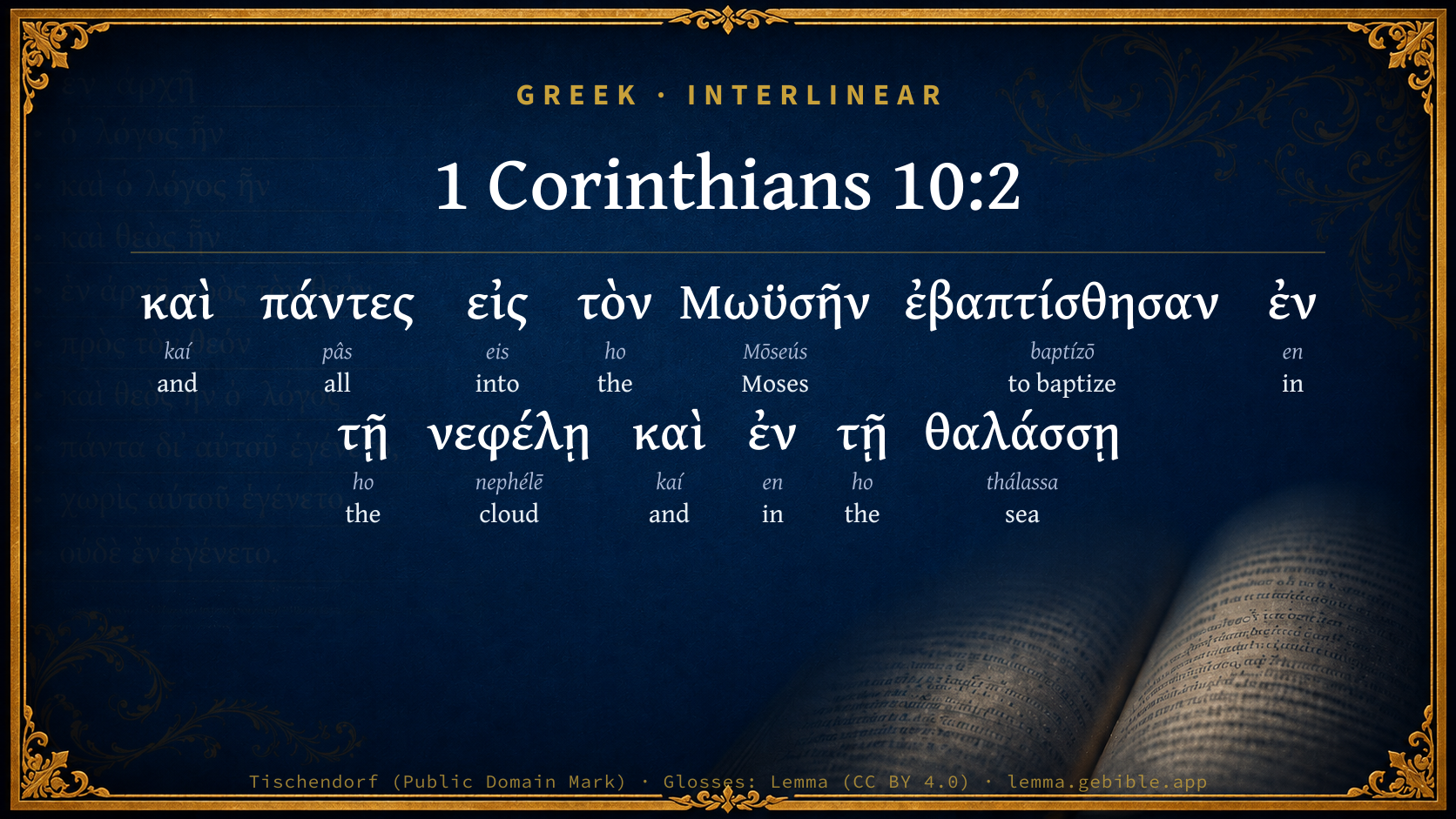
Greek (Tischendorf 8th ed.) 1 Corinthians 10:2 appears in the Greek New Testament. The text above is from the Tischendorf 8th edition. Each word links to its Strong’s number and a concise gloss. Click any word for its full Thayer’s Greek Lexicon entry.
Download image
Cite this verse

1 Corinthians 10:2 (World English Bible). Public Domain. Lemma interlinear Bible study tool, https://lemma.gebible.app/v/1-corinthians/10/2.

Show BibTeX & RIS
BibTeX
RIS
English Translation
and were all baptized into Moses in the cloud and in the sea;
World English Bible · Public Domain
Download a study sheet

One document with this verse’s original text, its word-by-word gloss line, the meaning frame, cross-references with their text, attributed commentary, and full source and license credits — printable, and it pastes into notes with its structure intact.

This verse Autodidact and up

Study sheet (.html) Plain text (.txt)

A passage Seminary Student

Up to 50 verses in one chapter. A passage sheet keeps up to 6 commentary sources and 12 cross-references per verse, in the order this page ranks them, and says so on the sheet whenever that leaves anything out. Ask for a single verse and you get the Autodidact verse sheet above.

Everything on this page stays free to read, with no account — the sheet is a download of what is already on screen, not access to it.

Want to remove ads? Support Godless Engineer
Compare translations 3

The same verse in 3 English versions, stacked beneath the original-language interlinear above. Click any original word for its lexicon entry.

Each is an independent rendering of the whole verse — the interlinear is not word-aligned to these translations.

Highlighted words mark where these versions differ — a whole-verse word diff, not a word-by-word alignment.

  • World English Bible Public Domain
    and were all baptized into Moses in the cloud and in the sea;
  • King James Version Public Domain
    And were all baptized unto Moses in the cloud and in the sea;
  • unfoldingWord Literal Text CC BY-SA 4.0
    and they all were baptized into Moses in the cloud and in the sea,

unfoldingWord Literal Text — © unfoldingWord, licensed CC BY-SA 4.0. Word-aligned USFM3 via Door43 (git.door43.org/unfoldingWord/en_ult).

Versions to compare (up to 4)

3 of 4 selected

Show all 19 translations

Every available English version of this verse, each an independent rendering of the whole verse.

  • World English Bible Public Domain
    and were all baptized into Moses in the cloud and in the sea;
  • Berean Standard Bible Public Domain
    They were all baptized into Moses in the cloud and in the sea.
  • Majority Standard Bible Public Domain
    They were all baptized into Moses in the cloud and in the sea.
  • King James Version Public Domain
    And were all baptized unto Moses in the cloud and in the sea;
  • American Standard Version (1901) Public Domain
    and were all baptized unto Moses in the cloud and in the sea;
  • Revised Version (1885) Public Domain
    and were all baptized unto Moses in the cloud and in the sea;
  • Geneva Bible (1599) Public Domain
    And were all baptized vnto Moses, in that cloude, and in that sea,
  • Douay-Rheims (1899) Public Domain
    And all in Moses were baptized, in the cloud, and in the sea:
  • Young's Literal Translation Public Domain
    and all to Moses were baptized in the cloud, and in the sea;
  • Literal Standard Version CC BY-SA 4.0
    and all were immersed into Moses in the cloud, and in the sea;
  • Unlocked Literal Bible CC BY-SA 4.0
    All were baptized into Moses in the cloud and in the sea,
  • unfoldingWord Literal Text CC BY-SA 4.0
    and they all were baptized into Moses in the cloud and in the sea,
  • Darby Bible Public Domain
    and all were baptised unto Moses in the cloud and in the sea;
  • World Messianic Bible Public Domain
    and were all immersed into Moses in the cloud and in the sea;
  • Webster's Bible Public Domain
    And were all baptized to Moses in the cloud and in the sea;
  • Free Bible Version CC BY-SA 4.0
    Symbolically then they were baptized “into Moses” in the cloud and in the sea.
  • Bible in Basic English Public Domain
    And they all had baptism from Moses in the cloud and in the sea;
  • Text-Critical English NT CC BY 4.0
    and all were baptized into Moses in the cloud and in the sea,
  • Tyndale New Testament (1534) Public Domain
    and were all baptised vnder Moses in the cloude and in the see:

Literal Standard Version (2020), Covenant Press — licensed CC BY-SA 4.0. Text via the HelloAO Bible API (eBible.org). Unlocked Literal Bible (unfoldingWord) — licensed CC BY-SA 4.0. Text via the HelloAO Bible API (eBible.org). unfoldingWord Literal Text — © unfoldingWord, licensed CC BY-SA 4.0. Word-aligned USFM3 via Door43 (git.door43.org/unfoldingWord/en_ult). Free Bible Version, Dr. Jonathan Gallagher — licensed CC BY-SA 4.0. Text via the HelloAO Bible API (eBible.org).

Word by word

More ways to search: Search by grammar → Find every occurrence → Compare this word →

Practice this passage: Drill this verse → Learn its vocabulary →

About this verse

These counts appear in no published source. They are computed here, from the morphology-tagged text and Lemma’s own curated glosses. What Lemma adds →

13
words
9
distinct lemmas
Pauline Epistles
section

Notable vocabulary

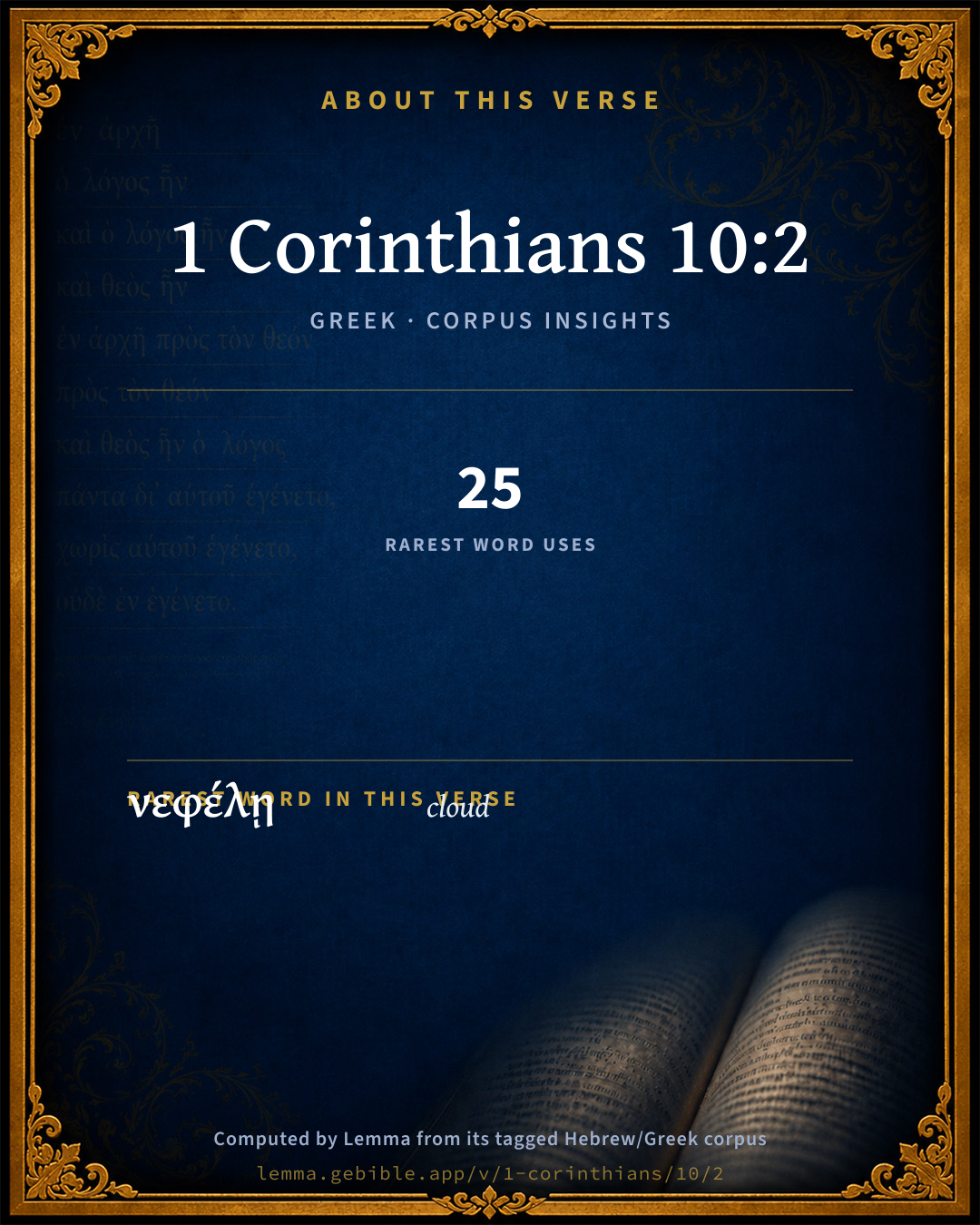
The rarest word here is νεφέλῃ cloud G3507 — appearing just 25 times in the whole Greek New Testament.

Shared distinctive vocabulary

νεφέλῃ cloud G3507 occurs in 21 verses of the Greek New Testament. Also found in:

Repetition

Words recur within this verse:

Cross-references

6

Topical passages linked to 1 Corinthians 10:2 in the Treasury of Scripture Knowledge — connected by theme and wording, ordered by reader-vote popularity; previews shown in the World English Bible.

  • Hebrews 3:2–3 who was faithful to him who appointed him, as also was Moses in all his house.
  • Exodus 14:31 Israel saw the great work which Yahweh did to the Egyptians, and the people feared Yahweh; and they believed in Yahweh, and in his servant Moses.
  • Romans 6:3 Or don't you know that all we who were baptized into Christ Jesus were baptized into his death?
  • 1 Corinthians 1:13–16 Is Christ divided? Was Paul crucified for you? Or were you baptized into the name of Paul?
  • John 9:28–29 They insulted him and said, "You are his disciple, but we are disciples of Moses.
  • Galatians 3:27 For as many of you as were baptized into Christ have put on Christ.

Cross-references courtesy of OpenBible.info (CC BY 4.0).

Commentary

Notes on 1 Corinthians 10:2 from classic Christian and Jewish commentators (each source and its license shown beneath its notes). The classic Christian expositions comment on the surrounding passage and are grouped to its opening verse, so a note may address several verses; the Jewish commentaries on the Tanakh (Rashi and others) are per-verse, so they appear only where the commentator wrote on this verse.

Lemma curates 59 commentaries, every one of them public domain or Creative Commons licensed, each selected and text-cleaned for this edition rather than reprinted as found. About our sources →

Tyndale Open Study Notes

Tyndale Open Resources

10:2 all of them were baptized: Paul draws a parallel with the baptized Corinthians.

Tyndale Open Study Notes — © Tyndale Open Resources, licensed CC BY-SA 4.0. Text via the HelloAO Bible API.

Bengel's Gnomon

Johann Albrecht Bengel

1Co 10:2. Καὶ πάντες εἰς τὸν Μωϋσὴν ἐβαπτίσαντο, and all were baptized unto Moses) καἰ, and so. He resumes what he slightly touched upon in the preceding verse about the cloud and the sea, and shows to what each refers. They were baptized in the cloud, so far as they were under it; and in the sea, so far as they passed through it. They were neither wet with the cloud nor with the sea, much less were they immersed in either (although some conjecture, that a miraculous rain fell from that cloud, from what is said in Psa 68:9; Psa 105:39), nor is the term baptism found in the writings of Moses. But Paul uses this term with great propriety, 1. Because the cloud and the sea are in their own nature water (wherefore also Paul is silent respecting the pillar of fire); 2. The cloud and the sea took the fathers out of sight and restored them again to view, and this is what the water does to those who are baptized. 3. They were initiated by the cloud and by the sea; and as initiation, at Col 2:11, is described by circumcision, so here by baptism, a metaphor common to the Old and New Testament; comp. ch. 1Co 5:7. But they were baptized unto Moses, as the servant of God, Exo 14:31, because they had begun to believe (in) him, and that they might afterwards believe (in) him; comp. εἰς, Rom 4:20.[85] ἐβαπτίσαντο, in the middle voice, received baptism. In the 1st verse it is hinted what God did for them; in 1Co 10:2, what the fathers received. The sacraments of the Old Testament were more than two, if we take into account these extraordinary ones, at the time of their exodus out of the land of Egypt.—καὶ ἐν τῇ θαλάσσῃ, and in the sea) In repeated indicates a new step in their progress and privileges.

[85] [He staggered not] at [in reference to], the promise of God: so here, baptized unto Moses, viz., in relation to him as their divinely appointed leader.—ED.

Bengel's Gnomon of the New Testament — English translation (T&T Clark, Edinburgh, 1860) — public domain. Text from a community e-Sword module.

Meyer's Critical & Exegetical Commentary

Heinrich August Wilhelm Meyer

1Co_10:2. The discourse flows on in uninterrupted stream, beginning with the ὅτι in 1Co_10:1, to the end of 1Co_10:5; then follows the application in 1Co_10:6.

εἰς τὸν Μωϋσῆν] in reference to Moses, so that they thereby devoted themselves to Moses as the deliverer and mediator whom God had sent them. Comp on Rom_6:3; Mat_28:19.

ἐβαπτίσαντο] they had themselves baptized, had the same thing, that is to say, done to them in reference to Moses as you had done to you in reference to Christ. The middle, which is not put here for the passive,comp, on the contrary, what was said regarding ἀπελούσ., 1Co_6:11,is purposely chosen, as in Act_22:16, to denote the receptive sense (see Kühner, II. p. 18; Valckenaer, p. 256; Winer, p. 239 [E. T. 319]); for although ἐβαπτ., and the subsequent ἔφαγον and ἔπιον, do not represent any apparent merit, yet they certainly assume the reception of those wonderful divine manifestations, which nevertheless could not place the fathers, to whom such high privileges had been vouchsafed, in a position of safety afterwards, etc.

ἐν τῇ νεφ.] ἐν is local, as in βαπτίζειν ἐν ὕδατι, Mat_3:11, al[1579], indicating the element in which, by immersion and emergence, the baptism was effected. Just as the convert was baptized in water with reference to Christ, so also that O. T. analogue of baptism, which presents itself in the people of Israel at the passage of the Red Sea with reference to Moses, was effected in the cloud under which they were, and in the sea through which they passed. So far as the sacred cloud, familiar to the readers, is concerned, there is no need for the assumption, based somewhat uncertainly on Psa_68:9, of a pluvia ex nube decidua (Wolf, comp Pott); neither, again, is it enough to define the point of comparison simply as Grotius does (comp de Wette): Nubes impendebat illorum capiti, sic et aqua iis, qui baptizantur; mare circumdabat eorum latera, sic et aqua eos, qui baptizantur. The cloud and the sea, both being taken together as a type of the water of baptism, must be regarded as similar in nature. Comp Pelagius: Et nubes proprium humorem portat; so also Bengel: Nubes et mare sunt naturae aqueae (quare etiam Paulus de columna ignis silet). Theodoret, on the other hand, with several more, among whom are Schrader, Olshausen, and Maier, makes the cloud a symbol of the Spirit (Joh_3:5); but this would have against it the fact, that the baptism in the cloud (answering, according to this view, to the baptism of the Spirit) had preceded the baptism in the sea (water-baptism); so that we should have an incongruous representation of the baptism with water and the Holy Ghost. The cloud and the sea do not represent the two elements in baptism, the former the heavenly, and the latter the earthly one; but both together form the undivided type of baptism. The type appropriated the subjects to Moses as his; the antitype appropriates them to Christ as His redeemed ones; and in both instances this is done with a view to their salvation, as in the one case from temporal bondage and ruin, so in the other from that which is spiritual and eternal. We may add, that there is room enough for the play of typico-allegorical interpretation, to allow the circumstance to be kept out of account that the Israelites went dry through the sea (Exo_14:16 ff.). The most arbitrary working out of the exposition of details may be seen in Theodoret.

[1579] l. and others; and other passages; and other editions.

Meyer — Critical and Exegetical Commentary on the New Testament — English translation by Peter Christie, edited by Frederick Crombie (T&T Clark, 1880) — public domain. Text from a community e-Sword module.

Hodge's Commentary on Romans, Ephesians & First Corinthians

Charles Hodge

1Co_10:2

And were all baptized‹14› unto Moses in the cloud and in the sea;

Baptized unto Moses, i.e. in reference to Moses, so as by baptism to be made his disciples. See 1Co_1:13. Rom_6:3. In the cloud and in the sea. The cloud and the sea did for them, in reference to Moses, what baptism does for us in reference to Christ. Their passage through the sea, and their guidance by the cloud, was their baptism. It made them the disciples of Moses; placed them under obligation to recognize his divine commission and to submit to his authority. This is the only point of analogy between the cases, and it is all the apostles argument requires. One class of commentators says that they were immersed in the sea, and therefore it was a baptism; another says, the cloud rained upon them, and on that account they are said to have been baptized. Both suggestions are equally forced. For the people were baptized as much in the cloud as in the sea; but they were not immersed in the cloud nor sprinkled by the sea. There is no allusion to the mode of baptism. Neither is the point of analogy to be sought in the fact, that the cloud was vapor and the sea water. The cloud by night was fire. The point of similarity is to be found, not in any thing external, but in the effect produced. The display of Gods power in the cloud and in the sea, brought the people into the relation of disciples to Moses. It inaugurated the congregation, and, as it were, baptized them to him, bound them to serve and follow him.

Charles Hodge — Commentary on Romans (1835), First Corinthians (1857), and Ephesians (1856) — public domain. Text from a community e-Sword module.

Geneva Bible (1599)

Geneva Bible translators

All of them were baptized with the outward sign, but not in deed, wherewith God cannot be charged, but they themselves.

Moses being their guide.

In effect the Sacrament of the old fathers were all one with ours, for they respected Christ only who offered himself unto them in divers shadows.

Geneva Bible (1599) marginal notes — public domain. Text via Bolls.life.

Jamieson, Fausset & Brown

Robert Jamieson, A. R. Fausset & David Brown

And--"And so" [BENGEL].

baptized unto Moses--the servant of God and representative of the Old Testament covenant of the law: as Jesus, the Son of God, is of the Gospel covenant (Joh 1:17; Heb 3:5-6). The people were led to believe in Moses as God's servant by the miracle of the cloud protecting them, and by their being conducted under him safely through the Red Sea; therefore they are said to be "baptized unto" him (Exo 14:31). "Baptized" is here equivalent to "initiated": it is used in accommodation to Paul's argument to the Corinthians; they, it is true, have been "baptized," but so also virtually were the Israelites of old; if the virtual baptism of the latter availed not to save them from the doom of lust, neither will the actual baptism of the former save them. There is a resemblance between the symbols also: for the cloud and sea consist of water, and as these took the Israelites out of sight, and then restored them again to view, so the water does to the baptized [BENGEL]. OLSHAUSEN understands "the cloud" and "the sea" as symbolizing the Spirit and water respectively (Joh 3:5; Act 10:44-47). Christ is the pillar cloud that screens us from the heat of God's wrath. Christ as "the light of the world" is our "pillar of fire" to guide us in the darkness of the world. As the rock when smitten sent forth the waters, so Christ, having been once for all smitten, sends forth the waters of the Spirit. As the manna bruised in mills fed Israel, so Christ, when "it pleased the Lord to bruise Him," has become our spiritual food. A strong proof of inspiration is given in this fact, that the historical parts of Scripture, without the consciousness even of the authors, are covert prophecies of the future.

Jamieson, Fausset & Brown — Commentary Critical and Explanatory on the Whole Bible (1871) — public domain (CC PDM 1.0). Text via the HelloAO Bible API.

Adam Clarke's Commentary

Verse 2. And were all baptized unto Moses] Rather INTO Moses-into the covenant of which Moses was the mediator; and by this typical baptism they were brought under the obligation of acting according to the Mosaic precepts, as Christians receiving Christian baptism are said to be baptized INTO Christ, and are thereby brought under obligation to keep the precepts of the Gospel.

Adam Clarke's Commentary on the Bible (1810–1826) — public domain. Text from a community e-Sword/MySword module.

Ellicott's Commentary for English Readers

(2) Were all baptized unto Moses.—The weight of evidence is in favour of the middle voice for the verb here used; signifying that they all voluntarily had themselves baptised to Moses. Moses was God’s representative under the Law, and so they were baptised unto him in their voluntarily joining with that “Church” of God which marched beneath the shadow of the cloud, and passed through the waters of the sea—as Christians, are baptised unto Jesus Christ,—He being (in a higher sense both in kind and in degree) God’s representative in the New Dispensation.

The “cloud” and the “sea” refer to the cloud that overshadowed the Israelites (Exo_13:21, and see Num_14:14), and the passage through the Red Sea (Exo_13:22; Num_35:8).

A Bible Commentary for English Readers, edited by Charles John Ellicott (1878–1897) — public domain. Text from a community e-Sword module.

The Cambridge Bible for Schools and Colleges

gen. ed. J. J. S. Perowne

2. and were all baptized unto Moses] The passing through the cloud (Exo_14:19) and the sea was a type of Christian Baptism, in that he who passes through it exchanges a state of bondage for a state of freedom, the hard yoke of a Pharaoh for the fatherly care of God, and this in consequence of his following the guidance of a leader sent by God. The Israelites were baptized ‘unto Moses,’ because by passing through the cloud and the sea they had become connected with him, dependent on his commands and guidance.

The Cambridge Bible for Schools and Colleges (gen. ed. J. J. S. Perowne; Cambridge University Press, 1878–1918) — public domain. Text from a community e-Sword module.

John Gill's Exposition

And were all baptized unto Moses,.... "In or by Moses"; and so the Syriac version renders it, , "by the hand of Moses"; by his means and direction, he going before, they followed after him into the sea, and passed through on dry land, and came out on the shore, which carried in it a resemblance of baptism; when they believed the Lord, and his servant Moses, Exo 14:31 and gave up themselves to him as their leader and commander through the wilderness: and this their baptism was

in the cloud, and in the sea; which may be considered either as together or separately; if together, the agreement between them and baptism lay in this; the Israelites, when they passed through the Red sea, hid the waters on each side of them, which stood up as a wall higher than they, and the cloud over them, so that they were as persons immersed in and covered with water; and very fitly represented the ordinance of baptism as performed by immersion; and which is the way it was administered in the apostles' time, to which he refers; and is the only way it ought to be administered in; and in which only the Israelites' passage through the sea, and under the cloud, could be a figure of it: or this may be considered separately, they were baptized in the cloud; which was either, as Gataker (g) thinks, when the cloud went from before the face of the Israelites, and stood behind them, and was between the two camps, to keep off the Egyptians from them, which as it passed over them let down a plentiful rain upon them, whereby they were in such a condition as if they had been all over dipped in water; or their being all under the cloud, and all over covered with it, was a representation of the ordinance of baptism, in which a person is all over covered with water; and then they were baptized in the sea, as they passed through it, the waters standing up above their heads, they seemed as if they were immersed in it. Very great is the resemblance between that passage of theirs, and baptism. For instance, their following Moses into the sea, which is meant by their being "baptized into him", was an acknowledgment of their regard unto him, as their guide and governor, as baptism is a following of Christ, who has left us an example that we should tread in his steps; and is an owning him to be our prophet to teach us, and lead us the way; and it is a profession of our faith in him, as our surety and Saviour, and a subjection to him as our King and Governor. This their baptism in the sea was after their coming out of Egypt, and at their first entrance on their journey to Canaan's land, as our baptism is, or should be, after a person is brought out of worse than Egyptian bondage and darkness, and has believed on the Lord Jesus Christ, and at the beginning of his profession of him, and entrance on his Christian race. The descent of the Israelites into the sea, when they seemed as buried in the waters, and their ascent out of it again on the shore, has a very great agreement with baptism, as administered by immersion, in which the person baptized goes down into the water, is buried with Christ therein, and comes up out of it as out of a grave, or as the children of Israel out of the Red sea; and as they, when they came out of it, could rejoice and sing in the view of their salvation and safety, and of the destruction of all their enemies, so the believer can, and does rejoice in this ordinance, in the view of his salvation by Christ, and safety in him, and of all his sins being buried and drowned in the sea of his blood; witness the instances of the eunuch and jailer. But though the Israelites were all in this sense baptized, yet they did not all inherit the land of Canaan.

(g) Aniversar. Miscellan. p. 30.

John Gill's Exposition of the Whole Bible (1746–1763) — public domain (CC PDM 1.0). Text via the HelloAO Bible API.

Trapp's Complete Commentary

John Trapp

2 And were all baptized unto Moses in the cloud and in the sea;

Ver. 2. And were all baptized] And yet were rooted out and rejected. Baptism sayeth; not the putting away of the filth of the flesh, but, &c., 1Pe 3:21. By this text it appears that infants also were baptized unto Moses, who was a typical mediator; therefore they ought to be into Christ, the true. It is here objected that those infants did also eat manna and drink of the rock; therefore by a like reason, they should also now receive the Lord’s supper. For answer, 1. How doth it appear that they did eat manna, &c.? 2. Though they did, yet they may not communicate at the Lord’s table, because they cannot "examine themselves, nor discern the Lord’s body," and are therefore flatly forbidden to come there, 1Co 11:28-29.

John Trapp, A Commentary or Exposition upon All the Books of the Old and New Testament (1647–1656) — public domain. Text from a community e-Sword module.

Albert Barnes' Notes on the Bible

And were all baptized - In regard to the meaning of the word “baptized,” see the note at Mat 3:6. We are not to suppose that the rite of baptism, as we understand it, was formally administered by Moses, or by any other person, to the Jews, for there is not the least evidence that any such rite was then known, and the very circumstances here referred to forbid such an interpretation. They were baptized “in the cloud” and “in the sea,” and this cannot be understood as a religious rite administered by the hand of man. It is to be remembered that the word “baptism” has two senses - the one referring to the application of water as a religious rite, in whatever mode it is done; and the other the sense of “dedicating, consecrating, initiating into,” or bringing under obligation to. And it is evidently in this latter sense that the word is used here, as denoting that they were devoted to Moses as a leader, they were brought under his laws, they became bound to obey him, they were placed under his protection and guidance by the miraculous interposition of God. This was done by the fact that their passing through the sea, and under the cloud, in this manner, brought them under the authority and direction of Moses as a leader, and was a public recognition of their being his followers, and being bound to obey his laws.

Unto Moses - (εἰς eis). This is the same preposition which is used in the form of baptism prescribed in Mat 28:19. See the note at that place. It means that they were thus devoted or dedicated to Moses; they received and acknowledged him as their ruler and guide; they professed subjection to his laws, and were brought under his authority. They were thus “initiated into” his religion, and thus recognized his divine mission, and bound themselves to obey his injunctions - Bloomfield.

In the cloud - This cannot be proved to mean that they were enveloped and, as it were, “immersed” in the cloud, for there is no evidence that the cloud thus enveloped them, or that they were immersed in it as a person is in water. The whole account in the Old Testament leads us to suppose that the cloud either passed before them as a pillar, or that it had the same form in the rear of their camp, or that it was suspended over them, and was thus the symbol of the divine protection. It would be altogether improbable that the dark cloud would pervade the camp. It would thus embarrass their movements, and there is not the slightest intheation in the Old Testament that it did. Nor is there any probability in the supposition of Dr. Gill and others, that the cloud. as it passed from the rear to the front of the camp, “let down a plentiful rain upon them, whereby they were in such a condition as if they had been all over dipped in water.” Because:

(1) There is not the slightest intheation of this in the Old Testament.

(2) The supposition is contrary to the very design of the cloud. It was not a natural cloud, but was a symbol of the divine presence and protection. It was not to give rain on the Israelites, or on the land, but it was to guide, and to be an emblem of the care of God.

(3) It is doing violence to the Scriptures to introduce suppositions in this manner without the slightest authority. It is further to be observed, that this supposition does by no means give any aid to the cause of the Baptist after all. In what conceivable sense were they, even on this supposition, “immersed?” Is it “immersion in water” when one is exposed to a shower of rain? We speak of being “sprinkled or drenched” by rain, but is it not a violation of all propriety of language to say that a man is “immersed” in a shower? If the supposition, therefore, is to be admitted, that rain fell from the cloud as it passed over the Jews, and that this is meant here by “baptism unto Moses,” then it would follow that “sprinkling” would be the mode referred to, since this is the only form that has resemblance to a falling shower. But the supposition is not necessary. Nor is it needful to suppose that water was applied to them at all. The thing itself is improbable; and the whole case is met by the simple supposition that the apostle means that they were initiated in this way into the religion of Moses, recognized his divine mission, and under the cloud became his followers and subject to his laws. And if this interpretation is correct, then it follows that the word “baptize” does not of necessity mean to “immerse.” (See Editors’ Notes on Mat 3:6 and Mat 3:16.)

And in the sea - This is another expression that goes to determine the sense of the word “baptize.” The sea referred to here is the Red Sea, and the event was the passage through that sea. The fact in the case was, that the Lord caused a strong east wind to blow all night, and made the sea dry land, and the waters were divided Exo 14:21, and the waters were a wall unto them on the right hand and on the left, Exo 14:22. From this whole narrative it is evident that they passed through the sea without being “immersed” in it. The waters were driven into high adjacent walls for the very purpose that they might pass between them dry and safe. There is the fullest proof that they were not submerged in the water. Dr. Gill supposes that the water stood up above their heads, and that “they seemed to be immersed in it.” This might be true; but this is to give up the idea that the word baptize means always to immerse in water, since it is a fact, according to this supposition, that they were not thus immersed, but only seemed to be. And all that can be meant, therefore, is, that they were in this manner initiated into the religion of Moses, convinced of his divine mission, and brought under subjection to him as their leader, lawgiver, and guide. This passage is a very important one to prove that the word baptism does not necessarily mean entire immersion in water. It is perfectly clear that neither the cloud nor the waters touched them. “They went through the midst of the sea on dry ground.” It remains only to be asked whether, if immersion was the only mode of baptism known in the New Testament, the apostle Paul would have used the word not only so as not necessarily to imply that, but as necessarily to mean something else? (See Editors’ Notes on Mat 3:6 and Mat 3:16.)

Albert Barnes' Notes on the Bible (1834–1885) — public domain. Text from a community e-Sword/MySword module.

Matthew Poole's English Annotations

There are two great difficulties in this verse:

1. What is meant by

Moses.

2. How and why the Israelites are said to be

baptized unto Moses.

Some understand by Moses the person of Moses; others, the law or doctrine of Moses. Those who by Moses understand the person of Moses, are divided in their opinions, whether the preposition εις, which signifieth divers things: Were better translated by, or into, or unto, or together with. Some think it were better translated by, and thus all the Jews were baptized by Moses in the cloud and in the sea, that is, by his ministry; and thus this very particle is translated, Act 7:53; 19:3. Some think it were better translated in Moses; that is, Moses going before them, when they were under the conduct of the cloud, and when they passed through the Red Sea. Others judge it better translated into Moses; that is, either Moses going before them; or, as Moses was a type of Christ, Gal 3:19. Some would have the particle here to signify together with. Others, even unto Moses, Moses himself not being excepted from that baptism in the cloud and in the sea. Others by Moses here understand the doctrine and law of Moses: thus the term Moses is used, Luk 16:29; Act 15:21. So they say, that to be baptized unto Moses, is to believe Moses so far, as to follow his conduct through the sea, and under the cloud.

The second difficulty is, to resolve what is meant by being baptized. The word signifieth, in the common acceptation of it, a being washed: in the ecclesiastical acceptation, it signifies a holy institution of the New Testament, according to which Christians are initiated into the church of God, by washing them in the name of the Father, Son, and Holy Ghost. Now how could the Jews be said either to be washed (that is, baptized) either in Moses, or by Moses, or with Moses, or into Moses; whenas the history of the Old Testament tells us, that both Moses and all the Israelites went through the sea on dry ground, and we do not read that the cloud, under the conduct of which the Israelites journeyed, ever poured down any water with which the Jews, or Moses their leader, could be washed.

Answer. Some think, that the cloud which, passing over the Israelites, was all darkness to their enemies, yet poured down water for the refreshing of the Israelites, as it passed over their heads, and that this is hinted to us by the psalmist, Psa 68:7-9. Others think, that the apostle applieth the term of baptism to a privilege of which the old Israelites had as much reason to glory, as the Corinthians had of their baptism, properly so called. Others say, that the Israelites’ walking under the cloud and through the sea, which was darkness and destruction to their adversaries, was a figure of baptism, the seal of the New Testament, by which Christ’s victory over our spiritual enemies is confirmed to us, and in that respect the apostle maketh use of this term baptized. Others, most probably, think, that the apostle useth this term, in regard of the great analogy between baptism, as it was then used, the persons going down into the waters, and being dipped in them; and the Israelites going down into the sea, the great receptacle of water; though the waters at that time were gathered on heaps on either side of them, yet they seemed buried in the waters, as persons in that age were when they were baptized; and for being baptized in the cloud, there is a great probability that the cloud did shower down rain, according to what is quoted out of the psalmist.

Matthew Poole's English Annotations on the Holy Bible (1683–1685) — public domain. Text from a community e-Sword/MySword module.

Whedon's Commentary on the Bible

Daniel D. Whedon

2. Were baptized—Greek middle voice, baptized themselves; that is, accepted the virtual baptism. Their own wills concurred with the divine act.

Unto Moses—Greek, εις, into Moses; into that religion of which Moses was representative. So Rom_6:3, baptized into Christ.

In the cloud—As overshadowing them.

In the sea—The sea, like the flood in

1Pe_1:2, suggests the baptismal element from which the simile of baptism takes its start. No definite image of the form of baptism, whether by affusion or immersion, is framed in either case.

Satan is our Pharaoh, Christ is our Moses, the pass of the sea is our baptism, the Holy Spirit is our guiding, protecting, separating, and consecrating fiery-cloudy pillar.

Daniel D. Whedon (gen. ed.), Commentary on the Old and New Testaments (1874–1909) — public domain. Text from a community e-Sword module.

The Pulpit Commentary

Were all baptized. This reading, though well supported, may, perhaps, be a correction for the middle, "they baptized themselves," i.e. accepted baptism. The passing under the cloud (Exo_14:19) and through the sea, constituting as it did their deliverance from bondage into freedom, their death to Egypt, and their birth to a new covenant, was a general type or dim shadow of Christian baptism (compare our collect, "figuring thereby thy holy baptism"). But the typology is quite incidental; it is the moral lesson which is paramount. Unto Moses; rather, into. By this "baptism" they accepted Moses as their Heaven-seat guide and teacher.

HOMILIES BY R. TUCK Ver. 2.

Baptism unto Moses.

The expression used here is a singular and suggestive one, and one that seems to require an enlargement of our associations with the term "baptized." "Were all baptized unto Moses in the cloud and in the sea." It may be noted that more precisely the passage should read, "all baptized themselves unto Moses." St. Paul sees, in the incidents of the crossing of the Red Sea under the guidance of the pillar cloud, a symbol of that Christian confession which puts us wholly under the redeemings and guidings of the Lord Jesus Christ. For the incidents, see Exo_14:21, Exo_14:22. The point is that the "fathers," the "Israelites,"voluntarily dedicated themselves to the leadership of Moses when they went through the waters at his command. They came up out of the waters, on the further shore, a new people, devoted to Moses as the earthly ruler representing Jehovah. "The Israelites were baptized "unto Moses because, by passing through the cloud and the sea, they had become connected with him, dependent on his commands and guidance." F. W. Robertson well points out the reason for the warnings here given. "The peril of the Corinthian Church lay in their false security. They were tempted to think that all things were safe to do, because all things were lawful. They were ready to rest satisfied with the knowledge that they were God"s people and God"s Church. Now, the apostle shakes this sense of their safety by reminding them that the ancient Church of Israel fell, although it had the same privileges; therefore he infers that spiritual privileges are not perfect security. Now, the argument by which he proves that the privileges of ancient Israel were similar to theirs is remarkable. That people had a baptism as well as they, and a spiritual food and drink. Baptism is the solemn profession of our Christianity; and the passing through the Red Sea was the Israelites" profession of discipleship to Moses." Here, then, baptism is the symbol of confession, or profession; it is the act by which we voluntarily yield ourselves to the leadership of another. This may receive four illustrations.

I COMPARE JOHN"S BAPTISM. Observe the connection between John"s teaching and John"s rite. Those who accepted his teaching yielded themselves to his leadership by the act of submitting to his rite. He led them to a change in their ideas and expectations of Messiah which should have prepared them to recognize in him a spiritual Saviour a Saviour from sin. Through voluntary submission to John"s baptism, they publicly confessed themselves to be John"s disciples.

II COMPARE OUR LORD"S BAPTISMS. It does not appear that he personally baptized any one; but his disciples did so in his Name. Here, again, the act was a public and outward acknowledgment or confession of the Messiahship of Christ, and a voluntary submission to his rule and law. It was the faith of the disciple gaining expression in a solemn public act. It brought the disciple under our Lord"s leadership, just as following Moses into the sea involved full submission to his guidance.

III COMPARE ST. PAUL"S TEACHING ABOUT BAPTISM. It is always with him the equivalent of confession. It is confession by an act rather than by a word. Such confession St. Paul declares to be an absolute necessity for salvation. With characteristic point and force, he even makes it as necessary as faith, saying in Rom_10:9, "If thou shalt confess with thy mouth the Lord Jesus, and shalt believe in thine heart that God hath raised him from the dead, thou shalt be saved." And from this St. Paul argues that we are now, by our own consecration, "under law to Christ." "We serve the Lord Christ.

IV COMPARE PRESENT DAY DISCIPLESHIP. The rite is perhaps less regarded, but that which it stands for is still essential. Impress that the following things are the proper stages of religious experience:

1. Repentance, with due forsaking of sinful ways.

2. Faith in Christ as able to grant forgiveness and to give life.

3. Confession of Christ, by some form of voluntary and public testimony.

4. Full and submissive practical obedience to his rule and law in everyday life and conduct. R.T.

The Pulpit Commentary (1880–1919), ed. H.D.M. Spence-Jones & Joseph S. Exell — public domain. Text from a community e-Sword module.

John Wesley's Explanatory Notes

And were all, as it were, baptized unto Moses - initiated into the religion which he taught them. In the cloud and in the sea - Perhaps sprinkled here and there with drops of water from the sea or the cloud, by which baptism might be the more evidently signified.

John Wesley, Explanatory Notes Upon the Whole Bible (1754–1765) — public domain. Text via the GEBible commentary corpus.

Burkitt's Expository Notes on the New Testament

William Burkitt

Observe, 1. The Israelites are here said to be baptized in the cloud and in the sea; that is, the cloud which overshadowed them, did sometimes bedew and sprinkle them; and the Red sea, through which they passed, and its waters gathered into two heaps, one on the right hand, and the left, betwixt which the Israelites passed, and in their passage seem to be buried in the waters, as persons in that age were put under the water when they were baptized: and thus were Israel baptized in the cloud and in the sea.

Observe, 2. They are said to be baptized unto Moses in the cloud and in the sea: Unto Moses, that is, into the doctrine taught by Moses. They believed him and followed his conduct through the sea, and were confirmed in their belief of Moses, (the typical mediator) as a person employed by God; and were obliged under the ministry and guidance of Moses, to follow God whithersoever he led them.

Observe, 3. That all this was a figure to which our baptism answers: both the cloud and the sea had some resemblance to our being covered with water in baptism, by which we are confirmed in the faith of Christ, and obliged to profess and own him, and to trust in and depend upon him, to serve and obey him, and this to the death.

Behold how much of Christ and his gospel was shadowed and held forth to the Jews under the dispensation of the ceremonial law; they had Christ in their sacrifices, and we have all their sacrifices in Christ. The cloud, the sea, the manna, the rock, all typified Christ, and were resemblances and representations of him. Christ was as truly represented to the Jews as unto us; as truly, though not so clearly.

William Burkitt's Expository Notes on the New Testament (1700–1703) — public domain. Text from a community e-Sword module.

McGarvey & Pendleton's Commentaries

J. W. McGarvey

and were all baptized unto Moses in the cloud and in the sea [Paul speaks of the fathers of the Jewish race as "our fathers," though addressing Gentiles. The patriarchs of Israel were the spiritual fathers of Gentile Christians ( Gal_3:7-8 ; Gal_3:29 ). Moreover, the patriarchal and Mosaic dispensations were preparatory to Christianity, and so, in a certain sense, fathered it. The passage through the Red Sea by the Israelites was in many ways analogous to Christian baptism. 1. It stood at the beginning of a journey undertaken by a divine call, and which led from a life and kingdom of bondage to a land of promise, which should be a land of liberty and an everlasting possession. 2. Baptism is a burial ( Rom_6:4 ). With a wall of water on each side and a cloud over them, the Israelites were buried from the sight of the Egyptians, or any others who stood upon the shores of the sea. Relying on the statement at Exo_14:19-21 that the cloud was between the Egyptians and the Israelites, and hence behind the Israelites part of the night, zealous paidobaptists have argued that at no part of the night were the Israelites under the cloud, their purpose being to avoid the idea of a burial. But in their zeal they have contradicted Paul, who says "under the cloud," "in the cloud," and who elsewhere speaks of baptism as a burial. Paul's language here implies that the children of Israel were between the walls of water while the cloud was still in front of them, and so they were under it and in it as it passed to their rear. and were all baptized unto Moses in the cloud and in the sea [Paul speaks of the fathers of the Jewish race as "our fathers," though addressing Gentiles. The patriarchs of Israel were the spiritual fathers of Gentile Christians (Gal. 3:7, 8, 29). Moreover, the patriarchal and Mosaic dispensations were preparatory to Christianity, and so, in a certain sense, fathered it. The passage through the Red Sea by the Israelites was in many ways analogous to Christian baptism. 1. It stood at the beginning of a journey undertaken by a divine call, and which led from a life and kingdom of bondage to a land of promise, which should be a land of liberty and an everlasting possession. 2. Baptism is a burial (Rom. 6:4). With a wall of water on each side and a cloud over them, the Israelites were buried from the sight of the Egyptians, or any others who stood upon the shores of the sea. Relying on the statement at Ex. 14:19-21 that the cloud was between the Egyptians and [97] the Israelites, and hence behind the Israelites part of the night, zealous paidobaptists have argued that at no part of the night were the Israelites under the cloud, their purpose being to avoid the idea of a burial. But in their zeal they have contradicted Paul, who says "under the cloud," "in the cloud," and who elsewhere speaks of baptism as a burial. Paul's language here implies that the children of Israel were between the walls of water while the cloud was still in front of them, and so they were under it and in it as it passed to their rear. 3. Baptism is a resurrection ( Rom_6:5 ). "The two phrases, 'were under the cloud,' and 'passed through the sea,' seem to prefigure the double process of submersion and emersion in baptism" (Canon Cook). The baptism of the Red Sea was to Israel a death to Egypt, and a birth to a new covenant. 4. Baptism is the final seal of discipleship ( Mat_28:19 ; Gal_3:27 ; 1Co_1:13 ). The passage of the Red Sea led Israel to fully accept Moses as their master and leader under God-- Gen_14:31 ];

J. W. McGarvey (with Philip Y. Pendleton), Commentaries on the New Testament (The Fourfold Gospel, 1914; Acts; and the epistles) — public domain. Text from a community e-Sword/MySword module.

The People's New Testament

B. W. Johnson

2. Were all baptized unto Moses. “The two phrases, 'Were under the cloud,' and 'Passed through the sea,' seem to prefigure the double process of submersion and emersion in baptism.”—Canon Cook. Observe that the Israelites, by this event, left Egypt, escaped from Pharaoh, and entered upon their march, with Moses as their leader, even as Christians leave the Egypt of sin behind, and start upon the Christian life, when they are “baptized into Christ.” One of the church Fathers, Theodoret, says: “The sea of transition represents the laver of regeneration, Moses foreshadows Christ, Israel the baptized disciples, the pursuing Egyptians are the sins left behind, and Pharaoh is a type of the devil.”

B. W. Johnson's The People's New Testament with Notes (1889–1891) — public domain. Electronic text from the Christian Classics Ethereal Library (CCEL) ThML edition.

Cambridge Greek Testament for Schools and Colleges

2. ἐβαπτίσαντο. Rec. and Tregelles with B. Tischendorf reads ἐβαπτίσθησαν with אACDEFG. Westcott and Hort put it in the margin. ἐβαπτίσθησαν may have been substituted for text either because it is more common in N. T. or because of the εἰς τὸν Μωϋσῆν which follows. But it is hardly possible to conceive of ἐβαπτίσαντο having been substituted for ἐβαπτίσθησαν.

2. εἰς τὸν Μωϋσῆν. The passing through the cloud (Exo 14:19) and the sea was a type of Christian Baptism, in that he who passes through it exchanges a state of bondage for a state of freedom, the hard yoke of a Pharaoh for the fatherly care of God, and this in consequence of his following the guidance of a leader sent by God. The Israelites were baptized ‘unto Moses,’ because by passing through the cloud and the sea they had become connected with him, dependent on his commands and guidance. Cf. εἰς τὸ ὄνομα, Mat 28:19. Cf. also Act 19:3-5.

Cambridge Greek Testament for Schools and Colleges (Cambridge University Press, 1896; 21 vols, various authors incl. Carr, Maclear, Plummer, Farrar, Lumby, Moule, M. R. James, Simcox) — public domain. Text from a community e-Sword module.

Alford’s Greek Testament

Henry Alford

2.] εἰς τ. Μωυς. ἐβαπτ., received baptism (lit. baptized themselves: middle, not passive, see var. read.) to Moses; entered by the act of such immersion into a solemn covenant with God, and became His church under the law as given by Moses, God’s servant,—just as we Christians by our baptism are bound in a solemn covenant with God, and enter His Church under the Gospel as brought in by Christ, God’s eternal Son: see Heb 3:5, Heb 3:6. Others (Syr., Beza) explain it ‘per Mosen,’ or (Calv., al.) ‘auspiciis Mosis,’ which εἰς will not bear,—not to mention that the formula βαπτίζω εἰς was already fixed in meaning, see reff.

ἐν τῇ ν. καὶ ἐν τῇ θ.] The cloud and the sea were both aqueous; and this point of comparison being obtained, serves the Apostle to indicate the outward symbols of their initiation into the church under the government of Moses as the servant of God, and to complete the analogy with our baptism. The allegory is obviously not to be pressed minutely: for neither did they enter the cloud, nor were they wetted by the waters of the sea; but they passed under both, as the baptized passes under the water, and it was said of them, Exo 14:31, “Then the people feared the Lord, and believed the Lord and his servant Moses.” To understand, as Olsh., the sea and cloud, of water and the Spirit respectively, is certainly carrying the allegory too far: not to mention that thus the baptism by the Spirit would precede that by water.

Henry Alford, The Greek Testament (1849–1861) — public domain. Text from a community e-Sword module.

International Critical Commentary

2. εἰς τὸν Μωϋσῆν ἐβ. ‘They received baptism unto Moses,’ as a sign of allegiance to him and trust in him; or ‘into Moses,’ as a pledge of union with him. Comparison with baptism ‘into Christ’ (Rom 6:3; Gal 3:27) is suggested, and it is implied that the union with Moses which was the saving of the Israelites was in some way analogous to the union with Christ which was the salvation of the Corinthians. Throughout the paragraph, the incidents are chosen from the Pentateuch with a view to parallels with the condition of the Corinthian Christians. The Israelites had had a baptism into Moses, just as the Corinthians had had a baptism into Christ. For a contrast between Christ and Moses, see Heb 3:1-6. With the aor. mid. compare ἀπελούσασθε, 6:2; with the είς Act 19:3.

ἐν τῇ νεφέλῃ καὶ ἐν τῇ θαλάσσῃ. Both cloud and sea represent “the element in which their typical baptism took place.” To make the cloud the Holy Spirit and the sea the water is forced and illogical; both are material and watery elements, and both refer to the water in baptism. In what follows it is the material elements in the Eucharist which are indicated.

Editors are divided between ἐβαπτίσαντο (B K L P) and ἐβαπτίσθησαν (א A C D E F G). But the latter looks like a correction to the expression which was generally used of Christian baptism (1:13, 15, 7:13; etc.). Cf. 6:2.

International Critical Commentary — older volumes (1896–1929), various authors — public domain. Text from a community e-Sword module.

Vincent's Word Studies in the New Testament

Marvin R. Vincent

Baptized unto Moses [εις] . Rev., margin, into. See on Mt 28:19; Rom 6:3. They were introduced into a spiritual union with Moses, and constituted his disciples.

Cloud - sea. The two together forming the type of the water of baptism. Bengel says : "The cloud and the sea are in their nature water." The cloud was diffused and suspended water.

Marvin R. Vincent, Word Studies in the New Testament (1887–1900) — public domain. Text from a community e-Sword/MySword module.

Lesson kit

Teaching starters — assembled from the data on this page, not authored interpretation. Every prompt links to the verse data it draws on. Edit before teaching.

1 Corinthians, in the Pauline Epistles, opens this verse with 13 words (9 distinct Greek lemmas). Its most distinctive word is nephélē (“cloud”). A historical commentator’s framing appears above. Read the whole chapter for the surrounding context.

Discussion questions

  1. How does “cloud” (nephélē) shape what this verse is saying?
  2. Matthew 17:5 shares the word «cloud» with this verse. How do the two illuminate each other?
  3. “the” occurs 3× in this one verse. What is the effect of the repetition?
  4. The translations on this page render this verse differently — a whole-verse word diff, not a word-by-word alignment. What might account for the different wordings?
  5. Reading how Tyndale Open Study Notes and Bengel's Gnomon read this verse, where do the two commentators agree and where do they part?

Things to notice

  • These translations choose different wording for 1 word in this verse.
  • “the” occurs 3× in this single verse.
  • 9 distinct Greek lemmas span 13 words in this verse.

Reading settings

Reading text

Shown beneath each verse's original-language words.

Old Testament
Old Testament edition

Read the OT as the Masoretic Hebrew (MT) or the Greek Septuagint (LXX).

English shown for the Greek Septuagint (in the Hebrew ↔ Greek comparison).

Comparing translations? Open the Compare panel on any verse page to stack up to four side by side.