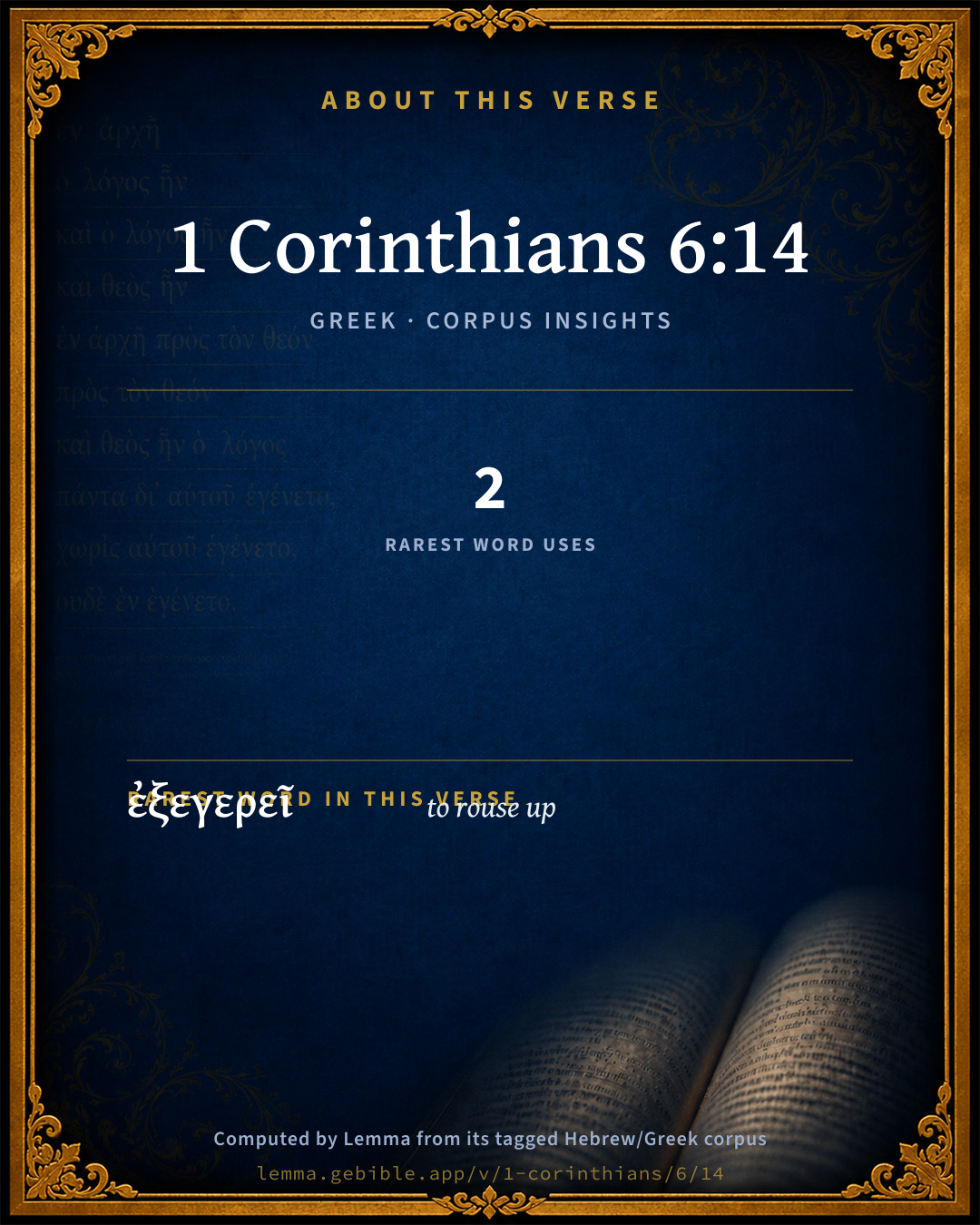
1 Corinthians 6:14

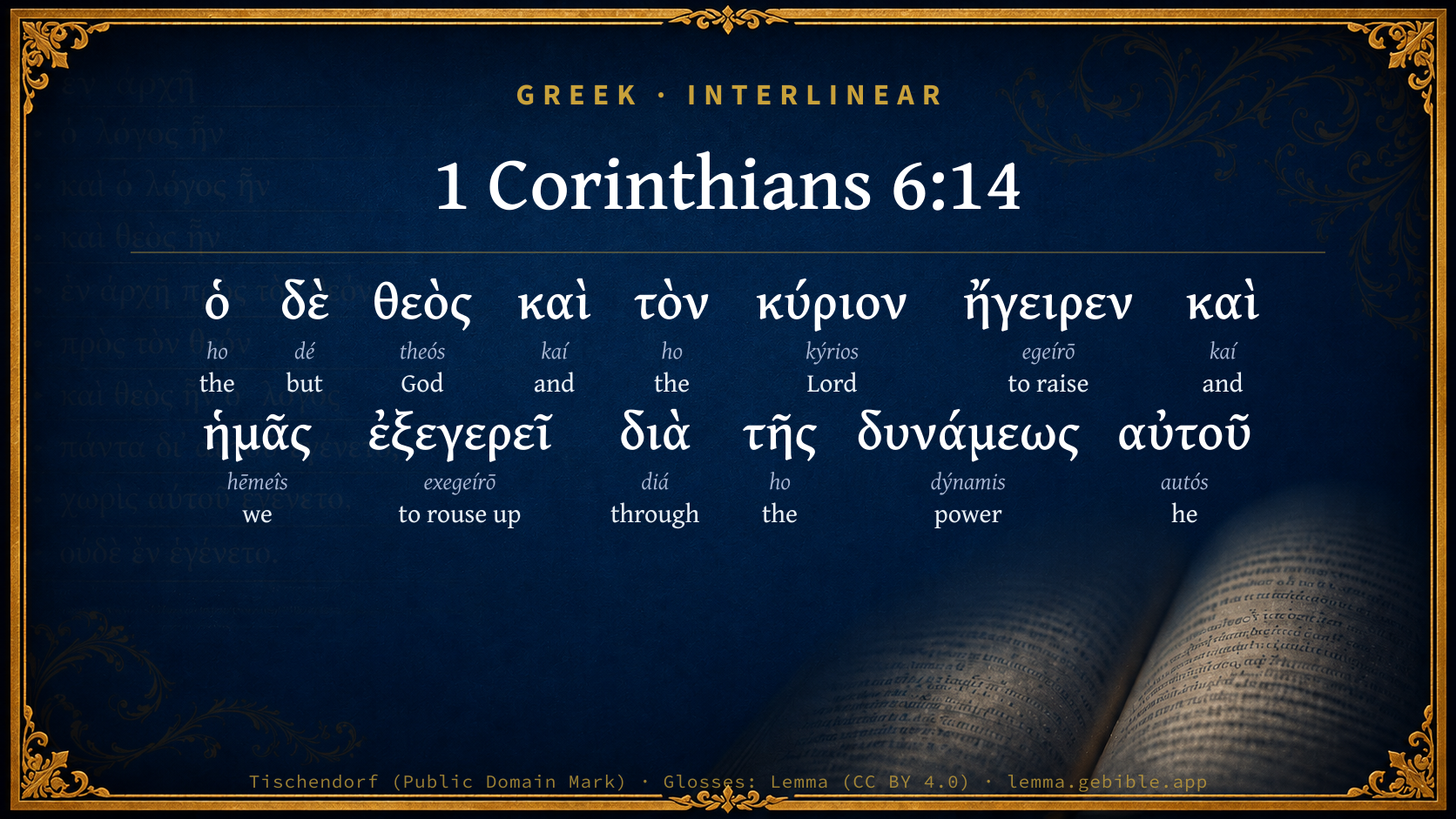
Greek (Tischendorf 8th ed.) 1 Corinthians 6:14 appears in the Greek New Testament. The text above is from the Tischendorf 8th edition. Each word links to its Strong’s number and a concise gloss. Click any word for its full Thayer’s Greek Lexicon entry.
Download image
Cite this verse

1 Corinthians 6:14 (World English Bible). Public Domain. Lemma interlinear Bible study tool, https://lemma.gebible.app/v/1-corinthians/6/14.

Show BibTeX & RIS
BibTeX
RIS
English Translation
Now God raised up the Lord, and will also raise us up by his power.
World English Bible · Public Domain
Download a study sheet

One document with this verse’s original text, its word-by-word gloss line, the meaning frame, cross-references with their text, attributed commentary, and full source and license credits — printable, and it pastes into notes with its structure intact.

This verse Autodidact and up

Study sheet (.html) Plain text (.txt)

A passage Seminary Student

Up to 50 verses in one chapter. A passage sheet keeps up to 6 commentary sources and 12 cross-references per verse, in the order this page ranks them, and says so on the sheet whenever that leaves anything out. Ask for a single verse and you get the Autodidact verse sheet above.

Everything on this page stays free to read, with no account — the sheet is a download of what is already on screen, not access to it.

Want to remove ads? Support Godless Engineer
Compare translations 3

The same verse in 3 English versions, stacked beneath the original-language interlinear above. Click any original word for its lexicon entry.

Each is an independent rendering of the whole verse — the interlinear is not word-aligned to these translations.

Highlighted words mark where these versions differ — a whole-verse word diff, not a word-by-word alignment.

  • World English Bible Public Domain
    Now God raised up the Lord, and will also raise us up by his power.
  • King James Version Public Domain
    And God hath both raised up the Lord, and will also raise up us by his own power.
  • unfoldingWord Literal Text CC BY-SA 4.0
    Now God indeed raised the Lord and will also raise up us by his power.

unfoldingWord Literal Text — © unfoldingWord, licensed CC BY-SA 4.0. Word-aligned USFM3 via Door43 (git.door43.org/unfoldingWord/en_ult).

Versions to compare (up to 4)

3 of 4 selected

Show all 19 translations

Every available English version of this verse, each an independent rendering of the whole verse.

  • World English Bible Public Domain
    Now God raised up the Lord, and will also raise us up by his power.
  • Berean Standard Bible Public Domain
    By His power God raised the Lord from the dead, and He will raise us also.
  • Majority Standard Bible Public Domain
    By His power God raised the Lord from the dead, and He will raise us also.
  • King James Version Public Domain
    And God hath both raised up the Lord, and will also raise up us by his own power.
  • American Standard Version (1901) Public Domain
    and God both raised the Lord, and will raise up as through his power.
  • Revised Version (1885) Public Domain
    and God both raised the Lord, and will raise up us through his power.
  • Geneva Bible (1599) Public Domain
    And God hath also raised vp the Lord, and shall raise vs vp by his power.
  • Douay-Rheims (1899) Public Domain
    Now God hath both raised up the Lord, and will raise us up also by his power.
  • Young's Literal Translation Public Domain
    and God both the Lord did raise, and us will raise up through His power.
  • Literal Standard Version CC BY-SA 4.0
    and God raised both the LORD, and will raise us up through His power.
  • Unlocked Literal Bible CC BY-SA 4.0
    God both raised the Lord and will also raise us up by his power.
  • unfoldingWord Literal Text CC BY-SA 4.0
    Now God indeed raised the Lord and will also raise up us by his power.
  • Darby Bible Public Domain
    And God has both raised up the Lord, and will raise us up from among [the dead] by his power.
  • World Messianic Bible Public Domain
    Now God raised up the Lord, and will also raise us up by his power.
  • Webster's Bible Public Domain
    And God hath both raised up the Lord, and will also raise up us by his own power.
  • Free Bible Version CC BY-SA 4.0
    By his power God raised the Lord from the dead, and he will raise us up the same way.
  • Bible in Basic English Public Domain
    And God who made the Lord Jesus come back from the dead will do the same for us by his power.
  • Text-Critical English NT CC BY 4.0
    Now God raised the Lord and will also raise us up by his power.
  • Tyndale New Testament (1534) Public Domain
    God hath raysed vp the Lorde and shall rayse vs vp by his power.

Literal Standard Version (2020), Covenant Press — licensed CC BY-SA 4.0. Text via the HelloAO Bible API (eBible.org). Unlocked Literal Bible (unfoldingWord) — licensed CC BY-SA 4.0. Text via the HelloAO Bible API (eBible.org). unfoldingWord Literal Text — © unfoldingWord, licensed CC BY-SA 4.0. Word-aligned USFM3 via Door43 (git.door43.org/unfoldingWord/en_ult). Free Bible Version, Dr. Jonathan Gallagher — licensed CC BY-SA 4.0. Text via the HelloAO Bible API (eBible.org).

Word by word

More ways to search: Search by grammar → Find every occurrence → Compare this word →

Practice this passage: Drill this verse → Learn its vocabulary →

ἐξεγερεῖ
exegeírō
G1825
“to rouse up”
Verb, Future, Active, Indicative, 3rd person, Singular
Part of Speech
Verb
Tense
Future
Voice
Active
Mood
Indicative
Person
3rd person
Number
Singular
Full Thayer's Definition

Origin: from G1537 and G1453

TDNT: 07:38,2

1. to arouse, raise up (from sleep) 2. to rouse up, stir up, incite
  1. ὁ ho G3588 “the” Article, Nominative, Singular, Masculine
  2. δὲ dé G1161 “but” Conjunction
  3. θεὸς theós G2316 “God” Noun, Nominative, Singular, Masculine
  4. καὶ kaí G2532 “and” Conjunction
  5. τὸν ho G3588 “the” Article, Accusative, Singular, Masculine
  6. κύριον kýrios G2962 “Lord” Noun, Accusative, Singular, Masculine
  7. ἤγειρεν egeírō G1453 “to raise” Verb, Aorist, Active, Indicative, 3rd person, Singular
  8. καὶ kaí G2532 “and” Conjunction
  9. ἡμᾶς hēmeîs G2249 “we” Personal pronoun, 1st person, Accusative, Plural
  10. διὰ diá G1223 “through” Preposition
  11. τῆς ho G3588 “the” Article, Genitive, Singular, Feminine
  12. δυνάμεως dýnamis G1411 “power” Noun, Genitive, Singular, Feminine
  13. αὐτοῦ autós G846 “he” Personal pronoun, Genitive, Singular, Masculine

About this verse

These counts appear in no published source. They are computed here, from the morphology-tagged text and Lemma’s own curated glosses. What Lemma adds →

14
words
11
distinct lemmas
Pauline Epistles
section

Notable vocabulary

The rarest word here is ἐξεγερεῖ to rouse up G1825 — appearing just 2 times in the whole Greek New Testament.

Shared distinctive vocabulary

ἐξεγερεῖ to rouse up G1825 occurs in 2 verses of the Greek New Testament. Also found in:

Repetition

Words recur within this verse:

Cross-references

14

Topical passages linked to 1 Corinthians 6:14 in the Treasury of Scripture Knowledge — connected by theme and wording, ordered by reader-vote popularity; previews shown in the World English Bible.

  • 2 Corinthians 4:14 knowing that he who raised the Lord Jesus will raise us also with Jesus, and will present us with you.
  • Romans 8:11 But if the Spirit of him who raised up Jesus from the dead dwells in you, he who raised up Christ Jesus from the dead will also give life to your mortal bodies through his Spirit who dwells in you.
  • Ephesians 1:19–20 and what is the exceeding greatness of his power toward us who believe, according to that working of the strength of his might
  • Philippians 3:21 who will change the body of our humiliation to be conformed to the body of his glory, according to the working by which he is able even to subject all things to himself.
  • Acts 2:24 whom God raised up, having freed him from the agony of death, because it was not possible that he should be held by it.
  • John 6:39–40 This is the will of my Father who sent me, that of all he has given to me I should lose nothing, but should raise him up at the last day.
  • Romans 6:4–8 We were buried therefore with him through baptism to death, that just like Christ was raised from the dead through the glory of the Father, so we also might walk in newness of life.
  • 1 Thessalonians 4:14 For if we believe that Jesus died and rose again, even so those who have fallen asleep in Jesus will God bring with him.
  • John 11:25–26 Jesus said to her, "I am the resurrection and the life. He who believes in me, though he die, yet will he live.
  • Acts 17:31 because he has appointed a day in which he will judge the world in righteousness by the man whom he has ordained; of which he has given assurance to all men, in that he has raised him from the dead."
  • 1 Corinthians 15:15–20 Yes, we are found false witnesses of God, because we testified about God that he raised up Christ, whom he didn't raise up, if it is so that the dead are not raised.
  • 1 Corinthians 15:23 But each in his own order: Christ the first fruits, then those who are Christ's, at his coming.
  • Philippians 3:10–11 that I may know him, and the power of his resurrection, and the fellowship of his sufferings, becoming conformed to his death;
  • John 5:28–29 Don't marvel at this, for the hour comes, in which all that are in the tombs will hear his voice,

Cross-references courtesy of OpenBible.info (CC BY 4.0).

Commentary

Notes on 1 Corinthians 6:14 from classic Christian and Jewish commentators (each source and its license shown beneath its notes). The classic Christian expositions comment on the surrounding passage and are grouped to its opening verse, so a note may address several verses; the Jewish commentaries on the Tanakh (Rashi and others) are per-verse, so they appear only where the commentator wrote on this verse.

Lemma curates 59 commentaries, every one of them public domain or Creative Commons licensed, each selected and text-cleaned for this edition rather than reprinted as found. About our sources →

Bengel's Gnomon

Johann Albrecht Bengel

1Co 6:14. Ἤγειρε—ἐξεγερεῖ, hath raised—and will raise) [Paul introduces here in the way of prelude those topics, which he was to discuss more fully and distinctly in ch. 15—V. g.] The simple verb is appropriately applied to [Christ] the first fruits, the compound, of rare occurrence, to the general mass of them that sleep. Εξ in composition often signifies consummation. The practical application from the resurrection of our flesh is, sin once committed in the flesh will never be undone.—διὰ, by) Paul would rather connect this with the mentioning of the resurrection, than with that of destruction.—δυνάμεως, power) who then can doubt? God is omnipotent.

Bengel's Gnomon of the New Testament — English translation (T&T Clark, Edinburgh, 1860) — public domain. Text from a community e-Sword module.

Meyer's Critical & Exegetical Commentary

Heinrich August Wilhelm Meyer

1Co_6:14. This is parallel in contents and form to the sentence, ὁ δὲ Θεὸς … καταργήσει, in 1Co_6:13 : Now God has not only raised up the Lord, but will raise up us also by His power. The body, consequently, has a destiny which stretches on into the future eternal αἰών; how wholly different therefore from the κοιλία, that organ of temporal nourishment, which will cease to be!

καὶ τὸν Κύρ. ἤγειρε] necessary assurance of what follows. See Rom_8:11. Comp 1Co_15:20; Col_1:18; 2Co_4:11; 2Co_4:14.

καὶ ἡμᾶς ἐξεγερεῖ[978]] The bodily change in the case of those still alive at the time of the Parousia (1Co_15:51; 2Co_5:2-4; 1Th_4:15 ff.) did not need to be specially mentioned, since Paul was not here to enter into detail upon the doctrine of the resurrection. Comp on Rom_8:11. He therefore, in accordance with the τὸν Κύρ. ἤγειρε, designates here the consummation of all things only a potiori, namely, as a raising up, speaking at the same time in the person of Christians generally (ἡμᾶς), and leaving out of view in this general expression his own personal hope that he might survive to the Parousia.

The interchange of ἤγ. and ἐξεγ. (out of the grave, comp ἐξανάστασις τῶν νεκρῶν, Php_3:11) is accidental, without any special designin opposition to Bengel and Osianders arbitrary opinion that the former word denoted the first-fruits, and the latter the massa dormientium.[981]

αὐτοῦ]not αὑτοῦ, because uttered from the standpoint of the writerapplies to God, not to Jesus (Theodoret); and διὰ τῆς δυνάμ. αὐτ. should be referred not to both the clauses in the sentence (Billroth), but, as its position demands, to ἐξεγερεῖ; for to the ground of faith which the latter has in καὶ τὸν Κύριον ἤγειρε, Paul now adds its undoubted possibility (Mat_22:29), perhaps glancing purposely at the deniers of the resurrection, τῇ ἀξιοπιστίᾳ τῆς τοῦ ποιοῦντος ἰσχύος τοὺς ἀντιλέγοντας ἐπιστομίζων, Chrysostom.

[978] If ἐξεγείρει were the true reading (but see the critical remarks), the tense employed would in that case bring before us as present what was certain in the future. If ἐξήγειρε were correct, we should have to interpret this according to the idea of the resurrection of believers being implied in that of Christ, comp. Col_2:12.

[981] Against this view may be urged the consideration, in itself decisive, that in the whole of chap. 15. ἐγείρω is the term constantly used both of Christs resurrection and that of believers; whereas ἐξεγείρω occurs in all the N. T. only here and Rom_9:17 (in the latter passage, however, not of the rising of the dead).

Meyer — Critical and Exegetical Commentary on the New Testament — English translation by Peter Christie, edited by Frederick Crombie (T&T Clark, 1880) — public domain. Text from a community e-Sword module.

Expositor's Greek Testament

ed. W. Robertson Nicoll

1Co 6:14 is parl [971] to 1Co 6:13 b (“God” the agent in both), as 1Co 6:13 c to 1Co 6:13 a : the previous δὲ contrasted the several natures of βρώματα and σῶμα ; this the opp [972] issues , καταργήσει and ἐξεγερεῖ . ὁ Κύριος is the determining factor of both contrasts. “God will abolish both the belly and its foods … but God both raised up the Lord, and will raise up us also through His power.” P. substitutes “us,” in the antithesis, for “our bodies,” since the man , including his body (see 1Co 15:35 ; 1Co 15:49 ) is the subject of resurrection. The saying ἀπαρχὴ Χριστός , of 1Co 15:23 , supplies the nexus between τ . Κύριον ἤγειρεν and ἡμ . ἐξεγερεῖ ; cf. also 2Co 4:14 , Rom 8:11 ; Rom 14:9 , Col 3:1 , Phi 3:21 ; Joh 5:20-30 ; Joh 14:2 ff., etc. The prefix in ἐξ - εγερεῖ is local out of ( sc. the grave; cf. ἐξ - ανάστασις , Phi 3:11 ); not de massa dormientium (Bg [973] ). The raising of Christ ( cf. Eph 1:19 ff.), then of Christians, from the dead is the supreme exhibition of God’s supernatural “power” (see Rom 4:17-24 , Mat 22:29 , Act 26:8 , etc.). Christ is raised as “Lord,” and will rule our life yon side of death more completely than on this (Act 2:36 , Col 1:18 , Phi 3:20 f.).

[971] parallel.

[972] opposite, opposition.

[973] Bengel’s Gnomon Novi Testamenti.

The Expositor's Greek Testament, edited by W. Robertson Nicoll (1897–1910) — public domain. Text from a community e-Sword module.

Hodge's Commentary on Romans, Ephesians & First Corinthians

Charles Hodge

1Co_6:14

And God hath both raised up the Lord, and will also raise up us by his own power.

The destiny of the body being what is stated in the preceding verse, it is not to perish, but is to share in the resurrection of Christ. He who raised Christ from the dead shall also quicken our mortal bodies by his Spirit that dwelleth in us,‹5› Rom_8:11. This verse is parallel to the second clause of 1Co_6:13. Of the stomach and meats, it is said, God will destroy both it and them; of the Lord and the body it is said, As he raised up the one, he will also raise up the other. The cases, therefore, are widely different. The relation between our organs of digestion and food is temporary; the relation between Christ and the body is permanent. What concerns the former relation is a matter of indifference; what concerns the other touches the groundwork of our nature and the design for which we were created. On this destiny of the body compare 1Co_15:15, 1Co_15:20, 35-56; Phi_3:21; Rom_8:11; 2Co_4:14; 1Th_4:14.

Charles Hodge — Commentary on Romans (1835), First Corinthians (1857), and Ephesians (1856) — public domain. Text from a community e-Sword module.

Jamieson, Fausset & Brown

Robert Jamieson, A. R. Fausset & David Brown

(Rom 8:11).

raised up--rather, "raised," to distinguish it from "will raise up us"; the Greek of the latter being a compound, the former a simple verb. Believers shall be raised up out of the rest of the dead (see on Phi 3:11); the first resurrection (Rev 20:5).

us--Here he speaks of the possibility of his being found in the grave when Christ comes; elsewhere, of his being possibly found alive (Th1 4:17). In either event, the Lord's coming rather than death is the great object of the Christian's expectation (Rom 8:19).

Jamieson, Fausset & Brown — Commentary Critical and Explanatory on the Whole Bible (1871) — public domain (CC PDM 1.0). Text via the HelloAO Bible API.

Adam Clarke's Commentary

Verse 14. And God hath both raised up the Lord] He has raised up the human nature of Christ from the grave, as a pledge of our resurrection; and will also raise us up by his own power, that we may dwell with him in glory for ever.

Adam Clarke's Commentary on the Bible (1810–1826) — public domain. Text from a community e-Sword/MySword module.

John Calvin's Commentaries

14. And God hath also raised up the Lord He shows from Christ’s condition how unseemly fornication is for a Christian man; for Christ having been received into the heavenly glory, what has he in common with the pollutions of this world? Two things, however, are contained in these words. The first is, that it is unseemly and unlawful, that our body, which is consecrated to Christ, should be profaned by fornication, inasmuch as Christ himself has been raised up from the dead, that he might enter on the possession of the heavenly glory. The second is, that it is a base thing to prostitute our body to earthly pollutions, while it is destined to be a partaker along with Christ of a blessed immortality and of the heavenly glory. There is a similar statement in Colossians 3:1, If we have risen with Christ, etc., with this difference, that he speaks here of the last resurrection only, while in that passage he speaks of the first also, or in other words, of the grace of the Holy Spirit, by which we are fashioned again to a new life. As, however, the resurrection is a thing almost incredible (Acts 26:8) to the human mind, when the Scripture makes mention of it, it reminds us of the power of God, with the view of confirming our faith in it. (Matthew 22:29.)

John Calvin's Commentaries (1540-1563) — public domain. Text from the Calvin Translation Society English edition (1840s-50s) via the Christian Classics Ethereal Library (ccel.org). Calvin's coverage is partial (roughly two-thirds of the Bible); uncommented books and verses are honest gaps, never fabricated. The 19th-century editor's footnotes and remarks are omitted so the notes are faithfully Calvin's own voice.

Ellicott's Commentary for English Readers

(14) Will also raise up us.—This phrase is remarkable as one of the few which show that the Apostle, while he in common with the early Church expected the early advent of Christ, did not think that it would necessarily occur in his own lifetime. Here, as ever, the resurrection of the dead, when we shall receive our spiritual body instead of the natural body, is joined with the fact of the resurrection of Christ the firstfruits.

A Bible Commentary for English Readers, edited by Charles John Ellicott (1878–1897) — public domain. Text from a community e-Sword module.

The Cambridge Bible for Schools and Colleges

gen. ed. J. J. S. Perowne

14. and will also raise up us] Unlike the belly, whose functions shall cease, the body, through its Lord, is destined to an enduring life. We are taught in Rom_8:11, in ch. 15, and by that much neglected article in the Creed, “The Resurrection of the Body,” that Christ came to save, sanctify, and raise again, not our souls only, but our bodies.

by his own power] Our version has rendered definite here what in the original is indefinite. It is impossible to say for certain whether the word “His” refers to the Father or to Christ; but the analogy of St Joh_5:21; Joh_5:25; Joh_5:28; Joh_11:25, and especially 2Co_4:14, would lead us to the conclusion that Christ is here meant. But see Eph_1:19-20. There seems to be a distinction implied in the Greek of this verse between the raising of Christ, who saw no corruption, and the raising us from our state of corruption and almost annihilation, through the power of Christ.

The Cambridge Bible for Schools and Colleges (gen. ed. J. J. S. Perowne; Cambridge University Press, 1878–1918) — public domain. Text from a community e-Sword module.

John Gill's Exposition

And God hath both raised up the Lord,.... God the Father has raised up from the dead the Lord Jesus Christ, though not exclusive of the Son, who was equally concerned in the resurrection of himself, whereby he demonstrated himself to be the Son of God, truly and properly God.

And will also raise up us by his own power; for the resurrection of the dead, whether of Christ, or of his people, is an act of power, of God's own power, even of his almighty power, and is what the power of a mere creature could never effect. Now as Christ, the head, is raised, so shall all his members by the same power; their bodies will be raised powerful, glorious, incorruptible; and spiritual; an argument that they were never made for fornication, nor to be defiled with such uncleanness.

John Gill's Exposition of the Whole Bible (1746–1763) — public domain (CC PDM 1.0). Text via the HelloAO Bible API.

Trapp's Complete Commentary

John Trapp

14 And God hath both raised up the Lord, and will also raise up us by his own power.

Ver. 14. And will also raise us up] He will make our vile bodies to be like unto his glorious body, the standard. Shall we then defile them with the kitchen stuff of uncleanness?

John Trapp, A Commentary or Exposition upon All the Books of the Old and New Testament (1647–1656) — public domain. Text from a community e-Sword module.

Albert Barnes' Notes on the Bible

And God hath both raised up ... - This is the “second” argument against indulgences in this sin. It is this. “We are united to Christ. God has raised him from the dead, and made his body glorified. Our bodies will be like his (compare Phi 3:21); and since our body is to be raised up by the power of God; since it is to be perfectly pure and holy, and since this is to be done by his agency, it is wrong that it should be devoted to purposes of pollution and lust.” It is unworthy:

(1) Of our connection with that pure Saviour who has been raised from the dead - the image of our resurrection from the death and defilements of sin (compare the notes at Rom 6:1-12); and,

(2) Unworthy of the hope that our bodies shall be raised up to perfect and immortal purity in the heavens. No argument could be stronger. A deep sense of our union with a pure and risen Saviour, and a lively hope of immortal purity, would do more than all other things to restrain from licentious indulgences.

Albert Barnes' Notes on the Bible (1834–1885) — public domain. Text from a community e-Sword/MySword module.

Matthew Poole's English Annotations

And God hath both raised up the Lord; the Lord Jesus Christ, as the first-fruits of those that sleep, from whose resurrection the apostle largely proveth our resurrection, 1Co 15:1-58.

And will also raise up us by his own power: God will raise up his saints by his own Almighty power.

Matthew Poole's English Annotations on the Holy Bible (1683–1685) — public domain. Text from a community e-Sword/MySword module.

Whedon's Commentary on the Bible

Daniel D. Whedon

14. And—In accordance with this correlation between our bodies and the Lord.

Raise up us—So that while the correlation between the stomach and the food God will destroy at death, the correlation between our body and the Lord, God will renew in the resurrection.

Daniel D. Whedon (gen. ed.), Commentary on the Old and New Testaments (1874–1909) — public domain. Text from a community e-Sword module.

The Pulpit Commentary

God hath both raised up the Lord. St. Paul always grounds man"s resurrection] and immortality on the resurrection and ascension of Christ (see ch. 15.; 2Co_4:14; Rom_6:5, 8 8:11)

The Pulpit Commentary (1880–1919), ed. H.D.M. Spence-Jones & Joseph S. Exell — public domain. Text from a community e-Sword module.

Burkitt's Expository Notes on the New Testament

William Burkitt

Here a second argument against fornication is taken from the body’s resurrection: Our bodies are to be raised, therefore not to be defiled; to be fashioned like unto Christ’s glorious body in heaven, therefore not to be defiled with lusts here on earth.

As if he had said, "Were your bodies to be finally lost in the dust, then were it no great matter how you used them, or abused them: but as God hath raised up Christ’s body, so he will raise up your body; and seeing your body is the garment which your soul is to wear to all eternity in heaven, keep it pure and undefiled here on earth."

William Burkitt's Expository Notes on the New Testament (1700–1703) — public domain. Text from a community e-Sword module.

Godbey's Commentary on the New Testament

William B. Godbey

14-17. Here the apostle runs on with his illustrative argument, showing the inconsistency of fornication, as the soul is wedded to Christ, her Divine Spouse, eternally absorbed from all other lovers.

William B. Godbey, Commentary on the New Testament (1896–1900) — public domain. Text from a community e-Sword module.

McGarvey & Pendleton's Commentaries

J. W. McGarvey

and God both raised the Lord, and will raise up us through his power .

J. W. McGarvey (with Philip Y. Pendleton), Commentaries on the New Testament (The Fourfold Gospel, 1914; Acts; and the epistles) — public domain. Text from a community e-Sword/MySword module.

The People's New Testament

B. W. Johnson

14. And God … will also raise us up. As the Lord was raised, so shall we be. Hence, we are for a nobler purpose than engaging in sensuality.

B. W. Johnson's The People's New Testament with Notes (1889–1891) — public domain. Electronic text from the Christian Classics Ethereal Library (CCEL) ThML edition.

unfoldingWord translationNotes

Door43 World Missions Community

raised the Lord

"caused the Lord to live again"

Do you not know that your bodies are members of Christ?

The word translated as "members" refers to parts of a body. Our belonging to Christ is spoken of as if we were parts of his body. We belong to him so much that even our bodies belong to him. Paul uses this question to remind the people of something they should already know. AT: "You should know that your bodies belong to Christ" (See: Metaphor and Rhetorical Question)

Shall I then take away the members of Christ and join them to a prostitute? May it not be!

Paul uses this question to emphasize how wrong it is for someone who belongs to Christ to go to a prostitute. AT: "I am part of Christ. I will not take my body and join myself to a prostitute!" or "We are parts of Christ's body. We must not take our bodies and join ourselves to prostitutes!" (See: Rhetorical Question)

May it not be!

"That should never happen!" or "We must never do that!"

translationWords

raise

lord

power

know

body

member

Christ

prostitute

unfoldingWord translationNotes — © Distant Shores Media and the Door43 World Missions Community, licensed CC BY-SA 4.0. Source: git.door43.org/Door43/en_tn.

Cambridge Greek Testament for Schools and Colleges

14. καὶ ἡμᾶς ἐξεγερεῖ. Christ’s Resurrection is the pledge of our own. See ch. 1Co 15:23.

διὰ τῆς δυνάμεως αὐτοῦ. It is impossible to say for certain whether the word αὐτοῦ refers to the Father or to Christ; but the analogy of Joh 5:21; Joh 5:25; Joh 5:28; Joh 11:25, and especially 2Co 4:14, would lead us to the conclusion that Christ is here meant. Yet see Eph 1:19-20. There seems to be a distinction implied here between the raising of Christ (ἤγειρεν), who saw no corruption, and the raising us (ἐξεγερεῖ) from our state of corruption through the power of Christ.

Cambridge Greek Testament for Schools and Colleges (Cambridge University Press, 1896; 21 vols, various authors incl. Carr, Maclear, Plummer, Farrar, Lumby, Moule, M. R. James, Simcox) — public domain. Text from a community e-Sword module.

Alford’s Greek Testament

Henry Alford

14.] “a cibis ad venerem non valet consequentia.” Bengel. The argument is,—meats (of which he doubtless had often impressed on them that they were ἀδιάφορα, whence the abuse) are expressly created for the belly, and the belly for them, by its organization being fitted to assimilate them; and both these are of a transitory nature: in the change to the more perfect state, God will do away with both. Therefore meats are ἀδιάφορα. But neither is the body created for fornication, nor can this transitoriness be predicated of it: the body is for the Lord, and the Lord (in his mediatorial work) for the body: and God raised up the Lord, and will raise up us (i.e. our bodies): so that the body is not perishable, and (resumed ver. 18) he that fornicates, sins against his own body. Therefore, fornication is not an ἀδιάφορον.

It is very remarkable how these verses contain the germ of three weighty sections of the Epistle about to follow, and doubtless in the Apostle’s mind when he wrote them, (1) the relation between the sexes: (2) the question of meats offered to idols: (3) the doctrine of the Resurrection of the Body. See Neander, Pfl. u. Leit. p. 401, note 21.

14.] So far from the case of the Lord and the body answering to the other, God raised up the Lord (Rom 8:11, al. fr.), and will raise up us too by His power. I cannot adopt here the reading (ἐξήγειρεν), or the view, of Meyer. He holds, that all reference to the resurrection, as a thing future, is out of place: that the Apostle refers to the virtual and proleptic resurrection which has already taken place in the case of the believer, as Eph 2:6; Col 2:12,—and thinks that the reading ἐξεγερεῖ has arisen from not seeing this. But how unnatural will the construction thus be—ὁ δὲ θεὸς καὶ τὸν κύριον ἤγειρεν, καὶ ἡμᾶς ἐξήγειρεν, διὰ τ. δυν. αὐτοῦ! I can conceive no account of such a sentence, except that some emphasis is meant to be laid on the distinction between ἤγειρεν and ἐξήγειρεν which idea (maintained by Bengel, al.) Meyer himself very properly repudiates: see below. The future corresponds to καταργήσει, and is used with ἡμᾶς,—contrary to the usual practice of Paul, who expected to be alive at the παρουσία,—as the expression, in the first person, of the truth of the future resurrection, not destruction of the body. ἤγειρεν, viz. ἐκ νεκρῶν, Act 3:15; Rom 4:24, and passim: ἐξεγερεῖ, viz. ἐκ νεκρῶν. So that there is no real difference between the two words.

Henry Alford, The Greek Testament (1849–1861) — public domain. Text from a community e-Sword module.

International Critical Commentary

14. ὁ δὲ Θεός. This is parallel to ὁ δὲ Θεός in v. 13, and puts the contrast between the two cases in a very marked way. In the case of the κοιλία, and the βρώματα to which it is related, God will reduce both of them to nothingness. In the case of the κοιλία, and the Βρώματα to which it is related, God will reduce both of them to nothingness. In the case of the σῶμα, and the Κύριος to which it is related, God has raised the Κύριος, and will raise up the σῶμα of every one who is a member of Him. The contrast between the two cases in complete. On the other hand, the close relationship between the Lord and all true Christians is shown by the doubled conjunction; καὶ τὸν Κύριον … καὶ ἡμᾶς. See Sanday (The Life of Christ in Recent Research, p. 132) on the view that it was St Paul who deified Christ.

The change from the simple (ἤγειρεν) to the compound verb (ἐξεγερεῖ) has perhaps little meaning. In late Greek, compounds do not always have any additional force, and the difference is not greater than that between ‘raise’ and ‘raise up.’ The compound may be used to mark the future raising as not less sure than the one which is past, and it is well to mark the difference, as RV. does. AV., with ‘raise up’ for both, ignores the change, as does Vulg., suscitavit … suscitabit, and Iren. int. (5:6:2). The compound occurs only here and Rom 9:17 in N.T.; in LXX it is very frequent. See on ἐξαπατάτω, 3:18.

διὰ τῆς δυνάμεως αὐτοῦ. This may qualify both verbs, but is more appropriate to ἐξεγερεῖ. There was need to remind the Corinthians of God’s power, in order to confirm their belief in their own future resurrection (15:12); but no one who believed that Christ had been raised needed to be reminded of that: cf. Mat 22:29. It is worth observing that St Paul does not take any account of the quick’ who will not need to be raised. Contrast 15:51; 1Th 4:15 f.; Rom 8:11.

ἐξεγερεῖ (א C D3 E,KL Vulg. Syrr. Copt. Aeth.) is probably to be preferred to ἐξεγείρει (A Dא Q, d e suscitat), or to ἐξήγειρεν (B, Am. suscitavit). ἐξεγειρεῖ(P) may be regarded as supporting either of the first two, of which ἐξεγείρει may be safely set aside. It is possible that B has preserved the original reading, for no intelligent copyist would alter ἐξεγερεῖ into ἐξήγειρεν, but an unintelligent one might assimilate the second verb to the first. If ἐξήγειρεν is regarded as original it may be explained as referring to spiritual resurrection to newness of life, or possibly as referring to our resurrection as comprised potentially in that of Christ: ‘God both raised the Lord and (by so doing) raised up us.’ But it is unlikely that the Apostle would have obscured the cetainty of the future resurrection of the body by using language which would have encouraged Hymenæsus and Philetus (2Ti 2:17, 2Ti 2:18). Qui dominum suscitavit, et nos suscitabit (Tert. Marc. v. 7).

International Critical Commentary — older volumes (1896–1929), various authors — public domain. Text from a community e-Sword module.

Vincent's Word Studies in the New Testament

Marvin R. Vincent

Will raise up us. The body being destined to share with the body of Christ in resurrection, and to be raised up incorruptible, is the subject of a higher adaptation, with which fornication is incompatible.

Marvin R. Vincent, Word Studies in the New Testament (1887–1900) — public domain. Text from a community e-Sword/MySword module.

Lesson kit

Teaching starters — assembled from the data on this page, not authored interpretation. Every prompt links to the verse data it draws on. Edit before teaching.

1 Corinthians, in the Pauline Epistles, opens this verse with 14 words (11 distinct Greek lemmas). Its most distinctive word is exegeírō (“to rouse up”). A historical commentator’s framing appears above. Read the whole chapter for the surrounding context.

Discussion questions

  1. How does “to rouse up” (exegeírō) shape what this verse is saying?
  2. Romans 9:17 shares the word «to rouse up» with this verse. How do the two illuminate each other?
  3. “the” occurs 3× in this one verse. What is the effect of the repetition?
  4. The translations on this page render this verse differently — a whole-verse word diff, not a word-by-word alignment. What might account for the different wordings?
  5. Reading how Bengel's Gnomon and Meyer's Critical & Exegetical Commentary read this verse, where do the two commentators agree and where do they part?

Things to notice

Reading settings

Reading text

Shown beneath each verse's original-language words.

Old Testament
Old Testament edition

Read the OT as the Masoretic Hebrew (MT) or the Greek Septuagint (LXX).

English shown for the Greek Septuagint (in the Hebrew ↔ Greek comparison).

Comparing translations? Open the Compare panel on any verse page to stack up to four side by side.