
1 Corinthians 11:6

Greek (Tischendorf 8th ed.) 1 Corinthians 11:6 appears in the Greek New Testament. The text above is from the Tischendorf 8th edition. Each word links to its Strong’s number and a concise gloss. Click any word for its full Thayer’s Greek Lexicon entry.
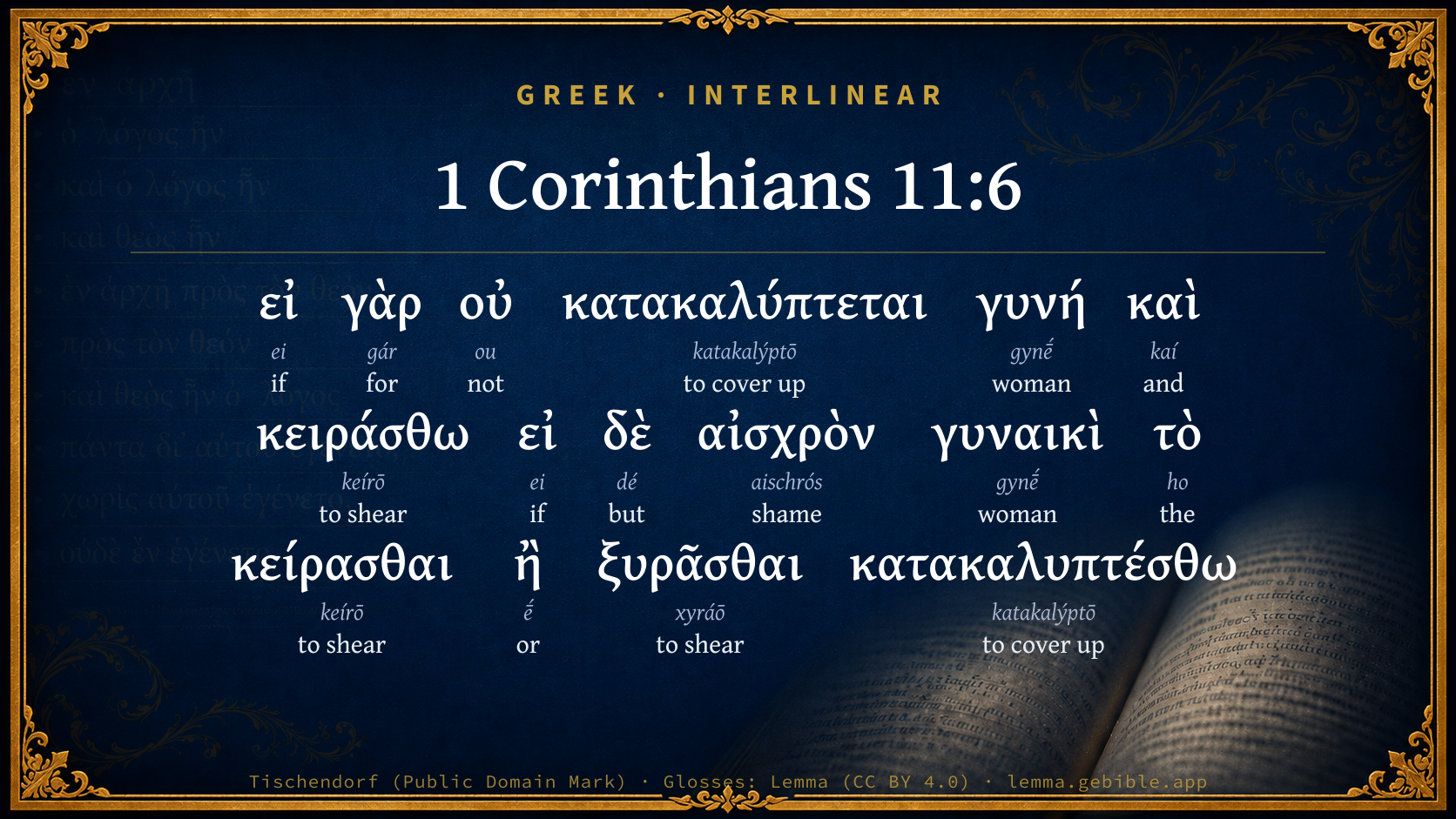
Download image
Cite this verse

1 Corinthians 11:6 (World English Bible). Public Domain. Lemma interlinear Bible study tool, https://lemma.gebible.app/v/1-corinthians/11/6.

Show BibTeX & RIS
BibTeX
RIS
English Translation
For if a woman is not covered, let her also be shorn. But if it is shameful for a woman to be shorn or shaved, let her be covered.
World English Bible · Public Domain
Highlights
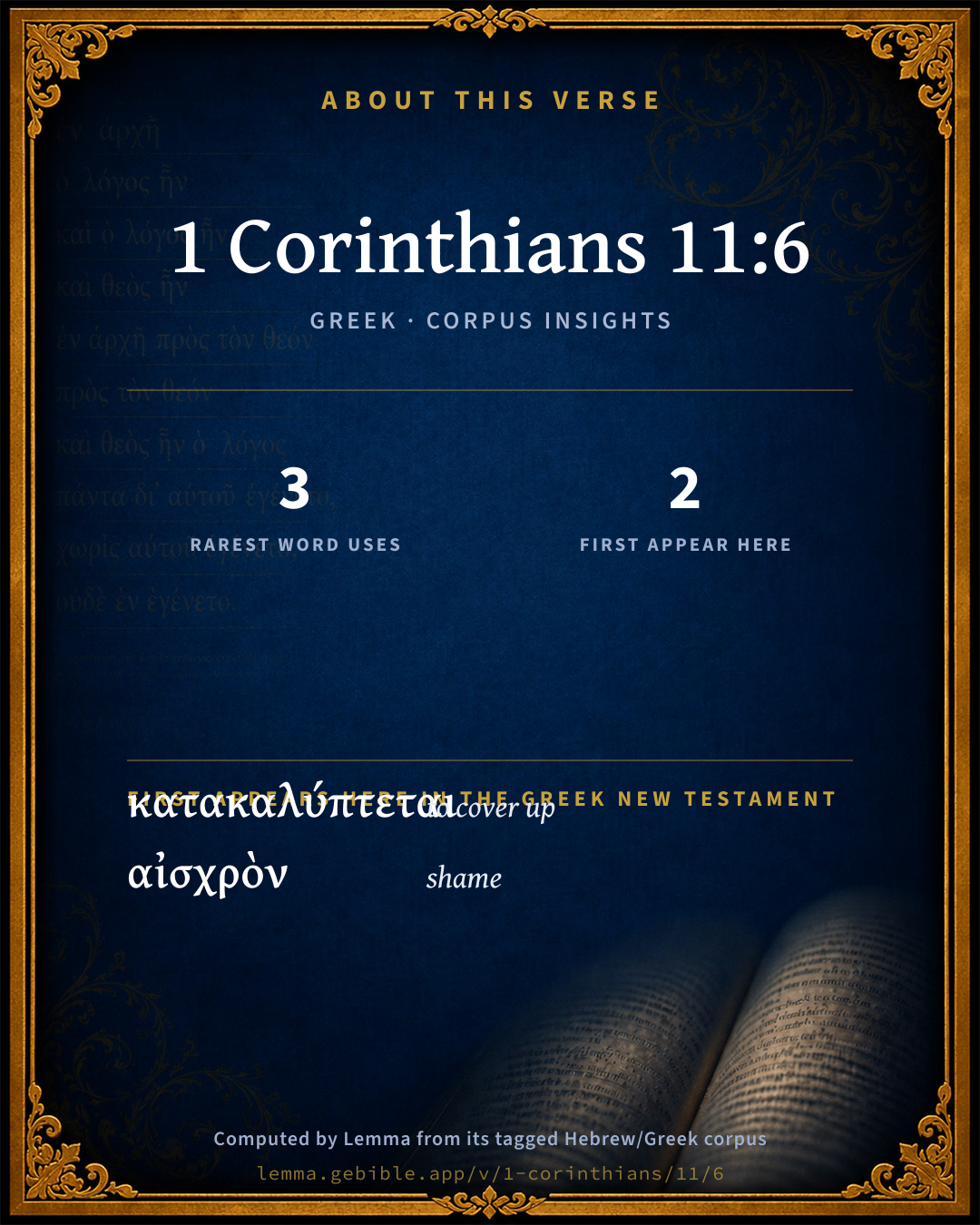
  • 2 first appearances in the Greek New Testament
Full analysis ↓
Download a study sheet

One document with this verse’s original text, its word-by-word gloss line, the meaning frame, cross-references with their text, attributed commentary, and full source and license credits — printable, and it pastes into notes with its structure intact.

This verse Autodidact and up

Study sheet (.html) Plain text (.txt)

A passage Seminary Student

Up to 50 verses in one chapter. A passage sheet keeps up to 6 commentary sources and 12 cross-references per verse, in the order this page ranks them, and says so on the sheet whenever that leaves anything out. Ask for a single verse and you get the Autodidact verse sheet above.

Everything on this page stays free to read, with no account — the sheet is a download of what is already on screen, not access to it.

Want to remove ads? Support Godless Engineer
Compare translations 3

The same verse in 3 English versions, stacked beneath the original-language interlinear above. Click any original word for its lexicon entry.

Each is an independent rendering of the whole verse — the interlinear is not word-aligned to these translations.

Highlighted words mark where these versions differ — a whole-verse word diff, not a word-by-word alignment.

  • World English Bible Public Domain
    For if a woman is not covered, let her also be shorn. But if it is shameful for a woman to be shorn or shaved, let her be covered.
  • King James Version Public Domain
    For if the woman be not covered, let her also be shorn: but if it be a shame for a woman to be shorn or shaven, let her be covered.
  • unfoldingWord Literal Text CC BY-SA 4.0
    For if a woman does not cover her head, let her hair also be cut off. But if disgraceful for a woman to have her hair cut off or to be shaved, let her cover her head.

unfoldingWord Literal Text — © unfoldingWord, licensed CC BY-SA 4.0. Word-aligned USFM3 via Door43 (git.door43.org/unfoldingWord/en_ult).

Versions to compare (up to 4)

3 of 4 selected

Show all 19 translations

Every available English version of this verse, each an independent rendering of the whole verse.

  • World English Bible Public Domain
    For if a woman is not covered, let her also be shorn. But if it is shameful for a woman to be shorn or shaved, let her be covered.
  • Berean Standard Bible Public Domain
    If a woman does not cover her head, she should have her hair cut off. And if it is shameful for a woman to have her hair cut or shaved off, she should cover her head.
  • Majority Standard Bible Public Domain
    If a woman does not cover her head, she should have her hair cut off. And if it is shameful for a woman to have her hair cut or shaved off, she should cover her head.
  • King James Version Public Domain
    For if the woman be not covered, let her also be shorn: but if it be a shame for a woman to be shorn or shaven, let her be covered.
  • American Standard Version (1901) Public Domain
    For if a woman is not veiled, let her also be shorn: but if it is a shame to a woman to be shorn or shaven, let her be veiled.
  • Revised Version (1885) Public Domain
    For if a woman is not veiled, let her also be shorn: but if it is a shame to a woman to be shorn or shaven, let her be veiled.
  • Geneva Bible (1599) Public Domain
    Therefore if the woman be not couered, let her also be shorne: and if it be shame for a woman to be shorne or shauen, let her be couered.
  • Douay-Rheims (1899) Public Domain
    For if a woman be not covered, let her be shorn. But if it be a shame to a woman to be shorn or made bald, let her cover her head.
  • Young's Literal Translation Public Domain
    for if a woman is not covered -- then let her be shorn, and if `it is' a shame for a woman to be shorn or shaven -- let her be covered;
  • Literal Standard Version CC BY-SA 4.0
    for if a woman is not covered—then let her be shorn, and if [it is] a shame for a woman to be shorn or shaven—let her be covered;
  • Unlocked Literal Bible CC BY-SA 4.0
    For if a woman will not cover her head, she should cut her hair short. If it is disgraceful for a woman to have her hair cut off or for her to shave her head, let her cover her head.
  • unfoldingWord Literal Text CC BY-SA 4.0
    For if a woman does not cover her head, let her hair also be cut off. But if disgraceful for a woman to have her hair cut off or to be shaved, let her cover her head.
  • Darby Bible Public Domain
    For if a woman be not covered, let her hair also be cut off. But if [it be] shameful to a woman to have her hair cut off or to be shaved, let her be covered.
  • World Messianic Bible Public Domain
    For if a woman is not covered, let her hair also be cut off. But if it is shameful for a woman to have her hair cut off or be shaved, let her be covered.
  • Webster's Bible Public Domain
    For if the woman is not covered, let her also be shorn: but if it is a shame for a woman to be shorn or shaved, let her be covered.
  • Free Bible Version CC BY-SA 4.0
    If a woman's head is not covered, then she should have her head shaved. If it's scandalous for a woman to be shorn or shaven, then she should have her head covered.
  • Bible in Basic English Public Domain
    For if a woman is not veiled, let her hair be cut off; but if it is a shame to a woman to have her hair cut off, let her be veiled.
  • Text-Critical English NT CC BY 4.0
    If a woman will not veil herself, she should cut off her hair. But if it is disgraceful for a woman to cut off her hair or shave her head, she should wear a veil.
  • Tyndale New Testament (1534) Public Domain
    If the woman be not covered lett her also be shoren. If it be shame for a woman to be shorne or shave let her cover her heed.

Literal Standard Version (2020), Covenant Press — licensed CC BY-SA 4.0. Text via the HelloAO Bible API (eBible.org). Unlocked Literal Bible (unfoldingWord) — licensed CC BY-SA 4.0. Text via the HelloAO Bible API (eBible.org). unfoldingWord Literal Text — © unfoldingWord, licensed CC BY-SA 4.0. Word-aligned USFM3 via Door43 (git.door43.org/unfoldingWord/en_ult). Free Bible Version, Dr. Jonathan Gallagher — licensed CC BY-SA 4.0. Text via the HelloAO Bible API (eBible.org).

Word by word

More ways to search: Search by grammar → Find every occurrence → Compare this word →

Practice this passage: Drill this verse → Learn its vocabulary →

κατακαλύπτεται
katakalýptō
G2619
“to cover up”
Verb, Present, Passive, Indicative, 3rd person, Singular
Part of Speech
Verb
Tense
Present
Voice
Passive
Mood
Indicative
Person
3rd person
Number
Singular
Full Thayer's Definition

Origin: from G2596 and G2572

TDNT: 12:21,4

1. to cover up 2. to veil or cover one's self
  1. εἰ ei G1487 “if” Conditional
  2. γὰρ gár G1063 “for” Conjunction
  3. οὐ ou G3756 “not” Particle, Negative
  4. γυνή gynḗ G1135 “woman” Noun, Nominative, Singular, Feminine
  5. καὶ kaí G2532 “and” Conjunction
  6. κειράσθω keírō G2751 “to shear” Verb, Aorist, Middle, Imperative, 3rd person, Singular
  7. εἰ ei G1487 “if” Conditional
  8. δὲ dé G1161 “but” Conjunction
  9. αἰσχρὸν aischrós G150 “shame” Adjective, Nominative, Singular, Neuter
  10. γυναικὶ gynḗ G1135 “woman” Noun, Dative, Singular, Feminine
  11. τὸ ho G3588 “the” Article, Nominative, Singular, Neuter
  12. κείρασθαι keírō G2751 “to shear” Verb, Aorist, Middle, Infinitive
  13. ἢ ḗ G2228 “or” Particle
  14. ξυρᾶσθαι xyráō G3587 “to shear” Verb, Present, Passive, Infinitive
  15. κατακαλυπτέσθω katakalýptō G2619 “to cover up” Verb, Present, Passive, Imperative, 3rd person, Singular

About this verse

These counts appear in no published source. They are computed here, from the morphology-tagged text and Lemma’s own curated glosses. What Lemma adds →

16
words
12
distinct lemmas
Pauline Epistles
section

Notable vocabulary

The rarest word here is κατακαλύπτεται to cover up G2619 — appearing just 3 times in the whole Greek New Testament.

First appearance in Scripture

These words make their first canonical appearance in the Greek New Testament here:

  • κατακαλύπτεται to cover up G2619
  • αἰσχρὸν shame G150

Shared distinctive vocabulary

κατακαλύπτεται to cover up G2619 occurs in 2 verses of the Greek New Testament. Also found in:
Repetition

Words recur within this verse:

  • κατακαλύπτεται to cover up G2619 ×2
  • γυνή woman G1135 ×2
  • κειράσθω to shear G2751 ×2
  • εἰ if G1487 ×2

Cross-references

1

Topical passages linked to 1 Corinthians 11:6 in the Treasury of Scripture Knowledge — connected by theme and wording, ordered by reader-vote popularity; previews shown in the World English Bible.

  • Deuteronomy 22:5 A woman shall not wear men's clothing, neither shall a man put on women's clothing; for whoever does these things is an abomination to Yahweh your God.

Cross-references courtesy of OpenBible.info (CC BY 4.0).

Commentary

Notes on 1 Corinthians 11:6 from classic Christian and Jewish commentators (each source and its license shown beneath its notes). The classic Christian expositions comment on the surrounding passage and are grouped to its opening verse, so a note may address several verses; the Jewish commentaries on the Tanakh (Rashi and others) are per-verse, so they appear only where the commentator wrote on this verse.

Lemma curates 59 commentaries, every one of them public domain or Creative Commons licensed, each selected and text-cleaned for this edition rather than reprinted as found. About our sources →

Bengel's Gnomon

Johann Albrecht Bengel

1Co 11:6. Κειράσθω, let her be shorn) As the hinder part of the head is by nature in the man and the woman respectively, so in general it is becoming the forehead to be in its mode of dressing: 1Co 11:14. The imperative here is that of permission, but a permission, which has in it mimesis, or a deduction to something unsuitable.[91] So shaving is unbecoming in nuns.—αἰσχρὸν, a shame) So 1Co 11:14. The opposite, comely, 1Co 11:13: glory, 1Co 11:15.—τὸ κείρασθαι, ἢ ξυρᾶσθαι) the one is more than the other. Mic 1:16, ξύρησαι καὶ κεῖραι. ξυρᾶται, the back part of the head; κείρεται, the forehead. In Mic. already quoted, there follows a gradation in the enlargement of the baldness occasioned by shaving.

[91] A woman would not wish κείρασθαι. But if she wishes to be uncovered in front, let her also be uncovered behind, i.e., κειράσθω. This allusion to the supposed words of the woman, whom he refutes, constitutes the mimesis. See Appendix.—ED.

Bengel's Gnomon of the New Testament — English translation (T&T Clark, Edinburgh, 1860) — public domain. Text from a community e-Sword module.

Meyer's Critical & Exegetical Commentary

Heinrich August Wilhelm Meyer

1Co_11:6 gives the ground of ἕν ἐστι κ.τ.λ[1768], 1Co_11:5. That ground is, that the step from not being covered to being shorn is only what consistency demands, while the dishonour again implied in being shorn requires that the woman should be covered; consequently, to be uncovered lies by no means midway between being shorn and being covered as a thing indifferent, but falls under the same moral category as being shorn. For when a woman puts on no covering, when she has once become so shameless, then she should have herself shorn too (in addition). A demand for logical consistency (Winer, p. 292 [E. T. 391]) serving only to make them feel the absurdity of this unseemly emancipation from restraint in public prayer and speaking (for 1Co_11:5 shows that these rules cannot be general ones, against Hofmann). To understand it simply as a permission, does not suit the conclusion; comp on the contrary κατακαλυπτέσθω.

τὸ κείρ ἢ ξυρᾶσθαι] Plus est radi (ξυρ.) quam tonderi, Grotius. Comp Valckenaer. Ξυρ. means to shave, with the razor (ξυρόν). The two words occur together in Mic_1:16, LXX. Note the absence of any repetition of the article in connection with the double description of the one unseemly thing.

[1768] .τ.λ. καὶ τὰ λοιπά.

Meyer — Critical and Exegetical Commentary on the New Testament — English translation by Peter Christie, edited by Frederick Crombie (T&T Clark, 1880) — public domain. Text from a community e-Sword module.

Expositor's Greek Testament

ed. W. Robertson Nicoll

1Co 11:6 , with a second γάρ , presses the above identity; the Ap. bids the woman who discards the veil carry her defiance a step further: “For if a woman is not veiled, let her also crop (her head); but if it is a disgrace for a woman to crop (it) or to keep (it) shaven, let her retain the veil” ( καλυπτέσθω , pr [1619] impv [1620] , continuous ). P. uses the modus tollens of the hypothetical syllogism: “If a woman prefers a bare head, she should remove her hair; womanly feeling forbids the latter, then it should forbid the former, for the like shame attaches to both.” The argument appeals to Gr [1621] and Eastern sentiment; “physical barefacedness led to the inference of moral, in a city like Corinth” (Ev [1622] ). κειράσθω and κείρασθαι , aor [1623] mid [1624] , denote a single act on the woman’s part, “to cut off her locks”; ξυρᾶσθαι , pres. mid [1625] , a shaven condition; the single art [1626] comprises the infs. in one view. Paul’s directions do not agree precisely with current practice. Jewish men covered their heads at prayers with the Tallith ( cf. the allusion of 2Co 3:14 ff.) this custom, retained probably by some Jews at Christian meetings (1Co 11:4 ), P. corrects without censure; women were both veiled and kept behind a screen. Amongst the Greeks, both sexes worshipped with uncovered head, although women covered their heads at other times (see Hermann, Gottesdienstl. Alterthümer , § 36, 18 f.; Plato, Phœdo , 89B, ), while Roman men and women alike covered their heads during religious rites (Servius ad Æn ., iii., 407). The usage here prescribed seems to be an adaptation of Gr [1627] custom to Christian conceptions. With us the diff [1628] of sex is more strongly marked in the general attire than with the ancients; but the draped head has still its appropriateness, and the distinction laid down in this passage has been universally observed. The woman is recognised by the side of the man as “praying” and “prophesying” (see note on 1Co 12:10 ); there is no ground in the text for limiting the ref [1629] in her case to the exercise of these gifts in domestic and private circles (thus Hf [1630] , Bt [1631] , and some others); on the contradiction with 1Co 14:34 , see note ad loc [1632] Under the Old Covenant women were at times signally endued with supernatural powers, and the prophetess occasionally played a leading public part ( e.g . Deborah and Huldah); in the Christian dispensation, from Act 1:14 onwards, they receive a more equal share in the powers of the Spirit (see Act 2:17 f., Gal 3:28 ). But in the point of ἐξουσία there lies an ineffaceable distinction.

[1619] present tense.

[1620] imperative mood.

[1621] Greek, or Grotius’ Annotationes in N.T.

[1622] T. S. Evans in Speaker’s Commentary .

[1623] aorist tense.

[1624] middle voice.

[1625] middle voice.

[1626] grammatical article.

[1627] Greek, or Grotius’ Annotationes in N.T.

[1628] difference, different, differently.

[1629] reference.

[1630] J. C. K. von Hofmann’s Die heilige Schrift N.T. untersucht , ii. 2 (2te Auflage, 1874).

[1631] J. A. Beet’s St. Paul’s Epp. to the Corinthians (1882).

[1632] ad locum , on this passage.

The Expositor's Greek Testament, edited by W. Robertson Nicoll (1897–1910) — public domain. Text from a community e-Sword module.

Hodge's Commentary on Romans, Ephesians & First Corinthians

Charles Hodge

1Co_11:6

For if the woman be not covered, let her also be shorn: but if it be a shame for a woman to be shorn or shaven, let her be covered.

That is, let her act consistently. If she wishes to be regarded as a reputable woman, let her conform to the established usage. But if she have no regard to her reputation, let her act as other women of her class. She must conform either to the reputable or disreputable class of her sex, for a departure from the one is conforming to the other. These imperatives are not to be taken as commands, but rather as expressing what consistency would require. Shorn or shaven, the latter is the stronger term; it properly means to cut with a razor.

Charles Hodge — Commentary on Romans (1835), First Corinthians (1857), and Ephesians (1856) — public domain. Text from a community e-Sword module.

Jamieson, Fausset & Brown

Robert Jamieson, A. R. Fausset & David Brown

A woman would not like to be "shorn" or (what is worse) "shaven"; but if she chooses to be uncovered (unveiled) in front, let her be so also behind, that is, "shorn."

a shame--an unbecoming thing (compare Co1 11:13-15). Thus the shaving of nuns is "a shame."

Jamieson, Fausset & Brown — Commentary Critical and Explanatory on the Whole Bible (1871) — public domain (CC PDM 1.0). Text via the HelloAO Bible API.

Adam Clarke's Commentary

Verse 6. For if the woman be not covered] If she will not wear a veil in the public assemblies, let her be shorn-let her carry a public badge of infamy: but if it be a shame-if to be shorn or shaven would appear, as it must, a badge of infamy, then let her be covered-let her by all means wear a veil. Even in mourning it was considered disgraceful to be obliged to shear off the hair; and lest they should lose this ornament of their heads, the women contrived to evade the custom, by cutting off the ends of it only. Euripides, in Orest., ver. 128, speaking of Helen, who should have shaved her head on account of the death of her sister Clytemnestra, says: ειδετε παρ' ακρας ὡς απεθρισεν τριχας, σωζουσα καλλος, εστι δε ἡ παλαι γυνη: "see how she cuts off only the very points of her hair, that she may preserve her beauty, and is just the same woman as before." See the note on the preceding verse 1Co 11:5.

In Hindostan a woman cuts off her hair at the death of her husband, as a token of widowhood; but this is never performed by a married woman, whose hair is considered an essential ornament. The veil of the Hindoo women is nothing more than the garment brought over the face, which is always very carefully done by the higher classes of women when they appear in the streets.-Ward's Customs.

Adam Clarke's Commentary on the Bible (1810–1826) — public domain. Text from a community e-Sword/MySword module.

Ellicott's Commentary for English Readers

(6) Let her also be shorn.—The force of this argument depends on the fact that a woman’s head being uncovered would be regarded by others as implying the same shame as was indicated by a woman’s hair being cut short (i.e., shorn), or altogether removed (i.e., shaven). It is as if the Apostle said—If a woman insists on her right to pray and speak in an assembly with uncovered head, let her carry out this principle to its logical result; let her insist on her right to have her hair cut short, so as to show her equality with man—and what would be thought of her then! No woman with a spark of shame in her would think of doing that. Accordingly you admit that this principle of sexual equality does not apply in all such matters; and it is illogical to argue in favour of any general principle as if it were of universal obligation, when you yourselves admit that it is not applicable in some cases.

A Bible Commentary for English Readers, edited by Charles John Ellicott (1878–1897) — public domain. Text from a community e-Sword module.

The Cambridge Bible for Schools and Colleges

gen. ed. J. J. S. Perowne

6. but if it be a shame for a woman to be shorn or shaven] i.e. with her hair either cropped close or shaven. This was considered a disgrace. It was the sign of a slave (see Aristophanes, Birds, 911), or of one in mourning and humiliation (Deu_21:12).

The Cambridge Bible for Schools and Colleges (gen. ed. J. J. S. Perowne; Cambridge University Press, 1878–1918) — public domain. Text from a community e-Sword module.

John Gill's Exposition

For a man indeed ought not to cover his head,.... The Ethiopic version adds, "whilst he prays"; which is a proper interpretation of the words, though a wrong version; for the apostle's meaning is not, that a man should not have his head covered at any time, but whilst he is in public worship, praying, prophesying, or singing of psalms: the reason is,

forasmuch as he is the image and glory of God. The apostle speaks of man here as in his first creation, in his state of innocence before his fall; but now he has sinned and defaced this image, and come short of this glory; which lay partly in his body being made after the exemplar of the body of Christ, the idea of which God had in his eternal mind, and according to which he shaped the body of Adam: and partly in his soul, in that righteousness and holiness, wisdom and knowledge, and all other excellent gifts in which it was formed. So the Jews (b) say, the understanding is "the glory of God". And it chiefly lay in the power and dominion he had over all the creatures, and even over the woman when made; at least this is principally respected here, in which there is such a shine and representation of the glory and majesty, power and dominion of God; and therefore man ought to worship him with his head uncovered, where this image and glory of God is most illustriously displayed: not but that the woman, is the image and glory of God also, and was made as man, after his image and likeness, with respect to internal qualities, as righteousness, holiness, knowledge, &c. and with regard to her power over the other creatures, though in subjection to man; but yet man was first originally and immediately the image and glory of God, the woman only secondarily and mediately through man. The man is more perfectly and conspicuously the image and glory of God, on account of his more extensive dominion and authority:

but the woman is the glory of the man; being made out of him, and for his help and assistance, and to be a crown of honour and glory to him. The apostle speaks the sense, and in the language of the Jews. The words in Isa 44:13. "After the figure of a man, according to the beauty of a man", are by the Targum rendered, "after the likeness of a man, after the glory of a woman"; and the note of a famous (c) interpreter of theirs upon the last clause is, "this is the woman", "who is the glory of her husband"; but why is she to be covered for this reason, when the man is to be uncovered? it is to be observed, that it is in the presence and worship of God that the one is to be uncovered, and the other covered; the one being the glory of God, and therefore to be uncovered before him; and the other the glory of man, and therefore to be covered before God; and especially, since being first in the transgression, she who is man's glory has been the means of his shame and disgrace. The Jews seem to make this the reason of the difference; they ask (d),

"why does a man go out with his head uncovered, and a woman with her head covered? it is answered, it is like to one that has committed a sin, and he is ashamed of the children of men, therefore she goes , "with her head covered".''

(b) Maimon. in Misn. Chagiga, c. 2. sect 1. 1. (c) R. Sol. Jarchi in Isa. xliv. 13. (d) Bereshit Rabba, sect. 17. fol. 15. 1.

John Gill's Exposition of the Whole Bible (1746–1763) — public domain (CC PDM 1.0). Text via the HelloAO Bible API.

Trapp's Complete Commentary

John Trapp

6 For if the woman be not covered, let her also be shorn: but if it be a shame for a woman to be shorn or shaven, let her be covered.

Ver. 6. For a woman to be shorn] Our Hic muliers hold it now no shame. If Henry VI had seen such creatures, he would have cried out, as once he did at the sight of naked breasts, Fie, fie, ladies, in sooth you are to blame. (Daniel’s Hist.)

John Trapp, A Commentary or Exposition upon All the Books of the Old and New Testament (1647–1656) — public domain. Text from a community e-Sword module.

Albert Barnes' Notes on the Bible

For if the woman be not covered - If her head be not covered with a veil.

Let her also be shorn - Let her long hair be cut off. Let her lay aside all the usual and proper indications of her sex and rank in life. If it is done in one respect, it may with the same propriety be done in all.

But if it be a shame ... - If custom, nature, and habit; if the common and usual feelings and views among people would pronounce this to be a shame, the other would be pronounced to be a shame also by the same custom and common sense of people.

Let her be covered - With a veil. Let her wear the customary attire indicative of modesty and a sense of subordination. Let her not lay this aside even on any pretence of religion.

Albert Barnes' Notes on the Bible (1834–1885) — public domain. Text from a community e-Sword/MySword module.

Matthew Poole's English Annotations

For if the woman be not covered, let her also be shorn: nature itself teacheth, that it is a shameful sight to see a woman revealing the mind and will of God, by an extraordinary pretended revelation, in so indecent a manner, as with her hair all hanging down; let her hair be either shaven off, or at least cut after the manner of men’s hair, if she will neither tie it up artificially, so as to make it a covering for her head, nor put on a veil to cover her: for though a woman prophesying from an extraordinary impulse, be not under the common law of women not speaking in the public assembly, but keeping silence; yet she is under the law of nature to do no such grave and solemn actions in such a rude manner, that from the light of nature, or the common account of all that live in that place, she should be judged to be irreverent and brutish in her religious action. From this text a question hath been started: Whether Christian women may lawfully go without any other covering upon their heads than their hair? I must confess, I see not how such a question can have any bottom in this text, where the apostle is not speaking of women’s ordinary habiting themselves, but only when they prayed and prophesied, and (if I mistake not) when they ministered in prayer and prophecy (as was said before). We now have no such prophetesses; so as I think that question about the lawfulness of women’s going without any other covering upon their heads than their hair, must be determined from other texts, not this, and is best determined from circumstances; for God having given to the woman her hair for a covering and an ornament, I cannot see how it should be simply unlawful; accidentally it may, from the circumstances of pride in her heart that so dresseth herself, or lust and wantonness in others’ hearts; or other circumstances of ill designs and intentions in the woman so dressing herself.

But if it be a shame for a woman to be shorn or shaven, let her be covered; if nature teacheth us that it is a shame for a woman to be shorn or shaven, it also teacheth us that it is a shame for her to be uncovered, either with her hair, or some artificial covering; which latter seemeth rather to be meant in this place, because divines think, that the face is that part of the head which the apostle here intendeth should be covered in their religious actions, which is not covered with the hair, but with a veil, &c.

Matthew Poole's English Annotations on the Holy Bible (1683–1685) — public domain. Text from a community e-Sword/MySword module.

Whedon's Commentary on the Bible

Daniel D. Whedon

6. Let her be—Let her carry out the principle, and see where it will land her. This is, of course, not a real command; the imperative being simply a form of the argument.

Shorn—As with shears.

Shaven—As with a razor.

Be covered—The obvious impropriety alike of either of the three exposures brings to the conclusion that she should be covered. The shaving of the woman’s head assimilated her, in the existing state of customs, to the disreputable class. “The antiquaries and philologists,” says Bloomfield, “have proved that all the ancient nations agree in accounting this as the greatest dishonour and disparagement to the person of a woman.

Hence it was adopted only as a sign of extreme grief, (see Deu_21:12,) or was imposed as a mark of infamy and disgrace.” Even among the Germans, as Tacitus informs us, the penalty for the adulteress was to be expelled from her husband’s house with a shaven head. A Jewish commentator on the words “uncover the woman’s head,” (Num_5:18,) says: “For what reason? Because it is not the custom of Israelitish women to have their heads uncovered. Wherefore he shaves her and says, ‘Inasmuch as thou hast seceded from the manner of the Israelite women, whose custom it is to cover their heads, and hast followed the manners of the Gentiles, who are accustomed to go with the head shaven, lo! it happens to thee as thou hast willed.’”

Daniel D. Whedon (gen. ed.), Commentary on the Old and New Testaments (1874–1909) — public domain. Text from a community e-Sword module.

The Pulpit Commentary

Let her also be shorn. Not a command, but, a sort of scornful inference, or reductio ad absurdum. If it be a shame for a woman to be shorn or shaven. When a woman was tried by "the ordeal of the water of jealousy," her head was uncovered by the priest. (Num_5:18) To be shorn or shaven was a sign of mourning, (Deu_21:12) and was a disgrace inflicted on adulteresses.

The Pulpit Commentary (1880–1919), ed. H.D.M. Spence-Jones & Joseph S. Exell — public domain. Text from a community e-Sword module.

John Wesley's Explanatory Notes

Therefore if a woman is not covered - If she will throw off the badge of subjection, let her appear with her hair cut like a man's. But if it be shameful far a woman to appear thus in public, especially in a religious assembly, let her, for the same reason, keep on her veil.

John Wesley, Explanatory Notes Upon the Whole Bible (1754–1765) — public domain. Text via the GEBible commentary corpus.

Burkitt's Expository Notes on the New Testament

William Burkitt

Our apostle here proceeds by many arguments to evince and prove the woman’s inferiority and subjection to the man, and that she ought to have a covering upon her head as a sign and token of it.

First, because the image of God, that is, the image of his majesty, dominion, and power, shineth forth most brightly in the man, therefore he ought to have his head uncovered: Man is the image and glory of God.

But is not the woman so likewise?

Ans. Consider the woman according to her specifical nature, and so she was created after the image of God, in righteousness and true holiness, as well as the man: but then consider the woman according to her personal relation to her husband, and in that regard the woman is not the image of God because dominion, which is the image of God, is the man’s privilege; and subjection the woman’s duty.

But she is the glory of the man; that is, it is the glory and honour of man, that God hath given him superiority over so excellent a creature as the woman; for if his dominion over the irrational creatures be his glory and honour, then what a glory and honour it is for a man to have so excellent a creature as the woman, a creature endued with reason like himself, subject to him?

But as in this sense the man is the glory of the woman, so in another sense the woman is the glory of the man. She communicates with him in all his dignity, how great soever; whatever natural or civil excellency is in him, reflects on her: Uxor fulget radiis mariti, the wife shines with the rays of her husband’s honour.

And the woman being thus in a state of inferiority, she ought to profess her subjection to her husband by wearing a veil.

William Burkitt's Expository Notes on the New Testament (1700–1703) — public domain. Text from a community e-Sword module.

McGarvey & Pendleton's Commentaries

J. W. McGarvey

For if a woman is not veiled, let her also be shorn: but if it is a shame to a woman to be shorn [with shears] or shaven [with a razor], let her be veiled . [Paul does not command that unveiled women be shorn, but he demands it as a logical consistency, as a scornful reductio ad absurdum. For a woman to want only to lay aside her veil was an open repudiation of the authority of her husband, and such a repudiation lowered her to the level of the courtesan, who, according to Elsner, showed her shamelessness by her shorn head, and likewise to the level of the adulteress, whose penalty, according to Wetstein and Meyer, was to have her head shaved. Paul, therefore, demands that those who voluntarily seek a low level, consent to wear all the signs and badges of that level that they may be shamed into rising above it. Having thus deduced a law from human custom, Paul now shows that the same law rests upon divine and creative relationships.]

J. W. McGarvey (with Philip Y. Pendleton), Commentaries on the New Testament (The Fourfold Gospel, 1914; Acts; and the epistles) — public domain. Text from a community e-Sword/MySword module.

The People's New Testament

B. W. Johnson

6. For if the woman be not covered. If she defies decorum by an uncovered head, let her go further, and be shaven.

B. W. Johnson's The People's New Testament with Notes (1889–1891) — public domain. Electronic text from the Christian Classics Ethereal Library (CCEL) ThML edition.

Cambridge Greek Testament for Schools and Colleges

6. εἰ γὰρ οὐ. A question has been raised why we have οὐ here rather than μή. The answer is that οὐ refers to a state of things which, as we learn from the whole passage, was actually occurring.

κείρασθαι ἢ ξυρᾶσθαι. Shorn or shaven, the latter being stronger than the former. The first signifies strictly to have the hair cropped close, the second to shaving with a razor. ‘Plus est radi quam tonderi.’ Grotius. See also the LXX. in Mic 1:16. Phrynichus, Ecloga, thus speaks of the word: καρῆναι φασίν, καὶ εἶναι τοῦτο πρὸς τὸ κείρασθαι διαφοράν. τὸ μὲν γὰρ ἐπὶ προβάτων τιθέασι, καὶ ἀτίμου κουρᾶς, κείρασθαι δὲ ἐπὶ ἀνθρώπων· ὃ δεῖ φυλάττειν. For ξυράω (for the earlier classical form ξυρέω), cf. Soph. Aj. 786 ξυρεῖ γὰρ ἐν χρῷ, ‘it comes close home.’

Cambridge Greek Testament for Schools and Colleges (Cambridge University Press, 1896; 21 vols, various authors incl. Carr, Maclear, Plummer, Farrar, Lumby, Moule, M. R. James, Simcox) — public domain. Text from a community e-Sword module.

Alford’s Greek Testament

Henry Alford

6.] the argument see above.

οὐ κατ.,—is to be unveiled, the pres. indicating the normal habit.

καὶ κειρ., let her also, besides being unveiled, &c.

κείρ. ἢ ξυρ.] ‘plus est radi quam tonderi,’ Grot.

Henry Alford, The Greek Testament (1849–1861) — public domain. Text from a community e-Sword module.

International Critical Commentary

6. If a woman refuses to be veiled, let her be consistently masculine and cut her hair close; no veil, short hair: the verbs are middle, not passive, and express her own action (Blass, Gr. § 55. 2). If she flings away the covering provided by Divine ordinance, let her also fling away the covering provided by nature (Chrys.). The combination of the aor. mid. with the pres. mid. (κείρασθαι ἢ ξυρᾶσθαι) is so unusual that some editors prefer ξύρασθαι, aor. mid. from ξύρω, a late form found in Plutarch (Veitch, s.v.; Blass, Gr. § 24).

International Critical Commentary — older volumes (1896–1929), various authors — public domain. Text from a community e-Sword module.

Vincent's Word Studies in the New Testament

Marvin R. Vincent

Shorn or shaven [κειρασθαι η ξυρασθαι] . To have the hair cut close, or to be entirely shaved as with a razor.

Marvin R. Vincent, Word Studies in the New Testament (1887–1900) — public domain. Text from a community e-Sword/MySword module.

Godet's Commentaries

Frédéric Louis Godet

VV. 6. To impress the revolting character of such a course, the apostle supposes it pushed to extremity. There is something of indignation in his words: “If this woman has effrontery enough to do the first of these acts, well and good, better also do the second!” The repulsive character of the one should make that of the other felt. The word ξυρασθαι is usually accented, as if it were the present infinitive passive of ξυράω (ξυρᾶσθαι). But why should it not be regarded as the aorist infinitive middle, like κείρασθαι, of the form ξύρω (ξύρασθαι)? See Passow. There is a gradation from the one of these verbs to the other: To cut the hair or even to shave the head.

The word αἰσχρόν, shameful, includes the two notions of physical ugliness and moral indecency.

Frédéric Louis Godet — Commentaries on Luke, John, Romans, and 1 Corinthians — English translation (T&T Clark, Edinburgh, 1870s–1890s) — public domain. Text from a community e-Sword module.

Lesson kit

Teaching starters — assembled from the data on this page, not authored interpretation. Every prompt links to the verse data it draws on. Edit before teaching.

1 Corinthians, in the Pauline Epistles, opens this verse with 16 words (12 distinct Greek lemmas). Its most distinctive word is katakalýptō (“to cover up”). A historical commentator’s framing appears above. Read the whole chapter for the surrounding context.

Discussion questions

  1. The word katakalýptō carries the sense “to cover up.” How does it shape the verse?
  2. 2 words make their first appearance in Scripture here. What does this debut establish?
  3. How does 1 Corinthians 11:7, which shares the word «to cover up», read alongside this verse?
  4. What does the repetition of “to cover up” (2× in this one verse) do in this verse?
  5. The translations on this page render this verse differently — a whole-verse word diff, not a word-by-word alignment. What might account for the different wordings?
  6. Compare how Bengel's Gnomon and Meyer's Critical & Exegetical Commentary read this verse. Where do they agree or differ?

Things to notice

  • 2 words make their first canonical appearance in Scripture here.
  • These translations choose different wording for 14 words in this verse.
  • “to cover up” occurs 2× in this single verse.
  • 12 distinct Greek lemmas span 16 words in this verse.

Reading settings

Reading text

Shown beneath each verse's original-language words.

Old Testament
Old Testament edition

Read the OT as the Masoretic Hebrew (MT) or the Greek Septuagint (LXX).

English shown for the Greek Septuagint (in the Hebrew ↔ Greek comparison).

Comparing translations? Open the Compare panel on any verse page to stack up to four side by side.