1 Corinthians 15:29

Greek (Tischendorf 8th ed.) 1 Corinthians 15:29 appears in the Greek New Testament. The text above is from the Tischendorf 8th edition. Each word links to its Strong’s number and a concise gloss. Click any word for its full Thayer’s Greek Lexicon entry.
Download image
Cite this verse

1 Corinthians 15:29 (World English Bible). Public Domain. Lemma interlinear Bible study tool, https://lemma.gebible.app/v/1-corinthians/15/29.

Show BibTeX & RIS
BibTeX
RIS
English Translation
Or else what will they do who are baptized for the dead? If the dead aren't raised at all, why then are they baptized for the dead?
World English Bible · Public Domain
Download a study sheet

One document with this verse’s original text, its word-by-word gloss line, the meaning frame, cross-references with their text, attributed commentary, and full source and license credits — printable, and it pastes into notes with its structure intact.

This verse Autodidact and up

Study sheet (.html) Plain text (.txt)

A passage Seminary Student

Up to 50 verses in one chapter. A passage sheet keeps up to 6 commentary sources and 12 cross-references per verse, in the order this page ranks them, and says so on the sheet whenever that leaves anything out. Ask for a single verse and you get the Autodidact verse sheet above.

Everything on this page stays free to read, with no account — the sheet is a download of what is already on screen, not access to it.

Want to remove ads? Support Godless Engineer
Compare translations 3

The same verse in 3 English versions, stacked beneath the original-language interlinear above. Click any original word for its lexicon entry.

Each is an independent rendering of the whole verse — the interlinear is not word-aligned to these translations.

Highlighted words mark where these versions differ — a whole-verse word diff, not a word-by-word alignment.

  • World English Bible Public Domain
    Or else what will they do who are baptized for the dead? If the dead aren't raised at all, why then are they baptized for the dead?
  • King James Version Public Domain
    Else what shall they do which are baptized for the dead, if the dead rise not at all? why are they then baptized for the dead?
  • unfoldingWord Literal Text CC BY-SA 4.0
    Otherwise, what will the ones being baptized for the dead do? If the dead are not raised at all, why then are they baptized for them?

unfoldingWord Literal Text — © unfoldingWord, licensed CC BY-SA 4.0. Word-aligned USFM3 via Door43 (git.door43.org/unfoldingWord/en_ult).

Versions to compare (up to 4)

3 of 4 selected

Show all 19 translations

Every available English version of this verse, each an independent rendering of the whole verse.

  • World English Bible Public Domain
    Or else what will they do who are baptized for the dead? If the dead aren't raised at all, why then are they baptized for the dead?
  • Berean Standard Bible Public Domain
    If these things are not so, what will those do who are baptized for the dead? If the dead are not raised at all, why are people baptized for them?
  • Majority Standard Bible Public Domain
    If these things are not so, what will those do who are baptized for the dead? If the dead are not raised at all, why are people baptized for the dead?
  • King James Version Public Domain
    Else what shall they do which are baptized for the dead, if the dead rise not at all? why are they then baptized for the dead?
  • American Standard Version (1901) Public Domain
    Else what shall they do that are baptized for the dead? If the dead are not raised at all, why then are they baptized for them?
  • Revised Version (1885) Public Domain
    Else what shall they do which are baptized for the dead? If the dead are not raised at all, why then are they baptized for them?
  • Geneva Bible (1599) Public Domain
    Els what shall they doe which are baptized for dead? if the dead rise not at all, why are they then baptized for dead?
  • Douay-Rheims (1899) Public Domain
    Otherwise what shall they do that are baptized for the dead, if the dead rise not again at all? why are they then baptized for them?
  • Young's Literal Translation Public Domain
    Seeing what shall they do who are baptized for the dead, if the dead do not rise at all? why also are they baptized for the dead?
  • Literal Standard Version CC BY-SA 4.0
    Seeing what will they do who are immersed for the dead, if the dead do not rise at all? Why are they also immersed for the dead?
  • Unlocked Literal Bible CC BY-SA 4.0
    Or else what will those do who are baptized for the dead? If the dead are not raised at all, why are they baptized for them?
  • unfoldingWord Literal Text CC BY-SA 4.0
    Otherwise, what will the ones being baptized for the dead do? If the dead are not raised at all, why then are they baptized for them?
  • Darby Bible Public Domain
    Since what shall the baptised for the dead do if [those that are] dead rise not at all? why also are they baptised for them?
  • World Messianic Bible Public Domain
    Or else what will they do who are immersed for the dead? If the dead aren’t raised at all, why then are they immersed for the dead?
  • Webster's Bible Public Domain
    Else what will they do, who are baptized for the dead, if the dead rise not at all? why are they then baptized for the dead?
  • Free Bible Version CC BY-SA 4.0
    Otherwise what will those people do who are baptized for the dead? If the dead are not raised at all, why then would people be baptized for them?
  • Bible in Basic English Public Domain
    Again, what will they do who are given baptism for the dead? if the dead do not come back at all, why are people given baptism for them?
  • Text-Critical English NT CC BY 4.0
    Otherwise, what are people doing when they get baptized for the dead? If the dead are not actually raised, why are people getting baptized for them?
  • Tyndale New Testament (1534) Public Domain
    Ether els what do they which are baptised over the deed yf the deed ryse not at all? Why are they then baptised over the deed?

Literal Standard Version (2020), Covenant Press — licensed CC BY-SA 4.0. Text via the HelloAO Bible API (eBible.org). Unlocked Literal Bible (unfoldingWord) — licensed CC BY-SA 4.0. Text via the HelloAO Bible API (eBible.org). unfoldingWord Literal Text — © unfoldingWord, licensed CC BY-SA 4.0. Word-aligned USFM3 via Door43 (git.door43.org/unfoldingWord/en_ult). Free Bible Version, Dr. Jonathan Gallagher — licensed CC BY-SA 4.0. Text via the HelloAO Bible API (eBible.org).

Word by word

More ways to search: Search by grammar → Find every occurrence → Compare this word →

Practice this passage: Drill this verse → Learn its vocabulary →

ὅλως
hólōs
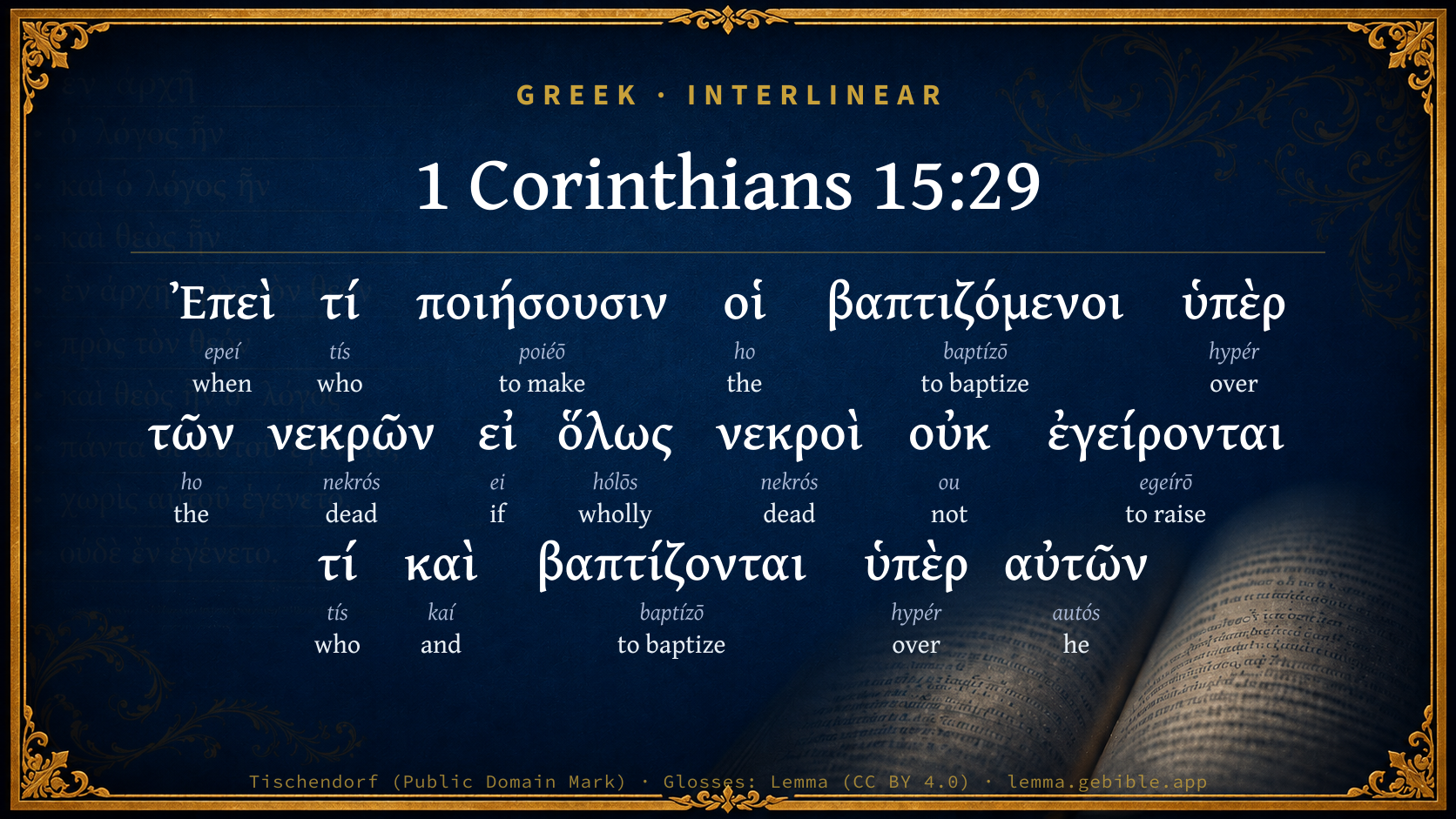
  1. Ἐπεὶ epeí G1893 “when” Conjunction
  2. τί tís G5101 “who” Interrogative pronoun, Accusative, Singular, Neuter
  3. ποιήσουσιν poiéō G4160 “to make” Verb, Future, Active, Indicative, 3rd person, Plural
  4. οἱ ho G3588 “the” Article, Nominative, Plural, Masculine
  5. βαπτιζόμενοι baptízō G907 “to baptize” Verb, Present, Passive, Participle, Nominative, Plural, Masculine
  6. ὑπὲρ hypér G5228 “over” Preposition
  7. τῶν ho G3588 “the” Article, Genitive, Plural, Masculine
  8. νεκρῶν nekrós G3498 “dead” Adjective, Genitive, Plural, Masculine
  9. εἰ ei G1487 “if” Conditional
  10. νεκροὶ nekrós G3498 “dead” Adjective, Nominative, Plural, Masculine
  11. οὐκ ou G3756 “not” Particle, Negative
  12. ἐγείρονται egeírō G1453 “to raise” Verb, Present, Passive, Indicative, 3rd person, Plural
  13. τί tís G5101 “who” Interrogative pronoun, Accusative, Singular, Neuter
  14. καὶ kaí G2532 “and” Conjunction
  15. βαπτίζονται baptízō G907 “to baptize” Verb, Present, Passive, Indicative, 3rd person, Plural
  16. ὑπὲρ hypér G5228 “over” Preposition
  17. αὐτῶν autós G846 “he” Personal pronoun, Genitive, Plural, Masculine

About this verse

These counts appear in no published source. They are computed here, from the morphology-tagged text and Lemma’s own curated glosses. What Lemma adds →

18
words
13
distinct lemmas
Pauline Epistles
section

Notable vocabulary

The rarest word here is ὅλως wholly G3654 — appearing just 4 times in the whole Greek New Testament.

Shared distinctive vocabulary

ὅλως wholly G3654 occurs in 4 verses of the Greek New Testament. Also found in:

Repetition

Words recur within this verse:

  • βαπτιζόμενοι to baptize G907 ×2
  • ὑπὲρ over G5228 ×2
  • νεκρῶν dead G3498 ×2
  • τί who G5101 ×2
  • οἱ the G3588 ×2

Cross-references

4

Topical passages linked to 1 Corinthians 15:29 in the Treasury of Scripture Knowledge — connected by theme and wording, ordered by reader-vote popularity; previews shown in the World English Bible.

  • Romans 6:3–4 Or don't you know that all we who were baptized into Christ Jesus were baptized into his death?
  • 1 Corinthians 15:16 For if the dead aren't raised, neither has Christ been raised.
  • Matthew 20:22 But Jesus answered, "You don't know what you are asking. Are you able to drink the cup that I am about to drink, and be baptized with the baptism that I am baptized with?" They said to him, "We are able."
  • 1 Corinthians 15:32 If I fought with animals at Ephesus for human purposes, what does it profit me? If the dead are not raised, then "let us eat and drink, for tomorrow we die."

Cross-references courtesy of OpenBible.info (CC BY 4.0).

Where the printed editions differ

1 variant

Places in this verse where the major printed Greek editions disagree on the wording in a way that affects the translation — a comparison of editions, not a manuscript-by-manuscript collation. The editions are the modern critical texts (Nestlé-Aland 28/27, SBL, Westcott-Hort, Tregelles, Tyndale House) and the traditional texts behind the KJV (the Textus Receptus and the Byzantine/Majority text). It is not a claim about which reading is original.

  1. Different wording
    αὐτῶν;

    “them?”

    In NA28NA27TynSBLWHTreg Not in TRByz

    νεκρῶν (nekrōn) 'dead' occurs in traditional manuscripts (TR+Byz) instead of αὐτῶν; (autōn) 'them?' in older manuscripts (NA28+NA27+Tyn+SBL+WH+Treg)

Textual data: Translators Amalgamated Greek New Testament (STEPBible TAGNT) · CC BY 4.0.

Commentary

Notes on 1 Corinthians 15:29 from classic Christian and Jewish commentators (each source and its license shown beneath its notes). The classic Christian expositions comment on the surrounding passage and are grouped to its opening verse, so a note may address several verses; the Jewish commentaries on the Tanakh (Rashi and others) are per-verse, so they appear only where the commentator wrote on this verse.

Lemma curates 59 commentaries, every one of them public domain or Creative Commons licensed, each selected and text-cleaned for this edition rather than reprinted as found. About our sources →

The Biblical Illustrator

Joseph S. Exell

1Co_15:29

Else what shall they do which are baptized for the dead, if the dead rise not at all.

Baptism for the dead

The baptized for the dead mean all those persons who, saved from a world of sin, from Pagan ignorance, and from the power of Satan, passed through the ordinance of initiatory baptism, there to fill the places and to carry on the work of the dead martyrs, as fresh soldiers fill the ranks of those who are slain in battle. What shall they do? Secular motives for such a profession they had none. What must be their disappointment if the hopes of spiritual recompense were delusive? This method of interpretation suggests--

I. That the disciples of Christ are always described as a peculiar people.

1. They are separated from the world--I have chosen you out of the world. The duty such a separation involves is manifest.

2. They are avowedly united one to another--in the fellowship of holy love. We much neglect our duty and our privilege if we neglect or refuse such communion with the people of God.

3. They form an organised and well connected body, in which every member has his proper place and office. The Church is likened to a kingdom, a house, a body, an army.

II. That the individual disciples of Christ are frequently removed, and their places rendered vacant by death. The ranks of Christs army are constantly being thinned. When the text was written many lost them through the bitterness of persecution. But the ordinary causes of death still exist. The best must die.

1. We see vacant places in the leadership; ministers, rulers, governors must lay down their authority.

2. We see vacant places among the rank and file. Our beloved companions are called away one after another, and our own turn must soon arrive.

III. That God always will raise up others to take the place of those who are removed. The Church of Christ is unchangeable and lasting as the throne of God, and, as such, neither can the gates of hell prevail against it, nor the change of time affect its constitution, nor the deaths of its individual members occasion its dissolution. It may suffer a temporary eclipse by the loss of its brightest ornaments, but it is never abandoned, and others soon rise to take the place of those gone before, The whole history of the past is a living commentary on this truth.

IV. That the prospect of the resurrection to a future life is the consoling element in all the changes of the present. If it were not for this prospect all else would be utter loss. Else what shall they do who are baptized for the dead, if Christ had not become the first-fruits of them that slept? All their labour would have been in vain and their duty lost. (Homilist.)

Baptism for the dead

I. Many commentators have declined to accept these words in their obvious sense. Here are some of their interpretations: What shall they gain who are baptized only to die? What shall they gain who are baptized when dying, as a sign that their dead bodies shall be raised? … What shall they gain who are baptized for the removal of their dead works? What shall they gain who are baptized into the death of Christ? What shall they gain who are baptized for the hope of the resurrection of the dead? What shall they gain who are baptized into the place of the dead martyrs? What shall they gain who are baptized into the name of the dead? What shall they gain who are baptized in order to convert those who are dead in sin? What shall they gain who are baptized over the graves of the dead? i.e., martyrs--a custom which existed in the post-apostolic Church. What shall they gain who are baptized for the good of the Christian dead? i.e., to accomplish the number of the elect, and to hasten the kingdom of Christ. Taken together, these sound like a series of ingenious answers to a conundrum, no one of which is the true answer. And thus they read us a most impressive homily against putting forced, or spiritual meanings on the plain words of Scripture. These opposing constructions of St. Pauls words refute each other, and warn us that we must abide by the natural and obvious sense of the passage, in whatever difficulties it may land us. Take them literally and St. Paul says, that in the Corinthian Church men were baptized for, in the stead of, the unbaptized dead.

II. We have many historical traces of the custom of baptizing for the dead. Tertullian and Chrysostom attest that it existed among the Marcionites (A.D.130-150). Epiphanius relates that a similar custom prevailed among the Corinthians, a still earlier sect, and adds: There was an uncertain tradition handed down that it was also to be found among some heretics in Asia, especially in Galatia, in the times of the apostles. St. Chrysostom gives us a graphic picture of such a baptism. He says: After a catechumen was dead, they hid a living man under the bed of the deceased; then, coming to the bed of the dead man, they spake to him and asked whether he would receive baptism, and he making no answer, the other replied in his stead, and so they baptized the living for the dead. Similar observances have obtained in all ages. The Februarian lustrations for the dead are familiar to all readers of Ovid. Tertullian refers to them as very much on a level with the Corinthian baptism for the dead. They were designed to contribute in some indefinite way to the welfare and happiness of the Roman dead. With the Jews, if any man died in a state of ceremonial uncleanness, which would have required ablution, one of his friends performed the ablution; he was washed, and the dead man was accounted clean. In a kindred spirit the Patristic Church once placed the eucharistical elements in the mouths or hands of the dead.

III. Now a custom which has obtained so widely, and which still lives virtually in the Roman masses for the dead, must have had some humane and noble motive. Nor, I think, is the motive far to seek. Death often lends new life to love. When we have lost those who were nearest to us, we long to do something to prove the sincerity of our love. Suppose, then, that in Corinth a son, who had often listened to the Christian preachers, lost the father who had listened with him. Both, let us assume, have been impressed by the truth, but they have not been drawn by it into the Christian fellowship. The father dies: and now the son resolves that he will hesitate no longer. He will put on Christ by baptism. But the dear father now dead--can nothing be done for him? He might have been baptized had he lived a little longer: perhaps, as he lay a-dying, he lamented that he had not been bolder. Are his good intentions, his regrets, to come to nothing? May not his sons baptism be in some sort the fathers too? May not the son say to the minister of the Church, My father would have been baptized had he lived; I will be baptized for him? If he did say that, we may be sure the minister would respect his feeling; possibly he might even share it. For we must not forget how ignorant the Corinthians were, and that on the main sacramental and doctrinal points. And if vicarious baptism were administered by any one teacher, if those were admitted to baptism who were moved thereto by love of the dead as well as by love for Christ, we can easily see how a superstitious custom would soon grow up in the Church.

IV. But Paul knew this to be a mere superstition. Can we suppose that he would argue from it without condemning it.

1. And yet, did he not, in becoming all things to all men, that he might save some, often accommodate himself to the views and feelings of those whom he addressed when he could not share them? We can hardly suppose that St. Paul admired the allegorical method of interpretation which was so dear to many of the Jews. Yet, in speaking or in writing to men who used this method, he often adopted it (Gal_4:21-31). So again, as he passed through Athens, he saw an altar with this inscription, To the Unknown God. The Athenians meant only some god whom they did not clearly know, who might well consort with the crowd of divinities in their Pantheon. Him, says St. Paul, I declare unto you. But it was not any such god as was in their thoughts, but the only wise and true God. Here again, therefore, he was accommodating himself to views which he could not share; he appealed to the polytheism of a heathen race in order to set forth Jesus as the Saviour and life of men. So, once more, when he took a Jewish vow, and, after a Jewish custom, shaved his head at Cenchrea; or when he went and purified himself in the Temple, or when he caused his son Timothy to be circumcised, he became as a Jew that he might, gain the Jews. Is it impossible, then, that, in persuading the Corinthians of a resurrection, he should appeal to a superstitious custom which he himself did not approve?

2. Nevertheless, one does not like to conceive of St. Paul as doing that. The least we should expect of him is that, if he condescended to use such an argument at all, he would disconnect himself from the superstition on which it was based, and hint his disapproval of it. And this much, I think, he does. There are traces of his tacit disapprobation of this baptism for the dead even in our English version. Mark the tone of his argument before and after the 29th verse, and you will see how completely he identifies himself with his friends at Corinth. If the dead rise not, he says in the previous verses, our preaching is vain, your faith is vain, etc. It is all we and you. The same tone dominates the subsequent verses. Contrast with this the tone of verse 29. Else, i.e., if the dead rise not, what shall they do who are baptized for the dead? St. Paul no longer speaks of we and you, but of they and them, as though he were speaking of men with whom neither he nor his friends were in perfect sympathy. And this change of tone is much more marked and obvious in the Greek. To give effect to his change of tone and the niceties of his grammar, we may paraphrase his question thus: What will become of those, or, What good account of themselves can they give, who are in the habit of being baptized for the dead, if the dead rise not? The very ground and motive of their custom is cut from under their feet by a denial of the resurrection, and therefore they, of all men, should be the very last to deny it.

V. Note one of the grave moral questions the subject suggests. I have spoken of the humane and universal feeling in which this vicarious baptism probably had its rise and strength. We have lost those who were dear to us, and if we have hope for all our dead, we can sympathise with the anguish of those who have no hope. We can see that if fears for their eternal welfare had been added to our sorrow at the loss of those who were very dear to us, that added burden would have been enough to break our hearts. And the question I would fain suggest is--Are your children to long, when you are taken from them, that they could be baptized for the dead? If only because you love those who will be after you, and would save them from vain longings and inconsolable regrets, it will be well for you to consider this question, and to act out your answer to it without delay. (S. Cox, D.D.)

Baptism for the dead

I. The connection of the passage. It is connected with verse 20, the intervening verses being a parenthesis. Paul has been speaking of the vanity of the Christian life apart from the resurrection (verses 19, 20), and then after a digression on the order of the resurrection, suggested by the word first-fruits, he resumes his argument. Else, if Christ be not risen, what shall they do that are baptized for the dead? But whilst the passage is thus disconnected from what precedes, it is directly connected with what follows (verse 30). If Christ be not risen, what is the use of our enduring sufferings for our faith in Him?

II. The apostles train of thought.

1. His chief argument is that derived from the resurrection of Christ. If there be no resurrection of the dead, then is not Christ risen, consequently your faith is vain, ye are yet in your sins, and in testifying to it we are found false witnesses. But we have the most convincing proofs, from numerous and unquestionable witnesses, of Christs resurrection, which is a proof and pledge of ours.

2. If there be no resurrection, then dead believers are annihilated (verse 18), and their Christianity, as it is inseparably connected with suffering, has augmented the misery of human existence (verse 19). But this is a consequence that cannot be admitted (verse 20).

3. And analogous to this the apostle argues that if there be no resurrection, all the trials of believers are useless; not the practice of the Christians, but that of the Epicureans, is reasonable (verses 30-33). Now it is evident that it is to this argument that the text belongs; therefore, baptism for the dead must be connected with the sufferings of believers.

III. The text therefore means baptism to fill the place of the dead.

1. The apostle represents one set of Christians succeeding another: when their ranks were thinned by death others rushed in to supply their place. But why so if there be no resurrection? Why do they voluntarily submit to like suffering for their faith? Such an interpretation agrees well with what follows. And what a noble idea does this give of Christians. They fill up the ranks and fight in the battle in which their companions have fallen. And what a touching scene it must have been in times of persecution to see the baptized, like soldiers, occupying the breach which death had made in their ranks, thus verifying the observation that the blood of the martyrs is the seed of the Church.

2. This interpretation gives us a striking view of the nature of baptism. It unites the baptized living with the baptized dead; it is the ceremony for our enrolment into the great army of the living God; it ensures the perpetuity of the Church, and supplies it with a constant succession of those who bear the name of Jesus; it is a solemn consecration to the service of Christ, and imposes upon us the duties which our predecessors performed, and enables us to look forward to those rewards which they now enjoy. (P. J. Gloag, D.D.)

Baptized for the dead

The words, baptized for the dead, do not, either necessarily or naturally, imply (in the original) a vicarious baptism: the for is in behalf of, rather than instead of--at the utmost for the benefit of, whatever sense may be given to it--as champions or advocates, rather than as proxies or substitutes.

I. St. Paul speaks (we venture to think) not of a caprice, and not of a superstition--not of a local custom, not of a human invention, not of a pious fancy, and not of a morbid and perilous addition to the faith and rule of the Churches: he speaks, we believe, of the ordinance of baptism as the risen and departing Saviour instituted it, and he unfolds to us here in brief, as elsewhere in detail, the connection of that ordinance with the foundation-fact of the resurrection. Every Christian baptism is a baptism for the dead. Not only is the resurrection of the dead one of the articles of the apostles creed which the person to be baptized professes himself to believe--as Chrysostom says, commenting upon this passage, When we are about to baptize, we bid the man say, I believe in the resurrection of the dead, and after this confession he is plunged in the sacred fountain--not only is there this connection between the sacrament and the doctrine--but also, as the same great writer goes on to explain, the very immersion in, and emergence from, the baptismal waters, is a symbol of the burial and the resurrection that shall be--it is an insertion into the Saviour dead and risen, it is the typical foreacting of that funeral and that revival, the anticipation of which is the saints life, the realisation of which is the saints glory. To be baptized for the dead is to vindicate, by our baptism, the sure hope of the dead--namely (to use again St. Pauls words), that, as we believe that Christ died and rose again, even so them also which have been laid to sleep through Jesus shall God bring with Him. If there is no such hope--if the dead rise not at all--what shall they do, which way shall they turn themselves, who have been subjected, on becoming believers, to that Christian baptism, which is, being interpreted, the assertion of the right of the dead, not only to immortality in a world of spirits, but, definitely and specifically, to a resurrection of the body? Why, he adds, if there be no such hope, are the generations of the faithful thus baptized for the dead?

II. The saying opens to us a new region of duty. We are apt to imagine that death breaks all ties. Certainly it breaks some. Ties of office--ties of courtesy--ties of parentage and wedlock--death breaks these--as to their form. But not even these, surely, as to their substance. What shall we say of the son whose heart does not burn within him at the slighting mention of a dead father--what shall we say of the patriot who has no sense of shame at the ridicule of a great statesman departed, or of the subject who is capable of no resentment when he reads some cowardly outrage upon the memory of a dead sovereign? Yes--cowardly I call it, if it concerns the dead. The characters of the dead are the heirlooms of the living. To disparage a dead man is like injuring a child or insulting a woman. If you must calumniate the departed, begin on the day of the funeral--while at least there may be some one to answer you--son, brother, friend--some one to call you to the reckoning--some one to challenge you to the proof. These, indeed, are more or less personal matters. They affect but a few--generally the more famous, the more illustrious, of mankind. But St. Paul tells us that there is an honour, and by consequence a dishonour, which may be done to all the dead. There is way in which we can disparage, or in which we can vindicate them, as a class. We may be baptized for them. And when he explains himself he says, We may either assert for them, or doubt for them, or deny to them, a resurrection--which is, in other words, an immortality of complete being. Let us not forget that we ourselves shall soon have gone across from this world to that. Baptized for the dead? then, baptized for ourselves. Let us cling now to that Easter which shall be our all then!

1. Let us thank God for the gospel. The gospel is true or not true--but at least it is clearly defined and very simple. Christ died for our sins, and was buried, and the third day rose. In Him we live--He is the Resurrection and the Life. Let us settle these matters. To live in suspense about Jesus Christ is to live in a trance, incapable of true speech or true action. Settle that question--and let it settle all else. I can recognise no plea for waiting. That which will be true at your death is true to-day. If true, it involves duties. Amongst others--and of that the text speaks--

2. A duty towards the departed. How often have we turned back from the open grave, as from a closed book or a career ended! Anxieties we have silenced by a peradventure, unuttered but tolerated, that all may be well because all may be nothing. Prayers for the dead are un-Protestant--the dead are in the hands of God. Duties to the dead are ended--neglected or done, they are of the past. Let them rest in peace. Nay, we have still to be their champions. We have still to think of them as being and to be--as members of the Church, as possessors of the Spirit. We have still to be in communion with them--meeting them when we pray--meeting them when we worship--meeting them when we communicate. We have still to feel, when we bring a little child to baptism, we are standing up for the dead. We are asserting the resurrection of the body. (Dean Vaughan.)

Baptism for the dead

Just as Christ died both for us and our sins, i.e., with a mind bent over us, in order to our redemption, or over our sins, with an eye to their abolition (see verse 3), even so catechumens in baptism emerged from the hallowed streams with their thoughts busy about or intent upon the dead, not as particular persons, but as a general class, distinct from the living on earth. And both context and circumstance together proclaim that the ulterior view of a neophites mind, bending over the long roll of the dead, is their resurrection. But to make certainty doubly certain, St. Paul adds, If absolutely not raised are dead men, why do persons actually receive baptism on their account? Between the death of the Duke of Wellington and his public funeral, I remember a lady, pointing to some crape near her, saying, This will be of use for the Duke of Wellington. The text came immediately to my mind as parallel in structure to the sentence uttered, which, expanded in full, signified, This crape will be of use for me to wear on the day of Wellingtons funeral. (Canon Evans.)

The Church-world

There is a community of men whose principles, spirit, aim, character, and destiny, distinguish them from every other class of human society. The text presents this Church-world:--

I. As thinned by death--the dead. The great law of mortality enters this realm. The intelligence, virtues, devotions, and usefulness of this Church-realm, constitute no barrier to the entrance of death. But--

1. He appears here as the messenger of mercy--outside as the officer of justice.

2. He leaves behind him here consolation for the survivors, but outside unmitigated sorrow.

II. As replenished by conversion. By those who are baptized for the dead I understand those who, from Pagan darkness, were converted by the gospel, and were admitted into the visible Church, there to fill up the place of those who, by martyrdom or otherwise, had been called away by death. The new convert then took the place of the departed saint. No sooner is one Christian removed from his station than another is raised up by God to supply the loss. As Joshua succeeded Moses, Elisha Elijah, Eleazer Aaron, so one man is ever raised in the Church to take the place of another. This succession affords a lesson--

1. For humility. The man of most brilliant talents, distinguished position, and extensive usefulness in the Church, has nothing whereof to flatter himself; however important he may be, the Church can do without him. When he fails, others are ready to step into his place, and to be baptized for the dead.

2. For encouragement. Gods redemptive plan will go on, whatever happens to individual agents. He buries His workmen, but carries on His work. Let us learn to trust God rather than His most distinguished servants. The treasure is only in earthern vessels--vessels that must crumble.

III. As living in hope. This language implies that the hope of a future state, of a resurrection, was a vital thing in the experience of the Church; and so it has ever been, is, and will ever be. The Church lives in hope. It reckons that the sufferings of the present time are not worthy to be compared with the glories that shall be. It is waiting for the adoption; it is looking for the blessed appearing, etc. Paul does not mean, however, that the religion of Christ is of no service to man if there be no future state. Let us answer his two questions.

1. What shall they do? We venture to reply, not renounce religion, but continue faithful for ever. Should there be no future, Christian virtue is good. You will lose nothing by it should you be annihilated: you will not feel even the disappointment, but you will gain immensely by it, even in the present life. Godliness is profitable unto all things.

2. Why are they then baptized? We answer, because the claims of religion are independent of the future state. Were there no heaven, no hell, we should be bound to be truthful, honest, benevolent, God loving, etc. (D. Thomas, D.D.)

The Biblical Illustrator, edited by Joseph S. Exell (c. 1880s–1900s) — public domain. Text from a community e-Sword module.

Joseph Benson's Commentary

1Co 15:29-30. Else, or otherwise, what shall they do — What will become of them? what shall they do to repair their loss, who are exposed to great sufferings in consequence of being baptized for the dead — That is, say some, “In token of their embracing the Christian faith in the room of the dead, who are just fallen in the cause of Christ, but are yet supported by a succession of new converts, who immediately offer themselves to fill up their places, as ranks of soldiers that advance to combat in the room of their companions, who have just been slain in their sight.” Others say, “In hope of blessings to be received after they are numbered with the dead.” Many other interpretations are given of this obscure and ambiguous phrase, υπερ των νεκρων, for the dead. But perhaps that of Dr. Macknight is the most probable, who supplies the words της αναστασεως, and reads the clause, who are baptized for the resurrection of the dead, or are immersed in sufferings, because of their believing in, and testifying the doctrine of the resurrection of the dead: for which interpretation he adduces solid reasons. If the dead rise not — If the doctrine I oppose be true, and the dead are not raised at all; why are they then baptized for the resurrection of the dead? And why stand we — The apostles; also in jeopardy — And are exposed to so much danger and suffering; every hour — In the service of a Master from whom, it is evident, we have no secular rewards to expect.

Joseph Benson's Commentary on the Old and New Testaments (1811–1818) — public domain. Text from a community e-Sword module.

Whedon's Commentary on the Bible

Daniel D. Whedon

4. The devastating result of a no-resurrection upon all our Christian hopes and activities, 1Co_15:29-34.

Paul resumes suddenly, and continues, the train of thought interrupted at 1Co_15:19 by the apocalypse of 1Co_15:20-28. In 1Co_15:12-19 he had argued that the no-resurrection doctrine contradicts Christianity; he now (1Co_15:29-34) shows how it blights all Christian hope and destroys all Christian heroism.

29. Else—If this apocalypse of the resurrection be not true.

What shall they do—Or say for themselves.

Baptized for the dead—Over this passage an interminable battle of commentary is waged. It is admitted by all that the Greek υπερ, for, signifies either, (1) over, in local position; or, (2) instead of, as a substitute, but rarely; or, (3) in behalf of, as favourer, sponsor, advocate, or other benefactor. Of the many interpretations fully given by Stanley but two are worth a discussion. 1. The supposed custom of substitutive baptism, by which a living person was baptized in place of a dead person, one or more. 2. The baptism in behalf of the resurrection of the dead.

By the substitutive interpretation (as Tertullian, Grotius, Alford, Hodge) it is maintained that when a catechumen died before baptism, a friend was baptized in his stead, and so was substitutively baptized for the dead.

But, 1. There is no reason to believe, outside of the passage itself, that any such practice existed in the apostolic Church. It seems illegitimate to create, for an exegetical purpose, a class of heretics practising a particular superstitious rite, when any other natural meaning exists. There is not the slightest reason to doubt that the practisers of substitutive baptism mentioned by Tertullian and ridiculed by Chrysostom were later than Paul’s day, and based their practice on their interpretation of this verse, as do the modern Mormons. 2. It could hardly be said that such substitutes were baptized universally for the dead; dead being a Greek plural with the article, and so signifying all the dead. Note, 1Co_15:12. The phrase to express this substitutive meaning should be υπερ νεκρου, for a dead person, or νεκρων, without the article, for dead persons. 3. Quoting the condemnable practice of heretics is out of the analogy and line of the argument. Paul has argued that a denial of the resurrection impugns Christ, Christians, and sufferers of persecution, like himself; and then a sudden and transient interpolation of heretical performers of a superstitious rite is incredible. 4. The argument would be without value. It would subject Paul to the reply, What authority for us is an example of a set of heretics practising a false superstition? And this worthlessness would be aggravated if it were true that Paul’s words intimate a disapproval of the practice.

Such disapproval, however, does not appear from the proofs Alford furnishes. His first proof is, that baptized is in the present, βαπτιζονται, are being baptized, instead of βαπτισθεντες, were baptized. The present is used, we think, as in the case of stand we in jeopardy, as a matter of vividness. The third person is used because, for the sake of that vividness, Paul speaks of converts being baptized now, rather than of persons, like himself, baptized twenty years ago. In fact, the they of this verse refers to the catechumens, and the we of the next verse to the apostles. 5. For substitution the proper Greek preposition is not υπερ, but αντι. The ordinary sense of in behalf of is the true intrinsic meaning, and should not be surrendered for any reasons that have ever here been produced.

The true interpretation is, we believe, that of Chrysostom. The apostolic Christians were baptized into the faith of the resurrection of the dead, and thereby they were sponsors in behalf of the dead, that the dead should rise. Baptism was itself an affirmation in behalf of the dead, who were assailed and condemned to final death by these deniers of their resurrection. In favour of this view, 1. Is Paul’s use of υπερ, as in behalf of, with an intermediate idea. So above, (1Co_15:3,) in behalf of our sins, that is, of their forgiveness. So also 2Th_2:1, in behalf of the parousia, which was involved in error by mistaken believers. So also in behalf of the dead, whose resurrection baptism asserts. 2. It lies in the direct line of the argument. Paul has quoted in favour of the resurrection the Christian preaching, (1Co_15:14,) faith, (1Co_15:17,) the salvation of dead Christians, (1Co_15:18,) the jeopardy of the living, (1Co_15:30); why should he not quote Christian baptism as a pledge in behalf of the dead? These deniers were against the dead; Christian baptism was for the dead. 3. The Church early recognised the connexion between baptism and the resurrection. It has its basis in the words of St. Paul: “Buried with him in baptism, wherein also ye are risen with him.” Col_2:12. And so Chrysostom says: “When we have instructed the catechumen in the divine mysteries of the Gospel, and are about to baptize him, we command him to say, ‘I believe in the resurrection of the body.’… This is what St. Paul recalls to their memory. If there is no resurrection of the body why are you baptized for the dead?”

Daniel D. Whedon (gen. ed.), Commentary on the Old and New Testaments (1874–1909) — public domain. Text from a community e-Sword module.

Lange's Commentary on the Holy Scriptures

B. Refutation of the impugners of the resurrection of the dead (2) from the inconceivableness of certain facts, except on its supposition

1Co_15:29-34

29Else what shall they do which are baptized [have themselves baptized, οἱ βαπτίζόμενοι] for the dead, if the dead rise not [are not raised, οὐχ ἐγείρονται] at all? why are they then baptized [do they have themselves baptized, βαπτιζονται] for the dead? 30[om. the dead. ins. them, αὐτῶν23]? And why stand we in jeopardy every hour? 31I protest by your24 rejoicing [by the boasting which I have concerning you,2 brethren, νὴ τὴν ὑμετέραν καύχησιν, ἀδειλφοί25] which I have in Christ Jesus our Lord, I die daily. 32If after the manner of men [with the views of common men, κατὰ ἄνθρωπον] I have [om. have] fought with beasts at Ephesus, what advantageth it me, if the dead rise not? let [me? If the dead rise not, let] us eat and drink; for to-morrow we die. 33Be not deceived: evil communications [associations, ὁμιλίαι] corrupt good manners 34[useful habits, ἤθη χρηστὰ26] Awake to righteousness [awake at once, as it is right, ἐκνἡφατε δικαίως], and sin not; for some have not the knowledge of God: I speak27 this to your shame.

EXEGETICAL AND CRITICAL

1Co_15:29.—Else what shall they do, —The connection here with what precedes involves some difficulties. [As Stanley remarks: “it is one of the most abrupt to be found in St. Paul’s Epistles. He leaves the new topic just at the moment when he has pursued it, as it were, to the remotest point, and goes back to the general argument as suddenly as if nothing had intervened. The two instances most similar are 1Co_5:9, 1Co_2:6; 1Co_2:8; 2Co_6:14; 2Co_7:1. Here, as there, the confusion may possibly have arisen from some actual interruption in the writing or the material, of the letter; the main argument proceeding continuously from 1Co_15:20 to 1Co_15:29, and the whole intervening passage being analogous to what in modern composition would be called a note”]. Inasmuch as ἑπεί, since, ordinarily indicates a connection with what immediately precedes, Meyer insists upon our interpreting it so here, q. d., ‘for if there is nothing in this development of human history onward to the end, when God shall be all in all, then what shall they do, etc’ Such a construction can be maintained only in so far as we regard the resurrection as the chief event in this final consummation. Neander, on the contrary, says: “We must suppose a digression to begin at 1Co_15:22, since, at that point, there opened upon the Apostle’s view a prospect of the whole process of the world’s development proceeding from the redemption of Christ. He started with the idea of the necessary connection which the resurrection to eternal life has with Christianity; and with this he now proceeds.” [The ellipsis hero may be thus supplied: ‘The dead are certainly to be raised, else what shall they do, etc.’ (Hodge); or, inserting it after “else,” ‘if it be as the adversaries suppose, what, etc.’ (Alford)].—The question here suggests the utter uselessness of the practice ho is about to adduce in confirmation of his position. “Every baptism that you perform in behalf of the dead, would be without meaning, if those who deny the resurrection were in the right. He indicates the subjective absurdity of the proceeding in this case.” Meyer.—who are baptized for the dead,—How are we to understand these words? The simplest explanation of the act here spoken of is, the suffering of one’s self to be baptized for the benefit of deceased persons, or in their stead, so as to redound to their advantage, i. e., that the salvation mediated by baptism, might fall to their lot, so that those who themselves died unbaptized, might pass for baptized, and thus have part in the resurrection and in the kingdom of Christ. A custom of this sort is discoverable in subsequent times; yet, however, only among heretical sects, such as the Cerinthians and the Marcionites (comp. Epiph. haer. 28, 3; Tertull. de resurr. 48; adv. Marc. 5, 10; Christ, i.h. 1.). The article before νεκῤῶν, dead, points to definite cases (‘for the dead’ in question). “We might imagine that many, having come to the exercise of faith, resolved to receive baptism, but died ere the rite could be performed. This was so much the more likely to have been the case, inasmuch as according to 1Co_11:30, there was an epidemic prevalent. If, then, a relative had suffered himself to be baptized in the conviction that he was only doing what the deceased would have done had he survived, the proceeding would not have been quite so superstitious.” Neander. But it is probable that this custom could have sprung up so early, and could have been mentioned by the Apostle without disapproval, when it was so inconsistent with his fundamental views of faith and of its efficiency for the attainment of salvation?—The latter, indeed, is perhaps supposable, since he has here primarily to do only with the testimony which might be adduced from an actual occurrence; respecting the relation of which, however, to the truth, there was no need of his explaining himself.28 Bisping considers the use of the third person (“what shall they do”) as an indirect intimation of disapproval. [And so. Alford: “There is in these words a tacit reprehension of the practice which it is hardly possible altogether to miss. Both by the third person and by the article before βαπτ. he indirectly separates himself and those to whom he is writing from participation in, or approval of the practice.” He translates βαπτιζόμενοι ‘those who are in the habit of being baptized,’ not οἱ βαπτίσθεντες. The distinction, he says, is important as affecting the interpretation]. Indeed, that Paul, as well as the other apostles, exercised a counteracting influence upon this custom, may be inferred from the fact that it afterwards vanished out of the orthodox church, and was perpetuated only among heretics. It is by no means improbable, that the high estimation of baptism, at so early a period, had acquired a superstitious taint. Since the deeply-rooted heathenish notion of the magical influence of sacred rites might easily have been preserved, or at least, have re-appeared, among those of whom the Apostle asserts that they were yet carnal, and who took so low a position in their estimate of spiritual gifts. This view is to be maintained all the more decidedly from the circumstance that all other views are, in part, opposed to the ordinary use of terms, and in part, improbable, and arbitrary on other grounds. But what we have adduced cannot well be questioned.—Proceeding from the signification of ὑπέρ here pre-supposed, viz: in behalf of, Olshausen could have interpretated it to imply that it was done for the benefit of the dead, in so far as a definite number (pleroma) must needs be baptized ere the second adventand resurrection could ensue; but this view appears in itself questionable, since there is nothing in the context intimating it, and it inclines to another signification of words, viz: ‘instead of the dead,’ i.e., to fill up the gap made by these deceased. But this interpretation would be devoide of significance, and also, in respect to the use of language, very doubtful. Luther’s translation, “over the dead,” i.e., over their graves, is opposed: 1. by the N. T. use of language which no where takes ὑπέρ with the genitive in a local sense; 2. by a lack of all historical trace of any such burial ceremony in apostolic times. Still less admissible is the explanation that applies it to the baptism of the Clinici, those upon the bed of death, jamjam morituri (Estius), or, quum mortem ante oculos positam hebeant (Bengel); since the words could not mean this, and besides we hear nothing of the baptism of the Clinici at this time. Equally untenable is the reference of the words “in behalf of the dead” to Christ (the plural here being taken in a general sense to designate the category [as Wordsworth,]; since water baptism would require the preposition etc, and to the blood-baptism no allusion whatever can be found in the context, and the word is never used in this sense by Paul. Besser interprets still differently: “Not a few heathen [convinced by the sight of a believer’s triumph over death] would allow themselves to be baptized for the sake of those deceased ones whom they had seen to depart in peace and joy—and before the dying beds and graves over which there seemed to flourish an unfading hope; in order to pass from death into life in company with those who slept in Christ.” Here ὑπέρ is taken in the sense of, on account of, because of, [not, to their advantage, but, out of admiration, or love for them], as in Rom_15:9. “That the Gentiles might glorify God for (ὑπέρ) his mercy; as it is written, For this cause I will confess to thee among the Gentiles and sing unto thy name.”29

[The most favorite interpretation for the last half century is that of Lightfoot and Rosenmüller, adopted by Robinson in his Lexicon, which takes βαπτιζόμενοι in the sense of ‘being immersed in sufferings,’ as parallel to ‘being in jeopardy,’ in the next clause. Referring to Mar_10:33; Mar_10:39, and Luk_12:50, it takes ὑπέρ in the sense of ἕνεκα, and τῶν νεκρῶν for death. The complete meaning of the words then would be, ‘those who have been overwhelmed with calamities, trials and sufferings, in the hope of the resurrection or with the expectation that the dead would rise.’ But the objections to this view are that the words are here taken in an unusual and unnatural sense, to which we are not to resort, unless compelled by some most evident reason; and also, the ellipsis implied is much too harsh to be admitted. Bloomfield and Barnes follow the interpretation of Chrys., and the early Greek Fathers, supported by Hammond! and Wetstein, which takes the baptism here alluded to as that which is applied to all believers, who, in receiving the rite, witness to their faith in the resurrection of the dead. Here an ellipsis of the word “resurrection” is presupposed. The great objection to this view is, that in this case the persons alluded to, instead of being, as they obviously are, a distinct class in the church, are the whole body of believers, leaving us nothing special here as the ground of the Apostle’s appeal]. The latest attempt now only remains to be mentioned (Theol. Stud, und Krit. 1860. 1. S. 135 ff.) There we have the interpretation, “why should a person suffer himself to be baptized on account of the dead,” i.e., to belong to! them, to come to them, so as to form a kingdom of the dead? However easy and simple this may I appear, yet such an interpretation of the phrase βαπτ. ὑπέρ τῶν νεκρῶν is an artificial one, and not sufficiently well grounded. Properly it should read, ‘who are baptized on account of the resurrection and in the hope of the same; because death, or coming into the kingdom of the dead, was the only thing to be anticipated without any further hope for this life. Something similar to this appears in Chrys., Theod. and others. Other interpretations may as well be passed over. [For a full list of these, see Pool’s synopsis and also Notes by Stanley and Barnes on this text].—The correct parallelism requires that the next clause, which in the Rec. is connected with that just considered, should be joined with what follows.—if the dead rise not at all?—ὀλως as in v. 1.—why are they even yet baptized for them?—καί intensive, still, even yet. The meaning is, [if we adopt the explanation first maintained above,] in this case nothing at all could be accomplished for the dead: it is therefore, perfectly useless any longer to submit to baptism in their behalf.’

1Co_15:30-34. As a second argument in his apogogical demonstration he refers to the perilous self-devotion and the hazards of martyr-death which were incurred by himself and his associates. The utter uselessness and folly of such conduct, in case the dead rose not, are indicated in the form of a question.—And why also do we stand in jeopardy every hour?—[With baptizing for the dead, he had nothing to do. But he, no less than those before mentioned, were pursuing a most absurd and irrational course, if they could count upon no compensation for the pains of their self-denial in a resurrection state. Here, it will be observed, all the way through, that, in the Apostle’s mind, future existence, apart from the resurrection, was as nothing. The doctrine of the immortality of the soul seems with him to have been identified with that of the restoration of the body. What he looked for was the glorification of his entire constitution, body, soul, and! spirit; and to be bereft of any part, was with him a marring of the whole. He “would not be unclothed, but clothed upon,” with a nobler vesture than that he had here. His reasoning is of force only on this supposition]. Dropping his associates he now passes over to himself individually.—Daily do I die.—As he before speaks of himself and his associates being in hourly jeopardy, so here he expresses the continuance of his own still worse condition, by exhibiting it as a daily death. And this dying may be explained, either of the extreme danger he was ever in, being so much greater than that just spoken of, q.d., ‘I daily hover on the brink of death’ (comp. Rom_8:36; 2Co_4:10; 2Co_1:10); or, it may be construed subjectively of his sense of dying (Osiander, according to Luther). Meyer explains it: “I go about dying; I am moribund,’—a vividly symbolic designation of the fatal dangers by which Paul saw himself to be daily threatened.” This explanation also slides over into the subjective, which is supported by the parallels adduced by Wetstein on this passage. This suits well with the adjuration following—(I protest) by your rejoicing,—This is the only place in the New Testament where νή occurs; but we meet with, it frequently in the LXX. It belongs to the Attic style, [and occurs in the celebrated oath of Demosthenes, where he swore by the shades of those who had met death in the field of Marathon, exhorting the Athenians to defend the Republic (Calvin)]. It is here used for strengthening the previous assertion [—“an oath by which he wished to arouse the Corinthians to be more attentive in listening to him as to the matter in hand, q. d. ‘brethren, I am not some philosopher, prattling in the shade. As I expose myself every day to death, it is necessary that I should think in good earnest of the heavenly life. Believe, therefore, a man who is thoroughly experienced.’ ” Calvin. And, in explaining the nature of the oath, Theophylact acutely observes, that, in, swearing by his boast over them, “he meant to remind them that he expects them to maintain with constancy this their faith; q. d. ‘If I boast on account of your improvement, so shall I be ashamed, if, at last, ye so wretchedly act as to disbelieve the resurrection,’ ” (cited by Bloomfield)].—That by which he protests, is the boasting which he had over the Corinthians; for we are here to take ὑμέτεραν, your, as standing in place of the genitive of the object, ὐμῶν, as in Rom_11:31; τὸκαύχημα ἡμῶν τὸ ὑπὲρ ὑμῶν, 2Co_9:3. In reference to this boasting, comp. 2Co_3:1; 2Co_10:15. There is something very touching in this declaration, which is still further enhanced by the affectionate address.—brethren,—[On this see Critical Notes]. This boasting over the Corinthians, over their subjection to the faith, and his great success in establishing a church so renowned and gifted, he says, he holds—in Christ Jesus our Lord.—i.e., in virtue of his fellowship with Christ, as a servant, who had accomplished great things by His power. The meaning then is, ‘as truly as I can boast of you, in Jesus Christ our Lord, do I daily tremble amid the dangers of death.’ Meyer Ed. 3, laying particular emphasis on “you,” explains it somewhat differently: “So truly as ye, yourselves, are the object of my boasting.” “The Corinthians, whose conversion was an apostolic triumph for Him, could themselves bear witness what fatal dangers beset him in his apostolic work” (?). From the general he now passes over into the special.—If after the manner of men—Here is where the emphasis in this clause lies. The meaning is not, ‘if, according to man’s ability, with the exercise of the utmost strength’ (Rückert); since neither the contrast points to this, nor is the phrase ordinarily used in this sense. Nor yet does it mean ‘to speak after the manner of men,’ for there is no λέγω or λαλῶ connected with it; [nor yet, ‘as far as man was concerned.’ (Wordsworth)]. But it means, ‘according to the ways of common men,’ ‘according to those interests and views by which men are governed,’—aiming, for example, at reward, or glory, and the like; or, as Neander: “with a merely human hope, and without any expectation of eternal life.”—I fought with beasts at Ephesus,—Respecting the allusion here, expositors are divided. Some take the words literally, and understand by them that the apostle, when at Ephesus, had been actually condemned to fight with beasts in the amphitheatre, from which contest he had been marvelously rescued; others, construe metaphorically, understanding the apostle to speak of a conflict with violent and dangerous men, or with strong and embittered foes. Expressions implying the latter are found in Appian (οί́οις θηρίοις μαχόμεθα), and in Ignatius Ad. Romans 5. (comp. 2Ti_4:17; Tit_1:12; Mat_7:6). The former interpretation is rendered improbable, not only because of the rights of Roman citizenship, which Paul enjoyed, which precluded such punishment, and to which he would have appealed, in case he had been condemned to it; but also from the fact that no mention of any such extraordinary occurrence is made in the Acts, nor in 2Co_11:23 ff.—But in adopting the metaphorical explanation, we are not to suppose the allusion here to be to the uproar excited by Demetrius (Acts 19), which did not occur until after this epistle was written, and in which Paul incurred no personal danger; nor yet, perhaps, to any one particular circumstance, but rather to his whole conflict with his Jewish opponents. (Comp. Act_20:19.) [The arguments for its being taken literally are thus set forth by Stanley, who, however, regards the metaphorical interpretation as the more likely.” 1. The metaphor would be more violent here than in Ignatius, where it is evidently drawn from the actual prospect of the wild beasts in the amphitheatre; 2. The Asiarchs, who are mentioned Act_19:31 of Acts, as restraining the tumult of Demetrius, appear in Polycarp’s Martyrdom to have had the charge of the wild beasts; 3. Although there are no remains of an amphitheatre at Ephesus, yet traces of a stadium are to be seen; and in the case of Polycarp, wild beasts were used in the stadium at Smyrna; 4. the young men at Ephesus were famous for their bull-fights. Artimedor. 1Co_1:9 (Wetstein); 5. that ἐν Σφέσω̣ seems a forced expression, if the allusion is merely to opponents generally. Whatever be the danger, it must be the same of which he speaks in Rom_16:4; 2Co_1:8; Act_20:19.”] what advantageth it me,—a strong way of putting the negative. His conflict was an aimless, useless hazarding of life.—if the dead rise not?—This clause is not to be connected with what precedes [as in the E. V.], as though designed to explain the words “after the manner of men;” or as forming a second condition to the question just put—although according to the sense, it belongs with it; but, because of the concinnity of the clauses, it must be connected with what follows, where it gives a frivolous turn to the question, “What advantageth it me?” in the spirit of a light hearted unbelief, in order to exhibit in its proper light, how unsuitable, even in a moral aspect, that supposition was, and how it involved the most absurd consequences.—let us eat and drink; for to-morrow we die.—These words are taken literally from Isa_22:13, where they occur as the utterance of a God-forgetting light-mindedness. The meaning is ‘He who denies the resurrection of the dead, by thus robbing himself of all the consolations of faith and hope, comes by natural consequence to surrender himself to the constant enjoyment of the present life, since death was soon coming to put an end to all enjoyment. We are not, however, to infer from this that the Corinthian opponents of the resurrection had actually preached such doctrine. All Paul intends is to let them see the consequences of their own position; and he here intimates that this denial was not altogether unconnected with the cultivation of too great intimacy with the profligate society around them. Similar expressions of Epicurean frivolity occur in Isa_56:12; Wis_2:1 ff, and in the classics;30 (Comp. Wetstein 1. h. 1.) The words “rise not,” and “die,” do not necessarily involve annihilation. Even existence in Hades, without the hope of resurrection, was a joyless state.

That the frivolous tendency indicated in the foregoing words actually existed among the Corinthian deniers of the resurrection is clear from the warning which follows; for in the “evil communications” he speaks of, he no doubt has these persons in mind, and by reference to a verse of the comedian Menander, expressive of a general truth which perhaps had also taken the form of a proverb among them, he admonishes his readers that they had reason to guard against the influences of such people.—Be not deceived:—The caution implies a strong temptation [inherent in human nature and its social tendencies, by which many are insensibly beguiled into the formation of views and habits from which they would at first have strongly recoiled],—Evil communications corrupt good manners.—’Ομιλία means association, intercourse, and conversation which arises from it; the plural form is found in the New Testament only here. Ηθος, a mode of action, character, disposition, moral quality. Χρηστός elsewhere in the New Testament means kind, mild, good, suitable, etc., here being contrasted with κακαί it implies moral goodness (Plato: χρηστότης=ῆθους σπονδαιότης). Lachmann gives the reading χρήσθ’. So it reads in the original of Menander ; but it is a question whether the apostle observed the metre. The authorities are not sufficient to decide. [“The quotation shows the apostle’s acquaintance with heathen literature, and to a certain extent his sanction of it, as in his quotation from Aratus in Act_17:28, and Epimedes in Tit_1:12. Menander was famous for the elegance with which he threw into the form of single verses or short sentences, the maxims of that practical wisdom in the affairs of common life which forms so important a feature in the new comedy. In the sentence cited, each word is emphatic; character (ἠ̓θη) may be undermined by talk (ὁμιλίαι): honesty (χρηστά) may be undermined by roguery (κακαί).” Stanley].—To those already contaminated by the treacherous influences of such frivolous men he now calls out abruptly—ἐκνήψατε δικαίως lit:—sober out rightly,—[“An exclamation full of apostolic majesty.” Bengel.] By this he gives them to understand that the susceptibility to such trifling communications lies in a state of spiritual drunkenness, out of which they ought at once to rouse themselves. The same expression is used of drunkards in Joe_1:5. [The aorist form adds force to the imperative, implying that the act must be done instantly.] Δικαίως means as it befits them, in the right way. By this he indicates, not so much the degree as the kind of sobriety he would have them cultivate—in contrast perhaps with the false sobriety of their new light which might appear to them as an emerging from the narrowness of their traditional notions into a state of luminous thought and feeling. Others explain the word of the direction which they were to take; or they refer it to the object to be pursued. So Calvin: ‘Turn your mind to good and holy things.’ But this transcends the simple meaning of the term. [Alford says, however, “The last meaning is well defended by Dr. Peil from Thuc. 1Co 1Co_1:21 : ἀπίστως ἐπὶ τὸ μυθῶδες ἐκνενικηότα,—where the adverb ἀπιστως must be rendered ‘so as to become incredible,’ and seems to be the best”]. and sin not;—The imperative is here in the present, and so implies the continued and perpetual abstaining from all sin. The words convey an exhortation, and not in inference, [as Bengel, who says that the imperative after an imperative has the force of a future (Joh_7:37. Note)], ‘so ye will not sin.’ Nor are we to understand by ‘sin,’ a mere error of the understanding (Bengel), (this may accord with the classical use of the word ἀμαρτάνειν, but not with its Biblical and Pauline use); but a turning aside from the ways of righteousness, moral error in consequence of unbelief and a denial of the resurrection. “In the apostle’s view, a frivolous mind appeared as something sinful.” Neander.—The reason for this admonition he further assigns by referring that treacherous unbelief which appeared to them as the result of profounder knowledge, to a lack of that true knowledge which is the ground of all other knowledge.—for some have ignorance of God.—As his previous admonition was directed to those in the church who were in danger of being ensnared by the talk of the frivolous deniers of the resur rection, so does this statement here point to the false teachers themselves, setting them in such light as to open the eyes of the others in regard to their true character and to bring them to see the vanity of this unbelief. Accordingly, by the word “some,” we are not to understand another portion of the church, but those mentioned in 1Co_15:12, and of these, not simply a portion, but the whole. “The ignorance of God” which they manifested and which was nothing less than a practical alienation from God, is exhibited as an abiding trait by the use of the word “have,” i. e. they are permanently affected with it. They are thus represented as having settled down upon the platform of heathenism. The thought is essentially the same as in Mat_22:29. “Ye do err, not knowing the Scriptures nor the power of God.” Not knowing God as the Living and Omnipotent One, is the reason why people assert the impossibility of the resurrection.—That such persons should be found in the church of God was a disgrace to the whole church. This he gives them to understand in the words annexed.—To your shame do I speak.—[“boldly—he speaks more severely than at the beginning on another subject.” 1Co_4:14. Bengel. There is no need of adding “this,” as the E. V., since the language here refers to what is said in the whole passage].

DOCTRINAL AND ETHICAL

The power of the believer’s faith and hope. Faith in a living Saviour, who was dead and rose again, and now lives eternally to take His own into the fellowship of His eternal and perfect life,—and also the root of this faith, even the knowledge of the living God, who is exalted above all changes of life and death, and lifts His kindred creature man out from his transient, mortal state, into His own unchanging felicity, through the redemption of His incarnate Son,—awakens in the believer a lofty, cheerful courage, which shrinks from no danger, which readily exposes itself to the most painful and appalling conflicts, and which is willing to lead a dying life, yea even to lay down body and soul when the Master’s cause requires it. For what is temporal life, with all its joys and pleasures, with all its needs and struggles, in comparison with that eternal life, from whence all that is transient has vanished, and where all that is now upon us and in us worthy of preservation, is insured and perpetuated after having been purified, developed and matured for unspeakable blessedness and glory?

Far different is it, where that faith and knowledge are wanting, and where a person is constrained to give up the hope of such blessedness. In such a case all sacrifices of whatever is transient, all hazards and self denials and conflicts, must appear useless and absurd. The sole reasonable course is to seize the passing moment, and enjoy to the full whatever this life may afford, and to use all means for obtaining, preserving and increasing such enjoyment.—Experience teaches, also, that that system of speculation which abandons the true Gospel foundation—a pantheistic gnosis, for example—however spiritual it may appear at the first, and even though asserting an ethical character, sinks at last gradually, if not suddenly, into downright materialism and carnal license. Its earlier aspects and attitude, both in its theoretical and practical bearings, must be ascribed to a previous knowledge, and regarded as the lingering result of the truth which has been essentially abandoned. We may also say, that the higher moral attitude maintained by any system which lacks the true faith and its attendant hope, is owing to a hidden faith and hope, still slumbering in the depths of the spirit, which, however, in consequence of the prevailing views can attain to no settled form in the thoughtful mind. But those who are of a frivolous nature, and who shamelessly proclaim their folly in word and deed, form a dangerous class for the unsteadfast to associate with. Against these it is needful to guard, since by them the fruit of a good education is often destroyed. And these influences are the more dangerous, in proportion as they carry the appearance of a high tone of spirituality, or fall in with the current of the time. In such a case we may well call to mind the language of the apostle where he speaks of Satan as “the prince of the power of the air, the spirit that now worketh in the children of disobedience.”

HOMILETICAL AND PRACTICAL

Luther:

1Co_15:34. “He who would recognize God, must learn to know Him through His Word. This they [the worldly-wise] don’t do; but they go directly at the articles of faith with their own understandings, and with their own thoughts, and so presume to judge of God, and of all things concerning Him. Hence they never hit Him.”

Starke:

1Co_15:30. No pains, or labors, or watchings, or strivings, to serve God are lost. As surely as God is a righteous judge will there come a resurrection of the dead.

1Co_15:31. What is the daily spiritual dying of the faithful, and their constant familiarity with sufferings and persecutions other than a confirmation of the resurrection to a life eternal? 1Co_15:32. Hostile, dangerous men are worse than wild beasts. If thou hast to deal with such, sigh to God; be watchful, circumspect, and patient.—Unhappy man, who believest not in the resurrection of the dead! For such a one grows secure, falls from one sin to another, and slides on towards damnation.

Hed.:

1Co_15:33. If we flee the plague and contagion, why not also evil companionship? Is temporal life more than the soul? Ordinarily, men guard against disease more than against sin. (2Ti_2:17).—There are words and speeches which, under cover of worldly respect and courtesy, conceal a dangerous poison to faith and life. Whoso is wise let him take heed. (Jam_3:8).

1Co_15:34. All who have the means for knowing God, and still are blind, are involved in disgrace. Oh! that they may not thereby be brought to shame and everlasting contempt! (Dan_12:2).

Berlenburger Bibel:

1Co_15:31. Dying means to hate one’s own life in true self denial, and to give it over to death and destruction, with everything which is in and upon man from the fall.—The fact itself is well substantiated, but what a great, deep, rich mystery of God is in it, that faith alone can see. This is already a kind of secret dying, when we dare not even reckon upon our own righteousness before God, but condemn it as a filthy rag. (Php_3:8-10). Accordingly, it is a sort of dying when we abandon ourselves in contradiction to, and beyond our own reason, solely to the unseen, and rest upon the simple promise of God, and that, too, after we have been accustomed to stand upon our own gifts and, works. And these secret crucifixions of nature, in its pride and self-willedness, and seeming sanctity, must take place daily, yea, momentarily, in the very best of Christians if they would not backslide. Yea, in all believers there is no surer safeguard against all kinds of pride which may arise easily in connection with much grace, than this daily dying to self, and one’s own life. But traces of this are manifest only in the children of light. Crude and unbroken spirits know as little of this as do hypocrites, who put their Christianity in much outward show. No one can occupy himself in this save he who is trained in conflict against the mysteries of iniquity hidden in himself.—He who does not of his own accord daily die unto the old man and his evil lusts, constrains God to lay hold on him with power and humble him; but he who willingly resolves to follow Christ, and confesses him honestly before men, will not long be exercised with tribulations.—In sum: Every thing with which man has to do, gives a believer cause and opportunity for mortifying his own life, and hastening to a complete separation from the false things of ‘this world.

1Co_15:32. The Christian’s life-walk, which consists in the constant renouncing of the works of darkness, in the mortification of the flesh and sin, in turning away from the godless; ways of this world, and in the denial of all lusts, desires, and vanities, is an earnest preparation! for the resurrection. Hence Christians prefer the Cross of Christ, and all the shame, and persecution, and contempt which may be heaped I upon them daily by the children of unbelief, to all the treasures, and honors, and enjoyments, and friendships of this present life. And this they could not certainly do, if they believed in no resurrection. The last refuge and comfort of the world is, to take what one can get.—But is there so much depending upon the resurrection? Could not the simple happiness of the soul after death recompense every thing? No. However much of enjoyment it may have, the soul must still always miss something, and through its natural inward longing, must ceaselessly urge God to bestow upon it again a suitable body.

1Co_15:33. There are many spirits who transform themselves into angels of light, and go about in sheep’s clothing, by whom many persons are befooled into dancing around some Aaron’s calf that has been set up. But if any one imagines that he is fully competent to take care of himself, such a person is altogether too confident, and will be certain not to escape unharmed.—Man has in himself enough which should humble him. But if he insists on spreading his feathers, alas! it is all over with him. The excuse: ‘I was young then, does not exonerate a person.

1Co_15:34. Ah! what charm is there not for throwing men into a deep sleep? Hence the necessity of holding fast, betimes, to what is fundamental. Wake at once out of such a fool’s sleep! Oh, how willingly does man linger in the haven of carnal security and indifference! From such places of case does He who walks in the midst of His Church summon all to come forth to earnest labor, and to advancement in their holy calling.—People deem it a disgrace if they are told, ‘they know not God,’ but it should only shame them into improvement.—There are two sorts of divine knowledge; the one is external, literal, dead, and unfruitful; the other is internal, spiritual, living, and fruitful. The former is grounded simply in natural knowledge, in learning, or speaking of God, as when one can use the language of Scripture, or repeat it again to others without experiencing its power. But if that which has been externally apprehended is sealed upon the conscience through the Holy Spirit, and if all the testimonies of God awaken in one a new life, so that he is actually changed and improved thereby, then does God appear before the eyes of the heart, and the man becomes inwardly convinced how righteous, true, good, and holy He is; then are the eyes of the understanding widely opened to see what and how much God does for him, and what he is bound to do in return—what God has promised, and what we have to expect of Him.

Rieger:

1Co_15:30 ff. In all the joy won by communion with Christ, there is daily opportunity to bear about in the body the dying of the Lord Jesus. Now if, with all this, I could not: set my hope upon the living God who raises the! dead; if I could not regard all the steps I take in the communion of His sufferings and in the likeness of His death as well-measured approaches to the resurrection of the dead; if all this is only for the maintenance of my own opinion,! and only with reference to this short life, what availeth it for me? To suppose that Divine! blessedness and also the sufferings endured in behalf of righteousness should avail nothing, is a thought which destroys all religion and sunders the connection between God and man. If we hold not to the word of promise, and to the hope afforded therein, we have no certainty for eternity, and consequently no assurance that we shall not slide into the old forms of speech, wherein everything runs to the enjoyment of this life, but where death, and its sting are frivolously denied, and all the weighty things which follow thereupon, together with all Christian hope, are thrust out of sight, and all exhortation to diligence in salvation will be heard no more.—That which deserves to be called good morals, and sound knowledge, and correct taste, I should aim at what is unseen and eternal, and be sustained and be kept in exercise by a spirit of faith and self-denial. But how full the world is of such idle talk which turns us away from this, and makes us uncertain and credulous, as if overcome by some magic potion. Error, slumber and in difference towards God and his counsel, and the observance of His ways, are the cause of much sin.

Heubner:

1Co_15:30 ff. Without faith in a future life, many acts of the Christian life, many sacrifices and hazards, would be foolish and purposeless. This faith and steadfast virtue are inseparable. Without this faith that virtue which looks not to the unseen, would be a vain over-straining and fanaticism; and a prudent enjoyment of life would be the highest wisdom. 1Co_15:34. Sobriety, is the clear consciousness of God and His will. A correct self-knowledge leads to a correct faith. Unbelief comes from thorough self-ignorance, dissipation and unrestrained frivolity.

W. F. Besser:

1Co_15:33. If traitors to God find ready helpers in our own lusts, then is it a Christian duty to avoid all needless intercourse with them, and not allow ourselves to purchase their vain words for the sake of setting forth our own hateful inclinations in a seemly garb (Eph_5:6-7).

1Co_15:34. The poison of all erroneous doctrine is intoxicating; and in imbibing it, we allow ourselves to be intoxicated. Well for us, if we properly awake when the voice of truth arouses us, in order that we may spue out the poison of sin, ere we die therein!—“God is not the God of the dead but of the living” (Mat_22:32). Hence, he who denies the resurrection of the dead knows not the true God.

[Robertson:

1Co_15:32. “How many of the myriads of the human race would do right for the sake of right, if they were only to live fifty years and then die for ever more? Go to the sensualist, and tell him that a nobler life is better than a base one, even for that time, and he will answer: ‘I like pleasure better than virtue; you can do as you please; for me, I will enjoy my time. It is a matter of taste. By taking away my hope of a resurrection you have dwarfed good and evil, and shortened their consequences. If I am only to live sixty or seventy years, there is no eternal right or wrong. By destroying the thought of immortality, I have lost the sense of the infinitude of evil, and the eternal nature of good.’ Besides, with our hopes of immortality gone, the value of humanity ceases and people become not worth living for. We have not got a motive strong enough to keep us from sin. Tell the sensualist that, though the theory of the life to come be a dream, yet that here the pleasure of doing right is sublimer than that of self indulgence, and he will answer: ‘Yes, but my appetites are strong; the struggle will be painful, and at last, only a few years will be left. The victory is uncertain, the present enjoyment is sure, why should I refrain? Do you think you can arrest that with some fine sentiment about nobler and baser being. No, the instincts of the animal will be more than a match for all the transcendental reasonings of the philosopher” (abbreviated).

Hodge:

1Co_15:33. “It is only when men associate with the wicked with the desire and purpose of doing them good, that they can rely on the protection of God to preserve them from contamination.”]

[Sermons.—J. Owen:

1Co_15:31. The Christian’s work of dying daily. This to be done cheerfully, comfortably, and triumphantly in the Lord. To this three things requisite: 1. The constant exercise of faith as to the resignation of a departing soul unto the hand and sovereign will-of God. 2. A readiness and willingness to part with this body on the grounds: a, That to depart is to be with Christ; b, That the body is dead because of sin. 3. Constant watchfulness against being surprised by death. R. Hall:

1Co_15:33. Nature and danger of evil communications. 1. What these communications are; a, such as tend to sensualize the mind; b, such as utterly lack a religious spirit; c, such as abound in skeptical objections to Christianity; d, such as are full of hatred to Christianity; e, such as are loose with respects to fundamental moral principles. 2. The way in which they corrupt through the natural suceptibilities of the human mind. 3. The need of the warning, “be not deceived”: a, by the adduction of false precedents; b, by your past experience; c, by any complacent reference to your age and attainments in piety; d, by any supposed strength of resolution].

Footnotes:

[24]1Co_15:31.—Others have ἡμετἐραν. Meyer thinks that ὑμετέραν was not understood, and ἡμετέραν seemed demanded by ἥν ἕχω. It has however, the weight of evidence against it.

[25]1Co_15:31.—The Rec. leaves out ἀδελφοί with D. E. F. G. L. several Ital. versions, the later Arm. Orig. Chrys. Theodt. Damasc. Ambrst.; but A. B. K. Siuait. Vulg. Syr. (both) Goth. Basm. Ann. Aeth. Arab. and Slav. Dial. Aug. Pel. Bede insert it. Some of these add μου C. P. W.]

[26][1Co_15:33.—The Rec. has χρῆσθ̀, Lachmann edits χρῆσθ̀ but they have no good MSS to support them. Clemens Alex. and Amphilochius (of Leon.) have the word thus abbreviated to constitute with the previous syllable a spondee; in our passage read as an iambic trimeter acataletic, which the Latins call senarius. Winer, Gram, of the N.T.§ 68.—JC. P.W.]

[27]1Co_15:34—Lachmann and Tischendorf have λαλῶ. The Rec. gives λώγω on equally good authority. [The former is sustained by B. D. E. Sinait. Dial. Several Latin versions and Armbrst. have loquor. The latter is favored by A. F. G. K. L., Chrys. Theodt. The Vulg. (Flor.) and two Latin and one Vulg. MSS. have dico—C. P. W.]

[28][In similar style Hodge accounts for Paul’s appeal to a wrong custom. “This method of arguing against others from their own concessions, is one which the Apostle frequently employs. When his mind is full of a particular subject, he does not leave it, to pronounce judgment on things incidentally introduced. Thus, in 1Co_11:5, when treating of women speaking in the church unveiled, he expresses no disapprobation of their speaking in public, although he afterwards condemned it. A still more striking example of the same thing is to he found 1Co_10:8, where ho speaks of the Corinthians “sitting at meat in an idol’s temple,” without any disapprobation of the thing itself, but only of its influence on the weaker brethren. Yet, in 1Co_10:14-22, he proves that the thing itself was an act of idolatry. The entire disappearance of this custom in the orthodox church, although other superstitious observances, not less objectionable, soon prevailed, is probably to be referred to the practice, having been forbidden by the Apostle as soon as he reached Corinth. This may have been one of the things which he left to be set in order when he came. 1Co_11:34.”]

[29][See this view wrought out with great originality and convincing argument by the Rev. H. D. Ganse. in the Amer. Pres. and Theo. Review, 1863, p. 83. It merits the preference over all others, because, while answering all the requirements of grammar, and conceding to each word its full and proper meaning, it rests on a natural hypothesis and relieves us of the difficulty of supposing that the Apostle here appeals for support to a practice wholly at variance with his fundamental doctrines. The whole article merits attention as a masterly specimen of exegesis, and as illustrating other points in this chapter with great beauty and force.]

[30] [The following instances may be quoted as a specimen: “O beate Sesti!

Vitae summa brevis nos vetat inchoare longam,

l am te premet nox, fabulaeque Manes

Et domus exilis Plutonia:

O happy Sestius! the brief span of human life forbids us to indulge a distant hope. Soon will night descend upon thee, and the fabulous Manes, and the shadowy mansion of Pluto.” Hor. Carm. 1Co_1:4; 1Co_1:13-17.

Sapias, vina liqnes, et spatio brevi

Speram longam reseces. Durn loquimur, fugerit invida

Aetas. Carpe diem, quam minimuu credula postero.

Be wise: rack off your wines; and abridge your distant hopes in adaptation to the brevity of life. While we speak, envious age has been flying. Seize the present day, depending as little as possible on any future one.”—Hor. Carm. 1Co_1:11; 1Co_1:6-8.]

Lange's Commentary on the Holy Scriptures (Critical, Doctrinal, and Homiletical), ed. John Peter Lange, English translation edited by Philip Schaff (1864–1880) — public domain. Text from a community e-Sword module.

Tyndale Open Study Notes

Tyndale Open Resources

15:29 Some first-century Christians apparently practiced baptism-by-proxy for dead unbelievers whom they wished to be saved. Paul neither endorses nor condemns the practice; he simply uses it as evidence for belief in resurrection. There is no other reference to such a practice in early Christian literature.

Tyndale Open Study Notes — © Tyndale Open Resources, licensed CC BY-SA 4.0. Text via the HelloAO Bible API.

Bengel's Gnomon

Johann Albrecht Bengel

1Co 15:29. Ἐπεὶ τί ποήσουσιν οἱ βαπτιζόμενοι ὑπὲρ τῶν νεκρῶν; εἰ ὅλως νεκροὶ οὐκ ἐγείρονται, τί καὶ βαπτίζονται ὑπὲρ αὐτῶν; τί καὶ ἡμεῖς χινδυνεύομεν τᾶσαν ὥραν;) We shall first say something on the pointing of this verse.[138] Many rightly connect, and have long been in the habit of connecting this clause, ΕἸ ὍΛΩς ΝΕΚΡΟῚ ΟὐΚ ἘΓΕΊΡΟΝΤΑΙ, with what follows; for the particle ἘΠΕῚ alone exhausts the force of the same clause in the first part of the verse. ΕἸ begins the sentence, as in 1Co 15:32, it does so twice; and often in 1Co 15:12, and those that follow. Hence the pronoun ΑὐΤῶΝ is to be referred to ΝΕΚΡΟῚ.[139] Furthermore, of the baptism for (over) the dead, the variety of interpretations is so great, that he who would collect, I shall not say, those different opinions, but a catalogue of the different opinions, would have to write a dissertation. At that time, as yet, there were neither martyrdoms nor baptisms over sepulchres, etc., especially at Corinth; but baptism over sepulchres, and baptism for the advantage of the dead came into use from a wrong interpretation of this very passage; as fire was used among the Egyptians and Abyssinians in the case of the baptized, from Mat 3:11. Often, when the true interpretation is nearer and easier than we think, we fetch it from a distance. We must mark—I. The paraphrase: Otherwise what will they do who are baptized for (super) the dead? If the dead rise not at all, why are they also baptized for the dead? and why also are we in danger every hour? II. The sense of the phrase, βαπτίζεσθαι ὑπὲρ τῶν νεκρῶν, to be baptized for (over) the dead. For they are baptized for (over) the dead [super mortuis], who receive baptism and profess Christianity at that time, when they have death set before their eyes, who are likely every moment to be added to the general mass of the dead, either on account of the decrepitude of age, or disease, or pestilence, or by martyrdom; in fact, those who, without almost any enjoyment of this life, are going down to the dead, and are constantly, as it were, hanging over the dead; they who might say קברים לי, the graves are ready for me, Job 17:1. III. The first part of the verse is of a milder character; but the last part which begins with if after all, has also an epitasis [an emphatic addition. Append.] expressed in its own protasis by after all, and in the apodosis by the even [ΤΊ ΚΑῚ]: and these two particles correspond to each other; and the same apodosis has an anaphora [the repetition of the same words in the beginnings of sections], joining its two parts by why even. IV. We must mark the connection of the subject under discussion. With the argument respecting the resurrection of Christ, from which our resurrection is derived, Paul connects the statement of two absurdities (indeed there are more than two, but the preceding absurdities are repeated, though they have been already sufficiently refuted by former reasonings) which would arise, if there be no resurrection of the dead, if Christ have not risen: and in the meantime, having disentangled the argument concerning Christ, 1Co 15:20-28, he refutes those two absurdities by a discussion of somewhat greater length, which draws the sinews of its strength from the argument concerning Christ. The latter absurdity (for this has its relation to the argument more evident) regarding the misery of Christians in this life, he set forth at 1Co 15:19, and now discusses at 1Co 15:29 in the middle, and in the following verses; if after all: and in like manner he stated the former concerning the ‘perishing’ of the Christians that are dead, at 1Co 15:18, and now discusses, or repeats, or explains it in the first part of 1Co 15:29. V. The force of the apostle’s argument, which in itself is both most clear and most urgent. I. The propriety of the several words consistent with themselves. Α) What shall they do? is future, in respect of eternal salvation, i.e., such persons being baptized, will be disappointed, their efforts will be vain, if the dead sleep the eternal sleep. Β) The term baptism continues to be used in its ordinary meaning; and indeed in this epistle Paul has made more mention of baptism than in any other, ch. 1Co 1:13-17, 1Co 10:2, 1Co 12:13. γ) The preposition ὑπὲρ with the genitive might be thus also taken in various senses; of the object simply, as the Latins use super, with respect to, about, so far as it concerns; with this meaning, that they may put the dead before them without consideration of the resurrection; or the words may be used of paying as it were a price, viz., that they should account the dead as nonentities; or of obtaining as the price for their trouble, viz., that they should be gathered to the dead for ever: but we maintain the propriety with which ὑπὲρ denotes nearness, hanging over [such propinquity as that one hangs immediately over] anything, whence Theocritus speaks of ἀσφόδελον τὸν ὑπὲρ γᾶς, the asphodel (king’s spear) that grows on the ground, Idyl. 26. Lexicographers give more examples, especially from Thucydides. So they are baptized over [immediately upon] the dead, who will be gathered to the dead immediately after baptism: and then over the dead is said here, as if it were said over the sepulchre, as Luk 24:5, with [Engl. Vers., among] the dead, i.e., in the sepulchre. Nor is it incredible, that baptism was often administered at funerals. Δ) The term dead is used in its ordinary sense of the dead generally, as the article also requires, taken in as wide a sense as the resurrection, ε) The adverb ὅλως, after all, is used by a Corinthian who is supposed to be led on by Paul, and who had rather peevishly opposed the resurrection, not reflecting on the loss of the advantages even in this life, which result in baptism: and ΕἸ ὍΛΩς is employed in the same way as ἘΠΕΙΔΉ ὍΛΩς in Chrysost. homil. 5, c. Anomoeos: Notwithstanding, though man differs little from an angel, since there is nevertheless [after all] some difference (ἘΠΕΙΔῊ ὍΛΩς ἘΣΤΊ ΤΙ ΜΈΣΟΝ), we know not accurately what angels are. ζ) καὶ is not redundant, but strengthens the force of the present tense, βαπτίζονται, what do they do who are baptized? in antithesis to the future, ΤΊ ΠΟΙΉΣΟΥΣΙ, what shall they do? Comp. καὶ, 2Co 1:14; 2Co 11:12; Php 3:7-8; Php 4:10. Paul in fact places those who are baptized for the dead, as it were at the point of death, and shows that no reward awaits them either for the future, if they denied the resurrection, or for the past. Paul seems to confute those who denied both the resurrection of the body and the immortality of the soul. The vindication of the former is a sufficient and more than sufficient vindication of the latter. This is an example of the συγκατάβασις, condescension of Scripture, which, out of regard to the weak and simple, does not enter into that subtle controversy, but lays hold of the subject at that part of it, which is easier to be proved, and yet also carries along with it the proof of the more difficult part. Η) The two clauses beginning with ΤΊ admirably cohere: with a gradation from those who could only for a little enjoy this life [i.e., those baptized at the point of death] to (us) those who could enjoy it longer, if they had not had their hope fixed in Christ.—ΝΕΚΡΟῚ, dead) Throughout this whole chapter, in the question, whether [dead men rise at all], Paul speaks of dead men, ΝΕΚΡΟῪς, without the article; afterwards, when this question has been cleared out of the way, in the question how, 1Co 15:35, etc., he uses the article; but τῶν in this verse has the meaning of the relative [τῶν νεκρῶν, those who are dead already spoken of, 1Co 15:12-13; 1Co 15:16].

[138] Lachm. and Tischend. punctuate as Bengel. Rec. Text puts the question not after νεκρῶν, but after ἐγειρονται; thus connecting this clause with what precedes, instead of with what follows.—ED.

[139] The Germ. Ver. repeats the noun τῶν νεκρῶν, instead of the pronoun at the end of the verse, and differs from the margin of both editions.—E. B.

Αὐτῶν is the reading of ABD corrected later, Gfg Vulg. Memph., later Syr. Origen. Τῶν νεκρῶν of Rec. Text is only found in later Uncial MSS. and Syr. Version alone, of the oldest versions.—ED.

Bengel's Gnomon of the New Testament — English translation (T&T Clark, Edinburgh, 1860) — public domain. Text from a community e-Sword module.

Meyer's Critical & Exegetical Commentary

Heinrich August Wilhelm Meyer

1Co_15:29.[59] Ἐπεί] for, if there is nothing in this eschatological development onward to the end, when God will be all in all, what shall those do, i.e. how absurdly in that case will those act, who have themselves baptized for the dead? Then plainly the result, which they aim at, is a chimera! Usually interpreters have referred ἐπεί back to 1Co_15:20, and regarded what lies between as a digression; Olshausen is more moderate, considering only 1Co_15:25-28 in that light, so also de Wette; Rückert, again, holds that Paul had perhaps rested from writing for a little after 1Co_15:28, and had had the sentence the dead arise in his mind, but had not expressed it. Pure and superfluous arbitrariness; as always, so here too, ἐπεί points to what has immediately preceded. But, of course, in this connection the final absolute sovereignty of God is conceived as conditioned by the resurrection of the dead, which, after all that had been previously said from 1Co_15:20 onwards, presented itself to every reader as a thing self-evident. Hofmann makes ἐπεί refer to the whole paragraph beginning with ἈΠΑΡΧῊ ΧΡΙΣΤΌς, as that is construed by him, down to 1Co_15:26, to which 1Co_15:27-28 have attached themselves as confirming the final abolition of death. But see on 1Co_15:24; 1Co_15:27.

Upon the words which follow all possible acuteness has been brought into play, in order just to make the apostle not say that which he says.

τί ποιήσουσιν] makes palpable the senselessness, which would characterize the procedure in the case assumed by ἐπεί. The future is that of the general proposition,[60] and applies to every baptism of this kind which should occur. Every such baptism will be without all meaning, if the deniers of the resurrection are in the right. Grotius: quid efficient (comp. Flatt). But that a baptism of such a kind effected anything, was assuredly a thought foreign to the apostle. He wished to point out the subjective absurdity of the procedure in the case assumed. The interpretation: nescient quid agendum sit (van Hengel) does not suit the connection, into which Ewald also imports too much: are they to think, that they have cherished faith and hope in vain?

ὑπὲρ τῶν νεκρῶν] The article is generic. Every baptism which, as the case occurs, is undertaken for a dead person, is a baptism for the dead, namely, as regards the category. It must have been something not wholly unusual in the apostolic church, familiarity with which on the part of the readers is here taken for granted, that persons had themselves baptized once more for the benefit of (ὑπέρ) people who had died unbaptized but already believing, in the persuasion that this would be counted to them as their own baptism, and thus as the supplement of their conversion to Christ which had already taken place inwardly, and that they would on this account all the more certainly be raised up with the Christians at the Parousia, and made partakers of the eternal Messianic salvation.[61] This custom propagated and maintained itself afterwards only among heretical sects, in particular among the Cerinthians (Epiphanius, Haer. xxviii. 7) and among the Marcionites (Chrysostom; comp., moreover, generally Tertullian, de resurr. 48, adv. Marc. v. 10).[62] Among the great multitude of interpretations (Calovius, even in his time, counts up twenty-three), this is the only one which is presented to us by the words. Ambrosiaster first took them so;[63] among the later interpreters, Anselm, Erasmus, Zeger, Cameron, Calixtus, Grotius, al.; and recently, Augusti, Denkwürdigk. IV. p. 119; Winer, p. 165 [E. T. 219]; Billroth, Rückert, de Wette, Maier, Neander, Grimm, Holtzmann (Judenth. u. Christenth. p. 741), also Kling and Paret (in Ewalds Jahrb. IX. p. 247 f.), both of which latter writers call to their aid, on the ground, it is true, of 1Co_11:30, the assumption of a pestilence having then prevailed in Corinth. The usual objection, that Paul would not have employed for his purpose at all, or at least not without adding some censure, such an abuse founded on the belief in a magical power of baptism (see especially, Calvin in loc.), is not conclusive, for Paul may be arguing ex concesso, and hence may allow the relation of the matter to evangelical truth to remain undetermined in the meantime, seeing that it does not belong to the proper subject of his present discourse. The abuse in question must afterwards have been condemned by apostolic teachers (hence it maintained itself only among heretics), and no doubt Paul too aided in the work of its removal. For to assume, with Baumgarten-Crusius (Dogmengesch. II. p. 313), that he himself had never at all disapproved of the βαπτίζεσθαι ὑπὲρ τῶν νεκρῶν, or to place, with Rückert, the vicarious baptism in the same line with the vicarious death of Christ, is to stand in the very teeth of the fundamental doctrine of the Pauline gospelthat of faith as the subjective ethical causa medians of salvation. For the rest, Rückert says well: Usurpari ab eo morem, qui ceteroqui displiceret, ad errorem, in quo impugnando versabatur, radicitus evellendum, ipsius autem reprehendendi aliud tempus expectari. The silent disapproval of the apostle is brought in by Erasmus in his Paraphrase: Fidem probo, factum non probo; nam ut ridiculum est, existimare mortuo succurri baptismo alieno, ita recte credunt resurrectionem futuram. Epiphanius, Haer. 28, explains it of the baptism of the clinici, of the catechumens on their deathbed, who πρὸ τῆς τελευτῆς λουτροῦ καταξιοῦνται. So Calvin, although giving it along with another interpretation equally opposed to the meaning of the words; also Flacius, Estius, al. But how can ὑπὲρ τ. νεκρ. mean jamjam morituri (Estius)! or how can the rendering ut mortuis, non vivis prosit (Calvin) lead any one to guess that the baptismus clinicorum was intended, even supposing that it had been already customary at that time![64] Chrysostom, too, runs counter to the words: ὑπὲρ τῶν νεκρῶν, τουτέστι τῶν σωμάτων, καὶ γὰρ ἐπὶ τοῦτο βαπτίζῃ, τοῦ νεκροῦ σώματος ἀνάστασιν πιστεύων. Paul, he holds, has in view the article in the baptismal creed (which, however, certainly belongs only to a later time): I believe in a resurrection of the dead. So, too, on the whole, Pelagius, Oecumenius, Photius, Theophylact, Melanchthon (profitentes de mortuis), Cornelius a Lapide, Er. Schmid, and others; and somewhat to the same effect also Wetstein. Comp. yet earlier, Tertullian: pro mortuis tingi pro corporibus est tingi. Theodoret gives it a different turn, but likewise imports a meaning, making the reference to be to the dead body: ὁ βαπτιζόμενος, φησι, τῷ δεσπότῃ συνθάπτεται, ἵνα τοῦ θανάτου κοινωνήσας καὶ τῆς ἀναστάσεως γένηται κοινωνός· εἰ δὲ νεκρόν ἐστι τὸ σῶμα, καὶ οὐκ ἀνίσταται, τί δήποτε καὶ βαπτίζεται. Luthers explanation, adopted again recently by Ewald and others, that to confirm the resurrection, the Christians had themselves baptized over the graves of the dead (so Glass and many of the older Lutherans; Calovius leaves us to choose between this view and that of Ambrosiaster), has against it, apart even from the fact that ὑπέρ with the genitive in the local sense of over is foreign to the New Testament, the following considerations: (1) that there is a lack of any historical trace in the apostolic period of the custom of baptizing over graves, such as of martyrs (for Eusebius, H. E. iv. 15, is not speaking of baptism), often as churches were built, as is well known, in later times over the graves of saints; (2) that we can see no reason why just the baptism at such places should be brought forward, and not the regarding of these spots as consecrated generally; (3) that to mark out the burial-places of pious persons who had fallen asleep, would have been in no way anything absurd even without the belief in a resurrection. And lastly, baptism took place at that time not in fonts or vessels of that kind, which could be set over graves, but in rivers and other natural supplies of water. Other interpreters, following Pelagius, refer ὑπὲρ τ. νεκρ. to Christ, taking βαπτ. in some cases of the baptism with water (Olearius, Schrader, Lange, Elwert); in others, of the baptism with blood (Al. Morus, Lightfoot). ΤῶΝ ΝΕΚΡ. would thus be the plural of the category (see on Mat_2:20). But, putting aside the consideration that Christ cannot be designated as ΝΕΚΡΌς (not even according to the view of the opponents), the baptism with water did not take place ὙΠῈΡ ΧΡΙΣΤΟῦ,[65] but ΕἸς ΧΡΙΣΤΌΝ; and the baptism with blood would have required to be forcibly indicated by the preceding context, or by the addition of some defining clause. For the benefit of the dead remains the right interpretation. Olshausen holds this also, but expounds it to this effect, that the baptism took place for the good of the dead, inasmuch as a certain number, a πλήρωμα of believers, is requisite, which must first be fully made up before the Parousia and the resurrection can follow. But this idea must be implied in the connection; what reader could divine it? Olshausen himself feels this, and therefore proposes to render, who have themselves baptized instead of the members removed from the church by death. So, too, in substance Isenberg (whose idea, however, is that of a militia Christi which has to be recruited), and among the older interpreters Clericus on Hammond, Deyling, Obss. II. p. 519, ed. 3, and Döderlein, Instit. I. p. 409. But in that case ὑπὲρ τ. νεκρ. would be something not at all essential and probative for the connection, since it is plain that every entrance of new believers into the church makes up for the departure of Christians who have died, but in this relation has nothing to do with the resurrection of the latter. This at the same time in opposition to van Hengels interpretation, about which he himself, however, has doubts: for the honour of deceased Christians, quos exteri vituperare vel despicere soleant. According to Diestelmann, ὑπὲρ τ. ν. is for the sake of the dead, and means: in order hereafter united with them in the resurrection to enter into the kingdom of Christ; while the νεκροί are Christ and those fallen asleep in Him.[66] But it is decisive against this view, first, that there is thus comprised in the simple preposition, an extent of meaning which the reader could not discover in it without more precise indication; secondly, that every baptism whatsoever would be also in this assumed sense a βαπτίζεσθαι ὑπὲρ τῶν νεκρῶν, whereby therefore nothing distinctive would be said here, such as one could not but expect after the quite singular expression; thirdly, that Christ cannot be taken as included among the ΝΕΚΡΟῖ, seeing that the resurrection of the Lord which had taken place was not the subject of the denial of resurrection here combated, but its denial is attributed by Paul to his opponents only per consequentiam, 1Co_15:13. According to Köster, those are meant who have themselves baptized for the sake of their Christian friends who have fallen asleep, i.e. out of yearning after them, in order to remain in connection with them, and to become partakers with them of the resurrection and eternal life. But in this way also a significance is imported into the simple ὑπὲρ τῶν νεκρῶν, which there is nothing whatever to suggest, and which would have been easily conveyed, at least by some such addition as ΣΥΓΓΕΝῶΝ ΚΑῚ ΦΊΛΩΝ. According to Linder, the ΒΑΠΤΙΖΌΜΕΝΟΙ and the ΝΕΚΡΟΊ are held to be even the same persons, so that the meaning would be: if they do not rise (in gratiam cinerum), which, however, the article of itself forbids; merely ὑπὲρ νεκρῶν (ΝΕΚΡ. would be in fact qualitative) must have been made use of, and even in that case it would be a poetical mode of expression, which no reader would have had any clue to help him to unriddle. Similarly, but with a still more arbitrary importing of meaning, Otto holds that οἱ βαπτιζόμ. are the deniers of the resurrection, who had themselves baptized in order (which is said, according to him, ironically) to become dead instead of living men. Most of all does Hofmann twist and misinterpret the whole passage (comp. also his Schriftbew. II. 2, p. 199 f.), punctuating it thus: ἐπεὶ τί ποιήσ. οἱ βαπτ. ὑπὲρ τῶν νεκρῶν, εἰ ὅλως νεκρ. οὐκ ἐγείρονται; τί καὶ βαπτίζονται; ὑπὲρ αὐτῶν τί καὶ ἡμεῖς κινδυνεύομεν; the thought being: If those, who by means of sin lie in death, become subject in their sins to an utter death from which there is no rising, then will those, who have themselves baptized, find no reason in their Christian status to do anything for them, that may help them out of the death in which they lie; nay, why do they then have themselves baptized? and why do we risk our lives for them? Ὑπὲρ τῶν νεκρ. thus belongs to ΤΊ ΠΟΙΉΣ.; the ὙΠῈΡ ΑὐΤῶΝ, placed for emphasis at the head of the last question, applies to the ΒΑΠΤΙΖΌΜΕΝΟΙ. Every point in this interpretation is incorrect; for (1) to do something for others, i.e. for their good, is an absolute duty, independent of the question whether there be a resurrection or not. (2) But to do something which will help them out of death, is not in the passage at all, but is imported into it. (3) Those who can and should do something for others are the Christians; these, however, cannot have been designated so strangely as by οἱ βαπτιζόμενοι, but must have been called in an intelligible way ΟἹ ΠΙΣΤΕΎΣΑΝΤΕς perhaps, or at least ΟἹ ΒΑΠΤΙΣΘΈΝΤΕς. (4) The ΝΕΚΡΟΊ can only, in accordance with the context, be simply the dead, i.e. those who have died, as through the whole chapter from 1Co_15:12 to 1Co_15:52. (5) To give to ὑπὲρ αὐτῶν another reference than ὙΠῈΡ ΤῶΝ ΝΕΚΡῶΝ, is just as violent a shift as the severance of either of the two from ΒΑΠΤΊΖΕΣΘΑΙ, in connection with which they are symmetrically requisite for more precise definition, and are so placed. And when (6) ὙΠῈΡ ΑὐΤῶΝ is actually made to mean in order to induce them to receive baptism, this just crowns the arbitrariness of inserting between the lines what the apostle, according to the connection, could neither say nor think. Moreover, ὑπὲρ αὐτῶν could not have the emphasis, but only the ἩΜΕῖς introduced with ΚΑΊ, like the ΒΑΠΤΊΖ. previously introduced with ΚΑΊ.

ΕἸ ὍΛΩς ΝΕΚΡΟῚ ΟὐΚ ἘΓΕΊΡ.] Parallel to the conditional clause to be supplied in connection with ἘΠΕΊ. For Paul conceives of the resurrection of the dead as being so necessarily connected with the completion of the Messianic kingdom that the denial of the one is also the denial of the other. If universally (as 1Co_5:1) dead persons cannot be raised up, why do they have themselves baptized also for them? since plainly, in that case, they would have nothing at all to do for the dead. See, generally, on Rom_8:24; Pflugk, ad Hec. 515; Baeumlein, Partik. p. 152. This also betokens the (entirely useless) superinduced character of the proceeding. To refer εἰ ἐγείρ. still to what precedes (Luther and many others, the texts of Elzevir, Griesbach, Scholz; not Beza) mars the parallelism; the addition of the conditional clause to ἐπεί would have nothing objectionable in itself (in opposition to van Hengel), Plato, Prot. p. 318 B; Xen. Anab. vi. 1. 30, vii. 6. 22; 4Ma_8:8.

[59] See on the passage, Rückert, Expos. loci P. 1Co_15:29, Jena, 1847; Otto in his dekalog. Unters. 1857; Diestelmann in the Jahrb. f. d. Theol. 1861, p. 522 ff.; Linder in the Stud. u. Krit. 1862, p. 571 f., and in the Luther. Zeitschr. 1862, p. 627 ff.; Isenberg in the Meklenb. Zeitschr. 186465, p. 779 ff.; Köster in the Luther. Zeitschr. 1866, p. 15 ff. Comp. also Elwert, Quaest. et obss. ad philol. sacram., Tüb. 1860, p. 12 ff. The various interpretations of older expositors may be seen especially in Wolf.

[60] Comp. Krüger, § liii. 7. 1; Elwert, p. 17; Fritzsche, ad Matth. p. 457; ad Rom. II. p. 9.

[61] It is to be noted that Paul does not speak at all in a self-inclusive way, as if of something common to all, but as of third persons, τί ποιήσουσιν κ.τ.λ. He designates only those who did it. Comp. already Scaliger.

[62] Chrysostom says that among the Marcionites, when a catechumen died unbaptized, some one hid himself under the bed; then they asked the dead man if he wished to be baptized, and on the living one answering affirmatively, they baptized the latter ἀντὶ τοῦ ἀπελθόντος. Of the Cerinthians, again, Epiphanius says, l.c.: καὶ τὶ παραδόσεως πρᾶγμα ηλθεν εἰς ἡμᾶς, ὡς τινῶν μὲν παρʼ αὐτοῖς προφθανόντων τελευτῆσαι ἄνευ βαπτίσματος, ἄλλους δὲ ἀντʼ αὐτῶν εἰς ὄνομα ἐκείνων βαπτίζεσθαι ὑπὲρ τοῦ μὴ ἐν τῇ ἀναστάσει ἀναστάσαντας αὐτοὺς δικὴν δοῦναι τιμωρίας, βάπτισμα μὴ εἰληφότας. Tertullian does not name the Marcionites, but quotes the explanation of our text as applying to the vicarious baptism, without approving of it.

[63] In tantum stabilem et ratam vult ostendere resurrectionem mortuorum, ut exemplum det eorum, qui tam securi erant de futura resurrectione, ut etiam pro mortuis baptizarentur, si quem mors praevenisset, timentes ne aut male aut non resurgeret, qui baptizatus non fuerat.… Exemplo hoc non factum illorum probat, sed fidem fixam in resurrectione ostendit.

[64] Bengel also understands it of those who receive baptism, quum mortem ante oculos positam habent (through age, sickness, or martyrdom). Osiander agrees with him. But how can ὑπὲρ τ. νεκρ. mean that? Equally little warrant is there for inserting what Krauss, p. 130, imports into it, taking it of baptism in the face of death: Who caused themselves to receive a consecration to life, while, notwithstanding, they were coming not to the living, but to the dead.

[65] Elwert, p. 15, defines the conception of the βαπτίζεσθαι ὑπὲρ Χριστοῦ: eo fine et consilio, ut per baptismum Christo addictus quaecunque suis promisit, tibi propria facias. But that is plainly included in the contents of the βαπτ. εἰς Χ. or ἐν ὀνόματι τοῦ κυρίου, and one does not see from this why Paul should have chosen the peculiar expression with ὑπέρ.

[66] Comp., too, Breitschwert in the Würtemb. Stud. X. 1, p. 129 ff.

Meyer — Critical and Exegetical Commentary on the New Testament — English translation by Peter Christie, edited by Frederick Crombie (T&T Clark, 1880) — public domain. Text from a community e-Sword module.

Expositor's Greek Testament

ed. W. Robertson Nicoll

1Co 15:29-34 . § 53. THE EFFECT OF UNBELIEF IN THE RESURRECTION. To clinch the argument for the truth and the necessity of the Christian resurrection and to bring it home to the readers, the Ap. points out how futile Christian devotion must be, such as is witnessed in “those baptised for the dead” and in his own daily hazards, if death ends all (1Co 15:29-31 ); present enjoyment would then appear the highest good (1Co 15:32 ). The effect of unbelief in the future life is already painfully apparent in the relaxed moral tone of a certain part of the Cor [2408] Church (1Co 15:33 f.).

[2408] Corinth, Corinthian or Corinthians.

1Co 15:29-30 . There are certain conditions of interpretation bearing on the sense of the much discussed expression οἱ βαπτιζόμενοι ὑπὲρ τῶν νεκρῶν which bar out a large number of attempted explanations: ( a ) οἱ βαπτιζόμενοι , unless otherwise defined, can only mean the recipients of Christian baptism , in its well-understood sense as the rite of initiation into the Christian state administered upon confession of faith (1Co 1:13 ff., 1Co 12:13 , Rom 6:3 f., Gal 3:27 , etc.). ( b ) ὑπὲρ τῶν νεκρῶν (not ὑπὲρ νεκρῶν , “on behalf of dead persons” as such: cf. 1Co 15:2 , etc.) points to a specific class of “the dead” interested in the baptism of the living presumably to “the (Christian) dead” of the last §, and probably to those amongst them who were connected with “the baptised” in question. ( c ) In following up 1Co 15:29 with the words of 1Co 15:30 ( τί καὶ ἡμεῖς κινδυνεύομεν ;) [2409] . associates himself with the action of “those baptised for the dead,” indicating that they and he are engaged on the same behalf (for καὶ ἡμεῖς associating “we” with persons aforementioned, cf. 2Co 4:13 , Gal 2:16 ; Gal 4:3 , Eph 2:3 , etc.). This last consideration excludes the interpretation, at present widely adopted (Ambrst., Anselm, Grot., Mr [2410] , Holsten, Al [2411] , Hn [2412] , Bt [2413] , El [2414] , Sm [2415] ), that P. alludes to a practice then (it is conjectured) in vogue at Cor [2416] , which existed much later amongst the heretical Cerinthians and Marcionites (see Cm [2417] ad loc [2418] in Cramer’s Catena ; Tert [2419] , De Resurr. Carnis , 48, adv. Marc ., v., 10; Epiph., Hær ., xxviii., 6), viz ., that of the vicarious baptism of living Christians as proxies for relatives or friends dying unbaptised. With such a proceeding P. could not have identified himself, even supposing that it existed at this time in the Church (of which there is no evidence), and that he had used it by way of argumentum ad hominem . An appeal to such a superstitious opus operatum would have laid the Ap. open to a damaging retort. Gd [2420] justly asks, ‘A quoi eût servi ce procédé de mauvaise logique et de bonne foi douteuse?” This objection tells less forcibly against the view, lately suggested, that P. alludes to some practice of substitutionary baptism observed in the Pagan mysteries , finding thus a witness to the Resurrection in the heathen conscience, καὶ ἡμεῖς adding thereto the Christian practical testimony; but condition ( a ) forbids this solution. As El [2421] admits, condition ( b ) also bears strongly against the prevalent exposition. ( b ) moreover negatives the idea of Cm [2422] and the Gr [2423] Ff [2424] , maintained by Est. and Ev [2425] (see the ingenious Addit. Note of the latter), that ὑπὲρ τῶν νεκρῶν means, as Thp [2426] puts it, ὑπὲρ ἀναστάσεως , ἐπὶ προσδοκίᾳ ἀναστάσεως : if P. meant this, why did he not say it? The following ὑπὲρ αὐτῶν indicates that by ὑπὲρ τῶν νεκρῶν definite (dead) persons are meant. Ed [2427] notices with approval the rendering of John Edwards (Camb., 1692), who supposed these “baptized” to be men converted to Christianity by the heroism of the martyrs ; somewhat similarly, Gd [2428] This points in the right direction, but misses the force of ὑπέρ ( on behalf of ; not διά , on account of ), and narrows the ref [2429] of τῶν νεκρῶν ( cf. 1Co 15:18 ; 1Co 15:20 ; 1Co 15:23 ); there is no indication in the ep. of martyrdoms at Cor [2430] (see, on the contrary, 1Co 4:9 f.). P. is referring rather to a much commoner, indeed a normal experience, that the death of Christians leads to the conversion of survivors, who in the first instance “for the sake of the dead” (their beloved dead), and in the hope of reunion, turn to Christ e.g ., when a dying mother wins her son by the appeal, “Meet me in heaven!” Such appeals, and their frequent salutary effect, give strong and touching evidence of faith in the resurrection ; some recent example of the kind may have suggested this ref [2431] Paul designates such converts “ baptised for the dead,” since Baptism seals the new believer and commits him to the Christian life (see note, 1Co 12:13 ) with all its losses and hazards ( cf. 1Co 12:30 ). The hope of future blessedness, allying itself with family affections and friendship, was one of the most powerful factors in the early spread of Christianity. Mr [2432] objects to this view (expounded by Köster) that τ . νεκρῶν needs definition by συγγενῶν καὶ φίλων , or the like, to bear such meaning; but to each of these βαπτιζόμενοι those who had thus influenced him would be “ the dead”. The obscure passage has, upon this explanation, a large, abiding import suitable to the solemn and elevated context in which it stands; the words reveal a communion in Christ between the living and departed ( cf. Rom 14:9 ), to which the hope of the resurrection gives validity and worth ( cf. 1Th 5:10 ; 1Th 5:2 These. 1Co 2:10 ). For ἐπεί , since otherwise, else ( alioquin , Vg [2433] ; Germ. da sonst ), see note on 1Co 5:10 . τί ποιήσουσιν ; (see LXX parls.) indicates that the hope on which these baptisms rest will be stultified, without a resurrection; it will betray them (Rom 5:5 ). εἰ ὅλως νεκροὶ κ . τ . λ ., “If absolutely ( omnino , Vg [2434] : see note, 1Co 5:10 ) dead men are not raised” (the axiom of the unbelievers, 12, 15, etc.), unfolds the assumption involved in ἐπεὶ as the protasis of τί καὶ βαπτίζονται ὑπὲρ αὐτῶν ; which repeats, with emphasis on the pronoun, the former question “Why indeed are they baptised for them ?” how can they be interested in the baptism of survivors, if they have perished (1Co 15:18 )? On this assumption, converts would have been gained upon false hopes ( cf. 1Co 15:19 ), as well as upon false testimony (1Co 15:15 ). “Why also do we run hazard every hour?” further consequent of εἰ νεκροὶ οὐκ ἐγείρονται : “our case (that of the App. and other missionaries, braving death unceasingly: see 11; 1Co 4:9 ff., 2Co 4:10 ff; 2Co 11:23 ff.; Joh 15:18 to Joh 16:22 ) is parl [2435] to theirs; as they, in love for the dead whom they hope to meet again, take up the cross of Christian profession, so we in the same hope face hourly peril”.

[2409] Codex Porphyrianus (sæc. ix.), at St. Petersburg, collated by Tischendorf. Its text is deficient for chap. 1Co 2:13-16 .

[2410] Meyer’s Critical and Exegetical Commentary (Eng. Trans.).

[2411] Alford’s Greek Testament .

[2412] C. F. G. Heinrici’s Erklärung der Korintherbriefe (1880), or 1 Korinther in Meyer’s krit.-exegetisches Kommentar (1896).

[2413] J. A. Beet’s St. Paul’s Epp. to the Corinthians (1882).

[2414] C. J. Ellicott’s St. Paul’s First Epistle to the Corinthians .

[2415] P. Schmiedel, in Handcommentar zum N.T. (1893).

[2416] Corinth, Corinthian or Corinthians.

[2417] John Chrysostom’s Homiliœ († 407).

[2418] ad locum , on this passage.

[2419]ert. Tertullian.

[2420] F. Godet’s Commentaire sur la prem. Ép. aux Corinthiens (Eng. Trans.).

[2421] C. J. Ellicott’s St. Paul’s First Epistle to the Corinthians .

[2422] John Chrysostom’s Homiliœ († 407).

[2423] Greek, or Grotius’ Annotationes in N.T.

[2424] Fathers.

[2425] T. S. Evans in Speaker’s Commentary .

[2426] Theophylact, Greek Commentator.

[2427] T. C. Edwards’ Commentary on the First Ep. to the Corinthians .

[2428] F. Godet’s Commentaire sur la prem. Ép. aux Corinthiens (Eng. Trans.).

[2429] reference.

[2430] Corinth, Corinthian or Corinthians.

[2431] reference.

[2432] Meyer’s Critical and Exegetical Commentary (Eng. Trans.).

[2433] Latin Vulgate Translation.

[2434] Latin Vulgate Translation.

[2435] parallel.

The Expositor's Greek Testament, edited by W. Robertson Nicoll (1897–1910) — public domain. Text from a community e-Sword module.

Cambridge Greek Testament for Schools and Colleges

29. αὐτῶν אABDEFG Vetus Lat. Vulg. τῶν νεκρῶν rec. with Peshito.

29. From hence to 1Co 15:34 arguments are drawn from the practice of baptism for the dead and from St Paul’s daily life of suffering, and the section winds up with an exhortation to greater holiness of life.

ἐπεί. Here and in ch. 1Co 14:16, the conclusion involved in ἐπεί seems to be derived from what follows, whereas in Rom 3:6, where it also ushers in a question, it clearly refers to what precedes. The sense here more nearly approaches to our ‘again.’

οἱ βαπτιζόμενοι ὑπὲρ τῶν νεκρῶν. St Paul now abruptly changes the subject, and appeals to the conduct of Christians as a witness to their belief. This is again a passage of extreme difficulty, and it would be impossible to notice one tithe of the explanations which have been proposed of it. We will only touch on three: (1) the natural and obvious explanation that the Apostle was here referring to a practice, prevalent in his day, of persons permitting themselves to be baptized on behalf of their dead relatives and friends. This interpretation is confirmed by the fact that Tertullian, in the third century, mentions such a practice as existing in his time. But there is great force in Robertson’s objection: ‘There is an immense improbability that Paul could have sustained a superstition so abject, even by an allusion. He could not have spoken of it without anger.’ The custom never obtained in the Church, and though mentioned by Tertullian, is as likely to have been a consequence of this passage as its cause. Then there is (2) the suggestion of Chrysostom, that inasmuch as baptism was a death unto sin and a resurrection unto righteousness, everyone who was baptized was baptized for the dead, i.e. for himself spiritually dead in trespasses and sins; and not only for himself, but for others, inasmuch as he proclaimed openly his faith in that Resurrection of Christ which was as efficacious on others’ behalf as on his own. There remains (3) an interpretation suggested by some commentators and supported by the context, which would refer it to the baptism of trial and suffering through which the disciples of Christ were called upon to go, which would be utterly useless and absurd if it had been, and continued to be, undergone for the dying and for the dead (1Co 15:6; 1Co 15:18). The use of the present tense in the verb baptized, the close connection of the second member of the sentence with the first, and the use of the word ‘baptized’ in this sense in Mat 3:11 and Mar 10:38-39, are the grounds on which this interpretation may be maintained. See Appendix II.

εἰ ὅλως. This is connected by the punctuation in the text (as well as in R.V.) with what follows, not (as A.V.) with what precedes.

τί καὶ βαπτίζονται. The repeated τί καί brings this clause into close connection with what follows, thus suggesting a closer relation between the present and the next verse than appears at first sight.

APPENDIX II

CH. 1Co 15:29

IT is useless to append a catena of interpretations of this passage. A question of this kind was not one to which the early writers of the Church paid much attention, and they either pass it by altogether, or give an unsatisfactory explanation. Tertullian, however (Adv. Marc. 1Co 15:10), propounds one which is as likely to be true as any other. To be baptized for the dead, he says, is to be baptized for our bodies, for if they do not rise again they are as good as dead. And this gives a very good sense. The passage would then mean, ‘What will they do who are being baptized on behalf of persons virtually dead?’ Baptism is a mystical resurrection to life (Rom 6:4). But what resurrection to life can there be said to be in a person who is doomed to eternal death? One of the two great Sacraments of the Gospel, from this point of view, becomes an absurdity. The arguments in favour of interpretation (3) in the note are certainly strong. Yet the argument from the apparently close connection between the first and second half of the verse is minimized by St Paul’s habit of breaking off suddenly into another topic when he grows impassioned. Cf. ch. 1Co 4:8, 1Co 6:12-14, 1Co 9:1, 1Co 11:21-23; 1Co 11:32-34 &c. So that one of the earliest interpretations of this passage may be said to be one of the most probable.

30. τί καὶ ἡμεῖς κινδυνεύομεν. Not only those who were daily being baptized for the dead witnessed to the universal belief among Christians in a resurrection, but the lives of daily peril in which St Paul and the other missionaries of the Gospel lived were sufficient evidence that they did not conceive all their hopes to be summed up in this life.

Cambridge Greek Testament for Schools and Colleges (Cambridge University Press, 1896; 21 vols, various authors incl. Carr, Maclear, Plummer, Farrar, Lumby, Moule, M. R. James, Simcox) — public domain. Text from a community e-Sword module.

Godet's Commentaries

Frédéric Louis Godet

1Co 15:29-34.

After securing for the resurrection of the body its place among the great hopes which stir the hearts of all believers, the apostle adds, as a supplementary argument, a few reflections as to the moral consequences of the denial of the dogma. Suppress the resurrection, and baptism for the dead becomes meaningless, and devotion to the cause of Christ madness. The only true wisdom is to enjoy the good things of this brief life as much as possible.

The apostle, when he reasons thus, seems to confound the dogma of the resurrection of the body with that of the immortality of the soul. We shall examine this difficulty at the close.

Vv. 29. “For else, what shall they do which are baptized for the dead? If the dead rise not at all, why are they baptized for them?”

The ἐπεί, for since, is here taken, as often, in the sense of: for if it is not so (if the dead rise not). The English translation can render this idea by: for otherwise, else. This conjunction rests, not on 1Co 15:28 only, but on the whole preceding passage, from 1Co 15:20: “If Christ risen be not the first-fruits of a harvest of glorified ones in whom God will become all in all...”

We must not confound the expression τί ποιήσουσιν, what shall they do? with the form τί ποιοῦσιν, what do they? The understood answer with the verb in the present would be: Nonsense, an absurdity; whereas with the verb in the future the meaning is: what result, what profit will they gain? Answer: none. It has been sought to explain the future in a purely logical sense: “What will every baptism be, performed under such conditions (once the resurrection is denied)?” But the following verses show that Paul’s eye is really turned to the future, the future which is to follow death: and if such was the meaning of this future tense, the logical condition would have required to be more expressly indicated. The meaning is certainly the same as that of the question: τί μοι τὸ ὄφελος, what advantageth it me (1Co 15:32)? The idea therefore is: “What will accrue to them from such a baptism?” Holsten recognises this: “The future relates to the result yet to come.”

Somewhere about thirty explanations are reckoned of the expression: to be baptized for the dead. This diversity is due, on the one hand, to our ignorance of the usage to which Paul alludes, on the other, to the absence of any parallel expression to guide us in the explanation of it. The term used by the apostle was evidently well known to his readers. In their Christian vocabulary it was a sort of technical phrase.

The ancient commentators are not altogether at one about its explanation. In two of his works (Cont. Marc.1Co 5:10, and De resur. carn. 48) Tertullian says that the apostle is here referring to the custom of baptizing a living Christian in place of another who died without baptism; but he does not think it follows from the reasoning of the apostle that he approved of such a custom. Epiphanius relates that the Cerinthians, when one of their catechumens happened to die, caused a member of the Church to be baptized in his room, that the deceased might escape the penalties of the unbaptized. Chrysostom tells the same story of the Marcionites. But these two Fathers do not think the apostle meant to refer to such a custom as existing among the first Christians. It is otherwise with Ambrosiaster: “Paul takes an example from the fact that if any one died before receiving baptism, a living person was baptized for him, because it was feared either that he would not rise again, or that he would rise again to suffer.” A very large number of ancient and modern commentators have adopted this meaning given by the Roman commentator, particularly Anselm, Erasmus, Grotius, Rückert, de Wette, Neander, Kling, Heinrici, Renan, Reuss, Edwards, Holsten. The last, as well as Kling, thinks he can connect this custom of representative baptism with the sickness prevailing at Corinth, mentioned 1Co 11:30. This connection is inadmissible; for those who were stricken with sickness were unworthy communicants, who were all baptized. As to the explanation itself, I do not think the apostle could have taken as the basis of an argument a superstitious custom absolutely opposed to his spiritual conception. Reuss himself says: “We grant that the argument in itself is extremely weak; indeed, it has probably no other object than to show the opponents guilty of self-contradiction.” But even on this supposition, what purpose would have been served by adopting this course of bad logic and of doubtful honesty? The opponents whom he sought to convince by such means would no doubt have answered that one absurdity is not proved by a greater; for, if they rejected the resurrection of the body, they would evidently reject baptism for the dead so understood. Rückert and Heinrici think that this was merely a preliminary argument, and that Paul had in view to rectify the superstitious custom from which it was drawn, when he should go to Corinth (1Co 11:34), that is to say, that he had in view then to refute himself! Heinrici supposes that this strange procedure arose from the consideration which he required to show to his colleague Apollos, who was very zealous in the matter of baptism, and who had introduced this kind of ceremony at Corinth. But we have seen that the part ascribed to Apollos by this critic is a simple creation of his imagination. It would consequently be necessary, if such was St. Paul’s argument, to go the length of holding with Holsten that the apostle’s spiritualism was yet very rudimentary, and that he himself had not drawn from it its last consequences. But who can believe that the man who had combated the opus operatum with such energy in his conflict with Jewish legalism, would have restored or tolerated it himself in a new form in the Churches which he had founded? The man whose spiritualism became that of the entire Church, and ours also at the present hour, certainly did not adopt in his evangelical convictions and practice an element stamped with the grossest religious materialism. Besides, we have no instance which can lead us to suppose that such a custom had a place in the life of the primitive Churches. It was not till after the apostolic period that the idea of the magical virtue of the sacraments began to corrupt the primitive spirituality. To these reasons there is added another, taken from the text itself: As the advantage of such an act must have accrued, not to those who performed it, but to those in whose behalf it was performed, instead of saying: “What shall they gain who are baptized for the dead?” Paul would have required to say: “What will the dead gain for whom such baptisms are performed?” This last reason would seem to me of itself sufficient to secure the rejection of an interpretation otherwise so incompatible with the apostle’s moral dignity and with the character of the apostolic Churches. As to the sects mentioned by the Fathers, they belong to a later period, when the life of the Church had lost its primitive simplicity, both in doctrine and ritual. And it may be supposed, not improbably, that it was our very passage, misunderstood, which gave rise to the absurd practices to which we have referred.

This meaning, the first—we admit—to occur to the mind, being set aside, we find ourselves face to face with a multitude of explanations, no one of which has yet succeeded in gaining general approval. Certain of them may be set aside without discussion, so evidently do they do violence to the meaning of one or other of the terms used by Paul. Beza: “Those who bathe the dead before burying them;” Thomas Aquinas: “Those who are baptized to obtain the pardon of mortal sins;” Olshausen: “The new converts who are baptized to fill the blank left in the Church by the Christians who die;” John Edwards (year 1692), quoted by Edwards: “Those who are converted by contemplating the glorious death of the martyrs, as Paul himself was in consequence of Stephen’s death.” — Luther and Ewald explain: “Those who are baptized over the graves of the martyrs.” But the preposition ὑπέρ, over, has never this local sense in the New Testament, and such a custom belongs to a kind of devotion posterior to the time of the apostles. Besides, the argument would have proved absolutely nothing. — Several commentators apply the word τῶν νεκρῶν, the dead, to the baptized themselves. So Chrysostom and the ancient Greek commentators: “for themselves as dead, that is to say, with a view to their own resurrection;” Chrysostom paraphrases τῶν νεκρῶν by τῶν σωμάτων. To the same effect Linder: “In gratiam cinerum.” But to give the argument any force, it would require to be established that the apostolic Church maintained a peculiar relation between the sacrament of baptism and the bodily resurrection of the baptized. The passage Rom 6:1 seq. proves nothing in this respect; for it refers only to spiritual resurrection. Then there would have been no need of the article before νεκρῶν; Paul must have said in this sense: for [some] dead (themselves as dead), and not: for the dead.

Otto has modified this meaning, applying the term the dead to the adversaries of the resurrection at Corinth. The question, according to him, is ironical: “Why, if there is no resurrection, do these people have themselves baptized to result in their being of the dead, not of the living?” The answer would thus be ironically introduced into the question. But in this sense the article would have required to be rejected. And would not this sarcasm be utterly out of place after the sublime thought of 1Co 15:28? Finally, the following question, in that case reproducing it a second time, would be grossly out of place. — It would be much more natural, starting from this explanation of τῶν νεκρῶν, the dead, to adopt the sense of Epiphanius and Calvin, who apply the words to the catechumens threatened with death by accident or disease, and who asked baptism, as Calvin says, “either for their own consolation, or for the edification of the brethren.” In this case we must understand the words: “for the dead,” in the sense of: in view of death, or: as about to be soon gathered to the dead; as Bengel says: “qui mox post baptismum ad mortuos aggregabuntur.” But one cannot help feeling how forced are the two meanings thus given to ὑπέρ, especially the former.

A group of more probable explanations, approaching in meaning the words of Bengel just quoted, is that in which the term: the dead, is applied to all deceased Christians, and to the Lord Jesus Christ Himself. So Pelagius and Diestelmann: “For the love of Christ; to be one day united with Him and with the faithful who surround Him in His kingdom.” But the term: they who are baptized, would require in this case to be applied to all Christians; now the οἱ before βαπτιζόμενοι denotes a special class of Christians. As is well said by Calvin: “Non de omnibus loquitur quum dicit: quid facient qui baptizantur?” And if Paul wished to characterize Christians in general, why speak of baptism rather than of faith? It is faith, and not the sign of faith, which opens the way into the kingdom of Christ. The same objections are opposed to Köster’s meaning: “To remain united to their dead Christian relatives and friends.” This explanation has moreover against it the want of a more precise description added to the general term “the dead.”

But these last interpretations, though we cannot accept them as satisfactory, set us on the way of what seems to us the true one. Morus, Flatt, and Lightfoot (the older) have thought that in this phrase: to be baptized for the dead, the word baptized referred, not to the baptism of water, but to the baptism of blood, by martyrdom. We have two sayings uttered by the Lord, in which the term baptism is used in this meaning; the one pointing to His own death, Luk 12:50 : “I have a baptism to be baptized with;” the other, to the bloody death of His disciples, Mar 10:38 : “Can ye be baptized with the baptism wherewith I shall be baptized?” One can easily understand how, under the influence of such sayings, there was formed in the primitive Church a new expression such as that used here by the apostle, to denote the bloody death of martyrdom. The words: “for the dead,” would thus signify: to be baptized, not as the believer is with the baptism of water to enter into the Church of the living, but to enter into that of the dead, the word dead being chosen in contrast to the Church on the earth and to bring out the heroism of that martyrbaptism which leads to life only through communion with the dead. Thereby the article οἱ before βαπτιζόμενοι is fully explained; such baptized ones certainly form a class of Christians by themselves. The future also, ποιήσουσιν, is accounted for: “If there is no resurrection, what will be gained by such baptized ones, by their joining the ranks of the dead for the love of Christ and of the Church in heaven?” Finally, we shall see how natural on this explanation is the transition to the question of 1Co 15:30 : “Why do we also stand in jeopardy every hour?” To this interpretation it is objected that there had not yet been either persecutions or martyrs in the Church of Corinth. But there had been persecutions and martyrs in the Church in general; comp. Act 7:58; Act 9:1; Act 12:2; Act 14:19; and there might have been some which are unknown to us. 1Co 15:32 of our chapter shows how many circumstances there are even in the life of the best known of the apostles of which we are totally ignorant.

The second question is a more emphatic repetition of the first. And therefore we are led to refer the proposition εἰ ὅλως...to what follows. As the first question was prefaced by the ἐπεί, the second is introduced by the subordinate proposition, which is a more emphatic development of the ἐπεί: “If absolutely the dead do not return to bodily life.”

The καί signifies notwithstanding, as in 1Co 7:21. These are two things which cannot co-exist (to remain dead, and to be baptized for them). Undoubtedly we must read ὑπὲρ αὐτῶν, for them, with almost all the authorities, connecting this regimen with βαπτίζονται, and not with κινδυνεύομεν, as Hofmann will have it.

Frédéric Louis Godet — Commentaries on Luke, John, Romans, and 1 Corinthians — English translation (T&T Clark, Edinburgh, 1870s–1890s) — public domain. Text from a community e-Sword module.

Hodge's Commentary on Romans, Ephesians & First Corinthians

Charles Hodge

1Co_15:29

Else what shall they do which are baptized for the dead, if the dead rise not at all? why are they then baptized for the dead?

The apostle, after the preceding digression, returns to his argument for the resurrection. The dead are certainly to be raised, otherwise (ἐπεί) what shall they do who are baptized for the dead? This practice (whatever it was) of baptizing for the dead, takes for granted that the dead are to rise. What shall they do, i.e. What account will they give of themselves? what explanation of their conduct can they make? The most important of the numerous interpretations of this verse admit of being reduced to the following classes:

1. Those which turn on the sense given to the word baptize.

2. Those which depend on the explanation of the preposition ὑπέρ, for.

3. Those which assume an ellipsis in the verse.

4. Those which turn on the explanation of τῶν νεκρῶν, the dead.

1. The simplest and most natural interpretation takes the word baptize in its ordinary sense. What do they do who allow themselves to be baptized in the place of the dead? This supposes that the custom of vicarious baptism, as afterwards practiced by the Cerinthians and Marcionites, had already been introduced into Corinth. Among those heretical sects, if a catechumen died before baptism, some one was baptized in his name, in order that he might be enrolled among Christians and receive the benefit of the ordinance. The objections to this interpretation are, that the practice was superstitious, founded on wrong views of the nature and efficacy of baptism.

2. That there are no traces elsewhere of the prevalence of vicarious baptism before the second century.

3. That it was universally condemned by the churches as heretical.

4. That it cannot be supposed that the apostle would refer to such a superstitious custom without condemning it.

These objections are in a measure met by the following considerations:

1. Paul, so far from intimating any approbation of the custom, distinctly separates himself from its abettors. He does not say, What shall we do What shall they do. It was something with which he had no fellowship.

2. That this method of arguing against others from their own concessions, is one which the apostle frequently employs.

3. That when his mind is full of a particular subject he does not leave it, to pronounce judgment on things incidentally introduced. Thus, in 1Co_11:5, when treating of women speaking in the church unveiled, he expresses no disapprobation of their speaking in public, although he afterwards condemned it. A still more striking example of the same thing is to be found 1Co_10:8, where he speaks of the Corinthians sitting at meat in an idols temple, without any disapprobation of the thing itself, but only of its influence on the weaker brethren. Yet, in 1Co_10:14-22, he proves that the thing itself was an act of idolatry.

4. That the entire disappearance of this custom in the orthodox church, although other superstitious observances not less objectionable soon prevailed, is probably to be referred to the practice having been forbidden by the apostle as soon as he reached Corinth. This may have been one of the things which he left to be set in order when he came, 1Co_11:34.

5. The state of the church in Corinth, as disclosed by this epistle, was not such as to render the adoption of such a custom by a portion of the people, incredible. Baptizing for the dead was not so bad as sitting at the table of devils, 1Co_10:21.

A second interpretation under this head gives the word baptize the figurative sense which it has in Mat_20:22. Luk_12:50, I have a baptism to be baptized with; and how am I straitened until it be accomplished! According to this view, Paul here refers to the baptism of afflictions. Why do men suffer so for the hopelessly dead? if the dead are not to rise, what is the use of suffering so much for them? i.e. of laboring so much, and enduring so much for men who, when dead, are never to live again. This, however, evidently puts a sense on the word dead, which it will not bear. It is assumed to designate not those actually dead, but men who when dead are not to rise again.

Of the second class of interpretations some propose to render ὑπέρ by over. Why do they baptize over the dead? i.e. over their graves. Sometimes, for the sake of expressing their faith in the resurrection, Christians are said to have been baptized over the graves of the martyrs. Others say that ὑπέρ means in the place of. Why should men be baptized in place of the dead? i.e. to supply their places in the church, and thus keep up the ranks of believers. A third class propose to take νεκρῶν for the singular, and to read, Why are they baptized for one dead? Others say the meaning is, for the dead, i.e. for bodies. What is the use of being baptized for a dead body? a body which is never to live again. He that is baptized receives the ordinance believing that his body is not to remain dead. Calvin and others understand the dead to mean here, those about to die. Why should baptism be administered for those on the verge of the grave if there be no resurrection? Finally, some suppose the passage is elliptical. Fully expressed it would be, What do they do who are baptized for the resurrection of the dead? i.e. in hope of the resurrection which was professed by all who receive baptism. The darkness which rests on this passage can never be entirely cleared away, because the reference is to a custom of which no account is extant. If the dead rise not at all belongs to the latter member of the verse. If the dead rise not at all, why are they baptized for them? Instead of τῶν νεκρῶν, the dead, modern editors read αὐτῶν, them.

Charles Hodge — Commentary on Romans (1835), First Corinthians (1857), and Ephesians (1856) — public domain. Text from a community e-Sword module.

Geneva Bible (1599)

Geneva Bible translators

They that are baptized, to this end and purpose, that death may be put out in them, or to rise again from the dead, whereof baptism is a seal.

The fifth argument taken of the end of Baptism, to wit, because that they which are baptized, are baptized for dead, that is to say, that they may have a remedy against death because that Baptism is a token of regeneration.

Geneva Bible (1599) marginal notes — public domain. Text via Bolls.life.

Jamieson, Fausset & Brown

Robert Jamieson, A. R. Fausset & David Brown

Else--if there be no resurrection.

what shall they do?--How wretched is their lot!

they . . . which are baptized for the dead--third person; a class distinct from that in which the apostle places himself, "we" (Co1 15:30); first person. ALFORD thinks there is an allusion to a practice at Corinth of baptizing a living person in behalf of a friend who died unbaptized; thus Paul, without giving the least sanction to the practice, uses an ad hominem argument from it against its practicers, some of whom, though using it, denied the resurrection: "What account can they give of their practice; why are they at the trouble of it, if the dead rise not?" [So Jesus used an ad hominem argument, Mat 12:27]. But if so, it is strange there is no direct censure of it. Some Marcionites adopted the practice at a later period, probably from taking this passage, as ALFORD does; but, generally, it was unknown in the Church. BENGEL translates, "over (immediately upon) the dead," that is, who will be gathered to the dead immediately after baptism. Compare Job 17:1, "the graves are ready for me." The price they get for their trouble is, that they should be gathered to the dead for ever (Co1 15:13, Co1 15:16). Many in the ancient Church put off baptism till near death. This seems the better view; though there may have been some rites of symbolical baptism at Corinth, now unknown, perhaps grounded on Jesus' words (Mat 20:22-23), which Paul here alludes to. The best punctuation is, "If the dead rise not at all, why are they then baptized for them" (so the oldest manuscripts read the last words, instead of "for the dead")?

Jamieson, Fausset & Brown — Commentary Critical and Explanatory on the Whole Bible (1871) — public domain (CC PDM 1.0). Text via the HelloAO Bible API.

Adam Clarke's Commentary

Verse 29. Else what shall they do which are baptized for the dead] This is certainly the most difficult verse in the New Testament; for, notwithstanding the greatest and wisest men have laboured to explain it, there are to this day nearly as many different interpretations of it as there are interpreters. I shall not employ my time, nor that of my reader, with a vast number of discordant and conflicting opinions; I shall make a few remarks:

1. The doctrine of the resurrection of our Lord was a grand doctrine among the apostles; they considered and preached this as the demonstration of the truth of the Gospel.

2. The multitudes who embraced Christianity became converts on the evidence of this resurrection.

3. This resurrection was considered the pledge and proof of the resurrection of all believers in Christ to the possession of the same glory into which he had entered.

4. The baptism which they received they considered as an emblem of their natural death and resurrection. This doctrine St. Paul most pointedly preaches, Ro 6:3-5: Know ye not that so many of us as were baptized into Jesus Christ, were baptized into his death? Therefore we are buried with him by baptism into death; that like as Christ was raised up from the dead, even so we also should walk in newness of life: for, if we have been planted together in the likeness of his death, we shall be also in his resurrection.

5. It is evident from this that all who died in the faith of Christ died in the faith of the resurrection; and therefore cheerfully gave up their lives to death, as they took joyfully the spoiling of their goods, knowing in themselves that they had in heaven a better and an enduring substance, Heb 10:34.

6. As is the body, so are the members; those who were properly instructed, and embraced Christianity, believed that as all who had died in the faith of Christ should rise again, so they were baptized in the same faith.

7. As so many of the primitive followers of Christ sealed the truth with their blood, and Satan and his followers continued unchanged, every man who took on him the profession of Christianity, which was done by receiving baptism, considered himself as exposing his life to the most imminent hazard, and offering his life with those who had already offered and laid down theirs.

8. He was therefore baptized in reference to this martyrdom; and, having a regard to those dead, he cheerfully received baptism, that, whether he were taken off by a natural or violent death, he might be raised in the likeness of Jesus Christ's resurrection, and that of his illustrious martyrs.

9. As martyrdom and baptism were thus so closely and intimately connected, βαπτιζεσθαι, to be baptized, was used to express being put to a violent death by the hands of persecutors. So Mat 20:22, Mat 20:23 : "But Jesus answered and said, Are ye able to drink of the cup that I shall drink of? c." (Can ye go through my sufferings?) "They say unto him, We are able. He saith unto them, Ye shall indeed drink of my cup," (ye shall bear your part of the afflictions of the Gospel,) "and be baptized with the baptism that I am baptized with (that is, ye shall suffer martyrdom.) See also Mr 10:38. So Lu 12:50 "I have a baptism to be baptized with; and how am I straitened till it be accomplished!" That is, I must die a violent death for the salvation of men.

10. The sum of the apostle's meaning appears to be this: If there be no resurrection of the dead, those who, in becoming Christians, expose themselves to all manner of privations, crosses, severe sufferings, and a violent death, can have no compensation, nor any motive sufficient to induce them to expose themselves to such miseries. But as they receive baptism as an emblem of death in voluntarily going under the water, so they receive it as an emblem of the resurrection unto eternal life, in coming up out of the water; thus they are baptized for the dead, in perfect faith of the resurrection. The three following verses seem to confirm this sense.

Adam Clarke's Commentary on the Bible (1810–1826) — public domain. Text from a community e-Sword/MySword module.

Ellicott's Commentary for English Readers

(29) Else.—We can well imagine the Apostle pausing, as it were, to take breath after the splendid outburst of mingled rhetoric and logic which we find in 1Co_15:23-28; or perhaps even postponing until some other day the further dictation of his Epistle, when he could calmly resume his purely logical argument in favour of the doctrine of the Resurrection. Then there will not appear such a startling or inexplicable abruptness in the words with which this new argument is commenced. “Else”—i.e., if there be no resurrection—what shall they who are baptised for the dead do? If the dead be not raised at all, why are they then baptised for the dead? Such is the proper punctuation, and not as in the English version, which joins the clause, “if the dead rise not,” with the preceding instead of with the following portion of the verse. Also the word translated “rise,” is “are raised.” This is an argumentum ad hominem. The practice known as baptism for the dead was absurd if there be no resurrection. To practise it and to deny the doctrine of the resurrection was illogical. What shall they do? i.e., What explanation shall they give of their conduct? asks the Apostle. There have been numerous and ingenious conjectures as to the meaning of this passage. The only tenable interpretation is that there existed amongst some of the Christians at Corinth a practice of baptising a living person in the stead of some convert who had died before that sacrament had been administered to him. Such a practice existed amongst the Marcionites in the second century, and still earlier amongst a sect called the Corinthians. The idea evidently was that whatever benefit flowed from baptism might be thus vicariously secured for the deceased Christian. St. Chrysostom gives the following description of it:—“After a catechumen (i.e., one prepared for baptism, but not actually baptised) was dead, they hid a living man under the bed of the deceased; then coming to the bed of the dead man they spake to him, and asked whether he would receive baptism, and he making no answer, the other replied in his stead, and so they baptised the ‘living for the dead.’” Does St. Paul then, by what he here says, sanction the superstitious practice? Certainly not. He carefully separates himself and the Corinthians, to whom he immediately addresses himself, from those who adopted this custom. He no longer uses the first or second person; it is “they” throughout this passage. It is no proof to others; it is simply the argumentum ad hominem. Those who do that, and disbelieve a resurrection, refute themselves. This custom possibly sprang up amongst the Jewish converts, who had been accustomed to something similar in their own faith. If a Jew died without having been purified from some ceremonial uncleanness, some living person had the necessary ablution performed on them, and the dead were so accounted clean.

A Bible Commentary for English Readers, edited by Charles John Ellicott (1878–1897) — public domain. Text from a community e-Sword module.

The Cambridge Bible for Schools and Colleges

gen. ed. J. J. S. Perowne

29. Else what shall they do which are baptized for the dead] St Paul now abruptly changes the subject, and appeals to the conduct of Christians as a witness to their belief. This is again a passage of extreme difficulty, and it would be impossible to notice one tithe of the explanations which have been proposed of it. We will only touch on three: (1) the natural and obvious explanation that the Apostle was here referring to a practice, prevalent in his day, of persons permitting themselves to be baptized on behalf of their dead relatives and friends. This interpretation is confirmed by the fact that Tertullian, in the third century, mentions such a practice as existing in his time. But there is great force in Robertson’s objection: “There is an immense improbability that Paul could have sustained a superstition so abject, even by an allusion. He could not have spoken of it without anger.” The custom never obtained in the Church, and though mentioned by Tertullian, is as likely to have been a consequence of this passage as its cause. Then there is (2) the suggestion of St Chrysostom, that inasmuch as baptism was a death unto sin and a resurrection unto righteousness, every one who was baptized was baptized for the dead, i.e. for himself spiritually dead in trespasses and sins; and not only for himself, but for others, inasmuch as he proclaimed openly his faith in that Resurrection of Christ which was as efficacious on others’ behalf as on his own. There remains (3) an interpretation suggested by some commentators and supported by the context, which would refer it to the baptism of trial and suffering through which the disciples of Christ were called upon to go, which would be utterly useless and absurd if it had been, and continued to be, undergone for the dying and for the dead (1Co_15:6; 1Co_15:18). The use of the present tense in the verb baptized, the close connection of the second member of the sentence with the first, and the use of the word baptized in this sense in St Mat_3:11; Mat_20:12, are the grounds on which this interpretation may be maintained.

The Cambridge Bible for Schools and Colleges (gen. ed. J. J. S. Perowne; Cambridge University Press, 1878–1918) — public domain. Text from a community e-Sword module.

John Gill's Exposition

If after the manner of men I have fought with beasts at Ephesus,.... This is one of the particulars of the jeopardy and danger of life he had been in: some understand this in a figurative sense, and think that by "beasts" are meant Satan, the roaring lion, and his principalities and powers; or men of savage dispositions, persecuting principles, and cruel practices; as Herod is called a fox, by Christ, and Nero a lion, by the apostle; and suppose his fighting with them at Ephesus designs his disputations with the hardened and unbelieving Jews, his concern with exorcists, the seven sons of Sceva, and the troubles he met with through Demetrius the silversmith, and others of the same craft; the reason of such an interpretation is, because Luke makes no mention of anything of this kind, that befell the apostle in his history of the Acts of the Apostles: but to this it may be replied, that Luke does not relate everything that befell him and the rest; and his omission of this is no sufficient argument against it; besides, a literal sense not to be departed from, unless there is a necessity for it; and especially when it is suitable to the context, and to the thread and reasoning of the discourse, as it is certainly here; the literal sense best agrees with the apostle's argument. There were two sorts of usages among the Romans in their theatres; sometimes they cast men naked to the wild beasts, to be devoured by them, as wicked servants, deadly enemies, and the vilest of men (m); and so the Syriac version renders the words here, "if as among men, , "I am cast to the beasts": and seems to represent it as a supposed case, and not as matter of fact, in which the difficulty about Luke's omission is removed, and the argument in a literal sense is just and strong: sometimes they put men armed into the theatre to fight with beasts (n), and if they could conquer them and save themselves it was well, if not, they fell a prey to them; it is this last custom that is here referred to: and if regard is had to what befell thee apostle at Ephesus, when Demetrius and his craftsmen made the uproar mentioned in Act 19:21 this could not be in reality, but only in the purpose and design of men; and certain it is, that though he was not then had to the theatre, yet Demetrius and his men intended to have hurried him there, as they did Gaius and Aristarchus his companions; and he himself was desirous of going thither, had he not been prevented by the disciples, and by the Asiarchs his friends, who had the command of the theatre where these practices were used; and then the sense is this, if after the manner of men, or in the intention and design of men, and as much as in them lay, "I have fought with beasts at Ephesus"; though if this epistle was written, as it is said to be, before that commotion by Demetrius, no respect can be had to that; but rather to something in fact before, at the same place, when the apostle did actually fight with beasts, and was wonderfully and providentially preserved; and may he what he refers to, in Co2 1:8 when he despaired of life, had the sentence of death in himself, and yet was delivered; and then his sense is, if "after the manner of brutish men", the Romans, I have fought with beasts at Ephesus": which I was obliged to do, or deny the Gospel preached;

what advantageth it me, if the dead rise not? instead of its being a glorious action, it was a fool hardy one; and if he had died in it, what profit could he have had by it, if he rose not again; or if there is no resurrection of the dead? instead of incurring such dangers, and running such risks, it would be more eligible to sit down and say with the Epicureans,

let us eat and drink, for tomorrow we die; which words seem to be taken out of Isa 22:13 and are used in favour of the doctrine of the resurrection, showing that the denial of it opens a door to all manner of licentiousness; and are not spoken as allowing or approving of such a conduct; nor as his own words, but as representing a libertine, and pointing out what such an one would say, and might justly infer from such a tenet, that there is no resurrection of the dead.

(m) Alex. ab Alex. Genial. Dier. l. 3. c. 5. Tertul. Apolog. c. 40. & de Spectaculis, c. 19. (n) Tertul. de Spectaculis, c. 21. & 23. Cicero in Vatinium Orat. 32.

John Gill's Exposition of the Whole Bible (1746–1763) — public domain (CC PDM 1.0). Text via the HelloAO Bible API.

Trapp's Complete Commentary

John Trapp

29 Else what shall they do which are baptized for the dead, if the dead rise not at all? why are they then baptized for the dead?

Ver. 29. Which are baptized] The several senses that are set upon this text, see in Beza, Piscator, but especially our new annotations upon the Bible.

John Trapp, A Commentary or Exposition upon All the Books of the Old and New Testament (1647–1656) — public domain. Text from a community e-Sword module.

Albert Barnes' Notes on the Bible

Else what shall they do ... - The apostle here resumes the argument for the resurrection which was interrupted at 1Co 15:19. He goes on to state further consequences which must follow from the denial of this doctrine, and thence infers that the doctrine must be true. There is, perhaps, no passage of the New Testament in respect to which there has been a greater variety of interpretation than this; and the views of expositors now by no means harmonize in regard to its meaning. It is possible that Paul may here refer to some practice or custom which existed in his time respecting baptism, the knowledge of which is now lost. The various opinions which have been entertained in regard to this passage, together with an examination of them, may be seen in Pool’s Synopsis, Rosenmuller, and Bloomfield. It may be not useless just to refer to some of them, that the perplexity of commentators may be seen:

(1) It has been held by some that by “the dead” here is meant the Messiah who was put to death, the plural being used for the singular, meaning “the dead one.”

(2) By others, that the word “baptized” here is taken in the sense of washing, cleansing, purifying, as in Mat 8:4; Heb 9:10; and that the sense is, that the dead were carefully washed and purified when buried, with the hope of the resurrection, and, as it were, preparatory to that.

(3) By others, that to be “baptized for the dead” means to be baptized as dead, being baptized into Christ, and buried with him in baptism, and that by their immersion they were regarded as dead.

(4) By others, that the apostle refers to a custom of vicarious baptism, or being baptized for those who were dead, referring to the practice of having some person baptized in the place of one who had died without baptism. This was the opinion of Grotius, Michaelis, Tertullian, and Ambrose. Such was the estimate which was formed, it is supposed, of the importance of baptism, that when one had died without being baptized, some other person was baptized over his dead body in his place. That this custom prevailed in the church after the time of Paul, has been abundantly proved by Grotius, and is generally admitted. But the objections to this interpretation are obvious:

There is no evidence that such a custom prevailed in the time of Paul. It cannot be believed that Paul would give countenance to a custom so senseless and so contrary to the Scripture, or that he would make it the foundation of a solemn argument. It does not accord with the strain and purpose of his argument. If this custom had been referred to, his design would have led him to say, “What will become of them for whom others have been baptized? Are we to believe that they have perished?” It is far more probable that the custom referred to in this opinion arose from an erroneous interpretation of this passage of Scripture, than that it existed in the time of Paul.

(5) There remain two other opinions, both of which are plausible, and one of which is probably the true one. One is, that the word baptized is used here as it is in Mat 20:22-23; Mar 10:39; Luk 12:50, in the sense of being overwhelmed with calamities, trials, and sufferings; and as meaning that the apostles and others were subjected to great trials on account of the dead, that is, in the hope of the resurrection; or with the expectation that the dead would rise. This is the opinion of Lightfoot, Rosenmuller, Pearce, Homberg, Krause, and of Prof. Robinson (see the Lexicon article Βαπτίζω Baptizō), and has much that is plausible. That the word is thus used to denote a deep sinking into calamities, there can be no doubt. And that the apostles and early Christians subjected themselves, or were subjected to great and overwhelming calamities on account of the hope of the resurrection, is equally clear. This interpretation, also, agrees with the general tenor of the argument; and is an argument for the resurrection. And it implies that this was the full and constant belief of all who endured these trials, that there would be a resurrection of the dead. The argument would be, that they should be slow to adopt an opinion which would imply that all their sufferings were endured for nothing, and that God had supported them in this in vain; that God had plunged them into all these sorrows, and had sustained them in them only to disappoint them. That this view is plausible, and that it suits the strain of remark in the following verses, is evident. But there are objections to it:

It is not the usual and natural meaning of the word “baptize.” A metaphorical use of a word should not be resorted to unless necessary. The literal meaning of the word here will as well meet the design of the apostle as the metaphorical. This interpretation does not relieve us from any of the difficulties in regard to the phrase “for the dead;” and, It is altogether more natural to suppose that the apostle would derive his argument from the baptism of all who were Christians, than from the figurative baptism of a few who went into the perils of martyrdom - The other opinion, therefore, is, that the apostle here refers to baptism as administered to all believers.

This is the most correct opinion; is the most simple, and best meets the design of the argument. According to this, it means that they had been baptized with the hope and expectation of a resurrection of the dead. They had received this as one of the leading doctrines of the gospel when they were baptized. It was a part of their full and firm belief that the dead would rise. The argument according to this interpretation is, that this was an essential article of the faith of a Christian; that it was embraced by all; that it constituted a part of their very profession; and that for anyone to deny it was to deny that which entered into the very foundation of the Christian faith.

If they embraced a different doctrine, if they denied the doctrine of the resurrection, they struck a blow at the very nature of Christianity, and dashed all the hopes which had been cherished and expressed at their baptism. And what could they do? What would become of them! What would be the destiny of all who were thus baptized? Was it to be believed that all their hopes at baptism were vain and that they would all perish? As such a belief could not be entertained, the apostle infers that, if they held to Christianity at all, they must hold to this doctrine as a part of their very profession. According to this view, the phrase “for the dead” means, with reference to the dead; with direct allusion to the condition of the dead, and their hopes; with a belief that the dead will rise. It is evident that the passage is elliptical, and this seems to be as probable as any interpretation which has been suggested. Mr. Locke says, frankly, “What this baptizing for the dead was, I know not; but it seems, by the following verses, to be something wherein they exposed themselves to the danger of death.” Tyndal translates it, “over the dead.” Doddridge renders it, “in the room of the dead, who are just fallen in the cause of Christ, but are yet supported by a succession of new converts, who immediately offer themselves to fill up their places, as ranks of soldiers that advance to the combat in the room of their companions who have just been slain in their sight.”

Albert Barnes' Notes on the Bible (1834–1885) — public domain. Text from a community e-Sword/MySword module.

Haydock's Catholic Bible Commentary

Who are baptized for the dead.[1] He still brings other proofs of the resurrection. This is a hard place, and the words are differently expounded. 1. Several late interpreters understand a metaphorical baptism, and that to be baptized for the dead, is to undertake self-denials, mortifications, and works of penance, in hopes of a happy resurrection; and this exposition agrees with what follows, of being exposed to dangers every hour, of dying daily, &c. But if this had been the apostle’s meaning, he would rather have said, Who baptize themselves. Besides, this exposition is not so much as mentioned in any of the ancient interpreters. 2. Some think that St. Paul tells the Corinthians that they ought not to question the resurrection of the dead, who had a custom among them, if any one died without baptism, to baptize another that was living for him; and this they did, fancying that such a baptism would be profitable to the dead person, in order to a happy resurrection. Tertullian mentions this custom in one or two places, and also St. John Chrysostom on this place. But it does not seem probable that St. Paul would bring any argument of the resurrection from a custom which he himself could not approve, nor was ever approved in the Church. 3. St. John Chrysostom and the Greek interpreters, who generally follow him, expound these words, who are baptized for the dead, as if it were the same as to say, who receive baptism with hopes that they themselves, and all the dead, will rise again; and therefore make a profession, when they are baptized, that they believe the resurrection. So that St. Paul here brings this proof among others, that they who have been made Christians, and continue Christians, cannot call in question the resurrection, which they professed to believe in their creed at their baptism, the creed being always repeated before they were baptized. 4. Others, by being baptized for the dead, understand those who begged and called for baptism when they were in danger of death, and would by no means go out of this world without being baptized, hoping thereby to have a happy resurrection of their bodies; so that to be baptized for the dead is the same as on the account of the state of the dead, which they were entering into. See St. Epiphanius, hær. viii. p. 144. Edit Petavii. (Witham) Some think the apostle here alludes to a ceremony then in use: but others, more probably, to the prayers and penitential labours performed by the primitive Christians for the souls of the faithful departed: or to the baptism of afflictions and sufferings undergone for sinners spiritually dead. (Challoner)

===============================

[BIBLIOGRAPHY]

Qui baptizantur pro mortuis, Greek: oi baptizomenoi uper ton nekron. See St. John Chrysostom, Greek: om. m. p. 154. Greek: epi te pistei taute, &c.; see Tertullian, lib. de resurrec. carnis chap. 48. and lib. v. . cont. Marcion. chap. 10. and the notes of Rigaltius on these places. See St. Epiphanius, hær. viii. p. 114. Greek: epi taute te elpidi, &c.

George Leo Haydock (1774–1849), Haydock's Catholic Family Bible and Commentary, 1859 edition — public domain. Excludes Psalms (Douay-Rheims chapter numbering differs from Protestant) and Deuterocanonical books (Catholic canon only).

Matthew Poole's English Annotations

A very difficult text, and variously expounded. The terms baptize, and baptism, signify no more in their original and native signification, than to wash, and a washing: the washing of pots and cups, in use amongst the Jews, is, in the Greek, the baptisms of pots and cups. But the most usual acceptation of baptism in Scripture, is to signify one of the sacraments of the New Testament; that sacred action, by which one is washed according to the institution of Christ, in the name of the Father, the Son, and the Holy Ghost. It is also metaphorically used by our Saviour in the Gospels, Mat 20:22,23; Mr 10:38,39; Lu 12:50, to signify a suffering for the name of Christ. And it is also used thus metaphorically, to signify the action of the Holy Ghost in cleansing and renewing our hearts, Mat 3:11,12; Joh 3:5. The last usage of the term is by no means applicable here. The question is: Whether the apostle meaneth here only: Why are men washed for the dead? Or why are men baptized religiously for the dead? Or why are men baptized with blood for the dead? For the popish notion, that baptism here signifies any religious actions, as fastings, and prayers, and penances for those that are in purgatory, there is no such usage of the term in Scripture; for though in Scripture it signifies sometimes sufferings from the hands of others, as in Mat 20:22,23; Mr 10:38,39, yet it no where signifies penances, or such sufferings as men impose upon themselves for the dead. Nor doth Paul here say: To what purpose do men baptize themselves? But

why are they baptized for the dead?

1. Those that think the term here signifies washing, what shall they do who are washed for the dead? Tell us, that it being a custom in many countries, for neatness and cleanliness, to wash dead bodies, the primitive Christians used that ceremony as a religious rite, and a testification of their belief of the resurrection. That such a custom was in use amongst Christians, is plain from Act 9:37; but that they used it as religious rite, or a testimony of their taith in the resurrection, appeareth not. And though it be υπερ των νεκρων, yet they say υπερ is so used, Rom 15:8, for the truth of God, expounded by the next word, to confirm the promises.

2. Those that think, that by baptizing, in this text, the sacrament of baptism is to be understood, give us more than one account. Some say, that whereas they were wont in the primitive church, before they admitted persons into a full communion with the church, to keep them for some time under catechism, in which time they were called catechumeni; if such fell sick, and in danger of death, they baptized them; or if they died suddenly, they baptized some other for them, in testimony of their hope of the joyful resurrection of such a person to eternal life. Now admit this were an error of practice in them, as to this ordinance; yet if any such thing were in practice in this church, the argument of the apostle was good against them. But how shall any such thing be made appear to us, that there was such an early corruption in this church? Others say, that some, believing the resurrection, would upon their death beds be baptized, in testimony of it, from whence they had the name of clinici. Others say: To be baptized for the dead, signifieth to be baptized when they were dying, and so as good as dead. Mr. Calvin chooseth this sense: but the question is: Whether the Greek phrase υπερ των νεκρων will bear it? Others tell us of a custom in use in the primitive church, to baptize persons over the graves of the martyrs, as a testimony of their belief of the resurrection. That there was anciently such a custom, I doubt not; and I believe that the custom with us in reading of prayers over dead bodies at the grave, doth much more probably derive from this ancient usage, than the papists’ praying for the dead; but that there was any such custom so ancient as the apostles’ times, I very much doubt. There are yet two other senses given of this difficult phrase, either of which seemeth to me much more probable than any of these. To the first we are led by the next verse:

And why stand we in jeopardy every hour? Which inclineth many good interpreters to think, that the baptism here mentioned, is that baptism with blood mentioned by our Saviour, Mat 20:22,23; and so the sense is no more than, if there be no resurrection of the dead, why do we die daily? Why are we killed all the day long? For we do that in hope of a blessed resurrection. The only objections against this are:

1. That none but Christ himself useth the word in this sense (which seemeth a light exception).

2. That υπερ των νεκρων is hardly capable of that sense; but yet our learned Dr. Lightfoot brings parallels of such a usage of the preposition out of the LXX. Others observe, that the apostle, in this whole chapter, is discoursing of the resurrection of believers unto life, and they are such dead alone, that he here speaketh of, for whom he saith any were baptized. Now, it is plain from Scripture, that baptism is a seal of the resurrection, signifying to believers, that they shall be made partakers of the death and resurrection of Christ (the resurrection being strongly proved from God’s covenant, of which baptism is a seal, Luk 20:37,38); and being so, it confirmed the covenant, not only to the persons baptized, but to the whole church, as well the triumphant as the militant part of it; as well with reference to those of it that were dead, as those that were living. So that so often as baptism was administered in the church, so often God repeated the covenant made to his whole church, that he was the God of believers and of their seed: so that all who to this day are baptized, are baptized for the dead, that is, for the confirmation of God’s covenant to his whole church, as well that part of it which is dead, as that part which is yet alive; and it testifieth, that those that sleep in Christ (although dead) yet live in the promise of the resurrection, because God is their God, and he is not the God of the dead, but of the living, as our Saviour speaketh in Luk 20:38. In this variety amongst learned men about the true sense of this place, I shall leave the reader to his own judgment, although to me the two last seem to be most probable.

Matthew Poole's English Annotations on the Holy Bible (1683–1685) — public domain. Text from a community e-Sword/MySword module.

The Pulpit Commentary

Vers. 29-34. Arguments from the practices and lives of Christians. The three arguments used in these verses are: If there be no resurrection:

1. Why do some of you get yourselves baptized on behalf of your dead friends?

2. Why do we face lives of daily peril?

3. How would it be otherwise possible to resist Epicurean views of life?

Else what shall they do which are baptized for the dead, etc.? This clause can have but one meaning, and that its obvious one, namely, that, among the many strange opinions and practices which then prevailed, was one which was entirely un-warranted-but which St. Paul does not hero stop to examine of persons getting themselves baptized as it were by proxy for others who had died. Doubtless some of the deaths alluded to in 1Co_11:30 had happened to persons who had been cut off before they were actually baptized; and their friends had as it were gone through the rite in their stead, in the hope of extending to them some of its benefits. It is argued that St. Paul could not possibly mention such a practice without reprobation; but that is an a priori assumption not warranted by St. Paul"s methods. (see 1Co_10:8 1Co_11:6) He always confines his attention to the question immediately before him, and his present object is merely to urge a passing argumentum ad hominem. There is nothing at all surprising in the existence of such an abuse in the medley of wild opinions and wild practices observable in this disorganized Church. It accords with the known tendency of later times to postpone baptism, as a rite which was supposed to work as a charm. We also find that the actual practice of baptism on behalf of the dead lingered on among Corinthians (Epiph., "Haer.," 28:7) and Marcionites (Tertullian, "De Resurrect.," 48; "Adv. Marc.," 5:10). Tertullian accepts the words in their obvious sense in his "De Praeser. Haer.," 48, but accepts the absurdity of "the dead" meaning "the body" ("pro mortuis tingui est pro corporibus tingui") in his book against Marcion (v. 10). St. Chrysostom tells us further that the proxy who was to be baptized used to be concealed under the bier of the dead man, who was supposed to answer in his name that he desired to be baptized. How perfectly natural the custom was may be seen from the fact that among the Jews also a man dying under ceremonial pollution was cleansed by proxy. The "interpretations" of this verse are so numerous that it is not even possible to give a catalogue of them. Many of them are not worth recording, and are only worth alluding to at all as specimens of the wilful bias which goes to Scripture, not to seek truth, hut to support tradition. They are mostly futile and fantastic, because they pervert the plain meaning of the plain words. It is a waste of time and space to give perpetuity to baseless fancies. Such are the notions that "for the dead" can mean "for our mortal bodies" (Chrysostom); or "for those about to die" (Estius, Calvin, etc.); or "over (the sepulchres of) the dead" (Luther); or "to supply the vacancies left by the dead" (Le Clerc, etc.). Equally unwarrantable are the "explanations" (?) which make those who are being "baptized" mean those who are "passing through a baptism of suffering"(!). Not a single argument which is worth a moment"s consideration can be urged in favour of any one of these, or scores of similar views. If we are to get rid of everything that is surprising on the ground that it is "immensely improbable," we may as well discard Scripture at once, and reconstruct early Christian history out of our own consciousness. It has been very usual to represent it as we think that it ought to have been, and not as it was. The disuse of this vicarious baptism among orthodox Christians may have been due to the discouragement of it by St. Paul when he went to Corinth, and "set in order" various erroneous customs. (1Co_11:34)

The Church world.

what shall they do which are baptized for the dead, if the dead rise not at all?" etc. There is a Church world a world inside, the general world of mankind, and in many respects distinct from it; a community of men whose principles, spirit, aim, character, and destiny distinguish them from every other class of human society. They are called a chosen generation, a royal priesthood, a holy nation, a peculiar people. They are united to each other as stones in one building, as branches in one root, as members in one body. The text presents this Church-world to us in three aspects.

I AS THINNED BY DEATH. The text speaks of those who are "baptized for the dead." Death was in the Church in the days of the apostle, and it has been ever since. The great law of mortality which extends over men in general enters this realm and operates here. The spiritual intelligence, the moral virtues, the godly devotions, and the social usefulness of this Church realm constitute no barrier to the entrance of death. There is, however, great difference between the aspects and effects of death as he appears and works in the world of mankind.

1. He appears in the Church world as the messenger of mercy; outside, as the officer of justice. Outside he appears to men as the stern officer of insulted justice, to drag the criminal to retribution; here as the messenger of heavenly mercy, to snap the chains of the prisoner, to terminate the trials of the afflicted, and to introduce the disciples of Christ to the joys of immortality.

2. He leaves behind in the Church world consolation for the survivors, but outside unmitigated sorrow. What have the widow of the wicked husband, the child of the ungodly parent, to console their bereavement? Nothing. Death leaves the social wounds he has created in the outside world to bleed and rankle without any balm. Not so in this Church world: here is abundant consolation. "Sorrow not as those that are without hope.

II AS REPLENISHED BY CONVERSION. "What shall they do which are baptized for the dead?" This is confessedly an obscure expression, and has given rise to many and conflicting interpretations. Some say that Paul refers to an old custom in the Church of vicarious baptism, that is, baptizing survivors for those who had died. without having received the ordinance of baptism; others, that the word "baptism" is to be taken in the metaphorical sense in which our Saviour sometimes employed it, as representing over, whelming sufferings (Mat_10:20; Mar_10:39) and that Paul meant to say, "Why should men be baptized with such sufferings, if there be no resurrection of the dead?" Others say that the baptism spoken of is the baptism of the Spirit, and refers to conversion of the soul by the Spirit of God. There are many other opinions, but this is not the place for critical inquiries. I accept the last mentioned idea, namely, conversion. By those who are "baptized for the dead" I understand those who, from pagan darkness, were converted by the gospel and were admitted into the visible Church, there to fill up the place of those who, by martyrdom or otherwise, had been called away by death. The new convert then took the place of the departed saint. Thus conversions in the Church replenish the losses caused by death. No sooner is one Christian removed from his station than another is raised up by God to supply the loss, Since the apostolic day, what myriads of able preachers, evangelists, theologians, reformers, and distinguished saints have passed away! Still the Church goes on, and. their places are all occupied. As Joshua succeeded Moses; Elisha, Elijah; Eleazar, Aaron; so one man is ever raised up in the Church to take the place of another. This succession:

1. Affords a lesson to us for humility. The man of most brilliant talents, distinguished position, and extensive usefulness in the Church has nothing whereof to flatter himself; however important he may be, the Church can do without him. When he falls, others are ready to step into his place, having been baptized for the dead.

2. Affords a lesson to us for encouragement. God"s redemptive plan will go on, whatever happens to individual agents. "He has buried his workmen," says Charles Wesley, "but carries on his work." Let us learn to trust God rather than his most distinguished servants. The treasure is only in "earthen vessels vessels that must crumble.

III AS LIVING IN HOPE. "What shall they do which are baptized for the dead, if the dead rise not at all?" This language implies that the hope of a future state, era resurrection, was a vital thing in the experience of the Church, and so it has ever been, so it is, and so it ever will be. The Church lives in hope. It reckons "that the sufferings of the present time are not worthy to be compared with the glories that shall be." It is "waiting for the adoption;" it is looking "for the blessed appearing." We must not mistake Paul"s meaning, however. He does not mean to say that the religion of Christ is of no service to men if there be no future state. Let us answer his two questions the what and the why.

1. What shall they do? We venture to reply, not renounce religion, but continue faithful forever. Should there be no future, Christian virtue is good. You will lose nothing by it should you be annihilated; in that case you will not feel the disappointment, but you will gain immensely by it, even in the present life. "Godliness is profitable unto all things.

2. Why are they, then, baptized? We answer, because the claims of religion are independent of the future state. Were there no heaven, no hell, we should be bound to be truthful, honest, benevolent, God loving.

Vers. 29-34.

Some things that follow upon the denial of the resurrection.

I THE FOLLY OF SELF DENIAL AND SUFFERING FOR CHRISTIANITY. These must be branded as imbecile; yet they have ever seemed most sublime. But if there be no resurrection (the resurrection of the body being vital to the gospel and all its hopes, as Paul has shown in preceding verses of this chapter), the argument for such conduct fails. Why order one"s life for a future which will never be realized? Why suffer for a lie as though it were a truth? There were some who had been "baptized for the dead an obscure expression, but probably meaning baptized to take the place of those who had suffered martyrdom. Why should these court so stern a fate if Christianity were a deception? The apostle had "fought with beasts at Ephesus probably figurative, to express his contest with beastlike men. He "died daily" in his faithfulness to his commission as a preacher ofwhat? Ah! upon the what depended everything. According to the answer, Paul was an utter fool or a marvellously heroic saint. If there was no resurrection, and if therefore the gospel fell to the ground, he was undoubtedly the former.

II THE REMOVAL OF RESTRAINTS FROM INDULGENCE AND VICE. The denial of the doctrine of the resurrection involved the denial of the gospel, and with this perished the hope of salvation. Christians thus became as men of this world, having no bright hope of the hereafter. Consequently the check upon natural appetite was removed. Common sense would seem to favour a life of Epicurean pleasure. If there be no hope concerning the world to come, let us make the best of the world that now is: "Let us eat and drink; for tomorrow we die." "Soul, thou hast much goods laid up for many years: take thine ease, eat, drink, and be merry." The apostle is not supposing that there is no future existence. By "the resurrection" in this chapter he means the resurrection of the body, but he shows that with the rejection of this doctrine Christianity is destroyed, and here he is showing that if Christianity be destroyed the incentives to a pure and virtuous life are removed. His thought seems to be that, apart from Christianity, there is nothing in the world which will constrain men generally to live great and noble and self-denying lives. And this is a matter for our most serious reflection. If Christianity be done away with, what is there which will restrain men from indulgence and vice? No other religion can compete with Christianity; if it falls, all religion is doomed. Can philosophy do the practical work required? Alas! it is possible to be a very excellent philosopher and a very poor moralist. Will general education restrain men? It will, when cleverness and goodness mean the same thing, but not before! Will art and refinement effect what is needed? The palmiest days of art have been the days of most glaring obscenity, and refinement has shown over and over again how easily it allies itself with brutal lust. If Christianity falls, the prevailing doctrine amongst men must be, "let us eat and drink; for tomorrow we die.

III CAREFULLY SHOULD WE GUARD AGAINST EMBRACING THIS FATAL OPINION. We may find difficulty in believing the doctrine; we shall find disaster in rejecting it.

1. The apostle notices one thing very likely to lead us astray. "Evil communications or, "evil company corrupt good manners a line borrowed from the Greek poet Menander. "Can a man touch pitch and not be defiled?" Many mix amongst the ungodly, confident in strength, and fall. We need remember that, in our present state, we are more easily influenced towards the wrong than the right. Our minds are not equally

2. poised. There is already a bias. Strange that those who are so bold to venture into the atmosphere of moral evil shun that of physical evil. A professing Christian will company with an arrant unbeliever, but not with a man suffering from small-pox.

3. Sin must not be yielded to. (Ver. 34.) Those who live in sin easily persuade themselves of the truth of anything which they would like to be true. As denial of the resurrection leads to sin, so sin leads to the denial of the resurrection. Sin blinds the intellect as well as corrupts the heart.

1. If we have been at all betrayed, we should at once seek to recover our position. "Awake to righteousness," or, "awake up righteously." We are more than half asleep if we deny that for which there is abundant evidence. We need to rub our eyes or to ask the great Physician to touch them. "Awake," or "be sober." The condition of those who deny the resurrection is one of carnal intoxication. In denial our faces are towards evil; in assent and reception we turn towards righteousness. "Righteousness" in the world depends, according to the apostle, upon the reception of this doctrine, because with it stands or falls Christianity itself.

2. Denial involves ignorance of God. (Ver. 34.) To the Sadducees, who denied the resurrection, Christ said, "Ye do err, not knowing the Scriptures, nor the power of God". (Mat_22:29) Men say, God cannot do this thing; but with him "all things are possible." True knowledge of God marvellously helps our faith. We doubt and question, not because we know so much, but because we know so little. The Corinthians boasted much of their knowledge; here Paul charges them with gross ignorance. H.

Vers. 29-32.

Baptism for the dead.

The apostle evidently alludes to some custom of the early Church, or some sentiment that prevailed concerning a custom which has not come down to us. "The only tenable interpretation of the passage is that there existed amongst some of the Christians at Corinth a practice of baptizing a living person in the stead of some convert who had died before that sacrament had been administered to him. Such a practice existed amongst the Marcionites in the second century, and still earlier amongst a sect called the Corinthians. The idea evidently was that whatever benefit flowed from baptism might be thus vicariously secured for the deceased Christian." It was plainly what we should call a superstitious custom, and we are not to understand that St. Paul gives it his sanction he only recalls the fact of the custom, and uses it for the purpose of his argument. F.W. Robertson objects to the association of such a custom with St. Paul"s argument, saying, "There is an immense improbability that Paul could have sustained a superstition so abject, even by an allusion. He could not have spoken of it without anger." It may be that the apostle simply refers to the baptism of trial and suffering through which the disciples had to go, which often involved even death. A very needless enduring of suffering and death if there was no resurrection life beyond. This is certainly more in harmony with the other arguments adduced in the chapter. Not only have those who are fallen asleep in Christ perished, if there be no resurrection, but they very needlessly endured suffering and trial. The underlying idea evidently is, that Christians are baptized into a life which is full of peril, trial, persecution, and martyrdom. They must look in the face, and fully accept, the possibility of death to seal their faithfulness. But how absurd it would be to voluntarily accept such a burdened and suffering life, if this life were all! Surely, then, the heathen were far wiser who said, "Let us eat and drink; for tomorrow we die." Why should the apostle be in "jeopardy every hour"? why should he die daily? save that he held fast the sure hope of being made partaker of his Lord"s resurrection, if he was made partaker of his sufferings. This point may be more fully opened and illustrated by dwelling on three separate thoughts.

I BAPTISM INTO CHRIST IS BAPTISM INTO SUFFERING. It may be shown

(1) that this was the fact in apostolic days;

(2) it has been the fact in every Christian age, sometimes more and sometimes less manifestly, and

(3) though it may take on milder forms, it is still as true as ever that "they who will live godly must suffer persecution," and "through much tribulation we must enter the kingdom." It may be argued that there is even a necessity for this, if the exclusive demands of the Christian profession are estimated in view of the antagonistic claims of the world, in which Christian profession finds a sphere.

II BAPTISM INTO SUFFERING MAY BE EVEN UNTO DEATH. Of this God keeps illustration forevery age. There are no martyr ages. Men die for Christ by overwork, by exposure, by peril, nowadays, as truly as when our fathers burned at stakes and died in prisons. The Martyns, and Williamses, and Browns, and Pattisons, are the proofs that still baptism into Christ may mean baptism unto death.

III SUFFERING MAY BE BORNE, AND DEATH MAY BE ENDURED, THROUGH FAITH IN THE RESURRECTION. There is a sufficient sustaining motive. Without a clear and full belief in the life beyond, men may well say that Christians are mad to put themselves under such painful limitations and endure such accumulated suffering. "If the future were no Christian doctrine, then the whole apostolic life nay, the whole Christian life were a monstrous and senseless folly. Grant an immortality, and it all has meaning; deny it, and it was in Paul a gratuitous folly." Impress what baptism into Christ pledges for us now. Show what forms of trial and suffering it may involve for us now. And urge what a sublime light of meaning on present trial is shed from the Christian revelation of the resurrection life, with Christ. R.T.

The Pulpit Commentary (1880–1919), ed. H.D.M. Spence-Jones & Joseph S. Exell — public domain. Text from a community e-Sword module.

John Wesley's Explanatory Notes

Who are baptized for the dead - Perhaps baptized in hope of blessings to be received after they are numbered with the dead. Or, "baptized in the room of the dead" - Of them that are just fallen in the cause of Christ: like soldiers who advance in the room of their companions that fell just before their face.

John Wesley, Explanatory Notes Upon the Whole Bible (1754–1765) — public domain. Text via the GEBible commentary corpus.

Scofield Reference Notes

C. I. Scofield

dead

i.e. who, through the introductory rite of baptism, are taking the places in the ranks left vacant by Christians who have died.

The Scofield Reference Bible (1917 edition), notes by C. I. Scofield — public domain. Text from a community e-Sword module.

Kretzmann's Popular Commentary

Paul E. Kretzmann

The effect of unbelief in the doctrine of the resurrection:

v. 29. Else what shall they do which are baptized for the dead, if the dead rise not at all? Why are they, then, baptized for the dead?

v. 30. And why stand we in jeopardy every hour?

v. 31. I protest by your rejoicing which I have in Christ Jesus, our Lord, I die daily.

v. 32. If after the manner of men I have fought with beasts at Ephesus, what advantages it me if the dead rise not? Let us eat and drink, for tomorrow we die.

v. 33. Be not deceived; evil communications corrupt good manners.

v. 34. Awake to righteousness, and sin not; for some have not the knowledge of God; I speak this to your shame.

Having been carried forward by his argument of the consequences of Christ’s resurrection to a triumphant burst of victory, the apostle now returns to his general proposition, his object being to show here the futility of all Christian devotion in case death is the final end. Referring to a rite which was then in use in some Christian communities, either that people were baptized on behalf of, instead of, dead persons, in the foolish belief that the benefits of the Sacrament would be credited to the dead, or that some Christians chose to be baptized over the graves of the sainted dead, as a confession of their belief that the blessings of Christ’s resurrection are transmitted in Baptism, and that the baptized believers will rise to eternal life with Christ, Paul states that this custom would be without sense and reason if there is no resurrection of the body. For that was the slogan of the unbelievers: The idea of a bodily resurrection is absolutely false! Referring to his own case, Paul asks And why do we run hazards every hour? What object would there be in his braving death from day to day if there were no hope of reward for the apostles, for the pains of their self-denial, in the state of resurrection? Take away a Christian’s hope of a future life with Christ, and you render the misery and tribulation of this present life unbearable. Paul emphasizes this point with the greatest vehemence: Daily I am dying; on account of the many dangers besetting me I am always on the brink of death. There was not a day, not an hour of the day, in which he might not expect to be seized and led forth to his execution. And to arouse the Corinthians to a realization of the meaning he wishes to convey, he adds the solemn oath: By your glorying, brethren, which I have in Christ Jesus, our Lord. The Corinthian believers themselves were the glory of Paul which, as their apostle, he had in Christ Jesus, chap. 9:1-2, which he had laid up as a precious possession in the hands of his Savior.

Paul cites a specific instance in which his hope of the future life sustained him: If after the manner of men I have fought with wild beasts at Ephesus, of what use is it to me? If the dead do not rise (there is only one thing to do): Let us eat and drink, for tomorrow we die! Some scholars, including Luther, believe that the apostle had actually been condemned to be thrown to the wild beasts in the stadium at Ephesus and that he was saved by a miracle. " But it is probable that Paul is speaking figuratively, and that he is referring to the mob at Ephesus which was stirred up by the shrine-makers, Act 19:23-41. or to the Jews that were always lying in ambush to kill him, Act 20:19. If he had endured all the hardships involved in that struggle, as men generally do, for the sake of the applause, money, glory, etc. , it would have been without benefit to him under the circumstances, if the arguments of the ignorant Corinthians were sound. For if there is no resurrection of the body, a person may just as well join in the slogan of the frivolous mockers of the world: Let us eat and drink, for tomorrow we die, Isa 22:13. If death is the end, if physical death is equivalent to annihilation, then the Christians may as well throw their Christianity overboard and live according to the adage: A short life and a merry one!

But Paul holds up a finger of warning: Be not seduced! Do not let anyone mislead you! Evil conversations, evil companionships, corrupt good manners. If a person courts temptation in the company of loose people, his moral nature is bound to suffer. His character will be undermined by evil talk; his honesty will be overcome by roguery. The apostle quotes this as a sort of proverb, a word which was probably in the mouth of everybody, though it is also embodied in classical Greek poetry, originally in Euripides, but also in Menander. With an exclamation full of apostolic majesty Paul turns to the entire Corinthian congregation: Sober up properly and cease to sin! He wants them all to return to and cultivate a mind full of soberness, saneness, common sense, and to that end also to recognize the sinfulness of this doctrinal position, as held in their midst, since false doctrine is a sin against the first table of the Law. For some of their members were deliberately holding to a position of ignorance, as Paul feels obliged to say, to the shame of them all. With all their boast of wisdom they are deliberately adhering to false views, which subvert the entire structure of Christian doctrine. This evil could be corrected only by a thorough reaction based upon the open acknowledgment of the wrong views existing in their midst, and by the speedy acceptance of the revealed truth.

Paul E. Kretzmann, Popular Commentary of the Bible (1921–1924) — public domain. Text from a community e-Sword module.

Burkitt's Expository Notes on the New Testament

William Burkitt

Expositors do vary exceedingly in the sense and interpretation of this difficult text: some understand it of a sacramental, some of a funeral, and some of a metaphorical baptism or washing.

Those who understand it as a sacramental baptizing, say, that the baptized for the dead, are those who are baptized upon the article of the resurrection of the dead, and consequently in hope of the resurrection. As if the apostle had said, As for those among you in the church of Corinth, who are baptized persons, and yet deny the resurrection of the dead, I would demand of them, why they have in their baptism made a profession of believing the article of the resurrection; why were they baptized in this faith, if they now renounce it? To be a baptized Christian, and yet deny the resurrection, is a flat and plain contradiction.

Others understand it of a funeral washing of the dead corpse in order to burial; and they say this was done in the belief and expectation of the dead body rising again. As if he had said, If the dead corpse shall never rise more, to what purpose do you wash them? Do men give respect where there is no hope?

Others will have a metaphorical and allegorical baptism here intended, namely afflictions, persecutions, and martyrdom. As if he had said, If there be no resurrection of the dead, what benefit will accrue to those that suffer persecution, and death itself, for professing and defending the resurrection of some that are dead, namely, Christ Jesus, whose resurrection is past; and of the saints, whose resurrection is to come?

Some, last of all, render the words thus: Moreover, what shall they do that are baptized for the sake of the dead? If the dead are not raised at all, why are they therefore baptized for the sake of the dead? As if the apostle had said, What shall they do which are baptized for the sake of the holy saints and martyrs deceased? Is it not by reason of them, that they take up the profession of Christianity?

Yes, surely, the sight of the holiness of their lives, and of their courage and constancy at their deaths, has stirred up many to espouse the same holy religion, and to admit themselves into it by the sacrament of baptism: The death of an eminent saint made a great number of disciples in those days, and the blood of an holy martyr baptized whole cities; now to what purpose is all this, if the dead rise not at all.

William Burkitt's Expository Notes on the New Testament (1700–1703) — public domain. Text from a community e-Sword module.

Godbey's Commentary on the New Testament

William B. Godbey

BAPTISM FOR THE DEAD

29. “Then what shall they do who are baptized instead of the dead? If the dead rise not at all, why indeed are they baptized instead of them?” During the apostolic age, as history well authenticates, while the apostles and their innumerable evangelistic contemporaries were traversing the whole country, preaching from house to house, as was their custom, as they had no church edifices, anon they evangelize a family and baptize them all in the name of the Heavenly Trinity, thus inducting them into the dispensation of Christ, for whom their ancestors had waited through ages. Here is a brother in tears. “Oh, that you had only come and told us this good news before Brother Thomas died last summer, so he could have been baptized with us. I do wish you would baptize me in his name, as a substitute for him.” So they kindly proceed to baptize for his dead brother, after he has been baptized for himself. Other members of the family are baptized in lieu of their dead brothers, sisters and parents. The Mormons now practice this baptism for the dead. Of course it did no good, and Paul does not here insinuate his endorsement of it. Baptism was an old Jewish institution among them, repeated over and over. A Jew might be baptized ten thousand times during life if he had contracted ceremonial defilement so often. These people were Jews entering the gospel dispensation by water baptism, hence they did not hesitate to repeat baptism in this way. It illustrates the large liberty enjoyed by the apostles and their contemporaries on the subject of baptism. Paul is a powerful logician. He sticks close to his subject, which is not baptism, but the resurrection of the dead. Hence the only end for which he makes this allusion is to strengthen his argument on the resurrection. It is a strong point, showing that those persons receiving and practicing baptism for the dead did certainly believe in the resurrection of the dead, because this was a recognition of him as still in existence, and going to live again. If he were utterly gone, there would be no consistency in baptizing for him. The very fact that a brother is baptized for his dead brother shows that his body is not utterly and eternally perished, but is still on hand and will rise again.

William B. Godbey, Commentary on the New Testament (1896–1900) — public domain. Text from a community e-Sword module.

McGarvey & Pendleton's Commentaries

J. W. McGarvey

Else [i. e., if it were otherwise--if baptism were not an all-important factor in God's plan] what shall they do that are baptized for [on account of, with reference to. For full discussion of this preposition see Canon Evans' additional note, Speaker's Commentary in loco] the dead? If the dead are not raised at all, why then are they baptized for them? [The word "baptized" is an imperfect participle, and denotes an act being continually performed. Paul's question, then, is this: If the resurrection is not part of God's plan--if affairs are otherwise, and there is really no resurrection then what are converts to do, who, under the mistaken notion that there is a resurrection, are now constantly presenting themselves to be buried in baptism on account of the dead? If the dead are not raised, why then are these converts buried in baptism on their account, or with a view to them? Rom_6:3-11 makes Paul's meaning in this passage very plain. The dead are a class of whom Christ is the head and firstfruits unto resurrection. By baptism we symbolically unite ourselves with that class, and so with Christ, and we do this because of the hope that we shall be raised with that class through the power of Christ ( Rom_6:5 ). But if the dead are not raised at all, then why should converts be united with them by a symbolic burial? why should they be baptized on their account, or with reference to them? If there is no resurrection, baptism, which symbolizes it, is meaningless. Commentators belonging to churches which have substituted sprinkling for baptism make sad havoc of this passage. Having lost sight of the symbolic meaning of baptism--that it is a union of the convert with the dead, and especially with the dead and buried Christ as their head and firstfruits unto life--they are at a loss how to interpret the apostle's words, and in despair assert that Christians were in the habit of being baptized vicariously for their friends who died without baptism. Long after Paul wrote, a similar misunderstanding of this passage led the followers both of Marcion and Cerenthus to practice such vicarious baptisms; but the practice grew out of Paul's words, instead of his words being called forth by the practice.]

J. W. McGarvey (with Philip Y. Pendleton), Commentaries on the New Testament (The Fourfold Gospel, 1914; Acts; and the epistles) — public domain. Text from a community e-Sword/MySword module.

The People's New Testament

B. W. Johnson

29–34. Else what shall they do which are baptized for the dead? Paul again returns to the argument for the resurrection. This passage is difficult, and has received almost as many interpretations as there have been commentators. Some have held that there was a custom of baptizing living persons for the benefit of persons who had died without baptism. Had that custom existed, Paul would have rebuked it. It did arise afterwards, as an abuse from the misinterpretation of this passage, among the followers of Cerinthus, and, in our times, of Joseph Smith. I will try to make clear its meaning: (1) All the Corinthians were baptized (Acts 18:8). (2) Their baptism was a “planting” in the likeness of the burial of Christ, and in the “likeness of his resurrection” (Rom. 6:4, 5). They were in, and raised from, a watery tomb. (3) Their baptism in the likeness of the death and resurrection of Christ was in hope of their own resurrection from the dead through Christ's resurrection. (Huper Nekroon, for, or on account of the dead, with the exception of resurrection from the dead.) But if Christ has not risen, and the dead rise not, this memorial and emblematic burial has no meaning. “Why, then, are they baptized for the dead?” that is, for the sake of their own resurrection from the dead. This interpretation harmonizes better with Paul's argument than any I have seen.

B. W. Johnson's The People's New Testament with Notes (1889–1891) — public domain. Electronic text from the Christian Classics Ethereal Library (CCEL) ThML edition.

unfoldingWord translationNotes

Door43 World Missions Community

Or else what will those do who are baptized for the dead?

Paul uses this question to teach the Corinthians. It can be stated in active form. AT: "Otherwise it would be useless for Christians to receive baptism for the dead." (See: Rhetorical Question and Active or Passive)

If the dead are not raised at all, why are they baptized for them?

Paul uses a hypothetical situation to argue that the dead are raised. To say that the dead are not raised is to say that people should not be baptized for the dead. But some people, probably some members of the church in Corinth, are baptized for the dead, so he infers those people are baptized for the dead because they believe that the dead are raised. (See: Hypothetical Situations)

the dead are not raised

This can be translated in active form. AT: "God does not raise the dead" (See: Active or Passive)

are not raised

"are not caused to live again"

why are they baptized for them?

Paul uses this question to teach the Corinthians. It can be stated in active form. AT: "there would be no reason for them to have people baptize them on behalf of dead people." (See: Rhetorical Question and Active or Passive)

Why then, are we in danger every hour?

Paul uses this question to teach the Corinthians. The reason he and others were in danger is that some people were angry that they taught that Jesus will raise people from death. AT: "If people will not rise from the dead, we gain nothing by being in danger every hour for teaching that people will rise." (See: Rhetorical Question and Assumed Knowledge and Implicit Information)

translationWords

baptize

die

raise

hour, hours

unfoldingWord translationNotes — © Distant Shores Media and the Door43 World Missions Community, licensed CC BY-SA 4.0. Source: git.door43.org/Door43/en_tn.

Alford’s Greek Testament

Henry Alford

29-34.] Arguments for the reality of the resurrection, from the practice (1) of those who were baptized for the dead, (2) of the Apostles, &c., who submitted to daily peril of death.

29.] ἐπεί resumes the main argument, which has been interrupted by the explanation since ver. 23 of ἕκαστος ἐν τῷ ἰδίῳ τάγματι. After it is an ellipsis of ‘if it be as the adversaries suppose.’

τί ποιήσουσιν] There is in these words a tacit reprehension of the practice about to be mentioned, which it is hardly possible altogether to miss. Both by the third person, and by the art. before βαπτ., he indirectly separates himself and those to whom he is writing from participation in or approval of the practice:—the meaning being, what will become of—‘what account can they give of their practice?’

οἱ βαπτιζόμενοι] those who are in the habit of being baptized—not οἱ βαπτισθέντες. The distinction is important as affecting the interpretation. See below.

ὑπὲρ τῶν νεκρῶν] on behalf of the dead; viz. the same νεκροί who are spoken of in the next clause and throughout the chapter as the subjects of ἀνάστασις—not νεκροί in any figurative sense. τῶν νεκρ., the art. marking the particular dead persons on behalf of whom the act took place. Before we pass to the exegesis, it will be well to go through the next question—εἰ ὅλως κ.τ.λ. If dead men are not raised at all, why do they trouble themselves (τί καί as in reff.) to be baptized for them?

Thus much being said as to the plain meaning of the words used, there can be no doubt as to their interpretation. The only legitimate reference is, to a practice, not otherwise known to us, not mentioned here with any approval by the Apostle, not generally prevalent (οἱ βαπτ.), but in use by some, of survivors allowing themselves to be baptized on behalf of (believing?) friends who had died without baptism. With the subsequent similar practices of the Cerinthians ( Hær. xxviii. § 6, p. 114) and Marcionites (Chrys., Tertull. de resurr. 48, vol. ii. p. 864, adv. v. 10, p. 494 f.) this may or may not have been connected. All we clearly see from the text, is that it unquestionably did exist.

With regard to the other interpretations, Bengel well says, “Tanta est interpretationum varietas, ut is, qui non dicam varietates ipsas, sed varietatum catalogos colligere velit, dissertationem scripturus sit.” I will give a few of them, mostly in the words of their authors: Chrys. (Hom. xl. p. 379):—ὑπὲρ τῶν νεκρῶν, τουτέστι τῶν σωμάτων. καὶ γὰρ ἐπὶ τούτῳ βαπτίζῃ, τῇ τοῦ νεκροῦ σώματος ἀναστάσει, πιστεύων ὅτι (Migne reads τὴν τ. ν. σ. ἀνάστασιν πιστ., ὅτι) οὐκέτι μένει νεκρόν. καὶ σὺ μὲν διὰ τῶν ῥημάτων λέγεις νεκρῶν ἀνάστασιν· ὁ δὲ ἱερεύς, ὥσπερ ἐν εἰκόνι τινὶ.… δείκνυσί σοι.… διὰ τοῦ ὕδατος· τὸ γὰρ βαπτίζεσθαι κ. καταδύεσθαι, εἶτα ἀνανεύειν, τῆς εἰς ᾅδου καταβάσεως ἐστὶ σύμβολον κ. τῆς ἐκεῖθεν ἀνόδου. διὸ κ. τάφον τὸ βάπτισμα ὁ Π. καλεῖ (Rom 6:4),—Theophyl.: φησὶν οὖν, ὅτι οἱ πιστεύσαντες ὅτι ἔσται ἀνάστασις νεκρῶν σωμάτων, καὶ βαπτισθέντες ἐπὶ τοιαύταις ἐλπίσι, τί ποιήσουσιν ἀπατηθέντες; τί δὲ ὅλως καὶ βαπτίζονται ἄνθρωποι ὑπὲρ ἀναστάσεως, τουτέστιν ἐπὶ προσδοκίᾳ ἀναστάσεως, εἰ ν οὐκ ἐγ.; and so in the main, Pelag., Œcum., , Corn.-a-Lap., Wetst.—Theodoret:—ὁ βαπτιζόμενός, φησι, τῷ δεσπότῃ συνθάπτεται, ἵνα τοῦ θανάτου κοινωνήσας καὶ τῆς ἀναστάσεως γένηται κοινωνός· εἰ δὲ νεκρόν ἐστι τὸ σῶμα, καὶ οὐκ ἀνίσταται, τί δήποτε καὶ βαπτίζεται; and so Castal., al. All these senses would require τί ποιήσετε βαπτισθέντες, to say nothing of the impossibility of thus understanding ὑπὲρ τῶν νεκρῶν. Estius explains ὑπὲρ τῶν νεκρ. as = ‘jamjam morituri,’ and Calvin justifies this, ‘baptizari pro mortuis erit sic baptizari ut mortuis non vivis prosit.’ So too Epiph. (l. c.),—of catechumens who πρὸ τῆς τελευτῆς λουτροῦ καταξιοῦνται:—and Bengel:—“baptizantur super mortuis ii, qui mox post baptismum ad mortuos aggregabuntur.” But against this ὑπὲρ τῶν νεκρῶν is decisive,—as is ὑπέρ against ‘over the dead,’ i.e. over their sepulchres (Luth., al.): this local sense of ὑπέρ not being found in the N. T. Le Clerc, Hammond, Olsh., al., explain ὑπ. τ. νεκρ., ‘to fill the place of the dead.’ But, as Meyer observes, such an idea can hardly be gathered from the words, but would want explaining in the context;—and besides, the question would thus be irrelevant, because, the place of the dead being supplied by their successors, it would be no matter to them, whether the dead themselves rose or not: whereas now, the benefits of baptism being supposed to be conveyed to the dead by the baptism of his substitute, the proceeding would be stultified, if the dead could never rise to claim those benefits.

This, the only justifiable rendering, is adopted by Ambrose, and by Anselm, Erasmus, Grotius, al., and recently by Billroth, Rückert, Meyer, De Wette, al. The ordinary objection to it is, that thus the Apostle would be giving his sanction to a superstitious usage, or at all events mentioning it without reprobation. But this is easily answered, by remembering that if the above view of τί ποιήσουσιν is correct, he does not mention it without a slur on it;—and more completely still, as Rückert (in Meyer), “usurpari ab eo morem, qui ceteroqui displiceret, ad errorem, in quo impugnando versabatur, radicitus evellendum; ipsius autem reprehendendi aliud tempus expectari.” See a multitude of other interpretations in Pool’s Synopsis and in Stanley’s note. His concluding remarks are worth quoting: “On the whole, therefore, this explanation of the passage (that given above) may be safely accepted, (1) as exhibiting a curious relic of primitive superstition, which, after having, as the words imply (?), prevailed generally in the apostolical church, gradually dwindled away till it was only to be found in some obscure sects, where it lost its original significance: (2) as containing an example of the Apostle’s mode of dealing with a practice, with which he could have no real sympathy; not condemning or ridiculing it, but appealing to it as an expression, however distorted, of their better feelings.”

Henry Alford, The Greek Testament (1849–1861) — public domain. Text from a community e-Sword module.

International Critical Commentary

29-34. Once more there is an abrupt change of tone;—“one of the most abrupt in St Paul’s Epistles. He leaves the new topic just when he has pursued it to the remotest point, and goes back to the general argument as suddenly as if nothing had intervened” (Stanley). He ceases to prophesy and reveal mysteries, and again begins to reason, as in the paragraph before 5:20. Two subsidiary arguments are here added, one based on baptism for the dead (v. 29), the other on the motive of the Christian life (30-34); and each has given rise to so much perplexity that some have proposed to omit ὑπὲρ τῶν νεκρῶν and ὑπὲρ αὐτῶν, or the whole of v. 29, or even the whole paragraph, as an interpolation.* But, apart from the violence of such emendations, what induced an interpolator to insert enigmas?

29. Ἐπεὶ τί ποιήσουσιν οἱ βαπτιζόμενοι ὑπὲρ τῶν νεκρῶν; ‘Otherwise, what will they do who receive baptism for the dead?’ ‘Otherwise’ or ‘Else’ (5:10, 7:14) means, εἰ ἀναστασις νεκρῶν οὐκ ἔστιν (v. 13): and τί ποιήσουσιν may mean either, ‘what will they have recourse to?’ or, ‘what will they gain?’ The second question, εἰ ὅλως κ.τ.λ., is in favour of ‘what will they gain?’ Neither Mar 11:5 nor Act 21:13 is quite parallel, for there the verb is present, not future. Jer 4:30 and Hos 9:5 have the future, with the meaning, ‘what will you resort to?’ The question here implies that they will be in an absurd and piteous state. We might render, ‘what will be the position of those who receive baptism for the dead?’

The meaning of οἱ βαπριζόμενοι ὑπὲρ τῶν νεκρῶν will remain doubtful. J. W. Horsley (Newbery House Magazine, June 1890) has collected thirty-six explanations; see also Meyer. Only three need be noticed.

International Critical Commentary — older volumes (1896–1929), various authors — public domain. Text from a community e-Sword module.

Vincent's Word Studies in the New Testament

Marvin R. Vincent

What shall they do [τι ποιησουσιν] . What will they effect or accomplish. Not, What will they have recourse to? nor, How will it profit them? The reference is to the living who are baptized for the dead.

Baptized for the dead [βαπτιζομενοι υπερ των νεκρων] . Concerning this expression, of which some thirty different explanations are given, it is best to admit frankly that we lack the facts for a decisive interpretation. None of the explanations proposed are free from objection. Paul is evidently alluding to a usage familiar to his readers; and the term employed was, as Godet remarks, in their vocabulary, a sort of technical phrase. A large number of both ancient and modern commentators 128 adopt the view that a living Christian was baptized for an unbaptized dead Christian. The Greek expositors regarded the words the dead as equivalent to the resurrection of the dead, and the baptism as a manifestation of belief in the doctrine of the resurrection. Godet adopts the explanation which refers baptism to martyrdom - the baptism of blood - and cites Luk 12:50, and Mr 10:38. In the absence of anything more satisfactory I adopt the explanation given above.

Marvin R. Vincent, Word Studies in the New Testament (1887–1900) — public domain. Text from a community e-Sword/MySword module.

Lesson kit

Teaching starters — assembled from the data on this page, not authored interpretation. Every prompt links to the verse data it draws on. Edit before teaching.

1 Corinthians, in the Pauline Epistles, opens this verse with 18 words (13 distinct Greek lemmas). Its most distinctive word is hólōs (“wholly”). A historical commentator’s framing appears above. Read the whole chapter for the surrounding context.

Discussion questions

  1. How does “wholly” (hólōs) shape what this verse is saying?
  2. Matthew 5:34 shares the word «wholly» with this verse. How do the two illuminate each other?
  3. “to baptize” occurs 2× in this one verse. What is the effect of the repetition?
  4. These translations render this verse differently. What is at stake in choosing one wording over another?
  5. Reading how The Biblical Illustrator and Joseph Benson's Commentary read this verse, where do the two commentators agree and where do they part?

Things to notice

  • These translations choose different wording for 11 words in this verse.
  • “to baptize” occurs 2× in this single verse.
  • 13 distinct Greek lemmas span 18 words in this verse.

Reading settings

Reading text

Shown beneath each verse's original-language words.

Old Testament
Old Testament edition

Read the OT as the Masoretic Hebrew (MT) or the Greek Septuagint (LXX).

English shown for the Greek Septuagint (in the Hebrew ↔ Greek comparison).

Comparing translations? Open the Compare panel on any verse page to stack up to four side by side.