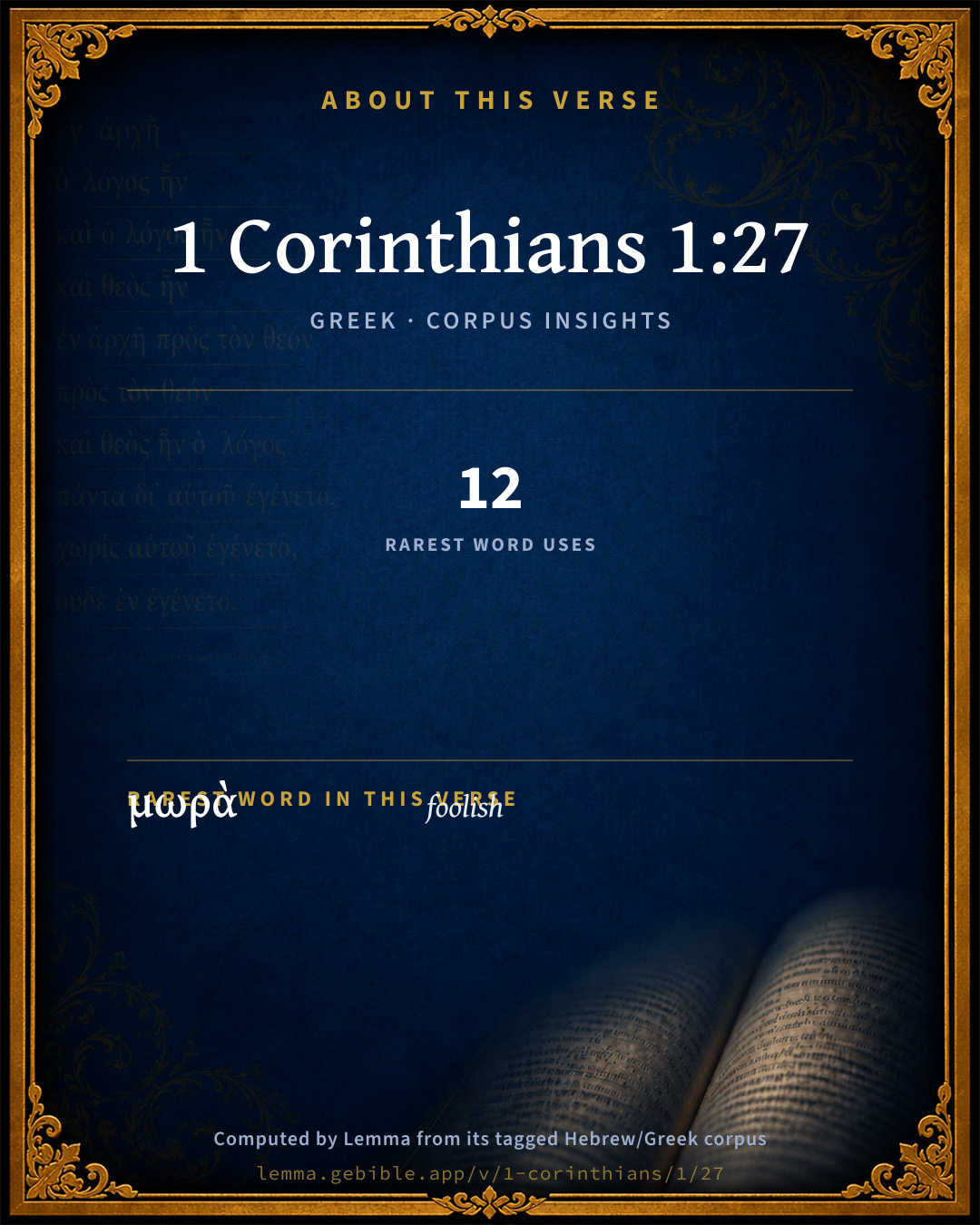
1 Corinthians 1:27

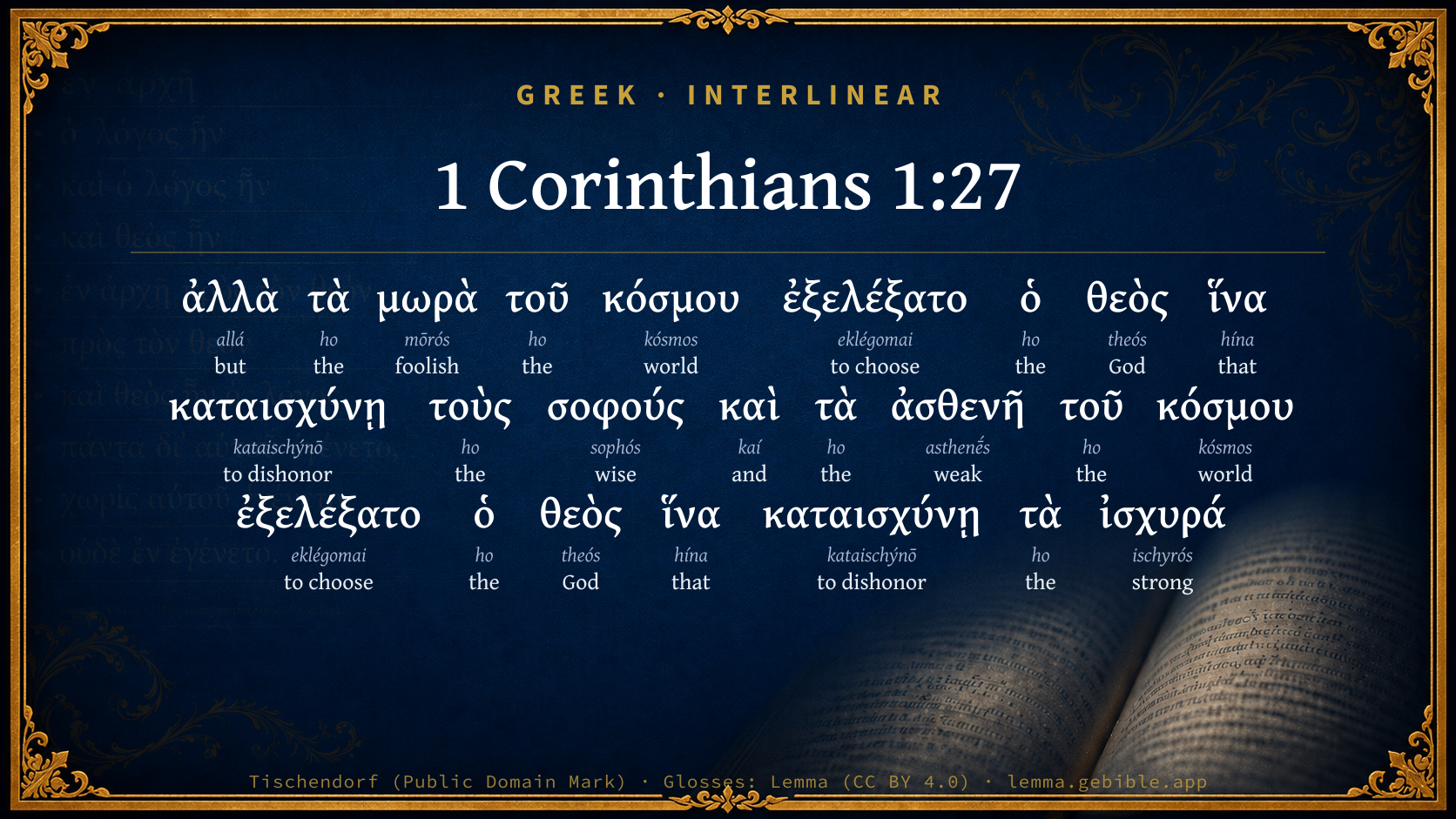
Greek (Tischendorf 8th ed.) 1 Corinthians 1:27 appears in the Greek New Testament. The text above is from the Tischendorf 8th edition. Each word links to its Strong’s number and a concise gloss. Click any word for its full Thayer’s Greek Lexicon entry.
Download image
Cite this verse

1 Corinthians 1:27 (World English Bible). Public Domain. Lemma interlinear Bible study tool, https://lemma.gebible.app/v/1-corinthians/1/27.

Show BibTeX & RIS
BibTeX
RIS
English Translation
but God chose the foolish things of the world that he might put to shame those who are wise. God chose the weak things of the world, that he might put to shame the things that are strong;
World English Bible · Public Domain
Download a study sheet

One document with this verse’s original text, its word-by-word gloss line, the meaning frame, cross-references with their text, attributed commentary, and full source and license credits — printable, and it pastes into notes with its structure intact.

This verse Autodidact and up

Study sheet (.html) Plain text (.txt)

A passage Seminary Student

Up to 50 verses in one chapter. A passage sheet keeps up to 6 commentary sources and 12 cross-references per verse, in the order this page ranks them, and says so on the sheet whenever that leaves anything out. Ask for a single verse and you get the Autodidact verse sheet above.

Everything on this page stays free to read, with no account — the sheet is a download of what is already on screen, not access to it.

Want to remove ads? Support Godless Engineer
Compare translations 3

The same verse in 3 English versions, stacked beneath the original-language interlinear above. Click any original word for its lexicon entry.

Each is an independent rendering of the whole verse — the interlinear is not word-aligned to these translations.

Highlighted words mark where these versions differ — a whole-verse word diff, not a word-by-word alignment.

  • World English Bible Public Domain
    but God chose the foolish things of the world that he might put to shame those who are wise. God chose the weak things of the world, that he might put to shame the things that are strong;
  • King James Version Public Domain
    But God hath chosen the foolish things of the world to confound the wise; and God hath chosen the weak things of the world to confound the things which are mighty;
  • unfoldingWord Literal Text CC BY-SA 4.0
    But God chose the foolish things of the world in order that he might shame the wise, and God chose the weak things of the world in order that he might shame the strong,

unfoldingWord Literal Text — © unfoldingWord, licensed CC BY-SA 4.0. Word-aligned USFM3 via Door43 (git.door43.org/unfoldingWord/en_ult).

Versions to compare (up to 4)

3 of 4 selected

Show all 19 translations

Every available English version of this verse, each an independent rendering of the whole verse.

  • World English Bible Public Domain
    but God chose the foolish things of the world that he might put to shame those who are wise. God chose the weak things of the world, that he might put to shame the things that are strong;
  • Berean Standard Bible Public Domain
    But God chose the foolish things of the world to shame the wise; God chose the weak things of the world to shame the strong.
  • Majority Standard Bible Public Domain
    But God chose the foolish things of the world to shame the wise; God chose the weak things of the world to shame the strong.
  • King James Version Public Domain
    But God hath chosen the foolish things of the world to confound the wise; and God hath chosen the weak things of the world to confound the things which are mighty;
  • American Standard Version (1901) Public Domain
    but God chose the foolish things of the world, that he might put to shame them that are wise; and God chose the weak things of the world, that he might put to shame the things that are strong;
  • Revised Version (1885) Public Domain
    but God chose the foolish things of the world, that he might put to shame them that are wise; and God chose the weak things of the world, that he might put to shame the things that are strong;
  • Geneva Bible (1599) Public Domain
    But God hath chosen the foolish thinges of the world to confound the wise, and God hath chosen the weake thinges of the worlde, to confound the mightie things,
  • Douay-Rheims (1899) Public Domain
    But the foolish things of the world hath God chosen, that he may confound the wise; and the weak things of the world hath God chosen, that he may confound the strong.
  • Young's Literal Translation Public Domain
    but the foolish things of the world did God choose, that the wise He may put to shame; and the weak things of the world did God choose that He may put to shame the strong;
  • Literal Standard Version CC BY-SA 4.0
    but God chose the foolish things of the world that He may put the wise to shame; and God chose the weak things of the world that He may put the strong to shame;
  • Unlocked Literal Bible CC BY-SA 4.0
    But God chose the foolish things of the world to shame the wise. God chose what is weak in the world to shame what is strong.
  • unfoldingWord Literal Text CC BY-SA 4.0
    But God chose the foolish things of the world in order that he might shame the wise, and God chose the weak things of the world in order that he might shame the strong,
  • Darby Bible Public Domain
    But God has chosen the foolish things of the world, that he may put to shame the wise; and God has chosen the weak things of the world, that he may put to shame the strong things;
  • World Messianic Bible Public Domain
    but God chose the foolish things of the world that he might put to shame those who are wise. God chose the weak things of the world that he might put to shame the things that are strong.
  • Webster's Bible Public Domain
    But God hath chosen the foolish things of the world to confound the wise; and God hath chosen the weak things of the world to confound the things which are mighty;
  • Free Bible Version CC BY-SA 4.0
    Instead God chose the things the world considers foolish to humiliate those who think they are wise. He chose the things the world considers weak to humiliate those who think they are strong.
  • Bible in Basic English Public Domain
    But God made selection of the foolish things of this world so that he might put the wise to shame; and the feeble things that he might put to shame the strong;
  • Text-Critical English NT CC BY 4.0
    But God chose the foolish things of the world to shame the wise, and God chose the weak things of the world to shame the strong.
  • Tyndale New Testament (1534) Public Domain
    but God hath chosen the folysshe thinges of the worlde to confounde the wyse. And God hath chosyn the weake thinges of the worlde to confounde thinges which are mighty.

Literal Standard Version (2020), Covenant Press — licensed CC BY-SA 4.0. Text via the HelloAO Bible API (eBible.org). Unlocked Literal Bible (unfoldingWord) — licensed CC BY-SA 4.0. Text via the HelloAO Bible API (eBible.org). unfoldingWord Literal Text — © unfoldingWord, licensed CC BY-SA 4.0. Word-aligned USFM3 via Door43 (git.door43.org/unfoldingWord/en_ult). Free Bible Version, Dr. Jonathan Gallagher — licensed CC BY-SA 4.0. Text via the HelloAO Bible API (eBible.org).

Word by word

More ways to search: Search by grammar → Find every occurrence → Compare this word →

Practice this passage: Drill this verse → Learn its vocabulary →

μωρὰ
mōrós
G3474
“foolish”
Adjective, Accusative, Plural, Neuter
Part of Speech
Adjective
Case
Accusative
Number
Plural
Gender
Neuter
Full Thayer's Definition

Origin: probably from the base of G3466

TDNT: 17:52,6

1. foolish 2. impious, godless
  1. ἀλλὰ allá G235 “but” Conjunction
  2. τὰ ho G3588 “the” Article, Accusative, Plural, Neuter
  3. τοῦ ho G3588 “the” Article, Genitive, Singular, Masculine
  4. κόσμου kósmos G2889 “world” Noun, Genitive, Singular, Masculine
  5. ἐξελέξατο eklégomai G1586 “to choose” Verb, Aorist, Middle, Indicative, 3rd person, Singular
  6. ὁ ho G3588 “the” Article, Nominative, Singular, Masculine
  7. θεὸς theós G2316 “God” Noun, Nominative, Singular, Masculine
  8. ἵνα hína G2443 “that” Conjunction
  9. καταισχύνῃ kataischýnō G2617 “to dishonor” Verb, Present, Active, Subjunctive, 3rd person, Singular
  10. τοὺς ho G3588 “the” Article, Accusative, Plural, Masculine
  11. σοφούς sophós G4680 “wise” Adjective, Accusative, Plural, Masculine
  12. καὶ kaí G2532 “and” Conjunction
  13. τὰ ho G3588 “the” Article, Accusative, Plural, Neuter
  14. ἀσθενῆ asthenḗs G772 “weak” Adjective, Accusative, Plural, Neuter
  15. τοῦ ho G3588 “the” Article, Genitive, Singular, Masculine
  16. κόσμου kósmos G2889 “world” Noun, Genitive, Singular, Masculine
  17. ἐξελέξατο eklégomai G1586 “to choose” Verb, Aorist, Middle, Indicative, 3rd person, Singular
  18. ὁ ho G3588 “the” Article, Nominative, Singular, Masculine
  19. θεὸς theós G2316 “God” Noun, Nominative, Singular, Masculine
  20. ἵνα hína G2443 “that” Conjunction
  21. καταισχύνῃ kataischýnō G2617 “to dishonor” Verb, Present, Active, Subjunctive, 3rd person, Singular
  22. τὰ ho G3588 “the” Article, Accusative, Plural, Neuter
  23. ἰσχυρά ischyrós G2478 “strong” Adjective, Accusative, Plural, Neuter

About this verse

These counts appear in no published source. They are computed here, from the morphology-tagged text and Lemma’s own curated glosses. What Lemma adds →

24
words
12
distinct lemmas
Pauline Epistles
section

Notable vocabulary

The rarest word here is μωρὰ foolish G3474 — appearing just 12 times in the whole Greek New Testament.

Shared distinctive vocabulary

μωρὰ foolish G3474 occurs in 12 verses of the Greek New Testament. Also found in:

Repetition

Words recur within this verse:

  • κόσμου world G2889 ×2
  • ἐξελέξατο to choose G1586 ×2
  • θεὸς God G2316 ×2
  • καταισχύνῃ to dishonor G2617 ×2
  • τὰ the G3588 ×8
  • ἵνα that G2443 ×2

Cross-references

22

Topical passages linked to 1 Corinthians 1:27 in the Treasury of Scripture Knowledge — connected by theme and wording, ordered by reader-vote popularity; previews shown in the World English Bible.

  • James 2:5 Listen, my beloved brothers. Didn't God choose those who are poor in this world to be rich in faith, and heirs of the Kingdom which he promised to those who love him?
  • Matthew 11:25 At that time, Jesus answered, "I thank you, Father, Lord of heaven and earth, that you hid these things from the wise and understanding, and revealed them to infants.
  • 1 Corinthians 1:20 Where is the wise? Where is the scribe? Where is the lawyer of this world? Hasn't God made foolish the wisdom of this world?
  • Psalms 8:2 From the lips of babes and infants you have established strength, Because of your adversaries, that you might silence the enemy and the avenger.
  • Luke 21:15 for I will give you a mouth and wisdom which all your adversaries will not be able to withstand or to contradict.
  • Isaiah 29:14 therefore, behold, I will proceed to do a marvelous work among this people, even a marvelous work and a wonder; and the wisdom of their wise men shall perish, and the understanding of their prudent men shall be hid.
  • Acts 4:11–21 He is 'the stone which was regarded as worthless by you, the builders, which has become the head of the corner.'
  • 2 Corinthians 10:4–5 for the weapons of our warfare are not of the flesh, but mighty before God to the throwing down of strongholds,
  • 2 Corinthians 4:7 But we have this treasure in clay vessels, that the exceeding greatness of the power may be of God, and not from ourselves.
  • Matthew 21:16 and said to him, "Do you hear what these are saying?" Jesus said to them, "Yes. Did you never read, 'Out of the mouth of babes and nursing babies you have perfected praise?'"
  • Zephaniah 3:12 But I will leave in the midst of you an afflicted and poor people, and they will take refuge in the name of Yahweh.
  • Isaiah 26:5–6 For he has brought down those who dwell on high, the lofty city: he lays it low, he lays it low even to the ground; he brings it even to the dust.
  • Isaiah 29:19 The humble also shall increase their joy in Yahweh, and the poor among men shall rejoice in the Holy One of Israel.
  • 2 Corinthians 10:10 For, "His letters," they say, "are weighty and strong, but his bodily presence is weak, and his speech is despised."
  • Matthew 4:18–22 Walking by the sea of Galilee, he saw two brothers: Simon, who is called Peter, and Andrew, his brother, casting a net into the sea; for they were fishermen.
  • Matthew 9:9 As Jesus passed by from there, he saw a man called Matthew sitting at the tax collection office. He said to him, "Follow me." He got up and followed him.
  • Acts 24:24–25 But after some days, Felix came with Drusilla, his wife, who was a Jewess, and sent for Paul, and heard him concerning the faith in Christ Jesus.
  • Luke 19:39–40 Some of the Pharisees from the multitude said to him, "Teacher, rebuke your disciples!"
  • Acts 6:9–10 But some of those who were of the synagogue called "The Libertines," and of the Cyrenians, of the Alexandrians, and of those of Cilicia and Asia arose, disputing with Stephen.
  • Acts 17:18 Some of the Epicurean and Stoic philosophers also were conversing with him. Some said, "What does this babbler want to say?" Others said, "He seems to be advocating foreign deities," because he preached Jesus and the resurrection.
  • Acts 7:54 Now when they heard these things, they were cut to the heart, and they gnashed at him with their teeth.
  • Acts 7:35 "This Moses, whom they refused, saying, 'Who made you a ruler and a judge?'--God has sent him as both a ruler and a deliverer by the hand of the angel who appeared to him in the bush.

Cross-references courtesy of OpenBible.info (CC BY 4.0).

Commentary

Notes on 1 Corinthians 1:27 from classic Christian and Jewish commentators (each source and its license shown beneath its notes). The classic Christian expositions comment on the surrounding passage and are grouped to its opening verse, so a note may address several verses; the Jewish commentaries on the Tanakh (Rashi and others) are per-verse, so they appear only where the commentator wrote on this verse.

Lemma curates 59 commentaries, every one of them public domain or Creative Commons licensed, each selected and text-cleaned for this edition rather than reprinted as found. About our sources →

Joseph Benson's Commentary

1Co 1:27-29. But God hath chosen the foolish things — Or, supplying the word προσωπα, the foolish persons of the world. Such persons as are of little esteem in the world, for want of learning, parts, eloquence, and such other endowments as some have attained, and who are judged altogether unfit to teach others, especially the Greeks and Romans. To confound the wise — To shame those who account themselves, and are accounted wise; and of whom the world is most ready to boast. In this passage the apostle imitates the contemptuous language in which the Greek philosophers, and men of learning, affected to speak of the Christian preachers: yet, as he does it in irony, he aggrandizes them. The first preachers of the gospel, as Bishop Newton observes, “were chiefly a few poor fishermen, of low parentage, of no learning or eloquence, of no reputation or authority, despised as Jews by the rest of mankind, and by the Jews as the meanest and worst of themselves. What improper instruments were these to contend with the prejudices of the world, the superstition of the people, the interests of the priests, the vanity of the philosophers, the pride of the rulers, the malice of the Jews, the learning of the Greeks, and the power of Rome!” But the weaker the instruments who converted the world, the greater was the display of the power of God by which they acted. See on 2Co 4:7. And the weak things of the world — Persons who pretend to no extraordinary abilities or endowments; to confound — Or shame; the things which are mighty — Which, with all their boasted powers and qualifications, have never been able to work such a reformation among men, as these despised disciples of Jesus have been the means of effecting. And base things of the world — Things accounted vile and despised, εξουθενημενα, set at naught; and things which are not — Which are as little regarded, or as much overlooked, as if they had no being, and were below contempt itself; hath God chosen — To be his instruments in renewing and saving mankind; to bring to naught — To annihilate; things that are — In the highest esteem, and that make the most illustrious figures among mankind. That no flesh — A fit appellation; flesh is fair, but withering as grass; should glory in his presence — That no human being might boast of any advantages or distinctions, or of any excellence in himself, as the cause of his being appointed an apostle, evangelist, or minister of Christ, and employed in preaching the gospel: and that none who are converted by the preaching of such, should consider their conversion as the effect of any human abilities, natural or acquired, but should be compelled to ascribe the glory of all to God.

Joseph Benson's Commentary on the Old and New Testaments (1811–1818) — public domain. Text from a community e-Sword module.

Tyndale Open Study Notes

Tyndale Open Resources

1:27-29 God chose despised and humble people in order to demonstrate his judgment on human pride (cp. Rom 3:27; 4:2; 2 Cor 4:7-11; 12:8-10; Eph 2:9).

Tyndale Open Study Notes — © Tyndale Open Resources, licensed CC BY-SA 4.0. Text via the HelloAO Bible API.

Bengel's Gnomon

Johann Albrecht Bengel

1Co 1:27. Τὰ) The article has this force: those things in particular and especially, which are foolish, etc.—ἐξελεξατο, hath chosen [viz., in great numbers]) Act 18:10—V. g.] (“I have much people in this city,” i.e., Corinth). This word is put thrice; election [choosing] and calling, 1Co 1:26, are joined in one; Eze 20:5. The latter is a proof of the former. Election is the judgment of Divine grace exempting in Christ from the common destruction of men, those who accept their calling by faith. Every one who is called, is elected from the first moment of his faith; and so long as he continues in his calling and faith, he continues to be elected; if at any time he loses calling and faith, he ceases to be elected; when he brings forth fruit in faith, he confirms that calling and election in his own case: if he returns to faith, and believing falls asleep, he returns to his state of election, and as one elected falls asleep. And these κατʼ ἐξοχὴν, pre-eminently, are the men who are elected and foreknown. Election relates either to peoples or individuals. The question here and in Eze 20:5: also Act 18:10; 1Th 1:4: is concerning the election of a people; and this species of election in a greater degree falls under the distinct perceptions of men that are believers, than the election of individuals; for some individuals of the people may fall away, and yet the breadth of calling and election [i.e. the calling viewed in its comprehension of the whole people as such] may be equally preserved. The election of some outside of the church is a Thing Reserved for God Himself, and must not be tried by the rule of the preaching of the Gospel.[14]—ΤΟῪς ΣΟΦΟῪς, the wise) In the masculine to express a very beautiful idea;[15] the rest are neuter, as all standing in opposition to τοὺς σοφοὺς, yea even foolish things.—καταισχύνῃ, might put to shame [confound]) This word is twice repeated; we have afterwards, might bring to nought [1Co 1:28]. By both of these words glorying [1Co 1:29; 1Co 1:31] is taken away, whether the subject of boasting be more or less voluntary.

[14] Which restricts salvation to them that believe.—ED.

[15] Viz., That even things (and, those too, foolish things) are chosen by God to confound persons (and, those too, persons who are wise).—ED.

Bengel's Gnomon of the New Testament — English translation (T&T Clark, Edinburgh, 1860) — public domain. Text from a community e-Sword module.

Meyer's Critical & Exegetical Commentary

Heinrich August Wilhelm Meyer

1Co_1:27-28. Expanded (see τοῦ κόσμου and πᾶσα σάρξ, 1Co_1:29) statement of the opposite: No; the foolish things of the world were what God chose out for Himself, etc. The calling, 1Co_1:26, was in truth just the result and the proof of the election. Comp 1Th_1:4 f.; 2Th_2:13 f.; Rom_8:30; Rom_9:23 f.

ΤᾺ ΜΩΡᾺ ΤΟῦ ΚΌΣΜΟΥ] the foolish elements of the world (mankind), i.e. those to whom earthly wisdom was a quite foreign thing, so that they were the simple among men. Comp Mat_11:25. Many exegetes (including Theodoret, Luther, Grotius, Estius, Rosenmüller, Flatt, and Billroth) take the genitive as: according to the judgment of the world. Against this may he urged, partly, the very fact that when God chose to Himself the persons referred to, they too had not yet the higher wisdom, and consequently were not unwise merely in the eyes of the world; and partly, as deciding the point, the following ἀσθ. and ἈΓΕΝ., for they were, it is plain, really (and not merely in the eyes of the world) weak and of mean origin.

The neuters (comp on the plural, Gal_3:22) indicate the category generally, it being evident from the context that what is meant is the persons included under that category. See generally, Winer, p. 167 [E. T. 222], and the same usage among classical writers in Blomfield, a[273] Aesch. Pers. Gloss. 101.

ἽΝΑ Τ. Σ. ΚΑΤΑΙΣΧ.] design. The nothingness and worthlessness of their wisdom were, to their shame, to be brought practically to light (by Gods choosing not them, but the unwise, for honour), no matter whether they themselves were conscious of this putting of them to shame or not.

The thrice-repeated ἐξελ. ὁ Θεός, beside the three contrasts of ΣΟΦΟΊ, ΔΥΝΑΤΟΊ, and ΕὐΓΕΝΕῖς (1Co_1:26), carries with it a triumphant emphasis.

ΤᾺ ΜῊ ὌΝΤΑ] The contrast to ΕὐΓΕΝΕῖς is brought out by three steps forming a climax. This third phrase is the strongest of all, and sums up powerfully the two foregoing ones by way of apposition (hence without ΚΑΊ): the non-existent, i.e. what was as utterly worth nothing as if it had not existed at all (Winer, p. 451 [E. T. 608]). Comp Eur. Hec. 284: ἦν πότʼ, ἀλλὰ νῦν οὐκ εἴμʼ ἔτι. Dem. 248. 25; Plat. Crit. p. 50 B; and Stallbaum thereon. The subjective negation μή is quite according to rule (Baeumlein, Partik. p. 296), since the participle with the article expresses a generic notion; and there is no need of importing the idea of an untrue although actual existence (Hofmann). We are not therefore to supply τι to ΤᾺ ὌΝΤΑ (as if ΜΗΔῈΝ ΕἾΝΑΙ had been used before), but to explain it: the existent, what through repute, fortune, etc., is regarded as that which is (κατʼ ἐξοχήν). Comp Pflugk, a[276] Hec. l.c[277]: ipsum verbum εἶναι eam vim habet, ut significet in aliquo numero esse, rebus secundis florere.

κατηργ.] Not ΚΑΤΑΙΣΧ. again, because the notions ΜῊ ΕἾΝΑΙ and ΕἾΝΑΙ required a stronger word to correspond to them; one which would convey the idea of bringing to nought (i.e. making worthless, Rom_3:31).

[273] d refers to the note of the commentator or editor named on the particular passage.

[276] d refers to the note of the commentator or editor named on the particular passage.

[277] .c. loco citato or laudato.

Meyer — Critical and Exegetical Commentary on the New Testament — English translation by Peter Christie, edited by Frederick Crombie (T&T Clark, 1880) — public domain. Text from a community e-Sword module.

Expositor's Greek Testament

ed. W. Robertson Nicoll

1Co 1:27-28 . “Nay, but ( ἀλλά , the but of exclusion) the foolish … the weak … the base-born things of the world God did choose out (when He chose you).” ἐξελέξατο ( selected, picked out for Himself ) is equivalent to ἐκάλεσεν ( 1Co 1:2 ; 1Co 1:9 ; 1Co 1:26 ), εὐδόκησεν … σῶσαι (1Co 1:21 ), τὴν χάριν ἔδωκεν ἐν Χ . Ἰ . (1Co 1:4 ); this word indicates the relation in which the saved are put both to God and to the world , out of ( ἐξ ) which they were taken (see parls.); nothing here suggests, as in Eph 1:4 , the idea of eternal election. ἐξελέξατο ὁ Θεός : the astonishing fact thrice repeated, with solemn emphasis of assurance. The objects of God’s saving choice and the means of their salvation match each other; by His τὸ μωρὸν and τὸ ἀσθενές (1Co 1:25 ) He saves τὰ μωρὰ and τὰ ἀσθενῆ : “the world laughs at our beggarly selves, as it laughs at our beggarly Gospell” The neut. adj [249] of 1Co 1:27 f. mark the category to which the selected belong; their very foolishness, weakness, ignobility determine God’s choice ( cf. Mat 9:13 , Luk 10:21 , etc.). τοῦ κόσμου is partitive gen [250] : out of all the world contained, God chose its (actually) foolish, weak, base things making “fæx urbis lux orbis!” In this God acted deliberately, pursuing the course maintained through previous ages, ἐν τῇ σοφίᾳ τοῦ Θεοῦ (see note, 1Co 1:21 ): He “selected the foolish things of the world, that He might shame its wise men ( τοὺς σοφούς ) … the weak things of the world, that He might shame its strong things ( τὰ ἰσχυρά ), and the base-born things of the world and the things made absolutely nothing of … the things nonexistent, that He might bring the things existent to naught”. In the first instance a class of persons , immediately present to Paul’s mind ( cf. 1Co 1:20 ), is to be “put to shame”; in the two latter P. thinks, more at large, of worldly forces and institutions ( cf. 1Co 7:31 , 2Co 10:4-6 ). The pride of the cultured and ruling classes of paganism was to be confounded by the powers which Christianity conferred upon its social outcasts; as, e.g. , Hindoo Brahminism is shamed by the moral and intellectual superiority acquired by Christian Pariahs. τὰ ἀγενῆ τοῦ κόσμου , third of the categories of disparagement, is reinforced by τὰ ἐξουθενημένα (from ἐξ and οὐδέν , pf. pass [251] : things set down as of no account whatever ), then capped by the abruptly apposed τὰ μὴ ὄντα , to which is attached the crowning final clause, ἵνα τὰ ὄντα καταργήσῃ . For καταργέω ( ut enervaret , Bz [252] ), see note on κενόω (1Co 1:17 ), and parls.; the scornful world-powers are not merely to be robbed of their glory (as in the two former predictions), but of their power and being , as indeed befell in the end the existing social and political fabric. In τὰ μὴ ὄντα , “ μὴ implies that the non-existence is not absolute but estimative ” (Al [253] ); the classes to which Christianity appealed were non-entities for philosophers and statesmen, cyphers in their reckoning: contrast οὐκ ὤν , of objective matter of fact, in Joh 10:12 , Act 7:5 ; also Eurip., Troad. , 600. τὰ ὄντα connotes more than bare existence; “ipsum verbum εἶναι eam vim habet ut significet in aliquo numero esse, rebus secundis florere” (Pflugk, on Eurip., Hecuba , 284, quoted by Mr [254] ); it is τὰ ὄντα κατʼ ἐξοχήν : cf. the adv [255] ὄντως in 1Ti 6:19 .

[249] adjective.

[250] genitive case.

[251] passive voice.

[252] Beza’s Nov. Testamentum: Interpretatio et Annotationes (Cantab., 1642).

[253] Alford’s Greek Testament .

[254] Meyer’s Critical and Exegetical Commentary (Eng. Trans.).

[255] adverb

The Expositor's Greek Testament, edited by W. Robertson Nicoll (1897–1910) — public domain. Text from a community e-Sword module.

Hodge's Commentary on Romans, Ephesians & First Corinthians

Charles Hodge

1Co_1:27

But God hath chosen the foolish things of the world to confound the wise, and God hath chosen the weak things of the world to confound the things which are mighty.

In this and the following verses the apostle asserts affirmatively what he had just stated negatively, God does not choose the wise, but he chooses the foolish.

The foolish things of the world, (τὰ μωρὰ τοῦ κόσμου) the foolish portion of mankind. In this and in the following clauses the neuter is used although persons are intended, because the reference is indefinite. God hath chosen the foolish, the weak, the insignificant, etc. Hath chosen. It is implied in this form of expression, which is repeated for the sake of emphasis, that as, on the one hand, the wise and the great were not chosen on account of their wisdom or greatness, so, on the other, the foolish and the weak were not chosen on account of their want of wisdom or greatness. God chose whom he pleased. He chose the ignorant that he might confound the wise; and the weak, that he might confound the mighty. That is, that he might put them to shame, by convincing them of the little value of the things on which they prided themselves, and by exalting over them those whom they despised.

Charles Hodge — Commentary on Romans (1835), First Corinthians (1857), and Ephesians (1856) — public domain. Text from a community e-Sword module.

Jamieson, Fausset & Brown

Robert Jamieson, A. R. Fausset & David Brown

the foolish things--a general phrase for all persons and things foolish. Even things (and those, too, foolish things) are chosen by God to confound persons, (and those too persons who are wise). This seems to me the force of the change from neuter to masculine.

to confound--The Greek is stronger, "that He might confound (or put to shame)." God confounds the wise by effecting through His instruments, without human wisdom, that the worldly wise, with it, cannot effect, namely, to bring men to salvation.

chosen . . . chosen--The repetition indicates the gracious deliberateness of God's purpose (Jam 2:5).

Jamieson, Fausset & Brown — Commentary Critical and Explanatory on the Whole Bible (1871) — public domain (CC PDM 1.0). Text via the HelloAO Bible API.

Adam Clarke's Commentary

Verse 27. But God hath chosen the foolish things] God has chosen by means of men who are esteemed rude and illiterate to confound the greatest of the Greek philosophers, and overturn their systems; and, by means of men weak, without secular power or authority, to confound the scribes and Pharisees, and in spite of the exertions of the Jewish sanhedrin, to spread the doctrine of Christ crucified all over the land of Judea, and by such instruments as these to convert thousands of souls to the faith of the Gospel, who are ready to lay down their lives for the truth. The Jews have proverbs that express the same sense as these words of the apostle. In Shemoth Rabba, sec. 17, fol. 117, it is said: "There are certain matters which appear little to men, yet by them God points out important precepts. Thus hyssop in the sight of man is worth nothing, but in the sight of God its power is great; sometimes he equals it to the cedar, particularly in the ordinance concerning the lepers, and in the burning of the red heifer. Thus God commanded them in Egypt, Ex 12:22: And ye shall take a bunch of hyssop, c. And concerning Solomon it is said, 1Kgs 4:33: And he discoursed of trees, from the cedar on Lebanon to the hyssop that grows out of the wall. Whence we may learn that great and small things are equal in the eyes of the Lord, and that even by small things He can work great miracles."

Adam Clarke's Commentary on the Bible (1810–1826) — public domain. Text from a community e-Sword/MySword module.

Ellicott's Commentary for English Readers

(27) Foolish things.—The neuter is used probably for the purpose of generalising, and it expresses the qualities of the men whom God has chosen—“the wise” is masculine in the Greek, showing that it is still of “persons” the Apostle is speaking.

A Bible Commentary for English Readers, edited by Charles John Ellicott (1878–1897) — public domain. Text from a community e-Sword module.

The Cambridge Bible for Schools and Colleges

gen. ed. J. J. S. Perowne

27. to confound] Literally to disgrace, bring to shame. That which is disgraced can have no ground for self-glorification.

The Cambridge Bible for Schools and Colleges (gen. ed. J. J. S. Perowne; Cambridge University Press, 1878–1918) — public domain. Text from a community e-Sword module.

John Gill's Exposition

But God hath chosen the foolish things of the world,.... So the Jews, in distinction from their wise Rabbins and doctors, call others, , "the fools of the world" (p); the persons whom God made choice of from all eternity, as appears by his calling them in time, are such who with respect to the wisdom of the world are foolish; have not those natural parts and abilities, that sagacity and penetration in things natural and civil, that knowledge and learning which many others have; and are therefore esteemed foolish by the men of the world, in comparison of whom; who are the wise and prudent, they are but babes: and God's end in his choice of them, and calling them, is

to confound the wise; who sooner or later will be brought to shame and confusion, to see such idiots, as they took them to be, wiser than they in the business of salvation; having been directed and influenced by divine grace to choose that good part, which shall never be taken from them, when they will be stripped of their nobility, wealth, and wisdom; to see these men go into the kingdom of heaven, and they themselves shut out:

and God hath chosen the weak things of the world; who cannot boast of their birth and pedigree, of their ancient and illustrious families; have no titles of honour to aggrandize them, nor estates, possessions, and worldly substance to support themselves with; and this he has done,

to confound the things which are mighty; as Haman was by the advancement of Mordecai. It will be to the utter confusion of the rich and mighty, to see persons of the lowest class in life made kings and priests by Christ, set among princes, and upon the throne of glory; and they themselves fleeing, and calling to the mountains to fall upon them, and cover them from the sight of him that sits on the throne, and the Lamb,

(p) Zohar in Numb. fol. 63. 3. & 65. 4.

John Gill's Exposition of the Whole Bible (1746–1763) — public domain (CC PDM 1.0). Text via the HelloAO Bible API.

Trapp's Complete Commentary

John Trapp

27 But God hath chosen the foolish things of the world to confound the wise; and God hath chosen the weak things of the world to confound the things which are mighty;

Ver. 27. But God hath chosen] In our Church assemblies the meaner usually, like little fishes, bite more than the greater. The poor are gospelized, Mat 11:5.

John Trapp, A Commentary or Exposition upon All the Books of the Old and New Testament (1647–1656) — public domain. Text from a community e-Sword module.

Albert Barnes' Notes on the Bible

But God hath chosen - The fact of their being in the church at all was the result of his choice. It was owing entirely to his grace.

The foolish things - The things esteemed foolish among people. The expression here refers to those who were destitute of learning, rank, wealth, and power, and who were esteemed as fools, and were despised by the rich and the great.

To confound - To bring to shame; or that he might make them ashamed; that is, humble them by showing them how little he regarded their wisdom; and how little their wisdom contributed to the success of his cause. By thus overlooking them, and bestowing his favors on the humble and the poor; by choosing his people from the ranks which they despised, and bestowing on them the exalted privilege of being called the sons of God, he had poured dishonor on the rich and the great, and overwhelmed them, and their schemes of wisdom, with shame. It is also true, that those who are regarded as fools by the wise men of the world are able often to confound those who boast of their wisdom; and that the arguments of plain people, though unlearned except in the school of Christ; of people of sound common sense under the influence of Christian principles, have a force which the learning and talent of the people of this world cannot gainsay or resist. They have truth on their side; and truth, though dressed in a humble garb, is more mighty than error, though clothed with the brilliancy of imagination, the pomp of declamation, and the cunning of sophistry.

And the weak things - Those esteemed weak by the people of the world.

The mighty - The great; the noble; the learned.

Albert Barnes' Notes on the Bible (1834–1885) — public domain. Text from a community e-Sword/MySword module.

Matthew Poole's English Annotations

God hath even amongst you chosen persons that are in the account of the world as foolish things, to put the wise to shame; and persons of weak esteem, to confound those that are mighty in the repute of the world.

Matthew Poole's English Annotations on the Holy Bible (1683–1685) — public domain. Text from a community e-Sword/MySword module.

Whedon's Commentary on the Bible

Daniel D. Whedon

27. God hath chosen—It is a divine revolution; and we have the divine honour of being its instruments chosen of God. In this revolution the foolish things and the weak overthrow the wise and the mighty.

Daniel D. Whedon (gen. ed.), Commentary on the Old and New Testaments (1874–1909) — public domain. Text from a community e-Sword module.

The Pulpit Commentary

God chose; not, hath chosen out. We may remark, once for all, that there was no reason why the translators of 1611 should thus have turned the Greek aorists of the New Testament into perfects. In this and in many instances the change of tense is unimportant, but sometimes it materially and injuriously affects the sense. The foolish things the weak things. So, too, the psalmist, "Out of the mouths of babes and sucklings hast thou ordained strength"; (Psa_8:2) and St. James, "Hath not God chosen the poor of this world rich in faith?". (Jam_2:5)

The Pulpit Commentary (1880–1919), ed. H.D.M. Spence-Jones & Joseph S. Exell — public domain. Text from a community e-Sword module.

Scofield Reference Notes

C. I. Scofield

world

kosmos = mankind. (See Scofield "Mat 4:8").

The Scofield Reference Bible (1917 edition), notes by C. I. Scofield — public domain. Text from a community e-Sword module.

Godbey's Commentary on the New Testament

William B. Godbey

27. “But God elected out the foolish things of the world that he may confound the wise.” We see this Scripture verified in our Savior’s apostles, “unlearned and ignorant men” (Act 4:13). He could equally conveniently have put His hand on the champions of Rabbinical and Grecian lore. Why did He select the heralds of salvation from the illiterate and uninfluential rabble? He wanted blank paper on which to write the message of salvation. The learned clergy would have been under great temptation to mix their human dogmata with the pure message of gospel grace, and thus adulterate it. Again, the popular mind would intuitively attribute the power to the gifted and cultured dispenser of the gospel benefactions, and fail to see the real Divinity in the plan of salvation. Hence Divine wisdom has in all ages utilized the elements regarded as “foolish” in worldly estimation to bear the message of redeeming grace and dying love to earth’s perishing millions. “And the weak things of the world God elected out that he may confound the strong.” When a church becomes strong numerically, financially and influentially, God lets her slide away. He has no more use for her. The Holy Ghost retreats away and leaves her to enjoy her worldly power and glory. You must remember that the Holy Ghost is God in the Church. What an awful evacuation of the Protestant churches by the Holy Ghost in the last twenty years. “He that rejecteth sanctification rejecteth not man but God, who giveth unto you his Holy Spirit.” God gives His Holy Spirit to all His people to sanctify them. When they reject the work, in so doing they reject the worker, and fall into the hands of Satan, who then delights to play off on them, robed as an angel of light, passing himself for God, inflating them with wonderful enthusiasm in church work, thus employing and comforting them in the absence of the Holy Ghost. The churches are apostatizing fearfully in the trend of human power and worldly influence, and equally rapidly forsaken by the Holy Ghost and given over to the delusions of the devil. Consequently God the Holy Ghost is everywhere raising up an army of blood-washed and fire-baptized evangelists, male and female, from hovels of poverty, retreats of ignorance, slums and jungles of iniquity, and sending them out to preach the unsearchable riches of Christ “with the Holy Ghost sent down from Heaven,” thus rapidly laying in the shade the cultured clergy, who depend on their intellect and education, instead of the omnipotent Galilean.

William B. Godbey, Commentary on the New Testament (1896–1900) — public domain. Text from a community e-Sword module.

McGarvey & Pendleton's Commentaries

J. W. McGarvey

but God chose the foolish things of the world, that he might put to shame them that are wise; and God chose the weak things of the world [ Psa_8:2 ; Joh_2:5 ], that he might put to shame the things that are strong ;

J. W. McGarvey (with Philip Y. Pendleton), Commentaries on the New Testament (The Fourfold Gospel, 1914; Acts; and the epistles) — public domain. Text from a community e-Sword/MySword module.

The People's New Testament

B. W. Johnson

27. But God hath chosen the foolish things. Men whom the world would call foolish, with a gospel that it called foolishness; yet these “confounded the wise” and upturned the world's philosophies.

B. W. Johnson's The People's New Testament with Notes (1889–1891) — public domain. Electronic text from the Christian Classics Ethereal Library (CCEL) ThML edition.

Cambridge Greek Testament for Schools and Colleges

27. ἐξελέξατο. Selected. The preposition denotes selection from among a number; the voice denotes the purpose for which God called them, i. e. to do His work; the tense denotes the act of choice itself.

ἵνα καταισχύνῃ. In order that he might bring to shame. It is stronger than the A.V. ‘confound.’ Man’s ill-placed self-confidence demanded humiliation.

Cambridge Greek Testament for Schools and Colleges (Cambridge University Press, 1896; 21 vols, various authors incl. Carr, Maclear, Plummer, Farrar, Lumby, Moule, M. R. James, Simcox) — public domain. Text from a community e-Sword module.

International Critical Commentary

27. τὰ μωρά. Cf Mat 11:25. The gender lends force to the paradox: τοὺς σοφούς leads us to expect τοὺς ἰσχυρούς, κ.τ.λ., but the contrast of genders is not kept up in the other cases.

έζελέξατο. The verb is the correlative of κλῆσις (26), but here, as in many other places, it brings in the idea of choice for a particular end. Thus, of the choosing of Matthias, of Stephen, of St Paul as a σκεῦος ἐκλογῆς, of St Peter to admit the first Gentiles (Act 15:7). The emphatic threefold ἐξελέξατο ὁ Θεός prepares the way for v. 31. See 4:7 and Eph 2:8. The Church, like the Apostle (2Co 12:10), was strong in weakness.

International Critical Commentary — older volumes (1896–1929), various authors — public domain. Text from a community e-Sword module.

Vincent's Word Studies in the New Testament

Marvin R. Vincent

Hath chosen. The threefold repetition of the word emphasizes the deliberate and free action of God 's gracious will.

Marvin R. Vincent, Word Studies in the New Testament (1887–1900) — public domain. Text from a community e-Sword/MySword module.

Godet's Commentaries

Frédéric Louis Godet

Vv. 27-29. “But God hath chosen the foolish things of the world to confound the wise, and God hath chosen the weak things of the world to confound the things which are mighty; 28. and base things of the world, and things which are despised, and things which are not, to bring to nought things that are; 29. that no flesh should glory before God.”

The emotion with which the apostle signalizes this providential fact is betrayed by the threefold repetition of the words God has chosen, by the thrice expressed contrast between the two opposite terms, God and the world, and by the emphatic position of the object (thrice repeated) at the beginning of the proposition. The neuter form of the three adjectives, foolish, weak, and vile, contrasted as it is with the masculines preceding, the wise, the mighty, the noble, is not used accidentally; these neuters indicate a mass in which the individuals have so little value that they are not counted as distinct personalities. So the word τὸ ἀνδράποδον, the domestic [thing], is used for slaves. The term ἐκλέγεσθαι does not here denote a decree of eternal predestination, but the energetic action whereby God has taken to Him (the Middle λέγεσθαι) from the midst of the world (ἐκ) those individuals whom no one judged worthy of attention, and made them the bearers of His kingdom. The strong, the wise, etc., are thus covered with shame, because the weak, etc., are not only equal to them, but preferred. In the phrase, things which are despised, is concentrated all that disdain with which the ignorant and weak and poor were overwhelmed in the society of heathendom; and the final term, things which are not, expresses the last step of that scale of abasement on which those beings vegetated. The subjective negative μή before ὄντα does not deny real existence, as would be done by οὐ, but the recognition of any value whatever in public opinion; all those beings were to it as non-existent. The καί, which in the received text precedes the last participle, is omitted by most of the Mjj. The meaning even would be the only suitable. But how could we explain this καί, if it were authentic, otherwise than the previous ones? It is better therefore to reject it. The asyndeton is perfectly in place; it makes this last word the summary, and, so to speak, the accumulation of all the preceding. There is a corresponding gradation in the verb καταργεῖν, to annul (bring to nought), to reduce to absolute powerlessness, which takes the place of the preceding and less strong term καταισχύνειν, to cover with confusion. Already the wise and mighty were humiliated by the call addressed to their social inferiors; now they disappear from the scene. And for what end does God act thus? The apostle answers in the following sentence:

Frédéric Louis Godet — Commentaries on Luke, John, Romans, and 1 Corinthians — English translation (T&T Clark, Edinburgh, 1870s–1890s) — public domain. Text from a community e-Sword module.

Lesson kit

Teaching starters — assembled from the data on this page, not authored interpretation. Every prompt links to the verse data it draws on. Edit before teaching.

1 Corinthians, in the Pauline Epistles, opens this verse with 24 words (12 distinct Greek lemmas). Its most distinctive word is mōrós (“foolish”). A historical commentator’s framing appears above. Read the whole chapter for the surrounding context.

Discussion questions

  1. How does “foolish” (mōrós) shape what this verse is saying?
  2. How does Matthew 5:22, which shares the word «foolish», read alongside this verse?
  3. What does the repetition of “world” (2× in this one verse) do in this verse?
  4. The translations on this page render this verse differently — a whole-verse word diff, not a word-by-word alignment. What might account for the different wordings?
  5. Compare how Joseph Benson's Commentary and Tyndale Open Study Notes read this verse. Where do they agree or differ?

Things to notice

Reading settings

Reading text

Shown beneath each verse's original-language words.

Old Testament
Old Testament edition

Read the OT as the Masoretic Hebrew (MT) or the Greek Septuagint (LXX).

English shown for the Greek Septuagint (in the Hebrew ↔ Greek comparison).

Comparing translations? Open the Compare panel on any verse page to stack up to four side by side.