
1 Corinthians 11:27

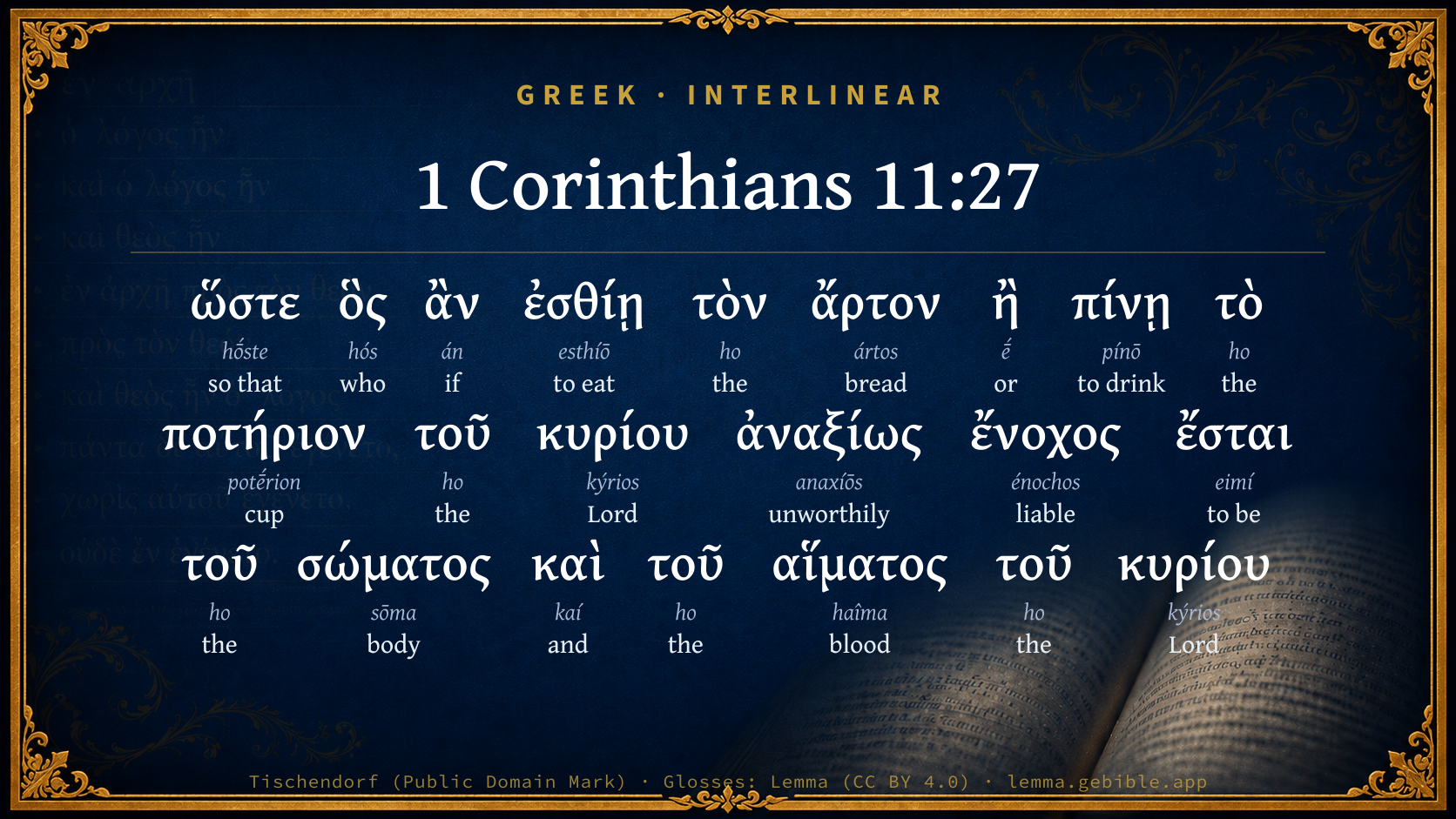
Greek (Tischendorf 8th ed.) 1 Corinthians 11:27 appears in the Greek New Testament. The text above is from the Tischendorf 8th edition. Each word links to its Strong’s number and a concise gloss. Click any word for its full Thayer’s Greek Lexicon entry.
Download image
Cite this verse

1 Corinthians 11:27 (World English Bible). Public Domain. Lemma interlinear Bible study tool, https://lemma.gebible.app/v/1-corinthians/11/27.

Show BibTeX & RIS
BibTeX
RIS
English Translation
Therefore whoever eats this bread or drinks the Lord's cup in a manner unworthy of the Lord will be guilty of the body and the blood of the Lord.
World English Bible · Public Domain
Highlights
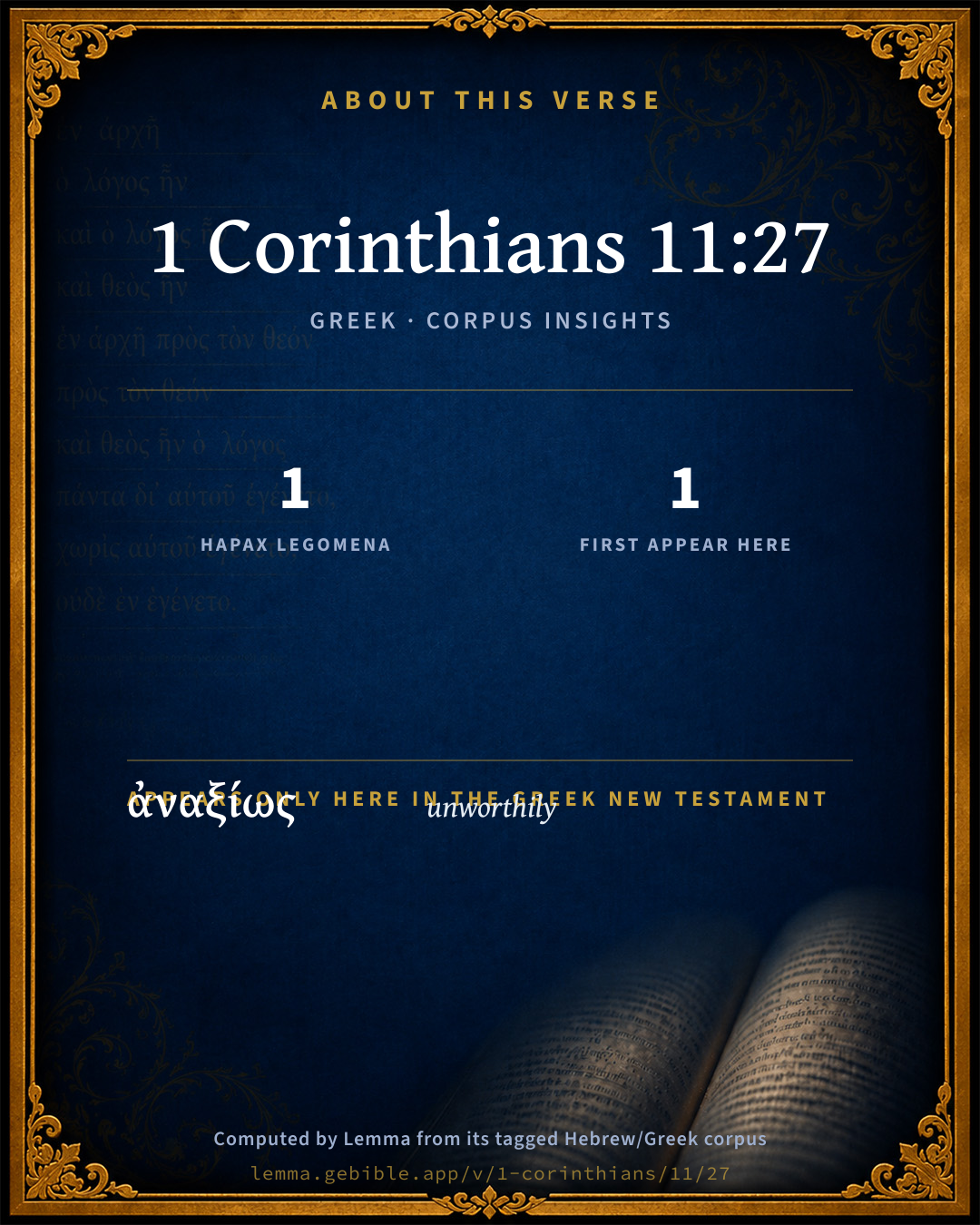
  • 1 hapax legomenon — only here in the Greek New Testament
  • 1 first appearance in the Greek New Testament
Full analysis ↓
Download a study sheet

One document with this verse’s original text, its word-by-word gloss line, the meaning frame, cross-references with their text, attributed commentary, and full source and license credits — printable, and it pastes into notes with its structure intact.

This verse Autodidact and up

Study sheet (.html) Plain text (.txt)

A passage Seminary Student

Up to 50 verses in one chapter. A passage sheet keeps up to 6 commentary sources and 12 cross-references per verse, in the order this page ranks them, and says so on the sheet whenever that leaves anything out. Ask for a single verse and you get the Autodidact verse sheet above.

Everything on this page stays free to read, with no account — the sheet is a download of what is already on screen, not access to it.

Want to remove ads? Support Godless Engineer
Compare translations 3

The same verse in 3 English versions, stacked beneath the original-language interlinear above. Click any original word for its lexicon entry.

Each is an independent rendering of the whole verse — the interlinear is not word-aligned to these translations.

Highlighted words mark where these versions differ — a whole-verse word diff, not a word-by-word alignment.

  • World English Bible Public Domain
    Therefore whoever eats this bread or drinks the Lord's cup in a manner unworthy of the Lord will be guilty of the body and the blood of the Lord.
  • King James Version Public Domain
    Wherefore whosoever shall eat this bread, and drink this cup of the Lord, unworthily, shall be guilty of the body and blood of the Lord.
  • unfoldingWord Literal Text CC BY-SA 4.0
    Whoever, therefore, might eat the bread or might drink the cup of the Lord in an unworthy manner will be guilty of the body and of the blood of the Lord.

unfoldingWord Literal Text — © unfoldingWord, licensed CC BY-SA 4.0. Word-aligned USFM3 via Door43 (git.door43.org/unfoldingWord/en_ult).

Versions to compare (up to 4)

3 of 4 selected

Show all 19 translations

Every available English version of this verse, each an independent rendering of the whole verse.

  • World English Bible Public Domain
    Therefore whoever eats this bread or drinks the Lord's cup in a manner unworthy of the Lord will be guilty of the body and the blood of the Lord.
  • Berean Standard Bible Public Domain
    Therefore, whoever eats the bread or drinks the cup of the Lord in an unworthy manner will be guilty of sinning against the body and blood of the Lord.
  • Majority Standard Bible Public Domain
    Therefore, whoever eats this bread or drinks the cup of the Lord in a manner unworthy of the Lord will be guilty of sinning against the body and blood of the Lord.
  • King James Version Public Domain
    Wherefore whosoever shall eat this bread, and drink this cup of the Lord, unworthily, shall be guilty of the body and blood of the Lord.
  • American Standard Version (1901) Public Domain
    Wherefore whosoever shall eat the bread or drink the cup of the Lord in an unworthy manner, shall be guilty of the body and the blood of the Lord.
  • Revised Version (1885) Public Domain
    Wherefore whosoever shall eat the bread or drink the cup of the Lord unworthily, shall be guilty of the body and the blood of the Lord.
  • Geneva Bible (1599) Public Domain
    Wherefore, whosoeuer shall eate this bread, and drinke the cup of the Lord vnworthily, shall be guiltie of the body and blood of the Lord.
  • Douay-Rheims (1899) Public Domain
    Therefore whosoever shall eat this bread, or drink the chalice of the Lord unworthily, shall be guilty of the body and of the blood of the Lord.
  • Young's Literal Translation Public Domain
    so that whoever may eat this bread or may drink the cup of the Lord unworthily, guilty he shall be of the body and blood of the Lord:
  • Literal Standard Version CC BY-SA 4.0
    so that whoever may eat this bread or may drink the cup of the LORD unworthily, he will be guilty of the body and blood of the LORD:
  • Unlocked Literal Bible CC BY-SA 4.0
    Whoever, therefore, eats the bread or drinks the cup of the Lord in an unworthy manner, will be guilty of the body and the blood of the Lord.
  • unfoldingWord Literal Text CC BY-SA 4.0
    Whoever, therefore, might eat the bread or might drink the cup of the Lord in an unworthy manner will be guilty of the body and of the blood of the Lord.
  • Darby Bible Public Domain
    So that whosoever shall eat the bread, or drink the cup of the Lord, unworthily, shall be guilty in respect of the body and of the blood of the Lord.
  • World Messianic Bible Public Domain
    Therefore whoever eats this bread or drinks the Lord’s cup in a way unworthy of the Lord will be guilty of the body and the blood of the Lord.
  • Webster's Bible Public Domain
    Wherefore, whoever shall eat this bread, and drink this cup of the Lord unworthily, shall be guilty of the body and blood of the Lord.
  • Free Bible Version CC BY-SA 4.0
    So anyone who eats the bread or drinks from the Lord's cup in a dishonorable way will be guilty of doing wrong against the body and blood of the Lord.
  • Bible in Basic English Public Domain
    If, then, anyone takes the bread or the cup of the Lord in the wrong spirit, he will be responsible for the body and blood of the Lord.
  • Text-Critical English NT CC BY 4.0
    So then, whoever eats this bread or drinks the cup of the Lord in a manner unworthy of the Lord will be guilty of the body and blood of the Lord.
  • Tyndale New Testament (1534) Public Domain
    Wherfore whosoevere shall eate of this bred or drynke of the cup vnworthely shalbe giltie of the body and bloud of the Lorde

Literal Standard Version (2020), Covenant Press — licensed CC BY-SA 4.0. Text via the HelloAO Bible API (eBible.org). Unlocked Literal Bible (unfoldingWord) — licensed CC BY-SA 4.0. Text via the HelloAO Bible API (eBible.org). unfoldingWord Literal Text — © unfoldingWord, licensed CC BY-SA 4.0. Word-aligned USFM3 via Door43 (git.door43.org/unfoldingWord/en_ult). Free Bible Version, Dr. Jonathan Gallagher — licensed CC BY-SA 4.0. Text via the HelloAO Bible API (eBible.org).

Word by word

More ways to search: Search by grammar → Find every occurrence → Compare this word →

Practice this passage: Drill this verse → Learn its vocabulary →

ἀναξίως
anaxíōs
G371
“unworthily”
Adverb
Part of Speech
Adverb
Full Thayer's Definition

Origin: from G370

TDNT: None

1. in an unworthy manner
  1. ὥστε hṓste G5620 “so that” Conjunction
  2. ὃς hós G3739 “who” Relative pronoun, Nominative, Singular, Masculine
  3. ἂν án G302 “if” Particle
  4. ἐσθίῃ esthíō G2068 “to eat” Verb, Present, Active, Subjunctive, 3rd person, Singular
  5. τὸν ho G3588 “the” Article, Accusative, Singular, Masculine
  6. ἄρτον ártos G740 “bread” Noun, Accusative, Singular, Masculine
  7. ἢ ḗ G2228 “or” Particle
  8. πίνῃ pínō G4095 “to drink” Verb, Present, Active, Subjunctive, 3rd person, Singular
  9. τὸ ho G3588 “the” Article, Accusative, Singular, Neuter
  10. ποτήριον potḗrion G4221 “cup” Noun, Accusative, Singular, Neuter
  11. τοῦ ho G3588 “the” Article, Genitive, Singular, Masculine
  12. κυρίου kýrios G2962 “Lord” Noun, Genitive, Singular, Masculine
  13. ἔνοχος énochos G1777 “liable” Adjective, Nominative, Singular, Masculine
  14. ἔσται eimí G1510 “to be” Verb, Future, Middle deponent, Indicative, 3rd person, Singular
  15. τοῦ ho G3588 “the” Article, Genitive, Singular, Neuter
  16. σώματος sōma G4983 “body” Noun, Genitive, Singular, Neuter
  17. καὶ kaí G2532 “and” Conjunction
  18. τοῦ ho G3588 “the” Article, Genitive, Singular, Neuter
  19. αἵματος haîma G129 “blood” Noun, Genitive, Singular, Neuter
  20. τοῦ ho G3588 “the” Article, Genitive, Singular, Masculine
  21. κυρίου kýrios G2962 “Lord” Noun, Genitive, Singular, Masculine

About this verse

These counts appear in no published source. They are computed here, from the morphology-tagged text and Lemma’s own curated glosses. What Lemma adds →

22
words
16
distinct lemmas
Pauline Epistles
section

Notable vocabulary

1 hapax legomenon — a word that appears only here in the entire Greek New Testament:

  • ἀναξίως unworthily G371

First appearance in Scripture

This word makes its first canonical appearance in the Greek New Testament here:

  • ἀναξίως unworthily G371

Shared distinctive vocabulary

ἔνοχος liable G1777 occurs in 8 verses of the Greek New Testament. Also found in:
Repetition

Words recur within this verse:

  • κυρίου Lord G2962 ×2
  • τὸν the G3588 ×6

Cross-references

10

Topical passages linked to 1 Corinthians 11:27 in the Treasury of Scripture Knowledge — connected by theme and wording, ordered by reader-vote popularity; previews shown in the World English Bible.

  • John 6:51 I am the living bread which came down out of heaven. If anyone eats of this bread, he will live forever. Yes, the bread which I will give for the life of the world is my flesh."
  • 1 Corinthians 10:21 You can't both drink the cup of the Lord and the cup of demons. You can't both partake of the table of the Lord, and of the table of demons.
  • Hebrews 10:29 How much worse punishment, do you think, will he be judged worthy of, who has trodden under foot the Son of God, and has counted the blood of the covenant with which he was sanctified an unholy thing, and has insulted the Spirit of grace?
  • Numbers 9:13 But the man who is clean, and is not on a journey, and fails to keep the Passover, that soul shall be cut off from his people. Because he didn't offer the offering of Yahweh in its appointed season, that man shall bear his sin.
  • Leviticus 10:1–3 Nadab and Abihu, the sons of Aaron, each took his censer, and put fire in it, and laid incense on it, and offered strange fire before Yahweh, which he had not commanded them.
  • Numbers 9:10 "Say to the children of Israel, 'If any man of you or of your generations is unclean by reason of a dead body, or is on a journey far away, he shall still keep the Passover to Yahweh.
  • John 6:63–64 It is the spirit who gives life. The flesh profits nothing. The words that I speak to you are spirit, and are life.
  • 2 Chronicles 30:18–20 For a multitude of the people, even many of Ephraim and Manasseh, Issachar and Zebulun, had not cleansed themselves, yet did they eat the Passover otherwise than it is written. For Hezekiah had prayed for them, saying, The good Yahweh pardon everyone
  • John 13:18–27 I don't speak concerning all of you. I know whom I have chosen. But that the Scripture may be fulfilled, 'He who eats bread with me has lifted up his heel against me.'
  • Matthew 22:11 But when the king came in to see the guests, he saw there a man who didn't have on wedding clothing,

Cross-references courtesy of OpenBible.info (CC BY 4.0).

Where the printed editions differ

2 variants

Places in this verse where the major printed Greek editions disagree on the wording in a way that affects the translation — a comparison of editions, not a manuscript-by-manuscript collation. The editions are the modern critical texts (Nestlé-Aland 28/27, SBL, Westcott-Hort, Tregelles, Tyndale House) and the traditional texts behind the KJV (the Textus Receptus and the Byzantine/Majority text). It is not a claim about which reading is original.

  1. Extra text
    τοῦτον

    “this”

    In TRByz Not in NA28NA27TynSBLWHTreg

    τοῦτον (touton) 'this' is only in traditional manuscripts (TR+Byz)

  2. Extra text
    τοῦ κυρίου,

    “of the - Lord”

    In Byz Not in NA28NA27TynSBLWHTregTR

    τοῦ κυρίου, (tou kuriou) 'of the - Lord' is only in a few manuscripts (Byz)

Textual data: Translators Amalgamated Greek New Testament (STEPBible TAGNT) · CC BY 4.0.

Commentary

Notes on 1 Corinthians 11:27 from classic Christian and Jewish commentators (each source and its license shown beneath its notes). The classic Christian expositions comment on the surrounding passage and are grouped to its opening verse, so a note may address several verses; the Jewish commentaries on the Tanakh (Rashi and others) are per-verse, so they appear only where the commentator wrote on this verse.

Lemma curates 59 commentaries, every one of them public domain or Creative Commons licensed, each selected and text-cleaned for this edition rather than reprinted as found. About our sources →

The Biblical Illustrator

Joseph S. Exell

1Co_11:27-32

Whosoever shall eat … and drink … unworthily shall be guilty of the body and blood of the Lord.

Eating and drinking unworthily

I. The sin consists in doing it--

1. Ignorantly.

2. Irreverently.

3. Uncharitably.

4. Sensually.

II. Its guilt includes--

1. A contempt of Christs sacrifice.

2. A denial of its efficacy; and by implication.

3. A repetition of His sufferings.

III. Its punishment.

1. Condemnation.

2. Temporal chastisement (1Co_11:30) corrective in its design (1Co_11:32).

IV. Its prevention is secured.

1. Not by neglect or abstinence.

2. But--

(1) By self-examination.

(2) Faithful and conscientious self-discipline (1Co_11:31). (J. Lyth, D.D.)

Worthy or unworthy

1. Verse 27 has operated as a hindrance to the approach of many of our best to the Lords table; but it is not so appalling as it looks. Unworthily must be understood relatively to human ignorance and imperfection; otherwise it would act as a bar to the approach of any. Were the right based upon righteousness there would be none but the Great Host at the table. The unworthy are they whose habitual temper is unchristlike, who, being unworthy, are content with their unworthiness. The qualified are those who wrestle with their bad spirit and tendencies, and who pant to be worthier men and the true children of God.

2. A sacrament is an outward sign of an inward experience. And this is the profanation--when he who gives the sign does not yearn for the thing signified.

3. The scruples that hold some back from the Lords table are--

I. As to the age at which a person should make public declaration of his discipleship. Now, the condition of time does not enter into the question at all. The spirit of life in man does not regulate its arrival by the chronometer. When the hour of conscious life in God and conscious fellowship with Him comes, then also comes the hour when you may give the sacred symbolic signs, and take your seat at the guest table of the Lord, no matter how young in years you may be. And, indeed, till the hour does come when you freely place yourself at the disposal of Christs influence, you have no right to claim a place at that board, no matter how many your years.

II. That their minds are unsettled by doubt. Well! the doubting temper is not the most blessed; but at the same time all doubts are not sins. It is not seldom by doubt that God leads us to faith. And as long as doubt does not spring from worldliness or levity; as long as it does not shake our faith in God, in Christ, and in conscience; as long as it drives us to the feet of God in prayer, and not away from them in pride; as long as we wish to believe the things we find it hard to believe, so long may doubt be a schoolmaster to bring us home to Christ. Doubt of dogma is no sin; indifference to Christs claims is; and the Lord has spread this table for the loving and the docile, not for the clear-headed system-maker and the scientific expert. The doubter who sits in the scorners chair, deriding, jeering, sneering, let him alone stay away! and let the reverent and lowly listening doubter come, and Christ, the Host, will not withhold His hand.

III. The consciousness of personal unworthiness of nature. But, if that table were only for the worthy, it were arrogance in any mortal man to appear. Christ invites not the righteous but the sinful to come. Indeed, it is in the feeling that we are unworthy that our only qualification lies. It is not that we be holy, but that we aspire to be holy; and in whomsoever there is this desire, no matter how poor and imperfect his actual attainments are in such, and not in the self-satisfied Pharisee, you find the true disciple who may take his place at the guest table of the Lord. (J. Forfar.)

Worthy and unworthy communicating

I. The sin, unworthy eating and drinking of the sacrament.

1. One may do an action worthily in a threefold respect.

(1) As the labourer is worthy of his hire (Luk_10:7). This exact worthiness may claim a reward due unto it, and the denier doth this worthy party wrong. Now no saint can receive with this worthiness, as appears by the humble confessions of Jacob (Gen_32:10), Jn Baptist (Mat_3:11). So communicants say, We be not worthy so much as to gather up the crumbs under Thy table.

(2) Though not in a perfect and exact proportion, yet in some fitness unto that which is required (Mat_3:8; Col_1:10; Eph_4:1; Php_1:27)--i.e., let not your life shame your belief; let not your practice be inconsistent with your profession. And we must know that sins of infirmity, through Gods mercy, may subsist with this worthiness. In this acception to eat worthily is to eat so fitted and prepared as may bear some resemblance and agreement to the solemnity of the work we go about.

(3) The worthiness of acceptance, when God for Christs sake is pleased to take our actions in good worth. That is well spoken which is well taken; and that man is worthy who by God is accepted so to be (Rev_3:4).

2. Two sorts of people, then, do eat and drink unworthily.

(1) The unregenerate who (Heb_6:1) have not as yet laid the foundation of repentance from dead works and faith. Without this foundation, the fair side-walls of a good nature, and the proud roof of all moral performances, will both totter and tumble to the ground.

(2) The regenerate, but guilty of some sins unrepented of, who eat unworthily till they have sued out a special pardon out of the court of heaven.

II. The sinfulness of the sin. Shall be guilty of the body and blood of the Lord. As those that deface the stamp or abuse the seal of a king are traitors, so the unworthy receivers of these elements, which personate and represent Christs body, sin against the body of Christ itself. Christs person is out of the reach of your cruelty; as for His picture, it is with us in the sacraments; and unworthy receivers show to the shadow what they would do to the substance if it were in their power. Conclusion: Men generally hate Pilate and Judas, being more angry with them than David with the rich man that took away the poor mans ewe lamb; whereas in some sense it may be said of many of us, Thou art the man. Yet, as for those which hitherto have not taken notice of the heinousness of this sin, let me say to them what St. Peter doth (Act_3:17). And let us all pray with David (Psa_51:14). (T. Fuller, D.D.)

Worthy and unworthy communicating

Perhaps no words in all the Bible have given so much distress as these, yet they need not have given any distress at all. The sufferers have created clouds in their own sky. I want to lift the cloud and to--

I. Recall the circumstances to which Paul addressed himself.

1. In connection with other abuses there arose a peculiar method of celebrating the Lords Supper. As it was originally instituted after a common meal with Christ and His disciples, people at Corinth said, We must have a meal first. In conducting that the rich brought their viands and their rich wines, the poor what they could; and this love feast became a revel. The rich man held up his viands and mocked the poor man, and the poor looked with hungry eyes upon the rich mans banquet; and after they had been thus infuriated alike by passion and by drink, they proceeded to add to their intoxication by the very wine that was meant to symbolise the sacrificial blood. Now you see the exact purport of the apostles words. He says, Have ye not houses to eat and drink in? etc. Take care, this is not for gluttons and drunkards. You do not come to it in a right spirit, you misconceive its meaning, and if you do not take it worthily you eat and drink damnation to your soul.

2. Now there is no church in England in which this practice is indulged. Your mistake has been in applying the word worthily to yourself instead of to the Supper. You must take it in a manner worthy of it, quietly, reverently, self-distrustingly, casting yourself with your sin upon the heart of the Saviour. That is to take the Lords Supper worthily. How can I speak in terms strong enough against the rubbish about people making themselves fit to come to the Lords Supper? Shame on the Pharisaism that gets itself ready to come, and blessings on the penitence that comes all tears and yearnings and self-distress, and says, Other refuge have I none, hangs my helpless soul on Thee. Unfitness may arise from two opposite points: the man who thrusts forth a drunken hand to take this cup, and the man who takes it with a hand soaped and dried in the tub of his own morality. These two hands thrust a sharp cold arrow into the Lords heart. I will presently sit there and say, God be merciful to me, a sinner.

II. What is the true and proper idea, then, of the Lords Supper?

1. It is a memorial.

(1) Christ did not say, This do because ye are angels amongst men, but This do in remembrance of Me. Is He worth remembering? He took just what was going on, and made it sacred by His touch and blessing. He did not go to far countries and bring rich luxuries which only wealth could supply. He never said anything about morally trimming ourselves up for the purpose of being fit for it. All the fitness He requires is to feel our need of Him.

(2) Now, why should any of us go away from this sacred opportunity? Take the children away? Take the poor, broken-hearted sinner away? Take away the poor soul that loves Christ, but knows nothing about theological metaphysics? God forbid. Take away the man who thinks he is fit to sit here, the man who thinks he is conferring patronage upon the table.

(3) Then is this feast to be taken without any self-examination? I think not. There must be self-examination, but beware, if you please, of vivisection. A man may lacerate himself, and he will find noworthiness in his own nature. I examine myself to find whether I am really penitent.

2. Being an act of memorial it is an act of love. Make a ceremony of it, and all the pathos is gone, all the deep, holy significance evaporates.

3. It is also an act of happy prospects. It goes back to the past, and it sets forth the Lords death till He come.

III. Many endeavour to persuade us that the word damnation ought to be softened into condemnation. Let the word stand; only apply it properly. If we had been spending the last hour in eating and drinking, in gluttony and wine-bibbing, the word damnation would itself be too gentle a word to apply to our case. (J. Parker, D.D.)

Desecration of the Lords Supper

The man who tramples on the flag of his country, insults his country; and he who treats with indignity the representative of a sovereign, thereby offends the sovereign himself. In like manner, he who treats the symbols of Christs body and blood irreverently is guilty of irreverence towards Christ. (C. Hodge, D.D.)

The unworthy receiving of the Lords Supper

I. What unworthy receiving is.

1. Something negatively.

(1) Unworthy receiving is not proper only to a man in a natural state. The apostle chargeth here unworthy receiving, not only upon the professing, but the regenerate Corinthians.

(2) Unworthy receiving is not to be measured by our sensible joy or comfort after receiving. Two men that have perfect health, have not equal stomachs, nor equal appetites, and consequently not the same joy in their meals, yet both in health. We should more consider how graces are acted, than how comforts are dispensed. Gods dispensations are not equal to all; some have no tastes, others full draughts; so we may have more joy than strength, others more strength than joy. But--

2. Positively that is an unworthy receiving.

(1) When evil dispositions and beloved sins are not laid aside and for-saken.

(2) When, though beloved sins are discarded, yet there is not a due preparation suitable to the quality of the institution.

(3) It is an unworthy receiving when we rest only in the ordinance, expecting from the work done what we should expect only from Christ in it. When we content ourselves with Elijahs mantle, without asking for the God of Elijah.

(4) When there is a garishness and looseness of spirit in the time of our attendance. Not discerning the Lords body, say some, not minding the Lords body, but letting the thoughts run at rovers, which should be fixed upon Christs dying.

II. The sinfulness of this. It is a contracting the guilt of the body and blood of the Lord. He that doth despite to the image or arms of a prince, would do the same to his person were it as much in his power.

1. It is an implicit approbation of the Jews act in crucifying Christ. If we are not affected with that state of Christ, we consent to, and approve of that act of His crucifiers; not positively, but privatively; not having that temper and affection of spirit which such an action doth call for from us. They were the authors of the first crime, and an unworthy receiver the abettor.

2. It exceeds the sin of the Jews in some circumstances, as well as that exceeded this in others. That was against His person, this against His propitiation.

3. In regard of the relation the ordinance hath to Christ. There is an analogy between the bread and the wine, and the body and blood of Christ. The nearer relation anything hath to God, the more heinous is the offence. It disparageth the whole covenant of grace. How base a disposition is it to sit down at the table of a man with an hostile mind against him, to slab the master of the feast at his own table while he is treating and entertaining us with dainties!

4. It is a great sin, as it is against the greatest testimony of His love.

III. The danger of this sin: he eats and drinks damnation to himself. That which is not melted by the sun grows into a greater hardness. Christ, as a sacrifice on the Cross, was pleasing to God; as the murdered Innocent a burden of guilt on the Jews: so as He is grateful food in the sacrament to a worthy receiver, He is the bane of an unworthy communicant, by reason of his unholiness.

IV. The use.

1. The manner of duties must be regarded as well as the matter. The matter of this ordinance is participated by both the worthy and the unworthy receiver: the manner makes the difference.

2. The holiness of an ordinance will not excuse a miscarriage in it. Some are nourished by this ordinance, others pollute themselves. The fruit is not according to the holiness of the ordinance, but the disposition of the receiver.

3. The sins of those that draw nearest to God are the blackest.

4. The ground of our mischief is always in ourselves. It is not from the emptiness of the ordinance, that is a full cistern; nor from the shortness of Gods grace, He is an overflowing fountain; but from want of those graces, or of exercising those graces which are the bucket to draw, and the mouth to drink.

5. We see here the base nature of sin. It changeth the brightest ordinances, makes the waters of the sanctuary bitter, turns food into poison, and a cup of salvation into one of damnation.

6. If an unworthy receiver be guilty of the body and blood of Christ, a worthy receiver hath a special interest; in the body and blood of Christ. He hath as much advantage thereby as the other hath guilt.

7. Should not all of us, that have at any time of our lives been partakers of this ordinance, reflect upon ourselves, yea the best of us?

8. How then should we take heed, whenever we approach to the Lords table, of any unworthy demeanour towards Him, whereby to contract such guilt, and incur such displeasure? (Bp. Hacket.)

The Biblical Illustrator, edited by Joseph S. Exell (c. 1880s–1900s) — public domain. Text from a community e-Sword module.

Tyndale Open Study Notes

Tyndale Open Resources

11:27 To take the Lord’s Supper without recognizing its significance or with unconfessed sin in one’s life is to take it unworthily (see 11:28-31). It is equivalent to sinning against the body and blood of the Lord himself; it treats his sacrificial death as trivial (cp. Heb 10:29).

Tyndale Open Study Notes — © Tyndale Open Resources, licensed CC BY-SA 4.0. Text via the HelloAO Bible API.

Bengel's Gnomon

Johann Albrecht Bengel

1Co 11:27. Ὥστε ὃς ἂν ἐσθίῃ τὸν ἄρτον τοῦτον ἢ πίνῃ τὸ ποτήριον τοῦ Κυρίου ἀναξίως) Some read ἢ formerly for καὶ, but καὶ[103] remains, as in what follows, of the body AND blood of the Lord. From the particle ἢ Pamelius, writing to Cypria[104] concerning the Lapsed, impugns the necessity of communion in both kinds. The disjunctive particle, if any one thinks that Paul used it, does not, however, separate the bread and the cup; otherwise the cup might as well be taken without the bread, as the bread without the cup. Paul twice demands, both with the bread and with the cup, the remembrance of the Lord Jesus, according to His own words, 1Co 11:24-25; but in the manner, in which the Lord’s Supper was celebrated among the Corinthians, a man might at the same time both eat this bread and drink the cup, and yet apart [separately] he might eat this bread unworthily or drink this cup unworthily, since the remembrance of the Lord was certainly profaned by any impropriety, though it were only in the case of one of the two elements, 1Co 11:21. But if any one among the Corinthians even in that time of confusion took the bread without the cup, or the cup without the bread, on that very account he took it unworthily, and became guilty of the body and blood of the Lord.—ἀναξίως unworthily) They do so, not only who are without repentance and faith, but who do not examine themselves. The unworthiness of him, who eats, is one thing, of eating, is another. “Some indeed say, that he excludes, not a person unworthy, but one receiving unworthily, from the sacred ordinance. If then even a worthy person approaching unworthily is kept back, how much more an unworthy person, who cannot worthily partake?”—Pelagius among the works of Jerome.

[103] The margin of the second edition, with the Germ. Ver., confirms this, his more recent opinion, which is different from the decision of the first edition.—E. B.

[104] yprian (in the beginning and middle of the third century: a Latin father). Ed. Steph. Baluzii, Paris. 1726.

BCDGfg Vulg., Cypr., read ἢ, which may seem to favour the Romish doctrine of communion in one kind being sufficient. A (and according to Lachm., which Tisch. contradicts, A or D) and translator of Orig. read καὶ.—ED.

Bengel's Gnomon of the New Testament — English translation (T&T Clark, Edinburgh, 1860) — public domain. Text from a community e-Sword module.

Meyer's Critical & Exegetical Commentary

Heinrich August Wilhelm Meyer

1Co_11:27. From that καταγγέλλειν κ.τ.λ[1869] it follows how great is the sin of participating unworthily. This reference of the ὥστε is sufficiently pointed and appropriate not to require us to go back further (to all that has been said from 1Co_11:20 onwards), as Rückert would have us do.

Ἢ ΠΊΝῌ] Ἤ does not stand for ΚΑΊ (Pott and older expositors);[1870] but the meaning is: a man may partake of the one or the other unworthily, he is alike guilty; neither in the case of the bread nor of the wine should there be an unworthy participation. We must remember that the two elements were not partaken of in immediate succession, but the bread during the meal and the wine after it, so that the case was quite a possible one that the bread might be partaken of in a worthy, and the cup in an unworthy frame of spirit, and vice versâ. Comp also Hofmann. The guilt, however, of the one or the other unworthy participation was the same, and was alike complete; hence ἤ is not repeated in the apodosis. Roman Catholics (see Estius and Cornelius a Lapide) find in this Ἤ a support for their communio sub una. See Calovius in opposition to this.

τοῦ Κυρίου] as ΚΥΡΙΑΚΌΝ in 1Co_11:20; 1Co_10:21.

ἈΝΑΞΊΩς] in an unworthy manner, i.e. in a way morally out of keeping with the nature (1Co_10:16) and design of the ordinance (1Co_11:24 f.). Paul does not define it more closely; hence, and because an unworthy participation may, in the concrete, occur in many different ways, the widely differing definitions of interpreters,[1872] which are, however, quite out of place here. For the apostle leaves it to his readers to rank for themselves their particular way of communicating under the general ἀναξίως, and not till 1Co_11:29 does he himself characterize the special form of unworthy participation which prevailed among them by Ὁ ΓᾺΡ ἘΣΘΊΩΝ Κ. ΠΊΝΩΝ. See on the verse.

ἜΝΟΧΟς ἜΣΤΑΙ Κ.Τ.Λ[1873]] ἔνοχος with the dative and genitive (see Matthiae, p. 850) expresses the liability of guilt (see Bleek on Heb_2:15): he shall befrom the moment he does sounder guilt to the body and blood of Christ, i.e. crimini et poenae corporis et sanguinis Christi violati obnoxius erit (comp Jam_2:10, and the classical ἔνοχος νόμοις, Plat. Legg. ix. p. 869 B E); inasmuch, namely, as the proclamation of the Lords death at the participation in the bread and the cup presupposes a moral condition which must be in keeping with this most sacred act of commemoration; and if the condition of the communicant be of an opposite kind, then the holy body and blood, into communion with which we enter through such participation, can only be abused and profaned. Comp 1Co_11:29, μὴ διακρίνων κ.τ.λ[1876] The often repeated interpretation: par facit, quasi Christum trucidaret (Grotius, following Chrysostom and Theophylact), appears once more in Ewald; but it neither corresponds sufficiently with the words themselves (for had Paul meant that, he would have said distinctly and suitably: ἜΝΟΧΟς ἜΣΤΑΙ ΤΟῦ ΘΑΝΆΤΟΥ ΤΟῦ ΚΥΡ.), nor with the parallel thought in 1Co_11:29. This holds, too, against Ebrards view (Dogma v. Abendm. I. p. 126); each man by his sins has a share in causing the death of Jesus; if now he communicates unworthily, not only do his other sins remain unforgiven, but there is added this fresh guilt besides, of having part in nailing Christ to the cross (which, with every other sin, is forgiven to the man who communicates worthily). But that would be surely no new guilt, but the continuance of the old; and in this sense Kahnis explains it, Dogmat. I. p. 620. But to bring out this meaning, the apostle, if he was not to leave his words open to misunderstanding (comp Joh_3:36; Joh_9:41), must have written not ἜΝΟΧ. ἜΣΤΑΙ, but ἜΝΟΧ. ΜΈΝΕΙ or ΜΕΝΕῖ. Olshausen again, with older expositors, thinks that our passage implies a powerful argument against all Zwinglian theories of a merely commemorative ordinance. This, however, is too hasty and uncertain an inference; because the profanation of an acknowledged symbol, especially if it be one recognised in the religious consciousness of the church (suppose, e.g., a crucifix), does injury to the object itself represented by the symbol. Hofmann is not justified in disputing this. Comp Oecolampadius, Piscator, and Scultetus, who adduce, as an analogous case, an injury done to the kings seal or picture.[1879] Rückert, on the other hand, is wrong in supposing that we have here a proof that the bread and wine are only symbols.[1880] For, even granting that they are really the body and blood of Christ, there was ground enough for the apostles warning in the fact that his readers seemed to be forgetting this relationship. Our conclusion therefore is, that this passage in itself proves neither the one theory nor the other, as even Hofmann now acknowledges, although he goes on to infer from 1Co_11:29 that Christs real body and blood are partaken of in the Sacrament. See, however, on 1Co_11:29, and comp on 1Co_10:15 f.

[1869] .τ.λ. καὶ τὰ λοιπά.

[1870] To this mistake, too, is to be traced the reading καί (in A D, some min. vss. and Fathers), which Fritzsche, ad Rom. III. p. 191, and Rückert approve. It was suggested by ver. 26, and gained support from the καί which follows; but is not necessary, for there is a change of conception.

[1872] Theophylact, following Chrysostom, makes it ὡς περιορῶντας τοὺς πένητας. Theodoret holds that Paul hits at those fond of power in Corinth, the incestuous person, and those who ate the things offered to idols, and generally all who receive the sacrament with bad conscience. Luther: he is worthy who has faith in these words, broken for you, etc. Grotius: qui hoc actu curat, quae sua sunt, non quae Domini. Bengel: qui se non probant. Flatt: not with thankful remembrance of the death of Jesus, not with reverence towards Him, not with love towards others; so also in substance Rückert in his Commentary, andwith more detail and to some extent differentlyin his work on the Lords Supper, p. 234. Billroth: with offence to the brethren. Olshausen: what is primarily meant is want of love, a disposition to judge others, but with the underlying idea that it is impenitence that makes an unworthy communicant. Kahnis: unbelief, which does not acknowledge a higher intrinsic worth in the Lords Supper. At all events, it is the lack of a constantly present, lively, and active faith in the atonement brought about by Christs death, which is the source of the various states of moral unworthiness in which men may partake of the Supper; as was the case also with the Corinthians when they degraded it into an ordinary meal for eating and drinking (and Hofmann goes no further in his explanation of the ἀναξίως). The more earnest and powerful this faith is, the less can that participation, by which we are conscious of coming into communion with the body and blood of the Lord, and thereby commemorating Him, take place in a way morally unworthy. Bengel is right indeed in saying: Alia est indignitas edentis, alia esus (comp. Rückert, Abendm. p. 253); but the latter in its different moral forms is the necessary consequence of the former.

[1873] .τ.λ. καὶ τὰ λοιπά.

[1876] .τ.λ. καὶ τὰ λοιπά.

[1879] Luthers objection to this in the Grosse Bekenntniss resolves itself, in truth, into mere hairsplitting. The argument of the old systematic divines again is: The object against which we sin must be present; we sin against the body and blood of Christ; therefore these must be present. This conclusion is incorrect, because the major premiss is so. The presence of the object in quod delinquimus quodque indigne tractamus (Quenstedt) is not always necessary, and need not be a real presence. Thus a man sins against the body of Christ, even when he sins against what is recognised as the sacred symbol of that body, and against the blood of Christ, in like manner. Comp. also Neander.

[1880] Otherwise in his treatise vom Abendm. p. 236, where, on the ground of 1Co_10:3 f., 1Co_10:16, he does not doubt that what is meant is a direct offence committed against the very things there present.

Meyer — Critical and Exegetical Commentary on the New Testament — English translation by Peter Christie, edited by Frederick Crombie (T&T Clark, 1880) — public domain. Text from a community e-Sword module.

Expositor's Greek Testament

ed. W. Robertson Nicoll

1Co 11:27 draws the practical consequence of 1Co 11:20-26 , stating the judgement upon Cor [1767] behaviour at the Supper that a right estimate of the covenant-cup and bread demands: “So then, whoever eats the bread or drinks the cup of the Lord unworthily, will be held guilty ( ἔνοχος ἔσται ; reus tenetur , Bz [1768] ; rather, tene-bitur ) of the body and blood of the Lord”; it is this that he ignores or insults; cf. 1Co 11:29 . On ὥστε with ind [1769] , see note to 1Co 3:7 . What “unworthily” means is patent from 1Co 11:20 ff. The or , for and , between ἐσθίῃ and πίνῃ supplies the single text adducible for the R.C [1770] practice of lay communion in one kind : “non leve argumentum,” says Est., “non enim sic loqueretur Ap., si non sentiret unam speciem sine altera sumi posse”. But and appeared in just the same connexion in 1Co 11:26 , and reappears in 1Co 11:28 f.; “or” replaces “and” when one is thinking of the parl [1771] acts distinctly, and the same communicant might behave unworthily in either act, esp. as the breaking of the bread and taking of the cup at this time came in probably at the beginning and end respectively of the Church Supper, and were separated by an interval of time; see notes on εὐχαριστήσας and μετὰ τ . δειπν . (1Co 11:24 f.). ἔνοχος (from ἐν - έχω , to hold in some liability) acquires in late Gr [1772] , like αἴτιος , a gen [1773] of person against whom offence is committed; see Ed [1774] in loc . To outrage the emblem is to outrage its original as if one should mock at the Queen’s picture or at his country’s flag. Except ἔλθῃ , the vbs. throughout this passage are pr [1775] in tense, relating to habit.

[1767] Corinth, Corinthian or Corinthians.

[1768] Beza’s Nov. Testamentum: Interpretatio et Annotationes (Cantab., 1642).

[1769] indicative mood.

[1770].C. Roman Catholic.

[1771] parallel.

[1772] Greek, or Grotius’ Annotationes in N.T.

[1773] genitive case.

[1774] T. C. Edwards’ Commentary on the First Ep. to the Corinthians . 2

[1775] present tense.

The Expositor's Greek Testament, edited by W. Robertson Nicoll (1897–1910) — public domain. Text from a community e-Sword module.

Hodge's Commentary on Romans, Ephesians & First Corinthians

Charles Hodge

1Co_11:27

Wherefore whosoever shall eat this bread, and drink (this) cup of the Lord, unworthily, shall be guilty of the body and blood of the Lord.

This is the second inference. Wherefore, i.e. so that, hence it follows. If the Lords Supper be in its very nature a proclamation of the death of Christ, it follows that those who attend upon it as an ordinary meal, or in an irreverent manner, or for any other purpose than that for which it was appointed, are guilty of the body and blood of the Lord. That is, they contract guilt in reference to the body and blood of Christ. See Jam_2:10. The man who tramples on the flag of his country, insults his country; and he who treats with indignity the representative of a sovereign, thereby offends the sovereign himself. In like manner, he who treats the symbols of Christs body and blood irreverently is guilty of irreverence towards Christ. The idea that he is so evil that he would have joined in the crucifixion of the Lord; or that he makes himself a partaker of the guilt of his death, does not lie in the words. It is also obvious that this passage affords no ground for either the Romish or Lutheran view of the local presence of Christs body in the sacrament, since an insult to the appointed symbol of his body, is an insult to his body itself. Neither does the passage countenance the doctrine held by both Romanists and Lutherans, that unbelievers receive the body and blood of Christ. If they do not receive them, it is asked, how can they be guilty in respect to them? By treating them, in their appointed symbols, irreverently. It is not necessary, therefore, in order to the guilt here spoken of, either that the body of Christ should be locally present, or that the unworthy receiver be a partaker of that body, which is received by faith alone. In our version it is, whosoever shall eat this bread and drink this cup; in the Greek it is (ἤ) or, not and. And this the sense requires. The irreverent use of either the bread or the cup in this ordinance involves the guilt of which the apostle here speaks; because the indignity extends to the whole service.

But what is it to eat and drink unworthily? It is not to eat and drink with a consciousness of unworthiness, for such a sense of ill-desert is one of the conditions of acceptable communion. It is not the whole, but the consciously sick whom Christ came to heal. Nor is it to eat with doubt and misgiving of our being duly prepared to come to the Lords table; for such doubts, although an evidence of a weak faith, indicate a better state of mind than indifference or false security. In the Larger Catechism of our Church, in answer to the question, whether one who doubts of his being in Christ, may come to the Lords supper, it is said, One who doubteth of his being in Christ, or of his due preparation to the sacrament of the Lords supper, may have true interest in Christ, though he be not yet assured thereof; and in Gods account hath it, if he be duly affected with the apprehension of the want of it, and unfeignedly desires to be found in Christ, and to depart from iniquity; in which case (because promises are made, and this sacrament is appointed, for the relief even of weak and doubting Christians) he is to bewail his unbelief, and labor to have his doubts resolved; and so doing, he may and ought to come to the Lords supper, that he may be further strengthened. To eat or drink unworthily is in general to come to the Lords table in a careless, irreverent spirit, without the intention or desire to commemorate the death of Christ as the sacrifice for our sins, and without the purpose of complying with the engagements which we thereby assume. The way in which the Corinthians ate unworthily was, that they treated the Lords table as though it were their own; making no distinction between the Lords supper and an ordinary meal; coming together to satisfy their hunger, and not to feed on the body and blood of Christ; and refusing to commune with their poorer brethren. This, though one, is not the only way in which men may eat and drink unworthily. All that is necessary to observe is, that the warning is directly against the careless and profane, and not against the timid and the doubting.

Charles Hodge — Commentary on Romans (1835), First Corinthians (1857), and Ephesians (1856) — public domain. Text from a community e-Sword module.

Geneva Bible (1599)

Geneva Bible translators

Whoever contemn the holy Sacrament: that is, use them not aright, are guilty not of the bread and wine, but of the thing itself, that is of Christ, and shall be grievously punished for it.

Otherwise then meet is such mysteries should be handled.

Geneva Bible (1599) marginal notes — public domain. Text via Bolls.life.

Jamieson, Fausset & Brown

Robert Jamieson, A. R. Fausset & David Brown

eat and drink--So one of the oldest manuscripts reads. But three or four equally old manuscripts, the Vulgate and CYPRIAN, read, "or." Romanists quote this reading in favor of communion in one kind. This consequence does not follow. Paul says, "Whosoever is guilty of unworthy conduct, either in eating the bread, or in drinking the cup, is guilty of the body and blood of Christ." Impropriety in only one of the two elements, vitiates true communion in both. Therefore, in the end of the verse, he says, not "body or blood," but "body and blood." Any who takes the bread without the wine, or the wine without the bread, "unworthily" communicates, and so "is guilty of Christ's body and blood"; for he disobeys Christ's express command to partake of both. If we do not partake of the sacramental symbol of the Lord's death worthily, we share in the guilt of that death. (Compare "crucify to themselves the Son of God afresh," Heb 6:6). Unworthiness in the person, is not what ought to exclude any, but unworthily communicating: However unworthy we be, if we examine ourselves so as to find that we penitently believe in Christ's Gospel, we may worthily communicate.

Jamieson, Fausset & Brown — Commentary Critical and Explanatory on the Whole Bible (1871) — public domain (CC PDM 1.0). Text via the HelloAO Bible API.

Adam Clarke's Commentary

Verse 27. Whosoever shall eat - and drink - unworthily] To put a final end to controversies and perplexities relative to these words and the context, let the reader observe, that to eat and drink the bread and wine in the Lord's Supper unworthily, is to eat and drink as the Corinthians did, who ate it not in reference to Jesus Christ's sacrificial death; but rather in such a way as the Israelites did the passover, which they celebrated in remembrance of their deliverance from Egyptian bondage. Likewise, these mongrel Christians at Corinth used it as a kind of historical commemoration of the death of Christ; and did not, in the whole institution, discern the Lord's body and blood as a sacrificial offering for sin: and besides, in their celebration of it they acted in a way utterly unbecoming the gravity of a sacred ordinance. Those who acknowledge it as a sacrificial offering, and receive it in remembrance of God's love to them in sending his Son into the world, can neither bring damnation upon themselves by so doing, nor eat nor drink unworthily. See our translation of this verse vindicated at the end of the chapter. 1Co 11:34.

Shall be guilty of the body and blood of the Lord. If he use it irreverently, if he deny that Christ suffered unjustly, (for of some such persons the apostle must be understood to speak,) then he in effect joins issue with the Jews in their condemnation and crucifixion of the Lord Jesus, and renders himself guilty of the death of our blessed Lord. Some, however, understand the passage thus: is guilty, i.e. eats and drinks unworthily, and brings on himself that punishment mentioned 1Co 11:30.

Adam Clarke's Commentary on the Bible (1810–1826) — public domain. Text from a community e-Sword/MySword module.

John Calvin's Commentaries

27. Therefore he who shall eat this bread unworthily. If the Lord requires gratitude from us in the receiving of this sacrament — if he would have us acknowledge his grace with the heart, and publish it with the mouth — that man will not go unpunished, who has put insult upon him rather than honor; for the Lord will not allow his commandment to be despised. Now, if we would catch the meaning of this declaration, we must know what it is to eat unworthily Some restrict it to the Corinthians, and the abuse that had crept in among them, but I am of opinion that Paul here, according to his usual manner, passed on from the particular case to a general statement, or from one instance to an entire class. There was one fault that prevailed among the Corinthians. He takes occasion from this to speak of every kind of faulty administration or reception of the Supper. “God,” says he, “will not allow this sacrament to be profaned without punishing it severely.”

To eat unworthily, then, is to pervert the pure and right use of it by our abuse of it. Hence there are various degrees of this unworthiness, so to speak; and some offend more grievously, others less so. Some fornicator, perhaps, or perjurer, or drunkard, or cheat, (1 Corinthians 5:11,) intrudes himself without repentance. As such downright contempt is a token of wanton insult against Christ, there can be no doubt that such a person, whoever he is, receives the Supper to his own destruction. Another, perhaps, will come forward, who is not addicted to any open or flagrant vice, but at the same time not so prepared in heart as became him. As this carelessness or negligence is a sign of irreverence, it is also deserving of punishment from God. As, then, there are various degrees of unworthy participation, so the Lord punishes some more slightly; on others he inflicts severer punishment.

Now this passage gave rise to a question, which some afterwards agitated with too much keenness — whether the unworthy really partake of the Lord’s body? For some were led, by the heat of controversy, so far as to say, that it was received indiscriminately by the good and the bad; and many at this day maintain pertinaciously, and most clamorously, that in the first Supper Peter received no more than Judas. It is, indeed, with reluctance, that I dispute keenly with any one on this point, which is (in my opinion) not an essential one; but as others allow themselves, without reason, to pronounce, with a magisterial air, whatever may seem good to them, and to launch out thunderbolts upon every one that mutters anything to the contrary, we will be excused, if we calmly adduce reasons in support of what we reckon to be true.

I hold it, then, as a settled point, and will not allow myself to be driven from it, that Christ cannot be disjoined from his Spirit. Hence I maintain, that his body is not received as dead, or even inactive, disjoined from the grace and power of his Spirit. I shall not occupy much time in proving this statement. Now in what way could the man who is altogether destitute of a living faith and repentance, having nothing of the Spirit of Christ, receive Christ himself? Nay more, as he is entirely under the influence of Satan and sin, how will he be capable of receiving Christ? While, therefore, I acknowledge that there are some who receive Christ truly in the Supper, and yet at the same time unworthily, as is the case with many weak persons, yet I do not admit, that those who bring with them a mere historical faith, without a lively feeling of repentance and faith, receive anything but the sign. For I cannot endure to maim Christ, and I shudder at the absurdity of affirming that he gives himself to be eaten by the wicked in a lifeless state, as it were. Nor does Augustine mean anything else when he says, that the wicked receive Christ merely in the sacrament, which he expresses more clearly elsewhere, when he says that the other Apostles ate the bread — the Lord; but Judas only the bread of the Lord

But here it is objected, that the efficacy of the sacraments does not depend upon the worthiness of men, and that nothing is taken away from the promises of God, or falls to the ground, through the wickedness of men. This I acknowledge, and accordingly I add in express terms, that Christ’s body is presented to the wicked no less than to the good, and this is enough so far as concerns the efficacy of the sacrament and the faithfulness of God. For God does not there represent in a delusive manner, to the wicked, the body of his Son, but presents it in reality; nor is the bread a bare sign to them, but a faithful pledge. As to their rejection of it, that does not impair or alter anything as to the nature of the sacrament.

It remains, that we give a reply to the statement of Paul in this passage. “Paul represents the unworthy as guilty, inasmuch as they do not discern the Lord’s body: it follows, that they receive his body.” I deny the inference; for though they reject it, yet as they profane it and treat it with dishonor when it is presented to them, they are deservedly held guilty; for they do, as it were, cast it upon the ground, and trample it under their feet. Is such sacrilege trivial? Thus I see no difficulty in Paul’s words, provided you keep in view what God presents and holds out to the wicked — not what they receive.

John Calvin's Commentaries (1540-1563) — public domain. Text from the Calvin Translation Society English edition (1840s-50s) via the Christian Classics Ethereal Library (ccel.org). Calvin's coverage is partial (roughly two-thirds of the Bible); uncommented books and verses are honest gaps, never fabricated. The 19th-century editor's footnotes and remarks are omitted so the notes are faithfully Calvin's own voice.

Ellicott's Commentary for English Readers

(27) Wherefore whosoever shall eat this bread, and drink this cup of the Lord . . .—Better, Wherefore, whosoever eats the bread or drinks the cup of the Lord. The entire weight of MS. evidence is in favour of the conjunction “or,” not “and,” which was probably retained in the English version lest the disjunctive “or” might seem to favour the practice of receiving in one kind only. It is, however, clear that if in these early days there was a considerable interval between the receiving the bread and the wine, it would have been quite possible for a partaker to have received one only unworthily, and the Apostle intimates that in either case he is guilty.

Sin was the cause of that body being broken and that blood shed, and therefore the one who unworthily uses the symbols of them becomes a participator in the very guilt of those who crucified that body and shed that blood.

A Bible Commentary for English Readers, edited by Charles John Ellicott (1878–1897) — public domain. Text from a community e-Sword module.

The Cambridge Bible for Schools and Colleges

gen. ed. J. J. S. Perowne

27. and drink this cup] Literally, or drink the cup. Many Protestant translators have evaded the force of the or, from a fear lest they should thereby be countenancing the denial of the Cup to the laity. See Alford, Stanley, Meyer, De Wette, who, while rejecting a rendering clearly incorrect, point out that the fear which prompted it was quite needless. Calvin renders boldly by aut; Wiclif and Tyndale by or. See also note on 1Co_11:25.

unworthily] “Not merely,” says Estius, “with a mind distracted by worldly thoughts, though that is not to be commended, but in an irreverent spirit,” in a frame of mind unsuitable to so solemn an act; without faith in, or a thankful remembrance of, the great mystery therein commemorated; and, above all, in a spirit which regarded what is essentially the Supper of the Lord as a supper of one’s own, and therefore as one at which it was lawful to be selfish, or intemperate, or both.

shall be guilty of the body and blood of the Lord] Either (1) shall be punishable for ‘crucifying the Son of God afresh, and putting Him to an open shame’ (Heb_6:6), “as though thou thyself didst shed the blood,” Theophylact; or (2) for committing an offence against the Body and Blood of Christ, since “the participation presupposes a moral condition which must be in keeping with this most sacred commemoration; but if the condition of the communicant be of an opposite kind, then the holy Body and Blood, into communion with which we enter through such participation, can only be abused and profaned.”—Meyer. The word here translated guilty (reus, Vulgate) signifies the condition in which a man becomes amenable to punishment. Cf. Mat_5:21-22, where the word is translated in danger of the judgment, council, hell-fire (see also Mar_3:29), and Mat_26:66, guilty of death, i.e. of a capital crime. Jas_2:10, guilty of all, i.e. liable to the same penalty as though he had broken all.

The Cambridge Bible for Schools and Colleges (gen. ed. J. J. S. Perowne; Cambridge University Press, 1878–1918) — public domain. Text from a community e-Sword module.

John Gill's Exposition

But let a man examine himself,.... Whether he has a true sense of sin, sorrow and repentance for it; otherwise he will see no need of a Saviour, nor will he look to Christ for salvation, or be thankful to him for redemption by him; all which are necessary in a due observance of this ordinance; also, whether he is in the faith, whether he is a partaker of the true grace of faith, which is attended with good works, and shows itself by love to Christ, and to the saints; whereby a man goes out of himself to Christ for spiritual food and strength, peace and comfort, righteousness, life, and salvation; and by which he receives all from Christ, and gives him all the glory: this is absolutely necessary to his right and comfortable partaking of the Lord's supper, since without faith he cannot discern the Lord's body, nor, in a spiritual sense, eat his flesh, and drink his blood, nor attend on the ordinance in a manner acceptable unto God. Let him also examine and try whether he is sound in the doctrine of faith; or let him prove himself to be so, or show that he is one that is approved thereby; to whom the word of faith has come with power, and who has received it in the love of it, and firmly believes it; since an heretic is to be rejected from the communion of the church, and to be debarred the ordinances of it: let him examine himself, whether Christ is in him, whether he is revealed to him, and in him, as God's way of salvation, and the hope of glory; whether he is formed in his soul, his Spirit put, and his grace implanted there; since if Christ is not within, it will be of no avail to partake of the outward symbols of his body and blood. But if a man, upon reflection, under the influence and testimony of the Spirit, can come to a satisfaction in these things, however mean and unworthy he may seem in his own sight, let him come to the table of the Lord, and welcome.

And so let him eat of that bread, and drink of that cup; none should discourage or hinder him; nor should he deprive himself of such a privilege, to which he has an undoubted right. There seems to be an allusion in these words to what the master of the family used at the passover, when he said (z),

"everyone that is hungry, , "let him come and eat", and everyone that hath need or ought, let him keep the passover.''

(z) Haggadah Shel Pesach, p. 4.

John Gill's Exposition of the Whole Bible (1746–1763) — public domain (CC PDM 1.0). Text via the HelloAO Bible API.

Trapp's Complete Commentary

John Trapp

27 Wherefore whosoever shall eat this bread, and drink this cup of the Lord, unworthily, shall be guilty of the body and blood of the Lord.

Ver. 27. Shall be guilty] Because they profane the holy symbols and pledges of Christ’s blessed body and blood. These are in some sense as guilty as those that spit upon Christ’s face, or that spilt his blood. As the Donatists, that cast the holy elements to dogs; or as that wretched Booth, a Bachelor of Arts in St John’s College in Cambridge, who being popishly affected, at the time of the communion took the consecrated bread, and forbearing to eat it, conveyed and kept it closely for a time, and afterwards threw it over the college wall. Not long after this, he threw himself headlong over the battlements of the chapel and so ended his life. (Bishop Morton, Instit. of the Sac.)

John Trapp, A Commentary or Exposition upon All the Books of the Old and New Testament (1647–1656) — public domain. Text from a community e-Sword module.

Albert Barnes' Notes on the Bible

Wherefore - (ὥστε hōste). So that, or it follows from what has been said. If this be the origin and intention of the Lord’s Supper, then it follows that whoever partakes of it in an improper manner is guilty of his body and blood. The design of Paul is to correct their improper mode of observing this ordinance; and having showed them the true nature and design of the institution, he now states the consequences of partaking of it in an improper manner.

Shall eat this bread - See 1Co 11:26. Paul still calls it bread, and shows thus that he was a stranger to the doctrine that the bread was changed into the very body of the Lord Jesus. If the papal doctrine of transubstantiation had been true, Paul could not have called it bread. The Romanists do not believe that it is bread, nor would they call it such; and this shows how needful it is for them to keep the Scriptures from the people, and how impossible to express their dogmas in the language of the Bible. Let Christians adhere to the simple language of the Bible, and there is no danger of their falling into the errors of the papists.

Unworthily - Perhaps there is no expression in the Bible that has given more trouble to weak and feeble Christians than this. It is certain that there is no one that has operated to deter so many from the communion; or that is so often made use of as an excuse for not making a profession of religion. The excuse is, “I am unworthy to partake of this holy ordinance. I shall only expose myself to condemnation. I must therefore wait until I become more worthy, and better prepared to celebrate it.” It is important, therefore, that there should he a correct understanding of this passage. Most persons interpret it as if it were “unworthy,” and not “unworthily,” and seem to suppose that it refers to their personal qualifications, to their “unfitness” to partake of it, rather than to the manner in which it is done. It is to he remembered, therefore. that the word used here is an “adverb,” and not an “adjective,” and has reference to the manner of observing the ordinance, and not to their personal qualifications or fitness. It is true that in ourselves we are all “unworthy” of an approach to the table of the Lord; “unworthy” to be regarded as his followers; “unworthy” of a title to everlasting life: but it does not follow that we may not partake of this ordinance in a worthy, that is, a proper manner, with a deep sense of our sinfulness, our need of a Saviour, and with some just views of the Lord Jesus as our Redeemer. Whatever may be our consciousness of personal unworthiness and unfitness - and that consciousness cannot be too deep - yet we may have such love to Christ, and such a desire to be saved by him, and such a sense of his worthiness, as to make it proper for us to approach and partake of this ordinance. The term “unworthily” (ἀναξίως anaxiōs) means properly “in an unworthy or improper” manner “in a manner unsuitable to the purposes for which it was designed or instituted;” and may include the following things, namely:

(1) Such an irregular and indecent observance as existed in the church of Corinth, where even gluttony and intemperance prevailed under the professed design of celebrating the Lord’s Supper.

(2) An observance of the ordinance where there should be no distinction between it and common meals (Note on 1Co 11:29); where they did not regard it as designed to show forth the death of the Lord Jesus. It is evident that where such views prevailed, there could be no proper qualification for this observance; and it is equally clear that such ignorance can hardly be supposed to prevail now in those lands which are illuminated by Christian truth.

(3) When it is done for the sake of mockery, and when the purpose is to deride religion, and to show a marked contempt for the ordinances of the gospel. It is a remarkable fact that many infidels have been so full of malignity and bitterness against the Christian religion as to observe a mock celebration of the Lord’s Supper. There is no profounder depth of depravity than this; there is nothing that can more conclusively or painfully show the hostility of man to the gospel of God. It is a remarkable fact, also, that not a few such persons have died a most miserable death. Under the horrors of an accusing conscience, and the anticipated destiny of final damnation, they have left the world as frightful monuments of the justice of God. It is also a fact that not a few infidels who have been engaged in such unholy celebrations have been converted to that very gospel which they were thus turning into ridicule and scorn. Their consciences have been alarmed; they have shuddered at the remembrance of the crime; they have been overwhelmed with the consciousness of guilt, and have found no peace until they have found it in that blood whose shedding they were thus profanely celebrating.

Shall be guilty - (ἔνοχοι enochoi). This word properly means obnoxious to punishment for personal crime. It always includes the idea of ill-desert, and of exposure to punishment on account of crime or ill-desert; Mat 5:22; compare Exo 22:3; Exo 34:7; Num 14:18; Num 35:27; Lev 20:9; see also Deu 19:10; Mat 26:66. “Of the body and blood of the Lord.” Commentators have not been agreed in regard to the meaning of this expression. Doddridge renders it, “Shall be counted guilty of profaning and affronting in some measure that which is intended to represent the body and blood of the Lord.” Grotius renders it, “He does the same thing as if he should slay Christ.” Bretschneider (Lexicon) renders it, “Injuring by crime the body of the Lord.” Locke renders it, “Shall be guilty of a misuse of the body and blood of the Lord;” and supposes it means that they should be liable to the punishment due to one who made a wrong use of the sacramental body and blood of Christ in the Lord’s Supper. Rosenmuller renders it, “He shall be punished for such a deed as if he had affected Christ himself with ignominy.”

Bloomfield renders it, “He shall be guilty respecting the body, that is, guilty of profaning the symbols of the body and blood of Christ, and consequently shall be amenable to the punishment due to such an abuse of the highest means of grace.” But it seems to me that this does not convey the fulness of the meaning of the passage. The obvious and literal sense is evidently that they should by such conduct be involved in the sin of putting the Lord Jesus to death. The phrase “the body and blood of the Lord,” in this connection, obviously, I think, refers to his death, to the fact that his body was broken, and his blood shed, of which the bread and wine were symbols; and to be guilty of that, means to be guilty of putting him to death; that is, to be involved in the crime, or to do a thing which should involve the same criminality as that. To see this, we are to remember:

(1) That the bread and wine were symbols or emblems of that event, and designed to set it forth.

(2) To treat with irreverence and profaneness the bread which was an emblem of his broken body, was to treat with irreverence and profaneness the body itself; and in like manner the wine, the symbol of his blood.

(3) Those, therefore who treated the symbols of his body and blood with profaneness and contempt were “united in spirit” with those who put him to death. They evinced the same feelings toward the Lord Jesus that his murderers did. They treated him with scorn, profaneness, and derision; and showed that with the same spirit they would have joined in the act of murdering the Son of God. They would evince their hostility to the Saviour himself as far as they could do, by showing contempt for the memorials of his body and blood. The apostle does by no means, however, as I understand him, mean to say that any of the Corinthians had been thus guilty of his body and blood. He does not charge on them this murderous intention. But he states what is the fair and obvious construction which is to be put on a wanton disrespect for the Lord’s supper. And the design is to guard them, and all others, against this sin. There can be no doubt that those who celebrate his death in mockery and derision are held guilty of his body and blood. They show that they have the spirit of his murderers; they evince it in the most awful way possible; and they who would thus join in a profane celebration of the Lord’s Supper would have joined in the cry, “Crucify him, crucify him,” For it is a most fearful and solemn act to trifle with sacred things; and especially to hold up to derision and scorn, the bitter sorrows by which the Son of God accomplished the redemption of the world.

Albert Barnes' Notes on the Bible (1834–1885) — public domain. Text from a community e-Sword/MySword module.

Haydock's Catholic Bible Commentary

Or drink. Here erroneous translators corrupted the text, by putting and drink (contrary to the original, Greek: e pine ) instead of or drink. --- Guilty of the body, &c. not discerning the body, &c. This demonstrates the real presence of the body and blood of Christ, even to the unworthy communicant; who otherwise could not be guilty of the body and blood of Christ, or justly condemned for not discerning the Lord’s body. (Challoner) --- The real presence in the sacrament is also proved by the enormity of the crime, in its profanation. See St. John Chrysostom, hom. de non contem. ec. and hom. lx. and lxi. ad pop. Antioch. where he shews that the unworthy receiver imitates the Jews in crucifying Jesus, and trampling under foot his sacred blood. Hence the dreadful punishments we read of in verse 27 and 30.

George Leo Haydock (1774–1849), Haydock's Catholic Family Bible and Commentary, 1859 edition — public domain. Excludes Psalms (Douay-Rheims chapter numbering differs from Protestant) and Deuterocanonical books (Catholic canon only).

Matthew Poole's English Annotations

Divines agree, that the unworthiness here spoken of, respecteth not the person of the receiver so much as the manner of the receiving; in which sense, a person that is worthy may receive this ordinance

unworthily: it is variously expounded, without due religion and reverence, without faith and love, without proposing a right end in the action, under the guilt of any known sin not repented of, &c.

Shall be guilty of the body and blood of the Lord; shall incur the guilt of the profanation of this sacred institution; for an abuse offered to a sign, reacheth to that of which it is a sign; as the abuse of a king’s seal, or picture, is justly accounted an abuse of the king himself, whose seal and picture it is. Some carry it higher; he shall be punished, as if he had crucified Christ, the profanation of Christ’s ordinance reflecting upon Christ himself.

Matthew Poole's English Annotations on the Holy Bible (1683–1685) — public domain. Text from a community e-Sword/MySword module.

Whedon's Commentary on the Bible

Daniel D. Whedon

27. Eat… and drink—The and, by the best readings, should be or. Alford thinks, apparently, that our translators have “unfairly” made it and to evade the Romish argument drawn from it in favour of withholding the cup from the laity. But the or does not aid the Romish practice. The or does make Paul say that dishonouring either one—the bread or the cup— renders guilty; but it does not, therefore, say that either one shall be withheld.

Guilty of the body—That is, it is the body and blood of Christ which he slights or insults. He is guilty, not of dishonouring mere bread and wine; he is guilty of dishonouring what they represent—Christ’s body and blood.

Daniel D. Whedon (gen. ed.), Commentary on the Old and New Testaments (1874–1909) — public domain. Text from a community e-Sword module.

The Pulpit Commentary

And drink this cup. This ought to be rendered, or drink this cup. It seems to be one of the extremely few instances in which the translators of our Authorized Version were led by bias into unfaithful rendering. They may have persuaded themselves that the apostle must have meant "and;" but their duty as translators was to translate what he said, not what they supposed him to have meant. What he meant was that it was possible to partake in a wrong spirit either of the bread or the cup. King James"s translators thought that, by rendering the word or, they might seem to favour communion in one kind only. St. Paul"s meaning was that a man might Lake either element of the sacrament unworthily. Unworthily. We are all "unworthy unworthy so much as to gather up the crumbs under Christ"s table;" yet not one of us need eat or drink unworthily, that is, in a careless, irreverent, defiant spirit. Guilty of. He draws on himself the penalty due to "crucifying to himself the Son of God afresh," by "putting him to an open shame.

Vers. 27-29.

Perils at the Lord"s table.

A frequent question, "Who should come to the Lord"s table?" Many have come who ought not to have come as they were; not a few have been deterred from coming who were quite suitable. Many have not pondered sufficiently the duty of observing the Lord"s Supper; many have been alarmed by certain expressions contained in this passage.

I GLANCE AT THE SCENE. It lies in gay, voluptuous, immoral Corinth. A city magnificent externally; abased and abandoned internally. A meeting of Christians in some private house, light amid darkness, truth surrounded by error, holiness in the centre of corruption. The gathering is for the love feast and the Supper of the Lord. A love feast, alas! in which love is largely absent; a Supper of the Lord in which the Lord is strangely dishonoured. The light is dimmed, the truth is alloyed with error, the holiness is defiled by guilt. There are divisions; (1Co_1:11, 1Co_1:12) there are pride, selfishness, irreverence (vers. 21, 22); there is even drunkenness (ver. 21); yea, even further, the hideous head of immorality is raised in the midst of this little Christian society. (1Co_5:1) This Epistle arrives from the founder of the Church a letter smiting Corinthian transgression and transgressors hip and thigh. Picture the scene!

II GLANCE AT CERTAIN WORDS AND THEIR MEANINGS.

1. Damnation. This word has so terrified some that they have never been able to summon sufficient courage to obey the dying command of their Lord. They have supposed that an unworthy participation in the sacred feast would seal their doom and consign them to perdition without remedy. But the word does not justify such a view. Instead of "damnation," we should read, as in the Revised Version, "judgment." And ver. 32 explains what "judgment" means: "When we are judged, we are chastened of the Lord, that we should not be condemned with the world. Judgment here means "chastisement," and note particularly that this chastisement is sent to prevent us from being condemned with unbelievers. What follows upon unworthy participation at the Lord"s table, if we are believers, is not something to destroy us, but something to prevent us from being destroyed. If we will not benefit by the chastisement, if under it we harden our hearts like Israel of old, then we shall be cast away. The sin of unworthy participation is great, and the correction will be severe, but neither is what some sensitive natures have dreaded,

2. Unworthily. Note that the apostle speaks of the unworthiness of the act, not the unworthiness of the person. To say, "I am unworthy," is doubtless to speak the truth, but it is irrelevant. Unworthy persons may participate worthily. Nay, further, only those who feel that they are unworthy are in a right state to sit at the table. The self righteous are never "fit." The supper is for penitent sinners; for such as Paul, "the chief of sinners." But the act may be unworthy, and that from many causes. Anything that hinders us from "discerning the Lord"s body" (ver. 29) will cause us to eat and drink unworthily. We have to recognize the bread and wine as emblems of that body, as set apart to show this forth, and therefore to be dealt with solemnly, thoughtfully, reverently. We must enter into the meaning of the feast, and through the outward reach the inward and spiritual. At the supper we do not halt at the emblems; we have fellowship with Christ, we remember him, we renew our vows, we profess to be his followers, we show forth his death "till he come." Now, many things may hinder us from doing this, and thus cause us to cat and drink unworthily; such as:

(1) Thoughtlessness, leading to irreverence.

(2) Ignorance of the meaning of the ordinance. This may be very culpable ignorance.

(3) Unconverted condition. Quite unfit for supper because have not received what it sets forth.

(4) Worldly spirit. "Ye cannot serve God and mammon." We may be trying, and thus be charging Christ with falsehood, even as we approach his table.

(5) Unbrotherly feeling. That which separates us from believers is very likely to separate us from Christ.

(6) Immorality. If we hug sin, we cannot embrace the Saviour.

Such unworthy participation involves:

(1) Guilt. We become guilty of the body and blood of the Lord, seeing that our sin is concentrated upon that observance which specially sets these forth.

(2) Punishment. "For this cause many are weak and sickly among you, and many sleep" (ver. 30). Present chastisement, and, if this prove inefficacious, future and final punishment.

III A REMEDY. This is not to see that "we are good," according to a very current expression and impression. In one sense we can never be "fit." It is to examine or prove ourselves by

(1) appeal to conscience,

(2) God"s Word,

(3) God"s Spirit.

And what we have to ascertain is whether we

(1) repent Of sin,

(2) believe on the Lord Jesus Christ, and.

(3) are seeking to live in the fear and love of God.

If we are right upon these points, we need have no dread in approaching the Lord"s table, but rather draw near in joy and confidence and in anticipation of large spiritual blessing.

IV A WARNING. Remark that none are here told to absent themselves from the Lord"s table. Not even the Corinthians most blamed, an apparent exception being the immoral person, (1Co_5:1) and he was excluded only until he had shown repentance for his sin. (2Co_2:7, 2Co_2:8) The reason is that to abstain from the Lord"s Supper is to sin. We ought to be "fit," in the true sense of the expression. There is only one place which is right for us, and that is at the table. We may be wrong in coming; we must be wrong in staying away. To refrain is to condemn ourselves at once. "This do in remembrance of me" is one of the most sacred of commands. If we are bound to break it because of our carnal and lost state, we do but multiply transgression. We are not bound, for we may escape from the condition which unfits us, and then draw near with boldness and with hope. There is a false humility restraining many from coming to the Lord"s Supper; it is a very false humility and a very deceptive humility it is the adding of another sin. Away from Christ we are altogether wrong, and in escaping from one sin (coming to the table whilst unconverted) we only fall into another (disobeying the dying command of Christ). There is every obligation resting upon us to repent, believe, and live to God; then we are fitted to discharge the other obligation, "This do in remembrance of me." Failure in the one involves failure in the other, and our condemnation is increased. There is no right place for the unbeliever. H.

Sacramental unworthiness.

The special thought here is the evil of looking at the Lord"s Supper as if it were a mere eating and drinking time. It is a symbolic time; it is a spiritually feasting time. It is a time when the wants and demands of the body are to be put wholly aside. It is a. soul time. He eats unworthily who stays with any bodily partaking of mere emblems, and fails to fill his soul with living bread with him who is the "Bread of life." The following points are so simple and suggestive that they only need statement: We eat, at the sacrament, unworthily;

1. When we eat without suitable remembrance. "The Son of man knew our nature far too well (to trust us without such. helps). He knew that the remembrance of his sacrifice would fade without perpetual repetition, and without an appeal to the senses; therefore by touch, by taste, by sight, we are reminded in the sacrament that Christianity is not a thing of mere feeling, but a real historical actuality. It sets forth Jesus Christ evidently crucified among us" (Robertson).

2. When we eat without spiritual insight, and so fail to recognize the holy mystery of the symbols.

3. When we eat without devout feeling duly nourished by preparatory seasons of quietness, meditation, communion, and prayer.

4. When we eat without thankful love cherished for him who gave his very life for us.

5. When we eat without holy resolves, to which gratitude ought to urge us. Impress the penalty of the unworthy eating.

(1) It is as if a man were really scorning Christ and putting him to shame.

(2) It is a piece of deception, for participation presupposes spiritual relations. The man who eats "unworthily" is guilty, that is, he is amenable to punishment; and spiritual punishments, though they may creep up very slowly and come on very silently, are fearful punishments: they are the hardened heart that cannot feel, the deluded mind that can perish in self deceptions. R.T.

The Pulpit Commentary (1880–1919), ed. H.D.M. Spence-Jones & Joseph S. Exell — public domain. Text from a community e-Sword module.

John Wesley's Explanatory Notes

Whosoever shall eat this bread unworthily - That is, in an unworthy, irreverent manner; without regarding either Him that appointed it, or the design of its appointment. Shall be guilty of profaning that which represents the body and blood of the Lord.

John Wesley, Explanatory Notes Upon the Whole Bible (1754–1765) — public domain. Text via the GEBible commentary corpus.

Scofield Reference Notes

C. I. Scofield

unworthily

i.e. in an unworthy manner; cf. vs. 1Co 11:20-22.

The Scofield Reference Bible (1917 edition), notes by C. I. Scofield — public domain. Text from a community e-Sword module.

Burkitt's Expository Notes on the New Testament

William Burkitt

The apostle having in the foregoing verses declared the original institution of the Lord’s supper, he comes now to instruct the Corinthians in the right use of it; and to excite them to a due regard in their approaches to it, he acquaints them with the great danger of an unworthy receiving of it; Whosoever shall eat this bread, &c. unworthily, shall be guilty of the body and blood of the Lord.

Quest. 1. What is it not to eat and drink unworthily?

Ans. (1.) To receive the sacrament with many doubts and fears, with a weak faith, with a trembling hand and fearful heart, all this may be, and yet the person not receive unworthily.

(2.) The want of perfect holiness, and a complete freedom from sin, doth not denominate a person an unworthy receiver; for this ordinance was not instituted for angels, but for men; to make sinful men good, and good men better.

(3.) Backwardness to the duty, deadness and dullness in the duty, when involuntary and lamented, makes not a person an unworthy receiver.

Quest. 2. What is it to eat and drink unworthily?

Ans. (1.) It is to receive without such a disposition of mind, such a preparation of heart, such reverence and devotion, as ought therein to be exercised; to receive without knowledge, without repentance, without faith, without resolution for a sincere obedience, without sincere reconciliation to our neighbour.

Quest. 3. What is it to be guilty of the body and blood of our Lord?

Ans. (1.) It is an implicit approbation of the Jews’ act in crucifying Christ.

(2.) It is implicitly a jesting with the body and blood of Christ, a playing with the most tremendous things in the world.

(3.) It is a crucifying the Son of God afresh: it is to stab the master of the feast at his own table, whilst he is treating us with the richest dainties.

William Burkitt's Expository Notes on the New Testament (1700–1703) — public domain. Text from a community e-Sword module.

Godbey's Commentary on the New Testament

William B. Godbey

27. “So whosoever may eat the bread or drink the cup unworthily, shall be guilty of the body and blood of the Lord.” What an awful responsibility! How consummate the delusions of the devil, which have long ago girdled the world with wicked carnal communicants, thus involving themselves in the guilt of the Lord’s innocent blood, shed by the diabolical rabble led on by the fallen clergy.

William B. Godbey, Commentary on the New Testament (1896–1900) — public domain. Text from a community e-Sword module.

McGarvey & Pendleton's Commentaries

J. W. McGarvey

Wherefore whosoever shall eat the bread or drink the cup of the Lord in an unworthy manner, shall be guilty of the body and the blood of the Lord . [It is possible to partake of either emblem unworthily, and so be guilty as to both ( Jam_2:10 ). Though we may be unworthy, we may still eat worthily, i. e., in a prayerful, reverent, repentant spirit; but if we eat unworthily, we profane not only the symbols, but the Lord who is symbolized--comp. Heb_10:29 ]

J. W. McGarvey (with Philip Y. Pendleton), Commentaries on the New Testament (The Fourfold Gospel, 1914; Acts; and the epistles) — public domain. Text from a community e-Sword/MySword module.

The People's New Testament

B. W. Johnson

27–30. Shall eat … or drink … unworthily. In a light, disorderly way, or with an unholy frame of mind. Shall be guilty of the body and blood of the Lord. Profane the body and blood by profanely eating the sacred tokens of these.

B. W. Johnson's The People's New Testament with Notes (1889–1891) — public domain. Electronic text from the Christian Classics Ethereal Library (CCEL) ThML edition.

unfoldingWord translationNotes

Door43 World Missions Community

eats the bread or drinks the cup of the Lord

"eats the bread of the Lord or drinks the cup of the Lord"

examine

Paul speaks of a person looking at his relationship to God and how he has been living his life as if that person is looking over something he wants to buy. See how "test the quality" is translated in 1 Corinthians 3:13. (See: Metaphor)

without discerning the body

Possible meanings are 1) "and does not recognize that the church is the body of the Lord" or 2) "and does not consider that he is handling the Lord's body."

weak and ill

These words mean almost the same thing and can be combined, as in UDB.

and some of you have fallen asleep

"Sleep" here is a euphemism for death. AT: "and some of you have died" (See: Euphemism).

some of you

If this would sound like Paul is talking to those who have died, you may need to make explicit that he is not. AT: "some of the members of your group" (See: Assumed Knowledge and Implicit Information)

translationWords

worthy

guilt

body

blood

discern

judge

asleep

unfoldingWord translationNotes — © Distant Shores Media and the Door43 World Missions Community, licensed CC BY-SA 4.0. Source: git.door43.org/Door43/en_tn.

Cambridge Greek Testament for Schools and Colleges

27. [τοῦτον] after ἄρτον, rec. with Vulg. (auth.). Text אABCDEFG Peshito and many ancient copies of the Vulg.

27. ἢ πίνῃ τὸ ποτήριον. Or drink the cup. Many Protestant translators, including those of the A.V., have evaded the force of the or, from a fear lest they should thereby be countenancing the denial of the Cup to the laity. See Alford, Stanley, Meyer, De Wette, who, while rejecting this clearly incorrect rendering, point out that the fear which prompted it was quite needless. Calvin renders boldly by aut; Wiclif and Tyndale by or. See also note on 1Co 11:25.

ὀναξίως. ‘Not merely,’ says Estius, ‘with a mind distracted by worldly thoughts, though that is not to be commended, but in an irreverent spirit,’ in a frame of mind unsuitable to so solemn an act; without faith in, or a thankful remembrance of, the great mystery therein commemorated; and, above all, in a spirit which regards what is essentially the Supper of the Lord as a supper of one’s own, and therefore as one at which it is lawful to be selfish, or intemperate, or both.

ἔνοχος. This word (Vulg. reus), translated guilty by the A.V. here and in Mat 26:66, Jas 2:10, signifies literally dependent on. Hence it comes to signify amenable to the laws, as in Plat. Legg. 869 B πολλοῖς ἔνοχος ἔστω νόμοις ὁ δράσας τι τοιοῦτον. Hence comes the sense liable to some particular punishment. Mat 5:21-22, and Mat 26:66 above cited. Cf. Mar 3:29, the punishment taking the gen. after it. Here it means liable to the consequences which flow from despising the Body and Blood of the Lord, just as in Jas 2:10 it means liable to the consequences which flow from a breach of the law. So to treat the Body and Blood of the Lord, mystically present in this Sacrament, is to treat Him with disrespect, to ‘crucify Him afresh and put Him to an open shame’ (Heb 6:6).

Cambridge Greek Testament for Schools and Colleges (Cambridge University Press, 1896; 21 vols, various authors incl. Carr, Maclear, Plummer, Farrar, Lumby, Moule, M. R. James, Simcox) — public domain. Text from a community e-Sword module.

Alford’s Greek Testament

Henry Alford

27.] A consequence, from the nature of the ordinance being, to proclaim the death of the Lord: the guilt of the unworthy participation of either of the elements. The death of the Lord was brought about by the breaking of His body and shedding His blood: this Death we proclaim in the ordinance by the bread broken—the wine poured out, of which we partake: whoever therefore shall either eat the bread or drink the cup of the Lord unworthily (see below ver. 29) shall be guilty of the Body and Blood of the Lord: i.e. “crimini et pœnæ corporis et sanguinis Christi violati obnoxius erit:” Meyer. Such an one proclaims the death of Christ, and yet in an unworthy spirit—with no regard to that Death as his atonement, or a proof of Christ’s love: he proclaims that Death as an indifferent person: he therefore partakes of the guilt of it. Chrysostom strikingly says, σφαγὴν τὸ πρᾶγμα ἀπέφηνεν, οὐκέτι θυσίαν, p. 247. But the idea ὡς καὶ αὐτὸς ἐκχέας τὸ αἷμα, Theophyl. (and Chrys., τί δήποτε; ὅτι ἐξέχεεν αὐτό, καὶ σφαγ., &c., as above), is irrelevant here, see ver. 29. The Romanists absurdly enough defend by this ἤ (the meaning of which is not to be changed to καί, as is most unfairly done in our E. V., and the completeness of the argument thereby destroyed) their practice of communicating only in one kind. Translated into common language, and applied to the ordinary sustenance of the body, their reasoning stands thus: ‘Whoever eats to excess, or drinks to excess, is guilty of sin: therefore eating, without drinking, will sustain life.’

Henry Alford, The Greek Testament (1849–1861) — public domain. Text from a community e-Sword module.

International Critical Commentary

27. ὥστε … ἔνοχος ἔσται. ‘Consequently … he will be guilty.’ Seeing that partaking of the bread and of the cup is a proclaiming of the Lord’s death, partaking unworthily must be a grievous sin. No definition of ‘unworthily’ is given; but the expression covers all that is incompatible with the intention of Christ in instituting the rite. It is quite certain that selfish and greedy irreverence is incompatible. But what follows shows that not only external behaviour but an inward attitude of soul is included. There must be brotherly love towards all and sure faith in Christ. Weinel fails to notice this (p. 259).

ἢ πίνῃ. As the cup followed the bread at a considerable interval, it was possible to receive one unworthily without receiving the other at all. In either case the whole sacrament was profaned. It is on the use of ἤ here, and not καί, that an argument is based for communion to one kind only; and it is the only one that can be found in Scripture. But the argument is baseless. Because profaning one element involves profaning both, it does not follow that receiving one element worthily is the same as worthily receiving both.* It is eating this bread and drinking the cup that proclaims the death of the Lord (v. 26): we have no right to assume that eating without drinking, or vice versa, will suffice. The whole passage, especially vv. 22, 26, 28, 29, may be called proof that we are to eat and drink. And see Blass, § 77. 11 on the quasi-copulative sense which ἤ has in such sentences: vel (Vulg.), aut (Calvin).

τὸ ποτήριον τοῦ Κυρίου. The cup which has reference to the Lord and brings us into communion with Him, as the ‘cup of demons’ (ποτήριον δαιμονίων) brings the partakers into communion with them (10:21): comp. κυριακὸν δεῖπνον (v. 20). Nowhere else in N.T. does ἀναξίως occur: in 6:2 we have ἀνάξιος.

ἔνοχος ἔσται τοῦ σώματος κ.τ.λ. ‘Shall be under guilt of violating, be guilty of a sin against, the Body and the Blood of the Lord.’ The dignity of that of which they partake (10:16) is the measure of the dignity which their irreverence profanes. He does not say ἔνοχος ἔσται τοῦ θανάτου τ. Κ., par facit, quasi Christum trucidaret (Grotius). The guilt is rather that of deliberate injury or insult to the king’s effigy or seal, or profane treatment of a crucifix. Dishonour to the symbols is dishonour to that which they represent; and to use the bread and the wine as the Corinthians used them was to treat the memorials of Christ’s death, and therefore that which they commemorated, with insult.

The use of ἔνοχος is varied: c. gen. of the offence (Mar 3:29), of that which is violated (here and Jas 2:10), and of the penalty (Mar 14:64; Heb 2:15); c. dat. of that which is violated (Deu 19:10), and of the tribunal (Mat 5:21, Mat 5:22).

After τὸν ἄρτον, K L P, Vulg. AV. add τοῦτον: א A B C D E F G, Lat.-Vet. RV. omit. For ἤ before πίνῃ A, Aegypt. Aeth. AV. read καί, a manifest correction. After ἀναξίως D L Pesh. Goth. add τοῦ Κυρίου. A few unimportant witnesses support the TR. in omitting τοῦ before αἵματος. The AV. inserts ‘this’ before ‘cup’ of the Lord,’ without authority.

International Critical Commentary — older volumes (1896–1929), various authors — public domain. Text from a community e-Sword module.

Vincent's Word Studies in the New Testament

Marvin R. Vincent

Unworthily [αναξιως] . Defined by "not discerning the Lord 's body," ver. 29.

Guilty [ενοχος] . See on Mr 3:29; Jas 2:10.

Marvin R. Vincent, Word Studies in the New Testament (1887–1900) — public domain. Text from a community e-Sword/MySword module.

Godet's Commentaries

Frédéric Louis Godet

Vv. 27. “Wherefore, whosoever shall eat this bread, or drink the cup of the Lord, unworthily, shall be guilty of the body and blood of the Lord.” — From the essential character of the Supper, expounded in 1Co 11:26, there follows the gravity of its profanation. The ἤ, or, should be remarked, instead of which we should rather expect καί, and, as in 1Co 11:26. But here, no doubt, is the reason of this ἤ, or. Though one may not eat the bread unworthily, there is still the possibility of profaning the use of the cup, which did not come till later, at the end of the feast. And the danger was greater, not only because it increased as the feast was prolonged, but especially because it was drink that was in question. The Catholics have therefore sought in vain to justify communion in one kind by this or. The argument would have had a certain show of reason if the ἤ were found in 1Co 11:26 instead of καί.

The word ἀναξίως, unworthily, has been explained in a host of ways: with a bad conscience, and without repentance (Theodoret, Olshausen); with contempt of the poor (Chrysostom, Billroth); without faith in the words: given for you (Luther); without self-examination (Bengel), etc. etc.; see Meyer. The explanation to which the context naturally leads is this: Without the grateful memory of Christ’s sufferings, a memory which necessarily implies the breaking of the will with sin. The apostle is thinking of the light and frivolous way of communicating whereby the Corinthians made this sacred feast a joyous banquet, like those which the Greeks loved to celebrate, either in the family, or in a select society, or at a club meeting. The unworthiness of the communicating does not therefore arise from that of the communicant, for by repentance he may always render himself fit to receive Jesus; it arises from his mode of conducting himself inwardly and outwardly. As Bengel well puts it: Alia est indignitas edentis, alia esûs.

The term ἔνοχος, from ἐνέχεσθαι, to be held in or by, denotes the state of a man bound by a fault he has committed. The regimen may be, either the law which has been violated (Jas 2:10), or the judge charged with applying the law (Mat 5:21-22), or the penalty incurred (Mat 26:66; Mar 3:29), or the person or object in respect of whom the violation has taken place; it is in this last sense that the term is used in our passage.

The object to which offence has been given is the body and blood of the Lord. The apostle’s expression finds a very natural explanation on the supposition of the real presence of the body and blood (the Catholic and Lutheran opinions). But it can be justified also on the symbolical interpretation of the Holy Supper; for to sin against the object which has been solemnly consecrated and recognised as the sign of a thing, is to sin against the thing itself. He who tramples the crucifix under foot, morally tramples under foot the crucified Himself.

If such is the gravity of the offence implied in a profane communion, the believer, before communicating, ought to do everything to prevent such a danger. This is what the apostle impresses in 1Co 11:28-29.

Frédéric Louis Godet — Commentaries on Luke, John, Romans, and 1 Corinthians — English translation (T&T Clark, Edinburgh, 1870s–1890s) — public domain. Text from a community e-Sword module.

Lesson kit

Teaching starters — assembled from the data on this page, not authored interpretation. Every prompt links to the verse data it draws on. Edit before teaching.

1 Corinthians, in the Pauline Epistles, opens this verse with 22 words (16 distinct Greek lemmas). Its most distinctive word is anaxíōs (“unworthily”). A historical commentator’s framing appears above. Read the whole chapter for the surrounding context.

Discussion questions

  1. How does “unworthily” (anaxíōs) shape what this verse is saying?
  2. This verse holds 1 word here found nowhere else in the Greek New Testament. What might the rare word draw attention to?
  3. The word “unworthily” first appears here in Scripture. What is being introduced at this debut?
  4. Matthew 5:21 shares the word «liable» with this verse. How do the two illuminate each other?
  5. “Lord” occurs 2× in this one verse. What is the effect of the repetition?
  6. These translations render this verse differently; the difference is in the English rendering, not the original. What questions does that raise?
  7. Reading how The Biblical Illustrator and Tyndale Open Study Notes read this verse, where do the two commentators agree and where do they part?

Things to notice

  • 1 word in this verse appears nowhere else in the Greek New Testament.
  • 1 word makes its first canonical appearance in Scripture here.
  • These translations choose different wording for 15 words in this verse.
  • “Lord” occurs 2× in this single verse.
  • 16 distinct Greek lemmas span 22 words in this verse.

Reading settings

Reading text

Shown beneath each verse's original-language words.

Old Testament
Old Testament edition

Read the OT as the Masoretic Hebrew (MT) or the Greek Septuagint (LXX).

English shown for the Greek Septuagint (in the Hebrew ↔ Greek comparison).

Comparing translations? Open the Compare panel on any verse page to stack up to four side by side.