1 Corinthians 14:19

Greek (Tischendorf 8th ed.) 1 Corinthians 14:19 appears in the Greek New Testament. The text above is from the Tischendorf 8th edition. Each word links to its Strong’s number and a concise gloss. Click any word for its full Thayer’s Greek Lexicon entry.
Download image
Cite this verse

1 Corinthians 14:19 (World English Bible). Public Domain. Lemma interlinear Bible study tool, https://lemma.gebible.app/v/1-corinthians/14/19.

Show BibTeX & RIS
BibTeX
RIS
English Translation
However in the assembly I would rather speak five words with my understanding, that I might instruct others also, than ten thousand words in another language.
World English Bible · Public Domain
Download a study sheet

One document with this verse’s original text, its word-by-word gloss line, the meaning frame, cross-references with their text, attributed commentary, and full source and license credits — printable, and it pastes into notes with its structure intact.

This verse Autodidact and up

Study sheet (.html) Plain text (.txt)

A passage Seminary Student

Up to 50 verses in one chapter. A passage sheet keeps up to 6 commentary sources and 12 cross-references per verse, in the order this page ranks them, and says so on the sheet whenever that leaves anything out. Ask for a single verse and you get the Autodidact verse sheet above.

Everything on this page stays free to read, with no account — the sheet is a download of what is already on screen, not access to it.

Want to remove ads? Support Godless Engineer
Compare translations 3

The same verse in 3 English versions, stacked beneath the original-language interlinear above. Click any original word for its lexicon entry.

Each is an independent rendering of the whole verse — the interlinear is not word-aligned to these translations.

Highlighted words mark where these versions differ — a whole-verse word diff, not a word-by-word alignment.

  • World English Bible Public Domain
    However in the assembly I would rather speak five words with my understanding, that I might instruct others also, than ten thousand words in another language.
  • King James Version Public Domain
    Yet in the church I had rather speak five words with my understanding, that by my voice I might teach others also, than ten thousand words in an unknown tongue.
  • unfoldingWord Literal Text CC BY-SA 4.0
    but in the church I prefer to speak five words with my mind so that I might also instruct others, than myriads of words in a tongue.

unfoldingWord Literal Text — © unfoldingWord, licensed CC BY-SA 4.0. Word-aligned USFM3 via Door43 (git.door43.org/unfoldingWord/en_ult).

Versions to compare (up to 4)

3 of 4 selected

Show all 19 translations

Every available English version of this verse, each an independent rendering of the whole verse.

  • World English Bible Public Domain
    However in the assembly I would rather speak five words with my understanding, that I might instruct others also, than ten thousand words in another language.
  • Berean Standard Bible Public Domain
    But in the church, I would rather speak five coherent words to instruct others than ten thousand words in a tongue.
  • Majority Standard Bible Public Domain
    But in the church, I would rather speak five coherent words to instruct others than ten thousand words in a tongue.
  • King James Version Public Domain
    Yet in the church I had rather speak five words with my understanding, that by my voice I might teach others also, than ten thousand words in an unknown tongue.
  • American Standard Version (1901) Public Domain
    howbeit in the church I had rather speak five words with my understanding, that I might instruct others also, than ten thousand words in a tongue.
  • Revised Version (1885) Public Domain
    howbeit in the church I had rather speak five words with my understanding, that I might instruct others also, than ten thousand words in a tongue.
  • Geneva Bible (1599) Public Domain
    Yet had I rather in the Church to speake fiue wordes with mine vnderstanding, that I might also instruct others, then ten thousande wordes in a strange tongue.
  • Douay-Rheims (1899) Public Domain
    But in the church I had rather speak five words with my understanding, that I may instruct others also; than ten thousand words in a tongue.
  • Young's Literal Translation Public Domain
    but in an assembly I wish to speak five words through my understanding, that others also I may instruct, rather than myriads of words in an `unknown' tongue.
  • Literal Standard Version CC BY-SA 4.0
    but I wish to speak five words in an assembly through my understanding, that I also may instruct others, rather than myriads of words in an [unknown] tongue.
  • Unlocked Literal Bible CC BY-SA 4.0
    But in the church I would rather speak five words with my understanding so that I might instruct others, than ten thousand words in a tongue.
  • unfoldingWord Literal Text CC BY-SA 4.0
    but in the church I prefer to speak five words with my mind so that I might also instruct others, than myriads of words in a tongue.
  • Darby Bible Public Domain
    but in [the] assembly I desire to speak five words with my understanding, that I may instruct others also, [rather] than ten thousand words in a tongue.
  • World Messianic Bible Public Domain
    However, in the assembly I would rather speak five words with my understanding, that I might instruct others also, than ten thousand words in another language.
  • Webster's Bible Public Domain
    Yet in the church I had rather speak five words with my understanding, that by my voice I may teach others also, than ten thousand words in an unknown language.
  • Free Bible Version CC BY-SA 4.0
    But in church I would rather speak five understandable words to teach others than ten thousand words in a tongue nobody understands.
  • Bible in Basic English Public Domain
    But in the church it would be better for me to make use of five words of which the sense was clear, so that others might have profit, than ten thousand words in a strange tongue.
  • Text-Critical English NT CC BY 4.0
    Nevertheless, in church I would rather speak five words with my mind to instruct others, than ten thousand words in a tongue.
  • Tyndale New Testament (1534) Public Domain
    Yet had I lever in the congregacion to speake five wordes with my mynde to the informacio of other rather then ten thousande wordes with the tonge.

Literal Standard Version (2020), Covenant Press — licensed CC BY-SA 4.0. Text via the HelloAO Bible API (eBible.org). Unlocked Literal Bible (unfoldingWord) — licensed CC BY-SA 4.0. Text via the HelloAO Bible API (eBible.org). unfoldingWord Literal Text — © unfoldingWord, licensed CC BY-SA 4.0. Word-aligned USFM3 via Door43 (git.door43.org/unfoldingWord/en_ult). Free Bible Version, Dr. Jonathan Gallagher — licensed CC BY-SA 4.0. Text via the HelloAO Bible API (eBible.org).

Word by word

More ways to search: Search by grammar → Find every occurrence → Compare this word →

Practice this passage: Drill this verse → Learn its vocabulary →

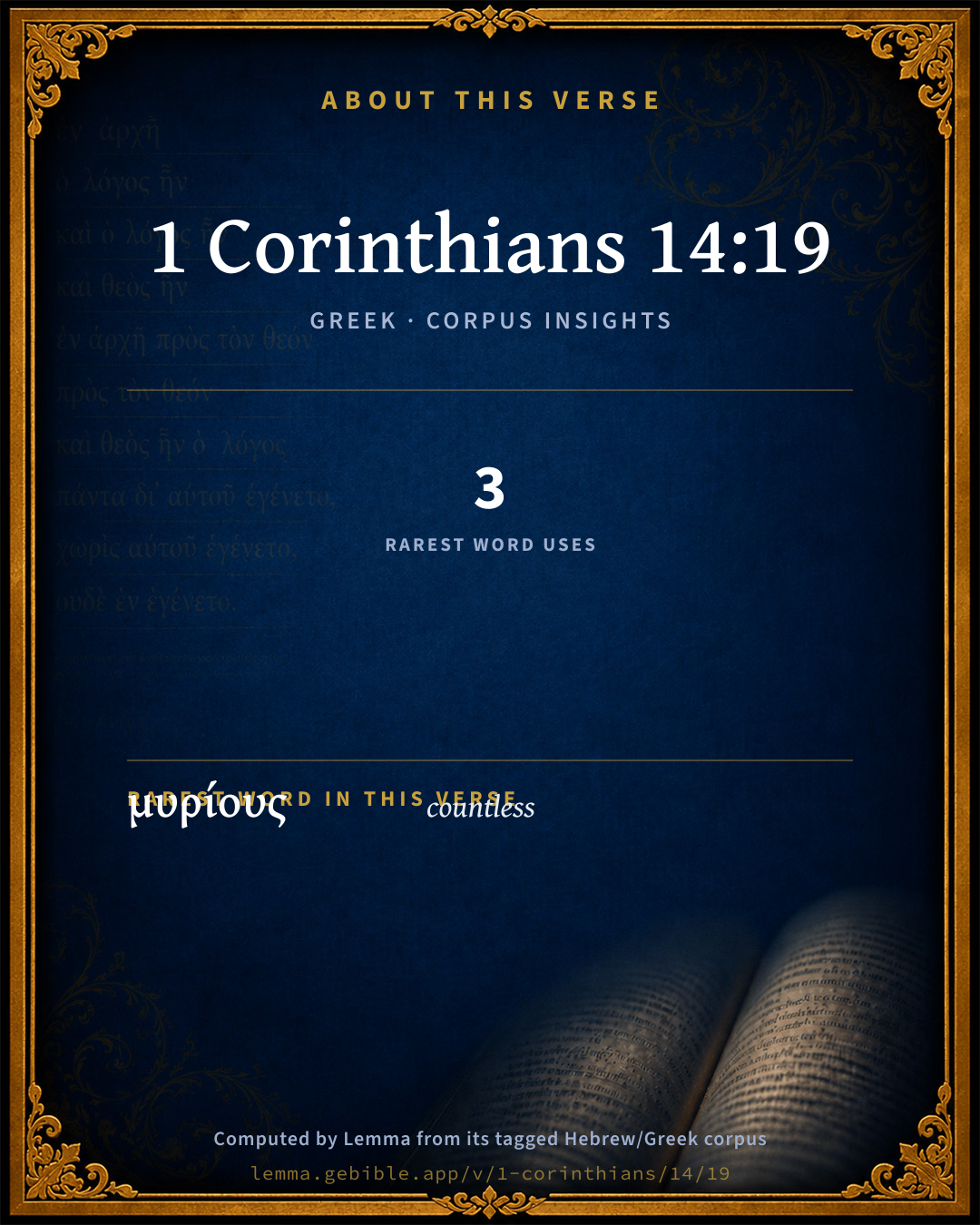
μυρίους
mýrioi
G3463
“countless”
Adjective, Accusative, Plural, Masculine
Part of Speech
Adjective
Case
Accusative
Number
Plural
Gender
Masculine
Full Thayer's Definition

Origin: plural of an apparently primary word (properly, meaning very many)

TDNT: None

1. innumerable, countless 2. ten thousand
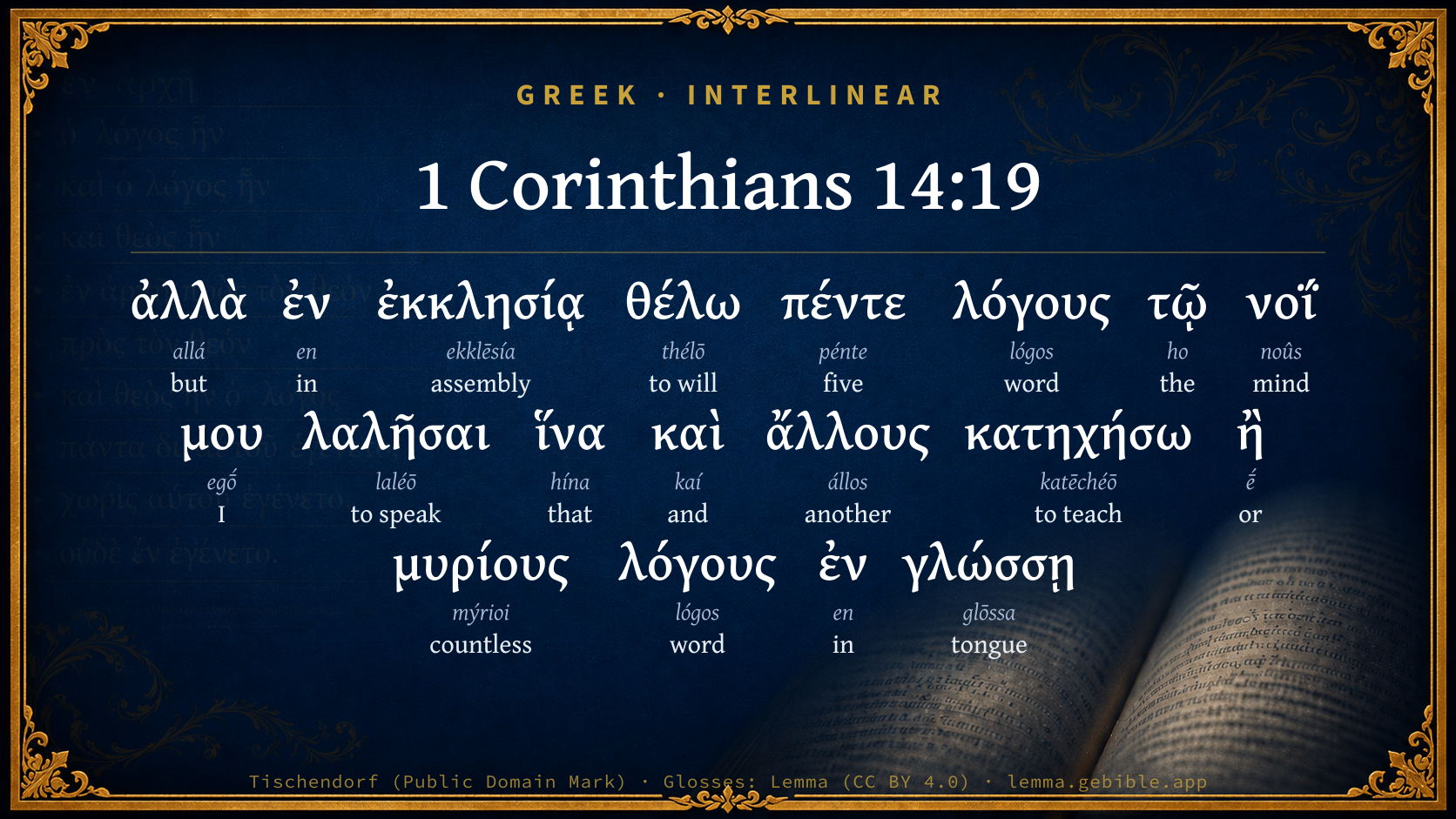
  1. ἀλλὰ allá G235 “but” Conjunction
  2. ἐν en G1722 “in” Preposition
  3. ἐκκλησίᾳ ekklēsía G1577 “assembly” Noun, Dative, Singular, Feminine
  4. θέλω thélō G2309 “to will” Verb, Present, Active, Indicative, 1st person, Singular
  5. πέντε pénte G4002 “five” Adjective, Numeral (indeclinable)
  6. λόγους lógos G3056 “word” Noun, Accusative, Plural, Masculine
  7. τῷ ho G3588 “the” Article, Dative, Singular, Masculine
  8. νοΐ noûs G3563 “mind” Noun, Dative, Singular, Masculine
  9. μου egṓ G1473 “I” Personal pronoun, 1st person, Genitive, Singular
  10. λαλῆσαι laléō G2980 “to speak” Verb, Aorist, Active, Infinitive
  11. ἵνα hína G2443 “that” Conjunction
  12. καὶ kaí G2532 “and” Conjunction
  13. ἄλλους állos G243 “another” Adjective, Accusative, Plural, Masculine
  14. κατηχήσω katēchéō G2727 “to teach” Verb, Aorist, Active, Subjunctive, 1st person, Singular
  15. ἢ ḗ G2228 “or” Particle
  16. λόγους lógos G3056 “word” Noun, Accusative, Plural, Masculine
  17. ἐν en G1722 “in” Preposition
  18. γλώσσῃ glōssa G1100 “tongue” Noun, Dative, Singular, Feminine

About this verse

These counts appear in no published source. They are computed here, from the morphology-tagged text and Lemma’s own curated glosses. What Lemma adds →

19
words
17
distinct lemmas
Pauline Epistles
section

Notable vocabulary

The rarest word here is μυρίους countless G3463 — appearing just 3 times in the whole Greek New Testament.

Shared distinctive vocabulary

μυρίους countless G3463 occurs in 3 verses of the Greek New Testament. Also found in:

Repetition

Words recur within this verse:

Cross-references

2

Topical passages linked to 1 Corinthians 14:19 in the Treasury of Scripture Knowledge — connected by theme and wording, ordered by reader-vote popularity; previews shown in the World English Bible.

  • 1 Corinthians 14:21–22 In the law it is written, "By men of strange languages and by the lips of strangers I will speak to this people. Not even thus will they hear me, says the Lord."
  • 1 Corinthians 14:4 He who speaks in another language edifies himself, but he who prophesies edifies the assembly.

Cross-references courtesy of OpenBible.info (CC BY 4.0).

Commentary

Notes on 1 Corinthians 14:19 from classic Christian and Jewish commentators (each source and its license shown beneath its notes). The classic Christian expositions comment on the surrounding passage and are grouped to its opening verse, so a note may address several verses; the Jewish commentaries on the Tanakh (Rashi and others) are per-verse, so they appear only where the commentator wrote on this verse.

Lemma curates 59 commentaries, every one of them public domain or Creative Commons licensed, each selected and text-cleaned for this edition rather than reprinted as found. About our sources →

Bengel's Gnomon

Johann Albrecht Bengel

1Co 14:19. Πέντε λόγους, five words) A definite for an indefinite number; the two thousandth part of ten thousand: comp. Lev 26:8.

Bengel's Gnomon of the New Testament — English translation (T&T Clark, Edinburgh, 1860) — public domain. Text from a community e-Sword module.

Hodge's Commentary on Romans, Ephesians & First Corinthians

Charles Hodge

1Co_14:18, 1Co_14:19

I thank my God, I speak with tongues more than ye all: yet in the church I had rather speak live words with my understanding, that (by my voice) I might teach others also, than ten thousand words in an (unknown) tongue.

That Paul should give thanks to God that he was more abundantly endowed with the gift of tongues, if that gift consisted in the ability to speak in languages which he himself did not understand, and the use of which, on that assumption, could according to his principle benefit neither himself nor others, is not to be believed. Equally clear is it from this verse that to speak with tongues was not to speak in a state of mental unconsciousness. The common doctrine as to the nature of the gift, is the only one consistent with this passage. Paul says that although he could speak in foreign languages more than the Corinthians, he would rather speak five words with his understanding, i.e. so as to be intelligible, than ten thousand words in an unknown tongue. In the church, i.e. in the assembly. That I might teach others also, (κατηχέω) to instruct orally, Gal_6:6. This shows what is meant by speaking with the understanding. It is speaking in such a way as to convey instruction.

Charles Hodge — Commentary on Romans (1835), First Corinthians (1857), and Ephesians (1856) — public domain. Text from a community e-Sword module.

Geneva Bible (1599)

Geneva Bible translators

A very few words.

Geneva Bible (1599) marginal notes — public domain. Text via Bolls.life.

Jamieson, Fausset & Brown

Robert Jamieson, A. R. Fausset & David Brown

I had rather--The Greek verb more literally expresses this meaning, "I WISH to speak five words with my understanding (rather) than ten thousand words in an unknown tongue"; even the two thousandth part of ten thousand. The Greek for "I would rather," would be a different verb. Paul would NOT wish at all to speak "ten thousand words in an unknown tongue."

Jamieson, Fausset & Brown — Commentary Critical and Explanatory on the Whole Bible (1871) — public domain (CC PDM 1.0). Text via the HelloAO Bible API.

Adam Clarke's Commentary

Verse 19. Yet in the church] As the grand object of public worship is the edification of those who attend, five words spoken so as to convey edification, were of much more consequence than ten thousand which, not being understood, could convey none. By the word γλωσση, tongue, to which we add unknown, I suppose the apostle always means the Hebrew, for the reasons offered in Clarke's note on "1Co 14:1".

One of the greatest difficulties, says Bishop Pearce, in this epistle is contained in the words πνευμα and νους, spirit and understanding, which are frequently used in this chapter; and fixing the true meaning of these words will solve the difficulty. In this verse the apostle explains λαλειν τῳ νοΐ, to speak with the understanding, by ινα αλλους κατηχησω, that I might teach others; so that the sense of νους, understanding, seems to be, that understanding which the hearer has of what is said; and this sense will agree well with, I will sing with the spirit, and with the understanding, 1Co 14:15.

He observes also that πνευμα spirit, and νους, understanding, have a sense opposite to each other; so that if νους is rightly rendered, the understanding which another has of what is said; then πνευμα will signify a man's own mind, i.e. his own understanding of what he himself speaks; and this sense agrees well with 1Co 14:2: In the spirit he speaketh mysteries.

Adam Clarke's Commentary on the Bible (1810–1826) — public domain. Text from a community e-Sword/MySword module.

John Calvin's Commentaries

19. I would rather speak five words. This is spoken hyperbolically, unless you understand five words, as meaning five sentences. Now as Paul, who might otherwise have exulted loftily in his power of speaking with tongues, voluntarily abstains from it, and, without any show, aims at edification exclusively, he reproves, by this means, the empty ambition of those, that are eagerly desirous to show themselves off with empty tinkling. (1 Corinthians 13:1.) The authority of the Apostle ought, also, to have no little weight in drawing them off from vanity of this kind.

John Calvin's Commentaries (1540-1563) — public domain. Text from the Calvin Translation Society English edition (1840s-50s) via the Christian Classics Ethereal Library (ccel.org). Calvin's coverage is partial (roughly two-thirds of the Bible); uncommented books and verses are honest gaps, never fabricated. The 19th-century editor's footnotes and remarks are omitted so the notes are faithfully Calvin's own voice.

The Cambridge Bible for Schools and Colleges

gen. ed. J. J. S. Perowne

19. yet in the church] “Whatever I may do in private, I should desire my public ministrations to be for the instruction and edification of the flock, and not for my own individual glorification.”

teach] The word in the original is that from which our word catechize is derived. The same word is used in St Luk_1:4; Act_18:25; Act_21:21; Act_21:24; Rom_2:18, and twice in Gal_6:6. It signifies to make to resound thoroughly in any one’s ears. The importance of sermons and catechetical teaching in public worship is thus indicated, as well as their proper object, the instruction and edification of the flock. See 1Co_14:24.

The Cambridge Bible for Schools and Colleges (gen. ed. J. J. S. Perowne; Cambridge University Press, 1878–1918) — public domain. Text from a community e-Sword module.

John Gill's Exposition

Brethren, be not children in understanding,.... There are some things in children in which it is reproachful for believers to be like them; as nonproficiency in knowledge, want of capacity to receive, bear, and digest strong meat; levity, fickleness, and inconstancy, unskilfulness in the word, deficiency of knowledge, want of understanding, not of things natural, but spiritual and evangelical; which is the more aggravated, since their understandings were opened and enlightened; an understanding was given them; the Spirit of God, as a spirit of understanding, was bestowed on them; they had the Scriptures, which are able to make wise unto salvation, and the man of God perfect; and also the ministers of the Gospel to explain divine truths to them; and many had been a long time in the school of Christ, and might have been teachers of others; and yet; after all, were children in understanding, and needed to be taught the first principles of the oracles of God. The apostle here has chiefly reference to the gift of speaking with tongues, these Corinthians were so desirous of; which when they had it, was only to talk like children; and for them to prefer it to other gifts, which were more useful and beneficial, discovered their judgment to be but the judgment of children; and if they desired this, and made use of it for ostentation, it showed a childish vanity, from which the apostle here dissuades:

howbeit in malice be ye children: in other things it is commendable to imitate children, and be like them; as in innocence and harmlessness of conversation; to be meek, modest, and humble, free from pride and vain glory; to be without guile and hypocrisy, without rancour and bitterness, envying and malice, but tender hearted, and ready to forgive. This the apostle recommends:

but in understanding be men; or "perfect", of ripe and full age, who have their senses exercised to discern between good and evil, "a man", says Aben Ezra (p), in our language, signifies , "one full of knowledge", as in Exo 10:11. It is not perfection of justification that is here meant, for babes in Christ are as perfect in this sense as grown men; nor a perfection of sanctification, for there is no such thing as this in any in this life; there is a perfection of sanctification in Christ, and of parts in everyone that is a new creature; and as that denotes sincerity and uprightness, it is in all that have known the grace of God in truth; but then these are each of them as true of new born babes, young converts, as of older Christians, and strong men: but of knowledge and understanding in divine things; which though it is imperfect in the best, yet in some it is in greater perfection than in others; who may, in a comparative sense, be said to be perfect, or men of full age, who are arrived to a considerable ripeness and maturity of spiritual knowledge; and this is what believers should be pressing after, and desirous of, and make use of all proper methods, such as reading, hearing, and praying, to attain unto.

(p) Comment. in Psal. xxxvii. 23.

John Gill's Exposition of the Whole Bible (1746–1763) — public domain (CC PDM 1.0). Text via the HelloAO Bible API.

Trapp's Complete Commentary

John Trapp

19 Yet in the church I had rather speak five words with my understanding, that by my voice I might teach others also, than ten thousand words in an unknown tongue.

Ver. 19. In an unknown tongue] A Parisian doctor tells us that though the apostle would have God’s service to be celebrated in a known tongue, yet the Church for various weighty reasons hath otherwise ordered and appointed it. (Benedict.) The Mahometans read their Koran (which they supposed were profaned if it were translated into common tongues) and perform their public devotions in the Arabic tongue, which is their learned language. (Montan. in 1Co 14:1-40)

John Trapp, A Commentary or Exposition upon All the Books of the Old and New Testament (1647–1656) — public domain. Text from a community e-Sword module.

Albert Barnes' Notes on the Bible

Yet in the church - In the Christian assembly. The word “church” does not refer to the “edifice” where Christians worshipped, but to the organized body of Christians.

I had rather ... - It is probable that in the Christian assembly, usually, there were few who understood foreign languages. Paul, therefore, would not speak in a foreign language when its only use would be mere display.

With my understanding - So as to be intelligible to others; so that I might understand it, and so that at the same time others might be benefitted.

Albert Barnes' Notes on the Bible (1834–1885) — public domain. Text from a community e-Sword/MySword module.

Haydock's Catholic Bible Commentary

But in the Church. The apostle here condemns the vanity of the Corinthians, who made a parade of their gift of tongues. (Calmet)

George Leo Haydock (1774–1849), Haydock's Catholic Family Bible and Commentary, 1859 edition — public domain. Excludes Psalms (Douay-Rheims chapter numbering differs from Protestant) and Deuterocanonical books (Catholic canon only).

Matthew Poole's English Annotations

Yet he had so great a regard to the end of his ministry, teaching others, and communicating Divine knowledge to them, that he had rather speak a little tending to that end, than never so much in a language which those to whom he spake did not understand.

Matthew Poole's English Annotations on the Holy Bible (1683–1685) — public domain. Text from a community e-Sword/MySword module.

Whedon's Commentary on the Bible

Daniel D. Whedon

19. In the church—In the Christian assembly gathered for religious exercises, as prayer, praise, (singing,) prophecy, (preaching,) and other modes suggested by the Spirit.

Five words—A definite small number designed to give sharpness to his sentence.

Ten thousand—Besser, quoted by Kling, says “rather half of ten, if of the edifying sort, than a thousand times ten of the other.” So that “the edifying sort” was twenty thousand times the better.

Daniel D. Whedon (gen. ed.), Commentary on the Old and New Testaments (1874–1909) — public domain. Text from a community e-Sword module.

The Pulpit Commentary

Yet in the Church. In any public assembly of Christians. Five words. No disparagement of the prominence given to glossolaly could be more emphatic. "Rather half of ten of the edifying sort than a thousand times ten of the other" (Besser). That I might may teach others also. The word rendered "teach" is rather instruct, the root of our "catechize" (Luk_1:4; Rom_2:8; Gal_6:6, etc.)

The Pulpit Commentary (1880–1919), ed. H.D.M. Spence-Jones & Joseph S. Exell — public domain. Text from a community e-Sword module.

John Wesley's Explanatory Notes

With my understanding - In a rational manner; so as not only to understand myself, but to be understood by others.

John Wesley, Explanatory Notes Upon the Whole Bible (1754–1765) — public domain. Text via the GEBible commentary corpus.

Godbey's Commentary on the New Testament

William B. Godbey

19. Here Paul says that he speaks with tongues more than all the rest; evidently the Hebrew, Greek, Latin, and doubtless many other languages currently spoken, especially by the nations of Asia, where he was born and reared and honored by the Holy Ghost to plant the gospel in so many different countries. Throughout this paragraph of nineteen verses, Paul ceases not to wield his most ponderous sledgehammer blows against all unintelligible exercises in church services. Evidently the reason he says so much about singing in this connection is because it is so apt to be unintelligible, consisting of sound without sense, i. e., thunder without lightning, which is just about as unprofitable in a fastidious choir as to catch a hog in the streets, bring him in, and let him squeal for the entertainment of the congregation. Good Lord, give us some sense, make us ashamed of our ignorance, and afraid of coming Judgment, as it is defiantly wicked and blasphemous to usurp the house of God for human pomp and show, offering sacrifices to pride and vanity, the daughters of the devil. I beg you, reader, faithfully to warn the people in harmony with earnest Paul in reference to unedifying church services, as this is the way meetings are killed dead and churches turned over to Satan.

William B. Godbey, Commentary on the New Testament (1896–1900) — public domain. Text from a community e-Sword module.

McGarvey & Pendleton's Commentaries

J. W. McGarvey

howbeit in the church [congregation] I had rather speak five words with my understanding [so as to be understood], that I might instruct others also, than ten thousand words in a tongue . [Paul was thankful for the gift of tongues because of its utility, but especially lest any should think that he disparaged the gift because he did not have it, and assigned it a subordinate place from envy. His disparagement is most emphatic. "Rather half of ten of the edifying sort than a thousand times ten of the other," says Besser. "There is a lesson here," says Johnson, "to preachers who are so learned in their utterances that the people can not understand them."]

J. W. McGarvey (with Philip Y. Pendleton), Commentaries on the New Testament (The Fourfold Gospel, 1914; Acts; and the epistles) — public domain. Text from a community e-Sword/MySword module.

Cambridge Greek Testament for Schools and Colleges

19. τῷ νοΐ אABDEFG, Vulg. Peshito. Rec. διὰ τοῦ νοός with some copies of the Vetus Lat.

19. ἀλλὰ ἐν ἐκκλησίᾳ. ‘Whatever I may do in private, I should desire my public ministrations to be for the instruction and edification of the flock, and not for my own individual glorification.’ See note on 1Co 14:4.

κατηχήσω. This word only occurs in two other places in St Paul’s Epistles, Rom 2:18; Gal 6:6. Nor does any other of the sacred writers use it but his friend and companion St Luke. See Luk 1:4; Act 18:25; Act 21:21; Act 21:24. The meaning is, as the A.V. renders it, to instruct with the voice, to teach in such wise that the learner echoes back the words of the master. From it our word catechize is derived. The importance of sermons and catechetical teaching in public worship is thus indicated, as well as their proper object, the instruction and edification of the flock. See 1Co 14:24.

ἤ, rather than. θέλω ἤ had become a ‘common formula’ in later Greek. So Winer, Gr. Gram. § 35. Cf. Mat 18:8; Luk 15:7; Luk 17:2.

ἐν γλώσσῃ. There is a difference between this and the simple dative τῷ νοΐ. ἐν here may intimate a degree of inspiration, or it may very possibly be a Hebraism for ‘with.’

Cambridge Greek Testament for Schools and Colleges (Cambridge University Press, 1896; 21 vols, various authors incl. Carr, Maclear, Plummer, Farrar, Lumby, Moule, M. R. James, Simcox) — public domain. Text from a community e-Sword module.

Alford’s Greek Testament

Henry Alford

19.] Declaration of his own feeling on the matter, highly endowed as he was with the gift. I thank God, I speak with a tongue (have the gift of speaking with tongues) more than you all. This juxtaposition of two clauses, between which ‘that’ is to be supplied in the sense, is not unusual: βούλει σκοπῶμεν: ‘fac videas,’—Eur. Hippol. 567, ἐπίσχετʼ, αὐδὴν τῶν ἔσωθεν ἐκμάθω. Hom. Od. β. 195, Τηλεμάχῳ δʼ ἐν πᾶσιν ἐγὼν ὑποθήσομαι αὐτός, Μητέρα ἣν ἐς πατρὸς ἀνωγέτω ἀπονέεσθαι. See Hartung, Partikell. ii. p. 134.

19.] ἐκ ἐκκλησίᾳ, in (the) assembly, ‘in the congregation’ [this is the better rendering here, and wherever there is a chance of the word church being mistaken as meaning a building],—not ‘in an assembly,’ as Meyer. The art. is omitted after a preposition: so Middleton, ch. vi. § 1; the logical account of which is, that the prep. serves to categorize the substantive following it, and so make it general instead of particular.

οέλω …, ἤ, as βούλομαι, ἤ, 11. α. 117: similarly ἐπιθυμέω, ζητέω,—see Hartung, ii. p. 72.

διὰ τοῦ νοός has probably been a correction, because λαλεῖν τῷ νοΐ was found harsh, the understanding being only the indirect instrument.

Henry Alford, The Greek Testament (1849–1861) — public domain. Text from a community e-Sword module.

International Critical Commentary

19. ἀλλὰ ἐν ἐκκλησίᾳ. ‘But (whatever I may do in private) in an assembly I had rather speak five words with my understanding.’ For θέλω … ἤ, ‘I prefer,’ comp. 2 Mac. 14:42; the use is classical (Hom. Il. 1. 117), and is found in papyri (Deissmann, Light, p. 179): and λαλῆσαι rather than λαλεῖν, because of the definite number of words spoken on the contemplated occasion. Κατηχήσω (Rom 2:18; Gal 6:6; Luk 1:4) implies thorough instruction by word of mouth; of what is sounded down into the ear. The verb in N.T. is found in Paul and Luke only. La Rochefoucauld (Max. 142) contrasts the grands esprits who convey much meaning in few words with those who have le don de beaucoup parler et de rien dire.*

International Critical Commentary — older volumes (1896–1929), various authors — public domain. Text from a community e-Sword module.

Vincent's Word Studies in the New Testament

Marvin R. Vincent

Teach [κατηχησω] . Orally. See on Luk 1:4.

Marvin R. Vincent, Word Studies in the New Testament (1887–1900) — public domain. Text from a community e-Sword/MySword module.

Lesson kit

Teaching starters — assembled from the data on this page, not authored interpretation. Every prompt links to the verse data it draws on. Edit before teaching.

1 Corinthians, in the Pauline Epistles, opens this verse with 19 words (17 distinct Greek lemmas). Its most distinctive word is mýrioi (“countless”). A historical commentator’s framing appears above. Read the whole chapter for the surrounding context.

Discussion questions

  1. How does “countless” (mýrioi) shape what this verse is saying?
  2. Matthew 18:24 shares the word «countless» with this verse. How do the two illuminate each other?
  3. “word” occurs 2× in this one verse. What is the effect of the repetition?
  4. These translations render this verse differently; the difference is in the English rendering, not the original. What questions does that raise?
  5. Reading how Bengel's Gnomon and Hodge's Commentary on Romans, Ephesians & First Corinthians read this verse, where do the two commentators agree and where do they part?

Things to notice

Reading settings

Reading text

Shown beneath each verse's original-language words.

Old Testament
Old Testament edition

Read the OT as the Masoretic Hebrew (MT) or the Greek Septuagint (LXX).

English shown for the Greek Septuagint (in the Hebrew ↔ Greek comparison).

Comparing translations? Open the Compare panel on any verse page to stack up to four side by side.