1 Corinthians 12:13

Greek (Tischendorf 8th ed.) 1 Corinthians 12:13 appears in the Greek New Testament. The text above is from the Tischendorf 8th edition. Each word links to its Strong’s number and a concise gloss. Click any word for its full Thayer’s Greek Lexicon entry.
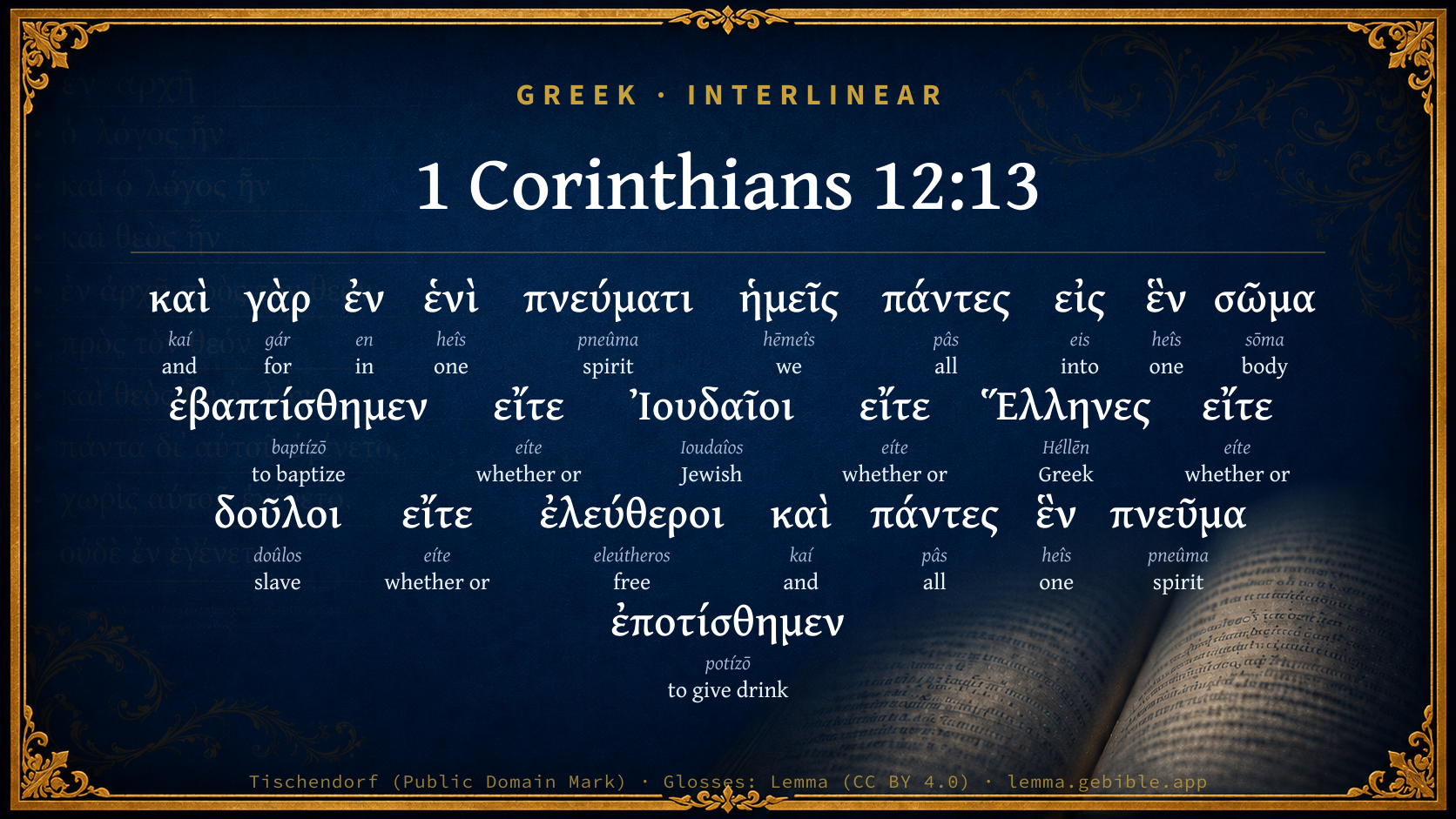
Download image
Cite this verse

1 Corinthians 12:13 (World English Bible). Public Domain. Lemma interlinear Bible study tool, https://lemma.gebible.app/v/1-corinthians/12/13.

Show BibTeX & RIS
BibTeX
RIS
English Translation
For in one Spirit we were all baptized into one body, whether Jews or Greeks, whether bond or free; and were all given to drink into one Spirit.
World English Bible · Public Domain
Download a study sheet

One document with this verse’s original text, its word-by-word gloss line, the meaning frame, cross-references with their text, attributed commentary, and full source and license credits — printable, and it pastes into notes with its structure intact.

This verse Autodidact and up

Study sheet (.html) Plain text (.txt)

A passage Seminary Student

Up to 50 verses in one chapter. A passage sheet keeps up to 6 commentary sources and 12 cross-references per verse, in the order this page ranks them, and says so on the sheet whenever that leaves anything out. Ask for a single verse and you get the Autodidact verse sheet above.

Everything on this page stays free to read, with no account — the sheet is a download of what is already on screen, not access to it.

Want to remove ads? Support Godless Engineer
Compare translations 3

The same verse in 3 English versions, stacked beneath the original-language interlinear above. Click any original word for its lexicon entry.

Each is an independent rendering of the whole verse — the interlinear is not word-aligned to these translations.

Highlighted words mark where these versions differ — a whole-verse word diff, not a word-by-word alignment.

  • World English Bible Public Domain
    For in one Spirit we were all baptized into one body, whether Jews or Greeks, whether bond or free; and were all given to drink into one Spirit.
  • King James Version Public Domain
    For by one Spirit are we all baptized into one body, whether we be Jews or Gentiles, whether we be bond or free; and have been all made to drink into one Spirit.
  • unfoldingWord Literal Text CC BY-SA 4.0
    For indeed by one Spirit we were all baptized into one body, whether Jews or Greeks, whether bound or free, and all were made to drink one Spirit.

unfoldingWord Literal Text — © unfoldingWord, licensed CC BY-SA 4.0. Word-aligned USFM3 via Door43 (git.door43.org/unfoldingWord/en_ult).

Versions to compare (up to 4)

3 of 4 selected

Show all 19 translations

Every available English version of this verse, each an independent rendering of the whole verse.

  • World English Bible Public Domain
    For in one Spirit we were all baptized into one body, whether Jews or Greeks, whether bond or free; and were all given to drink into one Spirit.
  • Berean Standard Bible Public Domain
    For in one Spirit we were all baptized into one body, whether Jews or Greeks, slave or free, and we were all given one Spirit to drink.
  • Majority Standard Bible Public Domain
    For in one Spirit we were all baptized into one body, whether Jews or Greeks, slave or free, and we were all given into one Spirit to drink.
  • King James Version Public Domain
    For by one Spirit are we all baptized into one body, whether we be Jews or Gentiles, whether we be bond or free; and have been all made to drink into one Spirit.
  • American Standard Version (1901) Public Domain
    For in one Spirit were we all baptized into one body, whether Jews or Greeks, whether bond or free; and were all made to drink of one Spirit.
  • Revised Version (1885) Public Domain
    For in one Spirit were we all baptized into one body, whether Jews or Greeks, whether bond or free; and were all made to drink of one Spirit.
  • Geneva Bible (1599) Public Domain
    For by one Spirit are we all baptized into one body, whether we bee Iewes, or Grecians, whether we be bonde, or free, and haue bene all made to drinke into one Spirit.
  • Douay-Rheims (1899) Public Domain
    For in one Spirit were we all baptized into one body, whether Jews or Gentiles, whether bond or free; and in one Spirit we have all been made to drink.
  • Young's Literal Translation Public Domain
    for also in one Spirit we all to one body were baptized, whether Jews or Greeks, whether servants or freemen, and all into one Spirit were made to drink,
  • Literal Standard Version CC BY-SA 4.0
    for also in one Spirit we were all immersed into one body, whether Jews or Greeks, whether servants or freemen, and all were made to drink one Spirit,
  • Unlocked Literal Bible CC BY-SA 4.0
    For by one Spirit we were all baptized into one body, whether Jews or Greeks, whether bound or free, and all were made to drink of one Spirit.
  • unfoldingWord Literal Text CC BY-SA 4.0
    For indeed by one Spirit we were all baptized into one body, whether Jews or Greeks, whether bound or free, and all were made to drink one Spirit.
  • Darby Bible Public Domain
    For also in [the power of] one Spirit *we* have all been baptised into one body, whether Jews or Greeks, whether bondmen or free, and have all been given to drink of one Spirit.
  • World Messianic Bible Public Domain
    For in one Spirit we were all immersed into one body, whether Jews or Greeks, whether bond or free; and were all given to drink into one Spirit.
  • Webster's Bible Public Domain
    For by one Spirit are we all baptized into one body, whether Jews or Gentiles, whether bond or free; and have been all made to drink into one Spirit.
  • Free Bible Version CC BY-SA 4.0
    For it was through one Spirit that we were all baptized into one body. It doesn't matter whether we are Jews or Greeks, slave or free—we all were given the one Spirit to drink.
  • Bible in Basic English Public Domain
    For through the baptism of the one Spirit we were all formed into one body, Jews or Greeks, servants or free men, and were all made full of the same Spirit.
  • Text-Critical English NT CC BY 4.0
    For by one Spirit we were all baptized into one body—whether Jews or Greeks, slave or free—and we have all been given to drink into one Spirit.
  • Tyndale New Testament (1534) Public Domain
    For in one sprete are we all baptysed to make one body whether we be Iewes or getyls whether we be bonde or fre: and have all dronke of one sprete.

Literal Standard Version (2020), Covenant Press — licensed CC BY-SA 4.0. Text via the HelloAO Bible API (eBible.org). Unlocked Literal Bible (unfoldingWord) — licensed CC BY-SA 4.0. Text via the HelloAO Bible API (eBible.org). unfoldingWord Literal Text — © unfoldingWord, licensed CC BY-SA 4.0. Word-aligned USFM3 via Door43 (git.door43.org/unfoldingWord/en_ult). Free Bible Version, Dr. Jonathan Gallagher — licensed CC BY-SA 4.0. Text via the HelloAO Bible API (eBible.org).

Word by word

More ways to search: Search by grammar → Find every occurrence → Compare this word →

Practice this passage: Drill this verse → Learn its vocabulary →

ἐποτίσθημεν
potízō
G4222
“to give drink”
Verb, Aorist, Passive, Indicative, 1st person, Plural
Part of Speech
Verb
Tense
Aorist
Voice
Passive
Mood
Indicative
Person
1st person
Number
Plural
Full Thayer's Definition

Origin: from a derivative of the alternate of G4095

TDNT: 08:39,8

1. to give to drink, to furnish drink 2. to water, irrigate (plants, fields etc.) 3. metaph. to imbue, saturate one's mind
  1. καὶ kaí G2532 “and” Conjunction
  2. γὰρ gár G1063 “for” Conjunction
  3. ἐν en G1722 “in” Preposition
  4. ἑνὶ heîs G1520 “one” Adjective, Dative, Singular, Neuter
  5. πνεύματι pneûma G4151 “spirit” Noun, Dative, Singular, Neuter
  6. ἡμεῖς hēmeîs G2249 “we” Personal pronoun, 1st person, Nominative, Plural
  7. πάντες pâs G3956 “all” Adjective, Nominative, Plural, Masculine
  8. εἰς eis G1519 “into” Preposition
  9. ἓν heîs G1520 “one” Adjective, Accusative, Singular, Neuter
  10. σῶμα sōma G4983 “body” Noun, Accusative, Singular, Neuter
  11. ἐβαπτίσθημεν baptízō G907 “to baptize” Verb, Aorist, Passive, Indicative, 1st person, Plural
  12. εἴτε eíte G1535 “whether or” Conjunction
  13. Ἰουδαῖοι Ioudaîos G2453 “Jewish” Adjective, Nominative, Plural, Masculine
  14. εἴτε eíte G1535 “whether or” Conjunction
  15. Ἕλληνες Héllēn G1672 “Greek” Noun, Nominative, Plural, Masculine
  16. εἴτε eíte G1535 “whether or” Conjunction
  17. δοῦλοι doûlos G1401 “slave” Noun, Nominative, Plural, Masculine
  18. εἴτε eíte G1535 “whether or” Conjunction
  19. ἐλεύθεροι eleútheros G1658 “free” Adjective, Nominative, Plural, Masculine
  20. καὶ kaí G2532 “and” Conjunction
  21. πάντες pâs G3956 “all” Adjective, Nominative, Plural, Masculine
  22. ἓν heîs G1520 “one” Adjective, Accusative, Singular, Neuter
  23. πνεῦμα pneûma G4151 “spirit” Noun, Accusative, Singular, Neuter

About this verse

These counts appear in no published source. They are computed here, from the morphology-tagged text and Lemma’s own curated glosses. What Lemma adds →

24
words
16
distinct lemmas
Pauline Epistles
section

Notable vocabulary

The rarest word here is ἐποτίσθημεν to give drink G4222 — appearing just 15 times in the whole Greek New Testament.

Shared distinctive vocabulary

ἐποτίσθημεν to give drink G4222 occurs in 15 verses of the Greek New Testament. Also found in:

Repetition

Words recur within this verse:

  • εἴτε whether or G1535 ×4
  • ἑνὶ one G1520 ×3
  • πνεύματι spirit G4151 ×2
  • πάντες all G3956 ×2
  • καὶ and G2532 ×2

Cross-references

33

Topical passages linked to 1 Corinthians 12:13 in the Treasury of Scripture Knowledge — connected by theme and wording, ordered by reader-vote popularity; previews shown in the World English Bible.

  • Ephesians 4:5 one Lord, one faith, one baptism,
  • Galatians 3:28 There is neither Jew nor Greek, there is neither slave nor free man, there is neither male nor female; for you are all one in Christ Jesus.
  • Colossians 3:11 where there can't be Greek and Jew, circumcision and uncircumcision, barbarian, Scythian, bondservant, freeman; but Christ is all, and in all.
  • John 7:37–39 Now on the last and greatest day of the feast, Jesus stood and cried out, "If anyone is thirsty, let him come to me and drink!
  • Romans 6:3–6 Or don't you know that all we who were baptized into Christ Jesus were baptized into his death?
  • 1 Peter 3:21 This is a symbol of baptism, which now saves you-- not the putting away of the filth of the flesh, but the answer of a good conscience toward God, through the resurrection of Jesus Christ,
  • Acts 1:5 For John indeed baptized in water, but you will be baptized in the Holy Spirit not many days from now."
  • Matthew 3:11 I indeed baptize you in water for repentance, but he who comes after me is mightier than I, whose shoes I am not worthy to carry. He will baptize you in the Holy Spirit.
  • Luke 3:16 John answered them all, "I indeed baptize you with water, but he comes who is mightier than I, the latchet of whose sandals I am not worthy to loosen. He will baptize you in the Holy Spirit and fire,
  • John 4:10 Jesus answered her, "If you knew the gift of God, and who it is who says to you, 'Give me a drink,' you would have asked him, and he would have given you living water."
  • John 4:14 but whoever drinks of the water that I will give him will never thirst again; but the water that I will give him will become in him a well of water springing up to eternal life."
  • Romans 3:29 Or is God the God of Jews only? Isn't he the God of Gentiles also? Yes, of Gentiles also,
  • Ephesians 2:11–22 Therefore remember that once you, the Gentiles in the flesh, who are called "uncircumcision" by that which is called "circumcision," (in the flesh, made by hands);
  • Titus 3:4–6 But when the kindness of God our Savior and his love toward mankind appeared,
  • Ezekiel 36:25–27 I will sprinkle clean water on you, and you shall be clean: from all your filthiness, and from all your idols, will I cleanse you.
  • John 1:33 I didn't recognize him, but he who sent me to baptize in water, he said to me, 'On whomever you will see the Spirit descending, and remaining on him, the same is he who baptizes in the Holy Spirit.'
  • John 3:5 Jesus answered, "Most assuredly I tell you, unless one is born of water and spirit, he can't enter into the Kingdom of God!
  • Romans 8:9–11 But you are not in the flesh but in the Spirit, if it is so that the Spirit of God dwells in you. But if any man doesn't have the Spirit of Christ, he is not his.
  • Ephesians 5:26 that he might sanctify it, having cleansed it by the washing of water with the word,
  • Colossians 2:11–12 in whom you were also circumcised with a circumcision not made with hands, in the putting off of the body of the sins of the flesh, in the circumcision of Christ;
  • John 6:63 It is the spirit who gives life. The flesh profits nothing. The words that I speak to you are spirit, and are life.
  • 1 Corinthians 10:2 and were all baptized into Moses in the cloud and in the sea;
  • Galatians 3:23 But before faith came, we were kept in custody under the law, shut up to the faith which should afterwards be revealed.
  • Ephesians 3:6 that the Gentiles are fellow heirs, and fellow members of the body, and fellow partakers of his promise in Christ Jesus through the Gospel,
  • Colossians 1:27 to whom God was pleased to make known what are the riches of the glory of this mystery among the Gentiles, which is Christ in you, the hope of glory;
  • Isaiah 41:17–18 The poor and needy seek water, and there is none, and their tongue fails for thirst; I, Yahweh, will answer them, I, the God of Israel, will not forsake them.
  • Isaiah 44:3–5 For I will pour water on him who is thirsty, and streams on the dry ground; I will pour my Spirit on your seed, and my blessing on your offspring:
  • John 1:16 From his fullness we all received grace upon grace.
  • Romans 4:11 He received the sign of circumcision, a seal of the righteousness of the faith which he had while he was in uncircumcision, that he might be the father of all those who believe, though they be in uncircumcision, that righteousness might also be accounted to them.
  • 1 Corinthians 7:21–22 Were you called being a bondservant? Don't let that bother you, but if you get an opportunity to become free, use it.
  • Ephesians 6:8 knowing that whatever good thing each one does, he will receive the same again from the Lord, whether he is bound or free.
  • Song of Solomon 5:1 I have come into my garden, my sister, my bride. I have gathered my myrrh with my spice; I have eaten my honeycomb with my honey; I have drunk my wine with my milk. Friends Eat, friends! Drink, yes, drink abundantly, beloved. Beloved
  • Zechariah 9:15–17 Yahweh of Hosts will defend them; And they will destroy and overcome with sling-stones; And they will drink, and roar as through wine; And they will be filled like bowls, Like the corners of the altar.

Cross-references courtesy of OpenBible.info (CC BY 4.0).

Commentary

Notes on 1 Corinthians 12:13 from classic Christian and Jewish commentators (each source and its license shown beneath its notes). The classic Christian expositions comment on the surrounding passage and are grouped to its opening verse, so a note may address several verses; the Jewish commentaries on the Tanakh (Rashi and others) are per-verse, so they appear only where the commentator wrote on this verse.

Lemma curates 59 commentaries, every one of them public domain or Creative Commons licensed, each selected and text-cleaned for this edition rather than reprinted as found. About our sources →

The Biblical Illustrator

Joseph S. Exell

1Co_12:13-20

For by one Spirit we are all baptized into one body.

Of union with Christ

Consider--

I. How Christs redemption is applied to a sinner. By uniting the sinner to Christ (1Co_1:30). Men must not think to stand afar from Christ, but must unite with Christ, and so partake of the redemption purchased by Him, as the poor widow drowned in debt, by marrying the rich man, is interested in his substance.

II. There is a real union betwixt Christ and believers. Consider--

1. The terms by which this union is expressed. Christ is said to be in believers (Col_1:27; Rom_8:10), and they in Him (1Co_1:30). He is said to dwell in them, and they in Him (Joh_6:54). They are said to abide in one another (Joh_15:4). Believers have put on Christ (Gal_3:27). They are so joined as to be one Spirit (1Co_6:17).

2. The several real and proper unions which it is resembled to. The vine and the branches (Joh_15:5); the head and the body (Eph_1:22-23); merit eaten and the eater (Joh_6:56); yea, to that betwixt Father and Christ (Joh_17:21).

3. If this union be not a true and real one, the sacrament of the supper is but a bare sign, and not a sea1.

III. What is that union. There are three mysterious unions in our religion--the substantial union of the three persons in one Godhead; the personal union of the Divine and human natures in Jesus Christ; the mystical union betwixt Christ and believers, which is that wherein Christ and believers are so joined that They are one Spirit and one mystical body (1Co_6:17 and text). In this union the whole man is united to a whole Christ. The believing soul is united to Him (Eph_3:17). His body also is united to Him (1Co_6:19; 1Th_4:14). They are united to Him in His Divine nature (Col_1:27), and in His human nature (Eph_5:30), and so through the Mediator unto God (2Co_6:16).

IV. The bonds of this union. All corporal union is made by contact; but Christ is in heaven, and we on earth, and so we can have no such union with Him; and if we had, what would it profit? (Joh_6:63.) But this union is spiritual (1Co_6:17), and so are the bonds of it. And they are two.

1. The Spirit on Christs part, whereby He taketh and keepeth hold of us (1Jn_3:1-24. ult.). And the distance betwixt Christ and believers, as great as is betwixt heaven and earth, cannot hinder the joining of our souls and bodies to His, since the Spirit is an infinite Spirit, everywhere present.

2. Faith on the believers part (Eph_3:17). Thereby the believer apprehends, takes, and keeps hold of Christ. It is by that we receive Christ (Joh_1:12), come unto Him (Joh_6:35), and feed on Him (verse 56). And its fitness for this.

V. The author and efficient cause of this union.

1. The Spirit of Christ comes in the Word, and enters into the heart of the elect sinner dead in sin (Gal_3:2).

2. That quickening Spirit works faith (Eph_2:8; Col_2:12). Hereby the soul lays hold on Christ, and actually unites with Him.

VI. The. Properties of this union.

1. A true, real, and proper union, not a mere relative one.

2. A spiritual union (1Co_6:17).

3. A mysterious union (Eph_5:32; Col_1:27).

4. A most close and intimate union (1Co_6:17; Joh_6:56; Eph_5:30).

5. An indissoluble union (Joh_10:28-29).

6. It is the leading, comprehensive, fundamental privilege of believers (1Co_3:23). All their other privileges are-derived from and grafted upon this--their justification, adoption, sanctification, and glorification. (T. Boston, D.D.)

Unity in Christ the secret of mans life: all one by faith in Christ, the one life of all

There is a joy familiar to you, from the experience of daily life, which may assist you in understanding the nature of the blessing to be derived from the Lords Supper. All of you have felt refreshed by meeting a friend. The very sight of him may have done you good, like a medicine. If you have ever tasted the blessedness of communion with a Christian friend, you will understand still better the nature of this spiritual food. The Ethiopian eunuch tasted it when he went on his way rejoicing, after Philip had come up into his chariot, and conversed with him about the One of whom he was reading. Still more did the two disciples learn the lesson on the way to Emmaus, where they met with Jesus, although in the guise of another-man, a fellow-traveller on the road. They had meat to eat of which others knew nothing, while He was thus manifesting Himself to them in another way than He does to the world. They and He were becoming one in spirit. They were growing up into Him, drinking into His spirit. Before they parted they had become one.

I. Elsewhere, as well as at the communion table, communion with Christ makes Christians one, and so feeds their spirits. This oneness is food to mans spirit, and is to be found in Christ alone, so that it is the secret of true Christians. All men in their spirits are seeking this oneness, more or less conscious that it is the food of their spirits, the secret of happiness; in fact, eternal life. Without faith in Christ this oneness is not attained at all, and therefore mans spirit, starved, stinted of its appropriate nourishment, remains unsatisfied, and is tormented with unquenchable longings, and disappointment in all the broken cisterns to which he resorts. Faith it is that gives friendship its substance, its strength, its eternal life; that alone keeps man from hungering and thirsting after some better nourishment suited to his spirits immortal nature and eternal longings. Faith alone binds the bond of perfectness between master and servant, between buyer and seller, between ruler and subject, between the citizens of one community or the members of one Christian Church. In all these, and the other channels of intercourse between man and man, without faith love is awanting, or is impure and imperfect. The parties, therefore, do not become one. For love is unity. Mans delusion is to expect unity without love, and love without faith. Men know that they cannot be happy till they become one; but they believe that they can become one without drinking into Christs one spirit, without being rooted and grounded in the love of God, without becoming one as the Father and the Son are one, through faith beholding in the Son the revelation of the Father, claiming sonship in Christ, and, therefore, brotherhood in the Lord, and thus coming to reconciliation in the Redeemer. Communion with Christ alone feeds mans spirit; and it is food in proportion to his faith, and love, or charity. It is food by bringing him in spirit and in truth into Gods presence, into the secret of the Lord, into the revelation of Gods grace and glory in the covenant, and in the kingdom, into conscious fellowship with the Father, and with His Son Jesus Christ, in all his fellowship with his fellow-Christians and fellow-men.

II. Sacramental communion brings all into one, and, so far as it does so, is a communion feast--faith discerning the Lords body--believers there and thus becoming one in spirit.

1. They feast by coming, through Christs body and blood discerned by faith, all to one Father. Saw you ever the child that was long away from home in the moment of his glad return, rushing into his mothers arms, pressed to his fathers bursting heart, welcomed back into the bosom of the family that have been counting the years of his absence, and watching for the blessed hour when they shall see him again, one of their circle in everything? Did not the soldier thus returning, from this or that battle-field and long campaign, find it food to his drooping heart to feel himself one again, and still one as ever, or more than ever, with those whom he loved and left behind sorrowing? Still more did not the prodigal, received back to forgiveness, live again, breathe freely, return to life and renew his strength, as he heard his fathers lips once more pronounce, My son, and knew that there was a fathers heart still welcoming him upon earth, however unworthy he had proved himself by his misconduct? So it is to the communicant in the bread and wine of the communion. They point to the body broken for him, to the blood of the new covenant shed for the remission of his sins, and thus to the bond of perfectness between him and the living God his Father in heaven. They bring him near consciously, and ill spirit, to that Father.

2. They feast by coming, through Christs body and blood discerned by faith, to one another, and nearer all to one another. It is a family feast, one Fathers board spread for all the members of His one family, without respect of persons. All are brethren, who are to sit side by side at one table, eat one common bread, and drink one cup of communion, the cup of brotherhood. Without the spirit of brotherhood we have nothing better than the shadow. Our feast is a counterfeit, a work of the flesh. Nay, it is worse, a substitution of the lust of the flesh for the love of the Spirit. Little children, love one another. This is the feast. It is a feast of love; and those only who love one another in the Lord are communicants here; those only have communion in the body and blood. The new commandment is the law of the communion table, the bond of perfectness in the new covenant.

3. They feast by coming near, or nearer, through the body and blood discerned by faith, to that kingdom of God in which all are one. In that body and blood we are to discern written the new covenant in Christ, the kingdom of God and of heaven brought near, so near that we can claim the place of citizens, and enter into a blessed fellowship with all, whether on earth or in heaven, who bow the knee to Jesus, and call Him Lord, taking on them His yoke. In the name of Jesus we are to receive and use all, calling nothing common or unclean, which He hath sanctified. This is the liberty of the children of God, a liberty which we are to guard with the utmost jealous, but which we are also to beware of abusing. Our life in this kingdom is to be a life of God--heavenly, holy, Christ-like--not of the world, as He was not of the world. (R. Paisley.)

The sameness of religion

We often read of water, of living water, of drawing water out of the wells of salvation, and of thirsting and drinking. By which expressions are undoubtedly meant the inward spirit and experience of religion, with the many comforts and blessings of it. Now, says the apostle, whatever be our character or circumstances in other respects, yet having felt the renewing influence of the grace of God, we have been all made to drink into one spirit. We have all hungered and thirsted after righteousness, have all been led to the same fountain-bead, and have all, in our different proportion, drank of the same Divine blessings which freely and largely flow thence.

I. As to that diversity of natural and external circumstances which attends the profession of religion, it will be necessary to take a general view of it, in order to set the contrast in the stronger light, and especially as the apostle himself directs us to it in the very text.

1. It is obvious to every one, that there is a wide difference among those who fear God, in respect of their outward and worldly circumstances. Religion is not confined to any particular nation or age of the world, nor to any particular rank or condition of men.

2. There is a remarkable difference among good men as to their intellectual capacities and their natural tempers. These, be they what they may, are not the tests by which the characters of the disciples of Jesus are to be decisively determined.

3. The difference may be considerable, in respect of the particular dispensations, forms, and means of religion they may be under. The same degree of light hath not been enjoyed, nor hath the same mode of worship obtained from the beginning.

4. The diversity there is of spiritual gifts infers no real diversity as to religion itself.

5. There may be, and often is, a difference as to the degree of religion, though it still retains the same nature. There are, in the language of Scripture, babes, young men, and fathers in Christ; some weak, and others strong in faith.

II. Wherein consists that uniformity in religion which our text mentions as a peculiar commendation of its real and intrinsic excellency.

1. By the sameness of religion is here meant, the exact similarity there is in the spirit and temper of all good men. As the several individuals of mankind are all made of one blood, and as the same faculty of reason in a greater or less degree is common to each of the human species, so what the Scripture calls a new creature is one Divine or spiritual nature common to all the people of God.

2. The main expressions of inward religion may be comprised in this short account of it. It first humbles the heart of man--then inspires it with Divine hopes and joys--by this means refines and sanctifies it--and so makes it capable of a pure love and exalted friendship. And in respect of each of these particulars there is an exact uniformity, at least in a degree, among all the people of God. They have all been made to drink into the same spirit.

III. The grounds or reasons of this uniformity.

1. They are all of the same nature. It is acknowledged indeed that there is a strength of genius, and a softness of natural temper in some, which renders them more amiable than others; yet the principal outlines of human apostacy are much the same in all. This inference is likewise with the same force of reason to be drawn from a contemplation--

2. Of the one grand source or origin whence religion is derived. It is from above, the offspring of God, and the genuine fruit of the influence and operation of His Spirit. Now as no fountain can send forth at the same place sweet water and bitter, so we may be very sure that what is the effect of a Divine influence on the souls of men must be of the same pure and spiritual nature and tendency. And for the like reason we may safely conclude in the general, that however the circumstances of particular persons may in some respects differ, yet the manner of the Divine operation on the hearts of men is much the same. Religion will begin then in our humiliation, and advance through various degrees of sanctification, till it rises to a perfection of happiness and glory in the heavenly world.

3. The great and important ends which religion proposes, clearly evince the simplicity and uniformity of it. The glory of God, our own happiness, and the welfare of society are acknowledged to be the principal objects of this great concern. (S. Stennett, D.D.)

Christians ingrafting into Christ

I. What is this body of Christ, which the Spirit of God doth ingraft His people into? First, it is the Church of God; as the apostle saith (Col_1:18), He is the head of the body, the Church. So that the Church is the body of Christ, that same peculiar company of men and women, as St. Peter calls them, You are a chosen generation, a peculiar people, a royal priesthood (1Pe_2:9). The author to the Hebrews calls them, the assembly of the firstborn (Heb_12:23). Now I call this invisible, for though their persons, and courses, and manner of life be seen and known, and they may be known who they are, yet all of them were never known, nor ever will be (2Ti_2:39). Secondly, it is such a company as is gathered out of all nations under heaven; as St. John speaks (Rev_7:9). Thirdly, this same godly company are a company of predestinated men unto eternal life. Fourthly, it is such a godly company as is gathered by the Word of God. The Word of God gathers them together. Fifthly, they are such a company as are made one, knit and combined together in Christ, though themselves are never so many, and never so remote and distant from one another. It is true, you are different among yourselves: one is a master, another a servant, one is a rich man, another a poor man--so there is a difference; but they are all one in Christ Jesus, they have all one and the selfsame faith, they have all one and the selfsame Father, there is but one Lord, and one Spirit to quicken and unite them all. Thus we see what this body of Christ is.

II. Now in the second place, what is it to be put into this body; to be implanted into it? I answer--First, it is a part of a mans ingrafting into Christ; for the ingrafting of a man into Christ, and into the body of Christ, are not two things, but God doth them by one and the selfsame act, as you may see (Rom_12:5). It must needs be the same work, for the putting a man into Christ in whom are the other members, that very act makes a man to have fellowship with Christ, together with all the other members. Secondly, this likewise is done by faith. Then in the third place, it makes a man have a common life with all the rest of the members of Jesus Christ. As you may see (Col_3:4), When Christ which is our life shall appear, ye also shall appear with Him in glory. Christ who is our life. In the fourth place, it makes a man to be of one consent with all the people of God everywhere (Zep_3:9). Fifthly, all this is for mutual profit, and help, and care, and sympathy.

III. In the third place we must show, that the spirit doth this, and why he doth it. First, that it is the Spirit that unites and tieth all these members together. This makes them hang together, therefore it is called the unity of the Spirit (Eph_4:3). Now the reason why the Spirit of God doth do this, is--first, because none else besides the Spirit is able to do it. For by nature we are woefully different from the body of Christ, we are of another nature, of another kind, of another life; nay, we are contrary to it. Secondly, there is none so fit as the Spirit of God to do it. Thirdly, how the Spirit of God doth this; and that is two ways, as the Scripture reveals to us. The one is, by being one and the same Spirit in all the members of Christ. He comes into them, and dwells in them as one and the selfsame Spirit, and so makes up this union. The same Spirit that was in Paul was in Peter; and so all the rest of the members of Christ one and the selfsame Spirit is in them (1Co_3:16). Secondly, the Spirit doth this by uniting and tying a knot between these members. He doth unite them, and make them hang together in one; He makes them to be of one heart.

IV. Now I come to the uses. First, is it so that the Spirit of God doth unite all the saints of God together in one body? Then here we may see the reason of the difference of men in the world. Some companies have a different spirit; but all the saints of God have the Spirit of God which makes them hang together. Secondly, doth the Spirit of God join all the saints of God together in one body? Then that which God hath joined together, let no man put asunder. Thirdly, here we may see how to try our acquaintance, and whether the company we join ourselves unto be good or no. If our company be right, the Spirit of God tieth the knot. The last use is this: is it so that the Spirit of God joins all the saints of God together in one body? Then we should have a fellow-feeling with all the members of Christ. But how shall we have a fellow-feeling with the members of Christ? First, we must inform ourselves as much as we can concerning one another. Secondly, we should visit our fellow-members. As it is said of Moses, though he were a great courtier in Pharaohs court, yet he went out to look upon his brethrens burdens (Exo_2:11). Thirdly, we should lay to heart their afflictions. (W. Fenner.)

The true unity of the Church

I. Is spiritual.

1. In its nature.

2. In its origin.

II. Surmounts all earthly distinctions.

1. Of nationality.

2. Denominationalism.

3. Of condition. (J. Lyth, D.D.)

For the body is not one member, but many.--

Human connections

Round about God is a universe of connections. Nothing stands single. The economy of universal administration is that of borrowing and lending. The root takes from the soil; the soil from the sun. There is no bulk of matter so large that it can stand alone by itself. The great worlds all lean on each other. Systems depend on systems, as worlds on worlds. They are all parts of one stupendous whole. From inanimate nature turn to human society. Here we find the same law.

1. We can trace it in all the stages of mans development. What is there so dependent as a babe? What do we not all owe to mother-love and father-love? How many eyes saw for us, how many feet ran for us, etc., when we were young. Furthermore, when the babe has become a man he is more dependent than ever. For man is dependent to the extent of his wants; and as a man grows, a great crop of wants grow up with him.

2. Indeed, society is only a partnership, and is more a confession of weakness than a proof of strength. Society is only a polite system of borrowing and lending. We talk of men being the architects of their own fortunes, of being self-made. But how? Because in them was the power of absorption. Their minds had in them that imperial quality which enabled them to tax the sources of all knowledge, and compel the universe of matter and of thought to bring tribute to the feet of their growth. But plant any man or woman rightly, i.e., give them favourable connections, and they will grow. Plant them wrongly, and their growth will be checked.

3. Consider the favourable connections in which men to-day, in this country, stand. Formerly, everything was against the individual. Government, religion, wealth robbed him indeed, the old civilisations were organised robbery of the individual. To-day government is nothing, religion is nothing, unless they assist man. The world, in all its combinations of law and love, has become his friend. If he is ignorant, it helps him to knowledge; if rude, it teaches him the lesson of refinement; if poor, it pushes him up toward riches; if blind, it teaches him to see with his fingers; if dumb, it instructs his lips to talk without sound. The whole drift of modern civilisation is to make mans connections benevolent and helpful. Under such conditions it is a shame for one not to succeed. Knowledge, virtue, manliness, and womanliness, piety, to-day are possible to all.

4. It is through the connections which the civilisation of his age weaves around a man that he ministers benevolence unto men, rather than by any self-created channels. There is a conscious benevolence, but what a man gives by his hand is nothing compared to what he gives through his activities. It is only as we apprehend how closely we are connected with people that we become sympathetic with them. Love demands contact, and is grown by it. If you desire to love men, go among them. Why do men call so fine an instrument as human nature base, when it is only loosened in its strings and weakened in its frame? Cannot the frame be rebraced and the strings strung anew? And when this has been done, and the hand of the Maker sweeps it again, and the latent harmonies roll forth, shall it be base then? And it is only as you live in close connection with men that you can ever know how splendid they are in their possibilities. Christ took human nature in order to know it. He loved men because they were brethren. And so to-day the saviours of men are the lovers of men. To help a mans body out of a slough you must take hold of it with your hands and lift, and so to help a mans mind and soul up your mind and soul must take hold of his and lift.

5. There is no other way by which society can be held together save by the principle of mutual benevolence, ministering to mutual dependence. The strong must bear the infirmities of the weak, or the universal order of creation would become chaotic and destructive. For the universe is peopled with weakness. Look at the natural kingdom. How few are the oaks, and how many are the rushes! Yet there is not a spire of grass, a bird, nor a worm, so low and weak as to be beneath Gods care. And if the strong should ignore the principle of love, the world would be swept backward and downward to the depth in which it lay when Christianity was born. Not only, however, do the strong help the weak, but the weak help the strong. The grasses give protection to the roots of the oak. And so, through all the orders of life, from trees to men, you will find that the humble things are needed by the proud and the lofty. The millionaire needs the tailor more than the tailor needs the millionaire. The branches of the tree need the soil more than the soil needs the branches. Therefore, if any of you who are poor, and have few talents, have been saying, We are of no use; if we only had talents, or money, or knowledge, or power, we might help people; say so no more, for however small and weak and lacking, you are not lacking, you are not useless. If you cannot be great trees, be grasses only, and know that grasses beautify the world.

6. The author of our religion, above all other men, recognised the responsibility of His human connections. He lived amid the weakness of the world, and did what He could to make it strength. The people were not slow to apprehend His goodness nor to love Him for it. They followed Him in throngs; and as they followed He continued to do them good. All this was done for our example. (W. H. H. Murray.)

The Biblical Illustrator, edited by Joseph S. Exell (c. 1880s–1900s) — public domain. Text from a community e-Sword module.

Tyndale Open Study Notes

Tyndale Open Resources

12:13 Ethnic and social distinctions have no significance in the church (see Gal 3:28; Col 3:11). • baptized into one body by one Spirit: Water baptism symbolizes a spiritual baptism in which the believer is united with Christ and the church by the work of the Holy Spirit.

Tyndale Open Study Notes — © Tyndale Open Resources, licensed CC BY-SA 4.0. Text via the HelloAO Bible API.

Bengel's Gnomon

Johann Albrecht Bengel

1Co 12:13. Ἐν ἑνὶ πνεύματι, by one Spirit) The Holy Spirit is in baptism.—εἰς ἕν σῶμα, into one body) that we may be one body, truly animated by one Spirit.—εἴτε Ἰουδαῖοι, εἴτε Ἕλληνες, whether Jews or Greeks) who were bodies of men very different by nature.—εἴτε δοῦλοι εἴτε ἐλεύθεροι, whether bond or free) who were bodies of men very different by human institution.—πάντες ἕν πνεῦμα) we all have been made to drink one Spirit. [Omitting εἰς, we have the true reading,[110] Not. crit.], Joh 7:37, etc. Hence also the unity of the body is inferred. I do not think however, that there is any direct allusion here to the Lord’s Supper, Mar 10:38, note.

[110] The εἰς is omitted by BCD corrected later, G; “unum spiritum (others, uno spiritu) potati sumus” in the oldest MS. (Amiat.) of Vulg. fg Syr. Memph. Rec. Text has εἰς with later uncial MSS. A has ἑν σωμα ἐσμεν.—ED.

Bengel's Gnomon of the New Testament — English translation (T&T Clark, Edinburgh, 1860) — public domain. Text from a community e-Sword module.

Meyer's Critical & Exegetical Commentary

Heinrich August Wilhelm Meyer

1Co_12:13. Confirmation of this unity from the holy inward relation which conditions it. For even by means of one Spirit were we all baptized into one bodyi.e. for even by this, that we received one and the same Holy Spirit at our baptism, were we all to be bound together into one ethical body. Comp Tit_3:5.

In καί, which belongs to ἐν ἑνὶ πν., is conveyed the indication of the relation corresponding to what was spoken of in 1Co_12:12; ἐβαπτίσθ., again, is not to be taken tropically, as is done by Reiche also (de Spiritu sancto largiter nobis collato), following Venema, Michaelis, Rosenmüller, Krause, Flatt. and admitting only an allusion to baptism; but, as the word itself must have suggested to the reader, of the actual baptism, only in such a way that by ἐν ἑνὶ πνεύματι it was to be brought prominently before the mind from its spiritual side, according to its materia coelestis, in so far as it was a baptism of the Spirit. Comp Hofmann also, now in opposition to his own Schriftbew. II. 2, p. 28. This βαπτισθῆναι ἐν ἑνὶ πνεύματι has taken place εἰς ἓν σῶμα, in reference to one body (Mat_28:19; Rom_6:3; 1Co_10:2), i.e. it had as its destination that we should all now make up one body. Regarding εἴτε Ἰουδαῖοι κ.τ.λ[1981], comp Gal_3:28; Col_3:11.

The second hemistich does not begin already with εἴτε Ἰουδαῖοι Κ.Τ.Λ[1983], in which case καί before πάντες would be only in the way (comp also 1Co_3:22; Col_1:16), but starts only from καὶ πάντες, so that the reception of the one Spirit at baptism is once again declared with emphasis. The reference to baptism was correctly made by as early commentators as Chrysostom,[1985] Oecumenius, Theophylact; in recent times, by Rückert, Baur, de Wette, Ewald, Maier, Hofmann: and we were all given to drink of one Spirit (comp Sir_15:3). To represent the communication of the Spirit which took place at baptism as a giving to drink, followed naturally from the conception of the pouring out of the Spirit,[1987] Joh_7:37 ff.; Act_2:17; Rom_5:5; and is here, after being already mentioned with ἐν ἑνὶ πνεύματι, brought forward yet again independently and with peculiar emphasis as the inward correlate of the ἓν σῶμα. This καὶ π. ἓν πν. ἐποτ. refers neither (Augustine, Luther, Beza, Calvin, Estius, Grotius, Calovius, Osiander, Neander, Kahnis, Kling, and many others) to the Lords Supper (most adopting the reading εἰς ἓν πν., which would mean: in order to make up one Spirit), nor to the further nourishment and training in Christianity through the Divine Spirit, who constantly renews Himself in every Christian (Billroth, Olshausen), in connection with which the reference to the Lords Supper is not excluded. The aorist is against both these interpretations, for its temporal significance must be the same with that of ἐβαπτ., and against the former of them is the reading ἓν πνεῦμα (without εἰς), by which the reference to the Lords Supper (see, in opposition to this, Theophylact) is debarred in this way, because the idea that we drink the Holy Spirit in the Lords Supper is not biblical, not even underlying 1Co_10:3 f. See, besides, Weiss, bibl. Theol. p. 355. Rückert refers correctly καί … ἐποτ. to the reception of the Spirit as an event happening once for all, but takes the relation of the two clauses in such a way, that what Paul means to say is, we are not simply one body, but also one spirit. In that case he would not have written ἐν ἑνὶ πνεύματι in the first clause.

[1981] .τ.λ. καὶ τὰ λοιπά.

[1983] .τ.λ. καὶ τὰ λοιπά.

[1985] He gives first the explanation referring it to the Lords Supper, but then goes on: ἐμοὶ δὲ δοκεῖ νῦν ἐκείνην λέγειν πνεύματος τὴν ἐπιφοίτησιν τὴν ἀπὸ τοῦ βαπτίσματος καὶ πρὸ τῶν μυστηρίων ἐγγινομένην ἡμῖν.

[1987] Comp. also Isa_19:10 : πεπότικεν ὑμᾶς κύριος πνεύματι κατανύξεως.

Meyer — Critical and Exegetical Commentary on the New Testament — English translation by Peter Christie, edited by Frederick Crombie (T&T Clark, 1880) — public domain. Text from a community e-Sword module.

Expositor's Greek Testament

ed. W. Robertson Nicoll

1Co 12:13 . καὶ γὰρ ἐν ἑβὶ Πνεύματι κ . τ . λ .: “For indeed in one Spirit we all into one body were baptized whether Jews or Greeks, whether bondmen or freemen and we all of one Spirit were made to drink,” were drenched (Ev [1875] ). An appeal to experience ( cf. Gal 3:2 ff; Gal 4:6 ; also Act 19:2-6 ): at their baptism the Cor [1876] believers, differing in race and rank, were consciously made one; one Spirit flooded their souls with the love and joy of a common faith in Christ. For βαπτίζω ἐν and εἰς , see parls.: ἐν defines the element and ruling influence of the baptism, εἰς the relationship to which it introduces. P. refers to actual Christian baptism, the essence of which lay in the regenerating influence of the Holy Spirit (Joh 3:5 ff., Tit 3:5 f.); baptism represents the entire process of personal salvation which it seals and attests (Eph 1:13 , Gal 3:26 ff., Rom 6:2 ff.), as the Queen’s coronation imports her whole investiture with royalty. That Jews and Greeks, slaves and freemen, had received at the outset an identical Spirit, shows that they were intended to form a single body, and that this body was designed to have a wide variety of members (1Co 12:11 f.). ἐποτίσθημεν (see parls.) has been referred by Cm [1877] , Aug [1878] , Cv [1879] , Est., and latterly by Hn [1880] , to the ποτήριον of the Lord’s Supper (1Co 10:16 , 1Co 11:25 ), as though καὶ coupled the two consecutive Sacraments ( cf. 1Co 10:2 f., and notes); but the tense , parl [1881] to ἐβαπτίσθημεν (otherwise in 1Co 10:16 , etc.), points to a past event , not a repeated act; and it is “the blood of Christ,” not the Holy Spirit, that fills (symbolically) the Eucharistic cup. The two aors. describe the same primary experience under opposite figures (the former of which is acted in baptism), as an outward affusion and an inward absorption; the Cor [1882] were at once immersed in ( cf. συνετάφημεν , Rom 6:4 ) and saturated with the Spirit; the second figure supplements the first: cf. Rom 5:5 , Tit 3:5-6 . ποτίζω , which takes double acc [1883] (1Co 3:2 ), retains that of the thing in the passive.

[1875] T. S. Evans in Speaker’s Commentary .

[1876] Corinth, Corinthian or Corinthians.

[1877] John Chrysostom’s Homiliœ († 407).

[1878] Augustine.

[1879] Calvin’s In Nov. Testamentum Commentarii .

[1880] C. F. G. Heinrici’s Erklärung der Korintherbriefe (1880), or 1 Korinther in Meyer’s krit.-exegetisches Kommentar (1896).

[1881] parallel.

[1882] Corinth, Corinthian or Corinthians.

[1883] accusative case.

The Expositor's Greek Testament, edited by W. Robertson Nicoll (1897–1910) — public domain. Text from a community e-Sword module.

Godet's Commentaries

Frédéric Louis Godet

Vv. 13a. “And indeed, by being baptized by one Spirit, we have all become one body, whether Jews or Greeks, whether bond or free.”

The καὶ γάρ, and indeed, relates to the last words of the foregoing verse: So is it with the Christ, the demonstration of which it announces.

The καί indicates a second fact analogous to the preceding; the γάρ shows that this fact justifies the comparison between the human body and what is done in Christ.

How different were both the religious condition (Jews, Gentiles) and the social condition (bond, free) of all those members of the Church of Corinth! By the same Spirit, into which they had all been baptized, they now find themselves fused, as it were, into one spiritual body, that is to say, into a society all whose members are moved by the same breath of life.

The ἐν (in or by one Spirit) denotes the means, and the εἰς (into one body) the result attained. When we think of the distance which at that period separated Jews from Gentiles, slaves from freemen, we measure the power of the principle of union which had filled up those gulfs. All those men so diverse in their antecedents, when once they go forth regenerated from baptism, form thenceforth only one new man in Christ (Eph 2:15).

But if diversity of gifts is resolved into unity by the fusion of all the individuals into one spiritual whole, the converse is also true. In Christ, as well as in the human body, unity must spread out into diversity. Such is the new idea to which the apostle passes from the second part of 1Co 12:13. On the understanding of this transition depends the understanding of the chapter as a whole. Thus far the apostle has explained how, notwithstanding their varied multiplicity, the gifts are one in virtue of their common principle, the Holy Spirit, and their sole destination, not the private advantage of their possessor, but the profit of the whole (1Co 12:7). Nevertheless this unity of principle and aim should not injure the manifestation of their diversity; they are and should remain different, as to the form in which they show themselves and their mode of action. And it is this other aspect of the truth, the necessary complement of the former, which is developed in the rest of the chapter.

Vers. 13b, 14. “And were all made to drink of one Spirit. 14. For also the body is not one member, but many.”

The reading is not εἰς ἓν πνεῦμα, but ἓν πνεῦμα without εἰς. This accusative is the qualifying substantive of the verb to make to drink; comp. the same construction 1Co 3:2.

The καί, and, contains the transition which we have just mentioned. And what clearly proves that we pass here to the idea of the diversity of gifts is the καὶ γάρ, for also, at the beginning of 1Co 12:14, a verse which is evidently meant to explain this diversity by that of the members of the body. This passage to the new idea (diversity) is also that which will enable us to apprehend the true meaning of the second proposition of 1Co 12:13. Augustine, Luther, Calvin, Osiander, Neander, Heinrici find in it the idea of the Holy Supper. They have been led to this view by the mention of baptism in the first part of the verse, as well as by the term ἐποτίσθημεν, we were made to drink, which seems to allude to the cup in the sacrament. But the expression to drink the Holy Spirit in the Supper is absolutely foreign to the language of Scripture. It is of the blood of Christ that the believer partakes when he uses the cup. Then in this sense the aor. ἐποτίσθημεν would not find a natural explanation, for the sacramental act is ever being repeated anew.

Or is it baptism that is still in question, as is held by Chrysostom, Bengel, de Wette, Meyer, Edwards? But the figure of drinking, or being made to drink (ποτισθῆναι), is as foreign to the form of the baptismal rite, as that of plunging, being bathed (βαπτισθῆναι), is naturally associated with it. Besides, the καί, and, indicates a new fact. If the second proposition served only to reaffirm in another form the idea of the first, there would be an asyndeton. The new fact in the mind of the apostle seems to me to be the communication of the gifts of the Spirit which accompanied the laying on of hands after baptism; comp. Act 8:17; Act 19:6 (Act 10:45-46). By baptism the believer is bathed in the Spirit as the source of new life; by the act which follows, the Spirit enters into him as the principle of certain particular gifts and of the personal activity which will flow from them. The believer is first plunged, bathed, in order to die to himself and live to God (Rom 6:3-5); then he is made to drink, saturated with new forces, that he may be able to serve the body of which he has become a member. Such are the two sides of his relation to the Holy Spirit. Holsten seems to me to have understood this passage nearly as I have done. It is easy to see how this thought forms the transition from the idea of the unity of the body to that of the diversity of gifts. After having been bathed in the same common life, they all come forth from it with the different gifts communicated to them by the Spirit.

Frédéric Louis Godet — Commentaries on Luke, John, Romans, and 1 Corinthians — English translation (T&T Clark, Edinburgh, 1870s–1890s) — public domain. Text from a community e-Sword module.

Hodge's Commentary on Romans, Ephesians & First Corinthians

Charles Hodge

1Co_12:13

For by one Spirit are we all baptized into one body, whether (we be) Jews or Gentiles, whether (we be) bond or free; and have been all made to drink into one Spirit.

This is the proof of what immediately precedes. The church is one, for by one Spirit we were all baptized into one body. The word is not in the present tense, but in the aorist. We were, by the baptism of the Spirit, constituted one body. This is commonly, and even by the modern commentators, understood of the sacrament of baptism; and the apostle is made to say that by the Holy Ghost received in baptism we were made one body. But the Bible clearly distinguishes between baptism with water and baptism with the Holy Ghost. I indeed baptize you with water … but he shall baptize you with the Holy Ghost, Mat_3:11. He that sent the to baptize with water, the same said unto me, Upon whom thou shall: see the Spirit descending, and remaining on him, the same is he which baptizeth with the Holy Ghost, Joh_1:33. John truly baptized with water, but ye shall be baptized with the Holy Ghost, not many days hence, Act_1:5. These passages not only distinguish between the baptism of water and the baptism of the Spirit, but they disconnect them. The baptism to which Act_1:5, refers took place on the day of Pentecost, and had nothing to do with the baptism of water. It is not denied that the one is sacramentally connected with the other; or that the baptism of the Spirit often attends the baptism of water; but they are not inseparably connected. The one may be without the other. And in the present passage there does not seem to be even an allusion to water baptism, any more than in Act_1:5. Paul does not say that we are made one body by baptism, but by the baptism of the Holy Ghost; that is, by spiritual regeneration. Any communication of the Holy Spirit is called a baptism, because the Spirit is said to be poured out, and those upon whom he is poured out, whether in his regenerating, sanctifying, or inspiring influences, are said to be baptized. In all the passages above quoted the expression is ἐν πνεύματι, by the Spirit, as it is here. ‹23› It is not therefore by baptism as an external rite, but by the communication of the Holy Spirit that we are made members of the body of Christ. Unto one body means so as to constitute one body (εἰς, unto, expressing the result). No matter how great may have been the previous difference, whether they were Jews or Gentiles, bond or free, by this baptism of the Spirit, all who experience it are merged into one body; they are all intimately and organically united as partaking of the same life. Comp. Gal_3:28. And this is the essential point of the analogy between the human body and the church. As the body is one because pervaded and animated by one soul or principle of life, so the church is one because pervaded by one Spirit. And as all parts of the body which partake of the common life belong to the body, so all those in whom the Spirit of God dwells are members of the church which is the body of Christ. And by parity of reasoning, those in whom the Spirit does not dwell are not members of Christs body. They may be members of the visible or nominal church, but they are not members of the church in that sense in which it is the body of Christ. This passage, therefore, not only teaches us the nature of the church, but also the principle of its unity. It is one, not as united under one external visible head, or under one governing tribunal, nor in virtue of any external visible bond, but in virtue of the indwelling of the Holy Spirit in all its members. And this internal spiritual union manifests itself in the profession of the same faith, and in all acts of Christian fellowship.

And have all been made to drink into one Spirit. This is a difficult clause. To drink into is an unexampled phrase, whether in English or Greek. The text varies. In some MSS. it is εἰς ἓν πνεῦμα, into one Spirit, in others, ἓν πνεῦμα, one Spirit. The latter is adopted by Lachmann and Tischendorf. If this be preferred, the sense is, We have all drank one Spirit. That is, we have all been made partakers of one Spirit. Compare Joh_7:37, and other passages, in which the Spirit is compared to water of which men are said to drink. The meaning of the passage according to this reading is simple and pertinent. By the baptism of the Holy Ghost we have all been united in one body and made partakers of one Spirit. If the common text be preferred, the most natural interpretation would seem to be, We have all been made to drink so as to become one Spirit. The words (εἰς ἓν πνεῦμα) unto one Spirit, would then correspond to (εἰς ἓν σῶμα) unto one body. The allusion is supposed by Luther, Calvin and Beza to be to the Lords Supper. By baptism we become one body, and by drinking (of the cup, i.e. by the Lords Supper) we become one body. But this allusion is not only foreign to the context, but is not indicated by the words. How can the simple word ἐποτίσθημεν, made to drink, in such a connection, mean to partake of the Lords Supper? Besides, as the modern commentators all remark, the tense of the verb forbids this interpretation. It must express the same time with the preceding verb. We were all baptized (ἐβαπτίσθημεν), and we were all made to drink (ἐποτίσθημεν). It is something done in the past, not something continued in the present that the word expresses. If any thing is to be supplied it is not the word cup, but the Spirit, i.e. the water of life. We have been made to drink (i.e. of the Spirit) so as to become one spirit. Another interpretation of the common text supposes that the preposition (εἰς) into belongs to the construction of the verb to drink into being equivalent to drink of. The sense is then the same as in the reading without the εἰς, We have all drank of one Spirit. The doctrine taught is clear, viz., that by receiving the Spirit we are all made members of the body of Christ, and that it is in virtue of the indwelling of the Spirit that the church is one.

Charles Hodge — Commentary on Romans (1835), First Corinthians (1857), and Ephesians (1856) — public domain. Text from a community e-Sword module.

Geneva Bible (1599)

Geneva Bible translators

To become one body with Christ.

By one quickening drink of the Lord’s blood, we are made partakers of his only Spirit.

Geneva Bible (1599) marginal notes — public domain. Text via Bolls.life.

Jamieson, Fausset & Brown

Robert Jamieson, A. R. Fausset & David Brown

by . . . Spirit . . . baptized--literally, "in"; in virtue of; through. The designed effect of baptism, which is realized when not frustrated by the unfaithfulness of man.

Gentiles--literally, "Greeks."

all made to drink into one Spirit--The oldest manuscripts read, "Made to drink of one Spirit," omitting "into" (Joh 7:37). There is an indirect allusion to the Lord's Supper, as there is a direct allusion to baptism in the beginning of the verse. So the "Spirit, the water, and the blood" (Jo1 5:8), similarly combine the two outward signs with the inward things signified, the Spirit's grace.

are . . . have been--rather as Greek, "were . . . were" (the past tense).

Jamieson, Fausset & Brown — Commentary Critical and Explanatory on the Whole Bible (1871) — public domain (CC PDM 1.0). Text via the HelloAO Bible API.

Adam Clarke's Commentary

Verse 13. For by one Spirit are we all baptized, c.] As the body of man, though composed of many members, is informed and influenced by one soul so the Church of Christ, which is his body, though composed of many members, is informed and influenced by one Spirit, the Holy Ghost; actuating and working by his spiritual body, as the human soul does in the body of man.

To drink into one Spirit.] We are to understand being made partakers of the gifts and graces of the Holy Ghost agreeably to the words of our Lord, Joh 7:37, &c.: If any man thirst, let him come unto me and drink: this he spake of the Spirit which they that believed on him should receive.

On this verse there is a great profusion of various readings, which may be found in Griesbach, but cannot be conveniently noticed here.

Adam Clarke's Commentary on the Bible (1810–1826) — public domain. Text from a community e-Sword/MySword module.

John Calvin's Commentaries

13. For we are all baptized by one Spirit. Here there is a proof brought forward from the effect of baptism. “We are,” says he, “engrafted by baptism into Christ’s body, so that we are by a mutual link bound together as members, and live one and the same life. Hence every one, that would remain in the Church of Christ, must necessarily cultivate this fellowship.” He speaks, however, of the baptism of believers, which is efficacious through the grace of the Spirit, for, in the case of many, baptism is merely in the letter — the symbol without the reality; but believers, along with the sacrament, receive the reality. Hence, with respect to God, this invariably holds good — that baptism is an engrafting into the body of Christ, for God in that ordinance does not represent anything but what he is prepared to accomplish, provided we are on our part capable of it. The Apostle, also, observes here a most admirable medium, in teaching that the nature of baptism is — to connect us with Christ’s body. Lest any one, however, should imagine, that this is effected by the outward symbol, he adds that it is the work of the Holy Spirit.

Whether Jews or Greeks. He specifies these instances, to intimate, that no diversity of condition obstructs that holy unity which he recommends. This clause, too, is added suitably and appropriately, for envy might at that time arise from two sources — because the Jews were not willing that the Gentiles should be put upon a level with them; and, where one had some excellence above others, with the view of maintaining his superiority, lie withdrew himself to a distance from his brethren.

We have all drunk in one Spirit. It is literally, “We have drunk into one Spirit,” but it would seem that, in order that the two words ἐν (in) and ἑν (one) might not immediately follow each other, Paul intentionally changed ἐν (in) into ἐις (into,) as he is accustomed frequently to do. Hence his meaning seems rather to be, that we are made to drink through the influence, as he had said before, of the Spirit of Christ, than that we have drunk into the same Spirit. It is uncertain, however, whether he speaks here of Baptism or of the Supper. I am rather inclined, however, to understand him as referring to the Supper, as he makes mention of drinking, for I have no doubt that he intended to make an allusion to the similitude of the sign. There is, however, no correspondence between drinking and baptism. Now, though the cup forms but the half of the Supper, there is no difficulty arising from that, for it is a common thing in Scripture to speak of the sacraments by synecdoche. Thus he mentioned above in the tenth chapter (1 Corinthians 10:17) simply the bread, making no mention of the cup. The meaning, therefore, will be this — that participation in the cup has an eye to this — that we drink, all of us, of the same cup. For in that ordinance we drink of the life-giving blood of Christ, that we may have life in common with him — which we truly have, when he lives in us by his Spirit. He teaches, therefore, that believers, so soon as they are initiated by the baptism of Christ, are already imbued with a desire of cultivating mutual unity, and then afterwards, when they receive the sacred Supper, they are again conducted by degrees to the same unity, as they are all refreshed at the same time with the same drink.

John Calvin's Commentaries (1540-1563) — public domain. Text from the Calvin Translation Society English edition (1840s-50s) via the Christian Classics Ethereal Library (ccel.org). Calvin's coverage is partial (roughly two-thirds of the Bible); uncommented books and verses are honest gaps, never fabricated. The 19th-century editor's footnotes and remarks are omitted so the notes are faithfully Calvin's own voice.

Ellicott's Commentary for English Readers

(13) For.—Here follows an illustrative proof of the former statement. The human body is composed of many members, and so also is the spiritual body of Christ, which is His Church.

To drink into one Spirit.—Better (in accordance with the best MSS.), to drink one Spirit. The act of baptism was not only a watering of the convert with the washing of regeneration, but a partaking of one Spirit on his part. It is the same word as is used in 1Co_3:6, Apollos “watered.”

A Bible Commentary for English Readers, edited by Charles John Ellicott (1878–1897) — public domain. Text from a community e-Sword module.

The Cambridge Bible for Schools and Colleges

gen. ed. J. J. S. Perowne

13. For by one Spirit] Literally, in one Spirit, i.e. in virtue of His operation.

are we all baptized] Literally, were we all baptized. All is the work of the Holy Spirit—the first arresting of the thoughts and awakening the dormant instincts of the spirit of man, the gradual process whereby conviction is produced and strengthened, until at last the inquirer formally enrolls himself as a member of the Church of Christ, ‘which is His Body,’ Eph_1:23, and becomes entitled to all the privileges which belong to the members of that body. Cf. St Joh_3:3-5, and notes on ch. 1Co_1:5.

into one body] “Does baptism teach of a difference between Christians? Does it not rather teach that all the baptized are baptized into one body?”—Robertson.

whether we be Jews or Gentiles] Literally, as margin, Greeks. Cf. Gal_3:28; Eph_2:12-17; Col_3:11. The Gospel of Christ was intended to abolish all national animosities, and to unite all men in one brotherhood, inspired by the Holy Spirit.

whether we be bond or free] See notes on ch. 1Co_7:21-22.

and have been all made to drink into one Spirit] The word into is omitted in many MSS. Some would translate, as in ch. 1Co_3:6-7, watered. Such is St Chrysostom’s interpretation. The usual signification of the word is to give to drink, as in ch. 1Co_3:2, and St Mat_10:42. But the aorist tense here, as well as the unusually large number of various readings, seems to lead to the conclusion that the reference is to Baptism (St Chrysostom refers it to Confirmation), and not, as the words would seem at first sight to imply, to the Holy Communion. If this be the case, they refer to the altered condition of him who has entered into fellowship with Christ. Henceforward the Holy Spirit becomes an abiding possession with him, guaranteed by the Christian covenant (see St Joh_3:3-5, as above, and 1Co_4:14, 1Co_7:38-39, 1Co_14:16-17, 1Co_15:26, 1Co_16:7, and cf. St Mat_3:11) so long as he himself is willing to be bound by the terms of that covenant. This change of relation to God, involving as it does a change of habits, dispositions, tempers, nature, in fact, is called in Scripture the new birth.

The Cambridge Bible for Schools and Colleges (gen. ed. J. J. S. Perowne; Cambridge University Press, 1878–1918) — public domain. Text from a community e-Sword module.

John Gill's Exposition

For by one Spirit are we all baptized,.... This is to be understood not of water baptism; for the apostle says not in one, and the same water, but "by", or "in" one Spirit, are we all baptized; the baptism of water, and of the Spirit, are two different things; see Mat 3:11. Besides, all that are baptized in water, are not baptized in or by the Spirit, as the case of Simon Magus, and that of others, show; nor does water baptism incorporate persons into the church of Christ; neither into the invisible church, which is the body of Christ, and here meant; nor into a visible Gospel church state; they being indeed true believers, and baptized, are proper persons to be received into a church; but baptism itself does not put them into it, or make them members of it: persons may be baptized in water, and yet may never be joined to a church. There is indeed an allusion made to water baptism, but it is the grace of the Spirit in regeneration and sanctification which is here intended; which grace, both in the Old and in the New Testament, is frequently signified by water, and called a baptism, or a being baptized, because of the plenty, abundance, and superabundance of it, then bestowed; and is expressed by floods and rivers, and a well of living water; and is what qualifies and fits persons for the ordinance of water baptism. Now this is wrought by the Spirit of God, and is owing to his divine power and energy; not to water baptism, which has no regenerating virtue in it; nor to carnal regeneration, or a being born of blood, or of the best of men; nor to the will of any man; nor to the will of the flesh, or the power of man's freewill; but to God, to the Spirit, who is Lord and God, and the only sanctifier of the sons of men; by which spiritual baptism, or by whose grace in regeneration and conversion they are brought into one body: the mystical body of Christ, the universal and invisible church; that is, openly and manifestatively; for otherwise it is the grace of God in election, and in the everlasting covenant, choosing them in Christ, as members in their head, and constituting them such, that puts them among that number; but spiritual baptism, or the sanctifying grace of the Spirit, makes them appear to belong to that body, and makes them meet for, and gives them a right unto, a particular Gospel church, and the privileges of it, which the Spirit of God directs and brings them to. Whether we be Jews or Gentiles, whether we be bond or free; it matters not of what nation, or of what state and condition of life persons be; if they are regenerated and sanctified, they appear equally to belong to Christ, to be of his body, and have an equal propriety in all immunities and blessings belonging to his people; see Col 3:11

and have been all made to drink into one Spirit; are all partakers of the same graces of the Spirit, as faith, hope, love, &c. and daily receive under his guidance, direction, and influence, out of the same fulness of grace in Christ, from whence they draw and drink this water with joy; and all drink the same spiritual drink, the blood of Christ, whose blood is drink indeed: and there may be in this clause an allusion to the ordinance of the supper, as in the former to the ordinance of baptism. Moreover, all new born babes, as they desire the sincere milk of the word, so they drink of it, and are refreshed with it, and are nourished by the words of faith, and sound doctrine, under the application, of the Spirit; and being trees of righteousness, and the planting of the Lord, the Spirit, they are watered by his grace, under the ministrations of the Gospel; and as they become one body under Christ, the head, so they are made to drink into one Spirit, or to become of one heart and soul with one another, being knit together in love, the bond of perfectness.

John Gill's Exposition of the Whole Bible (1746–1763) — public domain (CC PDM 1.0). Text via the HelloAO Bible API.

Trapp's Complete Commentary

John Trapp

13 For by one Spirit are we all baptized into one body, whether we be Jews or Gentiles, whether we be bond or free; and have been all made to drink into one Spirit.

Ver. 13. For by one Spirit, &c.] By the testimony of the two sacraments, whereof we all partake, the apostle proveth that we are all but one body, and should therefore as bees bring all our honey to the common hive.

Are we all baptized] The apostles received all into the Church that believed and were baptized, without particular probation for some days, weeks, months, or years, and entering into a private solemn covenant.

And have been all made to drink] Potionati sumus, We have drunk, saith Piscator, and so prove ourselves to be of the corporation and company of believers. But what was the meaning of that passage in the old Church catechism, "There are but two sacraments only, as generally necessary," &c. Are there any more than two, though not absolutely and generally necessary to all men in all times, states, and conditions whatsoever? The Papists themselves say, that five of their sacraments at least are not generally necessary.

John Trapp, A Commentary or Exposition upon All the Books of the Old and New Testament (1647–1656) — public domain. Text from a community e-Sword module.

Albert Barnes' Notes on the Bible

For by one Spirit - That is, by the agency or operation of the same Spirit, the Holy Spirit, we have been united into one body. The idea here is the same as that presented above 1Co 12:7, 1Co 12:11, by which all the endowments of Christians are traced to the same Spirit. Paul here says, that that Spirit had so endowed them as to fit them to constitute one body, or to be united in one, and to perform the various duties which resulted from their union in the same Christian church. The idea of its having been done by one and the same Spirit is kept up and often presented, in order that the endowments conferred on them might be duly appreciated.

Are we all - Every member of the church, whatever may be his rank or talents, has received his endowments from the same Spirit.

Baptized into one body - Many suppose that there is reference here to the ordinance of baptism by water. But the connection seems rather to require us to understand it of the baptism of the Holy Spirit Mat 3:11; and if so, it means, that by the agency of the Holy Spirit, they had all been suited, each to his appropriate place, to constitute the body of Christ - the church. If, however, it refers to the ordinance of baptism, as Bloomfield, Calvin, Doddridge, etc. suppose, then it means, that by the very profession of religion as made at baptism, by there being but one baptism Eph 4:5, they had all professedly become members of one and the same body. The former interpretation, however, seems to me best to suit the connection.

Whether we be Jews or Gentiles - There is no difference. All are on a level. In regard to the grand point, no distinction is made, whatever may have been our former condition of life.

Bond or free - It is evident that many who were slaves were converted to the Christian faith. Religion, however, regarded all as on a level; and conferred no favors on the free which it did not on the slave. It was one of the happy lessons of Christianity, that it taught people that in the great matters pertaining to their eternal interests they were on the same level. This doctrine would tend to secure, more than anything else could, the proper treatment of those who were in bondage, and of those who were in humble ranks of life. At the same time it would not diminish, but would increase their real respect for their masters, and for those who were above them, if they regarded them as fellow Christians, and destined to the same heaven; see the note at 1Co 7:22.

And have been all made to drink ... - This probably refers to their partaking together of the cup in the Lord’s Supper. The sense is, that by their drinking of the same cup commemorating the death of Christ, they had partaken of the same influences of the Holy Spirit, which descend alike on all who observe that ordinance in a proper manner. They had shown also, that they belonged to the same body, and were all united together; and that however various might be their graces and endowments, yet they all belonged to the same great family.

Albert Barnes' Notes on the Bible (1834–1885) — public domain. Text from a community e-Sword/MySword module.

Matthew Poole's English Annotations

The apostle proveth the oneness of the church, as the body of Christ, from the same sacraments of the New Testament instituted for all Christians, and wherein they jointly partake. He saith, we are

baptized into one body, by which he must mean the universal church, for Christ is the Head of that; particular churches are but parts of that church, of which Christ is the Head. Let men be of what nation they will, whether Jews or Gentiles, turning to the Christian religion, and of what condition they will, when they are baptized they are by it made members of that one body, of which Christ is the Head; though for the more convenient administration of, and participation in, the ordinances, they are divided into smaller societies, which also have the denomination of churches; as the smallest drop of water may be called water, though there be but one element of water.

And, saith the apostle, we have been all made to drink into one Spirit; which some interpret as if it were, we have all drank of one Spirit, that is, been made partakers of one Spirit, whose benefits are, sometimes set out under the notion of water, living water, Joh 4:10,14; 7:38,39; and so in the Old Testament, Isa 12:3; Eze 47:1-23. But many others choose rather to interpret drinking in this place, of drinking at the table of the Lord, partaking of that whole action being set out here by one particular act there performed. This is probable, considering that the apostle, in the former part of the verse, had been speaking of the other sacrament of the gospel, and that he, speaking of the Lord’s supper. 1Co 10:17, had used this expression: For we being many, are one bread, and one body.

Matthew Poole's English Annotations on the Holy Bible (1683–1685) — public domain. Text from a community e-Sword/MySword module.

Whedon's Commentary on the Bible

Daniel D. Whedon

13. One Spirit—As the vital principle organizes and holds in shapely unity the various elements of a living body, so does the one Spirit organize, vivify, and unify the body of the Church. That same divine One holds alike the various charisms in harmony and the body in unity.

Baptized—The descent of the pentecostal Spirit, like the outpouring of baptismal water, consecrated its subjects into the living Church. So the same spiritual outpouring sanctifies the members into one holy Church.

Jews or Gentiles—Whether formerly worshippers of Jehovah or of dumb idols.

Bond or free—Irrespective of rank or condition of life. The slave is enlarged into spiritual freedom; the freeman is bound, and yet ennobled, into the service of Christ.

Drink into one Spirit—Into is omitted by the best authorities. In Joh_7:37 the Spirit is compared to water which is drank. So that in the first part of the verse the Spirit is applied to us, and in this part we drink the Spirit.

Daniel D. Whedon (gen. ed.), Commentary on the Old and New Testaments (1874–1909) — public domain. Text from a community e-Sword module.

The Pulpit Commentary

By one Spirit; rather, in one Spirit. The diffusion of one spirit is the clement of unity. Are we all baptized; rather, we were all baptized. Whether we be Jews or Gentiles, whether we be bond or free. Moreover, as these were national and social differences, they were all obliterated by baptism, which made us all equal members of one holy brotherhood. (Gal_3:28) Have been all made to drink into one Spirit. The word "into" is probably spurious. We have all been given to drink of one Spirit, which is as the outpouring of living water. (Acts Joh_7:37)

The Pulpit Commentary (1880–1919), ed. H.D.M. Spence-Jones & Joseph S. Exell — public domain. Text from a community e-Sword module.

John Wesley's Explanatory Notes

For by that one Spirit, which we received in baptism, we are all united in one body. Whether Jews or gentiles - Who are at the greatest distance from each other by nature. Whether slaves or freemen - Who are at the greatest distance by law and custom. We have all drank of one Spirit - In that cup, received by faith, we all imbibed one Spirit, who first inspired, and still preserves, the life of God in our souls.

John Wesley, Explanatory Notes Upon the Whole Bible (1754–1765) — public domain. Text via the GEBible commentary corpus.

Godbey's Commentary on the New Testament

William B. Godbey

13. “For by one Spirit are we all baptized into one body, whether Jews or Greeks, bond or free, and we have all imbibed one Spirit.” The Jews and Greeks differed more widely than any of the religious denominations, either from other: yet they were indiscriminately mixed in the Corinthian church, worshipping together in perfect harmony. You see here the bond of Christian union for all ages and nations. It is not ordinances, creeds nor confessions. It is the baptism with the Holy Ghost. Before the Constantinian apostasy they had no denominations. The restoration of the baptism with the Holy Ghost to the Church will do away with them. How strange that a truth so patent is not hailed by all the churches as a Godsend, and made the battle-cry to run the devil out of the world! Christian union would economize millions of missionary money, curtail the expenses of the home church as least three-fourths, besides bringing a spiritual Pentecost on the world. As the ages go by, God raises revival after revival, calling the churches to the altar to receive the baptism which our Savior gives with the Holy Ghost and fire, and they reject. In this verse we have God’s positive word for this great truth, which ought to be sufficient for all calling themselves Christians; besides, we have this truth attested by millions of witnesses, living and dead. In all of my peregrinations by land and sea, I see this verified. The baptism which our Savior gives actually obliterates all lines of sect, race, color, and nationality. Here is the remedy for ten thousand human woes; aye, for a Hell on earth and a Hell for many through all eternity. God help us to appreciate it. I have heard the preachers all my life wearing themselves out to effect a union on their creed. Many have been vociferous for union, as they say, on the Bible, which sounds exceedingly plausible. But you must remember the only way to unite on the Bible is to take the Bible for our guide in the proposed union. There we are brought back to the starting-point, as the Bible positively presents the baptism by one Spirit into one body as the only feasible basis of Christian union. In that case, we drink in or imbibe one Spirit, which gives us all one disposition. God is in perfect harmony with Himself, hence all the people in whom the Holy Ghost, i. e., God, dwells, and whom He rules, are in perfect spiritual harmony. They differ physically and intellectually, but are sweetly one in Jesus, as He is one in God. There is no defalcation about this problem. It is true in the Bible and corroborated by universal experience.

William B. Godbey, Commentary on the New Testament (1896–1900) — public domain. Text from a community e-Sword module.

McGarvey & Pendleton's Commentaries

J. W. McGarvey

For in one Spirit were we all baptized into one body, whether Jews or Greeks, whether bond or free; and were all made to drink of one Spirit . [Paul here proves the unity of the church by the method of its creation. One Spirit, acting through the apostles and all other evangelists and ministers ( 1Th_1:5 ), had begotten people of different races and nationalities and conditions ( Joh_3:5 ), and had caused them to be baptized into the one church, and had bestowed itself upon them after they had been thus baptized ( Act_2:38 ). Thus it had made them one organism. Paul speaks of the bestowal of the Spirit under the figure of the living water used by Jesus ( Joh_7:37 ). As the spirit of a man keeps up the organic unity of the body, so the Spirit of God had vivified and organized the church.]

J. W. McGarvey (with Philip Y. Pendleton), Commentaries on the New Testament (The Fourfold Gospel, 1914; Acts; and the epistles) — public domain. Text from a community e-Sword/MySword module.

The People's New Testament

B. W. Johnson

13. For in one spirit we were all baptized into one body. “For by means of one spirit we were all baptized into one body” (Meyer). Rather, moved by one spirit acting through the apostles and evangelists, we were all baptized into one body, whether Jews or Gentiles, bond or free. The idea is that, though diverse in race and condition, all have been made parts of one body by baptism, and that this had all been done under the direction of one spirit. All, too, receiving it as a gift, drank of the same spirit. Hence, if special and extraordinary spiritual gifts were imparted to the members of this body, these would be due to one spirit.

B. W. Johnson's The People's New Testament with Notes (1889–1891) — public domain. Electronic text from the Christian Classics Ethereal Library (CCEL) ThML edition.

Cambridge Greek Testament for Schools and Colleges

13. [εἰς] before ἓν πνεῦμα, rec. with E and Vulg. (auth.). Omit א(A)BCDFG Vetus Lat. Peshito, and some copies of Vulg. Some later MSS. have πόμα for πνεῦμα.

13. ἐν ἑνὶ πνεύματι. Literally, in one Spirit, i.e. in virtue of His operation.

εἰς ἓν σῶμα. ‘Does baptism teach of a difference between Christians? Does it not rather teach that all the baptized are baptized into one body?’ Robertson.

ἐβαπτίσθημεν. Literally, were we all baptized. All is the work of the Holy Spirit—the first arresting of the thoughts and awakening the dormant instincts of the spirit of man, the gradual process whereby conviction is produced and strengthened, until at last the inquirer formally enrolls himself as a member of the Church of Christ, ‘which is His Body,’ Eph 1:23, and becomes entitled to all the privileges which belong to the members of that body. Cf. Joh 3:3-5, and notes on ch. 1Co 1:5. It must be remembered that those whom St Paul was addressing had been baptized as adults.

Ἕλληνες. Greeks. Cf. Gal 3:28; Eph 2:12-17; Col 3:11. The Gospel of Christ was intended to abolish all national animosities, and to unite all men in one brotherhood, inspired by the Holy Spirit.

εἴτε δοῦλοι εἴτε ἐλεύθεροι. See notes on ch. 1Co 7:21-22.

ἐποτίσθημεν. The omission of εἰς here fixes the meaning of this word, which has two significations in this Epistle. In ch. 1Co 3:2 it signifies to give to drink. Cf. also Mat 10:42; Mat 25:35, &c. It takes a double accusative, of the person, and of the thing, as in the first cited passage. In ch. 1Co 3:6-8 it signifies to water. Here we must render we were all given to drink of one Spirit. For ποτίζω does not appear to have been used with an accus. of the material with which anything is watered. Chrysostom gives a double explanation of the passage. He first of all explains it of Holy Communion and then of Confirmation.

Cambridge Greek Testament for Schools and Colleges (Cambridge University Press, 1896; 21 vols, various authors incl. Carr, Maclear, Plummer, Farrar, Lumby, Moule, M. R. James, Simcox) — public domain. Text from a community e-Sword module.

Alford’s Greek Testament

Henry Alford

13.] This shewn from our being baptized into one body, and receiving one Spirit. For in (see on ver. 9) one Spirit also (the emphasis on ἑνὶ πν., to which words καί belongs) we all were baptized into one Body, whether Jews or Greeks, whether slaves or freemen; and we all were made to drink of one Spirit (or, ‘all watered by one Spirit,’ viz. the water of baptism, here taken as identical with the Spirit whose influence accompanied it). So (understanding the whole verse of baptism) Chrys., Theophyl., Œc., Rückert, Meyer, De Wette. Luther, Beza, Calv., Estius, Grot., al., refer the latter half to the Lord’s Supper: and this is mentioned by Chrys. and Theophyl.:—Bilhoth and Olsh. to the abiding influence of the Spirit in strengthening and refreshing. But the aor. ἐποτίσθημεν, referring to a fact gone by, is fatal to both these latter interpretations: besides that it would be harsh to understand even εἰς ἓν πν. ἐποτίσθ. (see var. readd.) and impossible to understand ἓν πν. ἐποτ., of the cup in the Lord’s Supper.

Henry Alford, The Greek Testament (1849–1861) — public domain. Text from a community e-Sword module.

International Critical Commentary

13. καὶ γὰρ ἐν ἑνὶ Πνεύματι. The ‘one body’ suggests the ‘one Spirit,’ for it is in a body that spirit has a field for its operations. ‘For in one Spirit also we all were baptized so as to form one body.’ An additional reason (καὶ γάρ, 5:7, 11:9) for the oneness of the many. The Spirit is the element in (ἐν) which the baptism takes place, and the one body is the end to (εἰς) which the act is directed: ut simus unum corpus uno Spiritu animatum (Beng.); ἐπὶ τούτῷ ὤστε εἰς ἕν σῶμα τελεῖν (Theod.). St Paul insists here on the social aspect of Baptism, as in 10:17 on the social aspect of the Eucharist.

εἴτε Ἰουδαῖοι εἴτε Ἓλληνες, εἴτε δοῦλοι εἴτε ἐλεύθεροι. The insertion of this parenthetical explanation shows in the clearest way how diverse were to be the members and how close the oneness of the body. The racial difference between Jew and Greek was a fundamental distinction made by nature; the social difference between slave and freeman was a fundamental distinction made by custom and law: and yet both differences were to be done away, when those who were thus separated became members of Christ. In Gal 3:28 this momentous truth is stated still more broadly, and with more detail in Col 3:11. In each case the wording is probably determined by the thought of those to whom the Apostle is writing. See Lightfoot on Col 3:11, and cf. 7:22; Rom 10:12; Eph 2:14, with J. A. Robinson’s note.

πάντες ἕν πνεῦμα ἐποτίσθημεν. ‘Were all watered, saturated, imbued, with one Spirit.’ The πάντες and the ἕν are placed together in emphatic antithesis. The Christ is the ἕν σῶμα, and this suggests ἕν Πνεῦμα, for in man σῶμα and πνεῦμα are correlatives. Comp. Ἀπολλὼς ἐπότισεν.

The verse is taken in three different ways. (1) The whole refers to Baptism under two different figures,—being immersed in the Spirit, and being made to drink the Spirit as a new elixir of life. But, as ποτίζειν is used of irrigating lands, there is perhaps not much change of metaphor. (2) The first part refers to Baptism, the second to the outpouring of spiritual gifts after Baptism. (3) The first refers to Baptism, the second to the Eucharist (Aug. Luth. Calv.). This is certainly wrong; the aorists refer to some definite occasion, and ‘drinking the Spirit’ is not used of the Eucharist. Both parts refer to Baptism. Compare the thought in Gal 3:26 f., and see JTS., Jan. 1906, p. 198.

Before ἓν πν. ἐποτ., K L, Vulg. A V. insert εἰς, to agree with the first clause: א B C D* F P, Syrr. Aeth. Arm. RV. omit. For ἓν πν. ἐποτ., A has ἕν σῶμά ὲσμεν. For ἐποτίσθημεν, L and some cursives have ἐφωτίσθημεν, a verb which in ecclesiastical Greek is often used of baptism.

In the active ποτίζω has two accusatives, γάλα ὑμᾶς ἐπότισα, and therefore retains one acc. in the passive: comp. 2Th 2:15, Luk 12:47, Luk 16:19.

International Critical Commentary — older volumes (1896–1929), various authors — public domain. Text from a community e-Sword module.

Vincent's Word Studies in the New Testament

Marvin R. Vincent

Made to drink [εποτισθημεν] . The verb means originally to give to drink, from which comes the sense of to water or irrigate. The former is invariably the sense in the gospels and Revelation; the latter in 1Co 3:6 - 8, and by some here. The reference is to the reception of the Spirit in baptism. Omit into before one Spirit.

Marvin R. Vincent, Word Studies in the New Testament (1887–1900) — public domain. Text from a community e-Sword/MySword module.

Lesson kit

Teaching starters — assembled from the data on this page, not authored interpretation. Every prompt links to the verse data it draws on. Edit before teaching.

1 Corinthians, in the Pauline Epistles, opens this verse with 24 words (16 distinct Greek lemmas). Its most distinctive word is potízō (“to give drink”). A historical commentator’s framing appears above. Read the whole chapter for the surrounding context.

Discussion questions

  1. What does “to give drink” (potízō) contribute to the verse as a whole?
  2. Matthew 10:42 shares the word «to give drink» with this verse. How do the two illuminate each other?
  3. “whether or” occurs 4× in this one verse. What is the effect of the repetition?
  4. These translations render this verse differently. What is at stake in choosing one wording over another?
  5. Reading how The Biblical Illustrator and Tyndale Open Study Notes read this verse, where do the two commentators agree and where do they part?

Things to notice

  • These translations choose different wording for 9 words in this verse.
  • “whether or” occurs 4× in this single verse.
  • 16 distinct Greek lemmas span 24 words in this verse.

Reading settings

Reading text

Shown beneath each verse's original-language words.

Old Testament
Old Testament edition

Read the OT as the Masoretic Hebrew (MT) or the Greek Septuagint (LXX).

English shown for the Greek Septuagint (in the Hebrew ↔ Greek comparison).

Comparing translations? Open the Compare panel on any verse page to stack up to four side by side.