1 Corinthians 15:24

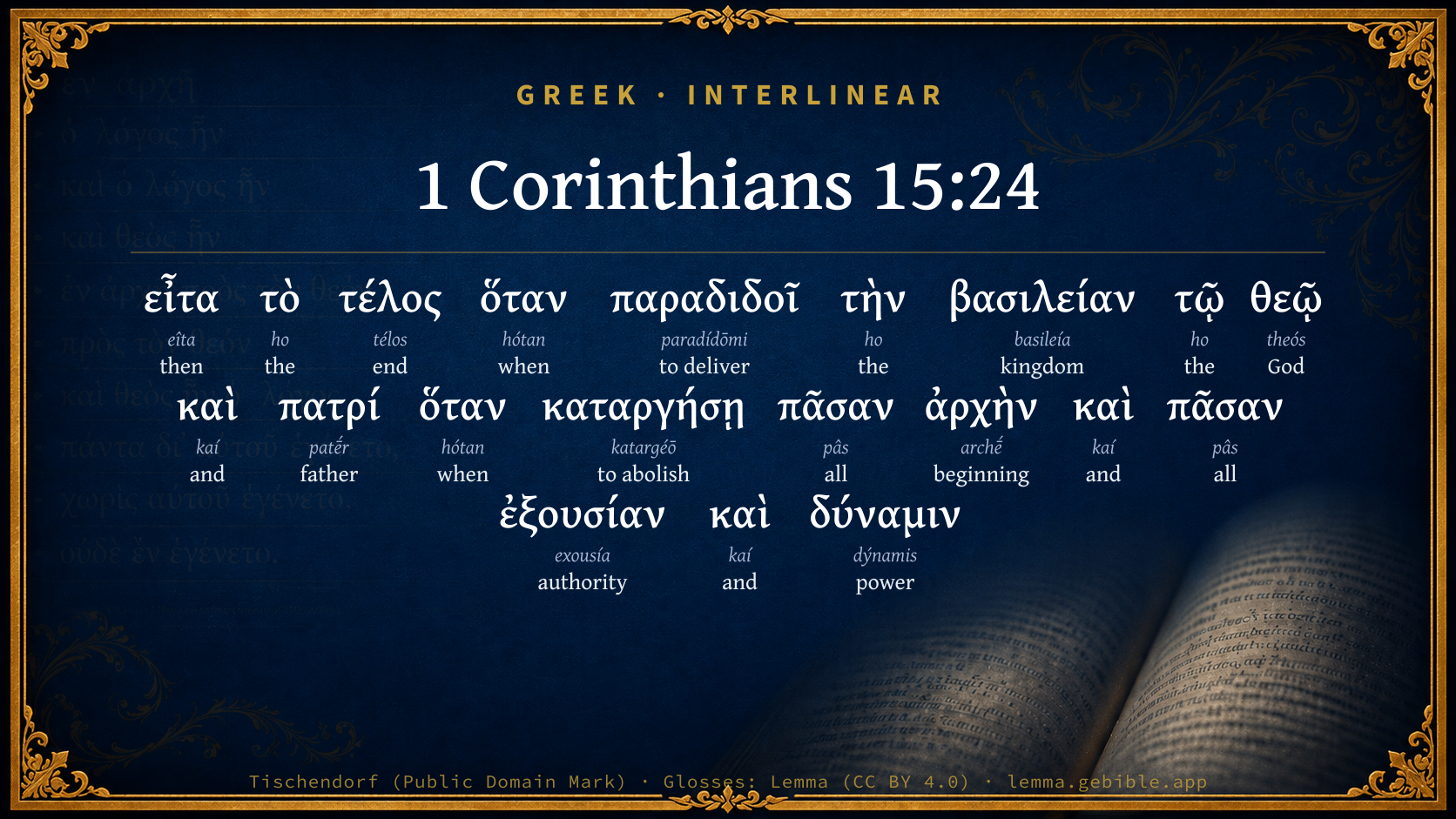
Greek (Tischendorf 8th ed.) 1 Corinthians 15:24 appears in the Greek New Testament. The text above is from the Tischendorf 8th edition. Each word links to its Strong’s number and a concise gloss. Click any word for its full Thayer’s Greek Lexicon entry.
Download image
Cite this verse

1 Corinthians 15:24 (World English Bible). Public Domain. Lemma interlinear Bible study tool, https://lemma.gebible.app/v/1-corinthians/15/24.

Show BibTeX & RIS
BibTeX
RIS
English Translation
Then the end comes, when he will deliver up the Kingdom to God, even the Father; when he will have abolished all rule and all authority and power.
World English Bible · Public Domain
Download a study sheet

One document with this verse’s original text, its word-by-word gloss line, the meaning frame, cross-references with their text, attributed commentary, and full source and license credits — printable, and it pastes into notes with its structure intact.

This verse Autodidact and up

Study sheet (.html) Plain text (.txt)

A passage Seminary Student

Up to 50 verses in one chapter. A passage sheet keeps up to 6 commentary sources and 12 cross-references per verse, in the order this page ranks them, and says so on the sheet whenever that leaves anything out. Ask for a single verse and you get the Autodidact verse sheet above.

Everything on this page stays free to read, with no account — the sheet is a download of what is already on screen, not access to it.

Want to remove ads? Support Godless Engineer
Compare translations 3

The same verse in 3 English versions, stacked beneath the original-language interlinear above. Click any original word for its lexicon entry.

Each is an independent rendering of the whole verse — the interlinear is not word-aligned to these translations.

Highlighted words mark where these versions differ — a whole-verse word diff, not a word-by-word alignment.

  • World English Bible Public Domain
    Then the end comes, when he will deliver up the Kingdom to God, even the Father; when he will have abolished all rule and all authority and power.
  • King James Version Public Domain
    Then cometh the end, when he shall have delivered up the kingdom to God, even the Father; when he shall have put down all rule and all authority and power.
  • unfoldingWord Literal Text CC BY-SA 4.0
    Then the end, when he hands over the kingdom to the God and Father, when he has abolished all rule and all authority and power.

unfoldingWord Literal Text — © unfoldingWord, licensed CC BY-SA 4.0. Word-aligned USFM3 via Door43 (git.door43.org/unfoldingWord/en_ult).

Versions to compare (up to 4)

3 of 4 selected

Show all 19 translations

Every available English version of this verse, each an independent rendering of the whole verse.

  • World English Bible Public Domain
    Then the end comes, when he will deliver up the Kingdom to God, even the Father; when he will have abolished all rule and all authority and power.
  • Berean Standard Bible Public Domain
    Then the end will come, when He hands over the kingdom to God the Father after He has destroyed all dominion, authority, and power.
  • Majority Standard Bible Public Domain
    Then the end will come, when He hands over the kingdom to God the Father after He has destroyed all dominion, authority, and power.
  • King James Version Public Domain
    Then cometh the end, when he shall have delivered up the kingdom to God, even the Father; when he shall have put down all rule and all authority and power.
  • American Standard Version (1901) Public Domain
    Then `cometh' the end, when he shall deliver up the kingdom to God, even the Father; when he shall have abolished all rule and all authority and power.
  • Revised Version (1885) Public Domain
    Then cometh the end, when he shall deliver up the kingdom to God, even the Father; when he shall have abolished all rule and all authority and power.
  • Geneva Bible (1599) Public Domain
    Then shalbe the end, when he hath deliuered vp the kingdome to God, euen the Father, when he hath put downe all rule, and all authoritie and power.
  • Douay-Rheims (1899) Public Domain
    Afterwards the end, when he shall have delivered up the kingdom to God and the Father, when he shall have brought to nought all principality, and power, and virtue.
  • Young's Literal Translation Public Domain
    then -- the end, when he may deliver up the reign to God, even the Father, when he may have made useless all rule, and all authority and power --
  • Literal Standard Version CC BY-SA 4.0
    then—the end, when He may deliver up the kingdom to God, even the Father, when He may have made all rule useless, and all authority and power.
  • Unlocked Literal Bible CC BY-SA 4.0
    Then will be the end, when Christ will hand over the kingdom to God the Father. This is when he will abolish all rule and all authority and power.
  • unfoldingWord Literal Text CC BY-SA 4.0
    Then the end, when he hands over the kingdom to the God and Father, when he has abolished all rule and all authority and power.
  • Darby Bible Public Domain
    Then the end, when he gives up the kingdom to him [who is] God and Father; when he shall have annulled all rule and all authority and power.
  • World Messianic Bible Public Domain
    Then the end comes, when he will deliver up the Kingdom to God the Father, when he will have abolished all rule and all authority and power.
  • Webster's Bible Public Domain
    Then cometh the end, when he shall have delivered up the kingdom to God, even the Father; when he shall have put down all rule, and all authority, and power.
  • Free Bible Version CC BY-SA 4.0
    After this comes the end, when Christ hands over the kingdom to God the Father, having destroyed all rulers, authorities, and powers.
  • Bible in Basic English Public Domain
    Then comes the end, when he will give up the kingdom to God, even the Father; when he will have put an end to all rule and to all authority and power.
  • Text-Critical English NT CC BY 4.0
    Then comes the end, when he hands the kingdom over to God the Father, after he has abolished all rule and all authority and power.
  • Tyndale New Testament (1534) Public Domain
    Then cometh the ende when he hath delivered vp the kyngdome to God the father when he hath put doune all rule auctorite and power.

Literal Standard Version (2020), Covenant Press — licensed CC BY-SA 4.0. Text via the HelloAO Bible API (eBible.org). Unlocked Literal Bible (unfoldingWord) — licensed CC BY-SA 4.0. Text via the HelloAO Bible API (eBible.org). unfoldingWord Literal Text — © unfoldingWord, licensed CC BY-SA 4.0. Word-aligned USFM3 via Door43 (git.door43.org/unfoldingWord/en_ult). Free Bible Version, Dr. Jonathan Gallagher — licensed CC BY-SA 4.0. Text via the HelloAO Bible API (eBible.org).

Word by word

More ways to search: Search by grammar → Find every occurrence → Compare this word →

Practice this passage: Drill this verse → Learn its vocabulary →

εἶτα
eîta
G1534
“then”
Adverb
Part of Speech
Adverb
Full Thayer's Definition

Origin: of uncertain affinity

TDNT: None

1. then 2. next, after that
  1. τὸ ho G3588 “the” Article, Nominative, Singular, Neuter
  2. τέλος télos G5056 “end” Noun, Nominative, Singular, Neuter
  3. ὅταν hótan G3752 “when” Conjunction
  4. παραδιδοῖ paradídōmi G3860 “to deliver” Verb, Present, Active, Subjunctive, 3rd person, Singular
  5. τὴν ho G3588 “the” Article, Accusative, Singular, Feminine
  6. βασιλείαν basileía G932 “kingdom” Noun, Accusative, Singular, Feminine
  7. τῷ ho G3588 “the” Article, Dative, Singular, Masculine
  8. θεῷ theós G2316 “God” Noun, Dative, Singular, Masculine
  9. καὶ kaí G2532 “and” Conjunction
  10. πατρί patḗr G3962 “father” Noun, Dative, Singular, Masculine
  11. ὅταν hótan G3752 “when” Conjunction
  12. καταργήσῃ katargéō G2673 “to abolish” Verb, Aorist, Active, Subjunctive, 3rd person, Singular
  13. πᾶσαν pâs G3956 “all” Adjective, Accusative, Singular, Feminine
  14. ἀρχὴν archḗ G746 “beginning” Noun, Accusative, Singular, Feminine
  15. καὶ kaí G2532 “and” Conjunction
  16. πᾶσαν pâs G3956 “all” Adjective, Accusative, Singular, Feminine
  17. ἐξουσίαν exousía G1849 “authority” Noun, Accusative, Singular, Feminine
  18. καὶ kaí G2532 “and” Conjunction
  19. δύναμιν dýnamis G1411 “power” Noun, Accusative, Singular, Feminine

About this verse

These counts appear in no published source. They are computed here, from the morphology-tagged text and Lemma’s own curated glosses. What Lemma adds →

20
words
14
distinct lemmas
Pauline Epistles
section

Notable vocabulary

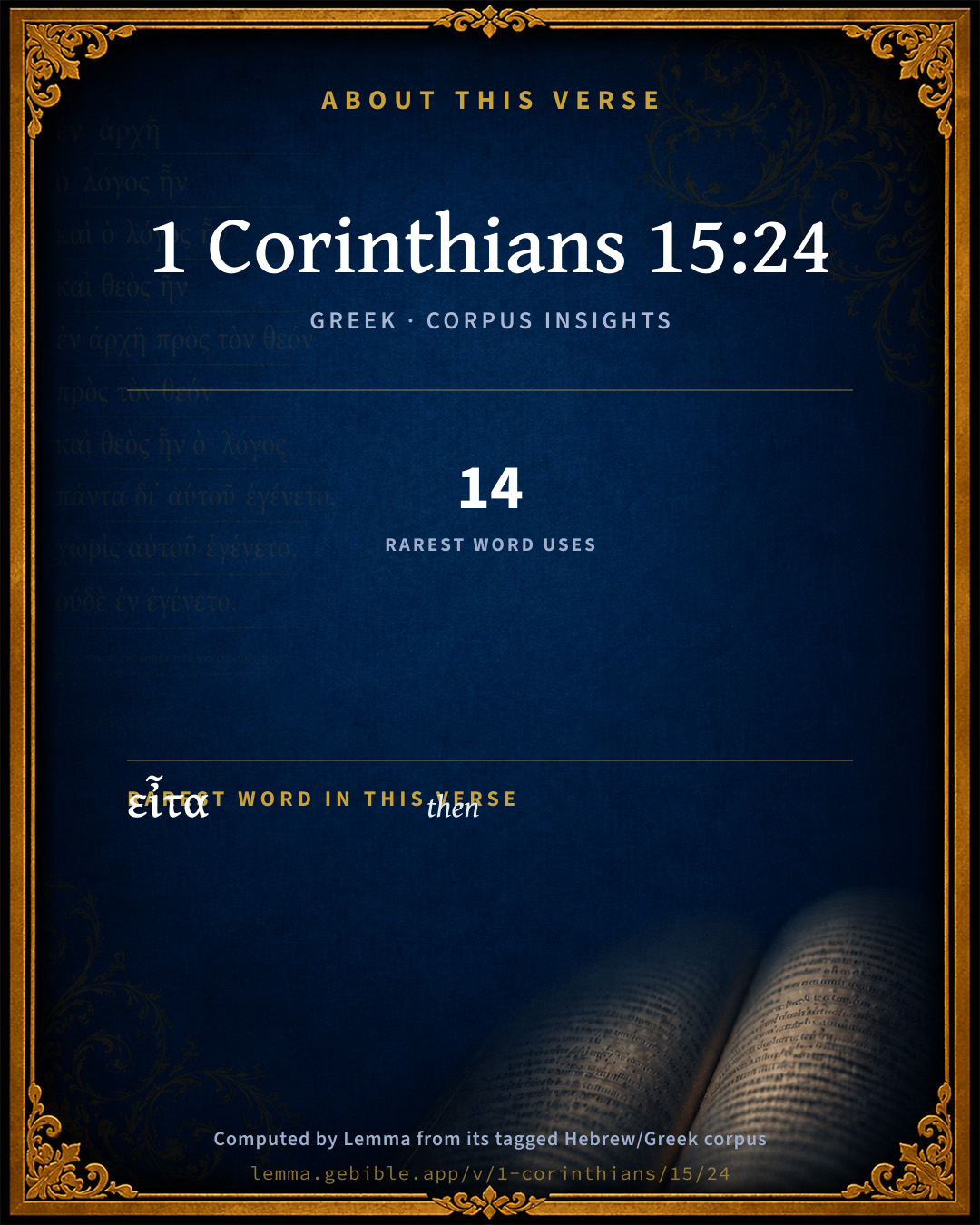
The rarest word here is εἶτα then G1534 — appearing just 14 times in the whole Greek New Testament.

Shared distinctive vocabulary

εἶτα then G1534 occurs in 13 verses of the Greek New Testament. Also found in:

Repetition

Words recur within this verse:

Cross-references

17

Topical passages linked to 1 Corinthians 15:24 in the Treasury of Scripture Knowledge — connected by theme and wording, ordered by reader-vote popularity; previews shown in the World English Bible.

  • Daniel 7:27 The kingdom and the dominion, and the greatness of the kingdoms under the whole the sky, shall be given to the people of the saints of the Most High: his kingdom is an everlasting kingdom, and all dominions shall serve and obey him.
  • Daniel 7:14 There was given him dominion, and glory, and a kingdom, that all the peoples, nations, and languages should serve him: his dominion is an everlasting dominion, which shall not pass away, and his kingdom that which shall not be destroyed.
  • Matthew 28:18 Jesus came to them and spoke to them, saying, "All authority has been given to me in heaven and on earth.
  • Isaiah 9:7 Of the increase of his government and of peace there shall be no end, on the throne of David, and on his kingdom, to establish it, and to uphold it with justice and with righteousness from henceforth even forever. The zeal of Yahweh of Hosts will perform this.
  • Matthew 11:27 All things have been delivered to me by my Father. No one knows the Son, except the Father; neither does anyone know the Father, except the Son, and he to whom the Son desires to reveal him.
  • John 13:3 Jesus, knowing that the Father had given all things into his hands, and that he came forth from God, and was going to God,
  • Daniel 2:44 In the days of those kings shall the God of heaven set up a kingdom which shall never be destroyed, nor shall the sovereignty of it be left to another people; but it shall break in pieces and consume all these kingdoms, and it shall stand forever.
  • 1 Timothy 6:15 which in its own times he will show, who is the blessed and only Ruler, the King of kings, and Lord of lords;
  • Matthew 24:13 But he who endures to the end, the same will be saved.
  • John 3:35 The Father loves the Son, and has given all things into his hand.
  • Luke 10:22 Turning to the disciples, he said, "All things have been delivered to me by my Father. No one knows who the Son is, except the Father, and who the Father is, except the Son, and he to whomever the Son desires to reveal him."
  • Matthew 10:22 You will be hated by all men for my name's sake, but he who endures to the end will be saved.
  • Daniel 12:9 He said, Go your way, Daniel; for the words are shut up and sealed until the time of the end.
  • Daniel 12:13 But go you your way until the end be; for you shall rest, and shall stand in your lot, at the end of the days.
  • 1 Peter 4:7 But the end of all things is near. Therefore be of sound mind, self-controlled, and sober in prayer.
  • Daniel 12:4 But you, Daniel, shut up the words, and seal the book, even to the time of the end: many shall run back and forth, and knowledge shall be increased."
  • Romans 8:38 For I am persuaded, that neither death, nor life, nor angels, nor principalities, nor things present, nor things to come, nor powers,

Cross-references courtesy of OpenBible.info (CC BY 4.0).

Commentary

Notes on 1 Corinthians 15:24 from classic Christian and Jewish commentators (each source and its license shown beneath its notes). The classic Christian expositions comment on the surrounding passage and are grouped to its opening verse, so a note may address several verses; the Jewish commentaries on the Tanakh (Rashi and others) are per-verse, so they appear only where the commentator wrote on this verse.

Lemma curates 59 commentaries, every one of them public domain or Creative Commons licensed, each selected and text-cleaned for this edition rather than reprinted as found. About our sources →

Joseph Benson's Commentary

1Co 15:24. Then — After the resurrection and the general judgment; cometh the end — Of the world, the grand period of all those wonderful scenes that have appeared for so many succeeding generations; when he shall — Publicly and solemnly; have delivered up — Greek, οταν παραδω, when he shall deliver up; the mediatorial kingdom to God, even the Father — By whose commission he had held it, and to whose glory he had always administered it; when he shall have put down — Οταν καταργηση, when he shall have destroyed all adverse rule, authority, and power — That had opposed itself to his government, and shall have triumphed over all the efforts which either men or devils could ever make against his dominion. This mediatorial kingdom which Christ will deliver up, is represented, Mat 28:18, to be his possessing all power in heaven and in earth; “that is, power over angels as well as over men. This kingdom our Lord received in the human nature, as the reward of his humiliation, and was solemnly installed in it after his resurrection, when he ascended into heaven, and was invited by God to sit at his right hand till he should make his enemies his footstool. Further, because it is said, Col 1:17, He is before all things, and by him all things consist; and because we are told, Heb 1:3, that the Son, while he spake the gospel, upheld all things by the word of his power; it is believed, that besides the mediatorial kingdom which the Son administered in the human nature, and which he will deliver up to the Father after the judgment, he possessed the government of the universe from the beginning, in his character as Creator: and that, after the mediatorial kingdom is delivered up, the kingdom which he holds as Creator, will remain with him as from the beginning. So that after the judgment, the righteous shall enter still into the everlasting kingdom of Jesus Christ, as they are represented to do, 2Pe 1:11.” — Macknight. Indeed, the divine reign, both of the Father and the Son, is from everlasting to everlasting. And only so far as the Father gave the kingdom to the Son, shall the Son deliver it up to the Father, Joh 13:3. Nor does the Father cease to reign when he gives it to the Son, neither the Son when he delivers it to the Father; but the glory which he had before the world began, (Joh 17:5; Heb 1:8,) will remain even after that is delivered up. Nor will he cease to be a king even in his human nature, Luk 1:33. If the citizens of the New Jerusalem shall reign for ever, (Rev 22:5,) how much more shall he!

Joseph Benson's Commentary on the Old and New Testaments (1811–1818) — public domain. Text from a community e-Sword module.

Godbey's Commentary on the New Testament

William B. Godbey

END OF THE MEDIATORIAL KINGDOM

1Co 15:24-28

24. “Then cometh the end,” i. e., the end of time and the mediatorial kingdom, this being the only one that will ever have an end. “When He may deliver up the kingdom to God, even the Father, when He may destroy all government, all authority and power,” i. e., all governmental authority antagonistic to God. When a human province revolted, the emperor always sent out a proconsul with an army to put down the rebellion, the former preparing to furnish the latter all of the men and money he needed until the work was done. When the news of the Fall reached Heaven, all the golden harps were hung on weeping willows, and Heaven turned into a Bochim of weeping over the loss of this world; no finite power was adequate to the emergency. Behold, the glorified Son espouses the lost cause! The news thrills all Heaven with unutterable surprise and shakes all Hell with unspeakable consternation. Then and there was inaugurated the mediatorial kingdom for the restoration of this lost world. Under this kingdom is every soul from righteous Abel to the last one that will be saved in the nick of time, when Gabriel is lifting the trumpet to roar the judgment blast. What is time? It is that portion of eternity which measures the duration of the mediatorial kingdom. Before the fall eternity was revolving its mighty course while millions of worlds sped their flight around the Throne of God. The revolt supervened and the Son of God came down from the Throne, mediatorial King, to put down the rebellion and expurgate sin from the universe. The mediatorial kingdom will sweep on through the Millennium from the simple fact that it includes the theocracy, which is the culmination of it. Hence salvation will continue through the Millennium down to the end of time.

William B. Godbey, Commentary on the New Testament (1896–1900) — public domain. Text from a community e-Sword module.

Tyndale Open Study Notes

Tyndale Open Resources

15:24-28 Christ is the Lord of all things, even death itself. Nevertheless, he remains subordinate to God his Father.

15:24 The phrase every ruler and authority and power refers to spiritual powers who oppose Christ (cp. Rom 8:38; Eph 1:21; Col 2:10, 15; 1 Pet 3:22).

Tyndale Open Study Notes — © Tyndale Open Resources, licensed CC BY-SA 4.0. Text via the HelloAO Bible API.

Bengel's Gnomon

Johann Albrecht Bengel

1Co 15:24. Εἶτα, afterwards) after the resurrection of those who are Christ’s; for He, as King, will consummate the judgment between the resurrection and the end.—τὸ τέλος) The end, viz., of the whole resurrection. This is the correlative to the first fruits. In this end all orders [referring to “every man in his own order”] will obtain their completion [consummated development]: 1Pe 4:7; Rom 6:22. This noun contains the force of the verbs, delivered up [1Co 15:24] and destroyed [1Co 15:26]. See how great mysteries that apostle draws from the prophetic syllables עד and כל, Psa 110:1; Psa 8:6. Gr. ἄχρις, until, and πάντα, all things. Therefore even the words of Scripture are inspired by God, θεόπνευστα. For all Scripture words rest upon the same principles as these [The same reasoning is applicable to all Scripture words].—ὅταν—ὅταν) when:—namely, when. The former is explained by the latter; and the first part of the following verse is to be referred to the former; the second part, to the latter. So soon as the Son shall have delivered up the kingdom to the Father, the Father will destroy all authority; and the deliverance of the kingdom into His hands takes place, that all authority may be swept away.—παραδῷ τὴν βασιλείαν, shall have delivered up the kingdom) The Father will not then begin to reign without the Son; nor will the Son cease then to reign without the Father; for the divine kingdom both of the Father and of the Son is from eternity and will be to eternity. But the apostle is here speaking of the mediatorial kingdom of the Son, which will be delivered up, and of the immediate [i.e., without mediation] kingdom of the Father, to which then it will give place. In the meantime, the Son manages the affairs, which the Father has put into His hands, for and by His own people, for the elect, by the instrumentality of angels also, and in the presence of the Father and against His enemies, so long as even an effort of these last continues. The Son will deliver up the kingdom to the Father, inasmuch as the Father gave it to the Son, Joh 13:3. The Father does not cease to reign, though He has appointed the Son to be king; nor does the Son cease to reign, when He delivers up the kingdom to the Father; and by the very circumstance, that it is said, not that it is to be abolished, but to be delivered up to the Father, it is signified, that it itself also is of infinite majesty. But the glory before the foundation of the world will remain, after the kingdom has been delivered up: Joh 17:5; Heb 1:8: and He will not cease to be king according to His human nature, Luk 1:33.[137] If the citizens of the New Jerusalem shall reign for ever and ever, Rev 22:5; how much more will God and Christ reign?—Τῷ ΘΕῷ ΚΑῚ ΠΑΤΡῚ, to God even the Father) God is here regarded in a twofold point of view. He is considered, both as God and as the Father in respect to Christ, Joh 20:17; even in His state of exaltation, Rev 3:12; Rev 3:21: and in respect to believers, Col 3:17. He is considered as God, towards [in relation to] His enemies. καταργήσῃ [shall have put down] shall have abolished) viz., God even the Father, of whom it is also said (until) He put (θῇ, 1Co 15:25) and He has subjected [ὑπέταξεν, 1Co 15:27]. In a similar manner, the subject is changed to a different one [from God to Christ] in the third person, 1Co 15:25; 1Co 15:29 [the baptized for the dead—the dead—they, i.e., the former].—πᾶσαν ἀρχὴν καὶ πᾶσαν ἐξουσίαν καὶ δύναμιν, all rule and all authority and power) Rule and authority are also said of the powers of men, Tit 3:1 [principalities and powers]: but oftener of those of angels, Col 1:16: and that too in the concrete, to denote their very essence [substances]: here however they are in the abstract, as βασιλείαν, concerning the kingdom of the Son: for the essences of angels will not be destroyed. Ἀρχὴ denotes rule; subordinate to this are ἐξουσία, authority, magistracy, and δύναμις, an army, forces.—ἐξουσία and ΔΎΝΑΜΙς are more closely connected as is seen by the fact that they have the one epithet, all, in common [The one πᾶσαν qualifies both ἘΞΟΥΣΊΑΝ and ΔΎΝΑΜΙΝ; though ἈΡΧῊΝ has a separate ΠᾶΣΑΝ]. Here not only rule, authority, forces of enemies, are signified, 1Co 15:25, such as is death, 1Co 15:26; but the all intimates that the rule, authority, etc., even of good angels shall cease. For when the king lays down His arms, after His enemies have been subdued, the soldiers are discharged, and the word καταργεῖν, to put down, is not an inapplicable term even to these latter: 1Co 13:8; 2Co 3:7.

[137] S. R. D. Moldenhauer on this passage refers to it the passage in Luke; comp. Dan 7:14. He very often agrees with Bengel: for example, ver. 32, 49, etc.—E. B.

Bengel's Gnomon of the New Testament — English translation (T&T Clark, Edinburgh, 1860) — public domain. Text from a community e-Sword module.

Meyer's Critical & Exegetical Commentary

Heinrich August Wilhelm Meyer

1Co_15:24. Εἶτα τὸ τέλος] sc. ἔσται. Then shall the end be, namely, as is clear from the whole context, the end of the resurrection. Bengel puts it aptly: correlatum primitiarum (comp. Mat_24:14, where τὸ τέλος is correlative with ἀρχή in 1Co_15:8, also Mar_13:7; Mar_13:9); although Christ is only the first-fruits of the believers, He is nevertheless at the same time the beginning of all. According to Paul, therefore, the order of the resurrection is this: (1) it has begun already with Christ Himself; (2) at Christs return to establish His kingdom the Christians shall be raised up; (3) thereafterhow soon, however, or how long after the Parousia, is not said[46]sets in the last act of the resurrection, its close, which, as is now self-evident after what has gone before, applies to the non-Christians[47]. These too shall, it is plain, be judged (1Co_6:2, 1Co_11:32), of which their resurrection is the necessary premiss (in opposition to Weiss, bibl. Theol. p. 430 f.). Paul has thus conjoined the doctrine of Judaism regarding a twofold resurrection (Bertholdt, Christol. pp. 176 ff., 203 ff.) with the Christian faith, in accordance with the example of Christ Himself (see on Luk_14:14; Joh_5:29). The majority of interpreters after Chrysostom (including Reiche, Ewald, Maier) understand τὸ τέλος of the end of the present age of the world,[48] the final consummation (Weiss), the closing issue of things (Luthardt, v. d. letzten Dingen, p. 127), which includes also the resurrection of all men. In connection with this Rückert thinks (comp. Kling, p. 505) that εἶτα indicates the immediate following, one upon the other, of the ἀνάστασις and the ΤΈΛΟς; Olshausen, again, that Paul conceived the thousand years of the Messianic kingdom to come in between the Parousia and the ΤΈΛΟς, and the resurrection of the non-Christians to be joined together with the ΤΈΛΟς. But against the latter view it may be urged that, according to the constant doctrine of the New Testament (apart from Revelation 20), with the Parousia there sets in the finis hujus saeculi, so that the Parousia itself is the terminal point of the pre-Messianic, and the commencing-point of the future, world-period (Mat_24:3, al.; Usteri, Lehrbegr. p. 344). Against the former view it may be decisively urged, that εἶτα τὸ τέλος in the assumed sense would be inappropriate here, where the order of the resurrection is stated and is begun with ἀπαρχή; further, that Paul would not have given, in any proper sense at all, the promised order of succession, whether we take ΠΆΝΤΕς, 1Co_15:22, simply of believers or correctly of all in general. For in the former case there could be no mention at all of several τάγματα (see on 1Co_15:22); and in the latter case Paul would have passed over in silence the very greatest ΤΆΓΜΑ of all, that of those who died non-Christians. But how complete and self-consistent everything is, if ἈΠΑΡΧΉ is the beginning, ἜΠΕΙΤΑ ΟἹ ΤΟῦ ΧΡΙΣΤΟῦ the second act, and ΕἾΤΑ ΤῸ ΤΈΛΟς the last act of the same transaction! So in substance among the old interpreters, Theodoret and Oecumenius, later Cajetanus, Bengel, Jehne, de resurrect. carn. Alton. 1788, p. 19; Heydenreich, Osiander, Grimm in the Stud. u. Krit. 1850, p. 784. In accordance with what has been said, we must reject also the view of Grotius and Billroth, that τὸ τέλος is the end of the kingdom of Christ (comp. Kahnis, Dogm. I. p. 575); in connection with which Billroth leaves it undecided whether Paul conceived that there would be a thousand years reign, but finds rightly that his conception is different from that of Rev_20:1 ff.[49] The same considerations militate against this view as against that of Rückert; moreover, τέλος requires its explanation not from what follows, but from what precedes it, with which it stands in the closest relation. This also in opposition to de Wette (so, too, Lechler, apost. u. nachapost. Zeitalter, p. 140; Neander in loc.), who understands the completion of the eschatological events (comp. Beza), so that the general resurrection would be included in the conception (comp. Theophylact: τὸ τέλος τῶν πάντων καὶ αὐτῆς τῆς ἀναστάσεως); similarly, therefore, as regards the latter point, with Luthardt and Olshausen. Theodoret is right, in accordance with the Pauline type of doctrine (comp. Mat_13:39 f.), in remarking already at the preceding class (οἱ τοῖ Χ.): ΚΑΤᾺ ΤῸΝ Τῆς ΣΥΝΤΕΛΕΊΑς ΚΑΙΡΌΝ. For the intervening period between the ἜΠΕΙΤΑ and the ΕἾΤΑ is by no means to be reckoned to the ΑἸῺΝ ΟὟΤΟς, but to the ΑἸῺΝ ΜΈΛΛΩΝ, of which it is the first stage in time and development; the absolute consummation is then the giving over of the kingdom, which is immediately preceded by the last act of the resurrection (ΤῸ ΤΈΛΟς). Hofmann (comp. also his Schriftbew. II. 2, p. 657) takes τὸ τέλος adverbidlly, and then the two clauses commencing with ὅταν as protases to ἜΣΧΑΤΟς ἘΧΘΡῸς ΚΑΤΑΡΓ. Ὁ ΘΆΝΑΤΟς, 1Co_15:26, so that in this way ΔΕῖ ΓᾺΡ ΑὐΤῸΝ Κ.Τ.Λ., 1Co_15:25, falls to the second of those two protases as a reason assigned, inserted between it and the apodosis; consequently: then shall finally, when …, when …, the last enemy be brought to nought. This bringing to nought of death, he holds, includes the raising to life of such as, being ordained to life, did not belong to Christ during their bodily existence, and thus there is formed of these a second τάγμα, for the possibility of which Hofmann adduces Rom_2:15 f. But in what an involved and violent way are the simple, clear, and logically flowing sentences of the apostle thus folded and fenced in, and all for the purpose of getting out of them at last a second ΤΆΓΜΑ, which, however, does not stand there at all, but is only inserted between the lines; and that, too, such a ΤΆΓΜΑ as is entirely alien to the New Testament eschatology, and least of all can be established by Rom_2:15 f. (see in loc.) as even barely possible! And how unsuitable it is to treat 1Co_15:25, although introduced with solemn words of Scripture, as a subordinate sentence of confirmation, making the chain of protases on to the final short principal sentence only the longer and clumsier! In this whole section withal Paul employs only sentences of short and simple construction, without any involved periods. It may be added that, from a linguistic point of view, there would be nothing to object against the adverbial interpretation of τὸ τέλος, considered solely in itself (comp. 1Pe_3:8); but, after the two elements which have gone before, the substantive explanation is the only one which presents itself as accordant with the context; nay, the adverbial use would have here, as the whole exegetical history of the passage shows, only led the understanding astra.

ὍΤΑΝ ΠΑΡΑΔΙΔῷ Κ.Τ.Λ.] states with what ΤῸ ΤΈΛΟς will be contemporaneous: when he gives over the (Messianic) kingdom, etc. The church, or the fellowship of believers (van Hengel), is never designated by ἡ βασιλ., not even 1Co_6:9 f.; Eph_5:5; Col_1:13; Col_4:11; neither is it so here. The conception, on the contrary, is: the last act of Christs Messianic rule consists in the close of the resurrection, namely, the raising up of the non-Christians;[50] this He performs when He is about to hand over the rule to God, after which the last-named wields the government Himself and immediately, and Christs Messianic, and in particular His kingly officethe regency which had been entrusted to Him by God (Php_2:9 f.)is accomplished. It was a purely dogmatic (anti-Arian) explaining away of the clear meaning of the word to take παραδιδόναι as equivalent to ΚΑΤΟΡΘΟῦΝ (Chrysostom) or ΤΕΛΕΙΟῦΝ (Theophylact); such, too, was the interpretation of Theodoret, Ambrosiaster, Cajetanus, Estius, and others, including Storr and Flatt, according to which the giving over of the kingdom to the Father denotes the producing the result, that God shall be universally acknowledged as the supreme Ruler, even by those who did not wish to acknowledge Him as such. Hilary and Augustine (de Trin. i. 8) have another mode of explaining it away: what is meant is the bringing of the elect to the vision of God; similarly van Hengel (comp. Neander): Paul means to say, Christum sectatores suos facturum peculium Dei, ut ei vivant; and in like manner Beza, Heydenreich: we are to understand it of the presentation of the citizens of the kingdom, raised from the dead, before God. Another mode is that of Calovius, Bengel, Osiander, Reiche, al. (comp. also Gess, Pers. Chr. p. 280): it is only the form of the rule of Christ (namely, as the reconciler) that ceases then; the regnum gratiae ceases, and the regnum gloriae follows, which is what Luthers and Melanchthons exposition[51] also comes to in substance. No; Christ, although by His exaltation to the right hand of the Father He has become the σύνθρονος of God, is still only He who is invested with the sovereignty by the Father until all hostile powers are overcome (comp. Php_2:9 ff.; Eph_1:21; Act_2:33 ff.; Heb_1:3; Heb_1:13),[52] so that the absolute supreme sovereignty, which remains with the Father, is again immediately exercised after that end has been attained; the work of Christ is then completed; He gives up to the Father the Messianic administration of the kingdom, which has continued since His ascension.[53] The thought is similar in Pirke Elies. 11. Nonus rex est Messias, qui reget ab extremitate una mundi ad alteram. Decimus Deus S. B.; tunc redibit regnum ad auctorem suum. We must not mix up the spiritual βασιλεία, Joh_18:37, here, where the subject is the exalted Lor.

Τῷ ΘΕῷ Κ. ΠΑΤΡΊ] God, who is at the same time Father, namely, of Jesus Christ. Comp. Rom_15:6; 2Co_1:3; 2Co_11:31; Gal_1:3; Eph_1:3; Eph_5:20; Col_1:3; 1Pe_1:3; Jam_1:27; Jam_3:9. Estius says rightly: unus articulus utrumque complectens. See Matthiae, p. 714 f., and on Rom_15:6. That Paul, however, means by πατὴρ Χριστοῦ, not the supernatural bodily generation, but the metaphysical spiritual derivation, according to which Christ is ΚΑΤᾺ ΠΝΕῦΜΑ ἉΓΙΩΣΎΝΗς the Son of God, see on Rom_1:4.

But this giving over of the kingdom will not take place sooner than: ὍΤΑΝ ΚΑΤΑΡΓΉΣῌ Κ.Τ.Λ., when He shall have done away, etc. Observe the difference of meaning between ὅταν with the present (παραδιδῷ) and with the aorist (futur. exact.). See Matthiae, p. 1195. And this difference of tense shows of itself that of the two clauses introduced with ὅταν, this second one is subordinated to the first, and not co-ordinated with it (Hofmann). Hence, too, we have no καί or ΤΈ with the second ὍΤΑΝ. It is the familiar phenomenon of the double protasis, the one being dependent on the other (Kühner, ad Xen. Mem. i. 2. 35; Anab. iii. 2. 31).

πᾶσαν ἀρχὴν … δύναμ.] every dominion and every power and might, is to be understood, as 1Co_15:25 proves clearly, of all hostile powers, of all influences opposed to God, whose might Christ will bring to nought (καταργ., comp. 1Co_2:6); consequently we may not explain it simply of demoniac powers (Chrysostom, Calovius, and others, including Heydenreich, Billroth, Usteri, Neander, Luthardt), nor refer it to worldly political powers as such (Grotius). In opposition to the context on account of τοὺς ἐχθρούς, 1Co_15:25, Calvin interprets it (comp. Cajetanus): potestates legitimas a Deo ordinatas; and Olshausen understands all rule, good as well as bad, and even that of the Son also, to be meant. The subject of καταργ. must, it may be added, be the same with that of ΠΑΡΑΔΙΔῷ, consequently not God (Beza, Grotius, Bengel, Heydenreich, van Hengel, and others).

[46] Within this intermediate time falls the continued conquest of Christ over all hostile powers, vv. 24, 25, whose subjugation will not yet be completed at the Parousia. This also in opposition to Weiss, bibl. Theol. p. 427. To import into this period a process of redemption for the non-Christians and the wicked (Weizel, Stroh), is neither in accord with Paul nor with the New Testament generally.

[47] Van Hengel, too, takes it rightly of the closing act of the resurrection, but explains this in consequence of his incorrect understanding of οἱ τοῦ Χ. ἐν τῇ παρουσ. αὐτοῦ: tum ceteri Christi sectatores, qui mortem subierant, in vitam restituentur.

[48] Comp. Calvin: finis, i.e. meta cursus nostri, quietus portus, conditio nullis amplius mutationibus obnoxia. Erasmus, Paraphr.: finis humanarum vicissitudinum.

[49] According to the Apocalypse, between the first and second resurrection there is the thousand years reign, which ends with Satans being again let loose and again overcome and cast into hell. Olshausen, who does not admit the variation of the Pauline doctrine from the Apocalyptic, holds that the Revelation, which handles the doctrine ex professo, is only more detailed. But this plea would only avail if Paul had shown himself to be a Chiliast somewhere else. This, however, he has never done, often as he had opportunity for doing so. In substance like Olshausens is the view of de Wette and of Georgii in Zellers Jahrb. 1845, 1, p. 14, who, however, puts this difference between Paul and the author of the Apocalypse, that the former leaves the duration of the reign indefinite, and places the Messiahs conflict not at the end of this regnal period, but throughout the whole time of its duration. But these differences are so essential, that they would do away with the agreement of the two.

[50] With which their judgment is necessarily bound up; but an express mention of the latter as included was not called for by the connection of the passage.

[51] Luther: Christ is now ruling through the word, not in visible public fashion, as we see the sun through a cloud. There we see indeed the light, but not the sun itself; but when the clouds are gone, then we see both light and sun together in one and the same subsistence. Melanchthon: Offeret regnum patri, i.e. ostendet has actiones (namely, of the mediatorial office), completas esse, et deinde simul regnabit ut Deus, immediate divinitatem nobis ostendens.

[52] Comp. upon the relation of the dominion of Christ, as conferred by the supreme Sovereign, the parable in Luk_19:12 ff.

[53] Comp. von Zezschwitz, l.c. p. 208; Luthardt, l.c. p. 128.

Meyer — Critical and Exegetical Commentary on the New Testament — English translation by Peter Christie, edited by Frederick Crombie (T&T Clark, 1880) — public domain. Text from a community e-Sword module.

Expositor's Greek Testament

ed. W. Robertson Nicoll

1Co 15:24 . εἶτα τὸ τέλος : “ Then (is) the end” sc., “at His coming”. Christ’s advent, attended with the resurrection of His redeemed to eternal life, concludes the world’s history; then “the harvest” which is “the end of the world” (Mat 13:39 f., Mat 13:49 ; cf. Rev 14:15 f.), “the end of all things” (1Pe 4:7 ), the dénoûment of the drama of sin and redemption in which “the Adam” and “the Christ” have played out their respective parts, the limit of the human horizon. As ἔπειτα was defined by ἐν τῇ παρουσίᾳ , so εἶτα by the two ὅταν clauses: “when He yields up the kingdom to His God and Father, when He has abolished every rule and every authority and power”. The two vbs. denote distinct, but connected and complementary acts. παραδιδῷ (the reading παραδιδοῖ is sbj [2359] , not opt.: Bm [2360] , p. 46) is pr . sbj [2361] , signifying a proceeding, contingent in its date and manner of occurrence, but concurrent with εἶτα , which again rests upon ἐν τ . παρουσίᾳ . The aor [2362] sbj [2363] καταργήσῃ (Lat. futurum exactum ) signalises an event lying behind the παραδιδῷ and by its nature antecedent thereto, “when He shall have done away, etc.”; every opposing force has been destroyed, then Christ lays at the Father’s feet His kingdom. “Cum tradat (not tradiderit : so Vg [2364] , eading παραδῷ ) regnum, etc., cum evacuerit omnem principatum, etc.” The title τῷ Θεῷ καὶ πατρί , “to Him who is God and Father,” contains the reason for this παράδοσις : Christ’s one aim was to glorify the Father (Luk 2:49 , Joh 4:34 ; Joh 6:38 ; Joh 17:4 , etc.); this end was reached proximately at the cross (Joh 19:30 ), and will be so ultimately when our Lord, having “subdued all things to Himself” (Phi 3:21 ), is able to present to the Father a realm dominated by His will and filled with His obedient sons ( cf. Mat 6:9 f.). This is no ceasing of Christ’s rule, but the inauguration of God’s eternal kingdom: παραδιδῷ does not connote the losing of anything (see Joh 17:10 ); it is just the rendering to another of what is designed for Him ( cf. 1Co 15:3 , 1Co 5:5 , Rom 8:32 , Luk 4:6 ; Luk 10:22 , etc.). “The end” does not mean the termination of Christ’s sovereignty , which in its largest sense began before the world (Joh 1:1-3 ; Joh 17:5 ) and is its goal (Col 1:16 ); but the termination of the reign of sin and death (Rom 5:21 ; cf. Joh 6:37 ff.). At the συντέλεια “the throne of God and of the Lamb,” “the kingdom of Christ and of God,” fills the N.T. horizon (Eph 5:5 , Rev 11:15 ; Rev 22:3 ). ἀρχὴν , ἐξουσίαν κ . τ . λ ., should not be limited (with Ff [2365] generally, Est., Ed [2366] , Gd [2367] , El [2368] , Sm [2369] : Everling, Paulin. Angelol. u.s.w ., p. 44, in view of Eph 1:21 ; Eph 6:12 , Col 2:15 , etc.) to angelic powers , or demons ; nor (as by Cv [2370] , Gr [2371] : cf. 1Co 2:6 ) to earthly rulers : πᾶσαν … πᾶσαν … (see πάντας τοὺς ἐχθροὺς , 25; πάντα ὑπέταξεν , 27; also Rom 8:37-39 ) embraces all forces oppugnant to God (Bg [2372] , Cr [2373] , Hn [2374] , Hf [2375] , Bt [2376] ), on earth or above it, whether they exercise princely sway ( ἀρχὴν ) or moral authority ( ἐξουσίαν ) or active power ( δύναμιν ). Death is a βασιλεὺς amongst these (Rom 5:14 ); and behind death Satan (Heb 2:14 f.), “the prince” and “god of this world” (2Co 4:4 , Joh 14:30 ). On καταργέω , see note to 1Co 1:28 .

[2359] subjunctive mood.

[2360] A. Buttmann’s Grammar of the N.T. Greek (Eng. Trans., 1873).

[2361] subjunctive mood.

[2362] aorist tense.

[2363] subjunctive mood.

[2364] Latin Vulgate Translation.

[2365] Fathers.

[2366] T. C. Edwards’ Commentary on the First Ep. to the Corinthians . 2

[2367] F. Godet’s Commentaire sur la prem. Ép. aux Corinthiens (Eng. Trans.).

[2368] C. J. Ellicott’s St. Paul’s First Epistle to the Corinthians .

[2369] P. Schmiedel, in Handcommentar zum N.T. (1893).

[2370] Calvin’s In Nov. Testamentum Commentarii .

[2371] Greek, or Grotius’ Annotationes in N.T.

[2372] Bengel’s Gnomon Novi Testamenti.

[2373] Cremer’s Biblico-Theological Lexicon of N.T. Greek (Eng. Trans.).

[2374] C. F. G. Heinrici’s Erklärung der Korintherbriefe (1880), or 1 Korinther in Meyer’s krit.-exegetisches Kommentar (1896).

[2375] J. C. K. von Hofmann’s Die heilige Schrift N.T. untersucht , ii. 2 (2te Auflage, 1874).

[2376] J. A. Beet’s St. Paul’s Epp. to the Corinthians (1882).

The Expositor's Greek Testament, edited by W. Robertson Nicoll (1897–1910) — public domain. Text from a community e-Sword module.

Hodge's Commentary on Romans, Ephesians & First Corinthians

Charles Hodge

1Co_15:24

Then (cometh) the end, when he shall have delivered up the kingdom to God, even the Father; when he shall have put down an rule, and an authority and power.

This is a very difficult passage, and the interpretations given of it are too numerous to be recited. The first question is, What is the end here spoken of? The common answer is, That it is the end of the world. That is, the close of the present order of things; the consummation of the work of redemption. In favor of this view, it may be urged,

1. That where there is nothing in the context to determine otherwise, The end naturally means the end of all things. There is nothing here to limit the application, but the nature of the subject spoken of.

2. The analogy of Scripture is in favor of this explanation. In 1Pe_4:7 we find the expression the end of all things is at hand. Mat_24:6, The end is not yet; Mat_24:14, Then shall the end come. So in Mar_13:7. Luk_21:9. In all these passages the end means the end of the world.

3. The equivalent expressions serve to explain the meaning of this phrase. The disciples asked our Lord, What shall be the sign of thy coming, and of the end of the world? (i.e. the consummation of the present dispensation.) In answer to this question, our Lord said certain things were to happen, but the end is not yet; and afterwards, then shall the end come. See Mat_24:3, Mat_24:6, Mat_24:14. The same expression occurs in the same sense, Mat_13:39; Mat_28:20, and elsewhere. The end, therefore, means the end of the world. In the same sense the phrase until the restoration of all things is probably used in Act_3:21.

4. What immediately follows seems decisive in favor of this interpretation. The end is, when Christ shall deliver up his kingdom, after having subdued all his enemies; i.e. after having accomplished the work of redemption.

Many commentators understand by the end, the end of the resurrection. That work, they say, is to be accomplished by distinct stages. First the resurrection of Christ, then that of his people, then that of the wicked. This last, they say, is expressed by then cometh the end, viz., the end of the resurrection. Against this view, however, are all the arguments above stated in favor of the opinion that the end means the end of the world. Besides, the doctrine that there are to be two resurrections, one of the righteous and another of the wicked, the latter separated from the former by an unknown period of time, is entirely foreign to the New Testament, unless what is said in the 20th chapter of Revelation teaches that doctrine. Admitting that a twofold resurrection is there spoken of, it would not be proper to transfer from that passage an idea foreign to all Pauls representations of the subject. If that fact was revealed to John, it does not prove that it was revealed to Paul. All that the most stringent doctrine of inspiration requires is, that the passages should not contradict each other. The passage in Revelation, however, is altogether too uncertain to be made the rule of interpretation for the plainer declarations of the epistolary portions of the New Testament. On the contrary, what is doubtful in the former should be explained by what is clearly taught in the latter. Secondly, it is clearly taught in the gospels and epistles that the resurrection of the righteous and of the wicked is to be contemporaneous. At least, that is the mode in which the subject is always presented. The element of time (i.e. the chronological succession of the events) may indeed in these representations be omitted, as is so often the case in the prophecies of the Old Testament. But unless it can be proved from other sources, that events which are foretold as contemporaneous, or as following the one the other in immediate succession, are in fact separated by indefinite periods of time, no such separation can properly be assumed. In the evangelists and epistles the resurrection of the righteous and that of the wicked are spoken of as contemporaneous, and since their separation in time is nowhere else revealed, the only proper inference is that they are to occur together. In Mat_24:3, the coming of Christ and the end of the world are coupled together as contemporaneous. And throughout that chapter our Lord foretells what is to happen before that event, and adds, Then shall appear the sign of the Son of Man in heaven … and he shall send his angels with the sound of a great trumpet, and they shall gather together the elect from the four winds, from one end of heaven to the other, Mat_24:30, Mat_24:31. In Joh_5:28, Joh_5:29 it is said, The hour is coming when all (good and bad) who are in their graves shall hear the voice of the Son of Man, and shall come forth, they that have done good unto the resurrection of life, and they that have done evil unto the resurrection of damnation. In 2Th_1:7-10, Christ is said to come to take vengeance on those who obey not the gospel, and to be glorified in the saints. These events go together. Besides, our Lord repeatedly says that he will raise up his people at the last day, Joh_6:39, Joh_6:40; Joh_11:24, and therefore not an indefinitely long period before the last day. According to the uniform representations of the Scriptures, when Christ comes he is to raise all the dead and separate the wicked from among the just as a shepherd divides his sheep from the goats. Or, according to another figure, he is to send forth his angels and separate the tares from the wheat. It has therefore been the constant faith of the church that the second advent of Christ, the resurrection of the just and of the unjust, the final judgment and end of the world are parts of one great transaction, and not events which are to succeed each other at long intervals of time. All this, however, is said with diffidence and submission. It may prove to be otherwise. The predictions of the Old Testament produced the universal impression that the first coming of Christ was to be attended at once by events which we learn from the New Testament require ages to bring about. Still, we are bound to take the Scriptures as they stand, and events which are described as contemporaneous are to be assumed to be so, until the event proves the contrary. We may be perfectly sure that the Scriptures will prove infallibly true. The predictions of the Old Testament, although in some points misinterpreted, or rather interpreted too far, by the ancient church, were fully vindicated and explained by the event.

The second question to be considered is, When is the end of the world to take place? According to some, at Christs coming; according to others, at an indefinite period after his second coming. It may be admitted that this verse is not decisive on this point. It marks the succession of certain events, but determines nothing as to the interval between them First, Christs resurrection; then the resurrection of his people; then the end of the world. But as it is said that those who are Christs shall rise at his coming, and then cometh the end; the natural impression is that nothing remains to be done after the resurrection before the end comes. This view is confirmed by the numerous passages of the New Testament, several of which have already been quoted, which connect the general judgment and end of the world as intimately with the coming of Christ as the resurrection of his people. Some of those who assume that an indefinite period is to elapse between the coming of Christ and the end of the world, suppose that the intervening period is to be occupied not in the work of conversion, but in the subjugation of the enemies of Christ spoken of in the following verses. The common opinion among those who adopt this interpretation is, that the interval in question is to be occupied by the personal reign of Christ on earth. This is the doctrine of the ancient Chiliasts, and of modern Millenarians. The form which this doctrine has commonly assumed in ancient and modern times is only a modified Judaism, entirely at variance with the spirituality of the gospel and with the teachings of the apostle in this chapter. He tells us that flesh and blood, i.e. bodies organized as our present bodies are, i.e. natural bodies, cannot inherit the kingdom of God. The whole design of the latter portion of this chapter is to show that after the resurrection, the bodies of believers will be like the glorious body of the Son of God, adapted to a heavenly, and not to an earthly condition.

A third question which this verse presents is, In what sense is Christ to deliver up the kingdom to the Father? In the common text the words are ὅταν παραδῷ, when he shall have delivered up; most of the modern editors read παραδιδῷ, when he delivers up. That is, when the end comes, Christ is to deliver up the kingdom to his Father. What does this mean? The Scriptures constantly teach that Christs kingdom is an everlasting kingdom, and of his dominion there is no end. In what sense, then, can he be said to deliver up his kingdom? It must be remembered that the Scriptures speak of a threefold kingdom as belonging to Christ.

1. That which necessarily belongs to him as a divine person, extending over all creatures, and of which he can never divest himself.

2. That which belongs to him as the incarnate Son of God, extending over his own people. This also is everlasting. He will for ever remain the head and sovereign of the redeemed.

3. That dominion to which he was exalted after his resurrection, when all power in heaven and earth was committed to his hands. This kingdom, which he exercises as the Theanthropos, and which extends over all principalities and powers, he is to deliver up when the work of redemption is accomplished. He was invested with this dominion in his mediatorial character for the purpose of carrying on his work to its consummation. When that is done, i.e. when he has subdued all his enemies, then he will no longer reign over the universe as Mediator, but only as God; while his headship over his people is to continue for ever.

To God even the Father, i.e. to him who is at once his God and Father. This is the Scriptural designation of the first person of the Trinity. He is the God of the Lord Jesus Christ, inasmuch as he is the God whom Christ came to reveal, and whose work he performs. He is his Father in virtue of the eternal relation subsisting between the first and second persons in the Godhead.

The fourth question which this pregnant verse suggests is presented in the last clause. When he shall have put down all rule, and authority and power. Calvin and others understand this to mean, When he shall have abrogated all other dominion than his own. Whatever authority is now exercised by one man over others is at last to be abolished, and merged in the all-pervading authority of God. Most commentators, in obedience to the context, understand the passage to refer to all hostile powers, whether demoniacal or human. These are to be put down, i.e. effectually subdued; not annihilated, and not converted; but simply deprived of all power to disturb the harmony of his kingdom.

1Co_15:25

For he must reign, till he hath put all enemies under his feet.

This verse assigns the reason why Christ cannot relinquish his dominion over the universe as mediator until the end comes, and why he will then deliver it up. He must reign until the purpose for which he was invested with this universal dominion is accomplished. As in Psa_110:1-7 it is said to the Messiah, Sit thou on my right hand until I make thy enemies thy footstool, many assume that God is the subject of the verb has put. The meaning would then be, He must reign until God has put all his enemies under his feet. But this is inconsistent with the context. Christ is to put down all rule, authority and power, 1Co_15:24, and he reigns until he has accomplished that work. The two modes of representation are perfectly consistent. The Father created the world, though he did it through the Son, Heb_1:3. The work, therefore, is sometimes ascribed to the one and sometimes to the other. In like manner the Father subdues the powers of darkness, but it is through Christ to whom all power in heaven and earth has been committed. It is therefore equally proper to say that God makes the enemies of Christ his footstool, and that Christ himself puts his enemies under his feet. The enemies who are to be thus subdued are not only intelligent beings hostile to Christ, but all the forms of evil, physical and moral, because death is specially included. By subduing, however, is not meant destroying or banishing out of existence. The passage does not teach that Christ is to reign until all evil is banished from the universe. Satan is said to be subdued, when deprived of his power to injure the people of God. And evil in like manner is subdued when it is restrained within the limits of the kingdom of darkness.

1Co_15:26

The last enemy (that) shall be destroyed (is) death.

Death shall reign until the resurrection. Then men shall never more be subject to his power. Then death shall be swallowed up in victory, Luk_20:36. Neither shall they die any more, 2Ti_1:10 Rev_20:14.

1Co_15:27

For he hath put all things under his feet. But when he saith, All things are put under (him, it is) manifest that he is excepted, which did put all things under him.

The proof that death is finally to be destroyed is derived from the 8th Psalm, where the subjection of all things to the Messiah is predicted. There are two passages of the Old Testament frequently quoted in the New Testament as foretelling the absolutely universal dominion of the Messiah, Psa_110:1-7 and Psa_8:1-9. The former is quoted, or its language appropriated, in 1Co_15:25. Mat_22:44. Act_2:34. Eph_1:22. Heb_1:13; Heb_10:12, Heb_10:13, 1Pe_3:22. In this there is no difficulty, as that Psalm clearly refers to the Messiah and to none else. The 8th Psalm is quoted and applied to Christ in this passage, and in Eph_1:22. Heb_2:8 and 1Pe_3:22. As this Psalm has no apparent reference to the Messiah, but is a thanksgiving to God for his goodness to man, the use made of it in the New Testament is to be understood as an inspired exposition of its hidden meaning. That is, when the Psalmist said, Thou madest him to have dominion over the works of thy hands, thou hast put all things under his feet, we learn from the New Testament that the Spirit of God intended by these words far more than that man was invested with dominion over the beasts of the field. There is no limit to the all things here intended. Heb_2:8. Man is clothed with dominion over the whole universe, over all principalities and powers, and every name that is named, not only in this world but also in that which is to come. This is fulfilled in the man Christ Jesus, into whose hands all power in heaven and earth has been committed. This may be called the hidden meaning of the Psalm, because it never would have been discovered without a further revelation such as we find in the exposition given by the inspired apostles,. When he saith, ὅταν εἴπῃ, This may mean either, when the Scripture saith, or when God saith. The latter is better on account of what follows. The verb is not to be translated as in the present tense, but, as the better commentators agree, in the past future, see 1Co_15:24. Heb_1:6. When God shall have said. That is, when God shall have declared his purpose to subject all things to Christ accomplished, it will then be manifest that all things are subject to him, God only excepted.

1Co_15:28

And when all things shall be subdued unto him, then shall the Son also himself be subject unto him that put all things under him, that God may be all in all.

When the work of redemption has been accomplished, the dead raised, the judgment held, the enemies of Christ all subdued, then, and not till then, will the Son also himself be subject to him who put all things under him. This passage is evidently parallel with that in 1Co_15:24. The subjection of the Son to the Father here means precisely what is there meant by his delivering up the kingdom to God even the Father. The thing done, and the person who does it, are the same. The subjection here spoken of is not predicated of the eternal Logos, the second person of the Trinity, any more than the kingdom spoken of in 1Co_15:24 is the dominion which belongs essentially to Christ as God. As there the word Christ designates the Theanthropos, so does the word Son here designate, not the Logos as such, but the Logos as incarnate. And as the delivery of the kingdom or royal authority over the universe committed to Christ after his resurrection, is consistent at once with his continued dominion as God over all creatures, and with his continued headship over his people; so is the subjection here spoken of consistent with his eternal equality with the Father. It is not the subjection of the Son as Son, but of the Son as Theanthropos of which the apostle here speaks. The doctrine of the true and proper divinity of our Lord is so dearly revealed in Scripture, and is so inwrought into the faith of his people, that such passages as these, though adduced with so much confidence by the impugners of that doctrine, give believers no more trouble than the ascription of the limitations of our nature to God. When the Bible says that God repents, we know that it is consistent with his immutability; and when it says the Son is subject or inferior to the Father, we know that it is consistent with their equality, as certainly as we know that saying that man is immortal is consistent with saying he is mortal. We know that both of the last-mentioned propositions are true: because mortality is predicated of man in one aspect, and immortality in another aspect. In one sense he is mortal, in another sense he is immortal. In like manner we know that the verbally inconsistent propositions, the Son is subject to the Father, and, the Son is equal with the Father, are both true. In one sense he is subject, in another sense he is equal. The son of a king may be the equal of his father in every attribute of his nature, though officially inferior. So the eternal Son of God may be coequal with the Father, though officially subordinate. What difficulty is there in this? What shade does it cast over the full Godhead of our adorable Redeemer? The subordination, however, here spoken of, is not that of the human nature of Christ separately considered, as when he is said to suffer, or to die, or to be ignorant; but it is the official subordination of the incarnate Son to God as God. The words αὐτὸς ὁ υἱός, the Son himself, here designate, as in so many other places, not the second person of the Trinity as such, but that person as clothed in our nature. And the subjection spoken of, is not of the former, but of the latter, i.e. not of the Son as Son, but of the Son as incarnate; and the subjection itself is official and therefore perfectly consistent with equality of nature.

There is another difficulty connected with this verse which it may be well to notice. According to the Scriptures and the creeds of all the great historical churches (Greek, Latin, Lutheran and Reformed), the term Son, as applied to Christ, designates his divine nature. It is a term of nature and not of office. He was from eternity the Son of God. Yet it is of the Son that subjection is here predicated. This is urged as an argument against his eternal sonship. The fact, however, is, that the person of Christ may be designated from one nature, when the predicate belongs either to the opposite nature or to the whole person. That is, he may be called God when what is said of him is true only of his human nature or of his complex person as God and man; and he may be called man, when what is said is true only of his divine nature. Thus he is called the Son of Man when omnipresence and omniscience are ascribed to him; and he is called God, the Son of God, the Lord of glory when he is said to die. These passages do not prove that the human nature of Christ is every where present; or that his divine nature suffered and died. Neither do such expressions as that in the text prove that the Son as such is inferior to the Father, nor that the term Son is not a scriptural designation of his divine nature. The principle here adverted to is so important, and serves to explain so many passages of Scripture, that it will bear to be often repeated.

That God may be all in all. Before the ascension of Christ, God reigned as God; after that event he reigned and still reigns through the Theanthropos; when the end comes, the Theanthropos will deliver up this administrative kingdom, and God again be all in all. Such is the representation of Scripture, and such seems to be the simple meaning of this passage. When our Lord ascended up on high all power in heaven and earth was given to him. It was given to him then, and therefore not possessed before. He is to retain this delegated power in his character of Mediator, God-man, until his enemies are put under his feet. Then he, the God-man, is to deliver it up. And God as God will reign supreme. The phrase here used, τὰ πάντα (or πάντα) ἐν πᾶσιν, all in all, depends (as is the case with all similar formulas), for its precise meaning on the connection. If words be taken by themselves, and made to mean any thing which their signification will admit, without regard to the context or to the analogy of Scripture, then the authority of the word of God is effectually subverted. No book, human or divine, can be interpreted on a principle so unreasonable. Some, however, regardless of this universally admitted rule of interpretation, say that these words teach that the whole universe is to be merged in God he is to become all in all he will be all, and all will be God. Others limit the last all to intelligent creatures, and the sense in which God is all is restricted to his gracious influence; so that while the continued personal existence of rational creatures is provided for, it is assumed that God is to reign supreme in all intelligent beings. All sin and evil will thus be banished from the whole universe. This interpretation is, in the first place, perfectly arbitrary. If the meaning of the words is to be pressed beyond the limits assigned by the context and the analogy of Scripture, why limit ἐν πᾶσι to intelligent creatures, and τὰ πάντα to mere gracious control? The passage teaches pantheism, if it teaches universalism. Secondly, this interpretation is contrary to the context. Paul is speaking simply of the continuance of the mediatorial dominion of Christ over the universe. That dominion was given to him for a specific purpose; when that purpose is accomplished, he will give it up, and God, instead of reigning through Christ, will be recognized as the immediate sovereign of the universe; his co-equal, co-eternal Son, clothed in our nature, being, as the everlasting head of the redeemed, officially subordinate to him. In other words, the whole question, so to speak, is whose hands are to hold the reins of universal dominion. They are now in the hands of Christ; hereafter they are to be in the hands of God as such. The passage does not teach us the design of redemption, but what is to happen when the redemption of Gods people is accomplished. Then the Messianic reign is to cease, and God is to rule supreme over a universe reduced to order, the people of God being saved, and the finally impenitent shut up with Satan and his angels in the prison of despair. Thirdly, the interpretation which makes this passage teach the restoration of all intelligent creatures to holiness, is contrary to the express declarations of Scriptures and to the faith of the church universal. This the most accomplished of its advocates virtually admit. See for example Olshausens commentary on this epistle. If the evidence in support of the doctrine of the everlasting perdition of the wicked were not overwhelming, it never could have become a part of the faith of the universal church. And that doctrine being once established on its own grounds, doubtful passages must he interpreted in accordance with it.

There is another orthodox interpretation of this passage. It is assumed to treat of the final result of the work of redemption. God will reign supreme in all. But the all is restricted to the subjects of redemption. The whole chapter treats of those who are in Christ. It is of their resurrection, and of the effect of redemption in their case, the apostle is assumed to speak. All who are in Christ shall be made alive, 1Co_15:22, and God shall reign in them all. The sense is good, but this interpretation overlooks what intervenes between 1Co_15:22 and 1Co_15:28 concerning the kingdom of Christ and its being given up.

Charles Hodge — Commentary on Romans (1835), First Corinthians (1857), and Ephesians (1856) — public domain. Text from a community e-Sword module.

Geneva Bible (1599)

Geneva Bible translators

All his enemies which shall be spoiled of all the power they have.

The shutting up and finishing of all things.

The fourth argument, wherewith also he confirmeth the others, hath a most sure ground, to wit, because that God must reign. And this is the manner of his reign, that the Father will be showed to be King in his Son who was made man, to whom all things are made subject (the promiser only except) to the end that the Father may afterward triumph in his Son the conqueror. And he maketh two parts of this reign and dominion of the Son, wherein the Father’s glory consisteth: to wit, the overcoming of his enemies (whereof some must be deprived of all power, as Satan and all the wicked, be they never so proud and mighty, and others must be utterly abolished as death) and a plain and full delivery of the godly from all enemies, that by this means God may fully set forth the body of the Church, cleaving fast to their head Christ, his kingdom and glory as a king in his subjects. Moreover he putteth the first degree of this kingdom in the resurrection of the Son, who is the head: and the perfection, in the full conjunction of the members with the head, which shall be in the latter day. Now all these tend to this purpose, to show that unless the dead do rise again, neither the Father can be King above all, neither Christ be Lord of all: for neither should the power of Satan and death be overcome, nor the glory of God be full in his Son, nor his Son in his members.

Geneva Bible (1599) marginal notes — public domain. Text via Bolls.life.

Jamieson, Fausset & Brown

Robert Jamieson, A. R. Fausset & David Brown

Then--after that: next in the succession of "orders" or "ranks."

the end--the general resurrection, and final judgment and consummation (Mat 25:46).

delivered up . . . kingdom to . . . Father--(Compare Joh 13:3). Seeming at variance with Dan 7:14, "His dominion is an everlasting dominion which shall not pass away." Really, His giving up of the mediatorial kingdom to the Father, when the end for which the mediatorial economy was established has been accomplished, is altogether in harmony with its continuing everlastingly. The change which shall then take place, shall be in the manner of administration, not in the kingdom itself; God shall then come into direct connection with the earth, instead of mediatorially, when Christ shall have fully and finally removed everything that severs asunder the holy God and a sinful earth (Col 1:20). The glory of God is the final end of Christ's mediatorial office (Phi 2:10-11). His co-equality with the Father is independent of the latter, and prior to it, and shall, therefore, continue when its function shall have ceased. His manhood, too, shall everlastingly continue, though, as now, subordinate to the Father. The throne of the Lamb (but no longer mediatorial) as well as of God, shall be in the heavenly city (Rev 22:3; compare Rev 3:21). The unity of the Godhead, and the unity of the Church, shall be simultaneously manifested at Christ's second coming. Compare Zep 3:9; Zac 14:9; Joh 17:21-24. The oldest manuscripts for "shall have delivered up," read, "delivereth up," which suits the sense better. It is "when He shall have put down all rule," that "He delivereth up the kingdom to the Father."

shall have put down all rule--the effect produced during the millennary reign of Himself and His saints (Psa 110:1; Psa 8:6; Psa 2:6-9), to which passages Paul refers, resting his argument on the two words, "all" and "until," of the Psalmist: a proof of verbal inspiration of Scripture (compare Rev 2:26-27). Meanwhile, He "rules in the midst of His enemies" (Psa 110:2). He is styled "the King" when He takes His great power (Mat 25:34; Rev 11:15, Rev 11:17). The Greek for "put down" is, "done away with," or "brought to naught." "All" must be subject to Him, whether openly opposed powers, as Satan and his angels, or kings and angelic principalities (Eph 1:21).

Jamieson, Fausset & Brown — Commentary Critical and Explanatory on the Whole Bible (1871) — public domain (CC PDM 1.0). Text via the HelloAO Bible API.

Adam Clarke's Commentary

Verse 24. When he shall have delivered up the kingdom] The mediatorial kingdom, which comprehends all the displays of his grace in saving sinners, and all his spiritual influence in governing the Church.

All rule, and all authority and power.] Αρχην - εξουσιαν - και δυναμιν. As the apostle is here speaking of the end of the present system of the world, the rule, authority, and power, may refer to all earthly governments, emperors, kings, princes, c. though angels, principalities, and powers, and the rulers of the darkness of this world, and all spiritual wickedness in high places, may be also intended. Our Lord Jesus is represented here as administering the concerns of the kingdom of grace in this lower world during the time that this Divine economy lasts; and when the end-the time determined by the wisdom of God, comes, then, as there is no longer any need of this administration, the kingdom is delivered up unto the Father: an allusion to the case of Roman viceroys or governors of provinces, who, when their administration was ended, delivered up their kingdom or government into the hands of the emperor.

The apostle may refer, also, to an opinion of the ancient Jews, that there should be ten kings who should have the supreme government of the whole world: the first and last of which should be GOD himself; but the ninth should be the Messiah; after whose empire the kingdom should be delivered up into the hands of God for ever. See the place in Schoettgen on this verse, and on Lu 1:33.

Adam Clarke's Commentary on the Bible (1810–1826) — public domain. Text from a community e-Sword/MySword module.

Ellicott's Commentary for English Readers

(24) All rule and all authority and power.—Not only hostile rule and authority and power, but all intermediate rule of any sort, good and bad. The direct government by God of all creatures is to be at last attained. All the interventions of authority and power which the fall of man rendered necessary will be needless when the complete triumph of Christ comes in. Thus Humanity, having for ages shared the condition of fallen Adam, will be finally restored to the state of unfallen Adam. Man will see God, and be ruled by God face to face.

(24-28) When he shall have delivered up the kingdom to God, even the Father.—The Apostle carries on the thought of a triumph which the use of the word “troop” in the previous verse had commenced or suggested. There rises before the prophetic vision of St. Paul the final triumph of Christ over all evil, over all power, and the Son giving up to the Father (not His humanity, which is “for ever and ever”—Luk_1:32-33) the kingdom of this world, which in His humanity He conquered for the Father as well as for Himself. He will, the moment He becomes conqueror, sit down with the Father on His throne. Christ laying the spoils of a conquered world at the foot of the throne of the Father, shows, by that supreme act of self-sacrifice, that in His office as Redeemer He came, not to do His own will, but the will of the Father. In this sense the Son Himself, as Redeemer, is “put under Him”—God is all in all. We must clearly remember that the Apostle is here speaking of the Son as Redeemer, and is not penetrating into the deeper mysteries of the relation of the Persons in the Godhead. (See Joh_17:5; Heb_1:8.)

A Bible Commentary for English Readers, edited by Charles John Ellicott (1878–1897) — public domain. Text from a community e-Sword module.

The Cambridge Bible for Schools and Colleges

gen. ed. J. J. S. Perowne

24. Then cometh the end] The end, the completion, that is, of the present order of things, when sin and death cease to be, and ‘the kingdoms of this world are become the kingdoms of our Lord and of His Christ,’ Rev_11:15.

when he shall have delivered up the kingdom to God, even the Father] The passage suggests to us the idea of a prince, the heir-apparent of the kingdom, going out to war, and bringing the spoils and trophies of his conquest to his father’s feet. Such an idea must have recurred with fresh vividness to the minds of the early Christians a few years afterwards, when they saw Titus bringing the spoils of the holy city of the old covenant, the ‘figure of the true,’ to his father Vespasian, and must have led them to look forward with eager expectation to the time when types and shadows should have their end, and the kingdom be the Lord’s, and He the governor among the people. At the Last Day, Christ as man shall receive the submission of all God’s enemies, and then lay them, all His triumphs, all those whom He has delivered captive from the hand of the enemy, at His Father’s feet. “Not,” says Estius, “that Christ shall cease to reign,” for ‘of His kingdom there shall be no end,’ St Luk_1:33 (cf. Dan_7:14; Heb_1:8; Heb_2:8), but that He will, by laying all His conquests at His Father’s feet, proclaim Him as the source of all authority and power. There were certain heretics, the followers of Marcellus of Ancyra, who taught that Christ’s kingdom should come to an end, holding the error of the Sabellians that Christ was an emanation from the Father, and would be finally reabsorbed into the Father’s personality. It is supposed that the words, “Whose kingdom shall have no end,” were inserted in the Nicene Creed at the Council of Constantinople, a. d. 381, with a view to this error. The words, God, even the Father, are perhaps best translated into English by God the Father. So Tyndale renders.

when he shall have put down all rule and all authority and power] Put down, literally, brought to an end. See ch. 1Co_13:10. All rule, that is, all exercise of authority save his own; princehead, Wiclif; all authority, that is, the right to exercise dominion; all power (virtus, Vulg.; vertu, Wiclif, see note on ch. 1Co_1:18), that is, all the inherent faculty of exercising authority. For earthly relations, such as those of father, magistrate, governor, prince, are but partial types and manifestations of the Divine Headship. Even Christ’s Humanity is but the revelation and manifestation of the Being of God. But ‘when that which is perfect is come, then that which is in part shall be done away.’ Such human relations shall cease, for they shall be no more needed. Cf. Col_2:10.

The Cambridge Bible for Schools and Colleges (gen. ed. J. J. S. Perowne; Cambridge University Press, 1878–1918) — public domain. Text from a community e-Sword module.

John Gill's Exposition

For he must reign,.... That is, Christ must reign; he is set as King over God's holy hill of Zion; he is King of saints; he is made and declared to be both Lord and Christ; he is exalted at the right hand of God as a Prince, where he sits and rules and reigns; and his sitting at God's right hand is here explained by his reigning, for reference is had to Psa 110:1 he must reign because it is the unalterable will, and unchangeable decree and purpose of God, that he should reign; and because he has promised it, and prophesied of it; and because the state and condition of his people require it, who otherwise could not be saved, nor dwell safely: and so he must and will,

till he hath put all enemies under his feet; and made them his footstool; meaning either all the elect of God, who in a state of nature are enemies in their minds, by wicked works, to himself and to his Father; whom he conquers by his grace, subdues their rebellious wills, of enemies makes them friends, brings them to his feet, and to a subjection to his sceptre, to his Gospel and ordinances; and he must reign till he has brought every elect soul into such an obedience to himself: or rather antichrist and his followers, and all wicked and ungodly men, with Satan and his angels; who will be destroyed with the breath of his mouth, and the brightness of his coming; and will be cast down by him into hell, and there be ever objects of his wrath and vengeance: and till all this is done he must reign; not that he shall cease to reign afterwards, but that he shall reign notwithstanding these enemies of his and his people, who would not have him to reign over them; and will reign until they are subdued or destroyed; and when they are entirely vanquished and overcome, who can doubt of his reigning then? or what, or who will there be to hinder it? The Alexandrian copy, and others, read, "his enemies"; and so do the Syriac and Ethiopic versions.

John Gill's Exposition of the Whole Bible (1746–1763) — public domain (CC PDM 1.0). Text via the HelloAO Bible API.

Trapp's Complete Commentary

John Trapp

24 Then cometh the end, when he shall have delivered up the kingdom to God, even the Father; when he shall have put down all rule and all authority and power.

Ver. 24. Delivered up the kingdom] Not his essential kingdom, as God, by his economical, as Mediator.

John Trapp, A Commentary or Exposition upon All the Books of the Old and New Testament (1647–1656) — public domain. Text from a community e-Sword module.

Albert Barnes' Notes on the Bible

Then cometh the end - Then is the end; or then “is” the consummation. It does not mean that the end, or consummation is to “follow” that event; but that this “will” be the ending, the winding up, the consummation of the affairs under the mediatorial reign of Christ. The word “end” (τέλος telos) denotes properly a limit, termination, completion of anything. The proper and obvious meaning of the word here is, that then shall be the end or completion of the work of redemption. That shall have been done which was intended to be done by the incarnation and the work of the atonement; the race shall be redeemed; the friends of God shall be completely recovered; and the administration of the affairs of the universe shall be conducted as they were before the incarnation of the Redeemer. Some understand the word “end” here, however, as a metaphor, meaning “the “last,” or the rest of the dead;” but this is a forced and improbable interpretation. The word end here may refer to the end of human affairs, or the end of the kingdoms of this world, or it may refer to the ends of the mediatorial kingdom of the Redeemer; the consummation of his special reign and work resulting in the surrender of the kingdom to the Father. The connection demands the last interpretation, though this involves also the former.

When he shall have delivered up - (παραδῷ paradō). This word means properly to give “near, with,” or “to” anyone; to give over, to deliver up - Robinson. It is applied to the act of delivering up “persons” to the power or authority of others, as e. g. to magistrates for trial, and condemnation, Mat 5:25; Mar 15:1; Luk 20:20; to lictors, or soldiers, for punishment Mat 18:24; or to one’s enemies, Mat 26:15. It is applied also to persons or things delivered over or surrendered to do or suffer anything, Act 15:26; 1Co 13:3; Eph 4:19. It is also applied to persons or things delivered over to the care, charge, or supervision of anyone, in the sense of giving up, entrusting, committing, Mat 11:27; Mat 25:14; Luk 4:6, Luk 4:10, Luk 4:22. Here the obvious sense is that of surrendering, giving back, delivering up, rendering up that which had been received, implying that an important trust had been received, which was now to be rendered back. And according to this interpretation, it means:

That the Lord Jesus had received or been entrusted with an important power or office as mediator; compare the note on Mat 18:18.

(2)That he had executed the purpose implied in that trust or commission; and,

That he was now rendering back to God that office or authority which he had received at his hands.

As the work had been accomplished which had been contemplated in his design; as there would be no further necessity for mediation when redemption should have been made, and his church recovered from sin and brought to glory; there would be no further need of that special arrangement which had been implied in the work of redemption, and, of course, all the entrustment of power involved in that would be again restored to the hands of God. The idea, says Grotius, is, that he would deliver up the kingdom as the governors of provinces render again or deliver up their commission and authority to the Caesars who appointed them. There is no absurdity in this view. For “if” the world was to be redeemed, it was necessary that the Redeemer should be entrusted with power sufficient for his work. When that work was done, and there was no further need of that special exercise of power, then it would be proper that it should be restored, or that the government of God should be administered as it was before the work of redemption was undertaken; that the Divinity, or the Godhead, as such, should preside over the destinies of the universe. Of course, it will not follow that the Second Person of the Trinity will surrender “all” power, or “cease” to exercise government. It will be that power only which he had as Mediator; and whatever part in the administration of the government of the universe he shared as divine before the incarnation, he will still share, with the additional “glory” and “honor” of having redeemed a world by his death.

The kingdom - This word means properly dominion, reign, the exercise of kingly power. In the New Testament it means commonly the reign of the Messiah, or the dominion which God would exercise through the Messiah; the reign of God over people by the laws and institutions of the Messiah; see the note on Mat 3:2. Here it means, I think, evidently, dominion in general. It cannot denote the peculiar administration over the world involved in the work of mediation, for that will be ended; but it means that the empire, the sovereignty, shall have been delivered up to God. His enemies shall have been subdued. His power shall have been asserted. The authority of God shall have been established, and the kingdom, or the dominion, shall be in the hands of God himself; and he shall reign, not in the special form which existed in the work of mediation, but absolutely, and as he did over obedient minds before the incarnation.

To God - To God “as” God; to the Divinity. The Mediator shall have given up the special power and rule as Mediator, and it shall be exercised by God as God.

Even the Father - And (καὶ kai) the Father. The word “Father,” as applied to God in the Scriptures, is used in two senses - to designate “the” Father, the first person of the Trinity as distinguished from the Son; and in a broader, wider sense, to denote God as sustaining the relation of a Father to his creatures; as the Father of all. Instances of this use are too numerous to be here particularly referred to. It is in this latter sense, perhaps, that the word is used here - not to denote that the second person of the Trinity is to surrender all power into the hands of the first, or that he is to cease to exercise dominion and control; but that the power is to be yielded into the hands of God as God, that is, as the universal Father, as the Divinity, without being exercised in any special and special manner by the different persons of the Godhead, as had been done in the work of redemption. At the close of the work of redemption this “peculiar” arrangement would cease; and God, as the universal Father and Ruler of all, would exercise the government of the world; see, however, see the note on 1Co 15:28.

When he shall have put down - When he shall have “abolished,” or brought to nothing, all that opposed the reign of God.

All rule ... - All those mighty powers that opposed God and resisted his reign. The words used here do not seem intended to denote the several departments or forms of opposition, but to be general terms, meaning that whatever opposed God should be subdued. They include, of course, the kingdoms of this world; the sins, pride, and corruption of the human heart; the powers of darkness - the spiritual dominions that oppose God on earth, and in hell; and death and the grave. All shalt be completely subdued, and cease to interpose any obstacles to the advancement of his kingdom and to his universal reign. A monarch reigns when all his enemies are subdued or destroyed; or when they are prevented from opposing his will, even though all should not voluntarily submit to his will. The following remarks of Prof. Bush present a plausible and ingenious view of this difficult passage, and they are, therefore, subjoined here. “If the opinion of the eminent critic, Storr, may be admitted, that the kingdom here said to be delivered up to the Father is not the kingdom of Christ, but the rule and dominion of all adverse power - an opinion rendered very probable by the following words: “when he shall have “put down” (Greek: “done away, abolished”) all rule, and all authority and power,” and 1Co 15:25, “till he hath put all “enemies” under his feet” - then is the passage of identical import with Rev 11:15, referring to precisely the same period: “And the seventh angel sounded; and there were great voices in heaven, saying, The kingdoms of the world are become the kingdoms of our Lord and of his Christ; and he shall reign forever and ever. It is, therefore, we conceive, but a special mode of denoting the “transfer,” the “making over” of the kingdoms of this world from their former despotic and antichristian rulers to the sovereignty of Jesus Christ, the appointed heir and head of all things, whose kingdom is to be everlasting.

If this interpretation be correct, we are prepared to advance a step further, and suggest that the phrase, “he shall have delivered up” (Greek, παραδῷ paradō), be understood as an instance of the idiom in which the verb is used without any personal nominative, but has reference to the “purpose of God as expressed in the Scriptures;” so that the passage may be read,” Then cometh the end (that is, not the close, the final winding up, but the perfect development, expansion, completion, consummation of the divine plans in regard to this world), when the prophetic announcements of the Scriptures require the delivering up (that is, the making over) of all adverse dominion into the hands of the Messiah, to whose supremacy we are taught to expect that everything will finally be made subject” - “Illustrations of Scripture.” A more extended examination of this difficult passage may be seen in Storr’s Opuscula, vol. i. pp. 274-282. See also Biblical Repository, vol. 3:pp. 748-755.

Albert Barnes' Notes on the Bible (1834–1885) — public domain. Text from a community e-Sword/MySword module.

Haydock's Catholic Bible Commentary

Afterwards the end; i.e. after the general resurrection of all, will be the end of the world. Then Christ shall deliver up his kingdom, as to this world, over all men, over the devil and his apostate angels, signified by principalities and powers; not but that Christ, both as God and man, shall reign for all eternity, not only over his elect but over all creatures, having triumphed by his resurrection over the enemy of mankind, the devil, over sin, and over death, which is as it were the last enemy of his elect. At the general resurrection, Christ will present these elect to his heavenly Father, as the fruits of his victory over sin and death; and though as man he came to suffer and die, and was also made subject to his eternal Father, yet being God as well as man, he is Lord of all, and will make his faithful servants partakers of his glory in his heavenly kingdom. (Witham)

George Leo Haydock (1774–1849), Haydock's Catholic Family Bible and Commentary, 1859 edition — public domain. Excludes Psalms (Douay-Rheims chapter numbering differs from Protestant) and Deuterocanonical books (Catholic canon only).

Matthew Poole's English Annotations

Then cometh the end; the end of all the miseries and afflictions which believers meet with in this life, or the end of all our preaching and ministry, the end of the world, or the end of man; or rather, (as the next words seem to interpret it), the end of that mediatory kingdom of Christ, which he now administereth instead of his Father, and shall manage to the end of the world.

When he shall have delivered up the kingdom to God, even the Father: Christ shall then deliver up those keys of life, and hell, and death to his Father, yet shall not Christ’s kingdom cease (for the prophet saith, Isa 9:7, that of it there shall be no end): Christ’s essential kingdom, which is his dominion, which he hath and exerciseth over all created beings, together with his Father, and the Holy Spirit, (all being but one Divine essence), that shall hold and abide for ever; but his mediatory kingdom, by which he ruleth over his church in the midst of his enemies, that shall cease, and be delivered up unto the Father. So that Christ’s delivering up the kingdom to his Father, proveth no inferiority of Christ to his Father, more than his Father’s committing that mediatory kingdom to him can prove his Father’s not reigning, or inferiority to him, which it certainly doth not. It signifieth only the ceasing of that dispensation, or Christ’s exercise of his mediatory kingdom on earth, in the rule and government of the church, and subduing his and his people’s enemies.

When he shall have put down all rule and all authority and power; then shall all rule and authority of kings and princes of the earth cease, and all the ministration of good angels, and power of evil angels; so shall all ministrations and governments in the church militant here on earth, and all those that are the enemies of the church shall be subdued and brought under.

Matthew Poole's English Annotations on the Holy Bible (1683–1685) — public domain. Text from a community e-Sword/MySword module.

Whedon's Commentary on the Bible

Daniel D. Whedon

24. Then cometh the end—The end of the mediatorial and probationary kingdom of the Messiah; that is, its restoring by Christ to the Father. This is the result of the completed judgment of both the righteous and the unrighteous. The words afterward and then, which mark the second and third of the points of succession, are in Greek επειτα and ειτα, which furnish no indication of the length of interval between the points. As the apostle was not given to know the length of time between Christ’s resurrection and second advent, nor between that advent and the end, he gives no measurement. Personally, he may have believed it possible that the three events were with little or no interval; and the revelation vouchsafed here to him, affirms nothing as to time. But many commentators hold that there are two bodily resurrections; one of the righteous and the other of the wicked, a thousand years apart; so that the end, the third point, is at least that length of period from the parousia. The only authority for this opinion is Rev_20:5, which, however, describes a resurrection of “souls,” not of bodies. The same two resurrections are shadowed by John in his gospel, Joh_5:25-29. There is nothing here to show any length of interval between the advent and the end, or to show that there is more than a one twofold resurrection at that advent. And such is the doctrine of Matthew 24, 25, and of Joh_5:28-29, as well as of the Apostles’ Creed just quoted, and, we may add, of all the confessions of faith of the great Churches of Christendom. The parousia or advent of this verse is identical with the “great white throne” of Rev_20:11.

The kingdom—The rule of the Son, as bringing to order the rebellion of the world, is well compared by Grotius to the vice-royalty of a king’s son, sent forth to subdue an insurgent province. When every enemy is subdued, he returns to the capital, gives up his commission, resigns his foreign viceroyalty, and resumes his royal place at the royal right hand; and the king is all-ruling in all things, owing to the harmony restored.

To God, even the Father—Literally, to the God and Father.

Put down—A bad rendering for καταργηση, which means nullify, abolish, or put out of existence, not the persons of his enemies, but their organic rule, authority, and power.

Daniel D. Whedon (gen. ed.), Commentary on the Old and New Testaments (1874–1909) — public domain. Text from a community e-Sword module.

The Pulpit Commentary

The end. That "end of all things," beyond which the vision of Christian eschatology does not look. When he shall have delivered up the kingdom to God. The "kingdom" delivered up is not that of the coequal Godhead, but the mediatorial kingdom. The Divine kingdom "shall have no end", (Luk_1:33, etc.) and "shall not pass away". (Dan_7:13) But the mediatorial kingdom shall end in completion when the redemptive act has achieved its final end. When he shall have put down; rather, shall have annulled or abolished. All rule. Because then "the kingdoms of the world" shall all "have become the kingdoms of our Lord and of his Christ". (Rev_11:15)

Vers. 24-28.

Christ resigning his administration.

cometh the end," etc. By the "end" here, I presume, is to be meant the redemptive reign of Christ. It means that when Christ, in the exercise of his mediatorial government, has subjugated all the powers of moral evil, he will deliver up his commission to God, who will then be acknowledged as the absolute Ruler of all. The following are some of the truths that the passage suggests:

I That THE GOVERNMENT OF OUR WORLD IS ADMINISTERED BY CHRIST. The New Testament is full of the doctrine that Christ reigns over our world. This doctrine explains several otherwise inexplicable things in the history of man.

1. The perpetuation of the human race on the earth. Death was threatened on Adam the same day on which he should sin. He sinned, and died. not that day, but lived for centuries, and became the father of an immense and ever multiplying family. And why? The Biblical doctrine of mediation is the only principle that explains it.

2. The coexistence of sin and happiness in the same individual. Under the government of absolute righteousness, we should antecedently expect that such an association would never exist. We are told that there is perfect happiness in heaven, and we can understand it, because perfect holiness is there. But here there are sin and happiness, comparative holiness and great suffering. The mediative government is the only principle that explains this.

3. The offer of pardon and the application of remedial influences to the condemned and corrupt. Under a righteous government how is this to be explained? It is explicable only on the ground that "he is exalted to be a Prince and a Saviour," etc.

II That Christ conducts the government of our world IN ORDER TO PUT DOWN ALL HUMAN EVILS. There are two classes of evil referred to here.

1. Moral. "All rule, all authority and power." Sinful principles are the moral potentates of this world. Christ"s government is to put them down from governments, Churches, books, hearts, etc.

2. Physical. "The last enemy that shall be destroyed is death." Death is the totality of physical evils. Christ will destroy this.

III That when these evils are entirely put down, CHRIST WILL RESIGN HIS ADMINISTRATION INTO THE HANDS OF THE EVERLASTING FATHER. The time will come when moral evil shall be entirely exterminated from the earth, and when death shall be swallowed up in victory. Christ, having finished the work that was given him to do, resigns his office. "Then cometh the end.

IV That when Christ shall have resigned his administration, GOD "WILL BE ALL IN ALL." What does this mean?

1. He will treat all men after this on the ground of their own moral merits. From the Fall up to this period, he had treated them on the ground of Christ"s mediation; but now, the mediation removed, each man shall reap the "fruit of his own doings.

2. All men after this will subjectively realize the absolute One as they have never before. The atmosphere of their nature purified, he shall appear within them as the central orb, making the finite manifest and glorious in the conscious light of the Infinite.

The Pulpit Commentary (1880–1919), ed. H.D.M. Spence-Jones & Joseph S. Exell — public domain. Text from a community e-Sword module.

John Wesley's Explanatory Notes

Then - After the resurrection and the general judgment. Cometh the end - Of the world; the grand period of all those wonderful scenes that have appeared for so many succeeding generations. When he shall have delivered up the kingdom to the Father, and he (the Father) shall have abolished all adverse rule, authority, and power - Not that the Father will then begin to reign without the Son, nor will the Son then cease to reign. For the divine reign both of the Father and Son is from everlasting to everlasting. But this is spoken of the Son's mediatorial kingdom, which will then be delivered up, and of the immediate kingdom or reign of the Father, which will then commence. Till then the Son transacts the business which the Father hath given him, for those who are his, and by them as well as by the angels, with the Father, and against their enemies. So far as the Father gave the kingdom to the Son, the Son shall deliver it up to the Father, John xiii, 3. Nor does the Father cease to reign, when he gives it to the Son; neither the Son, when he delivers it to the Father: but the glory which he had before the world began, John xvii, 5; Heb. i, 8, will remain even after this is delivered up. Nor will he cease to be a king even in his human nature, Luke i, 33. If the citizens of the new Jerusalem" shall reign for ever," Rev. xxii, 5, how much more shall he?

John Wesley, Explanatory Notes Upon the Whole Bible (1754–1765) — public domain. Text via the GEBible commentary corpus.

Scofield Reference Notes

C. I. Scofield

kingdom

Kingdom (N.T.), Summary: See "Kingdom (O.T.)" Gen 1:26-28. (See Scofield "Zec 12:8"). Kingdom truth is developed in the N.T. in the following order:

(1) The promise of the kingdom to David and his seed, and described in the prophets 2Sa 7:8-17,; Zec 12:8 enters the N.T. absolutely unchanged. Luk 1:31-33. The King was born in Bethlehem; Mat 2:1; Mic 5:2 of a virgin.; Mat 1:18-25; Isa 7:14.

(2) The kingdom announced as "at hand" (See Scofield "Mat 4:17"), by John the Baptist, by the King, and by the Twelve, was rejected by the Jews, first morally, See Scofield "Mat 11:20", and afterward officially Mat 21:42; Mat 21:43 and the King, crowned with thorns, was crucified.

(3) In anticipation of His official rejection and crucifixion, the King revealed the "mysteries" of the kingdom of heaven, (See Scofield "Mat 13:11") to be fulfilled in the interval between His rejection and His return in glory Mat 13:1-50.

(4) Afterward He announced His purpose to "build" His church Mat 16:18 another "mystery" revealed through Paul which is being fulfilled contemporaneously with the mysteries of the kingdom. The "mysteries of the kingdom of heaven" and the "mystery" of the church Eph 3:9-11 occupy, historically, the same period, i.e, this present age.

(5) The mysteries of the kingdom will be brought to an end by "the harvest" Mat 13:39-43; Mat 13:49; Mat 13:50 at the return of the King in glory, the church having previously been caught up to meet Him in the air 1Th 4:14-17.

(6) Upon His return the King will restore the Davidic monarchy in His own person, re- gather dispersed Israel, establish His power over all the earth, and reign one thousand years Mat 24:27-30; Luk 1:31-33; Act 15:14-17; Rev 20:1-10.

(7) The kingdom of heaven (See Scofield "Mat 3:2") thus established under David’s divine Son, has for its object the restoration of the divine authority in the earth, which may be regarded as a revolted province of the great kingdom of God See Scofield "Mat 6:33". When this is done (1Co 14:24; 1Co 14:25) the Son will deliver up the kingdom (of heaven), Mat 3:2 to "God, even the Father," that "God" (i.e. the triune God, Father, Son, and Holy Spirit) "may be all in all" (1Co 14:28). The eternal throne is that "of God, and of the Lamb" Rev 22:1. The kingdom-age constitutes the seventh Dispensation, See Scofield "Eph 1:10".

Then cometh Then, finally, when he delivers up the kingdom to God, even the Father; when he has done away with every rule, and every authority and power (for he must reign till he has put all enemies under his feet), the last enemy, death, is destroyed.

The Scofield Reference Bible (1917 edition), notes by C. I. Scofield — public domain. Text from a community e-Sword module.

McGarvey & Pendleton's Commentaries

J. W. McGarvey

Then cometh the end [the apostle does not mean to say that this end comes immediately after the resurrection, but that it is next in order of great events, so far as humanity is concerned], when he shall deliver up the kingdom to God, even the Father; when he shall have abolished all rule and all authority and power .

J. W. McGarvey (with Philip Y. Pendleton), Commentaries on the New Testament (The Fourfold Gospel, 1914; Acts; and the epistles) — public domain. Text from a community e-Sword/MySword module.

The People's New Testament

B. W. Johnson

24. Then cometh the end. The end follows soon after the resurrection of the saints. When he shall have delivered up the kingdom to God. See verse 28. When Christ's work is accomplished he places all in the Father's hands.

B. W. Johnson's The People's New Testament with Notes (1889–1891) — public domain. Electronic text from the Christian Classics Ethereal Library (CCEL) ThML edition.

unfoldingWord translationNotes

Door43 World Missions Community

General Information:

Here the words "he" and "his" refer to Christ.

he will abolish all rule and all authority and power

"he will stop those people who rule, who have authority, and who have power from doing what they are doing"

until he has put all his enemies under his feet

Kings who won wars would put their feet on the necks of those whom they had defeated. AT: "until God has completely destroyed all of Christ's enemies" (See: Idiom)

The last enemy to be destroyed is death

Paul speaks of death here as if it were a person whom God will kill. AT: "The final enemy that God will destroy is death itself" (See: Active or Passive and Personification)

translationWords

kingdom

God the Father

rule

authority

power

reign

adversary

die

unfoldingWord translationNotes — © Distant Shores Media and the Door43 World Missions Community, licensed CC BY-SA 4.0. Source: git.door43.org/Door43/en_tn.

Cambridge Greek Testament for Schools and Colleges

24. παραδιδοῖ BFG. παραδιδῶ אADE. παραδῶ rec. Tradiderit Vetus Lat. Vulg.

24. εἶτα τὸ τέλος. The end, i.e. the supersession of the present order of things by one more perfect; a time when sin and death cease to be, and ‘the kingdoms of this world are become the kingdoms of our Lord and of His Christ,’ Rev 11:15.

ὅταν παραδιδοῖ. ὅταν denotes the uncertainty when this period will arrive. The optative with ὅταν is not found in the best classical authors. But it is found again in N. T. in Mar 4:29 (Westcott and Hort’s text). If this or παραδιδῷ (see Critical Notes) be the true reading, we must see here an attempt to transport us in imagination to the moment when the surrender is made, while the aorist καταργήσῃ denotes the previous and complete destruction of all other rule than that of the Father. Meyer thinks that the difference of tenses refers to the fact that the second of these events is subordinated to the first, but is not closely related to it in order of time. Winer thinks the pres. with ὅταν is a mistake. But he admits that there is good authority for it in Mar 11:25. Tischendorf and other recent editors reject the rec. text in Rom 2:14.

τῷ θεῷ καὶ πατρί. The passage suggests to us the idea of a prince, the heir-apparent of the kingdom, going out to war, and bringing the spoils and trophies of his conquest to his father’s feet. Such an idea must have recurred with fresh vividness to the minds of the early Christians a few years afterwards, when they saw Titus bringing the spoils of the holy city of the old covenant, the ‘figure of the true,’ to his father Vespasian, and must have led them to look forward with eager expectation to the time when types and shadows should have their end, and the kingdom be the Lord’s, and He the governor among the people. At the Last Day, Christ as man shall receive the submission of all God’s enemies, and then lay them, all His triumphs, all those whom He has delivered captive from the hand of the enemy, at His Father’s feet. ‘Not,’ says Estius, ‘that Christ shall cease to reign, for “of His kingdom there shall be no end,” Luk 1:33 (cf. Dan 7:14; Heb 1:8; Heb 2:8), but that He will, by laying all His conquests at His Father’s feet, proclaim Him as the source of all authority and power.’ There were certain heretics, the followers of Marcellus of Ancyra, who taught that Christ’s kingdom should come to an end, holding the error of the Sabellians that Christ was an emanation from the Father, and would be finally reabsorbed into the Father’s personality. It is supposed that the words, ‘Whose kingdom shall have no end,’ were inserted in the Nicene Creed with a view to this error. The words may be translated either (1) with A. and R.V. God, even the Father, or (2) with marg. of R.V. the God and Father, or (3) with Tyndale God the Father. See note on ch. 1Co 2:13.

πᾶσαν ἀρχὴν καὶ πᾶσαν ἐξουσίαν καὶ δύναμιν. See ch. 1Co 13:10. All rule, that is, all exercise of authority save His own (princehead, Wiclif); all authority, that is, the right to exercise dominion, which is delegated, and will be resumed, by Him; all power (virtus, Vulg.; vertu, Wiclif, see note on ch. 1Co 1:18), that is, all the inherent faculty of exercising authority. For earthly relations, such as those of father, magistrate, governor, prince, are but partial types and manifestations of the Divine Headship. Even Christ’s Humanity is but the revelation and manifestation of the Being of God. But ‘when that which is perfect is come, then that which is in part shall be done away.’ Such human relations shall cease, for they shall be no more needed.

Cambridge Greek Testament for Schools and Colleges (Cambridge University Press, 1896; 21 vols, various authors incl. Carr, Maclear, Plummer, Farrar, Lumby, Moule, M. R. James, Simcox) — public domain. Text from a community e-Sword module.

Alford’s Greek Testament

Henry Alford

24. εἶτα] then, next in succession, introducing the third τάγμα,—see above.

τὸ τέλος] the end κατʼ ἐξοχήν: not the end of the resurrection, as Meyer, after Theodoret, Œcum., Bengel, al.:—nor, of this present world, as Chrys., al.,—which properly happens at the παρουσία: nor exactly, of the Kingdom of Christ, as Grot. and Billroth: but generally, the End, when all shall be accomplished, the bringing in and fulness of the Kingdom by the subjugation of the last enemy, the whole course of [the] mediatorial work of Christ, the salvation of the elect; the time indicated by Mat_25 ult.: καὶ ἀπελεύσονται οὗτοι εἰς κόλασιν αἰώνιον, οἱ δὲ δίκαιοι εἰς ζωὴν αἰώνιον.

ὅταν παραδιδοῖ] when He (Christ) gives up (the pres., for that which is certainly attached to the event as its accompaniment—ὅταν indicating the uncertainty of the time when, and the verb being probably subjunctive: see Winer, Moulton’s Trans, p. 360, note 2), the Kingdom to God, and the Father (reff.: to Him who is God and His Father)

Then the rest of the section as far as ver. 28, is in explanation of the giving up the kingdom. And it rests on this weighty verity: the kingdom fo Christ over this world, in its beginning, its furtherance, and its completion, has one great end,—the glorification of the Father by the Son. Therefore, when it shall be fully established, every enemy overcome, every thing subjected to Him, He will,—not, reign over it and abide its King, but deliver it up to the Father. Hence as in ver. 25, His reign will endure, not, like that of earthly kings, when He shall have put all enemies under His feet, but only till He shall have, &c.,—and then will be absorbed in the all-pervading majesty of Him for whose glory it was from first to last carried onward. It may be observed that the whole of this respects the mediatorial work and kingdom: the work of redemption,—and that Lordship over dead and living, for which Christ both died and rose. Consequently nothing is here said which can affect either (1) His coequality and coeternity with the Father in the Godhead, which is prior to and independent of this mediatorial work, and is not limited to the mediatorial kingdom; or (2) the eternity of His Humanity: for that Humanity ever was and is subordinate to the Father; and it by no means follows that when the mediatorial kingdom shall be given up to the Father, the Humanity, in which that kingdom was won, shall be put off: nay, the very fact of Christ in the body being the first-fruits of the resurrection, proves that His body, as ours, will endure for ever: as the truth that our humanity, even in glory, can only subsist before God by virtue of His Humanity, makes it plain that He will be very man to all eternity.

τὴν βασιλείαν] That kingdom, which in its fullest sense is then first His. At this very time of τὸ τέλος, Mat 25:34, He first calls Himself by the title of ὁ βασιλεύς. The name will no sooner be won, than laid at the feet of the Father, thus completing by the last great act of Redemption the obedience which He manifested in his Incarnation, and in his Death.

ὅταν καταργήσῃ] (aor.) when He shall have brought to nought, &c.: see above.

πᾶς. ἀρχ. κ.τ.λ.] not only, as Meyer, &c., hostile power and government, but as the context necessitates, all power. Christ being manifested as universal King, every power co-ordinate with His must come under the category of hostile: all kings shall submit to Him: the kingdoms of the world shall become the kingdoms of the Lord and of His Christ:—and see the similar expressions Eph 1:21, where speaking proleptically, the Apostle clearly indicates that legitimate authorities, all the powers that be, are included. Compare by all means Rev 11:15.

Henry Alford, The Greek Testament (1849–1861) — public domain. Text from a community e-Sword module.

International Critical Commentary

24. εἶτα τὸ τέλος. ‘After this will come the End’ is perhaps to be preferred to ‘Then cometh the End’; but the latter has the advantage of being as indefinite in meaning as the Greek seems to be. It is evident that there is an interval (ἔπειτα), which still continues, between the first and the second τάγμα. Christ’s Own are still waiting. Is there also to be an interval between His Coming and the End? Or does St Paul mean that the Coming is the End—that the two are simultaneous? It is impossible to say, for εἶτα, like ‘then,’ may introduce either what is subsequent or what is immediately consequent. In vv. 5 and 7 there is an interval: comp. 1Ti 2:13, 1Ti 3:10, the only other passages in which St Paul uses εἶτα: and what follows seems to imply an interval. See Thackeray, The Relation of St Paul to Contemporary Jewish Thought, pp. 120 f., and comp. 1Pe 4:7. ‘The End’ may be compared with ἡ συντέλεια τοῦ αἰῶνος (Mat 13:40, Mat 13:49, Mat 13:24:3, Mat 13:28:20); it balances ἀπαρχή.

ὅταν παραδιδῷ τὴν βασιλείαν τῷ Θεῷ καὶ πατρὶ. ‘Whenever He delivereth the Kingdom to the God and Father.’ The ὅταν indicates that the time for this is quite uncertain. As no ἡμῶν is expressed, the meaning probably is ‘His God and Father.’ It is to God that the Kingdom belongs, and it is to Him both as God and as Father that the Son delivers it. Comp. 2Co 1:3, 2Co 1:11:31; Rom 15:6; Eph 1:3, Eph 1:17; Mar 15:34; Joh 20:17; Joh 1:6, Joh 1:3:2, 1Pe 1:3, where see Hort’s note. Our Lord Himself spoke of the Father as His God, and His Apostles are not afraid of asserting the same truth. Usually ὁ Θεὸς κ. πατήρ is followed by genitive to show whose God and Father is meant, but in Eph 5:20 and Jas 1:27 there is no genitive, as here, and ‘of us’ may be included with ‘of Him.’ What exactly is meant by παραδῷ τὴν βασιλείαν, is beyond our comprehension. Sovereignty has been committed to the Son for a definite purpose: when that purpose has been fulfilled, the sovereignty returns to the original Source. We need not think of Christ as losing anything or as ceasing to rule, but as bringing to a triumphant conclusion a special dispensation. It is His work to put an end to all that opposes the sovereignty of God. When all opposition is brought to nought, the Divine sovereignty, in which the Son shares (Joh 17:10; Eph 5:5; Rev 11:15, 22:1, Rev 11:3), will be complete, and the reign of God, which is the reign of love, will no more have let or hindrance. We lose ourselves, when we try to define the details of this consummation: it is wiser to adopt a reverent reticence and reserve.

ὅταν καταργήσῃ πᾶσαν ἀρχὴν καὶ πᾶσαν ἐξουσίαν καὶ δύναμιν. ‘Whenever He shall have done away with every principality, and every authority and power.’ Although this clause is placed after ὅταν παραδῷ, it precedes it in time, as is shown by the change from present subjunctive to aorist. The ‘doing away’ is prior to the ‘delivering up.’ The order of events is (1) the abolition of all that opposes, (2) the handing over of the sovereignty, which is the End. This is not argument, but a revelation of mysteries. Nevertheless, the revelation has a place in the argument, for it shows how death, which at present has dominion over the human race, will at last be done away in the removal of every power that opposes the will of God. The terms, ἀρχή, ἐξουσία, and δύναμις, do not necessarily imply evil powers (Rom 8:38; Eph 1:21, Eph 1:3:10, Eph 1:6:12; Col 1:16): the context must decide.* Here they are evil—τοὺς ἐχθρούς, and all evil influences, human (2Th 2:8) and superhuman, are included. The verb is frequent in this Epistle, and has various shades of meaning; ‘reduce to inactivity,’ ‘supersede,’ ‘subdue,’ ‘abolish,’ ‘destroy.’ See Cremer.

It is not easy to decide between παραδιδῷ (א A D E P) and παραδιδοῖ (B F G), and it is not important to do so, for παραδιδοῖ may be a subjunctive: comp. Mar 4:29, Mar 5:43, Mar 9:30. Both forms are found in papyri; see Milligan on 1Th 5:15. παραδῷ (K L) is a correction, to make agreement in tense with καταργήσῃ.

International Critical Commentary — older volumes (1896–1929), various authors — public domain. Text from a community e-Sword module.

Vincent's Word Studies in the New Testament

Marvin R. Vincent

Rule - authority - power [αρχην, εξουσιαν, δυναμιν] . Abstract terms for different orders of spiritual and angelic powers; as Eph 1:21; Eph 3:10; Eph 6:12; Col 1:16.

Marvin R. Vincent, Word Studies in the New Testament (1887–1900) — public domain. Text from a community e-Sword/MySword module.

Godet's Commentaries

Frédéric Louis Godet

Vv. 24. “Then the end, when He shall deliver up the kingdom to God, even the Father: when He shall have put down all rule, and all authority and power.”

The εἶτα, then, does not allow us to identify the time of the τέλος, the end, with that of the Advent. Paul would have required to say in that sense τότε, at that time, and not εἶτα, then or thereafter. The εἶτα implies, in the mind of the apostle, a longer or shorter interval between the Advent and what he calls the end.

What is this end? According to Theodoret, Bengel, Meyer, Osiander: the end of the resurrection, the third act of the drama of which we have just seen the first two (the resurrection of Christ and that of believers); consequently the universal resurrection. But would not Paul have qualified the word the end more precisely, if such had been his thought? And would he not have brought out more clearly the relation between this third phase and the two preceding? Used without qualification, as it is here, the end must designate the end absolutely speaking, πάντων τὸ τέλος, the end of all things, as Peter puts it (1 Eph 4:7), the goal of the entire economy of education, redemption, and sanctification, the time when God’s thought shall be at length fully realized in regard to man, come to his perfect stature in Christ. Chrysostom explains: the end of the present age; which is true only if we include within the present age the whole interval between the Advent and the end; Holsten: the end of this created world, which, when believers have once been removed by resurrection to a higher world and hostile powers vanquished, has no more value and passes away. This critic rightly points out the mistake of Meyer, who thinks that Paul makes the present age end at the Advent, failing to remember that so long as death is not destroyed (1Co 15:26), the present age still continues. Besides, the apostle will say positively what he understands by the end in 1Co 15:28.

And what fact shall mark this solemn epoch which the apostle calls the end? He explains in the following words: when He shall deliver up the kingdom to God and the Father. A reading which is found in two Byz. and in the T. R. runs: “When He shall have delivered up,” ὅταν παραδῷ (the aorist subjunctive). If this were the true reading, the end would not coincide with the delivering up of the kingdom into the hands of the Father; it would follow it. But this reading is too weakly supported and has not sufficiently appreciable intrinsic superiority to make it preferable to that of the Alex. and Greco-Lat. documents. The latter read παραδιδοῖ or παραδιδῷ (two equivalent forms of the present subjunctive), which signifies: “When He delivers up,” for: “when He shall deliver up.” According to this reading, what Paul calls the end coincides absolutely with the delivering up of the kingdom into the hands of the Father. The same follows from 1Co 15:28.

We may understand by βασιλεία (the reign), either the kingdom, the state of things in which God shall reign perfectly, or the kingship, the dominion exercised over this state of things. The second is the more natural meaning according to 1Co 15:25 (“He must reign till...”) and 1Co 15:28, where it is said the kingdom of the Father must follow from the cessation of that of the Son.

In the expression: to God and the Father, are contained the two relations of Jesus to God: His subordination to Him as His God and His essential union to Him as His Father.

How will the interval be filled between the Advent and the end when the kingdom shall pass from the Son’s hands into those of the Father? This is what the apostle explains in the following words: When He shall have put down all rule...He really uses here the subjunctive aorist, according to all the documents, which proves that he is taking a step backwards. For this aorist is equivalent to our future perfect. It implies that the event which is about to be mentioned will transpire, on the one hand, immediately before the end, on the other, after the Advent. It is obvious how false it is to translate, as is often done: “When He shall have delivered up the kingdom to the Father and put down all powers...” This translation makes two events coincide, which, according to Paul, are successive. The meaning, on the contrary, is: “When He shall deliver up the kingdom to God and the Father, after having put down all powers...” The Advent will therefore be separated from the end (the delivering up of the kingdom) by an epoch of judgment. The word καταργεῖν strictly signifies: to reduce to impotence; hence to put down a power. The powers put down can only be the powers hostile to God and His kingdom; for they are called enemies in 1Co 15:25, and their fall is the condition of the establishment of the Divine kingdom (1Co 15:28). It has been thought that the reference here was to earthly powers (Calvin, Grotius); but the terms used by the apostle are so frequently employed by him to designate the invisible powers which contend against God and which seek to drag mankind into their opposition to His kingdom (comp. Rom 8:38; Col 1:13; Col 1:16; Col 2:15; Eph 2:2; Eph 6:11-12), that it is impossible to depart from this almost technical meaning. What confirms this explanation is, that in 1Co 15:26 death personified is ranked among the powers put down by the reigning and judging Christ. By ἀρχή, command, may be understood the superior beings who, in this invisible domain, exercise command over the others; the ἐξουσίαι designate authorities armed with legal qualification; δυνάμεις, the executive forces. The πᾶσαν, all, is not repeated with the third term, which would have been monotonous.

Such, then, will be the use of the interval between the Advent and the end. This period of judgment will only end with the complete reduction of the last enemy; and it must be so, for such is the declaration of Scripture.

Frédéric Louis Godet — Commentaries on Luke, John, Romans, and 1 Corinthians — English translation (T&T Clark, Edinburgh, 1870s–1890s) — public domain. Text from a community e-Sword module.

Lesson kit

Teaching starters — assembled from the data on this page, not authored interpretation. Every prompt links to the verse data it draws on. Edit before teaching.

1 Corinthians, in the Pauline Epistles, opens this verse with 20 words (14 distinct Greek lemmas). Its most distinctive word is eîta (“then”). A historical commentator’s framing appears above. Read the whole chapter for the surrounding context.

Discussion questions

  1. The word eîta carries the sense “then.” How does it shape the verse?
  2. How does Mark 4:17, which shares the word «then», read alongside this verse?
  3. What does the repetition of “when” (2× in this one verse) do in this verse?
  4. The translations on this page render this verse differently — a whole-verse word diff, not a word-by-word alignment. What might account for the different wordings?
  5. Compare how Joseph Benson's Commentary and Godbey's Commentary on the New Testament read this verse. Where do they agree or differ?

Things to notice

Reading settings

Reading text

Shown beneath each verse's original-language words.

Old Testament
Old Testament edition

Read the OT as the Masoretic Hebrew (MT) or the Greek Septuagint (LXX).

English shown for the Greek Septuagint (in the Hebrew ↔ Greek comparison).

Comparing translations? Open the Compare panel on any verse page to stack up to four side by side.