1 Corinthians 14:3

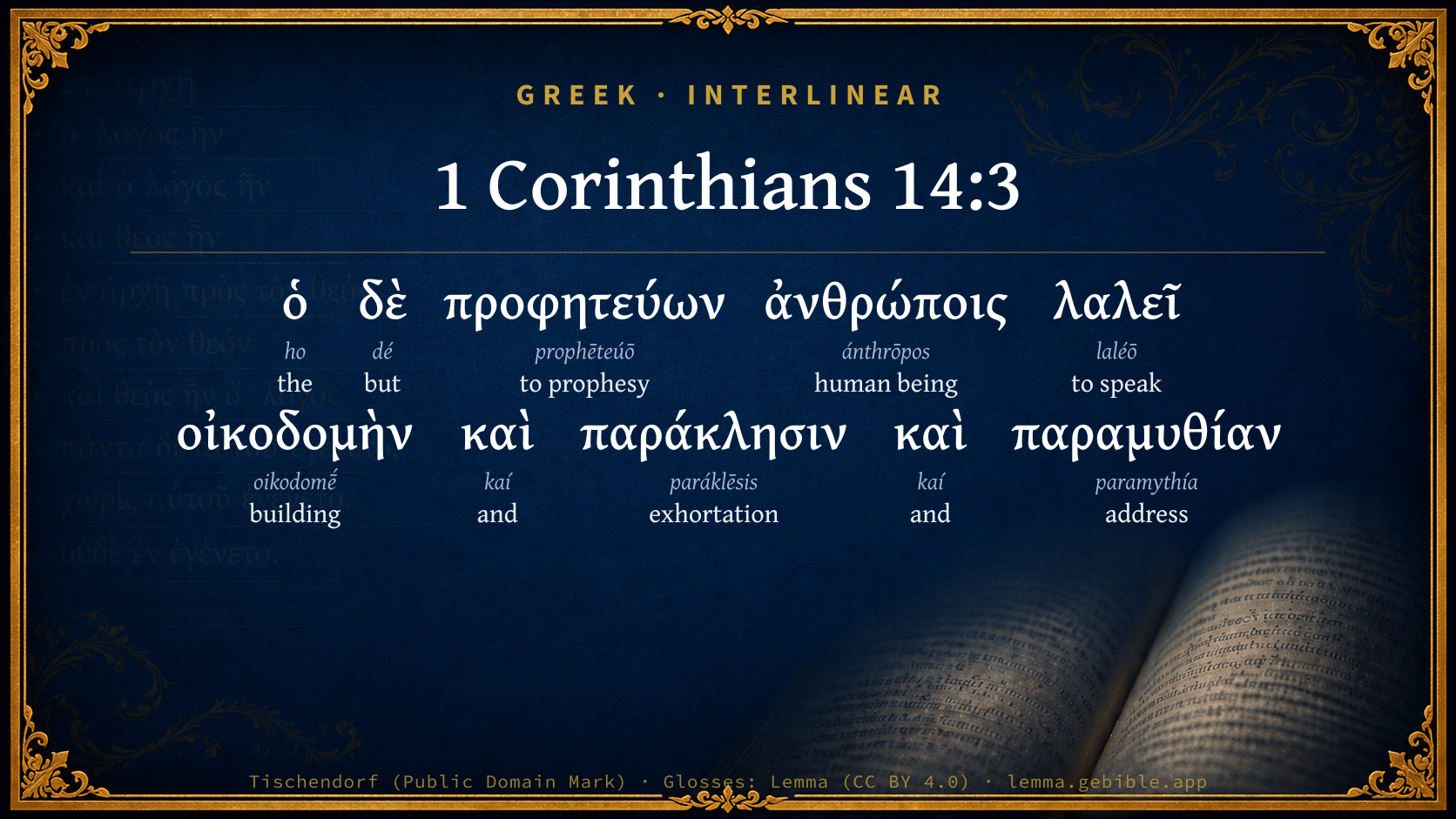
Greek (Tischendorf 8th ed.) 1 Corinthians 14:3 appears in the Greek New Testament. The text above is from the Tischendorf 8th edition. Each word links to its Strong’s number and a concise gloss. Click any word for its full Thayer’s Greek Lexicon entry.
Download image
Cite this verse

1 Corinthians 14:3 (World English Bible). Public Domain. Lemma interlinear Bible study tool, https://lemma.gebible.app/v/1-corinthians/14/3.

Show BibTeX & RIS
BibTeX
RIS
English Translation
But he who prophesies speaks to men for their edification, exhortation, and consolation.
World English Bible · Public Domain
Highlights
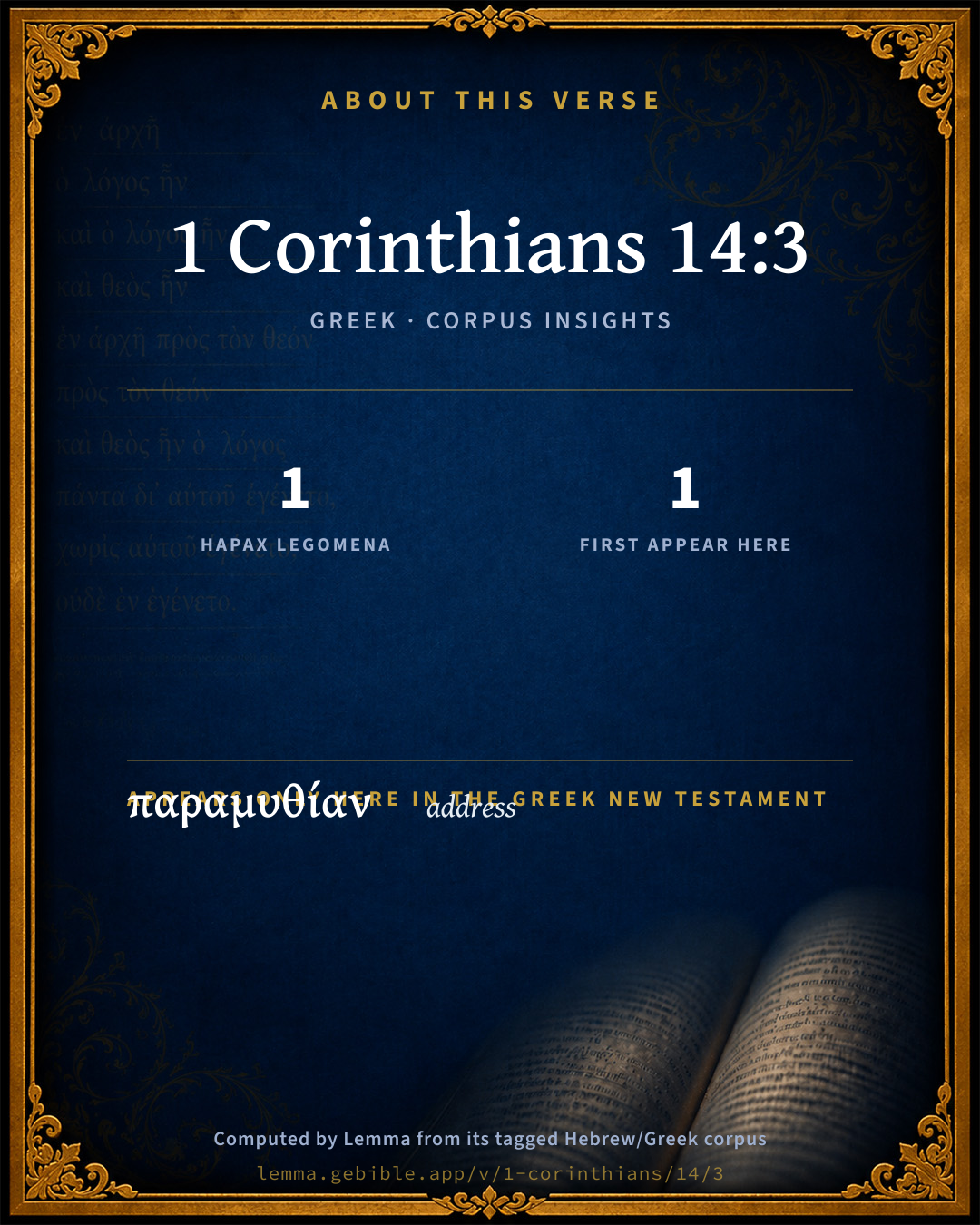
  • 1 hapax legomenon — only here in the Greek New Testament
  • 1 first appearance in the Greek New Testament
Full analysis ↓
Download a study sheet

One document with this verse’s original text, its word-by-word gloss line, the meaning frame, cross-references with their text, attributed commentary, and full source and license credits — printable, and it pastes into notes with its structure intact.

This verse Autodidact and up

Study sheet (.html) Plain text (.txt)

A passage Seminary Student

Up to 50 verses in one chapter. A passage sheet keeps up to 6 commentary sources and 12 cross-references per verse, in the order this page ranks them, and says so on the sheet whenever that leaves anything out. Ask for a single verse and you get the Autodidact verse sheet above.

Everything on this page stays free to read, with no account — the sheet is a download of what is already on screen, not access to it.

Want to remove ads? Support Godless Engineer
Compare translations 3

The same verse in 3 English versions, stacked beneath the original-language interlinear above. Click any original word for its lexicon entry.

Each is an independent rendering of the whole verse — the interlinear is not word-aligned to these translations.

Highlighted words mark where these versions differ — a whole-verse word diff, not a word-by-word alignment.

  • World English Bible Public Domain
    But he who prophesies speaks to men for their edification, exhortation, and consolation.
  • King James Version Public Domain
    But he that prophesieth speaketh unto men to edification, and exhortation, and comfort.
  • unfoldingWord Literal Text CC BY-SA 4.0
    But the one prophesying speaks to men for building up and encouragement and consolation.

unfoldingWord Literal Text — © unfoldingWord, licensed CC BY-SA 4.0. Word-aligned USFM3 via Door43 (git.door43.org/unfoldingWord/en_ult).

Versions to compare (up to 4)

3 of 4 selected

Show all 19 translations

Every available English version of this verse, each an independent rendering of the whole verse.

  • World English Bible Public Domain
    But he who prophesies speaks to men for their edification, exhortation, and consolation.
  • Berean Standard Bible Public Domain
    But he who prophesies speaks to men for their edification, encouragement, and comfort.
  • Majority Standard Bible Public Domain
    But he who prophesies speaks to men for their edification, encouragement, and comfort.
  • King James Version Public Domain
    But he that prophesieth speaketh unto men to edification, and exhortation, and comfort.
  • American Standard Version (1901) Public Domain
    But he that prophesieth speaketh unto men edification, and exhortation, and consolation.
  • Revised Version (1885) Public Domain
    But he that prophesieth speaketh unto men edification, and comfort, and consolation.
  • Geneva Bible (1599) Public Domain
    But he that prophecieth, speaketh vnto me to edifying, and to exhortation, and to comfort.
  • Douay-Rheims (1899) Public Domain
    But he that prophesieth, speaketh to men unto edification, and exhortation, and comfort.
  • Young's Literal Translation Public Domain
    and he who is prophesying to men doth speak edification, and exhortation, and comfort;
  • Literal Standard Version CC BY-SA 4.0
    and he who is prophesying to men speaks edification, and exhortation, and comfort;
  • Unlocked Literal Bible CC BY-SA 4.0
    But the one who prophesies speaks to people to build them up, to encourage them, and to comfort them.
  • unfoldingWord Literal Text CC BY-SA 4.0
    But the one prophesying speaks to men for building up and encouragement and consolation.
  • Darby Bible Public Domain
    But he that prophesies speaks to men [in] edification, and encouragement, and consolation.
  • World Messianic Bible Public Domain
    But he who prophesies speaks to men for their edification, exhortation, and consolation.
  • Webster's Bible Public Domain
    But he that prophesieth, speaketh to men to edification, and exhortation, and comfort.
  • Free Bible Version CC BY-SA 4.0
    However, the words of those who speak for God build people up—they provide encouragement and comfort.
  • Bible in Basic English Public Domain
    But the word of the prophet gives men knowledge and comfort and strength.
  • Text-Critical English NT CC BY 4.0
    But he who prophesies speaks edification, encouragement, and comfort to others.
  • Tyndale New Testament (1534) Public Domain
    But he that prophesieth speaketh vnto men to edifyinge to exhortacion and to comforte.

Literal Standard Version (2020), Covenant Press — licensed CC BY-SA 4.0. Text via the HelloAO Bible API (eBible.org). Unlocked Literal Bible (unfoldingWord) — licensed CC BY-SA 4.0. Text via the HelloAO Bible API (eBible.org). unfoldingWord Literal Text — © unfoldingWord, licensed CC BY-SA 4.0. Word-aligned USFM3 via Door43 (git.door43.org/unfoldingWord/en_ult). Free Bible Version, Dr. Jonathan Gallagher — licensed CC BY-SA 4.0. Text via the HelloAO Bible API (eBible.org).

Word by word

More ways to search: Search by grammar → Find every occurrence → Compare this word →

Practice this passage: Drill this verse → Learn its vocabulary →

About this verse

These counts appear in no published source. They are computed here, from the morphology-tagged text and Lemma’s own curated glosses. What Lemma adds →

10
words
9
distinct lemmas
Pauline Epistles
section

Notable vocabulary

1 hapax legomenon — a word that appears only here in the entire Greek New Testament:

  • παραμυθίαν address G3889

First appearance in Scripture

This word makes its first canonical appearance in the Greek New Testament here:

  • παραμυθίαν address G3889

Shared distinctive vocabulary

οἰκοδομὴν building G3619 occurs in 18 verses of the Greek New Testament. Also found in:

Repetition

A word recurs within this verse:

Cross-references

41

Topical passages linked to 1 Corinthians 14:3 in the Treasury of Scripture Knowledge — connected by theme and wording, ordered by reader-vote popularity; previews shown in the World English Bible.

  • 1 Corinthians 14:12 So also you, since you are zealous for spiritual gifts, seek that you may abound to the building up of the assembly.
  • 1 Timothy 4:13 Until I come, pay attention to reading, to exhortation, and to teaching.
  • Jude 1:20 But you, beloved, keep building up yourselves on your most holy faith, praying in the Holy Spirit.
  • 2 Timothy 4:2 preach the word; be urgent in season and out of season; reprove, rebuke, and exhort, with all patience and teaching.
  • Ephesians 6:22 whom I have sent to you for this very purpose, that you may know our state, and that he may comfort your hearts.
  • Romans 14:19 So then, let us follow after things which make for peace, and things by which we may build one another up.
  • 1 Corinthians 14:26 What is it then, brothers? When you come together, each one of you has a psalm, has a teaching, has a revelation, has another language, has an interpretation. Let all things be done to build each other up.
  • Titus 1:9 holding to the faithful word which is according to the teaching, that he may be able to exhort in the sound doctrine, and to convict those who contradict him.
  • 1 Corinthians 14:31 For you all can prophesy one by one, that all may learn, and all may be exhorted.
  • 1 Thessalonians 5:11–14 Therefore exhort one another, and build each other up, even as you also do.
  • 1 Corinthians 14:4–5 He who speaks in another language edifies himself, but he who prophesies edifies the assembly.
  • Titus 2:6 Likewise, exhort the younger men to be sober-minded;
  • 1 Corinthians 10:23 "All things are lawful for me," but not all things are profitable. "All things are lawful for me," but not all things build up.
  • 1 Thessalonians 2:3 For our exhortation is not of error, nor of uncleanness, nor in deception.
  • Titus 2:9 Exhort servants to be in subjection to their own masters, and to be well-pleasing in all things; not contradicting;
  • Luke 3:18 Then with many other exhortations he preached good news to the people,
  • Acts 9:31 So the assemblies throughout all Judea and Galilee and Samaria had peace, and were built up. They were multiplied, walking in the fear of the Lord and in the comfort of the Holy Spirit.
  • Acts 13:15 After the reading of the law and the prophets, the rulers of the synagogue sent to them, saying, "Brothers, if you have any word of exhortation for the people, speak."
  • Acts 14:22 confirming the souls of the disciples, exhorting them to continue in the faith, and that through many afflictions we must enter into the Kingdom of God.
  • Acts 15:32 Judas and Silas, also being prophets themselves, encouraged the brothers with many words, and strengthened them.
  • Romans 12:8 or he who exhorts, to his exhorting: he who gives, let him do it with liberality; he who rules, with diligence; he who shows mercy, with cheerfulness.
  • Romans 15:2 Let each one of us please his neighbor for that which is good, to be building him up.
  • 1 Corinthians 8:1 Now concerning things sacrificed to idols: We know that we all have knowledge. Knowledge puffs up, but love builds up.
  • 1 Corinthians 14:17 For you most assuredly give thanks well, but the other person is not built up.
  • 2 Corinthians 1:4 who comforts us in all our affliction, that we may be able to comfort those who are in any affliction, through the comfort with which we ourselves are comforted by God.
  • 2 Corinthians 2:7 so that on the contrary you should rather forgive him and comfort him, lest by any means such a one should be swallowed up with his excessive sorrow.
  • Ephesians 4:12–16 for the perfecting of the saints, to the work of serving, to the building up of the body of Christ;
  • Ephesians 4:29 Let no corrupt speech proceed out of your mouth, but such as is good for building up as the need may be, that it may give grace to those who hear.
  • Colossians 4:8 I am sending him to you for this very purpose, that he may know your circumstances and comfort your hearts,
  • 1 Thessalonians 2:11 As you know how we exhorted, comforted, and implored every one of you, as a father does his own children,
  • 1 Thessalonians 3:2 and sent Timothy, our brother and God's servant in the Gospel of Christ, to establish you, and to comfort you concerning your faith;
  • 1 Thessalonians 4:1 Finally then, brothers, we beg and exhort you in the Lord Jesus, that as you received from us how you ought to walk and to please God, that you abound more and more.
  • 1 Thessalonians 4:18 Therefore comfort one another with these words.
  • 2 Thessalonians 3:12 Now those who are that way, we command and exhort in the Lord Jesus Christ, that with quietness they work, and eat their own bread.
  • 1 Timothy 1:4 neither to pay attention to myths and endless genealogies, which cause disputes, rather than God's stewardship, which is in faith--
  • 1 Timothy 6:2 Those who have believing masters, let them not despise them, because they are brothers, but rather let them serve them, because those who partake of the benefit are believing and beloved. Teach and exhort these things.
  • Titus 2:15 Say these things and exhort and reprove with all authority. Let no man despise you.
  • Hebrews 10:25 not forsaking our own assembling together, as the custom of some is, but exhorting one another; and so much the more, as you see the Day approaching.
  • Hebrews 13:22 But I exhort you, brothers, endure the word of exhortation, for I have written to you in few words.
  • 1 Peter 5:12 Through Silvanus, our faithful brother, as I consider him, I have written to you briefly, exhorting, and testifying that this is the true grace of God in which you stand.
  • Hebrews 3:13 but exhort one another day by day, so long as it is called "today;" lest any one of you be hardened by the deceitfulness of sin.

Cross-references courtesy of OpenBible.info (CC BY 4.0).

Commentary

Notes on 1 Corinthians 14:3 from classic Christian and Jewish commentators (each source and its license shown beneath its notes). The classic Christian expositions comment on the surrounding passage and are grouped to its opening verse, so a note may address several verses; the Jewish commentaries on the Tanakh (Rashi and others) are per-verse, so they appear only where the commentator wrote on this verse.

Lemma curates 59 commentaries, every one of them public domain or Creative Commons licensed, each selected and text-cleaned for this edition rather than reprinted as found. About our sources →

Bengel's Gnomon

Johann Albrecht Bengel

1Co 14:3. Οἰκοδομὴν, edification) Two principal species are added to this genus; παράκλησις, exhortation, takes away sluggishness; παραμυθία, consolation takes away sadness.

Bengel's Gnomon of the New Testament — English translation (T&T Clark, Edinburgh, 1860) — public domain. Text from a community e-Sword module.

Hodge's Commentary on Romans, Ephesians & First Corinthians

Charles Hodge

1Co_14:3

But he that prophesieth speaketh unto men (to) edification, and exhortation, and comfort.

The prophet spoke in the native language of his hearers; the speaker with tongues in a foreign language. This made the difference between the cases. The one was understood and the other was not. The prophet spoke with a view to edification. This is a general term including the sense of the two following. He edified the church either by exhortation or comfort; either by arousing believers to do or suffer, or by pouring into their hearts the consolsations of the Spirit.

Charles Hodge — Commentary on Romans (1835), First Corinthians (1857), and Ephesians (1856) — public domain. Text from a community e-Sword module.

Geneva Bible (1599)

Geneva Bible translators

Which may further men in the study of godliness.

Geneva Bible (1599) marginal notes — public domain. Text via Bolls.life.

Jamieson, Fausset & Brown

Robert Jamieson, A. R. Fausset & David Brown

But--on the other hand.

edification--of which the two principal species given are "exhortation" to remove sluggishness, "comfort" or consolation to remove sadness [BENGEL]. Omit "to."

Jamieson, Fausset & Brown — Commentary Critical and Explanatory on the Whole Bible (1871) — public domain (CC PDM 1.0). Text via the HelloAO Bible API.

Adam Clarke's Commentary

Verse 3. But he that prophesieth] The person who has the gift of teaching is much more useful to the Church than he is who has only the gift of tongues, because he speaks to the profit of men: viz. to their edification, by the Scriptures he expounds; to their exhortation, by what he teaches; and to their comfort, by his revelation.-Whitby. I must here refer to my sermon on this text, intitled, "The Christian Prophet and his Work," in which I have endeavoured to consider the whole of this subject at large.

Adam Clarke's Commentary on the Bible (1810–1826) — public domain. Text from a community e-Sword/MySword module.

John Calvin's Commentaries

3. He that prophesieth, speaketh unto men “Prophecy,” says he, “is profitable to all, while a foreign language is a treasure hid in the earth. What great folly, then, it is to spend all one’s time in what is useless, and, on the other hand, to neglect what appears to be most useful!” To speak to edification, is to speak what contains doctrine fitted to edify. For I understand this term to mean doctrine, by which we are trained to piety, to faith, to the worship and fear of God, and the duties of holiness and righteousness. As, however, we have for the most part need of goads, while others are pressed down by afflictions, or labor under weakness, he adds to doctrine, exhortation and consolation It appears from this passage, and from what goes before, that prophecy does not mean the gift of foretelling future events: but as I have said this once before, I do not repeat it.

John Calvin's Commentaries (1540-1563) — public domain. Text from the Calvin Translation Society English edition (1840s-50s) via the Christian Classics Ethereal Library (ccel.org). Calvin's coverage is partial (roughly two-thirds of the Bible); uncommented books and verses are honest gaps, never fabricated. The 19th-century editor's footnotes and remarks are omitted so the notes are faithfully Calvin's own voice.

Ellicott's Commentary for English Readers

(3) Edification, and exhortation, and comfort.—They communed with God by the speaking with tongues; they communed with the brethren by prophecy—building up, stirring up, cheering up, as each required.

A Bible Commentary for English Readers, edited by Charles John Ellicott (1878–1897) — public domain. Text from a community e-Sword module.

John Gill's Exposition

But he that prophesieth,.... Preaches, prays, or sings, in a language understood by the common people:

speaketh unto men to edification; to the building of them up in Christ, and on their most holy faith, so that they grow up as an holy temple to the Lord: and exhortation; to the more vigorous exercise of grace, and the more cheerful and fervent discharge of duty:

and comfort; of distressed minds, either through the temptations of Satan, or divine desertions, or inward corruptions, or outward afflictions; for all which ends and purposes the Scriptures are written, and gifts are bestowed on men to explain them; and which ends are answered when God gives a blessing to the word; but can never be expected, if delivered in a language not understood. This bears hard upon the Papists performing any part of divine worship in a language unintelligible to the common people.

John Gill's Exposition of the Whole Bible (1746–1763) — public domain (CC PDM 1.0). Text via the HelloAO Bible API.

Trapp's Complete Commentary

John Trapp

3 But he that prophesieth speaketh unto men to edification, and exhortation, and comfort.

Ver. 3. To edification, to exhortation] These three ends every preacher ought to propound to himself: 1. Edification in knowledge and holiness. 2. Exhortation, that is, reprehension and admonition. 3. Consolation, lest that which is lame be turned out of the way, Heb 12:13.

John Trapp, A Commentary or Exposition upon All the Books of the Old and New Testament (1647–1656) — public domain. Text from a community e-Sword module.

Albert Barnes' Notes on the Bible

But he that prophesieth - See the note at 1Co 14:1. He that speaks under the influence of inspiration in the common language of his hearers. This seems to be the difference between those who spoke in foreign languages and those who prophesied. Both were under the influence of the Holy Spirit; both might speak the same truths; both might occupy an equally important and necessary place in the church; but the language of the one was intelligible to the church, the other not; the one was designed to edify the church, the other to address those who spoke foreign tongues, or to give demonstration, by the power of speaking foreign languages, that the religion was from God.

Speaketh unto men - So as to be understood by those who were present.

To edification - See the note at 1Co 10:8, note at 1Co 10:23. Speaks so as to enlighten and strengthen the church.

And exhortation - See the note at Rom 12:8. He applies and enforces the practical duties of religion, and urges motives for a holy life.

And comfort - Encouragement. That is, he presents the promises and the “hopes” of the gospel; the various considerations adapted to administer comfort in the time of trial. The other might do this, but it would be in a foreign language, and would be useless to the church.

Albert Barnes' Notes on the Bible (1834–1885) — public domain. Text from a community e-Sword/MySword module.

Matthew Poole's English Annotations

Speaketh unto men; that is, to the understanding of men, and for the good and profit of men.

To edification; for their increase in knowledge and all habits of grace.

And exhortation; to quicken them in the exercise and practice of such duties as God hath, in his word, required of, them.

And comfort; and for the relief of them under their burdens, to support and uphold their troubled or wounded spirits. These expressions make it probable, that the apostle, by prophecy in this text, understands ministerial preaching; which more properly tends to edification, exhortation, and comfort, than the foretelling of things to come.

Matthew Poole's English Annotations on the Holy Bible (1683–1685) — public domain. Text from a community e-Sword/MySword module.

Whedon's Commentary on the Bible

Daniel D. Whedon

3. Prophesieth—As the Spirit selects for its instruments the persons most qualified by nature for its special work, so the individual naturally susceptible to presentiment would be gifted with the prophetic charism.

Daniel D. Whedon (gen. ed.), Commentary on the Old and New Testaments (1874–1909) — public domain. Text from a community e-Sword module.

The Pulpit Commentary

To edification, and exhortation, and comfort. The "to" should be omitted. His words build up the Christian soul, by rousing its efforts and consoling its sorrows. The "Son of prophecy" (Barnabas) is, as Stanley points out, also "a Son of consolation". (Act_4:36) "Support" (paraklesis) involves "comfort," i.e. strength and calm.

HOMILIES BY J.R. THOMSON Ver. 3.

The purposes of prophesying.

There was a marked difference of judgment between St. Paul and his Corinthian converts with regard to the relative value of speaking with tongues and of prophesying. The Corinthians were disposed to set too high a value upon the more brilliant and startling girt; its novelty and singularity seem to have so impressed them with admiration that, in comparison with it, gifts which appealed to sober reason sank into insignificance. Paul, however, who himself spake with tongues, maintains the superiority of the rational and moral endowment over that which surprised the sense and dazzled the imagination. He does this most successfully by exhibiting in this verse the purposes of prophesying.

I EDIFICATION. A prophet is one who speaks from God and for God, to his fellow men. The prophets of the old covenant came before their fellow countrymen with messages which they prefaced by the declaration, "Thus saith the Lord." In the new dispensation, there seems to have been at first an order of prophets, but in addition to these there were many who upon occasion uttered forth the mind of God. Now, since human nature is dependent upon truth, upon spiritual motive, upon personal influence, for the realization of the designs of the Creator, it is dear that a true prophet is one who apprehends those designs, and seeks their accomplishment by means ordered by Divine wisdom. Character and moral life require building up, i.e. upon a divinely laid foundation, by the use of divinely provided material, so that the edifice may assume form, proportions, beauty, in consonance with the idea of the great Architect. Hence the importance given in the New Testament to that element in prophecy denominated edification. No individual can become full grown, no society can be at once progressive and secure, where this department of ministry is lacking.

II EXHORTATION. It must never be forgotten that the communication of knowledge is not the whole of ministry; that religion is not altogether a matter of the intellect; that human life is not simply one long lesson. Man is so framed that he is bound to action, and that he needs inducements, directions, encouragement, with a view to such action as shall be acceptable to his Maker and Saviour. Especially do the young, and converts whose principles are not fully formed, whose habits are not yet established, need frequent admonition. St. Paul reminds us that this also is part of the prophetic office and ministry.

III CONSOLATION. If the necessity of exhortation follows upon the characteristics of human nature, the necessity of consolation arises from the circumstances of human life. Stronger than human philosophy, and tenderer, the consolations of Christian prophecy are able to bind up all wounds, and to cheer all sad and downcast hearts. T. HOMILIES BY R. TUCK Ver. 3.

Christian prophesying.

In our day a "prophet" is one who predicts future events, but in the older times the word included much more than that. Old Testament prophets were religious teachers who revealed the will of God, and expounded the Word of God. Moses was a prophet, but his chief work was religious teaching. John the Baptist was a prophet, but he appeared as a preacher of repentance and of righteousness. New Testament prophets were the teachers or preachers of the Word men to whom God had given special insight into his Divine truth, and a happy faculty of imparting that truth to others. The verse now before us describes the proper results that are to be reached by the prophecy, or ministry, of the Word. The gift of prophesying, or preaching, is the most useful and most practical of all the gifts. Other gifts direct attention to the man who possesses them; this gift makes a man a blessing to others, for he may speak to "edification, and exhortation, and comfort.

I THE PROPER SPHERE OF THE CHRISTIAN PROPHET. Theoretically our pastors are separated unto the ministry of the Word; practically the office is very sadly confused, and our pastors are brought into the most hindering and injurious contact with common worldly things and inferior Church duties. The Pauline idea is, that God has bestowed a variety of gifts upon his Church, and the true conception of his Church is only realized when each man uses faithfully his own gift without interfering with the gifts of others. The work of the Christian pastor is precisely this by teaching and preaching to cultivate the spiritual life of believers.They should nourish so high and so vigorous a life and activity in the members of the Church as that each one might become, in his place, a light of God, a power for God; each one, in his own way, a holy force bringing in other souls to Christ. It does not matter what other work a pastor may do well, whether it be visiting or governing or writing, he is not faithful to his call and to his office unless by preaching he can speak to men "unto edification, and exhortation, and comfort." It would be a time of holiest revival for the Church of Christ, if her ministers might say, "For all other forms of work, look you out men from amongst you, full of the Holy Ghost and of faith, but we will give ourselves to the Word of the Lord and to prayer." If ministers could be more truly separated to their own proper work, they would bring, out of the deserts of holy stillness and quiet, the most heart stirring views of truth and the noblest spiritual influences. Moses came forth in power from the lonely wilderness. Elijah burst out as a sudden flash of Divine fire from the privacies and hidings of the desert. Our Lord himself had a scene of lonely stillness and struggle on the threshold of his ministry, and his story tells of nights on the desolate mountain brow, or in the shady garden outside the city. The Christian prophet can only come forth aright into his sphere, if he dwells in the "secret place of the Most High, and abides under the shadow of the Almighty.

II THE PROPER INFLUENCE OF THE CHRISTIAN PROPHET WITHIN HIS SPHERE. His sphere is the Church. He is to be a spiritual power upon its members. That is work enough for any man. To do it aright he must know all the forms and influences of human sorrow; he must understand, and find the antidote for, all the subtleties, devices, and diseases of temptation and of evil; he must win the power to sympathize in every joy that gladdens, and in every sorrow that clouds, the Christian heart. He must be able keenly, critically, to estimate the spirit of the age, "the signs of the times," the tone of social, moral, and religions life, so as to judge aright of the atmosphere in which Christian life has to be lived. He must have a wide acquaintance with the history of Christian thought, and with the books exerting present influence upon the Christian mind. He must be deeply read in the mystery and meaning of God"s great Book, so that, "like a scribe instructed to the kingdom, he may bring forth out of his treasury things new and old." Surely all this is a full life-work for any man. Observe the specific terms by which St. Paul describes the Christian prophet"s influence.

1. Edification a term bearing immediate relation to Christian growth. There is to be growth, under pastoral influence, in knowledge, in character,

2. in the great grace of self denial, in control over the bad passions and inclinations of a corrupt nature, and growth in practical devotedness to all works of charity. Upbuilding on all these sides must be continued, if the plan of the Divine Architect is to be seen gaining completion in the temple of our life.

3. Exhortation a term bearing relation to Christian dangers, failings, and temptations. Warnings, revelations of the evils of sin, searching pictures of the common experience of frail men, calls to neglected duties these are "exhortations," and a faithful ministry must deal largely with them. It must reach the worldly minded, the almost drunken, the man whose hands are stained with dishonest or ungenerous deeds, the injurer of the widow and the fatherless, the selfish, the proud, the unforgiving. He must "warn all the wicked from the error of their way.

4. Comfort a term bearing relation to Christian sorrows. The pastor"s words are to be holy words of quiet, tender memories of past goodnesses, gentle whispers of the stability of the God of Abraham and Isaac and Jacob, which may lift suffering souls up to their rest in the bosom of the heavenly Father, and lull the tired heart into a sweet sleep upon the "everlasting arms." What would Christian life be without its comfortings? It is no little thing that our pastors can bring balm for wounded hearts; leaves for the healing of bruised hearts; whispers of the eternal love for doubting hearts; and upliftings for downcast, tear-filled eyes, so that they may see the great High Priest "touched with the feeling of our infirmities," and "tempted even as we are. R.T.

The Pulpit Commentary (1880–1919), ed. H.D.M. Spence-Jones & Joseph S. Exell — public domain. Text from a community e-Sword module.

Godbey's Commentary on the New Testament

William B. Godbey

3. “He that prophesieth speaketh to men edification, exhortation and comfort.” Never forget this broad and comprehensive inspired definition of prophesying; you see it simply means talking for Jesus, whether to one or a thousand, telling them the way of salvation as revealed in the Bible, exhorting them to flee the wrath to come and make sure of Heaven, and comforting the brokenhearted with God’s precious and infallible promises.

William B. Godbey, Commentary on the New Testament (1896–1900) — public domain. Text from a community e-Sword module.

McGarvey & Pendleton's Commentaries

J. W. McGarvey

But he that prophesieth speaketh unto men edification, and exhortation, and consolation .

J. W. McGarvey (with Philip Y. Pendleton), Commentaries on the New Testament (The Fourfold Gospel, 1914; Acts; and the epistles) — public domain. Text from a community e-Sword/MySword module.

The People's New Testament

B. W. Johnson

3. He that prophesieth. To prophesy means more than to foretell. It is to declare the will of God under a divine impulse. When Peter spoke on Pentecost, he did the work of a New Testament prophet. In this formative period of the church, before the New Testament was written, it was needful that there be these inspired guides in the churches. Unto men edification. Instruction, and strengthening.

B. W. Johnson's The People's New Testament with Notes (1889–1891) — public domain. Electronic text from the Christian Classics Ethereal Library (CCEL) ThML edition.

Cambridge Greek Testament for Schools and Colleges

3. οἰκοδομήν. See note on 1Co 8:1.

παραμυθίαν. There is little distinction between this word and παράκλησις save that the former has more of the idea of comfort, the latter of encouragement. The one gives the idea of a friend beside us speaking soothing words, the other of a comrade cheering us on. Cf. Plat. Phaed. 70 B οὐκ ὀλίγης παραμυθίας δεῖται καὶ πίστεως, where the sense is that the speaker would need much encouragement and faith, to persuade himself of the immortality of the soul. παραμυθέομαι is, however, used in the sense of console in Plato Phaed. 115 D.

Cambridge Greek Testament for Schools and Colleges (Cambridge University Press, 1896; 21 vols, various authors incl. Carr, Maclear, Plummer, Farrar, Lumby, Moule, M. R. James, Simcox) — public domain. Text from a community e-Sword module.

Alford’s Greek Testament

Henry Alford

3.] but (on the other hand) he who prophesies, speaks to men edification (genus) and (species) exhortation and (species) consolation. See the definition of prophecy given on ch. 12:10: and Stanley’s excursus introductory to this chapter.

παραμυθία occurs Plato, Axioch. p. 365,—ἀσθενῆ τὴν ψυχήν, πάνυ ἐνδεᾶ παραμυθίας: and Ælian, V. H. xii. 1, fin., παρεμυθήσατο Ἀρταξέρξην, κ. τὸ τῆς λύπης ἰάσατο πάθος, εἴξαντος τοῦ βας. τῇ κηδεμονίᾳ, κ. τῇ παραμυθίᾳ πεισθέντος συνετῶς.

Henry Alford, The Greek Testament (1849–1861) — public domain. Text from a community e-Sword module.

International Critical Commentary

3. ὁ δὲ προφητεύων. ‘Whereas he who exerciseth the gift of prophesying does speak to men, what is in effect edification and exhortation and consolation.’ With λαλεῖ οἰκοδομήν comp. κρίμα ἐσθίει and τοῦτό μου ἐστὶ τὸ σῶμα (11:24, 29): in each case ‘what is in effect’ is the meaning. The metaphorical sense of οἰκοδομή, ‘building up the spiritual life,’ is peculiar to St Paul in the N.T., in Rom., 1 and 2 Cor., and Eph.: elsewhere (Mat 24:1; Mar 13:1, Mar 13:2) of actual buildings or edifices. Παράκλησις, ‘a calling near,’ is sometimes ‘supplication’ (2Co 8:4), ‘exhortation’ (Php 2:1), ‘consolation’ (2Co 1:4-7) or a combination of the last two, ‘encouragement’ (Heb 6:18, Heb 12:5). ‘Exhortation’ or ‘encouragement’ is right here. ‘Consolation’ or ‘comfort’ must be reserved for παραμυθία, which occurs nowhere else in the N.T.; in the LXX, Wisd. 19:12. But in Php 2:1 we have παραμύθιον coupled with παράκλησις, and in 1Th 2:11 we have παρακαλοῦντες καὶ παραμυθούμενοι. Prophesying was the power of seeing and making known the nature and will of God, a gift of insight into truth and of power in imparting it, and hence a capacity for building up men’s characters, quickening their wills, and encouraging their spirits. The three are co-ordinate: not build up by quickening and encouraging, nor build up and quicken in order to encourage. Compare Barnabas = ‘son of prophecy’ = υἱὸς παρακλήσεως (Act 4:36). Exhortatio tollit tarditatem, adhortatio timiditatem. See W. E. Chadwick, The Pastoral Teaching of St Paul, ch. ix.; Weinel, St Paul, 113 f.

International Critical Commentary — older volumes (1896–1929), various authors — public domain. Text from a community e-Sword module.

Vincent's Word Studies in the New Testament

Marvin R. Vincent

To edification - exhortation - comfort [οικοδομην - παρακλησιν - παραμυθιαν] . Omit to. For edification see on build up, Act 20:32. Exhortation, so American Rev. Rev., comfort. See on Luk 6:24. Paramuqia comfort, Rev., consolation, occurs only here in the New Testament. Paramuqion, which is the same, in Phi 2:1. The two latter words are found together in Phi 2:1, and their kindred verbs in 1Th 2:11. The differences in rendering are not important. The words will bear either of the meanings in the two Revisions. If paraklhsin be rendered as Rev., comfort, paramuqia might be rendered incentive, which implies exhortation. Consolation and comfort border a little too closely on each other.

Marvin R. Vincent, Word Studies in the New Testament (1887–1900) — public domain. Text from a community e-Sword/MySword module.

Lesson kit

Teaching starters — assembled from the data on this page, not authored interpretation. Every prompt links to the verse data it draws on. Edit before teaching.

1 Corinthians, in the Pauline Epistles, opens this verse with 10 words (9 distinct Greek lemmas). Its most distinctive word is paramythía (“address”). A historical commentator’s framing appears above. Read the whole chapter for the surrounding context.

Discussion questions

  1. What does “address” (paramythía) contribute to the verse as a whole?
  2. 1 word here appears nowhere else in the Greek New Testament. Why might the author reach for such rare wording?
  3. This is the first place “address” appears in Scripture (first appears here). What does its debut here establish?
  4. How does Matthew 24:1, which shares the word «building», read alongside this verse?
  5. What does the repetition of “and” (2× in this one verse) do in this verse?
  6. These translations render this verse differently. What is at stake in choosing one wording over another?
  7. Compare how Bengel's Gnomon and Hodge's Commentary on Romans, Ephesians & First Corinthians read this verse. Where do they agree or differ?

Things to notice

  • 1 word in this verse appears nowhere else in the Greek New Testament.
  • 1 word makes its first canonical appearance in Scripture here.
  • These translations choose different wording for 14 words in this verse.
  • “and” occurs 2× in this single verse.
  • 9 distinct Greek lemmas span 10 words in this verse.

Reading settings

Reading text

Shown beneath each verse's original-language words.

Old Testament
Old Testament edition

Read the OT as the Masoretic Hebrew (MT) or the Greek Septuagint (LXX).

English shown for the Greek Septuagint (in the Hebrew ↔ Greek comparison).

Comparing translations? Open the Compare panel on any verse page to stack up to four side by side.