1 Corinthians 15:4

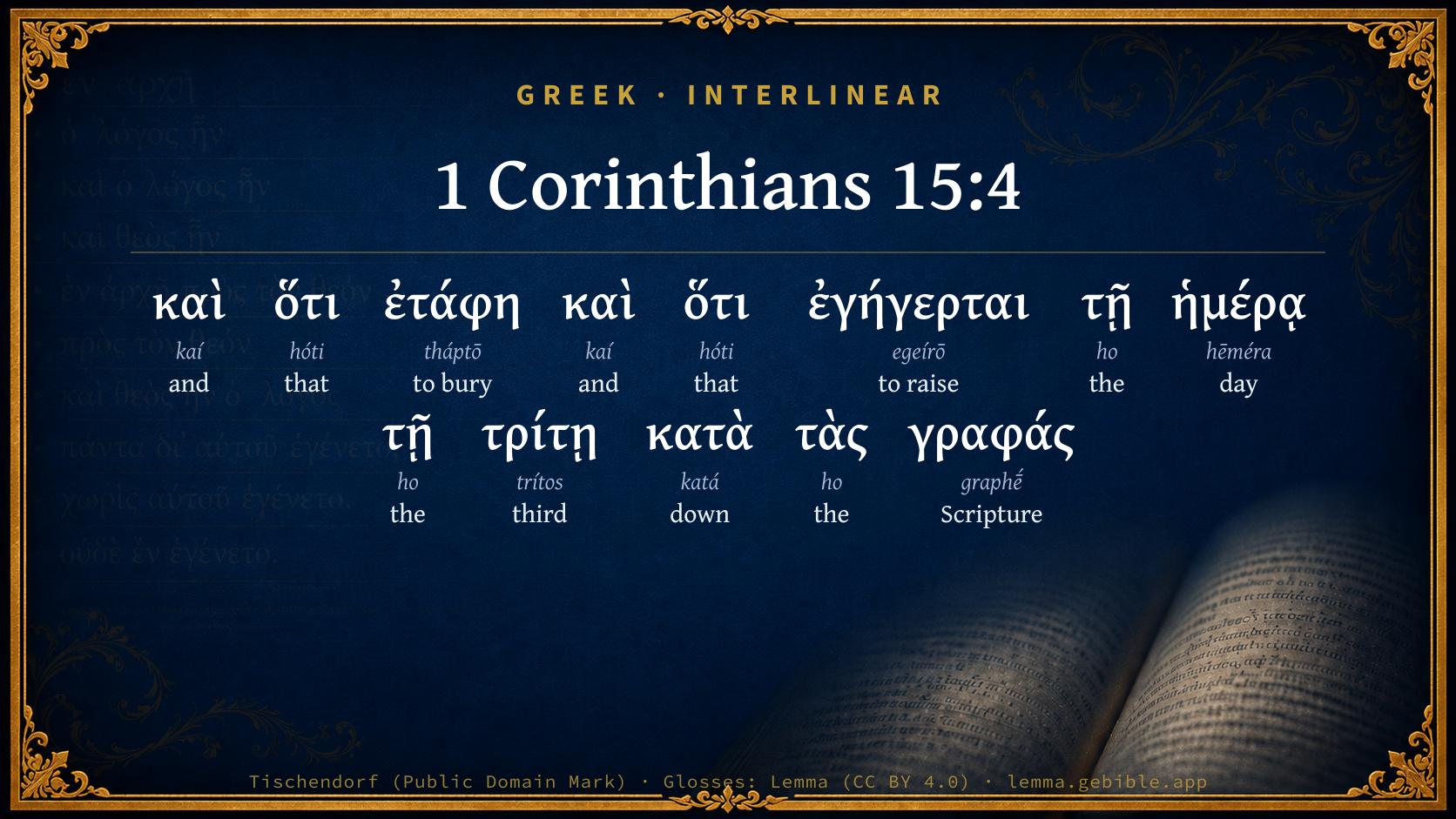
Greek (Tischendorf 8th ed.) 1 Corinthians 15:4 appears in the Greek New Testament. The text above is from the Tischendorf 8th edition. Each word links to its Strong’s number and a concise gloss. Click any word for its full Thayer’s Greek Lexicon entry.
Download image
Cite this verse

1 Corinthians 15:4 (World English Bible). Public Domain. Lemma interlinear Bible study tool, https://lemma.gebible.app/v/1-corinthians/15/4.

Show BibTeX & RIS
BibTeX
RIS
English Translation
that he was buried, that he was raised on the third day according to the Scriptures,
World English Bible · Public Domain
Download a study sheet

One document with this verse’s original text, its word-by-word gloss line, the meaning frame, cross-references with their text, attributed commentary, and full source and license credits — printable, and it pastes into notes with its structure intact.

This verse Autodidact and up

Study sheet (.html) Plain text (.txt)

A passage Seminary Student

Up to 50 verses in one chapter. A passage sheet keeps up to 6 commentary sources and 12 cross-references per verse, in the order this page ranks them, and says so on the sheet whenever that leaves anything out. Ask for a single verse and you get the Autodidact verse sheet above.

Everything on this page stays free to read, with no account — the sheet is a download of what is already on screen, not access to it.

Want to remove ads? Support Godless Engineer
Compare translations 3

The same verse in 3 English versions, stacked beneath the original-language interlinear above. Click any original word for its lexicon entry.

Each is an independent rendering of the whole verse — the interlinear is not word-aligned to these translations.

Highlighted words mark where these versions differ — a whole-verse word diff, not a word-by-word alignment.

  • World English Bible Public Domain
    that he was buried, that he was raised on the third day according to the Scriptures,
  • King James Version Public Domain
    And that he was buried, and that he rose again the third day according to the scriptures:
  • unfoldingWord Literal Text CC BY-SA 4.0
    and that he was buried, and that he was raised on the third day according to the Scriptures,

unfoldingWord Literal Text — © unfoldingWord, licensed CC BY-SA 4.0. Word-aligned USFM3 via Door43 (git.door43.org/unfoldingWord/en_ult).

Versions to compare (up to 4)

3 of 4 selected

Show all 19 translations

Every available English version of this verse, each an independent rendering of the whole verse.

  • World English Bible Public Domain
    that he was buried, that he was raised on the third day according to the Scriptures,
  • Berean Standard Bible Public Domain
    that He was buried, that He was raised on the third day according to the Scriptures,
  • Majority Standard Bible Public Domain
    that He was buried, that He was raised on the third day according to the Scriptures,
  • King James Version Public Domain
    And that he was buried, and that he rose again the third day according to the scriptures:
  • American Standard Version (1901) Public Domain
    and that he was buried; and that he hath been raised on the third day according to the scriptures;
  • Revised Version (1885) Public Domain
    and that he was buried; and that he hath been raised on the third day according to the scriptures;
  • Geneva Bible (1599) Public Domain
    And that he was buried, and that he arose the third day, according to the Scriptures,
  • Douay-Rheims (1899) Public Domain
    And that he was buried, and that he rose again the third day, according to the scriptures:
  • Young's Literal Translation Public Domain
    and that he was buried, and that he hath risen on the third day, according to the Writings,
  • Literal Standard Version CC BY-SA 4.0
    and that He was buried, and that He has risen on the third day according to the Writings,
  • Unlocked Literal Bible CC BY-SA 4.0
    that he was buried, and that he was raised on the third day according to the scriptures.
  • unfoldingWord Literal Text CC BY-SA 4.0
    and that he was buried, and that he was raised on the third day according to the Scriptures,
  • Darby Bible Public Domain
    and that he was buried; and that he was raised the third day, according to the scriptures;
  • World Messianic Bible Public Domain
    that he was buried, that he was raised on the third day according to the Scriptures,
  • Webster's Bible Public Domain
    And that he was buried, and that he rose again the third day according to the scriptures:
  • Free Bible Version CC BY-SA 4.0
    he was buried and was raised from the dead on the third day, again in accordance with Scripture.
  • Bible in Basic English Public Domain
    And he was put in the place of the dead; and on the third day he came back from the dead, as it says in the Writings;
  • Text-Critical English NT CC BY 4.0
    that he was buried, that he was raised on the third day according to the Scriptures,
  • Tyndale New Testament (1534) Public Domain
    and that he was buried and that he arose agayne the thyrd daye accordinge to the scriptures:

Literal Standard Version (2020), Covenant Press — licensed CC BY-SA 4.0. Text via the HelloAO Bible API (eBible.org). Unlocked Literal Bible (unfoldingWord) — licensed CC BY-SA 4.0. Text via the HelloAO Bible API (eBible.org). unfoldingWord Literal Text — © unfoldingWord, licensed CC BY-SA 4.0. Word-aligned USFM3 via Door43 (git.door43.org/unfoldingWord/en_ult). Free Bible Version, Dr. Jonathan Gallagher — licensed CC BY-SA 4.0. Text via the HelloAO Bible API (eBible.org).

Word by word

More ways to search: Search by grammar → Find every occurrence → Compare this word →

Practice this passage: Drill this verse → Learn its vocabulary →

About this verse

These counts appear in no published source. They are computed here, from the morphology-tagged text and Lemma’s own curated glosses. What Lemma adds →

13
words
9
distinct lemmas
Pauline Epistles
section

Notable vocabulary

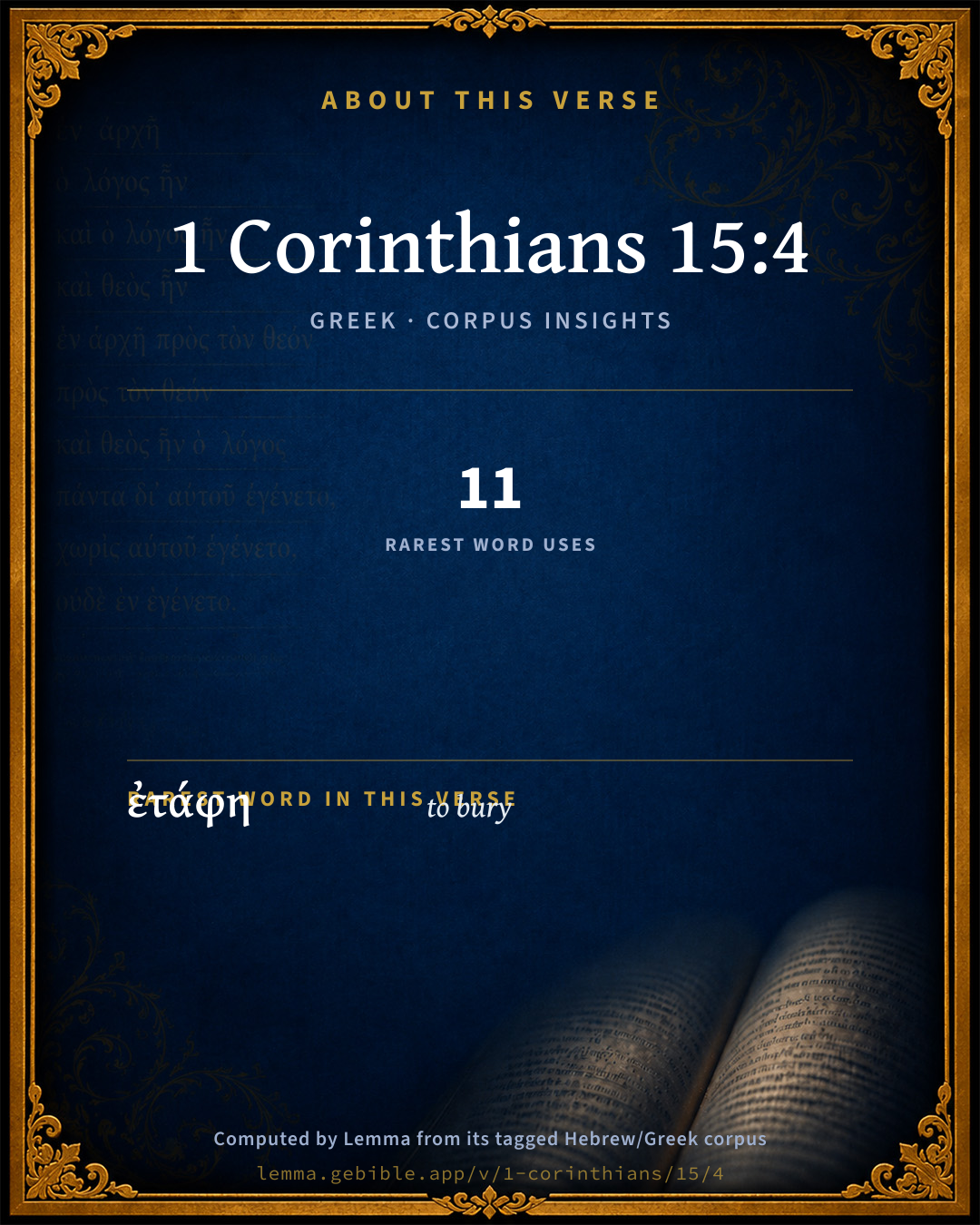
The rarest word here is ἐτάφη to bury G2290 — appearing just 11 times in the whole Greek New Testament.

Shared distinctive vocabulary

ἐτάφη to bury G2290 occurs in 11 verses of the Greek New Testament. Also found in:

Repetition

Words recur within this verse:

Cross-references

33

Topical passages linked to 1 Corinthians 15:4 in the Treasury of Scripture Knowledge — connected by theme and wording, ordered by reader-vote popularity; previews shown in the World English Bible.

  • Hosea 6:2 After two days will he revive us. On the third day he will raise us up, And we will live before him.
  • Matthew 12:40 For as Jonah was three days and three nights in the belly of the whale, so will the Son of Man be three days and three nights in the heart of the earth.
  • Psalms 16:10–11 For you will not leave my soul in Sheol, Neither will you allow your holy one to see corruption.
  • Isaiah 53:9–12 They made his grave with the wicked, and with a rich man in his death; although he had done no violence, neither was any deceit in his mouth.
  • Acts 13:29–37 When they had fulfilled all things that were written about him, they took him down from the tree, and laid him in a tomb.
  • Acts 26:22–23 Having therefore obtained the help that is from God, I stand to this day testifying both to small and great, saying nothing but what the prophets and Moses said would happen,
  • Luke 24:46 He said to them, "Thus it is written, and thus it was necessary for the Christ to suffer and to rise from the dead the third day,
  • Jonah 1:17 Yahweh prepared a great fish to swallow up Jonah, and Jonah was in the belly of the fish three days and three nights.
  • Psalms 2:7 I will tell of the decree. Yahweh said to me, "You are my son. Today I have become your father.
  • 1 Corinthians 15:16–21 For if the dead aren't raised, neither has Christ been raised.
  • Luke 9:22 saying, "The Son of Man must suffer many things, and be rejected by the elders, chief priests, and scribes, and be killed, and the third day be raised up."
  • Luke 24:5–7 Becoming terrified, they bowed their faces down to the earth. They said to them, "Why do you seek the living among the dead?
  • Luke 24:26 Didn't the Christ have to suffer these things and to enter into his glory?"
  • Acts 2:23–33 him, being delivered up by the determined counsel and foreknowledge of God, you have taken by the hand of lawless men, crucified and killed;
  • Romans 6:4 We were buried therefore with him through baptism to death, that just like Christ was raised from the dead through the glory of the Father, so we also might walk in newness of life.
  • Hebrews 13:20 Now may the God of peace, who brought again from the dead the great shepherd of the sheep with the blood of an eternal covenant, our Lord Jesus,
  • Mark 16:2–7 Very early on the first day of the week, they came to the tomb when the sun had risen.
  • Colossians 2:12 having been buried with him in baptism, in which you were also raised with him through faith in the working of God, who raised him from the dead.
  • Matthew 16:21 From that time, Jesus began to show his disciples that he must go to Jerusalem and suffer many things from the elders, chief priests, and scribes, and be killed, and the third day be raised up.
  • Matthew 20:19 and will hand him over to the Gentiles to mock, to scourge, and to crucify; and the third day he will be raised up."
  • Matthew 27:57–60 When evening had come, a rich man from Arimathaea, named Joseph, who himself was also Jesus' disciple came.
  • Matthew 27:63–64 saying, "Sir, we remember what that deceiver said while he was still alive: 'After three days I will rise again.'
  • Matthew 28:1–6 Now after the Sabbath, as it began to dawn on the first day of the week, Mary Magdalene and the other Mary came to see the tomb.
  • Mark 9:31 For he was teaching his disciples, and said to them, "The Son of Man is being handed over to the hands of men, and they will kill him; and when he is killed, on the third day he will rise again."
  • Mark 10:33–34 "Behold, we are going up to Jerusalem. The Son of Man will be delivered to the chief priests and the scribes. They will condemn him to death, and will deliver him to the Gentiles.
  • Luke 18:32–33 For he will be delivered up to the Gentiles, will be mocked, treated shamefully, and spit on.
  • Luke 23:50–53 Behold, a man named Joseph, who was a member of the council, a good and righteous man
  • John 2:19–22 Jesus answered them, "Destroy this temple, and in three days I will raise it up."
  • Acts 1:3 To these he also showed himself alive after he suffered, by many proofs, appearing to them over a period of forty days, and speaking about God's Kingdom.
  • Acts 17:31 because he has appointed a day in which he will judge the world in righteousness by the man whom he has ordained; of which he has given assurance to all men, in that he has raised him from the dead."
  • Mark 15:43–46 Joseph of Arimathaea, a prominent council member who also himself was looking for the Kingdom of God, came. He boldly went in to Pilate, and asked for Jesus' body.
  • John 19:38–20:9 After these things, Joseph of Arimathaea, being a disciple of Jesus, but secretly for fear of the Jews, asked of Pilate that he might take away Jesus' body. Pilate gave him permission. He came therefore and took away his body.
  • 1 Peter 1:11 searching for who or what kind of time the Spirit of Christ, which was in them, pointed to, when he predicted the sufferings of Christ, and the glories that would follow them.

Cross-references courtesy of OpenBible.info (CC BY 4.0).

Commentary

Notes on 1 Corinthians 15:4 from classic Christian and Jewish commentators (each source and its license shown beneath its notes). The classic Christian expositions comment on the surrounding passage and are grouped to its opening verse, so a note may address several verses; the Jewish commentaries on the Tanakh (Rashi and others) are per-verse, so they appear only where the commentator wrote on this verse.

Lemma curates 59 commentaries, every one of them public domain or Creative Commons licensed, each selected and text-cleaned for this edition rather than reprinted as found. About our sources →

MacLaren's Expositions of Holy Scripture

Alexander MacLaren

Matthew - 1 Corinthians

THE POWER OF THE RESURRECTION

ON THE MOUNTAIN

Mat 28:16 - Mat 28:17. - 1Co 15:4.

To infer an historian’s ignorance from his silence is a short and easy, but a rash, method. Matthew has nothing to say of our Lord’s appearances in Jerusalem, except in regard to that of the women in the early morning of Easter Day. But it does not follow that he was ignorant of these appearances. Imperfect knowledge may be the explanation; but the scope and design of his Gospel is much more likely to be so. It is emphatically the Gospel of the King of Israel, and it moves, with the exception of the story of the Passion, wholly within the limits of the Galilean ministry. What more probable than that the same motive which induced Jesus to select the mountain which He had appointed as the scene of this meeting should have induced the Evangelist to pass by all the other manifestations in order to fix upon this one? It was fitting that in Galilee, where He had walked in lowly gentleness, ‘kindly with His kind,’ He should assume His sovereign authority. It was fitting that in ‘Galilee of the Gentiles,’ that outlying and despised province, half heathen in the eyes of the narrow-minded Pharisaic Jerusalem, He should proclaim the widening of His kingdom from Israel to all nations.

If we had Matthew’s words only, we should suppose that none but the eleven were present on this occasion. But it is obviously the same incident to which Paul refers when he speaks of the appearance to ‘five hundred brethren at once.’ These were the Galilean disciples who had been faithful in the days of His lowliness, and were thus now assembled to hear His proclamation of exaltation. Apparently the meeting had been arranged beforehand. They came without Him to ‘the mountain where Jesus had appointed.’ Probably it was the same spot on which the so-called Sermon on the Mount, the first proclamation of the King, had been delivered, and it was naturally chosen to be the scene of a yet more exalted proclamation. A thousand tender memories and associations clustered round the spot. So we have to think of the five hundred gathered in eager expectancy; and we notice how unlike the manner of His coming is to that of the former manifestations. Then, suddenly, He became visibly present where a moment before He had been unseen. But now He gradually approaches, for the doubting and the worshipping took place ‘when they saw Him,’ and before ‘He came to them.’ I suppose we may conceive of Him as coming down the hill and drawing near to them, and then, when He stands above them, and yet close to them-else the five hundred could not have seen Him ‘at once’-doubts vanish; and they listen with silent awe and love. The words are majestic; all is regal. There is no veiled personality now, as there had been to Mary, and to the two on the road to Emmaus. There is no greeting now, as there had been in the upper chamber; no affording of a demonstration of the reality of His appearance, as there had been to Thomas and to the others. He stands amongst them as the King, and the music of His words, deep as the roll of thunder, and sweet as harpers harping with their harps, makes all comment or paraphrase sound thin and poor. But yet so many great and precious lessons are hived in the words that we must reverently ponder them. The material is so abundant that I can but touch it in the slightest possible fashion. This great utterance of our Lord’s falls into three parts: a great claim, a great commission, a great promise.

I. There is a Great Claim.

‘All power is given unto Me in heaven and in earth.’ No words can more absolutely express unconditional, unlimited authority and sovereignty. Mark the variety of the gift-’all power’; every kind of force, every kind of dominion is in His hands. Mark the sphere of sovereignty-’in heaven and in earth.’ Now, brethren, if we know anything about Jesus Christ, we know that He made this claim. There is no reason, except the unwillingness of some people to admit that claim, for casting any sort of doubt upon these words, or making any distinction in authority between them and the rest of the words of graciousness which the whole world has taken to its heart. But if He said this, what becomes of His right to the veneration of mankind, as the Perfect Example of the self-sacrificing, self-oblivious religious life? It is a mystery that I cannot solve, how any man can keep his reverence for Jesus, and refuse to believe that beneath these tremendous words there lies a solemn and solid reality.

Notice, too, that there is implied a definite point of time at which this all-embracing authority was given. You will find in the Revised Version a small alteration in the reading, which makes a great difference in the sense. It reads, ‘All power has been given’; and that points, as I say, to a definite period. When was it given? Let another portion of Scripture answer the question-’Declared to be the Son of God with power, by the resurrection from the dead.’ Then to the Man Jesus was given authority over heaven and earth. All the early Christian documents concur in this view of the connection between the death and resurrection of Jesus Christ, and His investiture with this sovereign power. Hearken to Paul, ‘Became obedient unto death, even the death of the Cross; wherefore God also hath highly exalted Him, and given Him a name that is above every name.’ Hearken to Peter, ‘Who raised Him from the dead and gave Him glory.’ Hearken to the writer of the Epistle to the Hebrews, ‘We see Jesus crowned with glory and honour for the suffering of death.’ Hearken to John, ‘To Him that is the Faithful Witness, and the First-born from the dead, and the Prince of the kings of the earth.’ Look with his eyes to the vision of the ‘Lamb as it had been slain,’ enthroned in the midst of the throne, and say whether this unanimous consent of the earliest Christian teachers is explicable on any reasonable grounds, unless there had been underlying it just the words of our text, and the Master Himself had taught them that all power was given to Him in heaven and in earth. As it seems to me impossible to account for the existence of the Church if we deny the Resurrection, so it seems to me impossible to account for the faith of the earliest stratum of the Christian Church without the acceptance of some such declaration as this, as having come from the Lord Himself. And so the hands that were pierced with the nails wield the sceptre of the Universe, and on the brows that were wounded and bleeding with the crown of thorns are wreathed the many crowns of universal Kinghood.

But we have further to notice that in this investiture, with ‘all power in heaven and on earth,’ we have not merely the attestation of the perfection of His obedience, the completeness of His work, and the power of His sacrifice, but that we have also the elevation of Manhood to enthronement with Divinity. For the new thing that came to Jesus after His resurrection was that His humanity was taken into, and became participant of, ‘the glory which I had with Thee, before the world was.’ Then our nature, when perfect and sinless, is so cognate and kindred with the Divine that humanity is capable of being invested with, and bearing, that ‘exceeding and eternal weight of glory.’ In that elevation of the Man Christ Jesus, we may read a prophecy, that shall not be unfulfilled, of the destiny of all those who conform to Him through faith, love, and obedience, finally to sit down with Him on His throne, even as He is set down with the Father on His throne.

Ah! brethren, Christianity has dark and low views of human nature, and men say they are too low and too dark. It is ‘Nature’s sternest painter,’ and, therefore, ‘its best.’ But if on its palette the blacks are blacker than anywhere else, its range of colour is greater, and its white is more lustrous. No system thinks so condemnatorily of human nature as it is; none thinks so glowingly of human nature as it may become. There are bass notes far down beyond the limits of the scale to which ears dulled by the world and sin and sorrow are sensitive; and there are clear, high tones, thrilling and shrilling far above the range of perception of such ears. The man that is in the lowest depths may rise with Jesus to the highest, but it must be by the same road by which the Master went. ‘If we suffer with Him, we shall also reign with Him,’ and only ‘if.’ There is no other path to the Throne but the Cross. Via crucis, via lucis-the way of the Cross is the way of light. It is to those who have accepted their Gethsemanes and their Calvarys that He appoints a kingdom, as His Father has appointed unto Him.

So much, then, for the first point here in these words; turn now to the second.

II. The Great Commission.

One might have expected that the immediate inference to be drawn from ‘All power is given unto Me in heaven and in earth’ would have been some word of encouragement and strengthening to those who were so soon to be left, and who were beginning to be conscious of their feebleness. But there is nothing more striking in the whole of the incidents of those forty days than the prominence which is given in them to the work of the Church when the Master had left it, and to the imperative obligations devolving upon it. And so here, not encouragement, but obligation is the inference that is drawn from that tremendous claim. ‘Because I have all power, therefore you are charged with the duty of winning the world for its King.’ The all-ruling Christ calls for the universal proclamation of His sovereignty by His disciples. These five hundred little understood the sweep of the commandment, and, as history shows, terribly failed to apprehend the emancipating power of it. But He says to us, as to them, ‘I am not content with the authority given to Me by God, unless I have the authority that each man for himself can give Me, by willing surrender of his heart and will to Me.’ Jesus Christ craves no empty rule, no mere elevation by virtue of Divine supremacy, over men. He regards that elevation as incomplete without the voluntary surrender of men to become His subjects and champions. Without its own consent He does not count that His universal power is established in a human heart. Though that dominion be all-embracing like the ocean, and stretching into all corners of the universe, and dominating over all ages, yet in that ocean there may stand up black and dry rocks, barren as they are dry, and blasted as they are black, because, with the awful power of a human will, men have said, ‘We will not have this Man to reign over us.’ It is willing subjects whom Christ seeks, in order to make the Divine grant of authority a reality.

In that work He needs His servants. The gift of God notwithstanding, the power of His Cross notwithstanding, the perfection and completeness of His great reconciling and redeeming work notwithstanding, all these are vain unless we, His servants, will take them in our hands as our weapons, and go forth on the warfare to which He has summoned us. This is the command laid upon us all, ‘Make disciples of all nations.’ Only so will the reality correspond to the initial and all-embracing grant.

It would take us too far to deal at all adequately, or in anything but the most superficial fashion, with the remaining parts of this great commission. ‘Make disciples of all nations’-that is the first thing. Then comes the second step: ‘Baptizing them into the name of the Father, and of the Son, and of the Holy Ghost.’ Who are to be baptized? Now, notice, if I may venture upon being slightly technical for a moment, that the word ‘nations’ in the preceding clause is a neuter one, and that the word for ‘them’ in this clause is a masculine, which seems to me fairly to imply that the command ‘baptizing them’ does not refer to ‘all nations,’ but to the disciples latent among them, and to be drawn from them. Surely, surely the great claim of absolute and unbounded power has for its consequence something better than the lame and impotent conclusion of appointing an indiscriminate rite, as the means of making disciples! Surely that is not in accordance with the spirituality of the Christian faith!

‘Baptizing them into the Name’-the name is one, that of the Father, and the Son, and the Holy Spirit. Does that mean the name of God, and of a man, and of an influence, all jumbled up together in blasphemous and irrational union? Surely, if Father, Son, and Holy Spirit have one name, the name of Divinity, then it is but a step to say that three Persons are one God! But there is a great deal more here than a baptismal formula, for to be baptized into the Name is but the symbol of being plunged into communion with this one threefold God of our salvation. The ideal state of the Christian disciple is that he shall be as a vase dropped into the Atlantic, encompassed about with God, and filled with Him. We all ‘live, and move, and have our being’ in Him, but some of us have so wrapped ourselves, if I may venture to use such a figure, in waterproof covering, that, though we are floating in an ocean of Divinity, not a drop finds its way in. Cast the covering aside, and you will be saturated with God, and only in the measure in which you live and move and have your being in the Name are you disciples.

There is another step still. Making disciples and bringing into communion with the Godhead is not all that is to flow from, and correspond to, and realise in the individual, the absolute authority of Jesus Christ-’Teaching them to observe all things whatsoever I have commanded you.’ We hear a great deal in these days about the worthlessness of mere dogmatic Christianity. Jesus Christ anticipated all that talk, and guarded it from exaggeration. For what He tells us here that we are to train ourselves and others in, is not creed but conduct; not things to be believed or credenda but things to be done or agenda-’teaching them to observe all things whatsoever I have commanded you.’ A creed that is not wrought out in actions is empty; conduct that is not informed, penetrated, regulated by creed, is unworthy of a man, not to say of a Christian. What we are to know we are to know in order that we may do, and so inherit the benediction, which is never bestowed upon them that know, but upon them that, knowing these things, are blessed in, as well as for, the doing of them.

That training is to be continuous, educating to new views of duty; new applications of old truths, new sensitiveness of conscience, unveiling to us, ever as we climb, new heights to which we aspire. The Christian Church has not yet learnt-thank God it is learning, though by slow degrees-all the moral and practical implications and applications of ‘the truth as it is in Jesus.’ And so these are the three things by which the Church recognises and corresponds to the universal dominion of Christ, the making disciples universally; the bringing them into the communion of the Father, the Son, and the Holy Spirit; and the training of them to conduct ever approximating more and more to the Divine ideal of humanity in the glorified Christ.

And now I must gather just into a sentence or two what is to be said about the last point. There is-

III. The Great Promise.

‘I am with you alway, even unto the end of the world,’ or, as it might be read, ‘with you all the days, even to the accomplishment of the age.’ Note that emphatic ‘I am,’ which does not only denote certainty, but is the speech of Him who is lifted above the lower regions where Time rolls and the succession of events occurs. That ‘I am’ covers all the varieties of was, is, will be. Notice the long vista of variously tinted days which opens here. Howsoever many they be, howsoever different their complexion, days of summer and days of winter, days of sunshine and days of storm, days of buoyant youth and days of stagnant, stereotyped old age, days of apparent failure and days of apparent prosperity, He is with us in them all. They change, He is ‘the same yesterday, and to-day, and for ever.’ Notice the illimitable extent of the promise-’even unto the end.’ We are always tempted to think that long ago the earth was more full of God than it is to-day, and that away forward in the future it will again be fuller, but that this moment is comparatively empty. The heavens touch the earth on the horizon in front and behind, and they are highest and remotest above us just where we stand. But no past day had more of Christ in it than to-day has, and that He has gone away is the condition of His coming. ‘He therefore departed for a season, that we might receive Him for ever.’

But mark that the promise comes after a command, and is contingent, for all its blessedness and power, upon our obedience to the prescribed duty. That duty is primarily to make disciples of all nations, and the discharge of it is so closely connected with the realisation of the promise that a non-missionary Church never has much of Christ’s presence. But obedience to all the King’s commands is required if we stand before Him, and are to enjoy His smile. If you wish to keep Christ very near you, and to feel Him with you, the way to do so is no mere cultivation of religious emotion, or saturating your mind with religious books and thoughts, though these have their place; but on the dusty road of life doing His will and keeping His commandments. ‘If a man love Me he will keep My words, and My Father will love Him. We will come to Him, and make our abode with Him.’

Alexander MacLaren, Expositions of Holy Scripture (1904–1910) — public domain. Text from a community e-Sword module.

Tyndale Open Study Notes

Tyndale Open Resources

15:4 just as the Scriptures said: See Ps 16:10; Hos 6:2; Jon 1:17; Matt 12:40; Acts 2:24-32.

Tyndale Open Study Notes — © Tyndale Open Resources, licensed CC BY-SA 4.0. Text via the HelloAO Bible API.

Bengel's Gnomon

Johann Albrecht Bengel

1Co 15:4. Ἐτάφη, He was buried) Mat 12:40. [Here the burial of Christ is more closely connected with His resurrection, than with His death. Assuredly, about the very moment of His death, the power of His life incapable of dissolution exerted itself, 1Pe 3:18; Mat 27:52. The grave was to Christ the Lord not the destined receptacle of corruption, but an apartment fitted for entering into life, Act 2:26.—V. g.]—ἐγήγερται, was raised again [rose again]) This enlarging on the resurrection of Christ is the more suitable on this account, that the epistle was written about the time of the passover; ch. 1Co 5:7, note. We must urge the weight of the subject of the resurrection, inasmuch as it is one which is made light of in the present day under various pretexts.—κατὰ τὰς γραφὰς, according to the Scriptures) which could not but be fulfilled.

Bengel's Gnomon of the New Testament — English translation (T&T Clark, Edinburgh, 1860) — public domain. Text from a community e-Sword module.

Hodge's Commentary on Romans, Ephesians & First Corinthians

Charles Hodge

1Co_15:4

And that he was buried, and that he rose again the third day according to the Scriptures:

There are two things taught in this, as in the preceding verse. First, the truth of the facts referred to; and secondly, that those facts had been predicted. It is true that Christ was buried, and that he rose again on the third day. These facts were included in the revelation made to Paul, and the truth of which he proceeds to confirm by abundant additional testimony. That these facts were predicted in the Old Testament, is taught in Joh_20:9. Act_26:23. The passage especially urged by the apostles as foretelling the resurrection of Christ, is Psa_16:10. Peter proves that that Psalm cannot be understood of David, because his body was allowed to see corruption. It must, he says, be understood of Christ, who was raised from the dead, and saw no corruption, Act_13:34-37. The prophetic Scriptures, however, are full of this doctrine; for on the one hand they predict the sufferings and death of the Messiah, and on the other his universal and perpetual dominion. It is only on the assumption that he was to rise from the dead that these two classes of prediction can be reconciled.

Charles Hodge — Commentary on Romans (1835), First Corinthians (1857), and Ephesians (1856) — public domain. Text from a community e-Sword module.

Jamieson, Fausset & Brown

Robert Jamieson, A. R. Fausset & David Brown

buried . . . rose again--His burial is more closely connected with His resurrection than His death. At the moment of His death, the power of His inextinguishable life exerted itself (Mat 27:52). The grave was to Him not the destined receptacle of corruption, but an apartment fitted for entering into life (Act 2:26-28) [BENGEL].

rose again--Greek, "hath risen": the state thus begun, and its consequences, still continue.

Jamieson, Fausset & Brown — Commentary Critical and Explanatory on the Whole Bible (1871) — public domain (CC PDM 1.0). Text via the HelloAO Bible API.

Ellicott's Commentary for English Readers

(4) And that he rose again.—Better, and that He has been raised again. The burial of our Lord is dwelt upon and emphasised as the proof of the reality of His death. Similarly in the case of Lazarus, his entombment is brought out strongly as showing that it was from no trance, but from death that he arose. (See John 11)

According to the scriptures.—The reiteration with each statement that it was “according to the scriptures,” i.e., according to the Old Testament scriptures, the Gospel narratives not yet being in existence—shows how strongly the Apostle dwelt on the unity of the facts of Christ’s life and the predictive utterances of the prophets. The death, burial, and resurrection of our Lord were all parts of that providential plan which the deep spiritual insight of God’s servants of old illumined by the Holy Spirit had enabled them to foresee. The resurrection was no subsequent invention to try and explain away or mitigate the terrible shock which Christ’s death had given to his followers. (See Psa_2:7; Psa_16:10; Isa_53:9-10; Isa_55:3; Hos_6:2.)

A Bible Commentary for English Readers, edited by Charles John Ellicott (1878–1897) — public domain. Text from a community e-Sword module.

The Cambridge Bible for Schools and Colleges

gen. ed. J. J. S. Perowne

4. was buried, and that he rose again] Literally, was buried and hath risen again, the aorist referring to the single act, the perfect to Christ’s continued life after his Resurrection.

The Cambridge Bible for Schools and Colleges (gen. ed. J. J. S. Perowne; Cambridge University Press, 1878–1918) — public domain. Text from a community e-Sword module.

John Gill's Exposition

And that he was buried,.... That is, according to the Scriptures; for as he died and rose again according to the Scriptures, he was buried according to them; which speak of his being in hell, in "sheol", in the grave, and of his making his grave with the wicked, and with the rich in his death, Psa 16:10 and which had their accomplishment through Joseph of Arimathea, a rich man, who begged the body of Jesus, wrapped in linen, and laid it in his own new tomb. And besides these Scripture prophecies of his burial, Jonah's being three days and three nights in the whale's belly was a type of it, and according to which our Lord himself foretold it, Mat 12:40. Now since this was prophesied of, and typified, and had its actual accomplishment, it was very proper for the apostle to take notice of it, both to confirm the certainty of Christ's death, and the truth of his resurrection, which his death and burial are mentioned, in order to lead on to, and next follows:

and that he rose again the third day according to the Scriptures: that he should rise again from the dead was very plainly hinted or expressed in several prophecies which speak of the rising of his dead body, of its not being left in the grave so long as to see corruption; and which therefore could not be in it more than three days; and of his lifting up his head after he had drank of the brook by the way; of his ascension to heaven, and session at the right hand of God, which suppose his resurrection, Isa 26:19. And that he should rise again the third day, is not only suggested in Hos 6:2 but was prefigured by the deliverance of Isaac on the third day after Abraham had given him up for dead, from whence he received him, in a figure of Christ's resurrection; and by Jonah's deliverance out of the whale's belly, after he had been in it three days. The Jews take a particular notice of the third day as remarkable for many things they observe (e), as

"of the third day Abraham lift up his eyes, Gen 22:4 of the third day of the tribes, Gen 42:18 of the third day of the spies, Jos 2:16 of the third day of the giving of the law, Exo 19:16 of the third day of Jonah, Jon 1:17 of the third day of them that came out of the captivity, Ezr 8:15 of the third day of the resurrection of the dead, as it is written, Hos 6:2 "after two days will he revive us, in the third day he will raise us up, and we shall live in his sight".''

From which passage, it is clear, that they under stood the prophecy in Hosea of the resurrection of the dead; and it is observable, that among the remarkable third days they take notice of, are the two instances of Isaac's and Jonah's deliverances, which were Scripture types of Christ's resurrection. From which observations they establish this as a maxim (f), that

"God does not leave the righteous in distress more than three days.''

That Christ did rise again from the dead, in pursuance of those prophecies and types, the apostle afterwards proves by an induction of particular instances of persons who were eyewitnesses of it.

(e) Bereshit Rabba, sect. 56. fol. 49. 3. (f) Mattanot Cehunah in ib.

John Gill's Exposition of the Whole Bible (1746–1763) — public domain (CC PDM 1.0). Text via the HelloAO Bible API.

Trapp's Complete Commentary

John Trapp

4 And that he was buried, and that he rose again the third day according to the scriptures:

Ver. 4. According to the Scriptures] Which both foreshowed and foreshadowed it in Adam’s waking, Isaac’s reviving, as it were from the dead, Joseph’s abasement and advancement, Samson’s breaking the bars and bearing away the gates of Gaza, David’s being drawn out of the deep, Daniel’s out of the den, Jeremiah’s out of the dungeon, Jonah’s out of the belly of hell, Mat 12:39, &c.

John Trapp, A Commentary or Exposition upon All the Books of the Old and New Testament (1647–1656) — public domain. Text from a community e-Sword module.

Albert Barnes' Notes on the Bible

And that he was buried - That is, evidently according to the Scriptures; see Isa 53:9.

And that he rose again the third day ... - That is, that he should rise from the dead was foretold in the Scriptures. It is not of necessity implied that it was predicted that he should rise “on the third day,” but that he should rise from the dead. See the argument for this stated in the discourse of Peter, in Act 2:24-32. The particular passage which is there urged in proof of his resurrection is derived from Psa 16:1-11.

Albert Barnes' Notes on the Bible (1834–1885) — public domain. Text from a community e-Sword/MySword module.

Matthew Poole's English Annotations

Not the death only, but the burial of Christ, and his resurrection again from the dead, were (though more darkly) revealed in the Scriptures of the Old Testament. Jonah and Isaac were both of them types of this; David prophesied, that God would not leave his soul in hell, nor suffer his Holy One to see corruption, Psa 16:10; which Peter applieth to Christ, Act 2:31; so Act 13:35. So that the doctrine of the New Testament in these things agreeth with the doctrine of the Old; with this only difference, that the Old Testament contained the New Testament in a mystery, and the New Testament was the Old Testament more fully and plainly revealed.

Matthew Poole's English Annotations on the Holy Bible (1683–1685) — public domain. Text from a community e-Sword/MySword module.

Whedon's Commentary on the Bible

Daniel D. Whedon

4. Buried—Entombed.

According to the Scriptures—Christ’s resurrection was not an isolated event, like a resuscitation from catalepsy or drowning of some apparent corpse. See note on Act_17:31; Act_2:24. It is the crowning fact of a great organic system of facts, binding each other into one common solidity.

Daniel D. Whedon (gen. ed.), Commentary on the Old and New Testaments (1874–1909) — public domain. Text from a community e-Sword module.

The Pulpit Commentary

And that he rose; rather, that he had been raised. The burial was a single act; the Resurrection is permanent and eternal in its issues. According to the Scriptures (Psa_16:10; Isa_53:10; Hos_6:2; Jon_2:10; comp. Mat_12:40 Mat_16:4; Act_2:31 Act_13:34.

Vers. 4, 5. Veritable death and veritable resurrection.

Men in all ages have recognized that the truth of Christianity depends upon the historical verity of our Lord"s resurrection from the dead. Consequently, attacks of various kinds have been made upon the fact. It has always been felt that this was the key of the Christian position. We may summarize the attacks thus:

1. Men denied the reality of our Lord"s death.

2. Then they argued that the only resurrection possible to man is a spiritual regeneration and conversion.

3. By and by men said that the resurrection was no fact, only a myth that grew up, fashioned by the wishes of a credulous band of disciples.

1. And then the scientific people thought to bury the old truth forever out of reach, by declaring that the resurrection of bodily forms which have once decayed is simply impossible; all decaying matter goes to the formation of fresh life, and the bodies of dead men really become, over and over again, constituents of the bodies of living men. But the question which concerns us first of all is not How can these things be? butIs there sufficient evidence and proof? The matter may be beyond present explication, but it is not therefore untrue, nor can we be justified in refusing to accept an adequately sustained historical fact, because the fact is surrounded with scientific and moral difficulties. True science bids us accept without questioning every well-ascertained fact. Now, the verses before us declare two facts:

1. Christ really died;

2. Christ really rose from the dead. We affirm that we have

I ADEQUATE PROOF OF THE REAL DEATH. Illustrate:

1. The nature of the death, from ruptured heart.

2. The testing spear thrust.

3. The distinct attestation of the Roman centurion, and subsidiary testimony of the Roman soldiers, who did not break our Lord"s legs.

4. The actual burial in the tomb.

II ADEQUATE PROOF OF THE REAL RESURRECTION.

1. Scripture antecedent cases show the possibility of resurrection from the dead. Our Lord"s resurrection does not stand alone.

2. The various appearances of our Lord.

3. His special manifestation to St. Paul. R.T.

The Pulpit Commentary (1880–1919), ed. H.D.M. Spence-Jones & Joseph S. Exell — public domain. Text from a community e-Sword module.

John Wesley's Explanatory Notes

According to the scriptures - He proves it first from scripture, then from the testimony of a cloud of witnesses. Psalm xvi, 10.

John Wesley, Explanatory Notes Upon the Whole Bible (1754–1765) — public domain. Text via the GEBible commentary corpus.

McGarvey & Pendleton's Commentaries

J. W. McGarvey

and that he was buried [and this also was according to the Scriptures-- Isa_53:9 ]; and that he hath been raised on the third day according to the scriptures [ Psa_16:10 ; Isa_53:10 ; Hos_6:2 ; Jon_2:10 . Here the apostle reminds the Corinthians that the message which he delivered to them was one which he had received by divine revelation; that it consisted of three pre-eminent facts, namely, the death, burial and resurrection of the Lord; that of these facts the two which were hard to believe, i. e., the first and the last, were made more easy of belief by having been predicted in the Scriptures, the latter with minuteness, even as to the day. The apostle does not waste time proving the death; it was witnessed by thousands, it had never been denied by friend or enemy, and it was not now called in question by the Corinthians. The third item was the one called in question, and, having first proved it by a witness before the fact (the Scriptures), the apostle proceeds to refresh their minds as to how fully it had been proved by witnesses after the fact (viz.: the apostles and others), thus making them again aware that the resurrection was a literal, historical, objective fact. A fact so important and so difficult of belief demanded a host of witnesses, but Paul had them to produce; this thing was not done in a corner-- Act_26:26 ];

J. W. McGarvey (with Philip Y. Pendleton), Commentaries on the New Testament (The Fourfold Gospel, 1914; Acts; and the epistles) — public domain. Text from a community e-Sword/MySword module.

The People's New Testament

B. W. Johnson

4. That he was buried and rose again the third day, according to the scriptures. Paul himself quotes Ps. 16:10 as predicting the resurrection. See Acts 13:35.

B. W. Johnson's The People's New Testament with Notes (1889–1891) — public domain. Electronic text from the Christian Classics Ethereal Library (CCEL) ThML edition.

Cambridge Greek Testament for Schools and Colleges

4. ὅτι ἐτάφη, καὶ ὅτι ἐγήγερται. Literally, was buried and hath risen again, the aorist referring to the single act, the perfect to Christ’s continued life after His Resurrection.

Cambridge Greek Testament for Schools and Colleges (Cambridge University Press, 1896; 21 vols, various authors incl. Carr, Maclear, Plummer, Farrar, Lumby, Moule, M. R. James, Simcox) — public domain. Text from a community e-Sword module.

Alford’s Greek Testament

Henry Alford

4. ἐγήγερται] the perfect marks the continuation of the state thus begun, or of its consequences: so Herod. vii. 8, ἀλλʼ ὁ μὲν τετελεύτηκε, καὶ οὐκ ἐξεγένετό οἱ τιμωρήσασθαι: see Kühner, § 441. 6.

Henry Alford, The Greek Testament (1849–1861) — public domain. Text from a community e-Sword module.

Vincent's Word Studies in the New Testament

Marvin R. Vincent

Rose [εγηγερται] . Rev., correctly, hath been raised. Died and was buried are in the aorist tense. The change to the perfect marks the abiding state which began with the resurrection. He hath been raised and still lives.

Marvin R. Vincent, Word Studies in the New Testament (1887–1900) — public domain. Text from a community e-Sword/MySword module.

Godet's Commentaries

Frédéric Louis Godet

Vv. 4. It is asked why the burial of Jesus occupies a place among these few essential facts. It is certainly not with a view to the spiritual application which is made of it, Rom 6:4; for this belonged to a more advanced stage of teaching. Neither is it to establish the reality of the death, for interment does not exclude the possibility of a lethargy. But the fact of interment ever recalls “that empty tomb on which, as has been said, the Church is founded,” and which remains inexplicable by all who deny the bodily resurrection of Jesus. It is indeed what excludes both the supposition of hallucination on the part of the apostles and that of a purely spiritual reappearance of Jesus after His death. The dead body laid in the sepulchre disappeared. What became of it? No explanation other than the fact itself of the resurrection has ever been able to account for this mystery.

Passing from the facts of the death and burial to the resurrection, Paul discontinues the aorists (died, was buried) for the perfect (ἐγήγερται). For the risen Christ continues in life.

Does the regimen: according to the Scriptures, which is repeated here, apply only to the fact in general or specially to the detail: the third day? In the former case, we must think of Isaiah 53 and Psalms 16; in the latter, we must add to these passages the history of Jonah and Hos 6:2.

This date of the third day was not accidental; for, as Hofmann observes, it is precisely then that dissolution ordinarily begins to appear.

Frédéric Louis Godet — Commentaries on Luke, John, Romans, and 1 Corinthians — English translation (T&T Clark, Edinburgh, 1870s–1890s) — public domain. Text from a community e-Sword module.

Lesson kit

Teaching starters — assembled from the data on this page, not authored interpretation. Every prompt links to the verse data it draws on. Edit before teaching.

1 Corinthians, in the Pauline Epistles, opens this verse with 13 words (9 distinct Greek lemmas). Its most distinctive word is tháptō (“to bury”). A historical commentator’s framing appears above. Read the whole chapter for the surrounding context.

Discussion questions

  1. What does “to bury” (tháptō) contribute to the verse as a whole?
  2. How does Matthew 8:21, which shares the word «to bury», read alongside this verse?
  3. What does the repetition of “the” (3× in this one verse) do in this verse?
  4. These translations render this verse differently; the difference is in the English rendering, not the original. What questions does that raise?
  5. Compare how MacLaren's Expositions of Holy Scripture and Tyndale Open Study Notes read this verse. Where do they agree or differ?

Things to notice

  • These translations choose different wording for 3 words in this verse.
  • “the” occurs 3× in this single verse.
  • 9 distinct Greek lemmas span 13 words in this verse.

Reading settings

Reading text

Shown beneath each verse's original-language words.

Old Testament
Old Testament edition

Read the OT as the Masoretic Hebrew (MT) or the Greek Septuagint (LXX).

English shown for the Greek Septuagint (in the Hebrew ↔ Greek comparison).

Comparing translations? Open the Compare panel on any verse page to stack up to four side by side.