1 Corinthians 9:8

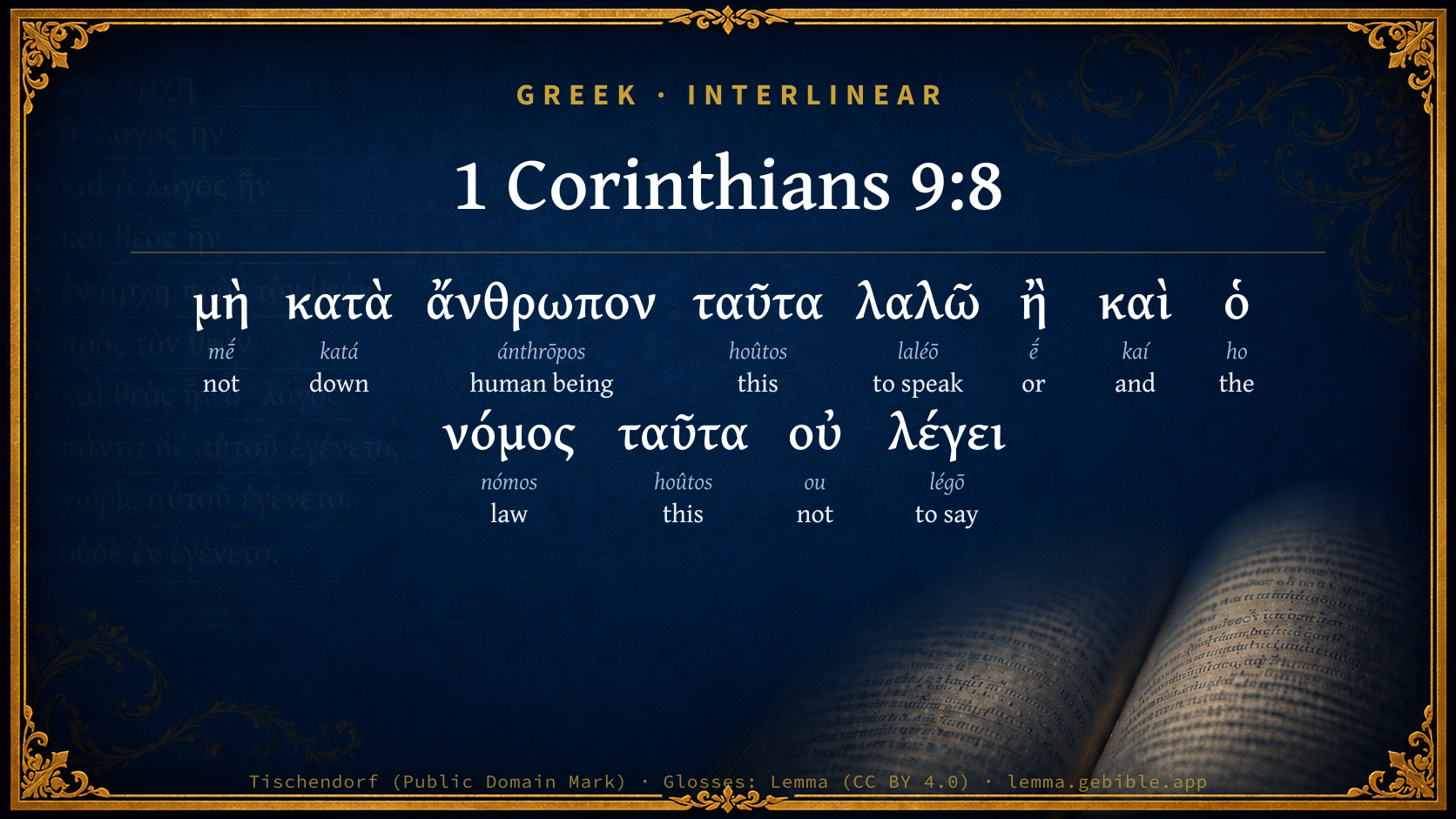
Greek (Tischendorf 8th ed.) 1 Corinthians 9:8 appears in the Greek New Testament. The text above is from the Tischendorf 8th edition. Each word links to its Strong’s number and a concise gloss. Click any word for its full Thayer’s Greek Lexicon entry.
Download image
Cite this verse

1 Corinthians 9:8 (World English Bible). Public Domain. Lemma interlinear Bible study tool, https://lemma.gebible.app/v/1-corinthians/9/8.

Show BibTeX & RIS
BibTeX
RIS
English Translation
Do I speak these things according to the ways of men? Or doesn't the law also say the same thing?
World English Bible · Public Domain
Download a study sheet

One document with this verse’s original text, its word-by-word gloss line, the meaning frame, cross-references with their text, attributed commentary, and full source and license credits — printable, and it pastes into notes with its structure intact.

This verse Autodidact and up

Study sheet (.html) Plain text (.txt)

A passage Seminary Student

Up to 50 verses in one chapter. A passage sheet keeps up to 6 commentary sources and 12 cross-references per verse, in the order this page ranks them, and says so on the sheet whenever that leaves anything out. Ask for a single verse and you get the Autodidact verse sheet above.

Everything on this page stays free to read, with no account — the sheet is a download of what is already on screen, not access to it.

Want to remove ads? Support Godless Engineer
Compare translations 3

The same verse in 3 English versions, stacked beneath the original-language interlinear above. Click any original word for its lexicon entry.

Each is an independent rendering of the whole verse — the interlinear is not word-aligned to these translations.

Highlighted words mark where these versions differ — a whole-verse word diff, not a word-by-word alignment.

  • World English Bible Public Domain
    Do I speak these things according to the ways of men? Or doesn't the law also say the same thing?
  • King James Version Public Domain
    Say I these things as a man? or saith not the law the same also?
  • unfoldingWord Literal Text CC BY-SA 4.0
    Am I not saying these things according to men, or does not the law also say these things?

unfoldingWord Literal Text — © unfoldingWord, licensed CC BY-SA 4.0. Word-aligned USFM3 via Door43 (git.door43.org/unfoldingWord/en_ult).

Versions to compare (up to 4)

3 of 4 selected

Show all 19 translations

Every available English version of this verse, each an independent rendering of the whole verse.

  • World English Bible Public Domain
    Do I speak these things according to the ways of men? Or doesn't the law also say the same thing?
  • Berean Standard Bible Public Domain
    Do I say this from a human perspective? Doesn’t the Law say the same thing?
  • Majority Standard Bible Public Domain
    Do I say this from a human perspective? Doesn’t the Law say the same thing?
  • King James Version Public Domain
    Say I these things as a man? or saith not the law the same also?
  • American Standard Version (1901) Public Domain
    Do I speak these things after the manner of men? or saith not the law also the same?
  • Revised Version (1885) Public Domain
    Do I speak these things after the manner of men? or saith not the law also the same?
  • Geneva Bible (1599) Public Domain
    Say I these thinges according to man? saith not the Lawe the same also?
  • Douay-Rheims (1899) Public Domain
    Speak I these things according to man? Or doth not the law also say these things?
  • Young's Literal Translation Public Domain
    According to man do I speak these things? or doth not also the law say these things?
  • Literal Standard Version CC BY-SA 4.0
    Do I speak these things according to man? Or does the Law not also say these things?
  • Unlocked Literal Bible CC BY-SA 4.0
    Do I say these things based on human authority? Does not the law also say this?
  • unfoldingWord Literal Text CC BY-SA 4.0
    Am I not saying these things according to men, or does not the law also say these things?
  • Darby Bible Public Domain
    Do I speak these things as a man, or does not the law also say these things?
  • World Messianic Bible Public Domain
    Do I speak these things according to the ways of men? Or doesn’t the Torah also say the same thing?
  • Webster's Bible Public Domain
    Do I say these things as a man? or saith not the law the same also?
  • Free Bible Version CC BY-SA 4.0
    Am I just speaking from a human point of view? Doesn't the law say the same thing?
  • Bible in Basic English Public Domain
    Am I talking as a man? does not the law say the same?
  • Text-Critical English NT CC BY 4.0
    Do I say this on human authority? Does not the law also say the same thing?
  • Tyndale New Testament (1534) Public Domain
    Saye I these thinges after the manner of men? Or sayth not the lawe the same also?

Literal Standard Version (2020), Covenant Press — licensed CC BY-SA 4.0. Text via the HelloAO Bible API (eBible.org). Unlocked Literal Bible (unfoldingWord) — licensed CC BY-SA 4.0. Text via the HelloAO Bible API (eBible.org). unfoldingWord Literal Text — © unfoldingWord, licensed CC BY-SA 4.0. Word-aligned USFM3 via Door43 (git.door43.org/unfoldingWord/en_ult). Free Bible Version, Dr. Jonathan Gallagher — licensed CC BY-SA 4.0. Text via the HelloAO Bible API (eBible.org).

Word by word

More ways to search: Search by grammar → Find every occurrence → Compare this word →

Practice this passage: Drill this verse → Learn its vocabulary →

νόμος
nómos
G3551
“law”
Noun, Nominative, Singular, Masculine
Part of Speech
Noun
Case
Nominative
Number
Singular
Gender
Masculine
Full Thayer's Definition

Origin: from a primary nemo (to parcel out, especially food or grazing to animals)

TDNT: 21:02,6

1. anything established, anything received by usage, a custom, a law, a command a. of any law whatsoever 1. a law or rule producing a state approved of God 1a b. by the observance of which is approved of God 1. a precept or injunction 2. the rule of action prescribed by reason c. of the Mosaic law, and referring, acc. to the context. either to the volume of the law or to its contents d. the Christian religion: the law demanding faith, the moral instruction given by Christ, esp. the precept concerning love e. the name of the more important part (the Pentateuch), is put for the entire collection of the sacred books of the OT
  1. μὴ mḗ G3361 “not” Particle, Negative
  2. κατὰ katá G2596 “down” Preposition
  3. ἄνθρωπον ánthrōpos G444 “human being” Noun, Accusative, Singular, Masculine
  4. ταῦτα hoûtos G3778 “this” Demonstrative pronoun, Accusative, Plural, Neuter
  5. λαλῶ laléō G2980 “to speak” Verb, Present, Active, Indicative, 1st person, Singular
  6. ἢ ḗ G2228 “or” Particle
  7. καὶ kaí G2532 “and” Conjunction
  8. ὁ ho G3588 “the” Article, Nominative, Singular, Masculine
  9. ταῦτα hoûtos G3778 “this” Demonstrative pronoun, Accusative, Plural, Neuter
  10. οὐ ou G3756 “not” Particle, Negative
  11. λέγει légō G3004 “to say” Verb, Present, Active, Indicative, 3rd person, Singular

About this verse

These counts appear in no published source. They are computed here, from the morphology-tagged text and Lemma’s own curated glosses. What Lemma adds →

12
words
11
distinct lemmas
Pauline Epistles
section

Repetition

A word recurs within this verse:

  • ταῦτα this G3778 ×2

Cross-references

7

Topical passages linked to 1 Corinthians 9:8 in the Treasury of Scripture Knowledge — connected by theme and wording, ordered by reader-vote popularity; previews shown in the World English Bible.

  • Isaiah 8:20 To the law and to the testimony! if they don't speak according to this word, surely there is no morning for them.
  • Romans 3:31 Do we then nullify the law through faith? May it never be! No, we establish the law.
  • Romans 6:19 I speak in human terms because of the weakness of your flesh, for as you presented your members as servants to uncleanness and to wickedness upon wickedness, even so now present your members as servants to righteousness for sanctification.
  • 1 Corinthians 7:40 But she is happier if she stays as she is, in my judgment, and I think that I also have God's Spirit.
  • 1 Corinthians 14:34 let your wives keep silent in the assemblies, for it has not been permitted for them to speak; but let them be in subjection, as the law also says.
  • 1 Thessalonians 2:13 For this cause we also thank God without ceasing, that, when you received from us the word of the message of God, you accepted it not as the word of men, but, as it is in truth, the word of God, which also works in you who believe.
  • 1 Thessalonians 4:8 Therefore he who rejects doesn't reject man, but God, who has also given his Holy Spirit to you.

Cross-references courtesy of OpenBible.info (CC BY 4.0).

Commentary

Notes on 1 Corinthians 9:8 from classic Christian and Jewish commentators (each source and its license shown beneath its notes). The classic Christian expositions comment on the surrounding passage and are grouped to its opening verse, so a note may address several verses; the Jewish commentaries on the Tanakh (Rashi and others) are per-verse, so they appear only where the commentator wrote on this verse.

Lemma curates 59 commentaries, every one of them public domain or Creative Commons licensed, each selected and text-cleaned for this edition rather than reprinted as found. About our sources →

Joseph Benson's Commentary

1Co 9:8-10. Say I these things as a man — Have I only human authority and reasons for what I say? or saith not the law — The revealed will of God; the same? For it is written — Deu 25:4, Thou shalt not muzzle the mouth of the ox, &c. — But shalt allow the poor animal to feed while it is labouring for thee, in the midst of food; a circumstance in which its hunger would be peculiarly painful. It is well known, that the people of the East did not thresh their corn as we do; but they pressed out the grain, by causing oxen to tread on the ears, a custom which is still retained in several of the eastern nations. “And, at this day,” as Bengelius observes, “horses tread out the corn in some parts of Germany.” Doth God take care for oxen — Was this precept given merely for their sakes? had he not a further meaning in it? did he not intend to show hereby what equity should be used in rewarding those that labour for us? For our sakes no doubt this is written — Not to oblige us to obey those laws, but to teach us to exercise humanity and equity toward those we employ or deal with. This precept, concerning oxen, being introduced in the law, immediately after precepts enjoining justice and mercy in punishments, it was certainly intended to impress the Israelites with a sense of the obligations of justice and humanity toward rational creatures, as the apostle here affirms. That he that plougheth should plough in hope — Of reaping; and he that thresheth in hope — Should not be disappointed of the fruit of his labour; that is, any one that is employed to work for us, should do it in hope of receiving a meet reward for his pains, whereby he may be encouraged in his work, and should be partaker of his hope — Should afterward receive the reward hoped for. And so ought they who labour faithfully in God’s husbandry.

Joseph Benson's Commentary on the Old and New Testaments (1811–1818) — public domain. Text from a community e-Sword module.

Bengel's Gnomon

Johann Albrecht Bengel

1Co 9:8. Καὶ) also. Not only do I not speak this as a man [according to mere human modes of thought], but with the approbation of the law itself.

Bengel's Gnomon of the New Testament — English translation (T&T Clark, Edinburgh, 1860) — public domain. Text from a community e-Sword module.

Meyer's Critical & Exegetical Commentary

Heinrich August Wilhelm Meyer

1Co_9:8. Transition to the proof from Scripture of the above ἐξουσία.

It is not supposed surely that I speak this (namely, what I say of that apostolic prerogative in applying to it the rule of these ordinary analogies) after the manner of a man (according to mere human judgment, as a purely human rule, and not a divinely given one)? or the law too, does it not say this? Is it silent concerning this principle? Does it contain no statement of it?

κατὰ ἄνθρ.] The opposite of this is κατὰ τὸν νόμον τοῦ Θεοῦ. Comp on Rom_3:5; Gal_3:15. Theodoret gives the idea correctly: ΕἸ ΔΈ ΤΙΝΙ ἈΝΘΡΏΠΙΝΟς ΕἾΝΑΙ ΤΑῦΤΑ ΔΟΚΕῖ ΛΟΓΙΣΜῸς, ἈΚΟΥΈΤΩ ΤΟῦ ΝΌΜΟΥ ΔΙΑῤῬΉΔΗΝ ΔΙΑΓΟΡΕΎΟΝΤΟς.

Ἤ] as in 1Co_9:6. I should not speak this after mans way of thinking, if it were the case that the law contained nothing of it. This is the affirmative sense of the interrogative phrase.

καί] too; the law is conceived of as the higher authority coming in over and above the individual λαλῶ.

οὐ] negatives the ΛΈΓΕΙ; see the critical remarks. Comp 1Co_9:7.

As to the difference to be noticed between ΛΑΛῶ and ΛΈΓΩ, see on Rom_3:19; Joh_8:43.

Meyer — Critical and Exegetical Commentary on the New Testament — English translation by Peter Christie, edited by Frederick Crombie (T&T Clark, 1880) — public domain. Text from a community e-Sword module.

Expositor's Greek Testament

ed. W. Robertson Nicoll

1Co 9:8-10 a . μὴ κατὰ ἄνθρωπον κ . τ . λ .; “Am I saying these things as any man might do” in accordance with human practice (as just seen in 7)? κατὰ ἄνθρ ., in contrast with what ὁ νόμος λέγει ; cf. Gal 3:15 ff. This dialectic use of μή , ἢ or ἢ καί , in a train of questions, is very Pauline; ἢ καὶ recommends the second alternative; cf. Rom 4:9 , Luk 12:41 . “The law” is abolished as a means of obtaining salvation (Rom 3:19 ff., etc.); it remains a revelation of truth and right (Rom 7:12 ff.), and P. draws from it guidance for Christian conduct; cf. 1Co 14:34 , Rom 13:8 ff., and (comprehensively)Rom 8:4Rom 8:4 . The ethics of the N.T. are those of the Old, enhanced by Christ (see Mat 5:17 ff.). Paul speaks however here, somewhat distantly, of the “law of Moses ” ( cf. 1Co 9:20 f., 1Co 10:2 ); but of “the law of Christ ” in Gal 6:2 ( cf. Joh 1:17 ; Joh 8:17 ; Joh 10:34 ; Joh 15:25 ). Οὐ φιμώσεις κ . τ . λ ., “Thou shalt not muzzle a threshing ox,” cited to the same effect in 1Ti 5:18 , οὐ with fut [1305] reproducing the Heb. lo’ with impf [1306] of emphatic prohibition. Deu 25:4 , detached where it stands, belongs to a series of Mosaic commands enjoining humane treatment of animals, regarded as being in some sense a part of the sacred community: cf. Exo 20:10 ; Exo 23:12 ; Exo 23:19 , Deu 22:4 ; Deu 22:6 f., Deu 22:10 . Corn was threshed either by the feet of cattle (Mic 4:12 f.), or by a sledge driven over the threshing-floor (2Sa 24:22 ). μὴ τῶν βοῶν μέλει τῷ Θεῷ κ . τ . λ .; “Is it for the oxen that God cares, or on our account, by all means, does He say (it)?” The argumentative πάντως ( cf. Rom 3:9 , Luk 4:23 ), “on every ground” slightly diff [1307] in 1Co 9:22 , more so in 1Co 5:10 : not that “God is concerned wholly ( exclusively ) for us” in this rule; but on every account a provision made for the beasts in man’s service must hold good, à fortiori , for God’s proper servants; cf. Mat 6:26 ff., also 1Co 10:31 , 1Co 12:12 . διʼ ἡμᾶς , emphatically repeated, signifies not men as against oxen, but nos evangelii ministros (Est.) in analogy to oxen; the right of Christ’s ministers “to eat and drink” is safeguarded by the principle that gives the ox his provender out of the corn he treads. Paul’s method in such interpretations is radically diff [1308] from that of Philo, who says, Οὐ ὑπὲρ τῶν ἀλόγων ὁ νόμος , ἀλλʼ ὑπὲρ τῶν νοῦν κ . λόγον ἐχόντων , De Victim. offer. , § 1: Philo destroys the historical sense; Paul extracts its moral principle.

[1305] future tense.

[1306]mpf. imperfect tense.

[1307] difference, different, differently.

[1308] difference, different, differently.

1Co 9:10 b . διʼ ἡμᾶς γάρ ( cf. 1Th 2:20 , for γὰρ in affirm. reply) κ . τ . λ .: “Yes, it was written on our account ( cf. Rom 4:23 f.) (to wit), that the ploughing (ox) ought to plough in hope, and the threshing (ox) in hope of partaking” ( ἐπʼ ἐλπίδι τοῦ μετέχειν ). The explanatory ὅτι clause ( cf. 1Co 1:5 ; 1Co 1:26 , 1Co 4:9 and note) restates and amplifies the previous quotation. The Ap. is not explaining how the command came to be given (“because,” E.V [1309] ), but unfolding the principle that lies in it. The right of the ox in threshing also belongs in equity to the ox at the plough ; all contributors to the harvest are included, whether at an earlier or later stage. ὀφείλει , emphatic debet (Vg [1310] ): the hope of participation in the fruit is due to the labourer beast or man. The moral, as applied to Christian teachers, is obvious; it embraces the successive stages of the common work ( cf. 1Co 3:9 , Joh 4:36 ). ἀροτριᾷν (sometimes “to sow”; so El. and some others here) contains the root of the Lat. aro and older Eng. ear .

[1309] English Version.

[1310] Latin Vulgate Translation.

The Expositor's Greek Testament, edited by W. Robertson Nicoll (1897–1910) — public domain. Text from a community e-Sword module.

Godet's Commentaries

Frédéric Louis Godet

Vv. 8, 9. “Say I these things as a man? or saith not the law the same also? 9. For it is written in the law of Moses, Thou shalt not muzzle the ox that treadeth out the corn. Doth God take care for oxen?”

God had commanded the Jews, Deu 25:4, that when harvest came, the ox, while treading the corn which it had contributed to produce by the painful labour of ploughing, should not be muzzled, and thereby prevented from enjoying, conjointly with man, the fruit of its toil. Among the heathen no scruple was felt about acting differently, and hence God expressly forbids this practice to His people. God’s object in acting thus was evidently to cultivate in the hearts of His people feelings of justice and equity. This moral object appears not only from the prohibition in itself, but also from all the other injunctions which accompany it in chaps. 24 and 25 of Deuteronomy: the command to restore to the poor man his garment, taken as a pledge, immediately after sunset (Deu 24:10-13); to pay to the poor labourer his wages on the same evening (Deu 24:14-15); not to put the child to death with the guilty father (Deu 24:16-18); always to leave, when gathering the harvest, a gleaning for widows and strangers (Deu 24:19-22); not to subject the criminal to more than forty stripes (Deu 25:1-3), etc. Does not this whole context show clearly enough what was the object of the prohibition quoted here? It was not from solicitude for oxen that God made this prohibition; there were other ways of providing for the nourishment of these animals. By calling on the Israelites to exercise gentleness and gratitude, even toward a poor animal, it is clear that God desired to inculcate on them, with stronger reason, the same way of acting toward the human workmen whose help they engaged in their labour. It was the duties of moral beings to one another, that God wished to impress by this precept.

The expression: according to [as a] man, is opposed to the law, which possesses a Divine authority. Here the apostle employs the term λέγω, to declare, ordain, whereas in speaking of his own saying, he had simply used the word λαλῶ, to express.

Vv. 9. We ought probably to prefer the reading of the Vaticanus, κημώσεις, to that of the T. R., φιμώσεις. The meaning is the same, but the second reading is no doubt derived from the LXX. The verb κημοῦν signifies more specially to close the mouth by a muzzle, while φιμοῦν signifies to close the mouth in general, by any means whatever.

The mode of treading out corn in the East is this: over the ears spread out on the threshing-floor there are made to pass horses or oxen, or sometimes a small wain drawn by these animals, and on which the driver stands.

When Paul asks if God takes care for oxen, it is clear that he is not speaking of God as Creator, but of God as giving the law (1Co 9:8), in ferendâ lege, as Calvin says; for in the domain of creation and Providence “He does not neglect even the smallest sparrow” (Calvin). As we have seen, it was on the heart of the Israelite that He sought to impress this prohibition.

Frédéric Louis Godet — Commentaries on Luke, John, Romans, and 1 Corinthians — English translation (T&T Clark, Edinburgh, 1870s–1890s) — public domain. Text from a community e-Sword module.

Hodge's Commentary on Romans, Ephesians & First Corinthians

Charles Hodge

1Co_9:8

Say I these things as a man? or saith not the law the same also?

Say I these things as a man? This phrase (κατὰ ἄνθρωπον λαλεῖν), to speak as a man, or after the manner of men, means in general, to speak as men are wont to speak, to utter their thoughts, or principles, or use illustrations derived from their customs. Rom_3:5. Gal_3:15. comp. Rom_6:19. The apostle means here to ask whether it was necessary to appeal to the usages of men in support of the principle that labor should be rewarded. Does not the law also say the same? i.e. does not the word of God sanction the same principle? The law (ὁ νόμος) means in general that which binds. It is applied to the law of God, however revealed, whether in the heart, the decalogue, the Pentateuch, or in the whole Scriptures. The context must determine the specific reference in each particular case. Here the law of Moses is intended.

Charles Hodge — Commentary on Romans (1835), First Corinthians (1857), and Ephesians (1856) — public domain. Text from a community e-Sword module.

Geneva Bible (1599)

Geneva Bible translators

Have I no better ground than the common custom of men?

Secondly he bringeth forth the authority of God’s institution by an argument of comparison.

Geneva Bible (1599) marginal notes — public domain. Text via Bolls.life.

Jamieson, Fausset & Brown

Robert Jamieson, A. R. Fausset & David Brown

as a man--I speak thus not merely according to human judgment, but with the sanction of the divine law also.

Jamieson, Fausset & Brown — Commentary Critical and Explanatory on the Whole Bible (1871) — public domain (CC PDM 1.0). Text via the HelloAO Bible API.

Adam Clarke's Commentary

Verse 8. Say I these things as a man?] Is this only human reasoning? or does not God say in effect the same things? See Clarke on Ro 6:19.

Adam Clarke's Commentary on the Bible (1810–1826) — public domain. Text from a community e-Sword/MySword module.

John Calvin's Commentaries

8. Say I these things as a man? Lest any one should cavil, and say that in the things of the Lord the case is different, and therefore that he had to no purpose brought forward so many comparisons, he now adds, that the very same thing is commanded by the Lord. To speak as a man sometimes means — speaking according to the perverse judgment of the flesh, (as in Romans 3:5.) Here, however, it means — bringing forward only those things that are in common use among men, and are merely current (as they speak) in a human court. Now, that God himself designed that the labors of men should be remunerated by wages, he proves from this, that he prohibits the muzzling of the mouth of the ox that treadeth out the corn; and with the view of applying it to the subject in hand, he says, that God was not concerned as to oxen, but rather had regard to men.

In the first place, it may be asked, Why has he more particularly selected this proof, while he had in the law passages that were much clearer? as for example, Deuteronomy 24:15,

The wages of the hireling shall not remain with thee over night.

If any one, however, will take a nearer view, he will acknowledge that there is more force in this quotation, in which the Lord requires cattle to be taken care of, for from this it is inferred, from the less to the greater, how much equity he requires among men, when he wishes that it should be shown to brute animals. When he says, that God does not take care for oxen, you are not to understand him as meaning to exclude oxen from the care of God’s Providence, inasmuch as he does not overlook even the least sparrow. (Matthew 6:26, and Matthew 10:29.) Nor is it as if he meant to expound that precept allegorically, as some hair-brained spirits take occasion from this to turn everything into allegories. Thus they turn dogs into men, trees into angels, and turn all scripture into a laughing-stock.

Paul’s meaning is simple — that, when the Lord enjoins humanity to oxen, he does not do it for the sake of oxen, but rather from a regard to men, on whose account, too, the very oxen were created. That compassion, therefore, towards oxen should be a stimulus to us to stir up to the exercise of humanity among us, as Solomon says, (Proverbs 12:10,)

The righteous man hath a care over his beast, but the bowels of the wicked are cruel.

Let it then be understood by you, that God is not so concerned for oxen, as to have had merely a regard to oxen in making that law, for he had mankind in view, and wished to accustom them to equity, that they might not defraud the workman of his hire. For it is not the ox that has the principal part in plowing or treading out the corn, but man, by whose industry the ox himself is set to work. Hence, what he immediately adds — He that ploweth, should plow in hope, etc. is an exposition of the precept, as if he had said, that it extends generally to any kind of recompense for labor.

John Calvin's Commentaries (1540-1563) — public domain. Text from the Calvin Translation Society English edition (1840s-50s) via the Christian Classics Ethereal Library (ccel.org). Calvin's coverage is partial (roughly two-thirds of the Bible); uncommented books and verses are honest gaps, never fabricated. The 19th-century editor's footnotes and remarks are omitted so the notes are faithfully Calvin's own voice.

Ellicott's Commentary for English Readers

(8) Say I these thing as a man?—He proceeds to show that his appeal is not to a human principle, but to the recognition by men of a principle which is itself divine. The divinely given Law also says these things.

A Bible Commentary for English Readers, edited by Charles John Ellicott (1878–1897) — public domain. Text from a community e-Sword module.

The Cambridge Bible for Schools and Colleges

gen. ed. J. J. S. Perowne

8. Say I these things as a man?] i.e. from a purely human point of view. Cf. Rom_3:5 and Gal_3:15. This second argument is drawn from the law of Moses, and its force would be admitted by the Judaizing section of St Paul’s opponents.

The Cambridge Bible for Schools and Colleges (gen. ed. J. J. S. Perowne; Cambridge University Press, 1878–1918) — public domain. Text from a community e-Sword module.

John Gill's Exposition

For it is written in the law of Moses,.... Deu 25:4

Thou shalt not muzzle the mouth of the ox that treadeth out the corn. The manner of threshing, or beating out the corn among the Jews, was not the same with ours; it was not done by the flail, at least not always, but by the means of oxen; and by these not only treading upon it to and fro, but drawing a wooden instrument after them, the bottom of which was stuck with iron teeth, and the top of it filled with stones, to press it down close by the weight thereof; the sheaves put in proper form, the oxen were led to and fro upon them, drawing this threshing instrument after them, by which means the grain was separated from the husk and ear (g); see Isa 41:15 The learned Beckius (h) has given us a figure of this instrument, and the manner of using it: now according to this law, whilst the ox was thus employed, its mouth was not to be muzzled, but it might freely eat of the corn it trod upon, excepting, the Jews say (i), what was dedicated to sacred uses. They give many rules relating to this law, and particularly observe, that it is to be extended to all sorts of creatures, as well as the ox, and to all sorts of business (k); and that what is said of the ox, is much more to be observed with respect to men (l); and which agrees with the apostle's reasoning here:

doth God take care for oxen? yes, he does, and for creatures of less importance than they, even the fowls of the air, and the most worthless of them, sparrows, two of which are sold for a farthing; but not for them only, nor principally, but chiefly for men.

(g) Ben Melec. in 2 Sam. xii. 31. & Jarchi in Isa. xli. 1, 5. (h) Not. in Targum in 1 Chron. xx. 3. p. 210. Vid. Surenhusii Biblos Kattallages, p. 535. (i) Maimon. & Bartenora in Misn. Meilah, c. sect. 6. & Trumot, c. 9. sect. 3. (k) Jarchi in loc. Maimon. Hilch. Shecirot, c. 13. sect. 1, 2, 3. Moses Kotsensis Mitzot Tora, pr. neg. 184. & affirm. 91. (l) T. Bab. Bava Metzia, fol. 88. 2.

John Gill's Exposition of the Whole Bible (1746–1763) — public domain (CC PDM 1.0). Text via the HelloAO Bible API.

Trapp's Complete Commentary

John Trapp

8 Say I these things as a man? or saith not the law the same also?

Ver. 8. Or saith not the law] Not of nations only, as 1Co 9:7, but of God expressly, Verbis non solum disertis, sed et exertis?

John Trapp, A Commentary or Exposition upon All the Books of the Old and New Testament (1647–1656) — public domain. Text from a community e-Sword module.

Albert Barnes' Notes on the Bible

Say I these things as a man? - Do I speak this on my own authority, or without the sanction of God? Is not this, which appears to be so reasonable and equitable, also supported by the authority of God?

Or saith not the law the same also? - The Law of Moses, to which the “Jewish” part of the church at Corinth - which probably had mainly urged these objections - professed to bow with deference. Paul was accustomed, especially in arguing with the Jews, to derive his proofs from the Old Testament. In the previous verse he had shown that it was equitable that ministers of the gospel should be supported. In this and the following verses he shows that the same principle was recognized and acted on under the Jewish dispensation. He does not mean to say, by this example of the ox treading out the grain, that the law as given by Moses referred to the Christian ministry; but that the principle there was settled that the laborer should have a support, and that a suitable provision should not be withheld even from an ox; and if God so regarded the welfare of a brute when laboring, it was much more reasonable to suppose that he would require a suitable provision to be made for the ministers of religion.

Albert Barnes' Notes on the Bible (1834–1885) — public domain. Text from a community e-Sword/MySword module.

Matthew Poole's English Annotations

That is, I do not speak this only rationally, or by a fallible spirit, nor do I build this assertion alone upon instances known and familiar amongst men. As this is highly reasonable, and conformable to what the very light of nature showeth, and the law of nature obligeth men to in other cases, where men take others off their own work to attend theirs; so it is according to the will of God, which is the highest reason.

Matthew Poole's English Annotations on the Holy Bible (1683–1685) — public domain. Text from a community e-Sword/MySword module.

Whedon's Commentary on the Bible

Daniel D. Whedon

8. As a man—Literally, after or according to man, that is, to man’s authority; in distinction from, according to God’s law.

Daniel D. Whedon (gen. ed.), Commentary on the Old and New Testaments (1874–1909) — public domain. Text from a community e-Sword module.

The Pulpit Commentary

Say I these things as a man? Am I relying exclusively on mere human analogies? The same phrase occurs in Rom_3:5; Gal_3:13. Saith not the Law. The verbs used for "say" (lalw) and "saith" (legei) are different: "Do I speak general word these things as a man? or saith a more dignified word not the Law," etc.?

The Pulpit Commentary (1880–1919), ed. H.D.M. Spence-Jones & Joseph S. Exell — public domain. Text from a community e-Sword module.

John Wesley's Explanatory Notes

Do I speak as a man - Barely on the authority of human reason? Does not God also say, in effect, the same thing? The ox that treadeth out the corn - This was the custom in Judea, and many eastern nations. In several of them it is retained still. And at this day, horses tread out the corn in some parts of Germany.

John Wesley, Explanatory Notes Upon the Whole Bible (1754–1765) — public domain. Text via the GEBible commentary corpus.

Kretzmann's Popular Commentary

Paul E. Kretzmann

The Scriptural proof and its application:

v. 8. Say I these things as a man? Or saith not the Law the same also?

v. 9. For it is written in the Law of Moses, Thou shalt not muzzle the mouth of the ox that treads out the corn. Doth God take care for oxen?

v. 10. Or saith He it altogether for our sakes? For our sakes, no doubt, this is written, that he that plows should plow in hope, and that he that threshes in hope should be partaker of his hope.

v. 11. If we have sown unto you spiritual things, is it a great thing if we shall reap your carnal things?

v. 12. If others be partakers of this power over you, are not we rather? Nevertheless we have not used this power, but suffer all things, lest we should hinder the Gospel of Christ.

The apostle by a Scripture-passage here substantiates the principle that the servants of the Lord have a right to expect the material support of their congregations. For he expressly says that he is not arguing the matter as any man might do, in accordance with general human practice, and he adduces a positive divine ordinance. He thus obviates the argument that he is taking examples from daily life to support his claim for the support of pastors. It is written, and therefore stands for all times, in the Law of Moses, in the book which bore the name of Moses, Deu 25:4: Thou shalt not muzzle a threshing ox. See 1Ti 5:18. In the Old Testament text this is one of the passages enjoining humane treatment of animals. Threshing was usually carried on either by having the oxen tread out the kernels from the hulls, Mic 4:12-13, or by hitching them to a heavy sledge which they dragged over the threshing-floor, 2Sa 24:22. The rule prohibited the muzzling of the oxen during this work, and they were thus left free to pick up stalks of grain whenever they became hungry. Paul defends his application of the Old Testament passage to the point in question by asking: Is it for oxen that God is concerned, or does He not by all means say it for our sakes? "It is a proverbial saying, which Paul explains at some length, so that he says: Does God care for the oxen? As though he would say: Though God takes care of the oxen, still He does not have this written for the sake of the oxen, since they cannot read; this is the meaning of Paul: This verse is to be understood not only of the oxen, but of workers in general that they should live of their work. " So Paul is right in making the application: For it is written for our sakes, on our account, namely, that it is necessary for the plower to plow in hope, and that the thresher do his work in the hope of partaking. Both plowing and threshing is laborious work, and therefore the picture fits into the context well; it exhibits typically the labors of Christian teachers in the language of the statute and under the forms of farm labor. The expectation of partaking of the fruit is due to the laborer, beast or man, and therefore the application is obvious. The hope of him that does his plowing and threshing in the spiritual world is indeed directed forward to a spiritual fruit, Joh 4:36, but since he employs the work of his body, of his physical life, in his calling, he has a right to expect, according to the rule of God, that the faith which follows preaching will also be active in love, and thus the physical needs of spiritual workers will be taken care of in the proper manner.

This deduction the apostle frankly makes: If we unto you sowed spiritual things, is it a great thing, is it too much, that we reap your carnal things? This question strikes the conceit of such Christians as place a high value upon the gifts which they communicate to their pastors, since they themselves place a low valuation upon that which they have received from them. For all the spiritual things that are to be found in the midst of a congregation: the gifts of the Spirit, faith, love, hope, knowledge, zeal, fervency in prayer, etc. , are all the fruit of the Gospel as it is sown by the teaching of the pastor, publicly and privately. Surely the Christian that realizes even faintly the inestimable value of these gifts will not hesitate about making at least an attempt to repay the spiritual blessings by offering the fruit of his hands, since to make a full return is impossible. Luther says: "I do not like to explain such texts as are on our side, as servants of the Word. It may seem, when such texts are properly expounded before the people, as if it were on account of greed. But it is necessary that the people be instructed in order that they may know what kind of honor and support they owe their teachers under obligation from God."

Paul now sets forth his own case in a still stronger light by comparing himself with other teachers who made use of the support of the congregations: If others be partakers of this power, make use of their right over you, why not we rather? Paul had a better claim to share in their domain, in a way to exercise dominion over them, as the first teacher of the Corinthian congregation, since he was the man who broke the ground and did the planting. But, he says, we did not make use of this right, not because he was too proud or because he did not dare, but because he wanted to bear everything in silence, he chose to endure without complaining, in order that he might not offer a hindrance to the Gospel of Christ. In the Gentile world the acceptance of pay by a wandering teacher was explained as avarice, a fact which naturally harmed the cause. Besides, Paul did not want to be tied to any certain congregation, since his call included the care of all the congregations founded by him and the establishing of others as occasion offered. Here was a fine proof of Paul’s unselfishness, on account of which he even waived a right which was in his hands, lest he be misunderstood and the preaching of the Gospel suffer in consequence.

Paul E. Kretzmann, Popular Commentary of the Bible (1921–1924) — public domain. Text from a community e-Sword module.

Burkitt's Expository Notes on the New Testament

William Burkitt

A second argument produced by the apostle for the people’s cheerful maintenance of the ministers of the gospel, is taken from the Levitical law: Say I these things as a man; or saith not the law the same also?

As if he had said, "I do not speak this only rationally, as a thing very agreeable to the light of nature, and the law of nations, but the Levitical law says the same. For when God, in Deu 25:4 forbids to muzzle the mouth of the ox, who by hard labour treadeth out the corn with his feet, his design therein is more than the bare taking care of the ox; for thereby he shows in general what equity should be used in the just rewarding of all men that labour for us; and in particular the spiritual labourers, and such as plough, and sow, and thresh, in the spiritual husbandry, should labour, in hope of a livelihood and subsistence, and eat their bread when they have earned it. If all men are encouraged to work, by a just expectation of the fruit of their own just labours, why should not the ministers of the word meet with the like encouragement, which all mankind look upon as their just due?

William Burkitt's Expository Notes on the New Testament (1700–1703) — public domain. Text from a community e-Sword module.

McGarvey & Pendleton's Commentaries

J. W. McGarvey

Do I speak these things after the manner of men? or saith not the law also the same? [Paul asks these two questions to show that while he has appealed to human authority, he has also divine authority for the principle which he asserts.]

J. W. McGarvey (with Philip Y. Pendleton), Commentaries on the New Testament (The Fourfold Gospel, 1914; Acts; and the epistles) — public domain. Text from a community e-Sword/MySword module.

The People's New Testament

B. W. Johnson

8. Say I these things as a man? Human affairs teach our right to be sustained, but the law of Moses teaches the same lesson.

B. W. Johnson's The People's New Testament with Notes (1889–1891) — public domain. Electronic text from the Christian Classics Ethereal Library (CCEL) ThML edition.

Cambridge Greek Testament for Schools and Colleges

8. μὴ κατὰ ἄνθρωπον. See note on 1Co 3:3. Cf. Rom 3:5 and Gal 3:15. This second argument is drawn from the law of Moses, and its force would be admitted by the Judaizing section of St Paul’s opponents.

Cambridge Greek Testament for Schools and Colleges (Cambridge University Press, 1896; 21 vols, various authors incl. Carr, Maclear, Plummer, Farrar, Lumby, Moule, M. R. James, Simcox) — public domain. Text from a community e-Sword module.

Alford’s Greek Testament

Henry Alford

8.] Am I speaking these things merely according to human judgment of what is right? Or (see note, ver. 6) does the law too not say these things?

Henry Alford, The Greek Testament (1849–1861) — public domain. Text from a community e-Sword module.

International Critical Commentary

8. Μὴ κατὰ ἂνθρωπον. ‘Do you think that I am speaking these things by man’s rule?’ It is not merely in accordance with human judgment of what is fitting that he lays down the principle that labour has a right to a living wage. There is higher authority than that. The expression κατὰ ἂνθρωπον occurs thrice in this Epistle (3:3, 15:32) and thrice in the same group (Rom 3:5; Gal 1:11, Gal 3:15), with slightly different shades of meaning: ‘from a human point of view’ is the leading idea.

ἢ καὶ ὁ νόμος ‘Or (v. 6) does the Law also not say these things?’ Perhaps some one had urged that ὁ νόμος ταῦτα οὐ λέγει ‘is silent on the subject’: it is not laid down that congregations must maintain Apostles. The change from λαλῶ to λέγει is perhaps intentional, the one referring to mere human expression, the other to the substance of what is said. As in οὐκ ἕχομεν (v. 4), the negative belongs to the verb.

Neither Vulg. (dico … dicit) nor AV. distinguishes the verbs: they apparently follow D E F G in reading λέγω for λαλῶ. K L P have ἢ οὐχὶ και ὁ νόμος ταῦτα λέγει : F G have ἢ εὶ καὶ ὁ ν.τ.λ. Doubtless ἢ καὶ ὁ ν.τ. οὐ λ. א A B C D E, Vulg. Copt.) is right.

International Critical Commentary — older volumes (1896–1929), various authors — public domain. Text from a community e-Sword module.

Vincent's Word Studies in the New Testament

Marvin R. Vincent

As a man [κατα ανθρωπον] . Rev., after the manner of men. See on Rom 3:5. The formula occurs six times in Paul 's epistles. The question introduces another kind of evidence - that from Scripture. I will not confine myself to illustrations from human affairs. I will appeal to Scripture.

Marvin R. Vincent, Word Studies in the New Testament (1887–1900) — public domain. Text from a community e-Sword/MySword module.

Lesson kit

Teaching starters — assembled from the data on this page, not authored interpretation. Every prompt links to the verse data it draws on. Edit before teaching.

1 Corinthians, in the Pauline Epistles, opens this verse with 12 words (11 distinct Greek lemmas). Its most distinctive word is nómos (“law”). A historical commentator’s framing appears above. Read the whole chapter for the surrounding context.

Discussion questions

  1. How does “law” (nómos) shape what this verse is saying?
  2. Isaiah 8:20 shares this passage’s theme. How do the two illuminate each other?
  3. “this” occurs 2× in this one verse. What is the effect of the repetition?
  4. The translations on this page render this verse differently — a whole-verse word diff, not a word-by-word alignment. What might account for the different wordings?
  5. Reading how Joseph Benson's Commentary and Bengel's Gnomon read this verse, where do the two commentators agree and where do they part?

Things to notice

Reading settings

Reading text

Shown beneath each verse's original-language words.

Old Testament
Old Testament edition

Read the OT as the Masoretic Hebrew (MT) or the Greek Septuagint (LXX).

English shown for the Greek Septuagint (in the Hebrew ↔ Greek comparison).

Comparing translations? Open the Compare panel on any verse page to stack up to four side by side.