1 Corinthians 16:9

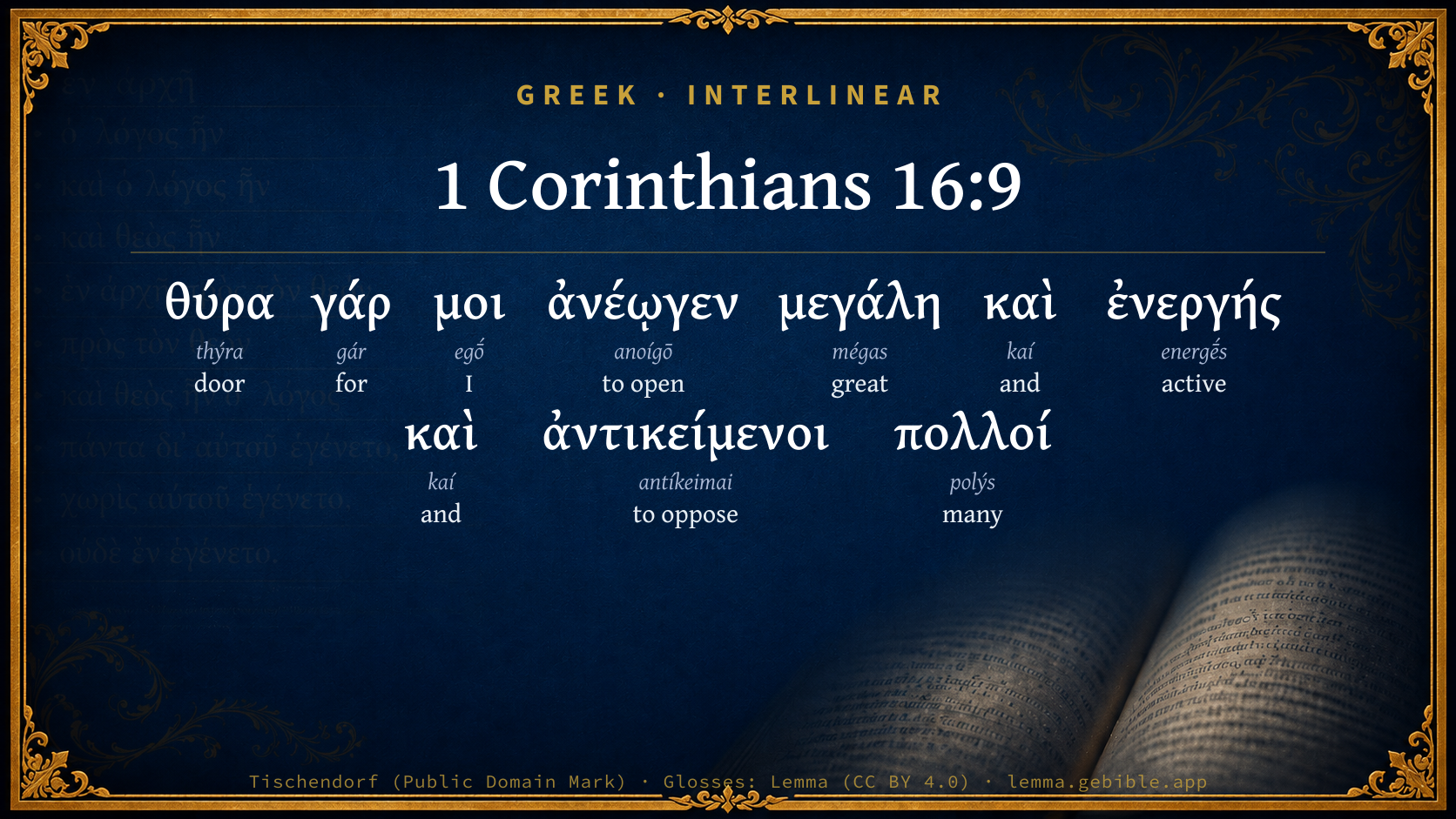
Greek (Tischendorf 8th ed.) 1 Corinthians 16:9 appears in the Greek New Testament. The text above is from the Tischendorf 8th edition. Each word links to its Strong’s number and a concise gloss. Click any word for its full Thayer’s Greek Lexicon entry.
Download image
Cite this verse

1 Corinthians 16:9 (World English Bible). Public Domain. Lemma interlinear Bible study tool, https://lemma.gebible.app/v/1-corinthians/16/9.

Show BibTeX & RIS
BibTeX
RIS
English Translation
for a great and effective door has opened to me, and there are many adversaries.
World English Bible · Public Domain
Highlights
  • 1 first appearance in the Greek New Testament
Full analysis ↓
Download a study sheet

One document with this verse’s original text, its word-by-word gloss line, the meaning frame, cross-references with their text, attributed commentary, and full source and license credits — printable, and it pastes into notes with its structure intact.

This verse Autodidact and up

Study sheet (.html) Plain text (.txt)

A passage Seminary Student

Up to 50 verses in one chapter. A passage sheet keeps up to 6 commentary sources and 12 cross-references per verse, in the order this page ranks them, and says so on the sheet whenever that leaves anything out. Ask for a single verse and you get the Autodidact verse sheet above.

Everything on this page stays free to read, with no account — the sheet is a download of what is already on screen, not access to it.

Want to remove ads? Support Godless Engineer
Compare translations 3

The same verse in 3 English versions, stacked beneath the original-language interlinear above. Click any original word for its lexicon entry.

Each is an independent rendering of the whole verse — the interlinear is not word-aligned to these translations.

Highlighted words mark where these versions differ — a whole-verse word diff, not a word-by-word alignment.

  • World English Bible Public Domain
    for a great and effective door has opened to me, and there are many adversaries.
  • King James Version Public Domain
    For a great door and effectual is opened unto me, and there are many adversaries.
  • unfoldingWord Literal Text CC BY-SA 4.0
    for a wide and effective door has opened for me, and many are opposing.

unfoldingWord Literal Text — © unfoldingWord, licensed CC BY-SA 4.0. Word-aligned USFM3 via Door43 (git.door43.org/unfoldingWord/en_ult).

Versions to compare (up to 4)

3 of 4 selected

Show all 19 translations

Every available English version of this verse, each an independent rendering of the whole verse.

  • World English Bible Public Domain
    for a great and effective door has opened to me, and there are many adversaries.
  • Berean Standard Bible Public Domain
    because a great door for effective work has opened to me, even though many oppose me.
  • Majority Standard Bible Public Domain
    because a great door for effective work has opened to me, even though many oppose me.
  • King James Version Public Domain
    For a great door and effectual is opened unto me, and there are many adversaries.
  • American Standard Version (1901) Public Domain
    for a great door and effectual is opened unto me, and there are many adversaries.
  • Revised Version (1885) Public Domain
    for a great door and effectual is opened unto me, and there are many adversaries.
  • Geneva Bible (1599) Public Domain
    For a great doore and effectuall is opened vnto me: and there are many aduersaries.
  • Douay-Rheims (1899) Public Domain
    For a great door and evident is opened unto me: and many adversaries.
  • Young's Literal Translation Public Domain
    for a door to me hath been opened -- great and effectual -- and withstanders `are' many.
  • Literal Standard Version CC BY-SA 4.0
    for a door has been opened to me—great and effectual—and withstanders [are] many.
  • Unlocked Literal Bible CC BY-SA 4.0
    for a wide door has opened for me, and there are many adversaries.
  • unfoldingWord Literal Text CC BY-SA 4.0
    for a wide and effective door has opened for me, and many are opposing.
  • Darby Bible Public Domain
    For a great door is opened to me and an effectual [one], and [the] adversaries many.
  • World Messianic Bible Public Domain
    for a great and effective door has opened to me, and there are many adversaries.
  • Webster's Bible Public Domain
    For a great door and effectual is opened to me, and there are many adversaries.
  • Free Bible Version CC BY-SA 4.0
    because a tremendous door of opportunity has opened up for me there, though there are plenty who oppose me.
  • Bible in Basic English Public Domain
    For a great and important door there is open to me, and there are a number of people against me.
  • Text-Critical English NT CC BY 4.0
    for a great and effective door has been opened to me, and there are many adversaries.
  • Tyndale New Testament (1534) Public Domain
    For a greate dore and a frutefull is opened vnto me: and ther are many adversaries.

Literal Standard Version (2020), Covenant Press — licensed CC BY-SA 4.0. Text via the HelloAO Bible API (eBible.org). Unlocked Literal Bible (unfoldingWord) — licensed CC BY-SA 4.0. Text via the HelloAO Bible API (eBible.org). unfoldingWord Literal Text — © unfoldingWord, licensed CC BY-SA 4.0. Word-aligned USFM3 via Door43 (git.door43.org/unfoldingWord/en_ult). Free Bible Version, Dr. Jonathan Gallagher — licensed CC BY-SA 4.0. Text via the HelloAO Bible API (eBible.org).

Word by word

More ways to search: Search by grammar → Find every occurrence → Compare this word →

Practice this passage: Drill this verse → Learn its vocabulary →

About this verse

These counts appear in no published source. They are computed here, from the morphology-tagged text and Lemma’s own curated glosses. What Lemma adds →

10
words
9
distinct lemmas
Pauline Epistles
section

Notable vocabulary

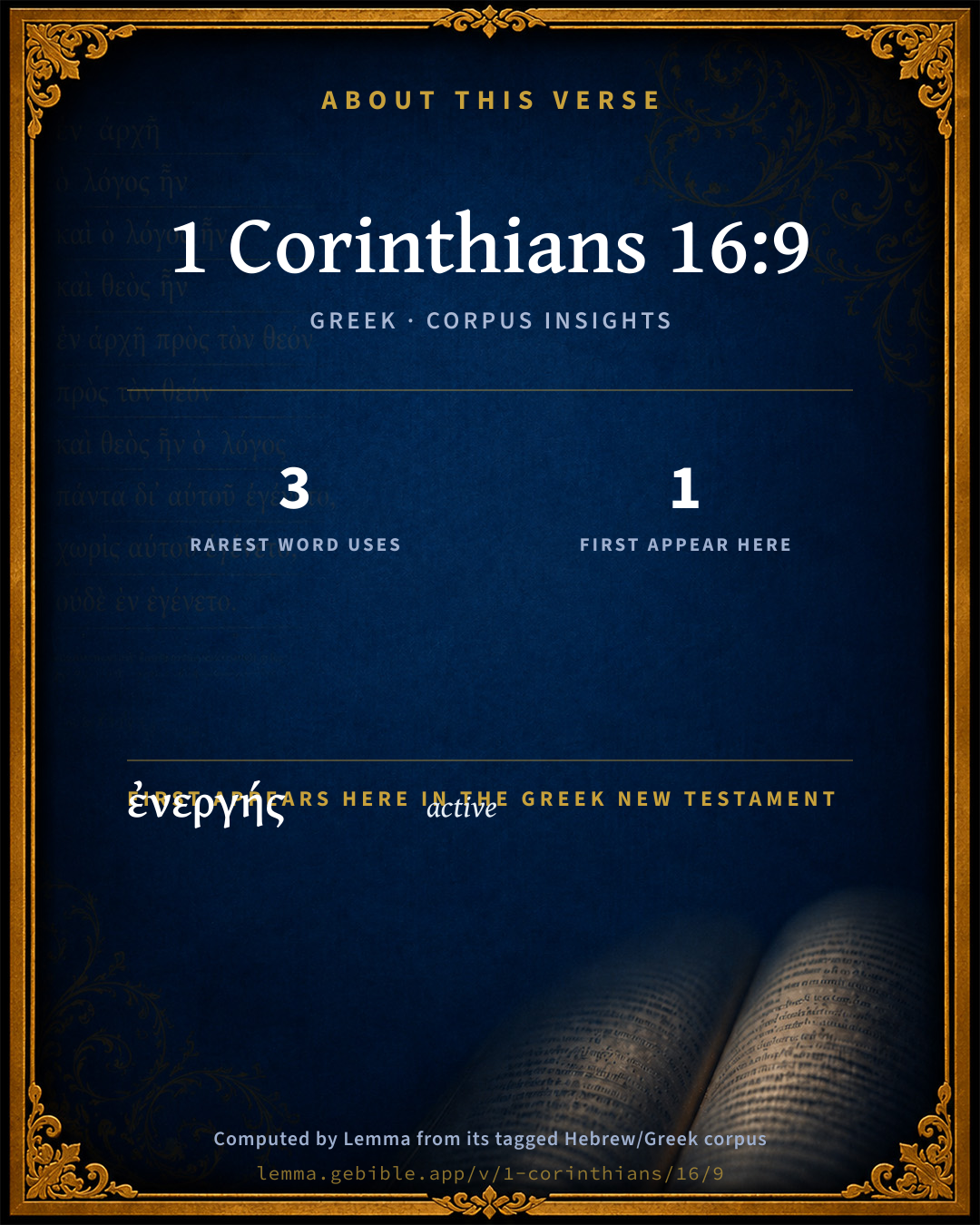
The rarest word here is ἐνεργής active G1756 — appearing just 3 times in the whole Greek New Testament.

First appearance in Scripture

This word makes its first canonical appearance in the Greek New Testament here:

  • ἐνεργής active G1756

Shared distinctive vocabulary

ἐνεργής active G1756 occurs in 3 verses of the Greek New Testament. Also found in:

Repetition

A word recurs within this verse:

Cross-references

8

Topical passages linked to 1 Corinthians 16:9 in the Treasury of Scripture Knowledge — connected by theme and wording, ordered by reader-vote popularity; previews shown in the World English Bible.

  • 2 Corinthians 2:12 Now when I came to Troas for the Gospel of Christ, and when a door was opened to me in the Lord,
  • Acts 14:27 When they had arrived, and had gathered the assembly together, they reported all the things that God had done with them, and that he had opened a door of faith to the Gentiles.
  • Colossians 4:3 praying together for us also, that God may open to us a door for the word, to speak the mystery of Christ, for which I am also in bonds;
  • Revelation 3:7–8 "To the angel of the assembly in Philadelphia write: "He who is holy, he who is true, he who has the key of David, he who opens and no one can shut, and who shuts and no one opens, says these things:
  • 2 Corinthians 1:8–10 For we don't desire to have you uninformed, brothers, concerning our affliction which happened to us in Asia, that we were weighed down exceedingly, beyond our power, so much that we despaired even of life.
  • Acts 19:8–10 He entered into the synagogue, and spoke boldly for a period of three months, reasoning and persuading about the things concerning the Kingdom of God.
  • 1 Corinthians 15:32 If I fought with animals at Ephesus for human purposes, what does it profit me? If the dead are not raised, then "let us eat and drink, for tomorrow we die."
  • Philippians 3:18 For many walk, of whom I told you often, and now tell you even weeping, as the enemies of the cross of Christ,

Cross-references courtesy of OpenBible.info (CC BY 4.0).

Commentary

Notes on 1 Corinthians 16:9 from classic Christian and Jewish commentators (each source and its license shown beneath its notes). The classic Christian expositions comment on the surrounding passage and are grouped to its opening verse, so a note may address several verses; the Jewish commentaries on the Tanakh (Rashi and others) are per-verse, so they appear only where the commentator wrote on this verse.

Lemma curates 59 commentaries, every one of them public domain or Creative Commons licensed, each selected and text-cleaned for this edition rather than reprinted as found. About our sources →

Bengel's Gnomon

Johann Albrecht Bengel

1Co 16:9. Θύρα, a door) It is the part of a wise man to watch opportunities.—ἀνέῳγε, has been opened) at Ephesus.—μεγάλη καὶ ἐνεργὴς, great and effectual) He was about to take advantage of so great an opportunity for some weeks; comp. ch. 1Co 5:7, note.—ἀντικείμενοι, adversaries) whom I must resist. Often good, and, its contrary, evil, flourish vigorously at one and the same time.

Bengel's Gnomon of the New Testament — English translation (T&T Clark, Edinburgh, 1860) — public domain. Text from a community e-Sword module.

Geneva Bible (1599)

Geneva Bible translators

Very fit and convenient to do great things by.

Geneva Bible (1599) marginal notes — public domain. Text via Bolls.life.

Jamieson, Fausset & Brown

Robert Jamieson, A. R. Fausset & David Brown

door-- (Co2 2:12). An opening for the extension of the Gospel. Wise men are on the watch for, and avail themselves of, opportunities. So "door of hope," Hos 2:15. "Door of faith," Act 14:27. "An open door," Rev 3:8. "A door of utterance," Col 4:3. "Great," that is, extensive. "Effectual," that is, requiring great labors [ESTIUS]; or opportune for effecting great results [BEZA].

many adversaries--who would block up the way and prevent us from entering the open door. Not here false teachers, but open adversaries: both Jews and heathen. After Paul, by his now long-continued labors at Ephesus, had produced effects which threatened the interests of those whose gains were derived from idolatry, "many adversaries" arose (Act 19:9-23). Where great good is, there evil is sure to start up as its antagonist.

Jamieson, Fausset & Brown — Commentary Critical and Explanatory on the Whole Bible (1871) — public domain (CC PDM 1.0). Text via the HelloAO Bible API.

Adam Clarke's Commentary

Verse 9. A great door and effectual is opened] Θυοα γαρ μοι ανεωγε μεγαλη και ενεργης· A great and energetic door is opened to me; that is, God has made a grand opening to me in those parts, which I perceive will require much labour; and besides, I shall have many adversaries to oppose me. So Bp. Pearce understands the words ενεργης, not as signifying effectual, but as implying full of labour. Door often signifies occasion or opportunity; but here, the apostle may allude to the throwing open of the great doors of the Circus Maximus before the chariot races began; and the many adversaries may refer to the numerous competitors in those races.

God gave him a grand opportunity to preach the Gospel; but he was not to expect that either Satan or wicked men would leave him unmolested.

Adam Clarke's Commentary on the Bible (1810–1826) — public domain. Text from a community e-Sword/MySword module.

The Cambridge Bible for Schools and Colleges

gen. ed. J. J. S. Perowne

9. For a great door] The use of door in the sense of opportunity in the N. T. is remarkable. It is a favourite word with St Paul. See 2Co_2:12; Col_4:3. St Luke has adopted it from him, Act_14:27. And it is also to be found in the same sense in Rev_3:8. This verse also strikingly corroborates the narrative in the Acts. Cf. Act_19:19-20.

and effectual] i.e. calculated to produce results.

The Cambridge Bible for Schools and Colleges (gen. ed. J. J. S. Perowne; Cambridge University Press, 1878–1918) — public domain. Text from a community e-Sword module.

John Gill's Exposition

Now if Timotheus come,.... The apostle had sent him already, as appears from Co1 4:17 and he was now gone from him; but whether he might not be prevented by unforeseen incidents in his journey, he could not say; and therefore speaks cautiously of his coming; from whence it is evident, that this epistle was not sent by Timothy, as the subscription to it suggests.

See that he may be with you without fear; should he come to them, the apostle desires they would take care of him, that he might be safe and secure from enemies of every sort, of which there were many at Corinth; who, as they were of a malignant disposition to him, would use a disciple of his ill: and these were not only, or so much, infidels and profane sinners, but false teachers, and the factions under them, and especially they of the circumcision.

For he worketh the work of the Lord, as I also do; which is a reason why they should be careful of him, that nobody molest him, and put him into fear; since though he was not in so high an office as the apostle, yet he was called to the same work of the ministry, was engaged in the same service of Christ, and was zealous in promoting the same common cause, interest, and kingdom of the Redeemer, and faithfully preached the same Gospel as the apostle did; and therefore would doubtless meet with the same enemies, and be in the same danger.

John Gill's Exposition of the Whole Bible (1746–1763) — public domain (CC PDM 1.0). Text via the HelloAO Bible API.

Trapp's Complete Commentary

John Trapp

9 For a great door and effectual is opened unto me, and there are many adversaries.

Ver. 9. And effectual] ενεργης, or, busy, that requires great painstaking. The ministry is not an idle man’s occupation, as some fools think it.

And many adversaries] Truth never lacks an opposite. In the beginning of the late Reformation, Eckius, Roffensis, Cajetan, Moore, Faber, Cochlaeus, Catharinus, Pighius, all these wrote against Luther, Summo conatu, acerrimo desiderio, non vulgari doctrina, as one saith, with utmost desire and endeavour.

John Trapp, A Commentary or Exposition upon All the Books of the Old and New Testament (1647–1656) — public domain. Text from a community e-Sword module.

Albert Barnes' Notes on the Bible

For a great door - There is abundant opportunity for usefulness. The word “door” is used evidently to denote an occasion or an opportunity for doing anything. It is the means by which we have entrance or access; and hence denotes facility in doing anything when there is no obstruction; see Act 14:27; 2Co 2:12; Col 4:3.

And effectual - That is, effective, or adapted to success; presenting opportunity for great effects. There is abundant opportunity to preach the gospel; there is attention to what is spoken, and great interest in it; there is great encouragement to labor. It is possible that this was one of the reasons why Paul had changed his mind about Macedonia. It would require time to visit Corinth, as he would wish to remain there; and an unexpected opportunity having arisen for doing good, he judged it best to remain at Ephesus as long as practicable, and then to go at once to Macedonia.

And there are many adversaries - Many opposers; many who resist the gospel. These were doubtless in part Jews who excited opposition to him, and in part the friends of Demetrius; see Acts 19. That Paul had great success in Ephesus, and that his labors were attended with a great revival of religion there, is manifest from that chapter. We may remark here:

(1) That such a work of grace, such a setting open a great and effectual door, is often the occasion of increased opposition to the gospel. It is no uncommon thing that the adversaries of Christ should be excited at such times; and we are not to be surprised if the same thing should occur now which occurred in the time of Paul.

(2) This was regarded by Paul as no reason why he should leave Ephesus, but rather as a reason why he should remain there. It was regarded by him as an evidence that the Holy Spirit was there. It was proof that the enemies of God were alarmed, and that the kingdom of Christ was advancing. His presence, also, would be needed there, to encourage and strengthen the young converts who would be attacked and opposed; and he deemed it his duty to remain. A minister should never wish to make enemies to the gospel, nor seek to excite them to make opposition; but such opposition is often evidence that the Spirit of God is among a people; that the consciences of sinners are aroused and alarmed; and that the great enemy of God and man is making, as he was at Ephesus, a desperate effort to preserve his kingdom from being destroyed.

(3) A minister should regard it as his duty in a special manner to be among his people when there is such opposition excited. His presence is needed to comfort and encourage the church; and when the minds of people are excited, it is often the best time to present truth, and to defend successfully the great doctrines of the Bible.

(4) Ministers should not be discouraged because there is opposition to the gospel. It is one ground of encouragement. It is an indication of the presence of God in awakening the conscience. And it is far more favorable as a season to do good than a dead calm, and when there is universal stagnation and unconcern.

Albert Barnes' Notes on the Bible (1834–1885) — public domain. Text from a community e-Sword/MySword module.

Haydock's Catholic Bible Commentary

A gate is opened to me, large and evident; that is, a fair and good occasion of labouring to convert many, where there are many adversaries. (Witham) --- The work of God is carried on by the power of the cross, and in the midst of contradictions and persecutions. If we suffer this to damp our courage, we forget that we are ministers of a crucified master, and ought to wear his livery.

George Leo Haydock (1774–1849), Haydock's Catholic Family Bible and Commentary, 1859 edition — public domain. Excludes Psalms (Douay-Rheims chapter numbering differs from Protestant) and Deuterocanonical books (Catholic canon only).

Matthew Poole's English Annotations

For God hath opened to me at Ephesus a great opportunity to preach the gospel, which I have reason to hope will also be effectual for the conversion of many souls. What this door of hope was, whether God had let him know there were many souls in that place prepared for receiving the gospel; or that some eminent persons for authority or learning, whom many were like to follow, were there already converted; or that he looked upon that famous city as like to be a place where many might be converted; is not told us.

And (saith the apostle)

there are many adversaries, ( as it will appear to those that read Act 19:1-41 and Act 20:1-38), therefore there was need of the presence of the apostle himself, whose authority might better stop their months, than the more inferior pastors could. What would have aftrighted others from going or staying there, this great apostle mentions as an argument to cause him to make haste to go thither, and to tarry there for some time.

Matthew Poole's English Annotations on the Holy Bible (1683–1685) — public domain. Text from a community e-Sword/MySword module.

Whedon's Commentary on the Bible

Daniel D. Whedon

9. A great door—Much of Ephesus heretofore closed is now opened to him.

Many adversaries—Requiring his presence to defend and protect the Church. It is very probable that it was this great door now opened that had already awakened the hostile zeal of Demetrius the silversmith, and other adversaries, in behalf of Diana and their “craft.”

Daniel D. Whedon (gen. ed.), Commentary on the Old and New Testaments (1874–1909) — public domain. Text from a community e-Sword module.

The Pulpit Commentary

A great door and effectual. A wide and promising opportunity for winning souls to God. The metaphor of "a door," perhaps suggested by our Lord himself, was common among Christians (2Co_2:12; Col_4:3; Act_14:27; Rev_3:8) Many adversaries. (Act_19:1, Act_19:8, Act_19:9, Act_19:19, Act_19:20)

The open door and many adversaries.

Ephesus evidently had, as a scene of labour, many attractions for the ardent and fearless spirit of the Apostle Paul. Its vast population, its devotion to idolatry, the excitability of its inhabitants, all rendered it a congenial field for such a worker. And the opposition he encountered and the danger he braved, it is plain from the narrative, made him feel the city all the more to be an honourable and attractive post for a bold and faithful soldier of Jesus Christ.

I THE OPPORTUNITY OF SERVICE FOR CHRIST REPRESENTED IN THIS FIGURATIVE LANGUAGE. A door offers the means of admittance to a house, and an open door invites approach and entrance. In Scripture a door is often used to express the opportunity to do God"s will and advance his cause. So here, the apostle represents by this figurative language the summons which Providence addressed to him to evangelize this great city of Asia Minor. The citizens and visitors were numerous, the idolatry and vice which prevailed were flagrant, human sorrows and difficulties and temptations abounded; so that there was abundant room for evangelistic and pastoral labour. Further, there seems to have been in some quarters a remarkable and gratifying readiness to hear the gospel of Christ.

II THE HINDRANCES TO SERVICE FOR CHRIST HERE ALLUDED TO.

1. Observe from what quarters it came. The narrative in the Book of the Acts makes it evident that opposition to Christian preaching arose from both Jews and Gentiles. On different grounds sinful men oppose the truth. It always has been so. It was so in the time of our Lord, and the disciple, the servant, must not expect or desire to be above his Master.

2. Observe what forms it took. Slander and secret misrepresentation was one way in which adversaries sought to hinder the truth. And another was open hostility and violence. This we know to have been put in motion at Ephesus against the apostle. The ignorant and impassioned mob was stirred up to oppose the work of Paul; in this sense, at all events, he fought with beasts at Ephesus.

III THE COMPATIBILITY OF GREAT OPPORTUNITIES AND MANY ADVERSARIES. It is certainly a paradoxical statement. Yet reflection will show that there is no real inconsistency.

1. Hindrances, calumnies, serve to draw attention to any cause, and the gospel is sure to profit by anything which leads men to inquire into it.

2. These obstacles serve to test the quality of the labourers, and to bring out courage and resolution and patience where such qualities are required.

3. They always answer a valuable purpose in testing the sincerity of the converts. Times of persecution are times of testing.

IV THE ATTRACTION THIS COMBINATION HAD FOR THE APOSTLE.

1. It called forth and employed his many and remarkable powers.

2. It enabled him to realize his fellowship with his Master.

3. It promised great results of spiritual good.

APPLICATION.

1. Enter in, Christian labourers, at every open door!

2. Be fearless of adversaries! T.

The mission of our hindrances.

are many adversaries." In life we always find that the "open door" and the "many hinderers" go together. Very seldom can we have the one without the other. For the use of the term "doer" as a figure for "opportunity," see Act_14:27; 2Co_2:12; Col_4:3. For the narrative which illustrates the expression here used, see Act_19:19, Act_19:20. Of hindrances affecting St. Paul, we may think of

(1) his own frail health;

(2) the difficulties and dangers of travelling;

(3) the wilfulness sometimes shown by his travelling companions;

(4) the sudden and unexpected claims of the Churches altering his plans;

(5) the persistent and watchful opposition of his Jewish enemies; and we may even add

(6) the sometimes strange and trying limitations put by the guiding Spirit, as in Act_16:6, Act_16:7.

That which was so evidently true of St. Paul is the common experience of God"s servants; and we must accept the conditions, and win virtue out of the very limitations.

I GOD"S PROVIDENCE IS EVER MAKING OPEN DOORS FOR US. This is true in educational life, and in business life. Every man sooner or later gets his turn and opportunity. But we observe how true it is both of personal Christian life and of Church life. God sets before us open doors, shows us spheres of service which we may occupy. And such we enter upon with great hopes and expectations, assuming that if Providence has so manifestly opened the door, the path within must be straight and plain and easy. This we find is not always true; for

II GOD"S PROVIDENCE IS ALSO EVER MAKING HINDRANCES.

1. Often health fails at the moment of opportunity.

2. Sometimes the will to do it fades when the opportunity for doing appears.

3. Events as providential seem to block the path just inside the open door.

4. The work involves labour which seriously taxes energy and faith.

5. Too often we faint and fail, and prove the greatest hinderers of our work. We must fully accept the fact that, here on earth, God has put open doors and hindrances together, that the combination might nurture and develop the noblest qualities in his servants. R.T.

The Pulpit Commentary (1880–1919), ed. H.D.M. Spence-Jones & Joseph S. Exell — public domain. Text from a community e-Sword module.

John Wesley's Explanatory Notes

A great door - As to the number of hearers. And effectual - As to the effects wrought upon them. And there are many adversaries - As there must always be where Satan's kingdom shakes. This was another reason for his staying there.

John Wesley, Explanatory Notes Upon the Whole Bible (1754–1765) — public domain. Text via the GEBible commentary corpus.

Godbey's Commentary on the New Testament

William B. Godbey

9. “For there is a great and effectual door opened to me, and there are many opposers.” It is pertinent that we note the Pauline estimation of a grand and effectual door opened for the work of the Lord. The only index he here gives is that the opposition was great. As a rule, where the devil works powerfully God is working too. These excarnate demons have access to information frequently beyond the reach of us mortals. My grandest success has been achieved amid the most formidable opposition. Satan is no fool, he does not waste his ammunition. The very fact that he is stirring earth and Hell to oppose the Lord’s work is a prima facie evidence that a great victory is coming. Paul so regarded it.

William B. Godbey, Commentary on the New Testament (1896–1900) — public domain. Text from a community e-Sword module.

McGarvey & Pendleton's Commentaries

J. W. McGarvey

for a great door [the common metaphor expressing opportunity-- Act_14:27 ; 2Co_2:12 ; Col_4:3 ; Rev_3:8 ; Hos_2:15 ] and effectual is opened unto me, and there are many adversaries . [For this success and the adversaries which it aroused see Act_19:1-20 . For the riot which it afterwards stirred up see Act_19:23-41 . From this paragraph it appears that it had been Paul's plan to visit Corinth, going thither from Ephesus by direct course across the Ægean Sea; and after a brief sojourn there to pass up into Macedonia, and visit Corinth again on the return. This plan he evidently communicated to the Corinthians in that first epistle which is lost ( 1Co_5:9 ). But the evil reports which came to him concerning the conduct of the Corinthian church caused him to change his purpose, and delay his visit, that they might have time to repent, and so escape the severe correction which he would otherwise have felt constrained to administer to them ( 2Co_1:23 ; 2Co_2:1 ). Moreover, he reversed his route; coming by Macedonia ( Act_19:21-22 ), and intending to depart by sea ( Act_20:3 ). To help bring about a state of repentance, he sent Timothy as a forerunner ( 1Co_4:16-21 ), and sent him by way of Macedonia (Acts 19:22). He now writes that he has thus altered his plans, and that he is coming through Macedonia, and that he will not pay them two cursory visits, but will make them one long one, and probably stay all winter. However, he will not begin this journey until after Pentecost, for the work in Ephesus has become so fruitful as to demand at present all his attention. Paul carried out his plan as here outlined ( 2Co_2:13 ; 2Co_8:1 ; 2Co_9:2 ; 2Co_9:4 ; 2Co_12:14 ; 2Co_13:1 ; Act_20:3-6 ). He suggests their forwarding him on his journey, thus showing his confidence in them, that they would give him this customary proof of affection ( Rom_15:24 ; Act_15:3 ; Act_17:15 ; Tit_3:13 ); but intimates, by using "whithersoever," that his course beyond them is uncertain. We find later that he was compelled to change his plan-- Act_20:3 ]

J. W. McGarvey (with Philip Y. Pendleton), Commentaries on the New Testament (The Fourfold Gospel, 1914; Acts; and the epistles) — public domain. Text from a community e-Sword/MySword module.

The People's New Testament

B. W. Johnson

9. For a great and effectual door is opened. His ministry in Ephesus was very successful. See Acts, chapter 19. There are many adversaries. Demetrius and his fellow-craftsmen had probably begun their agitation.

B. W. Johnson's The People's New Testament with Notes (1889–1891) — public domain. Electronic text from the Christian Classics Ethereal Library (CCEL) ThML edition.

Cambridge Greek Testament for Schools and Colleges

9. θύρα. The use of the word θύρα in the sense of opportunity in the N. T. is noticeable. And it is further remarkable that it is not confined to any one writer. See 2Co 2:12; Col 4:3; Act 14:27; Rev 3:8.

καὶ ἐνεργής. This, combined with θύρα, is a somewhat bold metaphor. The result of the opportunity is here taken in conjunction with the opportunity itself. ἐνεργής is used in Classical Greek for productive, as for instance Xen. Oec. IV. 8 ἐνεργὸν (for the later ἐνεργῆ) οὖσαν τὴν γῆν καὶ πλήρη δένδρων. Here, however, we in English might say not altogether incorrectly, an effective opportunity, i.e. an opportunity for acting effectively. We may observe here also how these words of the Apostle corroborate Act 19:19-20.

Cambridge Greek Testament for Schools and Colleges (Cambridge University Press, 1896; 21 vols, various authors incl. Carr, Maclear, Plummer, Farrar, Lumby, Moule, M. R. James, Simcox) — public domain. Text from a community e-Sword module.

Alford’s Greek Testament

Henry Alford

9.] His present plan regarding his stay in Ephesus (where he was writing).

τ. πεντηκ.] viz. that next coming. This probably happened so, or nearly so, notwithstanding the tumult of Act_19: for he already (see there vv. 21, 22) was meditating his departure, and had sent on two of his company, when the tumult occurred.

θύρα, see reff.: an opportunity of action.

μεγάλη refers to the extent of the action thus opened before him: ἐνεργής, to its requirements: neither of them (though μεγάλη may be referred to θύρα) properly agreeing with the figure, but both with the reality. Meyer compares Plato, Phædr. p. 245, a: μουσῶν ἐπὶ ποιητικὰς θύρας ἀφίκηται.

ἀντικ. πολλ. See Act 19:9, Act 19:23 ff.

10,

Henry Alford, The Greek Testament (1849–1861) — public domain. Text from a community e-Sword module.

International Critical Commentary

9. θύρα γάρ μοι ἀνέῳγεν μεγάλη καὶ ἐνεργῄς. ‘For a door is standing open for me, great and effective.’ The metaphor of a door for an opportunity is simple enough (2Co 2:12; Col 4:3, where see Lightfoot). In all three places an opening for preaching the Gospel seems to be meant, although in 2Co 2:12 the meaning might be that Troas was a good avenue for reaching the country beyond (Ramsay in Hastings, DB. 4. p. 814). It is possible that εἴσοδος is used in a similar sense 1Th 1:9, 1Th 2:1. In Act 14:27 the ‘door’ is opened to the hearers, not to the preachers. But it is not quite clear what ἐνεργής means, or in what sense a door can be called ἐνεργής. Probably St Paul is thinking more of the opportunity than of the ‘door.’ The ‘door’ means an opportunity, and he applies to it an epithet which suits the fact better than the symbol. It may mean either ‘effective, influential, productive of good results,’ or ‘calling for much activity, full of employment’; Phm 1:6; Heb 4:12. In Heb 4:12, the Vulg. has efficax; in Phm 1:6 and here, evidens (other Latin texts, manifesta), which is a translation of ἐναργής, a word which is not found in Biblical Greek; nor is ἐνεργής found in LXX. On the ‘opened door’ given to the Church in Philadelphia (3:8), see Swete ad loc. and Ramsay, Letters to the Seven Churches, p. 404. See also Deissmann, Light, p. 302.

ἀντικείμενοι πολλό. ‘There are many opposing my entrance,’ hindering him from making use of the great opportunity (Php 1:20). Among these are the wild beasts of 15:32, and they would include both Jews and heathen. Act_19. shows how true this estimate of the situation proved. “The superstition of all Asia was concentrated at Ephesus. Throughout the early centuries the city mob, superstitious, frivolous, swayed by the most common-place motives, was everywhere the most dangerous and unfailing enemy of Christianity, and often carried the imperial officials further than they wished in the way of persecution” (Ramsay, St Paul, p. 277). But this determines St Paul, not to fly, but to stay on: quod alios terruisset, Paulum invitat (Grotius).

The intransitive ἀνέῳγεν is late Greek for ἀνεῳκται.

International Critical Commentary — older volumes (1896–1929), various authors — public domain. Text from a community e-Sword module.

Vincent's Word Studies in the New Testament

Marvin R. Vincent

Great and effectual door. Door metaphorically for opportunity : great as to its extent; effectual as to the result. The figure of an effectual door, as it stands, is of course clumsy, but the idea as a whole is clear : a great opportunity for effective work.

Marvin R. Vincent, Word Studies in the New Testament (1887–1900) — public domain. Text from a community e-Sword/MySword module.

Lesson kit

Teaching starters — assembled from the data on this page, not authored interpretation. Every prompt links to the verse data it draws on. Edit before teaching.

1 Corinthians, in the Pauline Epistles, opens this verse with 10 words (9 distinct Greek lemmas). Its most distinctive word is energḗs (“active”). A historical commentator’s framing appears above. Read the whole chapter for the surrounding context.

Discussion questions

  1. What does “active” (energḗs) contribute to the verse as a whole?
  2. This is the first place “active” appears in Scripture (first appears here). What does its debut here establish?
  3. How does Philemon 1:6, which shares the word «active», read alongside this verse?
  4. What does the repetition of “and” (2× in this one verse) do in this verse?
  5. These translations render this verse differently; the difference is in the English rendering, not the original. What questions does that raise?
  6. Compare how Bengel's Gnomon and Geneva Bible (1599) read this verse. Where do they agree or differ?

Things to notice

  • 1 word makes its first canonical appearance in Scripture here.
  • These translations choose different wording for 8 words in this verse.
  • “and” occurs 2× in this single verse.
  • 9 distinct Greek lemmas span 10 words in this verse.

Reading settings

Reading text

Shown beneath each verse's original-language words.

Old Testament
Old Testament edition

Read the OT as the Masoretic Hebrew (MT) or the Greek Septuagint (LXX).

English shown for the Greek Septuagint (in the Hebrew ↔ Greek comparison).

Comparing translations? Open the Compare panel on any verse page to stack up to four side by side.