1 Corinthians 1:19

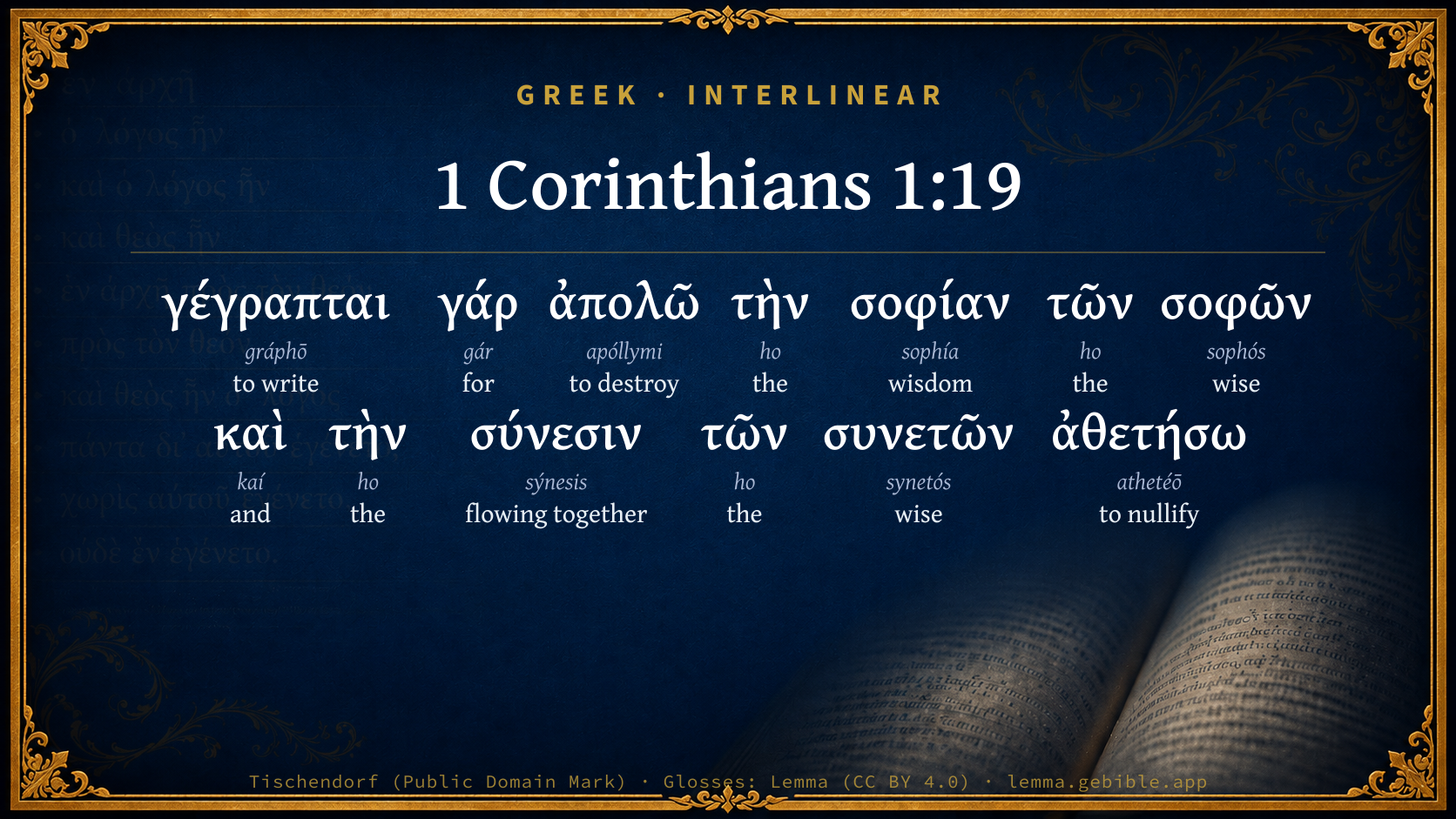
Greek (Tischendorf 8th ed.) 1 Corinthians 1:19 appears in the Greek New Testament. The text above is from the Tischendorf 8th edition. Each word links to its Strong’s number and a concise gloss. Click any word for its full Thayer’s Greek Lexicon entry.
Download image
Cite this verse

1 Corinthians 1:19 (World English Bible). Public Domain. Lemma interlinear Bible study tool, https://lemma.gebible.app/v/1-corinthians/1/19.

Show BibTeX & RIS
BibTeX
RIS
English Translation
For it is written, "I will destroy the wisdom of the wise, I will bring the discernment of the discerning to nothing."
World English Bible · Public Domain
Download a study sheet

One document with this verse’s original text, its word-by-word gloss line, the meaning frame, cross-references with their text, attributed commentary, and full source and license credits — printable, and it pastes into notes with its structure intact.

This verse Autodidact and up

Study sheet (.html) Plain text (.txt)

A passage Seminary Student

Up to 50 verses in one chapter. A passage sheet keeps up to 6 commentary sources and 12 cross-references per verse, in the order this page ranks them, and says so on the sheet whenever that leaves anything out. Ask for a single verse and you get the Autodidact verse sheet above.

Everything on this page stays free to read, with no account — the sheet is a download of what is already on screen, not access to it.

Want to remove ads? Support Godless Engineer
Compare translations 3

The same verse in 3 English versions, stacked beneath the original-language interlinear above. Click any original word for its lexicon entry.

Each is an independent rendering of the whole verse — the interlinear is not word-aligned to these translations.

Highlighted words mark where these versions differ — a whole-verse word diff, not a word-by-word alignment.

  • World English Bible Public Domain
    For it is written, "I will destroy the wisdom of the wise, I will bring the discernment of the discerning to nothing."
  • King James Version Public Domain
    For it is written, I will destroy the wisdom of the wise, and will bring to nothing the understanding of the prudent.
  • unfoldingWord Literal Text CC BY-SA 4.0
    For it is written, “I will destroy the wisdom of the wise, and I will frustrate the understanding of the intelligent.”

unfoldingWord Literal Text — © unfoldingWord, licensed CC BY-SA 4.0. Word-aligned USFM3 via Door43 (git.door43.org/unfoldingWord/en_ult).

Versions to compare (up to 4)

3 of 4 selected

Show all 19 translations

Every available English version of this verse, each an independent rendering of the whole verse.

  • World English Bible Public Domain
    For it is written, "I will destroy the wisdom of the wise, I will bring the discernment of the discerning to nothing."
  • Berean Standard Bible Public Domain
    For it is written: “I will destroy the wisdom of the wise; the intelligence of the intelligent I will frustrate.”
  • Majority Standard Bible Public Domain
    For it is written: “I will destroy the wisdom of the wise; the intelligence of the intelligent I will frustrate.”
  • King James Version Public Domain
    For it is written, I will destroy the wisdom of the wise, and will bring to nothing the understanding of the prudent.
  • American Standard Version (1901) Public Domain
    For it is written, I will destroy the wisdom of the wise, And the discernment of the discerning will I bring to nought.
  • Revised Version (1885) Public Domain
    For it is written, I will destroy the wisdom of the wise, And the prudence of the prudent will I reject.
  • Geneva Bible (1599) Public Domain
    For it is written, I will destroy the wisedome of the wise, and will cast away the vnderstanding of the prudent.
  • Douay-Rheims (1899) Public Domain
    For it is written: I will destroy the wisdom of the wise, and the prudence of the prudent I will reject.
  • Young's Literal Translation Public Domain
    for it hath been written, `I will destroy the wisdom of the wise, and the intelligence of the intelligent I will bring to nought;'
  • Literal Standard Version CC BY-SA 4.0
    for it has been written: “I will destroy the wisdom of the wise, and the intelligence of the intelligent I will bring to nothing”;
  • Unlocked Literal Bible CC BY-SA 4.0
    For it is written, “I will destroy the wisdom of the wise. I will frustrate the understanding of the intelligent.”
  • unfoldingWord Literal Text CC BY-SA 4.0
    For it is written, “I will destroy the wisdom of the wise, and I will frustrate the understanding of the intelligent.”
  • Darby Bible Public Domain
    For it is written, I will destroy the wisdom of the wise, and set aside the understanding of the understanding ones.
  • World Messianic Bible Public Domain
    For it is written, “I will destroy the wisdom of the wise. I will bring the discernment of the discerning to nothing.”
  • Webster's Bible Public Domain
    For it is written, I will destroy the wisdom of the wise, and will bring to nothing the understanding of the prudent.
  • Free Bible Version CC BY-SA 4.0
    As Scripture says, “I will destroy the wisdom of the wise, and I will wipe out the cleverness of the clever.”
  • Bible in Basic English Public Domain
    As it says in the holy Writings, I will put an end to the wisdom of the wise, and will put on one side the designs of those who have knowledge.
  • Text-Critical English NT CC BY 4.0
    For it is written, “I will destroy the wisdom of the wise, and the intelligence of the intelligent I will nullify.”
  • Tyndale New Testament (1534) Public Domain
    For it is written: I will destroye the wysdome of the wyse and will cast awaye the vnderstondinge of the prudet.

Literal Standard Version (2020), Covenant Press — licensed CC BY-SA 4.0. Text via the HelloAO Bible API (eBible.org). Unlocked Literal Bible (unfoldingWord) — licensed CC BY-SA 4.0. Text via the HelloAO Bible API (eBible.org). unfoldingWord Literal Text — © unfoldingWord, licensed CC BY-SA 4.0. Word-aligned USFM3 via Door43 (git.door43.org/unfoldingWord/en_ult). Free Bible Version, Dr. Jonathan Gallagher — licensed CC BY-SA 4.0. Text via the HelloAO Bible API (eBible.org).

Word by word

More ways to search: Search by grammar → Find every occurrence → Compare this word →

Practice this passage: Drill this verse → Learn its vocabulary →

About this verse

These counts appear in no published source. They are computed here, from the morphology-tagged text and Lemma’s own curated glosses. What Lemma adds →

13
words
10
distinct lemmas
Pauline Epistles
section

Notable vocabulary

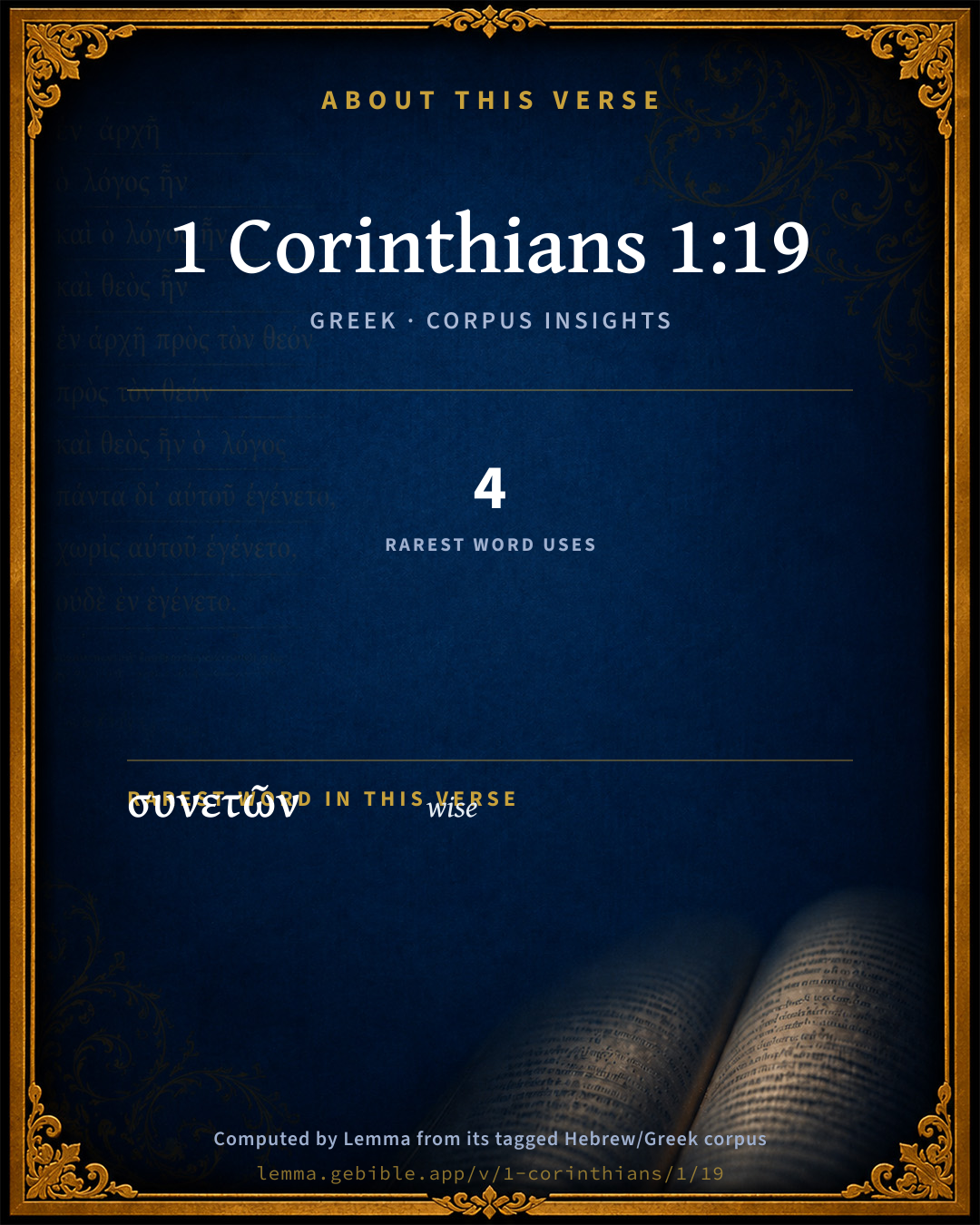
The rarest word here is συνετῶν wise G4908 — appearing just 4 times in the whole Greek New Testament.

Shared distinctive vocabulary

συνετῶν wise G4908 occurs in 4 verses of the Greek New Testament. Also found in:

Repetition

A word recurs within this verse:

Cross-references

6

Topical passages linked to 1 Corinthians 1:19 in the Treasury of Scripture Knowledge — connected by theme and wording, ordered by reader-vote popularity; previews shown in the World English Bible.

  • Isaiah 29:14 therefore, behold, I will proceed to do a marvelous work among this people, even a marvelous work and a wonder; and the wisdom of their wise men shall perish, and the understanding of their prudent men shall be hid.
  • Jeremiah 8:9 The wise men are disappointed, they are dismayed and taken: behold, they have rejected the word of Yahweh; and what manner of wisdom is in them?
  • 1 Corinthians 3:19 For the wisdom of this world is foolishness with God. For it is written, "He has taken the wise in their craftiness."
  • Job 5:12–13 He frustrates the devices of the crafty, So that their hands can't perform their enterprise.
  • Isaiah 19:11 The princes of Zoan are utterly foolish; the counsel of the wisest counselors of Pharaoh is become brutish: how do you say to Pharaoh, I am the son of the wise, the son of ancient kings?
  • Isaiah 19:3 The spirit of Egypt shall fail in the midst of it; and I will destroy the counsel of it: and they shall seek to the idols, and to the charmers, and to those who have familiar spirits, and to the wizards.

Cross-references courtesy of OpenBible.info (CC BY 4.0).

Commentary

Notes on 1 Corinthians 1:19 from classic Christian and Jewish commentators (each source and its license shown beneath its notes). The classic Christian expositions comment on the surrounding passage and are grouped to its opening verse, so a note may address several verses; the Jewish commentaries on the Tanakh (Rashi and others) are per-verse, so they appear only where the commentator wrote on this verse.

Lemma curates 59 commentaries, every one of them public domain or Creative Commons licensed, each selected and text-cleaned for this edition rather than reprinted as found. About our sources →

The Biblical Illustrator

Joseph S. Exell

1Co_1:19-21

For it is written, I will destroy the wisdom of the wise.

True wisdom

The discovery of what is true, and the practice of that which is good, are the two most important objects of philosophy. (Voltaire.)

Human wisdom

I. Its character.

1. Presumptuous in its attempts.

2. Proud in its assumptions.

3. Unsatisfactory in its conclusions.

II. Its destruction--effected--

1. By time.

2. By revelation.

3. By the Divine Spirit.

4. By the appearing of Christ. (J. Lyth, D. D.)

The vanity of the wisdom of this world

I. God puts it to shame.

1. It often blunders in its theories.

2. Always in relation to Divine things.

3. Generally leads to practical error.

II. It has utterly failed to regenerate the world. Instead of mending it it has made worse--witness the philosophy of the Greeks and the age of reason.

III. It is fully exposed by Christianity, which--

1. Succeeds where it fails.

2. Triumphs over it.

3. Will ultimately destroy it. (J. Lyth, D. D.)

The gospel ministry--its superiority over human methods

We have here--

I. The inference drawn from the effects of the gospel upon those who had received it.

1. It had accomplished that which the wisdom of the world had failed to do (1Co_1:20-21). The wise, the scribe, the disputer, include respectively the thinker, the writer, and the speaker. Thought and its two mediums of expression were the great agents in the worlds education, and had succeeded in creating a literature which remains unparalleled. But what had they done towards the regeneration of mankind? Nothing. Where is the wise? &c. In the world of philosophy, of poetry, of art, I can see their work; but in the realm of the spiritual they have left the world as they found it. God turns the tables upon those boastful wise ones. They call His plan foolishness, but its effectiveness proves the folly to be with them. And Christianity is not alone in its frustration of the predictions of the wise. When Fulton constructed a steamship to cross the Atlantic they cried, There goes Fultons Folly. Subsequent history has, however, proved them to be the fools, and Fulton the wise man. So when Christianity was starting on its grand voyage, laden with salvation to a sin-afflicted world, the wise called it foolishness. But how strangely has history proved their own infatuated folly.

2. This glorious result the gospel achieved whilst disregarding mens preconceived notions and prejudices (1Co_1:22-24). The Jews and the Greeks had their own theories of what ought to be the character of any religious message that might be addressed to them. The Jew, from the standpoint of his expectation of an all-conquering political Messiah, heralded by supernatural marvels, looked for a sign. The Greek, from his standpoint of intellectual culture, sought for wisdom. Of these, however, the apostle took no cognisance, but interpreting correctly the spirit of Christianity, boldly preached Christ crucified. There is something sublimely unique and grand in this attitude. Other religions seek to accommodate themselves to the thoughts and ways of those whom they seek to win.

II. But notwithstanding its bold defiance of cherished preferences, the gospel, being the power and wisdom of God, supplied in their highest form the very things which its rejectors desiderated.

1. It was the power, i.e., the miracle of God corresponding with the sign which the Jews sought. The ordinary operations of nature, though the expressions of His power, yet are never called the power of God. But the gospel is such a transcendent revelation of Gods love, such an extraordinary interruption of the ordinary course of dealing with sin, that it may well be called a miracle; and its moral effects upon those who come within the scope of its influence are so wonderful, as to render it a moral miracle far beyond any physical miracle.

2. It is the wisdom of God. Wisdom to the Greek meant learning and knowledge, but mostly only ingenuity in the use of dialectics. But that which is deserving of the name is the use of the best means for attaining the best ends. And the Cross proposes the best end within the entire scope of Divine benevolence to conceive of deliverance from sin, and forms the best means for attaining it.

III. The gospel exerted such power on the consciences of men because it was divine. If it be foolishness, still it is the foolishness of God; and the foolishness of God must be wiser than men. If it be weakness, still it is the weakness of God; and the weakness of God must be stronger than men. Thus is the success of the gospel assured by the simple fact of its relation to God.

IV. The thoughts forming the burden of the argument.

1. The comparative value of the Cross and human culture in the moral regeneration of men. The apostle shows that it is not a question of degree of efficacy, but of absolute failure in the one case, and of transcendent success in the other. Culture has its mission, and a most important one in its own proper sphere. But the human heart, with its sin and guilt, has needs which the highest culture cannot meet in the remotest degree. The moral history of those communities that have attained to the highest degree of cultivation testifies most unmistakably to this. The only remedy for sin is Christ crucified. The faith of some still is, that the sweetness of light, of intellectual discipline and refinement, will dissipate the gross moral darkness in which men lie. A little of any of the salts of sodium introduced into the flame of a gas lamp gives that flame the power of imparting to every coloured object a greenish yellow tint; but any black in that object remains still black. The sodium flame has no power of affecting this sombre hue. Just so is it with education in relation to sin.

2. The simple method of preaching as against the rhetorical. The apostle sets against the wisdom of words, so esteemed by the Corinthians, his own customary plainness of speech. He seems peculiarly apprehensive lest anything should stand between the truth and the conscience it is intended to influence. The more the mind is charmed by the style of the message, the less likely it is that the conscience will be pricked by its truth. Religion is so much a thing of the heart, that its truths come into the soul much more through spiritual insight and quickened sympathy than by logical processes. At one of the Westminster Industrial Exhibitions a workman exhibited two beautiful metal violins. The highest prize, however, was not awarded to him, for the reason that the instrument made of such material did not realise the purpose of a violin. The superior metal looked pretty, but the coarser material gave forth by far the sweeter sound. So high scholarly attainments may produce sermons, but they will, like the metal violin, fail in their purpose, while the discourses of the less polished preacher give forth music, often more capable of touching the heart. The cultured genius of Milton produced Paradise Lost, but the uncultured mother-wit of Bunyan produced The Pilgrims Progress. The refined acumen of Butler produced the Analysis, but it was the untutored fervour of Whitefield aroused the heart of England from its spiritual torpor. (J. A. Parry.)

Where is the wise? where is the scribe?--Where!

1. What have they not attempted?

2. What have they not promised?

3. What have they achieved?

4. How are they brought to nought? (J. Lyth, D. D.)

Philosophy and the gospel

The wise refers specially to the sages of Greece. They were called at first wise men, and afterwards assumed a more modest title, lovers of wisdom, philosophers. The scribe refers to the learned among the Jews. The appeal of the text, therefore, is to the wisdom or the philosophy of the world, including that of the Greek or Jew. Here we have philosophy--

I. Challenged by the gospel. The apostle here challenges the wise men of the world to accomplish the end which the gospel had in view. That end was the impartation to men of the saving knowledge of God. Where, unaided, had it ever succeeded in accomplishing this? Who amongst the wise will come forward to give one single instance.

II. Confounded by the gospel. Hath not God made foolish? &c.

1. By doing what philosophy could not. The world by wisdom knew not God. Though the pages of nature lay open to the eye, with Gods signature in every line, man failed to discover Him (see Rom_1:1-32.).

2. By doing, by the simplest instrumentality, what philosophy could not do. The proclamation of the history of Jesus of Nazareth, and that by a few simple men regarded as the off-scouring of all things, did the work. Hath not God in this way made foolish the wisdom of this world?

III. Superseded by the gospel. It pleased God by the foolishness of preaching to save them that believe. The preaching is not foolish in itself, only in the estimation of the would-be wise men. The great want of men is salvation--the restoration of the soul to the knowledge, the likeness, the fellowship of God. This want philosophy cannot supply, but the gospel does. It has done so, it is doing so, and it will continue to do so. (D. Thomas, D. D.)

The coronation of nescience

Our vaunted knowledge largely consists of shrewd guesses concerning surface appearances. The last result of culture is the coronation of nescience. Its proudest achievement is fixing the limits of thought. The most sinewy brain cannot scale those adamantine barriers that convert reasons highway into a no thoroughfare. (Dr. Howard Duffield.)

The failure of worldly philosophy

Lessing, after toiling at the task of establishing a morality which should be independent of revelation, confesses his failure in this plaintive cry: If any one can convince me that Christianity is true he will confer on me the greatest benefit that one can offer to another.

Insufficiency of philosophy

Philosophy, in the night of Paganism, was like the firefly of the tropics making itself visible, but not irradiating the darkness. But Christianity, revealing the sun of righteousness, sheds more than the full sunlight of those tropics on all that we need to see, whether for time or eternity. (Coleridge.)

Christ the wisdom of God

Justin Martyr wanders in search of the highest wisdom, the knowledge of God. He tries a stoic, who tells him his search is in vain. He turns to a second philosopher, whose mercenary tone quenches any hope of assistance from him. He appeals to a third, who requires the preliminary knowledge of music, astronomy, and geometry. Just think of a soul thirsting after God and pardon and peace being told, You cannot enter the palace and have access to the fountain until you have mastered music, astronomy, and geometry. What a weary climb for most! what a sheer inaccessible precipice for many of us! In his helplessness he applies to a follower of Plato, under whose guidance he does begin to cherish some hope that the road leading to the desired summit may some day be struck. But in a memorable hour, when earnestly groping after the path, he is met by a nameless old man, who discourses to him about Jesus the Christ. Without any more ado, he is at the end of his quest. Straightway, says Justin, a flame was kindled in my soul.

Pride, the antagonist of the gospel of Christ

I. In the meeting of St. Paul and the old heathendom at Corinth there was everything to stir each to the very inmost of its depths.

1. Every element of society here burst, as the whirlwind breaks on the giant of the forest, upon his whole intellectual, moral, and spiritual nature. In no city of the ancient paganism was the spirit of the world stronger. The grand families of the Bacchiadae, and even the descendants of the later dynasties of Cypselus and Periander, with their humanising ancestral recollections, had all perished by the sword of Mummius. A century later the discerning eye of Julius Caesar fixed on Corinth as the site of a colony; and it grew up marked by the unelastic hardness of the old soldier, and the elated baseness of the children of slaves. But, planted where it was, it could not but grow rich and prosperous. New Corinth gathered to itself the traders of the world, who multiplied at once its wickedness and its wealth. Many causes combined to promote the demoralisation of such a society. The wholesome lessons of ordinary labour were untaught within it. The barren soil of the Isthmus discouraged agriculture. Manufacture it had none. Trade, stained deeply by all the pollutions of heathendom, was everything in Corinth. Men met there to grow rich by all means, or to spend their acquired wealth in the most unrestrained sensuality. Religion amongst other powers ministered to their exaltation and amusement. The disputers of this world would speculate on Egyptian mysteries, mock at Jewish superstitions, trifle with Greek mythology, and be learned in Roman auguries. Each man took to himself his share of this distinction, and so believing himself wise, he in very deed became a fool. Into such a society the apostle cast himself with the doctrine of the Cross of Christ.

2. If the meeting moved to its lowest deep his mighty spirit, not less disturbing was it to every existing element of Corinthian society: not greater--if the sinewy arm of their fancied progenitor had cast one of their own hills into the blue waves which slept around their isthmus--not greater would have been the tumult of those riven waves, than was the shock to the moral stagnation of their sensual life by the casting in amongst them of the marvellous doctrine which the apostle preached. We may mark its effects in the brief record of the Acts, and yet more in the two Epistles. In them we may trace the intense sharpness of the gospel conflict with the schismatic habits bred of a fierce democracy, with the gross sensuality of heathen voluptuaries, with the speculating temper of a false and unreal philosophy, with the cold scorn of abundant wealth which shut the rich and noble out of the heavenly election.

II. But we may discern throughout the conflict as the foundation and protecting barrier of all, other forms of evil, a self-elating pride.

1. With this the apostle not darkly connects an outbreak within the new community of more than Gentile licentiousness; whilst everywhere outside the Church he speaks of it as the most insurmountable hindrance to the reception of the truth. Where?--looking round upon the gathered company with the saddened gaze of that discerning eye--he asks, is the wise? &c. Not one, he intimates, has listened to the gospel call.

2. It is not difficult to see why he thus treated this spirit of pride as his master antagonist. It was not merely because he ever remembered the guilty consequences of his own Jewish haughtiness, or because every circumstance of his own conversion was ever before his eyes; but it was pre-eminently a thorough insight into mans nature, and of the relations to it of the gospel which he preached.

3. For that nature does, indeed, bear its witness to the absolute need of humility as a prerequisite to all true learning. He who would learn the common truths of a business or an art, must, if that learning is to be successful, submit to take this posture of humility. As the truths to be mastered become more difficult of discovery, the need of humility increases. Upon almost every matter, some bias, preconception, assumption, troubles the course of discovery; and it needs a great humility of spirit to lay these down, and follow patiently the unlooked-for course. Yet without doing so progress is almost impossible. The history of philosophical discovery strikingly illustrates all this. Of old, man had gazed into the mystery of nature round him, and sought to impose upon it as laws the guesses of his own, often impatient, intellect. He came to it an unhumbled reasoner, and he learned nothing from it. Science was not, until man consented humbly to abandon theories, to be content to accumulate facts, and to let those facts teach him by degrees their often darkly intimated lesson. One of the greatest advancers of physiological knowledge in this land has been known to make ten thousand dissections whilst, setting experiment after experiment aside without gaining the clue he wanted, he followed fact after fact with humble conscientiousness, until at last the revelation which he longed for gladdened his heart. The greatest English discoverer of mathematical science records that he differed from others only in the greater largeness of his patience. Beyond, moreover, the humility of the mere waiting there must be humility in seeing old prepossessions swept away. No physician over forty, when Harvey discovered the circulation of the blood, ever received the new-found truth. The sacrifice of old opinions was too severe a trial of the humility of the learner.

4. But if in these comparatively cold and colourless inquiries humility must prepare the learners mind, how vastly greater must be the need of it to him who would receive in their simplicity the secrets of moral and spiritual truth; for against these are arrayed not merely foregone intellectual conclusions, and the impatience which the spirit feels at their removal, and its weary shrinking from the labour of a troublesome and passionless inquiry, but also the restless and impetuous forces of the appetites and particular affections which resent the imposition of a new law of restraint, which is absolutely inconsistent with their habitual or uncontradicted enjoyments. Then the gospel required of men, who proudly deemed themselves the traditional possessors of that wonderful mythology which genius, art, language, scenery, and climate had conspired to make so beautiful, to cast it all aside; to receive, from what they deemed dull Jewish hands, a teaching which trampled on all these wonderful creations of the natural imagination; which, moreover, was not only exclusive, but unspeakably real; which claimed the whole man, his body and mind, his soul and spirit; which was not to be speculated on or disputed about, but was to be lived; which revealed to him such depths of corruption, guilt, and helplessness within himself, that he was altogether hopeless of pardon, unless the Eternal Son had died for him; and powerless for any good, unless the Blessed Spirit breathed into him the breath of a new life. Surely, then, we may see why in rich, self-exalted, trading, sensual Corinth, the preaching of that blessed gospel, in which was all the power of God, must have been to the Jews a stumbling-block, and unto the Greeks foolishness.

III. The application of all this to ourselves is a most direct one. We, too, must be converted and become as little children, or we cannot enter into the kingdom of heaven; and there is much within us and around us leading us to resist the call. The trial is indeed largely various to men of different tempers, but to every one it is real, urgent, inevitable. To one the humiliation lies in the receiving simply the dogmas of the faith as the truth of God, instead of treating them as intellectual playthings, and so dissolving their reality in the fleeting colours of passing speculations, or developing from some supposed internal consciousness their supplements, or corrections, or substitutes. To another the trial is the curbing the appetites of the body and the particular affections of the mind by the law of the new kingdom. To another it is the yielding up the life to the one will of God. To another the receiving in its simplicity the atonement wrought for us by our Masters death, and craving meekly for the inpouring of His Spirit. To another it is the being led along, as the apostle speaks, with such lowly things as outward rules and institutions, whether it be of the Church or the particular society into which Gods providence has cast us. How real is this trial, how inevitable are its issues!

Conclusion:

1. Seek from God a special gift of His regenerating Spirit, a special sign of predestination unto life.

2. Set ever before your eyes the pattern of our Lords humility. If the pathway be hard, His steps have trodden it.

3. Keep watch over thine heart with diligence and wisdom. Beware of the many wiles of the proud deceiving spirit. Seek to be, not to seem humble, No pride is deadlier in its working than the pride of being humble. (Bp. S. Wilberforce.)

Hath not God made foolish the wisdom of this world?--

The folly of atheism

1. The wisdom of the world and the foolishness of the Cross are represented as rivals engaged in the regeneration of the race. By the wisdom of this world is meant all speculations begotten of antipathy to the conception of God, and intended to supersede its authority, including the labours and the spirit of those who do not like to retain God in their knowledge. Now, in this account of the wisdom of the world we cannot include science, or its discoveries, or literature. The most exalted work of God with which we are acquainted is the human mind. Even in partial eclipse, it is about the brightest of the known creations--and when the Scriptures refer to it it is always in language of respect. It is not intellectual labour honestly pursued, nor the discoveries and conduct which are the prizes of its success, that provoke the denunciations of Scripture. It is the mind that insists upon teaching everybody, but will not condescend to be taught by anybody. It is the mind that pursues as its chief end the distinctions, the worship of inferior minds, and allows itself to be flattered into delusions of greatness and authority until it acknowledges no other God but its own conceit. Now, the Bible has no mercy on men of this class; and for the very plain reason: in every age these men are the enemies of faith; and, whether they allow it or not, they are equally the enemies of morality. They are exposed in every book of the Scriptures.

2. And now let me ask, What is the pre-eminent virtue according to our adversaries, of learning and speculation? The votaries of these powers profess, while they have their accomplishments in refining taste and furnishing elegant occupation for leisure hours, that their chief mission is to raise the standard of life--to encourage its struggles against vice, and indolence, and want; to refine and multiply its fiery motions; to increase personal worth, and fit the entire community for great things. I agree with that. But here I differ from them. The wisdom which would make the human mind, thus cultivated, the ultimate authority on all moral questions, and make the training of the human faculties the source of moral power--has been stultified by God because it has universally failed. In endeavouring to cure the sickness of humanity the wisdom of man has not touched the roots of the disease. It has salved the surface, but never probed the wound.

3. If man were a mere animal we might look for a type of the family which has been formed under the most favourable conditions, and try to spread those conditions abroad. But man is not an animal. I grant that where climate is kind, and territorial selection happy, the tribe becomes a people, and the people a mighty nation. But I deny that this progress necessarily means the distinctive greatness of man. If I look at the Pyramids of Egypt, or the Colosseum at Rome, I see an impressive image of greatness. But, then, greatness itself is really the ascendency of moral intelligence--intelligence that grows righteousness. The wisdom of the world in its higher moods confesses this. But where is the people amongst whom the wisdom of the world has grown to righteousness? I confess that anything more sickly than the history of civilisation--as it is called--I cannot imagine. I visited Italy not long ago and I studied in its noble and pathetic remains the wisdom of Rome. In that city the man who wrote my text spent two years of his life. He was a man of taste, and he saw its beautiful palaces, its exquisite provision for the artificial productions of luxury, its triumphal arches, its amphitheatres, and he read its literature and saw its great men; and this was his opinion of its philosophy, and his analysis of it. Beware, lest any man spoil you through philosophy and vain deceit, &c., and the deeds that philosophy dared not rebuke, and was utterly helpless to arrest, are darkly shadowed forth in another verse, Have no fellowship with the unfruitful works of darkness, for it is a shame to speak of those things that are done of them in secret. He writes with a large and grateful appreciation of good wherever he may find it. He says, Whatsoever things are true, &c. Oh! ponder the moral condition of Rome when Paul was there--there, where the accomplishments of men--where the wisdom of the world in every department in which that wisdom is concerned--had exhausted its resources, morality was not to be found (see Rom_1:1-32.).

4. At all costs the folly, the wickedness of the atheistic spirit must be made flagrant. And they were made flagrant. The atheistic spirit in the interests of humanity has been from the beginning a universal and an unqualified failure. It has done nothing for humanity; it has left behind it nothing but disaster. It has befooled the worshipper, betrayed the legislator, ruined the people, and but for the fact that God has put a testimony into your very mind to controvert this atheism--a testimony which sceptical habits long continued cannot subdue, which the most violent lusts cannot intimidate, a testimony confirmed by nature around us, and by the striking providence of God--but for that, I believe that the race would have perished outright. The man who impugns my verdict is bound to point out, if he can, in the vast wilderness upon which atheism has been working all these ages past--to point out one single acre reclaimed from the desert and made to blossom like the rose.

5. The apostle cries out with pardonable triumph, Where is the wise? And we may take up the parable, and ask where are they? Where are the problems which they say they have made their own? I will tell you.

(1) The problem of the degeneracy of the race and how to arrest it. I wish them well over that.

(2) The problem of bringing back the departed manhood of the savage tribes. Let them do their best with that.

(3) The problem of invigorating and cleansing the nations of the earth--the stagnant nations of China and India--the problem of providing an adequate supply of knowledge, sympathy, and heart to meet the necessities of the race. These are their problems. They are a long time sitting down before them. Where are the wise to-day? They ought to be in the field if they are sincere. But they do not like the field. They are at home, writing, disputing, criticising! They were doing it in Pauls day: they are doing it to-day. It is their vocation!

6. What is the doctrine of the Cross doing to-day? Changing the world. I was thinking the other day whether I could find out one single force acting for the benefit of the human race that had not its origin from the Cross. I cannot find one. Who discovered the interior world of Africa? Missionaries. Who solved the problem of preaching liberty to the women of India? Missionaries and their wives. Who first brought into modern geography the hidden ]ands and rivers of China--unsealed for inspection the scholarship and opened for the enrichment of commerce the greatest empire of the East? Missionaries. Who first dared the cannibal regions, and converted wolves into a nation? Missionaries. To come nearer home. Who are those in Europe who are now lifting up their voices against war, that horrible perversion of the intellect and of the soul of man? Who are devoting their means and influence against vice in the high places and low, and against the infliction of wrong upon the defenceless? Who are those whose example of righteousness and purity and gentleness conforms with their own spirit the legislation of governments and the sentiments of society? The followers of the Nazarene. (E. E. Jenkins, LL. D.)

The Biblical Illustrator, edited by Joseph S. Exell (c. 1880s–1900s) — public domain. Text from a community e-Sword module.

Tyndale Open Study Notes

Tyndale Open Resources

1:19 This quotation from Isa 29:14 shows God’s estimation of mere human wisdom.

Tyndale Open Study Notes — © Tyndale Open Resources, licensed CC BY-SA 4.0. Text via the HelloAO Bible API.

Bengel's Gnomon

Johann Albrecht Bengel

1Co 1:19. Ἀπολῶ—ἀθετήσω) Isa 29:14, LXX. καὶ ἀπολῶ—κρύψω; the intermediate words of them (LXX.) and of Paul are the same.—ἀπολῶ, I will destroy) hence to bring to nought, 1Co 1:28, ch. 1Co 2:6.

Bengel's Gnomon of the New Testament — English translation (T&T Clark, Edinburgh, 1860) — public domain. Text from a community e-Sword module.

Meyer's Critical & Exegetical Commentary

Heinrich August Wilhelm Meyer

1Co_1:19. Establishment from Scripture of the foregoing τοῖς δὲ σωζομ. κ.τ.λ[225]: for were the word of the cross not Gods power for the σωζόμενοι, God could not say of it in the Scriptures: I will destroy, etc.

In the passage, Isa_29:14 (a free quotation from the LXX., the difference between which and the original Hebrew is unessential), Paul, in accordance with the typical significance attendant on the historical sense,[226] recognises a prediction of the powerful working of the doctrine of the cross as that through which God would bring to nought and do away with the wisdom of man, i.e. empty it of its estimation. The justification of this way of viewing it lay in the Messianic character of O. T. prophecy in general, by virtue of which the historical sense does not exhaust the design of the utterances, but leaves open higher references to the further development of the theocratic relations, and especially to the Messianic era, which references are to manifest themselves historically by the corresponding facts of later date, and so be recognised from the standpoint of their historical fulfilment. See more in detail, on Mat_1:22 f. Christ Himself confirms the Messianic reference of the prophetic utterance, Mat_15:8.

Regarding the distinction between σοφία and σύνεσις (intelligence), see on Col_1:9.

[225] .τ.λ. καὶ τὰ λοιπά.

[226] According to which the reference is not generally to the final catastrophe of the present state of things in Israel before the dawn of the Messianic period (Hofmann), but, as the context shows, to the penal judgments under Sennacherib, in which the wisdom of the rulers and false prophets of Israel was to be confounded and left helpless.

Meyer — Critical and Exegetical Commentary on the New Testament — English translation by Peter Christie, edited by Frederick Crombie (T&T Clark, 1880) — public domain. Text from a community e-Sword module.

Expositor's Greek Testament

ed. W. Robertson Nicoll

1Co 1:19 . As concerns “the perishing,” the above sentence agrees with God’s ways of judgment as revealed in Scripture: γέγραπται γάρ κ . τ . λ . The quotation Ἀπολῶ κ . τ . λ . (suggested by τ . ἀπολλυμένοις ) belongs to the cycle of Isaiah’s prophecies against the worldly-wise politicians of Jerus. in Assyrian times (1Co 1:28-31 .), who despised the word of Jehovah, relying on their shallow and dishonest statecraft; their policy of alliance with Egypt will lead to a shameful overthrow, out of which God will find the means of vindicating His wisdom and saving His people and city. The O.T. and N.T. situations are analogous: Gentile and Jewish wisdom, united in rejection of the Gospel, are coming to a like breakdown; and P. draws a powerful warning from the sacred history. ἀθετήσω (a reminiscence, perhaps, of Psa 33:10 ) displaces the less pointed κρύψω : otherwise the LXX text of Isa. is followed; in the Heb. the vbs. are pass [204] , “the wisdom … shall perish,” etc. Isa 29 is rich in matter for N.T. use: 1Co 1:13 ; 1Co 1:18 gave our Lord texts, in Mat 15:8 f., 1Co 11:5 respectively; the Ap. quotes the chap. twice elsewhere, and ch. 28 thrice.

[204] passive voice.

The Expositor's Greek Testament, edited by W. Robertson Nicoll (1897–1910) — public domain. Text from a community e-Sword module.

Hodge's Commentary on Romans, Ephesians & First Corinthians

Charles Hodge

1Co_1:19

For it is written, I will destroy the wisdom of the wise, and win bring to nothing the understanding of the prudent.

This is not to be considered as the citation of any one particular passage of the Old Testament, so much as an appeal to a doctrine therein clearly revealed. In a multitude of passages, and in various forms, God had taught by his prophets the insufficiency of human reason to lead men to the knowledge of the way of salvation. In Isa_29:14 nearly the same words are used, but with a more limited application. The wisdom of the wise, and the understanding of the prudent, are parallel expressions for the same thing.

Charles Hodge — Commentary on Romans (1835), First Corinthians (1857), and Ephesians (1856) — public domain. Text from a community e-Sword module.

Geneva Bible (1599)

Geneva Bible translators

The Apostle proveth that this ought not only not to seem strange, seeing that it was foretold so long before, but declareth further, that God is wont to punish the pride of the world in such sort, which so pleaseth itself in its own wisdom: and therefore that that is vain, yea a thing of nothing, and such as God rejecteth as unprofitable, which they so carefully labored for, and made so great account of.

Geneva Bible (1599) marginal notes — public domain. Text via Bolls.life.

Jamieson, Fausset & Brown

Robert Jamieson, A. R. Fausset & David Brown

I will destroy--slightly altered from the Septuagint, Isa 29:14. The Hebrew is, "The wisdom of the wise shall perish, and the understanding of their prudent men shall be hid." Paul by inspiration gives the sense of the Spirit, by making GOD the cause of their wisdom perishing, &c., "I will destroy," &c.

understanding of the prudent--literally, "of the understanding ones."

Jamieson, Fausset & Brown — Commentary Critical and Explanatory on the Whole Bible (1871) — public domain (CC PDM 1.0). Text via the HelloAO Bible API.

Adam Clarke's Commentary

Verse 19. For it is written] The place referred to is Isa 29:14.

I will destroy the wisdom of the wise] των σοφων, Of wise men-of the philosophers who in their investigations seek nothing less than God, and whose highest discoveries amount to nothing in comparison of the grand truths relative to God, the invisible world, and the true end of man, which the Gospel has brought to light. Let me add, that the very discoveries which are really useful have been made by men who feared God, and conscientiously credited Divine revelation: witness Newton, Boyle, Pascal, and many others. But all the skeptics and deists, by their schemes of natural religion and morality, have not been able to save one soul! No sinner has ever been converted from the error of his ways by their preaching or writings.

Adam Clarke's Commentary on the Bible (1810–1826) — public domain. Text from a community e-Sword/MySword module.

John Calvin's Commentaries

19. For it is written, etc. He shows still farther, from the testimony of Isaiah, how unreasonable a thing it is that the truth of the gospel should be regarded with prejudice on the ground that the wise of this world hold it in contempt, not to say derision. For it is evident from the words of the Prophet, that their opinion is regarded as nothing in the account of God. The passage is taken from Isaiah 29:14, where the Lord threatens that he will avenge himself upon the hypocrisy of the people by this kind of punishment, that wisdom will perish from the wise, etc. Now the application of this to the subject in hand is this: “It is nothing new or unusual for men to form utterly absurd judgments, who appear in other respects to be distinguished for wisdom. For in this manner the Lord has been wont to punish the arrogance of those who, depending on their own judgment, think to be leaders to themselves and others. In this manner did He, among the Israelitish people of old, destroy the wisdom of those who were the leaders of the people. If this happened among a people, whose wisdom the other nations had occasion to admire, what will become of others?”

It is proper, however, to compare the words of the Prophet with those of Paul, and to examine the whole matter still more closely. The Prophet, indeed, makes use of neuter verbs when he says, Wisdom will perish and prudence will vanish, while Paul turns them into the active form, by making them have a reference to God. They are, however, perfectly the same in meaning. For this is a great prodigy which God declares he will exhibit, so that all will be filled with astonishment. Wisdom, therefore, perishes, but it is by the Lord’s destroying it: wisdom vanishes, but it is by the Lord’s covering it over and effacing it. As to the second term αθετεῖν, (which Erasmus renders reject,) as it is ambiguous, and is sometimes taken to mean efface, or expunge, or obliterate, I prefer to understand it in this sense here, so as to correspond with the Prophet’s word vanish, or be hid. At the same time, there is another reason that has weighed more with me, — that the word reject was not in accordance with the subject, as will appear ere long. Let us see, then, as to the meaning.

The Prophet’s meaning, without doubt, is precisely this, that they would no longer have governors that would rule well, because the Lord will deprive them of sound judgment and intelligence. For as he elsewhere threatens to send blindness upon the whole nation (Isaiah 6:10,) so here, upon the leaders; which is just as though he were plucking the eyes out of the body. However this may be, a great difficulty arises from the circumstance, that the term wisdom or prudence was taken by Isaiah in a good sense, while Paul quotes it for an opposite purpose, as though the wisdom of men were condemned by God, as being perverted, and their prudence set aside as being mere vanity. I confess that it is commonly expounded in this way; but as it is certain that the oracles of the Holy Spirit are not perverted by the Apostles to meanings foreign to their real design, I choose rather to depart from the common opinion of interpreters than to charge Paul with falsehood. In other respects, too, the natural meaning of the Prophet’s words accords not ill with Paul’s intention; for if even the wisest become fools, when the Lord takes away a right spirit, what confidence is to be placed in the wisdom of men? Farther, as it is God’s usual way of punishing, to strike blind those who, following implicitly their own judgment, are wise in their own esteem, it is not to be wondered if carnal men, when they rise up against God, with the view of subjecting His eternal truth to their rashness, are turned into fools, and become vain in their imaginations. We now see with what appropriateness Paul makes use of this testimony. Isaiah declares that the vengeance of God upon all those that served God with their own inventions would be, that wisdom would vanish from their wise men. Paul, with the view of proving that the wisdom of this world is vain and worthless, when it exalts itself against God, adduces this testimony from Isaiah.

John Calvin's Commentaries (1540-1563) — public domain. Text from the Calvin Translation Society English edition (1840s-50s) via the Christian Classics Ethereal Library (ccel.org). Calvin's coverage is partial (roughly two-thirds of the Bible); uncommented books and verses are honest gaps, never fabricated. The 19th-century editor's footnotes and remarks are omitted so the notes are faithfully Calvin's own voice.

Ellicott's Commentary for English Readers

(19) For it is written.—This is a further explanation of why the word of the gospel, and not the word of merely human wisdom, is “the power of God.” The quotation which follows consists of two passages in Isaiah, and is taken from the LXX., one word being altered. We have here “bring to nothing,” instead of “I will conceal.” “Words which originally applied to those who assumed to be the guides of the Jewish race (Isa_29:14), apply with greater force to those who would presume to be Christian leaders.

A Bible Commentary for English Readers, edited by Charles John Ellicott (1878–1897) — public domain. Text from a community e-Sword module.

The Cambridge Bible for Schools and Colleges

gen. ed. J. J. S. Perowne

19. For it is written] In Isa_29:14.

The Cambridge Bible for Schools and Colleges (gen. ed. J. J. S. Perowne; Cambridge University Press, 1878–1918) — public domain. Text from a community e-Sword module.

John Gill's Exposition

As it is written,.... The passage referred to is in Isa 29:14 where it is read, "the wisdom of their wise men shall perish; and the understanding of their prudent men shall be hid"; and is rendered by the Septuagint, "I will destroy the wisdom of the wise, and will hide the understanding of the prudent": which is much the same with the apostle's version of it: and the sense of the prophecy is, that in the times of the Messiah, under the Gospel dispensation, the mysteries of grace should be hid from the wise rabbins among the Jews, the Scribes and Pharisees, who, with all their sagacity, parts, and learning, would not be able to comprehend the doctrines of the Gospel; by these their wisdom and understanding would be nonplussed, so that they would reject them as foolishness, because their carnal reason could not reach them; which shows what an infatuation they were given up to: and if this should be the case, as it was with the wise and learned philosophers among the Gentiles, it need not be wondered at; it was what was foretold in prophecy concerning the Jews, who had the oracles of God, and the advantage of a divine revelation; and therefore it need not be stumbling to them that are saved, that the Gospel should meet with so much scorn and contempt among them that perish in the Gentile world. These words are very pertinently cited by the apostle, since they are acknowledged by the Jews themselves to signify the departure of wisdom from the wise men of Israel, in the times of the destruction of the temple, as Jarchi on the place observes.

where it is read, "the wisdom of their wise men shall perish; and the understanding of their prudent men shall be hid"; and is rendered by the Septuagint, "I will destroy the wisdom of the wise, and will hide the understanding of the prudent": which is much the same with the apostle's version of it: and the sense of the prophecy is, that in the times of the Messiah, under the Gospel dispensation, the mysteries of grace should be hid from the wise rabbins among the Jews, the Scribes and Pharisees, who, with all their sagacity, parts, and learning, would not be able to comprehend the doctrines of the Gospel; by these their wisdom and understanding would be nonplussed, so that they would reject them as foolishness, because their carnal reason could not reach them; which shows what an infatuation they were given up to: and if this should be the case, as it was with the wise and learned philosophers among the Gentiles, it need not be wondered at; it was what was foretold in prophecy concerning the Jews, who had the oracles of God, and the advantage of a divine revelation; and therefore it need not be stumbling to them that are saved, that the Gospel should meet with so much scorn and contempt among them that perish in the Gentile world. These words are very pertinently cited by the apostle, since they are acknowledged by the Jews themselves to signify the departure of wisdom from the wise men of Israel, in the times of the destruction of the temple, as Jarchi on the place observes.

1 Corinthians 1:20

co1 1:20

co1 1:20

co1 1:20Where is the wise? where is the Scribe?.... These are the apostle's own words; though he may allude to Isa 33:18 where there are some phrases much like these, but the meaning is very different. Though they are interpreted by the Talmudists (g) in a sense pretty near the apostle's; for thus they remark upon them,

"where is the Scribe? he that counts all the letters which are in the law; "where is the receiver, or weigher?" who weighs all the light and heavy things in the law; "where is he that counted the towers?" he who counts, or teaches the three hundred traditions:

so that they understand these of their Scribes and Misnic doctors, and such that are curious searchers into the hidden senses of Scripture. The apostle also seems to allude to a distinction that obtained among the Jews, of wise men, Scribes, and mystical interpreters of the word. They had their "wise men", which was a general name for men of learning and knowledge; and their "Scribes", who interpreted the law in the literal and grammatical sense; and their "preachers, or disputers", who diligently searched into the hidden meaning of the Scriptures, and sought for and delivered out the mystical and allegorical sense of them, and who used to dispute about them in their schools. These three are sometimes to be met with together, and as distinct from each other. They say (h) that "God showed to the first man every generation, "and its expounders, or disputers"; and every generation, "and its wise men"; and every generation, "and its Scribes."

And the apostle's sense is, "where is the wise?" the man that boasts of his superior wisdom and knowledge in the things of nature, whether among the Jews or Gentiles; "where is the Scribe?" the letter learned man, who takes upon him to give the literal sense of the law,

where is the disputer of this world? the Jewish world, who pretends to the knowledge of the more abstruse and secret senses of Scripture; where are these men? they are not to be found among those that God employs in the ministration of the Gospel; he has laid them aside, and chosen others, where are they? what use have they been of to men? are men under their instructions the better, either in principle or practice? where are the thousands that have been turned to God by their wisdom, as can be shown by the faithful ministers of the Gospel? where are they? let them come and produce their cause, and bring forth their strong reasons against the Gospel they account foolishness, and try if these will stand before its superior power and wisdom; where are they? are they not fools, with all their wisdom and learning? The words may be rendered, "where is the searcher, or inquirer of this world?" and may design the same sort of persons whom the Jews call , "the wise men of search, or inquiry" (i), and sometimes , "the men of search, or inquiry" (k); by whom they seem to intend such who search into the nature of things, who study natural philosophy,

Hath not God made foolish the wisdom of this world? by bringing in the Gospel scheme, which the men of the world, the greatest wits in it, are not able to understand; by laying their wisdom aside as useless in the business of salvation; by showing it to be vain and empty, and of no service in things spiritual and divine; by detecting, through the ministration of the Gospel, the sophisms of men, and showing that the schemes both Jews and Gentiles give into abound with folly, with stupid notions, and are full of gross errors and fatal mistakes,

(g) T. Bab. Sanhedrin, fol. 106. 2. & Chagiga, fol. 15. 2. (h) Bereshit Rabba Parash. 24. fol. 21. 1. Vid. T. Bab. Avoda Zara, fol. 5. 1. & Sanhedrin, fol. 38. 2. (i) Kimchi in Sopher Shorashim, rad. & in Psal. cii. 26. (k) Aben Ezra in Psal. civ. 29.

John Gill's Exposition of the Whole Bible (1746–1763) — public domain (CC PDM 1.0). Text via the HelloAO Bible API.

Trapp's Complete Commentary

John Trapp

19 For it is written, I will destroy the wisdom of the wise, and will bring to nothing the understanding of the prudent.

Ver. 19. For it is written] Thus the Old Testament is fulfilled in the New, while the world’s wizards are dazzled, dulled, and disannulled, αθετησω.

John Trapp, A Commentary or Exposition upon All the Books of the Old and New Testament (1647–1656) — public domain. Text from a community e-Sword module.

Albert Barnes' Notes on the Bible

For it is written - This passage is quoted from Isa 29:14. The Hebrew of the passage, as rendered in the English version is, “the wisdom of their wise men shall perish, and the understanding of their prudent men shall be hid.” The version of the Septuagint is, “I will destroy the wisdom of the wise, and the understanding of the prudent I will hide” κρύψω krupsō, corresponding substantially with the quotation by Paul. The sense in the Hebrew is not materially different. The meaning of the passage as used by Isaiah is, that such was the iniquity and stupidity of “Ariel” Isa 29:1, that is, Jerusalem, that God would so execute his judgments as to confound their wise men, and overwhelm those who boasted of their understanding. Those in whom they had confided, and on whom they relied, should appear to be bereft of their wisdom; and they should be made conscious of their own lack of counsel to meet and remove the impending calamities. The apostle does not affirm that this passage in Isaiah refers to the times of the gospel. The contrary is manifestly true. But it expresses a general principle of the divine administration - “that the coming forth of God is often such as to confound human prudence; in a manner which human wisdom would not have devised; and in such a way as to show that he is not dependent on the wisdom of man.” As such, the sentiment is applicable to the gospel; and expresses just the idea which the apostle wished to convey - that the wisdom of the wise should be confounded by the plan of God; and the schemes of human devising be set at naught.

I will destroy - That is, I will abolish; or will not be dependent on it; or will show that my plans are not derived from the counsels of people.

The wisdom of the wise - The professed wisdom of philosophers.

And will bring to nothing - Will show it to be of no value in this matter.

The prudent - The people professing understanding; the sages of the world. We may remark:

(1) That the plan of salvation was not the contrivance of human wisdom.

(2) It is “unlike” what people have themselves devised as systems of religion. It did not occur to the ancient philosophers; nor has it occurred to the modern.

(3) It may be expected to excite the opposition, the contempt, and the scorn of the wise people of this world; and the gospel makes its way usually, not with their friendship, but in the face of their opposition.

(4) Its success is such as to confound and perplex them. They despise it, and they see not its secret power; they witness its effects, but are unable to account for them. It has always been a question with philosophers why the gospel met with such success; and the various accounts which have been given of it by its enemies, show how much they have been embarrassed. The most elaborate part of Gibbon’s “Decline and Fall of the Roman Empire,” is contained in his attempt to state the causes of the early propagation of Christianity, in 1Co 15:16; and the obvious failure of the account shows how much the mind of the philosophic sceptic was embarrassed by the fact of the spread of Christianity.

(5) The reception of the gospel demands an humble mind; Mar 10:15. People of good sense, of humble hearts, of childlike temper, embrace it; and they see its beauty, and are won by its loveliness, and controlled by its power. They give themselves to it; and find that it is suited to save their souls.

(6) In this, Christianity is like all science. The discoveries in science are such as to confound the wise in their own conceits, and overthrow the opinions of the prudent, just as much as the gospel does, and thus show that both are from the same God - the God who delights to pour such a flood of truth on the mind as to overwhelm it in admiration of himself, and with the conviction of its own littleness. The profoundest theories in science, and the most subtle speculations of people of genius, in regard to the causes of things, are often overthrown by a few simple discoveries - and discoveries which are at first despised as much as the gospel is. The invention of the telescope by Galileo was to the theories of philosophers and astronomers, what the revelation of the gospel was to the systems of ancient learning, and the deductions of human wisdom. The one confounded the world as much as the other; and both were at first equally the object of opposition or contempt.

Albert Barnes' Notes on the Bible (1834–1885) — public domain. Text from a community e-Sword/MySword module.

Haydock's Catholic Bible Commentary

I will destroy the wisdom of the wise. I will confound the false and mistaken wisdom of the great and wise philosophers, of the learned doctors or scribes, of the curious searchers of the secrets of nature. --- Hath not God made foolish the wisdom of this world, by the means he hath made use of to convert, and save the world, particularly by sending his only Son to die upon a cross? the preaching of which seems a folly, &c. only they who are called, believe Christ, though crucified, to be the power and wisdom of God. (Witham)

George Leo Haydock (1774–1849), Haydock's Catholic Family Bible and Commentary, 1859 edition — public domain. Excludes Psalms (Douay-Rheims chapter numbering differs from Protestant) and Deuterocanonical books (Catholic canon only).

Matthew Poole's English Annotations

What Isaiah said of the wise men among the Jews in his time, is applicable to the wise men among the heathen, God will destroy their wisdom, and make their understanding appear to be no better than foolishness. So as it is not at all to be admired, if the philosophers of this world count the gospel, and the preaching of it, foolishness; the taking away the wisdom and understanding of men worldly wise, is but an ordinary dispensation of God’s providence, no more than God threatened to do in Isaiah’s time to the men of that generation.

Matthew Poole's English Annotations on the Holy Bible (1683–1685) — public domain. Text from a community e-Sword/MySword module.

Whedon's Commentary on the Bible

Daniel D. Whedon

19. Written—Quotation of Isa_24:14, essentially after the Septuagint.

Wisdom of the wise—The sophia of the sophoi; the philosophy of the philosophs; the sagas of the sages.

Daniel D. Whedon (gen. ed.), Commentary on the Old and New Testaments (1874–1909) — public domain. Text from a community e-Sword module.

The Pulpit Commentary

It is written. This formula (1Co_1:31 1Co_2:9 1Co_3:19 1Co_9:9 1Co_10:7 1Co_15:45; 2Co_8:15) is chiefly used in letters to Churches in which there were many Jews. This is a free citation from the LXX of Isa_29:14 (the same thought is found in Job_5:12, Job_5:13; see too. Mat_11:25) The original.passage refers to penal judgments from the Assyrians, which would test the false prophets of Israel.

Vers. 19-25.

The world"s foolishness, and God"s wisdom.

So far as we can understand the Divine dealings with our race, it appears that, for some four thousand years, God left the nations to a free experiment. They might find out for themselves what is the "chief good of man." The more civilized Gentile nations were interested in one form of the experiment, viz. Can man find God, and all in God, by the researches of his own wisdom? At Corinth much was made of man"s "wisdom." Therefore Paul deals with it, and shows that

I HITHERTO MAN"S WISDOM HAD FAILED. The various devices of science, philosophy, and religion may be reviewed; and the actually hopeless moral condition of Paul"s age should be forcibly presented. There was prevalent atheism; religion was mocked at; philosophy was an amusement, and had become a mere logomachy, an arena for mere disputants; and there was no satisfaction for man"s mind or heart anywhere. The foolishness of the world"s wisdom was declared. Impress what must be the consequences always if man"s wisdom is made mistress, and not kept handmaid.

II HENCEFORTH MAN"S WISDOM MUST BE DISPLACED. It was not to be the Divine agency employed in the redemption of the world. That should be revelation, not man"s discovery. A manifestation, in the earthly spheres, beyond human imagination. A life and death, in which human wisdom would see nought but weakness and shame. And the simple heralding of a message, the proclaiming of a fact and truth given, which the wise of this world would think any commonplace and ignorant person could do. Yet God"s wisdom proves able to accomplish that in which man"s wisdom failed. For the gospel preaching does bring God near to men, does bring home to them the knowledge of him and the love of him, and does give to men the salvation, satisfaction, and eternal life which they both need and seek. R.T.

The Pulpit Commentary (1880–1919), ed. H.D.M. Spence-Jones & Joseph S. Exell — public domain. Text from a community e-Sword module.

John Wesley's Explanatory Notes

For it is written - And the words are remarkably applicable to this great event. Isaiah xxix, 14

John Wesley, Explanatory Notes Upon the Whole Bible (1754–1765) — public domain. Text via the GEBible commentary corpus.

Godbey's Commentary on the New Testament

William B. Godbey

19. “For it has been written: I will destroy the wisdom of the wise, and bring to naught the understanding of the intelligent.” The implication here is directly to worldly wisdom and understanding, which is vain and futile, and destined to come to an end. It belongs to this old ruined creation, which is under the ban of condemnation, it being only a question of time as to when it shall go down. The only hope is in the new creation. The soul is created anew in regeneration, the wreck and ruin of the Fall being fully and finally eliminated in entire sanctification. This old body must go down in mortal dissolution and rise again in the bright glories of the new creation. Even this old world is to go down amid the consuming fires and rise again in the transcendent beauties and fadeless glories of the new creation.

William B. Godbey, Commentary on the New Testament (1896–1900) — public domain. Text from a community e-Sword module.

McGarvey & Pendleton's Commentaries

J. W. McGarvey

For it is written, I will destroy the wisdom of the wise, And the discernment of the discerning will I bring to nought .

J. W. McGarvey (with Philip Y. Pendleton), Commentaries on the New Testament (The Fourfold Gospel, 1914; Acts; and the epistles) — public domain. Text from a community e-Sword/MySword module.

The People's New Testament

B. W. Johnson

19. I will destroy the wisdom of the wise (Isa. 29:14). By turning to the passage in Isaiah, its meaning is clear. God will put aside the wisdom and understanding of men; these will not save; but he will save by what the world called foolishness.

B. W. Johnson's The People's New Testament with Notes (1889–1891) — public domain. Electronic text from the Christian Classics Ethereal Library (CCEL) ThML edition.

Cambridge Greek Testament for Schools and Colleges

19. γέγραπται γάρ. In Isa 29:14.

τὴν σύνεσιν τῶν συνετῶν. The distinction between σύνεσις and σοφία is said by Cremer in his Lexicon to be that between reflective and productive thinking. Rather perhaps, between reflection and intuition. For σύνεσις (from σύνειμι or συνίημι) involves a process. Aristotle (Nic. Eth. VI. 10) distinguishes σύνεσις also from φρόνησις, the former being intellectual, the latter practical. See also Nic. Eth. VI. 11.

Cambridge Greek Testament for Schools and Colleges (Cambridge University Press, 1896; 21 vols, various authors incl. Carr, Maclear, Plummer, Farrar, Lumby, Moule, M. R. James, Simcox) — public domain. Text from a community e-Sword module.

Alford’s Greek Testament

Henry Alford

19.] For (continuation of reason for οὐκ ἐν σοφίᾳ λόγου: because it was prophesied that such wisdom should be brought to nought by God) it is written, &c. The citation is after the LXX, with the exception of ἀθετήσω for κρύψω. The Heb. is ‘the wisdom of the wise shall perish, and the prudence of the prudent shall disappear.’ (Lowth.) But Calv. says most truly, ‘Perit sapientia, sed Domino destruente: sapientia evanescit, sed inducta a Domino et deleta.’

Henry Alford, The Greek Testament (1849–1861) — public domain. Text from a community e-Sword module.

International Critical Commentary

19. γέγραπται γάρ. Proof of what is stated in v. 18, i.e. as regards the failure of worldly cleverness in dealing with the things of God. By γέγραπται, used absolutely, St Paul always means the O.T. Scriptures; v. 31, 2:9, 3:19, 10:7, 15:45; Rom 1:17, Rom 1:2:24, Rom 1:3:4, Rom 1:10, etc.

ἀπολῶ τὴν σοφίαν. From Isa 29:14 (LXX), substituting ἀθετήσω for κρύψω, in accordance with St Paul’s usual freedom of citation.* The Prophet, referring to the failure of worldly statesmanship in Judah in face of the judgment of the Assyrian invasion, states a principle which the Apostle seizes and applies. Possibly ἀθετήσω comes from Psa 33:10.

σύνεσιν. Worldly common sense (Mat 11:25). It has its place in the mind that is informed by the Spirit of God (Col 1:9), and the absence of it is a calamity (Rom 1:21, Rom 1:31). On σύνεσις and σοφία see Arist. Eth. Nic. VI. vii. 10.

ἀθετήσω. The verb is post-classical, frequent in Polybius and LXX. Its etymological sense is not ‘destroy,’ but ‘set aside’ or ‘set at nought,’ and this meaning satisfies the present passage and the use in N.T. generally.

International Critical Commentary — older volumes (1896–1929), various authors — public domain. Text from a community e-Sword module.

Vincent's Word Studies in the New Testament

Marvin R. Vincent

I will destroy, etc. Cited literally from the Septuagint, Isa 29:14, except that the Septuagint has kruyw I will conceal, instead of I will reject. The Hebrew reads : "The wisdom of its (Judah 's) wise men shall perish, and the sagacity of its sagacious men shall hide itself."

Wisdom - prudence [σοφιαν - συνεσιν] . The two words are often found together, as Exo 31:3; Deu 4:6; Col 1:9. Compare sofoi kai sunetoi wise and prudent, Mt 11:25. For the distinction, see, as to sofia wisdom, on Rom 11:33; as to sunesiv prudence, on Mr 12:33; Luk 2:47. Wisdom is the more general; mental excellence in its highest and fullest sense. Prudence is the special application of wisdom; its critical adjustment to particular cases.

Will bring to nothing [αθετησω] . See on Luk 7:30. Originally, to make disestablished [αθετον] something which is established or prescribed [θετον] . Hence to nullify, make void, frustrate, and, in a milder sense, to despise or reject, as Gal 2:21. The stronger sense is better here, so that Rev., reject is not an improvement on the A. V. The American revisers render : And the discernment of the discerning will I bring to nought.

Marvin R. Vincent, Word Studies in the New Testament (1887–1900) — public domain. Text from a community e-Sword/MySword module.

Godet's Commentaries

Frédéric Louis Godet

Vv. 19. “For it is written: I will destroy the wisdom of the wise, and will set aside the understanding of the prudent.”

Isaiah, Isa 29:14, had declared at the time when Sennacherib was threatening Judah, that the deliverance granted by Jehovah to His people would be His work, not that of the able politicians who directed the affairs of the kingdom. Was it not they on the contrary who, by counselling alliance with Egypt, had provoked the Assyrian intervention and thus paved the way for the destruction of Judah? It is on the same principle, says the apostle, that God now proceeds in saving the world. He snatches it from perdition by an act of His own love, and without deigning in the least to conjoin with Him human wisdom, which on the contrary He sweeps away as folly.

The verbs in the future, I will destroy...I will set aside, express a general maxim of the Divine government, which applies to every particular case and finds its full accomplishment in salvation by the cross. Paul quotes according to the LXX., who directly ascribe to God (“I will destroy...” etc.) what Isaiah had represented as the result of the Divine act: “Wisdom will perish,” etc.—᾿Αθετεῖν, to set aside, as useless or worth nothing. Not only has God in His plan not asked counsel of human wisdom, and not only in the execution of it does He deliberately dispense with its aid, but He even deals its demands a direct contradiction. The following verse forcibly brings out this treatment to which it is subjected in the gospel.

Frédéric Louis Godet — Commentaries on Luke, John, Romans, and 1 Corinthians — English translation (T&T Clark, Edinburgh, 1870s–1890s) — public domain. Text from a community e-Sword module.

Lesson kit

Teaching starters — assembled from the data on this page, not authored interpretation. Every prompt links to the verse data it draws on. Edit before teaching.

1 Corinthians, in the Pauline Epistles, opens this verse with 13 words (10 distinct Greek lemmas). Its most distinctive word is synetós (“wise”). A historical commentator’s framing appears above. Read the whole chapter for the surrounding context.

Discussion questions

  1. How does “wise” (synetós) shape what this verse is saying?
  2. Matthew 11:25 shares the word «wise» with this verse. How do the two illuminate each other?
  3. “the” occurs 4× in this one verse. What is the effect of the repetition?
  4. The translations on this page render this verse differently — a whole-verse word diff, not a word-by-word alignment. What might account for the different wordings?
  5. Reading how The Biblical Illustrator and Tyndale Open Study Notes read this verse, where do the two commentators agree and where do they part?

Things to notice

Reading settings

Reading text

Shown beneath each verse's original-language words.

Old Testament
Old Testament edition

Read the OT as the Masoretic Hebrew (MT) or the Greek Septuagint (LXX).

English shown for the Greek Septuagint (in the Hebrew ↔ Greek comparison).

Comparing translations? Open the Compare panel on any verse page to stack up to four side by side.