
1 Corinthians 15:52

Greek (Tischendorf 8th ed.) 1 Corinthians 15:52 appears in the Greek New Testament. The text above is from the Tischendorf 8th edition. Each word links to its Strong’s number and a concise gloss. Click any word for its full Thayer’s Greek Lexicon entry.
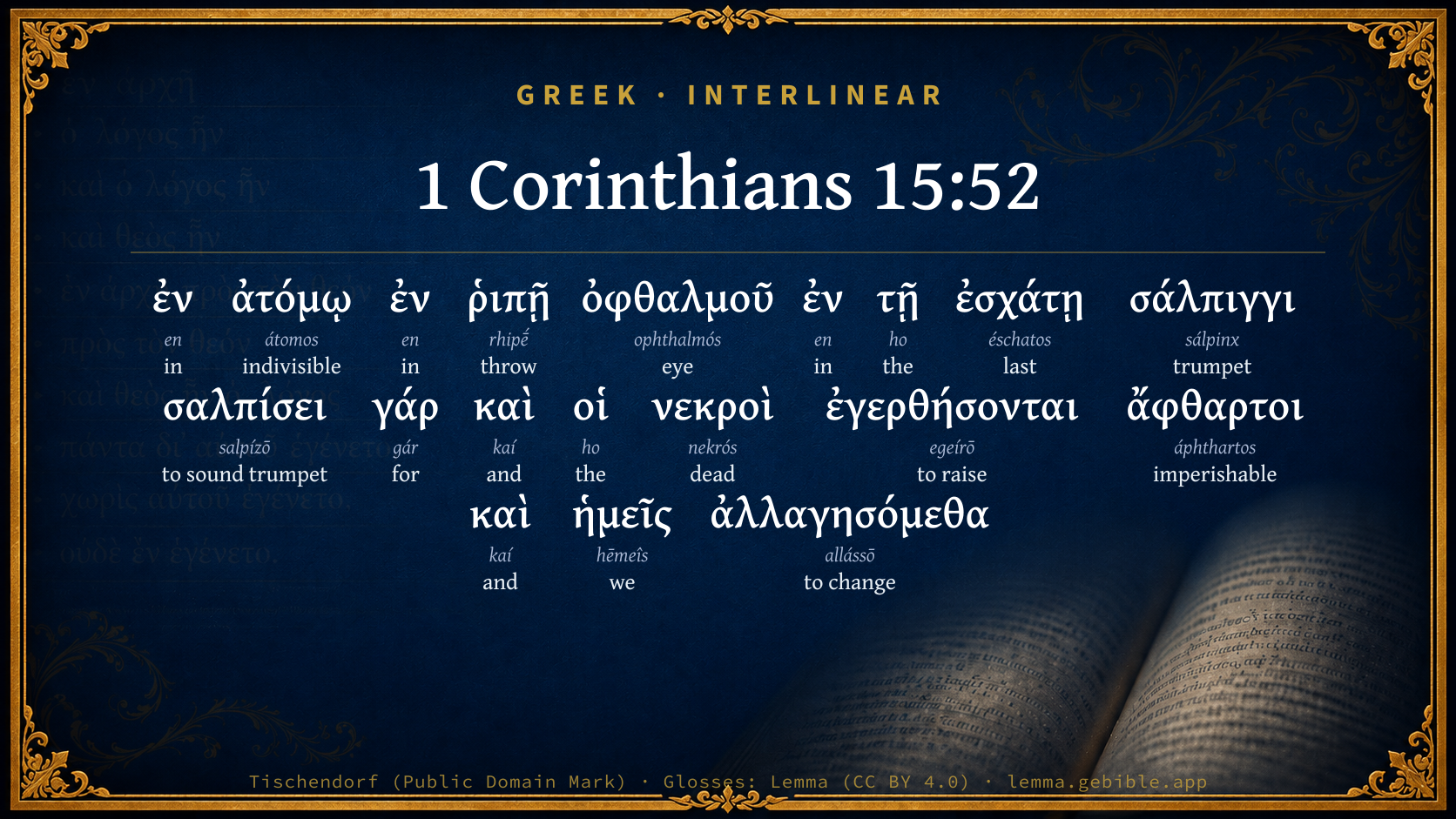
Download image
Cite this verse

1 Corinthians 15:52 (World English Bible). Public Domain. Lemma interlinear Bible study tool, https://lemma.gebible.app/v/1-corinthians/15/52.

Show BibTeX & RIS
BibTeX
RIS
English Translation
in a moment, in the twinkling of an eye, at the last trumpet. For the trumpet will sound, and the dead will be raised incorruptible, and we will be changed.
World English Bible · Public Domain
Highlights
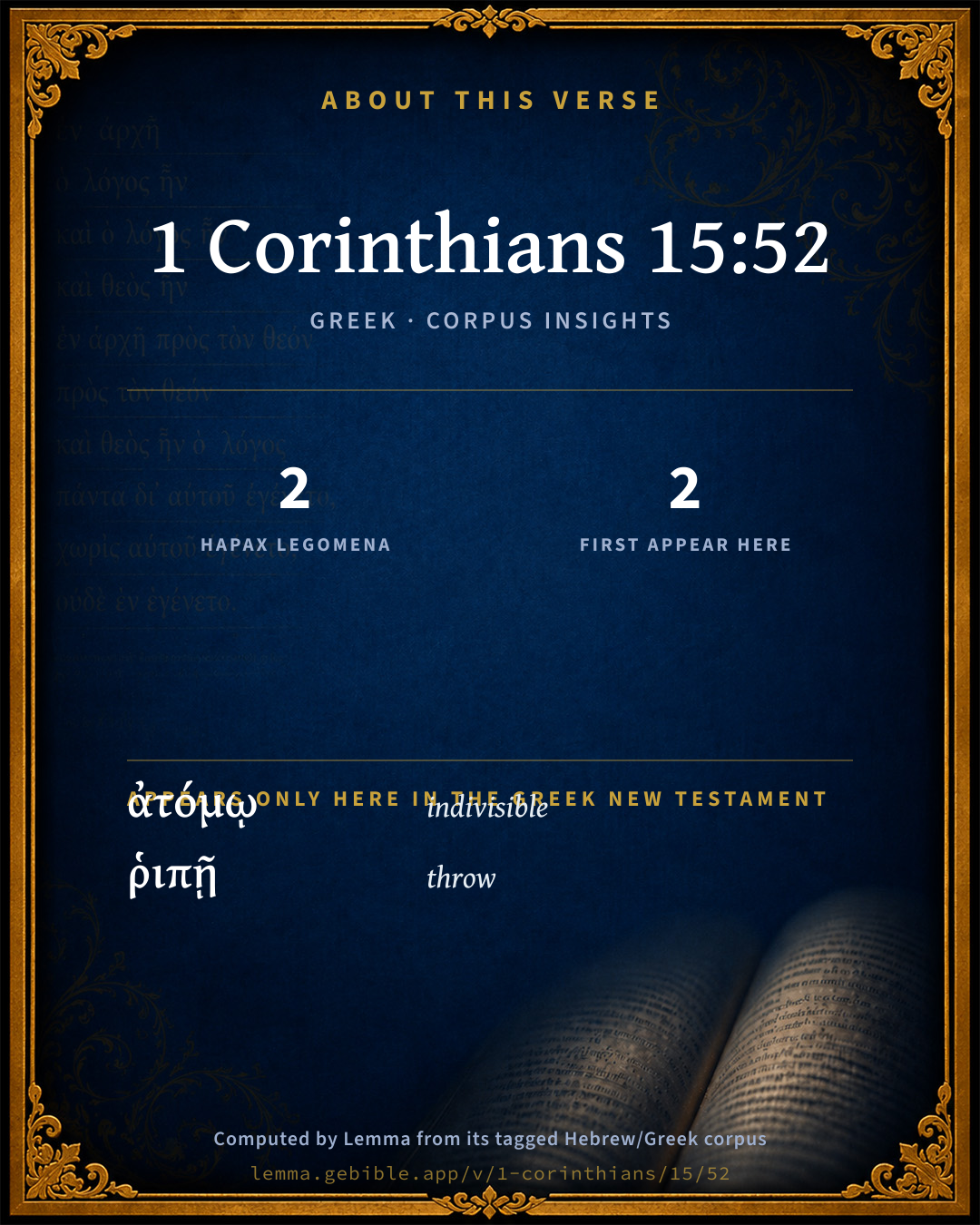
  • 2 hapax legomena — only here in the Greek New Testament
  • 2 first appearances in the Greek New Testament
Full analysis ↓
Download a study sheet

One document with this verse’s original text, its word-by-word gloss line, the meaning frame, cross-references with their text, attributed commentary, and full source and license credits — printable, and it pastes into notes with its structure intact.

This verse Autodidact and up

Study sheet (.html) Plain text (.txt)

A passage Seminary Student

Up to 50 verses in one chapter. A passage sheet keeps up to 6 commentary sources and 12 cross-references per verse, in the order this page ranks them, and says so on the sheet whenever that leaves anything out. Ask for a single verse and you get the Autodidact verse sheet above.

Everything on this page stays free to read, with no account — the sheet is a download of what is already on screen, not access to it.

Want to remove ads? Support Godless Engineer
Compare translations 3

The same verse in 3 English versions, stacked beneath the original-language interlinear above. Click any original word for its lexicon entry.

Each is an independent rendering of the whole verse — the interlinear is not word-aligned to these translations.

Highlighted words mark where these versions differ — a whole-verse word diff, not a word-by-word alignment.

  • World English Bible Public Domain
    in a moment, in the twinkling of an eye, at the last trumpet. For the trumpet will sound, and the dead will be raised incorruptible, and we will be changed.
  • King James Version Public Domain
    In a moment, in the twinkling of an eye, at the last trump: for the trumpet shall sound, and the dead shall be raised incorruptible, and we shall be changed.
  • unfoldingWord Literal Text CC BY-SA 4.0
    in an instant, in the twinkling of an eye, at the last trumpet. For a trumpet will sound, and the dead will be raised imperishable, and we will be changed.

unfoldingWord Literal Text — © unfoldingWord, licensed CC BY-SA 4.0. Word-aligned USFM3 via Door43 (git.door43.org/unfoldingWord/en_ult).

Versions to compare (up to 4)

3 of 4 selected

Show all 19 translations

Every available English version of this verse, each an independent rendering of the whole verse.

  • World English Bible Public Domain
    in a moment, in the twinkling of an eye, at the last trumpet. For the trumpet will sound, and the dead will be raised incorruptible, and we will be changed.
  • Berean Standard Bible Public Domain
    in an instant, in the twinkling of an eye, at the last trumpet. For the trumpet will sound, the dead will be raised imperishable, and we will be changed.
  • Majority Standard Bible Public Domain
    in an instant, in the twinkling of an eye, at the last trumpet. For the trumpet will sound, the dead will be raised imperishable, and we will be changed.
  • King James Version Public Domain
    In a moment, in the twinkling of an eye, at the last trump: for the trumpet shall sound, and the dead shall be raised incorruptible, and we shall be changed.
  • American Standard Version (1901) Public Domain
    in a moment, in the twinkling of an eye, at the last trump: for the trumpet shall sound, and the dead shall be raised incorruptible, and we shall be changed.
  • Revised Version (1885) Public Domain
    in a moment, in the twinkling of an eye, at the last trump: for the trumpet shall sound, and the dead shall be raised incorruptible, and we shall be changed.
  • Geneva Bible (1599) Public Domain
    In a moment, in the twinckling of an eye at the last trumpet: for the trumpet shall blow, and the dead shalbe raysed vp incorruptible, and we shalbe changed.
  • Douay-Rheims (1899) Public Domain
    In a moment, in the twinkling of an eye, at the last trumpet: for the trumpet shall sound, and the dead shall rise again incorruptible: and we shall be changed.
  • Young's Literal Translation Public Domain
    in a moment, in the twinkling of an eye, in the last trumpet, for it shall sound, and the dead shall be raised incorruptible, and we -- we shall be changed:
  • Literal Standard Version CC BY-SA 4.0
    in a moment, in the twinkling of an eye, in the last trumpet, for it will sound, and the dead will be raised incorruptible, and we will be changed;
  • Unlocked Literal Bible CC BY-SA 4.0
    We will be changed in a moment, in the twinkling of an eye, at the last trumpet. For the trumpet will sound, and the dead will be raised imperishable, and we will be changed.
  • unfoldingWord Literal Text CC BY-SA 4.0
    in an instant, in the twinkling of an eye, at the last trumpet. For a trumpet will sound, and the dead will be raised imperishable, and we will be changed.
  • Darby Bible Public Domain
    in an instant, in [the] twinkling of an eye, at the last trumpet; for the trumpet shall sound, and the dead shall be raised incorruptible, and *we* shall be changed.
  • World Messianic Bible Public Domain
    in a moment, in the twinkling of an eye, at the last shofar. For the shofar will sound and the dead will be raised incorruptible, and we will be changed.
  • Webster's Bible Public Domain
    In a moment, in the twinkling of an eye, at the last trumpet; for the trumpet shall sound, and the dead shall be raised incorruptible, and we shall be changed.
  • Free Bible Version CC BY-SA 4.0
    in a moment, in the blink of an eye, at the sound of the last trumpet. The trumpet will sound, and the dead will be raised never to die again, and we will be changed.
  • Bible in Basic English Public Domain
    In a second, in the shutting of an eye, at the sound of the last horn: for at that sound the dead will come again, free for ever from the power of death, and we will be changed.
  • Text-Critical English NT CC BY 4.0
    in an instant, in the twinkling of an eye, at the last trumpet call. For the trumpet will sound, and the dead will be raised imperishable, and we will be changed.
  • Tyndale New Testament (1534) Public Domain
    and that in a moment and in the twinclinge of an eye at the sounde of the last trompe. For the trompe shall blowe and the deed shall ryse incorruptible and we shalbe chaunged.

Literal Standard Version (2020), Covenant Press — licensed CC BY-SA 4.0. Text via the HelloAO Bible API (eBible.org). Unlocked Literal Bible (unfoldingWord) — licensed CC BY-SA 4.0. Text via the HelloAO Bible API (eBible.org). unfoldingWord Literal Text — © unfoldingWord, licensed CC BY-SA 4.0. Word-aligned USFM3 via Door43 (git.door43.org/unfoldingWord/en_ult). Free Bible Version, Dr. Jonathan Gallagher — licensed CC BY-SA 4.0. Text via the HelloAO Bible API (eBible.org).

Word by word

More ways to search: Search by grammar → Find every occurrence → Compare this word →

Practice this passage: Drill this verse → Learn its vocabulary →

ἀτόμῳ
átomos
G823
“indivisible”
Adjective, Dative, Singular, Neuter
Part of Speech
Adjective
Case
Dative
Number
Singular
Gender
Neuter
Full Thayer's Definition

Origin: from G1 (as a negative particle) and the base of G5114

TDNT: None

1. that cannot be cut in two, or divided, indivisible a. of a moment of time
  1. ἐν en G1722 “in” Preposition
  2. ἐν en G1722 “in” Preposition
  3. ῥιπῇ rhipḗ G4493 “throw” Noun, Dative, Singular, Feminine
  4. ὀφθαλμοῦ ophthalmós G3788 “eye” Noun, Genitive, Singular, Masculine
  5. ἐν en G1722 “in” Preposition
  6. τῇ ho G3588 “the” Article, Dative, Singular, Feminine
  7. ἐσχάτῃ éschatos G2078 “last” Adjective, Dative, Singular, Feminine, Superlative
  8. σάλπιγγι sálpinx G4536 “trumpet” Noun, Dative, Singular, Feminine
  9. σαλπίσει salpízō G4537 “to sound trumpet” Verb, Future, Active, Indicative, 3rd person, Singular
  10. γάρ gár G1063 “for” Conjunction
  11. καὶ kaí G2532 “and” Conjunction
  12. οἱ ho G3588 “the” Article, Nominative, Plural, Masculine
  13. νεκροὶ nekrós G3498 “dead” Adjective, Nominative, Plural, Masculine
  14. ἐγερθήσονται egeírō G1453 “to raise” Verb, Future, Passive, Indicative, 3rd person, Plural
  15. ἄφθαρτοι áphthartos G862 “imperishable” Adjective, Nominative, Plural, Masculine
  16. καὶ kaí G2532 “and” Conjunction
  17. ἡμεῖς hēmeîs G2249 “we” Personal pronoun, 1st person, Nominative, Plural
  18. ἀλλαγησόμεθα allássō G236 “to change” Verb, Future, Passive, Indicative, 1st person, Plural

About this verse

These counts appear in no published source. They are computed here, from the morphology-tagged text and Lemma’s own curated glosses. What Lemma adds →

19
words
15
distinct lemmas
Pauline Epistles
section

Notable vocabulary

2 hapax legomena — words that appear only here in the entire Greek New Testament:

  • ἀτόμῳ indivisible G823
  • ῥιπῇ throw G4493

First appearance in Scripture

These words make their first canonical appearance in the Greek New Testament here:

  • ἀτόμῳ indivisible G823
  • ῥιπῇ throw G4493

Shared distinctive vocabulary

ἄφθαρτοι imperishable G862 occurs in 7 verses of the Greek New Testament. Also found in:
Repetition

Words recur within this verse:

Cross-references

22

Topical passages linked to 1 Corinthians 15:52 in the Treasury of Scripture Knowledge — connected by theme and wording, ordered by reader-vote popularity; previews shown in the World English Bible.

  • 1 Thessalonians 4:16–17 For the Lord himself will descend from heaven with a shout, with the voice of the archangel, and with God's trumpet. The dead in Christ will rise first,
  • Matthew 24:31 He will send out his angels with a great sound of a trumpet, and they will gather together his chosen ones from the four winds, from one end of the sky to the other.
  • John 5:28 Don't marvel at this, for the hour comes, in which all that are in the tombs will hear his voice,
  • John 5:25 Most assuredly, I tell you, the hour comes, and now is, when the dead will hear the Son of God's voice; and those who hear will live.
  • Isaiah 27:13 It shall happen in that day, that a great trumpet shall be blown; and they shall come who were ready to perish in the land of Assyria, and those who were outcasts in the land of Egypt; and they shall worship Yahweh in the holy mountain at Jerusalem.
  • 1 Corinthians 15:42 So also is the resurrection of the dead. It is sown in corruption; it is raised in incorruption.
  • 2 Peter 3:10 But the day of the Lord will come as a thief in the night; in which the heavens will pass away with a great noise, and the elements will be dissolved with fervent heat, and the earth and the works that are in it will be burned up.
  • Zechariah 9:14 Yahweh will be seen over them; And his arrow will go flash like lightning; And the Lord Yahweh will blow the trumpet, And will go with whirlwinds of the south.
  • Isaiah 18:3 All you inhabitants of the world, and you dwellers on the earth, when an ensign is lifted up on the mountains, look; and when the trumpet is blown, listen.
  • Ezekiel 33:6 But if the watchman sees the sword come, and doesn't blow the trumpet, and the people aren't warned, and the sword comes, and take any person from among them; he is taken away in his iniquity, but his blood will I require at the watchman's hand.
  • 1 Corinthians 15:50 Now I say this, brothers, that flesh and blood can't inherit the Kingdom of God; neither does corruption inherit incorruption.
  • Revelation 9:13–14 The sixth angel sounded. I heard a voice from the horns of the golden altar which is before God,
  • Revelation 8:13 I saw, and I heard an eagle, flying in mid heaven, saying with a loud voice, "Woe! Woe! Woe for those who dwell on the earth, because of the other voices of the trumpets of the three angels, who are yet to sound!"
  • Exodus 19:16 It happened on the third day, when it was morning, that there were thunders and lightnings, and a thick cloud on the mountain, and the sound of an exceedingly loud trumpet; and all the people who were in the camp trembled.
  • Ezekiel 33:3 if, when he sees the sword come on the land, he blow the trumpet, and warn the people;
  • Revelation 8:2 I saw the seven angels who stand before God, and seven trumpets were given to them.
  • Exodus 20:18 All the people perceived the thunderings, the lightnings, the sound of the trumpet, and the mountain smoking. When the people saw it, they trembled, and stayed at a distance.
  • Psalms 73:19 How they are suddenly destroyed! They are completely swept away with terrors.
  • Exodus 33:5 Yahweh said to Moses, "Tell the children of Israel, 'You are a stiff-necked people. If I were to go up into your midst for one moment, I would consume you. Therefore now take off your jewelry from you, that I may know what to do to you."
  • Numbers 10:4 If they blow but one, then the princes, the heads of the thousands of Israel, shall gather themselves to you.
  • Numbers 16:21 Separate yourselves from among this congregation, that I may consume them in a moment.
  • Numbers 16:45 Get away from among this congregation, that I may consume them in a moment. They fell on their faces.

Cross-references courtesy of OpenBible.info (CC BY 4.0).

Commentary

Notes on 1 Corinthians 15:52 from classic Christian and Jewish commentators (each source and its license shown beneath its notes). The classic Christian expositions comment on the surrounding passage and are grouped to its opening verse, so a note may address several verses; the Jewish commentaries on the Tanakh (Rashi and others) are per-verse, so they appear only where the commentator wrote on this verse.

Lemma curates 59 commentaries, every one of them public domain or Creative Commons licensed, each selected and text-cleaned for this edition rather than reprinted as found. About our sources →

Tyndale Open Study Notes

Tyndale Open Resources

15:52 Cp. 1 Thes 4:13-17.

Tyndale Open Study Notes — © Tyndale Open Resources, licensed CC BY-SA 4.0. Text via the HelloAO Bible API.

Bengel's Gnomon

Johann Albrecht Bengel

1Co 15:52. Ἐν ἀτόμῳ, in a moment) Lest it should be considered hyperbolical, he adds a more popular phrase, in the twinkling of an eye. An extraordinary work of divine omnipotence! Who then can doubt, but that man even at death may be suddenly freed from sin?—σάλπιγγι, at the trumpet) The full description of the trumpets is reserved for the Apocalypse; yet some things may be gathered from Mat 24:31; 1Th 4:16, concerning the last trumpet; and this epithet is expressed here, as one that takes for granted the trumpets, that have preceded it; either because the Spirit has inspired Paul with an allusion, which anticipates the Apocalypse, or because Scripture long before teaches, that some trumpets, though not definitely enumerated, are before the last. Isa 27:13; Jer 51:27; Zec 9:14; Heb 12:19; 2Es 5:4: or especially in relation to the trumpet at the ascension, Psa 47:6, comp. Act 1:11: for one may be called the last, where two only are referred to, 1Co 15:45; not to say, where there is only one [sounding of a trumpet], without another following, Rev 10:7.—σαλπίσει γὰρ) for the Lord [Engl. V. the trumpet] shall sound by His archangel, 1Th 4:16. The trumpet was formerly used on feast days for the purpose of assembling the people.—καὶ) and immediately.—ἄφθαρτοι, incorruptible) Strictly speaking, one would think, that they should have been called immortal; for incorruptibility will be put on by means of the change, 1Co 15:53; but incorruptibility includes immortality.

Bengel's Gnomon of the New Testament — English translation (T&T Clark, Edinburgh, 1860) — public domain. Text from a community e-Sword module.

Meyer's Critical & Exegetical Commentary

Heinrich August Wilhelm Meyer

1Co_15:52. Ἐν ἀτόμῳ, ἐν ῥιπῇ ὀφθ.] A double, because a thoroughly designed and extremely exact description of the suddenness of the ἀλλαγησ., which is meant wholly to exclude even the possibility of those still alive having first, perhaps, to die at the Parousia, in order to come into the resurrection-lif.

ἄτομον, what is indivisible, an atom (Plato, Soph. p. 229 D), is here a little indivisible point of time. ἐν ἀτόμῳ· ἐν ῥιπήματι, Hesychius. Comp. the phrase, current in Greek writers, ἐν ἀκαρεῖ (Lucian, As. 37; Alciphron. iii. 25).

ἐν τῇ ἐσχ. σάλπιγγι] at the last trumpet, while it is sounded (by an archangel). See Winer, p. 361 [E. T. 482]. Comp. ἐν αὐλοῖς, Pindar, Ol. v. 45. Paul might also have written: ἀπὸ … σάλπιγγος, Polyb. iv. 13. 1. Regarding the subject-matter, comp. 1Th_4:16, and Lünemann and Ewald on that passage. The last trumpet is that sounding at the final moment of this age of the world. It does not conflict with this statement, if we suppose that Paul conceived the second resurrection also (1Co_15:24) to take place with trumpet-sound, for ἐσχ. has its temporal reference in αἰὼν οὗτος. De Wette (so, too, in the form of a suggestion, Vatablus; and comp. previously, Theodoret of Mopsuestia) thinks of the last among several trumpet-signals, against which, however, is the simple, not more precisely defined σαλπίσει γάρ which follows. This, too, in opposition to Osiander, van Hengel, Maier, and Hofmann. To understand, with Olshausen, who follows older expositors (τινές even already in Theophylact), the seventh trumpet, Rev_8:9, with which, along with the trumpets of Jericho, Hofmann also compares it, is to place it on the same level with the visions of the Revelation, for doing which we have no ground, since in 1 Thess. too, l.c., only one trumpet is mentioned, and that one taken for granted as well known. It is true that the Rabbins also taught that God will sound the trumpet seven times, and that in such a way that the resurrection will develope itself in seven acts;[94] but this conception, too, was foreign to the apostle, seeing that he represents the rising as an instantaneous event without breaks of development. It may be added, that the trumpet of the Parousia (see, already, Mat_24:31) is not to be explained away, either with Wolf and others: cum signa apparebunt judicii jam celebrandi, or, with Olshausen (comp. Maier), of a startling work of the Spirit, arousing mankind for a great end. Comp., too, Theophylact, who understands by the σάλπιγξ the ΚΈΛΕΥΣΜΑ and ΝΕῦΜΑ of God ΤῸ ΔΙᾺ ΠΆΝΤΩΝ ΦΘΆΝΟΝ; as in substance also Usteri, p. 356, Billroth, Neander, Hofmann.[95] As regards the phrase in itself, we might compare the Homeric ἀμφὶ δὲ σάλπιγξεν μέγας οὐρανός, Il. xxi. 388, where the thunder (as signal for the onset) is meant. But the connection gives us no right whatever to assume a non-literal, imaginative representation. On the contrary, Paul has in fact carried with him the conception of the resurrection-trumpet (resting upon Exo_19:16) from the popular sphere of conception, attested also in Matt. l.c. (comp. 4 Esdr. 6:24), into his Christian sphere,[96] as he then himself adds forthwith by way of confirmation and with solemn emphasis: σαλπίσει γὰρ κ.τ.λ.] for the trumpet shall sound, and the dead (the Christians who have already died up to that time) shall be raised incorruptible, and we (who are still alive then) shall be changed. The paratactic expression (instead of ὅτε γάρ, or some other such form of subordination) should of itself have been sufficient to prevent the divesting the ΣΑΛΠ. ΓΆΡ. of its emphasis by regarding it simply as an introduction to what follows in connection with ἘΝ Τ. ἘΣΧ. ΣΆΛΠ. (Hofmann); comp. Kühner, § 720, 4; Winer, p. 585 [E. T. 785]. A special attention is to be given to the ΣΑΛΠΊΣ. Instead of ἩΜΕῖς ἈΛΛΑΓ., Paul might have written ΟἹ ΖῶΝΤΕς ἈΛΛΑΓΉΣΟΝΤΑΙ; but from his persuasion that he should live to see the Parousia, he includes himself with the rest.[97] Comp. on 1Co_15:51. Van Hengel is wrong in referring οἱ νεκροί to those now (when Paul wrote) already dead, and ἡμεῖς to those now still alive, of whom a part will then be also dead; ἀλλαγ. can apply only to the change of the living.

σαλπίσει (sc. ὁ σαλπιγκτής) has become in its use just as impersonal as ὝΕΙ, ΝΊΦΕΙ, al. See Elmsl. ad Heracl. 830; Kühner, II. p. 36, and ad Xen. Anab. i. 2. 17. The form σαλπίσω instead of ΣΑΛΠΊΓΞΩ is later Greek. See Lobeck, ad Phryn. p. 191.

[94] Primo sono totus mundus commovebitur; secundo pulvis separabitur; tertio ossa colligentur … tuba septima vivi stabunt pedibus suis. See Eisenmenger, entdeckt. Judenth. II. p. 929.

[95] Lenge in the Stud. u. Krit. 1836, p. 708, thinks of a revolution of the earth. which will be the signal of the advent of Christ. Osiander holds that the victory over the last enemy (vv. 25, 27) is pointed at. According to de Wette, it is generally the apocalyptic figure for solemn, divinely-effected catastrophes.

[96] The recognition of this form of conception by no means implies that a dogma is to be made out of it.

[97] As in 1Th_4:15 ff., to which passage, however, this one does not stand in the relation of a further advance of development, or more thorough liberation from Rabbinical reminiscences (Krauss, p. 172); for the two passages agree in substance, and they supplement each other. The incapacity, too, of the flesh for inheriting the kingdom forms the necessary presupposition for 1Th_4:17. And the restoration of all is not taught even in our passage, ver. 54 f., where the final shout of triumph of the redeemed (ver. 26 f.) is heard.

Meyer — Critical and Exegetical Commentary on the New Testament — English translation by Peter Christie, edited by Frederick Crombie (T&T Clark, 1880) — public domain. Text from a community e-Sword module.

Expositor's Greek Testament

ed. W. Robertson Nicoll

1Co 15:52-53 . The necessity for change, negatively declared in 1Co 15:50 , is now reaffirmed positively, as a necessity lying in the nature and relations of the changed: “For this corruptible (perishable) is bound ( δεῖ : cf. 1Co 11:19 ) to put on incorruption (imperishableness), and this mortal to put on immortality”. The double τοῦτο speaks, as in 2Co 5:2 , Rom 7:24 , out of P.’s painful self-consciousness: cf. 2Co 4:10 , Gal 6:17 . τὸ θνητὸν and τὸ φθαρτόν ( concrete , of felt necessity: ἡ φθορά , 50, abstract , of general principle) relate, as in 1Co 15:42 ff., to the present, living body of the ἡμεῖς , not to the dead body deposited in the grave. The aforesaid “change” is now represented as an investiture ( ἐνδύσασθαι ) with incorruption and immortality; the two ideas are adjusted in 2Co 5:4 , where it is conceived that the living Christian will “put on” the new, spiritual body “over” ( ἐπ - ενδύσασθαι ) his earthly frame, which will then be “absorbed” ( καταποθῇ ) by it.

The Expositor's Greek Testament, edited by W. Robertson Nicoll (1897–1910) — public domain. Text from a community e-Sword module.

Hodge's Commentary on Romans, Ephesians & First Corinthians

Charles Hodge

1Co_15:52

In a moment, in the twinkling of an eye, at the last trump: for the trumpet shall sound, and the dead shall be raised incorruptible, and we shall be changed.

The change in question is to be instantaneous; in a moment, literally, an atom, i.e. in a portion of time so short as to be incapable of further division. It is to take place at the last trump, i.e. on the last day. As the trumpet was used for assembling the people or marshaling a host, it became the symbol for expressing the idea of the gathering of a multitude. So, in Mat_24:31, Christ says, He will send his angels with a great sound of a trumpet; and they shall gather his elect from the four winds, from one end of heaven to another. Comp. Isa_27:13; 1Th_4:16. This trumpet is called the last, not because several trumpets (the Jews say seven) are to sound in succession, but because it is the last that ever is to sound. In other words, the resurrection is to take place on the last day. For the trumpet shall sound. This is a confirmation of the preceding. That day shall surely come the voice of the archangel, the trump of God, shall certainly resound as it did from Sinai, Exo_19:16. And, i.e. and then, in consequence of the summons of God, the dead shall be raised in the manner described in 1Co_15:42, 1Co_15:43, incorruptible, glorious and powerful. And we shall be changed. This is in exact accordance with 1Th_4:15. Those who are alive when Christ comes shall not prevent them which are asleep. The dead in Christ shall rise first, and then the living shall undergo their instantaneous change. As remarked on the preceding verse, it is not necessary to understand the apostle as including himself and fellow believers in Corinth, when he says We shall be changed. The connection indeed is different here from what it is there. There he says, We shall not all die. If that means that the men of that generation should not all die, it is a positive assertion of what the event has proved to be false. But here he simply says, all who are alive when Christ comes shall be changed. If he hoped that he might be of the number there would be nothing in that expectation inconsistent with his inspiration. Calvin, therefore, so understands the passage.‹29› Considering, however, his express teaching in 2Th_2:2-12 on the subject, it is far more natural to understand him as contemplating the vast company of believers as a whole, and saying Those of us who are dead shall rise, and all who are alive shall be changed.

Charles Hodge — Commentary on Romans (1835), First Corinthians (1857), and Ephesians (1856) — public domain. Text from a community e-Sword module.

Geneva Bible (1599)

Geneva Bible translators

He showeth us that the time shall be very short.

Geneva Bible (1599) marginal notes — public domain. Text via Bolls.life.

Jamieson, Fausset & Brown

Robert Jamieson, A. R. Fausset & David Brown

the last trump--at the sounding of the trumpet on the last day [VATABLUS] (Mat 24:31; Th1 4:16). Or the Spirit by Paul hints that the other trumpets mentioned subsequently in the Apocalypse shall precede, and that this shall be the last of all (compare Isa 27:13; Zac 9:14). As the law was given with the sound of a trumpet, so the final judgment according to it (Heb 12:19; compare Exo 19:16). As the Lord ascended "with the sound of a trumpet" (Psa 47:5), so He shall descend (Rev 11:15). The trumpet was sounded to convoke the people on solemn feasts, especially on the first day of the seventh month (the type of the completion of time; seven being the number for perfection; on the tenth of the same month was the atonement, and on the fifteenth the feast of tabernacles, commemorative of completed salvation out of the spiritual Egypt, compare Zac 14:18-19); compare Psa 50:1-7. Compare His calling forth of Lazarus from the grave "with a loud voice," Joh 11:43, with Joh 5:25, Joh 5:28.

and--immediately, in consequence.

Jamieson, Fausset & Brown — Commentary Critical and Explanatory on the Whole Bible (1871) — public domain (CC PDM 1.0). Text via the HelloAO Bible API.

Adam Clarke's Commentary

Verse 52. In a moment] ενατομω. In an atom; that is, an indivisible point of time. In the twinkling of an eye; as soon as a man can wink; which expressions show that this mighty work is to be done by the almighty power of God, as he does all his works, He calls, and it is done. The resurrection of all the dead, from the foundation of the world to that time, and the change of all the living then upon earth, shall be the work of a single moment.

At the last trump] This, as well as all the rest of the peculiar phraseology of this chapter, is merely Jewish, and we must go to the Jewish writers to know what is intended. On this subject, the rabbins use the very same expression. Thus Rabbi Akiba: "How shall the holy blessed God raise the dead? We are taught that God has a trumpet a thousand ells long, according to the ell of God: this trumpet he shall blow, so that the sound of it shall extend from one extremity of the earth to the other. At the first blast the earth shall be shaken; at the second, the dust shall be separated; at the third, the bones shall be gathered together; at the fourth, the members shall wax warm; at the fifth, the heads shall be covered with skin; at the sixth, the souls shall be rejoined to their bodies; at the seventh, all shall revive and stand clothed." See Wetstein. This tradition shows us what we are to understand by the last trump of the apostle; it is the seventh of Rab. Akiba, when the dead shall be all raised, and, being clothed upon with their eternal vehicles, they shall be ready to appear before the judgment seat of God.

For the trumpet shall sound] By this the apostle confirms the substance of the tradition, there shall be the sound of a trumpet on this great day; and this other scriptures teach: see Zec 9:14; Mt 24:31; Joh 5:25; 1Th 4:16, in which latter place, the apostle treats this subject among the Thessalonians, as he does here among the Corinthians. See the notes there.

Shall be raised incorruptible] Fully clothed with a new body, to die no more.

We shall be changed.] That is, those who shall then be found alive.

Adam Clarke's Commentary on the Bible (1810–1826) — public domain. Text from a community e-Sword/MySword module.

Ellicott's Commentary for English Readers

(52) The last trump.—The trumpet was used to summon an assembly (Exo_20:18; Psa_81:3; Isa_18:3; Isa_27:13) or to sound a warning. The last trumpet is the one which concludes a series which have already been sounding at intervals in notes of warning to the nations (Psa_47:5; Isa_27:13; Jer_51:27). This verse states with reiterated emphasis that this change shall not be a protracted process, but a sudden and momentary alteration in the condition of our bodies.

A Bible Commentary for English Readers, edited by Charles John Ellicott (1878–1897) — public domain. Text from a community e-Sword module.

The Cambridge Bible for Schools and Colleges

gen. ed. J. J. S. Perowne

52. in a moment] The literal meaning of the word here used is, that which is so small as to be actually indivisible.

in the twinkling of an eye] Some MSS. read ῥοπῇ for ῥιπῇ, i.e. the downward motion of the eyelid (literally, the inclination of the scale), for the rapid movement suggested by the word twinkling. The latter suits the context best.

at the last trump] Some have referred this to the last of the seven trumpets in Revelation 8-11. See especially Rev_10:7. But this cannot be, since the visions recorded in that book had not yet been seen. It must therefore mean the trumpet which will sound on the last day. Cf. St Mat_24:31 and 1Th_4:16.

and we shall be changed] The we is emphatic; therefore the Apostle here expresses once more his belief that he will be alive at the coming of Christ; for, “since the last times were already come, the saints expected that day from hour to hour.” Calvin.

The Cambridge Bible for Schools and Colleges (gen. ed. J. J. S. Perowne; Cambridge University Press, 1878–1918) — public domain. Text from a community e-Sword module.

John Gill's Exposition

O death, where is thy sting?.... These words, with the following clause, are taken out of Hos 13:14 and that they belong to the times of the Messiah, the ancient Jews acknowledge; and the Chaldee paraphrase interprets them of the Logos, or Word of God, rendering them thus,

"my Word shall be among them to kill, and my Word to destroy;''

wherefore the apostle is not to be charged with a misapplication of them, nor with a perversion of them, as he is by the Jew (s): in the prophet they are thus read, "O death, I will be thy plagues, O grave, I will be thy destruction"; between which, and the apostle's citation of them, there is some difference; the word which we render in both clauses, "I will be", the apostle translates "where", and that very rightly, and so it should be rendered there; and so it is by the Septuagint interpreters, who render the whole as he, with a little variation, "where is thy revenge, O death? where is thy sting, O grave?" and so the Arabic version of Hosea still nearer the apostle, "where is now thy victory, O death?" or "where is thy sting, O grave?" and even the Chaldee paraphrase on Hos 13:14 renders the same word "where"; for instead of, "I will be thy king", the Targum reads, , "where is thy king?" and Aben Ezra, a Jewish writer of great note, on Hos 13:14 observes, that there are some that say the word is to be inverted as if it was "where", and he adds, and it is right; a like observation he makes on those words in Co1 15:14 and that that is the true sense of the word in both verses, is attested by Ebn Jannahius Tanchuma (t); so that the apostle is thus far to be justified, in his citation of this passage: it is further to be observed, that instead of "thy plagues", he reads, "thy sting"; and I doubt not, but that among the many things which signifies, as it must be owned it does signify the plague, or pestilence, see Psa 90:6 and which perhaps is so called, from the venomous nature of it, and the poisonous sting that is in it, so likewise a sting, though there is no instance of it; certain it is, that bees are called and as Cocceius (u) observes, from their sting; and so in the Chaldee and Arabic languages, a bee, or a wasp, is called and it is to such sort of creatures, that the allusion is here made; who having lost their stings, can do no hurt; and which will be the case of death in the resurrection morn, when risen saints will insult over it in this triumphant manner; having nothing more to fear from it, any more than a man has to be afraid of any animal whatever, that has lost its sting: and in the following clause,

O grave, where is thy victory? instead of "destruction", as it must be allowed the word signifies, see Psa 90:6 the apostle reads victory; but then there is no difference in the sense; for the grave gets its victory over its thousands, and ten thousands, and ten thousand times ten thousands, and millions of millions, by the destruction of them, which now it glories in, and boasts of; but in the resurrection morn, when its destruction will be at an end, the triumphant saints may reasonably ask, where is its boasted victory, since it can destroy no longer.

(s) R. lsaac Chizzuk Emuna, par. 2. c. 87. p. 463. (t) Apud Pocock. Not. Miscellan. ad Port. Mosis, p. 69, 70. (u) Lex. Heb. in rad.

John Gill's Exposition of the Whole Bible (1746–1763) — public domain (CC PDM 1.0). Text via the HelloAO Bible API.

Trapp's Complete Commentary

John Trapp

52 In a moment, in the twinkling of an eye, at the last trump: for the trumpet shall sound, and the dead shall be raised incorruptible, and we shall be changed.

Ver. 52. The trumpet shall sound] As at the giving of the law it did, Exo 19:16. If the law were thus given (saith a divine), how shall it be required? If such were the proclamation of God’s statutes, what shall the sessions be? I see and tremble at the resemblance; the trumpet of the angel called to the one; the trumpet of the archangel shall summon us to the other. In the one the mount only was on a flame; all the world shall be so in the other. To the one Moses says, God came with ten thousands of his saints; in the other thousand thousands shall minister to him, and ten thousand thousands shall stand before him.

John Trapp, A Commentary or Exposition upon All the Books of the Old and New Testament (1647–1656) — public domain. Text from a community e-Sword module.

Albert Barnes' Notes on the Bible

In a moment - (ἐν ἀτόμῳ en atomō). In an “atom,” scil. of time; a point of time which cannot be cut or divided (α a, the alpha privative (“not”) and τομη tomē, from τέμνω temnō, “to cut”). A single instant; immediately. It will be done instantaneously.

In the twinkling of an eye - This is an expression also denoting the least conceivable duration of time. The suddenness of the coming of the Lord Jesus is elsewhere compared to the coming of a thief in the night; 2Pe 3:10. The word rendered “twinkling” (ῥιπῆ ripē, from ῥίπτω rhiptō, “to throw, cast”) means “a throw, cast, jerk,” as of a stone; and then “a jerk of the eye,” that is, “a wink” - Robinson.

At the last trump - When the trumpet shall sound to raise the dead. The word “last” here does not imply that any trumpet shall have been before sounded at the resurrection, but is a word denoting that this is the consummation or close of things; it will end the economy of this world; it will be connected with the last state of things.

For the trumpet shall sound - See the note at Mat 24:31.

And the dead shall be raised - See the note at Joh 5:25.

Albert Barnes' Notes on the Bible (1834–1885) — public domain. Text from a community e-Sword/MySword module.

Haydock's Catholic Bible Commentary

In a moment, &c. By the power of the Almighty all shall rise again in their bodies, either to a happy or a miserable resurrection. (Witham)

George Leo Haydock (1774–1849), Haydock's Catholic Family Bible and Commentary, 1859 edition — public domain. Excludes Psalms (Douay-Rheims chapter numbering differs from Protestant) and Deuterocanonical books (Catholic canon only).

Matthew Poole's English Annotations

This change will be on the sudden, in a moment; either upon the will and command of Christ, which shall be as effectual to call persons out of their graves, as a trumpet is to call persons together; or rather, upon a sound made like to the sound of a trumpet, as it was at the giving of the law upon Sinai, Exo 19:16. We read of this last trump, Mat 24:31; 1Th 4:16. There shall (saith the apostle) be such a sound made; and upon the making of it, the saints, that are dead, shall be raised out of their graves; not with such bodies as they carried thither, (which were corruptible), but with such bodies as shall be no more subject to corruption; and those who at that time shall be alive, shall one way or another be

changed, and be also put into an incorruptible state.

Matthew Poole's English Annotations on the Holy Bible (1683–1685) — public domain. Text from a community e-Sword/MySword module.

Whedon's Commentary on the Bible

Daniel D. Whedon

52. In a moment—Εν ατομω. In an atom of time; in an indivisible instant. In the twinkling (literally, stroke) of the eye. Quick as a jerk of the eyelash.

The last trump—See note, 1Th_4:6.

We… changed—St. Paul’s present we conceptually includes not quite the same as the first we of 1Co_15:51, but all the living in the body at the parousia.

Daniel D. Whedon (gen. ed.), Commentary on the Old and New Testaments (1874–1909) — public domain. Text from a community e-Sword module.

The Pulpit Commentary

The trumpet shall sound. The Lord, he says, in 1Th_4:16, "shall descend from heaven with the voice of the archangel, and with the trump of God." The trumpet is, of course, only a natural symbol. It is also found in rabbinic writers, and in the Old Testament, (Zec_9:14) as well as in Rev_11:15. We shall be changed. The dead shall be changed by resurrection, the living by transition, into a glorified body. St. Paul, dealing with the essence of the question as it bore on the difficulties of his readers, says nothing here

(1) of those who will arise to judgment, or

(2) of any intermediate condition.

As to the former question, he scarcely ever alludes to it with any definiteness, but seems with deliberate choice to contemplate the final and absolute triumph of good. (Rom_8:19-23 Rom_11:30-36) To the intermediate state he does not here allude. He is here only speaking of death and glorious resurrection. In 2Co_5:1-4 he says all that he has to say on this latter question. It was not prominent in the minds of the early Christians, who, as Calvin says, were awaiting the return of Christ "from hour to hour."

The Pulpit Commentary (1880–1919), ed. H.D.M. Spence-Jones & Joseph S. Exell — public domain. Text from a community e-Sword module.

John Wesley's Explanatory Notes

In a moment - Amazing work of omnipotence! And cannot the same power now change us into saints in a moment? The trumpet shall sound - To awaken all that sleep in the dust of the earth.

John Wesley, Explanatory Notes Upon the Whole Bible (1754–1765) — public domain. Text via the GEBible commentary corpus.

Scofield Reference Notes

C. I. Scofield

raised

Resurrection, Summary:

(1) The resurrection of the dead was believed by the patriarchs Gen 22:5; Heb 11:19; Job 19:25-27 and revealed through the prophets; Isa 26:19; Dan 12:2; Dan 12:13; Hos 13:14 and miracles of the dead restored to life are recorded in the O.T.; 2Ki 4:32-35; 2Ki 13:21.

(2) Jesus Christ restored life to the dead Mat 9:25; Luk 7:12-15; Joh 11:43; Joh 11:44 and predicted His own resurrection; Joh 10:18; Luk 24:1-8.

(3) A resurrection of bodies followed the resurrection of Christ Mat 27:52; Mat 27:53 and the apostles raised the dead; Act 9:36-41; Act 20:9; Act 20:10.

(4) Two resurrections are yet future, which are inclusive of "all that are in the graves" Joh 5:28. These are distinguished as "of life"; 1Co 15:22; 1Co 15:23; 1Th 4:14-17; Rev 20:4 and "of judgment"; Joh 5:28; Joh 5:29; Rev 20:11-13. They are separated by a period of one thousand years Rev 20:5. The "first resurrection," that "unto life," will occur at the second coming of Christ 1Co 15:23 the saints of the O.T. and church ages meeting Him in the air 1Th 4:16; 1Th 4:17 while the martyrs of the tribulation, who also have part in the resurrection Rev 20:4 are raised at the end of the great tribulation.

(5) The mortal body will be related to the resurrection body as grain sown is related to the harvest 1Co 15:37; 1Co 15:38 that body will be incorruptible, glorious, powerful, and spiritual 1Co 15:42-44; 1Co 15:49.

(6) The bodies of living believers will, at the same time, be instantaneously changed 1Co 15:50-53; Php 3:20; Php 3:21. This "change" of the living, and resurrection of the dead in Christ, is called the "redemption of the body"; Rom 8:23; Eph 1:13; Eph 1:14.

(7) After the thousand years the "resurrection unto judgment" Joh 5:29 occurs. The resurrection-body of the wicked dead is not described. They are judged according to their works, and cast into the lake of fire. Rev 20:7-15.

The Scofield Reference Bible (1917 edition), notes by C. I. Scofield — public domain. Text from a community e-Sword module.

Godbey's Commentary on the New Testament

William B. Godbey

52. “In a moment, in the twinkling of an eye, at the last trumpet: for the trumpet will sound, and the dead will rise incorruptible, and we shall be changed.” The case is very clear here that Paul is speaking of the rapture of the saints, as there is no allusion whatever to the wicked. In the final resurrection the wicked as well as all the righteous not identified with the Bridehood will rise about the same time, perhaps even then a short interval between the righteous and the wicked. Hence we see from this Scripture that the living saints at the sound of the trumpet will all be translated instantaneously. This is beautifully corroborated in 1Th 4:13-18; 1Th 5:1-11, including a large paragraph devoted to this subject. There we learn that, when the Lord descends with a shout and with the trump of the archangel, the buried saints will first leap out of their graves all round the world. Then, “we who are alive, having been left, shall be caught up to meet the Lord in the air, and thus we shall be forever with the Lord.” Hence we see that the interval between the resurrection of the saints and the translation of the living will be very brief; because the latter will fly right up, and along with the former meet the Lord in the air. The most inspiring privilege of the Lord’s people, is to be living on the earth when He returns, and thus honored with the translation. Hence we have here the two distinct methods by which the Lord’s saints will enter the glorified state, i. e., translation and resurrection. In either case we pass into the transfiguration glory of our risen and ascended Lord.

William B. Godbey, Commentary on the New Testament (1896–1900) — public domain. Text from a community e-Sword module.

McGarvey & Pendleton's Commentaries

J. W. McGarvey

in a moment, in the twinkling of an eye, at the last trump: for the trumpet shall sound, and the dead shall be raised incorruptible, and we shall be changed .

J. W. McGarvey (with Philip Y. Pendleton), Commentaries on the New Testament (The Fourfold Gospel, 1914; Acts; and the epistles) — public domain. Text from a community e-Sword/MySword module.

The People's New Testament

B. W. Johnson

52. In a moment. The change will be instantaneous. At the last trump. See 1 Thess. 4:16. The trumpet shall sound. This signal for the close of all earthly things. See Matt. 24:31.

B. W. Johnson's The People's New Testament with Notes (1889–1891) — public domain. Electronic text from the Christian Classics Ethereal Library (CCEL) ThML edition.

unfoldingWord translationNotes

Door43 World Missions Community

We will be changed

This can be stated in active form. AT: "God will change us" (See: Active or Passive)

in the twinkling of an eye

It will happen as fast as it takes for a person to blink his or her eye.

at the last trumpet

"when the last trumpet sounds"

the dead will be raised

This can be translated in active form. AT: "God will raise the dead" (See: Active or Passive)

raised

"caused to live again"

imperishable ... this perishable body ... is imperishable

"in a form that cannot rot ... this body that can rot ... cannot rot." See how similar phrases are translated in 1 Corinthians 15:42.

must put on

Paul is speaking of God making our bodies so they will never die again as if God were putting new clothes on us. (See: Metaphor)

translationWords

trumpet

raise

die

unfoldingWord translationNotes — © Distant Shores Media and the Door43 World Missions Community, licensed CC BY-SA 4.0. Source: git.door43.org/Door43/en_tn.

Cambridge Greek Testament for Schools and Colleges

52. ἐν ἀτόμῳ. The literal meaning of the word here used is, that which is so small as to be actually indivisible.

ἐν ῥιπῇ ὀφθαλμοῦ. Some MSS. read ῥοπῇ for ῥιπῇ, i.e. the downward motion of the eyelid (literally, the inclination of the scale), for the rapid movement suggested by the word twinkling. The latter suits the context best. Cf. Soph. El. 106 παμφεγγεῖς ἄστρων ῥιπάς.

ἐν τῇ ἐσχάτῃ σάλπιγγι. Some have referred this to the last of the seven trumpets in Revelation 8-11. See especially Rev 10:7. But this cannot be, since the visions recorded in that book had not yet been seen. It must therefore mean the trumpet which will sound on the last day. Cf. Mat 24:31 and 1Th 4:16.

σαλπίσει. This form is found also Mat 6:2; Rev 8:6-13, &c. The usual classical form is σαλπίγξει. For the impersonal verb see Winer, § 58.

καὶ ἡμεῖς ἀλλαγησόμεθα. ἡμεῖς is emphatic; we who are alive and remain, 1Th 4:17. Therefore the Apostle here expresses once more his belief that he will be alive at the coming of Christ; for, ‘since the last times were already come, the saints expected that day from hour to hour.’ Calvin.

Cambridge Greek Testament for Schools and Colleges (Cambridge University Press, 1896; 21 vols, various authors incl. Carr, Maclear, Plummer, Farrar, Lumby, Moule, M. R. James, Simcox) — public domain. Text from a community e-Sword module.

Alford’s Greek Testament

Henry Alford

52.] ἐν ἀτόμῳ, in a point of time absolutely indivisible, ἐν ῥιπήματι,

ἐν τῇ ἐσχ. σάλπ. at (in, as part of the events of) the last trumpet-blowing. The word ἐσχ. must obviously not be refined upon as some (τινές in Theophyl.—and Olsh.) have done, identifying it with the seventh trumpet of the Apocalypse;—nor pressed too closely as if there were necessarily no trump after it,—but is the trump at the time of the end, the last trump, in a wide and popular sense. See ref. 1 Thess.

σαλπίσει] impersonal,—ὁ σαλπιγκτής, scil. So Od. φ. 142, ἀρξάμενοι τοῦ χώρου ὅθεν τέ περ οἰνοχοεύει (scil. ὁ οἰνόχοος): Herod. ii. 47, ἐπεὰν θύσῃ: Xen. Anab. i. 2. 17, ἐπεὶ ἐσάλπιγξε: iii. 4. 36, ἐκήρυξε:—vi. 5. 25, ἕως σημαίνοι τῇ σάλπιγγι Kühner, § 414. 2.

σαλπίσω for σαλπίγξω is reprobated by the grammarians: see Wetst.

ἡμεῖς, see above [on ver. 51].

Henry Alford, The Greek Testament (1849–1861) — public domain. Text from a community e-Sword module.

International Critical Commentary

52. ἐν ἀτόμω, ἐν ῥιπῇ ὀφθαλμοῦ. Neither expression occurs elsewhere in N.T. or LXX: compare the classical ἐν ἀκαρεῖ χρόνου. The marvellous change from death to life and from mortal to immortal will not be a long process, but instantaneous; and it will be final.

ἐν τῇ ἐσχάτῃ σάλπιγγι. For this idea see 1Th 4:16; Mat 24:31; Rev 8:2, where see Swete; 2 Esdr. 6:23. We need not suppose that St Paul believed that an actual trumpet would awaken and summon the dead. The language is symbolical in accordance with the apocalyptic ideas of the time. The point is that the resurrection of the dead and the transformation of the living will be simultaneous, as of two companies obeying the same signal. Here the Apostle classes himself and most of his hearers very distinctly among the living at the time of the Advent. “We, who shall not have put off the body, shall be changed, not by putting it off, but by putting on over it the immortal that shall absorb the mortal” (Evans). *

D* E F G have ῥοπῇ for ῥιπῇ and A D E F G P have ἀναστήσονται for ἐγερθήσονται. σαλπίσει is a late form for σαλπίγξει, and the nom. is not the trumpet, but the trumpeter, ὁ σαλπιγκτής. Later Jewish speculation makes God sounds a trumpet seven times at the end of the world to raise the dead. See Charles, Apocalypse of Baruch, p. 82.

International Critical Commentary — older volumes (1896–1929), various authors — public domain. Text from a community e-Sword module.

Vincent's Word Studies in the New Testament

Marvin R. Vincent

Moment [ατομω] . Only here in the New Testament. Atomos, from aj not and temnw to cut, whence our atom. An undivided point of time. The same idea of indivisibility appears in ajkarhv (not in the New Testament), from aj not and keirw to shear; primarily of hair too short to be cut, and often used in classical Greek of time, as in the phrase ejn ajkarei cronou in a moment of time.

Twinkling [ριπη] . Only here in the New Testament. Originally the swing or force with which a thing is thrown; a stroke or beat. Used in the classics of the rush of a storm, the flapping of wings; the buzz of a gnat; the quivering of a harpstring; the twinkling of the stars. Generally of any rapid movement, as of the feet in running, or the quick darting of a fish.

Marvin R. Vincent, Word Studies in the New Testament (1887–1900) — public domain. Text from a community e-Sword/MySword module.

Lesson kit

Teaching starters — assembled from the data on this page, not authored interpretation. Every prompt links to the verse data it draws on. Edit before teaching.

1 Corinthians, in the Pauline Epistles, opens this verse with 19 words (15 distinct Greek lemmas). Its most distinctive word is átomos (“indivisible”). A historical commentator’s framing appears above. Read the whole chapter for the surrounding context.

Discussion questions

  1. How does “indivisible” (átomos) shape what this verse is saying?
  2. This verse holds 2 words here found nowhere else in the Greek New Testament. What might the rare words draw attention to?
  3. 2 words here appear for the first time in Scripture. What is being introduced at this debut?
  4. Romans 1:23 shares the word «imperishable» with this verse. How do the two illuminate each other?
  5. “in” occurs 3× in this one verse. What is the effect of the repetition?
  6. These translations render this verse differently; the difference is in the English rendering, not the original. What questions does that raise?
  7. Reading how Tyndale Open Study Notes and Bengel's Gnomon read this verse, where do the two commentators agree and where do they part?

Things to notice

  • 2 words in this verse appear nowhere else in the Greek New Testament.
  • 2 words make their first canonical appearance in Scripture here.
  • These translations choose different wording for 7 words in this verse.
  • “in” occurs 3× in this single verse.
  • 15 distinct Greek lemmas span 19 words in this verse.

Reading settings

Reading text

Shown beneath each verse's original-language words.

Old Testament
Old Testament edition

Read the OT as the Masoretic Hebrew (MT) or the Greek Septuagint (LXX).

English shown for the Greek Septuagint (in the Hebrew ↔ Greek comparison).

Comparing translations? Open the Compare panel on any verse page to stack up to four side by side.