1 Corinthians 12:11

Greek (Tischendorf 8th ed.) 1 Corinthians 12:11 appears in the Greek New Testament. The text above is from the Tischendorf 8th edition. Each word links to its Strong’s number and a concise gloss. Click any word for its full Thayer’s Greek Lexicon entry.
Download image
Cite this verse

1 Corinthians 12:11 (World English Bible). Public Domain. Lemma interlinear Bible study tool, https://lemma.gebible.app/v/1-corinthians/12/11.

Show BibTeX & RIS
BibTeX
RIS
English Translation
But the one and the same Spirit works all of these, distributing to each one separately as he desires.
World English Bible · Public Domain
Download a study sheet

One document with this verse’s original text, its word-by-word gloss line, the meaning frame, cross-references with their text, attributed commentary, and full source and license credits — printable, and it pastes into notes with its structure intact.

This verse Autodidact and up

Study sheet (.html) Plain text (.txt)

A passage Seminary Student

Up to 50 verses in one chapter. A passage sheet keeps up to 6 commentary sources and 12 cross-references per verse, in the order this page ranks them, and says so on the sheet whenever that leaves anything out. Ask for a single verse and you get the Autodidact verse sheet above.

Everything on this page stays free to read, with no account — the sheet is a download of what is already on screen, not access to it.

Want to remove ads? Support Godless Engineer
Compare translations 3

The same verse in 3 English versions, stacked beneath the original-language interlinear above. Click any original word for its lexicon entry.

Each is an independent rendering of the whole verse — the interlinear is not word-aligned to these translations.

Highlighted words mark where these versions differ — a whole-verse word diff, not a word-by-word alignment.

  • World English Bible Public Domain
    But the one and the same Spirit works all of these, distributing to each one separately as he desires.
  • King James Version Public Domain
    But all these worketh that one and the selfsame Spirit, dividing to every man severally as he will.
  • unfoldingWord Literal Text CC BY-SA 4.0
    But the one and the same Spirit works all these things, distributing them to each one individually just as he desires.

unfoldingWord Literal Text — © unfoldingWord, licensed CC BY-SA 4.0. Word-aligned USFM3 via Door43 (git.door43.org/unfoldingWord/en_ult).

Versions to compare (up to 4)

3 of 4 selected

Show all 19 translations

Every available English version of this verse, each an independent rendering of the whole verse.

  • World English Bible Public Domain
    But the one and the same Spirit works all of these, distributing to each one separately as he desires.
  • Berean Standard Bible Public Domain
    All these are the work of one and the same Spirit, who apportions them to each one as He determines.
  • Majority Standard Bible Public Domain
    All these are the work of one and the same Spirit, who apportions them to each one as He determines.
  • King James Version Public Domain
    But all these worketh that one and the selfsame Spirit, dividing to every man severally as he will.
  • American Standard Version (1901) Public Domain
    but all these worketh the one and the same Spirit, dividing to each one severally even as he will.
  • Revised Version (1885) Public Domain
    but all these worketh the one and the same Spirit, dividing to each one severally even as he will.
  • Geneva Bible (1599) Public Domain
    And all these thinges worketh one and the selfe same Spirit, distributing to euery man seuerally as he will.
  • Douay-Rheims (1899) Public Domain
    But all these things one and the same Spirit worketh, dividing to every one according as he will.
  • Young's Literal Translation Public Domain
    and all these doth work the one and the same Spirit, dividing to each severally as he intendeth.
  • Literal Standard Version CC BY-SA 4.0
    and the one and the same Spirit works all these, dividing to each individually as He intends.
  • Unlocked Literal Bible CC BY-SA 4.0
    All these are the work of one and the same Spirit, giving the gifts to each one individually, as he chooses.
  • unfoldingWord Literal Text CC BY-SA 4.0
    But the one and the same Spirit works all these things, distributing them to each one individually just as he desires.
  • Darby Bible Public Domain
    But all these things operates the one and the same Spirit, dividing to each in particular according as he pleases.
  • World Messianic Bible Public Domain
    But the one and the same Spirit produces all of these, distributing to each one separately as he desires.
  • Webster's Bible Public Domain
    But all these worketh that one and the same Spirit, dividing to every man severally as he will.
  • Free Bible Version CC BY-SA 4.0
    But all of these gifts are the work of the one and the same Spirit, sharing with each person as he alone chooses.
  • Bible in Basic English Public Domain
    But all these are the operations of the one and the same Spirit, giving to every man separately as his pleasure is.
  • Text-Critical English NT CC BY 4.0
    All these gifts are empowered by one and the same Spirit, who distributes to each person individually just as he wills.
  • Tyndale New Testament (1534) Public Domain
    And these all worketh even the silfe same sprete devydynge to every man severall gyftes even as he will.

Literal Standard Version (2020), Covenant Press — licensed CC BY-SA 4.0. Text via the HelloAO Bible API (eBible.org). Unlocked Literal Bible (unfoldingWord) — licensed CC BY-SA 4.0. Text via the HelloAO Bible API (eBible.org). unfoldingWord Literal Text — © unfoldingWord, licensed CC BY-SA 4.0. Word-aligned USFM3 via Door43 (git.door43.org/unfoldingWord/en_ult). Free Bible Version, Dr. Jonathan Gallagher — licensed CC BY-SA 4.0. Text via the HelloAO Bible API (eBible.org).

Word by word

More ways to search: Search by grammar → Find every occurrence → Compare this word →

Practice this passage: Drill this verse → Learn its vocabulary →

διαιροῦν
diairéō
G1244
“to divide”
Verb, Present, Active, Participle, Nominative, Singular, Neuter
Part of Speech
Verb
Tense
Present
Voice
Active
Mood
Participle
Case
Nominative
Number
Singular
Gender
Neuter
Full Thayer's Definition

Origin: from G1223 and G138

TDNT: 04:04,3

1. to divide into parts, to part, to tear, cleave or cut asunder 2. to distribute
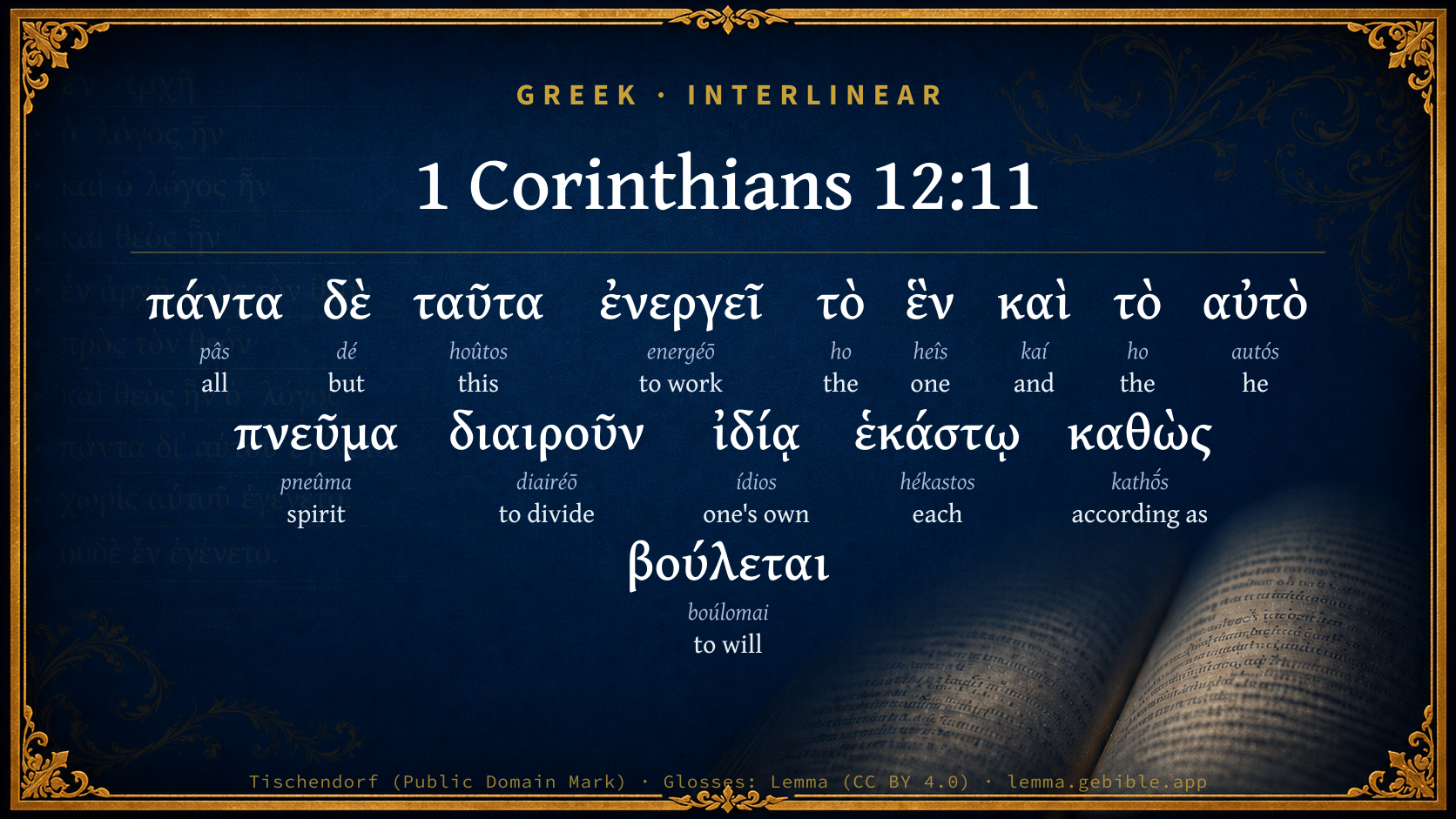
  1. πάντα pâs G3956 “all” Adjective, Accusative, Plural, Neuter
  2. δὲ dé G1161 “but” Conjunction
  3. ταῦτα hoûtos G3778 “this” Demonstrative pronoun, Accusative, Plural, Neuter
  4. ἐνεργεῖ energéō G1754 “to work” Verb, Present, Active, Indicative, 3rd person, Singular
  5. τὸ ho G3588 “the” Article, Nominative, Singular, Neuter
  6. ἓν heîs G1520 “one” Adjective, Nominative, Singular, Neuter
  7. καὶ kaí G2532 “and” Conjunction
  8. τὸ ho G3588 “the” Article, Nominative, Singular, Neuter
  9. αὐτὸ autós G846 “he” Personal pronoun, Nominative, Singular, Neuter
  10. πνεῦμα pneûma G4151 “spirit” Noun, Nominative, Singular, Neuter
  11. ἰδίᾳ ídios G2398 “one's own” Adjective, Dative, Singular, Feminine
  12. ἑκάστῳ hékastos G1538 “each” Adjective, Dative, Singular, Masculine
  13. καθὼς kathṓs G2531 “according as” Adverb
  14. βούλεται boúlomai G1014 “to will” Verb, Present, Middle or Passive deponent, Indicative, 3rd person, Singular

About this verse

These counts appear in no published source. They are computed here, from the morphology-tagged text and Lemma’s own curated glosses. What Lemma adds →

15
words
14
distinct lemmas
Pauline Epistles
section

Notable vocabulary

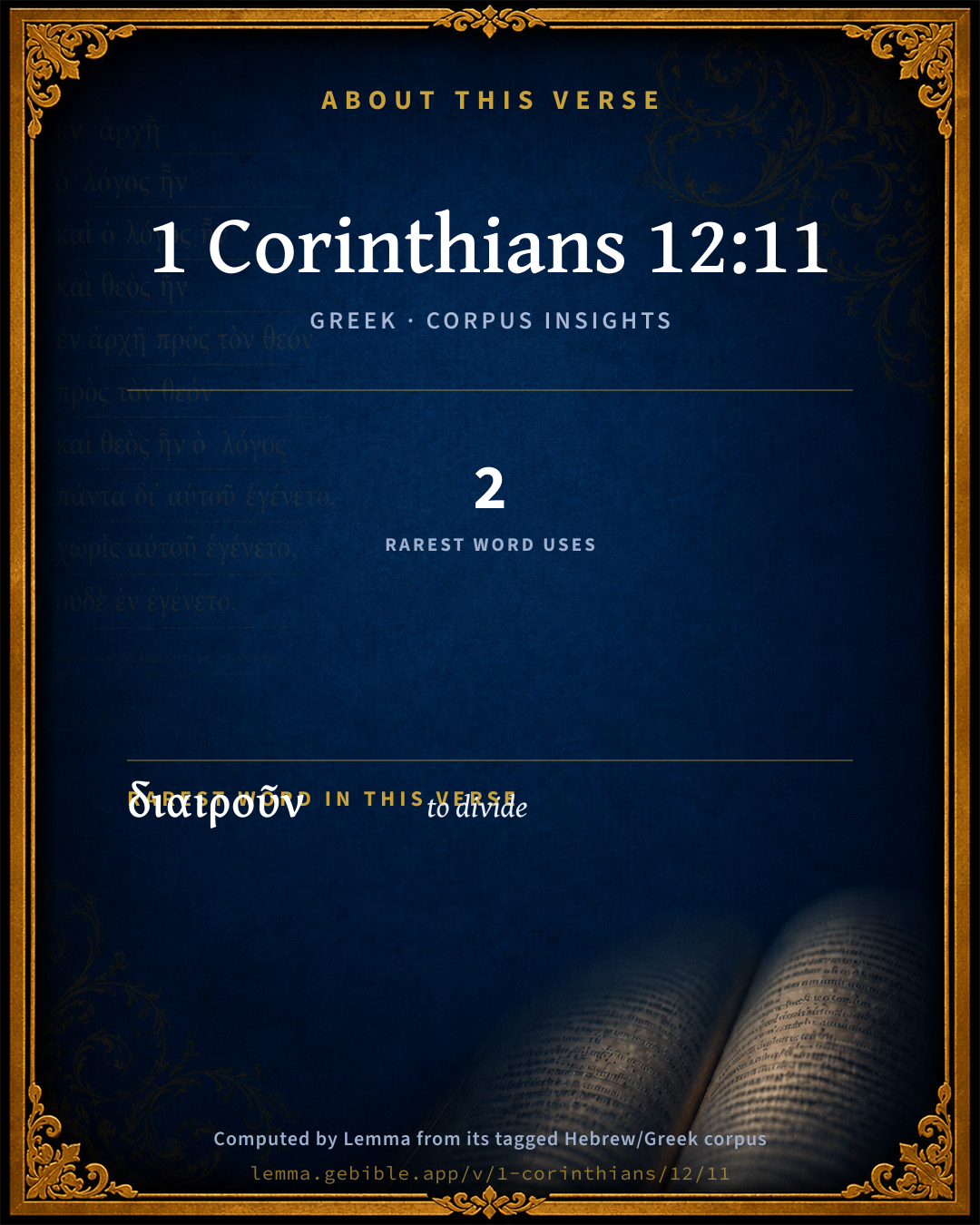
The rarest word here is διαιροῦν to divide G1244 — appearing just 2 times in the whole Greek New Testament.

Shared distinctive vocabulary

διαιροῦν to divide G1244 occurs in 2 verses of the Greek New Testament. Also found in:

Repetition

A word recurs within this verse:

Cross-references

17

Topical passages linked to 1 Corinthians 12:11 in the Treasury of Scripture Knowledge — connected by theme and wording, ordered by reader-vote popularity; previews shown in the World English Bible.

  • 1 Corinthians 12:4 Now there are various kinds of gifts, but the same Spirit.
  • Hebrews 2:4 God also bearing witness with them, both by signs and wonders, and by various works of power, and by gifts of the Holy Spirit, according to his own will?
  • 2 Corinthians 10:13 But we will not boast beyond proper limits, but within the boundaries with which God appointed to us, which reach even to you.
  • 1 Corinthians 12:6 There are various kinds of workings, but the same God, who works all things in all.
  • Ephesians 4:7 But to each one of us was the grace given according to the measure of the gift of Christ.
  • Daniel 4:35 All the inhabitants of the earth are reputed as nothing; and he does according to his will in the army of heaven, and among the inhabitants of the earth; and none can stay his hand, or tell him, What do you?
  • Matthew 11:26 Yes, Father, for so it was well-pleasing in your sight.
  • Matthew 20:15 Isn't it lawful for me to do what I want to with what I own? Or is your eye evil, because I am good?'
  • John 3:8 The wind blows where it wants to, and you hear its sound, but don't know where it comes from and where it is going. So is everyone who is born of the Spirit."
  • John 3:27 John answered, "A man can receive nothing, unless it has been given him from heaven.
  • John 5:21 For as the Father raises the dead and gives them life, even so the Son also gives life to whom he desires.
  • Romans 9:18 So then, he has mercy on whom he desires, and he hardens whom he desires.
  • Romans 12:6 Having gifts differing according to the grace that was given to us, if prophecy, let us prophesy according to the proportion of our faith;
  • 1 Corinthians 7:7 Yet I wish that all men were like me. However each man has his own gift from God, one of this kind, and another of that kind.
  • 1 Corinthians 7:17 Only, as the Lord has distributed to each man, as God has called each, so let him walk. So I command in all the assemblies.
  • Ephesians 1:11 in whom also we were assigned an inheritance, having been foreordained according to the purpose of him who works all things after the counsel of his will;
  • James 1:18 Of his own will he brought us forth by the word of truth, that we should be a kind of first fruits of his creatures.

Cross-references courtesy of OpenBible.info (CC BY 4.0).

Commentary

Notes on 1 Corinthians 12:11 from classic Christian and Jewish commentators (each source and its license shown beneath its notes). The classic Christian expositions comment on the surrounding passage and are grouped to its opening verse, so a note may address several verses; the Jewish commentaries on the Tanakh (Rashi and others) are per-verse, so they appear only where the commentator wrote on this verse.

Lemma curates 59 commentaries, every one of them public domain or Creative Commons licensed, each selected and text-cleaned for this edition rather than reprinted as found. About our sources →

The Biblical Illustrator

Joseph S. Exell

1Co_12:11

But all these things worketh that one and the selfsame Spirit, dividing to every man severally as He will.

The work of the Spirit

I. Christ promised that He would be present with His Church unto the end of the world (Mat_28:20). And this is that which differenceth His Church from any other society. If Christ be not present there is no Church. The foundation is wanting; and where there is no foundation, the higher the building, or the more glorious its appearance, the sooner it will fall.

II. Christ is thus present with His Church principally and fundamentally by His Spirit (Joh_14:1-31; Joh_15:1-27; Joh_16:1-33). Christ hath no vicar but the Spirit. Some say that Christ is no otherwise present than by outward ordinances. I grant that these are pledges of His presence, and instruments wherewith, by His Spirit, He doth effectually work. But make them Christs whole presence, and we have no better Church state than the Jews.

III. This presence of the Spirit is promised, and given unto the Church by an everlasting covenant (Isa_59:21).

IV. It is from hence that the ministry of the gospel is the ministry of the Spirit (2Co_3:6-8).

1. There were never but two ministrations, the one the ministration of the letter and of death, the other of the Spirit and of life; the one of the law, the other of the gospel. Any other is antichrists.

2. The ministration of the Spirit must signify--

(1) That the Spirit is the efficient of the ministration, giving spiritual gifts to the ministers of the gospel, to enable them to administer all gospel ordinances to the glory of Christ and the edification of the Church.

(2) The communication of Him, and so the effect of the ministration (Gal_3:2). Then it follows that, so long as there is the preaching of the gospel, there is the communication of the Spirit.

V. The general end, why the Spirit is thus promised unto the Church. God hath promised unto Christ a kingdom and Church in the world for ever (Psa_72:17; Isa_9:7; Mat_16:18). The accomplishment of this promise must depend upon the Spirit. If He should cease as to either of His operations, either in working internal saving grace or spiritual abilities for gospel admimistrations, the Churh must cease.

VI. The Holy Ghost thus promised and given furnishes the ministers of the gospel with spiritual abilities in the discharge of their work; and without it they are no way fitted for it.

1. Read Mat_15:14-30. Note in this parable--

(1) That wherever Christ calls and appoints a minister in His house, He gives him spiritual abilities for that work by the Holy Ghost. He set none at work, but He gave them talents.

(2) For men to take upon them to serve Christ who have received none of these spiritual abilities is a high presumption, and casts reflection on Christ, as if He called to work and gave no strength, as though He called to trade and gave no stock, or required spiritual duties and gave no spiritual abilities.

(3) Those who have received talents or gifts of the Holy Ghost are to trade with them.

2. Read Rom_12:4-8. Note here--

(1) That this discourse concerns the ordinary state of the Church in all ages.

(2) That gifts are the foundation of all Church work.

(3) That not only does work depend on the administration of gifts, but the measure of work depends upon the men, sure of gifts (Eph_4:8-13).

VII. As spiritual gifts are bestowed unto this end, so they are necessary for it. The way whereby the world lost the spiritual ministrations of the gospel was by the neglect and contempt of spiritual gifts, whereby alone they can be performed.

VIII. That there is a communication of spiritual gifts in all gospel ordinances we know by experience. This is derided by scoffers, but we plead the experience of humble Christians who have a spiritual acquaintance with these things. (J. Owen, D.D.)

The operations of the Spirit are

I. Rich in their variety. Gifts--

1. Of power.

2. Of grace.

II. Free in their dispensation.

III. Sovereign in their distribution.

IV. Beneficial in their design. (J. Lyth, D.D.)

Variety in unity

I. The divine worker.

1. Every good and perfect, gift is from above. Bezaleel and Aholiab were filled with the Spirit of God even as Moses and Aaron. The tact of the man of business, the fancy of the poet, the skill of the scientist are all from Him.

2. So in the spiritual sphere. Spiritual life is His gift; that life is preserved by His renewing, and all its progressive developments must be referred to Him. All aspirations after purity, all high purposes of consecration are from Him. In whatever way we are able to strengthen the Church and bless the world, the gift is a talent entrusted to us by Him.

3. There is great comfort in this thought. Men who have done eminent service pass away, and sometimes the anxious inquiry will arise, Where shall the host of the Lord find its leaders? Fear not! His gifts never fail, and His Church can never be abandoned. Moses died, but Joshua conducted the people to the promised land. Stephen fell a martyr, but the gap in the ranks was more than filled by Saul. Our Lord told the disciples that it was good for them that even He should be taken away, that the Comforter might come.

II. The characteristic of His works. Variety in unity. Variety is everywhere a condition of strength and beauty.

1. We should soon weary of landscapes in which the same features were ever reproduced. There would have been little beauty in the firmament if star had not differed from star in glory.

2. Intellect has been able to render humanity real service because it has had diversities of gifts. We want men of science and men of action to reduce their thoughts to practice; some to give strong and noble impulses, and others to apply the check of caution and experience; some to bear us aloft to the world of fancy, others to detain us among the hard realities of life.

3. So in the highest region of all.

(1) The ages of the Churchs story have been marked by different characteristics. There have been missionary ages, ages of defence, ages of quiet building to which we owe the great works of our theology, ages of pulling down so as to reform, to purify, to revive, and ages of suffering--heroic times. Here is variety, and the wise observer will see the presence of Gods Spirit in all, and admire the wisdom that has made all contribute to the prosperity of the Church.

(2) So is it with the various sections into which the Church has been divided. Men formed with different powers and temperaments, trained amid diversified circumstances, are sure to arrive at different conclusions. As to questions of Church polity, some will be sticklers for authority, while others will be concerned to maintain the rights of the individual Christian. In ritual some will attach importance to external beauty, others will refuse to depart from primitive simplicity. Some may be moved by an irrepressible enthusiasm, others will adhere to a mere formal service. Some may state truth in a way which may be offensive to men of culture, while others may seek to present it philosophically and disgust men of earnest heart. Yet everywhere we may feel that the work of the Church is more thoroughly done as the result of the diversified agencies enlisted on its behalf.

(3) The same manifoldness is seen, too, in individual character and experience. The story of no two souls is exactly alike.

(a) There are varieties of agency. Always the same truth must be the power of God unto salvation, but there are many avenues by which it obtains admission to the soul, and gains power and dominion there. In one the conscience is awakened to agonising convictions of sins; others are led by soft and gentle hands into the ways of peace. Lydia and the jailor were converted in the same city by the agency of the same apostle; but to the one the Spirit came in the still small voice; to the other He spoke in the terrors of an earthquake. Some are brought to enter the kingdom through a great fight of afflictions, and others are drawn as by the cords of love. Here the work is instantaneous, there gradual. One is converted by the appeal of the preacher, another by solitary meditation on the truth, another by the artless words of a little child.

(b) There are diversities in the result. In all there is faith in Jesus, but with innumerable points of difference. In some there is a burning enthusiasm, in others holy quiet. One is all activity and daring; another, like Mary, loves to sit at the feet of Jesus. One is a Boanerges, another a Barnabas. These, then, are the phenomena, and they are just such as we might have expected. The wind bloweth where it listeth. Sometimes its music is soft and sweet, anon it is clear and shrill, and again it is deep, solemn, and sad.

Conclusion:

1. We have here a rebuke of intolerant exclusiveness. There is a strong tendency in most men to expect that piety should be cast in one mould, and fashioned after one pattern.

2. We have a call to earnest diligence. The manifestation of the Spirit is given to every man to profit withal. Whatever gift the Spirit bestows on any man--by whatever impulse He stirs the soul, the design is that the talent should be used for the advancement of Divine glory. (J. Guinness Rogers, B.A.)

Ethnic and Christian views of Divine influence

So much of our knowledge comes through the senses, it is not wonderful that many persons believe that all our knowledge comes through the senses. So large a part of our time is occupied with this outward world of sights and sounds, no wonder many think that this is all we have to do with. What is spirit, what is soul, but a higher development of matter? What do we know of either, except what we see through forms of material organisation? This is modern materialism, which does not deny spirit but maintains that all we know of it is what comes to us from without, through forms of matter. It is not curious that multitudes of men should have been materialists; for matter impresses itself constantly and necessarily on all. But the really curious fact is that the great majority of mankind should have always been Spiritualists; believing in spirit more than in matter--in the infinite more than the finite; believing not in evolution, but emanation; accepting as the origin of the universe a dropping downward out of the infinite, into the finite, or a creation of the world by the Gods.

I. Christianity differs from all other religions, in maintaining the universality of this influence. Other religions, so far as I know, have limited inspiration, either to a few select souls, as prophets and saints; or, secondly, to some select class; as priests; or, thirdly, to those who sought it by seclusion, by meditation, by solitary prayer, by self-denial, going apart into caves and cells to macerate the body by starvation and asceticism. But on the day of Pentecost, in the first words which Peter said, he declared that the prophecy of Joel was fulfilled--It shall come to pass, in the last days, saith the Lord, that I will pour out My Spirit on all flesh, and your sons and daughters shall prophesy. Accordingly, through the Book of Acts, and in all the Epistles, we find that wherever the gospel was preached, all were told that they were to receive the Holy Spirit. All Christians were inspired; but their inspiration showed itself in different ways. It inspired some of them with knowledge, helping them to a clear sight of truth. It inspired some of them with wisdom, helping them to see what was the best thing to be done in any emergency. It inspired some of them with faith, enabling them to feel the presence and love of God amid bereavement, loneliness, bitter disappointment, and sharp trial. It inspired some of them to be good physicians, tender and careful nurses of the sick. If they saw a man or a woman who had a gift of healing, they said, She is inspired by the Holy Ghost to heal disease, as the Apostle Paul is inspired to preach. Gifts were special, but the inspiration was universal; one and the same for all, from the lowest to the highest. God was in every heart in this happy community of brothers and sisters. This, therefore, is one of the characters of the true Christian doctrine of Divine influence, that Gods influence comes to all of us whenever we wish for it. This is what Jesus says: If a hungry child asks his father and mother for bread, will they give him a stone? No! Do you think, then, that if any of you ask God for power to do right and be right, He will not give it to you? So certain it is that God will give His Holy Spirit to them who ask Him.

II. According to the New Testament, the Divine influence is not only universal, but it is continuous, constant, a never-flowing stream, descending into every open soul. It is not only for all men, but it is at all times. Undoubtedly there are seasons when the human heart is more tender, more susceptible, more open to Divine influence, than at other times. So in this opening season of the year, the seeds and buds are more susceptible to the influence of the sun. The buds are swelling by millions on the trees; every day they become a little larger; presently they open into delicate, soft leaflets; then they hang out their pretty forms more and more unfolded. Some immense force is pushing them from within, and attracting them from without. The small plant in the sick girls window in some narrow city lane feels the same influence; the weeds and grasses over ten thousand miles of latitude feel the influence. Every twenty-four hours swells this tide of vegetable life which flows in upon us like the ocean. Thus, too, there are doubtless spring seasons in the human soul, when we are more susceptible to Divine influence than at other times. God is not necessarily nearer than at other times, but our hearts are turned more towards Him.

III. A third peculiarity of the Christian view of Divine influence is, that it considers inspiration as natural, rational and practical.

1. It is rational. It does not come to confuse she mind, but to give it more insight, deeper knowledge. Part of our knowledge comes to us from the outward world by observation; but another part, and often the best part, comes to us from within, by intuition.

2. The Divine influence, according to Christianity, is not only rational, but also practical. We have seen that one of the gifts of the Holy Spirit is the gift of healing. We also read of the gifts of helping, of governing, of discerning of spirits. One man who believes in inspiration, and looks up for it, will be filled with a Divine power of helping those in difficulty, of showing them what they ought to do, of lending a hand to a weak brother or sister. Another man will, in answer to his inward prayer, be gifted with executive ability to direct and guide and govern. We know how some persons can govern without seeming to govern. Some are born leaders, but some are also inspired leaders. They are enabled by a power not their own to guide, repress, restrain, uplift, and bring together many hearts, till they beat as one. This is also a gift of the Holy Ghost. And others are made discerners of spirits. The eye is made clear and penetrating to discern shams. The hypocrite and deceiver is unmasked in their presence. These various powers of the soul are all as much quickened and fed and vitalised by the Holy Spirit as that of the prophet who speaks with the tongue of men and angels, or the rapt devotee who wears the stones with his knees in constant prayer. It is one spirit by which all Gods servants are baptised into that one body, the invisible church of good men and women.

3. Although this influence is supernatural it is also natural. The Divine life, flowing down through human souls into the world, must be, and is in harmony with the same Divine life flowing down into the world through external nature. Consequently, wherever God sends a fuller tide of religious inspiration into any period, it is followed by a greater growth of art, science, knowledge and civilisation. What we ought to believe, therefore, is that God is always inwardly near to us, in the depths of our soul, and always ready to strengthen us, and lighten our darkness, when we turn inward to Him. But it is a mistake to speak of any irresistible influence of the Holy Spirit. God respects our freedom, and, if we choose to resist these tender attractions and illuminations, they are never forced upon us. Let us not harden ourselves against the voice within, whether it comes to give us better insight into truth, or to show us how acceptably to work: whether it open our eyes to see, our ears to hear, our hands to act, our lips to speak, or our hearts to love. (James Freeman Clarke.)

One Spirit, many gifts

But now these best gifts of God, as well as all His other gifts, are in danger of being profaned by men. And it seems that the Corinthians did profane them. They employed the power of speaking new languages, as well as other spiritual gifts, to their His glory, and not to Gods glory alone. His mystical body, the Church, is like His natural body, or any of our bodies, in respect that although it is made up of many members, each having its own office, yet it is truly, strictly, mysteriously one. What makes it one, and binds it together, is the Holy Spirit of God dwelling in each persons soul and body, to unite him truly to Jesus Christ. Thus are Christians put in mind of the one Church, to which all alike belong; and they are also put in mind of the diversity of gifts, whereby each member is made different from another. First, to the weaker and less honourable member he says, you are not to be cast down nor discontented, as if no one cared for you, because others have higher places than you. Nay, it might be said, you surely have in you the same life, the same blood, that any other limbs of the body have. The pulse which beats in you comes from the heart, the power and will which guides you from the head; you are as much a member of the Man as any of the limbs which are most precious. If you hear instead of speaking, if you move instead of ruling, if you act instead of ordering, you are not therefore the less parts of the body. And much more should we quiet with the same gracious words all discontented and envious thoughts. Are you not a member of Christ? and what is it, in comparison of so great mercies, if another man is more learned, more respected, richer; or healthier than you are? The weak then are not to envy the strong, and the strong on the other hand are not to despise the weak. The eye is not to say to the hand, I have no need of thee; neither again the head to the feet, I have no need of you. Those who are above others, either in learning or in dignity, are of course in some danger of becoming proud and contemptuous. Let this then be the lesson settled in our hearts; to believe that we are Christian brethren indeed, and to cherish in our hearts true brotherly feeling one towards another. Now, then, with this deep faith in Christs Holy Spirit, as having really been given to dwell in our hearts, let us think on any other person, whomsoever we will, as being also partakers of the same Spirit. Consider; if he were partaker of the same blood with us, if it were our brother or sister after the flesh, should we not be full of love for him? Again, because this Spirit deals not with all exactly alike, but divides to every man severally as He will, how should the remembrance of Him fail to make us content in our places, orderly and diligent in our duties? since wherever we are in Gods work, He assigned us our place. Are you then a rich and prosperous person? do not trust in your own riches: beware of thinking that you can do without the poor, that you need them not. Are you, on the contrary, a poor man? Then beware how you allow yourself to think sadly on the rich, as being better off than you are. Such thoughts are too likely to end in repining and envy. Again, are you in comparison learned? are you able to read the Scriptures? yet do not trust in your reading: do not think that you can make out your duty, and save yourself well enough: you still need the prayers of Christs afflicted and poor. Are you, on the other hand, an ignorant person, and does it mortify you to see and feel that you know much less than most others? care not for it, but turn your thoughts to the infinite and wonderful truth, which, as we all know, belongs to us and to the very wisest alike. Are you so far blameless as to have kept, by Gods mercy, your soul and body from wilful deadly sin? You know it is altogether the work of Gods Spirit: believe and think of this; it will keep you from pride and self-righteousness. (Plain Sermons by Contributors to the Tracts for the Times.)

The Biblical Illustrator, edited by Joseph S. Exell (c. 1880s–1900s) — public domain. Text from a community e-Sword module.

Tyndale Open Study Notes

Tyndale Open Resources

12:11 The Spirit . . . decides which gift each person should have: See 12:4, 6, 18, 28. Paul paradoxically affirms both the sovereign choice of God in giving spiritual gifts and the human responsibility to “earnestly desire the most helpful gifts” (12:31).

Tyndale Open Study Notes — © Tyndale Open Resources, licensed CC BY-SA 4.0. Text via the HelloAO Bible API.

Bengel's Gnomon

Johann Albrecht Bengel

1Co 12:11. Βούλεται, wills) the Spirit. So, as God willed, 1Co 12:18, He gives the several gifts, or some gifts, in various measures, to the several individuals.

Bengel's Gnomon of the New Testament — English translation (T&T Clark, Edinburgh, 1860) — public domain. Text from a community e-Sword module.

Meyer's Critical & Exegetical Commentary

Heinrich August Wilhelm Meyer

1Co_12:11. Amid all this diversity, however, what unity of the operative principle!

ἐνεργεῖ] namely, as the divine power endowing the different individuals differently. See what follows. Διάφοροι μὲν οἱ κρουνοὶ, μία δὲ πάντως πηγή, Theodoret.

ἰδίᾳ] seorsim, severally. See Bernhardy, p. 185. Comp Plato, Menex. p. 249 B: ἅπερ ἰδίᾳ ἑκάστῳ ἴδια γίγνεται. Pind. Nem. iii. 42; and very often in classical writers. Elsewhere in the N. T.: κατʼ ἰδίαν.

καθὼς βούλεται] not: arbitrarily, but (comp on Mat_1:19): in accordance with the determination of His will, which by no means precludes this divine self-determining action of the Holy Spirit from proceeding in a manner corresponding to the natural and general Christian capacity, and to the peculiar disposition and tendency of the minds, of men. Hence, on the one hand, the possibility that, from the human side, particular charismata may be obtained by effort, 1Co_12:31; 1Co_14:1; and also, on the other hand, the duty of not estimating slightly the gifts of others. Observe, further, in καθὼς βούλεται, the personality of the Spirit.

Meyer — Critical and Exegetical Commentary on the New Testament — English translation by Peter Christie, edited by Frederick Crombie (T&T Clark, 1880) — public domain. Text from a community e-Sword module.

Expositor's Greek Testament

ed. W. Robertson Nicoll

1Co 12:11 sums up the last par. (1Co 12:4-10 ), impressing on the Cor [1869] with redoubled emphasis the variety in unity of the “gifts,” and vindicating the sanctity of each: “But all these things worketh the one and the same Spirit” ( cf. 1Co 12:9 ). In the qualifying clause, “dividing separately ( seorsim ) as He wills,” διαίρουν takes up the διαιρέσεις of 1Co 12:4-6 ; ἑκάστῳ is resumed from 1Co 12:7 ; ἰδίᾳ adds the thought that the Spirit deals with each recipient by himself, individually and appropriately ( cf. 1Co 7:7 , 1Co 3:8 , 1Co 15:23 ); while καθὼς βούλεται signifies that He acts in the distribution upon His choice and judgment , where lies the hidden reason for the giving or withholding of each particular gift. For βούλομαι , see parls.; and for its difference from ἐθέλω , cf. 1Co 12:18 ; also 1Co 4:19 ; 1Co 4:21 , and parls. Eurip., Hippol ., 1329 f., supplies a good example of the distinction, οὐδεὶς ἀπαντᾶν βούλεται προθυμίᾳ τῇ τοῦ θέλοντος , ἀλλʼ ἀφιστάμεθʼ ἀεί : “None of us likes to cross the purpose of one that is bent on anything, but we always stand aside”. No predicate could more strongly imply personality than does βούλεται .

[1869] Corinth, Corinthian or Corinthians.

The Expositor's Greek Testament, edited by W. Robertson Nicoll (1897–1910) — public domain. Text from a community e-Sword module.

Hodge's Commentary on Romans, Ephesians & First Corinthians

Charles Hodge

1Co_12:11

But all these worketh that one and the self-same Spirit, dividing to every man severally as he will.

But all these, etc., i.e. notwithstanding the diversity of these gifts they have a common origin. They are wrought by the same Spirit. What therefore in 1Co_12:6 is referred to the efficiency of God, is here referred to the efficiency of the Spirit. This is in accordance with constant scriptural usage. The same effect is sometimes attributed to one, and sometimes to another of the persons of the Holy Trinity. This supposes that, being the same in substance (or essence) in which divine power inheres, they cooperate in the production of these effects. Whatever the Father does, he does through the Spirit. The Holy Ghost not only produces these gifts in the minds of men, but he distributes them severally (ἰδίᾳ) to every man as he will, i.e. not according to the merits or wishes of men, but according to his own will. This passage clearly proves that the Holy Spirit is a person. Will is here attributed to him, which is one of the distinctive attributes of a person. Both the divinity and personality of the Holy Ghost are therefore involved in the nature of the work here ascribed to him.

Charles Hodge — Commentary on Romans (1835), First Corinthians (1857), and Ephesians (1856) — public domain. Text from a community e-Sword module.

Geneva Bible (1599)

Geneva Bible translators

He addeth moreover something else, to wit, that although these gifts are unequal, yet they are most wisely divided, because the will of the Spirit of God is the rule of this distribution.

Geneva Bible (1599) marginal notes — public domain. Text via Bolls.life.

Jamieson, Fausset & Brown

Robert Jamieson, A. R. Fausset & David Brown

as he will-- (Co1 12:18; Heb 2:4).

Jamieson, Fausset & Brown — Commentary Critical and Explanatory on the Whole Bible (1871) — public domain (CC PDM 1.0). Text via the HelloAO Bible API.

Adam Clarke's Commentary

Verse 11. But all these worketh that one and the self - same Spirit] All these gifts are miraculously bestowed; they cannot be acquitted by human art or industry, the different languages excepted; but they were given in such a way, and in such circumstances, as sufficiently proved that they also were miraculous gifts.

Adam Clarke's Commentary on the Bible (1810–1826) — public domain. Text from a community e-Sword/MySword module.

John Calvin's Commentaries

11. One and the same spirit distributing. Hence it follows that those act amiss who, having no concern as to participation, break asunder that holy harmony, that is fitly adjusted in all its parts, only when under the guidance of the same Spirit, all conspire toward one and the same object. He again calls the Corinthians to unity, by reminding them that all have derived from one fountain whatever they possess, while he instructs them, at the same time, that no one has so much as to have enough within himself, so as not to require help from others. For this is what he means by these words — distributing to every one severally as he willeth The Spirit of God, therefore, distributes them among us, in order that we may make all contribute to the common advantage. To no one does he give all, lest any one, satisfied with his particular portion, should separate himself from others, and live solely for himself. The same idea is intended in the adverb severally, as it is of great importance to understand accurately that diversity by which God unites us mutually to one another. Now, when will is ascribed to the Spirit, and that, too, in connection with power, we may conclude from this, that the Spirit is truly and properly God.

John Calvin's Commentaries (1540-1563) — public domain. Text from the Calvin Translation Society English edition (1840s-50s) via the Christian Classics Ethereal Library (ccel.org). Calvin's coverage is partial (roughly two-thirds of the Bible); uncommented books and verses are honest gaps, never fabricated. The 19th-century editor's footnotes and remarks are omitted so the notes are faithfully Calvin's own voice.

Ellicott's Commentary for English Readers

(11) But all these.—Again, in striking contrast to the great varieties of gifts, the common source of them all is emphatically repeated. The Corinthians estimated these gifts variously, according to their variety in operation. The Apostle estimates their common value as proceeding from the One Spirit, distributed according to His will. Those who valued men more or less according to the kind of gift they possessed were really, if unconsciously, criticising the giver.

A Bible Commentary for English Readers, edited by Charles John Ellicott (1878–1897) — public domain. Text from a community e-Sword module.

The Cambridge Bible for Schools and Colleges

gen. ed. J. J. S. Perowne

11. but all these worketh that one and the selfsame Spirit] This consideration absolutely excludes all boasting, all possibility of setting up one gift as essentially superior to another. It is worthy of remark that what is predicated of God in 1Co_12:6, is here predicated of His Spirit. The word translated worketh is the same in both places. “The Spirit worketh, not is worked. He worketh as He will, not as He is bidden.”—St Chrysostom.

dividing to every man severally as he will] Cf. Heb_2:4.

The Cambridge Bible for Schools and Colleges (gen. ed. J. J. S. Perowne; Cambridge University Press, 1878–1918) — public domain. Text from a community e-Sword module.

John Gill's Exposition

But all these worketh that one and the selfsame Spirit,.... Though these gifts, ministrations, and operations, are so different in themselves, and are bestowed upon different persons, yet they are all wrought by one and the same Spirit of God, who is the true Jehovah, and properly God, as these his works declare; for who, but the most high God, could ever communicate such gifts to men?

Dividing to every man severally as he will; giving one man this gift, and another that; imparting such a measure to one, and such a portion to another, just as seems good in his sight. For as his special grace in regeneration is dispensed when and where, and to whom he pleases, signified by the blowing of the wind where it listeth, Joh 3:8 so his gifts, ordinary and extraordinary, are severally distributed, according to his sovereign will and pleasure. This is a clear and full proof of the personality of the Spirit, who is not only distinguished from his gifts, and the distribution of them, which is a personal act described to him; but this is said to be done according to his will, which supposes him an intelligent agent, capable of choosing and willing; and whose will agrees with the Father's, and with the Son's.

John Gill's Exposition of the Whole Bible (1746–1763) — public domain (CC PDM 1.0). Text via the HelloAO Bible API.

Trapp's Complete Commentary

John Trapp

11 But all these worketh that one and the selfsame Spirit, dividing to every man severally as he will.

Ver. 11. One and the self-same Spirit] Who yet is called the seven spirits of God, Rev 1:4, for his manifold and various operations.

Dividing to every man severally, as he will] It is reported that in Luther’s house was found written, Res et verba Philippus. Res sine verbis Lutherus. Verba sine re Erasmus. Everyone hath his own share; all are not alike gifted; yet by "one and the self-same Spirit," that one and that self-same Spirit, as the Greek text runs, repeating the article, very elegantly and emphatically, το εν και το αυτο πρευμα..

John Trapp, A Commentary or Exposition upon All the Books of the Old and New Testament (1647–1656) — public domain. Text from a community e-Sword module.

Albert Barnes' Notes on the Bible

But all these - All these various endowments.

Worketh - Produces. All these are to be traced to him.

That one and the self-same Spirit - The Holy Spirit, Acts 2. They were all, though so different in themselves, to be traced to the Holy Spirit, just as all the natural endowments of people - their strength, memory, judgment, etc. - though so various in themselves are to be traced to the same God.

Dividing to every man severally - Conferring on each one as he pleases. He confers on each one that which he sees to be best, and most wise, and proper.

As he will - As he chooses or as in his view seems best. Dr. Doddridge remarks, that this word does “not so much express arbitrary pleasure, as a determination founded on “wise” counsel.” It implies, however, that he does it as a sovereign; as he sees to be right and best. He distributes these favors as to him seems best adapted to promote the welfare of the whole church and to advance his cause. Some of the doctrines which are taught by this verse are the following:

(1) The Holy Spirit is a “person.” For, he acts as a person; distributes favors, confers endowments and special mercies “as he will.” This proves that he is, in some respects, distinguished from the Father and the Son. It would be absurd to say of an “attribute” of God, that it confers favors, and distributes the various endowments of speaking with tongues, and raising the dead. And if so, then the Holy Spirit is “not” an attribute of God.

(2) He is a sovereign. He gives to all as he pleases. In regard to spiritual endowments of the highest order, he deals with people as he does in the common endowments bestowed upon people, and as he does in temporal blessings. He does not bestow the same blessings on all, nor make all alike. He dispenses his favors by a rule which he has not made known, but which, we may be assured, is in accordance with wisdom and goodness. He wrongs no one; and he gives to all the favors which might be connected with eternal life.

(3) No man should be proud of his endowments. Whatever they may be, they are the gifts of God, bestowed by his sovereign will and mercy. But assuredly we should not be proud of that which is the mere “gift” of another, and which has been bestowed, not in consequence of any merit of ours, but according to his mere sovereign will.

(4) No man should be depressed, or should despise his own gifts, however humble they may be. In their own place, they may be as important as the higher endowments of others. That God has placed him where he is, or has given less splendid endowments than he has to others, is no fault of his. There is no crime in it; and he should, therefore, strive to improve his “one talent,” and to make himself useful in the rank where he is placed. And,

(5) No man should despise another because be is in a more bumble rank, or is less favored than himself. God has made the difference, and we should respect and honor his arrangements, and should show that “respect” and “honor” by regarding with kindness, and treating as fellow laborers with us, all who occupy a more humble rank than we do.

Albert Barnes' Notes on the Bible (1834–1885) — public domain. Text from a community e-Sword/MySword module.

Matthew Poole's English Annotations

Though the Spirit of God be but one, from whom these several powers and abilities flow; yet he doth not give all this variety of gifts to all Christians, but one to this man, another to another, as the same Holy Spirit pleaseth, for the glory of God, or the good of the church.

Matthew Poole's English Annotations on the Holy Bible (1683–1685) — public domain. Text from a community e-Sword/MySword module.

Whedon's Commentary on the Bible

Daniel D. Whedon

11. One… Spirit—Let there be no strife or rivalry between the possessors of different gifts; but let all in unison trace them up to one source, and exercise them in harmony.

Dividing—It was not that these exercises were a spontaneous welling up of religious excitement, and assuming these forms, but a definite, divine assignment to each individual of his particular charism.

As he will—Wills.

Daniel D. Whedon (gen. ed.), Commentary on the Old and New Testaments (1874–1909) — public domain. Text from a community e-Sword module.

The Pulpit Commentary

One and the selfsame Spirit. The unity of the source from which all the charisms flowed ought to have excluded the possibility of a boastful comparison of gifts, arid all depreciation of those gifts which, because they were less dazzling, were deemed inferior. St. Paul afterwards shows that the less dazzling might be infinitely the more valuable for purposes of spiritual edification.

The Pulpit Commentary (1880–1919), ed. H.D.M. Spence-Jones & Joseph S. Exell — public domain. Text from a community e-Sword module.

John Wesley's Explanatory Notes

As he willeth - The Greek word does not so much imply arbitrary pleasure, as a determination founded on wise counsel.

John Wesley, Explanatory Notes Upon the Whole Bible (1754–1765) — public domain. Text via the GEBible commentary corpus.

Godbey's Commentary on the New Testament

William B. Godbey

THE HOLY GHOST HIMSELF NOT ONLY THE DISPENSER, BUT THE CUSTODIAN, OF HIS OWN GIFTS

11. “But all these things worketh in you one and the same Spirit, dispensing unto each one severally as He willeth.” In this verse you have the golden key which unlocks the mystery and solves the problem. The Holy Ghost Himself possesses the gifts perpetually, and is the custodian of the same. But do not forget that He has them on hand, not for Himself, for He does not need them, but for you. Consequently you may rest assured that you can have them as you need them, remembering that He commands you to earnestly seek them (1Co 12:31). A military general, approaching a city, first needs the cannons, to burst up the citadels and oust the enemy from their fortifications. Then, when they meet him in the open plain, he needs the rifle and plenty of ammunition. Finally, when the collision comes, he needs bayonets, swords and revolvers, for the hand-to-hand combat of man with man. So, when you need a cannon to fire on the devil, it is your privilege to enjoy such an attitude to the Holy Ghost that, responsive to your humility, faith and obedience, He puts the cannon in your hand. So also with the rifle, the bayonet, the sword and the revolver. N. B. — The Holy Ghost Himself is your Armor-Bearer, carrying these nine invincible weapons of the Christian warfare, and ready every minute to give you the very one you need in so quick succession as to impress you that you just have them all on hand simultaneously. The reason why Jonathan could stampede a whole army when he went out alone with an armor-bearer was a verification of the grand symbolic truth that his armor bearer represented the Holy Ghost. So you go out accompanied by the Holy Ghost alone, and you can put to flight a whole army of devils. Hence you see that these gifts are not constant. You have one today, another tomorrow, and still another the next day, or you may enjoy them all in very quick and rapid succession. These gifts constitute the grand panoply of the Christian warrior, and are indispensable to his full efficiency on the Lord’s battlefield, while they are not at all necessary to personal salvation. The reason why so many sanctified people manifest such little spiritual power is because they do not utilize this wonderful spiritual panoply as it is their privilege. I give glory to God that He permits me to be a personal witness of all these gifts, some of them predominating at one time and others at another. I pray God, reader, that you may receive and enjoy them all in greater and more efficient manifestation than your humble servant. This is an open door to illimitable efficiency for God and souls. N. B. — The availability of these gifts is simply illimitable, the proportion in which you participate in them constituting the measure of your efficiency as a soul- saver. If it were only possible to convince the people touching this interest, it would move three worlds and bring on the Millennium. Perfect humility, consecration, faith and obedience are the conditions of utilizations of these gifts. We should go forth constantly on the battlefield, accompanied by the Holy Ghost, our omnipotent Armor-Bearer, who has all of those gifts ready to bestow as we need them.

William B. Godbey, Commentary on the New Testament (1896–1900) — public domain. Text from a community e-Sword module.

McGarvey & Pendleton's Commentaries

J. W. McGarvey

but all these worketh the one and the same Spirit, dividing to each one severally even as he will . [Paul here sets forth fully the diversity of the gifts, but checks any tendency to boastful comparison by showing that the gifts emanate from a common source, and are operated by a common will, and are bestowed according to the pleasure of the Spirit, and not because of any inferiority or superiority on the part of the recipients. The nine gifts spoken of may be described as follows: 1. The "word of wisdom" was the ability to reveal divine truth which was possessed by the apostles and partially by prophets. 2. The "word of knowledge" was the ability to teach the truth thus revealed. Paul emphasizes that the second gift was as much a work of the Spirit as the first. 3. Faith, in this connection, is more than that which comes by hearing. It is that energy of faith which carries with it divine power ( Mat_17:19-20 ; 1Co_13:2 ). 4. "Gifts of healing" was the power to supernaturally restore the sick ( Act_5:15-16 ; Jam_5:14-15 ). This gift may have been separated from the one next named, because some had their miraculous power limited to this field. 5. "Workings of miracles" was larger than the one which preceded it, for it included acts of judgment as well as mercy. It was exercised by Paul in striking Elymas blind, and by Peter in the punishment of Ananias and Sapphira. Paul here names healing first, possibly because those who are called upon to exercise God's mercy stand higher in his esteem than those who execute his judgment, for pagans and unbelievers have often been used by him to mete out punishment. But in 1Co_12:28 he reverses the order, for the greater includes the less. 6. The "gift of prophecy" enabled one to speak the truth under the unerring guidance of the Holy Spirit. In the Old Testament this gift was a very important one; but in the New, the "word of wisdom," which embraced all the larger scope of prophecy, seems to have been mainly confined to the apostles, and so we find New Testament prophets merely foretelling things of a temporary or personal nature, as in the case of Agabus ( Act_11:28 ; Act_21:9-11 ). 7. "Discernings of spirits" was the power to recognize the difference between the utterances of genuine inspiration and those of a demoniacal or an unaided human spirit. 8. There has been much dispute as to what is meant by "kinds of tongues." Some modern commentators have attempted to show that the gift of tongues mentioned in the Epistles was entirely different from the ability to speak foreign languages manifested on the day of Pentecost. The weakness of those who take this position is fully exposed by Hodge in loco. Speaking with tongues was not an incoherent, meaningless jargon uttered by the speaker in ecstatic rhapsody, nor was it "spiritual language unknown to man, uttered in ecstasy." The second chapter of the Book of Acts shows us clearly what it was, and the New Testament never explains it as being anything less or different. 9. "Interpretation of tongues" was the ability to interpret what was said by the one who spoke with tongues. The gifts of speaking and interpreting were sometimes given to the same person ( 1Co_14:13 ), and sometimes to different persons.]

J. W. McGarvey (with Philip Y. Pendleton), Commentaries on the New Testament (The Fourfold Gospel, 1914; Acts; and the epistles) — public domain. Text from a community e-Sword/MySword module.

Cambridge Greek Testament for Schools and Colleges

11. πάντα δὲ ταῦτα ἐνεργεῖ. This consideration absolutely excludes all boasting, all possibility of setting up one gift as essentially superior to another. It is worthy of remark that what is predicated of God in 1Co 12:6, is here predicated of His Spirit. The word translated worketh is the same in both places. ‘The Spirit worketh, not is worked. He worketh as He will, not as He is bidden.’ Chrysostom.

διαιροῦν. Portioning out. Cf. Epictetus, Enchir. c. 50 τὸν διαιροῦντα λόγον, i.e. the reason which assigns to each its part. Cf. Heb 2:4.

ἰδίᾳ. This word is used adverbially. A.V. severally.

Cambridge Greek Testament for Schools and Colleges (Cambridge University Press, 1896; 21 vols, various authors incl. Carr, Maclear, Plummer, Farrar, Lumby, Moule, M. R. James, Simcox) — public domain. Text from a community e-Sword module.

Alford’s Greek Testament

Henry Alford

11.] The Spirit is the universal worker in men of all these powers, and that according to His own pleasure: see above on vv. 4-6.

ἰδίᾳ, ‘seorsim,’ respectively, or ‘severally,’ as E. V. This unity of the source of all spiritual gifts, in the midst of their variety, he presses as against those who valued some and undervalued others, or who depreciated them all.

Henry Alford, The Greek Testament (1849–1861) — public domain. Text from a community e-Sword module.

International Critical Commentary

11. πάντα δὲ ταῦτα. The πάντα is very emphatic, and the δέ marks the contrast of transition from the manifold gifts and powers to the one Source of them all. This Source is the Spirit of God; so that there is no contradiction between v. 6 and v. 10. What God works, the Spirit works. Nor is there any contradiction between v. 10 and v. 31. Our earnest desire for the best gifts is one of the things which fits us to receive them, and each man receives in proportion to this desire, a desire which may be cultivated. The Spirit knows the capacity of each; 3:8, 7:7, 15:23.

τὸ ἓν καὶ τὸ αὐτὸ Πνεῦμα. This is a combination of τῷ ἑνί Πν. with τῷ αὐτῷ Πν. in v. 9, and is so far a confirmation of the reading, τῷ ἑνί. This one and the same Spirit has already been defined as ‘God’s Spirit’ (v. 3), who is here said to do what God does (v. 6). But here there is something added; the Spirit ‘distinguishes and distributes severally to each, exactly as He willeth.’ Throughout the verse, but especially in the last words (καθὼς βούλεται), the personality of the Spirit is implied.* It is in the will that personality chiefly consists. The Apostle here teaches the Corinthians that they ought not to plume themselves upon the possession of one or more of these gifts. They may be evidence of capacity, but they are no proof of merit. It is the will of the Spirit that decides, a will which discriminates, but which cannot be compelled by anything which man can do: singulis dat singula, vel aliqua, varia mensura (Beng.). The Church consists of many persons very variously endowed, and the gifts bestowed upon individuals benefit the whole. Διαιρἐω in NT. is found only here and Luk 15:12.

The addition of ἰδίᾳ (sc, ὅδῷ) emphasizes the fact the spirit deals with men, not en masse but one by one, ‘to each according to his several ability’ (Mat 25:15; Rom 12:6; Eph 4:2. In N.T, we commonly have κατʼ ἰδιαν in this sense: here only ἰδίᾳ, and 2 Mac. 4:34 only in LXX. But ἰδίᾳ is not rare in class. Grk.

International Critical Commentary — older volumes (1896–1929), various authors — public domain. Text from a community e-Sword module.

Godet's Commentaries

Frédéric Louis Godet

Vv. 11. “But all these worketh that one and the selfsame Spirit, dividing to every man severally as He will.”

That one: in opposition to the plurality of believers; the same: in opposition to the diversity of gifts.

The partic. διαιροῦν, dividing, has no expressed object; the emphasis is on the act of dividing. With the adj. ἰδίᾳ, we must understand the subst. μοίρᾳ.

By the words: as He will, the apostle does not ascribe to the Spirit a capricious and fantastic mode of procedure. The good pleasure of God is never exercised except in perfect harmony with all the perfections of His character, His wisdom, goodness, righteousness. The analogous phrase, 1Co 15:38, shows how entirely the notion of arbitrariness is excluded, in the apostle’s view, from the idea of the Divine pleasure. One may compare in some respects Mat 25:15. — The deliberate will (βούλεσθαι), here ascribed to the Holy Spirit, seems to me to imply His personality, as the act of giving supposes His Divinity. The words: to every man as He will, are undoubtedly intended to sweep away, from the more gifted of the Corinthians, every feeling of self-merit, and, from the less favoured, every tendency to discontentment. It will be seen that this double intention is precisely what inspires the following passage (1Co 12:13-30). But, first of all, 1Co 12:12 serves by a figure to bring out again the fundamental thought of the passage, 1Co 12:4-11.

Frédéric Louis Godet — Commentaries on Luke, John, Romans, and 1 Corinthians — English translation (T&T Clark, Edinburgh, 1870s–1890s) — public domain. Text from a community e-Sword module.

Lesson kit

Teaching starters — assembled from the data on this page, not authored interpretation. Every prompt links to the verse data it draws on. Edit before teaching.

1 Corinthians, in the Pauline Epistles, opens this verse with 15 words (14 distinct Greek lemmas). Its most distinctive word is diairéō (“to divide”). A historical commentator’s framing appears above. Read the whole chapter for the surrounding context.

Discussion questions

  1. What does “to divide” (diairéō) contribute to the verse as a whole?
  2. Luke 15:12 shares the word «to divide» with this verse. How do the two illuminate each other?
  3. “the” occurs 2× in this one verse. What is the effect of the repetition?
  4. The translations on this page render this verse differently — a whole-verse word diff, not a word-by-word alignment. What might account for the different wordings?
  5. Reading how The Biblical Illustrator and Tyndale Open Study Notes read this verse, where do the two commentators agree and where do they part?

Things to notice

Reading settings

Reading text

Shown beneath each verse's original-language words.

Old Testament
Old Testament edition

Read the OT as the Masoretic Hebrew (MT) or the Greek Septuagint (LXX).

English shown for the Greek Septuagint (in the Hebrew ↔ Greek comparison).

Comparing translations? Open the Compare panel on any verse page to stack up to four side by side.