1 Corinthians 15:21

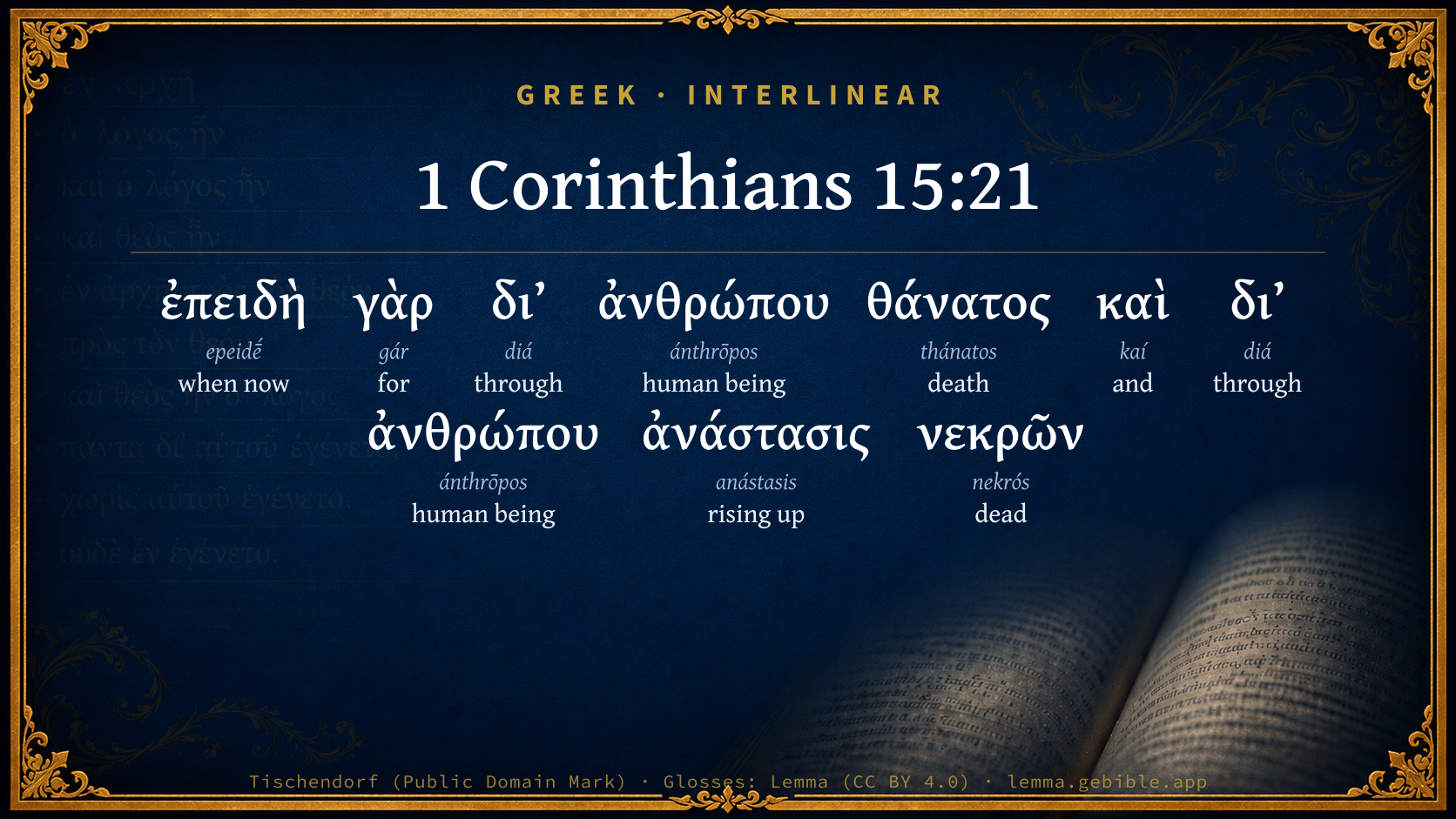
Greek (Tischendorf 8th ed.) 1 Corinthians 15:21 appears in the Greek New Testament. The text above is from the Tischendorf 8th edition. Each word links to its Strong’s number and a concise gloss. Click any word for its full Thayer’s Greek Lexicon entry.
Download image
Cite this verse

1 Corinthians 15:21 (World English Bible). Public Domain. Lemma interlinear Bible study tool, https://lemma.gebible.app/v/1-corinthians/15/21.

Show BibTeX & RIS
BibTeX
RIS
English Translation
For since death came by man, the resurrection of the dead also came by man.
World English Bible · Public Domain
Download a study sheet

One document with this verse’s original text, its word-by-word gloss line, the meaning frame, cross-references with their text, attributed commentary, and full source and license credits — printable, and it pastes into notes with its structure intact.

This verse Autodidact and up

Study sheet (.html) Plain text (.txt)

A passage Seminary Student

Up to 50 verses in one chapter. A passage sheet keeps up to 6 commentary sources and 12 cross-references per verse, in the order this page ranks them, and says so on the sheet whenever that leaves anything out. Ask for a single verse and you get the Autodidact verse sheet above.

Everything on this page stays free to read, with no account — the sheet is a download of what is already on screen, not access to it.

Want to remove ads? Support Godless Engineer
Compare translations 3

The same verse in 3 English versions, stacked beneath the original-language interlinear above. Click any original word for its lexicon entry.

Each is an independent rendering of the whole verse — the interlinear is not word-aligned to these translations.

Highlighted words mark where these versions differ — a whole-verse word diff, not a word-by-word alignment.

  • World English Bible Public Domain
    For since death came by man, the resurrection of the dead also came by man.
  • King James Version Public Domain
    For since by man came death, by man came also the resurrection of the dead.
  • unfoldingWord Literal Text CC BY-SA 4.0
    For since death by a man, by a man also resurrection of the dead.

unfoldingWord Literal Text — © unfoldingWord, licensed CC BY-SA 4.0. Word-aligned USFM3 via Door43 (git.door43.org/unfoldingWord/en_ult).

Versions to compare (up to 4)

3 of 4 selected

Show all 19 translations

Every available English version of this verse, each an independent rendering of the whole verse.

  • World English Bible Public Domain
    For since death came by man, the resurrection of the dead also came by man.
  • Berean Standard Bible Public Domain
    For since death came through a man, the resurrection of the dead comes also through a man.
  • Majority Standard Bible Public Domain
    For since death came through a man, the resurrection of the dead comes also through a man.
  • King James Version Public Domain
    For since by man came death, by man came also the resurrection of the dead.
  • American Standard Version (1901) Public Domain
    For since by man `came' death, by man `came' also the resurrection of the dead.
  • Revised Version (1885) Public Domain
    For since by man came death, by man came also the resurrection of the dead.
  • Geneva Bible (1599) Public Domain
    For since by man came death, by man came also the resurrection of the dead.
  • Douay-Rheims (1899) Public Domain
    For by a man came death, and by a man the resurrection of the dead.
  • Young's Literal Translation Public Domain
    for since through man `is' the death, also through man `is' a rising again of the dead,
  • Literal Standard Version CC BY-SA 4.0
    for since through man [is] death, also through Man [is] a resurrection of the dead,
  • Unlocked Literal Bible CC BY-SA 4.0
    For since death came by a man, by a man also came the resurrection of the dead.
  • unfoldingWord Literal Text CC BY-SA 4.0
    For since death by a man, by a man also resurrection of the dead.
  • Darby Bible Public Domain
    For since by man [came] death, by man also resurrection of [those that are] dead.
  • World Messianic Bible Public Domain
    For since death came by man, the resurrection of the dead also came by man.
  • Webster's Bible Public Domain
    For since by man came death, by man came also the resurrection of the dead.
  • Free Bible Version CC BY-SA 4.0
    Just as death came through a man, the resurrection of the dead came through a man.
  • Bible in Basic English Public Domain
    For as by man came death, so by man there is a coming back from the dead.
  • Text-Critical English NT CC BY 4.0
    For since death came through a man, the resurrection of the dead has also come through a man.
  • Tyndale New Testament (1534) Public Domain
    For by a man came deeth and by a man came resurreccion from deeth.

Literal Standard Version (2020), Covenant Press — licensed CC BY-SA 4.0. Text via the HelloAO Bible API (eBible.org). Unlocked Literal Bible (unfoldingWord) — licensed CC BY-SA 4.0. Text via the HelloAO Bible API (eBible.org). unfoldingWord Literal Text — © unfoldingWord, licensed CC BY-SA 4.0. Word-aligned USFM3 via Door43 (git.door43.org/unfoldingWord/en_ult). Free Bible Version, Dr. Jonathan Gallagher — licensed CC BY-SA 4.0. Text via the HelloAO Bible API (eBible.org).

Word by word

More ways to search: Search by grammar → Find every occurrence → Compare this word →

Practice this passage: Drill this verse → Learn its vocabulary →

About this verse

These counts appear in no published source. They are computed here, from the morphology-tagged text and Lemma’s own curated glosses. What Lemma adds →

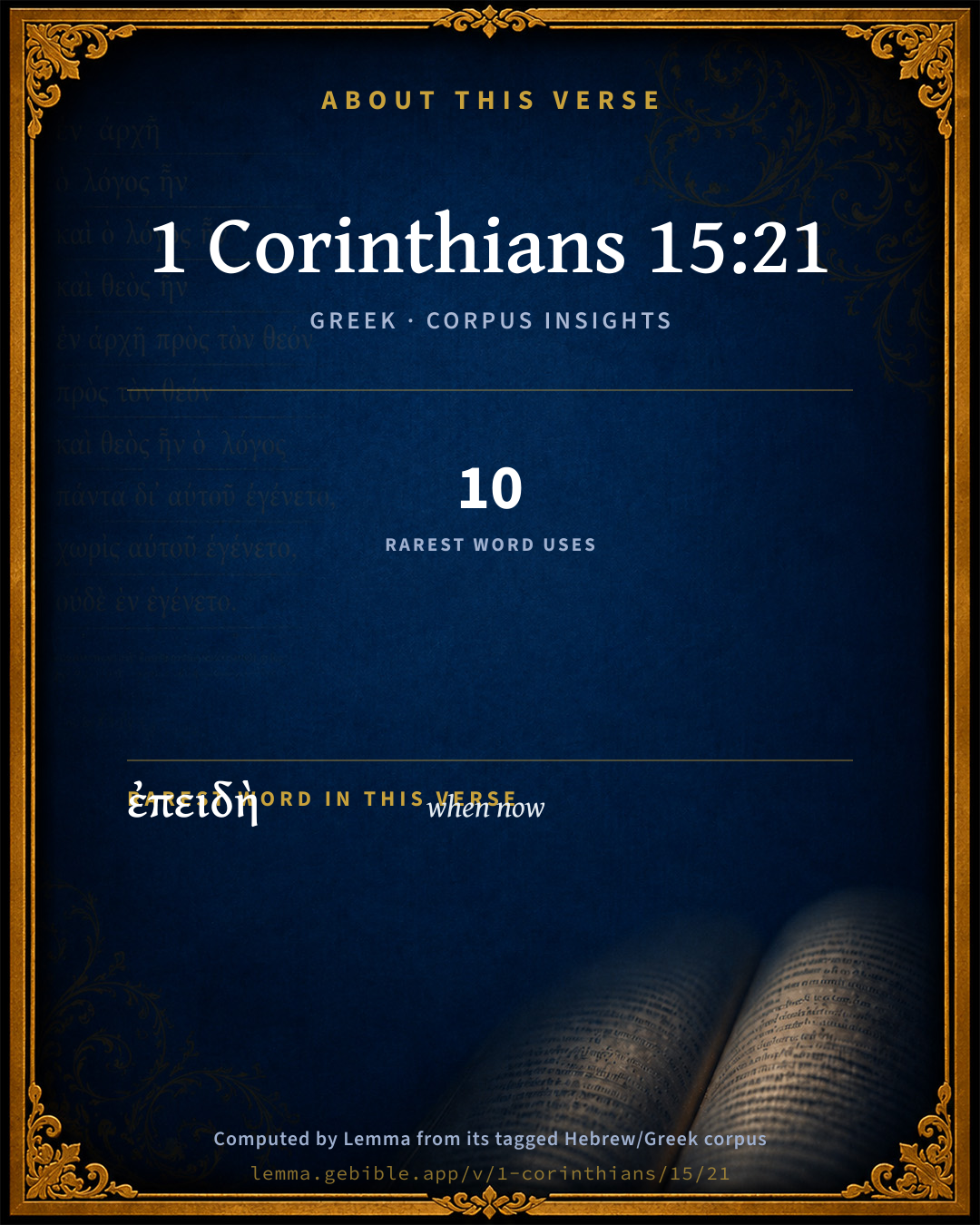
10
words
8
distinct lemmas
Pauline Epistles
section

Notable vocabulary

The rarest word here is ἐπειδὴ when now G1894 — appearing just 10 times in the whole Greek New Testament.

Shared distinctive vocabulary

ἐπειδὴ when now G1894 occurs in 10 verses of the Greek New Testament. Also found in:

Repetition

Words recur within this verse:

  • δι’ through G1223 ×2
  • ἀνθρώπου human being G444 ×2

Cross-references

4

Topical passages linked to 1 Corinthians 15:21 in the Treasury of Scripture Knowledge — connected by theme and wording, ordered by reader-vote popularity; previews shown in the World English Bible.

  • John 11:25 Jesus said to her, "I am the resurrection and the life. He who believes in me, though he die, yet will he live.
  • Romans 5:12–17 Therefore, as sin entered into the world through one man, and death through sin; and so death passed to all men, because all sinned.
  • Romans 6:23 For the wages of sin is death, but the free gift of God is eternal life in Christ Jesus our Lord.
  • 1 Corinthians 15:22 For as in Adam all die, so also in Christ all will be made alive.

Cross-references courtesy of OpenBible.info (CC BY 4.0).

Commentary

Notes on 1 Corinthians 15:21 from classic Christian and Jewish commentators (each source and its license shown beneath its notes). The classic Christian expositions comment on the surrounding passage and are grouped to its opening verse, so a note may address several verses; the Jewish commentaries on the Tanakh (Rashi and others) are per-verse, so they appear only where the commentator wrote on this verse.

Lemma curates 59 commentaries, every one of them public domain or Creative Commons licensed, each selected and text-cleaned for this edition rather than reprinted as found. About our sources →

The Biblical Illustrator

Joseph S. Exell

1Co_15:21-22

For since by man came death, by man came also the resurrection of the dead.

Salvation by man

When Paul says by man he refers to Christ; only taking advantage of the fact that, since the Son of God incarnate, is become a proper man, it is permitted us to regard the power of salvation as included in humanity itself. Christ is not so much to be thought of as being external, but as a regenerative power so inserted in humanity as to be, in a sense, of it. The word since supposes an impression felt of inherent fitness, requiring the corporate disadvantages of the fall to be made good by a corporate remedy. Consider, then--

I. The antecedent probability of such a remedy, indicated by familiar analogies. It is Gods manner to make all things largely self-remedial when attacked by disorder. The bush that is bent, as soon as it is let go springs up suddenly by an elastic force within. Cut it down and it will set to new growths. Every animal body has a distinct self-medicating force in its own nature, called by physiologists the vis medicatrix. The same is true of all defections of character, the man must repair his losses by a process of recovery undertaken by himself; the whole world toiling at his vices and dishonors could not repair one of them. The same is true of society. What, then, shall we expect when humanity is broken by sin, but that if God organises redemption, He will do it in a way to have it appear as a redemption from within, executed in a sense by man?

II. We not only want a supernatural salvation (for nothing less than that can possibly regenerate the fall of nature), but in order to have any steady faith in it we must have it wrought into nature and made to be, as it were. One of its own stock powers. Note the eagerness that turns such multitudes of our time after the doctrine of progress.

1. Yet there is no fiction more baseless than a strictly natural progress, for after the fact of sin the progress of the race must be (as we see it is) from bad to worse. We want a salvation that is to us all that this doctrine of progress pretends to be, and God gives us to see the general humanity so penetrated with the supernatural by Christ living in it, as to be, in a sense, working out redemption from within itself.

2. Meantime, if it were possible to restore the fall of our race by any kind of wholly external agency, supposing no concurrent struggles operating from within, it would reduce our character and grade of insignificance to a virtual nullity. But the Saviour being or becoming man, the salvation dignifies and raises man even before he receives it.

III. Since it is continually assumed in Scripture that we fall as a corporate whole, we naturally look for some recuperative grace to re entered into the race, by which so great a disadvantage may be repaid or overcome, True, we are not born of Christ physiologically. The correspondence must not be understood to hold in any but a general and qualified way. Let it be enough that as Adam is our head physiologically, so is Christ our head by the head influences He inaugurates. Good souls have a power to get into the race by collateral propagations of their goodness, when bad souls have almost no such power at all. They have a destiny of headship, becoming Adams in the sublime fatherhood of their power. And so it is, illustrating the Divine by the human, that the incarnate Word of Gods eternity, coming into birth and living and dying as a man, fills the race with new possibilities and powers, starts resurgent activities, and overtops the sin abounding with a grace that so much more abounds.

IV. Consider now some of the Scripture evidence of the subject. It declares the the seed of the woman shall bruise the serpents head. The womans whole posterity, including Christ, shall do it, God being always present in the struggle. Here and there the hidden method is departed from, and God does something for or upon our humanity and not through it, but nothing works like a power that does not work by man. When Christ comes, perfect in all Divinity, He gets into the common family register as man, and puts the struggle on as being a struggle of race. And when He is gone a gospel is born, and, though there seems nothing here but the same humanity there was before, it is a very different fight as respects the power of it. Observe how even Holy Scripture is written by man, bearing in every book the stamp of the particular mind in whose personal conception it was shaped. And the gospel of Christ is to be preached by human ministers, and the disciples are to be newer incarnations of Christ, and, in a sense, by their gifts, prayers, and sufferings, vehicles, also, of the Spirit. Ye are the light of the world. Conclusion:

1. We have, then, a very significant presumption raised, that when any breakage or damage occurs in any legitimate institution of the world, God has put in somewhere some kind of self-remedial force to mend it.

2. Note the immense responsibility thrown upon Christs followers. Christ lays it on them to be gospellers with Him, and to really believe is to come into the great life-struggle of Jesus.

3. Lift up your heads, O ye drooping ones! Christ is in the world. He is about us, within us, going through all things, moving onward in all. Leaven does not make a noise when it works, and yet it works. No river runs to the sea more certainly or steadily than the great salvation by man runs to conquest and a kingdom.

4. Observe the beautiful delicacy of God in His plan of salvation. He makes it not a salvation for man only, but contrives to make it, as far as possible, a salvation by man. True, it is all by Christ, and yet it is by the Christ within--the law of the spirit of life in Christ Jesus. And so, instead of making His mercy a mere pity that kills respect, He makes it a power that lifts into character and everlasting manhood. And when we shall go home to be with Christ, what shall we do but confess in lowliest homage--Unto Him that loved us and washed us from our sins in His own blood; raising our finale, also, to sing, in the glorified majesty of our feeling, And hath made us kings and priests unto God. (H. Bushnell, D.D.)

For as in Adam all die, even so in Christ shall all be made alive.--

Adam and Christ

Consider--

I. The points of resemblance between these two beings as traced out in different parts of Scripture.

1. Adam was the immediate creation of God. He had no other father--neither had Christs human nature.

2. In the perfect beauty of holiness was Adam created. And of Christ we are told that He was holy, harmless, undefiled.

3. The crown of dominion over the earth and the creatures was set upon the head of Adam; but this is more fully verified in the exalted humanity of Christ (Heb_2:8-9).

4. Adam was transported from the part of the earth where he was created to Eden; Christ ascended from the world to the heavenly Paradise.

II. The points of dissimilarity between them. There is between them the distance of humanity and deity. Christ was able to vivify His own body. He was made a quickening spirit; but Adam was made a living soul only.

III. The relation in which these personages stand to human beings, and the manner in which it is formed. To Adam all stand related by a natural connection--our bond with Christ is a bond of faith.

IV. The consequences accruing to us from this relation.

1. The baneful effects of our connection with Adam.

2. The benefits which come to us from our bond with Christ. (J. Leifchild, D.D.)

The Adam and the Christ

The apostle is not content with affirming the obvious fact, that as Adam died, so all men die. He traces the death of all to the death of the one, and affirms the work of Christ to be coextensive and coefficient with the work of Adam. Just as in Rom_5:12-21 he connects the results of Christs redemption with the sin which brought death into the world and all our woe.

I. Throughout the Scriptures Christ is set forth as the creative Word and wisdom of God. Without Him was not anything made that was made. By Him, the Quickening Spirit, Adam was made in His image, after His similitude. Adam, by his trespass, defaced that Divine image; but he did not altogether obliterate it. He brought evil and death into our nature; but there was still in that nature some remnant of its original beauty and goodness. And to this day our nature is a compound in which good and evil are strangely blended; the good of God, the evil of ourselves. In every child we see some bad, some good tendencies. Whence do they derive that goodness? From Christ, the Creative Word. All in himself and in us that Adam could not, or did not, wholly spoil, is a remnant of mans original endowment; it is the work and gift of Christ. And therefore it is that the better man, the better self, in us speaks with an authority which the worse self never claims.

II. But it is not as Creator alone that Christ saves us and gives us life: it is also as Redeemer, the Second Man, the Lord from heaven, who took our flesh and dwelt among us. Whatever our view of original sin, we all admit that the sins of the father do affect the very nature of his children; and that therefore, if by transgression our first parents fell from their purity, it may very well be that we are the worse for their transgression. But it is not equally easy to see how the redemption of Jesus should have a similar effect on us before we believe on Him. Yet a little consideration may suffice to show us that whatever Christ does must affect the whole human race in the same way in which it is affected by Adams sin. For what gave Adam his power over us and the renditions of our life? Simply the fact that he was our father; in the subordinate sense, our maker. Like begets like. God begot Adam in His likeness; Adam begot men in his likeness. As he transgressed, we suffer for his transgression. But who made Adam? Christ, the Creative Word, that afterwards took flesh and became man. If, then, whatever Adam did affects us, simply because we descend from him, will not whatever Christ--from whom also we descend--does, affect us? and affect us by so much the more as Christ is greater than Adam? If we can conceive that Christ, the Living and Creative Word, should have perished, should not we all have perished in Him? And if He, our Maker, assumes our nature, and renders a perfect obedience, must we not all be the better for His obedience? As well might the sun move from its place without influencing, in every part, the whole solar system, as the eternal Christ descend to earth, and dwell a Man among men, without sending a vital influence through the whole of humanity.

III. But how are all men the better for the grace of Christ? Death, moral and physical, was the consequence of Adams transgression. Had he become only what he had made himself, he would have sunk irremediably into evil. Had we in our nature only that which, in the strictest sense, we derive from him, we should be only evil. That he did not, that we do not, become the mere bondslaves of evil, is all of grace; it is because we derive from Christ other and better qualities than we inherit from Adam, because Adam derived from Christ other and better qualities than those which he superinduced upon his nature. As we have seen, even before we believe in Christ we have a better and a worse self contending in us for the mastery. Consider the children you know. Nay, consider the very worst man you know. Is there not a double nature in him? Has not even he a better self? Does he not know that it is the better, and that it should be supreme? This is the benefit all men derive from the redemption of Christ, that they have the Christ in them, just as the harm they inherit from Adam is that they have the Adam in them. But for the grace of Christ they would never have had that better self, of which they are conscious even when they wrong it by sinning against it. Conclusion: Perhaps it may be objected, But Adam was the first man. Christ did not come into the world for four thousand years after sin was in the world. It might be enough to reply that Christ was in the world before Adam, or how could He have made Adam? that He has never left the world: that He was in Adam as a spirit of righteousness and truth after the Fall, and in all who lived before the Advent: for how else could He have taught them what they knew of the spiritual and eternal world? how else could they have striven against His Spirit? how else could they have tempted Christ (1Co_10:9). How else could all the fathers drink of the spiritual Rock that followed them, and the Rock was Christ? (1Co_10:1-4; cf. Heb_11:26). But this objection springs from our purely human way of regarding things. We are in time, and judge events by the measures of time. We are so made that we can only conceive of events locally and in succession--i.e., within the limitations of time and space. But these limitations do not restrain the Inhabitant of Eternity. There is no before and after with Him. If the eternal Christ had been the last man on the earth, none the less His redemption would have passed in its effects through all the eras of time, and have moulded the destinies of all generations. We indeed cannot tell how; but neither can we comprehend the mere conception of eternity: how, then, can we hope to comprehend Him who sits above all of time, or to calculate the issues of His redeeming work?

2. Again, it may be asked, But if all men are to live in Christ as all men die in Adam, does not the parallel involve the ultimate recovery of the whole human race? No; both the Adam and the Christ are in us: the Adam with his offence, the Christ with His grace; the Adam with his disobedience, the Christ with His gift of righteousness. And we have to choose between them. Yielding to the Adam, we die; but if we yield to the Christ, we shall never die, but reign in life through Him. If we are not obliged to yield to Adams sin, why should we be obliged to yield to Christs grace? (S. Cox, D.D.)

The solidarity of salvation

1. A friend we love, how distinct and individual seems to us all he says and does! And his most marked peculiarities become dear to us simply because they are his and his only.

2. And yet, if we go home with him, counter-discoveries greet us on every side. We see in his father whence came that look in the eyes, and in his mother that turn of the mouth, that shade of colour in the hair, and his voice in his young brother. But is he any the less a distinct character?

3. How deep our searching might go if we penetrated the hidden ground of our friends life. And science could take up his mannerisms, and show us their exact parallel not only in the locality where he was born, but in the ancient homes of the English in the far north. Nor is it his body only into which these multitudinous influences have entered, but into his character and mind. We are using the stored experiences of bygone generations, and cannot throw off the domination of their hidden forces, for they lie at the most secret places of our souls. Old faces, long buried, look out of our eyes; voices from out of forgotten and unknown graves speak through our lips. Yet nothing of all this burdens us; we are ourselves; we miss nothing of our free manhood. We all of us live one life. Out of the same earth we grow, like plants out of a common soil, and each of us puts out our own colour, and shape, and scent. And it is by this unity of race that we effect a combined advance; civilisation is only possible, because the genius of each generation can be retained and transmitted.

4. But, then, we cannot accept the gains of heredity and refuse the losses. And why, then, are we perplexed, if, by this same habitual law, we all in Adam die? We men form one body; and to prohibit poison, once introduced, from spreading over the whole, would be done only at the cost of forbidding that body to perform its functions, at the cost of wrecking its structural life. Let Adam once have sinned, and we, who are in Adam, have the seeds of sin within us. Our freedom is all the more free when it acts under the uplifting pressure of a splendid inheritance; nor is it at all sensible of any diminution because its sin bears witness to the miserable story of a guilty stock.

5. In Adam all die. Yes! but hidden in this very mystery is the possibility of a redemption. The transmission that makes for the corruption of all, can be turned to the needs and uses of the regeneration. God converts the conditions of the curse into the very instruments of the blessing. In Adam, it is true, all would die; but, then, in Christ, all may be made alive. So, in the Beloved Son, man becomes new-begotten of God.

6. And now let us measure His task. His virtue must imbed itself by roots as deep and strong as those by which sin has dug its dire fangs into the inherited flesh. It must pervade and embrace the entire bulk of fallen and human nature. Everything that is ours He must make His. And ours, now, was a life bound down under a curse, smitten with the blight of sorrow. Yet He became ours; wholly human, wholly knit into our common fate, implicated with us in all our woe. And yet, lo! He has brought with Him into our burdened days the new vitality. The entire movement in which we had found ourselves held is reversed.

7. As that old sin spread out its baneful influence, ring upon ring, circle upon circle, so this new life issues out over the whole, in circle after circle, in ring upon ring. There is the outermost ring of that dim heathen world which has been brought nigh, in the Risen Christ, to the Father. And they, even they, amid ugly and foul confusions, are not insensible to that strange stirring which is the movement within them of the resurrection--a movement blind yet prophetic--prompting them to deeds which Christ will yet own as His at the Last Day. And within that ring is the ring of a civilisation that, for all its miserable stains, has yet this mark of Christ upon it; it can never lose its hope--a hope that has in it always the power of a recovery. We cannot despair, though the Lord delayeth His coming. And within that ring is the ring of those who cling to Christ. The Lord knows them that are His, and He showers down favour upon them as they look up to Him. And within this ring, again, its very heart and core, is Christs living Church. Christs love beats like a great heart, pulse upon pulse, expelling that slow death which has crept over the body of humanity. And, thus, in Christ, all are made alive. You and I, we are none the less free, because in Adam we all died; and then in Christ, in some strange recovery, achieved for and by God, we all were made alive. Just as we won the free exercise of our English name out of the very necessities which had made us English; so, out of our very bond to Christ, we win the energy to become free friends of Christ. Out of His action we are made free, and the more He does for us, the more we are enabled to do for ourselves. You are free this very minute to rise and follow Christ.

8. But such high freedom cannot but be perilous. It is not yours to choose whether you will rise with Christ or no. All rise with Him; all through Him are dragged through the darkness of the grave, and will stand before the judgment of God. As we must have died in Adam, so we must rise in Christ. And what is it, then, that strikes chill as fear upon our hearts? Can it, indeed, be that the freedom regained in Christ can itself be turned against the name of Him who inspires it? Yet this can be. We shall rise; but where will that order be in which we shall have placed ourselves? What if our approach to God be as the nearing of a great heat that scorches and kills? Holiness is as a fire to sin. (Canon Scott-Holland.)

Spiritual death

Adam, as used in this passage, is, so far as we shall regard it, only a synonym for sinfulness.

1. We assume that human nature is sinful. The degree of this sinfulness, I care nothing about. Look wherever you may and you will find the trace and evidence of deep depravity.

2. Note also that there is no sin without a sinner. Sin is not a vague, weird, devil-like shadow, which no one can grasp and define; it is a palpable fact. Whenever you find it, you find it in the shape of a deed done by some doer.

3. Human nature in its rudiments is precisely what it has always been; the world in the aggregate is just what it was a thousand years ago. We flush to the same wicked passions to-day that flamed in the lusts of our fathers. The old Adam still lives, sins, dies. If you demand proof, I point to your gaols, to your gallows, to yourselves.

4. There are those who do not resist temptation; some because they have never been successful in their resistance, and hence despair has entered into their souls. When Satan has threaded the very fibres of hope out of man, he has won a triumph indeed. The gambler that can take anothers money, and feel no compunction, illustrates how thoroughly sin can get the mastery of a human being. Such people are dead in trespasses and sins. You run a pin into your body and you scream because it is a live body. And so, while conscience is alive, the thrust of a wicked thought through it causes exquisite torture. But when one can lie, and steal, and be drunken--when these barbed iniquities can be driven day by day into the very centre of a mans life, and conscience receives the stab without a spasm--then is it dead. Hence, sin is moral suicide. This is what men mean by the phrase: He has no conscience.

5. All sin is a sin against God. He stands embodied in every creation that He has made. Sin is an electric current, and it matters not along what wire the shock of it is delivered, it finally enters His breast. Do you wonder that He is quick to interpret the insult? Does not a mother resent any injury done to her child? Whoever sins against himself sins against God. For all that makes us to differ from the beasts of the field is the Divinity within us.

6. We can never know how evil sin is, because we cannot measure the evil it works. And this because we cannot know how sublime are the possibilities in the nature which it destroys. He who without cause breaks a bud from a stem, has done a deed the evil of which we can measure. He has destroyed a rose. But he who murders a child has done a deed the sin of which we cannot measure; for we cannot tell how much good that child might have done. Much less can you measure the evil which sin works when it destroys a soul. For none, save God, knows what are the possibilities of a soul. In front of all our sinfulness stands the great fact, staring us in the face, that we cannot keep it to ourselves. For whatever makes me worse, makes all worse who intimately know me. Nor is there any knowing where sin ends. The Bible says that parental transgressions lap over five generations. The tide of human life flows on still turbid and dark; and even the filter of Christianity seems incapable of purifying the unsightly stream. We have done nothing evil that is not to-day as chemically potent to darken the purity of the world, as on that day and at that hour when the sinful deed, or word, or imagination dropped, like a black globule, into it. The young vulture, once having broken its chain, or overflown the wire, returns no more. So it is with sin. Once out of our reach it is for ever beyond our control. (W. H. H. Murray.)

Spiritual life

1. At the root of all higher life in man is a protest against his living a lower life. This protest we call conscience. Without it, men would be devils at birth. Within you all is this root of holiness. If you do evil, it condemns; if you do well, it applauds. Christ means the Anointed, the Consecrated, the Kingly One. Whatever, therefore, is kingly and consecrated in you, He represents. He is, as it were, your best self. Your higher life, therefore, is Divine. So far as you live in it you live in God. And out of this thought comes great hope for many. For there be many, I feel, that live in God and know it not.

2. Now the glory of the whole world is the glory of the life that is in it. A landscape in which there is no green, growthful thing, a level stretch of sea without ripple or current, a house in which no life stirs, a human face, set, colourless, rigid in all its lines--there is no glory in all these. Wherever you look, your eyes instinctively search for life. If you find it not, your soul instinctively draws back within itself. Death is universal horror. Life demands life. It lives on companionships. These are to it what sunshine and moisture are to plants. Only in this connection do we apprehend that fine eulogy of Christ, In Him was life, and the life was the light of men.

3. Now all life is not the same life. There is the life of beast, of bird, of man. Beyond we come to the life of angels, of spirits; and over all we find the Great Spirit, in whom all life is, and out of whom all life comes. God. In man you find the indwelling life graded as to quality and use. There is body-life, mind-life and soul-life. And the qualities and expressions of the last are finer than the qualities and expressions of the others. Now the life which we have in Christ is the life of the finest qualities in us. It is the life contained in those faculties and powers which are not only immortal, but which are adapted in their nature for the finest uses.

4. Life which is simply continued existence, is a low order of life. There is a life, the result of which is a curse. A bird which should lose its bird instincts and become swinish, would offer to our gaze a spectacle abhorrent to that sense in us which interprets the eternal fitness of things. And so when the man forgets that he is a spirit, when he deserts heaven and makes his home in the earth, offers a spectacle abhorrent to every instinct of justice and propriety.

5. Now, there is no denying that the earthly tendency is in us all. Neither is there any denying that the heavenly impulse is in all who allow it to dwell in them. Man is not an empty vase. He is filled, inwardly, with soul-life capacities. And in these capacities are seed-like qualities which need only Divine quickening to germinate to holiness. The best recognition of this native nobility in man is seen in the incarnation. I thus swing myself up to Gods standpoint and looking down upon the reckless of earth, exclaim: What a pity that such a creation should misdemean himself in that style! When I see one engaged in brave battle with some appetite, breasting up against some passion, or striving against unfortunate circumstances to better himself, I say The original impulse to virtue has not wholly left the race yet. My angels are not in the sky, but in the bosoms of men and women striving to be better. God is born in some men, and He groweth with their growth. The patience, the courage, the abhorrence of evil, the shrinking from coarseness, the innate love of pure things which are in the Divine nature, are in them.

6. Now this Divine element in human nature, this something in man which is finer than man, had perfect expression in Jesus. It was the moral perfection of the human being, Jesus, that made Him worthy to be called Christ. The title was descriptive of the man.

7. Pattern your lives after the model presented for your guidance and your inspiration in the character of this matchless being. In Him, standing here, behold the union of both worlds; the humanity of earth inspired with the divinity of the skies. Do you wonder that such a being should say, The kingdom of God is within you? Nay! For He felt that the foundations of that kingdom were laid in the capacities of His own bosom. As David said touching the Father, so we can say touching our Elder Brother, I shall be content when I awake in Thy likeness. Let the dead within you hear the voice to-day which calls it from its grave, and let it come forth and stand ready for action in the front rank of your purposes and endeavours. If ye then be risen with Christ, seek those things which are above, where Christ sitteth at the right hand of God. Every man must make his own world, as Jesus made His. And all who live upon the earth who would be like Him, must live above it.

8. This must be observed also, that whoever comes into that way of living which Christ had, comes into it first by the way of positive resolution. And this resolution is his own. It is conduct which makes character. And you can make your conduct whatever you please. Now he who continues in good conduct, continues in Christ (Joh_15:4; Joh_15:6). The man who ceases to practise the actual virtues that Christ practised, is a withered man, morally. (W. H. H. Murray.)

The Christians life in Christ

1. All which our Lord has is ours, if we are indeed His. As Man, He received gifts, that He might give them to men. As Man, He received the Holy Spirit, that He might again dwell in man, and clothe us with the holiness which we lost in Adam. For our sakes He sanctified Himself, that we also might be sanctified by the truth. His shame is our glory; His blood our ransom; His wounded side our hiding-place from our own sins and Satans wrath; His death our life. And what, then, should His life be? What but the sealing to us of all which He had wrought for us? What but the bursting of the bars of our prison-house, the opening of the kingdom of heaven?

2. All this is to us in Christ. In Christ shall all be made alive. We shall live then, not only as having our souls restored to our bodies, and souls and bodies living on in the presence of Almighty God. There is a higher blessedness yet in store, viz., to live on in Christ. For that implies Christs living on in us. For we can only dwell in God by His dwelling in us. To dwell in God is not to dwell on God only. He takes us out of our state of nature, in which we were, fallen, estranged, in a far country, out of and away from Him and takes us up into Himself.

3. This is the great difference between us and the brute creation. They are not capable of the presence of God. He made them; He extendeth His providence over them. Yet their spirit goeth downwards to the earth, not upwards to the God who gave it. This is also the great difference between us and those who lived under the Old Testament. Closer is the nearness of God to those who will receive Him, than when He walked with Adam in Paradise, or seemed to sit with Abraham, or to speak to Moses face to face, or when the angel in whom His presence was, wrestled with Jacob, or when One, in the form of a Son of Man, was with the three children in the fire; yea, nearer yet, than when, in the flesh, His disciples did eat and drink with Him. For all this nearness was still outward only. Such nearness had Judas also, who kissed Him. Such nearness shall they plead to whom He shall say, I never knew you; depart from Me, ye that work iniquity.

4. The Christians nearness He hath told, We will come unto Him, and make our abode with Him, in holiness, peace, bliss, cleansing love. It is not a presence to be seen, heard, felt by our bodily senses; yet nearer still, because when the bodily senses fail the inward eye sees a light brighter than all earthly joy; the inward ear bears His voice; the inmost soul feels the thrill of His touch; the heart of hearts tastes the sweetness of the love of the presence of its Lord and its God. The Everlasting Son dwelleth not as He doth in the material heavens, nor as He sanctified this house of God, nor as He did in the tabernacle, but united with the soul, and, in substance, dwelling in her, as He did personally in the man Christ Jesus.

5. This then, as it is the special mystery of the gospel, so is it of the Resurrection--to be in Christ. This is our justification, sanctification, redemption, in Him; this our hope for those who are departed before us, that they are fallen asleep in Him; are dead, but in Him (1Th_4:16); this is our hope in the day of judgment, that we may be found in Him; this our perfecting (Col_1:28), this our endless life (verse 22), this is the consummation of all things (Eph_1:10). Through Christs resurrection we have a new principle of life in us. The Spirit, which dwelt in Him without measure, He has imparted to us His members, that it may sanctify us, spiritualise our very bodies here, keep in us the true life, if we forfeit it not, and so, through that Spirit, shall our dust again be quickened, and we be raised at the last day to life (Rom_8:9).

6. The Spirit not only cometh upon those who are Christs, as of old, but is within them, (Rom_8:9-10). And if the Spirit abide in us, how should not the body, so lived in, have life? (Rom_8:11). The resurrection, then, of our Lord is not only a pledge of our own; it is our own, if we be His. His body is a pattern of what is in store for ours, since we, if His, are a part of it. Conclusion: Since these things are so, we may well stand in awe of our very selves and of the majesty bestowed upon our frail nature (chap. 3:16). Grieve not away the Holy Spirit of God. For if the evil spirit find the dwelling-place whence he was cast out empty, he will take to himself seven spirits more wicked than himself, and will re-enter and dwell there. Let us then, as we would hope at the last day to rise to life, and not to shame and everlasting contempt, seek, and watch, and pray, to rise with our risen Lord now. (E. B. Pusey, D.D.)

The power of the resurrection

The resurrection of Christ--

I. Is the great public manifestation of His authority over physical decay and death. This it is by being His own personal conquest of that power as it had been exercised upon Himself: a characteristic which separates it from all other instances of similar miraculous restorations. All others, in whatsoever age of the world, had been raised by a power from without: He alone by Himself. The power that revived all, stands self-revived.

II. Being a self-resurrection, stands alone as a monument of His inherent power of life. There seems a sort of progressive scale of the other resurrections noted in the gospel history. The daughter of Jairus was raised before she was conveyed from her chamber; the son of the widow of Nain was being carried out to burial; Lazarus had been four days in his grave. Neither were self-raised; Christ was self-raised.

III. Was the result of a power that did not cease at His departure from the world. The whole Church is the monument of its existence and its exercise; it is built upon His resurrection. For there is a spiritual resurrection and there is a physical resurrection. The latter was wrought by Christ when on earth, as a visible symbol of the other, and a proof of His power to effect it. His own resurrection from the dead mysteriously exemplified both: the general resurrection of the just at the consummation of all things shall again and for ever combine them. The resurrection of Christ, once performed in act, is immortal in energy; He rises again in every new-born child of God.

IV. Should prompt the desire for the final consummation of His work, the restoration of an immortal body to an immortal soul. In Christ shall all be made alive. All men are to be made alive spiritually and physically. Behold! we stand alone in creation; earth, sea, and sky can show nothing so awful as we are! The rooted bills shall flee before the fiery glance of the Almighty Judge; the mountains shall become dust, the ocean a vapour; the very stars of heaven shall fall as the fig-tree casts her untimely fruit! Yea, heaven and earth shall pass away, but the humblest, poorest, lowliest among us is born for undying life. Amid all the terrors of dissolving nature, the band of immortals shall stand before their Judge. (W. Archer Butler, M.A.)

The results of Christs resurrection

Consider--

I. The results of Christs resurrection to us. It is a pledge of the resurrection of all who share in His humanity.

1. Why does this result take place? (verse 22). Do not understand the apostle as if he merely said, If you sin as Adam sinned, you will die as Adam died. This was mere Pelagianism, and is expressly condemned in the article on Original Sin. According to the Scriptures we inherit the first mans nature, and that nature has in it the mortal, not the immortal. And yet there are in all of us two natures, that of the animal and that of the Spirit, an Adam and a Christ. St. Paul explains himself: The first man was of the earth, earthy; and again, The first man Adam was made a living soul.

(1) Recollect that the term a living soul means a mere natural man endowed with intellectual powers, with passions, and with those appetites which belong to us in common with the animals. In this our immortality does not reside; and it is from fixing our attention on the decay of these that doubt of our immortality begins. It is a dismal and appalling thing to witness the slow failure of living powers; as life goes on to watch the eye losing its lustre, and the cheek its roundness; to see the limbs becoming feeble and worn; to perceive the memory wander, and the features no longer bright with the light of expression; to mark the mind relax its grasp; and to ask the dreary question--Are these things immortal? You cannot but disbelieve, if you rest your hope of immortality on their endurance. Now the simple reply is, that the extinction of these powers is no proof against immortality, because they are not the seat of the immortal. They belong to the animal--to the organs of our intercourse with the visible world. Therefore it is not in what we inherit from Adam the man, but in what we hold from Christ the Spirit, that our immortality resides.

(2) Nay more, the growth of the Christ within us is in exact proportion to the decay of the Adam. Though our outward man perish, yet the inward man is renewed day by day. And this evidence of our immortality is perpetually before us. It is no strange thing to see the spirit ripening in exact proportion to the decay of the body. Many an aged one there is who loses one by one all his physical powers, and yet the spiritual in him is mightiest at the last.

2. When will this result take place? (verses 23, etc.) Note--

(1) That the resurrection cannot be till the kingdom is complete.

(2) That certain hindrances at present prevent the perfect operation of God in our souls. We are the victims of physical and moral evil, and till this is put down for ever, the completeness of the individual cannot be; for we are bound up with the universe. Talk of the perfect happiness of any unit man while the race still mourns and while the spiritual kingdom is incomplete! No, the golden close is yet to come, and the blessing of the individual parts can only be with the blessing of the whole. And so the apostle speaks of the whole creation groaning and travailing in pain together until now, waiting for the adoption, to wit, the redemption of our body.

(3) That the mediatorial kingdom of Christ shall be superseded by an immediate one; therefore the present form in which God has revealed Himself is only temporary. When the object of the present kingdom of Christ has been attained in the conquest of evil, there will be no longer need of a mediator. Then God will be known immediately. Then, when the last hindrance, the last enemy, is removed, we shall see Him face to face, know Him even as we are known, awake up satisfied in His likeness, and be transformed into pure recipients of the Divine glory. That will be the resurrection.

II. Corroborative proofs. These are two in number, and both are argumenta ad hominem. They are not proofs valid to all men, but cogent only to Christians.

1. When baptized, Christians made a profession of a belief in a resurrection, and St. Paul asks them here, What, then, was the meaning of their profession? Why were they baptized into the faith of a resurrection, if there were none? (verse 29).

2. Why stand we in jeopardy every hour?

(1) If the future life were no Christian doctrine, then the whole apostolic life--nay, the whole Christian life, were a monstrous and senseless folly.

(2) And again, Christian life, not merely apostolic devotedness, is a grand impertinence. Let us eat and drink, for to-morrow we die, and if this life be all, we defy you to disprove the wisdom of such reasoning. How many of the myriads of the human race would do right, for the sake of right, if they were only to live fifty years, and then die for evermore? Go to the sensualist, and tell him that a noble life is better than a base one, even for that time, and he will answer: I like pleasure better than virtue: you can do as you please; for me, I will wisely enjoy any time. It is merely a matter of taste. By taking away my hope of a resurrection you have dwarfed good and evil, and shortened their consequences if I am only to live sixty or seventy years, there is no eternal right or wrong. By destroying the thought of immortality I have lost the sense of the infinitude of evil, and the eternal nature of good.

(3) Besides, with our hopes of immortality gone, the value of humanity ceases, and people become not worth living for. We have not got a motive strong enough to keep us from sin. Christianity is to redeem from evil: it loses its power if the idea of immortal life be taken away. (F. W. Robertson, M.A.)

The Biblical Illustrator, edited by Joseph S. Exell (c. 1880s–1900s) — public domain. Text from a community e-Sword module.

MacLaren's Expositions of Holy Scripture

Alexander MacLaren

1 Corinthians

THE DEATH OF DEATH

1Co 15:20 - 1Co 15:21; 1Co 15:50 - 1Co 15:58.

This passage begins with the triumphant ringing out of the great fact which changes all the darkness of an earthly life without a heavenly hope into a blaze of light. All the dreariness for humanity, and all the vanity for Christian faith and preaching, vanish, like ghosts at cock-crow, when the Resurrection of Jesus rises sun-like on the world’s night. It is a historical fact, established by the evidence proper for such,-namely, the credible testimony of eye-witnesses. They could attest His rising, but the knowledge of the worldwide significance of it comes, not from testimony, but from revelation. Those who saw Him risen join to declare: ‘Now is Christ risen from the dead,’ but it is a higher Voice that goes on to say, ‘and become the first-fruits of them that slept.’

That one Man risen from the grave was like the solitary sheaf of paschal first-fruits, prophesying of many more, a gathered harvest that will fill the great Husbandman’s barns. The Resurrection of Jesus is not only a prophecy, showing, as it and it alone does, that death is not the end of man, but that life persists through death and emerges from it, like a buried river coming again flashing into the light of day, but it is the source or cause of the Christian’s resurrection. The oneness of the race necessitated the diffusion through all its members of sin and of its consequence-physical death. If the fountain is poisoned, all the stream will be tainted. If men are to be redeemed from the power of the grave, there must be a new personal centre of life; and union with Him, which can only be effected by faith, is the condition of receiving life from Him, which gradually conquers the death of sin now, and will triumph over bodily death in the final resurrection. It is the resurrection of Christians that Paul is dealing with. Others are to be raised, but on a different principle, and to sadly different issues. Since Christ’s Resurrection assures us of the future waking, it changes death into ‘sleep,’ and that sleep does not mean unconsciousness any more than natural sleep does, but only rest from toil, and cessation of intercourse with the external world.

In the part of the passage, 1Co 15:50 - 1Co 15:58, the Apostle becomes, not the witness or the reasoner, as in the earlier parts of the chapter, but the revealer of a ‘mystery.’ That word, so tragically misunderstood, has here its uniform scriptural sense of truth, otherwise unknown, made known by revelation. But before he unveils the mystery, Paul states with the utmost force a difficulty which might seem to crush all hope,-namely, that corporeity, as we know it, is clearly incapable of living in such a world as that future one must be. To use modern terms, organism and environment must be adapted to each other. A fish must have the water, the creatures that flourish at the poles would not survive at the equator. A man with his gross earthly body, so thoroughly adapted to his earthly abode, would be all out of harmony with his surroundings in that higher world, and its rarified air would be too thin and pure for his lungs. Can there be any possibility of making him fit to live in a spiritual world? Apart from revelation, the dreary answer must be ‘No.’ But the ‘mystery’ answers with ‘Yes.’ The change from physical to spiritual is clearly necessary, if there is to be a blessed life hereafter.

That necessary change is assured to all Christians, whether they die or ‘remain till the coming of the Lord.’ Paul varies in his anticipations as to whether he and his contemporaries will belong to the one class or the other; but he is quite sure that in either case the indwelling Spirit of Jesus will effect on living and dead the needful change. The grand description in 1Co 15:52, like the parallel in 1Th 4:16, is modelled on the account of the theophany on Sinai. The trumpet was the signal of the Divine Presence. That last manifestation will be sudden, and its startling breaking in on daily commonplace is intensified by the reduplication: ‘In a moment, in the twinkling of an eye.’ With sudden crash that awful blare of ‘loud, uplifted angel trumpet’ will silence all other sounds, and hush the world. The stages of what follows are distinctly marked. First, the rising of the dead changed in passing through death, so as to rise in incorruptible bodies, and then the change of the bodies of the living into like incorruption. The former will not be found naked, but will be clothed with their white garments; the latter will, as it were, put on the glorious robes above the ‘muddy vesture of decay,’ or, more truly, will see the miracle of these being transfigured till they shine ‘so as no fuller on earth could white them.’ The living will witness the resurrection of the dead; the risen dead will witness the transformation of the living. Then both hosts will be united, and, through all eternity, ‘live together,’ and that ‘with Him.’ Paul evidently expects that he and the Corinthians will be in the latter class, as appears by the ‘we’ in 1Co 15:52. He, as it were, points to his own body when he says, recurring to his former thought of the necessity of harmony between organism and environment, ‘this corruptible must put on incorruption.’ Here ‘corruption’ is used in its physical application, though the ethical meaning may be in the background.

The Apostle closes his long argument and revelation with a burst, almost a shout, of triumph. Glowing words of old prophets rush into his mind, and he breathes a new, grander meaning into them. Isaiah had sung of a time when the veil over all nations should be destroyed ‘in this mountain,’ and when death should be swallowed up for ever; and Paul grasps the words and says that the prophet’s loftiest anticipations will be fulfilled when that monster, whose insatiable maw swallows down youth, beauty, strength, wisdom, will himself be swallowed up. Hosea had prophesied of Israel’s restoration under figure of a resurrection, and Paul grasps his words and fills them with a larger meaning. He modifies them, in a manner on which we need not enlarge, to express the great Christian thought that death has conquered man but that man in Christ will conquer the conqueror. With swift change of metaphor he represents death as a serpent, armed with a poisoned sting, and that suggests to him the thought, never far away in his view of man, that death’s power to slay is derived from-or, so to say, concentrated in-sin; and that at once raises the other equally characteristic and familiar thought that law stimulates sin, since to know a thing to be forbidden creates in perverse humanity an itching to do it, and law reveals sin by setting up the ideal from which sin is the departure. But just as the tracks in Paul’s mind were well worn, by which the thought of death brought in that of sin, and that of sin drew after it that of law, so with equal closeness of established association, that of law condemnatory and slaying, brought up that of Christ the all-sufficient refuge from that gloomy triad-Death Sin, Law. Through union with Him each of us may possess His immortal risen life, in which Death, the engulfer, is himself engulfed; Death, the conqueror, is conquered utterly and for ever; Death, the serpent, has his sting drawn, and is harmless. That participation in Christ’s life is begun even here, and God ‘giveth us the victory’ now, even while we live outward lives that must end in death, and will give it perfectly in the resurrection, when ‘they cannot die any more,’ and death itself is dead.

The loftiest Christian hopes have close relation to the lowliest Christian duties, and Paul’s triumphant song ends with plain, practical, prose exhortations to steadfastness, unmovable tenacity, and abundant fruitfulness, the motive and power of which will be found in the assurance that, since there is a life beyond, all labour here, however it may fail in the eyes of men, will not be in vain, but will tell on character and therefore on condition through eternity. If our peace does not rest where we would fain see it settle, it will not be wasted, but will return to us again, like the dove to the ark, and we shall ‘self-enfold the large results of’ labour that seemed to have been thrown away.

Alexander MacLaren, Expositions of Holy Scripture (1904–1910) — public domain. Text from a community e-Sword module.

Tyndale Open Study Notes

Tyndale Open Resources

15:21-23 Adam’s sin contrasts with Christ’s resurrection (cp. 15:45-49).

Tyndale Open Study Notes — © Tyndale Open Resources, licensed CC BY-SA 4.0. Text via the HelloAO Bible API.

Bengel's Gnomon

Johann Albrecht Bengel

1Co 15:21. Καὶ) also. ἐπειδὴ γὰρ, for since, has here its apodosis.

Bengel's Gnomon of the New Testament — English translation (T&T Clark, Edinburgh, 1860) — public domain. Text from a community e-Sword module.

Meyer's Critical & Exegetical Commentary

Heinrich August Wilhelm Meyer

1Co_15:21. Assigning the ground for the characteristic ἀπαρχὴ τῶν κεκοιμ. For since (seeing that indeed, 1Co_1:21 f., 1Co_14:16; Php_2:26) through a man death is brought about, so also through a man is resurrection of the dead brought about. We must supply simply ἐστί; but the conclusion is not (Calvin and many others) e contrariis causis ad contrarios effectus, but, as is shown by the διʼ ἀνθρώπου twice prefixed with emphasis: a causa mali effectus ad similem causam contrarii effectus. The evil which arose through a human author is by divine arrangement removed also through a human author. How these different effects are each brought about by a man, Paul assumes to be known to his readers from the instructions which he must have given them orally, but reminds them thereof by 1Co_15:22.

θάνατος] of physical death, Rom_5:12.

ἀνάστασις νεκρῶν] resurrection of dead persons, abstractly expressed, designates the matter ideally and in general. So also θάνατος without the article; see the critical remarks.

Meyer — Critical and Exegetical Commentary on the New Testament — English translation by Peter Christie, edited by Frederick Crombie (T&T Clark, 1880) — public domain. Text from a community e-Sword module.

Expositor's Greek Testament

ed. W. Robertson Nicoll

1Co 15:21-22 explain the identification of the risen Christ with those sleeping in death, which was assumed by the word ἀπαρχή . It rests on the fact that Christ is the antitype of Adam, the medium of life to the race as Adam was of death. This parl [2338] is resumed in 1Co 15:46 ff., where it is applied to the nature of the resurrection body , as here to the universallty of the resurrection . These two passages form the complement of Rom 5:12-21 ; the antithesis of Adam and Christ who represent flesh, trespass, death and spirit, righteousness, life respectively is thus extended over the entire career of the race viewed as a history of sin and redemption. “For since through man (there is) death, through man also (there is) a resurrection of the dead”: διʼ ἀνθρώπου , “through a man ( qua man)” through human means or mediation . For ἐπειδὴ , quandoquidem (Cv [2339] ), see 1Co 1:21 f.; the first fact necessitated and shaped the second: man was the channel conveying death to his kind (Rom 5:12 ), through the same channel the counter current must flow (Rom 5:15 , etc.). This goes deeper than ἀπαρχή ; Christ is the ἀρχή , the principle and root of resurrection life (Col 1:18 ). “ Through man” implies that Death is not, as philosophy supposed, a law of finite being or a necessity of fate; it is an event of history, a calamity brought by man upon himself and capable of removal by the like means. ὥσπερ γὰρ ἐν τῷ Ἀδὰμ κ . τ . λ .: “For just as in the Adam all die, so also in the Christ all will be made alive”. The foregoing double διʼ ἀνθρώπου opens out into “the (representative) Adam and Christ” the natural and spiritual, earthly and heavenly counterparts (1Co 15:45 ff.), the two types and founders of humanity, paralleled by ὥσπερ … καὶ οὕτως ( cf. Rom 5:12 ff.). The stress of the comparison does not lie on πάντες , as though the Ap. meant to say that “ all (men)” will rise in Christ as certainly as they die in Adam (so, with variations, Or [2340] , Cm [2341] , Cv [2342] , Mr [2343] , Gd [2344] , Sm [2345] , El [2346] , referring to Joh 5:28 f., Act 24:15 ): says Bt [2347] says, the absence of ἄνθρωποι tells against such ref [2348] to the race (contrast Rom 5:12 ; Rom 5:18 ), also the use of ζωοποιέω (see below). The point is that as death in all cases is grounded in Adam , so life in all cases is grounded in Christ ( cf. Joh 6:53 ; Joh 11:25 ) no death without the one, no life without the other (Aug [2349] , Bg [2350] , Hf [2351] , Ed [2352] , Hn [2353] , Bt [2354] ). πάντες = οἱ πολλοί (Rom 5:18 f.), as set in contrast with ὁ εἷς ἄνθρωπος . Ζωοποίεω is narrower in extension than ἐγείρω (1Co 15:20 ), since the latter applies to every one raised from the grave (1Co 15:15 f., 1Co 15:35 ); wider in intension, as it imports not the mere raising of the body, but restoration to “life” in the full sense of the term (Hf [2355] ; cf. 1Co 15:45 , Rom 6:8 ; Rom 8:11 ; Joh 5:21 ; Joh 6:63 ), an ἀνάστασιν ζωῆς (Joh 5:29 ). A firm and broad basis is now shown to exist for the solidarity between Christ and the holy dead ( οἱ κεκοιμημένοι ) affirmed in 1Co 15:20 .

[2338] parallel.

[2339] Calvin’s In Nov. Testamentum Commentarii .

[2340] Origen.

[2341] John Chrysostom’s Homiliœ († 407).

[2342] Calvin’s In Nov. Testamentum Commentarii .

[2343] Meyer’s Critical and Exegetical Commentary (Eng. Trans.).

[2344] F. Godet’s Commentaire sur la prem. Ép. aux Corinthiens (Eng. Trans.).

[2345] P. Schmiedel, in Handcommentar zum N.T. (1893).

[2346] C. J. Ellicott’s St. Paul’s First Epistle to the Corinthians .

[2347] J. A. Beet’s St. Paul’s Epp. to the Corinthians (1882).

[2348] reference.

[2349] Augustine.

[2350] Bengel’s Gnomon Novi Testamenti.

[2351] J. C. K. von Hofmann’s Die heilige Schrift N.T. untersucht , ii. 2 (2te Auflage, 1874).

[2352] T. C. Edwards’ Commentary on the First Ep. to the Corinthians . 2

[2353] C. F. G. Heinrici’s Erklärung der Korintherbriefe (1880), or 1 Korinther in Meyer’s krit.-exegetisches Kommentar (1896).

[2354] J. A. Beet’s St. Paul’s Epp. to the Corinthians (1882).

[2355] J. C. K. von Hofmann’s Die heilige Schrift N.T. untersucht , ii. 2 (2te Auflage, 1874).

The Expositor's Greek Testament, edited by W. Robertson Nicoll (1897–1910) — public domain. Text from a community e-Sword module.

Godet's Commentaries

Frédéric Louis Godet

Vv. 21. In the expression ἀπαρχή, first-fruits, there was implicitly contained the notion of a community of nature between Christ and us. For the ear gathered as first-fruits is corn like all the rest. This is the idea which the apostle expounds in this verse. As it was by a member of the human family that it was smitten with death, so it is by a member of the family that it must obtain resurrection. The Apostle Paul here proclaims the idea with arresting solemnity: that death and resurrection are human facts, that is to say, the causality of them belongs to man himself. The idea is not exactly the same as that expressed in Rom 5:12 seq., though closely connected with it. In the passage of Romans, the emphasis is on εἷς, one, in opposition to many: one involving the many in his death, and one in His salvation. Here there is no εἷς; the emphasis is on ἀνθρώπου, man. It is the truly human origin of these two opposite phases in the existence of humanity which Paul wishes to set in relief. By man subjection to death was imposed on men; by man there must come to them the power of rising again. It is for man to repair the evil done by man.

In 1Co 15:21 there is stated, in the form of an abstract law, the necessary correlation between these two analogous but opposite facts. In 1Co 15:22 the two historical personalities will be contrasted with one another in whom this colossal antithesis has been realized.

Frédéric Louis Godet — Commentaries on Luke, John, Romans, and 1 Corinthians — English translation (T&T Clark, Edinburgh, 1870s–1890s) — public domain. Text from a community e-Sword module.

Hodge's Commentary on Romans, Ephesians & First Corinthians

Charles Hodge

1Co_15:21

For since by man (came) death, by man (came) also the resurrection of the dead.

The connection between this verse and the preceding is obvious. The resurrection of Christ secures the resurrection of his people, for as there was a causal relation between the death of Adam and the death of his descendants, so there is a causal relation between the resurrection of Christ and that of his people. What that causal relation is, is not here expressed. It is simply asserted that as death is δι ̓ ἀνθρώπου, by means of a man; so the resurrection is δι ̓ ἀνθρώπου, by means of a man. Why Adam was the cause of death, and why Christ is the cause of life, is explained in the following verse, and abundantly elsewhere in Scripture, but not here. By death, in this verse, is meant the death of the body; and by the resurrection is meant the restoration of the body to life. This, however, only proves that the death of which Adam was the cause includes physical death, and that the life of which Christ is the cause includes the future life of the body. But as the life which we derive from Christ includes far more than the life of the body, so the death which flows from Adam includes far more than physical death.

Charles Hodge — Commentary on Romans (1835), First Corinthians (1857), and Ephesians (1856) — public domain. Text from a community e-Sword module.

Geneva Bible (1599)

Geneva Bible translators

Another confirmation of the same consequent: for Christ is to be considered as opposite to Adam, that as from one man Adam, sin came over all, so from one man Christ, life cometh unto all: that is to say, that all the faithful, as they die, because by nature they were born of Adam, so because in Christ they are made the children of God by grace, they are quickened and restored to life by him.

Geneva Bible (1599) marginal notes — public domain. Text via Bolls.life.

Jamieson, Fausset & Brown

Robert Jamieson, A. R. Fausset & David Brown

by man . . . by man--The first-fruits are of the same nature as the rest of the harvest; so Christ, the bringer of life, is of the same nature as the race of men to whom He brings it; just as Adam, the bringer of death, was of the same nature as the men on whom he brought it.

Jamieson, Fausset & Brown — Commentary Critical and Explanatory on the Whole Bible (1871) — public domain (CC PDM 1.0). Text via the HelloAO Bible API.

Adam Clarke's Commentary

Verse 21. For since by man came death] Mortality came by Adam, immortality by Christ; so sure as all have been subjected to natural death by Adam, so sure shall all be raised again by Christ Jesus. Mortality and immortality, on a general ground, are the subject of the apostle's reasoning here; and for the explanation of the transgression of Adam, and the redemption by Christ, See Clarke on Ro 5:10, &c.

Adam Clarke's Commentary on the Bible (1810–1826) — public domain. Text from a community e-Sword/MySword module.

Ellicott's Commentary for English Readers

(21) For since by man . . .—The image of the firstfruits is followed up by an explanation of the unity of Christ and Humanity. The firstfruit must be a sample of the same kind as that which it represents. That condition is fulfilled in the case of the firstfruits of the resurrection.

A Bible Commentary for English Readers, edited by Charles John Ellicott (1878–1897) — public domain. Text from a community e-Sword module.

The Cambridge Bible for Schools and Colleges

gen. ed. J. J. S. Perowne

21. For since by man came death] Cf. Rom_5:12; Rom_5:17; Rom_6:21; Rom_6:23; Jas_1:15; and the narrative in Genesis 3.

by man came also the resurrection of the dead] Athanasius remarks that here we have not παρά but διά, as pointing out that even in Jesus Christ man was not the source, but the means of the blessings given to mankind in Him; that He took man’s nature in order to fill it, and through it us, each in our measure, with all the perfections of His Godhead. “As by partaking of the flesh and blood, the substance of the first Adam, we came to our death, so to life we cannot come unless we do participate in the flesh and blood of the Second Adam, that is, Christ. We drew death from the first by partaking of the substance; and so we must draw life from the second by the same. This is the way; become branches of the Vine and partakers of His Nature, and so of His life and verdure both.” Bp Andrewes, Serm. 2 on the Resurrection.

The Cambridge Bible for Schools and Colleges (gen. ed. J. J. S. Perowne; Cambridge University Press, 1878–1918) — public domain. Text from a community e-Sword module.

John Gill's Exposition

For as in Adam all die,.... The apostle here shows who he meant in the former verse, by the one man the cause of death, and by the other the author of the resurrection of the dead, and that he intended Adam and Christ; all men were in Adam seminally, as the common parent of human nature, in such sense as Levi was in the loins of Abraham when Melchizedek met him, and in him paid tithes unto him; and they were all in him representatively, he being the federal head of all his posterity, and so a type and figure of Christ that was to come; and being in him, they all sinned in him, and so died in him, the sentence of death passed on them in him; they became subject to a corporeal death, which has ever since reigned over mankind, even over infants, such who have not sinned after the similitude of his transgression; this was the doctrine of the Jewish church; See Gill on Rom 5:12, to which may be added one testimony more; says (g) one of their writers,

"by the means of the first Adam , "death was inflicted by way of punishment on all":''

even so in Christ shall all be made alive: not made spiritually alive, for Christ quickens whom he will; not all in this sense, some die in their sins; nor are all entitled to an eternal life; for though Christ has a power to give it, yet only to those whom the Father has given to him; it is true indeed, that all that are in Christ, chosen in him and united to him, are made alive by him, and have the gift of eternal life through him; but the apostle is not speaking of such a life, but of a corporeal one: to be quickened or made alive, is with the Jews, and other eastern nations, a phrase of the same signification with being raised from the dead, and as the context here shows; and not to be understood of the resurrection of all men, for though there will be a resurrection of the just and unjust, yet the one will be the resurrection of life, and the other the resurrection of damnation; now it is of the former the apostle here speaks, and expresses by being made alive: and the sense is, that as all that were in Adam, all that belonged to him, all his natural seed and posterity, all to whom he was a federal head, died in him, became mortal, and subject to death through him; so all that are in Christ, that belong to him, who are his spiritual seed and offspring, to whom he is a covenant head, and representative, shall be raised to an immortal life by him; or as all the elect of God died in Adam, so shall they all be quickened, or raised to life in and by Christ.

(g) Baal Hatturim in Dent. iii. 26.

John Gill's Exposition of the Whole Bible (1746–1763) — public domain (CC PDM 1.0). Text via the HelloAO Bible API.

Trapp's Complete Commentary

John Trapp

21 For since by man came death, by man came also the resurrection of the dead.

Ver. 21. By man came also, &c.] God’s justice would be satisfied in the same nature that had sinned.

John Trapp, A Commentary or Exposition upon All the Books of the Old and New Testament (1647–1656) — public domain. Text from a community e-Sword module.

Albert Barnes' Notes on the Bible

For since by man came death - By Adam, or by means of his transgression; see 1Co 15:22. The sense is, evidently, that in consequence of the sin of Adam all people die, or are subjected to temporal death. Or, in other words, man would not have died had it not been for the crime of the first man; see the note on Rom 5:12. This passage may be regarded as proof that death would not have entered the world had it not been for transgression; or, in other words, if man had not sinned, he would have remained immortal on the earth, or would have been translated to heaven, as Enoch and Elijah were, without seeing death. The apostle here, by “man,” undoubtedly refers to Adam; but the particular and specific idea which he intends to insist on is, that, as death came by human nature, or by a human being, by a man, so it was important and proper that immortality, or freedom from death, should come in the same way, by one who was a man. Man introduced death; man also would recover from death. The evil was introduced by one man; the recovery would be by another man.

By man came also - By the Lord Jesus, the Son of God in human nature. The resurrection came by him, because he first rose - first of those who should not again die; because he proclaimed the doctrine, and placed it on a firm foundation; and because by his power the dead will be raised up. Thus, he came to counteract the evils of the fall, and to restore man to more than his primeval dignity and honor. The resurrection through Christ will be with the assurance that all who are raised up by him shall never die again.

Albert Barnes' Notes on the Bible (1834–1885) — public domain. Text from a community e-Sword/MySword module.

Matthew Poole's English Annotations

Since by one man, viz. Adam, (who is also styled the son of God. Luk 3:38, because he had neither father nor mother), came man’s subjection to mortality, sicknesses, and death here, and eternal death and misery in another world; it pleased God that by one, who though he was the eternal, only begotten Son of God, yet was also made man, and was flesh of our flesh, the resurrection of those that are believers, and asleep in Christ, should come, Heb 2:14.

Matthew Poole's English Annotations on the Holy Bible (1683–1685) — public domain. Text from a community e-Sword/MySword module.

Whedon's Commentary on the Bible

Daniel D. Whedon

21, 22. Compare this parallelism between Adam and Christ with that in Rom_5:12-21.

21. For—Just as the afterfruits are of the same nature with the firstfruits, so the human race is after the nature of its heads.

By man—It pleased God that in some way humanity should within itself, however aided by divinity, work out its own destiny, both for death and life; within itself, in Adam and in Christ.

Daniel D. Whedon (gen. ed.), Commentary on the Old and New Testaments (1874–1909) — public domain. Text from a community e-Sword module.

The Pulpit Commentary

By man came death. (see Rom_5:12, 17 6:21, 23)

Vers. 21-23, 45.

The Two Adams.

In introducing this subject, set forth, explain, and illustrate the distinctions between the relations in which man stands to God as an individual, as bound together in the membership of a community or nationality, or as a specially constituted race. In all matters of government and order God is pleased to deal directly with the individual, but mediately and representatively with families, with citizens, and with races. In these cases some individual stands before God, to deal with him in behalf of those he represents, and the results of his dealing affect all those in whose name he goes forth. Illustrate by the sentiment that was cherished in tribes. The whole tribe was carried, as it were, by the sheikh, or chief, and affected, for good or evil, by his action. Or illustrate by the notion of a champion, as found in Roman history. He stands for the army, and by his conduct carries defeat or victory for them all. Similarly the ambassador, or plenipotentiary, pledges the nation to the peace or settlement which he makes in its name, and every individual really makes the peace in him whom the nation sends forth to stand for them. Upon this familiar fact and truth the idea of the two Adams is based. We must remember that men may be classified in various ways physically, locally, intellectually, morally, or spiritually, and under each classification men can act both directly and by representation. As a spiritual race of beings, man has had, at different times, two race-heads, the first and the second Adam.

I THE FIRST ADAM REGARDED AS A RACE HEAD, OR REPRESENTATIVE. Show how the race is bound up in him. Whether or not he be the actual race father, this is certain, "God has made of one blood all nations to dwell upon the earth," and the blood is Adam"s, the type is Adam"s, the whole bodily and mental functions are precisely Adam"s, and God is pleased to deal with the race through this Adam, making him the race"s test man, and laying the race under the burdens that were laid upon him. If we force the idea of our individuality into an undue strength, we shall resist the idea that any man can carry us with him so as to win for us blessing or woe; but if we duly estimate the solidarity of the human race, and what this involves for the good of the race, we shall be willing to accept the idea, and the consequences, of this mediation or representation. The standing of humanity before God is settled by the standing of Adam. The disabilities of humanity come as the disabilities of Adam, the consequences of his failure. It may even be that what we call death, as distinguished from simple change and passing, is due to Adam"s fall. And our very character may be said to be deteriorated through Adam"s triumphant wilfulness. We do not say that our relations with the first Adam are limited to these representative ones, but we do say that these are the prominent relations, and those which enable us to apprehend the similar relations of the Lord Jesus Christ.

II THE SECOND ADAM REGARDED AS A RACE HEAD, OR REPRESENTATIVE. Observe that the first Adam was directly born of God, not of any previous human being; and so, we are taught, was the Lord Jesus, though his full kinship with our humanity is brought home to us by his having a human mother. He, then, is a fitting new Race Head, and God is pleased to deal with him in our name, and his dealings with him cover, carry, and include us, as those for whom he stands. Work out:

1. How Christ stood for us as penitent sinners, and won for us full pardon.

2. How Christ presented, in our name, perfect obedience, and won for us full acceptance.

3. How Christ asked for us life eternal, and gained the unspeakable gift. He is himself the type and the model of the new human race, the race that hates sin, and loves righteousness, and seeks God; and every one of us who makes Christ stand for him thereby pledges himself that he will give himself no rest until he is in everything just what Christ represents him to be. And so "in Christ shall all be made alive. R.T.

The Pulpit Commentary (1880–1919), ed. H.D.M. Spence-Jones & Joseph S. Exell — public domain. Text from a community e-Sword module.

Burkitt's Expository Notes on the New Testament

William Burkitt

Here observe, That our apostle, to prove Christ’s resurrection to be the cause of our resurrection, makes a comparison betwixt Adam and Christ, whom he represents as two originals and fountains, the one of death the other of life. As by Adam’s sin all that are partakers of his human nature die a natural death, so all that are partakers of Christ’s divine nature, all that are his spiritual seed and offspring, shall be raised and made alive by him; for the expressions, in Adam and in Christ, do denote a casuality in both, the one of death, and the other of life; as the death of all mankind came by Adam, so the resurrection of all mankind comes by Christ. The wicked shall be raised by him officio judicis, by the power of Christ as their lord and judge: the righteous shall be raised beneficio Mediatoris, by virtue of their union with him as their head.

William Burkitt's Expository Notes on the New Testament (1700–1703) — public domain. Text from a community e-Sword module.

Godbey's Commentary on the New Testament

William B. Godbey

21. “For since death is through man, the resurrection of the dead is also through man.

William B. Godbey, Commentary on the New Testament (1896–1900) — public domain. Text from a community e-Sword module.

McGarvey & Pendleton's Commentaries

J. W. McGarvey

For since by man came death, by man came also the resurrection of the dead .

J. W. McGarvey (with Philip Y. Pendleton), Commentaries on the New Testament (The Fourfold Gospel, 1914; Acts; and the epistles) — public domain. Text from a community e-Sword/MySword module.

The People's New Testament

B. W. Johnson

21. Since by man came death. Man, the first man, sinned, and death came upon his race, because in him the race had sinned. By man, also, came the resurrection. By Christ, the Son of Man.

B. W. Johnson's The People's New Testament with Notes (1889–1891) — public domain. Electronic text from the Christian Classics Ethereal Library (CCEL) ThML edition.

Cambridge Greek Testament for Schools and Colleges

21. δι’ ἀνθρώπου θάνατος. Cf. Rom 5:12; Rom 5:17; Rom 6:21; Rom 6:23; Jas 1:15; and the narrative in Genesis 3.

καὶ δι’ ἀνθρώπου ἀνάστασις νεκρῶν. Athanasius remarks that here we have not παρά but διά, as pointing out that even in Jesus Christ man was not the source, but the means of the blessings given to mankind in Him; that He took man’s nature in order to fill it, and through it us, each in our measure, with all the perfection of His Godhead. ‘As by partaking of the flesh and blood, the substance of the first Adam, we came to our death, so to life we cannot come unless we do participate in the flesh and blood of the Second Adam, that is, Christ. We drew death from the first by partaking of the substance; and so we must draw life from the second by the same. This is the way; become branches of the Vine and partakers of His Nature, and so of His life and verdure both.’ Bp Andrewes, Serm. II on the Resurrection.

Cambridge Greek Testament for Schools and Colleges (Cambridge University Press, 1896; 21 vols, various authors incl. Carr, Maclear, Plummer, Farrar, Lumby, Moule, M. R. James, Simcox) — public domain. Text from a community e-Sword module.

Alford’s Greek Testament

Henry Alford

21.] Man the bringer-in both of death and life: explanation (not proof) of Christ being the ἀπαρχὴ τ. κεκοιμ.: and (1) in that He is Man: it being necessary that the first-fruit should be as the lump. The verity lying at the root of this verse is, that by man only can general effects pervading the whole human race be introduced.

διʼ ἀνθρώπου, sc. ἐστίν.

Henry Alford, The Greek Testament (1849–1861) — public domain. Text from a community e-Sword module.

International Critical Commentary

21. Christ leads the way in resurrection, as Adam did in death. In each case a man was the instrument of a great change in the condition of mankind, the one of a great disaster, the other of a great deliverance. ‘For since through man (by Adam’s sin) is death, through man also is resurrection of the dead’: Rom 5:12, where see Sanday and Headlam. He says διὰ ἀνθρώπου, not ἐξ ἀνθρ. The deadly wound came ἐκ τοῦ πονηροῦ: similarly the cure comes διὰ Χριστοῦ ἐκ τοῦ Πατρός.

How can Adam be said to have led the way in death,—to have been the means of introducing death, where death was previously unknown? Death, as geology teaches us, was in the world long before man existed on the earth. Granted; but death as the penalty of sin could not be in the world, until there was sin. Possibly St Paul believed Gen_2. and 3. to be literally true;† at any rate he regards the narrative as sufficiently true to be made the basis of a lesson. Genesis does not tell us that man was created immortal; it implies the contrary. But man was created with the opportunity of becoming immortal, for he was placed within reach of the tree of life. Because of his sin he was deprived of this opportunity, was driven from the tree of life, and consequently died. In this sense death came to the human race through his instrumentality. The fact that the brutes had been dying for ages before man existed does not affect the question. See Goudge, p. 149.

And how can Christ be said to have led the way in resurrection, and to be ἀπαρχὴ τῶν κεκοιμημένων? Others had been raised from the dead before He was; He had raised some Himself. But only to die again. None of those who had been restored to life remained for ever alive, for death had not yet been conquered. Christ was the first, and thus far is the only human being, who non moriturus surrexit—rose never to die again.

International Critical Commentary — older volumes (1896–1929), various authors — public domain. Text from a community e-Sword module.

Lesson kit

Teaching starters — assembled from the data on this page, not authored interpretation. Every prompt links to the verse data it draws on. Edit before teaching.

1 Corinthians, in the Pauline Epistles, opens this verse with 10 words (8 distinct Greek lemmas). Its most distinctive word is epeidḗ (“when now”). A historical commentator’s framing appears above. Read the whole chapter for the surrounding context.

Discussion questions

  1. The word epeidḗ carries the sense “when now.” How does it shape the verse?
  2. Luke 7:1 shares the word «when now» with this verse. How do the two illuminate each other?
  3. “through” occurs 2× in this one verse. What is the effect of the repetition?
  4. The translations on this page render this verse differently — a whole-verse word diff, not a word-by-word alignment. What might account for the different wordings?
  5. Reading how The Biblical Illustrator and MacLaren's Expositions of Holy Scripture read this verse, where do the two commentators agree and where do they part?

Things to notice

  • These translations choose different wording for 1 word in this verse.
  • “through” occurs 2× in this single verse.
  • 8 distinct Greek lemmas span 10 words in this verse.

Reading settings

Reading text

Shown beneath each verse's original-language words.

Old Testament
Old Testament edition

Read the OT as the Masoretic Hebrew (MT) or the Greek Septuagint (LXX).

English shown for the Greek Septuagint (in the Hebrew ↔ Greek comparison).

Comparing translations? Open the Compare panel on any verse page to stack up to four side by side.