1 Corinthians 15:18

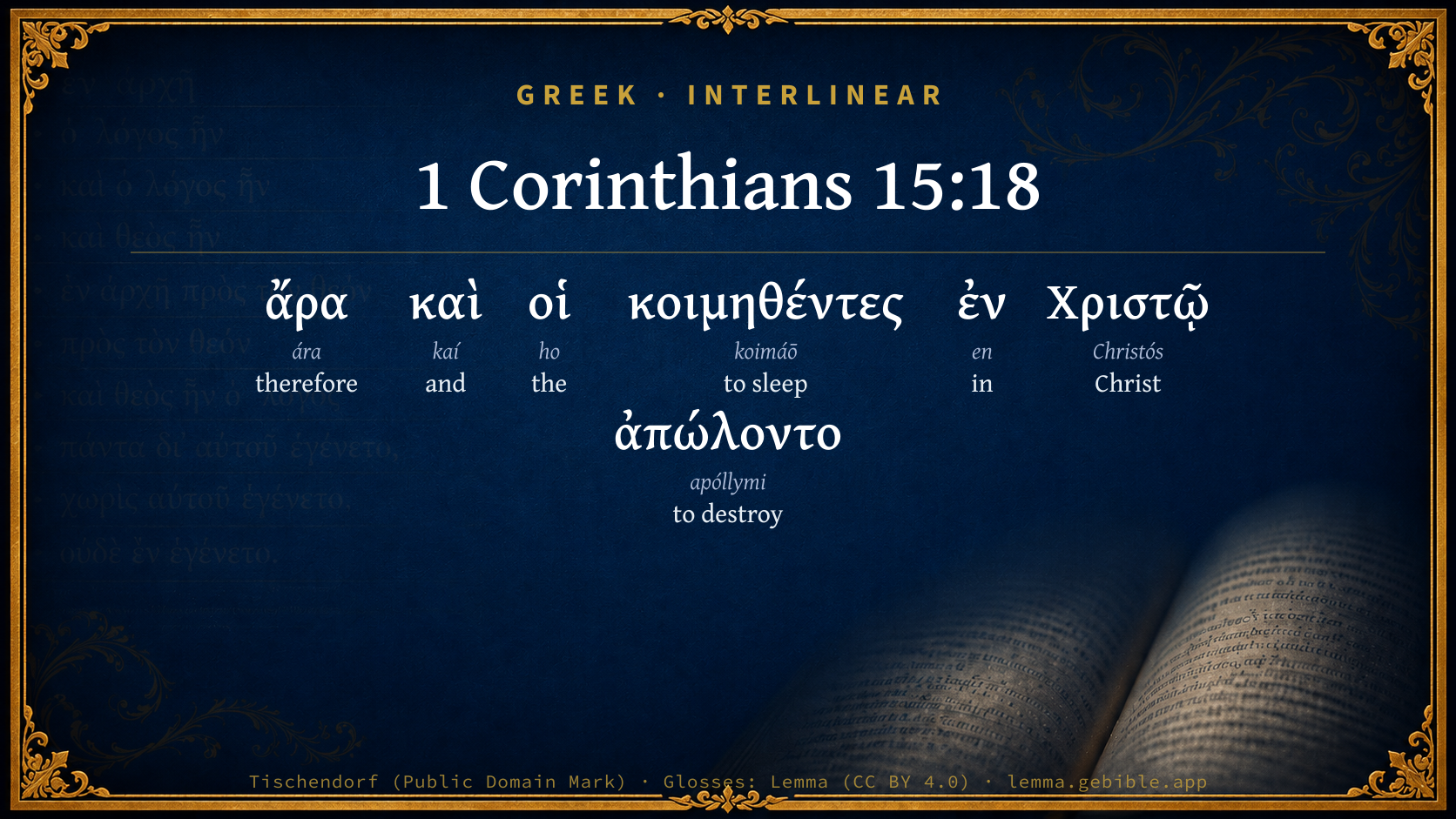
Greek (Tischendorf 8th ed.) 1 Corinthians 15:18 appears in the Greek New Testament. The text above is from the Tischendorf 8th edition. Each word links to its Strong’s number and a concise gloss. Click any word for its full Thayer’s Greek Lexicon entry.
Download image
Cite this verse

1 Corinthians 15:18 (World English Bible). Public Domain. Lemma interlinear Bible study tool, https://lemma.gebible.app/v/1-corinthians/15/18.

Show BibTeX & RIS
BibTeX
RIS
English Translation
Then they also who are fallen asleep in Christ have perished.
World English Bible · Public Domain
Download a study sheet

One document with this verse’s original text, its word-by-word gloss line, the meaning frame, cross-references with their text, attributed commentary, and full source and license credits — printable, and it pastes into notes with its structure intact.

This verse Autodidact and up

Study sheet (.html) Plain text (.txt)

A passage Seminary Student

Up to 50 verses in one chapter. A passage sheet keeps up to 6 commentary sources and 12 cross-references per verse, in the order this page ranks them, and says so on the sheet whenever that leaves anything out. Ask for a single verse and you get the Autodidact verse sheet above.

Everything on this page stays free to read, with no account — the sheet is a download of what is already on screen, not access to it.

Want to remove ads? Support Godless Engineer
Compare translations 3

The same verse in 3 English versions, stacked beneath the original-language interlinear above. Click any original word for its lexicon entry.

Each is an independent rendering of the whole verse — the interlinear is not word-aligned to these translations.

Highlighted words mark where these versions differ — a whole-verse word diff, not a word-by-word alignment.

  • World English Bible Public Domain
    Then they also who are fallen asleep in Christ have perished.
  • King James Version Public Domain
    Then they also which are fallen asleep in Christ are perished.
  • unfoldingWord Literal Text CC BY-SA 4.0
    Then also the ones having fallen asleep in Christ perished.

unfoldingWord Literal Text — © unfoldingWord, licensed CC BY-SA 4.0. Word-aligned USFM3 via Door43 (git.door43.org/unfoldingWord/en_ult).

Versions to compare (up to 4)

3 of 4 selected

Show all 19 translations

Every available English version of this verse, each an independent rendering of the whole verse.

  • World English Bible Public Domain
    Then they also who are fallen asleep in Christ have perished.
  • Berean Standard Bible Public Domain
    Then those also who have fallen asleep in Christ have perished.
  • Majority Standard Bible Public Domain
    Then those also who have fallen asleep in Christ have perished.
  • King James Version Public Domain
    Then they also which are fallen asleep in Christ are perished.
  • American Standard Version (1901) Public Domain
    Then they also that are fallen asleep in Christ have perished.
  • Revised Version (1885) Public Domain
    Then they also which are fallen asleep in Christ have perished.
  • Geneva Bible (1599) Public Domain
    And so they which are a sleepe in Christ, are perished.
  • Douay-Rheims (1899) Public Domain
    Then they also that are fallen asleep in Christ, are perished.
  • Young's Literal Translation Public Domain
    then, also, those having fallen asleep in Christ did perish;
  • Literal Standard Version CC BY-SA 4.0
    then, also, those having fallen asleep in Christ perished;
  • Unlocked Literal Bible CC BY-SA 4.0
    Then those who have died in Christ have also perished.
  • unfoldingWord Literal Text CC BY-SA 4.0
    Then also the ones having fallen asleep in Christ perished.
  • Darby Bible Public Domain
    Then indeed also those who have fallen asleep in Christ have perished.
  • World Messianic Bible Public Domain
    Then they also who are fallen asleep in Messiah have perished.
  • Webster's Bible Public Domain
    Then they also who have fallen asleep in Christ have perished.
  • Free Bible Version CC BY-SA 4.0
    This also means that those who died in Christ are lost.
  • Bible in Basic English Public Domain
    And, in addition, the dead in Christ have gone to destruction.
  • Text-Critical English NT CC BY 4.0
    Furthermore, those who have fallen asleep in Christ have also perished.
  • Tyndale New Testament (1534) Public Domain
    And therto they which are fallen a slepe in Christ are perished.

Literal Standard Version (2020), Covenant Press — licensed CC BY-SA 4.0. Text via the HelloAO Bible API (eBible.org). Unlocked Literal Bible (unfoldingWord) — licensed CC BY-SA 4.0. Text via the HelloAO Bible API (eBible.org). unfoldingWord Literal Text — © unfoldingWord, licensed CC BY-SA 4.0. Word-aligned USFM3 via Door43 (git.door43.org/unfoldingWord/en_ult). Free Bible Version, Dr. Jonathan Gallagher — licensed CC BY-SA 4.0. Text via the HelloAO Bible API (eBible.org).

Word by word

More ways to search: Search by grammar → Find every occurrence → Compare this word →

Practice this passage: Drill this verse → Learn its vocabulary →

About this verse

These counts appear in no published source. They are computed here, from the morphology-tagged text and Lemma’s own curated glosses. What Lemma adds →

7
words
7
distinct lemmas
Pauline Epistles
section

Notable vocabulary

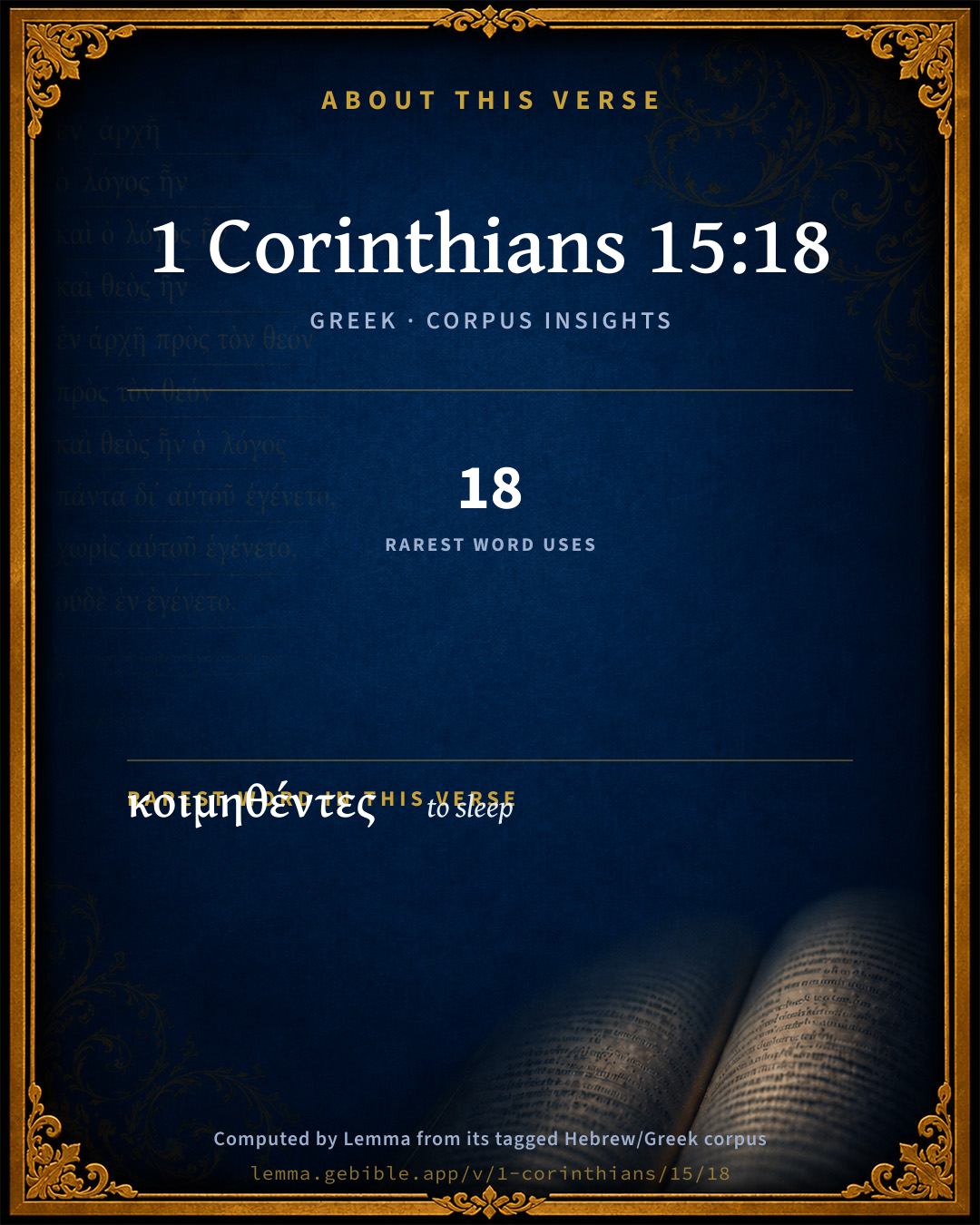
The rarest word here is κοιμηθέντες to sleep G2837 — appearing just 18 times in the whole Greek New Testament.

Shared distinctive vocabulary

κοιμηθέντες to sleep G2837 occurs in 18 verses of the Greek New Testament. Also found in:

Cross-references

4

Topical passages linked to 1 Corinthians 15:18 in the Treasury of Scripture Knowledge — connected by theme and wording, ordered by reader-vote popularity; previews shown in the World English Bible.

  • 1 Thessalonians 4:13–14 But we don't want you to be ignorant, brothers, concerning those who have fallen asleep, so that you don't grieve like the rest, who have no hope.
  • 1 Thessalonians 4:16 For the Lord himself will descend from heaven with a shout, with the voice of the archangel, and with God's trumpet. The dead in Christ will rise first,
  • 1 Corinthians 15:6 Then he appeared to over five hundred brothers at once, most of whom remain until now, but some have also fallen asleep.
  • Revelation 14:13 I heard the voice from heaven saying, "Write, 'Blessed are the dead who die in the Lord from now on.'" "Yes," says the Spirit, "that they may rest from their labors; for their works follow with them."

Cross-references courtesy of OpenBible.info (CC BY 4.0).

Commentary

Notes on 1 Corinthians 15:18 from classic Christian and Jewish commentators (each source and its license shown beneath its notes). The classic Christian expositions comment on the surrounding passage and are grouped to its opening verse, so a note may address several verses; the Jewish commentaries on the Tanakh (Rashi and others) are per-verse, so they appear only where the commentator wrote on this verse.

Lemma curates 59 commentaries, every one of them public domain or Creative Commons licensed, each selected and text-cleaned for this edition rather than reprinted as found. About our sources →

Bengel's Gnomon

Johann Albrecht Bengel

1Co 15:18. Ἀπώλοντο, perished) they were, they are not. Paul speaks conditionally: the heathen denying the resurrection might, if that supposition were true, regard the dead just the same as if they had never been. Nor was there here any necessity for Paul distinctly to express, what it is for a man to be in his sins.

Bengel's Gnomon of the New Testament — English translation (T&T Clark, Edinburgh, 1860) — public domain. Text from a community e-Sword module.

Hodge's Commentary on Romans, Ephesians & First Corinthians

Charles Hodge

1Co_15:18

Then they also which are fallen asleep in Christ are perished.

This is the fourth disastrous consequence of the denial of the doctrine in question. All the dead in Christ are lost. To fall asleep in Christ is to die in faith, or in communion with Christ for salvation. See 1Th_4:14. Rev_14:13. Are perished; rather, they perished. They perished when they died. Perdition, according to Scripture, is not annihilation, but everlasting misery and sin It is the loss of holiness and happiness for ever. If Christ did not rise for the justification of those who died in him, they found no advocate at the bar of God; and have incurred the fate of those who perish in their sins. Rather than admit such conclusions as these, the Corinthians might well allow philosophers to say what they pleased about the impossibility of a resurrection. It was enough for them that Christ had risen, whether they could understand how it can be that the dead should rise, or not.

Charles Hodge — Commentary on Romans (1835), First Corinthians (1857), and Ephesians (1856) — public domain. Text from a community e-Sword module.

Geneva Bible (1599)

Geneva Bible translators

Secondly, unless that this be certain that Christ rose again, all they which died in Christ, are perished. So then what profit cometh of faith?

Geneva Bible (1599) marginal notes — public domain. Text via Bolls.life.

Jamieson, Fausset & Brown

Robert Jamieson, A. R. Fausset & David Brown

fallen asleep in Christ--in communion with Christ as His members. "In Christ's case the term used is death, to assure us of the reality of His suffering; in our case, sleep, to give us consolation: In His case, His resurrection having actually taken place, Paul shrinks not from the term death; in ours, the resurrection being still only a matter of hope, he uses the term falling asleep" [PHOTIUS, Quæstiones Amphilochiæ, 197].

perished--Their souls are lost; they are in misery in the unseen world.

Jamieson, Fausset & Brown — Commentary Critical and Explanatory on the Whole Bible (1871) — public domain (CC PDM 1.0). Text via the HelloAO Bible API.

Adam Clarke's Commentary

Verse 18. They also which are fallen asleep] All those who, either by martyrdom or natural death, have departed in the faith of our Lord Jesus Christ, are perished; their hope was without foundation, and their faith had not reason and truth for its object. Their bodies are dissolved in the earth, finally decomposed and destroyed, notwithstanding the promise of Christ to such, that he would raise them up at the last day. See Joh 5:25, Joh 5:28, Joh 5:29; Joh 11:25, Joh 11:26, &c.

Adam Clarke's Commentary on the Bible (1810–1826) — public domain. Text from a community e-Sword/MySword module.

The Cambridge Bible for Schools and Colleges

gen. ed. J. J. S. Perowne

18. Then they also which are fallen asleep in Christ] See note on ch. 1Co_7:39. “The word does not apply to the soul, for that does not sleep (Luk_16:22-23; Luk_23:43), but it describes the state of the bodies of those who sleep in Jesus.” Wordsworth.

are perished] “You are required to believe that those who died in the field of battle, bravely giving up their lives for others, died even as the false and coward dies. You are required to believe that when there arose a great cry at midnight, and the wreck went down, they who passed out of the world with the oath of blasphemy or the shriek of despair, shared the same fate with those who calmly resigned their departing spirits into their Father’s hand;” in short, “that those whose affections were so pure and good that they seemed to tell you of an eternity, perished as utterly as the selfish and impure. If from this you shrink as from a thing derogatory to God, then there remains but that conclusion to which St Paul conducts us, ‘Now is Christ risen from the dead.’ ” Robertson.

The Cambridge Bible for Schools and Colleges (gen. ed. J. J. S. Perowne; Cambridge University Press, 1878–1918) — public domain. Text from a community e-Sword module.

John Gill's Exposition

If in this life only we have hope in Christ,.... The object of a believer's hope is not any creature, man, or angel; nor any creature enjoyment, as gold and silver; nor any creature righteousness, moral, legal, and civil; nor any external privilege, or profession of religion; but Christ alone as a surety, Saviour, and Redeemer; his person, blood, righteousness, sacrifice, and fulness: and what they hope for in him are, all grace, and the supplies of it; the forgiveness of their sins, the justification of their persons, eternal life and salvation; grace here, and glory hereafter; for all which they have great reason and encouragement to hope in him; but if their hope in him was only in this life, or whilst this life lasts; if they had not hope in death, that they should live again, and after death for the resurrection of their bodies; or if they hoped in Christ only for the things of this life, or as the Arabic version renders it, "if we from Christ, and by him, expect happiness in this world only"; if our hope in him is bounded with this life, and confined to the things of it, and does not reach to the things of another life, the things of eternity, the invisible glories of another world, to be enjoyed in soul and body;

we are of all men the most miserable; which may have respect not only to the apostles, though eminently true of them, who had little of the comforts of this life, being continually exposed to hardships and persecution for the sake of Christ; were set forth as a spectacle to angels and men; were accounted the filth of the world, and the offscouring of all things; and suffered many indignities, and great reproach and affliction, and that for asserting the doctrine of the resurrection of the dead; but is also true of all others that hope in Christ, and believe in him; for these not only deny themselves the pleasures, honours, and profits of this world, but are exposed continually to the hatred, reproach, and persecution of it; they are chastised by God as other men are, that they may not be condemned with the world, and yet they must be condemned, if Christ is not risen; they are harassed and distressed by Satan, who follows them with his temptations and suggestions, which are so many fiery darts, which give them great pain and uneasiness, when others are unmolested by him; they groan under a body of sin they carry about with them, and desire and long to be unclothed, that they might be clothed upon with glory and immortality; and yet these very desires and earnest longings after a blessed eternity do but add to their misery, if there is no foundation for them, and they will at last be frustrated: these are the sad conclusions, and wretched absurdities that must follow, upon the denial of the resurrection of the dead, and of Christ.

John Gill's Exposition of the Whole Bible (1746–1763) — public domain (CC PDM 1.0). Text via the HelloAO Bible API.

Trapp's Complete Commentary

John Trapp

18 Then they also which are fallen asleep in Christ are perished.

Ver. 18. Asleep in Christ] The Germans call the churchyard God’s Acre, because the bodies are sowed therein, to be raised again. The Greeks call them κοιμητηρια, sleeping houses. The Hebrews call the grave Becbajim, the house of the living, Job calls it the congregation house of all living, Job 30:23. As the apostle calls heaven the congregation house of the firstborn, Heb 12:23.

John Trapp, A Commentary or Exposition upon All the Books of the Old and New Testament (1647–1656) — public domain. Text from a community e-Sword module.

Albert Barnes' Notes on the Bible

Then they also ... - This verse contains a statement of another consequence which must follow from the denial of the resurrection - that all Christians who had died had failed of salvation, and were destroyed.

Which are fallen asleep in Christ - Which have died as Christians; 1Co 15:6 note; 1Th 4:15 note.

Are perished - Are destroyed; are not saved. They hoped to have been saved by the merits of the Lord Jesus; they trusted to a risen Saviour, and fixed all their hopes of heaven there; but if he did not rise, of course the whole system was delusion, and they have failed of heaven, and been destroyed. Their bodies lie in the grave, and return to their native dust without the prospect of a resurrection, and their souls are destroyed. The “argument” here is mainly an appeal to their feelings: “Can you believe it possible that the good people who have believed in the Lord Jesus are destroyed? Can you believe that your best friends, your kindred, and your fellow Christians who have died, have gone down to perdition? Can you believe that they will sink to woe with the impenitent, and the polluted, and abandoned? If you cannot, then it must follow that they are saved. And then it will follow that you “cannot” embrace a doctrine which involves this consequence.”

And this argument is a sound one still. There are multitudes who are made good men by the gospel. They are holy, humble, self-denying, and prayerful friends of God. “They have become such by the belief of the death and resurrection of the Lord Jesus.” Can it be believed that they will be destroyed? That they will perish with the profane, and licentious, and unprincipled? That they will go down to dwell with the polluted and the wicked? “Shall not the Judge of all the earth do right?” Gen 18:25. If it “cannot” be so believed, then they will be saved; and “if” saved it follows that the system is true which saves them, and, of course, that the Lord Jesus rose from the dead. We may remark here, that a denial of the truth of Christianity involves the belief that its friends will perish with others; that all their hopes are vain; and that their expectations are delusive. He, therefore, who becomes an infidel “believes” that his pious friends - his sainted father, his holy mother, his lovely Christian sister or child, is deluded and deceived; that they will sink down to the grave to rise no more; that their hopes of heaven will all vanish, and that they will be destroyed with the profane, the impure, and the sensual.

And if infidelity demands “this” faith of its votaries, it is a system which strikes at the very happiness of social life, and at all our convictions of what is true and right. It is a system that is withering and blighting to the best hopes of people. “Can” it be believed that God will destroy those who are living to his honor; who are pure in heart, and lovely in life, “and who have been made such by the Christian religion?” If it cannot, then every man knows that Christianity is not false, and that infidelity is not true.

Albert Barnes' Notes on the Bible (1834–1885) — public domain. Text from a community e-Sword/MySword module.

Matthew Poole's English Annotations

Some think that the term in Christ in this text, is of the same significancy with for the sake of Christ, which would restrain it to martyrs; but I know no reason for that, because what is said is true of all; for it is plain, from what was said before, that if Christ be not risen from the dead, all that die must die in their sins, there being no object for their faith to work or lay hold upon; the door of salvation remaineth as fast shut as ever, so as those whom they looked upon as being asleep in Christ, must necessarily perish, if Christ be not risen; there is no forerunner entered into the heavens for us.

Matthew Poole's English Annotations on the Holy Bible (1683–1685) — public domain. Text from a community e-Sword/MySword module.

Whedon's Commentary on the Bible

Daniel D. Whedon

18. Fallen asleep—Ruckert quotes an elegant sentence from Photius: “In regard to Christ, Paul uses the term death in order that his dying should be clearly affirmed; when he speaks of us, he uses the cheerful word sleep, that he may yield us consolation. When resurrection is the subject he frankly says death; but when he dwells upon our hopes he calls it sleep.”

Are perished—Literally, They that fell asleep in Christ perished; that is, aoristically, they perished in the act of falling asleep. They fell asleep in Christ, according to the Christian and Pauline view; they perished upon the non-resurrection and non-Christian view. What, then, is the meaning of perished? And it seems not pertinent here to say, with Kling: “Perdition, according to Scripture, is not annihilation, but the state of damnation— remaining in gehenna;” for Paul is writing for, and probably arguing with, those who ignore Gehenna, and even the future existence of the soul. Nor does it seem pertinent to say, with Alford, that perished means “passed into misery in hades.” Both these views Paul seems carefully to avoid expressing, and uses the generic term perished, which was in use among Gentiles on this very point, and which does not define the nature of the ruin. Besides, his statement that the falling asleep and the perishing is one and the same thing, forbids this applying the word perishing to an after state. Those with whom he argues confine the hope in Christ to this life, 1Co_15:19; and their view yields the Epicurean maxim of 1Co_15:32, both of which passages suggest that these heretics denied the future of the soul.

The philosophers who mocked Paul at Athens denied alike the resurrection, and the immortality of the soul. A short time before Christ, Cesar, in the Roman senate, argued against executing the followers of Cataline under the assumption, fully expressed, that death is the last of man; and of the entire senate not one dissented from that belief. This was the settled view of the civilized paganism of the age. Even the poets, who playfully prattled of manes, hades, and shadowy Plutonian domes, did, as prosaic thinkers, reject and laugh at such myths. And these Corinthian deniers of the resurrection clearly held the view that Christianity only presented a resurrection of the soul from sin, and was, therefore, a good thing for this life, but nothing for the life to come.

Daniel D. Whedon (gen. ed.), Commentary on the Old and New Testaments (1874–1909) — public domain. Text from a community e-Sword module.

The Pulpit Commentary

Which are fallen asleep in Christ. Christians whose bodies have sunk into the sleep of death. Are perished. A notion which he feels that Christians must reject as utterly impossible. All that goodness, faith, tenderness, love, have not been dissolved to nothing.

The Pulpit Commentary (1880–1919), ed. H.D.M. Spence-Jones & Joseph S. Exell — public domain. Text from a community e-Sword module.

John Wesley's Explanatory Notes

They who sleep in Christ - Who have died for him, or believing in him. Are perished - Have lost their life and being together.

John Wesley, Explanatory Notes Upon the Whole Bible (1754–1765) — public domain. Text via the GEBible commentary corpus.

Godbey's Commentary on the New Testament

William B. Godbey

18. “Then truly those who have fallen asleep in Christ perished.” In case that the Christhood fails, there is no conceivable alternative but for the scheme of redemption to eternally collapse and all departed souls relegated to Hell.

William B. Godbey, Commentary on the New Testament (1896–1900) — public domain. Text from a community e-Sword module.

McGarvey & Pendleton's Commentaries

J. W. McGarvey

Then they also that are fallen asleep in Christ have perished .

J. W. McGarvey (with Philip Y. Pendleton), Commentaries on the New Testament (The Fourfold Gospel, 1914; Acts; and the epistles) — public domain. Text from a community e-Sword/MySword module.

The People's New Testament

B. W. Johnson

18. Then they which are fallen asleep, etc. All the Christians who had died had fallen into eternal sleep. There is hope, in that case, only in this life; no hope of immortality.

B. W. Johnson's The People's New Testament with Notes (1889–1891) — public domain. Electronic text from the Christian Classics Ethereal Library (CCEL) ThML edition.

unfoldingWord translationNotes

Door43 World Missions Community

of all people

"of everyone, including believers and non-believers"

of all people we are most to be pitied

"people should feel sorry for us more than they do for anyone else"

translationWords

die

Christ

perish

life

confidence

unfoldingWord translationNotes — © Distant Shores Media and the Door43 World Missions Community, licensed CC BY-SA 4.0. Source: git.door43.org/Door43/en_tn.

Cambridge Greek Testament for Schools and Colleges

18. κοιμηθέντες. See note on ch. 1Co 7:39. ‘The word does not apply to the soul, for that does not sleep (Luk 16:22-23; Luk 23:43), but it describes the state of the bodies of those who sleep in Jesus.’ Bp Wordsworth.

ἀπώλοντο. ‘You are required to believe that those who died in the field of battle, bravely giving up their lives for others, died even as the false and coward dies. You are required to believe that when there arose a great cry at midnight, and the wreck went down, they who passed out of the world with the oath of blasphemy or the shriek of despair, shared the same fate with those who calmly resigned their departing spirits into their Father’s hand’; in short, ‘that those whose affections were so pure and good that they seemed to tell you of an eternity, perished as utterly as the selfish and impure. If from this you shrink as from a thing derogatory to God, then there remains but that conclusion to which St Paul conducts us, “Now is Christ risen from the dead.” ’ Robertson.

Cambridge Greek Testament for Schools and Colleges (Cambridge University Press, 1896; 21 vols, various authors incl. Carr, Maclear, Plummer, Farrar, Lumby, Moule, M. R. James, Simcox) — public domain. Text from a community e-Sword module.

Alford’s Greek Testament

Henry Alford

18.] Repetition of the consequence already mentioned in ver. 14, but fuller, and with more reference to its present and future calamitous results.

18. ἄρα καί] then also.

οἱ κοιμ.] those who fell asleep in Christ, perished (i.e. passed into misery in Hades). He uses the aorists, speaking of the act of death, not of the continuing state: the act of falling asleep in Christ was to them ἀπώλεια.

ἐν χρ., in communion with, membership of Christ.

On κοιμηθέντες Meyer quotes a beautiful sentence from Photius (Quæst. Amphiloch. 168 (al. 187 or 197), vol. i. p. 861, Migne): ἐπὶ μὲν οὖν τοῦ χριστοῦ θάνατον καλεῖ, ἵνα τὸ πάθος πιστώσηται· ἐπὶ δὲ ἡμῶν κοίμησιν, ἵνα τὴν ὀδύνην παραμυθήσηται. ἔνθα μὲν γὰρ παρεχώρησεν ἡ ἀνάστασις, θαῤῥῶν καλεῖ θάνατον. ἔνθα δὲ ἐν ἐλπίσιν ἔτι μένει, κοίμησιν καλεῖ.

Henry Alford, The Greek Testament (1849–1861) — public domain. Text from a community e-Sword module.

International Critical Commentary

18. ἄρα καὶ οἱ κοιμηθέντες ἐν Χριστῷ ἀπώλοντο. ‘So then, they also who were laid to sleep in Christ have perished’; an amazing result! By ἐν Χρ. is meant ‘believing in Christ, and in communion with Him.’ It is those who are not ἐν Χριστῷ when they die that perish. This denial of the resurrection of the dead throws everything into confusion. The ἀπώλεια is the utter loss consequent upon dying in sin. This meaning is frequent in St Paul (1:18, 8:11; 2Co 2:15, 2Co 2:4:3; 2Th 2:10). See Cremer, p. 452; also Beet, The Last Things, pp. 122 f., a valuable discussion. They have surrendered everything in order to have eternal life with Christ at His Coming, and they have died. If they are dead beyond possibility of restoration, then death separates us for ever from Christ. Is that credible? This is not an appeal to mere sentiment: it is an appeal to our sense of what is morally fitting, and this is a good supplement to the appeal to fact (v. 17).

In class. Grk. ἄρα rarely, if ever, stands first, as here; 2Co 5:15; Gal 2:21, Gal 2:5:11; etc. It is a little doubtful whether οἱ κοιμηθέντες is not a true passive, ‘those who were put to sleep,’ rather than middle, ‘those who fell asleep,’ both here and 1Th 4:14. See J. H. Moulton, Gr. p. 162, and on the other side Milligan on 1Th 4:14, a passage which throws much light on this verse. The expression does not imply that the departed are unconscious, but that they are at rest, and may be raised again to full activity. See above on 11:30.

International Critical Commentary — older volumes (1896–1929), various authors — public domain. Text from a community e-Sword module.

Godet's Commentaries

Frédéric Louis Godet

Vv. 18. There is a sharp contrast between the two terms. falling asleep in Christ and having perished. To close the eyes in the joy of salvation, to open them in the torments of perdition! The verb ἀπώλοντο, perished, cannot designate annihilation, for it is explained by the preceding expression: to be yet in sins. It denotes a state of perdition in which the soul remains under the weight of Divine condemnation. Nor does the aorist allow us to explain this idea of perishing proleptically, as the sense of destroying or annihilating would require.

So much for the dead; and what follows for us who still live here below in the faith of that unrisen Christ? The apostle tells us in 1Co 15:19:

Frédéric Louis Godet — Commentaries on Luke, John, Romans, and 1 Corinthians — English translation (T&T Clark, Edinburgh, 1870s–1890s) — public domain. Text from a community e-Sword module.

Lesson kit

Teaching starters — assembled from the data on this page, not authored interpretation. Every prompt links to the verse data it draws on. Edit before teaching.

1 Corinthians, in the Pauline Epistles, opens this verse with 7 words (7 distinct Greek lemmas). Its most distinctive word is koimáō (“to sleep”). A historical commentator’s framing appears above. Read the whole chapter for the surrounding context.

Discussion questions

  1. What does “to sleep” (koimáō) contribute to the verse as a whole?
  2. Matthew 27:52 shares the word «to sleep» with this verse. How do the two illuminate each other?
  3. These translations render this verse differently; the difference is in the English rendering, not the original. What questions does that raise?
  4. Reading how Bengel's Gnomon and Hodge's Commentary on Romans, Ephesians & First Corinthians read this verse, where do the two commentators agree and where do they part?

Things to notice

Reading settings

Reading text

Shown beneath each verse's original-language words.

Old Testament
Old Testament edition

Read the OT as the Masoretic Hebrew (MT) or the Greek Septuagint (LXX).

English shown for the Greek Septuagint (in the Hebrew ↔ Greek comparison).

Comparing translations? Open the Compare panel on any verse page to stack up to four side by side.