
1 Corinthians 7:35

Greek (Tischendorf 8th ed.) 1 Corinthians 7:35 appears in the Greek New Testament. The text above is from the Tischendorf 8th edition. Each word links to its Strong’s number and a concise gloss. Click any word for its full Thayer’s Greek Lexicon entry.
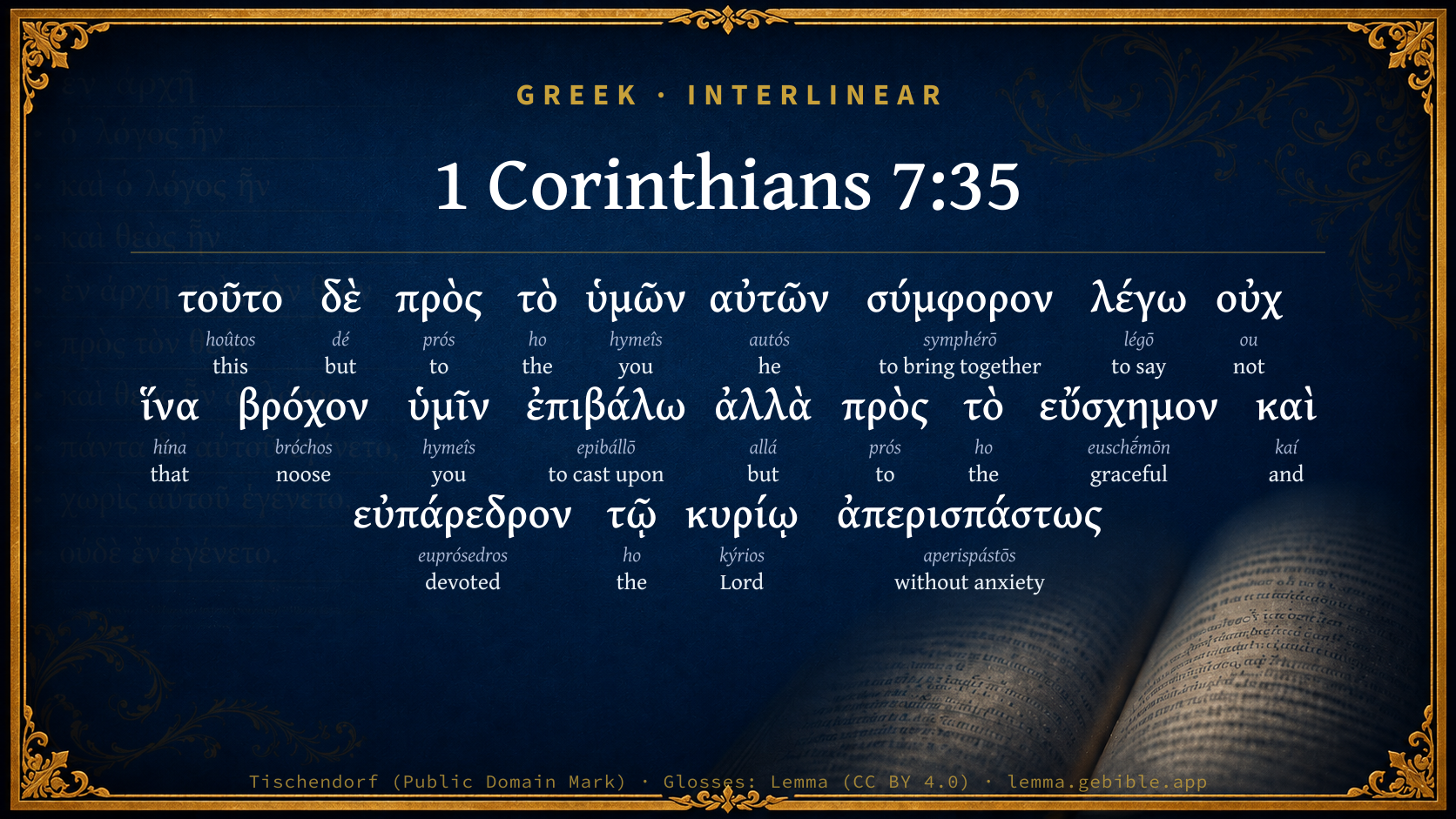
Download image
Cite this verse

1 Corinthians 7:35 (World English Bible). Public Domain. Lemma interlinear Bible study tool, https://lemma.gebible.app/v/1-corinthians/7/35.

Show BibTeX & RIS
BibTeX
RIS
English Translation
This I say for your own profit; not that I may ensnare you, but for that which is appropriate, and that you may attend to the Lord without distraction.
World English Bible · Public Domain
Highlights
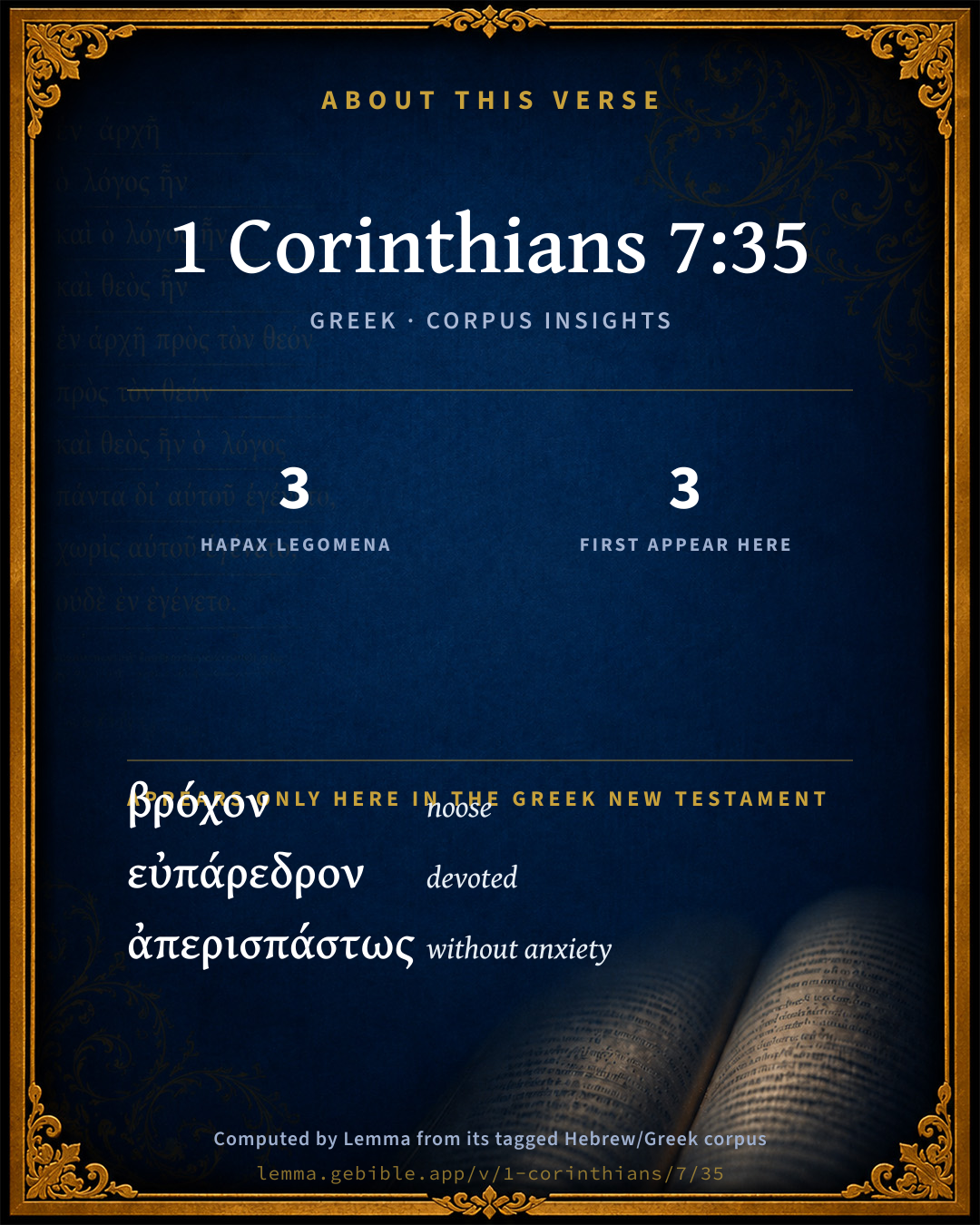
  • 3 hapax legomena — only here in the Greek New Testament
  • 3 first appearances in the Greek New Testament
Full analysis ↓
Download a study sheet

One document with this verse’s original text, its word-by-word gloss line, the meaning frame, cross-references with their text, attributed commentary, and full source and license credits — printable, and it pastes into notes with its structure intact.

This verse Autodidact and up

Study sheet (.html) Plain text (.txt)

A passage Seminary Student

Up to 50 verses in one chapter. A passage sheet keeps up to 6 commentary sources and 12 cross-references per verse, in the order this page ranks them, and says so on the sheet whenever that leaves anything out. Ask for a single verse and you get the Autodidact verse sheet above.

Everything on this page stays free to read, with no account — the sheet is a download of what is already on screen, not access to it.

Want to remove ads? Support Godless Engineer
Compare translations 3

The same verse in 3 English versions, stacked beneath the original-language interlinear above. Click any original word for its lexicon entry.

Each is an independent rendering of the whole verse — the interlinear is not word-aligned to these translations.

Highlighted words mark where these versions differ — a whole-verse word diff, not a word-by-word alignment.

  • World English Bible Public Domain
    This I say for your own profit; not that I may ensnare you, but for that which is appropriate, and that you may attend to the Lord without distraction.
  • King James Version Public Domain
    And this I speak for your own profit; not that I may cast a snare upon you, but for that which is comely, and that ye may attend upon the Lord without distraction.
  • unfoldingWord Literal Text CC BY-SA 4.0
    Now I say this for your own benefit, not in order to put any constraint on you, but toward what appropriate and devoted to the Lord without any distraction.

unfoldingWord Literal Text — © unfoldingWord, licensed CC BY-SA 4.0. Word-aligned USFM3 via Door43 (git.door43.org/unfoldingWord/en_ult).

Versions to compare (up to 4)

3 of 4 selected

Show all 19 translations

Every available English version of this verse, each an independent rendering of the whole verse.

  • World English Bible Public Domain
    This I say for your own profit; not that I may ensnare you, but for that which is appropriate, and that you may attend to the Lord without distraction.
  • Berean Standard Bible Public Domain
    I am saying this for your own good, not to restrict you, but in order to promote proper decorum and undivided devotion to the Lord.
  • Majority Standard Bible Public Domain
    I am saying this for your own good, not to restrict you, but in order to promote proper decorum and undivided devotion to the Lord.
  • King James Version Public Domain
    And this I speak for your own profit; not that I may cast a snare upon you, but for that which is comely, and that ye may attend upon the Lord without distraction.
  • American Standard Version (1901) Public Domain
    And this I say for your own profit; not that I may cast a snare upon you, but for that which is seemly, and that ye may attend upon the Lord without distraction.
  • Revised Version (1885) Public Domain
    And this I say for your own profit; not that I may cast a snare upon you, but for that which is seemly, and that ye may attend upon the Lord without distraction.
  • Geneva Bible (1599) Public Domain
    And this I speake for your owne commoditie, not to tangle you in a snare, but that yee follow that, which is honest, and that yee may cleaue fast vnto the Lord without separation.
  • Douay-Rheims (1899) Public Domain
    And this I speak for your profit: not to cast a snare upon you; but for that which is decent, and which may give you power to attend upon the Lord, without impediment.
  • Young's Literal Translation Public Domain
    And this for your own profit I say: not that I may cast a noose upon you, but for the seemliness and devotedness to the Lord, undistractedly,
  • Literal Standard Version CC BY-SA 4.0
    And this I say for your own profit: not that I may cast a noose on you, but for the seemliness and devotedness to the LORD, undistractedly,
  • Unlocked Literal Bible CC BY-SA 4.0
    I say this for your own benefit, and not to put any constraint on you. I say this for what is right, so that you may be devoted to the Lord without any distraction.
  • unfoldingWord Literal Text CC BY-SA 4.0
    Now I say this for your own benefit, not in order to put any constraint on you, but toward what appropriate and devoted to the Lord without any distraction.
  • Darby Bible Public Domain
    But I say this for your own profit; not that I may set a snare before you, but for what [is] seemly, and waiting on the Lord without distraction.
  • World Messianic Bible Public Domain
    This I say for your own benefit, not that I may ensnare you, but for that which is appropriate, and that you may attend to the Lord without distraction.
  • Webster's Bible Public Domain
    And this I speak for your own profit; not that I may cast a snare upon you, but for that which is comely, and that ye may attend upon the Lord without distraction.
  • Free Bible Version CC BY-SA 4.0
    I'm telling you this for your benefit. I'm not trying to put a noose around your neck, but to show you the right thing to do so you can serve the Lord without being distracted.
  • Bible in Basic English Public Domain
    Now I say this for your profit; not to make things hard for you, but because of what is right, and so that you may be able to give all your attention to the things of the Lord.
  • Text-Critical English NT CC BY 4.0
    I say this for your own benefit, not to lay any restraint upon you, but to promote proper behavior and devotion to the Lord without distraction.
  • Tyndale New Testament (1534) Public Domain
    This speake I for youre proffit not to tangle you in a snare: but for that which is honest and comly vnto you and that ye maye quyetly cleave vnto the lorde with out separacion.

Literal Standard Version (2020), Covenant Press — licensed CC BY-SA 4.0. Text via the HelloAO Bible API (eBible.org). Unlocked Literal Bible (unfoldingWord) — licensed CC BY-SA 4.0. Text via the HelloAO Bible API (eBible.org). unfoldingWord Literal Text — © unfoldingWord, licensed CC BY-SA 4.0. Word-aligned USFM3 via Door43 (git.door43.org/unfoldingWord/en_ult). Free Bible Version, Dr. Jonathan Gallagher — licensed CC BY-SA 4.0. Text via the HelloAO Bible API (eBible.org).

Word by word

More ways to search: Search by grammar → Find every occurrence → Compare this word →

Practice this passage: Drill this verse → Learn its vocabulary →

βρόχον
bróchos
G1029
“noose”
Noun, Accusative, Singular, Masculine
Part of Speech
Noun
Case
Accusative
Number
Singular
Gender
Masculine
Full Thayer's Definition

Origin: of uncertain derivation

TDNT: None

1. a noose, slip-knot, by which any person or thing is caught, or fastened, or suspended 2. to throw a noose upon one, a figure borrowed from war or the chase so that by craft or by force one is bound to some necessity, to constrain him to obey some command
  1. τοῦτο hoûtos G3778 “this” Demonstrative pronoun, Accusative, Singular, Neuter
  2. δὲ dé G1161 “but” Conjunction
  3. πρὸς prós G4314 “to” Preposition
  4. τὸ ho G3588 “the” Article, Accusative, Singular, Neuter
  5. ὑμῶν hymeîs G5210 “you” Personal pronoun, 2nd person, Genitive, Plural
  6. αὐτῶν autós G846 “he” Personal pronoun, Genitive, Plural, Masculine
  7. σύμφορον symphérō G4851 “to bring together” Adjective, Accusative, Singular, Neuter
  8. λέγω légō G3004 “to say” Verb, Present, Active, Indicative, 1st person, Singular
  9. οὐχ ou G3756 “not” Particle, Negative
  10. ἵνα hína G2443 “that” Conjunction
  11. ὑμῖν hymeîs G5210 “you” Personal pronoun, 2nd person, Dative, Plural
  12. ἐπιβάλω epibállō G1911 “to cast upon” Verb, Aorist, Active, Subjunctive, 1st person, Singular
  13. ἀλλὰ allá G235 “but” Conjunction
  14. πρὸς prós G4314 “to” Preposition
  15. τὸ ho G3588 “the” Article, Accusative, Singular, Neuter
  16. εὔσχημον euschḗmōn G2158 “graceful” Adjective, Accusative, Singular, Neuter
  17. καὶ kaí G2532 “and” Conjunction
  18. εὐπάρεδρον euprósedros G2145 “devoted” Adjective, Accusative, Singular, Neuter
  19. τῷ ho G3588 “the” Article, Dative, Singular, Masculine
  20. κυρίῳ kýrios G2962 “Lord” Noun, Dative, Singular, Masculine
  21. ἀπερισπάστως aperispástōs G563 “without anxiety” Adverb

About this verse

These counts appear in no published source. They are computed here, from the morphology-tagged text and Lemma’s own curated glosses. What Lemma adds →

22
words
18
distinct lemmas
Pauline Epistles
section

Notable vocabulary

3 hapax legomena — words that appear only here in the entire Greek New Testament:

  • βρόχον noose G1029
  • εὐπάρεδρον devoted G2145
  • ἀπερισπάστως without anxiety G563

First appearance in Scripture

These words make their first canonical appearance in the Greek New Testament here:

  • βρόχον noose G1029
  • εὐπάρεδρον devoted G2145
  • ἀπερισπάστως without anxiety G563

Shared distinctive vocabulary

εὔσχημον graceful G2158 occurs in 5 verses of the Greek New Testament. Also found in:
Repetition

Words recur within this verse:

Cross-references

13

Topical passages linked to 1 Corinthians 7:35 in the Treasury of Scripture Knowledge — connected by theme and wording, ordered by reader-vote popularity; previews shown in the World English Bible.

  • 1 Corinthians 7:33–34 but he who is married is concerned about the things of the world, how he may please his wife.
  • 1 Corinthians 7:36 But if any man thinks that he is behaving inappropriately toward his virgin, if she is past the flower of her age, and if need so requires, let him do what he desires. He doesn't sin. Let them marry.
  • Luke 8:14 That which fell among the thorns, these are those who have heard, and as they go on their way they are choked with cares, riches, and pleasures of life, and bring no fruit to maturity.
  • 1 Corinthians 7:2 But, because of sexual immoralities, let each man have his own wife, and let each woman have her own husband.
  • Philippians 4:8 Finally, brothers, whatever things are true, whatever things are honorable, whatever things are just, whatever things are pure, whatever things are lovely, whatever things are of good report; if there is any virtue, and if there is any praise, think about these things.
  • Matthew 19:12 For there are eunuchs who were born that way from their mother's womb, and there are eunuchs who were made eunuchs by men; and there are eunuchs who made themselves eunuchs for the Kingdom of Heaven's sake. He who is able to receive it, let him receive it."
  • Luke 10:40–42 But Martha was distracted with much serving, and she came up to him, and said, "Lord, don't you care that my sister left me to serve alone? Ask her therefore to help me."
  • Luke 21:34 "So be careful, or your hearts will be loaded down with carousing, drunkenness, and cares of this life, and that day will come on you suddenly.
  • 1 Corinthians 7:5–9 Don't deprive one another, unless it is by consent for a season, that you may give yourselves to fasting and prayer, and may be together again, that Satan doesn't tempt you because of your lack of self-control.
  • 1 Corinthians 7:28 But if you marry, you have not sinned. If a virgin marries, she has not sinned. Yet such will have oppression in the flesh, and I want to spare you.
  • Ephesians 5:3 But sexual immorality, and all uncleanness, or covetousness, let it not even be mentioned among you, as becomes saints;
  • Titus 2:3 and that older women likewise be reverent in behavior, not slanderers nor enslaved to much wine, teachers of that which is good;
  • 1 Timothy 1:10 for the sexually immoral, for homosexuals, for slave-traders, for liars, for perjurers, and for any other thing contrary to the sound doctrine;

Cross-references courtesy of OpenBible.info (CC BY 4.0).

Commentary

Notes on 1 Corinthians 7:35 from classic Christian and Jewish commentators (each source and its license shown beneath its notes). The classic Christian expositions comment on the surrounding passage and are grouped to its opening verse, so a note may address several verses; the Jewish commentaries on the Tanakh (Rashi and others) are per-verse, so they appear only where the commentator wrote on this verse.

Lemma curates 59 commentaries, every one of them public domain or Creative Commons licensed, each selected and text-cleaned for this edition rather than reprinted as found. About our sources →

Bengel's Gnomon

Johann Albrecht Bengel

1Co 7:35. Αὐτῶν, your own.—βρόχον, a snare) A snare, the fear of committing sin, where there is no sin, or even forced service. Men are unwillingly drawn into a snare, Pro 7:21, LXX. That is readily considered as a snare, which is most conducive to profit [σύμφερον].—εὔσχημον) an antithesis to ἀσχημονεῖν, in the following verse.—εὐπάρεδρον) akin to this is the verb προσεδρεύειν, in 1Co 9:13. An example is found in Luk 10:39.—τῷ Κυρίῳ, to the Lord) εὐπάρεδρον, as well as παρεδρεύω, governs the dative.—ἀπερισπάστως) This explains the word εὐπάρεδρον, for assiduous attendance upon the Lord, and distraction, are the reverse of each other. Sitting [involved in the εὐπάρεδρον] assists the devout mind. Comp. Luk 10:39-40. Paul says something similar of the widow, 1Ti 5:5.

Bengel's Gnomon of the New Testament — English translation (T&T Clark, Edinburgh, 1860) — public domain. Text from a community e-Sword module.

Meyer's Critical & Exegetical Commentary

Heinrich August Wilhelm Meyer

1Co_7:35. Τοῦτο] refers to the recommendation of single life contained in 1Co_7:26-34.

πρὸς τὸ ὑμ. αὐτῶν συμφ.] for your own advantage. The genitive with συμφέρον used as a substantive, as in 1Co_10:33; see Stallbaum, a[1248] Plat. Rep. p. 338 C.

οὐχ ἵνα κ.τ.λ[1249]] explaining more in detail, negatively and positively, the ΠΡῸς … ΣΥΜΦΈΡΟΝ. To cast a noose upon one is a figurative expression, originally borrowed from the chase (less probably, from warfare), for the idea of depriving of freedom (bringing under binding and limiting relations). Comp Pro_7:21, and see Wetstein and Loesner in loc[1251] The sense of giving occasion to scruples (Billroth, comp Bengel) does not correspond so well with the figure and the connection.

ἈΛΛᾺ ΠΡῸς ΤῸ ΕὔΣΧ. Κ.Τ.Λ[1253]] but to promote the habit of comeliness and undivided waiting upon the Lord (in faithfulness to Christ). For this habit prevailed chiefly, according to the apostles experience, on the side of the ἄγαμοι; see 1Co_7:32-34, where, too, he makes it clear beyond doubt what comeliness he means herenamely, such a manifestation of the inner life in all outward embodiment, as corresponds with consecration to the Lord. It is not merely chastity in the narrower sense that is intended, but all moral purity and consecration in so far as these manifest themselves in demeanour, in speech, gesture, bearing, etc., as the comely form of Christian life, as the ethical decorum of the Christian. Its sacred nature and the foul contrasts to it are set forth in Rom_13:13-14.

The dative of appropriation, τῷ Κυρίῳ and ἀπερισπ., are conjoined with the εὐπάρ., used as a substantive, to make up the unity of the idea.

εὐπάρεδρος does not occur elsewhere. Hesychius explains it by καλῶς παραμένου.

ἀπερισπ.] absque distractione, i.e. ἄνευ τοῦ μεριμνᾶν τὰ τοῦ κόσμου, Kypke, II. p. 207. Comp περισπᾶσθαι, Luk_10:40. Regarding the connection of the word with the later Greek, see Lobeck, a[1255] Phryn. p. 415. Xenophon, Ages. i. 4, has ἀδιασπάστως. The adverb attaches itself to εὐπάρ., defining its meaning precisely. see on 1Co_12:28.

[1248] d refers to the note of the commentator or editor named on the particular passage.

[1249] .τ.λ. καὶ τὰ λοιπά.

[1251] n loc. refers to the note of the commentator or editor named on the particular passage.

[1253] .τ.λ. καὶ τὰ λοιπά.

[1255] d refers to the note of the commentator or editor named on the particular passage.

Meyer — Critical and Exegetical Commentary on the New Testament — English translation by Peter Christie, edited by Frederick Crombie (T&T Clark, 1880) — public domain. Text from a community e-Sword module.

Expositor's Greek Testament

ed. W. Robertson Nicoll

1Co 7:35 . A third time P. declares that he is consulting for the welfare of his readers ( cf. 28 b , 32 a ), not insisting on his own preference nor laying down an absolute rule: “looking to ( πρός ) your advantage I say (it)”. τὸ σύμφορον is the abstract of συμφέρει (1Co 6:12 , 1Co 10:23 ). The βρόχος is the noose or lasso by which a wild creature is snared: P. does not wish by what he says to deprive the Cor [1200] of any liberty, to capture his readers and shut them up to celibacy “not that I may throw a snare over you”. He aims at what is socially εὔσχημον , “of honourable guise,” as belonging to the Christian decorum of life (see parls.); and at what is religiously εὐπάρεδρον τῷ Κυρίῳ , “promotive-of-fit-waiting on the Lord”. ἀπερισπάστως recalls the περιεσπᾶτο used of Martha in Luk 10:38-42 , and suggests that the Ap. had this story in his mind, esp. as μεριμνάω , his leading expression in this Section, is the word of reproof used by Jesus there. Epictetus’ dissuasive from marriage, in his Dissertt. , III., xxii., 67 ff., curiously resembles Paul’s: τοιαύτης οὔσης καταστάσεως οἵα νῦν ἐστιν , ὡς ἐν παρατάξει , μή ποτʼ ἀπερίσπαστον εἶναι δεῖ τ . Κυνικὸν ὅλον πρὸς τῇ διακονίᾳ τοῦ Θεοῦ , ἐπιφοιτᾶν ἀνθρώποις δυνάμενον , οὐ προσδεδεμένον καθήκουσιν ἰδιωτικοῖς οὐδʼ ἐμπεπλεγμένον ( cf. 2Ti 2:4 ) σχέσεσιν , ἃς παραβαίνων οὐκέτι σώσει τὸ τοῦ καλοῦ καὶ ἀγαθοῦ πρόσωπον , τηρῶν δʼ ἀπολεῖ τὸν ἄγγελον κ . κατάσκοπον κ . κήρυκα τῶν θεῶν ; (69).

[1200] Corinth, Corinthian or Corinthians.

The Expositor's Greek Testament, edited by W. Robertson Nicoll (1897–1910) — public domain. Text from a community e-Sword module.

Hodge's Commentary on Romans, Ephesians & First Corinthians

Charles Hodge

1Co_7:35

And this I speak for your own profit; not that I may cast a snare upon you, but for that which is comely, and that ye may attend upon the Lord without distraction.

The object of the apostle was their advantage. In urging them to remain single, he had no intention to cast a snare upon them, i.e. to restrain their liberty. Or the meaning of the figure is, I do not wish to raise scruples, to make you afraid to move lest you fall into a snare. The former explanation, however, is preferable. An animal ensnared was confined; it had no liberty of action. Paul did not wish to bring his readers into that state. They were perfectly free to do as they pleased. There was no moral obligation upon them to remain single; no superior holiness in celibacy. He was only saying what in his judgment would be most to their advantage under existing circumstances. That is, as he expresses it, his design was to promote what was becoming and proper in them; that is, to promote assiduous, undistracted devotion to the Lord. In other words, that they might be free from any thing to divert their minds from the service of the Lord. The literal translation is, For devotion to the Lord without distraction. Every where the apostle is careful to show that celibacy was preferred merely on the grounds of expediency, and not on the ground of its being a higher state of virtue. All assumption or imposition of vows of celibacy, is a restriction of the liberty which the apostle was solicitous not to invade. Such vows are a snare; and those who take them are like an animal in a net.

Charles Hodge — Commentary on Romans (1835), First Corinthians (1857), and Ephesians (1856) — public domain. Text from a community e-Sword module.

Geneva Bible (1599)

Geneva Bible translators

He meaneth that he will enforce no man either to marry or not to marry, but to show them barely what kind of life is most commodious.

Geneva Bible (1599) marginal notes — public domain. Text via Bolls.life.

Jamieson, Fausset & Brown

Robert Jamieson, A. R. Fausset & David Brown

for your own profit--not to display my apostolic authority.

not . . . cast a snare upon you--image from throwing a noose over an animal in hunting. Not that by hard injunctions I may entangle you with the fear of committing sin where there is no sin.

comely--befitting under present circumstances.

attend upon--literally, "assiduously wait on"; sitting down to the duty. Compare Luk 10:39, Mary; Luk 2:37, "Anna . . . a widow, who departed not from the temple, but served God with fastings and prayers night and day" (Ti1 5:5).

distraction--the same Greek as "cumbered" (Luk 10:40, Martha).

Jamieson, Fausset & Brown — Commentary Critical and Explanatory on the Whole Bible (1871) — public domain (CC PDM 1.0). Text via the HelloAO Bible API.

Adam Clarke's Commentary

Verse 35. This I speak for your own profit] The advices belong to yourselves alone, because of the peculiar circumstances in which you are placed. Nothing spoken here was ever designed to be of general application; it concerned the Church at Corinth alone, or Churches in similar circumstances.

Not that I may cast a snare upon you] Ουχ ἱνα βροχον ὑμιν επιβαλω - Here is a manifest allusion to the Retiarius among the Romans, who carried a small casting net, which he endeavoured to throw over the head of his adversary and thus entangle him. Or to a similar custom among the Persians, who made use of a noose called the [Arabic] camand; which they employed in the same way. One of these lies before me; it is a strong silken cord, one end of which is a loop to be held in the hand, and the rest is in the form of a common snare or noose, which, catching hold of any thing, tightens in proportion as it is pulled by the hand that holds the loop.

The apostle, therefore, intimates that what he says was not intended absolutely to bind them, but to show them the propriety of following an advice which in the present case would be helpful to them in their religious connections, that they might attend upon the Lord without distraction, which they could not do in times of persecution, when, in addition to their own personal safety, they had a wife and children to care for.

For that which is comely, and that ye may attend upon the Lord without distraction,] The original αλλα προς το ευσχημον και ευπροσεδρον τῳ Κυριῳ απερισπαστως, of which our version is only a paraphrase, is thus translated by Bishop Pearson: But for the sake of decency, and of attending more easily upon the Lord without distraction. This is much more literal than ours.

Adam Clarke's Commentary on the Bible (1810–1826) — public domain. Text from a community e-Sword/MySword module.

John Calvin's Commentaries

35. And this for your benefit. Observe the Apostle’s moderation. Though he knew the vexations, troubles, and difficulties of the married life, and, on the other hand, the advantages of celibacy, yet he does not venture to prescribe. On the contrary, having commended celibacy, and being afraid that some of his readers might be led away by such commendations, and might straightway say within themselves what the Apostles said in reply to Christ — It is good, therefore, so to be, (Matthew 19:10) — not in the meantime taking into view their ability, he here declares in express terms, that he points out, indeed, what is most advantageous, but does not wish to impose a necessity upon any one.

And here you have two things worthy of observation. The first is, for what purpose celibacy is to be desired — not on its own account, nor on the ground of its being a state that is nearer to perfection, but that we may cleave to God without distraction — that being the one thing that a Christian man ought exclusively to look to during his whole life. The second thing is, that no snare must be put upon men’s consciences, so as to keep back any one from marriage, but that every one must have liberty allowed him. It is well known what grievous errors have been fallen into on both these points. As to the second point, those assuredly have been bolder than Paul, who have not shrunk from passing a law respecting celibacy, with the view of prohibiting the whole of the clergy from matrimony. The same may be said of those who have made vows of perpetual continency, which are snares by which not a few myriads of souls have been drawn into endless ruin. Hence, if the Holy Spirit has spoken by the mouth of Paul, Papists cannot clear themselves from the crime of fighting against God, (Acts 5:39,) while binding men’s consciences in a matter in which He designed that they should remain free unless, perhaps, He has since that time adopted a new plan, so as to construct a snare, which he had previously disapproved of.

John Calvin's Commentaries (1540-1563) — public domain. Text from the Calvin Translation Society English edition (1840s-50s) via the Christian Classics Ethereal Library (ccel.org). Calvin's coverage is partial (roughly two-thirds of the Bible); uncommented books and verses are honest gaps, never fabricated. The 19th-century editor's footnotes and remarks are omitted so the notes are faithfully Calvin's own voice.

Ellicott's Commentary for English Readers

(35) And this I speak for your own profit.—The reference is to the preceding passage, commencing with 1Co_7:32; and the writer explains that these instructions are given, not to please himself, but for (emphatically) your own advantage; not to entangle you in a noose, and so take away your liberty, but with a view to comeliness (or, honesty, Rom_13:13), and to your waiting upon the Lord without being cumbered with earthly things (as, in Luk_10:40, Martha was “cumbered”).

A Bible Commentary for English Readers, edited by Charles John Ellicott (1878–1897) — public domain. Text from a community e-Sword module.

The Cambridge Bible for Schools and Colleges

gen. ed. J. J. S. Perowne

35. attend upon the Lord] Literally, sit conveniently before (or beside) Him. Dean Stanley refers to Martha and Mary in St Luk_10:39-41, as an exact illustration of this expression. Martha is ‘cumbered with much serving,’ Mary sits at Jesus’ feet.

The Cambridge Bible for Schools and Colleges (gen. ed. J. J. S. Perowne; Cambridge University Press, 1878–1918) — public domain. Text from a community e-Sword module.

John Gill's Exposition

And this I speak for your own profit,.... The apostle suggests, that in giving the advice he did to unmarried persons to abide single, he had nothing else in view than their temporal and spiritual advantage; that they might be better able to meet and grapple with persecution for the sake of the Gospel; that they might be more free from the cares and encumbrances of life, and more at liberty to serve the Lord; whereby not only his glory, but their spiritual good, might be promoted; not that he thought that marriage was unlawful, or that the single life was a more honest, and a more chaste way of living, or that it was absolutely necessary, and an incumbent duty upon them to remain single, nor would he be so understood: all that he had said was by way of advice; he had very faithfully laid before them the advantages and disadvantages of both states, and now leaves them to their full liberty to do as they pleased to take his advice, or not:

not that I may cast a snare on you; as fowlers on birds: had he enjoined virginity as necessary, and insisted upon it, that it was absolutely their duty to live a single life; this would have been laying an obligation upon them, and an ensnaring and entangling of them: hereby some might have engaged in a single life, who had not the gift of continence, and so might have been drawn into the sin of fornication, or into unnatural lust, and such impurities as would be very scandalous unto, and highly reflect upon, the Gospel of Christ. But the apostle delivered himself on the subject with no such view, and in such a manner as is plain he meant not to ensnare any:

but for that which is comely, and that you may attend upon the Lord without distraction: all he aimed at, by advising them to a single life, was that they might more orderly and constantly, and without distraction of mind, through the cares of the world, wait upon the Lord, and serve him; which, in his opinion, was choosing the good part with Mary; whilst others, like Martha, were troubled, divided, and distracted with many things.

John Gill's Exposition of the Whole Bible (1746–1763) — public domain (CC PDM 1.0). Text via the HelloAO Bible API.

Trapp's Complete Commentary

John Trapp

35 And this I speak for your own profit; not that I may cast a snare upon you, but for that which is comely, and that ye may attend upon the Lord without distraction.

Ver. 35. That you may attend, &c.] Gr. ευπροσεδρον. That you may sit close to him, as Mary did, Luk 10:40, while Martha was distracted about much service. Let every man bend himself to banish and beat away distractions,

" Nam neque chorda sonum reddit, quem vult manus et mens

Poscentique gravem persaepe remittit acutum."

Hor. de Art. Poet.

John Trapp, A Commentary or Exposition upon All the Books of the Old and New Testament (1647–1656) — public domain. Text from a community e-Sword module.

Albert Barnes' Notes on the Bible

For your own profit - That you may avail yourselves of all your advantages and privileges, and pursue such a course as shall tend most to advance your personal piety and salvation.

Not that I may cast a snare upon you - The word rendered “snare” (βρόχον brochon) means a cord, a rope, a bond; and the sense is, that Paul would not BinD them by any rule which God had not made; or that he would not restrain them from that which is lawful, and which the welfare of society usually requires. Paul means, that his object in his advice was their welfare; it was not by any means to bind, fetter, or restrain them from any course which would be for their real happiness, but to promote their real and permanent advantage. The idea which is here presented by the word “snare,” is usually conveyed by the use of the word “yoke” Mat 11:29; Act 15:10; Gal 5:1, and sometimes by the word “burden;” Mat 23:4; Act 15:28.

But for that which is comely - (εὔσχημον euschēmon). Decorous, fit, proper, noble. For that which is best Fitted to your present condition, and which, on the whole, will be best, and most for your own advantage. There would be a fitness and propriety in their pursuing the course which he recommended.

That ye may attend on the Lord - That you may engage in religious duties and serve God.

Without distraction - Without being drawn away ἀπερισπάστως aperispastōs; without care, interruption, and anxiety. That you may be free to engage with undivided interest in the service of the Lord.

Albert Barnes' Notes on the Bible (1834–1885) — public domain. Text from a community e-Sword/MySword module.

Matthew Poole's English Annotations

And this I speak for your own profit; for your advantage both as to your converse in the world, and also for your religious conversation, and the performance of those duties which you owe unto God; for those that are married must meet with more troubles and cares in this life, and cannot have so much time and leisure for religious duties, as others have that are not entangled in the domestic cares of a family.

Not that I may cast a snare upon you; yet I would not bring you under a snare, imposing what God hath not imposed, and obliging you where God hath not obliged you.

But for that which is comely; the word here is ευσχημον, it strictly signifies a thing of a good figure, and is translated in Scripture honourable, Mar 15:43; Act 13:50; 17:11; where it signifies what is of a fair and good repute in the eye of the world; which is also the sense of it, 1Co 12:24, where we read of the comely parts of man’s body; but in this place the word signifies most largely, the same with profitable and convenient. For marriage is a state which neither is in itself indecent, nor ever was so reputed in the world by any nation, and the Scripture tells us, that marriage is honourable amongst all, Heb 13:4. The word therefore here is of the same significancy with συμφερον, which in the beginning of the verse is translated profit, and 1Co 6:12, is translated expedient. And that you may attend upon the Lord without distraction; the phrase in the Greek is very difficult to be translated properly into our English language, word for word it is, to sit well to the Lord without distraction; our translators render it, attend upon the Lord. We have something like it in our language, when we express our diligent attendance to a thing, under the notion of sitting close to a business; which is opposed to such an attendance to business as we give when we have many avocations and callings away, so as we cannot sit close to it. The apostle saith, that this was the end of his advising those who could contain not to marry under that state of things in the world referring to the church, that they might with more ease and conveniency attend to the great concerns of their souls, without those distracting and dividing thoughts which they must have who were entangled with domestic businesses and relations.

Matthew Poole's English Annotations on the Holy Bible (1683–1685) — public domain. Text from a community e-Sword/MySword module.

Whedon's Commentary on the Bible

Daniel D. Whedon

35. A snare—A lasso by which, being thrown, an animal is caught in its noose; figuratively, a fetter by which one is hampered and burdened. Paul would not lay fetters upon the Corinthians by these injunctions, requiring them to be celibates against their will. His object is their profit. The apostle’s condensed Greek is difficult to be given in exact parallel English, and so our translators have paraphrased it. We translate: I speak not that I may throw a lasso upon you, but in behalf of the becoming, and well-beside-sitting to the Lord, undistractedly. And now our English will need translating about as much as St. Paul’s Greek.

He alludes, we think, to Luk_10:38-42, where see our notes upon the relation between outward and inner piety. Both passages have several of the same peculiar Greek words, and the comparison conclusively proves to our own mind that Paul had read Luke. The word which we literally render well-beside-sitting, has a close parallel with the Greek of Mary’s sat at Jesus’ feet. But among manuscript critics there was a curious contest (see Bloomfield’s Recensio Synoptica) whether the true reading is ευπαρεδρον, well-beside-sitting, or ευπροσεδρον, well-toward-sitting. Anciently the suppliant was accustomed to sit ευπροσεδρον, with face toward the altar, and the pupil with face toward the rabbi or sophos; and so we should have expected that Luke would make Mary sit (as our English translation really does) facing Jesus; whereas his real words are παρκαθεσθεισα, beside-sitting.

Without distraction—Produced by worldly cares.

Daniel D. Whedon (gen. ed.), Commentary on the Old and New Testaments (1874–1909) — public domain. Text from a community e-Sword module.

The Pulpit Commentary

For your own profit. My advice turns simply on questions of expedience. Not that I may cast a snare upon you. He does not wish to "fling a noose" over them to win them over to his own private views, and entangle them in rules which they might not be able to bear. That which is comely. Seemliness; "the beauty of holiness". (Rom_13:13) Without distraction. The phrases used in this clause make it probable that St. Paul had heard how Martha was "anxious" and distracted (periespato) about much serving, while Mary sat at Jesus" feet. (Luk_10:39-41)

The Pulpit Commentary (1880–1919), ed. H.D.M. Spence-Jones & Joseph S. Exell — public domain. Text from a community e-Sword module.

John Wesley's Explanatory Notes

Not that I may cast a snare upon you - Who are not able to receive this saying. But for your profit - Who are able. That ye may resolutely and perseveringly wait upon the Lord - The word translated wait signifies sitting close by a person, in a good posture to hear. So Mary sat at the feet of Jesus, Luke x, 39. Without distraction - Without having the mind drawn any way from its center; from its close attention to God; by any person, or thing, or care, or incumbrance whatsoever.

John Wesley, Explanatory Notes Upon the Whole Bible (1754–1765) — public domain. Text via the GEBible commentary corpus.

Godbey's Commentary on the New Testament

William B. Godbey

35. He here certifies that he is going to lay no restriction on their liberties in the light of God’s Word, Spirit and Providence to pursue the course which is “profitable and well pleasing to the Lord” without disharmony.

William B. Godbey, Commentary on the New Testament (1896–1900) — public domain. Text from a community e-Sword module.

McGarvey & Pendleton's Commentaries

J. W. McGarvey

And this I say for your own profit; not that I may cast a snare upon you, but for that which is seemly, and that ye may attend upon the Lord without distraction . [The less the Christian is entangled with social ties, the freer he is to perform the Lord's service. Those who have no desire to marry have larger liberty to do church work if they remain single. But the apostle warns us not to turn his counsel into a snare by construing it as a prohibition of marriage. Paul saw no peculiar holiness in celibacy, for with him marriage was holy ( 1Co_11:13 ; Eph_5:25-32 ; comp. Rev_4:4 ; Rev_21:2 ). He merely states that unmarried people are less encumbered.]

J. W. McGarvey (with Philip Y. Pendleton), Commentaries on the New Testament (The Fourfold Gospel, 1914; Acts; and the epistles) — public domain. Text from a community e-Sword/MySword module.

The People's New Testament

B. W. Johnson

35. This I speak … not that I may cast a snare. Not to interfere with your freedom to marry. A snare thrown over the head made the victim helpless. Paul merely advises what, under the circumstances of that period, seemed most prudent.

B. W. Johnson's The People's New Testament with Notes (1889–1891) — public domain. Electronic text from the Christian Classics Ethereal Library (CCEL) ThML edition.

unfoldingWord translationNotes

Door43 World Missions Community

constraint

restriction

may be devoted to

"can concentrate on"

translationWords

lord

unfoldingWord translationNotes — © Distant Shores Media and the Door43 World Missions Community, licensed CC BY-SA 4.0. Source: git.door43.org/Door43/en_tn.

Cambridge Greek Testament for Schools and Colleges

35. σύμφορον אABD.

εὐπάρεδρον אABDEFG.

35. βρόχον. ‘Snare,’ A.V. Better noose.

εὐπάρεδρον. Literally, sitting conveniently before (or beside). Dean Stanley refers to Martha and Mary in Luk 10:39-41, as an exact illustration of this expression. Martha is ‘cumbered with much serving,’ Mary sits at Jesus’ feet.

ἀπερισπάστως. The word περισπάω is a very expressive one and is precisely equivalent in Luk 10:40 to our distracted. Here the meaning is, not drawn in different directions by various considerations.

Cambridge Greek Testament for Schools and Colleges (Cambridge University Press, 1896; 21 vols, various authors incl. Carr, Maclear, Plummer, Farrar, Lumby, Moule, M. R. James, Simcox) — public domain. Text from a community e-Sword module.

Alford’s Greek Testament

Henry Alford

35.] Caution against mistaking what has been said for an imperative order, whereas it was only a suggestion for their best interest.

τοῦτο] vv. 32-34.

πρὸς τὸ ὑμ. αὐτ. σύμ.] For your own (emph.) profit,—i.e. not for my own purposes—not to exercise my apostolic authority: not that I may cast a snare (lit. ‘a noose;’ the metaphor is from throwing the noose in hunting, or in war; so Herod. vii. 85, ἡ δὲ μάχη τούτεων τῶν ἀνδρῶν ἥδε. ἐπεὰν συμμίσγωσι τοῖς πολεμίοις, βάλλουσι τὰς σειρὰς ἐπʼ ἄκρῳ βρόχους ἔχουσας, ὅτευ δʼ ἂν τύχῃ ἤντε ἵππου ἤντε ἀνθρώπου, ἐπʼ ἑωϋτὸν ἕλκει· οἱ δὲ ἐν ἕρκεσι ἐμπαλασσόμενοι διαφθείρονται. See other examples in Wetst.) over you (i.e. entangle and encumber you with difficult precepts), but with a view to seemliness (cf. Rom 13:13) and waiting upon the Lord without distraction. De W. remarks, that πρὸς τὸ παρεδρεύειν τῷ κ. ἀπερ. would be the easier construction. Stanley draws out the parallel to the story in ref. Luke.

Henry Alford, The Greek Testament (1849–1861) — public domain. Text from a community e-Sword module.

International Critical Commentary

35. πρός τὸ ὑμῶν αὐτῶν σύμφορον. His aim is not to glorify his ministry as Apostle of the Gentiles (Rom 11:13), but to keep them free from cares (v. 32). Cf. 10:33, the only other place in N.T. in which σύμφορος occurs. The reading συμφέρον is probably wrong, as in 10:33.

βρόχον ὑμῖν ἐπιβάλω. ‘Cast a snare upon you’ (AV., RV.) gives a wrong idea: βρόχος is a halter or lasso, not a trap (here only, in N.T.). He has no wish to curtail their freedom, as one throws a rope over an animal that is loose, or a person that is to be arrested: accesserat lictor injiciebatque laqueum (Livy i. 26). Cf. Phm 1:14; Pro 6:5. Laqueo trahuntur inviti (Beng.).

ἀλλὰ ρὸς τὸ κ.τ.λ. ‘On the contrary, with a view to’: what follows is an expansion of ἀμερίμνους: cf. Rom 13:13.

εὐπάρεδρον. Cf. παρεδρεύοντες in 9:13, and ‘Give me wisdom, that sitteth by Thy throne,’ τὴν τῶν σῶν θρόνων πάρεδρον (Wisd. 9:4). The word occurs nowhere else in N.T. or LXX. Combined with ἀπερισπάστως it suggests the contrast between Mary sitting at the Lord’s feet and Martha distracted by much serving, περιεσπᾶτο περὶ πολλὴν διακονίαν (Luk 10:40). Cf. ἵνα ἀπερίσπαστοι γένωνται τῆς σῆς εὐεργεσίας, ‘that they might never be distracted from Thy goodness’ (Wisd. 16:11); and see Ecclus. 40:1, 2. The reading εὐπρόσεδρον has hardly any authority.*

International Critical Commentary — older volumes (1896–1929), various authors — public domain. Text from a community e-Sword module.

Vincent's Word Studies in the New Testament

Marvin R. Vincent

Snare [βροχον] . Lit., a noose or slip - knot for hanging or strangling. Thus Homer of Jocasta : "She went to Hades having suspended a noose on high from the lofty roof" (" Odyssey, " 11, 278). Sophocles, of Antigone :

"We descried her hanging by the neck, slung by a thread - wrought halter of fine linen" (" Antigone, " 1222). Also a snare for birds; the meshes of a net. That ye may attend [προς - ευπαρεδρον] . Only here in the New Testament. From euj well, paredrov setting beside. That ye may attend is a kind of circumlocution. The Greek reads literally : for that which is seemly and for that which is assiduous. Assiduous conveys the sense of the word as nearly as possible, since etymologically it means sitting close at. One is reminded of Mary at Bethany sitting at Jesus ' feet, Luk 10:39.

Without distraction [απερισπαστως] See on Luk 10:40. The same word compounded here with aj not, is used of Martha 's being cumbered or distracted with much serving.

Marvin R. Vincent, Word Studies in the New Testament (1887–1900) — public domain. Text from a community e-Sword/MySword module.

Godet's Commentaries

Frédéric Louis Godet

Vv. 35. “And this I speak for your own profit, not that I may cast a snare upon you, but for that which is comely, and that ye may attend upon the Lord without distraction.”

Paul feels the need of defending himself from the charge which might be brought against him of giving scope to an individual preference, and of letting his private position influence his directions as an apostle. In all that he has just said, he has had in view nothing but the real advantage of those who have consulted him: the simplest and easiest possible consecration of their whole life to the Lord, without any concern to divert them from it.

The word βρόχος denotes the noose thrown in the chase to capture game. Some have thought that Paul meant that while thus recommending celibacy, he did not seek to make them fall into impurity. But would he have needed to set aside such a suspicion? The figure of throwing a net over them contains a wholly different idea: “I do not claim to make slaves of you, to hamper your liberty by forcing you to live to my taste, and according to my personal sympathies; but this is what I have in view.” And he then expounds the ideal of Christian celibacy in the elevated and pure light in which he contemplates it, that is to say, as a state of supreme comeliness through the consecration of body and spirit to the Lord.

Τὸ εὔσχημον denotes perfect fitness. Natural innocence raised to heavenly saintship through union with Christ, such, in the eyes of the apostle, is the incomparable adornment of the virgin. This first term refers to state; the second rather to action. The reading by far most widely spread is εὐπάρεδρον, a term compounded of three words: ἕζομαι, I seat myself; παρά, by the side of, and εὖ, well, honourably. The word therefore calls up the figure of a person nobly seated at the Lord’s side. But two Byz. documents read,—the one εὐπρόσεδρον, the other πρόσεδρον, an expression if possible still more beautiful, the preposition πρός adding to the idea of παρά, beside, that of being turned toward (Joh 1:1): the state, that is, of a person seated beside the Lord, with his eye turned to Him. Of the two adjectives πάρεδρος and πρόσεδρος, the most frequently used is πάρεδρος; it is translated by assessor, colleague, disciple, etc. The word πρόσεδρος scarcely figures in Greek literature; a reason for giving it the preference, all the more that to the idea of assiduity it adds a notion of tenderness which is foreign to the other. Let us add that in Hellenistic Greek, which must have been especially familiar to the apostle, the use of the word προσεδρία is established to denote assiduity (3Ma 4:15). These reasons will have some weight with those who think that in view of the different texts they ought to preserve their liberty of judgment.

The neuter of the two adjectives may be regarded as the equivalent of the verb in the infinitive (with the article); only by the form which the apostle chooses the act becomes in a sense a quality inherent in the subject.

The εὖ, well, in the two adjectives, expresses the propriety, the dignity, the moral beauty of this position, and of the activity of the Christian virgin; here is the excellence, the καλόν, of celibacy, the utility, the συμφέρον of which has been described in 1Co 7:34-35. Finally, the adverb so full of gravity, ἀπερισπάστως, literally, without dragging in different directions, without distractions, closes this development with a last word which sums it up in its entirety; comp. the ἕως ἄρτι, 1Co 4:13. The term reminds us of the double solicitude which divides the heart of the married woman: on the one side, concern for the will of the Lord; on the other, concern about the will of her husband and the exigencies of the world.

It is difficult to think that Paul, in writing these exquisite lines on the position of the young Christian, had not in view the picture drawn, Luk 10:39-42, of Mary of Bethany seated at the Saviour’s feet and hearing His words. As has been pointed out, the μεριμνᾷ of Paul (1Co 7:34) corresponds to the μεριμνᾷς of Luke, the εὐπρόσεδρον to the παρακαθίσασα, and the ἀπερισπάστως to the περιεσπᾶτο and the τυρβάζῃ.

The apostle has concluded the exposition of his reasons. The present excellence of celibacy for the virgin arises from the greater facility of life which it will procure for her; and to this advantage another is added, which belongs to the state of celibacy in general: the perfect simplicity of the task for which the unmarried Christian lives.

From these considerations Paul finally draws the practical conclusion. He puts two cases, as he had done in regard to married Christians, 1Co 7:12; 1Co 7:15, and gives his decision as to the one (1Co 7:36), and as to the other (1Co 7:37); after which he sums up his judgment (1Co 7:38).

The first case:

Frédéric Louis Godet — Commentaries on Luke, John, Romans, and 1 Corinthians — English translation (T&T Clark, Edinburgh, 1870s–1890s) — public domain. Text from a community e-Sword module.

Lesson kit

Teaching starters — assembled from the data on this page, not authored interpretation. Every prompt links to the verse data it draws on. Edit before teaching.

1 Corinthians, in the Pauline Epistles, opens this verse with 22 words (18 distinct Greek lemmas). Its most distinctive word is bróchos (“noose”). A historical commentator’s framing appears above. Read the whole chapter for the surrounding context.

Discussion questions

  1. How does “noose” (bróchos) shape what this verse is saying?
  2. This verse holds 3 words here found nowhere else in the Greek New Testament. What might the rare words draw attention to?
  3. 3 words here appear for the first time in Scripture. What is being introduced at this debut?
  4. Mark 15:43 shares the word «graceful» with this verse. How do the two illuminate each other?
  5. “the” occurs 3× in this one verse. What is the effect of the repetition?
  6. These translations render this verse differently; the difference is in the English rendering, not the original. What questions does that raise?
  7. Reading how Bengel's Gnomon and Meyer's Critical & Exegetical Commentary read this verse, where do the two commentators agree and where do they part?

Things to notice

  • 3 words in this verse appear nowhere else in the Greek New Testament.
  • 3 words make their first canonical appearance in Scripture here.
  • These translations choose different wording for 21 words in this verse.
  • “the” occurs 3× in this single verse.
  • 18 distinct Greek lemmas span 22 words in this verse.

Reading settings

Reading text

Shown beneath each verse's original-language words.

Old Testament
Old Testament edition

Read the OT as the Masoretic Hebrew (MT) or the Greek Septuagint (LXX).

English shown for the Greek Septuagint (in the Hebrew ↔ Greek comparison).

Comparing translations? Open the Compare panel on any verse page to stack up to four side by side.