
1 Corinthians 11:5

Greek (Tischendorf 8th ed.) 1 Corinthians 11:5 appears in the Greek New Testament. The text above is from the Tischendorf 8th edition. Each word links to its Strong’s number and a concise gloss. Click any word for its full Thayer’s Greek Lexicon entry.
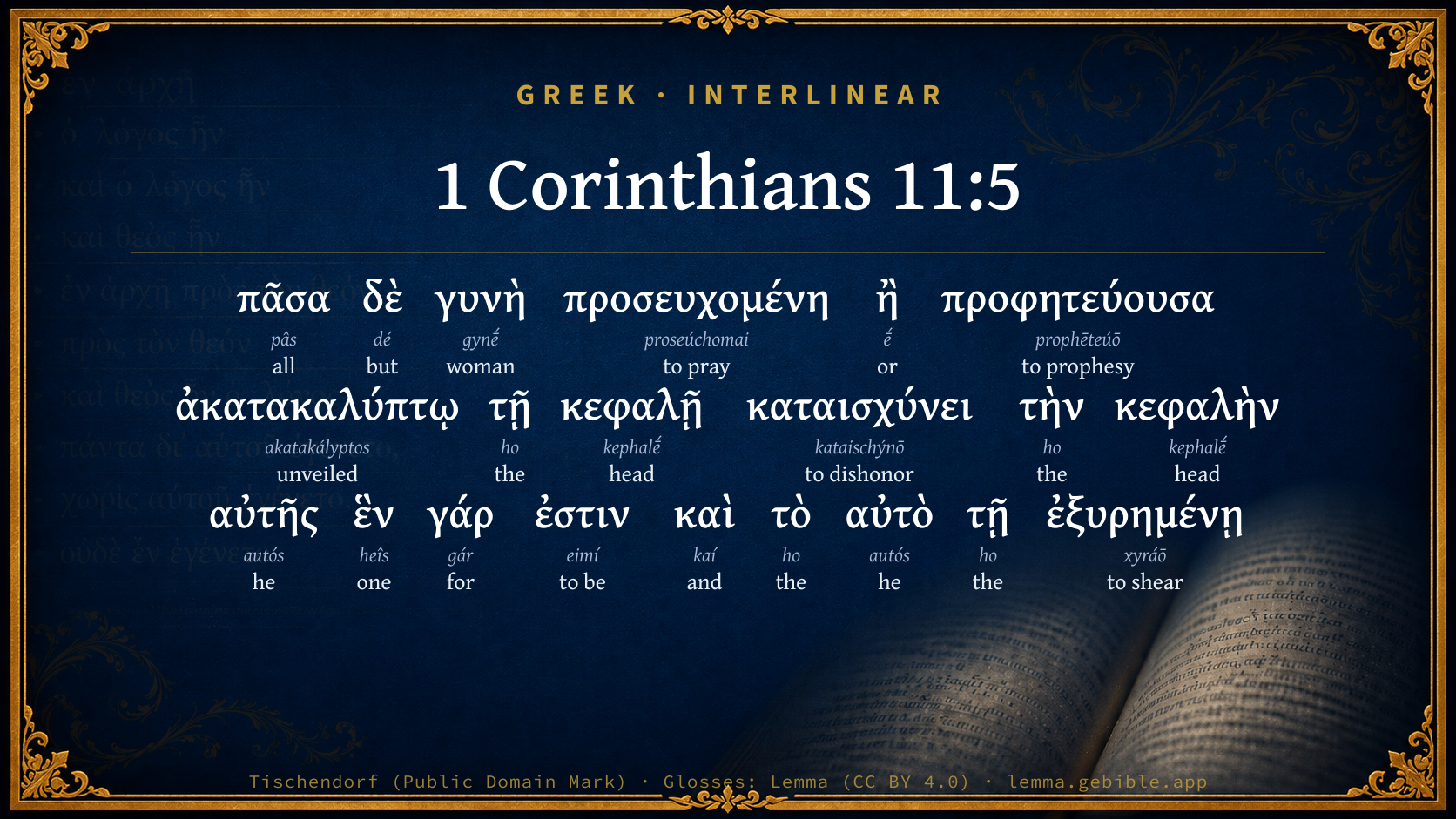
Download image
Cite this verse

1 Corinthians 11:5 (World English Bible). Public Domain. Lemma interlinear Bible study tool, https://lemma.gebible.app/v/1-corinthians/11/5.

Show BibTeX & RIS
BibTeX
RIS
English Translation
But every woman praying or prophesying with her head unveiled dishonors her head. For it is one and the same thing as if she were shaved.
World English Bible · Public Domain
Highlights
  • 1 first appearance in the Greek New Testament
Full analysis ↓
Download a study sheet

One document with this verse’s original text, its word-by-word gloss line, the meaning frame, cross-references with their text, attributed commentary, and full source and license credits — printable, and it pastes into notes with its structure intact.

This verse Autodidact and up

Study sheet (.html) Plain text (.txt)

A passage Seminary Student

Up to 50 verses in one chapter. A passage sheet keeps up to 6 commentary sources and 12 cross-references per verse, in the order this page ranks them, and says so on the sheet whenever that leaves anything out. Ask for a single verse and you get the Autodidact verse sheet above.

Everything on this page stays free to read, with no account — the sheet is a download of what is already on screen, not access to it.

Want to remove ads? Support Godless Engineer
Compare translations 3

The same verse in 3 English versions, stacked beneath the original-language interlinear above. Click any original word for its lexicon entry.

Each is an independent rendering of the whole verse — the interlinear is not word-aligned to these translations.

Highlighted words mark where these versions differ — a whole-verse word diff, not a word-by-word alignment.

  • World English Bible Public Domain
    But every woman praying or prophesying with her head unveiled dishonors her head. For it is one and the same thing as if she were shaved.
  • King James Version Public Domain
    But every woman that prayeth or prophesieth with her head uncovered dishonoureth her head: for that is even all one as if she were shaven.
  • unfoldingWord Literal Text CC BY-SA 4.0
    But every woman praying or prophesying with her head uncovered dishonors her head. For it is one and the same thing as having been shaved.

unfoldingWord Literal Text — © unfoldingWord, licensed CC BY-SA 4.0. Word-aligned USFM3 via Door43 (git.door43.org/unfoldingWord/en_ult).

Versions to compare (up to 4)

3 of 4 selected

Show all 19 translations

Every available English version of this verse, each an independent rendering of the whole verse.

  • World English Bible Public Domain
    But every woman praying or prophesying with her head unveiled dishonors her head. For it is one and the same thing as if she were shaved.
  • Berean Standard Bible Public Domain
    And every woman who prays or prophesies with her head uncovered dishonors her head, for it is just as if her head were shaved.
  • Majority Standard Bible Public Domain
    And every woman who prays or prophesies with her head uncovered dishonors her head, for it is just as if her head were shaved.
  • King James Version Public Domain
    But every woman that prayeth or prophesieth with her head uncovered dishonoureth her head: for that is even all one as if she were shaven.
  • American Standard Version (1901) Public Domain
    But every woman praying or prophesying with her head unveiled dishonoreth her head; for it is one and the same thing as if she were shaven.
  • Revised Version (1885) Public Domain
    But every woman praying or prophesying with her head unveiled dishonoureth her head: for it is one and the same thing as if she were shaven.
  • Geneva Bible (1599) Public Domain
    But euery woman that prayeth or prophecieth bare headed, dishonoureth her head: for it is euen one very thing, as though she were shauen.
  • Douay-Rheims (1899) Public Domain
    But every woman praying or prophesying with her head not covered, disgraceth her head: for it is all one as if she were shaven.
  • Young's Literal Translation Public Domain
    and every woman praying or prophesying with the head uncovered, doth dishonour her own head, for it is one and the same thing with her being shaven,
  • Literal Standard Version CC BY-SA 4.0
    and every woman praying or prophesying with the head uncovered, dishonors her own head, for it is one and the same thing with her being shaven,
  • Unlocked Literal Bible CC BY-SA 4.0
    But any woman who prays or prophesies with her head uncovered dishonors her head. For it is the same thing as if her head were shaved.
  • unfoldingWord Literal Text CC BY-SA 4.0
    But every woman praying or prophesying with her head uncovered dishonors her head. For it is one and the same thing as having been shaved.
  • Darby Bible Public Domain
    But every woman praying or prophesying with her head uncovered puts her own head to shame; for it is one and the same as a shaved [woman].
  • World Messianic Bible Public Domain
    But every woman praying or prophesying with her head uncovered dishonors her head. For it is one and the same thing as if she were shaved.
  • Webster's Bible Public Domain
    But every woman that prayeth or prophesieth with her head uncovered, dishonoreth her head: for that is even all one as if she were shaved.
  • Free Bible Version CC BY-SA 4.0
    A woman's head is dishonored if she prays or prophesies with her head uncovered—it's just as if she had her hair shaved off.
  • Bible in Basic English Public Domain
    But every woman who does so with her head unveiled, puts shame on her head: for it is the same as if her hair was cut off.
  • Text-Critical English NT CC BY 4.0
    and every woman who prays or prophesies with her head unveiled disgraces her head, for it is one and the same as having her head shaved.
  • Tyndale New Testament (1534) Public Domain
    Every woman that prayeth or prophisieth bare hedded dishonesteth hyr heed. For it is even all one and the very same thinge even as though she were shaven.

Literal Standard Version (2020), Covenant Press — licensed CC BY-SA 4.0. Text via the HelloAO Bible API (eBible.org). Unlocked Literal Bible (unfoldingWord) — licensed CC BY-SA 4.0. Text via the HelloAO Bible API (eBible.org). unfoldingWord Literal Text — © unfoldingWord, licensed CC BY-SA 4.0. Word-aligned USFM3 via Door43 (git.door43.org/unfoldingWord/en_ult). Free Bible Version, Dr. Jonathan Gallagher — licensed CC BY-SA 4.0. Text via the HelloAO Bible API (eBible.org).

Word by word

More ways to search: Search by grammar → Find every occurrence → Compare this word →

Practice this passage: Drill this verse → Learn its vocabulary →

ἀκατακαλύπτῳ
akatakályptos
G177
“unveiled”
Adjective, Dative, Singular, Feminine
Part of Speech
Adjective
Case
Dative
Number
Singular
Gender
Feminine
Full Thayer's Definition

Origin: from G1 (as a negative particle) and G2619 a derivative of a compound of G2596 and G2572

TDNT: None

1. not covered, unveiled
  1. πᾶσα pâs G3956 “all” Adjective, Nominative, Singular, Feminine
  2. δὲ dé G1161 “but” Conjunction
  3. γυνὴ gynḗ G1135 “woman” Noun, Nominative, Singular, Feminine
  4. προσευχομένη proseúchomai G4336 “to pray” Verb, Present, Middle or Passive deponent, Participle, Nominative, Singular, Feminine
  5. ἢ ḗ G2228 “or” Particle
  6. προφητεύουσα prophēteúō G4395 “to prophesy” Verb, Present, Active, Participle, Nominative, Singular, Feminine
  7. τῇ ho G3588 “the” Article, Dative, Singular, Feminine
  8. κεφαλῇ kephalḗ G2776 “head” Noun, Dative, Singular, Feminine
  9. καταισχύνει kataischýnō G2617 “to dishonor” Verb, Present, Active, Indicative, 3rd person, Singular
  10. τὴν ho G3588 “the” Article, Accusative, Singular, Feminine
  11. κεφαλὴν kephalḗ G2776 “head” Noun, Accusative, Singular, Feminine
  12. αὐτῆς autós G846 “he” Personal pronoun, Genitive, Singular, Feminine
  13. ἓν heîs G1520 “one” Adjective, Nominative, Singular, Neuter
  14. γάρ gár G1063 “for” Conjunction
  15. ἐστιν eimí G1510 “to be” Verb, Present, Active, Indicative, 3rd person, Singular
  16. καὶ kaí G2532 “and” Conjunction
  17. τὸ ho G3588 “the” Article, Nominative, Singular, Neuter
  18. αὐτὸ autós G846 “he” Personal pronoun, Nominative, Singular, Neuter
  19. τῇ ho G3588 “the” Article, Dative, Singular, Feminine
  20. ἐξυρημένῃ xyráō G3587 “to shear” Verb, Perfect, Passive, Participle, Dative, Singular, Feminine

About this verse

These counts appear in no published source. They are computed here, from the morphology-tagged text and Lemma’s own curated glosses. What Lemma adds →

21
words
16
distinct lemmas
Pauline Epistles
section

Notable vocabulary

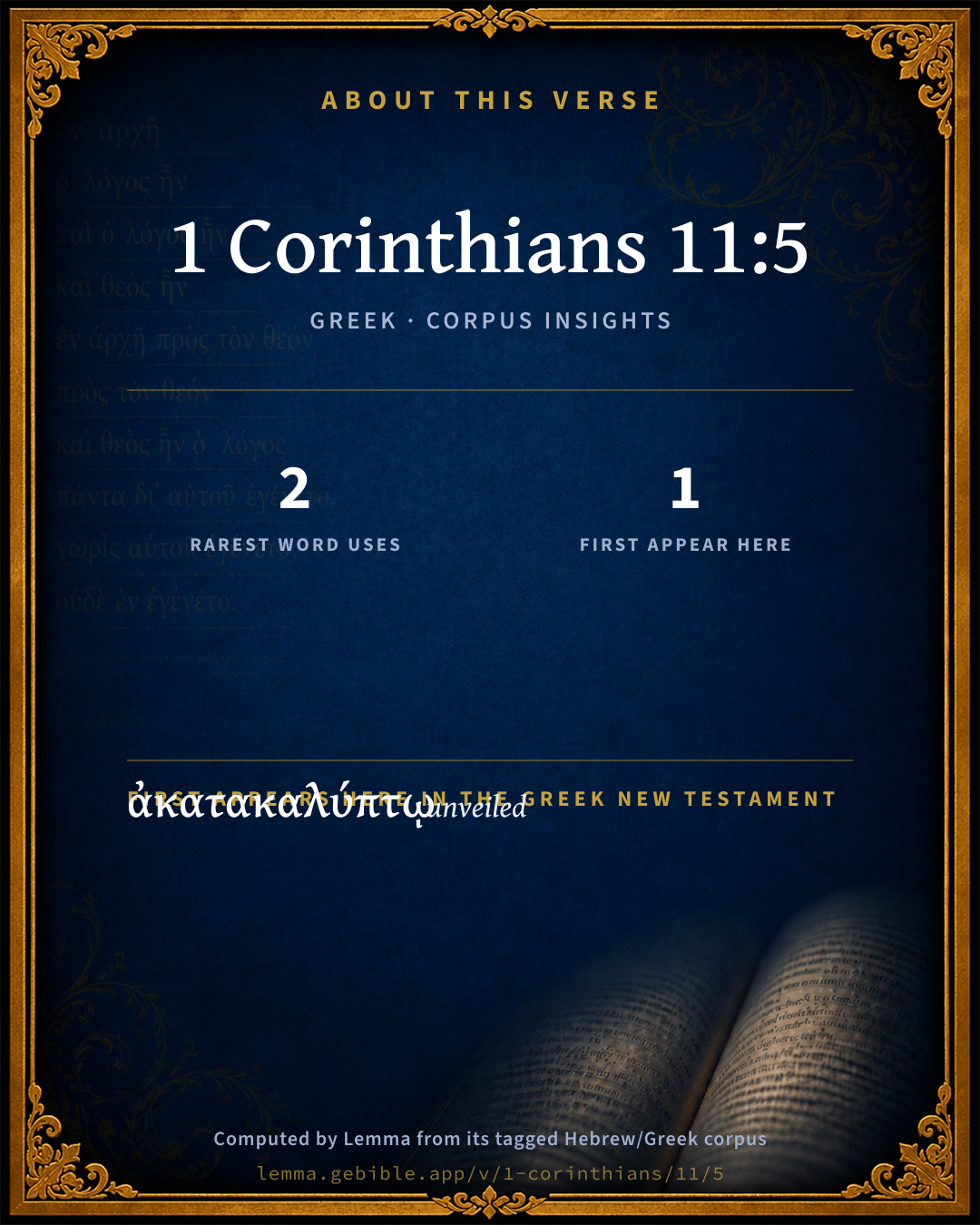
The rarest word here is ἀκατακαλύπτῳ unveiled G177 — appearing just 2 times in the whole Greek New Testament.

First appearance in Scripture

This word makes its first canonical appearance in the Greek New Testament here:

  • ἀκατακαλύπτῳ unveiled G177

Shared distinctive vocabulary

ἀκατακαλύπτῳ unveiled G177 occurs in 2 verses of the Greek New Testament. Also found in:
Repetition

Words recur within this verse:

  • κεφαλῇ head G2776 ×2
  • τῇ the G3588 ×4
  • αὐτῆς he G846 ×2

Cross-references

5

Topical passages linked to 1 Corinthians 11:5 in the Treasury of Scripture Knowledge — connected by theme and wording, ordered by reader-vote popularity; previews shown in the World English Bible.

  • Deuteronomy 21:12 then you shall bring her home to your house; and she shall shave her head, and pare her nails;
  • Luke 2:36 There was one Anna, a prophetess, the daughter of Phanuel, of the tribe of Asher (she was of a great age, having lived with a husband seven years from her virginity,
  • Acts 2:17 'It will be in the last days, says God, That I will pour out my Spirit on all flesh. Your sons and your daughters will prophesy. Your young men will see visions. Your old men will dream dreams.
  • Acts 21:9 Now this man had four virgin daughters who prophesied.
  • 1 Corinthians 14:34 let your wives keep silent in the assemblies, for it has not been permitted for them to speak; but let them be in subjection, as the law also says.

Cross-references courtesy of OpenBible.info (CC BY 4.0).

Commentary

Notes on 1 Corinthians 11:5 from classic Christian and Jewish commentators (each source and its license shown beneath its notes). The classic Christian expositions comment on the surrounding passage and are grouped to its opening verse, so a note may address several verses; the Jewish commentaries on the Tanakh (Rashi and others) are per-verse, so they appear only where the commentator wrote on this verse.

Lemma curates 59 commentaries, every one of them public domain or Creative Commons licensed, each selected and text-cleaned for this edition rather than reprinted as found. About our sources →

Bengel's Gnomon

Johann Albrecht Bengel

1Co 11:5. Πᾶσα δὲ γυνὴ, but every woman) δὲ, but, forms an epitasis [emphatic augmentation or addition]. In this whole passage the woman, especially the woman of Corinth, is principally admonished.—προσευχομένη ἢ προφητεύουσα, praying or prophesying) Therefore women are not altogether excluded from these duties; at least the Corinthian women did that, which, so far as it may be lawful, Paul at ch. 14. [34, 35] puts off, namely, to some suitable occasion distinct from the more solemn assembly.—ἀκατακαλύπτῳ, uncovered) nature demands a covering, but how far the forehead with the face, and the hinder part of the head, should be covered, is a matter left to the customs of the people. It is probable, that Jesus and His disciples had their heads covered according to the customs of the Israelites; whence the rule is not universal, and not more ancient than Paul. And there was παράδοσις, an ordinance, not a rule strictly so called, but a custom [institutum] eine Verordnung. A question arises here, what is to be thought concerning wigs? First, they do not seem to be considered as περιβόλαιον, or covering for the head, for they are an imitation of the hair, and where that is too thin, they supply the defect, and in the present day are sometimes quite necessary for the sake of health, and they no more veil the face, than every man’s own hair: and even if women were accustomed to wear wigs, they would not be considered as thereby sufficiently covered. Therefore the head of a man is scarcely more dishonoured by them, while he prays, than while he does not pray. The wig, however, especially one too long and bushy and having little resemblance to the natural hair, is in reality an adventitious thing, and originates in pride or at least in effeminacy either voluntary, or arising from a false necessity:—it was not so from the beginning, and it will not be so always. Paul, if we could now consult him, would, I believe, not compel those, who wear wigs to cast them off entirely; but he would teach those, at least, who have not begun to wear them, for ever to unlearn [avoid] them, as a thing unbecoming men, especially men engaging in prayer.—ἔστι, is) Such a woman does not differ from one, that has been shaved.

Bengel's Gnomon of the New Testament — English translation (T&T Clark, Edinburgh, 1860) — public domain. Text from a community e-Sword module.

Meyer's Critical & Exegetical Commentary

Heinrich August Wilhelm Meyer

1Co_11:5. A second inference of an opposite kind from 1Co_11:3, namely, with respect to the women.

Prayer and prophetic utterances in meetings on the part of the women are assumed here as allowed. In 1Co_14:34, on the contrary, silence is imposed upon them; comp also 1Ti_2:12, where they are forbidden to teach. This seeming contradiction between the passages disappears, however, if we take into account that in chap. 14 it is the public assembly of the congregation, the whole ἐκκλησία, that is spoken of (1Co_11:4-5; 1Co_11:12; 1Co_11:16; 1Co_11:19; 1Co_11:23; 1Co_11:26 ff., 1Co_11:33). There is no sign of such being the case in the passage before us. What the apostle therefore has in his eye here, where he does not forbid the ΠΡΟΣΕΎΧΕΣΘΑΙ Ἢ ΠΡΟΦΗΤΕΎΕΙΝ of the women, and at the same time cannot mean family worship simply (see on 1Co_11:4), must be smaller meetings for devotion in the congregation, more limited circles assembled for worship, such as fall under the category of a church in the house (1Co_16:19; Rom_16:5; Col_4:15; Phm_1:2). Since the subject here discussed, as we may infer from its peculiar character, must have been brought under the notice of the apostle for his decision by the Corinthians themselves in their letter, his readers would understand both what kind of meetings were meant as those in which women might pray and speak as prophetesses, and also that the instruction now given was not abrogated again by the taceat mulier in ecclesia. The latter would, however, be the case, and the teaching of this passage would be aimless and groundless, if Paul were here only postponing for a little the prohibition in 1Co_14:34, in order, first of all, provisionally to censure and correct a mere external abuse in connection with a thing which was yet to be treated as wholly unallowable (against my own former view). It is perfectly arbitrary to say, with Grotius, that in 1Co_14:34 we must understand as an exception to the rule: nisi speciale Dei mandatum habeant.

ἀκατακαλύπτῳ] Polyb. xv. 27. 2. As to the dative, see Winer, p. 203 [E. T. 271].

ΤῊΝ ΚΕΦΑΛ. ΑὐΤῆς]see the critical remarksis, like Τ. ΚΕΦ. ΑὐΤΟῦ in 1Co_11:4, to be understood of the literal head. A woman when praying was to honour her head by having a sign upon it of the authority of her husband, which was done by having it covered; otherwise she dishonoured her head by dressing not like a married wife, from whose head-dress one can see that her husband is her head (lord), but like a loose woman, with whose shorn head the uncovered one is on a par.

ἓν γάρ ἐστι Κ.Τ.Λ[1762]] for she is nothing else, nothing better, than she who is shorn. As the long tresses of the head were counted a womanly adornment among Jews and Gentiles, so the hair shorn off was a sign either of mourning (Deu_21:12; Homer, Od. iv. 198, xxiv. 46; Eurip. Or. 458; Hermann, Privatalterth. § xxxix. 28) or of shamelessness (Elsner, Obss. p. 113), and was even the penalty of an adulteress (Wetstein in loc[1763]). What Paul means to say then is: a woman praying with uncovered head stands in the eye of public opinion, guided as it is by appearances, on just the same level with her who has the shorn hair of a courtesan.

ἓν κ. τὸ αὐτό] emphatic: unum idemque. See instances in Kypke, II. p. 220. The subject to this is πᾶσα γυνὴ κ.τ.λ[1764], not the appearing uncovered, so that strictly it ought to have been Τῷ ἘΞΥΡῆΣΘΑΙ (Billroth). And the neuter is used, because the subject is regarded as a general conception. Comp 1Co_3:8. Respecting the dative, see Kühner, II. p. 244; Krüger, § xlviii. 14. 9.

The form ΞΥΡΆΩ has less authority in Attic writers than ΞΥΡΈΩ. See Lobeck, a[1766] Phryn. p. 205.

[1762] .τ.λ. καὶ τὰ λοιπά.

[1763] n loc. refers to the note of the commentator or editor named on the particular passage.

[1764] .τ.λ. καὶ τὰ λοιπά.

[1766] d refers to the note of the commentator or editor named on the particular passage.

REMARK.

The evil, which Paul here rebukes with such sharpness and decision, must have broken out after the apostle had left Corinth; had he been present, he would not have allowed it to emerge. It arose probably from an unseemly extension of the principle of Christian liberty, occasioned by the fact of women partaking in the special gifts of the Spirit, 1Co_11:4, and doubtless under the influence of the greater laxity of Hellenic ideas about female dress. The letter from the Corinthians, when referring to the way in which the apostles instructions were acted upon at Corinth (1Co_11:2), must have contained an inquiry put to him upon this particular point (comp on 1Co_11:5). The fact that Paul makes no allusion to virgins here proves that they were not involved in the wrong practice, although Tertullian (de virginib. veland.) unwarrantably applies our passage to them also.

Meyer — Critical and Exegetical Commentary on the New Testament — English translation by Peter Christie, edited by Frederick Crombie (T&T Clark, 1880) — public domain. Text from a community e-Sword module.

Godet's Commentaries

Frédéric Louis Godet

Vv. 5. But precisely because the woman is in a position contrasted with that of the man, in so far as she has here below a visible head, she would dishonour this head by affecting a costume which would be a symbol of independence. And since the woman does not naturally belong to public life, if it happen that in the spiritual domain she has to exercise a function which brings her into prominence, she ought to strive the more to put herself out of view by covering herself with the veil, which declares the dependence in which she remains relatively to her husband. As Heinrici says, it can only be to the shame of her husband if a wife present herself in a dress which belongs to the man. By uncovering her head (in the literal sense) she dishonours her head (in the figurative sense).

Here a difficulty arises. The apostle, by laying down for the woman the condition of wearing the veil, seems decidedly to authorize the act to which this condition applies, that is to say, he permits the woman to pray and to prophesy in public. Now in chap. 1Co 14:34 he says, absolutely and without restriction: “Let your women keep silence in the Churches.” This apparent contradiction has led Hofmann, Meyer, Beet, and others to the idea, that, in our chapter, Paul had in view only gatherings for family worship (Hofmann) or private meetings (Meyer), composed exclusively of women (Beet). But it is impossible to hold that the apostle would have imposed the obligation of the veil on a mother praying while surrounded by her husband and children. Neither is it possible to see how the idea of Meyer and of Beet could be reconciled with 1Co 11:10 of our chapter (because of the angels). Besides, 1Co 11:16 naturally implies that Paul is thinking of public worship (the Churches of God). Finally, in 1Co 14:34-35 he is not distinguishing between different kinds of assemblies; but he is contrasting assemblies in general with the time when husband and wife find themselves alone together at home: “Let the women keep silence in the Churches...” (1Co 14:34), “let them ask their husbands at home” (1Co 14:35).

Heinrici proposes to restrict the prohibition laid on women, in chap. 14, to the tokens of admiration which they liked to give to those who spoke in tongues, or also to the curious questions which they put to the prophets, thus of course disturbing the decorum of the assemblies. Some writers in England have even supposed that in chap. 14. Paul simply means to forbid women to indulge in the whisperings and private conversations which would break the stillness of worship. But it is impossible so to restrict the meaning of the word λαλεῖν, to speak, in chap. 14, applied as it is in that chapter to all the forms of public speaking. Besides, the prohibition, if it had one of these meanings, should have been addressed to men as much as to women. What the passage in chap. 14 forbids to women, is not ill-speaking or ill-timed speaking, it is speaking; and what Paul contrasts with the term speaking, is keeping silence or asking at home.

It might be supposed that the apostle meant to let the speaking of women in the form of prophesying or praying pass for the moment only, contemplating returning to it afterwards to forbid it altogether, when he should have laid down the principles necessary to justify this complete prohibition. So it was that he proceeded in chap. 6, in regard to lawsuits between Christians, beginning by laying down a simple restriction in 1Co 11:4, to condemn them afterwards altogether in 1Co 11:7. We have also observed the use of a similar method in the discussion regarding the participation of the Corinthians in idolatrous feasts; the passage, 1Co 8:10, seemed first to authorize it; then, afterwards, when the time has come, he forbids it absolutely (1Co 10:21-22), because he then judges that the minds of his readers are better prepared to accept such a decision. But this solution is unsatisfactory, because it remains true that one does not lay down a condition to the doing of a thing which he intends afterwards to forbid absolutely.

It has also been thought that the term λαλεῖν, speaking, should be taken in chap. 14 solely in the sense of teaching. Thus the woman might prophesy or pray in an unknown tongue; but she must never indulge in teaching. But it is impossible to accept so limited a meaning of the word λαλεῖν in a chapter where it is used all through to denote both prophetical speaking and speaking in tongues. This solution is not, perhaps, radically false, but it is impossible to deduce it from the word speaking in chap. 14 in contrast to the terms prophesying and praying in chap. 11

I rather think, therefore, that while rejecting, as a rule, the speaking of women in Churches, Paul yet meant to leave them a certain degree of liberty for the exceptional case in which, in consequence of a sudden revelation (prophesying), or under the influence of a strong inspiration of prayer and thanksgiving (speaking in tongues), the woman should feel herself constrained to give utterance to this extraordinary impulse of the Spirit. Only at the time when she thus went out of her natural position of reserve and dependence, he insisted the more that she should not forget, nor the Church with her, the abnormal character of the action; and this was the end which the veil was intended to serve. Moreover, Paul does not seem to think that such cases could be frequent. For in chap. 14 prophetesses are not once mentioned along with prophets, and yet the name προφῆτις was familiar in the Old Testament, and is not wanting in the New (Luk 2:36; Rev 2:20). Probably in making the concession which we find in this passage, the apostle was thinking only of married women. The question could hardly have been even raised as to young women. Reuss says: “In Greece a woman of character did not appear in public without a veil.” How much more must it have been so with unmarried persons! And if Paul had extended to the latter the permission implied in his words, he would still less have suppressed in their case the condition of the veil imposed on the former.

In the last words of 1Co 11:5, Paul likens the woman who appears in public with her head uncovered to one who has her head shaven. This was never found among the Greeks, except in the case of women who were slaves; among the Jews, only in the case of the woman accused of adultery by her husband (Num 5:18). A similar usage seems to have prevailed among other nations besides. — The subject of the proposition, according to most, is understood: every woman that speaketh with her head uncovered (see Meyer). But is it not simpler to make ἓν καὶ τὸ αὐτό, one and the same thing, the subject of ἐστί: “One and the same [condition] is the woman’s who is shaven [as hers who is not veiled].” The verb ξυρέω, or ξυράω, or ξύρω, signifies to shave to the skin.

Frédéric Louis Godet — Commentaries on Luke, John, Romans, and 1 Corinthians — English translation (T&T Clark, Edinburgh, 1870s–1890s) — public domain. Text from a community e-Sword module.

Hodge's Commentary on Romans, Ephesians & First Corinthians

Charles Hodge

1Co_11:5

But every woman that prayeth or prophesieth with (her) head uncovered dishonoreth her head; for that is even all one as if she were shaven.

Praying and prophesying were the two principal exercises in the public worship of the early Christians. The latter term, as above stated, included all forms of address dictated by the Holy Spirit. It was Pauls manner to attend to one thing at a time. He is here speaking of the propriety of women speaking in public unveiled, and therefore he says nothing about the propriety of their speaking in public in itself. When that subject comes up, he expresses his judgment in the clearest terms, 1Co_14:34. In here disapproving of the one, says Calvin, he does not approve of the other.

The veils worn by Grecian women were of different kinds. One, and perhaps the most common, was the peplum, or mantle, which in public was thrown over the head, and enveloped the whole person. The other was more in the fashion of the common eastern veil which covered the face, with the exception of the eyes. In one form or other, the custom was universal for all respectable women to appear veiled in public. The apostle therefore says, that a woman who speaks in public with her head uncovered, dishonoreth her head. Here ἑαυτῆς is used, her own head; not her husband, but herself. This is plain, not only from the force of the words, but from the next clause, for that is even all one as if she were shaven. This is the reason why she disgraces herself. She puts herself in the same class with women whose hair has been cut off. Cutting off the hair, which is the principal natural ornament of women, was either a sign of grief, Deu_21:12, or a disgraceful punishment. The literal translation of this clause is: she is one and the same thing with one who is shaven. She assumes the characteristic mark of a disreputable woman.

Charles Hodge — Commentary on Romans (1835), First Corinthians (1857), and Ephesians (1856) — public domain. Text from a community e-Sword module.

Geneva Bible (1599)

Geneva Bible translators

And in like sort he concludeth, that women which show themselves in public and ecclesiastical assemblies without the sign and token of their subjection, that is to say, uncovered, shame themselves.

The first argument taken from the common sense of man, forsomuch as nature teacheth women, that it is dishonest for them to come abroad bareheaded, seeing that she hath given them thick and long hair, which they do so diligently trim and deck, that they can in no wise abide to have it shaven.

Geneva Bible (1599) marginal notes — public domain. Text via Bolls.life.

Jamieson, Fausset & Brown

Robert Jamieson, A. R. Fausset & David Brown

woman . . . prayeth . . . prophesieth--This instance of women speaking in public worship is an extraordinary case, and justified only by the miraculous gifts which such women possessed as their credentials; for instance, Anna the prophetess and Priscilla (so Act 2:18). The ordinary rule to them is: silence in public (Co1 14:34-35; Ti1 2:11-12). Mental receptivity and activity in family life are recognized in Christianity, as most accordant with the destiny of woman. This passage does not necessarily sanction women speaking in public, even though possessing miraculous gifts; but simply records what took place at Corinth, without expressing an opinion on it, reserving the censure of it till Co1 14:34-35. Even those women endowed with prophecy were designed to exercise their gift, rather in other times and places, than the public congregation.

dishonoureth . . . head--in that she acts against the divine ordinance and the modest propriety that becomes her: in putting away the veil, she puts away the badge of her subjection to man, which is her true "honor"; for through him it connects her with Christ, the head of the man. Moreover, as the head-covering was the emblem of maiden modesty before man (Gen 24:65), and conjugal chastity (Gen 20:16); so, to uncover the head indicated withdrawal from the power of the husband, whence a suspected wife had her head uncovered by the priest (Num 5:18). ALFORD takes "her head" to be man, her symbolical, not her literal head; but as it is literal in the former clause, it must be so in the latter one.

all one as if . . . shaven--As woman's hair is given her by nature, as her covering (Co1 11:15), to cut it off like a man, all admit, would be indecorous: therefore, to put away the head-covering, too, like a man, would be similarly indecorous. It is natural to her to have long hair for her covering: she ought, therefore, to add the other (the wearing of a head-covering) to show that she does of her own will that which nature itself teaches she ought to do, in token of her subjection to man.

Jamieson, Fausset & Brown — Commentary Critical and Explanatory on the Whole Bible (1871) — public domain (CC PDM 1.0). Text via the HelloAO Bible API.

Adam Clarke's Commentary

Verse 5. But every woman that prayeth, c.] Whatever may be the meaning of praying and prophesying, in respect to the man, they have precisely the same meaning in respect to the woman. So that some women at least, as well as some men, might speak to others to edification, and exhortation, and comfort. And this kind of prophesying or teaching was predicted by Joel, Joe 2:28, and referred to by Peter, Ac 2:17. And had there not been such gifts bestowed on women, the prophecy could not have had its fulfilment. The only difference marked by the apostle was, the man had his head uncovered, because he was the representative of Christ the woman had hers covered, because she was placed by the order of God in a state of subjection to the man, and because it was a custom, both among the Greeks and Romans, and among the Jews an express law, that no woman should be seen abroad without a veil. This was, and is, a common custom through all the east, and none but public prostitutes go without veils. And if a woman should appear in public without a veil, she would dishonour her head-her husband. And she must appear like to those women who had their hair shorn off as the punishment of whoredom, or adultery.

Tacitus informs us, Germ. 19, that, considering the greatness of the population, adulteries were very rare among the Germans; and when any woman was found guilty she was punished in the following way: accisis crinibus, nudatam coram propinquis expellit domo maritus; "having cut off her hair, and stripped her before her relatives, her husband turned her out of doors." And we know that the woman suspected of adultery was ordered by the law of Moses to be stripped of her veil, Nu 5:18. Women reduced to a state of servitude, or slavery, had their hair cut off: so we learn from Achilles Tatius. Clitophon says, concerning Leucippe, who was reduced to a state of slavery: πεπραται, δεδουλευκεν, γην εσκαψεν, σεσυληται της κεφαλης το καλλος, την κουραν ὁρᾳς· lib. viii. cap. 6, "she was sold for a slave, she dug in the ground, and her hair being shorn off, her head was deprived of its ornament," c. It was also the custom among the Greeks to cut off their hair in time of mourning. See Euripides in Alcest., ver. 426. Admetus, ordering a common mourning for his wife Alcestis, says: πενθος γυναικος της δε κοινουσθαι λεγω, κουρᾳ ξυρηκει και μελαμπεπλῳ στολῃ· "I order a general mourning for this woman! let the hair be shorn off, and a black garment put on." Propriety and decency of conduct are the points which the apostle seems to have more especially in view. As a woman who dresses loosely or fantastically, even in the present day, is considered a disgrace to her husband, because suspected to be not very sound in her morals so in those ancient times, a woman appearing without a veil would be considered in the same light.

Adam Clarke's Commentary on the Bible (1810–1826) — public domain. Text from a community e-Sword/MySword module.

John Calvin's Commentaries

5. Every woman praying or prophesying Here we have the second proposition — that women ought to have their heads covered when they pray or prophesy; otherwise they dishonor their head For as the man honors his head by showing his liberty, so the woman, by showing her subjection. Hence, on the other hand, if the woman uncovers her head, she shakes off subjection — involving contempt of her husband. It may seem, however, to be superfluous for Paul to forbid the woman to prophesy with her head uncovered, while elsewhere he wholly

prohibits women from speaking in the Church. (1 Timothy 2:12.)

It would not, therefore, be allowable for them to prophesy even with a covering upon their head, and hence it follows that it is to no purpose that he argues here as to a covering. It may be replied, that the Apostle, by here condemning the one, does not commend the other. For when he reproves them for prophesying with their head uncovered, he at the same time does not give them permission to prophesy in some other way, but rather delays his condemnation of that vice to another passage, namely in 1 Corinthians 14. In this reply there is nothing amiss, though at the same time it might suit sufficiently well to say, that the Apostle requires women to show their modesty — not merely in a place in which the whole Church is assembled, but also in any more dignified assembly, either of matrons or of men, such as are sometimes convened in private houses.

6. For it is all one as if she were shaven. He now maintains from other considerations, that it is unseemly for women to have their heads bare. Nature itself, says he, abhors it. To see a woman shaven is a spectacle that is disgusting and monstrous. Hence we infer that the woman has her hair given her for a covering Should any one now object, that her hair is enough, as being a natural covering, Paul says that it is not, for it is such a covering as requires another thing to be made use of for covering it And hence a conjecture is drawn, with some appearance of probability — that women who had beautiful hair were accustomed to uncover their heads for the purpose of showing off their beauty. It is not, therefore, without good reason that Paul, as a remedy for this vice, sets before them the opposite idea — that they be regarded as remarkable for unseemliness, rather than for what is an incentive to lust.

John Calvin's Commentaries (1540-1563) — public domain. Text from the Calvin Translation Society English edition (1840s-50s) via the Christian Classics Ethereal Library (ccel.org). Calvin's coverage is partial (roughly two-thirds of the Bible); uncommented books and verses are honest gaps, never fabricated. The 19th-century editor's footnotes and remarks are omitted so the notes are faithfully Calvin's own voice.

Ellicott's Commentary for English Readers

(5) But every woman that prayeth . . . From the hypothetical case of the man praying or preaching with covered head (which was mentioned first for the sake of introducing the antithesis), the Apostle comes now to the actual case of which he has to treat, viz., the woman uncovering her head. At first sight the permission here implied for a woman to pray and teach in public may seem at variance with the teaching in 1Co_14:34, where she is commanded to observe silence, and the injunction in 1Ti_2:12, that women should not “teach.” In these passages, however, it is the public meeting of the whole Church that is spoken of, and in such the women were to be silent—but the meetings spoken of here, though public as distinguished from the private devotions of individuals, were probably only smaller gatherings such as are indicated in Rom_14:5; Col_4:5; Phm_1:2. It has been suggested by some writers that the command in 1Co_14:34, does forbid the practice which is here assumed to be allowable only for the sake of argument; but surely St. Paul would not have occupied himself and his readers here with the elaborate, and merely forensic discussion of the conditions under which certain functions were to be performed which he was about subsequently to condemn, as not allowable under any restriction whatever?

Dishonoureth her head.—Both among Jews and Greeks the long tresses of a woman were her glory. Only in times of mourning (Deu_21:12), or when convicted of shameful sin, was a woman to have her hair cut short.

Here, again, the word “head” must be taken in its double significance. A woman with uncovered head dishonours that head itself by making it thus in the sight of others the type of a shame which is really not hers, and as her head typically is her husband, so she dishonours him also.

A Bible Commentary for English Readers, edited by Charles John Ellicott (1878–1897) — public domain. Text from a community e-Sword module.

The Cambridge Bible for Schools and Colleges

gen. ed. J. J. S. Perowne

5. But every woman that prayeth or prophesieth] This refers, of course, to the public assemblies of the Church, where the woman appears, not in her individual character, but as the member of a community. She must therefore perform her devotions in this latter character, and her attire must bear witness to the fact that she is subordinate to those of the other sex in whose presence she worships. Alone, of course, or in the presence of her own sex only, she has the same privilege of approaching God unveiled, that man has. Some difficulty has been raised about the words ‘or prophesieth.’ It has been thought that the woman was here permitted to prophesy, i.e. in smaller assemblies, and that the prohibitions in ch. 1Co_14:34, and 1Ti_2:12, referred to the more general gatherings of the Church. The subject is one of some difficulty (see Act_2:18; Act_21:9), but it is perhaps best, with De Wette and Calvin (who says, “Apostolum hic unum improbando alteram non probare”) to suppose that the Apostle blames only the praying in public with uncovered head, and reserves his blame of the prophesying for ch. 1Co_14:34. As for the prophetic gifts of the daughters of Philip the evangelist, Act_21:9, they were probably reserved for assemblies of their own sex.

with her head uncovered] i.e. without the peplum or shawl, which (see Art. in Smith’s Dictionary of Antiquities, and Dean Stanley’s note), used ordinarily as a covering for the body, was on public occasions thrown over the head also. In Oriental countries, however, the women wore, and still wear, a veil.

dishonoureth her head] “As the man honours his head by proclaiming his liberty, so the woman by acknowledging her subjection.”—Calvin. Cf. Num_5:18.

for that is even all one as if she were shaven] i.e. she might just as well be shaven, as appear in the public assemblies with her face entirely uncovered.

The Cambridge Bible for Schools and Colleges (gen. ed. J. J. S. Perowne; Cambridge University Press, 1878–1918) — public domain. Text from a community e-Sword module.

John Gill's Exposition

For if the woman be not covered,.... That is, if her head is not covered with some sort of covering, as is the custom of the place where she lives,

let her also be shorn; let her hair be cut short; let her wear it as men do theirs; and let her see how she will look, and how she will like that, and how she will be looked upon, and liked by others; everybody will laugh at her, and she will be ashamed of herself:

but if it be a shame for a woman to be shorn or shaven: as it is accounted in all civilized nations: the very Heathens (a) speak of it as a thing abominable, and of which there should not be one single dreadful example: then let her be covered; with a veil, or any sort of covering in common use.

(a) Vid. Apul. Metamorph. l. 2. p. 21.

John Gill's Exposition of the Whole Bible (1746–1763) — public domain (CC PDM 1.0). Text via the HelloAO Bible API.

Trapp's Complete Commentary

John Trapp

5 But every woman that prayeth or prophesieth with her head uncovered dishonoureth her head: for that is even all one as if she were shaven.

Ver. 5. Praying or prophesying] That is, joining with the man that prayeth or prophesieth, and going along with him in her heart. Thus the king and all Israel with him offered sacrifice before the Lord, 1Ki 8:62. And thus the unlearned say Amen, 1Co 14:16. {See Trapp on "Rom 16:1"}

John Trapp, A Commentary or Exposition upon All the Books of the Old and New Testament (1647–1656) — public domain. Text from a community e-Sword module.

Albert Barnes' Notes on the Bible

But every woman that prayeth or prophesieth - In the Old Testament prophetesses are not unfrequently mentioned. Thus, Miriam is mentioned Exo 15:20; Deborah Jdg 4:4; Huldah 2Ki 22:14; Noadiah Neh 6:14. So also in the New Testament Anna is mentioned as a prophetess; Luk 2:36. That there were females in the early Christian church who corresponded to those known among the Jews in some measure as endowed with the inspiration of the Holy Spirit, cannot be doubted. What was their precise office, and what was the nature of the public services in which they were engaged, is not however known. That they prayed is clear; and that they publicly expounded the will of God is apparent also; see the note on Act 2:17. As the presumption is, however, that they were inspired, their example is no warrant now for females to take part in the public services of worship, unless they also give evidence that they are under the influence of inspiration, and the more especially as the apostle Paul has expressly forbidden their becoming public teachers; 1Ti 2:12.

If it is now pled, from this example, that women should speak and pray in public, yet it should be just so far only as this example goes, and it should be only when they have the qualifications that the early “prophetesses” had in the Christian church. If there are any such; if any are directly inspired by God, there then will be an evident propriety that they should publicly proclaim the will, and not till then. It may be further observed, however, that the fact that Paul here mentions the custom of women praying or speaking publicly in the church, does not prove that it was right or proper. His immediate object now was not to consider whether the practice was itself right, but to condemn the manner of its performance as a violation of all the proper rules of modesty and of subordination. On another occasion, in this very epistle, he fully condemns the practice in any form, and enjoins silence on the female members of the church in public; 1Co 14:34.

With her head uncovered - That is, with the veil removed which she usually wore. It would seem from this that the women removed their veils, and wore their hair disheveled, when they pretended to be under the influence of divine inspiration. This was the case with the pagan priestesses; and in so doing, the Christian women imitated them. On this account, if on no other, Paul declares the impropriety of this conduct. It was, besides, a custom among ancient females, and one that was strictly enjoined by the traditional laws of the Jews, that a woman should not appear in public unless she were veiled. See this proved by Lightfoot in loco.

Dishonoureth her head - Shows a lack of proper respect to man, to her husband, to her father, to the sex in general. The veil is a token of modesty and of subordinaion. It is regarded among Jews, and everywhere, as an emblem of her sense of inferiority of rank and station. It is the customary mark of her sex, and that by which she evinces her modesty and sense of subordination. To remove that, is to remove the appropriate mark of such subordination, and is a public act by which she thus shows dishonor to the man. And as it is proper that the grades and ranks of life should be recognized in a suitable manner, so it is improper that, even on pretence of religion, and of being engaged in the service of God, these marks should be laid aside.

For that is even all one as if she were shaven - As if her long hair, which nature teaches her she should wear for a veil (1Co 11:15, margin,) should be cut off. Long hair is, by the custom of the times, and of nearly all countries, a mark of the sex, an ornament of the female, and judged to be beautiful and comely. To remove that is to appear, in this respect, like the other sex, and to lay aside the badge of her own. This, says Paul, all would judge to be improper. You yourselves would not allow it. And yet to lay aside the veil - the appropriate badge of the sex, and of her sense of subordination - would be an act of the same kind. It would indicate the same feeling, the same forgetfulness of the proper sense of subordination; and if that is laid aside, all the usual indications of modesty and subordination might be removed also. Not even under religious pretences, therefore, are the usual marks of sex, and of propriety of place and rank, to be laid aside. Due respect is to be shown, in dress, and speech, and deportment, to those whom God has placed above us; and neither in language, in attire nor in habit are we to depart from what all judge to he proprieties of life, or from what God has judged and ordained to be the proper indications of the regular gradations in society.

Albert Barnes' Notes on the Bible (1834–1885) — public domain. Text from a community e-Sword/MySword module.

Matthew Poole's English Annotations

But every woman that prayeth or prophesieth: though the woman be forbidden to teach, and commanded to be in silence, 1Ti 2:12; yet that text must be understood of ordinary women, and in ordinary cases, not concerning such as prophesied from an extraordinary impulse or motion of the Spirit. We read of women prophetesses both in the Old and New Testament; such was Huldah in Josiah’s time, and Anna, of whom we read Luk 2:36; and we read that Philip

had four daughters that did prophesy, Act 21:9.

With her head uncovered: the uncovered head here (as before) must signify not covered with some artificial covering, such as our quoifs, hats, hoods, or veils, &c., or with her own hair, not hanging loose, but artificially used so as to be a covering.

Dishonoureth her head; dishonoureth either her husband, who is her political or economical head, for by that habit she behaveth herself as if she were not one in subjection, and seemeth to usurp an undue authority over the man; or her natural head, it being in those places accounted an immodest thing for a woman to appear in public uncovered. It is observed of Rebekah, when she met Isaac, Gen 24:65; She took a veil, and covered herself. For that is even all one as if she were shaven; for, saith the apostle, yourselves would judge it an uncomely thing for a woman to be shaven; now to pray or to prophesy with the head uncovered, is all one. This last clause will incline us to think, that by the uncovered head in this verse, is not only to be understood uncovered with some other covering besides her hair, but with her hair dishevelled, hanging loose at its length, for else it is not all one to have the head uncovered with a hat, or hood, or quoif, and to be shaven; for the apostle afterward saith, 1Co 11:15, her hair is given to her for a covering or a veil: so that possibly that which the apostle here reflecteth upon, is women’s coming into the public assemblies with their hair hanging loosely down, and not decently wound up so as to make a covering for the head; which, we are told, was the practice of those beastly she-priests of Bacchus, who, like frantic persons, performed those pretendedly religious rites with their hair so hanging loose, and were called manades, because they behaved themselves more like mad persons than such as were in the actual use of their reason: something like which, it is most probable, some women in the Christian church at Corinth affected, against which the apostle here argueth.

Matthew Poole's English Annotations on the Holy Bible (1683–1685) — public domain. Text from a community e-Sword/MySword module.

Whedon's Commentary on the Bible

Daniel D. Whedon

5. Every woman that prayeth… prophesieth—Grotius thus comments: “So in the Old Testament women were prophetesses, as Miriam, sister of Moses, Exo_15:20; Deborah, Jdg_4:1; Jdg_4:5; the wife of Isaiah, Isa_8:3; Huldah, 2Ki_22:14; so also in the New Testament, the daughters of Philip, Act_21:9, and others. Such were accustomed also to expound the sacred prophecies publicly, as appears from the passages above quoted from the Old Testament. Wherefore Paul’s prohibition of women from performing the office of teaching, is to be understood with this exception, unless they have the special commandment of God.”

Wetstein says, similarly: “It was not permissible for women to teach or lead prayers in the congregation, (xiv, 34,) unless, for an exceptional reason and in a special manner, they were impelled to so doing by the Spirit of God. Act_2:17; Act_21:9; Luk_1:41-42; 1Sa_10:5; 1Sa_10:10; 1Ch_25:1-3; 2Ch_29:30; 2Ch_35:15.” It is sometimes denied that any female prophet ever prophesied in public. But in Jdg_4:4, Deborah is styled “a prophetess” who “judged”—that is, ruled—Israel in peace and led her army in war. Her “judgment,” (Jdg_4:5,) her generalship, and her chant of triumph, were all public. Her judging itself was by divine mission and impulse; and so was, strictly, in the biblical sense, prophecy. Her chant was prophecy, for 1Ch_25:1-3 shows that music and psalm came under the head of prophecy. It is ludicrous to suppose that it was in accordance with feminine modesty for Deborah to judge the people and command an army in public, but a violation of that virtue to utter a supernatural sentence in a religions assembly! Miriam’s rhythmical prophecy was uttered with timbrel before Israel’s whole camp. Huldah was installed in the prophetic college, and it was permitted her to teach a body of men sent to her by the king, including the high priest. These cases completely negative the doctrine that an inspired or gifted woman was unauthorized to speak in public. To make Paul forbid a woman’s public prophesying is to make him nullify some of the most striking facts of Old Testament history.

Both the above eminent commentators (with whom Wesley concurs) maintain that Paul in this passage assumes the right of women in the proper exceptional cases to pray or prophesy in the congregation, and maintain that in 1Co_14:34 he forbids the mass of women to interrupt the service with their noisy chatter. Alford, Stanley, and others, maintain that Paul, in 1Co_14:34, not only forbids the uncovered head in these services, but forbids the service by women at all. Thus Calvin is quoted as saying: “In here disapproving of the one, he does not approve of the other. Paul attends to one thing at a time.” But the “one thing” which this makes him “attend to” seems a very unwise “thing.” Why should he forbid praying uncovered when he condemns and prohibits their praying at all? Such a view vacates this whole paragraph of sense, rendering it so much blank paper. The Corinthian query clearly was, Ought women to have the head uncovered in their public prophesying? And St. Paul’s brief, plain answer should have been, There is to be no women’s public praying or prophesying at all. Prohibiting the incident permits the main thing. It assumes that if the incident is set right, the whole thing is right. Both Grotius and Wetstein hold that feminine prophecy is “for exceptional reason,” and by divine specialty. Hence it is often said that the female at the present day must, in her own case, in order to be accepted, be able to show an express divine authorization to prophesy or preach. To this, however, it may fairly be replied, that even the male prophet must individually profess to be “moved by the Holy Ghost,” to his office. Such a “call,” in either case, is not miraculous, but is supernatural and individual. In the case of the man, it is in accordance with the nature of man, and with the ordinary rule of Providence. In the case of the woman, it is less accordant with the feminine nature, and is more extraordinary and special; especially where it implies the exercise of authority over both sexes.

With her head uncovered—Before the gaze of masculinity it often is at once the modesty and the dignity of woman to vail herself. That unrestrained gaze is often profane; and it is a divine reserve that shrinks and conceals from it. In that reserve is contained even the proudest and noblest self-respect; so that under the forms of humiliation resides woman’s exaltation. Thereby she becomes, to man’s idea, a something sacred and imperial. Let her forfeit that ideal and she dethrones herself, and becomes an unlovely being. By most divine law each sex is confined to its own nature. It is equally shameful for manhood to become effeminate, and for womanhood to become masculine.

All one as if… shaven—One in shamefulness, for both are an unwarrantable exposure, but different in degree; for the former is a beginning and the latter is the consummation. The covering of the head as a sign of womanly modesty before man was a rigid point with the Jews. And noblest was the woman that carried it out most nobly. “The lady Kimhith bore seven sons, of whom each one attained the high priesthood. They inquired of her what she had done to accomplish so great a felicity. She replied: “At no time did ever the ceilings of my house behold the locks of my head.” — Quoted by Wetstein. Doubtless this, however, was but a sample of the tone of her character on all other points. This energy of self-control and severity of obedience to law is the very essence of a lofty moral nature. No wonder the woman of such a nature should give a line of high priests to the world; she is a born high priestess.

Of course the apostle at the present day would not consider the hood as possessing any religious significance. Women now sit or stand before men with heads uncovered, not only in the social circle, but in large assemblies; nor is it any religious obligation that requires her to wear a bonnet in church, or forbids her to speak or pray with bonnet off. And all this, when the letter of the apostle’s language condemns the uncovered head in the most explicit terms. But really, Paul condemned the uncovered female head of his day because it then expressed the moving of woman from her sphere, and suggested a dishonouring association, calculated to bring the purity of the Church into suspicion.

Daniel D. Whedon (gen. ed.), Commentary on the Old and New Testaments (1874–1909) — public domain. Text from a community e-Sword module.

The Pulpit Commentary

Or prophesieth. Although St. Paul "thinks of one thing at a time," and is not here touching on the question whether women ought to teach in public, it appears from this expression that the rule which he lays down in 1Co_14:34, 1Co_14:35, and 1Ti_2:12 was not meant to be absolute. See the case of Philip"s daughters (Act_21:9 and 2:17). With her head uncovered. For a woman to do this in a public assembly was against the national custom of all ancient communities, and might lead to the gravest misconceptions. As a rule, modest women covered their heads with the peplum or with a veil when they worshipped or were in public. Christian women at Corinth must have caught something of the "inflation" which was characteristic of their Church before they could have acted with such reprehensible boldness as to adopt a custom identified with the character of immodest women. Dishonoureth her head. Calvin, with terse good sense, observes, "As the man honours his head by proclaiming his liberty, so the woman by acknowledging her subjection."

The Pulpit Commentary (1880–1919), ed. H.D.M. Spence-Jones & Joseph S. Exell — public domain. Text from a community e-Sword module.

John Wesley's Explanatory Notes

But every woman - Who, under an immediate impulse of the Spirit, (for then only was a woman suffered to speak in the church,) prays or prophesies without a veil on her face, as it were disclaims subjection, and reflects dishonour on man, her head. For it is the same, in effect, as if she cut her hair short, and wore it in the distinguishing form of the men. In those ages, men wore their hair exceeding short, as appears from the ancient statues and pictures.

John Wesley, Explanatory Notes Upon the Whole Bible (1754–1765) — public domain. Text via the GEBible commentary corpus.

McGarvey & Pendleton's Commentaries

J. W. McGarvey

But every woman praying or prophesying with her head unveiled dishonoreth her head [Corinth was made up of Greeks, Romans and Jews, and all these three elements of her population were found in the church to which Paul wrote. The Jew and the Roman worshipped with covered, and the Greek with uncovered, head. Naturally a dispute would arise as to which custom was right. Moreover, as the women were beyond all doubt acquainted with the principle that there is neither male nor female in the spiritual realm (Gal 3:28), they seem to have added to the confusion by taking sides in the controversy, so that some of them asserted the right to worship with uncovered heads after the fashion of the Greeks. Now, in the East in Paul's day, all women went into public assemblies with their heads veiled, and this peplum, or veil, was regarded as a badge of subordination, a sign that the woman was under the power of the man. Thus Chardin, the traveler, says that the women of Persia wear a veil in sign that they are "under subjection," a fact which Paul also asserts in this chapter. Now, the symbolic significance of a woman's head-dress became the determining factor in this dispute. For a man to worship with a covered head was an act of effeminacy, a disgrace to his head, and for a woman to worship with uncovered head was likewise disgraceful, for it would at once be looked upon as a bold assertion of unwarranted independence, a sign that she had laid aside her modesty and removed from her sphere. From this passage it is plain that it was not intended that Christianity should needlessly vary from the national customs of the day. For Christians to introduce needless innovations would be to add to the misconceptions which already subjected them to persecution. One who follows Christ will find himself conspicuously different from the world, without practicing any tricks of singularity]; or it is one and the same thing as if she were shaven .

J. W. McGarvey (with Philip Y. Pendleton), Commentaries on the New Testament (The Fourfold Gospel, 1914; Acts; and the epistles) — public domain. Text from a community e-Sword/MySword module.

The People's New Testament

B. W. Johnson

5. Every one that prayeth, etc. With the customs and ideas which existed in the East in that age it would be an unseemly act, and would bring reproach. The veil was regarded as a badge of subordination, and if not worn would imply that the woman did not yield deference to her husband. Almost all women are still veiled in the presence of men in the East. All one as if she were shaven. For a woman's head to be shaven was usually a sign of shamelessness (See Meyer). The uncovered head in an assembly was also unbecoming.

B. W. Johnson's The People's New Testament with Notes (1889–1891) — public domain. Electronic text from the Christian Classics Ethereal Library (CCEL) ThML edition.

unfoldingWord translationNotes

Door43 World Missions Community

woman who prays ... dishonors her head

Possible meanings are 1) "woman who prays ... brings disgrace on herself" or 2) "wife who prays ... brings disgrace on her husband."

with her head uncovered

That is, without the cloth that was worn on the top of the head and that covered the hair and shoulders.

as if her head were shaved

as if she had removed all the hair on her head with a razor

If it is disgraceful for a woman

It was a mark of disgrace or humiliation for a woman to have her hair shaved off or cut short.

cover her head

place on her head the cloth that was worn on the top of the head and that covered the hair and shoulders

translationWords

pray

prophet

head

dishonor

disgrace

unfoldingWord translationNotes — © Distant Shores Media and the Door43 World Missions Community, licensed CC BY-SA 4.0. Source: git.door43.org/Door43/en_tn.

Cambridge Greek Testament for Schools and Colleges

5. πᾶσα δὲ γυνή. This refers, of course, to the public assemblies of the Church, where the woman appears, not in her individual character, but as the member of a community. She must therefore perform her devotions in this latter character, and her attire must bear witness to the fact that she is subordinate to those of the other sex in whose presence she worships. Alone, of course, or in the presence of her own sex only, she has the same privilege of approaching God unveiled, that man has. So says Dean Colet, ‘in feminarum ecclesia nihil impedit feminae prophetent[138].’ Some difficulty has been raised about the words ‘or prophesieth.’ It has been thought that the woman was here permitted to prophesy, i.e. in smaller assemblies, and that the prohibitions in ch. 1Co 14:34, and 1Ti 2:12, referred to the more general gatherings of the Church. The subject is one of some difficulty (see Act 2:18; Act 21:9), but it is perhaps best, with De Wette and Calvin (who says, ‘Apostolum hic unum improbando alterum non probare’) to suppose that the Apostle blames only the praying in public with uncovered head, and reserves his blame of the prophesying for ch. 1Co 14:34. As for the prophetic gifts of the daughters of Philip the evangelist, Act 21:9, they were probably reserved for assemblies of their own sex.

[138] So the words stand both in Lupton’s edition and in the MS from which it was printed.

ἀκατακαλύπτῳ τῇ κεφαλῇ, i.e. without the peplum or shawl, which (see Art. Peplum in Smith’s Dictionary of Antiquities, and Dean Stanley’s note), used ordinarily as a covering for the body, was on public occasions thrown over the head also. In Oriental countries, however, the women wore, and still wear, a veil.

καταισχύνει τὴν κεφαλήν. ‘As the man honours his head by proclaiming his liberty, so the woman by acknowledging her subjection.’ Calvin. Cf. Num 5:18.

τὸ αὐτό. The same thing as.

τῇ ἐξυρημένῃ. The shaven (woman), the article denoting the class to which such a woman belonged.

Cambridge Greek Testament for Schools and Colleges (Cambridge University Press, 1896; 21 vols, various authors incl. Carr, Maclear, Plummer, Farrar, Lumby, Moule, M. R. James, Simcox) — public domain. Text from a community e-Sword module.

Alford’s Greek Testament

Henry Alford

5.] The case of the woman is just the converse. She, if she uncovers herself (on the manner of covering, see below ver. 15, note) in such an assembly, dishonours her head (the man; not, as Meyer and many others, literally, her own head (but see above): of this kind of dishonour there is no mention at all in our passage, and ver. 3 has expressly guarded us against making the mistake) by apparently casting off his headship: and if this is to be so, the Apostle proceeds, why not go further and cut off her hair, which of itself is a token of this subjection? But if this be acknowledged to be shameful (it was a punishment of adulteresses, see Wetst. in loc. and Tacit. Germ. 19), let the further decency of the additional covering be conceded likewise.

The reading ἑαυτῆς may have arisen from fancying that her own head is meant.

ἓν … ἐστιν κ. τὸ αὐτό] she: not it, τὸ ἀκατακάλυπτον εἶναι. The neut. is used because the identity is generic, not individual: cf. Eur. Med. 928,—γυνὴ δὲ θῆλυ κἀπὶ δακρύοις ἔφυ, and other examples in Kühner, ii. 45 (§ 421).

Henry Alford, The Greek Testament (1849–1861) — public domain. Text from a community e-Sword module.

International Critical Commentary

5. ‘Praying or prophesying’ must be understood in the same way in both verses: it is arbitrary to say that the man is supposed to be taking the lead in full public worship, but the woman in mission services or family prayers. Was a woman to be veiled at family prayers? Yet in public worship women were not to speak at all (14:34; 1Ti 2:12). Very possibly the women had urged that, if the Spirit moved them to speak, they must speak; and how could they speak if their faces were veiled? In that extreme case, which perhaps would never occur, the Apostle says that they must speak veiled. They must not outrage propriety by coming to public worship unveiled because of the bare possibility that the Spirit may compel them to speak.* Comp. Philip’s daughters (Act 21:9), and the quotation from Joel (Act 2:18). In neither men nor women must prophesying be interpreted as speaking with Tongues. The latter was addressed to God and was unintelligible to most hearers; prophesying was addressed to the congregation. The women perhaps argued that distinctions of sex were done away in Christ (Gal 3:28), and that it was not seemly that a mark of servitude should be worn in Christian worship; or they may have asked why considerations about the head should lead to women being veiled and men not. And perhaps they expected that the Apostle who preached against the bondage of the Law would be in favour of the emancipation of women. See De Wette, ad loc.

The unveiled woman dishonours her head, because that is the part in which the indecency is manifested. Also by claiming equality with the other sex she disgraces the head of her own sex; she is a bare-faced woman, ‘for she is one and the same thing (neut. Mass, Gr. § B1. 2) with the woman that is shaven,’ either as a disgrace for some scandalous offence, or out of bravado. Aristoph. Thesm. 838; Tac. Germ. 19; and other illustrations in Wetst. The Apostle has married women chiefly in view. In Corinth anything questionable in Christian wives was specially dangerous, and the Gospel had difficulties enough to contend against without shocking people by breaches of usage. Christianity does not cancel the natural ordinances of life; and it is by the original ordinance of God that the husband has control of the wife. Only here and v. 13 does ἀκατακάλυπτος occur in N.T. Having decided the matter in question (vv. 4, 5), St Paul now proceeds (vv. 6-16) to justify his decision.

International Critical Commentary — older volumes (1896–1929), various authors — public domain. Text from a community e-Sword module.

Vincent's Word Studies in the New Testament

Marvin R. Vincent

Her head uncovered. Rev., unveiled. The Greek women rarely appeared in public, but lived in strict seclusion. Unmarried women never quitted their apartments, except on occasions of festal processions, either as spectators or participants. Even after marriage they were largely confined to the gynaeconitis or women 's rooms. Thus Euripides : "As to that which brings the reproach of a bad reputation upon her who remains not at home, giving up the desire of this, I tarried in my dwelling" (" Troades, "649). And Menander :" The door of the court is the boundary fixed for the free woman. " The head - dress of Greek women consisted of nets, hair - bags, or kerchiefs, sometimes covering the whole head. A shawl which enveloped the body was also often thrown over the head, especially at marriages or funerals. This costume the Corinthian women had disused in the christian assemblies, perhaps as an assertion of the abolition of sexual distinctions, and the spiritual equality of the woman with the man in the presence of Christ. This custom was discountenanced by Paul as striking at the divinely ordained subjection of the woman to the man. Among the Jews, in ancient times, both married and unmarried women appeared in public unveiled. The later Jewish authorities insisted on the use of the veil.

All one as if she were shaven. Which would be a sign either of grief or of disgrace. The cutting off of the hair is used by Isaiah as a figure of the entire destruction of a people by divine retribution. Isa 7:20 Among the Jews a woman convicted of adultery had her hair shorn, with the formula : "Because thou hast departed from the manner of the daughters of Israel, who go with their head covered, therefore that has befallen thee which thou hast chosen." According to Tacitus, among the Germans an adulteress was driven from her husband 's house with her head shaved; and the Justinian code prescribed this penalty for an adulteress, whom, at the expiration of two years, her husband refused to receive again. Paul means that a woman praying or prophesying uncovered puts herself in public opinion on a level with a courtesan.

Marvin R. Vincent, Word Studies in the New Testament (1887–1900) — public domain. Text from a community e-Sword/MySword module.

Lesson kit

Teaching starters — assembled from the data on this page, not authored interpretation. Every prompt links to the verse data it draws on. Edit before teaching.

1 Corinthians, in the Pauline Epistles, opens this verse with 21 words (16 distinct Greek lemmas). Its most distinctive word is akatakályptos (“unveiled”). A historical commentator’s framing appears above. Read the whole chapter for the surrounding context.

Discussion questions

  1. The word akatakályptos carries the sense “unveiled.” How does it shape the verse?
  2. The word “unveiled” first appears here in Scripture. What is being introduced at this debut?
  3. 1 Corinthians 11:13 shares the word «unveiled» with this verse. How do the two illuminate each other?
  4. “head” occurs 2× in this one verse. What is the effect of the repetition?
  5. These translations render this verse differently; the difference is in the English rendering, not the original. What questions does that raise?
  6. Reading how Bengel's Gnomon and Meyer's Critical & Exegetical Commentary read this verse, where do the two commentators agree and where do they part?

Things to notice

  • 1 word makes its first canonical appearance in Scripture here.
  • These translations choose different wording for 16 words in this verse.
  • “head” occurs 2× in this single verse.
  • 16 distinct Greek lemmas span 21 words in this verse.

Reading settings

Reading text

Shown beneath each verse's original-language words.

Old Testament
Old Testament edition

Read the OT as the Masoretic Hebrew (MT) or the Greek Septuagint (LXX).

English shown for the Greek Septuagint (in the Hebrew ↔ Greek comparison).

Comparing translations? Open the Compare panel on any verse page to stack up to four side by side.