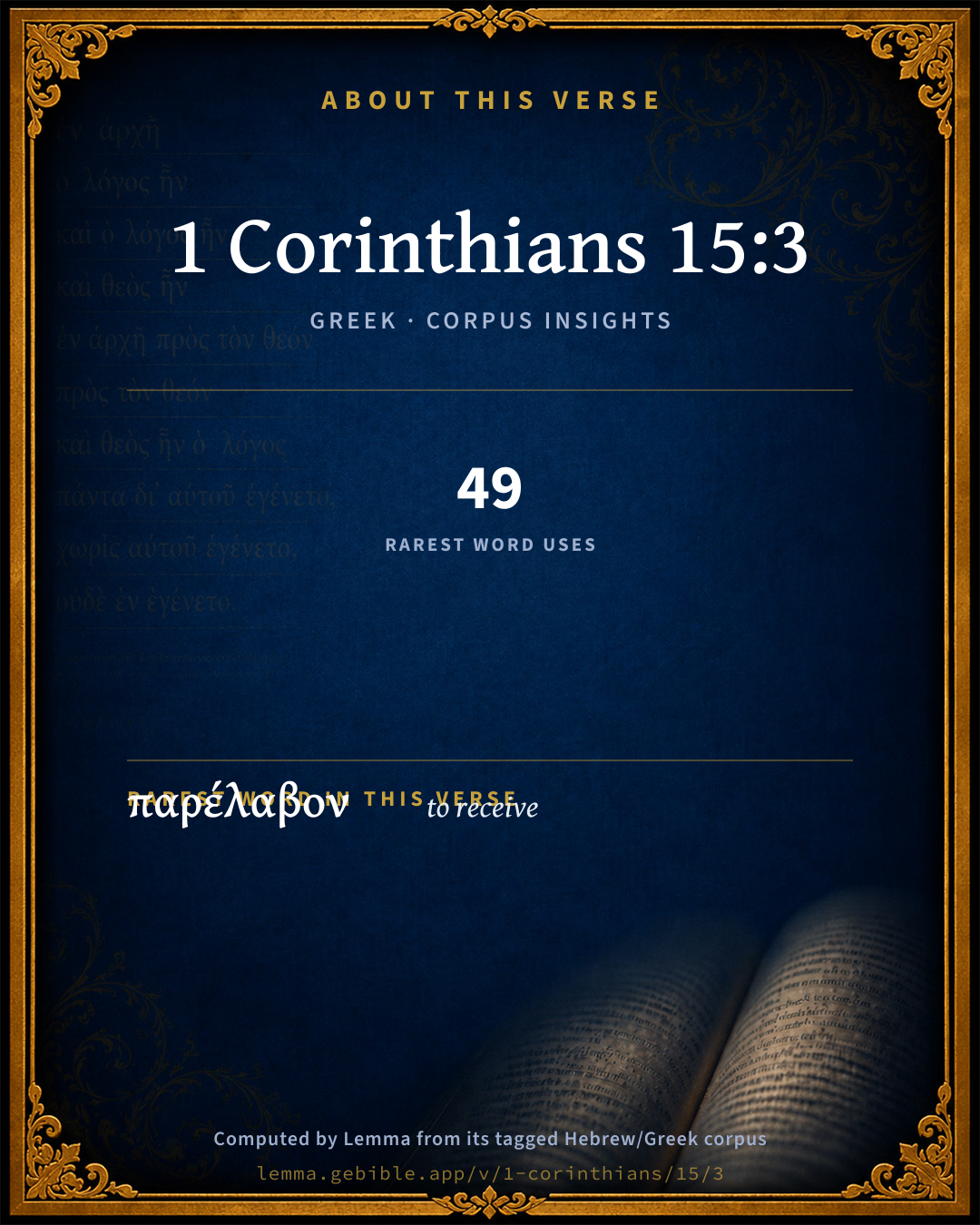
1 Corinthians 15:3

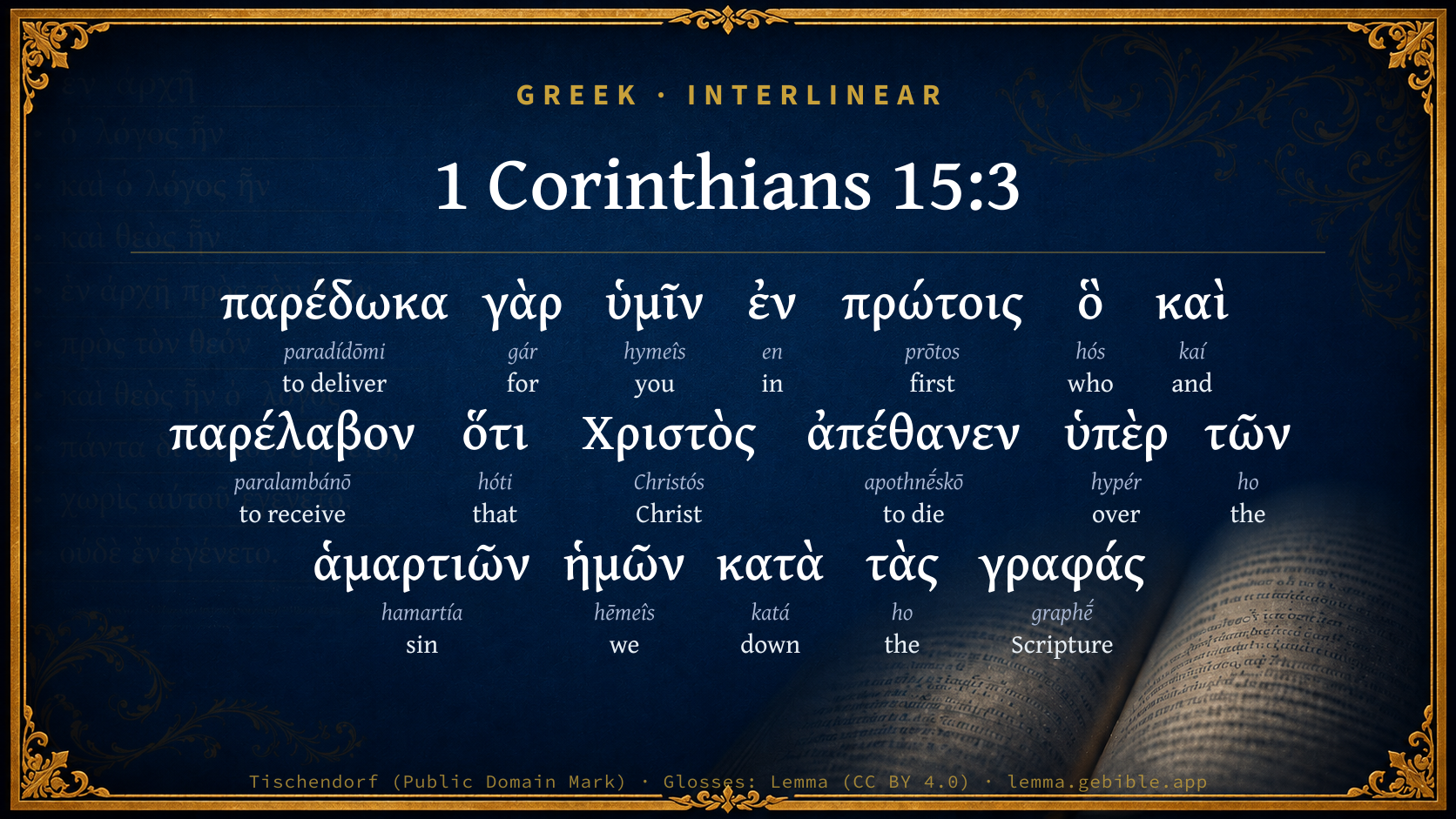
Greek (Tischendorf 8th ed.) 1 Corinthians 15:3 appears in the Greek New Testament. The text above is from the Tischendorf 8th edition. Each word links to its Strong’s number and a concise gloss. Click any word for its full Thayer’s Greek Lexicon entry.
Download image
Cite this verse

1 Corinthians 15:3 (World English Bible). Public Domain. Lemma interlinear Bible study tool, https://lemma.gebible.app/v/1-corinthians/15/3.

Show BibTeX & RIS
BibTeX
RIS
English Translation
For I delivered to you first of all that which I also received: that Christ died for our sins according to the Scriptures,
World English Bible · Public Domain
Download a study sheet

One document with this verse’s original text, its word-by-word gloss line, the meaning frame, cross-references with their text, attributed commentary, and full source and license credits — printable, and it pastes into notes with its structure intact.

This verse Autodidact and up

Study sheet (.html) Plain text (.txt)

A passage Seminary Student

Up to 50 verses in one chapter. A passage sheet keeps up to 6 commentary sources and 12 cross-references per verse, in the order this page ranks them, and says so on the sheet whenever that leaves anything out. Ask for a single verse and you get the Autodidact verse sheet above.

Everything on this page stays free to read, with no account — the sheet is a download of what is already on screen, not access to it.

Want to remove ads? Support Godless Engineer
Compare translations 3

The same verse in 3 English versions, stacked beneath the original-language interlinear above. Click any original word for its lexicon entry.

Each is an independent rendering of the whole verse — the interlinear is not word-aligned to these translations.

Highlighted words mark where these versions differ — a whole-verse word diff, not a word-by-word alignment.

  • World English Bible Public Domain
    For I delivered to you first of all that which I also received: that Christ died for our sins according to the Scriptures,
  • King James Version Public Domain
    For I delivered unto you first of all that which I also received, how that Christ died for our sins according to the scriptures;
  • unfoldingWord Literal Text CC BY-SA 4.0
    For I delivered to you among the first what I also received—that Christ died for our sins, according to the Scriptures,

unfoldingWord Literal Text — © unfoldingWord, licensed CC BY-SA 4.0. Word-aligned USFM3 via Door43 (git.door43.org/unfoldingWord/en_ult).

Versions to compare (up to 4)

3 of 4 selected

Show all 19 translations

Every available English version of this verse, each an independent rendering of the whole verse.

  • World English Bible Public Domain
    For I delivered to you first of all that which I also received: that Christ died for our sins according to the Scriptures,
  • Berean Standard Bible Public Domain
    For what I received I passed on to you as of first importance: that Christ died for our sins according to the Scriptures,
  • Majority Standard Bible Public Domain
    For what I received I passed on to you as of first importance: that Christ died for our sins according to the Scriptures,
  • King James Version Public Domain
    For I delivered unto you first of all that which I also received, how that Christ died for our sins according to the scriptures;
  • American Standard Version (1901) Public Domain
    For I delivered unto you first of all that which also I received: that Christ died for our sins according to the scriptures;
  • Revised Version (1885) Public Domain
    For I delivered unto you first of all that which also I received, how that Christ died for our sins according to the scriptures;
  • Geneva Bible (1599) Public Domain
    For first of all, I deliuered vnto you that which I receiued, how that Christ died for our sinnes, according to the Scriptures,
  • Douay-Rheims (1899) Public Domain
    For I delivered unto you first of all, which I also received: how that Christ died for our sins, according to the scriptures:
  • Young's Literal Translation Public Domain
    for I delivered to you first, what also I did receive, that Christ died for our sins, according to the Writings,
  • Literal Standard Version CC BY-SA 4.0
    For I delivered to you as most important what I also received: that Christ died for our sins according to the Writings,
  • Unlocked Literal Bible CC BY-SA 4.0
    For I delivered to you as of first importance what I also received, that Christ died for our sins according to the scriptures,
  • unfoldingWord Literal Text CC BY-SA 4.0
    For I delivered to you among the first what I also received—that Christ died for our sins, according to the Scriptures,
  • Darby Bible Public Domain
    For I delivered to you, in the first place, what also I had received, that Christ died for our sins, according to the scriptures;
  • World Messianic Bible Public Domain
    For I delivered to you first of all that which I also received: that Messiah died for our sins according to the Scriptures,
  • Webster's Bible Public Domain
    For I delivered to you first of all, that which I also received, that Christ died for our sins, according to the scriptures;
  • Free Bible Version CC BY-SA 4.0
    I passed on to you what I myself had also received, a message of vital importance: that Christ died for our sins, according to Scripture;
  • Bible in Basic English Public Domain
    For I gave to you first of all what was handed down to me, how Christ underwent death for our sins, as it says in the Writings;
  • Text-Critical English NT CC BY 4.0
    For I delivered to you as of first importance what I also received: that Christ died for our sins according to the Scriptures,
  • Tyndale New Testament (1534) Public Domain
    For fyrst of all I delivered vnto you that which I receaved: how that Christ dyed for oure synnes agreinge to the scriptures:

Literal Standard Version (2020), Covenant Press — licensed CC BY-SA 4.0. Text via the HelloAO Bible API (eBible.org). Unlocked Literal Bible (unfoldingWord) — licensed CC BY-SA 4.0. Text via the HelloAO Bible API (eBible.org). unfoldingWord Literal Text — © unfoldingWord, licensed CC BY-SA 4.0. Word-aligned USFM3 via Door43 (git.door43.org/unfoldingWord/en_ult). Free Bible Version, Dr. Jonathan Gallagher — licensed CC BY-SA 4.0. Text via the HelloAO Bible API (eBible.org).

Word by word

More ways to search: Search by grammar → Find every occurrence → Compare this word →

Practice this passage: Drill this verse → Learn its vocabulary →

παρέλαβον
paralambánō
G3880
“to receive”
Verb, Aorist, Active, Indicative, 1st person, Singular
Part of Speech
Verb
Tense
Aorist
Voice
Active
Mood
Indicative
Person
1st person
Number
Singular
Full Thayer's Definition

Origin: from G3844 and G2983

TDNT: 04:11,5

1. to take to, to take with one's self, to join to one's self a. an associate, a companion b. metaph. 1. to accept or acknowledge one to be such as he professes to be 2. not to reject, not to withhold obedience 2. to receive something transmitted a. an office to be discharged b. to receive with the mind 1. by oral transmission: of the authors from whom the tradition proceeds 2. by the narrating to others, by instruction of teachers (used of disciples)
  1. παρέδωκα paradídōmi G3860 “to deliver” Verb, Aorist, Active, Indicative, 1st person, Singular
  2. γὰρ gár G1063 “for” Conjunction
  3. ὑμῖν hymeîs G5210 “you” Personal pronoun, 2nd person, Dative, Plural
  4. ἐν en G1722 “in” Preposition
  5. πρώτοις prōtos G4413 “first” Adjective, Dative, Plural, Masculine, Superlative
  6. ὃ hós G3739 “who” Relative pronoun, Accusative, Singular, Neuter
  7. καὶ kaí G2532 “and” Conjunction
  8. ὅτι hóti G3754 “that” Conjunction
  9. Χριστὸς Christós G5547 “Christ” Noun, Nominative, Singular, Masculine
  10. ἀπέθανεν apothnḗskō G599 “to die” Verb, Aorist, Active, Indicative, 3rd person, Singular
  11. ὑπὲρ hypér G5228 “over” Preposition
  12. τῶν ho G3588 “the” Article, Genitive, Plural, Feminine
  13. ἁμαρτιῶν hamartía G266 “sin” Noun, Genitive, Plural, Feminine
  14. ἡμῶν hēmeîs G2249 “we” Personal pronoun, 1st person, Genitive, Plural
  15. κατὰ katá G2596 “down” Preposition
  16. τὰς ho G3588 “the” Article, Accusative, Plural, Feminine
  17. γραφάς graphḗ G1124 “Scripture” Noun, Accusative, Plural, Feminine

About this verse

These counts appear in no published source. They are computed here, from the morphology-tagged text and Lemma’s own curated glosses. What Lemma adds →

18
words
17
distinct lemmas
Pauline Epistles
section

Shared distinctive vocabulary

παρέλαβον to receive G3880 occurs in 49 verses of the Greek New Testament. Also found in:

Repetition

A word recurs within this verse:

Cross-references

33

Topical passages linked to 1 Corinthians 15:3 in the Treasury of Scripture Knowledge — connected by theme and wording, ordered by reader-vote popularity; previews shown in the World English Bible.

  • 1 Peter 2:24 who his own self bore our sins in his body on the tree, that we, having died to sins, might live to righteousness; by whose stripes you were healed.
  • Galatians 1:4 who gave himself for our sins, that he might deliver us out of this present evil age, according to the will of our God and Father--
  • Isaiah 53:1–12 Who has believed our message? and to whom has the arm of Yahweh been revealed?
  • 1 John 2:2 And he is the atoning sacrifice for our sins, and not for ours only, but also for the whole world.
  • Daniel 9:24–26 Seventy weeks are decreed on your people and on your holy city, to finish disobedience, and to make an end of sins, and to make reconciliation for iniquity, and to bring in everlasting righteousness, and to seal up vision and prophecy, and to anoint the most holy.
  • Acts 26:22–23 Having therefore obtained the help that is from God, I stand to this day testifying both to small and great, saying nothing but what the prophets and Moses said would happen,
  • Galatians 1:12 For neither did I receive it from man, nor was I taught it, but it came to me through revelation of Jesus Christ.
  • Romans 4:25 who was delivered up for our trespasses, and was raised for our justification.
  • Revelation 1:5 and from Jesus Christ, the faithful witness, the firstborn of the dead, and the ruler of the kings of the earth. To him who loves us, and washed us from our sins by his blood;
  • Luke 24:46–47 He said to them, "Thus it is written, and thus it was necessary for the Christ to suffer and to rise from the dead the third day,
  • Ephesians 5:2 Walk in love, even as Christ also loved you, and gave himself up for us, an offering and a sacrifice to God for a sweet-smelling fragrance.
  • 2 Corinthians 5:21 For him who knew no sin he made to be sin on our behalf; so that in him we might become the righteousness of God.
  • John 1:29 The next day, he saw Jesus coming to him, and said, "Behold, the Lamb of God, who takes away the sin of the world!
  • Acts 3:18 But the things which God announced by the mouth of all his prophets, that Christ should suffer, he thus fulfilled.
  • Ezekiel 3:17 Son of man, I have made you a watchman to the house of Israel: therefore hear the word at my mouth, and give them warning from me.
  • Zechariah 13:7 "Awake, sword, against my shepherd, And against the man who is close to me," says Yahweh of Hosts. Strike the shepherd, and the sheep will be scattered; And I will turn my hand against the little ones.
  • Matthew 26:28 for this is my blood of the new covenant, which is poured out for many for the remission of sins.
  • Luke 24:26–27 Didn't the Christ have to suffer these things and to enter into his glory?"
  • Romans 3:25 whom God set forth to be an atoning sacrifice, through faith in his blood, for a demonstration of his righteousness through the passing over of prior sins, in God's forbearance;
  • Galatians 3:13 Christ redeemed us from the curse of the law, having become a curse for us. For it is written, "Cursed is everyone who hangs on a tree,"
  • Ephesians 1:7 in whom we have our redemption through his blood, the forgiveness of our trespasses, according to the riches of his grace,
  • Hebrews 10:11–12 Every priest indeed stands day by day ministering and often offering the same sacrifices, which can never take away sins,
  • 1 Peter 1:11 searching for who or what kind of time the Spirit of Christ, which was in them, pointed to, when he predicted the sufferings of Christ, and the glories that would follow them.
  • 1 Corinthians 11:23 For I received from the Lord that which also I delivered to you, that the Lord Jesus on the night in which he was betrayed took bread.
  • Psalms 69:1–36 Save me, God, For the waters have come up to my neck!
  • Matthew 20:18–19 "Behold, we are going up to Jerusalem, and the Son of Man will be delivered to the chief priests and scribes, and they will condemn him to death,
  • 1 Peter 3:18 Because Christ also suffered for sins once, the righteous for the unrighteous, that he might bring you to God; being put to death in the flesh, but made alive in the spirit;
  • Psalms 22:1–31 My God, my God, why have you forsaken me? Why are you so far from helping me, and from the words of my groaning?
  • Mark 16:15–16 He said to them, "Go into all the world, and preach the Gospel to the whole creation.
  • Hebrews 5:3 Because of this, he must offer sacrifices for sins for the people, as well as for himself.
  • 1 Corinthians 4:1–2 So let a man think of us as Christ's servants, and stewards of God's mysteries.
  • Hebrews 5:1 For every high priest, being taken from among men, is appointed for men in things pertaining to God, that he may offer both gifts and sacrifices for sins.
  • Genesis 3:15 I will put enmity between you and the woman, and between your offspring and her offspring. He will bruise your head, and you will bruise his heel."

Cross-references courtesy of OpenBible.info (CC BY 4.0).

Commentary

Notes on 1 Corinthians 15:3 from classic Christian and Jewish commentators (each source and its license shown beneath its notes). The classic Christian expositions comment on the surrounding passage and are grouped to its opening verse, so a note may address several verses; the Jewish commentaries on the Tanakh (Rashi and others) are per-verse, so they appear only where the commentator wrote on this verse.

Lemma curates 59 commentaries, every one of them public domain or Creative Commons licensed, each selected and text-cleaned for this edition rather than reprinted as found. About our sources →

The Biblical Illustrator

Joseph S. Exell

1Co_15:3-4

For I delivered unto you first of all that which I also received, how that Christ died for our sins.

First of all

First of all in his profoundest arguments; first of all in his richest encouragements; first of all in his severest, denunciations; first of all in his fervid exhortations; first of all in his impassioned expostulations; first of all in his enraptured, sometimes his entranced and enraptured and absorbed anticipations of the life and the immortality that was to come. If he wanted to induce a habit of self-denying liberality, mark him--thus he did it:--You know the grace of our Lord Jesus Christ, that though He was rich, yet for your sakes He became poor, that you, through His poverty, might be made rich. If he wanted to get men to forbear with one another, thus he did it:--Be kind one to another, tender-hearted, forgiving one another, even as God, for Christs sake, hath forgiven you. When he wanted to get men to lead righteous, sober, and godly lives, thus he did it:--You are not your own, you are bought with a price; therefore glorify God in your bodies and in your spirits, which are His. If he wanted, whenever he had a congregation like this, to get the impenitent and the unbelieving out of the hands and out of the snare of the devil, thus be did it:--There is no other sacrifice for sin (dont trifle with that one), but a fearful looking for of judgment and fiery indignation that shall devour the adversary. In a word, he determined not to know anything among men, but Jesus Christ and Him crucified. Your teaching cannot get on without the alphabet; and Paul could not have got on without his alphabet. And thus it was evangelically, that wherever he went he gloried in nothing save the Cross of our Lord Jesus Christ. (W. Brock, D.D.)

Originality in preaching

Notice that the preacher does not make the gospel. If he makes it, it is not worth your having. Originality in preaching, if it be originality in the statement of doctrine, is falsehood. We are not makers and inventors; we are repeaters, we tell the message we have received. (C. H. Spurgeon.)

The Apostles creed

1. In these verses we have the earliest specimen of a Christian creed; the compendious form which Paul habitually used in order that, whatever else they forgot, they might not forget this, and to supply a test of the claims of those who assumed to speak in the name of Christ. Note how in 1Co_11:23, St. Paul introduces the form of words to be used at the Supper in precisely the same way he introduces the creed before us. The phrase seems to have been that by which St. Paul habitually introduced settled and formal statements of Divine truth.

2. But if this creed were already familiar, why repeat it here? Simply because the Corinthians needed to hear it again and again. There were those who held that matter was the root of all evil, that only as the spirit was redeemed from its thraldom to the body could men hope to rise into a happy spiritual life. And when Paul taught that the death and resurrection of Christ were virtually the death and resurrection of all who believed on Him, they concluded that the resurrection was past already. Nay, as they reflected on the dignity of Him who had achieved this great spiritual redemption for them, they began to doubt whether the pure Son of God had ever been brought into immediate contact with aught so vile and corrupt as matter; whether all that pertains to His physical life was not a series of illusions. It was in this mood that St. Paul met them.

I. The apostles creed includes the three following facts.

1. That Christ really died--that His death was a genuine historical event, the date, manner, and place of which were all perfectly well known.

2. That Christ was buried--a real human body being laid in an actual grave, a grave familiar to those who dwelt in Jerusalem.

3. That Christ has been raised, as could be proved by hundreds of witnesses still alive. These three facts are the cardinal facts of Christian history. To believe in these is, so far forth, to hold the catholic Christian faith.

II. From these three facts the apostle draws two doctrinal sequences.

1. Christ died; but to believe that will do no more for us than to believe that Lazarus died, unless we also believe that Christ died for our sins.

(1) The death of Christ was not a mere natural event. For in Him was no sin, and death is the natural consequence and proper wage of sin: in Him was the power of an endless life over which death had no claim or sway. His death, therefore, unlike ours, was a willing sacrifice. He died for the sins of those who were dead in sin, that, coming into their death, He might give them His life.

(2) But St. Paul does not embarrass his affirmation with any theory of the mode in which the death of Christ takes away sin. He is content to leave men to theorise as they will, if only they receive the cardinal fact.

2. The death and resurrection of Jesus are parts of an ordered scheme of a Divine economy. Christ died, has been raised again according to the Scriptures, the law, the will of God. Now that the Hebrew Scriptures did foretell this (Isa_53:8-9; Psa_16:10) is obvious.

(1) Mark the value of this fact. It demonstrates that the sacrifice for our sins has found acceptance in heaven. The plan of the work wrought by Christ was designed by God. All the lines of His life were drawn by the hand of God before Christ took our flesh to atone our sin. And therefore to accept the redemption of Christ is to accept the redemption of God. We believe in Christ; we also believe in God.

(2) But here again St. Paul quietly passes by all the subtleties of speculative minds. He simply declares the simple fact that the redeeming work of Christ was in accordance with the will of God. He neither affirms anything nor requires us to believe anything as to the mode in which God accepts the righteousness of Christ on behalf of guilty men. All he demands is, that we should find here an expression of the good-will of God; and he demands this because to believe that Jesus died for our sins will be no gospel to us, unless we also believe that God sent His Son to be the propitiation of our sins. Conclusion:

1. The creed is brief enough, and simple enough when compared with the creeds of the Church, and yet, in the judgment of an inspired apostle, it contains all that is essential to the Christian faith. Nay, St. Paul goes even farther than this. There were those at Corinth who, as yet, could not adopt even this succinct and simple creed in its integrity. But instead of expelling them from the Church, or dooming them to everlasting perdition, he sets himself to teach them more perfectly the way of life.

2. The lessons of St. Pauls wise, gracious conduct are--

(1) The more accurate and full a mans knowledge of Christian doctrine, the greater will be his help, of an intellectual sort, to Christian obedience. And therefore we should spare no pains to get and to give him rounded and complete views of the truth as it is in Jesus. But we must not be impatient with him if he is slow to learn.

(2) If we hold St. Pauls creed in St. Pauls spirit, we shall be very willing to hold as much more as we can. He delivered his creed first of all. He delivered it first, because the fact that Christ died for our sins was of all facts the most momentous to sinful men--the very first thing they needed to learn. But if he taught this first, he also taught a good deal more than this. Having taught the simple lesson of the Cross, he was for ever urging men to go on to perfection. (S. Cox, D.D.)

The glorious gospel

I. Its great facts.

1. The death.

2. The burial.

3. The resurrection of Christ.

II. Their paramount importance.

1. Sin expiated.

2. Death conquered.

3. Heaven opened.

III. Their absolute certainty.

1. Predicted.

2. Attested.

3. Delivered to us on the authority of the Scriptures. (J. Lyth, D.D.)

The foundation facts of the gospel

I. The facts of pauls gospel. First of all … I delivered these things. And the first not only points to the order of time, but to the order of importance.

1. The system unfolded in the New Testament is a simple record of historical fact. It becomes a philosophy and a religions system; but it is first of all a story of something that took place in the world. If that be so, let preachers never forget that their business is to insist upon the truth of these fundamental facts. They must evolve all the deep meanings which are wrapped up in the facts; but they will not be faithful to their Lord unless there be the unfaltering proclamation--first of all, etc.

2. This character of the gospel makes short work of a great deal that calls itself liberal Christianity. We are told that it is quite possible to be a very good Christian, and reject the supernatural. It may be so, but I cannot understand how, if the fundamental character of Christian teaching be the proclamation of certain facts, a man who does not believe those facts has the right to call himself a Christian.

3. There is an explanation which turns the facts into a gospel.

(1) Mark how that Christ died, not Jesus. Christ is the name of an office, into which is condensed a whole system of truth, declaring that it is He who is the Apex, the Seal, and the ultimate Word of all Divine revelation.

(2) He died for our sins. Now, if the apostle had only said He died for us, that might conceivably have meant that, in a multitude of different ways of example, etc., His death was of use to mankind. But when he says He died for our sins, that expression has no meaning, unless it means that He died as the expiation for mens sins.

(3) He died and rose … according to the Scriptures, fulfilling the Divine purposes revealed from of old. These three things turn the narrative into a gospel, and without all three, the death of Christ is nothing to us, any more than the death of thousands of saintly men has been. Do you think that these twelve fishermen would ever have shaken the world if they bad gone out with the story of the Cross unless they had carried along with it the commentary? And do you suppose that the type of Christianity which slurs over the explanation, and so does not know what to do with the facts, will ever do much in the world, or will ever touch men? Let us liberalise our Christianity by all means, but do not let us evaporate it.

II. What establishes the facts.

1. This Epistle is one of the four letters of Paul which nobody disputes, and was written before the Gospels, probably within twenty-five years of the Crucifixion.

(1) And what do we find alleged by it as the state of things at its date? That the belief in the Resurrection of Christ was universally taught in and accepted by all the Christian communities. And if that be so, there is not, between the moment when Paul penned these words and the day of Pentecost, a single chink in the history where you can insert such a tremendous innovation as the full-fledged belief in a resurrection coming in as something new.

(2) Unless the belief that Christ had risen originated at the time of His death, there would never have been a Church at all. Take the nave out of the wheel and what becomes of the spokes? A dead Christ could never have been the basis of a living Church.

2. The contemporaneousness of the evidence is sufficiently established. What about its good faith? Anybody that knows an honest man when he sees him, anybody that has the least ear for the tone of sincerity and the accent of conviction, must say they may have been fanatics, but one thing is clear, they were not false witnesses for God.

3. What, then, about their competency? Their simplicity; their ignorance; their slowness to believe; their surprise when the fact first dawned upon them, all tend to make us certain that there was no hysterical turning of a wish into a fact, on the part of these men. Fancy five hundred people all at once smitten with the same mistake, imagining that they saw what they did not see!

4. He was buried. Why does Paul introduce that amongst his facts? Because, if the grave was there, why did not the rulers put an end to the heresy by saying, Let us go and see if the body is there? If His body was not in the grave, what had become of it? If His friends stole it away, then they were deceivers of the worst type. If His enemies took it away, for which they had no motive, why did they not produce it and say, There is an answer to your nonsense?

III. What the facts establish.

1. Christ has risen from the dead; and that opens a door wide enough to admit all the rest of the gospel miracles.

2. The resurrection casts back a light upon the Cross, and we understand that His death is the life of the world, and that by His stripes we are healed.

3. But, further, remember how He claimed to be the Son of God; how He demanded absolute obedience, trust, and love--and consider the resurrection as bearing on the reception or rejection of these tremendous claims. We are brought sharp up to this alternative--Christ rose from the dead, and was declared by the resurrection to be the Son of God with power; or Christ has not risen from the dead--and what then? Then He was either deceiver or deceived, and in either case has no right to my reverence and love.

4. The resurrection of Christ teaches us that life has nothing to do with organisation but exists apart from the body; that a man may pass from death and be unaltered in the substance of his being: and that the earthly house of our tabernacle may be fashioned like unto the glorious house in which He dwells now at the right hand of God. There is no other absolute proof of immortality but the resurrection of Jesus Christ. (A. Maclaren, D.D.)

Primary Christian truths

I. The primary truths which St Paul delivered to the Corinthians.

1. Here is a solitary Jew visiting a great heathen city for the first time, to preach an entirely new religion. His bodily presence is weak, and his speech, compared to that of Greek rhetoricians, contemptible. He stands almost alone in a city, famous all over the world for luxury, immorality, and idolatry. A more remarkable conjuncture it is hard to conceive. And what did he say about the Founder of the new faith which he wanted them to receive in place of their ancient religion?

(1) That He died, and died as a malefactor on the Cross. Why did St. Paul lay so much stress upon this? Because He died for our sins.

(2) That He rose from the dead. By this amazing miracle He proved, as He had frequently said He would, that He was the Saviour foretold in prophecy; that the satisfaction for sin He had made by His death was accepted by God the Father; that the work of our redemption was completed, and that death, as well as sin, was a conquered enemy.

2. Learn--

(1) What were the leading principles of that religion which, eighteen centuries ago, came forth from Palestine, and turned the world upside down. Christianity starved idolatry, and emptied the heathen temples, stopped gladiatorial combats, elevated the position of women, raised the whole tone of morality, and improved the condition of children and the poor. These are facts which we may safely challenge all the enemies of revealed religion to gainsay. What did it all? Not the mere publication of a higher code of duty, but the simple story of the Cross and the sepulchre.

(2) What the foundation of our own personal religion must be, if we really want inward spiritual comfort. That the early Christians possessed such comfort is plain. These men had a firm grasp of the two great facts which St. Paul proclaimed first and foremost to the Corinthians.

II. The reasons why he was led to assign to these truths such a prominent position. There are three great facts which stare us in the face everywhere.

1. Sin. When the sense of this is really awakened, what can cure it? Nothing has ever been found to do good to a sin-stricken soul but the sight of a Divine Mediator.

2. Sorrow. What shall best help man to meet and bear this? The cold lessons of Stoicism have no power in them. Just here, the Pauline doctrine of a risen Christ comes in with a marvellous power, and exactly meets our necessities.

3. Death. At no point do human religions and philosophies break down so completely as in the article of death. At the point where all man-made systems are weakest, there the gospel is strongest.

Conclusion:

1. Do not be ashamed of holding decided views about the first things--the foundation truths of religion.

2. The only way to do good is to walk in St. Pauls steps, and to tell men first, foremost, continually, that Jesus Christ died for their sins, and rose again for their justification. (Bp. Ryle.)

On the atonement

I. The expediency of Christs interposition for our salvation may be inferred from the guilt and degradation of mankind. Once, indeed, there was, as it has been called, a golden age; but the same persons who have described it, also delineate the degeneracy of our race. Good men, according to one ancient writer, were scarce as the gates of Thebes, or the mouths of the Nile. Another tells us, that peace had left the earth, truth taken her departure, and fidelity fled far away. In consulting the records of ages that are past, amiable qualities, no doubt, occasionally appear which attract our esteem, and splendid virtues are displayed which excite admiration; still, however, misconduct and crime are the prominent features. Yes, crimes follow in close succession, while virtues are rare like those beautiful flowers which spring up here and there among the weeds of the wilderness. They who contemplate the wandering idolaters in the wilds of Tartary, not to mention the ancient votaries of superstition in Greece and Rome; they who behold the Indian on the banks of the Ganges, or the Samoeide situated on the frozen ocean, must discern, in a striking point of view, the degraded state of humanity, and the expediency of that plan of salvation which the gospel unfolds. The degraded state of humanity, on account of the numberless violations of duty, is productive of many apprehensions and alarms. In the presence of a Being of infinite perfection man has trembled to appear, being timorous and dismayed, like the progenitor of our race, when he hid himself from the presence of the Lord among the trees of the garden. If he would still hope for happiness, after his manifold provocations, he suspects that he cannot demand it from the inflexible justice of the Almighty, but that he must intreat it from the tender mercy of his God. And how astonishing the display of the Divine mercy to the children of men!

II. The expediency of His interposition may be deduced from the inefficacy of every other known mode of atonement for transgression. Much efficacy has been ascribed to repentance; but it is doubtful how far mere repentance is a reparation for wrong. Is not guilt often attended with punishment which repentance alone cannot remove? Has not the murderer been tortured with remorse, after sincerely deploring his crime, and firmly resolving to shed no more innocent blood? True penitence implies a complete change of life: but who ceases entirely to do evil? Erring man sins, repents, and sins again. Even his best resolutions are at times fallacious, and as the stream of brooks they pass away. Hence he is full of anxious disquietude, apprehensive that, while the corruptions of his nature continue, the Divine displeasure will also remain. Distrusting the efficacy of repentance for appeasing His anger, he naturally fears, as a great philosopher has justly remarked, lest the wisdom of God should not, like the weakness of man, be prevailed on to spare the crime by the most importunate lamentations of the criminal. Some other intercession, some other sacrifice, some other atonement, he imagines, must be made for him beyond what he himself is capable of making, before the purity of the Divine justice can be reconciled to his manifold offences. But legal oblations were deficient in efficacy. It was not possible, according to the declaration of an apostle, that these should take away sin. A superior sacrifice was requisite, and a better atonement than these. On the Saviours merits the believer reflects with hope and trust, gratitude and transport, in his last moments.

III. The atonement was expedient to vindicate the honour of the Divine government. Mercy to the guilty without suitable expiation might produce ruinous effects. Were breach of order not punished, all would become anarchy and confusion. When the genius of justice seems to slumber for ages, she is scorned like the threatenings of Noah. Never will that Omnipotent Being, who is of purer eyes than to behold iniquity but with abhorrence, allow guilty mortals to trample on the majesty of His laws, and with impunity to set examples of crimes the most atrocious. That obnoxiousness to punishment which results from the violation of the Divine laws was transferred to Christ when He offered Himself as a substitute for sinners. And this substitution, completely voluntary on His part, and consequently highly meritorious, exalted in every point of view, instead of debasing the doctrine of the natural placability of the Divine Being.

IV. Our Saviours interposition was expedient as being a subject of prophecy, and the Divine veracity interested of consequence in its accomplishment. Many hundred years before His appearance on earth, the interposition of our Redeemer was predicted with the utmost perspicuity. The whole scene of His sufferings passed before the prophets, and they describe them as circumstantially as if they had been spectators of the crucifixion on Mount Calvary. Without controversy, it was a great and mysterious sacrifice. But mystery is merely a relative term. To infinite intelligence all is plain in the whole economy of grace, the arrangement of providence, and the system of nature. Let us, who are children of the dust, receive with reverence every doctrine which is revealed from heaven, rather availing ourselves of the light of the sun, so to speak, than attempting to gaze on his glory. (T. Laurie, D.D.)

Jesus Christ died for the sins of men

I. It was violent and ignominious--a death by crucifixion. Christians living at this remote age of the Church, are, in some sense, disqualified to conceive of that extremity of pain and shame which attended an execution by the cross. We have been accustomed to associate with the cross whatever is stupendous in history, whatever is dear, and sacred, and sublime in truth. But it was far otherwise in that age, and with those nations among whom the apostles went forth to proclaim their crucified Lord. They knew the cross in no other character than as the instrument of the most horrible and most infamous of punishments. We cannot, therefore, but admire, that in the face of this strong and universal detestation, the apostles should so explicitly affirm and so earnestly iterate the fact of their Masters crucifixion. Far from drawing an oblivious veil over the Cross, far from attempting, by partial or enigmatical statements, to conceal the offensive fact, they assert it, they appeal to it, they rejoice and glory in it!

1. The sincerity of the apostles, and their conviction that Jesus is the Saviour of the world. Had they been insincere, or had they been of doubtful mind, as to the Christ of God, the mode of their Masters death they might well have kept back.

2. We ourselves may take a lesson not to stumble at the scandal of the Cross. Happy they who, feeling it to be the power of God and the wisdom of God, are raised above the contempt of unbelieving men, and can glory in the Cross of Christ!

II. The death of Christ was positive and real--not fictitious, not visionary: Christ died for our sins. The importance of this part of apostolic instruction we should have much more distinctly perceived had we lived nearer the times of the apostles. Very early in the Christian Church, yea, even in the days of the apostles themselves, there arose a sect of people who denied the reality of the sufferings and death of the Holy Jesus, maintaining that the Jews spent their fury on a phantom sent from heaven to delude them, and that the real Christ was far removed above the reach of their malignant and cruel hands. Some of these persons had witnessed the miracles which the apostles wrought, and probably some of them those of the Saviour Himself; and we may readily conceive how the witnesses of such wonders should find it difficult to credit, that He who wrought them could ever fall a victim to wicked and impotent men! Be this as it may, the apostles, those wise master builders, were careful to guard against the fatal mistake we have mentioned. With what particularity of circumstance did the sacred historians narrate the manner of Messiahs death!

III. These sufferings, and this death, were a vicarious, sacrificial offering to God, for the sins of the world.

1. This account of the Saviours death is required by the express and constant language of the inspired writers. See Isa_53:6; 1Ti_2:5-6; 1Pe_2:24; 1Jn_2:2; Rev_5:9.

2. This view of the sufferings and death of the Lord Jesus is no less forced upon us by the narrative of the event. I will not ask where was the goodness, the compassion of the Divine nature? but I will ask where was its justice, its equity, its righteousness if the immaculate Jesus could bear all this weight of woe, and yet not sacrificially, not as a substitute, not as the Lamb of God, dying for the sins of the world?

3. It is when the sufferings and death of the Lord Jesus are regarded in this light that they become, what the sacred Scriptures represent them, the highest display of the love of God to man.

Conclusion:

1. This vital, all-momentous Christian doctrine may serve to guide us in our behaviour towards those who deny the Lord that bought them. As men, and as men for whom Christ died, they are entitled to our respect, our pity, and our prayers; but never let us be found lending ourselves to countenance their fatal errors.

2. The exhibition of this great truth may serve to make known the aggravated guilt, the awful danger of an impenitent life.

3. This blessed doctrine ought especially to bring encouragement to every one who sincerely mourns on account of sin.

4. Finally, standing on this bright and eternal truth, I have a right to require that you unite with me in ascriptions of praise to the adorable Fountain of all this love to man. (J. Bromley.)

Christs death: the primary teaching of Christianity

The phrase first of all means not only first in point of time, but first in point of importance. If we ask why? the answer is that Christs death is--

I. An unanswerable proof of the humanity of our Lord. It declares Him Son of Man, and therefore not a phantom too high for fellowship and following. A conviction of this ought to be grasped by us, first of all, because it is essential to our regarding Him--

1. As Redeemer.

2. As Friend.

3. As Example.

II. The strongest utterance of Divine love. In following the life of Jesus we gaze on Gods love in unwearied toil, in patient endurance, in keenest sympathy, in bitter tears. But gazing on Christs death we see Divine love in agony, humiliation, shame. Mans highest love to God was when Abram offered his only son Isaac; Gods deepest love to man is seen in giving His only begotten Son in sacrifice on Calvary.

III. The mightiest force in the salvation of the world.

1. He Himself relied on it: I, if I be lifted up, wilt draw all men.

2. The influence of His death on many at the crucifixion illustrates it.

3. The history of Christianity testifies to it. (U. R. Thomas.)

Christs death a cardinal fact and doctrine

Why did the Apostle Paul make it the very beginning of his preaching? Because--

I. It was most struck at by enemies. Though not a blind zealot who courted opposition, and though he knew how to become all things to all men, he was no trimmer; and when any known doctrine of his Master was impugned, that was the doctrine to which he devoted himself in affectionate defence.

II. It is the distinguishing doctrine of Christianity. In Christianity there are many things common to it with Judaism, Mohammedanism, and even pure Theism; but here is a discriminative mark.

III. It brings men down to the earth, in a sense of sin, weakness, shame, and danger. The gospel is a remedy. It seeks, not to improve what is sound, but to cure what is dying. It is a remedy which none accept but such as despair of other help. All who ever received the doctrine, received it on their knees. He that humbleth himself shall be exalted.

IV. It is of all doctrines that which lies nearest the heart of Christian affection. It was uppermost in the heart of Paul; it throbbed in its inmost pulses. It reminds him of what he was, it makes him what he is.

V. It is the precise object of saving faith. To be saved is the one thing needful. But to be saved one thing is necessary--faith. But in what? In this crucified but risen Redeemer. The man who believes in Him, with a spiritual apprehension of what he believes, is a saved man.

VI. It is the key to all other doctrines. The symbol of Christianity is not the all-seeing eye, the creative hand, the sepulchre, the sceptre--but the Cross. With this you can explain all; but denying this, you go on till to be consistent you must deny all.

VI. It is the great instrument of conversion. This is the very event the recital of which, even before the end of the generation then born, filled the Roman Empire with converts. It is the power of God unto salvation to every one that believeth. Conclusion:

1. These things enable us to come to a judgment with regard to Churches and religious communities. The criterion is the relative place which they give to the doctrine of Christs death.

2. In like manner, we may judge of books, preaching, and systems of theology. Try them by this question, What think ye of Christ?

3. We may here judge of our own personal religion. (J. W. Alexander, D.D.)

The death of our Lord

I. Its nature. We must affirm and believe that it was a true and proper death, such as that to which all mortals are by the law of our nature subjected. Such is expressed by all the terms appropriated to it, and by the ordinary signs of death.

II. Its peculiar adjuncts ann respects of our lords death, which commend it to our regard, and amplify its worth.

1. Its being a result of Gods eternal counsel and decree by which our Saviour was a Lamb, slain from the foundation of the world.

2. Its being a matter of free consent and compact between God and His Son. It was pre-ordained by God; and our Saviours reply was: Lo! I come to do Thy will, O God.

3. Its great excellency and efficacy, appearing from manifold types foreshadowed, and in divers prophecies foretold.

4. Its being compassed by Gods especial providence directing and disposing it, though not without the active concurrence of men; so that although as a work of Divine Providence it was most admirable, yet as an act of human pravity it was the most heinous ever committed.

5. Its great commendation in the quality of our blessed Saviours person: how valuable must be the death of one so incomparably transcendent in glory!

III. The causes and principles whence it proceeded; which moved God to determine it, and our Lord to undertake it. There is in Scripture a threefold love of God towards men intimated.

1. A general love to mankind antecedent to the sending of our Lord and His performances, being the ground of Gods designing them.

2. A love, consequent on these, and procured by them.

3. A peculiar love of friendship and complacence, which God bears to all who repent of their sins and embrace the gospel. The like principles are said to move our Lord to undergo death for us. To these may be added our sins, as the meritorious causes of our Saviours death: He was bruised for our iniquities. He died for us, not only as men, but as sinful and wretched men.

IV. The ends which it aims at.

1. The illustration of Gods glory, by displaying His most glorious perfections.

2. The dignifying and exaltation of our Lord Himself, which is what He Himself foresaw and foretold.

3. The salvation of mankind; which He procured by appeasing that wrath which God bears towards iniquity, and reconciling Him to men, who by sin were alienated from Him.

4. Other subordinate designs and effects are the reparation of Gods honour; the ratification of the new covenant; the reconciliation of all in heaven and earth; the defeat of death, and of the powers of darkness; the engaging us to the practice of all righteousness and obedience; for attestation to, and confirmation of Divine truth.

V. The practical influences which a consideration of this point should have on us.

1. It should beget in us the highest degree of love and gratitude towards God and our Saviour.

2. It should raise in us great faith and hope in God, excluding all distrust or despair.

3. It should comfort and satisfy us in regard to our sins supposing that we heartily repent of them.

4. It discovers to us their heinousness, and thereby should move our detestation of them.

5. It should work in us a kindly contrition and remorse for them.

6. And engage us carefully to avoid them, as crucifying Him afresh.

7. It should engage us to patience and resignation to the will of God.

8. It obliges us to the deepest mortification, in conformity with Christs death, being with Him crucified to the lusts of the flesh.

9. It is also a strong engagement to the fullest measure of charity towards our brethren.

10. We are hence obliged to yield ourselves wholly up to the service of our Saviour, to the promoting of His interest and glory; since we are not our own; being bought with a price, etc. (I. Barrow, D.D.)

The mystery of death

I. Why did Christ die?

1. Christ has bequeathed to us the invaluable legacy of a true ideal. We desire to know how to conduct ourselves, and our desire is satisfied by the ideal left by Christ.

(1) There was in Him a sincerity and simple-mindedness which were yoked with restrained and yet unmeasured power. It is needless to say that whenever this is realised in life its effect is overwhelming.

(2) There was in Him a noble-mindedness, a loftiness of tone which struck and moved. He touched the commonest things; whatever He touched He raised; He carried contentedly the atmosphere of eternity into the work and trials of time.

(3) And what rendered, what renders, such an one so entirely approachable? His extraordinary devotion to the human race.

2. Now to complete the picture was needed the tragedy of death. Given absolute human perfection in a world death-stricken, then not merely, as Plato said, must the good man suffer at the hands of sinners, but the ideal must be perfected by submission to the common doom of death.

(1) Why did He die? The deepest mystery of revelation is the mystery of atonement. Something within us tells us of the chasm between our personal acts and the fulfilment of a righteous law. That fulfilment is in the atoning sacrifice.

(2) Wily did He die? Certainly to complete that sympathetic tie that binds Him to us all.

II. What is the significance of death?

1. Well, clearly death is a fact; a fact of intimate and universal interest. In a world of infinite possibilities, and therefore of immeasurable uncertainties, one fact is certain, we shall die. Death is the consummation of the tragedy of change. All is changing--we ourselves among the many that people this mysterious life. Now, death is the crown of change. All other changes are as nothing compared with this. There is a tragic strain in every life when, taking account of so much that has been full of love, and joy, and happiness, we say, It can never be again. That tragic strain is heard in its deepest chords, in its fullest, most heart-rending music, in the mystery of death.

3. Death in one sense is an unparalleled catastrophe. The ancients when they thought of it at all, they gazed shuddering at a world of gloom. The philosophic thinkers, the tragic poets of the ancient world, tell the same story by their unvarying strain of sadness; do what they would, it was an unparalleled catastrophe. We Christians feel, in a sense, the same. Did you ever take from your shelves a long-closed volume, and shake out from its pages unawares a letter, written by a dear dead hand? Why for a moment are you all unmanned? Littera scripta manet, yes, remains but only to mock you. Where is he? How does he feel to me? Shall we meet again? Whatever answer comes, this is certain; what once was is not. Think one moment more. On your table you have the portrait of your wife, your child, your friend. Are they near you? You scarcely care to look at it. Why? Because that sweet presence is about the house. Absence comes, you love the portrait better, for absence is the first, faint, saddening image of the great farewell Let the grave divide. You cannot bear to part with that portrait now. It is all that you have left you of what was once so dear, so fair.

III. If our Christianity be a grand reality, we must view even this saddening spectacle in the light and atmosphere of the new creation.

1. We are in Christ, and Christ has died. Remembering this, I ask in an altogether happier temper, What is the significance of death?

(1) Certainly death even in Christ is a punishment for sin. But as surely also, in Christ, it takes a touch from the Passion, a power from the Precious Brood. Right dear in the sight of the Lord is the death of His saints.

(2) Death in Christ is an escape from a world of trouble. We weep, and who can blame us? But for the dear one gone, we know it is blessed, taken away from the evil to come.

(3) Death in Christ is an accident in immortality. The great unity of life lasts on. And further, one of the bitterest pangs of life is the pang of the parting of friends. Now, death in Christ is the entrance to a land where partings are no more.

2. There always is, there always must be, something awful in the thought that I must die. For death has had a fatal affinity to the Prince of Darkness. True: but the Passion of Christ conquers by transforming all. In Christ it is still certainly awful, but it is blessed to die. If Christianity has made death more serious by revealing hidden facts of another life, has it not also--for this, too, we must remember--much to offer of compensating strength? To live in faith is to prepare to die. Christ by His death has given us a ground of confidence in His unflagging tenderness, and it is devotion to a person, it is faith in Jesus Christ which, as it conquers the world, so it subdues the grave. (Canon Knox-Little.)

And that He was buried, and that He rose again.

The mystery of the grave

The memory of the burial of Jesus is stamped upon the heart of Christendom. There are many reasons why it should be so.

1. Since our dear Lord is the Eternal Word, every act of that most sacred life and death has its special significance.

2. It is one of that store of mortal experiences laid up, not by omniscient power, but by personal trial, in the heart of God.

3. It stands in direct relation to that strange borderland, at the memory of whose twilight indistinctness voices are hushed, and dreams of ambition die. The question is, Why was He buried?

I. Death is an act of solemn separation, but henceforth the grave to the Christian is a witness to--

1. Its meaning. Well, the souls of the dead are robed in mystery; but this at least is clear, there is some special force in the separation for the ennobling of the body; some peculiar power for developing the energy of the soul.

2. Its limits. It cannot last. The strange dark sleep of death is the prelude to a resurrection morning.

II. The burial night of the redeemer gives a tender touch of sentiment to the grave. Nor is this wrong. False sentiment is never so detestable as in religion. But Christianity, because it is a religion of Divine everlasting realities, rouses the deepest feeling and expresses them in sentiments of beauty, as the deep and massive energy of the ocean flings up the sun-bespangled spray. There is a sweet touch of the real truth of things expressed in a pure poetic sentiment, in the Christian certainty that death is sleep. Now the calm majestic rest of the Redeemer is the evident witness that there is this mystery in the grave. It is the sleeping-place of the weary. They rest from their labours. Their graves are symbols of faithful service. Ah! as you love them you would not call them back again. (Canon Knox-Little.)

The Biblical Illustrator, edited by Joseph S. Exell (c. 1880s–1900s) — public domain. Text from a community e-Sword module.

Joseph Benson's Commentary

1Co 15:3-4. For I delivered unto you first of all — Among the first things, and as the chief articles of the gospel, that which I also received, namely, from Christ himself; that Christ died for our sins — Made atonement for them by dying; according to the Scriptures — Of the Old Testament, particularly Isa 53:5-6; Isa 53:12; Dan 9:26. He proves, first, from the Scriptures, that the Messiah was to die for the expiation of sin, and then from the testimony of a cloud of witnesses, that Jesus of Nazareth, who by his miracles had proved himself to be that Messiah, had died for men’s sins accordingly. And that he was buried — In consequence of his being certainly dead; and that he rose again the third day — His enemies keeping guard about his dead body in vain. According to the Scriptures — The Scriptures which foretold the resurrection of Christ on the third day, and to which St. Paul refers, are Psa 16:10, (which Peter, Act 2:31, expressly affirmed to be a prediction of that event,) and Jon 1:17, which our Lord himself affirmed to be a typical prophecy of his continuing three days in the heart of the earth, and of his subsequent resurrection. See Mat 12:39-40. Here we see the apostle delivered to the Corinthians, from the Lord himself, not only that he died for our sins, and rose again the third day after his death, but that these things had happened according to the prophecies of the Scriptures concerning the Christ, because by that circumstance, as well as by his resurrection, our Lord was demonstrated to be the Christ.

Joseph Benson's Commentary on the Old and New Testaments (1811–1818) — public domain. Text from a community e-Sword module.

MacLaren's Expositions of Holy Scripture

Alexander MacLaren

1 Corinthians

THE POWER OF THE RESURRECTION

1Co 15:3 - 1Co 15:4.

Christmas day is probably not the true anniversary of the Nativity, but Easter is certainly that of the Resurrection. The season is appropriate. In the climate of Palestine the first fruits of the harvest were ready at the Passover for presentation in the Temple. It was an agricultural as well as a historical festival; and the connection between that aspect of the feast and the Resurrection of our Lord is in the Apostle’s mind when he says, in a subsequent part of this chapter, that Christ is ‘risen from the dead and become the first fruits of them that slept.’

In our colder climate the season is no less appropriate. The ‘life re-orient out of dust’ which shows itself to-day in every bursting leaf-bud and springing flower is Nature’s parable of the spring that awaits man after the winter of death. No doubt, apart from the Resurrection of Jesus, the yearly miracle kindles sad thoughts in mourning hearts, and suggests bitter contrasts to those who sorrow, having no hope, but the grave in the garden has turned every blossom into a smiling prophet of the Resurrection.

And so the season, illuminated by the event, teaches us lessons of hope that ‘we shall not all die.’ Let us turn, then, to the thoughts naturally suggested by the day, and the great fact which it brings to each mind, and confirmed thereafter by the miracle that is being wrought round about us.

I. First, then, in my text, I would have you note the facts of Paul’s gospel.

‘First of all . . . I delivered’ these things. And the ‘first’ not only points to the order of time in the proclamation, but to the order of importance as well. For these initial facts are the fundamental facts, on which all that may follow thereafter is certainly built. Now the first thing that strikes me here is that, whatever else the system unfolded in the New Testament is, it is to begin with a simple record of historical fact. It becomes a philosophy, it becomes a religious system; it is a revelation of God; it is an unveiling of man; it is a body of ethical precepts. It is morals and philosophy and religion all in one; but it is first of all a story of something that took place in the world.

If that be so, there is a lesson for men whose work it is to preach it. Let them never forget that their business is to insist upon the truth of these great, supernatural, all-important, and fundamental facts, the death and the Resurrection of Jesus Christ. They must evolve all the deep meanings that lie in them; and the deeper they dig for their meanings the better. They must open out the endless treasures of consolation and enforce the omnipotent motives of action which are wrapped up in the facts; but howsoever far they may carry their evolving and their application of them, they will neither be faithful to their Lord nor true stewards of their message unless, clear above all other aspects of their work, and underlying all other forms of their ministry, there be the unfaltering proclamation-’first of all,’ midst of all, last of all-’how that Christ died for our sins according to the Scriptures,’ and ‘that He was raised again according to the Scriptures.’

Note, too, how this fundamental and original character of the gospel which Paul preached, as a record of facts, makes short work of a great deal that calls itself ‘liberal Christianity’ in these days. We are told that it is quite possible to be a very good Christian man, and reject the supernatural, and turn away with incredulity from the story of the Resurrection. It may be so, but I confess that it puzzles me to understand how, if the fundamental character of Christian teaching be the proclamation of certain facts, a man who does not believe those facts has the right to call himself a Christian.

Note, further, how there is an element of explanation involved in the proclamation of the facts which turns them into a gospel. Mark how ‘that Christ died,’ not Jesus. It is a great truth, that the man, our Brother, Jesus, passed through the common lot, but that is not what Paul says here, though he often says it. What he says is that ‘Christ died.’ Christ is the name of an office, into which is condensed a whole system of truth, declaring that it is He who is the Apex, the Seal, and ultimate Word of all divine revelation. It was the Christ who died; unless it was so, the death of Jesus is no gospel.

‘He died for our sins.’ Now, if the Apostle had only said ‘He died for us,’ that might conceivably have meant that, in a multitude of different ways of example, appeal to our pity and compassion and the like, His death was of use to mankind. But when he says ‘He died for our sins,’ I take leave to think that that expression has no meaning, unless it means that He died as the expiation and sacrifice for men’s sins. I ask you, in what intelligible sense could Christ ‘die for our sins’ unless He died as bearing their punishment and as bearing it for us? And then, finally, ‘He died and rose . . . according to the Scriptures,’ and so fulfilled the divine purposes revealed from of old.

To the fact that a man was crucified outside the gates of Jerusalem, ‘and rose again the third day,’ which is the narrative, there are added these three things-the dignity of the Person, the purpose of His death, the fulfilment of the divine intention manifested from of old. And these three things, as I said, turn the narrative into a Gospel.

So, brethren, let us remember that, without all three of them, the death of Jesus Christ is nothing to us, any more than the death of thousands of sweet and saintly men in the past has been, who may have seen a little more of the supreme goodness and greatness than their fellows, and tried in vain to make purblind eyes participate in their vision. Do you think that these twelve fishermen would ever have shaken the world if they had gone out with the story of the Cross, unless they had carried along with it the commentary which is included in the words which I have emphasised? And do you suppose that the type of Christianity which slurs over the explanation, and so does not know what to do with the facts, will ever do much in the world, or will ever touch men? Let us liberalise our Christianity by all means, but do not let us evaporate it; and evaporate it we surely shall if we falter in saying with Paul, ‘I declare, first of all, that which received,’ how that the death and resurrection were the death and resurrection of the Christ, ‘for our sins, according to the Scriptures.’ These are the facts which make Paul’s gospel.

II. Now I ask you to look, in the second place, at what establishes the facts.

We have here, in this chapter, a statement very much older than our existing written gospels. This epistle is one of the four letters of Paul which nobody that I know of-with some quite insignificant exceptions in modern times-has ever ventured to dispute. It is admittedly the writing of the Apostle, written before the gospels, and in all probability within five-and-twenty years of the date of the Crucifixion. And what do we find alleged by it as the state of things at its date? That the belief in the Resurrection of Jesus Christ was the subject of universal Christian teaching, and was accepted by all the Christian communities. Its evidence to that fact is undeniable; because there was in the early Christian Church a very formidable and large body of bitter antagonists of Paul’s, who would have been only too glad to have convicted him, if they could, of any misrepresentation of the usual notions, or divergence from the usual type of teaching. So we may take it as undeniable that the representation of this chapter is historically true; and that within five-and-twenty years of the death of Jesus Christ every Christian community and every Christian teacher believed in and proclaimed the fact of the Resurrection.

But if that be so, we necessarily are carried a great deal nearer the Cross than five-and-twenty years; and, in fact, there is not, between the moment when Paul penned these words and the day of Pentecost, a single chink in the history where you can insert such a tremendous innovation as the full-fledged belief in a resurrection coming in as something new.

I do not need to dwell at all upon this other thought, that, unless the belief that Jesus Christ had risen from the dead originated at the time of His death, there would never have been a Church at all. Why was it that they did not tumble to pieces? Take the nave out of the wheel and what becomes of the spokes? A dead Christ could never have been the basis of a living Church. If He had not risen from the dead, the story of His disciples would have been the same as that which Gamaliel told the Sanhedrim was the story of all former pseudo-Messiahs such as that man Theudas. ‘He was slain, and as many as followed him were dispersed and came to naught.’ Of course! The existence of the Church demands, as a pre-requisite, the initial belief in the Resurrection. I think, then, that the contemporaneousness of the evidence is sufficiently established.

What about its good faith? I suppose that nobody, nowadays, doubts the veracity of these witnesses. Anybody that knows an honest man when he sees him, anybody that has the least ear for the tone of sincerity and the accent of conviction, must say that they may have been fanatics, they may have been mistaken, but one thing is clear as sunlight, they were not false witnesses for God.

What, then, about their competency? Their simplicity, their ignorance, their slowness to believe, their stupor of surprise when the fact first dawned upon them, which they tell not with any idea of manufacturing evidence in their own favour, but simply as a piece of history, all tend to make us certain that there was no play of a morbid imagination, no hysterical turning of a wish into a fact, on the part of these men. The sort of things which they say that they saw and experienced are such as to make any such supposition altogether absurd. There are long conversations, appearances appealing to more than one sense, appearances followed by withdrawals, sometimes in the morning, sometimes in the evening, sometimes at a distance, as on the mountain, sometimes close by, as in the chamber, to single souls and to multitudes. Fancy five hundred people all at once smitten with the same mistake, imagining that they saw what they did not see! Miracles may be difficult to believe, they are not half so difficult to believe as absurdities. And this modern explanation of the faith in the Resurrection I venture respectfully to designate as absurd.

But there is one other point to which I would like to turn for a moment; and that is that little clause in my text that ‘He was buried.’ Why does Paul introduce that amongst his facts? Possibly in order to affirm the reality of Christ’s death; but I think for another reason. If it be true that Jesus Christ was laid in that sepulchre, a stone’s throw outside the city gate, do you not see what a difficulty that fact puts in the way of disbelief or denial of His Resurrection? If the grave-and it was not a grave, remember, like ours, but a cave, with a stone at the door of it, that anybody could roll away for entrance-if the grave was there, why, in the name of common-sense, did not the rulers put an end to the pestilent heresy by saying, ‘Let us go and see if the body is there’ ?

Modern deniers of the Resurrection may fairly be asked to front this thought-If Jesus Christ’s body was in the sepulchre, how was it possible for belief in the Resurrection to have been originated, or maintained? If His body was not in the grave, what had become of it? If His friends stole it away then they were deceivers of the worst type in preaching a resurrection; and we have already seen that that hypothesis is ridiculous. If His enemies took it away, for which they had no motive, why did they not produce it and say, ‘There is an answer to your nonsense. There is the dead man. Let us hear no more of this absurdity of His having risen from the dead’ ?

‘He died . . . according to the Scriptures, and He was buried.’ And the angels’ word carries the only explanation of the fact which it proclaims, ‘He is not here-He is risen.’

I take leave to say that the Resurrection of Jesus Christ is established by evidence which nobody would ever have thought of doubting unless for the theory that miracles were impossible. The reason for disbelief is not the deficiency of the evidence, but the bias of the judge.

III. And now I have no time to do more than touch the last thought. I have tried to show what establishes the facts. Let me remind you, in a sentence or two, what the facts establish.

I by no means desire to suspend the whole of the evidence for Christianity on the testimony of the eyewitnesses to the Resurrection. There are a great many other ways of establishing the truth of the Gospel besides that, upon which I do not need to dwell now. But, taking this one specific ground which my text suggests, what do the facts thus established prove?

Well, the first point to which I would refer, and on which I should like to enlarge, if I had time, is the bearing of Christ’s Resurrection on the acceptance of the miraculous. We hear a great deal about the impossibility of miracle and the like. It upsets the certainty and fixedness of the order of things, and so forth, and so forth. Jesus Christ has risen from the dead; and that opens a door wide enough to admit all the rest of the Gospel miracles. It is of no use paring down the supernatural in Christianity, in order to meet the prejudices of a quasi-scientific scepticism, unless you are prepared to go the whole length, and give up the Resurrection. There is the turning point. The question is, Do you believe that Jesus Christ rose from the dead, or do you not? If your objections to the supernatural are valid, then Christ is not risen from the dead; and you must face the consequences of that. If He is risen from the dead, then you must cease all your talk about the impossibility of miracle, and be willing to accept a supernatural revelation as God’s way of making Himself known to man.

But, further, let me remind you of the bearing of the Resurrection upon Christ’s work and claims. If He be lying in some forgotten grave, and if all that fair thought of His having burst the bands of death is a blunder, then there was nothing in His death that had the least bearing upon men’s sin, and it is no more to me than the deaths of thousands in the past. But if He is risen from the dead, then the Resurrection casts back a light upon the Cross, and we understand that His death is the life of the world, and that ‘by His stripes we are healed.’

But, further, remember what He said about Himself when He was in the world-how He claimed to be the Son of God; how He demanded absolute obedience, implicit trust, supreme love, how He identified faith in Himself with faith in God-and consider the Resurrection as bearing on the reception or rejection of these tremendous claims. It seems to me that we are brought sharp up to this alternative-Jesus Christ rose from the dead, and was declared by the Resurrection to be the Son of God with power; or Jesus Christ has not risen from the dead-and what then? Then He was either deceiver or deceived, and in either case has no right to my reverence and my love. We may be thankful that men are illogical, and that many who reject the Resurrection retain reverence, genuine and deep, for Jesus Christ. But whether they have any right to do so is another matter. I confess for myself that, if I did not believe that Jesus Christ had risen from the dead, I should find it very hard to accept, as an example of conduct, or as religious teacher, a man who had made such great claims as He did, and had asked from me what He asked. It seems to me that He is either a great deal more, or a great deal less, than a beautiful saintly soul. If He rose from the dead He is much more; if He did not, I am afraid to say how much less He is.

And, finally, the bearing of the Resurrection of Jesus Christ upon our own hopes of the future may be suggested. It teaches us that life has nothing to do with organisation, but persists apart from the body. It teaches us that a man may pass from death and be unaltered in the substance of his being; and it teaches us that the earthly house of our tabernacle may be fashioned like unto the glorious house in which He dwells now at the right hand of God. There is no other absolute proof of immortality than the Resurrection of Jesus Christ.

If we accept with all our hearts and minds Paul’s Gospel in its fundamental facts, we need not fear to die, because He has died, and by dying has been the death of death. We need not doubt that we shall live again, because He was dead and is alive for ever more. This Samson has carried away the gates on His strong shoulders, and death is no more a dungeon but a passage. If we rest ourselves upon Him, then we can take up, for ourselves and for all that are dear to us and have gone before us, the triumphant song, ‘O Death, where is thy sting?’ ‘Thanks be to God, which giveth us the victory through our Lord Jesus Christ.’

Alexander MacLaren, Expositions of Holy Scripture (1904–1910) — public domain. Text from a community e-Sword module.

Tyndale Open Study Notes

Tyndale Open Resources

15:3 The heart of the Good News is that Christ died for our sins (see Rom 3:24-25; 5:8-10; Gal 1:4; 1 Thes 5:9-10).

Tyndale Open Study Notes — © Tyndale Open Resources, licensed CC BY-SA 4.0. Text via the HelloAO Bible API.

Bengel's Gnomon

Johann Albrecht Bengel

1Co 15:3. [132] Ἐν πρώτοις, among the primary things) The things, which are of greatest importance, ought to be taught among the first things. בראשונה, the LXX., ἐν πρώτοις, i.e. in old time; 2Sa 20:18: but, first, in Deu 13:9, and so here.—παρελάβον, I received) from Christ Himself, what I have spoken is no fiction, 2Pe 1:16.—ὍΤΙ, that) Paul says that he had declared among the first points of faith, not only the resurrection of Christ, but also the resurrection of the dead, which flows from it; and the Corinthians believed in these doctrines, before they were baptised in the name of Christ, who was crucified for them, and so also died and rose again, 1Co 1:13: comp. Heb 6:2.—ὙΠῈΡ, for) a very effective expression, which means, for taking away our sins, Gal 1:4; 1Pe 2:24; 1Jn 3:5. So ὑπέρ, Heb 5:3; comp. Tit 2:14; Luk 1:71-74; 2Co 5:15.—ἁμαρτιῶν, sins) on account of which we had deserved death, 1Co 15:17.—γραφάς, Scriptures) Many things are said in Scripture respecting the death of Christ. Paul puts the testimony of Scripture before the testimony of those, who saw the Lord after His resurrection.

[132] Εἰκῆ, in vain—a melancholy term, Gal 2:2; Gal 3:4; Gal 4:11.—Vg.

Bengel's Gnomon of the New Testament — English translation (T&T Clark, Edinburgh, 1860) — public domain. Text from a community e-Sword module.

Meyer's Critical & Exegetical Commentary

Heinrich August Wilhelm Meyer

1Co_15:3 f. More precise explanation of the τίνι λόγῳ εὐηγγ. ὑμ. εἰ κατέχετε, by adducing those main points of that λόγος, which are of decisive importance for the further discussion which Paul now has in view. Hofmanns interpretation of it as specifying the ground of the alleged condition and reservation in 1Co_15:2, falls with his incorrect exposition of εἰ κατέχετε κ.τ.λ.

ἐν πρώτοις] neuter: in primis, chiefly, i.e. as doctrinal points of the first rank. Comp. Plato, Pol. p. 522 C: ὃ καὶ παντὶ ἐν πρώτοις ἀνάγκη μανθάνειν. To take it, with Chrysostom,[26] of the time (ἘΞ ἈΡΧῆς), comp. Sir_4:17, Pro_20:21, runs counter to the connection, according to which it is rather the fundamental significance of the following doctrines that is concerned. This in opposition also to Rückerts view of it as masculine: to you among the first (comp. 1Ma_6:6; Sir_45:20; Thuc. vii. 19. 4; Lucian, Paras. 49; Fritzsche, Quaest. Luc. p. 220), which is, moreover, historically untrue, unless with Rückert we arbitrarily supply in Achaia.

ὃ καὶ παρέλαβον] This conveys the idea: which had been likewise communicated to me,nothing therefore new or self-invented. From whom Paul had received the contents of 1Co_15:3-5, he does not say; but for the very reason that he does not add an ἀπὸ τοῦ κυρίου, as in 1Co_11:23, or words to like effect, and on account of the correlation in which ΠΑΡΈΛΑΒΟΝ stands to ΠΑΡΈΔΩΚΑ (comp. also Ὃ ΚΑῚ ΠΑΡΕΛΆΒΕΤΕ, 1Co_15:1), as well as on account of the reference extending to the simple historical statements in 1Co_15:5 ff., we are not to supply: from Christ, through revelation (the common view since Chrysostom), but rather: through historical tradition, as it was living in the church (comp. van Hengel, Ewald, Hofmann). It is true, indeed, that he has that, which forms the inner relation of the ἀπέθανεν κ.τ.λ. and belongs to the inner substance of the gospel, from revelation (Gal_1:12); but here it is the historical element which is predominantly present to his min.

ὑπὲρ τῶν ἁμαρτ. ἡμ.] on account of our sins, i.e. in order to expiate them, Rom_3:23-26; Gal_3:13 ff., al. The connection of the preposition with the abstract noun proves that Paul, in saying elsewhere ὑπὲρ ἡμῶν (comp. also Eph_5:25 : ὙΠῈΡ Τῆς ἘΚΚΛΗΣΊΑς), has not used the preposition in the sense of loco, not even in 2Co_5:21; Gal_3:13. The idea of the satisfactio vicaria lies in the thing itself, not in the preposition. See on Rom_5:6; Gal_1:4; Eph_5:2. It may be added that, except in this passage, the expression ὑπὲρ τῶν ἁμαρτιῶν ἡμ. occurs nowhere in the writings of Paul (not even in Gal_1:4), although it does in the Epistle to the Heb_5:1; Heb_5:3 (?), Heb_9:7; Heb_10:12. Regarding the distinction between ὙΠΈΡ and ΠΕΡΊ the remark holds true: id unum interest, quod ΠΕΡΊ usu frequentissimo teritur, multo rarius usurpatur ὙΠΈΡ,[27] quod ipsum discrimen inter Lat. praep. de et super locum obtinet, Buttmann, Ind. ad Mid. p. 188.

κατὰ τ. γραφ.] according to the Scriptures of the O. T. (quae non impleri non potuere, Bengel), in so far as these (as e.g. especially Isaiah 53) contain prophecies regarding the atoning death of Christ. Comp. Luk_24:25 ff.; Joh_20:9; Joh_2:22; Act_17:3; Act_26:22 f., Act_8:35; 1Pe_1:11.

The second κ. τ. γρ. does not refer to the burial (Isa_53:9) also, as de Wette and most interpreters assume, following Theodoret and Oecumenius, but, as is to be deduced from the repetition of the ὅτι before ἐγηγ., only to the resurrection.[28] See on Joh_2:22. Christs death and resurrection are the great facts of the redemptive work, borne witness to by the Scriptures; the burial (comp. Rom_6:4; Col_2:12; Act_13:29), being the consequence of the one and the presupposition of the other, lies between as historical correlate of the corporeal reality of the resurrection, but not as a factor of the work of redemption, which as such would require to have been based upon Scripture testimony.

ἐγήγερται] not the aorist again; the being risen is the abiding state, which commenced with the ἘΓΕΡΘῆΝΑΙ. Comp. 2Ti_2:8; Winer, p. 255 [E. T. 339].

[26] Who is followed by van Hengel: Recenset partem eorum, a quibus proponendis Corinthios docere incepit. So Hofmann also in substance. According to Chrysostom, Paul adduces the time as witness καὶ ὅτι ἐσχάτης ἦν αἰσχύνης, ποσοῦτον χρόνον πεισθέντας νῦν μετατίθεσθαι.

[27] This holds in the N. T., where the death of Christ is spoken of, only of those passages in which the preposition is not joined with persons: of persons Paul constantly uses ὑπέρ. Comp. on 1Co_1:13, Remark.

[28] And that on the third day, which κατὰ τ. γραφ. must be held to include in its reference. Comp. Mat_12:40; Luk_24:46.

Meyer — Critical and Exegetical Commentary on the New Testament — English translation by Peter Christie, edited by Frederick Crombie (T&T Clark, 1880) — public domain. Text from a community e-Sword module.

Expositor's Greek Testament

ed. W. Robertson Nicoll

1Co 15:3-4 answer the question put in 1Co 15:2 , reinforming the readers: “For I delivered to you amongst the first things, that which I also received”. καὶ emphasises the identity of the παραδοθὲν and παραλημφθέν , involved in the character of a “faithful steward” (1Co 4:1 f., cf. Joh 17:8 , etc.). How these matters had been received whether by direct revelation (Gal 1:12 ) or through other contributory channels ( cf. note on 1Co 11:23 above) is irrelevant. ἐν πρώτοις , in primis, in chief ( cf. 1Ti 1:15 f.). The things thus delivered are “that Christ died for our sins according to the Scriptures, and that He was buried, and that He has been raised on the third day according to the Scriptures”. Amongst the three πρῶτα , the first and third are πρώτιστα ( cf. 2Co 5:14 f., Rom 4:25 , 1Th 4:14 , etc.); the second is the link between them, signalising at once the completeness of the death and the reality of the resurrection ( cf. Rom 6:4 ; Rom 10:7 ); ὅτι ἐτάφη καὶ ὅτι ἐγήγερται is a more vivid and circumstantial expression for ὅτι ἐγήγερται ἐκ νεκρῶν (1Co 15:12 , etc.). The two chiefest facts P. and the other Apostolic preachers (1Co 15:2 ) were accustomed to verify, both separately and jointly, from the Old Testament, κατὰ τὰς γραφάς (Act 13:32 ff; Act 17:3 ; Act 26:22 f., Rom 1:2 ff.), after the manner of Jesus (Luk 22:37 ; Luk 24:25 ff., Joh 3:14 ). But it was the facts that opened their eyes to the meaning of the Scriptures concerned ( cf. Joh 2:22 ; Joh 20:9 ). The death and burial are affirmed in the aor [2262] as historical events; the resurrection is put with emphasis into the pf . these, as an abiding power ( cf. 1Co 15:14 ; 1Co 15:17 ; 1Co 15:20 ) = ἐγερθεὶς … οὐκέτι ἀποθνήσκει (Rom 6:9 ; cf. Heb 7:25 ). “For our sins,” see parls. “pro peccatis nostris abolendis” (Bg [2263] ). “P. could not have said ὑπὲρ f1τῶν ἁμαρτιῶν ἡμῶν if Christ’s death were only an example of self-denial, not because ὑπὲρ must be rendered ‘instead of’ ( in loco ), but because the ref [2264] to sin involves with ὑπὲρ the notion of expiation” (Ed [2265] ); cf. the excellent note of Mr [2266] ; see the exposition of the relation of Christ’s death to man’s sin in 2Co 5:18 ff., Rom 3:23 ff; Rom 5:6-11 , Gal 3:10 ff., with notes in this Comm [2267] ad locc. ; also 1Co 15:56 below, and note. The definition on the third day indicates that “in His case restoration to life ensued, instead of the corruption of the corpse that sets in otherwise after this interval” (Hf [2268] ). Jesus appears to have seen a Scriptural necessity in the “third day” (Luk 24:46 ).

[2262] aorist tense.

[2263] Bengel’s Gnomon Novi Testamenti.

[2264] reference.

[2265] T. C. Edwards’ Commentary on the First Ep. to the Corinthians . 2

[2266] Meyer’s Critical and Exegetical Commentary (Eng. Trans.).

[2267] commentary, commentator.

[2268] J. C. K. von Hofmann’s Die heilige Schrift N.T. untersucht , ii. 2 (2te Auflage, 1874).

The Expositor's Greek Testament, edited by W. Robertson Nicoll (1897–1910) — public domain. Text from a community e-Sword module.

Hodge's Commentary on Romans, Ephesians & First Corinthians

Charles Hodge

1Co_15:3

For I delivered unto you first of all that which I also received, how that Christ died for our sins according to the Scriptures:

For introduces the explanation of what he had preached. I delivered unto you first of all; first, not in reference to time; nor first to the Corinthians, which would not be historically true, as Paul did not preach first at Corinth; but ἐν πρώτοις means, among the first, or principal things. The death of Christ for our sins and his resurrection were therefore the great facts on which Paul insisted as the foundation of the gospel. Which also I received, i.e. by direct revelation from Christ himself. Comp. 1Co_11:23. Gal_1:12. I did not receive it (the gospel) from man, neither was I taught it; but by revelation of Jesus Christ. The apostle, therefore, could speak with infallible confidence, both as to what the gospel is and as to its truth. That Christ died for our sins, i.e. as a sacrifice or propitiation for our sins. Comp. Rom_3:23-26. Some commentators remark that as ὑπὲρ ἁμαρτιῶν, for sin, cannot mean in the place of sin, therefore ὑπὲρ ἡμῶν for us, cannot mean in our place. This remark, however, has no more force in reference to the Greek preposition, ὑπέρ, than it has in relation to the English preposition, for. Whether the phrase, to die for any one, means to die for his benefit, or in his place, is determined by the connection. It may mean either or both; and the same is true of the corresponding scriptural phrase.

According to the Scriptures, i.e. the fact that the Messiah was to die as a propitiation for sin had been revealed in the Old Testament. That the death of Christ as an atoning sacrifice was predicted by the law and the prophets is the constant doctrine of the New Testament. Our Lord reproved his disciples for not believing what the prophets had spoken on this subject, Luk_24:25, Luk_24:26. Paul protested before Festus, that in preaching the gospel he had said none other things than those which Moses and the prophets say should come; that Christ should suffer, and that he should be the first that should rise from the dead, and should show light unto the people, and to the Gentiles, Act_26:22, Act_26:23. He assured the Romans that his gospel was witnessed (to) by the law and the prophets, Rom_3:21. The epistle to the Hebrews is an exposition of the whole Mosaic service as a prefiguration of the office and work of Christ. And the fifty-third chapter of Isaiah is the foundation of all the New Testament exhibitions of a suffering and atoning Messiah. Paul and all other faithful ministers of the gospel, therefore, teach that atonement for sin, by the death of Christ, is the great doctrine of the whole word of God.

Charles Hodge — Commentary on Romans (1835), First Corinthians (1857), and Ephesians (1856) — public domain. Text from a community e-Sword module.

Jamieson, Fausset & Brown

Robert Jamieson, A. R. Fausset & David Brown

I delivered unto you--A short creed, or summary of articles of faith, was probably even then existing; and a profession in accordance with it was required of candidates for baptism (Act 8:37).

first of all--literally, "among the foremost points" (Heb 6:2). The atonement is, in Paul's view, of primary importance.

which I . . . received--from Christ Himself by special revelation (compare Co1 11:23).

died for our sins--that is, to atone FOR them; for taking away our sins (Jo1 3:5; compare Gal 1:4): "gave Himself for our sins" (Isa 53:5; Co2 5:15; Tit 2:14). The "for" here does not, as in some passages, imply vicarious substitution, but "in behalf of" (Heb 5:3; Pe1 2:24). It does not, however, mean merely "on account of," which is expressed by a different Greek word (Rom 4:25), (though in English Version translated similarly, "for").

according to the scriptures--which "cannot be broken." Paul puts the testimony of Scripture above that of those who saw the Lord after His resurrection [BENGEL]. So our Lord quotes Isa 53:12, in Luk 22:37; compare Psa 22:15, &c.; Dan 9:26.

Jamieson, Fausset & Brown — Commentary Critical and Explanatory on the Whole Bible (1871) — public domain (CC PDM 1.0). Text via the HelloAO Bible API.

Adam Clarke's Commentary

Verse 3. For I delivered unto you first of all] εν προτοις. As the chief things, or matters of the greatest importance; fundamental truths.

That which I - received] By revelations from God himself, and not from man.

That Christ died for our sins] The death of Jesus Christ, as a vicarious sacrifice for sin, is ενπρωτοις; among the things that are of chief importance, and is essential to the Gospel scheme of salvation.

According to the Scriptures] It is not said any where in the Scriptures, in express terms, that Christ should rise on the third day; but it is fully implied in his types, as in the case of Jonah, who came out of the belly of the fish on the third day; but particularly in the case of Isaac, who was a very expressive type of Christ; for, as his being brought to the Mount Moriah, bound and laid on the wood, in order to be sacrificed, pointed out the death of Christ; so his being brought alive on the third day from the mount was a figure of Christ's resurrection. Bishop Pearce and others refer to Mat 12:40; Mat 16:21; and Lu 9:22; "which two Gospels, having been written at the time when Paul wrote this epistle, were properly called by the name of the Sacred Scriptures." It might be so; but I do not know of one proof in the New Testament where its writings, or any part of them, are called the Scriptures.

Adam Clarke's Commentary on the Bible (1810–1826) — public domain. Text from a community e-Sword/MySword module.

Ellicott's Commentary for English Readers

(3) For I delivered . . .—Here follows the explanation and illustration of what he meant, in 1Co_15:2, by “with what word I preached the gospel.” We see here what the subject of apostolic teaching was—not indeed all the gospel that the Apostle taught, but what he considered of the first importance, and therefore put in the forefront of his teaching—viz., the historical fact of Christ’s death for our sins, His burial, His resurrection. This was the first Creed of Christendom.

For our sins.—Not only because of, but in behalf of our sins, in order to take them away (Gal_1:4; 1Pe_2:24; 1Jn_3:5). The fact of the Atonement was not something evolved by the Apostle’s own consciousness, but a fact revealed to him by Christ. (See 1Co_11:23, and Note there.)

A Bible Commentary for English Readers, edited by Charles John Ellicott (1878–1897) — public domain. Text from a community e-Sword module.

The Cambridge Bible for Schools and Colleges

gen. ed. J. J. S. Perowne

3. For I delivered unto you first of all that which I also received] The close resemblance of this passage to the Apostles’ Creed shews that this summary of the doctrines of our faith is actually what it professes to be, a short compendium of Apostolic teaching. Irenaeus, a writer in the second century, and a careful observer of Apostolic tradition, gives a very similar summary in his treatise against Heresies, Book iii. c. 4. Dean Stanley calls attention to the fact that this bold affirmation of the truth of the Resurrection, possibly the earliest we have (see above ch. 1Co_11:23) was written barely twenty-five years after the event St Paul does not state here from whom he received his doctrine, but he must have acquired some elementary instruction in the first principles of the Christian faith from his intercourse with the disciples (Act_9:19), and even at his admission into the Christian body. And what he had received from others he tested by examination of the Scriptures, by prayer and silent communing with God, till it became his own, by revelation and by that inward conviction which none but God can give. See Gal_1:12; Gal_1:16.

died for our sins] Cf. ch. 1Co_1:18, 1Co_5:7, 1Co_8:11. Also St Mat_20:28; St Mar_10:45; Rom_5:8-10; 2Co_5:14-15; 1Ti_2:6; 1Pe_1:19, &c.

according to the scriptures] What Scriptures? Those of the O. T., clearly. Those of the New (see ch. 1Co_4:6 and note) were hardly any of them in existence. If it be asked what Scriptures of the O. T. are meant, we may refer to Psalms 22.; Isaiah 53., as well as to Genesis 22.; Deu_9:24-26; Zec_12:10. For the same words in the next verse see Psa_16:10; Isa_53:10; Hos_6:2; Jon_2:10. This latter passage having been applied to the Resurrection by Christ Himself (St Mat_12:40; Mat_16:4), may not unnaturally be conceived to be among those St Paul had in his mind here.

The Cambridge Bible for Schools and Colleges (gen. ed. J. J. S. Perowne; Cambridge University Press, 1878–1918) — public domain. Text from a community e-Sword module.

John Gill's Exposition

For I delivered unto you first of all,.... Not only in the first place as to order; but among the chief and principal things, as the words will bear to be rendered, this was insisted on in his ministry; this was one he after relates, even a crucified Christ, or the doctrine of his dying for the sins of his people; and which he mentions to lead on to his resurrection; which he meant to improve, and does improve, in a very strong manner, in favour of the resurrection of the saints. This doctrine of a crucified Saviour, which he at first determined only to make known among them, and did make known, was what he fully and faithfully delivered to them, as he had received it:

that which also I received; not from men, but from Christ; for from him he had the doctrines of the Gospel, as well as the ordinances of it; and he delivered nothing to be believed and practised, but what he had received, and which ought to be the practice and conduct of every Gospel minister; whatever they have received they should deliver, and nothing else: and especially the following important doctrine,

how that Christ died for our sins according to the Scriptures; that is, of the Old Testament, the writings of Moses, and the prophets, according to Scripture promises, Scripture types, and Scripture prophecies; particularly Gen 3:15 Dan 9:24 which declare that his heel was to be bruised, that he should be brought to the dust of death, should pour out his soul unto death, and be stricken and cut off in a judicial way, and that for sins; not his own, but for the sins of his people, in order to atone for them, procure the pardon of them, take them away, make an end of them, and abolish them; all which he has done, as the Gospel declares, and the apostle affirms; and thereby was accomplished what Moses and the prophets did say should come to pass. Every promise, type, and prophecy recorded in the law, in the prophets, and in the psalms, concerning his sufferings and death, had their fulfilment in him; nothing was more clearly prefigured and foretold, and nothing more punctually and fully answered.

John Gill's Exposition of the Whole Bible (1746–1763) — public domain (CC PDM 1.0). Text via the HelloAO Bible API.

Trapp's Complete Commentary

John Trapp

3 For I delivered unto you first of all that which I also received, how that Christ died for our sins according to the scriptures;

Ver. 3. First of all] Christ is to be preached with the first, as being the prora et puppis of man’s happiness, Joh 16:14. It is the office of the Holy Ghost to take of Christ’s excellencies, and hold them out to the world. What then should ministers, the mouth of the Holy Ghost, do rather?

John Trapp, A Commentary or Exposition upon All the Books of the Old and New Testament (1647–1656) — public domain. Text from a community e-Sword module.

Albert Barnes' Notes on the Bible

For I delivered unto you - See the note at 1Co 11:23. “First of all.” Among the first doctrines which I preached. As the leading and primary doctrines of Christianity.

That which I also received - Which had been communicated to me. Not doctrines of which I was the author, or which were to be regarded as my own. Paul here refers to the fact that he had received these doctrines from the Lord Jesus by inspiration; compare the 1Co 10:23, note; Gal 1:2, note. This is one instance in which he claims to be under the divine guidance, and to have received his doctrines from God.

How that Christ died for our sins - The Messiah, The Lord Jesus, died as an expiatory offering on account of our sins. They caused his death; for them he shed his blood; to make expiation for them, and to wipe them away, he expired on the cross. This passage is full proof that Christ did not die merely as a martyr, but that his death was to make atonement for sin. That he died as an atoning sacrifice, or as a vicarious offering, is here declared by Paul to be among the “first” things that he taught; and the grand fundamental truth on which the church at Corinth had been founded, and by which it had been established, and by which they would be saved. It follows that there can be no true church, and no wellfounded hope of salvation, where the doctrine is not held that Christ died for sin.

According to the Scriptures - The writings of the Old Testament; See the note at Joh 5:39. It is, of course, not certain to what parts of the Old Testament Paul here refers. He teaches simply that the doctrine is contained there that the Messiah would die for sin; and, in his preaching, he doubtless adduced and dwelt upon the particular places. Some of the places where this is taught are the following: Ps. 22; Isa 53:1-12; Dan 9:26; Zec 12:10; compare Luk 24:26, Luk 24:46. See also Hengstenberg’s Christology of the Old Testament, vol. 1:pp. 187,216, translated by Keith.

Albert Barnes' Notes on the Bible (1834–1885) — public domain. Text from a community e-Sword/MySword module.

Matthew Poole's English Annotations

For I, in my preaching, delivered it to you as one of the principal articles of the Christian faith, which I received, either from Christ by revelation, ( as he saith, Gal 1:12), or from Ananias. Act 9:17, how that Christ died for our sins, Rom 4:25, that is, that he might satisfy the Divine justice for our sins, and make an atonement for us. And this is according to the Scriptures of the Old Testament, where it was foretold, Isa 53:5, He was wounded for our transgressions, and bruised for our iniquities; and Dan 9:26, that the Messiah should be cut off, but not for himself.

Matthew Poole's English Annotations on the Holy Bible (1683–1685) — public domain. Text from a community e-Sword/MySword module.

Whedon's Commentary on the Bible

Daniel D. Whedon

3. I delivered… received—St. Paul rigidly expresses the fact that his message was given, as received, with perfect exactness. In this Christ-narrative every item has been carefully guarded. He repeats it with all the formality of a profession of faith.

For our sins—’Υπερ, on behalf of our sins. So says Alford, and he very strikingly adds, “It may be noticed that in 1Ki_16:19, where it is said that Zimri ‘died for (υπερ) his sins which he had done,’ it is for his own sins, as their punishment, that he died. So that υπερ may bear the meaning, that Christ’s punishment was of the sins of our nature which he took upon him. But its undoubtedly inclusive vicarious import in other passages where υπερ ημων and the like occur, seems to rule it to have that sense here also.”

According to the Scriptures—See note on Luk_24:26. The fifty-third chapter of Isaiah, and the whole system of Jewish sacrifices, were predictive of the one real sacrifice. The Scriptures, here, mean the Old Testament, for the New was but yet partially written.

Daniel D. Whedon (gen. ed.), Commentary on the Old and New Testaments (1874–1909) — public domain. Text from a community e-Sword module.

The Pulpit Commentary

First of all; literally, among the first things; but this idiom means "first of all." It does not occur elsewhere in the New Testament, but is found in Gen_33:2; 2Sa_5:8 (LXX). This testimony to the Resurrection is very remarkable, because:

1. It is the completest summary.

2. It refers to some incidents which are not mentioned in the Gospels.

3. It declares that the death and resurrection of Christ were a subject of ancient prophecy.

4. It shows the force of the evidence on which the apostles relied and the number of living eye witnesses to whom they could appeal.

5. It is the earliest written testimony to the Resurrection; for it was penned within twenty-five years of the event itself.

6. It shows that the evidence for the Resurrection as a literal, historical, objective fact, was sufficient to convince the powerful intellect of a hostile contemporary observer.

7. It probably embodies, and became the model for, a part of the earliest Creed of the Church. For our sins; literally, on behalf of. The passage is remarkable as the only one in which "on behalf of" is used with "sins" in St. Paul. In 1Co_1:13 we are told that he died" on behalf of Rom_5:8; (see 2Co_5:21; 1Pe_2:24) The expressions involve the image of Christ as a Sin Offering for the forgiveness of sins. According to the Scriptures. The chief passages alluded to are doubtless Isa_53:5, Isa_53:8; Dan_9:26 Ps 22.; Zec_12:10; together with such types as the offering of Isaac (Ge 22) and the Paschal lamb, etc. Our Lord had taught the apostles confidently to refer to the Messianic interpretation of the Old Testament prophecies (Luk_24:25, 46: Act_8:35 Act_17:3 Act_26:22, Act_26:23; Joh_2:22 Joh_20:9; 1Pe_1:11)

Death for sins.

"How that Christ died for our sins." Here history is bound up with theology. The historical fact is that Christ died. More carefully considered, the historical fact is that he died for no sins of his own, but was put to death by the malice and sin of bitter enemies. The theological fact which is bound up with the historical fact is that in some sense mysterious, spiritual, mystical, but nevertheless most real and most true he died for sin, in respect of sin, in gracious Divine relations to the pardon and removal of sin. It will be necessary to discuss fully the conceptions that are possible under this term for for sin. Our preference for either one of the conceptions will depend on the school of theology to which we belong. For may mean in place of, or in respect of, or on account of, or with a view to the removal of. Scripture teachings should be appealed to, to fix what is the proper and precise meaning. The following may be consulted: Old Testament. Genesis 22., Deu_9:24-26 Ps 22 Isa 53; Zec_12:10. New Testament: Mat_20:28; Mar_10:45; Rom_5:8-10; 1Co_1:18 1Co_5:7 1Co_8:11; 2Co_5:14, 2Co_5:15; 1Ti_2:6; 1Pe_1:19. The subject may be fully treated under three headings, and, as it should be a scriptural rather than a theological study, the statement of the headings should suffice.

I OLD TESTAMENT ANTICIPATIONS OF THE DOCTRINE OF DEATH FOR SINS.

II OUR LORD"S OWN TEACHINGS RESPECTING HIS DEATH FOR SINS.

III APOSTOLIC VIEWS CONCERNING THE DEATH FOR SINS.

If the Scripture passages be fully and fairly considered, it will be felt that the commonly accepted theological notions of our Lord"s atonement for sin, need to be broadened and widened, and made inclusive of various possible relations. No one aspect of the death for sins need be conceived of as antagonistic to another. In the many sidedness of the relation lies the depth and the glory of the truth. R.T.

The Pulpit Commentary (1880–1919), ed. H.D.M. Spence-Jones & Joseph S. Exell — public domain. Text from a community e-Sword module.

John Wesley's Explanatory Notes

I received - From Christ himself. It was not a fiction of my own. Isaiah liii, 8, 9.

John Wesley, Explanatory Notes Upon the Whole Bible (1754–1765) — public domain. Text via the GEBible commentary corpus.

Scofield Reference Notes

C. I. Scofield

sins

Sin. (See Scofield "Rom 3:23").

The Scofield Reference Bible (1917 edition), notes by C. I. Scofield — public domain. Text from a community e-Sword module.

Burkitt's Expository Notes on the New Testament

William Burkitt

Observe here, The apostle’s fidelity,

1. In delivering nothing to the church but what he had received: I delivered to you first of all that which I also received; either mediately by Ananias, or by immediate revelation from Christ himself.

Observe, 2. The principal and fundamental doctrines or articles of faith, which the apostle in his preaching had insisted upon amongst them; namely, the death, the burial, and the resurrection, of our Lord and Saviour Jesus Christ.

That he died for our sins, that is, a voluntary sacrifice for our sins, to make an atonement for sin, as the prophets Isaiah and Daniel had long foretold.

And that he was buried: the dead body of our dear Redeemer was decently buried by a small number of his own disciples, and continued in the state of the dead, and under the power of death for a time. That he was buried, is a demonstration of the certainty that he died.

And that he rose again the third day, according to the scriptures. Christ, though laid, was not lost, in the grave; but by the omnipotent power of his Godhead revived, and rose again from the dead the third day, to the consternation of his enemies, and the consolation of all believers.

Observe, 3. How the apostle proves the truth and verity of Christ’s resurrection by ocular demonstration; he is risen, because he was seen alive after his passion; first of Peter, next of the whole college of the apostles, which formerly consisted of twelve, then of five hundred brethren at once in Galilee, whereof some were then alive to testify it; after which he was seen of James, and then of all the apostles.

These were all holy persons, who durst not deceive, and who confirmed their testimony with their blood. So that no article of faith, no point of religion, is of more confessed truth and infallible certainty, than this of our Lord’s resurrection; and blessed by God it is so, seeing the whole weight of faith, hope, and salvation, depends upon Christ as risen from the dead. Behold how great a weight the scripture hangs upon this nail: Thanks be to God, it is a nail fastened in a sure place. Our Lord’s resurrection is his church’s consolation.

William Burkitt's Expository Notes on the New Testament (1700–1703) — public domain. Text from a community e-Sword module.

McGarvey & Pendleton's Commentaries

J. W. McGarvey

For I delivered unto you first of all [as a matter of primary importance: see 1Co_2:3-4 ] that which also I received [and hence no device or invention of my own]: that Christ died for our sins [to atone for them-- 1Jo_3:5 ; Gal_1:4 ; 2Co_5:15 ; Tit_2:14 ] according to the scriptures [ Isa_53:5 ; Isa_53:10 ; Dan_9:26 ; Psa_22:1-22 ; Zec_12:10 ];

J. W. McGarvey (with Philip Y. Pendleton), Commentaries on the New Testament (The Fourfold Gospel, 1914; Acts; and the epistles) — public domain. Text from a community e-Sword/MySword module.

The People's New Testament

B. W. Johnson

3–11. For I delivered unto you, first of all, that which I also received (Acts 18:8). Note the three facts which Paul declares to be the gospel, or the facts on which it rests; viz: the death, the burial, and the resurrection. The facts Paul received by revelation (Gal. 1:12) as well as from men. Christ died for our sins according to the scriptures. The fifty-third chapter of Isaiah is especially exact in the outlines of our Lord's suffering. He quotes it in Luke 22:37.

B. W. Johnson's The People's New Testament with Notes (1889–1891) — public domain. Electronic text from the Christian Classics Ethereal Library (CCEL) ThML edition.

unfoldingWord translationNotes

Door43 World Missions Community

as of first importance

Possible meanings are 1) as the most important of many things or 2) as the first in time .

for our sins

"to pay for our sins" or "so that God could forgive our sins"

according to the scriptures

Paul is referring to the writings of the Old Testament.

he was buried

This can be stated in active form. AT: "they buried him" (See: Active or Passive)

he was raised

This can be stated in active form. AT: "God raised him" (See: Active or Passive)

was raised

"was caused to live again"

translationWords

receive

Christ

die

sin

word of God

bury

raise

unfoldingWord translationNotes — © Distant Shores Media and the Door43 World Missions Community, licensed CC BY-SA 4.0. Source: git.door43.org/Door43/en_tn.

Cambridge Greek Testament for Schools and Colleges

3. ἐν πρώτοις. Not first in order of time, but in order of importance ‘as a truth of the first magnitude.’ Chrysostom takes it as equivalent to ‘at the first.’ See however Plat. Pol. VII. 522 C ὃ καὶ παντὶ ἐν πρώτοις ἀνάγκη μανθάνειν.

ὃ καὶ παρέλαβον. The close resemblance of this passage to the Apostles’ Creed shews that this summary of the doctrines of our faith is actually what it professes to be, a short compendium of Apostolic teaching. Irenaeus, a writer in the second century, and a careful observer of Apostolic tradition, gives a very similar summary in his treatise against Heresies, Book III. ch. 4. St Paul does not state here from whom he received his doctrine, but he must have acquired some elementary instruction in the first principles of the Christian faith from his intercourse with the disciples (Act 9:19), and even at his admission into the Christian body. And what he had received from others he tested by examination of the Scriptures, by prayer and silent communing with God, till it became his own, by revelation and by that inward conviction which none but God can give. See Gal 1:12; Gal 1:16.

ὑπὲρ τῶν ἁμαρτιῶν ἡμῶν. Cf. ch. 1Co 1:18, 1Co 5:7, 1Co 8:11. Also Mat 20:28; Mar 10:45; Rom 5:8-10; 2Co 5:14-15; 1Ti 2:6; 1Pe 1:19, &c.

κατὰ τὰς γραφάς. What Scriptures? Those of the O. T., clearly. Those of the New (see ch. 1Co 4:6 and note) were hardly any of them in existence. If it be asked what Scriptures of the O. T. are meant, we may refer to Psalms 22; Isaiah 53, as well as to Genesis 22; Deu 9:24-26; Zec 12:10. For the same words in the next verse see Psa 16:10; Isa 53:10; Hos 6:2; Jon 2:10. This latter passage having been applied to the Resurrection by Christ Himself (Mat 12:40; Mat 16:4), may not unnaturally be conceived to be among those St Paul had in his mind here.

Cambridge Greek Testament for Schools and Colleges (Cambridge University Press, 1896; 21 vols, various authors incl. Carr, Maclear, Plummer, Farrar, Lumby, Moule, M. R. James, Simcox) — public domain. Text from a community e-Sword module.

Alford’s Greek Testament

Henry Alford

3-11.] A detail of the great facts preached to them, centering in the Resurrecton of Christ.

3. ἐν πρώτοις] in primis, with relation not to order of time (as Chrys.: ἐξ ἀρχῆς), but to importance (as Theophyl.: οἱονεὶ γὰρ θεμέλιός ἐστι πάσης τῆς πίστεως). So Plato, Rep. vii. 6; p. 522: τοῦτο τὸ κοινὸν.… ὃ καὶ παντὶ ἐν πρώτοις ἀνάγκη μανθάνειν.

ὃ καὶ παρέλαβον] viz. (see ch. 11:23 and note) from the Lord himself, by special revelation. Before his conversion he may have known the bare fact of the death of Jesus, but the nature and reason of that Death he had to learn from revelation:—the Resurrection he regarded as a fable,—but revelation informed him of its reality, and its accordance with prophecy. On the following clauses, ‘the earliest known specimen of what may be termed the creed of the early Church,’ see Stanley’s notes, and [his] dissertation at the end of the section.

ὑπὲρ τ. ἁμ. ἡμ.] on behalf of our sins: viz. to atone for them. Meyer makes the important remark, that this use of ὑπέρ with τῶν ἁμαρτιῶν ἡμ. shews, that when Paul uses it in speaking of Christ’s sufferings with ἡμῶν only, he does not mean by it ‘loco nostri.’ He also quotes from Buttmann (Index to Meidias, p. 188), on the distinction between ὑπέρ and περί: “id unum interest, quod περί usu frequentissimo teritur, multo rarius usurpatur ὑπέρ, quod ipsum discrimen inter Lat. præp. de et super locum obtinet.”

It may be noticed, that in 3 Kings 16:19, where it is said that Zimri ἀπέθανεν ὑπὲρ τῶν ἁμαρτιῶν αὐτοῦ ὧν ἐποίησεν, it is for his own sins, as their punishment, that he died. So that ὑπέρ may bear the meaning that Christ’s death was the punishment of the sins of that our nature which he took upon Him. But its undoubtedly inclusive vicarious import in other passages where ὑπὲρ ἡμῶν and the like occur, seems to rule it to have that sense here also.

κατὰ τὰς γρ.] This applies to Christ’s Death, Burial, and Resurrection on the third day: see reff.

Henry Alford, The Greek Testament (1849–1861) — public domain. Text from a community e-Sword module.

International Critical Commentary

3. παρέδωκα γὰρ ὑμῖν ἐν πρώτοις. ‘For I delivered to you (11:2) in the foremost place (Gen 33:2) what I also received.’ Foremost in importance, not in time; the doctrine of the Resurrection is primary and cardinal, central and indispensable. The γάρ may look back either to γνωρίζω ὑμῖν, or (better) to τίνι λόγῳ, ‘You remember how I preached, for.’ St Paul lingers over this preface, qua eos quasi suspensos tenet (Beng.). What follows is almost a creed; but we need not suppose that it had already been formulated. Rather, this passage supplied material for the formulating of creeds.

ὅ καὶ παρέλαβον. ‘Which also I received.’ Nothing is said as to the source from which he received it, or the way in which the communication was made. It is possible that he received it from Christ by special revelation; but this is even less probable than in 11:23 (see notes there). Here there is neither ἐγώ nor ἀπὸ τοῦ Κυρίον to emphasize the authority either of the person who made the communication or of the Source from which he derived it. Neither of these is the question here. The point is that St Paul did not invent what he communicated to them; he received just what they received. The καί indicates the exact agreement of what he received with what he passed on to them. He appeals (vv. 5-7) to human testimony prior to his own experience, and it is reasonable to suppose that this is what is implied in παρέλαβον. In any case, it is clear that he does not appeal to documents either here or in 11:23. St Paul knows nothing of written Gospels; and ὅ καὶ παρέλαβον seems to refer to something quite different from ὤφθη κἀμοί (v. 8). And he knows nothing of a formulated Creed, neither in Rom 6:17, ‘the standard of teaching to which ye were committed,’ nor in 2Ti 1:13, ‘the pattern of sound words which thou hast heard from me.’ See Dobschütz, Probleme, pp. 2, 106. He received the facts from the Apostles and others; the import of the facts was made known to him by Christ (Gal 1:12).

ἀπέθανεν ὑπὲρ τῶν ἁμαρτιῶν ἡμῶν. ‘He died for our sins,’ i.e. ‘on account of our sins,’ not ‘on behalf of them,’ which is hardly sense. One may die on behalf of sinners, but hardly on behalf of sins (2Co 5:14, 2Co 5:15; Gal 3:13). On the whole, περί is used of things, τοῦ δόντος ἑαυτὸν περὶ τῶν ἁμαρτιῶν ἡμῶν (Gal 1:4, where see Lightfoot), and ὑπέρ of persons, Χριστὸς ἅπαξ περὶ ἁμαρτιῶν ἀπέθανεν, δίκαιος ὑπὲρ ἀδίκων (1Pe 3:18), but exceptions abound. Neither preposition implies vicarious action, which would require ἄντί, but vicarious action may be implied in the context. Pro peccatis nostris abolendis (Beng.) gives the right meaning. There is a real connexion, beyond our comprehension, between Christ’s death and the forgiveness of men’s sins. This is in agreement with the O.T. (Isa 53:4-12), and this agreement is part of the εὐαγγέλιον which St Paul proclaimed to them. Nowhere else does he use the expression ὑπὲρ τ. ἁμαρτιῶν: comp. Gal 2:20; Eph 5:2, Eph 5:25; Tit 2:14. See Knowling, Messianic Interpretation, pp. 90 f.

κατὰ τὰς γραφάς. The double appeal to Scripture in so brief a statement is deliberate and important; and the divine prediction of what would take place is appropriately placed before the Apostolic testimony as to what did take place. The agreement of what did take place with what was foretold in Scripture is pointed out with special frequency in the writings of St Luke (22:37, 25-27, 44-46; Act 2:25-27, Act 2:3:35, Act 2:13:34, Act 2:35, Act 2:17:3, Act 2:18:28). See Cyril, Cat. Lect. 14, which is a commentary on these verses.

καὶ ὅτι ἐτάφη. The inclusion of this detail in so brief a statement of facts is remarkable. But the burial is carefully recorded in all four Gospels, and was evidently regarded as of importance. The importance there and here is that the burial was evidence of a bodily resurrection. The body was laid in the tomb, and the tomb was afterwards found to be empty.*

καὶ ὅτι ἐγήγερται. ‘And that He hath been raised—on the third day.’ Change from aorists of what took place once for all to the perfect of a result which abides; He remains alive as the Risen One. By death and burial He came down to our level, by Resurrection He raised us to His: mortuus est iste nobiscum, ut nos cum ipso resurgamus (Calv.). ‘On the third day’ does not harmonize well with a perfect, but it is added as of importance (1) as evidence of a bodily resurrection (comp. Act 2:24 f.), and (2) to show the exact coincidence with prophecy (Hos 6:2; comp. Psa 16:10, Psa 16:11; 17:15-24). Christ is said to have included ‘on the third day’ in what was predicted in Scripture (Luk 24:46).† Mat 12:40 cannot safely be quoted here, for there are strong reasons for believing that there we have the Evangelist’s misunderstanding of Christ’s words rather than the words themselves. Christ was not three days and three nights in the grave. See Allen ad loc. “In any case we have here irresistible evidence that this difficult clause, ‘raised on the third day in accordance with the Scriptures’ formed part of the earliest Christian creed; and its difficulty, and its antiquity, justify the conviction that the words proceeded from Christ Himself” (Abbott, The Son of Man, p. 188; see also pp. 186, 200).

3. The reference is to something exceptional, but which may often have occurred at Corinth and elsewhere, and which the Apostle would approve. Persons, previously inclined to Christianity, sometimes ended in being baptized out of affection or respect for the dead, i.e. because some Christian relation or friend had died, earnestly desiring and praying for their conversion. Such might reasonably be designated as ‘those who receive baptism on behalf of the dead.’ See Findlay, ad loc.; also Hastings, BD. i. p. 245. Stanley gives thirteen interpretations, but not this last, which is one of the best. With regard to the arguments as a whole he says; “They may fail of themselves in persuading us of a future state, but they cannot fail in persuading us of his intense conviction of the reality of Christ’s resurrection; and not of its reality only, but of its supreme importance as a turning-point in the destinies of the human race” (p. 313).

εἰ ὅλως νεκροὶ οὐκ ἐγείρονται. To be taken with what follows (RV.), rather than with what precedes (AV.). “If dead people are not raised at all (if this is quite certain), why in the world (καί intensive) are they baptized for them?” Comp. εἰ μὴ γὰρ τοὺς προπεπτωκότας ἀναστὴναι προσεδόκα, περισσὸν καὶ ληρῶδες ὐπὲρ νεκρῶν εὔχεσθαι (2 Macc. 12:44), an instructive passage in connexion with this verse. With ὅλως here comp. μὴ ὀμόσαι ὅλως (Mat 5:34), and see on 5:1, 6:7. In all four places the Vulg. has omnino, a word which has as many shades of meaning as ὅλως. ‘Actually’ or ‘absolutely’ might serve here, as in 5:1. With the intensive καί comp. the readings Rom 8:24, τί καὶ ἐλπίζει and τίς καἰ ὑπομένει. If resurrection is absolutely a fiction, then baptism for the dead is an absurdity.

Both 2. and 3. have the decisive merit of satisfying the ὑπὲρ αὐτῶν at the end of the verse. These words would be superfluous, or even inexplicable, if St Paul were speaking simply of ordinary Christian baptism.

International Critical Commentary — older volumes (1896–1929), various authors — public domain. Text from a community e-Sword module.

Vincent's Word Studies in the New Testament

Marvin R. Vincent

That Christ, etc. Stanley remarks that vers. 1 - 11 contain the earliest known specimen of what may be called the creed of the early Church, differing, indeed, from what is properly called a creed, in being rather a sample of the exact form of the apostle 's early teaching, than a profession of faith on the part of converts. See his dissertation in the commentary on Corinthians.

Marvin R. Vincent, Word Studies in the New Testament (1887–1900) — public domain. Text from a community e-Sword/MySword module.

Godet's Commentaries

Frédéric Louis Godet

Vv. 3-5. “For I delivered unto you, first of all, that which I also received: how that Christ died for our sins, according to the Scriptures, 4. and that He was buried, and that He rose again the third day, according to the Scriptures, 5. and that He was seen of Cephas, then of the Twelve.”

The for bears, not on either of the secondary ideas of the previous verses: If you hold firmly, or: By which you are saved, but on the principal idea: “I declare to you what I preached to you.” Paul means: “The points which I put in the first rank, when I preached the gospel to you, are the following.” He had laid down as the basis of Christian teaching, in the same way as he does here, the facts of the Lord’s death and resurrection. We need not, with Chrysostom and Hofmann, give the word first the temporal meaning; it is the fundamental importance of those one or two points which Paul wishes to characterize by the term.

It was formerly held that the word I received referred, as in 1Co 11:23, to a direct communication from the Lord. Modern commentators rather think that the reference here is to a human tradition, to the narrative of the Twelve as witnesses to facts. And indeed it should be remarked that the apostle does not here say ἐγώ, I [emphatic], and that he does not add, as in the passage quoted, of the Lord. He evidently knew the facts of the death, burial, and resurrection of Jesus in the same way as the whole Church, by their public notoriety and the narratives of the apostles. If Paul afterwards speaks specially of two appearances which were granted to Peter and James, this agrees well with the fact that it was with these two men he had conferred personally during his first stay at Jerusalem, after his conversion (Gal 1:19). But, true as this view is, perhaps it is incomplete. In the gospel preached by Paul at Corinth, there was not only, as we have seen, the historical side of facts; his preaching contained a higher element, the understanding of those facts as expressed in the words: for our sins, and: according to the Scriptures. And on such points Paul had received, as he says, Gal 1:12, the teaching of the Lord Himself whereby alone the external facts related in apostolical tradition had become to him soteriological facts; I think, therefore, that he designedly used the verb παρέλαβον, I received, without regimen, leaving it in all its generality, that it might embrace both human tradition and Divine teaching.

The καί, also, expresses the exact conformity between the deposit committed to Paul and his conveying of it to the Corinthians.

The regimen: for our sins, has special importance, because it is the Divine meaning of the fact, as he will afterwards explain it, 1Co 15:17-18. It is quite clear that in this phrase the ὑπέρ does not signify: in place of, but: in behalf of: “In behalf of our sins to expiate them.” This phrase is found nowhere else in Paul; but comp. Heb 9:7; Heb 10:12.

The regimen: according to the Scriptures, has its importance: the Divine testimony of the Scriptures is designedly placed before all the apostolic testimonies which are about to follow. The Scriptures had said the event would happen; the witnesses declare it has happened.

Frédéric Louis Godet — Commentaries on Luke, John, Romans, and 1 Corinthians — English translation (T&T Clark, Edinburgh, 1870s–1890s) — public domain. Text from a community e-Sword module.

Lesson kit

Teaching starters — assembled from the data on this page, not authored interpretation. Every prompt links to the verse data it draws on. Edit before teaching.

1 Corinthians, in the Pauline Epistles, opens this verse with 18 words (17 distinct Greek lemmas). Its most distinctive word is paralambánō (“to receive”). A historical commentator’s framing appears above. Read the whole chapter for the surrounding context.

Discussion questions

  1. What does “to receive” (paralambánō) contribute to the verse as a whole?
  2. Matthew 1:20 shares the word «to receive» with this verse. How do the two illuminate each other?
  3. “the” occurs 2× in this one verse. What is the effect of the repetition?
  4. These translations render this verse differently; the difference is in the English rendering, not the original. What questions does that raise?
  5. Reading how The Biblical Illustrator and Joseph Benson's Commentary read this verse, where do the two commentators agree and where do they part?

Things to notice

Reading settings

Reading text

Shown beneath each verse's original-language words.

Old Testament
Old Testament edition

Read the OT as the Masoretic Hebrew (MT) or the Greek Septuagint (LXX).

English shown for the Greek Septuagint (in the Hebrew ↔ Greek comparison).

Comparing translations? Open the Compare panel on any verse page to stack up to four side by side.