1 Corinthians 11:21

Greek (Tischendorf 8th ed.) 1 Corinthians 11:21 appears in the Greek New Testament. The text above is from the Tischendorf 8th edition. Each word links to its Strong’s number and a concise gloss. Click any word for its full Thayer’s Greek Lexicon entry.
Download image
Cite this verse

1 Corinthians 11:21 (World English Bible). Public Domain. Lemma interlinear Bible study tool, https://lemma.gebible.app/v/1-corinthians/11/21.

Show BibTeX & RIS
BibTeX
RIS
English Translation
For in your eating each one takes his own supper before others. One is hungry, and another is drunken.
World English Bible · Public Domain
Download a study sheet

One document with this verse’s original text, its word-by-word gloss line, the meaning frame, cross-references with their text, attributed commentary, and full source and license credits — printable, and it pastes into notes with its structure intact.

This verse Autodidact and up

Study sheet (.html) Plain text (.txt)

A passage Seminary Student

Up to 50 verses in one chapter. A passage sheet keeps up to 6 commentary sources and 12 cross-references per verse, in the order this page ranks them, and says so on the sheet whenever that leaves anything out. Ask for a single verse and you get the Autodidact verse sheet above.

Everything on this page stays free to read, with no account — the sheet is a download of what is already on screen, not access to it.

Want to remove ads? Support Godless Engineer
Compare translations 3

The same verse in 3 English versions, stacked beneath the original-language interlinear above. Click any original word for its lexicon entry.

Each is an independent rendering of the whole verse — the interlinear is not word-aligned to these translations.

Highlighted words mark where these versions differ — a whole-verse word diff, not a word-by-word alignment.

  • World English Bible Public Domain
    For in your eating each one takes his own supper before others. One is hungry, and another is drunken.
  • King James Version Public Domain
    For in eating every one taketh before other his own supper: and one is hungry, and another is drunken.
  • unfoldingWord Literal Text CC BY-SA 4.0
    For when eating, each one takes his own supper first; and one is indeed hungry, but one is drunk.

unfoldingWord Literal Text — © unfoldingWord, licensed CC BY-SA 4.0. Word-aligned USFM3 via Door43 (git.door43.org/unfoldingWord/en_ult).

Versions to compare (up to 4)

3 of 4 selected

Show all 19 translations

Every available English version of this verse, each an independent rendering of the whole verse.

  • World English Bible Public Domain
    For in your eating each one takes his own supper before others. One is hungry, and another is drunken.
  • Berean Standard Bible Public Domain
    For as you eat, each of you goes ahead without sharing his meal. While one remains hungry, another gets drunk.
  • Majority Standard Bible Public Domain
    For as you eat, each of you goes ahead without sharing his meal. While one remains hungry, another gets drunk.
  • King James Version Public Domain
    For in eating every one taketh before other his own supper: and one is hungry, and another is drunken.
  • American Standard Version (1901) Public Domain
    for in your eating each one taketh before `other' his own supper; and one is hungry, and another is drunken.
  • Revised Version (1885) Public Domain
    for in your eating each one taketh before other his own supper; and one is hungry, and another is drunken.
  • Geneva Bible (1599) Public Domain
    For euery man when they should eate, taketh his owne supper afore, and one is hungry, and another is drunken.
  • Douay-Rheims (1899) Public Domain
    For every one taketh before his own supper to eat. And one indeed is hungry and another is drunk.
  • Young's Literal Translation Public Domain
    for each his own supper doth take before in the eating, and one is hungry, and another is drunk;
  • Literal Standard Version CC BY-SA 4.0
    for each takes his own dinner before in the eating, and one is hungry, and another is drunk;
  • Unlocked Literal Bible CC BY-SA 4.0
    When you eat, each one eats his own food before the others have their meal. One is hungry, and another becomes drunk.
  • unfoldingWord Literal Text CC BY-SA 4.0
    For when eating, each one takes his own supper first; and one is indeed hungry, but one is drunk.
  • Darby Bible Public Domain
    For each one in eating takes his *own* supper before [others], and one is hungry and another drinks to excess.
  • World Messianic Bible Public Domain
    For in your eating each one takes his own supper first. One is hungry, and another is drunken.
  • Webster's Bible Public Domain
    For in eating every one taketh before another his own supper: and one is hungry, and another is drunken.
  • Free Bible Version CC BY-SA 4.0
    Some want to eat first before everyone else, leaving others hungry. Still others get drunk.
  • Bible in Basic English Public Domain
    For when you take your food, everyone takes his meal before the other; and one has not enough food, and another is the worse for drink.
  • Text-Critical English NT CC BY 4.0
    For when you eat, some of you eat your own supper without waiting for others. So one person is hungry while another gets drunk.
  • Tyndale New Testament (1534) Public Domain
    For every man begynneth a fore to eate his awne supper. And one is hongrye and another is dronken.

Literal Standard Version (2020), Covenant Press — licensed CC BY-SA 4.0. Text via the HelloAO Bible API (eBible.org). Unlocked Literal Bible (unfoldingWord) — licensed CC BY-SA 4.0. Text via the HelloAO Bible API (eBible.org). unfoldingWord Literal Text — © unfoldingWord, licensed CC BY-SA 4.0. Word-aligned USFM3 via Door43 (git.door43.org/unfoldingWord/en_ult). Free Bible Version, Dr. Jonathan Gallagher — licensed CC BY-SA 4.0. Text via the HelloAO Bible API (eBible.org).

Word by word

More ways to search: Search by grammar → Find every occurrence → Compare this word →

Practice this passage: Drill this verse → Learn its vocabulary →

προλαμβάνει
prolambánō
G4301
“to anticipate”
Verb, Present, Active, Indicative, 3rd person, Singular
Part of Speech
Verb
Tense
Present
Voice
Active
Mood
Indicative
Person
3rd person
Number
Singular
Full Thayer's Definition

Origin: from G4253 and G2983

TDNT: 04:14,5

1. to take before 2. to anticipate, to forestall 3. to take one by forestalling (him i.e. before he can flee or conceal his crime) a. surprise, detect
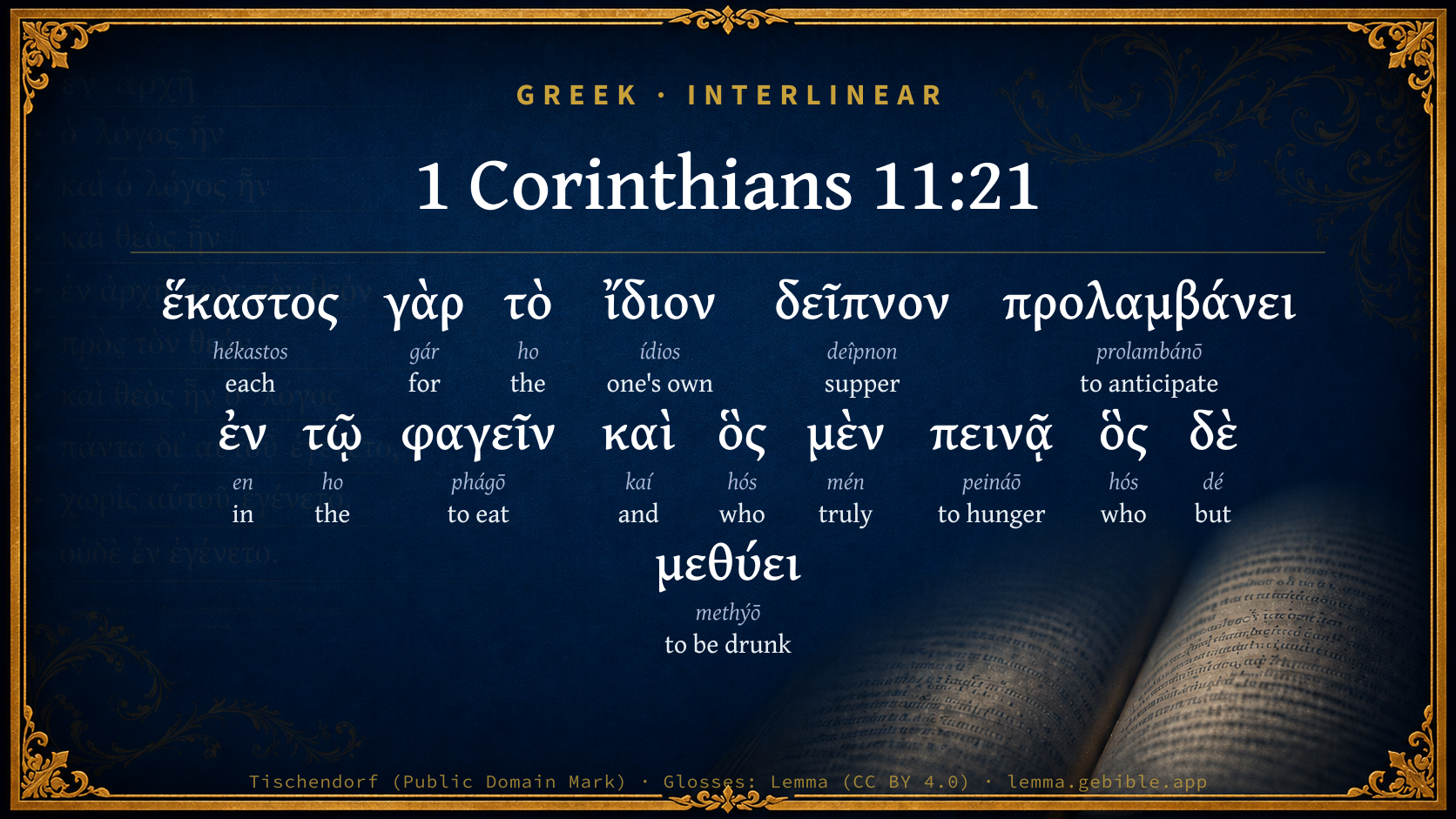
  1. ἕκαστος hékastos G1538 “each” Adjective, Nominative, Singular, Masculine
  2. γὰρ gár G1063 “for” Conjunction
  3. τὸ ho G3588 “the” Article, Accusative, Singular, Neuter
  4. ἴδιον ídios G2398 “one's own” Adjective, Accusative, Singular, Neuter
  5. δεῖπνον deîpnon G1173 “supper” Noun, Accusative, Singular, Neuter
  6. ἐν en G1722 “in” Preposition
  7. τῷ ho G3588 “the” Article, Dative, Singular, Neuter
  8. φαγεῖν phágō G5315 “to eat” Verb, Aorist, Active, Infinitive
  9. καὶ kaí G2532 “and” Conjunction
  10. ὃς hós G3739 “who” Relative pronoun, Nominative, Singular, Masculine
  11. μὲν mén G3303 “truly” Particle
  12. πεινᾷ peináō G3983 “to hunger” Verb, Present, Active, Indicative, 3rd person, Singular
  13. ὃς hós G3739 “who” Relative pronoun, Nominative, Singular, Masculine
  14. δὲ dé G1161 “but” Conjunction
  15. μεθύει methýō G3184 “to be drunk” Verb, Present, Active, Indicative, 3rd person, Singular

About this verse

These counts appear in no published source. They are computed here, from the morphology-tagged text and Lemma’s own curated glosses. What Lemma adds →

16
words
14
distinct lemmas
Pauline Epistles
section

Notable vocabulary

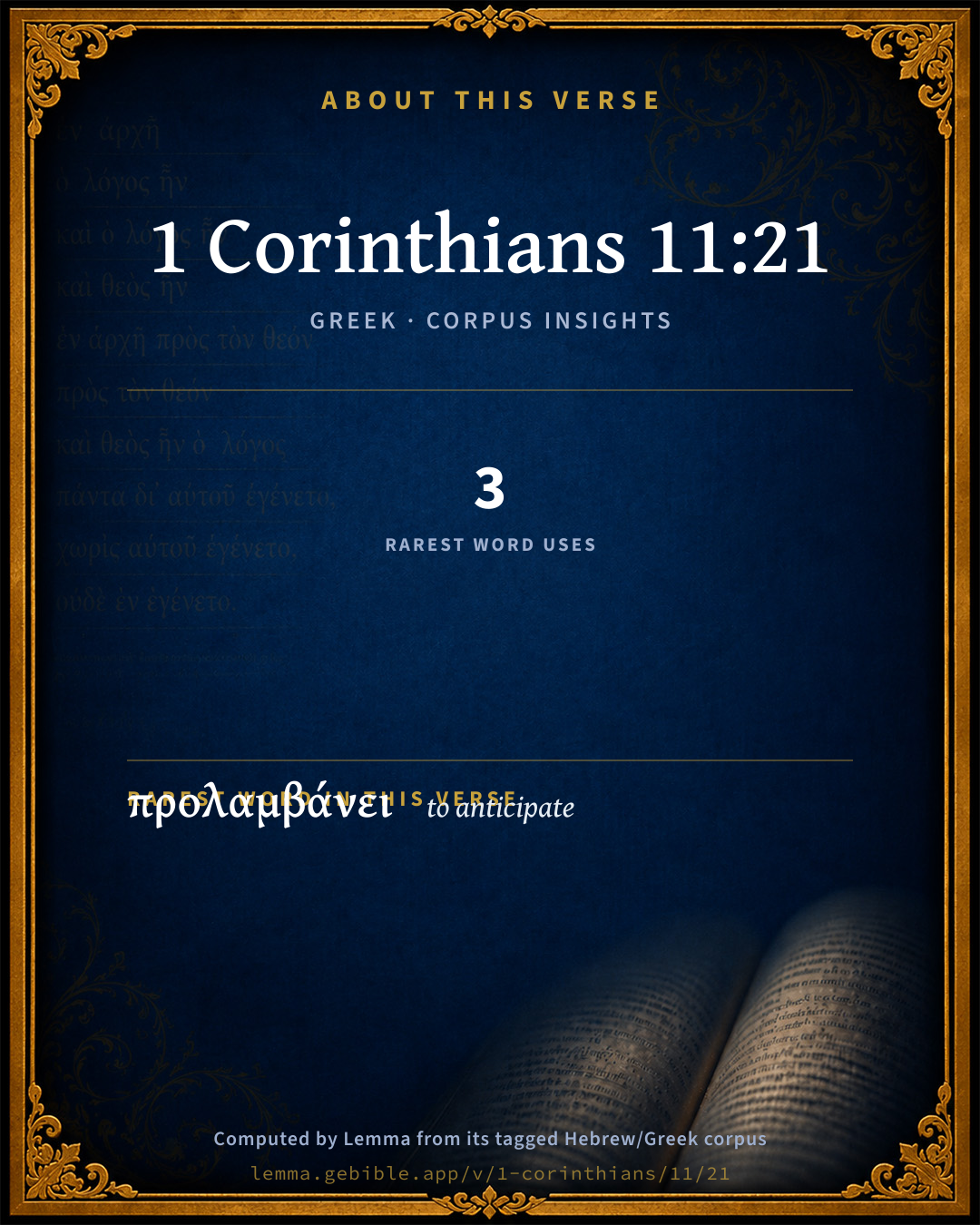
The rarest word here is προλαμβάνει to anticipate G4301 — appearing just 3 times in the whole Greek New Testament.

Shared distinctive vocabulary

προλαμβάνει to anticipate G4301 occurs in 3 verses of the Greek New Testament. Also found in:

Repetition

Words recur within this verse:

Cross-references

4

Topical passages linked to 1 Corinthians 11:21 in the Treasury of Scripture Knowledge — connected by theme and wording, ordered by reader-vote popularity; previews shown in the World English Bible.

  • 2 Peter 2:13 receiving the wages of unrighteousness; people who count it pleasure to revel in the day-time, spots and blemishes, reveling in their deceit while they feast with you;
  • Jude 1:12 These are hidden rocky reefs in your love feasts when they feast with you, shepherds who without fear feed themselves; clouds without water, carried along by winds; autumn leaves without fruit, twice dead, plucked up by the roots;
  • 1 Corinthians 10:16–18 The cup of blessing which we bless, isn't it a communion of the blood of Christ? The bread which we break, isn't it a communion of the body of Christ?
  • 1 Corinthians 11:23–25 For I received from the Lord that which also I delivered to you, that the Lord Jesus on the night in which he was betrayed took bread.

Cross-references courtesy of OpenBible.info (CC BY 4.0).

Commentary

Notes on 1 Corinthians 11:21 from classic Christian and Jewish commentators (each source and its license shown beneath its notes). The classic Christian expositions comment on the surrounding passage and are grouped to its opening verse, so a note may address several verses; the Jewish commentaries on the Tanakh (Rashi and others) are per-verse, so they appear only where the commentator wrote on this verse.

Lemma curates 59 commentaries, every one of them public domain or Creative Commons licensed, each selected and text-cleaned for this edition rather than reprinted as found. About our sources →

Bengel's Gnomon

Johann Albrecht Bengel

1Co 11:21 Ἕκαστος, every one) G. Raphelius says: “It was a custom at Athens, in the age of Socrates, for every one of those, who met at supper, to bring some meat for himself, which they did not set out for general use, but every one usually ate his own.” Then, after he has referred to the testimony of Xenophon, he concludes, “That this very passage of the apostle, is a proof so far of the observance of this custom, even at that time, by the Corinthians, who had become Christians, that when they were about to celebrate the Lord’s Supper, they brought at least bread and wine, if not other meats also, into the church, of which a part was afterwards taken and consecrated for the eucharist. For doubtless Paul calls the first their own supper, 1Co 11:21, ἴδιον δεῖπνον, namely the meat, which every one had brought from home, and which they fell upon as their right, without waiting for others. Then, οἱ μὴ ἔχοντες, those who have not, 1Co 11:22, can be understood to be no other than the poorer members, in whose presence, the richer, not without showing contempt for them, intemperately feasted, before the distribution of the elements in the Lord’s Supper, which the poor were present (had come) to enjoy, while no other food besides was prepared for them.”—προλαμβάνει, takes before) when he ought to wait, 1Co 11:33.—ἐν τῷ φαγεῖν, in eating) Language which relates to the feeding of the body, 1Co 11:33, etc., from which the Lord’s Supper very widely differs.—καὶ, and) and one indeed (inasmuch as he has not) is hungry (and thirsty): but another (inasmuch as he has, is well filled and) becomes drunken. The one has more than is good for him, the other less.

Bengel's Gnomon of the New Testament — English translation (T&T Clark, Edinburgh, 1860) — public domain. Text from a community e-Sword module.

Meyer's Critical & Exegetical Commentary

Heinrich August Wilhelm Meyer

1Co_11:21. Προλαμβάνει] takes beforehand his own meal (as contrasted with κυριακ. δεῖπν., comp Chrysostom: ΤῸ ΓᾺΡ ΚΥΡΙΑΚῸΝ ἸΔΙΩΤΙΚῸΝ ΠΟΙΟῦΣΙΝ). Instead of waiting (1Co_11:33) till a general distribution be made and others thus obtain a share (comp Xen. Mem. iii. 14. 1), and till by this means the meal assume the form of a κυριακὸν δεῖπνον, he seizes at once for himself alone upon the portion which he brought with him, and holds therewith his own private meal in place of the Lords Supper. The expression is not in the highest degree surprising, as Rückert calls it; but it is very descriptive of the existing state of matters. Grotius (comp de Wette) is wrong in supposing that the rich ate first, and left what remained for the poorer members. This runs counter to the ἕκαστος, which must mean every one who brought anything with him. Of course, when the rich acted in the way here described, the poor also had to eat whatever they might have brought with them by themselves; and if they had nothing, then this abuse of the Lords Supper sent them empty away, hungry and put to shame (1Co_11:22; 1Co_11:33).

ἐν τῷ φαγεῖν] not ad manducandum (Vulg.), but in the eating, at the holding of the meal.

πεινᾷ] because, that is to say, he had nothing, or but little, to bring with him, so that he remained unsatisfied, receiving nothing from the stores of the wealthier members.

ΜΕΘΎΕΙ] is drunken, not giving the exact opposite of πεινᾷ, but making the picture all the fuller and more vivid, because ΠΕΙΝᾷ and ΜΕΘΎΕΙ lead the reader in both cases to imagine for himself the other extreme corresponding to the one specified. We must not weaken the natural force of μεθ., as Grotius does, to plus satis bibit. See on Joh_2:20. Paul paints the scene in strong colours; but who would be warranted in saying that the reality fell at all short of the description?

Meyer — Critical and Exegetical Commentary on the New Testament — English translation by Peter Christie, edited by Frederick Crombie (T&T Clark, 1880) — public domain. Text from a community e-Sword module.

Hodge's Commentary on Romans, Ephesians & First Corinthians

Charles Hodge

1Co_11:21

For in eating every one taketh before (other) his own supper: and one is hungry, and another is drunken.

For, i.e. the reason why the Corinthian suppers were not the Lords supper, is (so far as here stated) that there was no communion, or eating together. They were not all partakers of one bread, 1Co_10:17. They did not wait for each other. Comp. 1Co_11:33. On the contrary, each one took beforehand, i.e. before others could join with him, his own supper, i.e. that which he had brought. The consequence was, that one was hungry; the poor had nothing, while another was drunk. Such is the meaning of the word. Whether the apostle intended to say that any of the Corinthians actually became intoxicated at the table which they called the table of the Lord, or whether he meant simply to say, that while one had more, another had less, man enough, it is not easy to decide. As they seem to have accommodated their service to the sacrificial feasts to which they had, while yet heathens, been accustomed, it is the less improbable that in some cases they were guilty of actual excess. It is wonderful, and well nigh portentous, says Calvin, that Satan could have accomplished so much in so short a time. We may learn from this example, what is the worth of mere antiquity; that is, what authority is due to custom unsustained by the word of God …. Yet this is the firmest foundation of Popery: it is ancient; it was done of old, therefore it has divine authority! If, within twenty years of its institution, the Corinthians turned the Lords supper into a disorderly feast, although the apostles were then alive, we need not wonder at the speedy corruption of the church after their death.

Charles Hodge — Commentary on Romans (1835), First Corinthians (1857), and Ephesians (1856) — public domain. Text from a community e-Sword module.

Geneva Bible (1599)

Geneva Bible translators

Eateth his meat and tarrieth not till other come.

Geneva Bible (1599) marginal notes — public domain. Text via Bolls.life.

Jamieson, Fausset & Brown

Robert Jamieson, A. R. Fausset & David Brown

one taketh before other--the rich "before" the poor, who had no supper of their own. Instead of "tarrying for one another" (Co1 11:33); hence the precept (Co1 12:21, Co1 12:25).

his own supper--"His own" belly is his God (Phi 3:19); "the Lord's Supper," the spiritual feast, never enters his thoughts.

drunken--The one has more than is good for him, the other less [BENGEL].

Jamieson, Fausset & Brown — Commentary Critical and Explanatory on the Whole Bible (1871) — public domain (CC PDM 1.0). Text via the HelloAO Bible API.

Adam Clarke's Commentary

Verse 21. Every one taketh before - his own supper] They had a grand feast, though the different sects kept in parties by themselves; but all took as ample a supper as they could provide, (each bringing his own provisions with him,) before they took what was called the Lord's Supper. See note on 1Co 11:17.

Adam Clarke's Commentary on the Bible (1810–1826) — public domain. Text from a community e-Sword/MySword module.

John Calvin's Commentaries

21. For every one of you taketh before others his own supper. It is truly wonderful, and next to a miracle, that Satan could have accomplished so much in so short a time. We are, however, admonished by this instance, how much antiquity, without reason on its side, can effect, or, in other words, how much influence a long continued custom has, while not sanctioned by a single declaration of the word of God. This, having become customary, was looked upon as lawful. Paul was then at hand to interfere. What then must have been the state of matters after the death of the Apostles? With what liberty Satan must have sported himself. Yet here is the great strength of Papists: “The thing is ancient — it was done long ago — let it, therefore, have the weight of a revelation from heaven.”

It is uncertain, however, what was the origin of this abuse, or what was the occasion of its springing up so soon. Chrysostom is of opinion, that it originated in the love-feasts, (ἀπὸ τῶν ἀγαπῶν) and that, while the rich had been accustomed to bring with them from their houses the means of feasting with the poor indiscriminately and in common, they afterwards began to exclude the poor, and to guzzle over their delicacies by themselves. And, certainly, it appears from Tertullian, that that custom was a very ancient one. Now they gave the name of Agapae to those common entertainments, which they contrived among themselves, as being tokens of fraternal affection, and consisted of alms. Nor have I any doubt, that it took its rise from sacrificial rites commonly observed both by Jews and Gentiles. For I observe that Christians, for the most part, corrected the faults connected with those rites, in such a manner, as to retain at the same time some resemblance. Hence it is probable, that, on observing that both Jews and Gentiles added a feast to their sacrifice, as an appendage to it, but that both of them sinned in respect of ambition, luxury, and intemperance, they instituted a kind of banquet, which might accustom them rather to sobriety and frugality, and might, at the same time, be in accordance with a spiritual entertainment in respect of mutual fellowship. For in it the poor were entertained at the expense of the rich, and the table was open to all. But, whether they had from the very first fallen into this profane abuse, or whether an institution, otherwise not so objectionable, had in this way degenerated in process of time, Paul would have them in no way mix up this spiritual banquet with common feasts. “This, indeed, looks well — that the poor along with the rich partake in common of the provisions that have been brought, and that the rich share of their abundance along with the needy, but nothing ought to have such weight with us as to lead us to profane the holy sacrament.”

And one is hungry This was one evil in the case, that while the rich indulged themselves sumptuously, they appeared, in a manner, to reproach the poor for their poverty. The inequality he describes hyperbolically, when he says, that some are drunken and others are hungry, for some had the means of stuffing themselves well, while others had slender fare. Thus the poor were exposed to the derision of the rich, or at least they were exposed to shame. It was, therefore, an unseemly spectacle, and not in accordance with the Lord’s supper

John Calvin's Commentaries (1540-1563) — public domain. Text from the Calvin Translation Society English edition (1840s-50s) via the Christian Classics Ethereal Library (ccel.org). Calvin's coverage is partial (roughly two-thirds of the Bible); uncommented books and verses are honest gaps, never fabricated. The 19th-century editor's footnotes and remarks are omitted so the notes are faithfully Calvin's own voice.

Ellicott's Commentary for English Readers

(21) For.—Here follows a description of the conduct and mode of proceeding at this feast, which renders it impossible, as stated in 1Co_11:20, for it to be a Lord’s Supper. Every one greedily seizes (takes before distribution is made) what he has brought with him, and appropriates it to his own individual use, instead of making it a contribution to the general and common supply. Every one comes to eat his own supper, and not the Lord’s Supper. And the result is that while some poor man, who has not been able to bring enough for himself, remains unfed, some rich man, drinking the wine which he brought, and which he has not shared with others, is drunken. (See Note on 1Co_11:34.)

A Bible Commentary for English Readers, edited by Charles John Ellicott (1878–1897) — public domain. Text from a community e-Sword module.

The Cambridge Bible for Schools and Colleges

gen. ed. J. J. S. Perowne

21. For in eating every one taketh before other his own supper] Rather, for in the eating, i.e. when ye eat. Every passage relating to the Eucharist in the N. T. leads to the conclusion that it took place at the end of a social meal, such as the Last Supper itself. See Act_2:42; Act_2:46; Act_20:7; Act_20:11. It was called the Agapè, or feast of love, and was like the ἔρανος of the Greeks, to which, very frequently, each brought his own portion. See Art. Erani in Smith’s Dictionary of Antiquities. The divisions among the Corinthian Christians (1Co_11:18) were of the kind which we are accustomed to denominate “sets” in a small society,—cliques and coteries, which were the product, not so much of theological, as of social antagonism. Thus the members of the Corinthian Church were accustomed to share their provisions with members of their own “set,” to the exclusion of those who, having an inferior social position, had few provisions, or none, to bring. Hence while one was only too well provided with food, another had none.

and another is drunken] We have no right, with some commentators, to soften down the force of this word, as though no such abominations were possible at Corinth. The permeation of the Christian community by the Spirit of Christ (see note on ch. 1Co_5:1) was a more gradual process than is generally supposed.

The Cambridge Bible for Schools and Colleges (gen. ed. J. J. S. Perowne; Cambridge University Press, 1878–1918) — public domain. Text from a community e-Sword module.

John Gill's Exposition

What? have ye not houses to eat and drink in?.... This shows that one taking his supper before another, was not in their own houses, before they came to the place of divine worship, but in the house of God; and the apostle suggests, that if they must have their ante-suppers, and were disposed to eat and drink freely, before they partook of the Lord's supper, it was more decent and orderly, and less reflected upon the honour of religion and the ordinances of Christ, to eat and drink in their own houses; in which they were not only more private and retired, but which they had for such purposes; whereas the house of God was not for any such use, nor should they meet together there on such an account; at least, such disorderly, unequal, and intemperate feasts there, were very scandalous and reproachful: and it was contrary to a Jewish canon to eat and drink in the synagogues, which runs thus (o),

"in the synagogues they do not use a light behaviour, nor do they eat and drink in them;''

though they sometimes speak of travellers eating and drinking and lodging in the synagogues (p), yet they interpret these of places adjoining to them:

or despise ye the church of God; that is, expose it to contempt and scorn; meaning either the community, the people of God gathered together in a Gospel church state; or the place where they met for public worship, which the Ethiopic version calls, "the house of God"; which was rendered very contemptible by such disorderly practices;

and shame them that have not; no houses to eat in, or supper to eat, or any of this world's goods, or money to purchase food for themselves; who must be confounded and put to shame, when, coming in expectation of being fed, the provisions were eaten up by the rich before they came, or, however, were not allowed to partake when they did come; this was such a respecting of persons, as was justly culpable in them by the apostle.

(o) T. Hieros. Megilia, fol. 74. 1. & T. Bab. Megilla, fol. 28. 1. (p) Gloss. in T. Bab. Bava Bathra, & Pesachim, fol. 101. 1. & Gloss. in ib. Maimon. Hilch. Sabbat, c. 29. sect. 8. & Maggid Misna in ib.

John Gill's Exposition of the Whole Bible (1746–1763) — public domain (CC PDM 1.0). Text via the HelloAO Bible API.

Trapp's Complete Commentary

John Trapp

21 For in eating every one taketh before other his own supper: and one is hungry, and another is drunken.

Ver. 21. Every one taketh] Eateth and communicateth with those of his own sect and faction only, not staying for others. Such among the Philippians were those of "the concision," 1Co 3:2, that made divisions, and cut the Church into little pieces and sucking congregations, making separation.

John Trapp, A Commentary or Exposition upon All the Books of the Old and New Testament (1647–1656) — public domain. Text from a community e-Sword module.

Albert Barnes' Notes on the Bible

For in eating - When you eat, having professedly come together to observe this ordinance. In order to understand this, it seems necessary to suppose that they had in some way made the Lord’s supper either connected with a common feast, or that they regarded it as a mere common festival to be observed in a way similar to the festivals among the Greeks. Many have supposed that this was done by making the observance of the supper follow a festival, or what were afterward called “love feasts” ἀγάπαι agapai - “Agapae”). Many have supposed that that custom was derived from the fact that the Saviour instituted the supper after a festival, a feast in which he had been engaged with his disciples, and that thence the early Christians derived the custom of observing such a festival, or common meal, before they celebrated the Lord’s Supper. But it may be observed, that the passover was not a mere preliminary festival, or feast.

It had no resemblance to the so called love feasts. It was itself a religious ordinance; a direct appointment of God; and was never regarded as designed to be preliminary to the observance of the Lord’s Supper, but was always understood as designed to be superseded by that. Besides, I know not that there is the slightest evidence, as has been often supposed, that the observance of the Lord’s Supper was preceded, in the times of the apostles, by such a festival as a love feast. There is no evidence in the passage before us; nor is any adduced from any other part of the New Testament. To my mind it seems altogether improbable that the disorders in Corinth would assume this form - that they would first observe a common feast, and then the Lord’s Supper in the regular manner. The statement before us leads to the belief that all was irregular and improper; that they had entirely mistaken the nature of the ordinance, and had converted it into an occasion of ordinary festivity, and even intemperance; that they had come to regard it as a feast in honor of the Saviour on some such principles as they observed feasts in honor of idols, and that they observed it in some such manner; and that all that was supposed to make it unlike those festivals was, that it was in honor of Jesus rather than an idol, and was to be observed with some reference to his authority and name.

Everyone taketh before other his own supper - That is, each one is regardless of the needs of the others; instead of making even a meal in common, and when all could partake together, each one ate by himself, and ate that which he had himself brought. They had not only erred, therefore, by misunderstanding altogether the nature of the Lord’s supper, and by supposing that it was a common festival like those which they had been accustomed to celebrate; but they had also entirely departed from the idea that it was a festival to be partaken of in common, and at a common table. It had become a scene where every man ate by himself; and where the very idea that there was anything like a “common” celebration, or a celebration “together,” was abandoned. There is allusion here, doubtless, to what was a custom among the Greeks, that when a festival was celebrated, or a feast made, it was common for each person to provide, and carry a part of the things necessary for the entertainment. These were usually placed in common, and were partaken of alike by all the company. Thus, Xenophon (Mem. lib. 3:cap. xiv.) says of Socrates, that he was much offended with the Athenians for their conduct at their common suppers, where some prepared for themselves in a delicate and sumptuous manner, while others were poorly provided for. Socrates endeavored, he adds, to shame them out of this indecent custom by offering his provisions to all the company.

And one is hungry - Is deprived of food. It is all monopolized by others.

And another is drunken - The word used here (μεθύω methuō) means properly to become inebriated, or intoxicated; and there is no reason for understanding it here in any other sense. There can be no doubt that the apostle meant to say, that they ate and drank to excess; and that their professed celebration of the Lord’s Supper became a mere revel. It may seem remarkable that such scenes should ever have occurred in a Christian church, or that there could have been such an entire perversion of the nature and design of the Lord’s Supper. But we are to remember the following things:

(1) These persons had recently been pagans, and were grossly ignorant of the nature of true religion when the gospel was first preached among them.

(2) They had been accustomed to such revels in honor of idols under their former modes of worship, and it is the less surprising that they transferred their views to Christianity.

(3) When they had once so far misunderstood the nature of Christianity as to suppose the Lord’s Supper to be like the feasts which they had formerly celebrated, all the rest followed as a matter of course. The festival would be observed in the same manner as the festivals in honor of idolaters; and similar scenes of gluttony and intemperance would naturally follow.

(4) We are to bear in mind, also, that they do not seem to have been favored with pious, wise, and prudent teachers.

There were false teachers; and there were those who prided themselves on their wisdom, and who were self-confident, and who doubtless endeavored to model the Christian institutions according to their own views; and they thus brought them, as far as they could, to a conformity with pagan customs and idolatrous rites, We may remark here:

(1) We are not to expect perfection at once among a people recently converted from paganism.

(2) We see how prone people are to abuse even the most holy rites of religion, and hence, how corrupt is human nature.

(3) We see that even Christians, recently converted, need constant guidance and superintendence; and that if left to themselves they soon, like others, fall into gross and scandalous offences.

Albert Barnes' Notes on the Bible (1834–1885) — public domain. Text from a community e-Sword/MySword module.

Haydock's Catholic Bible Commentary

Every one taketh before his own supper to eat. The sense seems to be, that he took and brought with him, what he designed to eat with others, and give at that supper: but as soon as some were met (without staying for others, as he orders them, ver. 33. when he again speaks of these suppers) the rich placing themselves together, began this supper, and did not take with them their poor brethren, who had brought nothing, or had nothing to bring; by this means, one indeed is hungry, and another is drunk, that is, had at least drunk plentifully, while the poor had nothing but shame, and confusion. By this means of eating and drinking without temperance and moderation, they were by no means disposed to receive afterwards the holy Eucharist. He tells such persons that committed these disorders, that if they be so hungry that they cannot fast, they should eat (ver. 34.) before they come from home. We find these Agape forbidden to be made in the Churches, in the 28th canon of the council of Laodicea, a little before the general council of Nice. In St. John Chrysostom’s time, and from the first ages, every one received the sacrament of the holy eucharist fasting, as it is probable this was one of the things which St. Paul gave orders about, (ver. 34.) when he came to Corinth. We must not imagine, that because Christ instituted the holy sacrament, and gave it to his apostles after he had supped with them, that the apostles, or the pastors of the Church, their successors, could not order it to be received fasting, and kneeling, for greater reverence and devotion. See St. Augustine on this same subject, in his letter to Januarius, liv. tom. 2. part 2. p. 126. Nov. edit. He says, that though it is evident that apostles did not receive the body and blood of Christ fasting, yet we must not on that account calumniate, or blame the universal Church, in which it is received only by those who are fasting. He says, it is most insolent madness to dispute against what is a custom in the universal Church. (Witham)

George Leo Haydock (1774–1849), Haydock's Catholic Family Bible and Commentary, 1859 edition — public domain. Excludes Psalms (Douay-Rheims chapter numbering differs from Protestant) and Deuterocanonical books (Catholic canon only).

Matthew Poole's English Annotations

There was at this time in most of the Christian church a Jewish party, viz. such as were converted from Judaism to Christianity, and had a tang of the old cask, being too tenacious of some Jewish rites. These looked upon the Lord’s supper as an appurtenance to the passover, immediately after which we know that Christ at first instituted his supper. As therefore Christ did eat the paschal supper before the Lord’s supper; so they, in imitation of him, though they forbore the paschal lamb, yet would have a supper of their own to precede the Lord’s supper, and having provided it at home, would bring it to the place where the church was to meet; and their poor brethren contributing nothing to the charge of that supper, they would not stay for them, but took this their own supper: so it came to pass, that the poorer Christians were hungry, had none or very little share in their feast, while others, the richer part of the church, had too much; for I take our translation of this word, μεθυει, to be very hard and uncharitable. Hard, because the word doth not necessarily so signify, only drinking beyond what is strictly necessary, and our translators themselves, Joh 2:10, render it well drunk. Uncharitable, because it certainly must be very uncharitably presumed of this church of Corinth, that they should suffer persons, at that time actually drunk, to come to the Lord’s table.

Matthew Poole's English Annotations on the Holy Bible (1683–1685) — public domain. Text from a community e-Sword/MySword module.

Whedon's Commentary on the Bible

Daniel D. Whedon

21. Every one—Each one. Instead of spreading a table for a common supper, each one made an own supper, of his own food, and preoccupied it entire. Thereby separate sets were established, and what was meant for union became disunion.

Hungry—He whom persecution had made poor was left hungry; so that what was meant for liberality became insult.

Drunken—At the symposium (which term was compounded of two Greek words, signifying a drink together) even Socrates was said not seldom to have appeared too vinous for a philosopher. The philosopher, therefore, sadly incurred the rebuke of the apostle. Paul, probably, uses as condemnatory a word as truth would allow. It does not necessarily follow from the word, yet it may have been, as Renan says, that some “went reeling from the table of the Lord.” The pagan Corinthians would doubtless consider the apostle as an extremist in temperance. Modern temperance reformers would, perhaps, think that Paul had better go further and prohibit the wine from the agape entirely; but the existence of more fiery liquors, like brandy and whisky, had not suggested the necessity of the law of entire abstinence for all persons from wine. Even now the law of abstinence from wine should be based not upon the intrinsic wickedness of a limited drinking of wine, but upon the obligation to abstain as part of a great reformatory enterprise, and as a prudential safeguard from moral danger. On the word drunken, see note on Joh_2:10. The antithesis to hungry would suggest that the opposite word would mean surfeited.

Daniel D. Whedon (gen. ed.), Commentary on the Old and New Testaments (1874–1909) — public domain. Text from a community e-Sword module.

The Pulpit Commentary

For in eating; rather, in your eating. Every one. All who have themselves contributed a share to the common meal. Taketh before other his own supper. It is as if they had come together only to eat, not to partake of a holy sacrament. The abuse rose from the connection of the Lord"s Supper with the agape, or love feast, a social gathering of Christian brothers, to which each, as in the Greek eranoi, or "club feasts," contributed his share. The abuse led to the separation of the agape from the Holy Communion, and ultimately to the entire disuse of the former at religious gatherings. One is hungry. The poor man, who has been unable to contribute to the meal which was intended to be an exhibition of Christian love, looked on with grudging eyes and craving appetite, while the rich had more than enough. Is drunken. "St. Paul draws the picture in strong colours, and who can say that the reality was less strong?" (Meyer). Calvin says, "It is portentous that Satan should have accomplished so much in so short a time." But the remark was, perhaps, dictated by the wholly mistaken fancy that the Church of the apostolic days was exceptionally pure. On the contrary, many of the heathen converts were unable at once to break the spell of their old habits, and few modern Churches present a spectacle so deplorable as that which we here find in the apostolic Church of Corinth. It is quite obvious that Church discipline must have been almost in abeyance if such grave scandals could exist uncorrected and apparently unreproved.

The Pulpit Commentary (1880–1919), ed. H.D.M. Spence-Jones & Joseph S. Exell — public domain. Text from a community e-Sword module.

John Wesley's Explanatory Notes

For in eating what ye call the Lord's supper, instead of all partaking of one bread, each person brings his own supper, and eats it without staying for the rest. And hereby the poor, who cannot provide for themselves, have nothing; while the rich eat and drink to the full just as the heathens use to do at the feasts on their sacrifices.

John Wesley, Explanatory Notes Upon the Whole Bible (1754–1765) — public domain. Text via the GEBible commentary corpus.

Burkitt's Expository Notes on the New Testament

William Burkitt

Here our apostle begins to reprove the Corinthians for the abuses found in their love-feasts. These love-feasts were founded on no express command in holy writ, but only on the custom of the church, who immediately before receiving the sacrament used to have a great feast, to which all the poor were invited at the charges of the rich, as an expression of their perfect love and charity one towards another.

Now in these feasts of charity they did not observe due order and decency: for every one, that is, every party and faction, being come to the place of the assembly, did presently sit down and eat what they had bought, in the company of their own party, not minding or regarding others; whereupon this holy feast of charity was neither celebrated at the same time by all, nor with that unanimity and concord which it was designed to represent: whilst the poor were excluded, and sent home hungry, the rich were feasted, and drank to some degree of excess, which is here called drunkenness; one is hungry, and another is drunken.

Behold what great irregularities and disorders are here found in the church of Corinth! Who can expect a church without spot in this imperfect state? God has left these miscarriages upon record, not for imitation, but for our caution.

William Burkitt's Expository Notes on the New Testament (1700–1703) — public domain. Text from a community e-Sword module.

Godbey's Commentary on the New Testament

William B. Godbey

21. He here alludes to the fact that in this meal — which preceded the sacrament, and in its original institution was simple and frugal, demonstrative of their love to one another — some of them have gone to excess, actually eating to gluttony and drinking to drunkenness. This was not the sacrament, but the meal which preceded it, called the agapee, i. e., the love feast.

William B. Godbey, Commentary on the New Testament (1896–1900) — public domain. Text from a community e-Sword module.

McGarvey & Pendleton's Commentaries

J. W. McGarvey

for in your eating each one taketh before other his own supper; and one is hungry, and another is drunken . [This verse is an indictment with three counts. There could be no communion supper when: 1. The parties did not eat at the same time, but some before and some after; 2. when each ate his own meal, instead of sharing in "the one bread" ( 1Co_10:17 ); 3. when some ate to the full and others ate nothing at all, because there was nothing left. It is likely that "drunken" indicates a state of partial intoxication. Grotius gives "drunken" the milder, and Meyer the stronger, sense. But the context suggests that one had more than was good for him, and the other less, and there is a subtle innuendo in the crossing of the terms, so that overdrinking stands in contrast to undereating, for overdrinking is greater debauchery than overeating.]

J. W. McGarvey (with Philip Y. Pendleton), Commentaries on the New Testament (The Fourfold Gospel, 1914; Acts; and the epistles) — public domain. Text from a community e-Sword/MySword module.

The People's New Testament

B. W. Johnson

21. For every one partaketh before others his own supper. It was customary in Corinth to eat a meal together as did Christ and his disciples the night of the Lord's supper. After this came the Lord's supper. At this meal each party in Corinth sat apart and ate when it was ready. The result was that some began before the others. One would be hungry, and another drunken. This last clause means that he had eaten and was satisfied.

B. W. Johnson's The People's New Testament with Notes (1889–1891) — public domain. Electronic text from the Christian Classics Ethereal Library (CCEL) ThML edition.

Cambridge Greek Testament for Schools and Colleges

21. τὸ ἴδιον δεῖπνον. ‘It is not the Lord’s Supper, but your own that you eat. Jesus Christ established a Supper with a solemn celebration of His Death, as at once a symbol of the unity of those who believed in Him, and a means of effecting that unity. By the course you are pursuing you are defeating His purpose, and evacuating the ceremony He has instituted of all its meaning.’

προλαμβάνει. The whole idea of a common meal was thus set aside. The members of the Church not only did not share their provisions together, but they did not eat them at the same time.

ἐν τῷ φαγεῖν. For in the eating, i. e. when ye eat. Every passage relating to the Eucharist in the N. T. leads to the conclusion that it took place at the end of a social meal, such as the Last Supper itself. See Act 2:42; Act 2:46; Act 20:7; Act 20:11. That supper in early Christian times was called the Agapè, or feast of love, and was like the ἔρανος of the Greeks, to which, very frequently, each brought his own portion. See Art. Erani in Smith’s Dictionary of Antiquities. The divisions among the Corinthian Christians (1Co 11:18) were of the kind which we are accustomed to denominate ‘sets’ in a small society,—cliques and coteries, which were the product, not so much of theological, as of social antagonism. Thus the members of the Corinthian Church were accustomed to share their provisions with members of their own ‘set,’ to the exclusion of those who, having an inferior social position, had few provisions, or none, to bring. Hence while one was only too well provided with food, another had little or none.

ὃς δὲ μεθύει. We have no right, with some commentators, to soften down the force of this word, as though no such abominations were possible at Corinth. The permeation of the Christian community by the Spirit of Christ (see note on ch. 1Co 5:1) was a more gradual process than is generally supposed. The wine could hardly have been unfermented.

Cambridge Greek Testament for Schools and Colleges (Cambridge University Press, 1896; 21 vols, various authors incl. Carr, Maclear, Plummer, Farrar, Lumby, Moule, M. R. James, Simcox) — public domain. Text from a community e-Sword module.

Alford’s Greek Testament

Henry Alford

21.] προλ., as in E. V., takes before another, viz. during the feast (ἐν τῷ φ.), not, at home, before coming. Obviously the ἕκαστος must be limited to the rich: the poor had no ἴδιον δεῖπνον to take, and were the losers by the selfishness of the rich.

πεινᾷ] one is craving (the poor), another is drunken (the rich. There is no need to soften the meaning of μεθύει: as Meyer says, “Paul draws the picture in strong colours, and who can say that the reality was less strong?”).

Henry Alford, The Greek Testament (1849–1861) — public domain. Text from a community e-Sword module.

International Critical Commentary

21. ἕκαστος γὰρ τὸ ἴδιον δεῖπνον προλαμβάνει ‘For each one takes before the rest (instead of with them) his own supper’: he anticipates the partaking in common, and thus destroys the whole meaning and beauty of the ordinance. It was thus not even a κοινὸν δεῖπνον, much less κυριακόν. The ἐν τῷ φαγεῖν is not an otiose addition: it is a mere eating, which he might just as well or better have done elsewhere and elsewhen.*

καὶ ὃς μὲν πεινᾷ. ‘The consequence is that one man cannot even satisfy his hunger, while another even drinks to excess.’ These are probably respectively the rich and the poor. The poor brought little or nothing to the common meal, and got little or nothing from the rich, who brought plenty; while some of the rich, out of their abundant supplies, became drunk. There is a sharp antithesis between deficiency in necessary food and excess in superfluous drink. There is no need to water down the usual meaning of μεθύειν (Mat 24:49; Joh 2:10; Act 2:15; 1Th 5:7). Even in a heathen ἔρανος such selfish and disgusting behaviour would have been considered shameful, as the directions given by Socrates show; they are very similar to those of St Paul (Xen. Mem. III. iv. 1). Certainly such meetings must have been ‘for the worse’; hungry poor meeting intoxicated rich, at what was supposed to be a supper of the Lord! In these gatherings the religious element was far more important than the social; but the Corinthians had destroyed both. For this late use of the relative, ὃς μὲν … ὃς δὲ … comp. Rom 9:21; 2Ti 2:20; Mat 21:35, Mat 22:5, Mat 25:15. Coincidence is implied.

For προλαμβάνει (א B C D E F G K L P) A and some cursives have προσλαμβάνει, the active of which does not occur in the N.T., except as a variant here and Act 27:34.

International Critical Commentary — older volumes (1896–1929), various authors — public domain. Text from a community e-Sword module.

Vincent's Word Studies in the New Testament

Marvin R. Vincent

Taketh before other. Not waiting for the coming of the poor to participate.

Marvin R. Vincent, Word Studies in the New Testament (1887–1900) — public domain. Text from a community e-Sword/MySword module.

Godet's Commentaries

Frédéric Louis Godet

Vv. 21. By the way in which they act, they change the sacred feast into an ordinary supper, which has no longer anything in common with the sacred feast which it should recall. It is on the προ, before, in the verb προλαμβάνειν, that the emphasis lies: “You make haste to take the provisions you have brought before it has become possible to make a general distribution of them, and without sharing them with your neighbours.” — The epithet ἴδιον, his own, expresses the right in virtue of which the owner thinks he can act thus.

The words ἐν τῷ φάγειν indicate the moment when the feast begins, following the act of worship which had certainly preceded: when the feasting is reached, including the supper, and then the holy sacrament.

The words: one is hungry, refer to the poor who are present.

The verb μεθύειν usually signifies to be intoxicated; but it may also be applied to eating, in the sense in which we say to eat his fill, and so to form a contrast, as is the case in this passage, to πεινᾷν, to be hungry. The word μεθύειν certainly shows that the pleasure of good cheer and drinking went the length of intemperance, just as in those friendly feasts at which Greek gaiety and frivolity took free course. — Now follow the rebukes which such conduct deserves.

Frédéric Louis Godet — Commentaries on Luke, John, Romans, and 1 Corinthians — English translation (T&T Clark, Edinburgh, 1870s–1890s) — public domain. Text from a community e-Sword module.

Lesson kit

Teaching starters — assembled from the data on this page, not authored interpretation. Every prompt links to the verse data it draws on. Edit before teaching.

1 Corinthians, in the Pauline Epistles, opens this verse with 16 words (14 distinct Greek lemmas). Its most distinctive word is prolambánō (“to anticipate”). A historical commentator’s framing appears above. Read the whole chapter for the surrounding context.

Discussion questions

  1. How does “to anticipate” (prolambánō) shape what this verse is saying?
  2. Mark 14:8 shares the word «to anticipate» with this verse. How do the two illuminate each other?
  3. “the” occurs 2× in this one verse. What is the effect of the repetition?
  4. These translations render this verse differently; the difference is in the English rendering, not the original. What questions does that raise?
  5. Reading how Bengel's Gnomon and Meyer's Critical & Exegetical Commentary read this verse, where do the two commentators agree and where do they part?

Things to notice

Reading settings

Reading text

Shown beneath each verse's original-language words.

Old Testament
Old Testament edition

Read the OT as the Masoretic Hebrew (MT) or the Greek Septuagint (LXX).

English shown for the Greek Septuagint (in the Hebrew ↔ Greek comparison).

Comparing translations? Open the Compare panel on any verse page to stack up to four side by side.