1 Corinthians 8:6

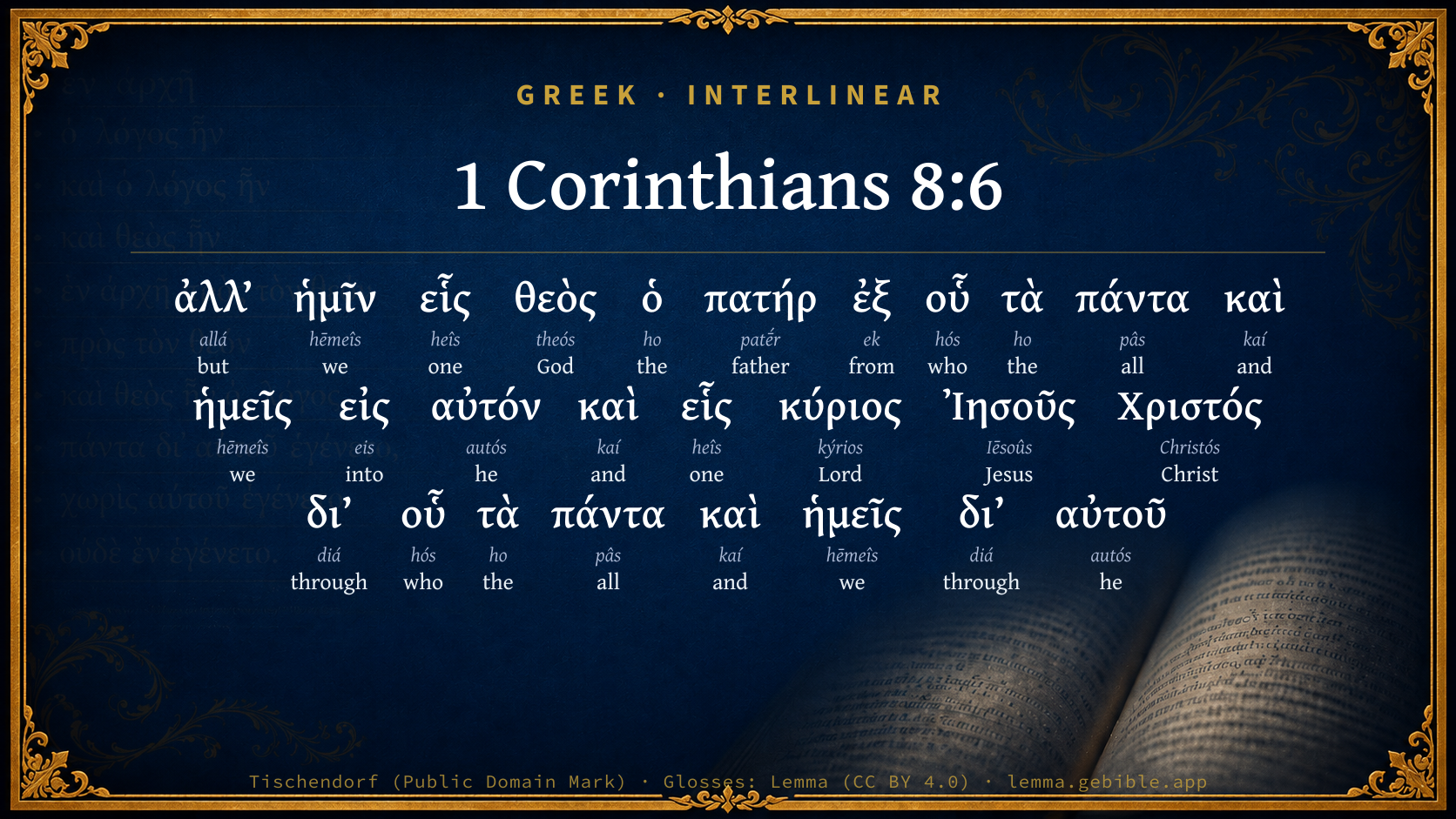
Greek (Tischendorf 8th ed.) 1 Corinthians 8:6 appears in the Greek New Testament. The text above is from the Tischendorf 8th edition. Each word links to its Strong’s number and a concise gloss. Click any word for its full Thayer’s Greek Lexicon entry.
Download image
Cite this verse

1 Corinthians 8:6 (World English Bible). Public Domain. Lemma interlinear Bible study tool, https://lemma.gebible.app/v/1-corinthians/8/6.

Show BibTeX & RIS
BibTeX
RIS
English Translation
yet to us there is one God, the Father, of whom are all things, and we for him; and one Lord, Jesus Christ, through whom are all things, and we live through him.
World English Bible · Public Domain
Download a study sheet

One document with this verse’s original text, its word-by-word gloss line, the meaning frame, cross-references with their text, attributed commentary, and full source and license credits — printable, and it pastes into notes with its structure intact.

This verse Autodidact and up

Study sheet (.html) Plain text (.txt)

A passage Seminary Student

Up to 50 verses in one chapter. A passage sheet keeps up to 6 commentary sources and 12 cross-references per verse, in the order this page ranks them, and says so on the sheet whenever that leaves anything out. Ask for a single verse and you get the Autodidact verse sheet above.

Everything on this page stays free to read, with no account — the sheet is a download of what is already on screen, not access to it.

Want to remove ads? Support Godless Engineer
Compare translations 3

The same verse in 3 English versions, stacked beneath the original-language interlinear above. Click any original word for its lexicon entry.

Each is an independent rendering of the whole verse — the interlinear is not word-aligned to these translations.

Highlighted words mark where these versions differ — a whole-verse word diff, not a word-by-word alignment.

  • World English Bible Public Domain
    yet to us there is one God, the Father, of whom are all things, and we for him; and one Lord, Jesus Christ, through whom are all things, and we live through him.
  • King James Version Public Domain
    But to us there is but one God, the Father, of whom are all things, and we in him; and one Lord Jesus Christ, by whom are all things, and we by him.
  • unfoldingWord Literal Text CC BY-SA 4.0
    yet for us one God the Father, from whom all things and for whom we, and one Lord Jesus Christ, through whom all, and through whom we.

unfoldingWord Literal Text — © unfoldingWord, licensed CC BY-SA 4.0. Word-aligned USFM3 via Door43 (git.door43.org/unfoldingWord/en_ult).

Versions to compare (up to 4)

3 of 4 selected

Show all 19 translations

Every available English version of this verse, each an independent rendering of the whole verse.

  • World English Bible Public Domain
    yet to us there is one God, the Father, of whom are all things, and we for him; and one Lord, Jesus Christ, through whom are all things, and we live through him.
  • Berean Standard Bible Public Domain
    yet for us there is but one God, the Father, from whom all things came and for whom we exist. And there is but one Lord, Jesus Christ, through whom all things came and through whom we exist.
  • Majority Standard Bible Public Domain
    yet for us there is but one God, the Father, from whom all things came and for whom we exist. And there is but one Lord, Jesus Christ, through whom all things came and through whom we exist.
  • King James Version Public Domain
    But to us there is but one God, the Father, of whom are all things, and we in him; and one Lord Jesus Christ, by whom are all things, and we by him.
  • American Standard Version (1901) Public Domain
    yet to us there is one God, the Father, of whom are all things, and we unto him; and one Lord, Jesus Christ, through whom are all things, and we through him.
  • Revised Version (1885) Public Domain
    yet to us there is one God, the Father, of whom are all things, and we unto him; and one Lord, Jesus Christ, through whom are all things, and we through him.
  • Geneva Bible (1599) Public Domain
    Yet vnto vs there is but one God, which is that Father, of whome are all things, and we in him: and one Lord Iesus Christ, by whome are all things, and we by him.
  • Douay-Rheims (1899) Public Domain
    Yet to us there is but one God, the Father, of whom are all things, and we unto him; and one Lord Jesus Christ, by whom are all things, and we by him.
  • Young's Literal Translation Public Domain
    yet to us `is' one God, the Father, of whom `are' the all things, and we to Him; and one Lord, Jesus Christ, through whom `are' the all things, and we through Him;
  • Literal Standard Version CC BY-SA 4.0
    yet to us [is] one God, the Father, of whom [are] all things, and we to Him; and one Lord, Jesus Christ, through whom [are] all things, and we through Him;
  • Unlocked Literal Bible CC BY-SA 4.0
    Yet for us there is only one God, the Father, from whom are all things and for whom we live, and one Lord Jesus Christ, through whom all things exist, and through whom we exist.
  • unfoldingWord Literal Text CC BY-SA 4.0
    yet for us one God the Father, from whom all things and for whom we, and one Lord Jesus Christ, through whom all, and through whom we.
  • Darby Bible Public Domain
    yet to us [there is] one God, the Father, of whom all things, and *we* for him; and one Lord, Jesus Christ, by whom [are] all things, and *we* by him.
  • World Messianic Bible Public Domain
    yet to us there is one God, the Father, of whom are all things, and we for him; and one Lord, Yeshua the Messiah, through whom are all things, and we live through him.
  • Webster's Bible Public Domain
    Yet to us there is but one God, the Father, from whom are all things, and we in him; and one Lord Jesus Christ, by whom are all things, and we by him.
  • Free Bible Version CC BY-SA 4.0
    But for us there is only one God, the Father, from whom everything was made, and he is the goal of our existence; and one Lord, Jesus Christ, through whom everything was made, and he is the means of our existence.
  • Bible in Basic English Public Domain
    There is for us only one God, the Father, of whom are all things, and we are for him; and one Lord, Jesus Christ, through whom are all things, and we have our being through him.
  • Text-Critical English NT CC BY 4.0
    for us there is one God, the Father, from whom are all things, and we exist for him; and there is one Lord, Jesus Christ, through whom are all things, and we exist through him.
  • Tyndale New Testament (1534) Public Domain
    yet vnto vs is there but one god which is the father of whom are all thinges and we in him: and one lorde Iesus Christ by whom are all thinges and we by him.

Literal Standard Version (2020), Covenant Press — licensed CC BY-SA 4.0. Text via the HelloAO Bible API (eBible.org). Unlocked Literal Bible (unfoldingWord) — licensed CC BY-SA 4.0. Text via the HelloAO Bible API (eBible.org). unfoldingWord Literal Text — © unfoldingWord, licensed CC BY-SA 4.0. Word-aligned USFM3 via Door43 (git.door43.org/unfoldingWord/en_ult). Free Bible Version, Dr. Jonathan Gallagher — licensed CC BY-SA 4.0. Text via the HelloAO Bible API (eBible.org).

Word by word

More ways to search: Search by grammar → Find every occurrence → Compare this word →

Practice this passage: Drill this verse → Learn its vocabulary →

εἷς
heîs
G1520
“one”
Adjective, Nominative, Singular, Masculine
Part of Speech
Adjective
Case
Nominative
Number
Singular
Gender
Masculine
Full Thayer's Definition

Origin: (including the neuter [etc.] hen)

TDNT: 09:14,2

1. one
  1. ἀλλ’ allá G235 “but” Conjunction
  2. ἡμῖν hēmeîs G2249 “we” Personal pronoun, 1st person, Dative, Plural
  3. θεὸς theós G2316 “God” Noun, Nominative, Singular, Masculine
  4. ὁ ho G3588 “the” Article, Nominative, Singular, Masculine
  5. πατήρ patḗr G3962 “father” Noun, Nominative, Singular, Masculine
  6. ἐξ ek G1537 “from” Preposition
  7. οὗ hós G3739 “who” Relative pronoun, Genitive, Singular, Masculine
  8. τὰ ho G3588 “the” Article, Nominative, Plural, Neuter
  9. πάντα pâs G3956 “all” Adjective, Nominative, Plural, Neuter
  10. καὶ kaí G2532 “and” Conjunction
  11. ἡμεῖς hēmeîs G2249 “we” Personal pronoun, 1st person, Nominative, Plural
  12. εἰς eis G1519 “into” Preposition
  13. αὐτόν autós G846 “he” Personal pronoun, Accusative, Singular, Masculine
  14. καὶ kaí G2532 “and” Conjunction
  15. εἷς heîs G1520 “one” Adjective, Nominative, Singular, Masculine
  16. κύριος kýrios G2962 “Lord” Noun, Nominative, Singular, Masculine
  17. Ἰησοῦς Iēsoûs G2424 “Jesus” Noun, Nominative, Singular, Masculine
  18. Χριστός Christós G5547 “Christ” Noun, Nominative, Singular, Masculine
  19. δι’ diá G1223 “through” Preposition
  20. οὗ hós G3739 “who” Relative pronoun, Genitive, Singular, Masculine
  21. τὰ ho G3588 “the” Article, Nominative, Plural, Neuter
  22. πάντα pâs G3956 “all” Adjective, Nominative, Plural, Neuter
  23. καὶ kaí G2532 “and” Conjunction
  24. ἡμεῖς hēmeîs G2249 “we” Personal pronoun, 1st person, Nominative, Plural
  25. δι’ diá G1223 “through” Preposition
  26. αὐτοῦ autós G846 “he” Personal pronoun, Genitive, Singular, Masculine

About this verse

These counts appear in no published source. They are computed here, from the morphology-tagged text and Lemma’s own curated glosses. What Lemma adds →

27
words
16
distinct lemmas
Pauline Epistles
section

Repetition

Words recur within this verse:

Cross-references

34

Topical passages linked to 1 Corinthians 8:6 in the Treasury of Scripture Knowledge — connected by theme and wording, ordered by reader-vote popularity; previews shown in the World English Bible.

  • Romans 11:36 For of him, and through him, and to him, are all things. To him be the glory for ever! Amen.
  • John 1:3 All things were made through him. Without him was not anything made that has been made.
  • Malachi 2:10 Don't we all have one father? Hasn't one God created us? Why do we deal treacherously every man against his brother, profaning the covenant of our fathers?
  • Hebrews 1:2–3 has at the end of these days spoken to us by his Son, whom he appointed heir of all things, through whom also he made the worlds.
  • Colossians 1:16–17 For by him were all things created, in the heavens and on the earth, things visible and things invisible, whether thrones or dominions or principalities or powers; all things have been created through him, and for him.
  • 1 Corinthians 8:4 Therefore concerning the eating of things sacrificed to idols, we know that no idol is anything in the world, and that there is no other God but one.
  • Ephesians 4:5–6 one Lord, one faith, one baptism,
  • Acts 17:28 'For in him we live, and move, and have our being.' As some of your own poets have said, 'For we are also his offspring.'
  • Deuteronomy 6:4 Hear, Israel: Yahweh is our God; Yahweh is one:
  • John 14:20 In that day you will know that I am in my Father, and you in me, and I in you.
  • Matthew 11:27 All things have been delivered to me by my Father. No one knows the Son, except the Father; neither does anyone know the Father, except the Son, and he to whom the Son desires to reveal him.
  • John 20:17 Jesus said to her, "Don't touch me, for I haven't yet ascended to my Father; but go to my brothers, and tell them, 'I am ascending to my Father and your Father, to my God and your God.'"
  • Matthew 28:18 Jesus came to them and spoke to them, saying, "All authority has been given to me in heaven and on earth.
  • John 10:30 I and the Father are one."
  • John 13:13 You call me, 'Teacher' and 'Lord.' You say so correctly, for so I am.
  • John 14:9–10 Jesus said to him, "Have I been with you such a long time, and do you not know me, Philip? He who has seen me has seen the Father. How do you say, 'Show us the Father?'
  • John 17:21–23 that they may all be one; even as you, Father, are in me, and I in you, that they also may be one in us; that the world may believe that you sent me.
  • Acts 2:36 "Let all the house of Israel therefore know assuredly that God has made him both Lord and Christ, this Jesus whom you crucified."
  • 1 Corinthians 12:3 Therefore I make known to you that no man speaking by God's Spirit says, "Jesus is accursed." No one can say, "Jesus is Lord," but by the Holy Spirit.
  • Philippians 2:9–11 Therefore God also highly exalted him, and gave to him the name which is above every name;
  • 1 Timothy 2:5–6 For there is one God, and one mediator between God and men, the man Christ Jesus,
  • John 5:20–29 For the Father has affection for the Son, and shows him all things that he himself does. He will show him greater works than these, that you may marvel.
  • John 17:3 This is eternal life, that they should know you, the only true God, and him whom you sent, Jesus Christ.
  • Acts 5:31 God exalted him with his right hand to be a Prince and a Savior, to give repentance to Israel, and remission of sins.
  • Ephesians 1:3 Blessed be the God and Father of our Lord Jesus Christ, who has blessed us with every spiritual blessing in the heavenly places in Christ;
  • Ephesians 3:14 For this cause, I bow my knees to the Father of our Lord Jesus Christ,
  • 1 Peter 1:2–3 according to the foreknowledge of God the Father, in sanctification of the Spirit, that you may obey Jesus Christ and be sprinkled in his blood: Grace to you and peace be multiplied.
  • Revelation 1:18 and the Living one. I was dead, and behold, I am alive forevermore. Amen. I have the keys of Death and of Hades.
  • Jonah 1:9 He said to them, "I am a Hebrew, and I fear Yahweh, the God of heaven, who has made the sea and the dry land."
  • 1 Corinthians 1:2 to the assembly of God which is at Corinth; those who are sanctified in Christ Jesus, called to be saints, with all who call on the name of our Lord Jesus Christ in every place, both theirs and ours:
  • 1 Corinthians 6:13 "Foods for the belly, and the belly for foods," but God will bring to nothing both it and them. But the body is not for sexual immorality, but for the Lord; and the Lord for the body.
  • Ephesians 1:20–23 which he worked in Christ, when he raised him from the dead, and made him to sit at his right hand in the heavenly places,
  • Colossians 1:6 which has come to you; even as it is in all the world and is bearing fruit and growing, as it does in you also, since the day you heard and knew the grace of God in truth;
  • 1 Peter 1:21 who through him are believers in God, who raised him from the dead, and gave him glory; so that your faith and hope might be in God.

Cross-references courtesy of OpenBible.info (CC BY 4.0).

Commentary

Notes on 1 Corinthians 8:6 from classic Christian and Jewish commentators (each source and its license shown beneath its notes). The classic Christian expositions comment on the surrounding passage and are grouped to its opening verse, so a note may address several verses; the Jewish commentaries on the Tanakh (Rashi and others) are per-verse, so they appear only where the commentator wrote on this verse.

Lemma curates 59 commentaries, every one of them public domain or Creative Commons licensed, each selected and text-cleaned for this edition rather than reprinted as found. About our sources →

Bengel's Gnomon

Johann Albrecht Bengel

1Co 8:6. Ἡμῖν) to us, believers.—ἐξ οὗ τὰ πάντα, of whom are all things) Therefore, we have one God.—τὰ πάντα, all things) by creation.—ἡμεῖς, we) believers.—εἰς αὐτὸν, unto Him) He is the end for whom believers live.—καὶ εἷς, and one) Christ, the object of divine and religious worship. The apostles also, for the purpose of avoiding the appearance of polytheism, more frequently called Christ Lord, than God, when they wrote to the Gentile churches.—Κύριος, Lord) This appellation comprehends in itself the notion of the Son of God, and therefore also of God, along with the idea of Redeemer.—διʼ οὗ, by whom) The dominion of Christ is hereby proved; by Him all things are of God.—διʼ αὐτοῦ, by Him) We come by Him, εἰς, to the Father.

7. Αλλʼ) We have γνῶσιν, knowledge; but others have it not in the same degree.—τινὲς, some) an antithesis to all, 1Co 8:1. Some, viz. the Jews, holding the idol in abomination; the Greeks regarding it with reverence, 1Co 10:32.—τοῦ εἰδώλου, of the idol) They had this feeling,[65] as if the idol were something; or at least as if the thing offered to the idol were polluted thereby.—ἓως ἄρτι, until this hour) when by this time they should have knowledge.—ὡς) as: on this depends the distinction.—μολύνεται, is defiled) a suitable expression, by a metaphor derived from flesh.—βρῶμα, food) used indefinitely, 1Co 8:13.—ἡμᾶς, us) having or not having knowledge.—οὐ παρίστησι) neither as regards pleasing Him in the judgment, nor as regards displeasing Him, πρὸς τὸ ὑστερεῖσθαι [so as to be accounted the worse for it]; συνίστημι, I commend; but the word παρίστημι occupies a middle place between a good and a bad sense, as is evident from the Ep. of Athanasius, προς ʼ Αμοῦν, where he makes this periphrasis, φυσική τις ἔκκρισις ἡμᾶς οὐ παραστήσει πρὸς τιμωρίαν.[66] So 1Co 8:10, οἰκοδομηθήσεται is used as a word in a middle sense. This is the foundation of lawful power [liberty, 1Co 8:9], ἐξονσίας; comp. δὲ in the next verse.—οὔτε—περισσεύομεν οὔτε—ὑστερούμεθα, neither are we the better; nor—are we the worse) because in both cases thanksgiving is retained, Rom 14:6.

[65] Ernesti says, Bibl. th. noviss. T. i., p. 511, that Bengel, along with Heumann, prefers the reading συνηθείᾳ in this verse to the common reading συνειδήσει, and approves of it, but without foundation. Certainly Bengel’s older margin has marked συνηθείαò with γ, the later with δ; and the Germ. Vers. has expressly printed συνειδήσει.—E. B.

[66] Any natural ejection in the animal functions will not bring us to punishment.

Tisch. prefers συνειδήσει with D (A) G Vulg. both Syr. Versions, and fg. Lachm. reads συνηθείᾳ with AB Memph.—ED.

Bengel's Gnomon of the New Testament — English translation (T&T Clark, Edinburgh, 1860) — public domain. Text from a community e-Sword module.

Meyer's Critical & Exegetical Commentary

Heinrich August Wilhelm Meyer

1Co_8:6. Apodosis: yet have we Christians but one God, the Father, etc. Therefore: οἴδαμεν ὅτι οὐδὲν εἴδωλον κ.τ.λ[1335] The ἘΣΤΊΝ to be supplied after ἩΜῖΝ is the simple verb substantive.

ἈΛΛʼ] as in 1Co_4:15.

ΘΕῸς Ὁ ΠΑΤΉΡ] might be taken together here as forming one conception, like Κύριος ὁ Θεός (Fritzsche, a[1336] Matt. p. 168); it agrees better, however, with the ΕἿς ΚΎΡΙΟς Ἰ. Χ. which follows, to understand Ὁ ΠΑΤΉΡ as in apposition to ΘΕΌς and defining it more precisely. By Ὁ ΠΑΤΉΡ, and the relative definitions of it which follow, the ΕἿς ΘΕΌς has its specific character assigned to it, and that in such a way as to make the reader feel, from the relation of the One God to the world, and from his own relation to Him, how the Christian, despite that plurality of gods, comes to rest in the thought of the unity of God, and how idols are with him put out of account altogether. Comp Hofmann, Schriftbew. I. p. 348.

ὁ πατήρ] in the Christian sense, according to the idea of the υἱοθεσία of Christians. Rom_8:15; Gal_3:26.

ἘΞ ΟὟ ΤᾺ ΠΆΝΤΑ] as to primary origin. see on Rom_11:36.

ΚΑῚ ἩΜΕῖς ΕἸς ΑὐΤΌΝ] i.e. and we Christians are destined to serve His purposes: He is our End. Here again, after the καί, we have the deviation from the relative construction, common with the apostle from his preference for direct address. Comp on 1Co_7:13. Bernhardy, p. 304. It is arbitrary to take ΕἸς in such a narrow sense as is given to it by Piscator, Grotius, Rosenmüller, al[1339]: for Gods honour; but positively incorrect to take it for ἘΝ, with Beza, Calvin, and others; or for ἘΞ, with Schulz, Heydenreich, and Pott. Billroth interprets it in Hegelian fashion: that man should be towards God, should return into Him as his First Cause, not remain for himself. This has only a seeming likeness to Augustines Fecisti me ad te, et inquietum est cor nostrum, donec requiescat in te, Conf. i. 1. Olshausen, following older expositors (Calovius, Estius, al[1340]), finds the Trinity here also (comp on Rom_11:36), which is obviously wrong, were it only for this reason, that we have neither one subject alone named in this passage (as at least in Rom. loc. cit.), nor three, but two.[1342] He holds, with Billroth (comp also Neander), that the ΕἸς refers to the agency of the Holy Spirit in bringing all back to its primary origin.[1344]

διʼ οὗ τὰ πάντα] does not apply to the new moral creation (Grotius, Stolz, Pott), and consequently cannot include all that is involved in redemption and atonement (Baur, neut. Theol. p. 193), which is clearly against the sense of the preceding τὰ πάντα; but it means that Jesus Christ, in His pre-mundane existence, as the Son of God (not as the Ideal Man or the like), as πρωτότοκος πάσης κτίσεως (in Johns phrase, as Λόγος), was He through whom[1345] God brought about the creation of the world. see on Col_1:15 ff. Comp Joh_1:3. Usteri, Lehrbegriff, p. 315 ff.; Räbiger, Christol. Paul. p. 29 ff.; Hahn, Theol. d. N. T. § 85; Lechler, p. 51 f.; Weiss, bibl. Theol. p. 318. Philo calls the λόγος the ὄργανον, διʼ οὗ κατεσκευάσθη (ὁ κόσμος). See de Cherub. I. p. 162. In Rom_11:36, διʼ οὗ is said of God, and the reference is therefore of a different kind than here.

καὶ ἡμεῖς διʼ αὐτοῦ] is not to be referred to the physical creation (Rückert); for the idea thus elicited would not only be tame and obvious of itself, but also out of keeping with what has previously been stated of God, the second clause in which, κ. ἡμεῖς εἰς αὐτόν, adds a different, namely, an ethical relation. The reference here is to the new creation of believers (Eph_2:10; 2Co_5:17; Gal_6:15); this is effected by God through Christ, who, as in the physical creation, is the causa medians. Just as we Christians have but one God, the true Creator, whose designs: we serve; so, too, we have but one Lord, the true Mediator, to whom all things owe their being, and we our Christian existence, that which we are as Christians. This one God and one Lord shuts out the whole heathen gods as such, so far as the Christian consciousness is concerned.

[1335] .τ.λ. καὶ τὰ λοιπά.

[1336] d refers to the note of the commentator or editor named on the particular passage.

[1339] l. and others; and other passages; and other editions.

[1340] l. and others; and other passages; and other editions.

[1342] Hence we find, in some of the later codd. and Fathers, additional clauses respecting the Spirit, namely, καὶ ἓν πνεῦμα ἅγιον, ἐν ᾧ τὰ πάντα κ. ἡμεῖς ἐν αὐτῷ, and: καὶ ἕν πνεῦμα ἅγ. διʼ οὗ πάντα. But so early an expositor as Chrysostom remarks expressly that the Spirit is not mentioned here.

[1344] In order to bring out the all (Rom_11:36), Olshausen affirms: Insomuch as the church is destined to receive all men into it, and insomuch as it exerts a reflex restorative influence even upon the κτίσις (Rom_8:19 ff.), those who believe are equivalent to things as a whole. An instanceto be taken as a warningof exegetical subjectivity in the interest of dogmatic preconception.

[1345] Not ἐξ οὗ, which holds only of the Father, although εἰς ὅν could be said of the Son also (comp. Col_1:16).

Meyer — Critical and Exegetical Commentary on the New Testament — English translation by Peter Christie, edited by Frederick Crombie (T&T Clark, 1880) — public domain. Text from a community e-Sword module.

Expositor's Greek Testament

ed. W. Robertson Nicoll

1Co 8:6 affirms in positive Christian terms, as 1Co 8:4 b stated negatively and retrospectively, the creed of the Cor [1249] believers. The “one God” of O.T. monotheism is “to us one God the Father”. “Of whom are all things, and we for Him:” the universe issues from God, and “we,” His sons in Christ, are destined therein for His use and glory He would reap in “us” His glory, as a father in the children of his house; see, on this latter purpose, Eph 1:5 ; Eph 1:10 ff., Eph 1:18 b , 1Co 3:9 ff.; also 1Pe 2:9 , Jas 1:18 , Joh 17:9 f., etc.; cf. Aug [1250] , “ Fecisti nos ad Te”. In the emphatic ἡμεῖς εἰς αὐτὸν there speaks the joyful consciousness of Gentiles called to know and serve the true God; cf. 1Co 12:2 f., Eph 2:11 ff. The “one Lord Jesus Christ” is Mediator, as in 1Ti 2:5 “through whom are all things, and we through Him”; again ἡμεῖς stands out with high distinction from the dim background of τὰ πάντα . The contrasted ἐξ οὗ , εἰς αὐτὸν of the previous clause is replaced by the doubled διὰ of this: God is the source of all nature, but the end specifically of redeemed humanity; Christ is equally the Mediator and in this capacity the Lord (1Co 15:24-28 ) of nature and of men. The universe is of God through Christ (Heb 1:2 , Joh 1:3 ): we are for God through Christ (2Co 5:18 , Eph 1:5 , etc.). Col 1:15 ff. unfolds this doctrine of the double Lordship of Christ, basing His redemptional upon His creational headship. It is an exegetical violence to limit the second τὰ πάντα , as Grotius and Baur have done, to “the ethical new creation”; in 2Co 5:18 the context gives this limitation, which in our passage it excludes. The inferior reading διʼ ὅν (for οὗ : see txtl. note), “ because of whom are all things,” would consist with a lower doctrine of Christ’s Person, representing Him as preconceived object, while with διʼ οὗ He is pre-existent medium of creation. The full Christology of the 3rd group of the Epp. is latent here. The faith which refers all things to the one God our Father as their spring, and subordinates all things to the one Lord our Redeemer, leaves no smallest spot in the universe for other deities; intelligent Christians justly inferred that the material of the idolothyta was unaffected by the hollow rites of heathen sacrifice.

[1249] Corinth, Corinthian or Corinthians.

[1250] Augustine.

The Expositor's Greek Testament, edited by W. Robertson Nicoll (1897–1910) — public domain. Text from a community e-Sword module.

Hodge's Commentary on Romans, Ephesians & First Corinthians

Charles Hodge

1Co_8:6

But to us (there is but) one God, the Father, of whom (are) all things, and we in him; and one Lord Jesus Christ, by whom (are) all things, and we by him.

Though there are many creatures called gods, there is but one true God, the creator of all things. To us, i.e. to Christians. There is one God, i.e. only one being who is eternal, self-existing and almighty. This one God is, first, the Father; not the first person of the Trinity, but our father. The word does not here express the relation of the first to the second person in the Godhead, but the relation of God as such to us as his children. When we say, Our Father who art in heaven, the word Father designates the Supreme Being, the Triune Jehovah. Secondly, of this one God it is said, of him are all things. He, the one God, is the source of the whole universe, and all that it contains. He created all things by the word of his power. All other beings are his creatures. Thirdly, we are to him. He is our end; for his glory we were created and redeemed. Our version rendering the words εἰς αὐτόν, in him, is an unnecessary departure from their proper meaning.

As there is but one divine Being, so there is but one Lord, i.e. one administrator of the universe, into whose hands all power in heaven and earth has been committed, and who is the only mediator between God and man. This one Lord is Jesus Christ, Jesus the Messiah, the historical person, born in Bethlehem and crucified on Calvary. Of this one Lord it is said, first, all things are by him. The all things in this clause must be coextensive with the all things in the preceding one, i.e. the universe. Comp. Eph_3:9. Col_1:16. Heb_1:2. The universe was created through Jesus Christ, i.e. the energy of the one God was exercised through the Logos, who became flesh, assuming our nature into personal union with himself, and is therefore called Jesus Christ. This passage affords a striking illustration of the fact that the person of Christ may be denominated from his human nature, when what is affirmed of him is true only of his divine nature. He is here called Jesus Christ, though the work of creation attributed to him was the work of the Logos. Secondly, it is said of this one Lord, that we are by him. This does not mean we were created by him; for we Christians are included in the all things. It would be tautological to say, He created all things, and he created us. The meaning is, we as Christians (not, we as creatures, for that had been said before), we as the children of God are by him. We were redeemed by him; we are brought unto God by him.

Charles Hodge — Commentary on Romans (1835), First Corinthians (1857), and Ephesians (1856) — public domain. Text from a community e-Sword module.

Geneva Bible (1599)

Geneva Bible translators

When the Father is distinguished from the Son, He is named the beginning of all things.

We have our being in him.

But as the Father is called Lord, so is the Son, God therefore this word (One) doth not respect the persons, but the natures.

This word (By) doth not signify the instrumental cause, but the efficient: For the Father and the Son work together, which is not so to be taken, that we make two causes, seeing they have both but one nature though they be distinct persons.

Geneva Bible (1599) marginal notes — public domain. Text via Bolls.life.

Jamieson, Fausset & Brown

Robert Jamieson, A. R. Fausset & David Brown

to us--believers.

of whom--from whom as Creator all things derive their existence.

we in him--rather, "we for Him," or "unto Him." God the FATHER is the end for whom and for whose glory believers live. In Col 1:16 all things are said to be created (not only "by" Christ, but also) "for Him" (CHRIST). So entirely are the Father and Son one (compare Rom 11:36; Heb 2:10).

one Lord--contrasted with the "many lords" of heathendom (Co1 8:5).

by whom-- (Joh 1:3; Heb 1:2).

we by him--as all things are "of" the Father by creation, so they (we believers especially) are restored to Him by the new creation (Col 1:20; Rev 21:5). Also, as all things are by Christ by creation, so they (we especially) are restored by Him by the new creation.

Jamieson, Fausset & Brown — Commentary Critical and Explanatory on the Whole Bible (1871) — public domain (CC PDM 1.0). Text via the HelloAO Bible API.

Adam Clarke's Commentary

Verse 6. But to us there is but one God, the Father] Who produced all things, himself uncreated and unoriginated. And we in him, καιημειςειςαυτον, and we FOR him; all intelligent beings having been created for the purpose of manifesting his glory, by receiving and reflecting his wisdom, goodness, and truth.

And one Lord Jesus] Only one visible Governor of the world and the Church, by whom are all things: who was the Creator, as he is the Upholder of the universe. And we by him, being brought to the knowledge of the true God, by the revelation of Jesus Christ; for it is the only begotten Son alone that can reveal the Father. The gods of whom the apostle speaks were their divinities, or objects of religious worship; the lords were the rulers of the world, such emperors, who were considered next to gods, and some of them were deified. In opposition to those gods he places GOD the Father, the fountain of plenitude and being; and in opposition to the lords he places Jesus Christ, who made and who governs all things. We, as creatures, live in reference, ειςαυτον, to him, God the Father, who is the fountain of our being: and, as Christians, we live δι αυτου, by or through him, Jesus Christ; by whom we are bought, enlightened, pardoned, and saved.

Adam Clarke's Commentary on the Bible (1810–1826) — public domain. Text from a community e-Sword/MySword module.

John Calvin's Commentaries

6. But to us there is but one God, the Father Though Paul says these things by anticipation, he repeats the excuse made by the Corinthians, in such a way as at the same time to convey instruction. For, from what is more especially peculiar to God, he proves that there is but one God: “Whatever has its origin from what is foreign to itself, is not eternal, and, consequently, is not God. All things have their origin from one Being: he alone, therefore, is God.” Again — “He is assuredly God who gives existence to all, and from whom all things flow, as from the supreme source; but there is only One, from whom all things flow, and hence there is but one God.” When he adds — and we in him, (εἰς αὐτόν,) he means, that we subsist in God, as it was by him that we were once created. For this clause might, indeed, seem to have another signification — that as we have our beginning from him, so we ought to devote our life to him as its end; and it is used in this sense in Romans 11:39. Here, however, it is taken for ἐν αὐτῷ, which is commonly made use of by the Apostles. His meaning, therefore, is, that as we were once created by God, so it is by his power that we are preserved in our present condition. That this is its meaning, is evident from what he affirms respecting Christ immediately afterwards — that we are by him For he designed to ascribe the same operation to the Father and to the Son, adding, however, the distinction which was suitable to the Persons. He says, then, that we subsist in the Father, and that it is by the Son, because the Father is indeed the foundation of all existence; but, as it is by the Son that we are united to him, so he communicates to us through him the reality of existence.

One Lord These things are affirmed respecting Christ relatively, that is, in relationship to the Father. For all things that are God’s are assuredly applicable to Christ, when no mention is made of persons; but as the person of the Father is here brought into comparison with the person of the Son, it is with good reason that the Apostle distinguishes what is peculiar to them.

Now the Son of God, after having been manifested in the flesh, received from the Father dominion and power over all things, that he might reign alone in heaven and on earth, and that the Father might exercise his authority through his hands. For this reason our Lord is spoken of as one. But in respect of dominion being ascribed to him alone, this is not to be taken as meaning that worldly distinctions are abolished. For Paul speaks here of spiritual dominion, while the governments of the world are political; as when he said a little before — there are many that are called lords — (1 Corinthians 8:5) — he meant that, not of kings, or of others who excel in rank and dignity, but of idols or demons, to whom foolish men ascribe superiority and rule. While, therefore, our religion acknowledges but one Lord, this is no hindrance in the way of civil governments having many lords, to whom honor and respect are due in that one Lord

John Calvin's Commentaries (1540-1563) — public domain. Text from the Calvin Translation Society English edition (1840s-50s) via the Christian Classics Ethereal Library (ccel.org). Calvin's coverage is partial (roughly two-thirds of the Bible); uncommented books and verses are honest gaps, never fabricated. The 19th-century editor's footnotes and remarks are omitted so the notes are faithfully Calvin's own voice.

Ellicott's Commentary for English Readers

(6) But to us.—Though this be so, yet for us Christians there exists but one God the Father, from whom alone every created thing has come, and for (not “in”) whom alone we exist; and one Lord Jesus Christ, through whom all things are created (Joh_1:3), and we Christians created spiritually by Him. All creation is of the Father through the Son. All creation is for the Father and likewise for the Son. (See Col_1:16.) The words “we by Him” must not be regarded as a repetition of part of the thought of the previous sentence; but as the words “by whom are all things” express the fact of physical creation, so the words, “we by Him,” attribute our spiritual re-creation as Christians to the same source. (See Gal_6:15; Eph_2:10.) This sixth verse then sweeps away completely any pantheistic conception which might have been thought to be in the previous words. Even granting, for argument sake, that such gods or lords do exist, we have but one God, one Lord.

A Bible Commentary for English Readers, edited by Charles John Ellicott (1878–1897) — public domain. Text from a community e-Sword module.

The Cambridge Bible for Schools and Colleges

gen. ed. J. J. S. Perowne

6. to us there is but one God, the Father, of whom are all things] There is but one eternal First Cause and fountain of existence. Compare for the whole passage Eph_4:5-6. “The ancient doctors have not stuck to call the Father the origin, the cause, the author, the root, the fountain, and the head of the Son.… The Son is from the Father, receiving His subsistence by generation from Him. The Father is not from the Son, as being what He is from none.” Bishop Pearson, On the Creed, Art. i.

and we in him] Rather, as margin, for Him.

by whom are all things] God the Son, the Eternal Word or Reason of the Father, is the Agent by Whom He works in the creation, preservation, redemption, regeneration of all things. Cf. St Joh_1:3; Joh_1:10; Eph_3:9; Col_1:10; Heb_1:2.

The Cambridge Bible for Schools and Colleges (gen. ed. J. J. S. Perowne; Cambridge University Press, 1878–1918) — public domain. Text from a community e-Sword module.

John Gill's Exposition

But to us there is but one God, the Father,.... In this Christians and Jews agree with the best and wisest philosophers of the Gentiles, that there is but one God; which is clear from the perfections of God, as necessary existence, eternity, infinity, omnipotence, all-sufficiency, goodness, and perfection; from one first cause of all things; from the government of the world; and from the writings of the Old and New Testament: so that to us believers this point is out of all doubt; but who this one God is the Gentiles knew not, and the Jews are very ignorant of; but we Christians know him to be "the Father"; by whom meant either God essentially considered, the one God, Father, Son, and Spirit, called the Father, not in relation to any person in the Godhead, but in relation to the creatures: so this one God, Father, Son, and Spirit, is the Father of spirits, the creator of angels, and the souls of men, the God of all flesh, the Father of all the individuals of human nature, the Father or author of all the mercies and blessings the children of men enjoy. Or else personally considered, and so designs the first person in the Godhead, who is called so in relation to his Son, who is styled the only begotten of the Father: and when he is said to be the one God, it must be understood, not as exclusive of the Son and Spirit; for if the Son stands excluded in this clause from being the one God with the Father, by the same rule of interpretation, the Father, in the next clause must stand excluded from being the one Lord with Christ; but as dominion or lordship belongs to the Father, so deity to the Son, and also to the Spirit.

Of whom are all things; all created beings and things; angels are of him, are created by him, serve and worship him; devils are of him, and under him, and at his control, though they have rebelled against him; all mankind are of him, and are his offspring; the whole universe, the heavens, the earth, and seas, and all that in them are, are of him; all things in nature, providence, grace, and glory, come of him: he is the author of every mercy, temporal and spiritual.

And we in him: or "for him": as creatures we are not only made by him, but live in him, and are supported in him, and by him, and are created for his glory: though this seems rather to respect what believers are, as new creatures; they are in God; they are interested in him as their covenant God, and in his everlasting and immutable love; they are engraven on his hands, and set as a seal on his heart; they are "into him", as it may be rendered; they are brought into nearness to him, and communion with him; and are "for him", are chosen, redeemed, regenerated, and called for the glorifying of his grace, and to show forth his praise.

And one Lord Jesus Christ; so called, not to the exclusion of the Father and Spirit, but in opposition to the lords many before mentioned, and with respect to all his people. Christ is the one Lord of all, as he is God over all, the Creator and Former of all things; and he is so likewise as Mediator, having all power, dominion, and government put into his hands: he is, in a special sense, the one Lord of his people, and that by right of marriage to them; by right of redemption of them; through his being an head unto them, and King of them; and by a voluntary surrender of themselves to him, rejecting all other lords, as sin, Satan, and the world, who have formerly had dominion over them, they acknowledge him to be their one and only Lord:

by whom are all things; in nature; all the created beings of this, or the other world, whether visible or invisible, thrones, dominions, principalities, and powers, are by him; no creature was made without him, and all by him; and all things in grace, our election, redemption, reconciliation, pardon, justification, and everlasting glory and happiness,

And we by him; we are redeemed by him from sin, Satan, the law, death, and hell; we are by him what we are, as Christians, as believers in him; by him, and from him, we have all the grace and the supplies of it we have; by him we have access to the Father, and fellowship with him; by him we are governed, influenced, protected, and preserved to his kingdom and glory; and by him we are, and shall be, saved with an everlasting salvation.

John Gill's Exposition of the Whole Bible (1746–1763) — public domain (CC PDM 1.0). Text via the HelloAO Bible API.

Trapp's Complete Commentary

John Trapp

6 But to us there is but one God, the Father, of whom are all things, and we in him; and one Lord Jesus Christ, by whom are all things, and we by him.

Ver. 6. But to us there is but one God] Be the gods of the heathen good fellows (saith one), the true God is a jealous God, and will not share his glory with another.

Of whom are all things, and we for him] So that God is the first cause and the last end of all: which two are the properties of the chief good.

John Trapp, A Commentary or Exposition upon All the Books of the Old and New Testament (1647–1656) — public domain. Text from a community e-Sword module.

Albert Barnes' Notes on the Bible

But to us - Christians. We acknowledge but one God, Whatever the pagan worship, we know that there is but one God; and he alone has a right to rule over us.

One God, the Father - Whom we acknowledge as the Father of all; Author of all things; and who sustains to all his works the relation of a father. The word “Father” here is not used as applicable to the first person of the Trinity, as distinguished from the second, but is applied to God as God; not as the Father in contradistinction from the Son, but to the divine nature as such, without reference to that distinction - the Father as distinguished from his offspring, the works that owe their origin to him. This is manifest:

(1) Because the apostle does not use the correlative term” Son” when he comes to speak of the “one Lord Jesus Christ;” and,

(2) Because the scope of the passage requires it. The apostle speaks of God, of the divine nature, the one infinitely holy Being, as sustaining the relation of Father “to his creatures.” He produced them, He provides for them. He protects them, as a father does his children. He regards their welfare; pities them in their sorrows; sustains them in trial; shows himself to be their friend. The name “Father” is thus given frequently to God, as applicable to the one God, the divine Being; Psa 103:13; Jer 31:9; Mal 1:6; Mal 2:10; Mat 6:9; Luk 11:2, etc. In other places it is applied to the first person of the Trinity as distinguished from the second; and in these instances the correlative “Son” is used, Luk 10:22; Luk 22:42; Joh 1:18; Joh 3:35; Joh 5:19-23, Joh 5:26, Joh 5:30, Joh 5:36; Heb 1:5; 2Pe 1:17, etc.

Of whom - ἐξ οὗ ex hou. From whom as a fountain and source; by whose counsel, plan, and purpose. He is the great source of all; and all depend on him. It was by his purpose and power that all things were formed, and to all he sustains the relation of a Father. The agent in producing all things, however, was the Son, Col 1:16; see the note at Joh 1:3.

Are all things - These words evidently refer to the whole work of creation, as deriving their origin from God, Gen 1:1. Everything has thus been formed in accordance with his plan; and all things now depend on him as their Father.

And we - We Christians. We are what we are by him. We owe our existence to him; and by him we have been regenerated and saved. It is owing to his counsel, purpose, agency, that we have an existence; and owing to him that we have the hope of eternal life. The leading idea here is, probably, that to God Christians owe their hopes and happiness.

In him - (εἰς αὐτόν eis auton); or rather unto him: that is, we are formed for him, and should live to his glory. We have been made what we are, as Christians, that we may promote his honor and glory.

And one Lord ... - One Lord in contradistinction from the “many lords” whom the pagans worshipped. The word “Lord” here is used in the sense of proprietor, ruler, governor, or king; and the idea is, that Christians acknowledge subjection to Him alone, and not to many sovereigns, as the pagans did. Jesus Christ is the Ruler and Lord of his people. They acknowledge their allegiance to him as their supreme Lawgiver and King. They do not acknowledge subjection to many rulers, whether imaginary gods or human beings; but receive their laws from him alone. The word “Lord” here does not imply of necessity any inferiority to God; since it is a term which is frequently applied to God himself. The idea in the passage is, that from God, the Father of all, we derive our existence, and all that we have; and that we acknowledge “immediate and direct” subjection to the Lord Jesus as our Lawgiver and Sovereign. From him Christians receive their laws, and to him they submit their lives. And this idea is so far from supposing inferiority in the Lord Jesus to God, that it rather supposes equality; since a right to give laws to people, to rule their consciences, to direct their religious opinions and their lives, can appropriately pertain only to one who has equality with God.

By whom ... - δἰ οὗ di' hou. By whose “agency;” or through whom, as the agent. The word “by” (δι ̓ di') stands in contradistinction from “of” (ἐξ ex) in the former part of the verse; and obviously means, that, though “all things” derived their existence from God as the fountain and author, yet it was “by” the agency of the Lord Jesus. This doctrine, that the Son of God was the great agent in the creation of the world, is elsewhere abundantly taught in the Scriptures; see the note at Joh 1:3.

Are all things - The universe; for so the phrase τὰ πάντα ta panta properly means. No words could better express the idea of the universe than these; and the declaration is therefore explicit that the Lord Jesus created all things. Some explain this of the “new creation;” as if Paul had said that all things pertaining to our salvation were from him. But the objections to this interpretation are obvious:

(1) It is not the natural signification.

(2) The phrase “all things” naturally denotes the universe.

(3) The scope of the passage requires us so to understand it. Paul is not speaking of the new creature; but he is speaking of the question whether there is more than one God, one Creator, one Ruler over the wide universe. The pagan said there was; Christians affirmed that there was not. The scope, therefore, of the passage requires us to understand this of the vast material universe; and the obvious declaration here is, that the Lord Jesus was the Creator of all.

And we - We Christians 1Pe 1:21; or, we as people; we have derived our existence “by” δι ̓ di' or “through” him. The expression will apply either to our original creation, or to our hopes of heaven, as being by him; and is equally true respecting both. Probably the idea is, that all that we have, as people and as Christians, our lives and our hopes, are through him and by his agency.

By him - δι ̓ αὐτόυ di' autou. By his agency. Paul had said, in respect to God the Father of all, that we were unto εἰς eis him; he here says that in regard to the Lord Jesus, we are by διά dia Him, or by His agency. The sense is, “God is the author, the former of the plan; the Source of being and of hope; and we are to live to Him: but Jesus is the agent by whom all these things are made, and through whom they are conferred on us.” Arians and Socinians have made use of this passage to prove that the Son was inferior to God; and the argument is, that the “name” God is not given to Jesus, but another name implying inferiority; and that the design of Paul was to make a distinction between God and the Lord Jesus. It is not the design of these notes to examine opinions in theology; but in reply to this argument we may observe, briefly:

(1) That those who hold to the divinity of the Lord Jesus do not deny that there is a distinction between him and the Father: they fully admit and maintain it, both in regard to his eternal existence (that is, that there is an eternal distinction of persons in the Godhead) and in regard to his office as mediator.

(2) The term “Lord,” given here, does not of necessity suppose that he is inferior to God.

(3) The design of the passage supposes that there was equality in some respects. God the Father and the Lord Jesus sustain relations to people that in some sense correspond to the “many gods” and the “many lords” that the pagan adored; but they were equal in nature.

(4) The work of creation is expressly in this passage ascribed to the Lord Jesus. But the work of creation cannot be performed by a creature. There can be no delegated God, and no delegated omnipotence, or delegated infinite wisdom and omnipresence. The work of creation implies divinity; or it is impossible to prove that there is a God; and if the Lord Jesus made “all things,” he must be God.

Albert Barnes' Notes on the Bible (1834–1885) — public domain. Text from a community e-Sword/MySword module.

Haydock's Catholic Bible Commentary

To us there is but one God, the Father; of whom all things, and we unto him. Of or from the Father are all things, even the eternal Son and the Holy Ghost, though they are one and the same God with the Father. --- And one Lord Jesus Christ: by whom are all things, and we by him. All things were created by the Son of God, the eternal and uncreated wisdom of the Father, from whom he proceeds from eternity, and also by the Holy Ghost, all creatures being equally the work of the three divine persons. The Arians and Socinians pretend from this place, that only the Father is truly and properly God. The Catholics answer, that he is called the God, of whom all, because from him always proceeded, do proceed, and shall always proceed the Son and the Holy Ghost, though one and the same God in nature, substance, &c. And that when he is called the one God, by these words are excluded the false gods of the heathens, not the Son, and the Holy Ghost, who are but one God with the Father. St. John Chrysostom also here observes, (hom. xx.) that if the two other persons are excluded, because the Father is called one God, by the same way of reasoning it would follow, that because Jesus Christ is called the one Lord, neither the Holy Ghost, nor even the Father, are the one Lord, whereas the Scriptures many times express the divine majesty, as well by the word Lord as by the word God. (Witham)

George Leo Haydock (1774–1849), Haydock's Catholic Family Bible and Commentary, 1859 edition — public domain. Excludes Psalms (Douay-Rheims chapter numbering differs from Protestant) and Deuterocanonical books (Catholic canon only).

Matthew Poole's English Annotations

Whatever the idolatrous heathens think or believe, to us (who are Christians)

there is but one who is truly and essentially God, ( though indeed there be more than one person in the Deity), the Father, who is the Fountain of the Deity, communicating his Divine nature to the other two persons, and of whom are all things. It is a term which signifieth the primary Cause and Author of all things: we subsist in him, according to that of the apostle, Act 17:28;

In him we live, and move, and have our being; and we are for him, created for his honour and glory, as the phrase may also be translated.

And one Lord Jesus Christ, by whom are all things. He is the second person in the holy Trinity. It is the observation of a learned author: That though the name of God be often given to Christ, yet no where by Paul where he maketh mention of God the Father; from whence he concludes, that the term of Lord given to Christ, signifieth his pre-eminence above all things, (the Father excepted), according to what the apostle speaks, 1Co 15:27. By this Christ, saith the apostle, are all things: All things were made by him, and without him was not any thing made that was made, Joh 1:3; yet the difference of the phrase is observable, to denote to us the order of working in the holy Trinity. All things are of the Father by the Son.

And we by him; and we (saith the apostle) are by the Son created, redeemed, &c.

Matthew Poole's English Annotations on the Holy Bible (1683–1685) — public domain. Text from a community e-Sword/MySword module.

Whedon's Commentary on the Bible

Daniel D. Whedon

6. To us—Emphatically to us Christians. St. Paul now takes occasion to lay down the positive Christian creed on the subject, cleansing our moral sky of all mythologies, and giving us alone God in heaven and our Lord Christ on earth.

God, the Father—Father here used not of his divine paternity of us, but in relation to the Son.

Of whom—As himself the unrevealed background of Deity.

One Lord… Christ—The divine Manifestation on earth of the hidden Infinite in heaven. Lord as being the executive of the divine power and grace immediately upon us, on earth. Idolatry was the unregenerate effort of fallen man to frame an earthly representative of God. Christ is the true living representative, humanizing the divine, and bringing the Infinite into finite sympathy with us. The idol-lord is therefore a false, fabricated, rival to the true Lord. It must be abolished in order that He may stand supreme and alone. God, therefore, is not here so styled God as to exclude Christ from the Godhead, any more than Christ is styled Lord to exclude God from the Lordship. One is distinctly God and the other Lord, yet both are both God and Lord. And St. Paul thus states the true Christian gnosis as abolishing the idol as a nothing in the world.

Daniel D. Whedon (gen. ed.), Commentary on the Old and New Testaments (1874–1909) — public domain. Text from a community e-Sword module.

The Pulpit Commentary

But to us. The "but" means "nevertheless." We Christians only regard these "gods," "lords," and "idols" as nonexistent, except so far as they correspond to created and material things. The Father. Not only by creation and preservation, but much more by redemption and adoption, and as the Father of our Lord Jesus Christ (Rom_8:15; Gal_3:26) Of whom are all things. All things, even including the gods of the heathen, "visible and invisible, whether they be thrones, or dominions, or principalities, or powers; all firings were created by him and for him, and by him all things consist". (Col_1:16, Col_1:17) And we in him; rather, into or for him. He is the End and Goal as well as the Author of our existence. One Lord. The only real "Lord," though the Roman emperors often took the title, and one of them Domitian insisted on the use of the expression, "Dominus Deusque noster" ("Our Lord and God"), as applied to himself (Suetonius. "Domit.," 13). By whom are all things. "By whom," as the Agent of creation and redemption (Joh_1:3, Joh_1:10; Heb_1:2) And we by him. "By him,"as the Mediator and the Giver of life. (Rom_11:36, "Of him, and to him, and through him are all things

One God... one Lord.

I THE ONE GOD. The oneness of Deity is here emphasized. It is insisted upon throughout the Scriptures. The true Israel, ancient and modern, has been monotheistic. The conflict, contradiction, confusion, and absurdity, conspicuous enough in the polytheistic systems, find no place in Judaism or Christianity. The oneness of Deity is confirmed by

(1) nature,

(2) providence,

(3) the moral sense. The one God is:

1. The Source of all things. "Of whom are all things." He is the great Originator; all things sprang from his creative touch. We know not how the manner is not revealed to us, the fact is. God may have left much to man"s scientific instinct to discover; he may have intended not a little to remain enshrouded in mystery. We may travel reverently along the lines of true knowledge until they cease for us; then the great truth remains still for our enlightenment and comfort. The march backward of science is towards unity; revelation began with it.

2. The End of all things. "We unto not "in him." What is here asserted of some of God"s works ("we") applies to all. (see Col_1:16) All things were created "unto" God; the object of their existence terminates in God, they show forth his glory, they subserve his purposes. The whole universe looks God wards. So far as intelligent creatures do not find the end of their existence in God, so far as they do not seek the Divine glory, so far they fall out of harmony with the rest of creation and bring failure into their lives. We are not created for ourselves, but for God; we should therefore "glorify God. in our Bodies, and in our spirits, which are his and for him.

II THE ONE LORD. This is Jesus Christ the "Son of man" and the "Son of God." We are here taught that the Head of the Christian Church was the active Power in creation. Of the Deity, as such, were all things; through the one Lord, the second person in the Deity, were all things. Some have been led by this verse to question the divinity of Christ: it appears to teach it in a very impressive and convincing manner. The administrative, mediating position occupied by Christ is indeed recognized, but the assertion that through" him all things were seems scarcely susceptible of a fair interpretation if his divinity be excluded. Moreover, this very expression, "through him," is applied elsewhere to God as such (Rom_11:36; Heb_2:10) And the expression which we have here applied to God, "unto him," is in Col_1:16 applied to Christ. The apostle is speaking to the Corinthians about idols as "gods and lords." These were all regarded as deities. In carrying over the same terms to the realm of Christianity, there is nothing in the statements made which should lead us to regard "Lord" as less Divine than "God.

III THE SPECIAL RELATIONS SUBSISTING BETWEEN BELIEVERS AND THE ONE LORD AND ONE GOD.

1. Believers are "through" Jesus Christ. As creatures, they are amongst the "all things" which are said to be "through" him. But the additional statement, "we through him," indicates a very special relationship. Believers are such through Christ; they believe on him. Through Christ they are separated from the "all things" and made a "peculiar people." All that distinguishes them from others in condition and prospect is "through" him. He is their "Alpha and Omega." He created all things, and they are his new creation a creation of a higher order and with sublimer ends. Apart from Christ believers are nothing; through him they become "heirs of God." As through Christ in the realm of nature the chaos became order and beauty, so through Christ men pass from the disorders of a lost state into the excellences and glories of a redeemed and consecrated existence.

1. Believers are "unto" God. All things are, but believers are in a very special sense. This is "through" Jesus Christ. As all the creation under the administration of Jesus Christ is "unto God," so in a peculiar and lofty sense are believers. They show forth the Divine glories as none other of the human race can. They reflect the Divine love manifested in the transcendent work of redemption. They are presented to God as the fruits of the Divine grace. Their "life is hid with Christ in God." They are "not their own." Their lives are devoted to the Divine service. They are "servants of God." Once rebellious, they are now obedient; once defiled, now purified; once lost, now saved "unto God." Here is pre-eminently the believer"s condition; he is emphatically "unto God." Is this so with us? If

2. we are saved by Christ, for what, to what, are we saved? Some seem to be saved for nothing in particular! Many are satisfied with being "saved, and never ask," Saved for what?

3. God is the Father to believers. In a certain restricted sense he is the Father of all. We are all his offspring. But in a spiritual sense God is not the Father of all Of certain unbelievers Christ said, "Ye are of your father the devil." God cannot be our Father unless we are his children. There must be the double relationship or none. Some are willing enough for God to be their Father, but not willing at all to be his children! But the true believer has received the adoption and cries, "Abba, Father." High privilege indeed! How it speaks of care, and support, and protection, and guidance, and teaching, and love! How near to God we are brought when he becomes our Father! Our origination is in the mysterious Deity; we are fashioned by the hands of Christ; amid the infinities of creation receiving existence for the Divine glory, we seek our own, and become blots on the universe otherwise so fair; "through" Jesus Christ we become changed, redeemed; by him we are led back to God, and see as life"s supreme object the glory of God, now brought so much nearer to our grasp; and as we reach the dread presence of the Eternal, whence all things come, we lift up our eyes and behold "our Father." This also is "through Christ." God is the Father of Jesus Christ, and Jesus Christ has become our Brother. If Christ be our Brother, his Father is our Father. H.

The Pulpit Commentary (1880–1919), ed. H.D.M. Spence-Jones & Joseph S. Exell — public domain. Text from a community e-Sword module.

John Wesley's Explanatory Notes

Yet to us - Christians. There is but one God - This is exclusive, not of the One Lord, as if he were an inferior deity; but only of the idols to which the One God is opposed. From whom are all things - By creation, providence, and grace. And we for him - The end of all we are, have, and do. And one Lord - Equally the object of divine worship. By whom are all things - Created, sustained, and governed. And we by him - Have access to the Father, and all spiritual blessings.

John Wesley, Explanatory Notes Upon the Whole Bible (1754–1765) — public domain. Text via the GEBible commentary corpus.

Godbey's Commentary on the New Testament

William B. Godbey

6. “But there is unto us one God the Father, of whom are all things, and we in Him, and one Lord Jesus Christ, through whom are all things, and we in Him.” Here Paul clears up the problem and simplifies the whole matter, though so many idols are called gods, yet it is but a freak of human fancy, Jehovah being the only God in the universe; and though men in all ages and nations have been called “lords,” yet Jesus Christ the God-man is the only Lord in all the boundless universe.

William B. Godbey, Commentary on the New Testament (1896–1900) — public domain. Text from a community e-Sword module.

McGarvey & Pendleton's Commentaries

J. W. McGarvey

yet to us there is one God, the Father [contradicting the many], of whom are all things [whose creatorship undeifies all other beings, reducing them to mere creatures], and we unto him [created as his peculiar treasure and possession, and hence exalted far above the idols which we once worshiped]; and one Lord [also contradicting the many], Jesus Christ, through whom are all things [as the Father's creative executive-- Joh_1:3 ; Heb_1:2 ], and we through him . [regenerated and reconciled to the Father.]

J. W. McGarvey (with Philip Y. Pendleton), Commentaries on the New Testament (The Fourfold Gospel, 1914; Acts; and the epistles) — public domain. Text from a community e-Sword/MySword module.

The People's New Testament

B. W. Johnson

6. But to us there is but one God. To Christians, there is but one divinity, one object of worship, the true and living God. One God, the Father, instead of the “gods many;” one Lord, Christ, instead of the “lords many” of heathenism; one God, and one Mediator between man and God.

B. W. Johnson's The People's New Testament with Notes (1889–1891) — public domain. Electronic text from the Christian Classics Ethereal Library (CCEL) ThML edition.

Cambridge Greek Testament for Schools and Colleges

6. ὁ πατήρ, ἐξ οὗ τὰ πάντα. There is but one eternal First Cause and fountain of existence. Compare for the whole passage Eph 4:5-6. ‘The ancient doctors have not stuck to call the Father the origin, the cause, the author, the root, the fountain, and the head of the Son.… The Son is from the Father, receiving His subsistence by generation from Him. The Father is not from the Son, as being what He is from none.’ Bishop Pearson, On the Creed, Art. I.

εἰς αὐτόν. Unto Him. Toward Him as a goal all our thoughts, desires, purposes, should tend. The being which comes from Him should flow back to its source. Cf. Rom 11:36.

Cambridge Greek Testament for Schools and Colleges (Cambridge University Press, 1896; 21 vols, various authors incl. Carr, Maclear, Plummer, Farrar, Lumby, Moule, M. R. James, Simcox) — public domain. Text from a community e-Sword module.

Alford’s Greek Testament

Henry Alford

6.] Further explanation and confirmation of ver. 4.

6.] Yet (see reff. just given, and ch. 4:15) to us (emphatic: however that matter may be, we hold) there is one God, the Father (ὁ πατήρ answers to Ἰησοῦς χριστός in the parallel clause below, and serves to specify what God—viz. the Father of our Lord Jesus Christ), of Whom (as their Source of being) are all things, and we unto (i.e. for) Him (His purposes—to serve His will); and one Lord Jesus Christ (notice the εἷς θεός opposed to θεοὶ πολλοί, and εἷς κύριος to κύριοι πολλοί), by Whom (as Him by whom the Father made the worlds, Joh 1:3; Heb 1:2) are all things, and we (but here secondly, we as his spiritual people, in the new creation) by Him. The inference from the foregoing is that, per se, the eating of meat offered to idols is a thing indifferent, and therefore allowed. The limitation of this licence now follows.

Henry Alford, The Greek Testament (1849–1861) — public domain. Text from a community e-Sword module.

International Critical Commentary

6. ἀλλʼ ἡμῖν εἷς Θεὸς ὁ πατήρ. ‘Nevertheless (whatever may be the truth about these), for us believers (emphatically) there is one God, the Father, from whom come all things, while we tend towards Him, and one Lord Jesus Christ, through whom are all things, we also through Him.† There are two parallel triplets; θεοὶ πολλοί, εἷς Θεός, τὰ πάντα: κύριοι πολλοί, εἷς Κύριος, τὰ πάντα. The one God is compared on the one side with many gods, on the other with the sum total of the universe: so also the one Lord. The comparison results in opposition in the one case, in harmony in the other. The πολλοί are intolerable rivals to the εἷς Θεός and εἷς Κύριος· τα: πάντα are welcome creatures. The ἠμεῖς, like the previous ἡμῖν, means ‘we Christians.’ Bruta animalia et infideles homines in terram curvantur et terrena quaerunt; * nos vero per fidem et desiderium tendimus in eum a quo descendimus (Herv.). God is the central Fount and the central Goal: all beings proceed from the former; only believers consciously work towards the latter. See Resch, Agrapha, p. 129.

In the case of Jesus Christ we have the same preposition (διά c. gen.) with both τὰ πάντα and ἡμεῖς.† But διʼ οὗ does not refer to the same fact as διʼ αὐτοῦ. The former points to the Son’s work in creation, the latter to His work in the new creation of mankind. ‘If any man is in Christ there is a new creation’ (2Co 5:17; see Lightfoot on Gal 6:15). “This verse contains the earliest statement in the N.T. as to the work of our Lord in creation. This is stated more fully in Col 1:16-18. There, as here, the work of our Lord in creation and His work for the Church are spoken of together” (Goudge). Per quem creati sumus ut essemus, per ipsum recreati sumus ut unum Deum intelligeremus, atque idolum nihil esse recognosceremus (Atto). The statement is clear evidence of the Apostle’s belief in the pre-existence of Christ; see on 10:4, where we have similar evidence. Schmiedel remarks that Paul nowhere else ascribes to Christ a share in the work of creation; but, as he frequently teaches the pre-existence, it is not going much further to ascribe to Him this work. Wace & Schaff, Nicene Library, IV. Athanasius, p. lxxi. n.; Sanday, Life of Christ in Recent Research, p. 131; J. Kaftan, Jesus u. Paulus, p. 64; Weinel, St Paul, p. 45.

B, Fay. omit ἀλλʼ before ἠμῖν. א* omits Θεός. B, Aeth. have διʼ ὃν for διʼ οὗ.

International Critical Commentary — older volumes (1896–1929), various authors — public domain. Text from a community e-Sword module.

Lesson kit

Teaching starters — assembled from the data on this page, not authored interpretation. Every prompt links to the verse data it draws on. Edit before teaching.

1 Corinthians, in the Pauline Epistles, opens this verse with 27 words (16 distinct Greek lemmas). Its most distinctive word is heîs (“one”). A historical commentator’s framing appears above. Read the whole chapter for the surrounding context.

Discussion questions

  1. How does “one” (heîs) shape what this verse is saying?
  2. How does Romans 11:36, which shares this passage’s theme, read alongside this verse?
  3. What does the repetition of “one” (2× in this one verse) do in this verse?
  4. The translations on this page render this verse differently — a whole-verse word diff, not a word-by-word alignment. What might account for the different wordings?
  5. Compare how Bengel's Gnomon and Meyer's Critical & Exegetical Commentary read this verse. Where do they agree or differ?

Things to notice

Reading settings

Reading text

Shown beneath each verse's original-language words.

Old Testament
Old Testament edition

Read the OT as the Masoretic Hebrew (MT) or the Greek Septuagint (LXX).

English shown for the Greek Septuagint (in the Hebrew ↔ Greek comparison).

Comparing translations? Open the Compare panel on any verse page to stack up to four side by side.