1 Corinthians 15:41

Greek (Tischendorf 8th ed.) 1 Corinthians 15:41 appears in the Greek New Testament. The text above is from the Tischendorf 8th edition. Each word links to its Strong’s number and a concise gloss. Click any word for its full Thayer’s Greek Lexicon entry.
Download image
Cite this verse

1 Corinthians 15:41 (World English Bible). Public Domain. Lemma interlinear Bible study tool, https://lemma.gebible.app/v/1-corinthians/15/41.

Show BibTeX & RIS
BibTeX
RIS
English Translation
There is one glory of the sun, another glory of the moon, and another glory of the stars; for one star differs from another star in glory.
World English Bible · Public Domain
Download a study sheet

One document with this verse’s original text, its word-by-word gloss line, the meaning frame, cross-references with their text, attributed commentary, and full source and license credits — printable, and it pastes into notes with its structure intact.

This verse Autodidact and up

Study sheet (.html) Plain text (.txt)

A passage Seminary Student

Up to 50 verses in one chapter. A passage sheet keeps up to 6 commentary sources and 12 cross-references per verse, in the order this page ranks them, and says so on the sheet whenever that leaves anything out. Ask for a single verse and you get the Autodidact verse sheet above.

Everything on this page stays free to read, with no account — the sheet is a download of what is already on screen, not access to it.

Want to remove ads? Support Godless Engineer
Compare translations 3

The same verse in 3 English versions, stacked beneath the original-language interlinear above. Click any original word for its lexicon entry.

Each is an independent rendering of the whole verse — the interlinear is not word-aligned to these translations.

Highlighted words mark where these versions differ — a whole-verse word diff, not a word-by-word alignment.

  • World English Bible Public Domain
    There is one glory of the sun, another glory of the moon, and another glory of the stars; for one star differs from another star in glory.
  • King James Version Public Domain
    There is one glory of the sun, and another glory of the moon, and another glory of the stars: for one star differeth from another star in glory.
  • unfoldingWord Literal Text CC BY-SA 4.0
    one glory of the sun, and another glory of the moon, and another glory of the stars. For star differs from star in glory.

unfoldingWord Literal Text — © unfoldingWord, licensed CC BY-SA 4.0. Word-aligned USFM3 via Door43 (git.door43.org/unfoldingWord/en_ult).

Versions to compare (up to 4)

3 of 4 selected

Show all 19 translations

Every available English version of this verse, each an independent rendering of the whole verse.

  • World English Bible Public Domain
    There is one glory of the sun, another glory of the moon, and another glory of the stars; for one star differs from another star in glory.
  • Berean Standard Bible Public Domain
    The sun has one degree of splendor, the moon another, and the stars another; and star differs from star in splendor.
  • Majority Standard Bible Public Domain
    The sun has one degree of splendor, the moon another, and the stars another; and star differs from star in splendor.
  • King James Version Public Domain
    There is one glory of the sun, and another glory of the moon, and another glory of the stars: for one star differeth from another star in glory.
  • American Standard Version (1901) Public Domain
    There is one glory of the sun, and another glory of the moon, and another glory of the stars; for one star differeth from another star in glory.
  • Revised Version (1885) Public Domain
    There is one glory of the sun, and another glory of the moon, and another glory of the stars; for one star differeth from another star in glory.
  • Geneva Bible (1599) Public Domain
    There is another glorie of the sunne, and another glorie of the moone, and another glorie of the starres: for one starre differeth from another starre in glorie.
  • Douay-Rheims (1899) Public Domain
    One is the glory of the sun, another the glory of the moon, and another the glory of the stars. For star differeth from star in glory.
  • Young's Literal Translation Public Domain
    one glory of sun, and another glory of moon, and another glory of stars, for star from star doth differ in glory.
  • Literal Standard Version CC BY-SA 4.0
    one glory of sun, and another glory of moon, and another glory of stars, for star differs from star in glory.
  • Unlocked Literal Bible CC BY-SA 4.0
    There is one glory of the sun, and another glory of the moon, and another glory of the stars. For one star differs from another star in glory.
  • unfoldingWord Literal Text CC BY-SA 4.0
    one glory of the sun, and another glory of the moon, and another glory of the stars. For star differs from star in glory.
  • Darby Bible Public Domain
    one [the] sun's glory, and another [the] moon's glory, and another [the] stars' glory; for star differs from star in glory.
  • World Messianic Bible Public Domain
    There is one glory of the sun, another glory of the moon, and another glory of the stars; for one star differs from another star in glory.
  • Webster's Bible Public Domain
    There is one glory of the sun, and another glory of the moon, and another glory of the stars; for one star differeth from another star in glory.
  • Free Bible Version CC BY-SA 4.0
    The sun shines in one way, and the moon another, while the stars are different again, with each one shining in a different way.
  • Bible in Basic English Public Domain
    There is one glory of the sun, and another glory of the moon, and another glory of the stars; for the glory of one star is different from that of another.
  • Text-Critical English NT CC BY 4.0
    There is one glory of the sun, another glory of the moon, and another glory of the stars; for star differs from star in glory.
  • Tyndale New Testament (1534) Public Domain
    Ther is one maner glory of the sonne and another glory of the mone and another glory of the starres. For one starre differth from another in glory.

Literal Standard Version (2020), Covenant Press — licensed CC BY-SA 4.0. Text via the HelloAO Bible API (eBible.org). Unlocked Literal Bible (unfoldingWord) — licensed CC BY-SA 4.0. Text via the HelloAO Bible API (eBible.org). unfoldingWord Literal Text — © unfoldingWord, licensed CC BY-SA 4.0. Word-aligned USFM3 via Door43 (git.door43.org/unfoldingWord/en_ult). Free Bible Version, Dr. Jonathan Gallagher — licensed CC BY-SA 4.0. Text via the HelloAO Bible API (eBible.org).

Word by word

More ways to search: Search by grammar → Find every occurrence → Compare this word →

Practice this passage: Drill this verse → Learn its vocabulary →

σελήνης
selḗnē
G4582
“moon”
Noun, Genitive, Singular, Feminine
Part of Speech
Noun
Case
Genitive
Number
Singular
Gender
Feminine
Full Thayer's Definition

Origin: from selas (brilliancy, probably akin to the alternate of G138 , through the idea of attractiveness)

TDNT: None

1. the moon
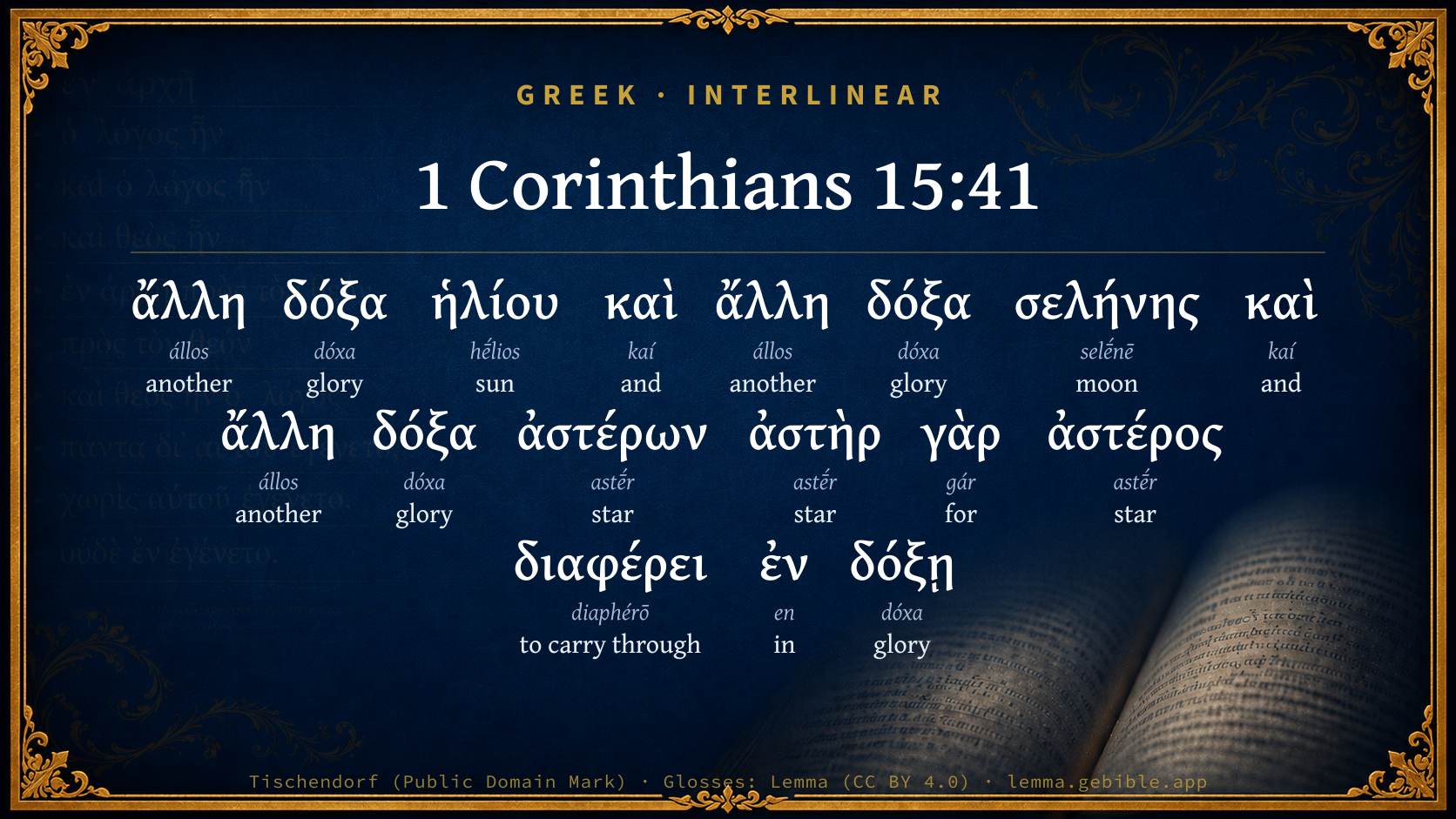
  1. ἄλλη állos G243 “another” Adjective, Nominative, Singular, Feminine
  2. δόξα dóxa G1391 “glory” Noun, Nominative, Singular, Feminine
  3. ἡλίου hḗlios G2246 “sun” Noun, Genitive, Singular, Masculine
  4. καὶ kaí G2532 “and” Conjunction
  5. ἄλλη állos G243 “another” Adjective, Nominative, Singular, Feminine
  6. δόξα dóxa G1391 “glory” Noun, Nominative, Singular, Feminine
  7. καὶ kaí G2532 “and” Conjunction
  8. ἄλλη állos G243 “another” Adjective, Nominative, Singular, Feminine
  9. δόξα dóxa G1391 “glory” Noun, Nominative, Singular, Feminine
  10. ἀστέρων astḗr G792 “star” Noun, Genitive, Plural, Masculine
  11. ἀστὴρ astḗr G792 “star” Noun, Nominative, Singular, Masculine
  12. γὰρ gár G1063 “for” Conjunction
  13. ἀστέρος astḗr G792 “star” Noun, Genitive, Singular, Masculine
  14. διαφέρει diaphérō G1308 “to carry through” Verb, Present, Active, Indicative, 3rd person, Singular
  15. ἐν en G1722 “in” Preposition
  16. δόξῃ dóxa G1391 “glory” Noun, Dative, Singular, Feminine

About this verse

These counts appear in no published source. They are computed here, from the morphology-tagged text and Lemma’s own curated glosses. What Lemma adds →

17
words
9
distinct lemmas
Pauline Epistles
section

Notable vocabulary

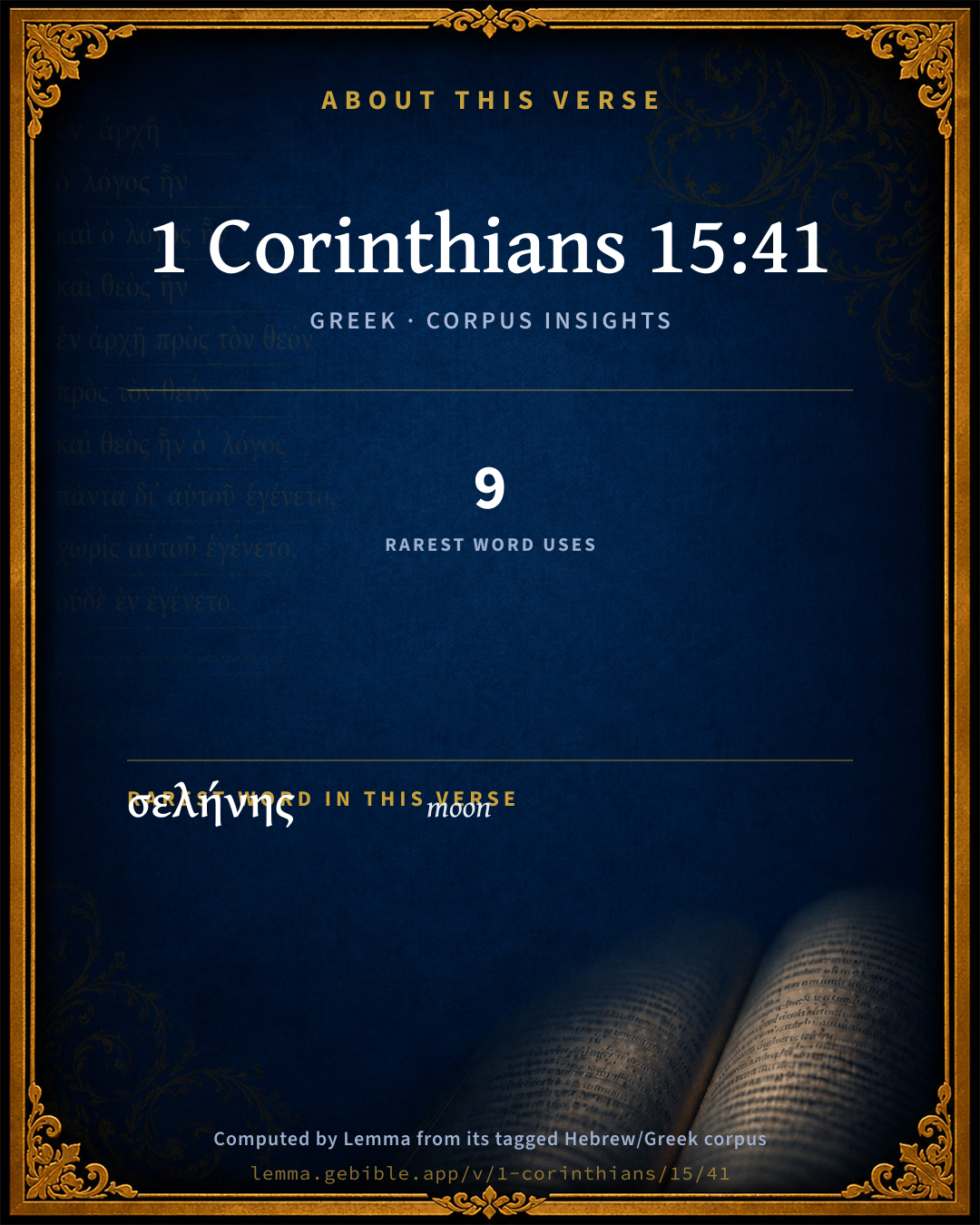
The rarest word here is σελήνης moon G4582 — appearing just 9 times in the whole Greek New Testament.

Shared distinctive vocabulary

σελήνης moon G4582 occurs in 9 verses of the Greek New Testament. Also found in:

Repetition

Words recur within this verse:

  • δόξα glory G1391 ×4
  • ἄλλη another G243 ×3
  • ἀστέρων star G792 ×3
  • καὶ and G2532 ×2

Cross-references

7

Topical passages linked to 1 Corinthians 15:41 in the Treasury of Scripture Knowledge — connected by theme and wording, ordered by reader-vote popularity; previews shown in the World English Bible.

  • Deuteronomy 4:19 and lest you lift up your eyes to the sky, and when you see the sun and the moon and the stars, even all the host of the sky, you are drawn away and worship them, and serve them, which Yahweh your God has allotted to all the peoples under the whole sky.
  • Psalms 148:3–5 Praise him, sun and moon! Praise him, all you shining stars!
  • Isaiah 24:23 Then the moon shall be confounded, and the sun ashamed; for Yahweh of Hosts will reign on Mount Zion, and in Jerusalem; and before his elders shall be glory.
  • Genesis 1:14 God said, "Let there be lights in the expanse of sky to divide the day from the night; and let them be for signs, and for seasons, and for days and years;
  • Job 31:26 If I have seen the sun when it shined, Or the moon moving in splendor,
  • Psalms 8:3 When I consider your heavens, the work of your fingers, The moon and the stars, which you have ordained;
  • Psalms 19:4–6 Their voice has gone out through all the earth, Their words to the end of the world. In them he has set a tent for the sun,

Cross-references courtesy of OpenBible.info (CC BY 4.0).

Commentary

Notes on 1 Corinthians 15:41 from classic Christian and Jewish commentators (each source and its license shown beneath its notes). The classic Christian expositions comment on the surrounding passage and are grouped to its opening verse, so a note may address several verses; the Jewish commentaries on the Tanakh (Rashi and others) are per-verse, so they appear only where the commentator wrote on this verse.

Lemma curates 59 commentaries, every one of them public domain or Creative Commons licensed, each selected and text-cleaned for this edition rather than reprinted as found. About our sources →

The Biblical Illustrator

Joseph S. Exell

1Co_15:41-42

There is one glory of the sun, and another glory of the moon.

Degress of glory in heaven

I. What this means. That as the Lord has displayed His mercy and His love to holiness, by rewarding a short and imperfect obedience by an eternal glory, so it is accordant with these perfections to confer higher degrees of this glory on those whose obedience has been more constant, and piety more ardent. While we maintain this--

1. We allow that all will nevertheless be perfectly happy, according to their faculties and power of enjoyment.

2. We also maintain that in many things their felicity will be common. It will be common in--

(1) Its object, the blessed God and adorable Redeemer.

(2) In its subject, all the powers of the glorified body and soul.

(3) In its duration, which will be eternal.

(4) In its security, since all the blest are sustained by the Divine promise and faithfulness.

(5) In the full satisfaction of soul which all will possess.

II. This is proved--

1. By Scripture.

(1) By all those passages which lay down, in general terms, the great role of Gods proceedings with the children of men (2Co_5:10; Rom_2:6; 2Co_9:6; Gal_6:7-9).

(2) From the account which Paul gives of the different rewards which will be given to the ministers of the gospel (1Co_3:12-15). In this representation there are persons who obtain salvation, and yet have not the recompense which the wiser administrators of the Word receive. And therefore we conclude that there will be the same difference between hearers, according to the manner they have profited.

(3) From Dan_12:3. As there is a difference between the general brilliancy of the firmament and the lustre of the stars, so there shall be a difference between those ordinary Christians who obtain felicity and those zealous persons who have been the instruments of the conversion of many sinners.

(4) From the parable of the pounds (Luk_19:1-48.).

(5) From those passages where we find the patriarchs, the prophets, and the apostles represented as occupying a more conspicuous situation in glory than ordinary believers (Mat_8:11; Mat_19:28; Luk_22:30).

2. From analogy. Look at--

(1) Nature. In what an infinite variety of methods do you see the Creator displaying His perfections!

(2) The operations of grace. There are diversities of gifts, though but one Spirit.

(3) Christians. How various their attainments, knowledge, holiness, and joy, though all beloved by God!

(4) The heavenly host. Though all holy and happy, there are archangels, and angels, thrones, dominions, principalities, and powers.

3. From the transactions of the judgment-day, and the nature of the future felicity (Mat_25:1-46.).

III. The objections that have been made against it.

1. Perhaps the most plausible has been drawn from the parable of the labourers in Mat_20:1-15. But how can the reward signify eternal life, since it is given to the murmurers and envious (verse 14). The design of the parable is to repress the pride of the Jews, and show the propriety of the vocation of the Gentiles. It has no reference whatever to future reward.

2. Are not all believers, through the merits of Christ, alike justified and adopted, and must they not therefore be alike glorified? But do the blessings of God spring less from grace because He has established a wise order in the distribution of them? There are different degrees of holiness and comfort enjoyed by Christians upon earth; then, there may be different degrees of glory in the world to come. The objection is precisely as strong against a difference in sanctification as against a difference in glorification.

3. As all the blessed are perfectly holy, they must all be perfectly and alike happy. The conclusion by no means follows. Are the angels alike elevated because they are all perfectly holy? We know that there are distinctions among them. If two diamonds are of the same water and perfection does it follow that there may not be a difference in their weight and value?

4. They all derive their felicity from the same source, the beatific vision of God, and therefore their felicity most be equal. But may we not view the same sun, and receive its rays differently? When vessels of capacity cast into the same ocean are filled by the same mass of waters, must the quantity they receive be alike?

5. The titles given to the redeemed are the same; they are all called kings, the sons of God, the spouse, the members of Christ. And are not these names given to believers on earth, and, notwithstanding, do we not see a great diversity among them? Are all kings equal in power? Have all sons the same inheritance? Have all members of the body equal honour? (H. Kollock, D.D.)

Diversity in the heavenly inhabitants

Such a variety is--

I. A fact well sustained.

1. By all analogy. No two objects are exactly alike. This variety reveals the illimitable inventiveness of the Divine mind, and gives to the universe its freshness and charm.

2. It meets the instinctive love for the new in human souls. All souls loathe monotony. A dead uniformity would crush out its life.

3. It agrees with the varieties found amongst men here. No two minds are alike. Is it conceivable that in the higher world all souls will run into a common mould?

4. It accords with the general teaching of the Scriptures. Paul speaks of the temple of the good as composed of gold, silver, and precious stones. Christ refers to Abraham, Isaac, and Jacob as sustaining the most honourable positions at the heavenly feast.

II. Essential to social blessedness. Suppose a society, all of whose members shall be exactly alike in temperament, experience, attainments, modes of thought, and forms of expression. Why, such a state of things would be incompatible, not only with social enjoyment, but with social life. The monotony would become intolerable. The utmost variety in speculative thought is compatible with unity of heart; and the larger variety in spiritual temperament and conception in any circle--where all hearts are one--the higher the social enjoyment. Most unwise, most impious have been the attempts to force on all men the same system of thought and form of worship.

III. Consistent with the highest unity. Whatever variety in the stars--

1. They have one centre. Some larger, some smaller, some dimmer, some brighter, some moving more quickly, and some more slowly, yet all move round the same central orb: so with sainted souls. Whatever their diversities, they revolve round one great centre--God.

2. They are controlled by one law. Attraction moves all, regulates all, keeps each in its place and speed. One law, the law of love, rules all sainted souls above, however illimitable their varieties,

3. They fulfil one mission. They all catch the light from the central orb, and flash their borrowed radiance abroad through all their spheres. So with souls above. They are all the recipients and reflectors of Divine light and love. (D. Thomas, D.D.)

Identity and variety

Note--

I. The idea of identity and variety ministering to each other.

1. St. Paul bases the argument for immortality upon the richness and splendour of this mortal life. Often have men made heaven a compensation for the woes of earth; St. Paul makes it not a compensation, but a development. How much nobler is this! For he who finds the manifold glories of this mortal life to be the symbols of immortality, will always be led to live this life as intensely and profoundly as he can, in order that the higher life may become real and attractive to him.

2. Identity and variety express the tone and feeling which life demands. Identity is sound, solid, and substantial; variety is vital, interesting, and novel. To quicken identity with variety, to steady variety with identity, is to make a man always keep himself and yet always feel the power of new conditions around him. Think of the best men you have known, and you will find in them these qualities in their highest union.

3. See how largely this union pervades the universe, and how, wherever it appears, it gives richness and depth.

(1) Take nature. Lark and lily, sunbeam and cloud, river and mountain, ocean and land; it takes but the most elementary knowledge to feel the oneness of them all; still all our senses are tingling with the tidings of their differences that they are always sending to us.

(2) Take the history of man. This cannot be rightly understood unless illumined by this double truth. Ages come and go, each stamped with its own character. There are ages of war and ages of peace, centuries of thought and centuries of action, etc., etc. Each has its own glory. In the eyes of the inhabitants of each it seems as if all other times were inglorious. We rejoice in the nineteenth century; but greater is the sum of all centuries, this ever changing life of man. The ages of the cloisters and castles, of dreams and of mysteries, are all needed; each of them, while it is different, may be proud of all the rest.

(3) So with nations. England, France, America--each is a living being with a character unlike all the others, and yet bearing a true identity with them because both it and they are made up of men, and have shaped all their ways and institutions out of the needs of the same old manhood, living on the same old earth. Nations, like children, match themselves with each other, and are as apt to envy or contemn others as they are great or small; but Palestine, Greece, Rome, America, or England, who can decide which is greater? There is one glory of the sun, etc.; and, altogether, they fill the radiant sky.

(4) Take the occupations of mankind. Three men are close together in the street; one of them makes shoes, another writes books, another is the mayor. It is foolish and false to say that there is no rank or precedence here. One of them demands higher powers and education than the others. It is perfectly right that the shoemaker, if he has power to rise, should leave his bench and write a book, or become mayor. But there are other truths besides this.

(a) That each of these arts has its own absolute standard, its own good or bad ways of doing its own work.

(b) That each art, so far as it lives up to its own standard, becomes a true utterance of the universal human nature, which gets its value from the fact that it is at once identical with and different from all other utterances. These truths make the richness and harmony of all active life.

(5) And so with men. We have the greatest varieties of man, the thoughtful or the active, the Conservative or the Radical, etc.; but below all men are men, and every man is man. If variety fails, mankind is a great dreary, undistinguishable monotony; if identity fails, mankind is a great tumult of confused and inharmonious particles. How unchristian either of these views is the Incarnation teaches. Christ is at once the inspiration of the individual and the assertion of the identity of man. He is the revealer of the Fatherhood of God, and thus builds mankind into a family where each is distinct and yet all are one.

II. Its consequences, and the sort of life and character it will make in him who entertains and accepts it.

1. It will produce self-respect. Here are you, seemingly insignificant, yet--

(1) You are a different creature from any that the world has ever seen.

(2) You are a branch of the tree of life from which sprang Isaiah and St. John. God forbid if you are really a sun and not a star, that any compulsion of your fellow-men should keep you in the stars place, and shut you out of the suns. But you do know yourself; you are a star, and not a sun; your place is subordinate, secondary. What then? If you do your work with perfect faithfulness, you are making just as genuine a contribution to the substance of the universal good as is the most brilliant worker. It is the fable of the mountain and the squirrel: If I cannot carry a forest on my back, neither can you crack a nut. There is one glory of the sun, etc.

2. Respect for others is bound up in such self-respect as this. The philanthropist, all eager to set right the world, is apt to become furious at the sight of the scholar; and the scholar, in his turn, is ready to despise the bustling restlessness of the man who is for ever organising committees, petitioning legislators, and screwing up the loosened machinery of charity. There is one glory of the sun, etc. Surely it must be possible for men to be devoted to their own work and yet thankful for the work which other men are doing, which they can neither do nor understand. All things are yours, and you are Christs, and Christ is Gods.

3. This truth may also apply to the different degrees and conditions in which our own lives are passing. You and I are this to-day; to-morrow or the next year we may be something quite different. To-day we may be insignificant, to-morrow or the next year we may be prominent, or vice versa. How shall we look upon this uncertainty of human life? Let us look upon each as a distinct thing, with its own values and meaning, and yet feel how our human life may still be the same, ever spreading itself out to larger things. This harmonises everything. Conclusion: To Paul this truth was a proof of immortality. He would have men live upon earth, yet conscious of their capacity for heaven. Is not that what we want--the life of earth now, the life of heaven by and by, each clear with its own glory, and our humanity capable of them both? We must not lose either of them in the other. We must not be so full of hope of the future that we cannot do our daily work here upon the road. We must not be so lost in dull work on the earth that we shall not be perpetually inspired by the hope of heaven. (Bp. Phillips Brooks.)

Death and the grave the physical preparation for the perfect humanity of the resurrection state

A dewdrop, so says the Oriental fable, hung on a rose leaf. It was a summer morning; and delighted with itself and the calm loveliness around, it could have hung there for ever. But, alas! it soon fell to the ground. What a change! Earth for the bright sky, and darkness for the ten thousand hues of natures loveliness! But through its dark prison-house in the earth it gradually passed till it reached a river, by which it was conveyed to the ocean; and there, deposited in one of its rocky cavities, it became a brilliant and costly gem. In due course the hand of man reached it; and from its long rest in isolation and darkness, it was taken, polished, and set in gold--finally terminating its career by occupying the place of honour in the very diadem of majesty itself! Such is the fable which illustrates the principle of development affirmed here. It doth not yet appear what we shall be, etc. Our connection with this world is very insecure, and in a moment that connection may be dissolved. We hang like the dew-drop on the odorous petals of the rose; and some of us, perchance, would be willing to hang there for ever. But a touch suffices to loosen the attachment, and downwards we are carried to the darkness of the earth. Are we then extinguished? Far from it; we have only passed from one domain of creative instrumentality to another. The river of God will bear us to the ocean at length. There our resting-place shall be provided; but from the secret recesses of the spirit-world we shall emerge again, like a gem of purest water and costliest price, to adorn the diadem of the King of kings. The apostle asserts that this principle of development universally prevails throughout nature, and that the glory of mundane arrangements is mainly dependent upon it. Childhood has its glory; so has youth; so has mature manhood; so even has old age; and when man reappears at the resurrection, it will be to supply another illustration. As sun, moon, and stars all differ from one another in glory, so will the risen and immortal man be distinguished from man fallen and immortal.

I. All the redeemed are on their journey towards mental and corporeal perfection; and all the phenomena of the present life have a bearing on that destiny. There are two preliminary stages of human existence--the first beginning at birth and ending at death, the second commencing with death and terminating at the resurrection. Everything in the universe proceeds by steps. The acorn does not bound in an instant to the dimensions of the full-grown oak. Why should not man, therefore, the most wonderful of all Gods works, be Divinely carried through many preliminaries? Before birth man passes through various stages of development, and could we but realise our arrival at physical perfection, and take, in connection with that, the certainty that every stage and event going before contributes towards it, we world be much more patient under trials. The afflictions of the present life, being temporary, will soon pass away; but the obedient submission to the will of God, the compassion for the afflicted, and the other virtues which they have fostered and brought to maturity, are permanent improvements in our character, and may be needed even in eternity. So in the intermediate state influences are at work upon both which bear with prodigious force on our final perfection. What we shall be in eternity is as much the result of causes operating there, as the full-grown man is the product of the causes which carry the infant from childhood to maturity. Such reflections ought to mitigate the fear of death, and comfort all mourning friends.

II. We may arrive at some explanation of the fact itself.

1. The Shorter Catechism, in answer to the question, What benefits do believers receive from Christ at death? says, The souls of believers are at their death made perfect in holiness, and do immediately pass into glory; and their bodies, being still united to Christ, do rest in their graves till the resurrection. The body, although left behind to decay, is not forgotten; it is still united to Christ. The living Christ in heaven regards it, even then, as part of His spiritual body … not dead, but only sleeping, and by that repose preparing for the awakening of the resurrection day. And as, when children or other loved ones go to rest, care is taken to provide a place of security for them, and, if need be, a guard set; over their slumbers, so, we may be sure, there is a special superintendency of the dead, with a view to prepare for what is to come. The crooked may be made straight, the defective supplied, the hideous made beautiful. And who is to affirm that there may not be influences in nature quite competent to produce this result? The acorn has a wonderful power of extracting such substances from the earth as are fitted to constitute an oak; and so is it with every other seed. Nay, it is within the competency of science and skill greatly to modify and improve the various products of the vegetable creation. There are chemical affinities also whose operation can exhibit the most extraordinary changes. What is so cheap and worthless as a piece of charcoal; what so precious as a diamond?--and yet in constitution they are absolutely identical. The grave may thus become the alembic in which the clay of mans fallen humanity is transmuted into the gold of the kingdom of heaven.

2. Then again the believer is a temple of the Holy Ghost. The effect of this is to consecrate the body, or to make it holy. Why, then, should we imagine that the Holy Spirit should maintain His union with the soul, and abandon altogether the body? The separated spirit cannot but think much and often of its ancient and close companion, and God the Spirit cannot possibly be divorced from any member or fragment of that temple wherein He had a loved abode. (J. Cochrane, A.M.)

The Biblical Illustrator, edited by Joseph S. Exell (c. 1880s–1900s) — public domain. Text from a community e-Sword module.

Whedon's Commentary on the Bible

Daniel D. Whedon

41. Glory—Visible splendour. The splendours of the luminaries differ in intensity, magnitude, and colour. Against the doctrine of a resurrection it is argued that our bodies are now in a continual process of change; so that, even here, our very material sameness is not a literal, but a successional and historical one. Yet, we reply, this molecular succession is, in fact, now most carefully maintained unbroken; so that the historical continuity and sameness can be traced and sworn to. The murderer of twenty years ago, in spite of all organic changes, is hung to-day. This man at seventy is husband of the wife he married at twenty-five, and heir of the patrimony he inherited in infancy. But we never in life drop our whole body to-day, pass a bodiless period, and then take a whole new body. Nor then would the new body be the same as the old. In order to be the same body next year, the reconstructor must go back and take up the material of the old body into the new. And so in the resurrection, the reorganizer must go back and take up the body that died; otherwise, the successional historical identity which exists in our present life, and which is quoted as a precedent, is wholly abolished.

Dr. Poor theorizes that the “plastic principle” may, at the resurrection, “assimilate new materials of a wholly different kind” from those in our present bodies. What demand for such a supposition? For, 1. There is not known to science, or demanded by reason, any other “plastic principle” than an omnipresent divine power, working under forms of law and finite causations. As Paul says, God giveth it a body as it hath pleased him, yet in accordance with the laws of resurrection. 2. When the undressed soul appears before God on the morning of the resurrection, it is by divine power that from somewhere in the wide universe, the particles should gather in accretion upon the soul, to form its body. Now why is it not quite as easy for divine power to order the coming of that set of particles which formed the old body as any other? What demand from science, reason, or Scripture for any new materials? Nay, that divine power may establish such affinity between the soul and the particles of the old organism that it may attract them to itself by a process as truly natural as that by which a magnet draws a mass of iron filings to itself.

Otherwise there is no resurrection, but a new creation and a substitution. The real debate is not between “two theories of the resurrection,” but between the resurrection and something else that is not a resurrection. An anastasis (resurrection) of the dead is an uprising of the body from its fallen position in death, and, normally, the grave. That is the very meaning of the word. And it is that which down-fell which must uprise, and not something else. Or, if it is called in the New Testament an egersis, it is an upraising. What is it that is upraised unless the previous body, the body that fell, and that now lies a prostrate corpse? There must be no legerdemain about it; no slipping in a supposititious body; no substitution; no new creation “out of new materials of a wholly different kind.” If either of those things takes place, it is no resurrection at all, and the doctrine of the resurrection is wholly denied.

This realistic identity is absolutely required by Scripture. Daniel tells us (Dan_12:2) that they “that sleep in the dust of the earth,” which can be no other than the buried corpses, “shall awake.” Our Lord, almost quoting Daniel’s words, says that it is “they that are in the graves,” which can again mean only the entombed corpses, that “shall come forth.” Joh_5:28-29. Wherever death is called a sleep it is the body (certainly not the soul) that is conceived to sleep, and the resurrection is the awakening of that same body. Our Lord’s resurrection—the pattern and model for all—was of his same body from the tomb. In his transfiguration, by which he was assimilated to the resurrection body of Moses and Elijah, that self-same body rose into the resurrection state, and then subsided into its ordinary conditions; unchanged in material throughout. In the change of 1Co_15:51-52 it is this same mortal body; and the change is simply its putting on immortality.

If by divine law there may be a fixed affinity between the soul and its last investiture, that law can secure that the same material shall never be organic in two bodies at death; just as a secret law secures the equality in number of the two sexes.

This modern unscriptural pseudo-resurrection is a Gnostical one. It has “an ignorance of God,” doubting his power to raise the same body. It has the Gnostic abhorrence of matter, demanding “new materials of a wholly different kind,” known as matter now. But it does not deny a future life, like the errorists whom Paul corrects; and so does not shake the foundations of Christianity.

Meyer quotes from Tertullian the following notes as a caution to over-brilliant commentators, 1Co_15:40 : One flesh of men, that is, servants of God; another of beasts, that is, the heathen; another of birds, that is, the martyrs; another of fish, to whom belongs the water of baptism! Also, 1Co_15:41.

There is one glory of the sun—Christ; of the moon—The Church; of the stars—The seed of Abraham.

Daniel D. Whedon (gen. ed.), Commentary on the Old and New Testaments (1874–1909) — public domain. Text from a community e-Sword module.

Bengel's Gnomon

Johann Albrecht Bengel

1Co 15:41. Ἀστὴρ γὰρ, for one star) For intensive. Not only have the stars a glory differing from that of the sun and moon, but also, what is more to the point, one star often surpasses another star in brightness. There is no star, no glorious body that has not some decided point of difference from another.

Bengel's Gnomon of the New Testament — English translation (T&T Clark, Edinburgh, 1860) — public domain. Text from a community e-Sword module.

Expositor's Greek Testament

ed. W. Robertson Nicoll

1Co 15:41 . Even amongst the σωματα ἐπουράνια there are varieties, just as amongst the ἐπίγεια (1Co 15:39 ), such as are indicated by the diff [2518] of aspect in the visible celestial objects: “There is one glory of sun, and another glory of moon, and another glory of stars for star differs from star in glory”. While these luminous orbs are not to be identified with the “heavenly bodies” of 1Co 15:40 (see note), they serve to symbolise the diversity of glory amongst them; all are glorious, but in degrees. ἄλλη , as in 1Co 15:39 (contrast 1Co 15:40 ), indicates diff [2519] within the same order. The frequent symbolic association of sun and stars with God, the angels, the righteous , and with the glorified Jesus , may account for the asyndetic transition from 1Co 15:40 b (signifying persons ) to 1Co 15:41 . From the distinctions manifest amid the common glory of the visible heavens we may conjecture corresponding distinctions in the heavenly Intelligences and in the bodies appropriate to them.

[2518] difference, different, differently.

[2519] difference, different, differently.

1Co 15:42-49 . § 55. THE FIRST ADAM AND THE LAST. The Ap. has now removed à priori objections, and brought his theory of bodily resurrection within the lines of natural analogy and probability of reason. He has at the same time largely expounded it, intimating (1) that the present is , in some sense, the seed of the future body , and (2) that the two will differ as the heavenly must needs differ from the earthly . He goes on to show that this diff [2520] has its basis and pattern in the diff [2521] between the primitive Adam and the glorified Christ , who are contrasted in condition (1Co 15:42 b , 1Co 15:43 ), in nature (1Co 15:44 ff.), and in origin (1Co 15:47 ff.).

[2520] difference, different, differently.

[2521] difference, different, differently.

The Expositor's Greek Testament, edited by W. Robertson Nicoll (1897–1910) — public domain. Text from a community e-Sword module.

Hodge's Commentary on Romans, Ephesians & First Corinthians

Charles Hodge

1Co_15:41

(There is) one glory of the sun, and another glory of the moon, and another glory of the stars; for (one) star differeth from (another) star in glory.

Not only do the heavenly bodies differ from the earthly bodies in glory, but there is great diversity among the heavenly bodies themselves. How different is the sun from the moon, the moon from the stars, and even one star from another. Standing, therefore, as we do in the midst of this wonderful universe, in which we see matter in every conceivable modification, from a clod of earth to a sunbeam, from dust to the lustre of the human eye, how unutterably absurd is it to say that if we are to have bodies hereafter, they must be as gross, and heavy, and as corruptible as those which we have now.

Charles Hodge — Commentary on Romans (1835), First Corinthians (1857), and Ephesians (1856) — public domain. Text from a community e-Sword module.

Jamieson, Fausset & Brown

Robert Jamieson, A. R. Fausset & David Brown

one glory of . . . sun . . . another . . . of . . . moon--The analogy is not to prove different degrees of glory among the blessed (whether this may be, or not, indirectly hinted at), but this: As the various fountains of light, which is so similar in its aspect and properties, differ (the sun from the moon, and the moon from the stars; and even one star from another star, though all seem so much alike); so there is nothing unreasonable in the doctrine that our present bodies differ from our resurrection bodies, though still continuing bodies. Compare the same simile, appropriate especially in the clear Eastern skies (Dan 12:3; Mat 13:43). Also that of seed in the same parable (Mat 13:24; Gal 6:7-8).

Jamieson, Fausset & Brown — Commentary Critical and Explanatory on the Whole Bible (1871) — public domain (CC PDM 1.0). Text via the HelloAO Bible API.

Adam Clarke's Commentary

Verse 41. There is one glory of the sun] As if he had said: This may be illustrated by the present appearance of the celestial bodies which belong to our system. The sun has a greater degree of splendour than the moon; the moon than the planets; and the planets than the stars. And even in the fixed stars, one has a greater degree of splendour than another, which may proceed either from their different magnitudes, or from the comparative proximity of some of them to our earth; but from which of these causes, or from what other cause unknown, we cannot tell, as it is impossible to ascertain the distance of any of the fixed stars; even the nearest of them being too remote to afford any sensible parallax, without which their distances cannot be measured. See the concluding observations.

Adam Clarke's Commentary on the Bible (1810–1826) — public domain. Text from a community e-Sword/MySword module.

Ellicott's Commentary for English Readers

(41) For one star . . .—Better, for star differeth from star in glory. It is not only that the heavenly bodies differ from earthly, but they differ from each other—sun from moon, moon from stars. And there is a further variety still—even amid the stars themselves there is variety. The word “glory” is naturally used as intimating the aspect in which the difference of the heavenly bodies strikes us, looking at them from earth. The God who is thus not limited to a monotonous form for the substance of which Physical Nature consists, need not be in any difficulty as to some other variety of form for Human Nature beyond that which we see it confined to during its earthly life.

A Bible Commentary for English Readers, edited by Charles John Ellicott (1878–1897) — public domain. Text from a community e-Sword module.

The Cambridge Bible for Schools and Colleges

gen. ed. J. J. S. Perowne

41. There is one glory of the sun, and another glory of the moon] The argument is pushed a step farther. The celestial bodies are not all alike. They differ in beauty and excellency. And so to all eternity it shall be true of men raised and in possession of their heavenly bodies, that ‘one star differeth from another star in glory.’ So Chrysostom on 1Co_15:38. “Augustine elegantly says, ‘splendor dispar: cœlum commune.’ ” Wordsworth. An erroneous interpretation of St Mat_20:10 has led some to the conclusion that all rewards shall be exactly alike in the world to come. As the Apostle here shews, the analogy of nature makes against this in every way. And the passage just cited has reference not to the equality of rewards, but of the principle on which such rewards are given. The labourer is rewarded, not for length of service, but for the spirit in which that service has been rendered.

The Cambridge Bible for Schools and Colleges (gen. ed. J. J. S. Perowne; Cambridge University Press, 1878–1918) — public domain. Text from a community e-Sword module.

John Gill's Exposition

It is sown a natural body,.... Or an animal one, being generated as animals are, and supported with food as they be, and die at last as they do: see Ecc 3:19.

It is raised a spiritual body; not as to substance, but as to its quality; it will not be changed into a spirit; our Lord's risen body, to which ours will be conformed, was not a spirit, but, as before, consisted of flesh and bones: but the body will then be subject to the spirit and soul of man; it will be employed in spiritual service, for which it will be abundantly fitted and assisted by the Spirit of God; and it will be delighted with spiritual objects; it will be like the angels, those excellent spirits; it will live as spirits do, without natural helps and means, as meat, drink, clothes, sleep, and, as they, will never die:

there is a natural; or "animal body", such as the first man's was, and those are that descend from him by ordinary generation; and

there is a spiritual body; such as the body of Christ now is, and as will be the bodies of the risen saints; the phrase is Jewish, , "the spiritual body" (y) and the flesh of the righteous, being , "spiritual flesh" (z), are to be met with in their writings.

(y) Nishmath Chayim. fol. 37. 1. (z) Tzeror Hammor, fol. 9. 4.

John Gill's Exposition of the Whole Bible (1746–1763) — public domain (CC PDM 1.0). Text via the HelloAO Bible API.

Trapp's Complete Commentary

John Trapp

41 There is one glory of the sun, and another glory of the moon, and another glory of the stars: for one star differeth from another star in glory.

Ver. 41. One star differeth, &c.] The morning star is said to cast a shadow with its shine. "Canst thou bind the sweet influences of the seven stars?" Job 38:31, whose work is to bring the spring, and which, like seven sisters or lovers (as the word signifies), are joined together in one fair constellation. Or "loose the bands of Orion?" the star that brings winter, and binds the earth with frost and cold. "Canst thou bring forth Mazzaroth," the southern constellations? "Or canst thou guide Arcturus with his sons," that is, the northern stars, those storehouses of God’s good treasure, which he openeth to our profit? Deu 28:12.

John Trapp, A Commentary or Exposition upon All the Books of the Old and New Testament (1647–1656) — public domain. Text from a community e-Sword module.

Albert Barnes' Notes on the Bible

There is one glory of the sun ... - The sun has one degree of splendor, and the moon another, and so also the stars. They differ from each other in magnitude, in brightness, in beauty. The idea in this verse differs from that in the former. In that 1Co 15:40 Paul says, that there was a difference between the different classes of bodies; between those in heaven and those on earth. He here says, that in the former class, in the heavenly bodies themselves, there was a difference. They not only differed from those on earth, but they differed from each other. The sun was more splendid than the moon, and one star more beautiful than another. The idea here is, therefore, not only that the bodies of the saints in heaven shall differ from those on earth, but that they shall differ among themselves, in a sense somewhat like the difference of the splendor of the sun, the moon, and the different stars. Though all shall be unlike what they were on earth, and all shall be glorious, yet there may be a difference in that splendor and glory. The argument is, since we see so great differences in fact in the works of God, why should we doubt that he is able to make the human body different from what it is now, and to endow it with immortal and eternal perfection?

Albert Barnes' Notes on the Bible (1834–1885) — public domain. Text from a community e-Sword/MySword module.

Matthew Poole's English Annotations

Amongst the celestial bodies there is a great deal of difference with respect to the qualities; one of them is in glory much differing from another, the glory of the moon is not like the glory of the sun, and the glory of a star is much beneath the glory both of the sun and of the moon; yea, one star is more glorious than another: yet they are all bodies, though of different species and qualities.

Matthew Poole's English Annotations on the Holy Bible (1683–1685) — public domain. Text from a community e-Sword/MySword module.

The Pulpit Commentary

There is one glory of the sun. "Then shall the righteous shine forth as the sun". (Mat_13:43) The point of the illustration is the difference between the earthly and the resurrection body; not the supposed differences between the saints themselves in glory. This is not a question under consideration, and St. Paul, as we have seen, is not in the habit of mixing up half a dozen different questions in the same immediate argument. St. Augustine says of the saints, "Their splendour is unequal; their heaven is one." This may be very true, but to deduce it from this verse is to press into the argument an illustration used for another purpose. Tertullian"s comment is very unhappy. He makes "men" mean servants of God; "beasts," Gentiles; "birds," martyrs; "fishes," those who have been baptized; the "sun," Christ; the "moon," the Church, etc. One star differeth from another star in glory. All the righteous shall shine as "the brightness of the firmament and... as the stars forever and ever", (Dan_12:3) and their future bodies shall differ from their present, as one star differs from another.

Diversity in the heavenly inhabitants.

star differeth from another star in glory." The idea of Paul unquestionably is that there is as great a variety amongst redeemed men in the celestial world as there is in the orbs of heaven, that saint differs from saint as star from star in the midnight vault. We offer three remarks on this subject. Such a variety is

I A FACT WELL SUSTAINED.

1. It is sustained by all analogy. Variety reigns through every part of nature, not only in celestial, but in terrestrial spheres. No two objects are exactly alike. This variety reveals the illimitable inventiveness of the Divine mind, and gives to the universe its eternal freshness and transporting charms.

2. It meets the instinctive love for the new in human souls. All souls loathe monotony and crave for the fresh. A dead uniformity would crush out its life.

3. It agrees with the varieties found amongst men here. No two minds are alike here. They differ in the kind and measure of faculty, differ in the educational processes through which they have passed, differ in the positions which they occupy in relation to all objective truths and realities. Is it conceivable that all these varieties can be lost in the higher world, that all souls will run into a common mould?

4. It accords with the general teaching of the Scriptures. Paul speaks of the temple of the good as composed of gold, silver, and precious stones. Christ refers to Abraham, Isaac, Jacob, as sustaining the most honourable positions at the heavenly feast. Ay, ay, there must be varieties there. There are the speculative in mind and the practical, the imaginative and the logical, the intuitive and the philosophical; there are those who have been advancing in intelligence and power for millenniums, and those who have just commenced their heavenly studies, with those of every intervening stage. Such a variety is

II ESSENTIAL TO SOCIAL BLESSEDNESS. Suppose a society, all of whose members shall be exactly alike in temperament, in experience, in attainments, in articles of faith, in modes of thought, and in forms of expression. Could there in such a circle be any social enjoyment? What one thought, all thought; what one felt, all felt: why, such a state of things would be incompatible, not only with social enjoyment, but with social life. The monotony would become intolerable. The utmost variety in speculative thought is compatible with unity of heart; and the larger variety in spiritual temperament and conception in any circle where all hearts are one the higher the social enjoyment. Most unwise, most unrighteous, most impious, have been the attempts of ecclesiastics to force on all men the same system of thought and form of worship. Such a variety is

III CONSISTENT WITH THE HIGHEST UNITY. "One star differeth from another star in glory.

1. Whatever variety in the stars, they have one centre. Some larger, sonic smaller, some dimmer, some brighter, some moving more quickly, and some more slowly, yet all move round the same central orb: so with sainted

2. souls. Whatever their diversities, they revolve round one great centre God. God in nature and God in Christ.

3. Whatever variety in the stars, they are. controlled by one law. Attraction moves all, regulates all, keeps each in its place and speed. One law, the law of love, rules all sainted souls above, however illimitable their varieties.

4. Whatever variety in the stars, they fulfil one mission. They all catch the light from the central orb, and flash their borrowed radiance abroad through all their spheres. So with souls above. They are all the recipients and reflectors of Divine light and love.

The Pulpit Commentary (1880–1919), ed. H.D.M. Spence-Jones & Joseph S. Exell — public domain. Text from a community e-Sword module.

John Wesley's Explanatory Notes

Yea, and the heavenly bodies themselves differ from each other.

John Wesley, Explanatory Notes Upon the Whole Bible (1754–1765) — public domain. Text via the GEBible commentary corpus.

McGarvey & Pendleton's Commentaries

J. W. McGarvey

There is one glory of the sun, and another glory of the moon, and another glory of the stars; for one star differeth from another star in glory .

J. W. McGarvey (with Philip Y. Pendleton), Commentaries on the New Testament (The Fourfold Gospel, 1914; Acts; and the epistles) — public domain. Text from a community e-Sword/MySword module.

The People's New Testament

B. W. Johnson

41. The sun has its own peculiar form and glory. So of the moon, and the stars. The thought is, that to every condition is given a form suited to that condition. Now an application is made of this thought in verse 42.

B. W. Johnson's The People's New Testament with Notes (1889–1891) — public domain. Electronic text from the Christian Classics Ethereal Library (CCEL) ThML edition.

Cambridge Greek Testament for Schools and Colleges

41. ἄλλῃ. The change from ἑτέρα is not without its meaning. The glory of the various celestial bodies is the same in kind but different in degree. The glory of heavenly and earthly bodies is different in kind. So in 1Co 15:39.

δόξα ἡλίου. The argument is pushed a step farther. The celestial bodies are not all alike. They differ in beauty and excellency. And so to all eternity it shall be true of men raised and in possession of their heavenly bodies, that ‘one star differeth from another star in glory.’ So Chrysostom on 1Co 15:38. ‘Augustine elegantly says, “splendor dispar: coelum commune.” ’ Wordsworth. An erroneous interpretation of Mat 20:10 has led some to the conclusion that all rewards shall be exactly alike in the world to come. As the Apostle here shews, the analogy of nature makes against this in every way. And the passage just cited has reference not to the equality of rewards, but of the principle on which such rewards are given. The labourer is rewarded, not for length of service, but for the spirit in which that service has been rendered.

Cambridge Greek Testament for Schools and Colleges (Cambridge University Press, 1896; 21 vols, various authors incl. Carr, Maclear, Plummer, Farrar, Lumby, Moule, M. R. James, Simcox) — public domain. Text from a community e-Sword module.

Alford’s Greek Testament

Henry Alford

41.] This third analogy is suggested perhaps by δόξα just before. There is no allusion whatever here (as some have imagined,—even Chrys., Œcum., Theodoret, Calov., Estius, al.) to different degrees of glorification of the bodies of the blessed; the introduction of such an idea confuses the whole analogical reasoning: which is, that even various fountains of light, so similar in its aspect and properties, differ; the sun from the moon and the stars: the stars (and much more vividly would this be felt under the pure sky of the East than here) from one another: why not then a body here from a resurrection body,—both bodies, but different?

42-44 a.] Application of these analogies to the doctrine of the Resurrection.

Henry Alford, The Greek Testament (1849–1861) — public domain. Text from a community e-Sword module.

International Critical Commentary

41. ἀστὴρ γὰρ ἀστέρος κ.τ.λ. ‘I say “stars” and not “a star,” for star differs from star in glory’; the differences in light and lustre are endless. It is legitimate to apply these differences in the heavenly bodies to possible differences in the glories of the risen saints, and it is not impossible that the Apostle had this thought in his mind. See Tert. De Res. 49, 52. But his main argument is that God, who made all these known differences and connexions, may have made differences and connexions between our present and future bodies which are quite beyond our comprehension. Immense differences there are certain to be. See some excellent remarks of Origen in Jerome, Letter to Pammachius against John of, Jerusalem, 26.

International Critical Commentary — older volumes (1896–1929), various authors — public domain. Text from a community e-Sword module.

Vincent's Word Studies in the New Testament

Marvin R. Vincent

Glory [δοξα] . Lustre; beauty of form and color.

"As heaven 's high twins, whereof in Tyrian blue The one revolveth, through his course immense Might love his fellow of the damask hue, For like and difference." " - the triple whirl Of blue and red and argent worlds that mount Or float across the tube that Herschel sways, Like pale - rose chaplets, or like sapp'hire mist, Or hang or droop along the heavenly ways, Like scarves of amethyst. "Jean Ingelow," Honors. "

Herodotus, describing the Median city of Agbatana, says that it is surrounded by seven walls rising in circles, one within the other, and having their battlements of different colors - white, black, scarlet, blue, orange, silver, and gold. These seven colors were those employed by the Orientals to denote the seven great heavenly bodies : Saturn black, Jupiter orange, Mars scarlet, the sun gold, Mercury blue, the Moon green or silver, and Venus white. The great temple of Nebuchadnezzar at Borsippa was built in seven platforms colored in a similar way. See the beautiful description of the Astrologer's Chamber in Schiller's "Wallenstein," Part 1, Act 2. 4. There is no allusion to the different degrees of glory among the risen saints.

Marvin R. Vincent, Word Studies in the New Testament (1887–1900) — public domain. Text from a community e-Sword/MySword module.

Godet's Commentaries

Frédéric Louis Godet

Vv. 41. “The glory of the sun is one, and the glory of the moon another, and the glory of the stars another: for star differeth from star in glory.”

Even in the case of beings having so great a resemblance in nature (substance and form), if we observe them with some care we discover differences between one and another which attest the infinite riches of God’s work and the illimitable range of His power. What a difference between the animating splendour of the sun on a fine day and the quiet moonlight; between the calm beauty of the latter and the penetrating and pure scintillations of the stars! There are differences too between the stars themselves. The brilliance of Venus does not resemble that of Mars, nor the latter that of Jupiter; and what a difference between the planets and the fixed stars! Open your eyes, then, the apostle means to say, and as you see so many different glories shining in the heavens, you will cease to ask, as if God’s power were limited: “With what body shall they come?” You will understand how infinite are the resources of Divine power!

It has often been thought, that by stopping to describe so particularly this wide diversity of splendour, the apostle meant to allude to the difference of glory which will exist among the risen, according to the different degrees of moral perfection to which they have attained. The Fathers especially dwelt fondly on this view; see Ambrose, Chrysostom, Tertullian. This last makes the future body of God’s servants correspond to the flesh of men; that of pagans, to the flesh of beasts; that of the martyrs, to the flesh of birds; that of the Christians who have had only baptism with water, to the flesh of fishes; then the glory of Christ corresponds to the brightness of the sun; that of the Church, to the brightness of the moon; that of the Jews, to the brightness of the stars (De Resurrectione, c. 52). All this is evidently only a play of imagination. The context requires no such application; for, as is proved by the sequel, Paul proposes, by bringing as it were before the very eye the infinite resources of Divine power, to show that God can hold in reserve for His elect a body absolutely different from their terrestrial body. But, while holding exegetically by this application, the only one justified by the context, we need not deny the possibility of a purely secondary allusion to the diversity which God may be pleased to make between the bodies of the risen. As Holsten well says: “The way in which Paul emphasizes the diversity of the heavenly bodies implies the supposition of an analogous difference of glory between the risen.”

The apostle now applies the facts which have just been cited to the question under discussion: 1Co 15:42-49. And that by expounding, first, the difference of nature between the present and the resurrection body.

Frédéric Louis Godet — Commentaries on Luke, John, Romans, and 1 Corinthians — English translation (T&T Clark, Edinburgh, 1870s–1890s) — public domain. Text from a community e-Sword module.

Lesson kit

Teaching starters — assembled from the data on this page, not authored interpretation. Every prompt links to the verse data it draws on. Edit before teaching.

1 Corinthians, in the Pauline Epistles, opens this verse with 17 words (9 distinct Greek lemmas). Its most distinctive word is selḗnē (“moon”). A historical commentator’s framing appears above. Read the whole chapter for the surrounding context.

Discussion questions

  1. The word selḗnē carries the sense “moon.” How does it shape the verse?
  2. Matthew 24:29 shares the word «moon» with this verse. How do the two illuminate each other?
  3. “glory” occurs 4× in this one verse. What is the effect of the repetition?
  4. The translations on this page render this verse differently — a whole-verse word diff, not a word-by-word alignment. What might account for the different wordings?
  5. Reading how The Biblical Illustrator and Whedon's Commentary on the Bible read this verse, where do the two commentators agree and where do they part?

Things to notice

  • These translations choose different wording for 3 words in this verse.
  • “glory” occurs 4× in this single verse.
  • 9 distinct Greek lemmas span 17 words in this verse.

Reading settings

Reading text

Shown beneath each verse's original-language words.

Old Testament
Old Testament edition

Read the OT as the Masoretic Hebrew (MT) or the Greek Septuagint (LXX).

English shown for the Greek Septuagint (in the Hebrew ↔ Greek comparison).

Comparing translations? Open the Compare panel on any verse page to stack up to four side by side.