1 Corinthians 7:3

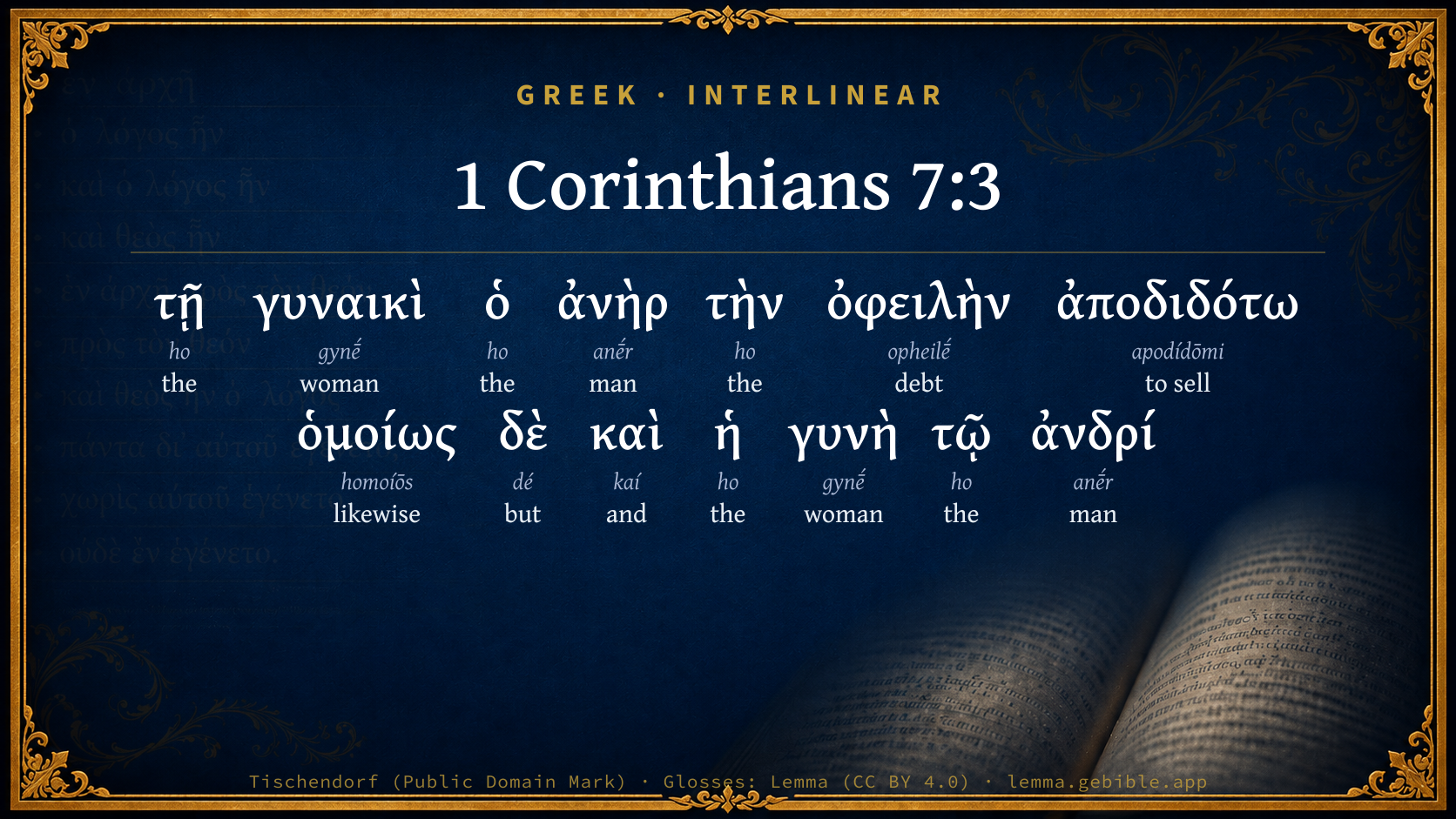
Greek (Tischendorf 8th ed.) 1 Corinthians 7:3 appears in the Greek New Testament. The text above is from the Tischendorf 8th edition. Each word links to its Strong’s number and a concise gloss. Click any word for its full Thayer’s Greek Lexicon entry.
Download image
Cite this verse

1 Corinthians 7:3 (World English Bible). Public Domain. Lemma interlinear Bible study tool, https://lemma.gebible.app/v/1-corinthians/7/3.

Show BibTeX & RIS
BibTeX
RIS
English Translation
Let the husband render to his wife the affection owed her, and likewise also the wife to her husband.
World English Bible · Public Domain
Download a study sheet

One document with this verse’s original text, its word-by-word gloss line, the meaning frame, cross-references with their text, attributed commentary, and full source and license credits — printable, and it pastes into notes with its structure intact.

This verse Autodidact and up

Study sheet (.html) Plain text (.txt)

A passage Seminary Student

Up to 50 verses in one chapter. A passage sheet keeps up to 6 commentary sources and 12 cross-references per verse, in the order this page ranks them, and says so on the sheet whenever that leaves anything out. Ask for a single verse and you get the Autodidact verse sheet above.

Everything on this page stays free to read, with no account — the sheet is a download of what is already on screen, not access to it.

Want to remove ads? Support Godless Engineer
Compare translations 3

The same verse in 3 English versions, stacked beneath the original-language interlinear above. Click any original word for its lexicon entry.

Each is an independent rendering of the whole verse — the interlinear is not word-aligned to these translations.

Highlighted words mark where these versions differ — a whole-verse word diff, not a word-by-word alignment.

  • World English Bible Public Domain
    Let the husband render to his wife the affection owed her, and likewise also the wife to her husband.
  • King James Version Public Domain
    Let the husband render unto the wife due benevolence: and likewise also the wife unto the husband.
  • unfoldingWord Literal Text CC BY-SA 4.0
    Let the husband give to the wife the duty and likewise the wife also to the husband.

unfoldingWord Literal Text — © unfoldingWord, licensed CC BY-SA 4.0. Word-aligned USFM3 via Door43 (git.door43.org/unfoldingWord/en_ult).

Versions to compare (up to 4)

3 of 4 selected

Show all 19 translations

Every available English version of this verse, each an independent rendering of the whole verse.

  • World English Bible Public Domain
    Let the husband render to his wife the affection owed her, and likewise also the wife to her husband.
  • Berean Standard Bible Public Domain
    The husband should fulfill his marital duty to his wife, and likewise the wife to her husband.
  • Majority Standard Bible Public Domain
    The husband should render the affection due to his wife, and likewise the wife to her husband.
  • King James Version Public Domain
    Let the husband render unto the wife due benevolence: and likewise also the wife unto the husband.
  • American Standard Version (1901) Public Domain
    Let the husband render unto the wife her due: and likewise also the wife unto the husband.
  • Revised Version (1885) Public Domain
    Let the husband render unto the wife her due: and likewise also the wife unto the husband.
  • Geneva Bible (1599) Public Domain
    Let the husband giue vnto the wife due beneuolence, and likewise also the wife vnto the husband.
  • Douay-Rheims (1899) Public Domain
    Let the husband render the debt to his wife, and the wife also in like manner to the husband.
  • Young's Literal Translation Public Domain
    to the wife let the husband the due benevolence render, and in like manner also the wife to the husband;
  • Literal Standard Version CC BY-SA 4.0
    to the wife let the husband render the due benevolence, and in like manner also the wife to the husband;
  • Unlocked Literal Bible CC BY-SA 4.0
    The husband should give to the wife her sexual rights, and likewise the wife to her husband.
  • unfoldingWord Literal Text CC BY-SA 4.0
    Let the husband give to the wife the duty and likewise the wife also to the husband.
  • Darby Bible Public Domain
    Let the husband render her due to the wife, and in like manner the wife to the husband.
  • World Messianic Bible Public Domain
    Let the husband give his wife the affection owed her, and likewise also the wife her husband.
  • Webster's Bible Public Domain
    Let the husband render to the wife due benevolence: and likewise also the wife to the husband.
  • Free Bible Version CC BY-SA 4.0
    The husband should meet his wife's sexual needs, and the wife her husband's.
  • Bible in Basic English Public Domain
    Let the husband give to the wife what is right; and let the wife do the same to the husband.
  • Text-Critical English NT CC BY 4.0
    The husband should fulfill his marital duty to his wife, and likewise the wife to her husband.
  • Tyndale New Testament (1534) Public Domain
    Let the man geve vnto the wyfe due benevolence. Lykwyse also the wyfe vnto the man.

Literal Standard Version (2020), Covenant Press — licensed CC BY-SA 4.0. Text via the HelloAO Bible API (eBible.org). Unlocked Literal Bible (unfoldingWord) — licensed CC BY-SA 4.0. Text via the HelloAO Bible API (eBible.org). unfoldingWord Literal Text — © unfoldingWord, licensed CC BY-SA 4.0. Word-aligned USFM3 via Door43 (git.door43.org/unfoldingWord/en_ult). Free Bible Version, Dr. Jonathan Gallagher — licensed CC BY-SA 4.0. Text via the HelloAO Bible API (eBible.org).

Word by word

More ways to search: Search by grammar → Find every occurrence → Compare this word →

Practice this passage: Drill this verse → Learn its vocabulary →

About this verse

These counts appear in no published source. They are computed here, from the morphology-tagged text and Lemma’s own curated glosses. What Lemma adds →

14
words
8
distinct lemmas
Pauline Epistles
section

Notable vocabulary

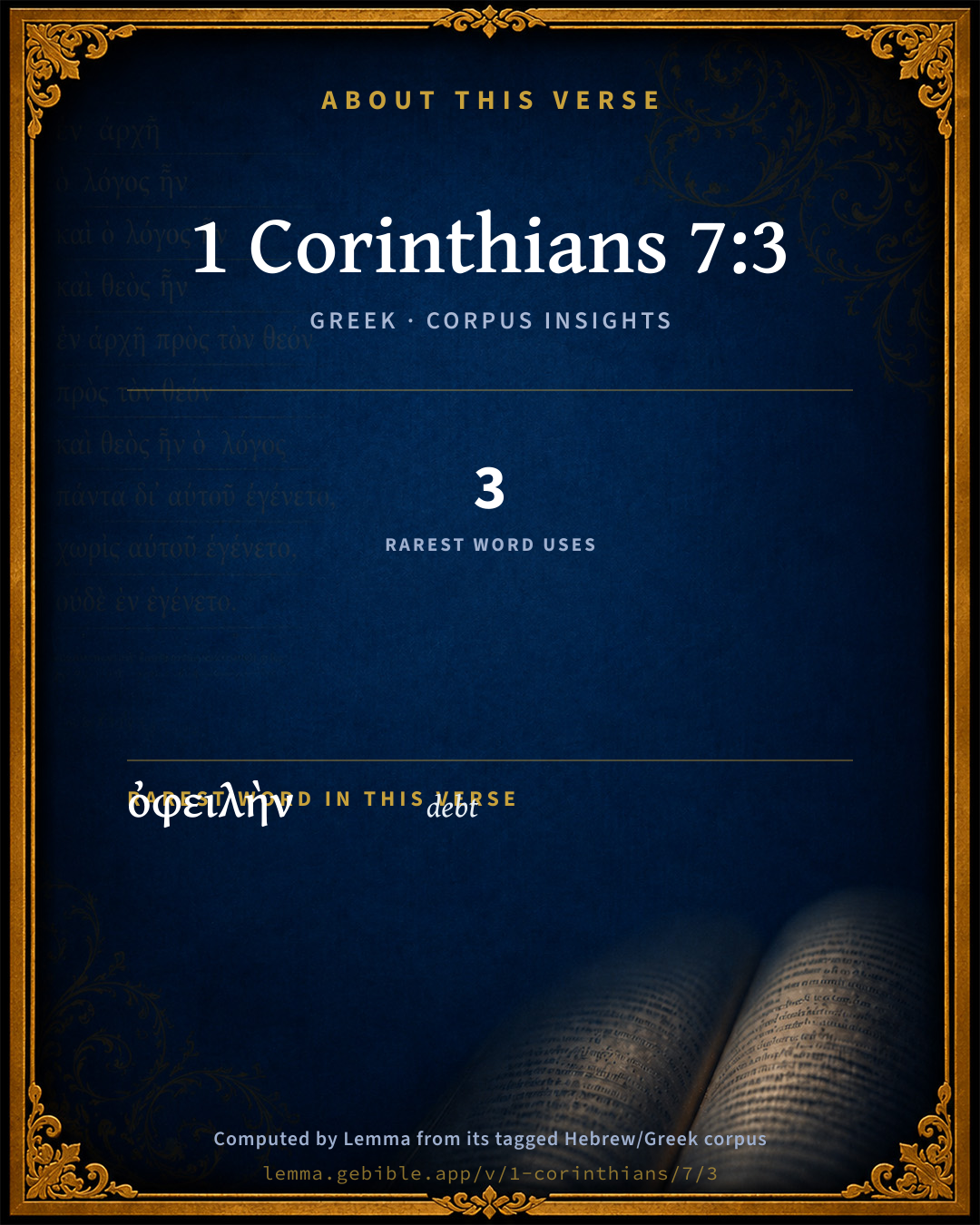
The rarest word here is ὀφειλὴν debt G3782 — appearing just 3 times in the whole Greek New Testament.

Shared distinctive vocabulary

ὀφειλὴν debt G3782 occurs in 3 verses of the Greek New Testament. Also found in:

Repetition

Words recur within this verse:

  • γυναικὶ woman G1135 ×2
  • ἀνὴρ man G435 ×2
  • τῇ the G3588 ×5

Cross-references

2

Topical passages linked to 1 Corinthians 7:3 in the Treasury of Scripture Knowledge — connected by theme and wording, ordered by reader-vote popularity; previews shown in the World English Bible.

  • 1 Peter 3:7 You husbands, in like manner, live with your wives according to knowledge, giving honor to the woman, as to the weaker vessel, as being also joint heirs of the grace of life; that your prayers may not be hindered.
  • Exodus 21:10 If he takes another wife to himself, he shall not diminish her food, her clothing, and her marital rights.

Cross-references courtesy of OpenBible.info (CC BY 4.0).

Where the printed editions differ

1 variant

Places in this verse where the major printed Greek editions disagree on the wording in a way that affects the translation — a comparison of editions, not a manuscript-by-manuscript collation. The editions are the modern critical texts (Nestlé-Aland 28/27, SBL, Westcott-Hort, Tregelles, Tyndale House) and the traditional texts behind the KJV (the Textus Receptus and the Byzantine/Majority text). It is not a claim about which reading is original.

  1. Extra text
    εὔνοιαν

    “good will”

    In TRByz Not in NA28NA27TynSBLWHTreg

    εὔνοιαν (eunoian) 'good will' is only in traditional manuscripts (TR+Byz)

Textual data: Translators Amalgamated Greek New Testament (STEPBible TAGNT) · CC BY 4.0.

Commentary

Notes on 1 Corinthians 7:3 from classic Christian and Jewish commentators (each source and its license shown beneath its notes). The classic Christian expositions comment on the surrounding passage and are grouped to its opening verse, so a note may address several verses; the Jewish commentaries on the Tanakh (Rashi and others) are per-verse, so they appear only where the commentator wrote on this verse.

Lemma curates 59 commentaries, every one of them public domain or Creative Commons licensed, each selected and text-cleaned for this edition rather than reprinted as found. About our sources →

Joseph Benson's Commentary

1Co 7:3-4. Let the husband — Where this relation is commenced; render unto the wife, Την οφειλομενην ευνοιαν, the due benevolence — That is, the conjugal duty, the duty resulting from the nature of the marriage- covenant. Or, let not married persons fancy that there is any perfection in living with each other as if they were unmarried. The wife hath not power over her own body — Namely, in this respect, but by the marriage- covenant hath transferred it to her husband. And likewise the husband hath not power over his own body; but it is, as it were, the property of the wife, their engagements being mutual; so that, on every occasion, conscience obliges them to remain appropriated to each other. “The right of the wife to her husband’s body, being here represented as precisely the same with the husband’s right to her body, it excludes the husband from simultaneous polygamy; otherwise the right of the husband to his wife’s body would not exclude her from being married to another, during her husband’s lifetime. Besides, the direction, (1Co 7:2,) let every woman have her own husband, plainly leads to the same conclusion. The right of the wife to her husband’s body is a perfect right, being founded on the ends of marriage, namely, the procreation of children, their proper education, and the prevention of fornication. But these ends would, in a great measure, be frustrated, if the wife had not an exclusive right to her husband’s person.” — Macknight.

Joseph Benson's Commentary on the Old and New Testaments (1811–1818) — public domain. Text from a community e-Sword module.

Tyndale Open Study Notes

Tyndale Open Resources

7:3-4 Because of the temptation to sexual immorality, married Christians must always be considerate of the sexual needs of their spouses. Sexual intimacy is a mutual right for both spouses in a marriage and must not be withheld. Marriage includes yielding the authority over one’s body to one’s spouse, though such authority is clearly not to be abused.

Tyndale Open Study Notes — © Tyndale Open Resources, licensed CC BY-SA 4.0. Text via the HelloAO Bible API.

Bengel's Gnomon

Johann Albrecht Bengel

1Co 7:3. Ὀφειλὴν, what is due [due benevolence, Engl. Vers.]) This is explained in the next verse. Gataker shows, that the same duty was called by the Greeks χάριν, by the poets φιλότητα. The reading of this passage, due benevolence, ὀφειλομένην εὒνοιαν, is a spurious paraphrase.[56] [ὀφειλὴν is the native (genuine) and simple reading.—Not. crit.]

[56] Ὀφειλὴν is the reading of ABCDG Vulg. fg Memph. Orig. Cypr. Ὀφειλομένην εὐνοίαν of Rec. Text is the reading of both the Syriac Versions, but of none other of the oldest authorities.—ED.

Bengel's Gnomon of the New Testament — English translation (T&T Clark, Edinburgh, 1860) — public domain. Text from a community e-Sword module.

Meyer's Critical & Exegetical Commentary

Heinrich August Wilhelm Meyer

1Co_7:3-4. The occasion for this injunction, which otherwise might very well have been dispensed with, must have been given by the statement in the letter from Corinth of scruples having arisen on the point. See on 1Co_7:1.

τὴν ὀφειλήν] the due in the matter (Rom_13:7), i.e. according to the context, as euphemistically expressed, the debitum tori.[1071] See 1Co_7:4. The word does not occur at all in Greek writers; see Lobeck, a[1072] Phryn. p. 90. Nor does it in the LXX. and the Apocrypha.

ἡ γυνὴ τοῦ ἰδίου σώμ. κ.τ.λ[1073]] Explanatory of 1Co_7:3. The wife has no power over her own body, namely, as regards cohabitation, but the husband has that power; likewise (ὁμοίως) also, on the other hand, the converse holds, so that neutri liceat alteri conjugale debitum poscenti denegare, Estius. Corresponding statements of the Rabbins may be seen in Selden, uxor. Hebr. iii. 6, 7.

Bengel says happily respecting ἰδίου, that it forms with ΟὐΚ ἘΞΟΥΣΙΆΖΕΙ, an elegans paradoxon.

[1071] If we adopted the common reading τὴν ὀφειλομ. εὔνοιαν, we should not take it, with Grotius, al., in the same sense as given above, but generally, with Calvin and others, as benevolentiam. For the expression for that special idea is not εὔνοια (not even in Philo, de Abr. p. 384), but φιλότης (Homer), μίξις, συνουσία. The author of the gloss, therefore, must either have misunderstood τὴν ὀφειλήν, or, understanding it rightly, have used a wrong expression to explain it. The reading ὀφειλομένην τιμήν in Chrysostom points to the former alternative.

[1072] d refers to the note of the commentator or editor named on the particular passage.

[1073] .τ.λ. καὶ τὰ λοιπά.

Meyer — Critical and Exegetical Commentary on the New Testament — English translation by Peter Christie, edited by Frederick Crombie (T&T Clark, 1880) — public domain. Text from a community e-Sword module.

Expositor's Greek Testament

ed. W. Robertson Nicoll

1Co 7:3-4 . Within the bonds of wedlock, “the due” should be yielded (1Co 7:3 ) by each for the satisfaction and according to the rights of the other (1Co 7:4 ). This dictum defends marital intercourse against rigorists, as that of 1Co 7:1 commends celibacy against sensualists. The word ὀφειλὴ guards, both positively and negatively, the κοίτη ἀμίαντος (Heb 13:4 ); what is due to one alone must be given to one alone ( τῇ γυναικί , τῷ ἀνδρί ). The gloss of the T.R., as old as the Syriac Version, is a piece of mistaken delicacy. The precise repetition of ὁμοίως δὲ καὶ corrects the onesidedness of common sentiment and of public law, both Greek and Jewish: she is as much the mistress of his person, as he the master of hers. ἐξουσιάζω (= ἐξουσίαν ἔχω ) implies moral power, authority ( cf. 1Co 6:12 ). τοῦ ἰδίου … οὐκ ἐξουσιάζει , “elegans paradoxon” (Bg [1008] ) his (her) own is not his (her) own.

[1008] Bengel’s Gnomon Novi Testamenti.

The Expositor's Greek Testament, edited by W. Robertson Nicoll (1897–1910) — public domain. Text from a community e-Sword module.

Godet's Commentaries

Frédéric Louis Godet

Vv. 3-5. “Let the husband render unto the wife her due, and likewise also the wife unto the husband. 4. The wife hath not power of her own body, but the husband; and likewise also the husband hath not power of his own body, but the wife. 5. Defraud ye not one the other, except it be with consent, for a time, that ye may give yourselves to prayer, and come together again, that Satan tempt you not for your incontinency.”

The reading of the T. R., due benevolence, is a paraphrase substituted for Paul’s real words, the debt, with the view of avoiding what might be offensive in the latter in public reading. This verse confirms us in the idea that among some of the Corinthians there existed an exaggerated spiritualistic tendency, which threatened to injure conjugal relations, and thereby holiness of life.

Vv. 4. This verse justifies the direction given in the preceding. By the conjugal bond, each spouse acquires a right over the person of the other. Consequently each alienates a portion of personal independence. Hence precisely the καλόν of celibacy.

Vv. 5. In this verse there is reproduced the direction given in 1Co 7:3, but in a negative form: Defraud not, to exclude expressly the contrary opinion, and at the same time to limit this prohibition, nevertheless under certain conditions fitted to remove the danger of the restriction. The interruption of the conjugal relations authorized by the apostle may take place on three conditions: 1. mutual consent; 2. temporary duration; 3. the aim of securing spiritual meditation; and the particle εἰ μή τι ἄν, unless it is, by which Paul authorizes the exception, is immediately determined by two restrictions, one of which gives it a purely contingent or doubtful (ἄν) character, the other a limited (τι) character. — To prayer T. R. adds fasting; but this is an interpolation arising from later ecclesiastical usages.

The reading συνέρχεσθε or συνέρχησθε, in the Byz. documents, instead of ἦτε, is due to the same cause as the variant of 1Co 7:3.

Among the Jews, also, it was customary to prepare by temporary separation for acts of particular solemnity (Exo 19:15; 1Sa 21:4; comp. Jos 7:13, etc.). The spirit, by asserting its dominion over the senses, becomes more conscious of its own proper life, and by this concentration on itself, opens more profoundly to the communications of the higher world.

All these restrictions are suggested to the apostle by a double fear; on the one hand, the natural incontinence of his readers (ἀκρασία from ἀκρατής, one who is not master of himself), and on the other, the working of Satan, who fans carnal desires with his breath, and thus brings about from the smallest occasion the cause of a fall. These occasions were frequent at Corinth; there was one especially, of which the apostle will afterwards speak, participation in idolatrous banquets.

Frédéric Louis Godet — Commentaries on Luke, John, Romans, and 1 Corinthians — English translation (T&T Clark, Edinburgh, 1870s–1890s) — public domain. Text from a community e-Sword module.

Hodge's Commentary on Romans, Ephesians & First Corinthians

Charles Hodge

1Co_7:3-5

Let the husband render unto the wife due benevolence: ‹7› and likewise also the wife unto the husband. The wife hath not power of her own body, but the husband: and likewise also the husband hath not power of his own body, but the wife. Defraud ye not one the other, except (it be) with consent for a time, that ye may give yourselves to fasting and prayer; and come together again, that Satan tempt you not for your incontinency.

There is abundant evidence in the New Testament of the early manifestation of those principles of asceticism which soon produced such wide-spread effects, and which to so great a degree modified the reigning Spirit of the church. The idea that marriage was a less holy state than celibacy, naturally led to the conclusion that married persons ought to separate; and it soon came to be regarded as an evidence of eminent spirituality when such separation was final. The Apostle teaches that neither party has the right to separate from the other; that no separation is to be allowed which is not with mutual consent, for a limited time, for the purpose of special devotion, and with the definite intention of reunion. Nothing can be more foreign to the mind of the Apostle than the Spirit which filled the monasteries and convents of the mediaeval church.

Charles Hodge — Commentary on Romans (1835), First Corinthians (1857), and Ephesians (1856) — public domain. Text from a community e-Sword module.

Geneva Bible (1599)

Geneva Bible translators

Secondly, he showeth that the parties married, must with singular affection entirely love one the other.

This word (due) containeth all kind of benevolence, though he speak more of one sort than of the other, in that that followeth.

Geneva Bible (1599) marginal notes — public domain. Text via Bolls.life.

Jamieson, Fausset & Brown

Robert Jamieson, A. R. Fausset & David Brown

The duty of cohabitation on the part of the married.

due benevolence--The oldest manuscripts read simply, "her due"; that is, the conjugal cohabitation due by the marriage contract (compare Co1 7:4).

Jamieson, Fausset & Brown — Commentary Critical and Explanatory on the Whole Bible (1871) — public domain (CC PDM 1.0). Text via the HelloAO Bible API.

Adam Clarke's Commentary

Verse 3. Let the husband render unto the wife due benevolence] την οφειλομενην ευνοιαν. Though our version is no translation of the original, yet few persons are at a loss for the meaning, and the context is sufficiently plain. Some have rendered the words, not unaptly, the matrimonial debt, or conjugal duty-that which a wife owes to her husband, and the husband to his wife; and which they must take care mutually to render, else alienation of affection will be the infallible consequence, and this in numberless instances has led to adulterous connections. In such cases the wife has to blame herself for the infidelity of her husband, and the husband for that of his wife. What miserable work has been made in the peace of families by a wife or a husband pretending to be wiser than the apostle, and too holy and spiritual to keep the commandments of God!

Adam Clarke's Commentary on the Bible (1810–1826) — public domain. Text from a community e-Sword/MySword module.

John Calvin's Commentaries

3. The husband to the wife. He now prescribes the rules to be observed in the marriage connection, or he teaches what is the duty of husband and wife. And in the first place he lays down a general doctrine as to mutual benevolence — that the husband love his wife, and the wife her husband; for as to the interpretation which others give to the expression due benevolence — duty of marriage — I do not know how far it is suitable. The reason that inclines them to this view is, that it is immediately added, The husband has not power of his own body, etc.; but it will suit better to regard that as an inference drawn from the preceding statement. Husband and wife, therefore, are bound to mutual benevolence: hence it follows, that they have, neither the one nor the other, the power of their own body. But it may be asked, why the Apostle here puts them upon a level, instead of requiring from the wife obedience and subjection. I answer, that it was not his intention to treat of all their duties, but simply of the mutual obligation as to the marriage bed. In other things, therefore, husband and wife differ, both as to duty and as to authority in this respect the condition of both is alike — as to the maintaining of conjugal fidelity. For this reason, also, polygamy (τολυγαμία) is again condemned; for if this is an invariable condition of marriage, that the husband surrenders the power of his own body, and gives it up to his wife, how could he afterwards connect himself with another, as if he were free?

John Calvin's Commentaries (1540-1563) — public domain. Text from the Calvin Translation Society English edition (1840s-50s) via the Christian Classics Ethereal Library (ccel.org). Calvin's coverage is partial (roughly two-thirds of the Bible); uncommented books and verses are honest gaps, never fabricated. The 19th-century editor's footnotes and remarks are omitted so the notes are faithfully Calvin's own voice.

Ellicott's Commentary for English Readers

(3) Let the husband render unto the wife due benevolence.—Rather, Let the husband render unto the wife her due—such being the reading of the better MSS. In this verse the Apostle answers the scruples of those who already were married and who doubted whether they should continue so.

A Bible Commentary for English Readers, edited by Charles John Ellicott (1878–1897) — public domain. Text from a community e-Sword module.

The Cambridge Bible for Schools and Colleges

gen. ed. J. J. S. Perowne

3. due benevolence] The better supported reading is what is due, the debt.

The Cambridge Bible for Schools and Colleges (gen. ed. J. J. S. Perowne; Cambridge University Press, 1878–1918) — public domain. Text from a community e-Sword module.

John Gill's Exposition

Let the husband render unto the wife due benevolence,.... The Syriac version renders it, , "due love"; and so the Arabic; and may include all the offices of love, tenderness, humanity, care, provision, and protection, which are to be performed by the husband to his wife; though it seems chiefly, if not solely, here to respect what is called, Exo 21:10 "her marriage duty", as distinct from food and raiment to be allowed her; and what is meant by it the Jewish doctors will tell us: one says (t), it is , "the use of the marriage bed"; and, says another (u), , "it is to lie with her", according to the way of all the earth. And so the phrase here, "due benevolence", is an euphemism, and designs the act of coition; which as it is an act of love and affection, a sign of mutual benevolence, so of justice; it is a due debt from divine ordination, and the matrimonial contract. The Jewish doctors have fixed and settled various canons (w) concerning the performance, of this conjugal debt: and the apostle may not be altogether without some view to the rules and customs which obtained in his own nation.

And, likewise also the wife unto the husband; she is not to refuse the use of the bed when required, unless there is some just impediment, otherwise she comes under the name of a "rebellious wife"; concerning whom, and her punishment, the Jews (x) give the following rules:

"a woman that restrains her husband from the use of the bed, is called rebellious; and when they ask her why she rebels, if she says, because it is loathsome to me, and I cannot lie with him; then they oblige him to put her away directly, without her dowry; and she may not take any thing of her husband's, not even her shoe strings, nor her hair lace; but what her husband did not give her she may take, and go away: and if she rebels against her husband, on purpose to afflict him, and she does to him so or so, and despises him, they send to her from the sanhedrim, and say to her, know thou, that if thou continuest in thy rebellion, thou shalt not prosper? and after that they publish her in the synagogues and schools four weeks, one after another, and say, such an one has rebelled against her husband; and after the publication, they send and say to her, if thou continuest in thy rebellion, thou wilt lose thy dowry; and they appoint her twelve months, and she has no sustenance from her husband all that time; and she goes out at the end of twelve months without her dowry, and returns everything that is her husband's.''

This account, with a little variation, is also given by Maimonides (y).

(t) Mosis Kotsensis Mitzvot Tora, praecept. neg. 81. Sol. Jarchi in Exod. xxi. 10. (u) Maimon. Hilch. Isbot, c. 12. sect. 2. Vid. Aben Ezra in Exod. xxi. 10. (w) Vid. Misn. Cetubot, c. 5. sect. 6. & Mikvaot, c. 8. sect. 3. (x) Mosis Kotsensis Mitzvot Tora, pr. neg. 81. (y) Hilch. Ishot, c. 14. sect. 8, 9, 10. Vid. Misn. Cetubot, c. 5. sect. 7. & Maimon. & Bartenora in ib.

John Gill's Exposition of the Whole Bible (1746–1763) — public domain (CC PDM 1.0). Text via the HelloAO Bible API.

Trapp's Complete Commentary

John Trapp

3 Let the husband render unto the wife due benevolence: and likewise also the wife unto the husband.

Ver. 3. Let the husband, &c.] Let them be chaste between themselves, and beware both of excess and defect. Chastity is a man’s honour, 1Th 4:5. And modesty is the best preserver of nuptial chastity. Marriage as well as meats must be sanctified by the word and prayer. God must be sent for to bless this physic to the soul. Raging lust is a great enemy to conjugal love.

John Trapp, A Commentary or Exposition upon All the Books of the Old and New Testament (1647–1656) — public domain. Text from a community e-Sword module.

Albert Barnes' Notes on the Bible

Let the husband ... - “Let them not imagine that there is any virtue in bring separate from each other, as if they were in a state of celibacy” - “Doddridge.” They are bound to each other; in every way they are to evince kindness, and to seek to promote the happiness and purity of each other. There is a great deal of delicacy used here by Paul, and his expression is removed as far as possible from the grossness of pagan writers. His meaning is plain; but instead of using a word to express it which would be indelicate and offensive, he uses one which is not indelicate in the slightest degree. The word which he uses εὔνοιαν eunoian,” benevolence”) denotes kindness, good-will, affection of mind. And by the use of the word “due” ὀφειλομένην opheilomenēn, he reminds them of the sacredness of their vow, and of the fact that in person, property, and in every respect, they belong to each other. It was necessary to give this direction, for the contrary might have been regarded as proper by many who would have supposed there was special virtue and merit in living separate from each other; as facts have shown that many have imbibed such an idea - and it was not possible to give the rule with more delicacy than Paul has done. Many mss., however, instead of “due benevolence,” read ὀφειλὴν opheilēn, “a debt, or that which is owed;” and this reading has been adopted by Griesbach in the text. Homer, with a delicacy not unlike the apostle Paul, uses the word φιλότητα filotēta, “friendship,” to express the same idea.

Albert Barnes' Notes on the Bible (1834–1885) — public domain. Text from a community e-Sword/MySword module.

Matthew Poole's English Annotations

The word translated due benevolence, signifieth due goodwill or kindness, but from 1Co 7:5, it appeareth what the apostle meaneth: Moses, Exo 21:10, calleth it, the duty of marriage; both of them using a modest term in expressing the conjugal act, as we shall observe the Scripture always doing, when there is occasion to mention what men of profane hearts are ready to make a scoff at. The apostle maketh this the mutual duty both of husband and wife, under due circumstances, therefore useth the word render, which implieth the thing required to be an act of justice.

Matthew Poole's English Annotations on the Holy Bible (1683–1685) — public domain. Text from a community e-Sword/MySword module.

Whedon's Commentary on the Bible

Daniel D. Whedon

3. Due benevolence—The best reading omits benevolence. Let each party, instead of an ascetic abstinence, render to the other the conjugal due.

Daniel D. Whedon (gen. ed.), Commentary on the Old and New Testaments (1874–1909) — public domain. Text from a community e-Sword module.

The Pulpit Commentary

Due benevolence. An euphemistic and needless modification by the copyists of the pure and simple expression of St. Paul, which, as shown by the best manuscripts, is "her duedebitum tori. St. Paul is evidently entering on these subjects, not out of any love for them; but because all kinds of extreme views immoral indifference and over scrupulous asceticism had claimed dominance among the Corinthians.

The Pulpit Commentary (1880–1919), ed. H.D.M. Spence-Jones & Joseph S. Exell — public domain. Text from a community e-Sword module.

John Wesley's Explanatory Notes

Let not married persons fancy that there is any perfection in living with each other, as if they were unmarried. The debt - This ancient reading seems far more natural than the common one.

John Wesley, Explanatory Notes Upon the Whole Bible (1754–1765) — public domain. Text via the GEBible commentary corpus.

Burkitt's Expository Notes on the New Testament

William Burkitt

Observe here, 1. That matrimonial conversation, or the husband’s and wife’s performing towards each other all the duties of marriage which they promised, is an act of justice, which they owe to one another: this is intimated in the word render, and consequently to deny the same is injustice and fraud: Defraud not one another. Marriage takes away from persons that power which they had over themselves and their own bodies, and transfers it in some sort to the person they are married to.

Yet observe, 2. That persons in a married state may, and in some cases ought, (namely, for religious ends and purposes,) by mutual consent to abstain from a conjugal duty for some time: Defraud not one another, except it be with consent for a time, that ye may give yourselves to fasting and prayer.

Observe, 3. The apostle lays no obligation upon any single persons to take upon them a vow for a single life, nor doth he direct married persons to those perpetual divorces from the marriage-bed, which the papists practise, under pretence of religion: for the apostle admits of no perpetual separation between husband and wife, upon any pretence whatever: no, not that they may give themselves to prayer and fasting; but only permits it for a time, upon condition that they come together again. So far was this holy man from laying a snare upon the consciences of any persons, either in a single or married state.

William Burkitt's Expository Notes on the New Testament (1700–1703) — public domain. Text from a community e-Sword module.

Godbey's Commentary on the New Testament

William B. Godbey

3. “Let the husband give to the wife that which is due, and also likewise the wife to her husband.

William B. Godbey, Commentary on the New Testament (1896–1900) — public domain. Text from a community e-Sword module.

McGarvey & Pendleton's Commentaries

J. W. McGarvey

Let the husband render unto the wife her due: and likewise also the wife unto the husband .

J. W. McGarvey (with Philip Y. Pendleton), Commentaries on the New Testament (The Fourfold Gospel, 1914; Acts; and the epistles) — public domain. Text from a community e-Sword/MySword module.

The People's New Testament

B. W. Johnson

3. Let the husband render unto the wife her due. The Revision is correct. Marriage is a state of mutual obligations. Each must yield to the other what those obligations require.

B. W. Johnson's The People's New Testament with Notes (1889–1891) — public domain. Electronic text from the Christian Classics Ethereal Library (CCEL) ThML edition.

unfoldingWord translationNotes

Door43 World Missions Community

sexual rights

Both husbands and wives are obligated to regularly sleep with their spouses. (See: Euphemism)

likewise the wife to her husband

The words "should give" and "sexual rights" are understood from the previous phrase. AT: "likewise the wife should give to her husband his sexual rights" (See: Ellipsis)

translationWords

authority

body

unfoldingWord translationNotes — © Distant Shores Media and the Door43 World Missions Community, licensed CC BY-SA 4.0. Source: git.door43.org/Door43/en_tn.

Cambridge Greek Testament for Schools and Colleges

3. τὴν ὀφειλήν אABCDEFG, Vetus Lat., Vulg., Tertullian, and every version of importance except the Peshito, which, with rec., has τὴν ὀφειλομένην εὔνοιαν.

3. τὴν ὀφειλήν. What is due, the debt.

Cambridge Greek Testament for Schools and Colleges (Cambridge University Press, 1896; 21 vols, various authors incl. Carr, Maclear, Plummer, Farrar, Lumby, Moule, M. R. James, Simcox) — public domain. Text from a community e-Sword module.

Alford’s Greek Testament

Henry Alford

3. τὴν ὀφειλήν] ‘debitum tori’. The rec. was perhaps an euphemism (we have also the varieties, ὀφειλομένην τιμὴν, Chrysostom once: ὀφ. τιμὴν καὶ εὔνοιαν in the ms. 40) for the same thing. Meyer will not concede this, but thinks it arose from a mistaken interpretation of ὀφειλή as meaning merely ‘benevolentia:’ thinking that not εὔνοια, but φιλότης would be the word in the other case. But some of the later examples in Wetst. seem to bear out this meaning of εὔνοια.

Henry Alford, The Greek Testament (1849–1861) — public domain. Text from a community e-Sword module.

International Critical Commentary

3. τῇ γυναικὶ ὁ ἀνήρ. Here he is speaking of married persons, and therefore γυναικί has the article, and we have ἀνήρ and not ἄνθρωπος.

τὴν ὀφειλήν. Not found in LXX, but frequent in papyri in the common sense of debt (Mat 18:32; Rom 13:7). See Deissmann, Bible Studies, p. 221.

ἀποδιδότω. Present imperative: the mutual recognition of conjugal rights is the normal condition, and it is not the conferring of a favour (διδότω), but the payment of a debt (ἀποδιδότω). Cf. the change from δοῦναι (the questioners’ view) to ἀπόδοτε (Christ’s correction) in Mat 22:17, Mat 22:21.

τὴν ὀφειλὴν (א A B C D E F G P Q 17, Vulg. Copt. Arm. Aeth.) is to be preferred to τὴν ὀφειλημένην εὔνοιαν (K L, Syrr.), or τ. ὀφ. τιμήν (Chrys.), or τ. ὀφ. τιμὴν καὶ εὔνοιαν (40), which may have been euphemisms adopted in public reading. Or they may be ascetic periphrases to obscure the plain meaning of τ. ὀφειλήν. Cf. Rom 8:7.

A, Copt. Arm. omit δέ before καί.

International Critical Commentary — older volumes (1896–1929), various authors — public domain. Text from a community e-Sword module.

Lesson kit

Teaching starters — assembled from the data on this page, not authored interpretation. Every prompt links to the verse data it draws on. Edit before teaching.

1 Corinthians, in the Pauline Epistles, opens this verse with 14 words (8 distinct Greek lemmas). Its most distinctive word is opheilḗ (“debt”). A historical commentator’s framing appears above. Read the whole chapter for the surrounding context.

Discussion questions

  1. What does “debt” (opheilḗ) contribute to the verse as a whole?
  2. How does Matthew 18:32, which shares the word «debt», read alongside this verse?
  3. What does the repetition of “woman” (2× in this one verse) do in this verse?
  4. These translations render this verse differently; the difference is in the English rendering, not the original. What questions does that raise?
  5. Compare how Joseph Benson's Commentary and Tyndale Open Study Notes read this verse. Where do they agree or differ?

Things to notice

  • These translations choose different wording for 7 words in this verse.
  • “woman” occurs 2× in this single verse.
  • 8 distinct Greek lemmas span 14 words in this verse.

Reading settings

Reading text

Shown beneath each verse's original-language words.

Old Testament
Old Testament edition

Read the OT as the Masoretic Hebrew (MT) or the Greek Septuagint (LXX).

English shown for the Greek Septuagint (in the Hebrew ↔ Greek comparison).

Comparing translations? Open the Compare panel on any verse page to stack up to four side by side.