
1 Corinthians 11:25

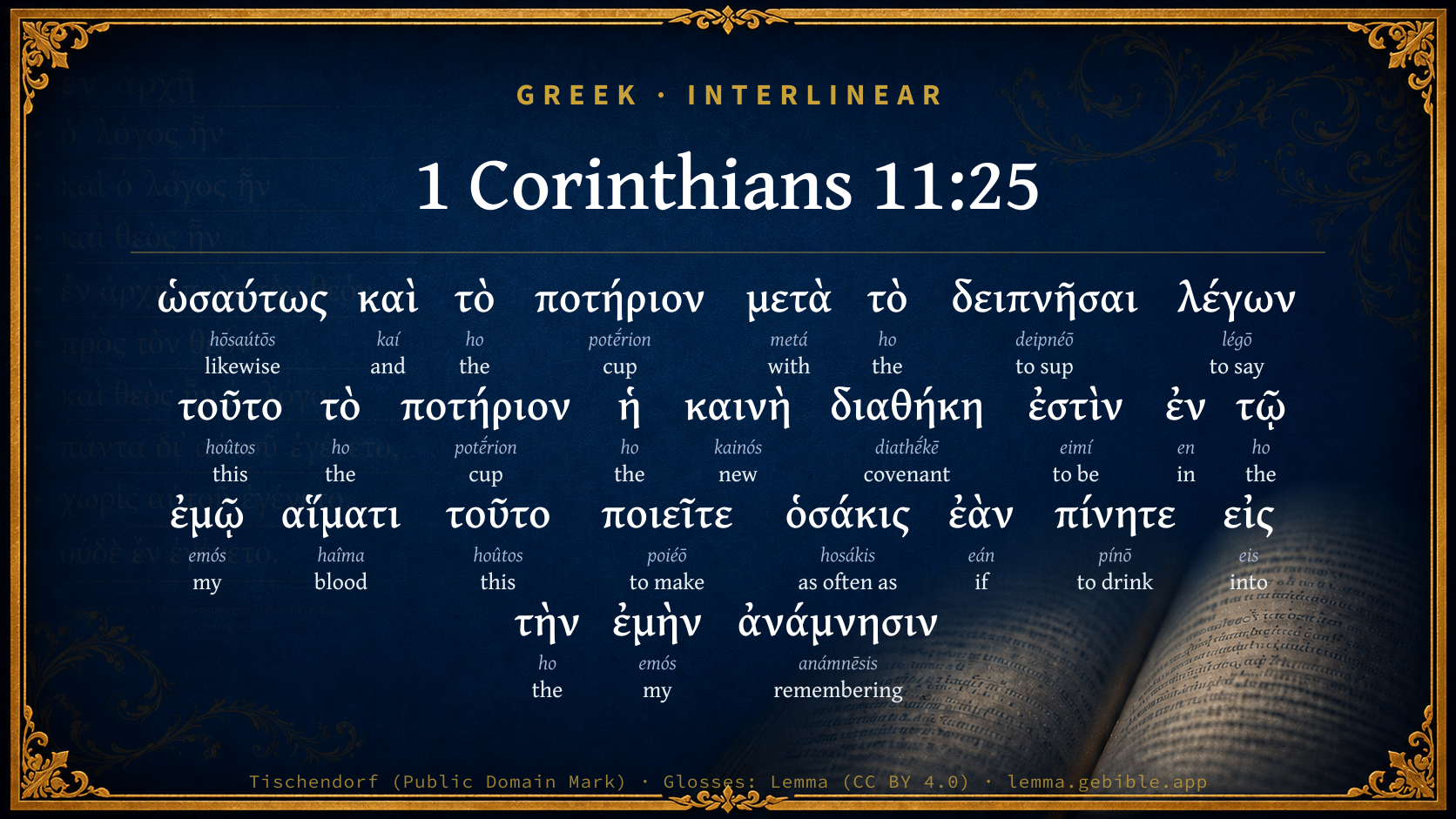
Greek (Tischendorf 8th ed.) 1 Corinthians 11:25 appears in the Greek New Testament. The text above is from the Tischendorf 8th edition. Each word links to its Strong’s number and a concise gloss. Click any word for its full Thayer’s Greek Lexicon entry.
Download image
Cite this verse

1 Corinthians 11:25 (World English Bible). Public Domain. Lemma interlinear Bible study tool, https://lemma.gebible.app/v/1-corinthians/11/25.

Show BibTeX & RIS
BibTeX
RIS
English Translation
In the same way he also took the cup, after supper, saying, "This cup is the new covenant in my blood. Do this, as often as you drink, in memory of me."
World English Bible · Public Domain
Highlights
  • 1 first appearance in the Greek New Testament
Full analysis ↓
Download a study sheet

One document with this verse’s original text, its word-by-word gloss line, the meaning frame, cross-references with their text, attributed commentary, and full source and license credits — printable, and it pastes into notes with its structure intact.

This verse Autodidact and up

Study sheet (.html) Plain text (.txt)

A passage Seminary Student

Up to 50 verses in one chapter. A passage sheet keeps up to 6 commentary sources and 12 cross-references per verse, in the order this page ranks them, and says so on the sheet whenever that leaves anything out. Ask for a single verse and you get the Autodidact verse sheet above.

Everything on this page stays free to read, with no account — the sheet is a download of what is already on screen, not access to it.

Want to remove ads? Support Godless Engineer
Compare translations 3

The same verse in 3 English versions, stacked beneath the original-language interlinear above. Click any original word for its lexicon entry.

Each is an independent rendering of the whole verse — the interlinear is not word-aligned to these translations.

Highlighted words mark where these versions differ — a whole-verse word diff, not a word-by-word alignment.

  • World English Bible Public Domain
    In the same way he also took the cup, after supper, saying, "This cup is the new covenant in my blood. Do this, as often as you drink, in memory of me."
  • King James Version Public Domain
    After the same manner also he took the cup, when he had supped, saying, This cup is the new testament in my blood: this do ye, as oft as ye drink it, in remembrance of me.
  • unfoldingWord Literal Text CC BY-SA 4.0
    In the same way also the cup after the supper, saying, “This cup is the new covenant in my blood. Do this, as often as you drink, in the remembrance of me.”

unfoldingWord Literal Text — © unfoldingWord, licensed CC BY-SA 4.0. Word-aligned USFM3 via Door43 (git.door43.org/unfoldingWord/en_ult).

Versions to compare (up to 4)

3 of 4 selected

Show all 19 translations

Every available English version of this verse, each an independent rendering of the whole verse.

  • World English Bible Public Domain
    In the same way he also took the cup, after supper, saying, "This cup is the new covenant in my blood. Do this, as often as you drink, in memory of me."
  • Berean Standard Bible Public Domain
    In the same way, after supper He took the cup, saying, “This cup is the new covenant in My blood; do this, as often as you drink it, in remembrance of Me.”
  • Majority Standard Bible Public Domain
    In the same way, after supper He took the cup, saying, “This cup is the new covenant in My blood; do this, as often as you drink it, in remembrance of Me.”
  • King James Version Public Domain
    After the same manner also he took the cup, when he had supped, saying, This cup is the new testament in my blood: this do ye, as oft as ye drink it, in remembrance of me.
  • American Standard Version (1901) Public Domain
    In like manner also the cup, after supper, saying, This cup is the new covenant in my blood: this do, as often as ye drink `it', in remembrance of me.
  • Revised Version (1885) Public Domain
    In like manner also the cup, after supper, saying, This cup is the new covenant in my blood: this do, as oft as ye drink it, in remembrance of me.
  • Geneva Bible (1599) Public Domain
    After the same maner also he tooke the cup, when he had supped, saying, This cup is the Newe Testament in my blood: this doe as oft as ye drinke it, in remembrance of me.
  • Douay-Rheims (1899) Public Domain
    In like manner also the chalice, after he had supped, saying: This chalice is the new testament in my blood: this do ye, as often as you shall drink, for the commemoration of me.
  • Young's Literal Translation Public Domain
    In like manner also the cup after the supping, saying, `This cup is the new covenant in my blood; this do ye, as often as ye may drink `it' -- to the remembrance of me;'
  • Literal Standard Version CC BY-SA 4.0
    In like manner also the cup after the supping, saying, “This cup is the New Covenant in My blood; do this, as often as you may drink [it]—to the remembrance of Me”;
  • Unlocked Literal Bible CC BY-SA 4.0
    In the same way he took the cup after supper, and he said, “This cup is the new covenant in my blood. Do this as often as you drink it, to remember me.”
  • unfoldingWord Literal Text CC BY-SA 4.0
    In the same way also the cup after the supper, saying, “This cup is the new covenant in my blood. Do this, as often as you drink, in the remembrance of me.”
  • Darby Bible Public Domain
    In like manner also the cup, after having supped, saying, This cup is the new covenant in my blood: this do, as often as ye shall drink [it], in remembrance of me.
  • World Messianic Bible Public Domain
    In the same way he also took the cup after supper, saying, “This cup is the new covenant in my blood. Do this, as often as you drink, in memory of me.”
  • Webster's Bible Public Domain
    After the same manner also he took the cup, when he had supped, saying, This cup is the new testament in my blood: this do ye, as often as ye drink it, in remembrance of me.
  • Free Bible Version CC BY-SA 4.0
    In the same way he took the cup, after the meal, and said, “This cup is the new agreement sealed with my blood. Remember me when you drink it.
  • Bible in Basic English Public Domain
    In the same way, with the cup, after the meal, he said, This cup is the new testament in my blood: do this, whenever you take it, in memory of me.
  • Text-Critical English NT CC BY 4.0
    In the same way, he also took the cup after supper, saying, “This cup is the new covenant in my blood. Do this, as often as you drink it, in remembrance of me.”
  • Tyndale New Testament (1534) Public Domain
    After the same maner he toke the cup when sopper was done sayinge. This cup is the newe testament in my bloude. This do as oft as ye drynke it in the remembraunce of me.

Literal Standard Version (2020), Covenant Press — licensed CC BY-SA 4.0. Text via the HelloAO Bible API (eBible.org). Unlocked Literal Bible (unfoldingWord) — licensed CC BY-SA 4.0. Text via the HelloAO Bible API (eBible.org). unfoldingWord Literal Text — © unfoldingWord, licensed CC BY-SA 4.0. Word-aligned USFM3 via Door43 (git.door43.org/unfoldingWord/en_ult). Free Bible Version, Dr. Jonathan Gallagher — licensed CC BY-SA 4.0. Text via the HelloAO Bible API (eBible.org).

Word by word

More ways to search: Search by grammar → Find every occurrence → Compare this word →

Practice this passage: Drill this verse → Learn its vocabulary →

ὁσάκις
hosákis
G3740
“as often as”
Adverb
Part of Speech
Adverb
Full Thayer's Definition

Origin: multiple adverb from G3739

TDNT: None

1. as often as, as often soever as
  1. ὡσαύτως hōsaútōs G5615 “likewise” Adverb
  2. καὶ kaí G2532 “and” Conjunction
  3. τὸ ho G3588 “the” Article, Nominative, Singular, Neuter
  4. ποτήριον potḗrion G4221 “cup” Noun, Nominative, Singular, Neuter
  5. μετὰ metá G3326 “with” Preposition
  6. τὸ ho G3588 “the” Article, Accusative, Singular, Neuter
  7. δειπνῆσαι deipnéō G1172 “to sup” Verb, Aorist, Active, Infinitive
  8. λέγων légō G3004 “to say” Verb, Present, Active, Participle, Nominative, Singular, Masculine
  9. τοῦτο hoûtos G3778 “this” Demonstrative pronoun, Nominative, Singular, Neuter
  10. τὸ ho G3588 “the” Article, Nominative, Singular, Neuter
  11. ποτήριον potḗrion G4221 “cup” Noun, Nominative, Singular, Neuter
  12. ἡ ho G3588 “the” Article, Nominative, Singular, Feminine
  13. καινὴ kainós G2537 “new” Adjective, Nominative, Singular, Feminine
  14. διαθήκη diathḗkē G1242 “covenant” Noun, Nominative, Singular, Feminine
  15. ἐστὶν eimí G1510 “to be” Verb, Present, Active, Indicative, 3rd person, Singular
  16. ἐν en G1722 “in” Preposition
  17. τῷ ho G3588 “the” Article, Dative, Singular, Neuter
  18. ἐμῷ emós G1699 “my” Possessive pronoun, 1st person, Dative, Singular, Neuter
  19. αἵματι haîma G129 “blood” Noun, Dative, Singular, Neuter
  20. τοῦτο hoûtos G3778 “this” Demonstrative pronoun, Accusative, Singular, Neuter
  21. ποιεῖτε poiéō G4160 “to make” Verb, Present, Active, Imperative, 2nd person, Plural
  22. ἐὰν eán G1437 “if” Conditional
  23. πίνητε pínō G4095 “to drink” Verb, Present, Active, Subjunctive, 2nd person, Plural
  24. εἰς eis G1519 “into” Preposition
  25. τὴν ho G3588 “the” Article, Accusative, Singular, Feminine
  26. ἐμὴν emós G1699 “my” Possessive pronoun, 1st person, Accusative, Singular, Feminine
  27. ἀνάμνησιν anámnēsis G364 “remembering” Noun, Accusative, Singular, Feminine

About this verse

These counts appear in no published source. They are computed here, from the morphology-tagged text and Lemma’s own curated glosses. What Lemma adds →

28
words
20
distinct lemmas
Pauline Epistles
section

Notable vocabulary

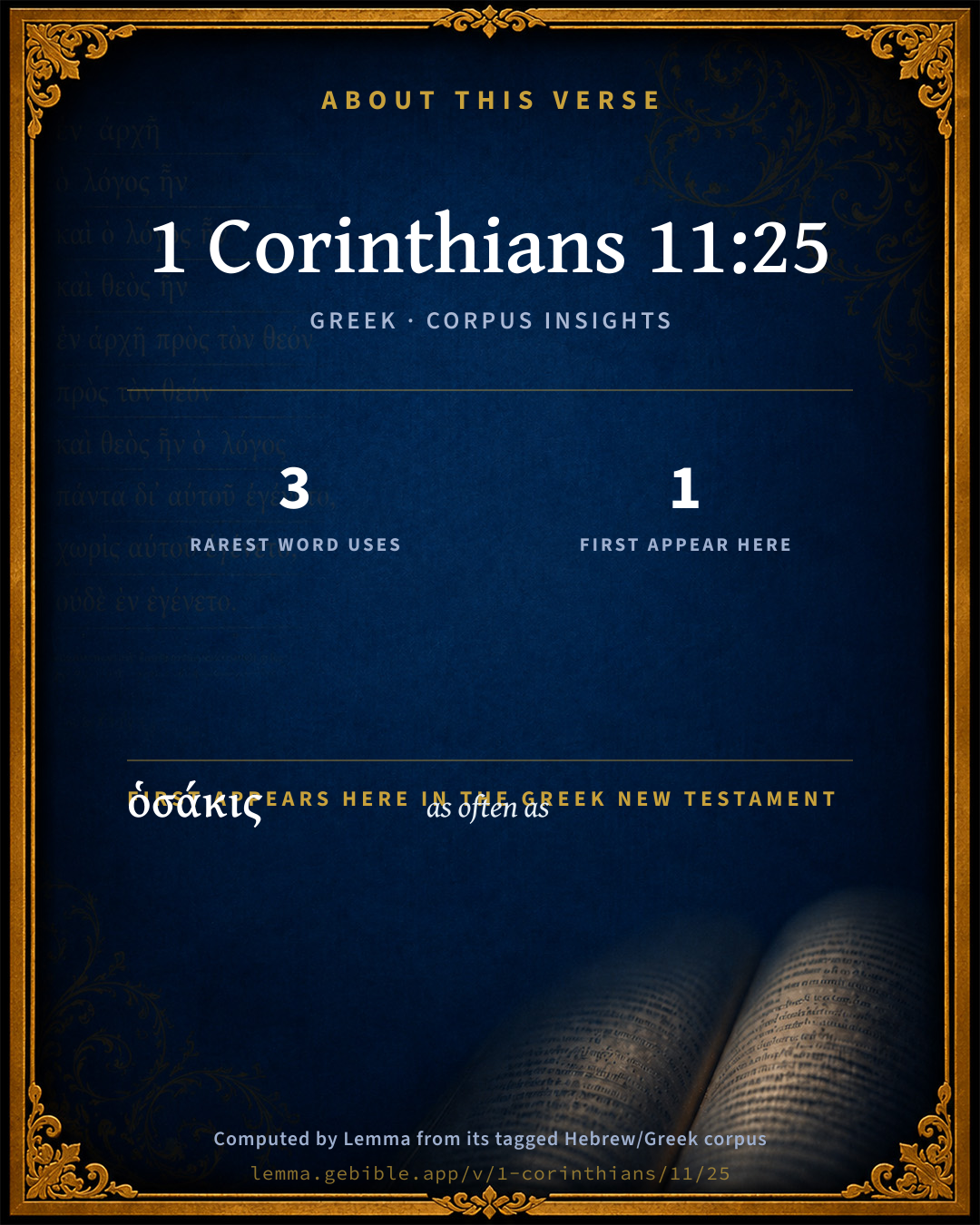
The rarest word here is ὁσάκις as often as G3740 — appearing just 3 times in the whole Greek New Testament.

First appearance in Scripture

This word makes its first canonical appearance in the Greek New Testament here:

  • ὁσάκις as often as G3740

Shared distinctive vocabulary

ὁσάκις as often as G3740 occurs in 3 verses of the Greek New Testament. Also found in:
Repetition

Words recur within this verse:

  • ποτήριον cup G4221 ×2
  • τὸ the G3588 ×6
  • τοῦτο this G3778 ×2
  • ἐμῷ my G1699 ×2

Cross-references

7

Topical passages linked to 1 Corinthians 11:25 in the Treasury of Scripture Knowledge — connected by theme and wording, ordered by reader-vote popularity; previews shown in the World English Bible.

  • Luke 22:20 Likewise, he took the cup after supper, saying, "This cup is the new covenant in my blood, which is poured out for you.
  • Hebrews 9:15–20 For this reason he is the mediator of a new covenant, since a death has occurred for the redemption of the transgressions that were under the first covenant, that those who have been called may receive the promise of the eternal inheritance.
  • Hebrews 13:20 Now may the God of peace, who brought again from the dead the great shepherd of the sheep with the blood of an eternal covenant, our Lord Jesus,
  • 2 Corinthians 3:6 who also made us sufficient as servants of a new covenant; not of the letter, but of the Spirit. For the letter kills, but the Spirit gives life.
  • 1 Corinthians 10:16 The cup of blessing which we bless, isn't it a communion of the blood of Christ? The bread which we break, isn't it a communion of the body of Christ?
  • 2 Corinthians 3:14 But their minds were hardened, for until this very day at the reading of the old covenant the same veil remains, because in Christ it passes away.
  • 1 Corinthians 11:27–28 Therefore whoever eats this bread or drinks the Lord's cup in a manner unworthy of the Lord will be guilty of the body and the blood of the Lord.

Cross-references courtesy of OpenBible.info (CC BY 4.0).

Commentary

Notes on 1 Corinthians 11:25 from classic Christian and Jewish commentators (each source and its license shown beneath its notes). The classic Christian expositions comment on the surrounding passage and are grouped to its opening verse, so a note may address several verses; the Jewish commentaries on the Tanakh (Rashi and others) are per-verse, so they appear only where the commentator wrote on this verse.

Lemma curates 59 commentaries, every one of them public domain or Creative Commons licensed, each selected and text-cleaned for this edition rather than reprinted as found. About our sources →

Joseph Benson's Commentary

1Co 11:25-27. He also took the cup when he had supped — Or, after supper. “This circumstance is mentioned to show that the Lord’s supper is not intended for the refreshment of the body, but, as we are told 1Co 11:26, for perpetuating the memory of Christ’s death, resurrection, and ascension, to the end of the world, and declaring our expectation of his return from heaven to judge all mankind; that by seriously and frequently meditating on these things, the faith, hope, and gratitude of his disciples may be nourished. Now, that these ends may be effectually answered, this service must be performed by the whole members of each particular church, not in separate companies, but together, as making one harmonious society, by whose joint concurrence and communion in the service, the death of their Master is not only remembered, but declared in the most public manner to the world, as a fact known and believed by all Christians from the beginning.” Saying, This cup is the new testament — Or, new covenant, rather, as the word more properly signifies. That is, it is the solemn seal and memorial of the covenant which is established in my blood, by which all its invaluable blessings are procured for you. Our Lord did not mean that the covenant of grace was first made at the time he shed his blood. It was made immediately after the fall, on account of the merit of his obedience unto the death, which God then considered as accomplished, because it was certainly to be accomplished at the time determined. Now this likewise do ye, as oft as ye drink it, in remembrance of me — And in order to maintain the memory of my bleeding, dying love, in the church and in the world. The ancient sacrifices were offered in remembrance of sin; this sacrifice, once offered, is still represented in remembrance of the remission of sin. According to the Papists, the expression, as oft as ye drink it, “implies that the cup, in the Lord’s supper, may sometimes be omitted; and on that pretence they have denied the cup to the laity;” but how justly, may be known by taking notice that the words, as often as, are applied (1Co 11:26) to the bread as well as to the cup. Besides, Matthew hath told us, that when Christ gave the cup, he said, (Mat 26:27,) drink ye all of it; which being both an invitation and a command, all Christians are as much entitled to the cup as to the bread.” For as often as ye — The church of God in any age; eat this bread and drink this cup — With proper solemnity and seriousness, faith, love, and gratitude; ye do show forth the Lord’s death — Ye proclaim, as it were, and openly avow it to God and all the world; so the word καταγγελλετε, here used, signifies: till he come — To close the present scene of things, and to receive all his faithful servants to a place where, for ever dwelling with him, they will no more need these memorials of an absent Saviour. Though at the institution of this ordinance our Lord spake nothing of his own second coming, yet in his discourse after the celebration of it, he connected his second coming with his death, Joh 14:3. The apostle therefore truly expressed his Master’s intention, when he told the Corinthians, that by publishing the Lord’s death, they published also his coming to judgment, and that the service of the supper was intended as a publication of both. Wherefore — Ωστε, so that; whosoever shall eat this bread, &c., unworthily — That is, in an unworthy, irreverent manner, without properly regarding him that appointed it, or the design of its appointment; shall be guilty of the body and blood of the Lord — That is, of profaning that which represents his body and blood.

Joseph Benson's Commentary on the Old and New Testaments (1811–1818) — public domain. Text from a community e-Sword module.

Tyndale Open Study Notes

Tyndale Open Resources

11:25 After supper might suggest that the main meal separated the breaking of the bread from the drinking of the cup (see Luke 22:20). • The new covenant is God’s promise to forgive sins because of the sacrificial death of Jesus (cp. Jer 31:31-34; 32:40; Luke 22:20; Heb 7:22; 8:8-10; 9:15; 10:12-18; 12:24; 13:20). The blood of a sacrifice confirmed an agreement or covenant (see Exod 24:8; Zech 9:11; Heb 9:12; 13:20; cp. Rom 3:25; 5:9).

Tyndale Open Study Notes — © Tyndale Open Resources, licensed CC BY-SA 4.0. Text via the HelloAO Bible API.

Bengel's Gnomon

Johann Albrecht Bengel

1Co 11:25. Μετὰ τὸ δειπνῆσαι, after supper) Therefore you, Corinthians, ought to separate common meals from the Lord’s Supper.—ὁσάκις, as often as) As often as is not a command, but it is implied that we should often eat and drink.—πίνητε, you may drink) this cup, 1Co 11:26.—εἰς τὴν ἐμὴν ἀνάμνησιν, in remembrance of me) This is presupposed by Matthew and Mark. Luke uses it once, Paul twice, because it is very suitable to his purpose. The old sacrifices were useful in bringing sins to remembrance, Heb 10:3; the sacrifice of the body of Christ, accomplished once for all, is revived by the remembrance of forgiveness.

Bengel's Gnomon of the New Testament — English translation (T&T Clark, Edinburgh, 1860) — public domain. Text from a community e-Sword module.

Meyer's Critical & Exegetical Commentary

Heinrich August Wilhelm Meyer

1Co_11:25. Ὡσαύτ. κ. τ. ποτ.] sc[1858] ἔλαβε καὶ εὐχαριστήσας ἔδωκεν αὐτοῖς (this last is to be taken from ἜΚΛΑΣΕ), 1Co_11:23-24.

ΤῸ ΠΟΤΉΡ.] the cup which stood before Him. It was the cup which closed the meal, although there is no ground to connect ΜΕΤᾺ ΤῸ ΔΕΙΠΝ. here with to ΤῸ ΠΟΤΉΡ., as Pott does.

ἘΣΤΊΝ] in the position which it has here, is decisive against our connecting ἘΝ Τῷ ἘΜῷ ΑἽΜ. with Ἡ Κ. ΔΙΑΘ., as most interpreters do (Erasmus, Beza, Calvin, and many others, including de Wette, Rodatz, Maier, Hofmann), although Luther (in the gr. Bek.) rightly rejects that connection. What Christ says is, that the cup is the new covenant in virtue of His blood, which, namely, is in the cup. For in the wine of the cup the Lord sees nothing else than His blood which was about to be shed. This vividly concrete, direct, but symbolical mode of view at that solemn moment stands out in the sharpest contrast with the strife of the churches on the subject (for the rest, see on Luk_22:19 f.). Christs blood became, by its being poured forth, the ἱλαστήριον,[1859] whereby the new covenant[1860] was founded (Rom_3:24 f., 1Co_5:3), the covenant of grace, in which were established, on mans side, faith in Christ,not, as in the old covenant, the fulfilling of the law,and on Gods side forgiveness by the way of grace, justification, sanctification, and bestowal of eternal Messianic salvation. Comp 2Co_3:6. And the Lord looks upon the cup as this covenant, because He sees in the wine of the cup His covenant-sealing blood. The cup therefore, in this deeply vivid symbolism of view is, as that which contains the covenant-blood, to Him the covenant.

τοῦτο ποιεῖτε] to be taken so as to harmonize with 1Co_11:24. Hofmann is wrong in thinking that Paul lays such special emphasis on this statement of the purpose of the Supper, because it appeared incompatible with the Corinthian mode of observing it. The apostle has no intention whatever here of laying emphasis either on one thing or another; he wishes only to report, in their simple objectivity, the sacred words in which the original institution was couched. What he desires to lay stress upon as against the Corinthians, comes in afterwards in 1Co_11:26 ff.

ὁσάκις ἂν πίν.] peculiar to this account of the ordinance: as often as ever (quotiescunque, see Kühner, II. p. 94; comp Bengel) ye drink it; the context supplies τοῦτο τὸ ποτήρ. as the object of. πίν., without its having to be represented by a pronoun (αὐτό). See Krüger, § 60. 7; Kühner, a[1863] Xen. Mem. i. 3. 4. The will of Jesus, according to this, is that every time, when they drink the concluding cup at the meal of communion, they should, in remembrance of Him, do with it as has now been done. Hofmann would make the words mean: as often as ye are together at a מִשְׁתֶּה. But how can that be conveyed by the simple πίνητε? And it was certainly not a drinking meal, but a regular ΔΕῖΠΝΟΝ (1Co_11:25).

Note, further, as to the ἌΝ, that it is placed after ὉΣΆΚΙς, quia in hac voce maximum sententiae pondus positum est, Kühner, a[1864] Xen. Mem. i. 1. 16.

[1858] c. scilicet.

[1859] The atonement through the death of Jesus is at any rate the necessary premiss of even the symbolical interpretation of the Lords Supper. With every attempt to explain away the atoning death, the Supper becomes utterly unintelligible. Comp. Ebrard, Dogma vom Abendm. II. p. 752 ff.

[1860] The word covenant is unquestionably genuine, for it is common to all the narratives; but the designation of the διαθήκη as καινή dates from Paul, being a later more precise definition of the phrase. Καινῆς in Mat_26:27 and Mar_14:24 is spurious. This applies also in opposition to Baur in the theol. Jahrb. 1857, p. 551.

[1863] d refers to the note of the commentator or editor named on the particular passage.

[1864] d refers to the note of the commentator or editor named on the particular passage.

Meyer — Critical and Exegetical Commentary on the New Testament — English translation by Peter Christie, edited by Frederick Crombie (T&T Clark, 1880) — public domain. Text from a community e-Sword module.

Expositor's Greek Testament

ed. W. Robertson Nicoll

1Co 11:25 . ὡσαύτως καὶ τὸ πατήριον : “In the same fashion also (He gave) the cup”. The two ritual actions correspond, and form one covenant. μετὰ τὸ δειπνῆσαι (as in Luke) “postquam cœnaverunt” (Cv [1756] ), or better “cœnatum est” (Rom. Liturgy) is studiously added to “emphasise the distinction between the Lord’s Supper and an ordinary evening meal; cf. 1Co 11:20 f. The eating of the bread originally formed part of the common meal (consider Mat 26:26 , Mar 14:22 , ἐσθιόντων αὐτῶν ), and may still have so continued, but the cup was certainly afterwards” (El [1757] ) a solemn close to the κυριακὸν δεῖπνον . “This cup is (see note 24: ἐστὶν wanting in Luke) the new covenant, in my blood”; cf. notes on 1Co 10:16 f. for τὸ ποτ ., and the relation of διαθήκη to κοινωνία . The cup, given by the Lord’s hand and tasted by each disciple in turn, is a virtual covenant for all concerned; in His blood it becomes so ( ἐν τ . αἴμ . is made by its position a further predicate, not a mere adjunct of διαθ .: cf. Rom 3:25 ), since that is the ground on which God grants and man accepts the covenant. For διαθήκη , see Cr [1758] , s.v .; this term, in distinction from συνθήκη , indicates the initiative of God as Disposer in the great agreement. For P.’s interpretation of ἐν τ . αἴματι , see Rom 3:23 ff., Eph 1:7 ; Eph 2:13 ff., Col 1:20 ; also parls. in Ep. to Heb., Rev 1:5 , 1Jn 1:7 , 1Pe 1:18 f. For “ new covenant,” see parls.: καινός , new in nature, contents , as securing complete forgiveness and spiritual renovation (Jer [1759] 31:31 ff., etc.).“This do … for the commemoration of Me”: see 1Co 11:24 b ; τοῦτο includes, beside the act , the accompanying words , without which the ἀνάμνησις is imperfect. ὁσάκις ἐὰν (late Gr [1760] for ἄν ) πίνητε : “so many times as ( quotiescunque ) you drink (it)” the cup of the context; not “so often as you drink ” (Hf [1761] ), sc . at any table where Christians meet. Our Lord prescribed no set times; P. assumes that celebration will be frequent, for he directs that, however frequent , it must be guided by the Lord’s instructions, so as to keep the remembrance of Him unimpaired.

[1756] Calvin’s In Nov. Testamentum Commentarii .

[1757] C. J. Ellicott’s St. Paul’s First Epistle to the Corinthians .

[1758] Cremer’s Biblico-Theological Lexicon of N.T. Greek (Eng. Trans.).

[1759] Jerome, Hieronymus.

[1760] Greek, or Grotius’ Annotationes in N.T.

[1761] J. C. K. von Hofmann’s Die heilige Schrift N.T. untersucht , ii. 2 (2te Auflage, 1874).

The Expositor's Greek Testament, edited by W. Robertson Nicoll (1897–1910) — public domain. Text from a community e-Sword module.

Hodge's Commentary on Romans, Ephesians & First Corinthians

Charles Hodge

1Co_11:25

After the same manner also (he took) the cup, when he had supped, saying, This cup is the new testament in my blood: this do ye, as oft as ye drink (it), in remembrance of me.

This second part of the service is introduced by Luke with the same words which are here used, though our translators there render them Likewise also the cup, after supper. This latter version is the literal and simple rendering of the original. In Matthew and Mark it is said, Having taken the cup, and having given thanks. This explains what Paul and Luke mean by likewise, or after the same manner. They intend to say that Christ did with the cup what he had done with the bread, i.e. he took it, and pronounced over it the eucharistical benediction, i.e. a blessing connected with thanksgiving. In this particular there is a slight departure in our mode of administering this ordinance, from the example of Christ. With us there is generally but one eucharistical blessing at the introduction of the service, having reference both to the bread and to the cup. Whereas it seems that our Lord blessed the bread, and having broken, distributed it to his disciples; and then took the cup, and having blessed it, gave it to them to drink. After supper, i.e. after the conclusion of the paschal supper.

Saying, This cup is the New Testament in my blood. The same words occur in Luk_22:20. In Matthew and Mark the corresponding expression is, This is my blood of the New Testament. The sense must be the same. The blood of the covenant means here, as in Exo_24:8, the blood by which the covenant was ratified and its blessings secured. The passage referred to in Exodus shows the manner in which covenants were anciently ratified in the East. A victim was slain and the blood sprinkled upon the contracting parties, by which they were solemnly bound to their mutual engagements. The word διαθήκη so constantly, after the Vulgate, rendered Testament by our translators, always in the New Testament means a covenant, unless Heb_9:16 be an exception. Here that sense is required by the context, as a covenant and not a testament was ratified by blood. This covenant is called new in reference to the Mosaic covenant. The latter was ratified by the blood of animals; the new, by the blood of the eternal Son of God; the one in itself could secure only temporal benefits and the remission of ceremonial offenses; the other secures eternal redemption, and the remission of sin in the sight of God. As the Hebrews entered into covenant with God when the blood of the heifer was sprinkled upon them and thereby bound themselves to be obedient to the Mosaic institutions, and as God thereby graciously bound himself to confer upon them all its promised blessings on condition of that obedience; so, in the Lords supper, those who receive the cup profess to embrace the covenant of grace, and bind themselves to obedience to the gospel; and God binds himself to confer on them all the benefits of redemption. In receiving the cup, therefore, they receive the pledge of their salvation. The death of Christ, which is so often compared to a sin-offering, is here, as well as in the Epistle to the Hebrews, compared to a federal sacrifice. The two, however, do not differ. The death of Christ is the latter only in virtue of its being the former. It ratifies the covenant of grace and secures its benefits, only because it was a propitiation, i.e. because it was a satisfaction to divine justice, as is so clearly taught in Rom_3:25, Rom_3:26. Every time, therefore, the consecrated wine touches the believers lips, he receives anew the application of the blood of Christ for the remission of his sins and his reconciliation with God. If the Bible says we are sprinkled with the blood of Jesus, 1Pe_1:2, why may we not be said to receive his blood? If the former expression means the application of the benefits of his sacrificial death, why may not the latter mean the reception of those benefits? Here, as elsewhere, the difficulty is the want of faith. He who by faith appropriates a divine promise recorded in the word, receives the blessing promised; and he who in the exercise of faith receives the sacramental cup receives the benefits of the covenant of which that cup is the symbol and the pledge. But what is faith? or rather, what is it that we are required to believe, in order to experience all this?

1. We must believe that Jesus is the Son of God, and that he loved us and gave himself for us.

2. That his blood cleanses from all sin.

3. That in the sacrament he offers us, with the symbols of his broken body and his shed blood, the benefits of his death; and that he will certainly convey those benefits to all those who hold out even a trembling hand to receive them.

In Luke, after the words in my blood, it is added, which is shed for you. In Mark the explanation is, which is shed for many; and in Matthew, still more fully, which is shed for many for the remission of sins. These are different forms of expressing the sacrificial character of the death of Christ. Though it was the blood of the covenant, yet it was at the same time shed for many, not merely for their benefit in the general, but for the specific object of securing the remission of sins. It was, therefore, truly a sin-offering. Thus does Scripture explain Scripture. What is said concisely in one place is more fully and clearly stated in another.

This do, as oft as ye drink it, in remembrance of me. These words do not occur in Luke. In Matthew the words are, Drink ye all of it. Mark says, They all drank of it. In each account the fact is made plain that the cup was distributed to all at the table and that all drank of it. The words This do are to be understood here as in 1Co_11:24, Do what I have done, i.e. bless the cup and distribute it among yourselves. As oft as ye drink of it. This does not mean that every time Christians drank wine together they should do it in commemoration of Christs death; but, as often as this ordinance is celebrated, do what I have done, to commemorate my death. The Lords Supper is a commemoration of Christs death, not only because it was designed for that purpose, but also because the bread and wine are the significant symbols of his broken body and shed blood. In this ordinance therefore Christ is set forth as a sacrifice which at once makes expiation for sin and ratifies the covenant of grace.

Charles Hodge — Commentary on Romans (1835), First Corinthians (1857), and Ephesians (1856) — public domain. Text from a community e-Sword module.

Jamieson, Fausset & Brown

Robert Jamieson, A. R. Fausset & David Brown

when he had supped--Greek, "after the eating of supper," namely, the Passover supper which preceded the Lord's Supper, as the love-feast did subsequently. Therefore, you Corinthians ought to separate common meals from the Lord's Supper [BENGEL].

the new testament--or "covenant." The cup is the parchment-deed, as it were, on which My new covenant, or last will is written and sealed, making over to you all blessings here and hereafter.

in my blood--ratified by MY blood: "not by the blood of goats and calves" (Heb 9:12).

as oft as--Greek, "as many times soever": implying that it is an ordinance often to be partaken of.

in remembrance of me--Luke (Luk 22:19) expresses this, which is understood by Matthew and Mark. Paul twice records it (Co1 11:24 and here) as suiting his purpose. The old sacrifices brought sins continually to remembrance (Heb 10:1, Heb 10:3). The Lord's Supper brings to remembrance Christ and His sacrifice once for all for the full and final remission of sins.

Jamieson, Fausset & Brown — Commentary Critical and Explanatory on the Whole Bible (1871) — public domain (CC PDM 1.0). Text via the HelloAO Bible API.

John Calvin's Commentaries

25. The cup, when he had supped The Apostle seems to intimate, that there was some interval of time between the distribution of the bread and that of the cup, and it does not quite appear from the Evangelists whether the whole of the transaction was continuous. This, however, is of no great moment, for it may be that the Lord delivered in the meantime some address, after distributing the bread, and before giving the cup. As, however, he did or said nothing that was not in harmony with the sacrament, we need not say that the administration of it was disturbed or interrupted. I would not, however, render it as Erasmus does — supper, being ended, for, in a matter of so great importance, ambiguity ought to be avoided.

This cup is the New Testament What is affirmed as to the cup, is applicable also to the bread; and thus, by this form of expression, he intimates what he had before stated more briefly — that the bread is the body. For it is so to us, that it may be a testament in his body, that is, a covenant, which has been once confirmed by the offering up of his body, and is now confirmed by eating, when believers feast upon that sacrifice. Accordingly, while Paul and Luke use the words — testament in the blood, Matthew and Mark employ the expression — blood of the testament, which amounts to the same thing. For the blood was poured out to reconcile us to God, and now we drink of it in a spiritual sense, that we may be partakers of reconciliation. Hence, in the Supper, we have both a covenant, and a confirmatory pledge of the covenant.

I shall speak in the Epistle to the Hebrews, if the Lord shall allow me opportunity, as to the word testament It is well known, however, that sacraments receive that name, from being testimonies to us of the divine will, to confirm it in our minds. For as a covenant is entered into among men with solemn rites, so it is in the same manner that the Lord deals with us. Nor is it without strict propriety that this term is employed; for in consequence of the connection between the word and the sign, the covenant of the Lord is really included in the sacraments, and the term covenant has a reference or relation to us. This will be of no small importance for understanding the nature of the sacraments; for if they are covenants, then they contain promises, by which consciences may be roused up to an assurance of salvation. Hence it follows, that they are not merely outward signs of profession before men, but are inwardly, too, helps to faith.

This do, as often as ye drink Christ, then, has appointed a two-fold sign in the Supper.

What God hath joined together let not man put asunder. (Matthew 19:6.)

To distribute, therefore, the bread without the cup, is to man Christ’s institution. For we hear Christ’s words. As he commands us to eat of the bread, so he commands us to drink of the cup To obey the one half of the command and neglect the other half — what is this but to make sport of his commandment? And to keep back the people from that cup, which Christ sets before all, after first drinking of it, as is done under the tyranny of the Pope — who can deny that this is diabolical presumption? As to the cavil that they bring forward — that Christ spoke merely to the Apostles, and not to the common people — it is exceedingly childish, and is easily refuted from this passage — for Paul here addresses himself to men and women indiscriminately, and to the whole body of the Church. He declares that he

had delivered this to them agreeably to the commandment of the Lord. (1 Corinthians 11:23.)

By what spirit will those pretend to be actuated, who have dared to set aside this ordinance? Yet even at this day this gross abuse is obstinately defended; and what occasion is there for wonder, if they endeavor impudently to excuse, by words and writings, what they so cruelly maintain by fire and sword?

John Calvin's Commentaries (1540-1563) — public domain. Text from the Calvin Translation Society English edition (1840s-50s) via the Christian Classics Ethereal Library (ccel.org). Calvin's coverage is partial (roughly two-thirds of the Bible); uncommented books and verses are honest gaps, never fabricated. The 19th-century editor's footnotes and remarks are omitted so the notes are faithfully Calvin's own voice.

Ellicott's Commentary for English Readers

(25) After the same manner also he took the cup, when he had supped.—We have here an intimation not found in St. Matthew or St. Mark’s narrative, that the blessing of the cup took place “after supper,” which implies that the blessing of the bread took place earlier in the meal.

This cup is the new testament.—Better, This cup is the new covenant. The word “new” is peculiar to this and St. Luke’s narrative; it does not occur in the best MSS. of St. Matthew and St. Mark. The new covenant of grace between God and Humanity was ratified in the blood of Christ. The cup containing the symbol of that blood is therefore the pledge and witness of that covenant. This was a new covenant in blood (Rom_3:25) as contrasted with the old covenant in blood (Exo_24:8).

As oft as ye drink.—This can scarcely be taken as a command to make all occasions of bodily refreshment virtually a eucharist, but must be regarded as referring definitely (as in the following verse) to this particular rite.

A Bible Commentary for English Readers, edited by Charles John Ellicott (1878–1897) — public domain. Text from a community e-Sword module.

The Cambridge Bible for Schools and Colleges

gen. ed. J. J. S. Perowne

25. After the same manner also he took the cup, when he had supped] The words in the original, though translated differently, are precisely the same as those of St Luke, and seem to imply (see also St Luk_22:17) that while the bread was administered at supper, the cup was administered after it.

saying] The literal translation of the words is, This cup is the New Covenant in My Blood; this do whensoever ye drink it, in remembrance of Me. St Luke gives us the words as follows: ‘This Cup is the New Covenant in My Blood, which is being poured forth for you;’ St Matthew, ‘Drink ye all of it, for this is My Blood which is of the New Covenant, which is poured forth for many unto the remission of sins;’ St Mark, ‘This is My Blood, which is of the [New] Covenant, which is poured forth for many.’ It is obvious that no one report of these important words can be pressed to the exclusion of the rest.

new testament] This is unquestionably the original meaning of the word thus translated in Classical Greek. It is derived from a word signifying to put thoroughly in order, and is used of that complete arrangement of his worldly affairs which a man is accustomed to make in a will. See perhaps for this meaning Heb_9:16 (though the question is much debated). In other places in the N. T. it is used, as in the Septuagint, in place of the Hebrew Berith, a covenant or agreement between two parties, one of which sometimes is God. For an example of this sense see Gal_3:15. Here it would appear to include both senses, for (1) it was a covenant that Christ entered into with man, and (2) it was His Death which gave that covenant validity.

The Cambridge Bible for Schools and Colleges (gen. ed. J. J. S. Perowne; Cambridge University Press, 1878–1918) — public domain. Text from a community e-Sword module.

John Gill's Exposition

For as often as ye eat this bread, and drink this cup,.... Not any bread, or any cup: but what is ate and drank in an ordinance way, and according to the institution and appointment of Christ, and with a view to the end proposed by him; and though there is no set fixed time for the administration of this ordinance, yet this phrase seems to suggest that it should be often: and very plainly signifies, that the bread and wine, after the blessing or thanksgiving, remain such, and are not converted into the real body and blood of Christ; but are only outward elements representing these to faith;

ye do show the Lord's death till he come; or rather, as it may be rendered in the imperative mood, as an exhortation, direction or command, "show ye the Lord's death till he come"; since everyone that eats and drinks at the Lord's table does not show forth his death, which is the great end to be answered by it; for the design of the institution of it is to declare that Christ died for the sins of his people: to represent him as crucified; to set forth the manner of his sufferings and death, by having his body wounded, bruised, and broken, and his blood shed; to express the blessings and benefits which come by his death, and his people's faith of interest in them; and to show their sense of gratitude, and declare their thankfulness for them; and all this, "till he come"; which shows the continuance of this ordinance, which is to last till Christ's second coming, where the carnal ordinances of the former dispensation were shaken and removed; and also the continuance of Gospel ministers to the end of the world, to administer it, and of churches to whom it is to be administered: this assures of the certainty of Christ's second coming; as it leads back to his coming in the flesh, suffering and dying in our stead, and thereby obtaining redemption for us; it leads forward to expect and believe he will come again, to put us into the full possession of the salvation he is the author of; when there will be no more occasion for this ordinance, nor any other, but all will cease, and God will be all in all. The apostle here refers to a custom used by the Jews in the night of the passover, to show forth the reason of their practice, and that institution to their children; when either (u).

"the son asked the father, or if the son had not understanding (enough to ask), then the father taught him, saying, how different is this night from all other nights? for in all other nights we eat leavened and unleavened bread, but in this night only unleavened; in all other nights we eat the rest of herbs, but in this night bitter herbs; in all other nights we eat flesh roasted, broiled, and boiled, in this night only roasted; in all other nights we wash once, in this night twice; and as elsewhere (w) it is added, in all other nights we eat sitting or lying, in this night all of us lie; and according to the capacity of the child, the father teaches him,''

particularly he was to inform him what these several things showed forth, or declared (x); as that

"the passover "declared", or "showed forth", that the Lord passed over the houses of our fathers in Egypt; the bitter herbs "showed forth", that the Egyptians made the lives of our fathers bitter in Egypt; and the unleavened bread "declared" that they were redeemed; and all these things are called "the declaration", or showing forth:''

and there is a treatise called , "the showing forth of the passover"; in which, besides the things mentioned, and many others, it is observed (y), that it was commanded the Jews "to declare" the going out of Egypt, and that everyone that diligently declares the going out of Egypt, is praiseworthy: now the apostle observes this end of the Lord's supper, to show forth his death, in opposition to the notion of the "judaizing" Christians at Corinth, who thought of nothing else but the showing forth of the passover, and the declaration of that deliverance and redemption wrought for the people of Israel; whereas the true and only intent of it was to show forth the death of Christ, redemption by him, and the greatness of his love expressed therein, and which is to be continued till his second coming; whereas the time was come when it should "be no more said, the Lord liveth, that brought up the children of Israel out of the land of Egypt", Jer 16:14.

(u) Misn. Pesach. c. 10. sect. 4. Haggadah Shel. Pesach. p. 5. (w) Maimon. Chametz Umetzah, c. 8. sect. 2. (x) Moses Kotsensis Mitzvot Tora prec. aff. 41. (y) P. 5, 6. Ed. Rittangel. & Seder. Tephillot. Ed. Basil. fol. 243. 1.

John Gill's Exposition of the Whole Bible (1746–1763) — public domain (CC PDM 1.0). Text via the HelloAO Bible API.

Trapp's Complete Commentary

John Trapp

25 After the same manner also he took the cup, when he had supped, saying, This cup is the new testament in my blood: this do ye, as oft as ye drink it, in remembrance of me.

Ver. 25. He took the cup] {See Trapp on "Mat 26:27"}

John Trapp, A Commentary or Exposition upon All the Books of the Old and New Testament (1647–1656) — public domain. Text from a community e-Sword module.

Albert Barnes' Notes on the Bible

After the same manner - In like manner; likewise. With the same circumstances, and ceremonies, and designs. The purpose was the same.

When he had supped - That is, all this occurred after the observance of the usual paschal supper. It could not, therefore, be a part of it, nor could it have been designed to be a festival or feast merely. The apostle introduces this evidently in order to show them that it could not be, as they seemed to have supposed, an occasion of feasting. It was after the supper, and was therefore to be observed in a distinct manner.

Saying, This cup ... - See the note at Mat 26:27-28.

Is the New Testament - The new covenant which God is about to establish with people. The word “testament” with us properly denotes a “will” - an instrument by which a man disposes of his property after his death. This is also the proper classic meaning of the Greek word used here, διαθήκη (diathēkē). But this is evidently not the sense in which the word is designed to be used in the New Testament. The idea of a “will” or “testament,” strictly so called, is not that which the sacred writers intend to convey by the word. The idea is evidently that of a compact, agreement, covenant, to which there is so frequent reference in the Old Testament, and which is expressed by the word בּרית berı̂yth (Berith), a compact, a covenant, Of that word the proper translation in Greek would have been συνθηκη sunthēkē a covenant, agreement. But it is remarkable that that word never is used by the Septuagint to denote the covenant made between God and man.

That translation uniformly employs for this purpose the word διαθήκη diathēkē, a will, or a testament, as a translation of the Hebrew word, where there is a reference to the covenant which God is represented as making with people. The word συνθηκη sunthēkē is used by them but three times Isa 28:15; Isa 30:1; Dan 11:6, and in neither instance with any reference to the covenant which God is represented as making with man. The word διαθήκη diathēkē, as the translation of בּרית berı̂yth (Berith), occurs more than two hundred times. (See Trommius’ Concord.) Now this must have evidently been of design. What the reason was which induced them to adopt this can only be conjectured. It may have been that as the translation was to be seen by the Gentiles as well as by the Jews (if it were not expressly made, as has been affirmed by Josephus and others, for the use of Ptolemy), they were unwilling to represent the eternal and infinite Yahweh as entering into a “compact, an agreement” with his creature man. They, therefore, adopted a word which would represent him as expressing “his will” to them in a book of revelation. The version by the Septuagint was evidently in use by the apostles, and by the Jews everywhere. The writers of the New Testament, therefore, adopted the word as they found it; and spoke of the new dispensation as a new “testament” which God made with man. The meaning is, that this was the new compact or covenant which God was to make with man in contradistinction from that made through Moses.

In my blood - Through my blood; that is, this new compact is to be sealed with my blood, in illusion to the ancient custom of sealing an agreement by a sacrifice; see the note at Mat 26:28.

This do ye - Partake of this bread and wine; that is, celebrate this ordinance.

As oft as ye drink it - Not prescribing any time; and not even specifying the frequency with which it was to be done; but leaving it to themselves to determine how often they would partake of it. The time of the Passover had been fixed by positive statute; the more mild and gentle system of Christianity left it to the followers of the Redeemer themselves to determine how often they would celebrate his death. It was commanded them to do it; it was presumed that their love to him would be so strong as to secure a frequent observance; it was permitted to them, as in prayer, to celebrate it on any occasion of affliction, trial, or deep interest when they would feel their need of it, and when they would suppose that its observance would be for the edification of the Church.

In remembrance of me - This expresses the whole design of the ordinance. It is a simple memorial, or remembrancer; designed to recall in a striking and impressive manner the memory of the Redeemer. It does this by a tender appeal to the senses - by the exhibition of the broken bread, and by the wine. The Saviour knew how prone people would be to forget him, and he, therefore, appointed this ordinance as a means by which his memory should be kept up in the world. The ordinance is rightly observed when it recalls the memory of the Saviour; and when its observance is the means of producing a deep, and lively, and vivid impression on the mind, of his death for sin. This expression, at the institution of the supper, is used by Luke Luk 22:19; though it does not occur in Matthew, Mark, or John.

Albert Barnes' Notes on the Bible (1834–1885) — public domain. Text from a community e-Sword/MySword module.

The Pulpit Commentary

When he had supped. (see Gal_4:19.

The Church"s proclamation.

What so fitted to rebuke those who profaned the Supper of the Lord, what so fitted to arouse them to a sense of their high calling, as a solemn declaration like this? The noisy, greedy, quarrelsome gatherings which seem at Corinth to have been associated with the professed observance of one of the highest mysteries of the Christian faith, naturally awakened the indignation and the reproaches of the apostle. Recalling them to a sense of the dignity of their position as witnesses to God in an ignorant and sinful world, the apostle summons the Corinthian Christians so to eat the bread and drink the cup of the Eucharist as to declare to all the sacred tidings of a Redeemer"s death.

I THIS SACRAMENT IS A COMMEMORATION OF THE PAST. The Lord"s death was an admitted fact; and if anything was needed to establish the historical fact, the existence of this ordinance was sufficient and more than sufficient for the purpose. But men may forget and lose sight of an event which they do not dream of denying. And it seemed good to Divine wisdom that the crucifixion and sacrifice of the Son of God should be held in everlasting memory by means of this simple but most significant observance. It was not simply as a historical fact that the death of Christ was to be recorded, but as a Christian doctrine. Christ"s was a redeeming, atoning, reconciling death; and as such was cherished in everlasting memory by those who profited by it, who owed to it their eternal hopes.

II THIS SACRAMENT IS A PROCLAMATION TO THE PRESENT. "Ye set forth, or proclaim, the Lord"s death," says the apostle. And from his expression, "as often," it may be inferred that periodically and frequently the primitive Christians kept the feast, remembering and declaring that "Christ our Passover is slain for us." There is something very affecting and at the same time very inspiring in this representation. From generation to generation and from age to age the sacrament of the Lord"s body and blood publishes salvation to mankind, telling of him who tasted death forevery man, and in his cross reconciled the world unto God. It is an aspect of the Holy Communion which should not be left out of sight, upon which great stress should be laid; for some, whom words may fail to reach, may have their hearts opened to the grace and love of Christ by witnessing the silent yet eloquent declaration concerning the Saviour which is presented when the members of Christ"s Church partake of the symbols of their redemption.

III THIS SACRAMENT IS A PREDICTION OF THE FUTURE. "Till he come!" Our Lord, in instituting the ordinance, had turned the gaze of his disciples towards the future, speaking of drinking wine new in the kingdom of God, And here the eye of faith is pointed on to the glory which shall be revealed when he who came to die shall come to judge, shall come to reign!

And thus that dark betrayal night With the last advent we unite By one bright chain of loving rite, Until he come!

T.

The Pulpit Commentary (1880–1919), ed. H.D.M. Spence-Jones & Joseph S. Exell — public domain. Text from a community e-Sword module.

John Wesley's Explanatory Notes

After supper - Therefore ye ought not to confound this with a common meal. Do this in remembrance of me - The ancient sacrifices were in remembrance of sin: this sacrifice, once offered, is still represented in remembrance of the remission of sins.

John Wesley, Explanatory Notes Upon the Whole Bible (1754–1765) — public domain. Text via the GEBible commentary corpus.

McGarvey & Pendleton's Commentaries

J. W. McGarvey

In like manner also the cup, after supper [Paul here inserts the entering wedge of reform. The Lord's Supper came after the Passover, and was no part of it; hence it was no part of the Agapæ which was substituted for the Passover. As therefore the Agapæ was fruitful of disorder, would it not be well to separate it from the communion? By the end of the first century it was so separated, and at last it was formally prohibited by the Council of Carthage. See Poole's synopsis on Mat_26:26 ], saying, This cup is the new covenant in my blood: this do, as often as ye drink it, in remembrance of me . [Diatheke may be translated "testament" ( Heb_9:16 ), or "covenant." The latter is the meaning here, for wills or testaments were not sealed with blood, as were covenants. The cup is the symbol of Christ's blood, which ratified the gospel covenant.]

J. W. McGarvey (with Philip Y. Pendleton), Commentaries on the New Testament (The Fourfold Gospel, 1914; Acts; and the epistles) — public domain. Text from a community e-Sword/MySword module.

The People's New Testament

B. W. Johnson

25. This do ye, as oft as ye drink it, in remembrance of me. The memorial design of the Lord's supper is reiterated. It is not a “sacrifice of the mass,” but a remembrance of Christ's sacrifice.

B. W. Johnson's The People's New Testament with Notes (1889–1891) — public domain. Electronic text from the Christian Classics Ethereal Library (CCEL) ThML edition.

unfoldingWord translationNotes

Door43 World Missions Community

the cup

It is best to translate this literally. The Corinthians knew which cup he took, so it is not simply "a cup" or "some cup" or "any cup." Possible meanings are that it was 1) the cup of wine that one would expect him to use or 2) the third or fourth of the four cups of wine that the Jews drank at the Passover meal.

Do this as often as you drink it

"Drink from this cup, and as often as you drink from it"

proclaim the Lord's death

teach about the crucifixion and resurrection

until he comes

Where Jesus comes to can be made explicit. AT: "until Jesus comes back to the earth" (See: Assumed Knowledge and Implicit Information)

translationWords

covenant

blood

preach

die

unfoldingWord translationNotes — © Distant Shores Media and the Door43 World Missions Community, licensed CC BY-SA 4.0. Source: git.door43.org/Door43/en_tn.

Cambridge Greek Testament for Schools and Colleges

25. ὁσάκις ἐάν אBC. ὁσάκις ἄν DEFG. So also in next verse.

25. ὡσαύτως. The words in the original, though translated differently, are precisely the same as those of St Luke, and seem to imply that, according to Jewish practice at the Passover, while the bread was administered at supper, the cup was administered after it. See, however, next note.

λέγων. The literal translation of the words that follow is, This cup is the New Covenant in My Blood; this do whensoever ye may drink it, in remembrance of Me. St Luke gives us the words as follows: ‘This Cup is the New Covenant in My Blood, which is being poured forth for you’ (but the whole verse is bracketed by Westcott and Hort; see Critical Note). St Matthew, ‘Drink ye all of it, for this is My Blood which is of the New Covenant, which is poured forth for many unto the remission of sins’; St Mark, ‘This is My Blood, which is of the [New] Covenant, which is poured forth for many.’ It is obvious that no one report of these important words can be pressed to the exclusion of the rest.

ἡ καινὴ διαθήκη. The new covenant. In Classical Greek διαθήκη has unquestionably the signification testament. It is derived from διατίθημι, to put thoroughly in order, and is used of that complete arrangement of his worldly affairs which a man is accustomed to make in a will. See perhaps for this meaning Heb 9:16 (though the question is much debated and the sense ‘covenant’ falls in best with the general drift of the argument). In other places in the N. T. it is used, as in Gen 9:12 and elsewhere in the LXX., in place of the Hebrew Berith, a covenant or agreement between two parties, one of which sometimes is God. For an example of this sense see Gal 3:15. Here it would appear to include both senses, for (1) it was a covenant that God entered into with man, and (2) it was Christ’s Death which sealed it.

Cambridge Greek Testament for Schools and Colleges (Cambridge University Press, 1896; 21 vols, various authors incl. Carr, Maclear, Plummer, Farrar, Lumby, Moule, M. R. James, Simcox) — public domain. Text from a community e-Sword module.

Alford’s Greek Testament

Henry Alford

25.] See Luk 22:20.

ὡσαύτ. καὶ τὸ π.] “viz. ἔλαβεν καὶ εὐχ. ἔδωκεν αὐτοῖς. These last words are implied in ἔκλασεν above.” Meyer.

ἡ καιν. δ. ἐστὶν ἐν τῷ ἐμῷ αἵμ. is the new covenant in (ratified by the shedding of, and therefore standing in, as its conditioning element) my blood: = ἐστὶν ἡ καιν. δ. ἡ ἐν τῷ ἐμῷ αἵμ. The position of ἐστιν is no objection to this, nor the omission of the art. Meyer would render it, ‘is the N. C. by means of my blood:’ i.e. by virtue of its contents, which are my blood: and this solely on account of the position of ἐστιν. But the meaning is as harsh, as the rendering is unrequired.

ὁσάκις ἐὰν πίν.] Not a general rule for all common meals of Christians; but a precept that as often as that cup is drunk, it should be in remembrance of Him: on these last words is the emphasis: see below.

Henry Alford, The Greek Testament (1849–1861) — public domain. Text from a community e-Sword module.

International Critical Commentary

25. ὡσαύτως τὸ ποτήριον. He acted with the cup as with the bread: He took it, gave thanks, and administered it to the disciples. ‘The cup’ means ‘the usual cup,’ the wellknown one (10:16). The addition of μετὰ τὸ δειπνῆσαι shows that the bread was distributed during the meal, ἐσθιόντων αὐτῶν (Mar 14:22): but it was after supper was over, postquam caenatum est (Aug.), not postquam coenavit (Vulg.), that the cup was administered. Perhaps the Apostle is pointing out that the cup, against which they had so grievously offended by intoxication, was no part of the meal, but a solemn addition to it. But we must not translate, ‘the after-supper cup,’ which would require τὸ μετὰ τὸ δ. ποτήριον. Thomas Aquinas would give a meaning to the fact that the bread was distributed during the meal, while the cup was not administered till the meal was over. The one represents the Incarnation, which took place while the observances of the Law still had force; but the other represents the Passion, which put an end to the observances of the Law. And Cornelius à Lapide regards Christ’s taking the cup into His hands as a token of His voluntarily taking death for us. Such thoughts are admissible, if it is not maintained that they are the meaning which is intended in Scripture*.

Τοῦτο τὸ ποτήριον ἡ καινὴ διαθήκη ἐστὶν ἐν τῷ ἐμῷ αἵματι. Hic calix novum testamentum est in meo sanguine. The position of ἐστίν is against combining ἐν τῷ ἐμῷ αἵματι with ἡ καινὴ διαθήκη. Rather, ‘This cup is the new covenant, and it is so in virtue of My Blood.’ ‘In My Blood’ is an expansion or explanation of the ‘is,’ and is equivalent to an adverb such as ‘mystically.’ The cup represents that which it contains, and the wine which it contains represents the Blood which seals the covenant. The Atonement is implied, without which doctrine the Lord’s Supper is scarcely intelligible. Only St Paul (and Luke?) has the καινή. The covenant is ‘fresh’ as distinct from the former covenant which is now obsolete. It is καινή in its contents, in the blessings which it secures, viz. forgiveness and grace: and τῷ ἐμῷ αἵμ. is in contrast to the blood with which the old covenant was confirmed (Exo 24:8). See Jer 31:31, the only place in O.T. in which διαθήκη καινή occurs. The choice of διαθήκη, rather than συνθήκη, which is the common word for covenant, is no doubt deliberate, for συνθήκη might imply that the parties to the covenant contracted on equal terms. Between God and man that is impossible. When He enters into a contract He disposes everything, as a man disposes of his property by will: hence διαθήκη often means a testament or will. In the LXX συνθήκη is freq.; in the N.T. it does not occur. Westcott, Hebrews, p. 299. On the meaning of ‘blood,’ ‘which is the life,’ in connexion with Christ’s Sacrifice, see Westcott, Hebrews, pp. 293 f.; Epp. of St john, pp. 34 f.; Sanday and Headlam, Romans, pp. 89, 91.

τοῦτο ποιεῖτε κ.τ.λ. St Paul alone has these words of the cup. In the disputed passage in Luke they are wanting.

ὁσάκις ἐὰν πίνητε. This makes the command very comprehensive; quotiescunque: comp. ὁσάκις ἐὰν θελήσωσιν (Rev 11:6). Every time that they partake of the sacramental cup (τοῦτο τὸ ποτήριον), they are to do as He has done in remembrance of Him. He does not merely give permission; He commands. It is perverse to interpret this as a general command, referring to all meals at which anything is drunk. What precedes and follows limits the meaning to ‘the cup of blessing.’ The Lord commands that the Supper be often repeated, and His Apostle charges those who repeat it to keep in view Him who instituted it, and who died to give life to them. In liturgies these words are transferred to Christ; ‘ye proclaim My death till I come.’

With regard to the Lord’s presence in Holy Communion, Bishop Westcott wrote to the Archbishop of York, 8th Oct. 1900; “The circumstances of the Institution are, we may say, spiritually reproduced. The Lord Himself offers His Body given and His Blood shed. But these gifts are not either separately (as the Council of Trent) or in combination Himself … I shrink with my whole nature from speaking of such a mystery, but it seems to me to be vital to guard against the thought of the Presence of the Lord ‘in or under the forms of bread and wine.’ From this the greatest practical errors follow” (Life and Letters of B. F. Westcott, II. p. 351).

It is very remarkable that “the words of institution” differ widely in the four accounts. There is substantial agreement in meaning; but the only clause in which all four agree is ‘This is My Body’; and even here there is a difference of order between Τοῦτό μου ἐστὶν τὸ σῶμα (1 Cor.) and Τοῦτό ἐστιν τὸ σῶμά μου (Mark, Matt., Luke). It is quite clear that in all four accounts these words are words of administration, not of consecration. This is specially manifest in Mark, where they are preceded by ‘Take ye’ (Λάβετε), and in Matt., where they are preceded by ‘Take, eat’ (Λάβετε, φάγετε). The same may be said of ‘This is My Blood’ (Mark, Matt.): they are words of administration, not of consecration. The consecration has preceded, and would seem to be included in εὐχαριστήσας or εὐλογήσας. “All liturgies of every type agree in bearing witness to the fact that the original form of consecration was a thanksgiving”; and the form of words in which our Lord gave thanks has not been preserved. In the Eastern liturgies “the words of institution were not recited as of themselves effecting the consecration, but rather as the authority in obedience to which the rite is performed” (W. C. Bishop, Ch. Quart. Rev., July 1908, pp. 387-92). In the main lines of Eucharistic teaching in the fourth, fifth, and sixth centuries, “The moment of consecration is associated with the invocation of God the Word (Serapion, 1), or with the invocation of God the Holy Ghost (St. Cyril of Jerusalem, Cat. xxi:3), or with the Invocation of the Holy Trinity (Ibid. xix:7),* or with the recital of the words recorded to have been used by our Lord at the institution (Pseudo-Ambrose, De Sacr. 4:21-23)” (Darwell Stone, Ch. Quart. Rev. Oct. 1908, p. 36). Cyril of Jerusalem quotes St Paul as saying (v. 25), “And having taken the cup and given thanks, He said, Take, drink, this is My Blood,” which is wide of St Paul’s words, and agrees exactly with none of the other accounts (Cat. xxi:1). It would thus appear that we know the eact words of institution only very imperfectly, and the exact words of consecration not at all. Again, just as we do not know the manner of our Lord’s Presence in the rite as a whole, so we do not know “the supreme moment of consecration.” It is lawful to believe that we should not be in a better position for making a good use of this mystery if all these things were known.*

International Critical Commentary — older volumes (1896–1929), various authors — public domain. Text from a community e-Sword module.

Vincent's Word Studies in the New Testament

Marvin R. Vincent

After supper. Only Luke records this detail. It is added to mark the distinction between the Lord 's Supper and the ordinary meal.

Testament [διαθηκη] . Rev., correctly, covenant. See on Mt 26:28. The Hebrew word is derived from a verb meaning to cut. Hence the connection of dividing the victims with the ratification of a covenant. See Gen 14:9 - 18. A similar usage appears in the Homeric phrase orkia pista tamein, lit., to cut trustworthy oaths, whence the word oaths is used for the victims sacrificed in ratification of a covenant or treaty. See Homer, "Iliad," 2, 124; 3. 73, 93. So the Latin foedus ferire "to kill a league," whence our phrase to strike a compact. In the Septuagint proper, where it occurs nearly three hundred times, diaqhkh, in all but four passages, is the translation of the Hebrew word for covenant (berith). In those four it is used to render brotherhood and words of the covenant. In Philo it has the same sense as in the Septuagint, and covenant is its invariable sense in the New Testament.

Marvin R. Vincent, Word Studies in the New Testament (1887–1900) — public domain. Text from a community e-Sword/MySword module.

Godet's Commentaries

Frédéric Louis Godet

Vv. 25. The first words reappear literally in Luke’s account. The two narratives prove that a certain interval separated the two acts of institution. The bread was distributed while they were eating; ἐσθιόντων αὐτῶν, say Matthew and Mark, thus positively expressing what is implied by the accounts of Luke and Paul. The words: after they had supped, in Paul and Luke, complete the view of what was done. The feast was therefore closed when the Lord took the cup. The interval which separated the two acts no doubt explains the term: in like manner also, ὡσαύτως καί, in Paul and Luke. After the distribution of the bread, Jesus had for a few moments given up the solemn attitude which befitted the institution of a rite, and familiar conversation had resumed its course. Supper ended, at the time of distributing the cup, He resumed the same attitude as in the preceding action.

This cup which Jesus now passes round, certainly corresponds to that which in the Paschal ritual bore the name of Cos Haberakia (1Co 10:16), the cup of blessing, which the father of the family circulated to close the feast.

The article τό, the, designates the cup as the one which stood there before Him, but at the same time as becoming from that moment the type of those which shall afterwards figure in all the celebrations of the Supper.

The first words of the formula of institution are the same as in Luke; only he adds after the expression ἐν τῷ αἵματί μου, in My blood, the determining clause τὸ ὑπὲρ ὑμῶν ἐκχυνόμενον, which is shed for you, thus making his formula parallel to that of the other two synoptics: “This is My blood, that of the covenant shed for many.” The formula of Paul and Luke: This cup is the New Testament, has something more spiritual about it than that of the other two synoptics. In fact, what, according to this formula, corresponds to the cup, or the wine contained in the cup, is not the blood itself, but the covenant entered into over the blood. Hence it is easy to see what elasticity is demanded in the interpretation of the word est (is), and how thoroughly mistaken Luther was when he sought at Marburg to crush Zwingle with this one word.

The term new covenant alludes to the covenant made at Sinai over the blood of the victim which Moses offered for all the people. Indeed it is related, Exo 24:8, that Moses took the blood and said: “Behold the blood of the covenant which the Lord hath made with you.” This old covenant was recalled every year by the Paschal feast; but Jeremiah had already contrasted it with another, a future and more excellent one, when he uttered the promise: “Behold, the days come that I will make a new covenant with you, not according to the covenant that I made with your fathers in the day that I took them by the hand to bring them out of Egypt, which My covenant they brake; but this is the covenant that I will make after those days: I will put My law in their inward parts...for I will forgive their iniquity, and their sins will I remember no more” (Jer 31:31-34).

Matthew and Mark, at least according to the most probable reading, omit the word new. According to them, Jesus said: “This is My blood, the blood of the covenant shed...” Strange to say, Holsten alleges that Paul has here preserved the true formula adopted in the primitive apostolical Church; for, he says, in view of the Judaizing adversaries whom Paul had before him at Corinth, he would not have dared to modify the original formula. It was Matthew, according to him, who, seeking to efface every trace of opposition between the old and the new covenant in favour of a strict Jewish Christianity hostile to Paul, deliberately rejected the term new. But Mark? What of him, independent as he certainly is of Matthew in his whole account, and betraying not the slightest tendency hostile to Paul? What is more curious still, if possible, is the entirely opposite opinion of Meyer, who thinks that the designation of the covenant as new, can only be of Pauline origin. There is here a description added at a later time to the authentic words of Jesus. But what! Jeremiah, six centuries before, had already characterized the Messianic covenant by this epithet; and Jesus could not have used the same expression, either at His own hand, or in imitation of the prophet! The absence of the word in the Gospels of Mark and Matthew proves nothing. They both reproduce the formula in use in the Jewish Christian Churches, where the expressions relating to the bread and wine were gradually identified: “This is My body..., this is My blood.” As to Luke, he depends on Paul, and Paul himself gives us the formula as he “received it of the Lord.” It is obvious why he had from the beginning rested his argument on that personal revelation which had been granted to him; otherwise, indeed,—and this is the truth in Holsten’s remark,—he could not in opposition to his adversaries have enunciated a different formula from that which prevailed in the apostolic Churches.

The words: in My blood, depend, according to Meyer and Hofmann, on the verb is: “This cup is, in virtue of the blood which it contains, the new covenant.” But it would be far from natural to say that the blood is the means in virtue of which the cup establishes the covenant. It is simpler, as is admitted by Heinrici and Holsten, to refer the regimen in My blood to the notion of the substantive covenant itself: the covenant in My blood, for: the covenant concluded in My blood. The absence of the article ἡ is objected, which would be required, it is alleged, to connect the substantive with the regimen; but the omission of the article is easily explained by the verbal meaning of the word διαθήκη, contract; from this substantive there is easily taken the understood participle διατιθεμένη, contracted. As the blood of the Paschal lamb, and afterwards that of the offered victim (Exodus 24), were the foundation of the covenant agreement passed in Egypt and at Sinai between the Lord and His people, so the blood of Christ, represented by the wine contained in the cup, is the foundation on which the new covenant rests, which is concluded in Christ between God and mankind. For the old contract, which had for its object, on the one side, the promise of the Divine protection, on the other, the engagement to obey the law of Sinai, there is substituted the new covenant, which has for its contents, on the one side, the pardon of sins, on the other, free obedience to the Divine will through the Holy Spirit.

The last words: Do this in remembrance of Me, express once more the idea of the institution of a rite which is to continue to be celebrated in the Church. Here they do not occur even in Luke. But in Mark and Matthew there are found words which have some analogy to this command: “Drink ye all of it.”

In the injunction: Do this, the word this denotes what Christ is now doing when He holds out the cup to them, and what they themselves do when partaking of it; such is the act which is always to be repeated anew in the assembly of believers. When so? Jesus says: as often as ye drink. Evidently this cannot be understood: as every time ye drink, in general, or when ye take any meal whatever. The following verse is opposed to this; for there Paul says: “As often as ye drink this cup;” comp. also 1Co 11:22, where the Lord’s Supper has been positively distinguished from common meals. Meyer understands: Every time that at a love-feast you come to this final cup. Hofmann and Osiander almost the same: Every time you assemble for a love-feast. But these ellipses are very arbitrary. The thought of the Lord is better explained, as it seems to me, if it is qualified by connecting it with the words: in remembrance of Me, and by the evident allusion to the remembrance of the Paschal lamb: “Every time you celebrate, as members of the new covenant, the religious feast corresponding to the Paschal feast of the old, distribute the cup and drink of it in remembrance of Me.” The memory of Jesus is to be substituted in their heart for that of the lamb, every time they celebrate the new Paschal feast.

This very indefinite expression ὁσάκις ἄν, every time it shall happen that, shows that henceforth this ceremony will no longer be bound to a fixed day of the year, like the Paschal feast, but that it is put at the discretion of the Church. Again we see in this how important it was for St. Paul’s apostleship that he should possess an independent and original acquaintance with the mode in which this ceremony was instituted. Langen, in his monograph on the narrative of the Passion, has sought to combine in one sentence the formulas of Paul and Luke on the one hand, and of Mark and Matthew on the other; but the proposition thus reached is very complicated and clumsy, far from suitable to the sharply cut form which should characterize the institution of a rite. Meyer gives the preference to the formula presented in the two first synoptics as more concise and striking. It seems to me, on the contrary, that Paul’s form, independently even of his testimony, deserves the preference. Tradition and ecclesiastical usage must naturally have inclined to assimilate more and more to one another the two formulas relating to the bread and the wine, and consequently to simplify the second as much as possible, to bring it nearer the first, originally the more simple. Paul was put in a position to restore the original difference; and it is from him that Luke has taken his formula, so like Paul’s own.

It is singular that Paul, who, agreeably to the historical order, here puts the bread before the cup, has done the opposite in chap. 10. No doubt it is because in the last passage, where the matter in question was not the narrative of the fact as such, he has followed the order which corresponds to the assimilation of faith. The believer first appropriates the pardon which is connected with the shedding of the blood, then he receives the life and strength which are represented by the eating of the body. Here he simply reproduces the fact. His sole aim is to contrast the seriousness of the action with the manner in which it is treated by the Corinthians.

He now draws the practical consequences of the description which he has just given (1Co 11:26-32).

Frédéric Louis Godet — Commentaries on Luke, John, Romans, and 1 Corinthians — English translation (T&T Clark, Edinburgh, 1870s–1890s) — public domain. Text from a community e-Sword module.

Lesson kit

Teaching starters — assembled from the data on this page, not authored interpretation. Every prompt links to the verse data it draws on. Edit before teaching.

1 Corinthians, in the Pauline Epistles, opens this verse with 28 words (20 distinct Greek lemmas). Its most distinctive word is hosákis (“as often as”). A historical commentator’s framing appears above. Read the whole chapter for the surrounding context.

Discussion questions

  1. What does “as often as” (hosákis) contribute to the verse as a whole?
  2. The word “as often as” first appears here in Scripture. What is being introduced at this debut?
  3. 1 Corinthians 11:26 shares the word «as often as» with this verse. How do the two illuminate each other?
  4. “cup” occurs 2× in this one verse. What is the effect of the repetition?
  5. The translations on this page render this verse differently — a whole-verse word diff, not a word-by-word alignment. What might account for the different wordings?
  6. Reading how Joseph Benson's Commentary and Tyndale Open Study Notes read this verse, where do the two commentators agree and where do they part?

Things to notice

  • 1 word makes its first canonical appearance in Scripture here.
  • These translations choose different wording for 14 words in this verse.
  • “cup” occurs 2× in this single verse.
  • 20 distinct Greek lemmas span 28 words in this verse.

Reading settings

Reading text

Shown beneath each verse's original-language words.

Old Testament
Old Testament edition

Read the OT as the Masoretic Hebrew (MT) or the Greek Septuagint (LXX).

English shown for the Greek Septuagint (in the Hebrew ↔ Greek comparison).

Comparing translations? Open the Compare panel on any verse page to stack up to four side by side.