1 Corinthians 1:8

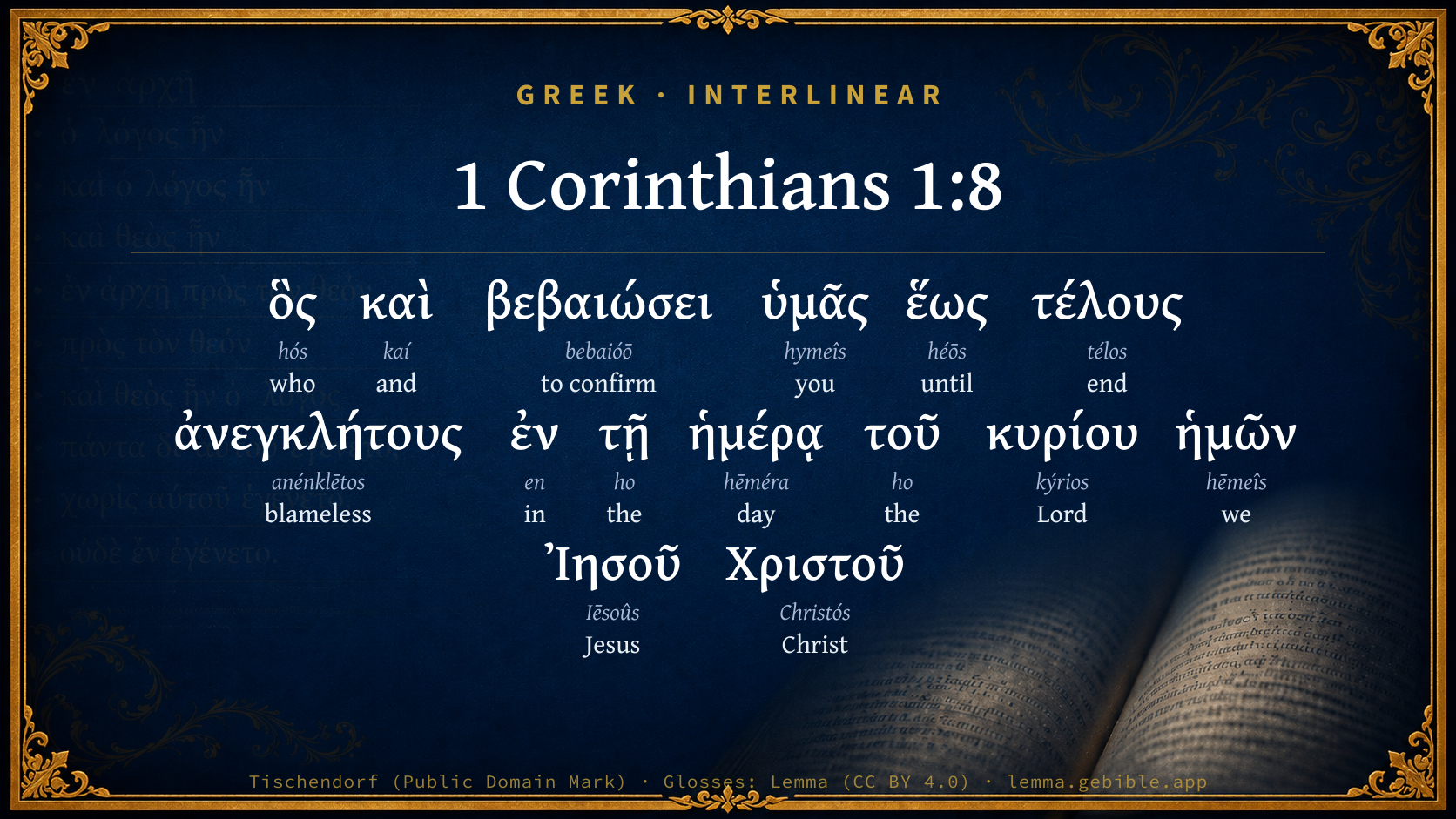
Greek (Tischendorf 8th ed.) 1 Corinthians 1:8 appears in the Greek New Testament. The text above is from the Tischendorf 8th edition. Each word links to its Strong’s number and a concise gloss. Click any word for its full Thayer’s Greek Lexicon entry.
Download image
Cite this verse

1 Corinthians 1:8 (World English Bible). Public Domain. Lemma interlinear Bible study tool, https://lemma.gebible.app/v/1-corinthians/1/8.

Show BibTeX & RIS
BibTeX
RIS
English Translation
who will also confirm you until the end, blameless in the day of our Lord Jesus Christ.
World English Bible · Public Domain
Highlights
  • 1 first appearance in the Greek New Testament
Full analysis ↓
Download a study sheet

One document with this verse’s original text, its word-by-word gloss line, the meaning frame, cross-references with their text, attributed commentary, and full source and license credits — printable, and it pastes into notes with its structure intact.

This verse Autodidact and up

Study sheet (.html) Plain text (.txt)

A passage Seminary Student

Up to 50 verses in one chapter. A passage sheet keeps up to 6 commentary sources and 12 cross-references per verse, in the order this page ranks them, and says so on the sheet whenever that leaves anything out. Ask for a single verse and you get the Autodidact verse sheet above.

Everything on this page stays free to read, with no account — the sheet is a download of what is already on screen, not access to it.

Want to remove ads? Support Godless Engineer
Compare translations 3

The same verse in 3 English versions, stacked beneath the original-language interlinear above. Click any original word for its lexicon entry.

Each is an independent rendering of the whole verse — the interlinear is not word-aligned to these translations.

Highlighted words mark where these versions differ — a whole-verse word diff, not a word-by-word alignment.

  • World English Bible Public Domain
    who will also confirm you until the end, blameless in the day of our Lord Jesus Christ.
  • King James Version Public Domain
    Who shall also confirm you unto the end, that ye may be blameless in the day of our Lord Jesus Christ.
  • unfoldingWord Literal Text CC BY-SA 4.0
    who will also confirm you to the end, blameless on the day of our Lord Jesus Christ.

unfoldingWord Literal Text — © unfoldingWord, licensed CC BY-SA 4.0. Word-aligned USFM3 via Door43 (git.door43.org/unfoldingWord/en_ult).

Versions to compare (up to 4)

3 of 4 selected

Show all 19 translations

Every available English version of this verse, each an independent rendering of the whole verse.

  • World English Bible Public Domain
    who will also confirm you until the end, blameless in the day of our Lord Jesus Christ.
  • Berean Standard Bible Public Domain
    He will sustain you to the end, so that you will be blameless on the day of our Lord Jesus Christ.
  • Majority Standard Bible Public Domain
    He will sustain you to the end, so that you will be blameless on the day of our Lord Jesus Christ.
  • King James Version Public Domain
    Who shall also confirm you unto the end, that ye may be blameless in the day of our Lord Jesus Christ.
  • American Standard Version (1901) Public Domain
    who shall also confirm you unto the end, `that ye be' unreproveable in the day of our Lord Jesus Christ.
  • Revised Version (1885) Public Domain
    who shall also confirm you unto the end, that ye be unreproveable in the day of our Lord Jesus Christ.
  • Geneva Bible (1599) Public Domain
    Who shall also confirme you vnto the ende, that ye may be blamelesse, in the day of our Lord Iesus Christ.
  • Douay-Rheims (1899) Public Domain
    Who also will confirm you unto the end without crime, in the day of the coming of our Lord Jesus Christ.
  • Young's Literal Translation Public Domain
    who also shall confirm you unto the end -- unblamable in the day of our Lord Jesus Christ;
  • Literal Standard Version CC BY-SA 4.0
    who also will confirm you to the end—unblamable in the day of our Lord Jesus Christ;
  • Unlocked Literal Bible CC BY-SA 4.0
    He will also strengthen you to the end, so that you will be blameless on the day of our Lord Jesus Christ.
  • unfoldingWord Literal Text CC BY-SA 4.0
    who will also confirm you to the end, blameless on the day of our Lord Jesus Christ.
  • Darby Bible Public Domain
    who shall also confirm you to [the] end, unimpeachable in the day of our Lord Jesus Christ.
  • World Messianic Bible Public Domain
    who will also confirm you until the end, blameless in the day of our Lord Yeshua the Messiah.
  • Webster's Bible Public Domain
    Who will also confirm you to the end, that ye may be blameless in the day of our Lord Jesus Christ.
  • Free Bible Version CC BY-SA 4.0
    He will also keep you strong to the very end, so you will be kept right until the day of the Lord Jesus Christ.
  • Bible in Basic English Public Domain
    Who will give you strength to the end, to be free from all sin in the day of our Lord Jesus Christ.
  • Text-Critical English NT CC BY 4.0
    He will strengthen you to the end, so that you will be blameless on the day of our Lord Jesus Christ.
  • Tyndale New Testament (1534) Public Domain
    which shall streght you vnto the ende that ye maye be blamelesse in the daye of oure lorde Iesus Christ.

Literal Standard Version (2020), Covenant Press — licensed CC BY-SA 4.0. Text via the HelloAO Bible API (eBible.org). Unlocked Literal Bible (unfoldingWord) — licensed CC BY-SA 4.0. Text via the HelloAO Bible API (eBible.org). unfoldingWord Literal Text — © unfoldingWord, licensed CC BY-SA 4.0. Word-aligned USFM3 via Door43 (git.door43.org/unfoldingWord/en_ult). Free Bible Version, Dr. Jonathan Gallagher — licensed CC BY-SA 4.0. Text via the HelloAO Bible API (eBible.org).

Word by word

More ways to search: Search by grammar → Find every occurrence → Compare this word →

Practice this passage: Drill this verse → Learn its vocabulary →

ἀνεγκλήτους
anénklētos
G410
“blameless”
Adjective, Accusative, Plural, Masculine
Part of Speech
Adjective
Case
Accusative
Number
Plural
Gender
Masculine
Full Thayer's Definition

Origin: from G1 (as a negative particle) and a derivative of G1458

TDNT: 06:56,6

1. that cannot be called into to account, unreproveable, unaccused, blameless
  1. ὃς hós G3739 “who” Relative pronoun, Nominative, Singular, Masculine
  2. καὶ kaí G2532 “and” Conjunction
  3. βεβαιώσει bebaióō G950 “to confirm” Verb, Future, Active, Indicative, 3rd person, Singular
  4. ὑμᾶς hymeîs G5210 “you” Personal pronoun, 2nd person, Accusative, Plural
  5. ἕως héōs G2193 “until” Adverb
  6. τέλους télos G5056 “end” Noun, Genitive, Singular, Neuter
  7. ἐν en G1722 “in” Preposition
  8. τῇ ho G3588 “the” Article, Dative, Singular, Feminine
  9. ἡμέρᾳ hēméra G2250 “day” Noun, Dative, Singular, Feminine
  10. τοῦ ho G3588 “the” Article, Genitive, Singular, Masculine
  11. κυρίου kýrios G2962 “Lord” Noun, Genitive, Singular, Masculine
  12. ἡμῶν hēmeîs G2249 “we” Personal pronoun, 1st person, Genitive, Plural
  13. Ἰησοῦ Iēsoûs G2424 “Jesus” Noun, Genitive, Singular, Masculine
  14. Χριστοῦ Christós G5547 “Christ” Noun, Genitive, Singular, Masculine

About this verse

These counts appear in no published source. They are computed here, from the morphology-tagged text and Lemma’s own curated glosses. What Lemma adds →

15
words
14
distinct lemmas
Pauline Epistles
section

Notable vocabulary

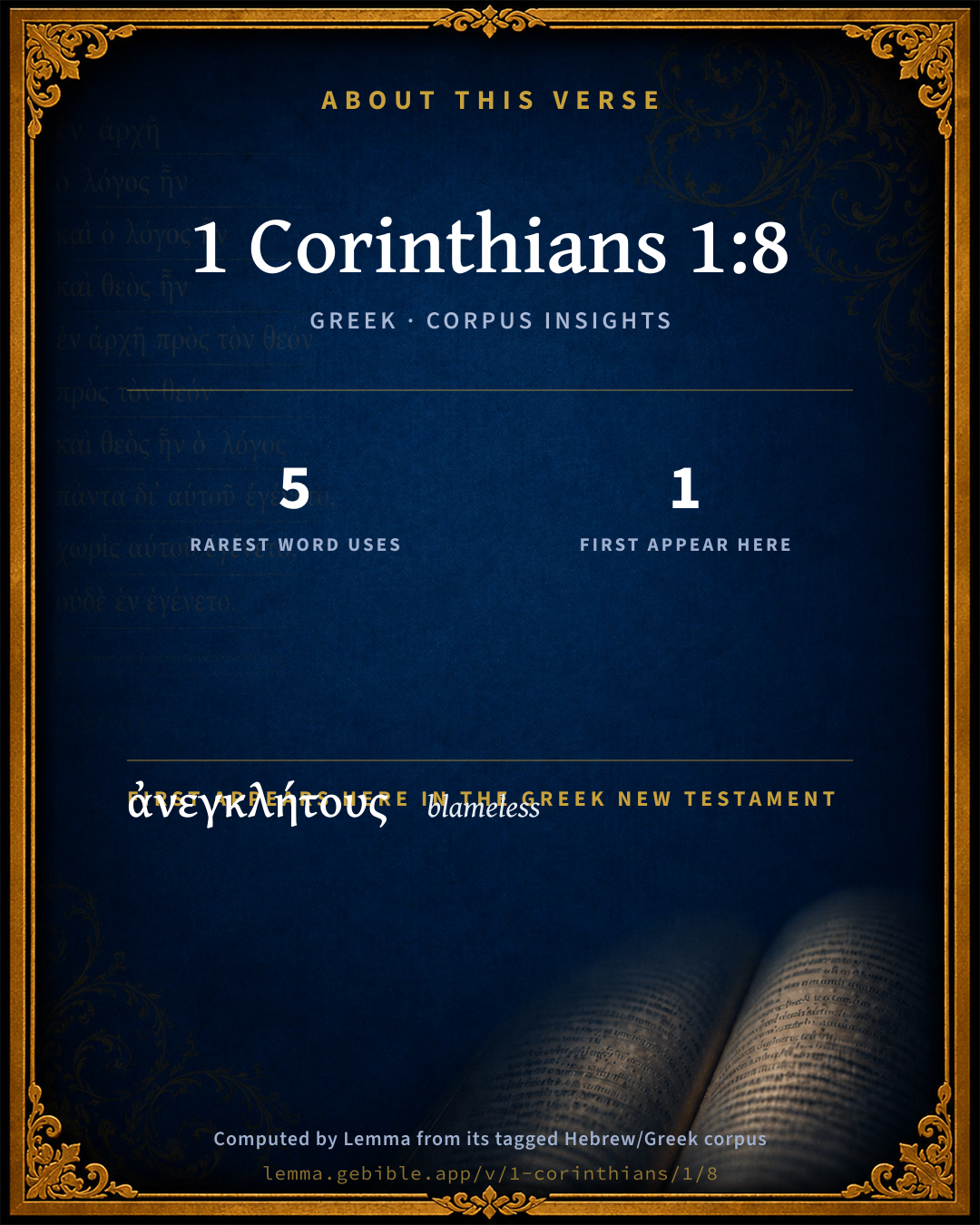
The rarest word here is ἀνεγκλήτους blameless G410 — appearing just 5 times in the whole Greek New Testament.

First appearance in Scripture

This word makes its first canonical appearance in the Greek New Testament here:

  • ἀνεγκλήτους blameless G410

Shared distinctive vocabulary

ἀνεγκλήτους blameless G410 occurs in 5 verses of the Greek New Testament. Also found in:

Repetition

A word recurs within this verse:

Cross-references

20

Topical passages linked to 1 Corinthians 1:8 in the Treasury of Scripture Knowledge — connected by theme and wording, ordered by reader-vote popularity; previews shown in the World English Bible.

  • 1 Thessalonians 5:23–24 May the God of peace himself sanctify you completely. May your whole spirit, soul, and body be preserved blameless at the coming of our Lord Jesus Christ.
  • 1 Thessalonians 3:13 to the end he may establish your hearts blameless in holiness before our God and Father, at the coming of our Lord Jesus with all his saints.
  • Colossians 1:22 yet now he has reconciled in the body of his flesh through death, to present you holy and without blemish and blameless before him,
  • Philippians 1:6 being confident of this very thing, that he who began a good work in you will complete it until the day of Jesus Christ.
  • Jude 1:24–25 Now to him who is able to keep them from stumbling, and to present you faultless before the presence of his glory in great joy,
  • 2 Thessalonians 3:3 But the Lord is faithful, who will establish you, and guard you from the evil one.
  • Ephesians 5:27 that he might present the assembly to himself gloriously, not having spot or wrinkle or any such thing; but that it should be holy and without blemish.
  • Romans 16:25
  • 1 Peter 5:10 But may the God of all grace, who called you to his eternal glory by Christ Jesus, after you have suffered a little while, perfect, establish, strengthen, and settle you.
  • Philippians 1:10 so that you may approve the things that are excellent; that you may be sincere and without offense to the day of Christ;
  • Philippians 2:15–16 that you may become blameless and harmless, children of God without blemish in the midst of a crooked and perverse generation, among whom you are seen as lights in the world,
  • Psalms 37:28 For Yahweh loves justice, And doesn't forsake his saints. They are preserved forever, But the children of the wicked shall be cut off.
  • Romans 14:4 Who are you who judge another's servant? To his own lord he stands or falls. Yes, he will be made to stand, for God has power to make him stand.
  • 2 Peter 3:14 Therefore, beloved, seeing that you look for these things, be diligent to be found in peace, without blemish and blameless in his sight.
  • 2 Corinthians 1:21 Now he who establishes us with you in Christ, and anointed us, is God;
  • 2 Peter 3:10 But the day of the Lord will come as a thief in the night; in which the heavens will pass away with a great noise, and the elements will be dissolved with fervent heat, and the earth and the works that are in it will be burned up.
  • Psalms 37:17 For the arms of the wicked shall be broken, But Yahweh upholds the righteous.
  • 2 Corinthians 1:14 as also you acknowledged us in part, that we are your boasting, even as you also are ours, in the day of our Lord Jesus.
  • Luke 17:24 for as the lightning, when it flashes out of the one part under the sky, shines to the other part under the sky; so will the Son of Man be in his day.
  • 1 Corinthians 5:5 are to deliver such a one to Satan for the destruction of the flesh, that the spirit may be saved in the day of the Lord Jesus.

Cross-references courtesy of OpenBible.info (CC BY 4.0).

Commentary

Notes on 1 Corinthians 1:8 from classic Christian and Jewish commentators (each source and its license shown beneath its notes). The classic Christian expositions comment on the surrounding passage and are grouped to its opening verse, so a note may address several verses; the Jewish commentaries on the Tanakh (Rashi and others) are per-verse, so they appear only where the commentator wrote on this verse.

Lemma curates 59 commentaries, every one of them public domain or Creative Commons licensed, each selected and text-cleaned for this edition rather than reprinted as found. About our sources →

Scofield Reference Notes

C. I. Scofield

day of our Lord Jesus

The expression "day of Christ," occurs in the following passages: 1Co 1:8; 1Co 5:5; 2Co 1:14; Php 1:6; Php 1:10; Php 2:16. A.V. has "day of Christ," 2Th 2:2 incorrectly, for "day of the Lord"; Isa 2:12; Rev 19:11-21 The "day of Christ" relates wholly to the reward and blessing of saints at his coming, as "day of the Lord" is connected with judgment.

The Scofield Reference Bible (1917 edition), notes by C. I. Scofield — public domain. Text from a community e-Sword module.

Tyndale Open Study Notes

Tyndale Open Resources

1:8 Even though believers are saved from eternal condemnation (see Rom 8:1), they remain accountable to God for the way they live (see 1 Cor 3:12-15; 4:4-5; 2 Cor 5:10). Paul encourages his readers to live a holy life so that they will be found faultless when Christ returns (see Phil 1:6, 10; 1 Thes 3:13; 5:23-24).

Tyndale Open Study Notes — © Tyndale Open Resources, licensed CC BY-SA 4.0. Text via the HelloAO Bible API.

Bengel's Gnomon

Johann Albrecht Bengel

1Co 1:8. Ὅς, who) God, 1Co 1:4 [not Jesus Christ, 1Co 1:7]: comp. 1Co 1:9.—ἕως τέλους, even to the end) an antithesis to the beginning implied in the phrase; which was given, 1Co 1:4. This end is immediately described in this verse, comp. ch. 1Co 15:24.—ἐν τῇ ἡμέρᾳ, in the day) construed with unblamed [blameless], 1Th 5:23. After that day, there is no danger, Eph 4:30; Php 1:6. Now, there are our own days, in which we work, as also the days of our enemies, by whom we are tried; then there will be the day of Christ and of His glory in the saints.

Bengel's Gnomon of the New Testament — English translation (T&T Clark, Edinburgh, 1860) — public domain. Text from a community e-Sword module.

Meyer's Critical & Exegetical Commentary

Heinrich August Wilhelm Meyer

1Co_1:8. Ὅς] refers to Ἰησοῦ Χ., not, as Flatt, Pott, Billroth, Schrader, Olshausen, de Wette, Osiander, Ewald, Hofmann, with the majority of interpreters, assume, to the far-distant Θεός 1Co_1:4,a view to which we are not compelled either by the Ἰησ. Χριστοῦ which follows (see below), or by 1Co_1:9, seeing that the working of the exalted Christ is in fact subordinated to the will of God (1Co_3:23, 1Co_11:3; Rom_8:34, al[131]). Comp Winer, p. 149 [E.T. 196]. The apostle, however, is so full of Christ, as he addresses himself to his Epistle, that throughout the preamble he names Him in almost every verse, sometimes even twice. Comp Rom_1:1-7.

καί] also, denotes that which corresponds to the ἀπεκδέχεσθαι κ.τ.λ[134], what Christ will do.

ΒΕΒΑΙΏΣΕΙ] ΣΤΗΡΊΞΕΙ Rom_16:25; 1Th_3:13; 2Co_1:21. The future stands here not optatively (Pott), but as expressive of a confident hope in the gracious working of Christ.[135]

ἝΩς ΤΈΛΟΥς] applies not to the end of life (Calovius, Flatt, and others), but, as the foregoing τ. ἀποκάλ. Κ.Τ.Λ[136] and the following ἐν τῇ ἡμέρᾳ κ.τ.λ[137] clearly show, to the end of the pre-Messianic period of the worlds history (the αἰὼν οὗτος, see on Mat_13:32), which is to be ushered in by the now nearly approaching (1Co_7:29, 1Co_15:51) Parousia. Comp 1Co_10:11; 2Co_1:13. It is the ΣΥΝΤΈΛΕΙΑ ΤΟῖ ΑἸῶΝΟς, Mat_13:39 f., Mat_24:3, Mat_28:20; comp Heb_9:26.

ἈΝΕΓΚΛΉΤΟΥς Κ.Τ.Λ[140]] result of the strengthening: so that ye shall be free from reproach in the day, etc. Comp 1Th_3:13. See respecting this proleptic usage generally, on Mat_12:13; Php_3:21, and Jacob, Quaest. epic. ii. 4, p. 136 ff. Stallb. a[142] Plat. Rep. p. 560 D.

τοῦ Κυρίον κ.τ.λ[143]] The repetition of the noun instead of the mere pronoun is common in the classics also (Ellendt, a[144] Arrian. Exp. Al. i. 55; Kühner, a[145] Xen. Mem. i. 6. 1), and elsewhere in the N. T. (Winer, l.c[146] and p. 136 [E. T. 180]). Here (as at 2Co_1:5; Eph_1:13; Col_1:13 f., al[147]) it has solemn emphasis. Comp 1Co_1:21.

It is to be noted, moreover, that the blamelessness in the day of Christ (comp Rom_8:33) is conditioned (2Ti_4:7) by perseverance in the faith (through which justification is appropriated), and consequently rests on the imputation of faith (Rom_4:4 f.); but is nevertheless, in virtue of the moral character and power of faith, as also in virtue of sanctification through the Spirit, of a thoroughly moral nature (Rom_6:1 ff; Rom_8:1 ff.), so that the ἈΝΈΓΚΛΗΤΟς at the Parousia appears not, indeed, as ἈΝΑΜΆΡΤΗΤΟς, but as ΚΑΙΝῊ ΚΤΊΣΙς ἘΝ ΧΡΙΣΤῷ (2Co_5:17), who, being divinely restored (Eph_2:10; Col_3:10) and progressively sanctified (1Th_5:23), has worked out his own salvation (Php_2:12) in the consecration of the moral power of the new spiritual life (Rom_8:2 f.; Php_1:10 f.), and now receives the ΒΡΑΒΕῖΟΝ of his calling (Php_3:14), the ΣΤΈΦΑΝΟς of the ΔΙΚΑΙΟΣΎΝΗ (2Ti_4:8), in the ΔΌΞΑ of everlasting life.

[131] l. and others; and other passages; and other editions.

[134] .τ.λ. καὶ τὰ λοιπά.

[135] Chrysostom, Theodoret, Theophylact, and others, find in this expression an indirect censure; as a hint that they were σαλενόμενοι and ἐγκλήμασι νῦν ὑποκείμενοι. A view the more inappropriate, when we consider how natural and familiar to the apostle was the thought expressed with respect to all his churches.

[136] .τ.λ. καὶ τὰ λοιπά.

[137] .τ.λ. καὶ τὰ λοιπά.

[140] .τ.λ. καὶ τὰ λοιπά.

[142] d refers to the note of the commentator or editor named on the particular passage.

[143] .τ.λ. καὶ τὰ λοιπά.

[144] d refers to the note of the commentator or editor named on the particular passage.

[145] d refers to the note of the commentator or editor named on the particular passage.

[146] .c. loco citato or laudato.

[147] l. and others; and other passages; and other editions.

Meyer — Critical and Exegetical Commentary on the New Testament — English translation by Peter Christie, edited by Frederick Crombie (T&T Clark, 1880) — public domain. Text from a community e-Sword module.

Expositor's Greek Testament

ed. W. Robertson Nicoll

1Co 1:8 . ὃς καὶ βεβαιώσει ὑμᾶς echoes ἐβεβαιώθη (1Co 1:6 ); cf. the thanksgiving of Phi 1:6 . ἕως τέλους (see parls.) points to a consummation , not a mere termination of the present order; cf. Rom 6:21 f. ἀνεγκλήτους , “unimpeached,” synonymous with ἀμέμπτους (unblamed), but judicial in significance, in view of the ἡμέρα τοῦ Κυρίου : “free from charge when the day of the Lord shall come”; cf. Rom 8:33 , τίς ἐγκαλέσει ; ὅς refers to the foregoing κύριος Ἰ . Χ ., not to the distant Θεὸς of 1Co 1:4 ; the Saviour “who will make sure” the innocence of the Cor [106] on that day is the Judge who will pronounce upon it ( cf. Col 1:22 , Eph 5:27 , where Christ is to “present” the Church “unblemished and unimpeached” before Himself): He will then confirm them and vindicate their character, as they have confirmed the testimony about Him ( cf. Luk 9:26 ). P. does not say the Cor [107] are ἀνέγκλητοι now; he hopes that they will prove so then . “The day of our Lord Jesus Christ” ( cf. note on 1Co 3:13 ) is the O.T. “day of Jehovah” (LXX, τ . Κυρίου ), translated into the “day of Christ,” since God has revealed His purpose to “judge through Jesus Christ” (Rom 2:16 , Act 17:31 ). ἐν τ . ἡμέρᾳ = ἐν τ . παρουσίᾳ τ . κυρ . Ἰ . Χ . (1Th 5:23 , etc.), with the added connotation of judgment , to which the ἀποκάλυψις of 1Co 1:7 leads up: for this connexion of thought, see Rom 2:5 , 2Th 1:7 ff. P. does not say “ His day,” though ὅς recalls ὁ κύρ . Ἰ . Χ .: Christ’s name is repeated ten times in the first ten vv. six times, as here, in full style with sustained solemnity of emphasis ( cf. the repetition of “God” in 20 29); “P. thus prepares for his exhortations these Cor [108] , who were disposed to treat Christianity as a matter of human choice and personal liking, under the sense that in a Christian Church Christ is the one thing and everything” (Hf [109] ).

[106] Corinth, Corinthian or Corinthians.

[107] Corinth, Corinthian or Corinthians.

[108] Corinth, Corinthian or Corinthians.

[109] J. C. K. von Hofmann’s Die heilige Schrift N.T. untersucht , ii. 2 (2te Auflage, 1874).

The Expositor's Greek Testament, edited by W. Robertson Nicoll (1897–1910) — public domain. Text from a community e-Sword module.

Godet's Commentaries

Frédéric Louis Godet

Vv. 8. “Who shall also confirm you unto the end, that ye may be blameless in the day of our Lord Jesus Christ. 9. God is faithful, by whom ye were called unto the fellowship of His Son Jesus Christ our Lord.” — The pron. ὅς, who, refers of course to the person of Jesus Christ (1Co 1:7). But this name being expressly repeated at the end of the verse, many commentators have been led to refer the pronoun ὅς to θεός, God (1Co 1:4). But this reference would reduce the whole passage, 1Co 1:5-7, to a simple parenthesis; it has besides against it the repetition of the word θεός in 1Co 1:9. If the expression our Lord Jesus Christ appears again at the end of the verse, instead of the pronoun, this arises from the fact that the term “the day of Christ” is a sort of technical phrase in the New Testament; it corresponds to the “day of the Lord” in the Old Testament.

The καί, also, implies that the work to be yet accomplished will only be the legitimate continuation of that which is already wrought in them. There is undoubtedly an intentional correlation between the βεβαιώσει, will confirm, of 1Co 1:8, and the ἐβεβαιώθη, was confirmed, of 1Co 1:6. Since God confirmed Paul’s preaching at Corinth by the gifts which His Spirit produced there, He will certainly confirm believers in their faith in the gospel to the end.

This end is the Lord’s coming again, for which the Church should constantly watch, for the very reason that it knows not the time of it; comp. Luk 12:35-36; Mar 13:32. If this event does not happen during the life of this or that generation, death takes its place for each, till that generation for which it will be realized externally. The phrase, in the day of Christ, does not depend on the verb will confirm, but on the epithet ἀνεγκλήτους, unblameable. We must understand between the verb and the adjective the words εἰς τὸ εἶναι, as in Rom 8:29; 1Th 3:13; Php 3:21 (where the words εἰς τὸ γενέσθαι are a gloss): the end is directly connected with the means.—᾿Ανέγκλητος signifies exempt from accusation, and many apply the word to the act of justification which will cover the infirmities and stains of believers in that supreme hour, so that, as Meyer says, the epithet is not equivalent to ἀναμάρτητος, exempt from sin. It does not seem to me that this meaning suits the parallels 2Co 7:1, 1Th 5:23; for these passages represent believers as completely sanctified at that time. If then they are no longer subject to any accusation, it will not be only, as during their earthly career, in virtue of their justification by faith, it will be in virtue of their thenceforth perfected sanctification. The Greek - Latin reading παρουσία, advent, instead of ἡμέρα, day, has no probability.

Frédéric Louis Godet — Commentaries on Luke, John, Romans, and 1 Corinthians — English translation (T&T Clark, Edinburgh, 1870s–1890s) — public domain. Text from a community e-Sword module.

Hodge's Commentary on Romans, Ephesians & First Corinthians

Charles Hodge

1Co_1:8

Who shall also confirm you unto the end, (that ye may be) blameless in the day of our Lord Jesus Christ.

Who most naturally refers to God as its antecedent, because he is the prominent subject in the context; and because the reference to Christ would make the apostle say Christ shall confirm unto the day of Christ; and because in the following verse, God is expressly mentioned. Because God is faithful, he will confirm you, is the clear meaning of the passage. Besides, vocation and perseverance are, in the work of redemption, specially referred to the Father.

Shall also confirm you. God had not only enriched them with the gifts of the Spirit but he would also confirm them. The one was an assurance of the other. Those to whom God gives the renewing influence of the Spirit, he thereby pledges himself to save; for the first fruits of the Spirit are, as just remarked, of the nature of a pledge. They are an earnest, as the apostle says, of the future inheritance, Eph_1:14; 2Co_1:21, 2Co_1:22. Shall confirm (βεβαιώσει) i.e. shall make steadfast, preserve from falling. The word is used in reference to persons and things. God is said to confirm his promises, when he fulfills them, or so acts as to prevent their failing, see Rom_15:8 or when he demonstrates their truth, Mar_16:20. He is said to confirm his people when he renders them steadfast in the belief and obedience of the truth, 2Co_1:21. Unto the end, may mean the end of life, or the end of this dispensation, i.e. to the end of the period which was to precede the advent of Christ; or it may be understood indefinitely as we use the expression final perseverance. Unblamable, i.e. not arraigned or accused. He is unblamable against whom no accusation can be brought. In this sense it is said a bishop must be blameless, Tit_1:6.7. God will confirm his people so that when the day of judgment comes, which is the day of our Lord Jesus, i.e. the day of his second advent, they shall stand before him blameless, not chargeable with apostasy or any other sin. They are to be holy and without blame. Compare 1Th_5:23. When we remember on the one hand how great is our guilt, and on the other, how great is our danger from without and from within, we feel that nothing but the righteousness of Christ and the power of God can secure our being preserved and presented blameless in the day of the Lord Jesus.

Charles Hodge — Commentary on Romans (1835), First Corinthians (1857), and Ephesians (1856) — public domain. Text from a community e-Sword module.

Geneva Bible (1599)

Geneva Bible translators

He calleth them blameless, not whom man never found fault with, but with whom no man can justly find fault, that is to say, them which are in Christ Jesus, in whom there is no condemnation. See Luke 1:6.

He testifieth that he hopeth well of them hereafter, that they may more patiently abide his reprehension afterward. And yet together therewithall showeth, that as well the beginning as the accomplishing of our salvation is only the work of God.

Geneva Bible (1599) marginal notes — public domain. Text via Bolls.life.

Jamieson, Fausset & Brown

Robert Jamieson, A. R. Fausset & David Brown

Who--God, Co1 1:4 (not Jesus Christ, Co1 1:7, in which case it would be "in His day").

unto the end--namely, "the coming of Christ."

blameless in the day of . . . Christ-- (Th1 5:23). After that day there is no danger (Eph 4:30; Phi 1:6). Now is our day to work, and the day of our enemies to try us: then will be the day of Christ, and of His glory in the saints [BENGEL].

Jamieson, Fausset & Brown — Commentary Critical and Explanatory on the Whole Bible (1871) — public domain (CC PDM 1.0). Text via the HelloAO Bible API.

Adam Clarke's Commentary

Verse 8. Who shall - confirm you] As the testimony of Christ was confirmed among you, so, in conscientiously believing and obeying, God will confirm you through that testimony. See 1Co 1:6.

In the day of our Lord Jesus] In the day that he comes to judge the world, according to some; but, in the day in which he comes to destroy the Jewish polity, according to others. While God destroys them who are disobedient, he can save you who believe.

Adam Clarke's Commentary on the Bible (1810–1826) — public domain. Text from a community e-Sword/MySword module.

John Calvin's Commentaries

8. Who will also confirm you. The relative here refers not to Christ, but to God, though the word God is the remoter antecedent. For the Apostle is going on with his congratulation, and as he has told them previously what he thought of them, so he now lets them know what hope he has of them as to the future, and this partly for the purpose of assuring them still farther of his affection for them, and partly that he may exhort them by his own example to cherish the same hope. It is as if he had said — Though the expectation of a salvation to come keeps you still in suspense, you ought nevertheless to feel assured that the Lord will never forsake you, but will on the contrary increase what he has begun in you, that when that day comes on which

“we must all appear before the judgment-seat of Christ,” (2 Corinthians 5:10,)

we may be found there blameless.

Blameless In his Epistles to the Ephesians and Colossians (Ephesians 1:4, and Colossians 1:22) he teaches that this is the end of our calling — that we may appear pure and unreproachable in the presence of Christ. It is, however, to be observed, that this glorious purity is not in the first instance perfected in us; nay, rather, it goes well with us if we are every day making progress in penitence, and are being purged from the sins (2 Peter 1:9) that expose us to the displeasure of God, until at length we put off, along with the mortal body, all the offscourings of sin. Of the day of the Lord we shall have occasion to speak when we come to the fourth chapter.

John Calvin's Commentaries (1540-1563) — public domain. Text from the Calvin Translation Society English edition (1840s-50s) via the Christian Classics Ethereal Library (ccel.org). Calvin's coverage is partial (roughly two-thirds of the Bible); uncommented books and verses are honest gaps, never fabricated. The 19th-century editor's footnotes and remarks are omitted so the notes are faithfully Calvin's own voice.

Ellicott's Commentary for English Readers

(8) Who.—The use of the words “day of our Lord Jesus Christ,” instead of “His day,” has been regarded by some as a sufficient evidence that “who” does not refer to Christ. This by itself would scarcely be so, for there are examples elsewhere of St. Paul using our Lord’s name where the possessive pronoun would have seemed more natural (Eph_4:12; Col_2:11). The general sense of the passage, however, and especially of the following verse, shows that the antecedent to “who” is not “Christ,” in 1Co_1:7, but “God,” in 1Co_1:4.

Three distinct periods are referred to in these verses—(1) the time when the grace of God was given them (1Co_1:4); (2) the present time while they wait for the coming of the Lord Jesus, endowed as they are with the qualities described in 1Co_1:5-7; and (3) the day of our Lord Jesus Christ, which is still future—if preserved blameless until that, then they are finally and for ever safe; and that they will be so preserved by God the Apostle has no doubt, for the reason stated in the next verse. (See 1Co_4:3.)

A Bible Commentary for English Readers, edited by Charles John Ellicott (1878–1897) — public domain. Text from a community e-Sword module.

The Cambridge Bible for Schools and Colleges

gen. ed. J. J. S. Perowne

8. blameless] is the exact equivalent of the Greek, which signifies free from reproach. It is worthy of remark that “blame,” though the Saxon termination “less” has been appended to it, is itself a word of Greek origin. It is identical with “blaspheme,” the original meaning of which is, “to speak ill of,” and has reached us in an abbreviated form through the French.

The Cambridge Bible for Schools and Colleges (gen. ed. J. J. S. Perowne; Cambridge University Press, 1878–1918) — public domain. Text from a community e-Sword module.

John Gill's Exposition

Who shall also confirm you unto the end,.... The author of this blessing of confirmation is not the Lord Jesus Christ, though he is mentioned in the latter part of Co1 1:7; and seems to be the antecedent to the relative "who" in this, but is not, for this confirmation is made in him; see Co2 1:21; and besides, it is in order that the saints might be blameless in the day of Christ, and so must design some other person distinct from him, which is God the Father, Co1 1:4, to whom the apostle gives thanks, and continues to do so unto this verse; in which he assures the saints of confirmation in grace by God, the author and giver of all grace: and which may be understood of their confirmation in the love and favour of God, from which there can be no separation; and of their establishment in the person of Christ, and in the doctrines of grace; and of the permanency of the grace of the Spirit in them, and of their perseverance in faith and holiness unto the end: that is, of their days; even until the day of Christ, when the good work begun in them shall be performed and finished; that is, "for ever", as the Ethiopic version reads it; for the love of God to his people always continues; their interest in Christ can never be lost; grace in them is an immortal seed; nor shall they be ever finally and totally moved away from the hope of the Gospel:

that ye may be blameless; not in themselves, for no man is without his faults; none of God's children are without their failings and infirmities; they have whereof to blame themselves, and may be blamed by God too in a providential way; but they are so in Christ their head, being justified by his righteousness, and washed in his blood; and so in the sight of God, as considered in Christ; and will appear such

in the day of our Lord Jesus Christ, when he shall descend from heaven, and take his saints to him, and present them to himself a glorious church, without spot or wrinkle, or any such thing.

John Gill's Exposition of the Whole Bible (1746–1763) — public domain (CC PDM 1.0). Text via the HelloAO Bible API.

Trapp's Complete Commentary

John Trapp

8 Who shall also confirm you unto the end, that ye may be blameless in the day of our Lord Jesus Christ.

Ver. 8. In the day of our Lord Jesus] Eleven times in these first ten verses (as Chrysostom well observeth) the apostle mentioneth the Lord Jesus Christ, who was to him, and should be to us, mel in ore, melos in aure, iubilum in corde, honey in the mouth, music in the ear, joy in the heart. (Bernard.) The Jews used to cast to the ground the Book of Esther, before they read it, because the name of God is not in it. This is ill done of them. But that is recorded to the commendation of Augustine, that he cast by Cicero’s writings (though otherwise very delightful to him) because he found not in them that mellifluous {a} name of Jesus.

{a} Flowing with honey, honey dropping; sweetened with or as with honey. Now rare. ŒD

John Trapp, A Commentary or Exposition upon All the Books of the Old and New Testament (1647–1656) — public domain. Text from a community e-Sword module.

Albert Barnes' Notes on the Bible

Who shall also confirm you - Who shall establish you in the hopes of the gospel. He shall make you “firm” (βεβαιώσει bebaiōsei) amidst all your trials, and all the efforts which may be made to shake your faith, and to remove you from that firm foundation on which you now rest.

Unto the end - That is, to the coming of the Lord Jesus Christ. He would keep them to the end of life in the path of holiness, so that at the coming of the Lord Jesus they might be found blameless; compare Joh 13:1. The sense is, that they should be kept, and should not be suffered to fall away and perish - and this is one of the many places which express the strong confidence of Paul that those who are true Christians shall be preserved unto everlasting life; compare Phi 1:6.

That ye may be blameless - The word rendered “blameless” ἀνεγκλήτου anegklētou does not mean perfect, but properly denotes those against whom there is no charge of crime; who are unaccused, and against whom there is no ground of accusation. Here it does not mean that they were personally perfect, but that God would so keep them, and enable them to evince a Christian character, as to give evidence that they were his friends, and completely escape condemnation in the last Day; see the notes at Rom 8:33-34. There is no man who has not his faults; no Christian who is not conscious of imperfection; but it is the design of God so to keep his people, and so to justify and sanctify them through the Lord Jesus, that the church may be presented “a glorious church, without spot or wrinkle” Eph 5:27 on the Day of Judgment.

In the day ... - On the Day when the Lord Jesus shall come to judge the world; and which will be called his Day, because it will be the Day in which he will be the great and conspicuous object, and which is especially appointed to glorify him; see 2Th 1:10, “Who shall come to be glorified in his saints, and to be admired in all them that believe.”

Albert Barnes' Notes on the Bible (1834–1885) — public domain. Text from a community e-Sword/MySword module.

Matthew Poole's English Annotations

Which Lord Jesus Christ, ( mentioned immediately before), or which God who is faithful, ( mentioned immediately after, 1Co 1:9), shall confirm your habits of grace unto the end, approving himself the finisher of your faith, (you being not wanting in your duty and endeavour): so as either you shall not fall, or at least not totally and finally, but so as you shall rise again, and appear in the day of our Lord Jesus without blame, so as he will accept you as if you had never sinned against him.

Matthew Poole's English Annotations on the Holy Bible (1683–1685) — public domain. Text from a community e-Sword/MySword module.

Whedon's Commentary on the Bible

Daniel D. Whedon

8. Who—Referring to Jesus Christ.

Shall confirm—Will confirm; being the simple future. Fatalistic doctrine interprets this will confirm to mean that there can be no failure of their firmly enduring to the end; that the passage “furnishes a guarantee against that greatest of dangers, the fickleness of the human will.”—LANGE’S Bibel-werke, on the passage. Such an interpretation violates the true doctrine of probation, and ignores the true nature of the freedom of a responsible will, which must be allowed the power and the area for choosing either way. See our note on Rom_2:9. Hence Grotius well says, “God does his own part,” in confirming. We say as above, 1Co_1:1, the apostle expresses only the divine side of the work, implying the required performance of the human conditions which are elsewhere expressed in countless cases. That is, assuming that the Corinthian Church are earnestly anxious to be confirmed blameless to the end, he promises that God on his part will be faithful to confirm them.

Blameless—Being forgiven of every sin and sanctified unto all holiness; so that at the end we are perfectly blameless. Note Rom_8:33.

The end—the coming of Christ to judgment. See note on 1Co_15:24.

Daniel D. Whedon (gen. ed.), Commentary on the Old and New Testaments (1874–1909) — public domain. Text from a community e-Sword module.

The Pulpit Commentary

Who; clearly Christ, though his Name is again repeated in the next clause. Shall also confirm you. This natural expression of the apostle"s yearning hope for them must not be overpressed into any such doctrine as "the indefectibility of grace." All honest and earnest students must resist the tendency to strain the meaning of Scripture texts into endless logical inferences which were never intended to be deduced from them. Unto the end; namely, to the end of "this age," and to the coming of Christ. (Mat_28:20; Heb_3:6, 13 6:11) That ye be unreprovable; rather, unimpeached (anenkletous), as in Colossians 1Ti 3:17; Tit_1:6. It is not the word rendered "blameless" (amemptos) in Php_2:15 or in 2Pe_3:14. A Christian can only be "blameless," not as being sinless, but as having been forgiven, renewed, sanctified. (1Co_6:11; Rom_8:30) In the day of our Lord Jesus Christ. This is the same as the apokalypsis or parousia. It is sometimes called simply "the day". (comp. 1Co_3:13; Act_1:20; Joe_3:4; 2Th_1:10 Rev_6:17)

The Pulpit Commentary (1880–1919), ed. H.D.M. Spence-Jones & Joseph S. Exell — public domain. Text from a community e-Sword module.

John Wesley's Explanatory Notes

Who will also - if you faithfully apply to him. Confirm you to the end. In the day of Christ - Now it is our day, wherein we are to work out our salvation; then it will be eminently the day of Christ, and of his glory in the saints.

John Wesley, Explanatory Notes Upon the Whole Bible (1754–1765) — public domain. Text via the GEBible commentary corpus.

Godbey's Commentary on the New Testament

William B. Godbey

8. “Who will also establish you unto the end unrebukable in the day of our Lord Jesus Christ.” What a glorious promise that if we are only true to the grace given, our wonderful Savior will see to the fact that we are washed in the blood, filled with the Spirit, robed and ready to meet our glorious King in the eventful day of His coming.

William B. Godbey, Commentary on the New Testament (1896–1900) — public domain. Text from a community e-Sword module.

McGarvey & Pendleton's Commentaries

J. W. McGarvey

who shall also confirm you [assuming that they earnestly desired and labored to be confirmed, or kept stedfast] unto the end [i. e., unto the coming of Christ], that ye be unreprovable [unimpeachable, because forgiven-- Col_1:22 ; 1Ti_3:10 ; Tit_1:6 ] in the day [judgment day] of our Lord Jesus Christ .

J. W. McGarvey (with Philip Y. Pendleton), Commentaries on the New Testament (The Fourfold Gospel, 1914; Acts; and the epistles) — public domain. Text from a community e-Sword/MySword module.

The People's New Testament

B. W. Johnson

8. Who shall confirm you. He will do his part to confirm you; give you strength to the end, that ye may be blameless in the day, etc. Free from blame when they are called to meet the Lord.

B. W. Johnson's The People's New Testament with Notes (1889–1891) — public domain. Electronic text from the Christian Classics Ethereal Library (CCEL) ThML edition.

Cambridge Greek Testament for Schools and Colleges

8. ὃς καὶ βεβαιώσει ὑμᾶς. ‘Who shall establish us, so that we shall be blameless in the day of Jesus Christ.’

ἕως τέλους. This fixes the sense of ἀποκάλυψις above as a gradual revelation, leading up to the great day.

ἀνεγκλήτους. The construction is ‘shall make you firm, as men against whom no accusation can be brought.’ The word ἀνέγκλητος signifies one against whom no charge (ἔγκλημα) can be sustained.

Cambridge Greek Testament for Schools and Colleges (Cambridge University Press, 1896; 21 vols, various authors incl. Carr, Maclear, Plummer, Farrar, Lumby, Moule, M. R. James, Simcox) — public domain. Text from a community e-Sword module.

Alford’s Greek Testament

Henry Alford

8. ὅς] viz. θεός, ver. 4, not Ἰησοῦς χριστός, in which case we should have ἐν τῇ ἡμέρᾳ αὐτοῦ. The καί besides shews this.

ἕως τέλ. ἀνεγκ.] i.e. εἰς τὸ εἶναι ὑμᾶς ἀνεγκ.;—so ἀπεκατεστάθη ὑγιής, Mat 12:13.

To the end, see reff.—i.e. to the συντέλεια τ. αἰῶνος,—not merely ‘to the end of your lives.’

Henry Alford, The Greek Testament (1849–1861) — public domain. Text from a community e-Sword module.

International Critical Commentary

8. ὃς καὶ βεβαιώσει. Origen asks, τίς βεβαιοῖ; and answers, Χριστὸς Ἰησοῦς. the ὅς refers to τοῦ Κυρίου ἡμ. Ἰ. Χρ.; certainly not, as Beng. and others, to Θεός in v. 4. This remote reference is not made probable by the words ἐν τῇ ἡμέρᾳ τ. Κ. ἡμ. Ἰ. Χρ. instead of simply ἐν τῇ ἡμ. αὐτοῦ. We have christ’s name ten times in the first ten verses, and the solemn repetition of the sacred name, instead of the simple pronoun, is quite in St Paul’s manner; 5:3, 4: 2Co 1:5; 2Ti 1:18. Cf. Gen 19:24, which is sometimes wrongly interpreted as implying a distinction of Persons. The καί points to correspondence ‘on His part,’ answering to ἐβεβαιώθη, ἀπεκδεχομένους, in vv. 6, 7.

βεβαιώσει. Cf. 2Co 1:21, and, for the thought, Rom 16:25; 1Th 3:13, 1Th 5:24. If they fail, it will not be His fault.

ἕως τέλους. The sense is intenser than in 2Co 1:13; cf. εἰς ἐκείνην τὴν ἡμέραν (2Ti 1:12). Mortis dies est unicuique dies adventus Domini (Herv.).†

ἀνεγκλήτους. ‘Unimpeachable’ for none will have the right to impeach (Rom 8:33; Col 1:22, Col 1:28). The word implies, not actual freedom from sins, but yet a state of spiritual renewal (2:12 f.; Php 1:10; 2Co 5:17; Rom 8:1). This proleptic construction of the accusative is found in 1Th 3:13, 1Th 3:5:23; Php 3:21. connect ἐν τῇ ἡμέρᾳ with ἀνεγκλήτους.

ἐν τῇ ἡμέρᾳ א A B C L P, Syrr. Copt. Arm. Aeth.) rather than ἐν τῇ παρουσία (D E F G, Ambrst.), B omits Χριστοῦ.

International Critical Commentary — older volumes (1896–1929), various authors — public domain. Text from a community e-Sword module.

Vincent's Word Studies in the New Testament

Marvin R. Vincent

Confirm. Compare ver. 6.

Unto the end. Of the present aeon or period. See on end of the world, Mt 28:20.

Blameless [ανεγκλητους] . Used by Paul only. In apposition with you. Rev., unreprovable. The kindred verb ejgkalew occurs only in Acts and Romans. See on Rom 8:33. It means to accuse publicly, but not necessarily before a tribunal. See Act 23:28, 29; Act 26:2, 7. Hence the word here points to appearance at God 's bar.

Marvin R. Vincent, Word Studies in the New Testament (1887–1900) — public domain. Text from a community e-Sword/MySword module.

Lesson kit

Teaching starters — assembled from the data on this page, not authored interpretation. Every prompt links to the verse data it draws on. Edit before teaching.

1 Corinthians, in the Pauline Epistles, opens this verse with 15 words (14 distinct Greek lemmas). Its most distinctive word is anénklētos (“blameless”). A historical commentator’s framing appears above. Read the whole chapter for the surrounding context.

Discussion questions

  1. How does “blameless” (anénklētos) shape what this verse is saying?
  2. The word “blameless” first appears here in Scripture. What is being introduced at this debut?
  3. Colossians 1:22 shares the word «blameless» with this verse. How do the two illuminate each other?
  4. “the” occurs 2× in this one verse. What is the effect of the repetition?
  5. These translations render this verse differently; the difference is in the English rendering, not the original. What questions does that raise?
  6. Reading how Scofield Reference Notes and Tyndale Open Study Notes read this verse, where do the two commentators agree and where do they part?

Things to notice

  • 1 word makes its first canonical appearance in Scripture here.
  • These translations choose different wording for 4 words in this verse.
  • “the” occurs 2× in this single verse.
  • 14 distinct Greek lemmas span 15 words in this verse.

Reading settings

Reading text

Shown beneath each verse's original-language words.

Old Testament
Old Testament edition

Read the OT as the Masoretic Hebrew (MT) or the Greek Septuagint (LXX).

English shown for the Greek Septuagint (in the Hebrew ↔ Greek comparison).

Comparing translations? Open the Compare panel on any verse page to stack up to four side by side.