1 Corinthians 2:3

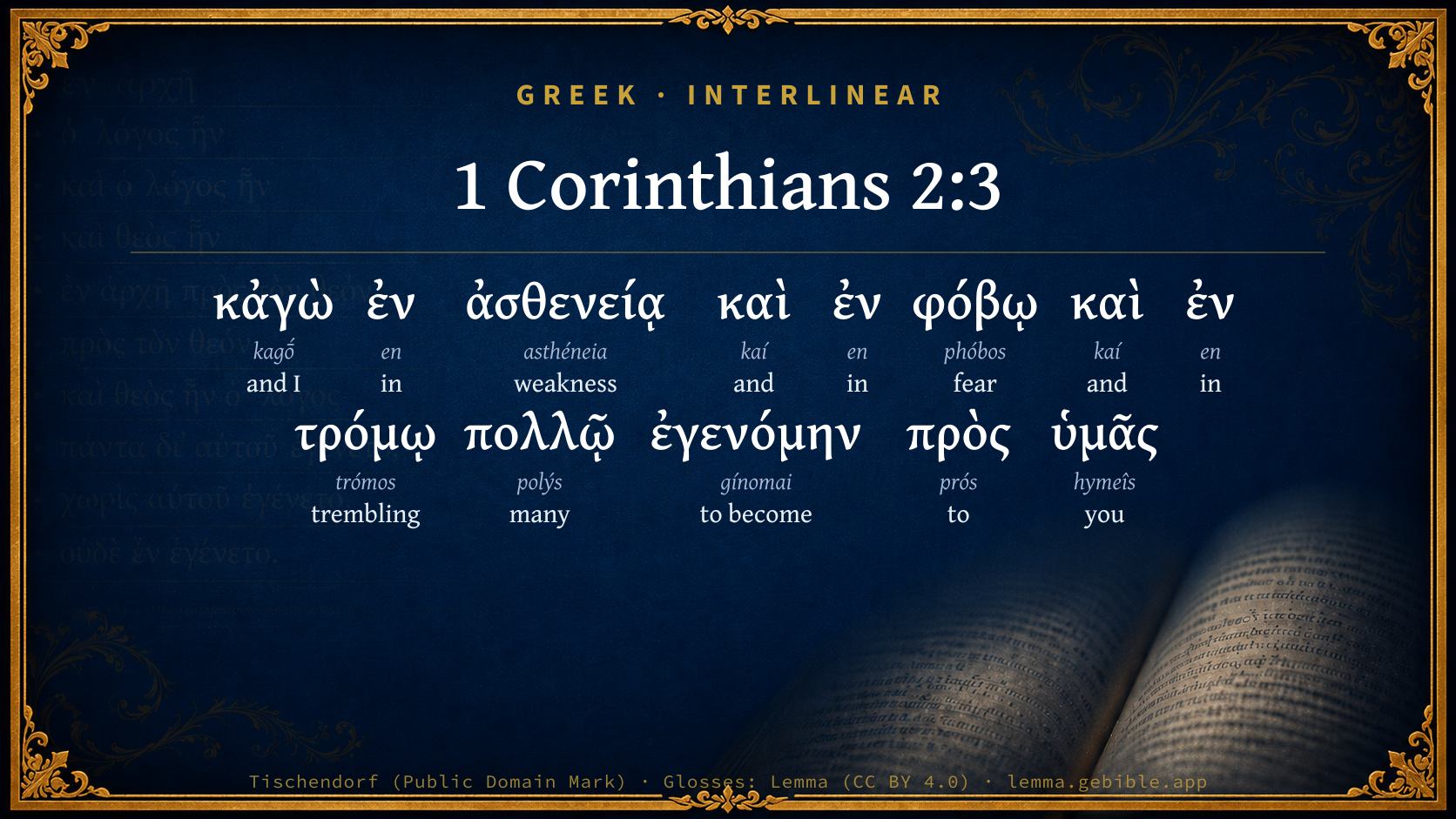
Greek (Tischendorf 8th ed.) 1 Corinthians 2:3 appears in the Greek New Testament. The text above is from the Tischendorf 8th edition. Each word links to its Strong’s number and a concise gloss. Click any word for its full Thayer’s Greek Lexicon entry.
Download image
Cite this verse

1 Corinthians 2:3 (World English Bible). Public Domain. Lemma interlinear Bible study tool, https://lemma.gebible.app/v/1-corinthians/2/3.

Show BibTeX & RIS
BibTeX
RIS
English Translation
I was with you in weakness, in fear, and in much trembling.
World English Bible · Public Domain
Download a study sheet

One document with this verse’s original text, its word-by-word gloss line, the meaning frame, cross-references with their text, attributed commentary, and full source and license credits — printable, and it pastes into notes with its structure intact.

This verse Autodidact and up

Study sheet (.html) Plain text (.txt)

A passage Seminary Student

Up to 50 verses in one chapter. A passage sheet keeps up to 6 commentary sources and 12 cross-references per verse, in the order this page ranks them, and says so on the sheet whenever that leaves anything out. Ask for a single verse and you get the Autodidact verse sheet above.

Everything on this page stays free to read, with no account — the sheet is a download of what is already on screen, not access to it.

Want to remove ads? Support Godless Engineer
Compare translations 3

The same verse in 3 English versions, stacked beneath the original-language interlinear above. Click any original word for its lexicon entry.

Each is an independent rendering of the whole verse — the interlinear is not word-aligned to these translations.

Highlighted words mark where these versions differ — a whole-verse word diff, not a word-by-word alignment.

  • World English Bible Public Domain
    I was with you in weakness, in fear, and in much trembling.
  • King James Version Public Domain
    And I was with you in weakness, and in fear, and in much trembling.
  • unfoldingWord Literal Text CC BY-SA 4.0
    And I was with you in weakness and in fear and in much trembling.

unfoldingWord Literal Text — © unfoldingWord, licensed CC BY-SA 4.0. Word-aligned USFM3 via Door43 (git.door43.org/unfoldingWord/en_ult).

Versions to compare (up to 4)

3 of 4 selected

Show all 19 translations

Every available English version of this verse, each an independent rendering of the whole verse.

  • World English Bible Public Domain
    I was with you in weakness, in fear, and in much trembling.
  • Berean Standard Bible Public Domain
    I came to you in weakness and fear, and with much trembling.
  • Majority Standard Bible Public Domain
    I came to you in weakness and fear, and with much trembling.
  • King James Version Public Domain
    And I was with you in weakness, and in fear, and in much trembling.
  • American Standard Version (1901) Public Domain
    And I was with you in weakness, and in fear, and in much trembling.
  • Revised Version (1885) Public Domain
    And I was with you in weakness, and in fear, and in much trembling.
  • Geneva Bible (1599) Public Domain
    And I was among you in weakenesse, and in feare, and in much trembling.
  • Douay-Rheims (1899) Public Domain
    And I was with you in weakness, and in fear, and in much trembling.
  • Young's Literal Translation Public Domain
    and I, in weakness, and in fear, and in much trembling, was with you;
  • Literal Standard Version CC BY-SA 4.0
    and I, in weakness, and in fear, and in much trembling, was with you;
  • Unlocked Literal Bible CC BY-SA 4.0
    And I was with you in weakness, and in fear, and in much trembling.
  • unfoldingWord Literal Text CC BY-SA 4.0
    And I was with you in weakness and in fear and in much trembling.
  • Darby Bible Public Domain
    And *I* was with you in weakness and in fear and in much trembling;
  • World Messianic Bible Public Domain
    I was with you in weakness, in fear, and in much trembling.
  • Webster's Bible Public Domain
    And I was with you in weakness, and in fear, and in much trembling.
  • Free Bible Version CC BY-SA 4.0
    I came to you in weakness, fearful and trembling.
  • Bible in Basic English Public Domain
    And I was with you without strength, in fear and in doubt.
  • Text-Critical English NT CC BY 4.0
    I came to you in weakness and fear, and with much trembling.
  • Tyndale New Testament (1534) Public Domain
    And I was amonge you in weaknes and in feare and in moche treblinge.

Literal Standard Version (2020), Covenant Press — licensed CC BY-SA 4.0. Text via the HelloAO Bible API (eBible.org). Unlocked Literal Bible (unfoldingWord) — licensed CC BY-SA 4.0. Text via the HelloAO Bible API (eBible.org). unfoldingWord Literal Text — © unfoldingWord, licensed CC BY-SA 4.0. Word-aligned USFM3 via Door43 (git.door43.org/unfoldingWord/en_ult). Free Bible Version, Dr. Jonathan Gallagher — licensed CC BY-SA 4.0. Text via the HelloAO Bible API (eBible.org).

Word by word

More ways to search: Search by grammar → Find every occurrence → Compare this word →

Practice this passage: Drill this verse → Learn its vocabulary →

About this verse

These counts appear in no published source. They are computed here, from the morphology-tagged text and Lemma’s own curated glosses. What Lemma adds →

13
words
10
distinct lemmas
Pauline Epistles
section

Notable vocabulary

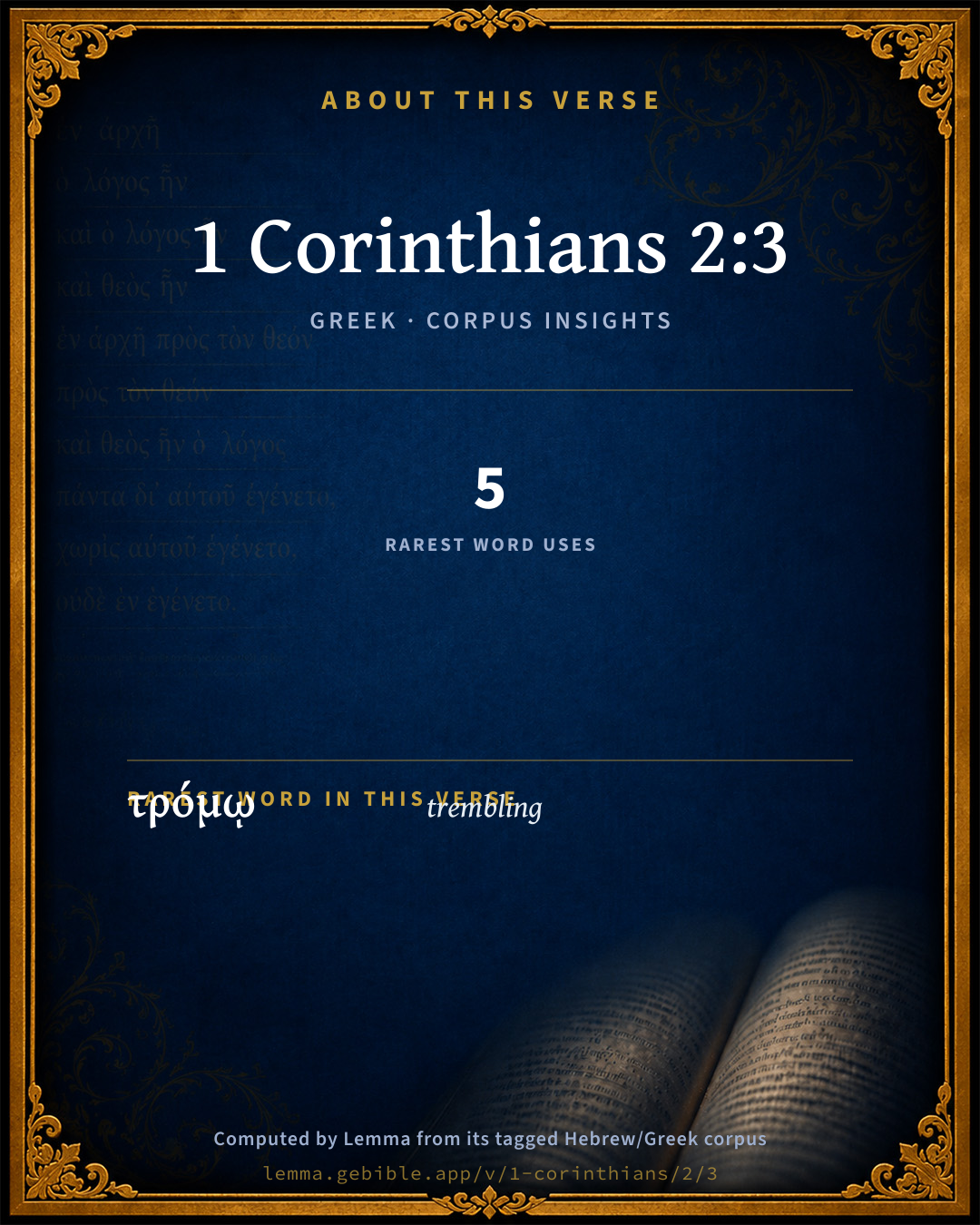
The rarest word here is τρόμῳ trembling G5156 — appearing just 5 times in the whole Greek New Testament.

Shared distinctive vocabulary

τρόμῳ trembling G5156 occurs in 5 verses of the Greek New Testament. Also found in:

Repetition

Words recur within this verse:

Cross-references

18

Topical passages linked to 1 Corinthians 2:3 in the Treasury of Scripture Knowledge — connected by theme and wording, ordered by reader-vote popularity; previews shown in the World English Bible.

  • 2 Corinthians 13:4 For he was crucified through weakness, yet he lives through the power of God. For we also are weak in him, but we will live with him through the power of God toward you.
  • 1 Corinthians 4:10–13 We are fools for Christ's sake, but you are wise in Christ. We are weak, but you are strong. You have honor, but we have dishonor.
  • 2 Corinthians 12:5–10 On behalf of such a one I will boast, but on my own behalf I will not boast, except in my weaknesses.
  • 2 Corinthians 13:9 For we rejoice when we are weak and you are strong. And this we also pray for, even your perfecting.
  • Acts 17:6–12 When they didn't find them, they dragged Jason and certain brothers before the rulers of the city, crying, "These who have turned the world upside down have come here also,
  • Acts 18:6 When they opposed him and blasphemed, he shook out his clothing and said to them, "Your blood be on your own heads! I am clean. From now on, I will go to the Gentiles!"
  • Acts 18:12 But when Gallio was proconsul of Achaia, the Jews with one accord rose up against Paul and brought him before the judgment seat,
  • Acts 20:18–19 When they had come to him, he said to them, "You yourselves know, from the first day that I set foot in Asia, how I was with you all the time,
  • 2 Corinthians 4:1 Therefore seeing we have this ministry, even as we obtained mercy, we don't faint.
  • 2 Corinthians 4:7–12 But we have this treasure in clay vessels, that the exceeding greatness of the power may be of God, and not from ourselves.
  • 2 Corinthians 4:16 Therefore we don't faint, but though our outward man is decaying, yet our inward man is renewed day by day.
  • 2 Corinthians 6:4 but in everything commending ourselves, as servants of God, in great endurance, in afflictions, in hardships, in distresses,
  • 2 Corinthians 10:1 Now I Paul, myself, entreat you by the humility and gentleness of Christ; I who in your presence am lowly among you, but being absent am of good courage toward you.
  • 2 Corinthians 10:10 For, "His letters," they say, "are weighty and strong, but his bodily presence is weak, and his speech is despised."
  • Galatians 4:13–14 but you know that because of weakness of the flesh I preached the Gospel to you the first time.
  • Acts 17:1 Now when they had passed through Amphipolis and Apollonia, they came to Thessalonica, where there was a synagogue of the Jews.
  • 2 Corinthians 7:5 For even when we had come into Macedonia, our flesh had no relief, but we were afflicted on every side. Fightings were outside. Fear was inside.
  • 2 Corinthians 11:29–30 Who is weak, and I am not weak? Who is caused to stumble, and I don't burn with indignation?

Cross-references courtesy of OpenBible.info (CC BY 4.0).

Commentary

Notes on 1 Corinthians 2:3 from classic Christian and Jewish commentators (each source and its license shown beneath its notes). The classic Christian expositions comment on the surrounding passage and are grouped to its opening verse, so a note may address several verses; the Jewish commentaries on the Tanakh (Rashi and others) are per-verse, so they appear only where the commentator wrote on this verse.

Lemma curates 59 commentaries, every one of them public domain or Creative Commons licensed, each selected and text-cleaned for this edition rather than reprinted as found. About our sources →

The Biblical Illustrator

Joseph S. Exell

1Co_2:3-5

And I was with you in weakness and in fear.

The apostles discouragements

St. Paul was laden with a message that would seem homely and jejune beside a fine-spun rhetoric. Come from Athens, where he had partly failed, to make at Corinth a fresh attempt to confront the grandeur of Greek philosophy with the simplicity of the gospel, was enough to make him timid. Of this contrast he was daily conscious, and the weakness here described was ethical, not physical. He was naturally anxious, lest in poising the plain argument of the Cross against the colossal fabric of a seated philosophy, he might fail: was a David armed with such a pebble to prevail against a Goliath in such a panoply? But in his fear and tremblingthe apostle was encouraged by a vision of Gods presence and his own duty (Act_18:9). (Canon Evans.)

The feelings of a faithful minister

I. Their character--often--

1. Intense.

2. Painful.

II. The occasion of them--a sense of--

1. The importance of his work.

2. His own insufficiency.

3. His responsibility.

4. The tremendous issues. (J. Lyth, D. D.)

And … preaching was not with enticing words,… but in demonstration of the Spirit and of power.--

Enticing words

It is related of Dr. Manton that, having to preach before the Lord Mayor and Aldermen of London, he chose a subject in which he had an opportunity of displaying his learning and judgment. He was heard with admiration and applause by the intelligent part of his audience; but as he was returning from dinner with the Lord Mayor, a poor man, following him, pulled him by the sleeve of his gown, and asked him if he was the gentleman that preached before the Lord Mayor. He replied he was. Sir, said he, I came with the hopes of getting some good to my soul, but I was greatly disappointed, for I could not understand a great deal of what you said; you were quite above my comprehension. Friend, said the doctor, if I have not given you a sermon, you have given me one: by the grace of God, I will not play the fool in such a manner again.

Some displeased and one converted

The Rev. John Cotton was an eminent minister of the seventeenth century, who laboured for many years at Boston, in Lincolnshire. When at the University of Cambridge, he was remarkable for learning and eloquence; and being called upon to preach at St. Marys church in that town, high expectations were raised as to the character of the sermon. After many struggles in his own mind, arising from the temptation to display his talent and learning, and from a powerful impression of the importance of preaching the gospel with all simplicity, he at length wisely determined on the latter course. The vice-chancellor and students were not pleased, though a few of the professors commended his style; but his sermon was blessed to the conversion of Dr. Preston, who became one of the most eminent ministers of his day.

Effective preaching

I. Needs so display.

1. This does not exclude the use of knowledge or talent.

2. But the ostentatious exhibition of it.

3. Which helps nothing.

4. But damages much.

II. Depends on divine power.

1. The convincing energy of the Holy Spirit.

2. The saving power of the truth.

III. Requires the communication of the spirit.

1. To the preacher.

2. To the hearer. (J. Lyth, D. D.)

Flowery preaching

Hall was once asked what he thought of a sermon which he had just heard delivered, and which had appeared to produce a great sensation among the congregation. His reply may suggest an important hint to some Christian ministers--Very fine, sir; but a man cannot live upon flowers.

Force the main consideration in preaching

I had tried to drive certain long brass-headed nails into a wall, but had never succeeded, except in turning up their points, and rendering them useless. When a tradesman came who understood his work, I noticed that he filed off all the points of the nails, the very points upon whose sharpness I had relied; and when he had quite blunted them, he drove them in as far as he pleased. With some consciences our fine points in preaching are worse than useless. Our keen distinctions and nice discriminations are thrown away on many; they need to be encountered with sheer force and blunt honesty. The truth must be hammered into them by main strength, and we know from whom to seek the needed power. (C. H. Spurgeon.)

Popular and apostolical preaching

I. Popular.

1. Is distinguished by display, attractiveness, novelty.

2. Aims at pleasing and sensational effect.

II. Apostolic.

1. Plain.

2. Unvarnished.

3. Accompanied by the convictions of the Spirit and the saving power of God. (J. Lyth, D. D.)

Pauls preaching and the blessing that attended it

I. The speech and preaching of the apostle.

1. His great subject was the gospel. He was a great preacher of the law; for no man preaches the gospel who does not preach the law, and our appreciation of the gospel is always in direct proportion to our real perception of Gods holy law. But that which Paul delighted in was the gospel. He preached in all His fulness a full Christ; he exhibited Him in the glory of His person, in all the perfection of His atonement, in all the freeness of His free-grace salvation. And he preached it largely, and wherever he went. He preached it holily too; he set it forth in all its holy tendencies, and he exhibited it in its holy effects in his own life (1Th_1:5).

2. His manner was not with enticing words of mans wisdom. His subject was grand, awful, sublime, wondrous; but his speech was plain, simple, unadorned, and homely. No glare and glitter were his, no traps for human applause, no desire to be thought a man of great talent; the gifted apostle was above it. How does this show to us what sort of preachers we want! We do not mean that the apostle did not suit his speech to those to whom he spake, for he became all things to all men, &c.

II. The blessing that attended it. In demonstration of the Spirit and of power.

1. Many understand by this the miraculous gifts that Paul was able to exhibit, as proof that he was an apostle of Christ. That be wrought miracles, is quite clear; and that they were great seals to his ministry is also quite clear (Rom_15:18). But the Word of God tells us that signs and wonders may be the means of hardening those who work them. Besides, a continuous miracle would cease to be a miracle; and the mightiest could never of itself convert one single soul.

2. More marvellous things than those that wrought in the triumph of God over matter are wrought when He triumphs over mind. The apostle set forth the truth to mens understanding, but the Holy Ghost conveyed the light into their minds; he spake to mens consciences, but the Spirit conveyed the tenderness of heart, and made the word effectual. Here is no violence, no new faculty, no new truth; but the Holy Ghost put forth His power, and brought in demonstration (Col_1:5-6; 1Th_1:5; 1Th_2:13).

3. The power of the gospel is demonstrated--

(1) In the conversion of the sinner.

(2) In the comfort of the mourner.

(3) In the sanctification of the believer.

(4) In the hour of death. (J. H. Evans, M. A.)

Powerless sermons

Many a powerful sermon so called is a powerless sermon, because of the absence from it of what is invisible. The gospel preached without power is like a cloud, without rain; there is a promise of rain, but there is no water of life, and no springing up of the seed the result. The gospel preached without power is like a well with all its arrangements for drawing perfect--but without water. (G. Pentecost.)

True power lies in the gospel itself

Hipponicus, intending to dedicate a costly statue, was advised by a friend to employ Policletus, a famous workman, in the making of it; but he, being anxious that his great expense should be the admiration of all men, said that he would not make use of a workman whose art would be more regarded than his own cost. When, in preaching the great truths of gospel salvation, the enticing words which mans wisdom teacheth are so much sought out that the art of the orator is more regarded by the hearers than the value of the truth spoken, it is no wonder that the Lord refuses to grant His blessing. He will have it seen that the excellency of the power lies not in our speech, but in His gospel.

That your faith should not stand in the wisdom of men, but in the power of God.

Faith

1. Upon what does your faith stand?

2. Where ought it to stand?

3. Why should it stand there? (J. Lyth, D. D.)

True faith

I. Cannot be produced by the wisdom of man.

1. He may convince by the force of argument or persuasion.

2. But such a faith is--

(1) Impure.

(2) Unsettled.

(3) Inoperative.

II. Depends upon the power of God.

1. Through the operation of the Spirit.

2. This--

(1)Heals the conscience.

(2) Converts the soul.

(3) Sanctifies the life.

III. Should be the end of all preaching.

1. The preacher should aim at it.

2. The people should desire it. (J. Lyth, D. D.)

The domain of faith

I. The domain of faith is to be distinguished from that of human wisdom,

1. Men are ever confounding the two. Faith, they think, is simply the intellect in its ordinary processes dealing with religious things. The man who rejects Christianity does it on this ground. I cannot, he says, reason out a demonstrative proof of Christianity; therefore I refuse to believe it true. Because faith cannot stand in the wisdom of man, it cannot, he thinks, stand at all. Now, according to the apostle, faith stands in the power of God. What is the difference?

2. How do we know things?

(1) By sensible proof. If I put my finger into the fire it burns me; if I hear music it delights me. This is the proof which my body furnishes concerning things that appeal to it. I do not reason about them; no spiritual or moral sympathies are called into exercise. I prove them exactly as a brute does.

(2) By rational proof. If a man tells me that two and two make four, that a whole is greater than its part, my senses, my religious feeling have nothing to do with the proof--it is a process of pure reason. A brute could not prove anything in this way. A rational man must believe on such evidence.

(3) Moral proof. When I see moral qualities in a man, I instinctively receive impressions concerning him. I say he is a kind man, a true man, a reverential man. If he be a hypocrite, he may deceive me; but that does not affect the validity of this method of proof. Life would be impossible if we could not trust men until we had collected evidence about them. We are always trusting men whom we know nothing about, because of the moral judgment of them which we form.

3. Now, this distinction of different kinds of proof will carry us a long way in understanding the domain of faith as distinguished from that of intellectual wisdom. When God speaks religious things to me, He does not appeal to my physical senses. He does not appeal to my reason, as the multiplication table does, as a proof in logic does; He appeals directly to my religious sense. Is not this religiously true, pure, suitable? And my religious sense responds, as the eye responds to light, understanding to intellectual truth, the heart to love. Men who are of the truth respond to moral truth when they see it.

4. Now, the strong tendency is to interchange these methods of proof. I can believe nothing, says the materialist, that I cannot prove. Quite true; neither ought you. Aye, but I mean that I cannot prove by processes of reason, which is quite another thing. Suppose the brute should say, I will believe nothing which I cannot prove by the senses. I will not believe in your mathematical astronomy, your subtle chemistry. And is he not as much justified in denying your rational proof as you are in denying my spiritual proof? Your rational proof belongs to a higher nature than his; my spiritual proof belongs to a higher nature than mere reason. What can reason do with moral qualities? You cannot reason out right and wrong; you cannot by reason prove love, or purity, or goodness; you can only feel them. You tell me that you have explored nature, but cannot find God; as well may the surgeon conducting a post-mortem examination tell us that he cannot find the pure patriot, the loving father. How can he detect moral qualities by physical tests?

5. We are always trying to get above the domain of mere matter into that of reason. How the painter and the poet idealise nature; change actual colour and form into glorious ideals! How the philosopher uses them for the creation of a science! How the economist uses them for an economy of social life! And so we are always trying to get above the domain of reason into the domain of faith. It is the necessity of our nature to think about good and evil, to form moral judgments about things. There is another tendency which is always dragging the spiritual down to the sensual; but all men agree to call this wrong moral feeling; Christianity calls it sin.

6. Faith, then, is that quality of our spiritual nature which, when it hears Gods truth, sees Gods purity, feels Gods love, simply and implicitly believes it. It does not wait for processes of reason to prove it, any more than the eye waits for processes of reason to prove light, or the heart for processes of reason to prove love. But, it may be said, does not this make faith irrational? Certainly not. It simply goes farther than reason can go, sees things that reason cannot see, feels things that reason cannot feel. When a truth of God is spoken to me--first, my senses are exercised; next, my reason--it judges the meaning of the words, of the thought, then it delivers the sentiment to my spiritual faculty. Is it religiously true, suitable, and precious? Simple reason could not pronounce upon this; but my religious heart does. I am told of the existence of a God; my senses cannot recognise Him, my reason cannot demonstrate Him, but my spiritual nature confesses His existence, just as the heart confesses love. I am told of the Incarnation; neither sense nor reason can prove it; but my religious consciousness testifies that it is precisely what my condition needed. So with the atonement--the regeneration of the Holy Spirit, the resurrection of Christ; and the immortal life that He gives.

II. How did Paul set forth Christ? (verse 1). Not as a rhetorician, or a moral philosopher. Why not? There is no merit in abjuring reason, when it is a process of reasoning that has to be conducted. But it was not an argument that Paul had to conduct; it was a testimony of God that he had to bear. It was not a science of religion that he had to construct; it was a simple fact that he had to declare. Men knew all about sin; he did not need to prove that they were sinful. Men earnestly craved to know what they must do to be saved. He did not need to reason about that. And he simply declared the great fact that Christ Jesus came into the world to save sinners; that was all he said, but that was enough. Thus, receiving his testimony to the Divine fact, the faith of these men stood not in the wisdom of men, but in the power of God. Christ, then, is to be preached, and His atonement set forth by bearing testimony. It is the cry of a herald rather than a philosophical argument. The physician does not need to prove to the sick that they need healing; he needs only say, Wilt thou be made whole? Preaching Christ is simply setting Him forth as the great gift of the Fathers love. They who hear the testimony have only to trust in the crucified Christ for forgiveness and life. And when so believing Gods testimony we receive Christ, and have experience of His redeeming grace, our faith stands in the power of God.We have the witness in ourselves--a certainty and strength of belief which is like the consciousness of life; argument cannot disturb it. Christ is formed in us; we know whom we have believed.(H. Allon, D. D.)

The Biblical Illustrator, edited by Joseph S. Exell (c. 1880s–1900s) — public domain. Text from a community e-Sword module.

Tyndale Open Study Notes

Tyndale Open Resources

2:3-4 Human weakness is no barrier to God’s work (2 Cor 12:7-10). The real power is not in charismatic preaching, finesse of presentation, or logical persuasiveness (cp. 2 Cor 10:10), but in the message itself, centered on Christ and his death for our sins, and in the power of the Holy Spirit, who convicts the human heart.

Tyndale Open Study Notes — © Tyndale Open Resources, licensed CC BY-SA 4.0. Text via the HelloAO Bible API.

Bengel's Gnomon

Johann Albrecht Bengel

1Co 2:3. Καὶ ἐγὼ, and I) The antithesis is, my speech, 1Co 2:4; and, to know, 1Co 2:2. For he describes the subject [1Co 2:2, to know Christ crucified], the preacher [1Co 2:3, and I], the mode of speaking [1Co 2:4, my speech—not with enticing words].—ἀσθενείᾳ, in weakness) It is opposed to, power [1Co 2:4]. We must not suppose that the apostle’s state of mind was always pleasant and quite free from all perturbations, 2Co 7:5; 2Co 11:30; Gal 4:13.—καὶ ἐν φόβῳ καὶ ἐν τρὁμῳ πολλῷ, and in fear and in much trembling) This is a proverbial saying, and denotes the fear, which abounds to such a degree as even to fall upon the body and its gestures and movements, Mar 5:33; Eph 6:5; Php 2:12; LXX., Deu 11:25. So Isa 19:16, LXX., ἔσονται ἐν φόβῳ καὶ ἐν τρόμῳ, “They shall be in fear and trembling.”[17] The world admires any thing but this [the very contrary to all this].—ἐγενόμην,) I began to be, with you, towards you.

[17] An antithesis to “excellency of speech,” 1Co 2:1.—V. g.

Bengel's Gnomon of the New Testament — English translation (T&T Clark, Edinburgh, 1860) — public domain. Text from a community e-Sword module.

Meyer's Critical & Exegetical Commentary

Heinrich August Wilhelm Meyer

1Co_2:3-4. After the probative sentence, 1Co_2:2, Paul takes up again the connection of 1Co_2:1, and that with the simple καί: And I for my part (with others it may have been different!) fell into weakness and into much fear and trembling among you (πρὸς ὑμ.; see on Joh_1:1).

γίγνεσθαι ἐν, to fall into a state, etc. (and to be in it); so Thuc. i. 78. 1; Plato, Prot. p. 314 C; Dem. p. 179, ult. Comp Luk_22:44; 1Ma_1:27; 2Ma_7:9; Hist. Sus. 8. We might also join πρὸς ὑμᾶς to ἐγενόμην, not, indeed, in the way in which Hofmann interprets it, as if for ἐγενόμην there stood ἤμην (Mar_14:49), but in the sense: I arrived among you (2Jn_1:12, and see generally, Fritzsche, Ind. ad Lucian. Dial. Deor. p. 85; Nägelsbach on the Iliad, p. 295, ed. 3); 1Co_2:4, however, shows that what is here spoken of is not again (1Co_2:1) the coming thither, but the state when there.

The three phrases, ἀσθ., φόβος, and τρόμος, depict the deep bashfulness with which Paul was in Corinth, through his humble sense of the disproportion between his own powers and the great enterprise to which his conscientiousness kept him bound. In facing it he felt himself very weak, and was in fear and trembling. As for want of natural strength of will and determination, of which Hofmann speaks, there were no signs of anything of the kind in Paul, even judging from his experience at Athens; and no such weakness betrays itself in Act_18:4-11. The connection forbids us from thinking, with Chrysostom, Theodoret, Theophylact, Erasmus, Cornelius a Lapide, Grotius, and others, of the sufferings and persecutions (ἀσθ.), and of the apprehension of dangers, which he had to undergo in Corinth; for the text hints nothing of persecutions and dangers, and these would not necessarily furnish the motive for simplicity in preaching (1Co_2:1; 1Co_2:4 f.), nay, might even excite to the greater rhetorical exertion. The weakness, etc., was of a deep ethical nature, being based on the entire renunciation of human wisdom and strength (1Co_2:5). Other exegetes wrongly understand ἀσθενεία even of bodily weakness, either generally sickliness (Rückert), or more especially weakness in the chest and voice (Storr, comp Rosenmüller).

φόβος κ. τρόμος] always denote with Paul (comp also Psa_2:11) the deeply vivid and keen apprehension of humility, lest it should be unable to meet the emergency concerned. See 2Co_7:15; Php_2:12; Eph_6:5.

ὁ λόγος μου κ. τ. κήρυγμά μου] are indeed emphatically separated from each other by the repetition of the μου; but it is an arbitrary distinction to make the former of the two refer to the form, the latter to the contents (Heydenreich), or the former to the privata, the latter to the publica institutio (so Rückert and the majority of commentators). The former is the more general expression, the latter the particular: my speech generally (comp 2Co_10:10), and especially my public preaching.

οὐκ ἐν πειθοῖς σοφ. λόγοις] sc[337] ἦν, non versabatur in, did not move in the element of persuasive words of wisdom, such words as are philosophically arranged and thereby fitted to persuade. Πειθός is found nowhere else in the whole range of extant Greek literature, πιθανός being the word in use (Xen. Cyr. vi. 4. 5; Thuc. iv. 21; Dem. 928. 14; Josephus, Antt. viii. 9; and the passages from Plato in Ast, Lex. III. p. 102. Meineke, Menand. p. 222). Πειθός, however, is formed from πείθω by correct analogy as φειδός from φείδομαι, etc. Comp Salmasius, de ling. Hellenist, p. 86; Reiche, Comment. crit. I. p. 136 f. It was in all likelihood an adjective belonging only to the colloquial language of common life. Kypke, indeed (Obss. II. p. 193), would find some trace of it in Plato, Gorg. p. 493 A; but what we have there is a play on the words τὸ πιθανόν and πίθος, a cask, which has no connection whatever with πειθός. Pasor and Schrader make πειθοῖς to be the dative plural of πειθώ, suada, and what follows to be in apposition to it: in persuasions, in words of wisdom. But the plural of πειθώ also has no existence; and how abrupt such an apposition would be, as well as wholly at variance with the parallel in 1Co_2:13! The following are simply conjectures (comp the critical remarks): Beza and Erasmus Schmid (after Eusebius), ἐν πειθοῖ σοφίας λόγων; Grotius, ἐν πιστοῖς κ.τ.λ[340]; Valckenaer, Klose, and Kühn (Commentat. a[341] 1 Cor. ii. 15, Lips. 1784), ἐν πιθανοῖς or ΠΕΙΘΑΝΟῖς Κ.Τ.Λ[342] (comp also Alberti, Schediasm. p. 105); Alberti, ἐν πειθοῦς (suadae) σ. λόγοις, or (so, too, Semler, Flatt, Rinck, Fritzsche in the Hall. Lit. Zeit. 1840, Nr. 100) ἐν πειθοῖ σοφίας (without λόγοις).

ἐν ἀποδείξει πνεύματος κ. δυνάμεως] Without there being any necessity for explaining the two genitives by a ἓν διὰ δυοῖν as equivalent to πνεύματος δυνατοῦ (so still Pott, Flatt, Billroth, Olshausen, Maier, with older expositors), the meaning may, according to our interpretation of ἀπόδειξις and to our taking the genitives in an objective or subjective sense, be either: so that I evinced Spirit and power (so Vatablus and others, with Pott and Billroth); or: so that Spirit and power made themselves known through me (Calvin: in Pauli ministerio … quasi nuda Dei manus se proferebat); or: so that Spirit and power gave the proof (Rückert, de Wette, Osiander, Neander, and Maier, following older commentators). The latter is most in keeping with the purposely-chosen expression ἀπόδειξις (found here only in the N. T.; Dem. 326. 4; Plato, Phaed. p. 77 C, Theaet. p. 162 E, and often; 3Ma_4:20), and with the significant relation to οὐκ ἐν πειθοῖς σ. λόγοις. Paul means the Holy Spirit (1Co_2:10 ff.) and the divine power communicating itself therein, 1Co_2:5 (Rom_1:16; 2Co_4:7; 1Th_1:5), which wrought through his preaching upon the minds of men, persuading them of its truth,the testimonium Spiritus Sancti internum.[344] At variance with the text is the view of several of the older expositors (following Origen, contra Celsum, i. p. 5), who refer πνεύματος to the oracles of the O. T., and δυνάμ. to the miracles of the apostle; as well as the view of Grotius, that the former applies to the prophecies, and the latter to the cures, by means of which Paul had given the ἀπόδειξις.

[337] c. scilicet.

[340] .τ.λ. καὶ τὰ λοιπά.

[341] d refers to the note of the commentator or editor named on the particular passage.

[342] .τ.λ. καὶ τὰ λοιπά.

[344] Theophylact is right in supposing as regards πνεύματος: ἀῤῥήτῳ τινὶ τρόπῳ πίστιν ἐνεποίει τοῖς ἀκούουσι. He makes δυνάμεως, however, apply to the miracles, as does Theodoret also, who takes the two elements together, and explains the clause of the θαυματουργία τοῦ πνεύματος. So, too, in substance, Chrysostom, according to whom it is by πνεύματος that the miracles are made to appear as true miracles.

Meyer — Critical and Exegetical Commentary on the New Testament — English translation by Peter Christie, edited by Frederick Crombie (T&T Clark, 1880) — public domain. Text from a community e-Sword module.

Expositor's Greek Testament

ed. W. Robertson Nicoll

1Co 2:3 . “In weakness”: cf. 1Co 1:25 ; 1Co 1:27 ; also 2Co 10:10 ; 2Co 13:3 f. This condition was bodily the Cor [304] had received an impression of Paul’s physical feebleness; but the phrase expresses, more broadly, his conscious want of resources for the task before him ( cf. 2Co 2:16 ; 2Co 3:5 ). Hence he continues, “and in fear and in much trembling” the inward emotion and its visible expression (see parls.). P. stood before the Cor [305] at first a timid, shaken man: on the causes see Introd. , ch. 1

[304] Corinth, Corinthian or Corinthians.

[305] Corinth, Corinthian or Corinthians.

For γίνομαι ἐν ( versari in ), to be in a state of, cf. parls. πρὸς ὑμᾶς qualifies the whole foregoing sentence: “I was weak, timid, trembling before you (when I addressed you)”: ἐγενόμην … πρὸς ὑμᾶς might be construed together, ἐγενόμην becoming a vb [306] of motion “I came to (and was amongst) you in weakness,” etc. (Ed [307] , as in 1Co 16:10 ); this would, however, needlessly repeat 1Co 2:1 .

[306] verb

[307] T. C. Edwards’ Commentary on the First Ep. to the Corinthians .

The Expositor's Greek Testament, edited by W. Robertson Nicoll (1897–1910) — public domain. Text from a community e-Sword module.

Hodge's Commentary on Romans, Ephesians & First Corinthians

Charles Hodge

1Co_2:3

And I was with you in weakness, and in fear, and in much trembling.

I came to you, ἐγενόμην πρὸϚ ὐμᾶς, I came to you and was with you, see Joh_1:2, weakness of which he here speaks was not bodily weakness; for although he elsewhere speaks of himself as weak in body, 2Co_10:10, and as suffering under bodily infirmity, Gal_4:14, yet here the whole context shows he refers to his state of mind. It was not in the consciousness of strength, self confident and self-relying, that he appeared among them, but as oppressed with a sense of his weakness and insufficiency. He had a work to do which he felt to be entirely above his powers.

In fear and trembling, i.e. in anxiety, or solicitude of mind arising out of a sense of his insufficiency, and of the infinite importance of his work, 2Co_7:15. Phi_2:12. Eph_6:5.

Charles Hodge — Commentary on Romans (1835), First Corinthians (1857), and Ephesians (1856) — public domain. Text from a community e-Sword module.

Geneva Bible (1599)

Geneva Bible translators

He setteth weakness, against excellency of words, and therefore joineth with it fear and trembling, which are the companions of true modesty, not such fear and trembling as terrify the conscience, but such as are contrary to vanity and pride.

Geneva Bible (1599) marginal notes — public domain. Text via Bolls.life.

Jamieson, Fausset & Brown

Robert Jamieson, A. R. Fausset & David Brown

I--the preacher: as Co1 2:2 describes the subject, "Christ crucified," and Co1 2:4 the mode of preaching: "my speech . . . not with enticing words," "but in demonstration of the Spirit."

weakness--personal and bodily (Co2 10:10; Co2 12:7, Co2 12:9; Gal 4:13).

trembling--(compare Phi 2:12). Not personal fear, but a trembling anxiety to perform a duty; anxious conscientiousness, as proved by the contrast to "eye service" (Eph 6:5) [CONYBEARE and HOWSON].

Jamieson, Fausset & Brown — Commentary Critical and Explanatory on the Whole Bible (1871) — public domain (CC PDM 1.0). Text via the HelloAO Bible API.

Adam Clarke's Commentary

Verse 3. I was with you in weakness] It is very likely that St. Paul had not only something in his speech very unfavourable to a ready and powerful elocution, but also some infirmity of body that was still more disadvantageous to him. A fine appearance and a fine voice cover many weaknesses and defects, and strongly and forcibly recommend what is spoken, though not remarkable for depth of thought or solidity of reasoning. Many popular orators have little besides their persons and their voice to recommend them. Louis XIV. styled Peter du Bosc le plus beau parleur de son royaume, the finest speaker in his kingdom; and among his own people he was styled l'orateur parfait, the perfect orator. Look at the works of this French protestant divine, and you find it difficult to subscribe to the above sayings. The difficulty is solved by the information that the person of M. du Bosc was noble and princely, and his voice full, harmonious, and majestic. Paul had none of these advantages, and yet idolatry and superstition fell before him. Thus GOD was seen in the work, and the man was forgotten.

In fear, and in much trembling.] This was often the state of his mind; dreading lest he should at any time be unfaithful, and so grieve the Spirit of God; or that, after having preached to others, himself should be a castaway. See 1Co 9:27.

An eminent divine has said that it requires three things to make a good preacher; study, temptation, and prayer. The latter, no man that lives near to God can neglect; the former, no man who endeavours rightly to divide the word of truth will neglect; and with the second every man will be more or less exercised whose whole aim is to save souls. Those of a different cast the devil permits to pass quietly on in their own indolent and prayerless way.

Adam Clarke's Commentary on the Bible (1810–1826) — public domain. Text from a community e-Sword/MySword module.

John Calvin's Commentaries

3. And I was with you in weakness He explains at greater length what he had previously touched upon — that he had nothing shining or excellent in him in the eyes of men, to raise him to distinction. He concedes, however, to his adversaries what they desired in such a way as to make those very things which, in their opinion, tended to detract from the credit of his ministry, redound to its highest commendation. If he appeared less worthy of esteem from his being so mean and abject according to the flesh, he shows that the power of God shone out the more conspicuously in this, that he could effect so much, while sustained by no human helps. He has in his eye not merely those foolish boasters who aimed at mere show, with the view of obtaining for themselves a name, but the Corinthians, too, who gazed with astonishment on their empty shows. Accordingly a recital of this kind was fitted to have great weight with them. They were aware that Paul had brought nothing with him in respect of the flesh that was fitted to help him forward, or that might enable him to insinuate himself into the favor of men, and yet they had seen the amazing success which the Lord had vouchsafed to his preaching. Nay more, they had in a manner beheld with their own eyes the Spirit of God present in his doctrine. When, therefore, despising his simplicity, they were tickled with a desire for a kind of wisdom, I know not of what sort, more puffed up and more polished, and were captivated with outward appearance, nay, even with adventitious ornament, rather than with the living efficacy of the Spirit, did they not sufficiently discover their ambitious spirit? It is with good reason, therefore, that Paul puts them in mind of his first entering in among them, (1 Thessalonians 2:1,) that they may not draw back from that divine efficacy, which they once knew by experience.

The term weakness he employs here, and in several instances afterwards, (2 Corinthians 11:30; 2 Corinthians 12:5, 9, 10,) as including everything that can detract from a person’s favor and dignity in the opinion of others. Fear and trembling are the effects of that weakness There are, however, two ways in which these two terms may be explained by us. Either we may understand him to mean, that when he pondered the magnitude of the office that he sustained, it was tremblingly, and not without great anxiety, that he occupied himself in it; or that, being encompassed with many dangers, he was in constant alarm and incessant anxiety. Either meaning suits the context sufficiently well. The second, however, is, in my opinion, the more simple. Such a spirit of modesty, indeed, becomes the servants of the Lord, that, conscious of their own weakness, and looking, on the other hand, at once to the difficulty and the excellence of so arduous an office, they should enter on the discharge of it with reverence and fear For those that intrude themselves confidently, and in a spirit much elated, or who discharge the ministry of the word with an easy mind, as though they were fully equal to the task, are ignorant at once of themselves and of the task.

As, however, Paul here connects fear with weakness, and as the term weakness denotes everything that was fitted to render him contemptible, it follows necessarily that this fear must relate to dangers and difficulties. It is certain, however, that this fear was of such a nature as did not prevent Paul from engaging in the Lord’s work, as facts bear witness. The Lord’s servants are neither so senseless as not to perceive impending dangers, nor so devoid of feeling as not to be moved by them. Nay more, it is necessary for them to be seriously afraid on two accounts chiefly — first, that, abased in their own eyes, they may learn wholly to lean and rest upon God alone, and secondly, that they may be trained to a thorough renunciation of self. Paul, therefore, was not devoid of the influence of fear, but that fear he controlled in such a manner as to go forward, notwithstanding, with intrepidity through the midst of dangers, so as to encounter with undaunted firmness and fortitude all the assaults of Satan and of the world; and, in fine, so as to struggle through every impediment.

John Calvin's Commentaries (1540-1563) — public domain. Text from the Calvin Translation Society English edition (1840s-50s) via the Christian Classics Ethereal Library (ccel.org). Calvin's coverage is partial (roughly two-thirds of the Bible); uncommented books and verses are honest gaps, never fabricated. The 19th-century editor's footnotes and remarks are omitted so the notes are faithfully Calvin's own voice.

Ellicott's Commentary for English Readers

(3) And I was with you.—To show that the real force of his teaching lay in its subject-matter, and not in any power with which he may have proclaimed the gospel, the Apostle now dwells upon his own physical weakness. The “weakness and fear and trembling” of which St. Paul speaks here had in it probably a large element of that self-distrust which so noble and sensitive a nature would feel in the fulfilment of such an exalted mission as the preaching of the Cross. I cannot think, however, the allusion is only to that. There is, I believe, a reference also to what we may call a physical apprehension of danger. The bravest are not those who do not experience any sensation of fear, but rather those who keenly appreciate danger, who have an instinctive shrinking from it, and yet eventually by their moral might conquer this dread. There are traces of this element in St. Paul’s character to be found in several places, as, for example, in Act_18:9, when the Lord encourages him when labouring at Corinth with the hopeful words, “Be not afraid;” again in Act_23:11, when the terrible scene before Ananias had depressed him, the Lord is with him to strengthen him, “Be of good cheer, Paul;” and in Act_27:24, when the angel of the Lord appears to him amid the storm and shipwreck, “Fear not, Paul.”

A Bible Commentary for English Readers, edited by Charles John Ellicott (1878–1897) — public domain. Text from a community e-Sword module.

The Cambridge Bible for Schools and Colleges

gen. ed. J. J. S. Perowne

3. And I was with you in weakness] No personal advantages assisted his preaching: no eloquence, save that of deep conviction; no self-confidence; nothing but self-mistrust, anxiety, the deepest sense of unworthiness, combined with an infirmity of body, which was a great trial to the Apostle, and of which he makes frequent mention. See 2Co_10:10; 2Co_11:30; 2Co_12:5; 2Co_12:7; 2Co_12:9-10; Gal_4:13-14.

The Cambridge Bible for Schools and Colleges (gen. ed. J. J. S. Perowne; Cambridge University Press, 1878–1918) — public domain. Text from a community e-Sword module.

John Gill's Exposition

And I was with you in weakness,.... Meaning either the weakness of his bodily presence, the contemptibleness of his voice, and the mean figure he made as a preacher among them, both with respect to the matter and manner of his ministry in the eyes of many; or his lowly and humble deportment among them, not exerting the power and authority Christ had given him as an apostle; but choosing rather to work with his own hands, as he did at Corinth, to minister to his own necessities, and those of others; or the many persecutions which he endured there for the sake of preaching a crucified Christ; and which he sometimes calls "infirmities"; see Co2 12:9 wherefore it is added,

and in fear, and in much trembling: not only on account of the greatness and awfulness of the work in which he was engaged, and lest the souls he ministered unto should be drawn aside from the truth, and into a sinful compliance; but because of the violence of men against him, threatening his life, and lying in wait for it: hence, the Lord, to encourage him, spake in a vision to him, and bid him not be afraid, but boldly preach his Gospel, and not be silent; assuring him of his presence, and that no man should set on him to hurt him, for he had many chosen vessels there to call by his grace through his ministry, Act 18:9 which no doubt greatly served to remove the fears and tremor that attended him.

John Gill's Exposition of the Whole Bible (1746–1763) — public domain (CC PDM 1.0). Text via the HelloAO Bible API.

Trapp's Complete Commentary

John Trapp

3 And I was with you in weakness, and in fear, and in much trembling.

Ver. 3. In weakness] In misery, and in a mean condition, labouring with his hands, &c., Act 18:3.

And in fear] Of adversaries, or through care of discharging my duty among you.

John Trapp, A Commentary or Exposition upon All the Books of the Old and New Testament (1647–1656) — public domain. Text from a community e-Sword module.

Albert Barnes' Notes on the Bible

And I was with you - Paul continued there at least a year and six months. Act 18:11.

In weakness - In conscious feebleness; diffident of my own powers, and not trusting to my own strength.

And in fear, and in much trembling - Paul was sensible that he had many enemies to encounter Act 18:6.; and he was sensible of his own natural disadvantages as a public speaker, 2Co 10:10. He knew too, how much the Greeks valued a manly and elegant species of oratory; and he, therefore, delivered his message with deep and anxious solicitude as to the success. It was at this time, and in view of these circumstances, that the Lord spoke to him by night in a vision, and said, “be not afraid, but speak, and hold not thy peace; for I am with thee, and no man shall set on thee to hurt thee; for I have much people in this city,” Act 18:9-10. If Paul was conscious of weakness, well may other ministers be; and if Paul sometimes trembled in deep solicitude about the result of his message, well may other ministers tremble also. It was in such circumstances, and with such feelings, that the Lord met him to encourage him - And it is when other ministers feel thus, that the promises of the gospel are inestimably precious. We may add, that it is then, and then only, that they are successful. Notwithstanding all Paul’s fears, he was successful there. And it is commonly, perhaps always, when ministers go to their work conscious of their own weakness; burdened with the weight of their message; diffident of their own powers; and deeply solicitous about the result of their labors, that God sends down His Spirit, and converts sinners to God. The most successful ministers have been men who have evinced most of this feeling; and most of the revivals of religion have commenced, and continued, just as ministers have preached, conscious of their own feebleness, distrusting their own powers, and looking to God for aid and strength.

Albert Barnes' Notes on the Bible (1834–1885) — public domain. Text from a community e-Sword/MySword module.

Haydock's Catholic Bible Commentary

In weakness, and in fear, and in much trembling. We must not think, says St. John Chrysostom, that this made the virtue of St. Paul less commendable. It is natural to every man to fear persecutions and torments. We admire the apostle, who amidst these fears, was always ready to expose himself, was always fighting, and always victorious. (Witham) --- During the stay I made with you at Corinth, I saw myself daily exposed to injuries, affronts, and persecutions. I had then the opportunity of practising the lessons which our expiring Redeemer delivered to us from the wood on which he died, and the daily contradictions I met with obliged me to think of other things than fine discourses, and elegant harangues. (Theophylactus)

George Leo Haydock (1774–1849), Haydock's Catholic Family Bible and Commentary, 1859 edition — public domain. Excludes Psalms (Douay-Rheims chapter numbering differs from Protestant) and Deuterocanonical books (Catholic canon only).

Matthew Poole's English Annotations

Either in a weakness of style, I used a plain, low, intelligible style, studying rather to be understood by all than admired by any. Or in weakness of state, in a mean and low condition; for we read, Act 18:3, that he wrought with his hands at Corinth; so Act 20:34. Or it may be, in a weak state of body; or it may be he means humbleness of mind and modesty, which to worldly eyes looks like a weakness of mind. And in much fear and trembling, either with respect to the Jews, and the danger he was exposed to from them, or with respect to the greatness of his work, lest they should refuse the grace of the gospel, by him brought and offered to them. So as (saith he) you might see that all the work was God’s, I but a poor instrument, contemptible with respect to my outward quality, appearing poor and mean, in my phrase and style, and whole behaviour amongst you.

Matthew Poole's English Annotations on the Holy Bible (1683–1685) — public domain. Text from a community e-Sword/MySword module.

Whedon's Commentary on the Bible

Daniel D. Whedon

3. Weakness… fear… trembling—A blending of feelings arising, perhaps, from different causes, yet uniting in one effect. We have intimated that Paul, coming to Corinth fresh from his ill-success at Athens, may have felt a check upon his spirit. Note on Act_18:3. The loneliness of his separation from Silas and Timothy chilled his courage. His experience at Athens may have deeply impressed him with the feeling that less of appeal to natural reason, and a more forcible pressure on the religious sensibilities by the presentation of Christ and the atonement, should frame his whole discourse. This was that foolishness of preaching in renunciation of all Grecian sophia which he proved to be the power of God to the founding of the Corinthian Church, and which he has described in those flashing and triumphant antitheses that run through 1Co_1:22-28.

Daniel D. Whedon (gen. ed.), Commentary on the Old and New Testaments (1874–1909) — public domain. Text from a community e-Sword module.

The Pulpit Commentary

I was with you; literally, I became or proved myself, towards you, as in 1Co_16:10. In weakness. St. Paul was physically weak and liable also to nervous weakness and depression (1Co_4:7-12; Gal_4:13; 2Co_10:1, 10 12:7, 10) He shows an occasional self distrust rising from the consciousness of personal infirmities. This enhances our sense of his heroic courage and endurance. Doubtless this physical weakness and nervous depression were connected with his "stake in the flesh," which seems to have been an acute and distressing form of ophthalmia, accompanied with cerebral disturbance (see my "Life of St. Paul," 1:215-221). In fear, and in much trembling. Probably the words are even literally true, though they are a common phrase (2Co_7:15; Php_2:12, 13; Eph_6:5) It must be remembered that in his first visit to Corinth St. Paul had gone through stormy and troubled days. (Act_18:1-12)

Vers. 3-5.

Personal weakness and spiritual strength.

In both the ordinary daily concerns and in the special religious service of life, a man may he just himself alone, confident in his own powers, self centred, self satisfied, reliant, on his own health of body, vigour of mind, well trained habits, quick judgment, and sound wisdom. Titan, no matter how sate and strong he may seem to be, he is really weak; and, as life advances and testing times take new and severer forms, his weakness will be proved and his pride effectively humbled. A man may even now be moved and possessed by an evil spirit. Still the solemn fact remains that man"s soul" lies open to malign spiritual influences, which work through the bodily lusts and passions. Then the man himself is weak indeed, and the alien force within him shows strength only unto things that are debasing and evil. A man may be God"s agent, having the Spirit of God dwelling in him and working through him. Then, no matter what may be the bodily frailties or the untoward earthly surroundings, the man will be found really strong, efficient to all spiritual work, which the indwelling Spirit may move him to undertake. This last is St. Paul"s experience, Men saw in him great human weakness. tie felt within him great spiritual power, for he was the agent of the Holy Ghost.

I THE IMPRESSION MADE BY ST. PAUL"S APPEARANCE. There can be little doubt that he was diminutive in stature, frail in health, unskilful as a rhetorician, and probably he was suffering from some disease or infirmity which made his appearance even unsightly. Of this his enemies were prepared to take undue advantage. The various descriptions of St. Paul"s person should be considered, and the various theories concerning the special infirmity from which he suffered, Many of God"s most devoted servants have, like Richard Baxter, Robert Hall, and many others, had to bear the heavy burden of constitutional disease, of intense physical suffering. But these things have been overruled, as in St. Paul"s case, for good, so that they have become the very forces that have fitted the men for the nobler discharge of their great life works.

II THE CONSCIOUSNESS OF FRAILTY WITH WHICH ALL HIS WORK WAS DONE. There was not only the fact of suffering, but also the feeling of frailty. There was the sense of" fear," and there was much "trembling." He did not overmaster his trouble, but actually worked with it ever pressing upon him. "There was no self confidence, nothing but self mistrust, anxiety, the deepest sense of unworthiness". (comp 2Co_10:10 2Co_11:30 2Co_12:5, 2Co_12:7, 2Co_12:9, 2Co_12:10; Gal_4:13, Gal_4:14) "There was a large element of that self distrust which so noble and sensitive a nature would feel in the fulfilment of such an exalted mission as the preaching of the cross." We may to some extent realize at how great a cost Christian ministers master bodily infirmity in order to do us service for Christ"s sake; but few can know how much intenser is the struggle with inward fear and hesitation, and with the overwhelming sense of unworthiness and unfitness. Only in the strength and grace of God are these diffidences and inward fears overcome.

III THE GLORIOUS RESULTS REACHED BY ST. PAUL"S WORK. These are implied in his appeal to the Corinthians that his work had been "in demonstration of the Spirit and of power." Those results were of two kinds

(1) conversions;

(2) edifications.

Men received Christ as St. Paul unfolded his claims and his love. The Church was built up in the faith through the Pauline instructions. Subsidiary results, such as overthrow of idolatry, and change of daily moral life and relations, may be further considered. The Corinthians were themselves among the most interesting results of his divinely inspired labours.

IV THE SECRET OF HIS SUCCESS IN HIS OPENNESS TO DIVINE LEAD. Men would have found it in his "accent of conviction," his intensity, his natural gift of leadership, the newness of his subject, the preparedness of the times, or the appeal to men"s feelings; but none of these would have satisfied St. Paul. He would have said, when all had passed by, "You have not found out my secret." None of these explanations could satisfy any of us who carefully judged the phenomena. St. Paul was an endowed man. He was open to the Divine leadings. He was inspired by the Divine Spirit. God wrought with him, and these were the signs following. True spiritual work has still no other explanation. Men are mighty in the measure of their openness to the Divine lead. And the maintenance of this openness is the supreme anxiety of all earnest Christian workers. There must be, for all noble and lasting issues, the "demonstration of the Spirit.

Impress the mysterious power which some men have in conversation and in preaching; yet how often they are men or women of frail bodies, sensitive nerves, and wearying disease! They are under all kinds of disabilities; but these seem only to culture the higher spiritual power. Illustrate, e.g., McCheyne, Henry Martyn, F. Ridley Havergal, etc. This openness to the agency of the Holy Ghost is to be won. Our Lord taught us how. Such power comes through prayer and fasting: prayer, or closeness and intimacy of communion with God; fasting, or watchfulness, self denial, and mastery of bodily passion. We may win the joy of being "coworkers together with God. R.T.

The Pulpit Commentary (1880–1919), ed. H.D.M. Spence-Jones & Joseph S. Exell — public domain. Text from a community e-Sword module.

John Wesley's Explanatory Notes

And I was with you - At my first entrance. In weakness - Of body, 2 Cor. xii, 7 And in fear - Lest I should offend any. And in much trembling - The emotion of my mind affecting my very body.

John Wesley, Explanatory Notes Upon the Whole Bible (1754–1765) — public domain. Text via the GEBible commentary corpus.

Burkitt's Expository Notes on the New Testament

William Burkitt

Observe here, 1. How the apostle declares that his person was suitable to his preaching, both plain, neither pompous. 2Co 10:10 He tells us, That his bodily presence was weak and mean, and his speech contemptible. Tradition tells us, that Paul (according as his name signifies) was a man of a very little stature, his voice small, and wanting that presence which some others had.

Observe, 2. Some pain that the apostle was in, fearing lest the infirmity of his flesh should render him as a minister despicible in the eyes of any, or the course of the gospel be hindered and obstructed by his bodily infirmities; for this was he with them in fear and much trembling. Nothing doth so much affect and afflict the ministers of Christ, as an apprehension and fear lest any thing in or from themselves should obstruct or hinder the success of the gospel which they teach. It is sad when our poverty or mean appearance, to despise our message, or from any natural imperfections found with us; but much sadder, when such moral blemishes are found with us, as to render us the occasion of our own contempt, and the cause of our ministry’s unsuccessfulness.

William Burkitt's Expository Notes on the New Testament (1700–1703) — public domain. Text from a community e-Sword module.

Godbey's Commentary on the New Testament

William B. Godbey

3. “Indeed I was with you in weakness, in fear and in much trembling.” Many years of hard toiling and terrible exposure had told on his bodily organs so that he was physically weak, and at the same time tremulous with solicitude in their behalf, lest they might reject his message, or, having received it, make shipwreck and be lost world without end.

William B. Godbey, Commentary on the New Testament (1896–1900) — public domain. Text from a community e-Sword module.

McGarvey & Pendleton's Commentaries

J. W. McGarvey

And I was with you in weakness, and in fear, and in much trembling . [Paul frequently asserts his tendency to physical weakness and depression ( 1Co_4:7-12 ; Gal_4:13 ; 2Co_10:1 ; 2Co_10:10 ; 2Co_12:7 ). This sense of weakness was accentuated by his recent semi-failure at Athens, by frequent persecution, and by the absence of his companions, Silas and Timothy, till Paul's sense of timidity amounted to actual fear ( Act_18:9 ). He was also out of money and had to work for Aquila. The slight admixture of philosophy which he had used in addressing the Athenians ( Act_17:22-34 ) had thoroughly convinced the apostle that it was of no use, or benefit, in the presentation of the gospel.]

J. W. McGarvey (with Philip Y. Pendleton), Commentaries on the New Testament (The Fourfold Gospel, 1914; Acts; and the epistles) — public domain. Text from a community e-Sword/MySword module.

The People's New Testament

B. W. Johnson

3. I was with you in weakness, etc. In this great center of Greek culture, he felt a human timidity at first in presenting the simple gospel in the face of the splendors of the Greek philosophy.

B. W. Johnson's The People's New Testament with Notes (1889–1891) — public domain. Electronic text from the Christian Classics Ethereal Library (CCEL) ThML edition.

unfoldingWord translationNotes

Door43 World Missions Community

I was with you

"I was visiting with you"

in weakness

Possible meanings are: 1) "physically weak" or 2) "feeling like I could not do what I needed to do."

persuasive words of wisdom

words that sound wise and with which the speaker hopes to cause people to do or believe something

translationWords

fear

preach

word

wise

Holy Spirit

power

faith

God

unfoldingWord translationNotes — © Distant Shores Media and the Door43 World Missions Community, licensed CC BY-SA 4.0. Source: git.door43.org/Door43/en_tn.

Cambridge Greek Testament for Schools and Colleges

3. πρὸς ὑμᾶς has been taken by some commentators as equivalent to arrived among you. But as De Wette points out, 1Co 16:10 decides the point in favour of the rendering in A.V. There is in each case a kind of double construction involved, that of coming to and staying with the persons mentioned.

ἐν ἀσθενείᾳ. No personal advantages assisted his preaching; no eloquence, save that of deep conviction; no self-confidence; nothing but self-mistrust, anxiety, the deepest sense of unworthiness, combined with an infirmity of body, which was a great trial to the Apostle, and of which he makes frequent mention. See 2Co 10:10; 2Co 11:30; 2Co 12:5; 2Co 12:7; 2Co 12:9-10; Gal 4:13-14.

Cambridge Greek Testament for Schools and Colleges (Cambridge University Press, 1896; 21 vols, various authors incl. Carr, Maclear, Plummer, Farrar, Lumby, Moule, M. R. James, Simcox) — public domain. Text from a community e-Sword module.

Alford’s Greek Testament

Henry Alford

3.] κἀγώ, and I, coupled to ἦλθον in ver. 1, and ἐγώ repeated for emphasis, the nature of his own preaching being the leading subject-matter here. The weakness and fear and much trembling must not be exclusively understood of his manner of speech as contrasted with the rhetorical preachers, for ὁ λόγος μου κ. τὸ κήρυγμά μου follow in the next verse,—but partly of this, and principally of his internal deep and humble persuasion of his own weakness and the mightiness of the work which was entrusted to him. So in Php 2:12, Php 2:13, he commands the Philippians, μετὰ φόβου κ. τρόμου τὴν ἑαυτῶν σωτηρίαν κατεργάζεσθε, θεὸς γάρ ἐστιν ὁ ἐνεργῶν ἐν ὑμῖν. The ἀσθένεια may have reference to the παρουσία σώματος ἀσθενής of 2Co 10:10. Chrys., al., understand it of persecutions: but in the places to which he refers, it has a far wider meaning,—viz. infirmities, including those resulting from persecution.

Henry Alford, The Greek Testament (1849–1861) — public domain. Text from a community e-Sword module.

International Critical Commentary

3. κἀγώ. He now gives the positive side—in what fashion he did come (3-5). As in v. 1, the ἐγώ is emphatic; but here the emphasis is one of contrast. ‘Although I was the vehicle of God’s power (1:18, 2:4, 5), I not only eschewed all affectation of cleverness or grandiloquence, but I went to the opposite extreme of diffidence and nervous self-effacement. Others in my place might have been bolder, but I personally was as I say.’ Or else we may take v. 3 as beginning again at the same point as v. 1; as if the Apostle had been interrupted after dictating v. 2, and had then begun afresh. Lightfoot regards κἀγώ as simply an emphatic repetition, citing Juvenal 1:15, 16, Et nos ergo manum ferulae subduximus, et nos Consilium dedimus Sullae.

ἐν ἀσθενείᾳ. Cf. 2Co 11:29, 2Co 12:10. The sense is general, but may included his unimpressive presentce (2Co 10:10) and shyness in venturing unaccompanied into strange surroundings (cf. Act 17:15, Act 18:5), coupled with anxiety as to the tidings which Timothy and Silvanus might bring (cf. 2Co 2:13). There was also the thought of the appalling wickedness of Corinth, of his poor success at Athens, and of the deadly hostility of the Jews to the infant Church of Thessalonica (Act 17:5, Act 17:13). Possibly the malady which had led to his first preaching in Galatia (Gal 4:13) was upon him once more. If this was epilepsy, or malarial fever (Ramsay), it might well be the recurrent trouble which he calls a ‘thorn for the flesh’ (2Co 12:7).

ἐν φόβῳ καὶ ἐν τρόμῳ πολλῷ. We have φόβος and τρόμος combined in 2Co 7:15; Php 2:12; Eph 6:5. The physical manifestation of distress is a climax. St Paul rarely broke new ground without companions, and to face new hearers required an effort for which he had to brace himself. But it was not the Gospel which he had to preach that made him tremble: he was ‘not ashamed’ of that (Rom 1:16). Nor was it fear of personal danger. It was rather “a trembling anxiety to perform a duty.” In Eph 6:5, slaves are told to obey their masters μετὰ φόβου κ.τρόμου, which means with that conscientious anxiety that is opposed to ὀφθαλμοδουλία (Conybeare and Howson).*, No other N.T. writer has this combination of φόβος and τρόμος. Some MSS. omit the second ἐν.

ἐγενόμην πρὸς ὑμᾶς. These words are probably to be taken together, exactly as in 16:10; ‘I was with you.’ The sense of becoming in the verb, and of movement in the preposition, is attenuated. ‘My visit to you was in weakness,’ preserves both the shade of meaning and the force of the tense. Cf. 2Jn 1:12; 1Th 1:7, 1Th 1:10.

3. 1 And I, Brothers, acting on this principle, have not been able to treat you as spiritual persons, but as mere creatures of flesh and blood, as still only babes in the Christian course. 2 I gave you quite elementary teaching, and not the more solid truths of the Gospel, for these ye were not yet strong enough to digest. 3 So far from being so then, not even now are ye strong enough, for ye are still mere beginners. For so long as jealousy and contention prevail among you, are you not mere tyros, behaving no better than the mass of mankind? 4 For when one cries, I for my part stand by Paul, and another, I by Apollos, are you anything better than men who are still uninfluenced by the Spirit of God?

International Critical Commentary — older volumes (1896–1929), various authors — public domain. Text from a community e-Sword module.

Vincent's Word Studies in the New Testament

Marvin R. Vincent

I was with you [εγενομην προς υμας] . I was is rather I became. I fell into a state of weakness, etc., after I had come among you. With you, i e., in intercourse with. See on with God, Joh 1:1. The implication is that his condition grew out of the circumstances in which he found himself in Corinth.

Marvin R. Vincent, Word Studies in the New Testament (1887–1900) — public domain. Text from a community e-Sword/MySword module.

Godet's Commentaries

Frédéric Louis Godet

Vv. 3. “And I was with you in weakness, in fear, and in much trembling.”

The words καὶ ἐγώ, and I, are not the repetition of the κἀγώ of 1Co 2:1; they announce a new feature subordinate to the preceding and in agreement with it. As he did not seek to render his preaching brilliant in matter or form, so in his personal demeanour he did not affect the airs of one assured of success. He felt and showed only one feeling, that of his own weakness. Addressing himself to this Gentile community, he had not, as among Jews, the point of support supplied by the prophecies. On the other hand, he surrendered what might have been his help in his new surroundings — depth of thought and charm of language. What remained to him? Humanly speaking, he felt like one disarmed; hence the ἐν ἀσθενείᾳ, in weakness. And this feeling of weakness went the length of fear, when he weighed the gravity of a work like his, and the responsibility it laid on him. By repeating the prep. ἐν before τρόμῳ, “and in trembling,” which Paul does not do in the other instances when he joins these two substantives (2Co 7:15; Eph 6:5; Php 2:12), he distinguishes the second from the first more precisely; fear even produced in him a sort of physical tremor. Perhaps he also felt himself humbled by the weakness of his outward appearance (2Co 10:10). All this sufficiently explains the terms of this verse, without the necessity of having recourse to fear of persecutions, of which Chrysostom thinks, or even to the supposition of ill-health, according to Rückert. It is interesting to compare the picture which Paul here traces of his inward frames with the narrative of the external facts of his ministry in Acts 18. The first of these pictures remarkably completes the second, and explains why the Lord found it necessary to grant to His servant the vision, related Act 18:9, and to say to him, like a friend encouraging his friend: “Fear not; speak and be not silent.”

The words I was with you embrace not only his public teachings, but his private conversations and all his personal relations.

What a contrast between this humble, even timid, attitude of the apostle, and the bold confidence of the Greek rhetorician stepping before his auditory as a man sure of the success of his person and piece!

Frédéric Louis Godet — Commentaries on Luke, John, Romans, and 1 Corinthians — English translation (T&T Clark, Edinburgh, 1870s–1890s) — public domain. Text from a community e-Sword module.

Lesson kit

Teaching starters — assembled from the data on this page, not authored interpretation. Every prompt links to the verse data it draws on. Edit before teaching.

1 Corinthians, in the Pauline Epistles, opens this verse with 13 words (10 distinct Greek lemmas). Its most distinctive word is trómos (“trembling”). A historical commentator’s framing appears above. Read the whole chapter for the surrounding context.

Discussion questions

  1. How does “trembling” (trómos) shape what this verse is saying?
  2. Mark 16:8 shares the word «trembling» with this verse. How do the two illuminate each other?
  3. “in” occurs 3× in this one verse. What is the effect of the repetition?
  4. Reading how The Biblical Illustrator and Tyndale Open Study Notes read this verse, where do the two commentators agree and where do they part?

Things to notice

Reading settings

Reading text

Shown beneath each verse's original-language words.

Old Testament
Old Testament edition

Read the OT as the Masoretic Hebrew (MT) or the Greek Septuagint (LXX).

English shown for the Greek Septuagint (in the Hebrew ↔ Greek comparison).

Comparing translations? Open the Compare panel on any verse page to stack up to four side by side.