1 Corinthians 16:19

Greek (Tischendorf 8th ed.) 1 Corinthians 16:19 appears in the Greek New Testament. The text above is from the Tischendorf 8th edition. Each word links to its Strong’s number and a concise gloss. Click any word for its full Thayer’s Greek Lexicon entry.
Download image
Cite this verse

1 Corinthians 16:19 (World English Bible). Public Domain. Lemma interlinear Bible study tool, https://lemma.gebible.app/v/1-corinthians/16/19.

Show BibTeX & RIS
BibTeX
RIS
English Translation
The assemblies of Asia greet you. Aquila and Priscilla greet you much in the Lord, together with the assembly that is in their house.
World English Bible · Public Domain
Download a study sheet

One document with this verse’s original text, its word-by-word gloss line, the meaning frame, cross-references with their text, attributed commentary, and full source and license credits — printable, and it pastes into notes with its structure intact.

This verse Autodidact and up

Study sheet (.html) Plain text (.txt)

A passage Seminary Student

Up to 50 verses in one chapter. A passage sheet keeps up to 6 commentary sources and 12 cross-references per verse, in the order this page ranks them, and says so on the sheet whenever that leaves anything out. Ask for a single verse and you get the Autodidact verse sheet above.

Everything on this page stays free to read, with no account — the sheet is a download of what is already on screen, not access to it.

Want to remove ads? Support Godless Engineer
Compare translations 3

The same verse in 3 English versions, stacked beneath the original-language interlinear above. Click any original word for its lexicon entry.

Each is an independent rendering of the whole verse — the interlinear is not word-aligned to these translations.

Highlighted words mark where these versions differ — a whole-verse word diff, not a word-by-word alignment.

  • World English Bible Public Domain
    The assemblies of Asia greet you. Aquila and Priscilla greet you much in the Lord, together with the assembly that is in their house.
  • King James Version Public Domain
    The churches of Asia salute you. Aquila and Priscilla salute you much in the Lord, with the church that is in their house.
  • unfoldingWord Literal Text CC BY-SA 4.0
    The churches of Asia send greetings to you. Aquila and Priscilla enthusiastically greet you in the Lord, with the church in their home.

unfoldingWord Literal Text — © unfoldingWord, licensed CC BY-SA 4.0. Word-aligned USFM3 via Door43 (git.door43.org/unfoldingWord/en_ult).

Versions to compare (up to 4)

3 of 4 selected

Show all 19 translations

Every available English version of this verse, each an independent rendering of the whole verse.

  • World English Bible Public Domain
    The assemblies of Asia greet you. Aquila and Priscilla greet you much in the Lord, together with the assembly that is in their house.
  • Berean Standard Bible Public Domain
    The churches in the province of Asia send you greetings. Aquila and Prisca greet you warmly in the Lord, and so does the church that meets at their house.
  • Majority Standard Bible Public Domain
    The churches in the province of Asia send you greetings. Aquila and Priscilla greet you warmly in the Lord, and so does the church that meets at their house.
  • King James Version Public Domain
    The churches of Asia salute you. Aquila and Priscilla salute you much in the Lord, with the church that is in their house.
  • American Standard Version (1901) Public Domain
    The churches of Asia salute you. Aquila and Prisca salute you much in the Lord, with the church that is in their house.
  • Revised Version (1885) Public Domain
    The churches of Asia salute you. Aquila and Prisca salute you much in the Lord, with the church that is in their house.
  • Geneva Bible (1599) Public Domain
    The Churches of Asia salute you: Aquila and Priscilla with ye Church that is in their house, salute you greatly in the Lord.
  • Douay-Rheims (1899) Public Domain
    The churches of Asia salute you. Aquila and Priscilla salute you much in the Lord, with the church that is in their house, with whom I also lodge.
  • Young's Literal Translation Public Domain
    Salute you do the assemblies of Asia; salute you much in the Lord do Aquilas and Priscilla, with the assembly in their house;
  • Literal Standard Version CC BY-SA 4.0
    The assemblies of Asia greet you; Aquilas and Priscilla greet you much in the LORD, with the assembly in their house;
  • Unlocked Literal Bible CC BY-SA 4.0
    The churches of Asia send greetings to you. Aquila and Priscilla greet you in the Lord, with the church that is in their home.
  • unfoldingWord Literal Text CC BY-SA 4.0
    The churches of Asia send greetings to you. Aquila and Priscilla enthusiastically greet you in the Lord, with the church in their home.
  • Darby Bible Public Domain
    The assemblies of Asia salute you. Aquila and Priscilla, with the assembly in their house, salute you much in [the] Lord.
  • World Messianic Bible Public Domain
    The assemblies of Asia greet you. Aquila and Priscilla greet you warmly in the Lord, together with the assembly that is in their house.
  • Webster's Bible Public Domain
    The churches of Asia salute you. Aquila and Priscilla salute you much in the Lord, with the church that is in their house.
  • Free Bible Version CC BY-SA 4.0
    The churches of Asia send their greetings. Aquila and Priscilla, along with the church that meets in their home, send their best wishes.
  • Bible in Basic English Public Domain
    The churches of Asia send their love to you. So do Aquila and Prisca, with the church which is in their house.
  • Text-Critical English NT CC BY 4.0
    The churches of Asia greet you. Aquila and Priscilla greet you earnestly in the Lord, and so does the church that meets in their house.
  • Tyndale New Testament (1534) Public Domain
    The congregacions of Asia salute you. Aquila and Priscilla salute you moche in the Lorde and so doeth the congregacion that is in their housse.

Literal Standard Version (2020), Covenant Press — licensed CC BY-SA 4.0. Text via the HelloAO Bible API (eBible.org). Unlocked Literal Bible (unfoldingWord) — licensed CC BY-SA 4.0. Text via the HelloAO Bible API (eBible.org). unfoldingWord Literal Text — © unfoldingWord, licensed CC BY-SA 4.0. Word-aligned USFM3 via Door43 (git.door43.org/unfoldingWord/en_ult). Free Bible Version, Dr. Jonathan Gallagher — licensed CC BY-SA 4.0. Text via the HelloAO Bible API (eBible.org).

Word by word

More ways to search: Search by grammar → Find every occurrence → Compare this word →

Practice this passage: Drill this verse → Learn its vocabulary →

Πρίσκα
Príska
G4251
“Priscilla”
Noun, Nominative, Singular, Feminine
Part of Speech
Noun
Case
Nominative
Number
Singular
Gender
Feminine
Full Thayer's Definition

Origin: of Latin origin

TDNT: None

Priscilla = "ancient" 1. a Christian woman, the wife of Aquila
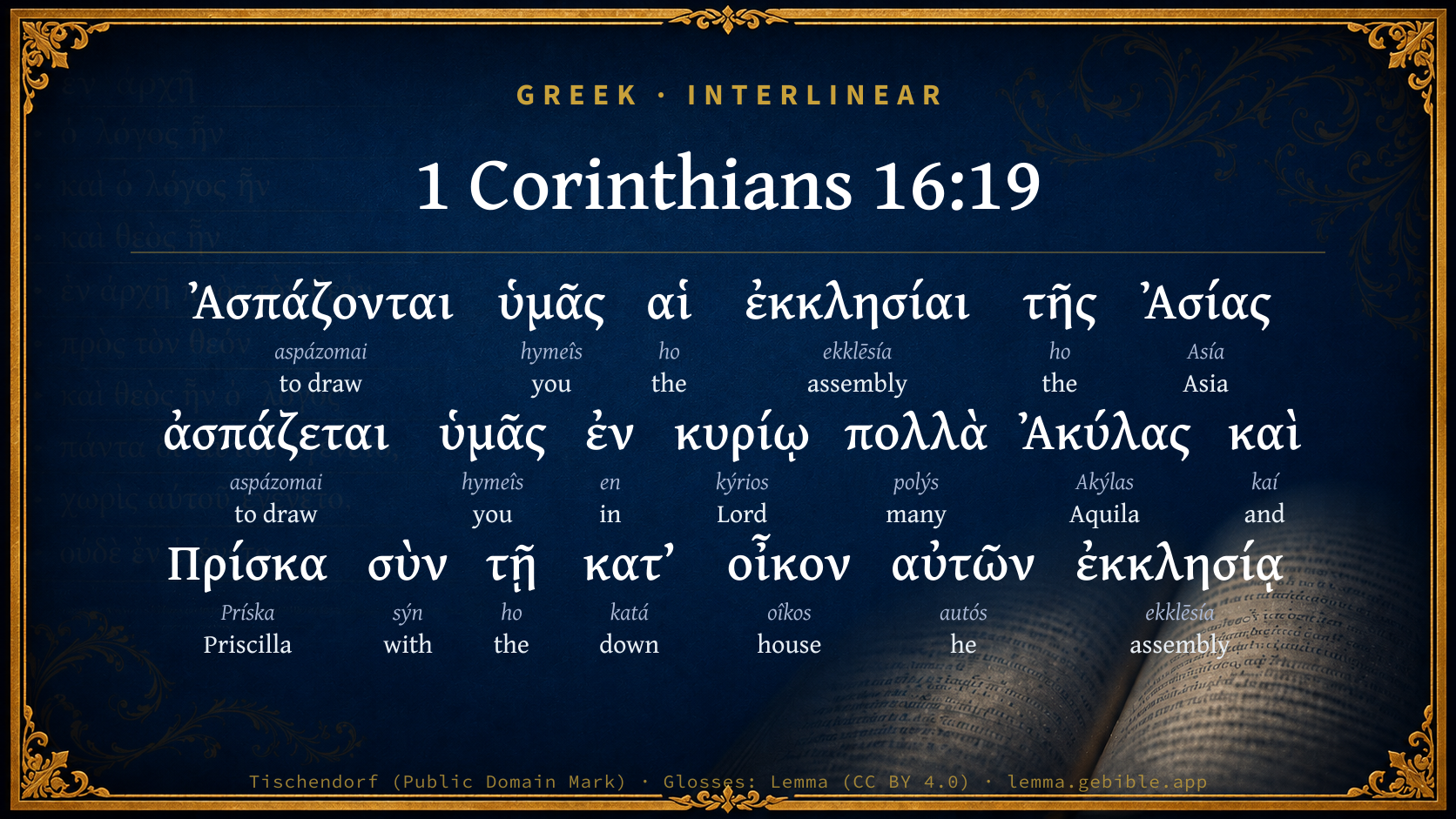
  1. Ἀσπάζονται aspázomai G782 “to draw” Verb, Present, Middle or Passive deponent, Indicative, 3rd person, Plural
  2. ὑμᾶς hymeîs G5210 “you” Personal pronoun, 2nd person, Accusative, Plural
  3. αἱ ho G3588 “the” Article, Nominative, Plural, Feminine
  4. ἐκκλησίαι ekklēsía G1577 “assembly” Noun, Nominative, Plural, Feminine
  5. τῆς ho G3588 “the” Article, Genitive, Singular, Feminine
  6. Ἀσίας Asía G773 “Asia” Noun, Genitive, Singular, Feminine
  7. ἀσπάζεται aspázomai G782 “to draw” Verb, Present, Middle or Passive deponent, Indicative, 3rd person, Singular
  8. ὑμᾶς hymeîs G5210 “you” Personal pronoun, 2nd person, Accusative, Plural
  9. ἐν en G1722 “in” Preposition
  10. κυρίῳ kýrios G2962 “Lord” Noun, Dative, Singular, Masculine
  11. πολλὰ polýs G4183 “many” Adjective, Accusative, Plural, Neuter
  12. Ἀκύλας Akýlas G207 “Aquila” Noun, Nominative, Singular, Masculine
  13. καὶ kaí G2532 “and” Conjunction
  14. σὺν sýn G4862 “with” Preposition
  15. τῇ ho G3588 “the” Article, Dative, Singular, Feminine
  16. κατ’ katá G2596 “down” Preposition
  17. οἶκον oîkos G3624 “house” Noun, Accusative, Singular, Masculine
  18. αὐτῶν autós G846 “he” Personal pronoun, Genitive, Plural, Masculine
  19. ἐκκλησίᾳ ekklēsía G1577 “assembly” Noun, Dative, Singular, Feminine

About this verse

These counts appear in no published source. They are computed here, from the morphology-tagged text and Lemma’s own curated glosses. What Lemma adds →

20
words
15
distinct lemmas
Pauline Epistles
section

Notable vocabulary

The rarest word here is Πρίσκα Priscilla G4251 — appearing just 3 times in the whole Greek New Testament.

Shared distinctive vocabulary

Πρίσκα Priscilla G4251 occurs in 3 verses of the Greek New Testament. Also found in:

Repetition

Words recur within this verse:

  • Ἀσπάζονται to draw G782 ×2
  • ἐκκλησίαι assembly G1577 ×2
  • αἱ the G3588 ×3
  • ὑμᾶς you G5210 ×2

Cross-references

11

Topical passages linked to 1 Corinthians 16:19 in the Treasury of Scripture Knowledge — connected by theme and wording, ordered by reader-vote popularity; previews shown in the World English Bible.

  • Acts 18:2 He found a certain Jew named Aquila, a man of Pontus by race, who had recently come from Italy, with his wife Priscilla, because Claudius had commanded all the Jews to depart from Rome. He came to them,
  • Acts 18:18 Paul, having stayed after this many more days, took his leave of the brothers, and sailed from there for Syria, together with Priscilla and Aquila. He shaved his head in Cenchreae, for he had a vow.
  • Acts 18:26 He began to speak boldly in the synagogue. But when Priscilla and Aquila heard him, they took him aside, and explained to him the way of God more accurately.
  • Acts 19:10 This continued for two years, so that all those who lived in Asia heard the word of the Lord Jesus, both Jews and Greeks.
  • Romans 16:3–5 Greet Prisca and Aquila, my fellow workers in Christ Jesus,
  • Romans 16:15 Greet Philologus and Julia, Nereus and his sister, and Olympas, and all the saints who are with them.
  • Colossians 4:15 Greet the brothers who are in Laodicea, and Nymphas, and the assembly that is in his house.
  • 2 Timothy 4:19 Greet Prisca and Aquila, and the house of Onesiphorus.
  • Philemon 1:2 to the beloved Apphia, to Archippus, our fellow soldier, and to the assembly in your house:
  • 1 Peter 1:1 Peter, an apostle of Jesus Christ, to the chosen ones who are living as strangers in the Dispersion in Pontus, Galatia, Cappadocia, Asia, and Bithynia,
  • Revelation 1:11 saying, "What you see, write in a book and send to the seven assemblies: to Ephesus, Smyrna, Pergamum, Thyatira, Sardis, Philadelphia, and to Laodicea."

Cross-references courtesy of OpenBible.info (CC BY 4.0).

Where the printed editions differ

1 variant

Places in this verse where the major printed Greek editions disagree on the wording in a way that affects the translation — a comparison of editions, not a manuscript-by-manuscript collation. The editions are the modern critical texts (Nestlé-Aland 28/27, SBL, Westcott-Hort, Tregelles, Tyndale House) and the traditional texts behind the KJV (the Textus Receptus and the Byzantine/Majority text). It is not a claim about which reading is original.

  1. Different wording
    Ἀσπάζεται

    “he greets”

    In NA28NA27TynSBLWH Not in TregTRByz

    ἀσπάζονται (aspazontai) 'they greet' occurs in traditional manuscripts (Treg+TR+Byz) instead of Ἀσπάζεται (Aspazetai) 'he greets' in older manuscripts (NA28+NA27+Tyn+SBL+WH)

Textual data: Translators Amalgamated Greek New Testament (STEPBible TAGNT) · CC BY 4.0.

Commentary

Notes on 1 Corinthians 16:19 from classic Christian and Jewish commentators (each source and its license shown beneath its notes). The classic Christian expositions comment on the surrounding passage and are grouped to its opening verse, so a note may address several verses; the Jewish commentaries on the Tanakh (Rashi and others) are per-verse, so they appear only where the commentator wrote on this verse.

Lemma curates 59 commentaries, every one of them public domain or Creative Commons licensed, each selected and text-cleaned for this edition rather than reprinted as found. About our sources →

Matthew Henry's Commentary

The apostle closes his epistle,

I. With salutations to the church of Corinth, first from those of Asia, from Priscilla and Aquila (who seem to have been at this time inhabitants of Ephesus, vid. Act 18:26), with the church in their house (Co1 16:19), and from all the brethren (Co1 16:20) at Ephesus, where, it is highly probable at least, he then was. All these saluted the church at Corinth, by Paul. Note, Christianity does by no means destroy civility and good manners. Paul could find room in an epistle treating of very important matters to send the salutations of friends. Religion should promote a courteous and obliging temper towards all. Those misrepresent and reproach it who would take any encouragement from it to be sour and morose. Some of these salute them much in the Lord. Note, Christian salutations are not empty compliments; they carry in them real expressions of good-will, and are attended with hearty recommendations to the divine grace and blessing. Those who salute in the Lord wish their brethren all good from the Lord, and breathe out their good wishes in fervent prayers. We read also of a church in a private family, Co1 16:19. It is very probable that the family itself is called the church in their house. Note, Every Christian family should in some respects be a Christian church. In some cases (as, for instance, were they cast away on a foreign shore, where there are no other Christians), they should be a church themselves, if large enough, and live in the use of all ordinances; but in common cases they should live under the direction of Christian rules, and daily offer up Christian worship. Wherever two or three are gathered together, and Christ is among them, there is a church. To these salutations he subjoins, 1. An advice, that they should greet one another with a holy kiss (Co1 16:20), or with sincere good-will, a tacit reproof of their feuds and factions. When the churches of Asia, and the Christian brethren so remote, did so heartily salute them in the Lord, and own and love them as brethren, and expressed so much good-will to them, it would be a shame for them not to own and love one another as brethren. Note, The love of the brethren should be a powerful incentive to mutual love. When the other churches of Christ love us all, we are very culpable if we do not love one another. 2. He subjoins his own salutation: The salutation of me Paul with my own hand, Co1 16:21. His amanuensis, it is reasonable to think, wrote the rest of his epistle from his mouth, but at the close it was fit that himself should sign it, that they might know it to be genuine; and therefore it is added (Th2 3:17), Which is my token in every epistle, the mark of its being genuine; so he wrote in every epistle which he did not wholly pen, as he did that to the Galatians, Gal 6:11. Note, Those churches to whom apostolical letters were sent were duly certified of their being authentic and divine. Nor would Paul be behind the rest of the brethren in respect to the Corinthians; and therefore, after he has given their salutations, he adds his own.

II. With a very solemn warning to them: If any man love not the Lord Jesus Christ, let him be Anathema, Maran-atha, Co1 16:22. We sometimes need words of threatening, that we may fear. Blessed is he, says the wise man, who feareth always. Holy fear is a very good friend both to holy faith and holy living. An how much reason have all Christians to fear falling under this doom! If any man love not the Lord Jesus Christ, let him be Anathema, Maran-atha. Here observe, 1. The person described, who is liable to this doom: He that loveth not the Lord Jesus Christ. A meiōsis, as some think; he who blasphemes Christ disowns his doctrine, slights and contemns his institutions, or, through pride of human knowledge and learning, despises his revelations. It stands here as a warning to the Corinthians and a rebuke of their criminal behaviour. It is an admonition to them not to be led away from the simplicity of the gospel, or those principles of it which were the great motives to purity of life, by pretenders to science, by the wisdom of the world, which would call their religion folly, and its most important doctrines absurd and ridiculous. Those men had a spite at Christ; and, if the Corinthians give ear to their seducing speeches, they were in danger of apostatizing from him. Against this he gives them here a very solemn caution. "Do not give into such conduct, if you would escape the severest vengeance." Note, Professed Christians will, by contempt of Christ, and revolt from him, bring upon themselves the most dreadful destruction. Some understand the words as they lie, in their plain and obvious meaning, for such as are without holy and sincere affection for the Lord Jesus Christ. Many who have his name much in their mouths have no true love to him in their hearts, will not have him to rule over them (Luk 19:27), no, not though they have very towering hopes of being saved by him. And none love him in truth who do not love his laws and keep his commandments. Note, There are many Christians in name who do not love Christ Jesus the Lord in sincerity. But can any thing be more criminal or provoking? What, not love the most glorious lover in the world! Him who loved us, and gave himself for us, who shed his blood for us, to testify his love to us, and that after heinous wrong and provocation! What had we a power of loving for, if we are unmoved with such love as this, and without affection to such a Saviour? But, 2. We have here the doom of the person described: "Let him be Anathema, Maran-atha, lie under the heaviest and most dreadful curse. Let him be separated from the people of God, from the favour of God, and delivered up to his final, irrevocable, and inexorable vengeance" Maran-atha is a Syriac phrase, and signifies The Lord cometh. That very Lord whom they do not love, to whom they are inwardly and really disaffected whatever outward profession they make, is coming to execute judgment. And to be exposed to his wrath, to be divided to his left hand, to be condemned by him, how dreadful! If he will destroy, who can save? Those who fall under his condemning sentence must perish, and that for ever. Note, Those who love not the Lord Jesus Christ must perish without remedy. The wrath of God abides on every one who believes not on the Son, Joh 3:36. And true faith in Christ will evermore be productive of sincere love to him. Those who love him not cannot be believers in him.

III. With his good wishes for them and expressions of good-will to them. 1. With his good wishes: The grace of our Lord Jesus Christ be with you, Co1 16:23. As much as if he had said, "Though I warn you against falling under his displeasure, I heartily wish you an interest in his dearest love and his eternal favour." The grace of our Lord Jesus Christ comprehends in it all that is good, for time or eternity. To wish our friends may have this grace with them is wishing them the utmost good. And this we should wish all our friends and brethren in Christ. We can wish them nothing more, and we should wish them nothing less. We should heartily pray that they may value, and seek, and obtain, and secure, the grace and good-will of their Lord and Judge. Note, The most solemn warnings are the result of the tenderest affection and the greatest good-will. We may tell our brethren and friends with great plainness and pathos that, if they love not the Lord Jesus Christ, they must perish, while we heartily wish the grace of Christ may be with them. Nay, we may give them this warning that they may prize and lay hold of this grace. Note also, How much true Christianity enlarges our hearts; it makes us wish those whom we love the blessings of both worlds; for this is implied in wishing the grace of Christ to be with them. And therefore it is no wonder that the apostle should close all, 2. With the declaration of his love to them in Christ Jesus: My love be with you all, in Christ Jesus, Amen, Co1 16:24. He had dealt very plainly with them in this epistle, and told them of their faults with just severity; but, to show that he was not transported with passion, he parts with them in love, makes solemn profession of his love to them, nay, to them all in Christ Jesus, that is, for Christ's sake. He tells them that his heart was with them, that he truly loved them; but lest this, after all, should be deemed flattery and insinuation, he adds that his affection was the result of his religion, and would be guided by the rules of it. His heart would be with them, and he would bear them dear affection as long as their hearts were with Christ, and they bore true affection to his cause and interest. Note, We should be cordial lovers of all who are in Christ, and who love him in sincerity. Not but we should love all men, and wish them well, and do them what good is in our power; but those must have our dearest affection who are dear to Christ, and lovers of him. May our love be with all those who are in Christ Jesus! Amen.

Matthew Henry's Commentary on the Whole Bible (1708–1710) — public domain (CC PDM 1.0). Text via the HelloAO Bible API.

The Biblical Illustrator

Joseph S. Exell

1Co_16:19-21

The Churches of Asia salute you.

The social temperature of a Church

While doctrines are being discussed in the pulpit, and ecclesiastical distinctions expressed in modes of worship and of discipline, there remains to be studied something quite as essential as these to the future of religion, in the common life that is going on beneath them, the varying phases of which it is impossible for any definition to express. Not second in importance to a Churchs teaching or organisation, is the question of its temperature. The necessity of urging this is not diminished by the consideration of the extreme difficulty of ascertaining what, in Church life, is the exact figure at which the social thermometer should stand. The social habits of our English churches, to confine ourselves for a moment to them, will necessarily be determined to a large extent by our characteristics as a race; and enthusiastic sociability is not, as a rule, regarded as one of these. A witty Frenchman has observed that not only is England an island, but every Englishman is an island. The haughty reserve of manner for which he is celebrated on the Continent, and which at home carries him through a long days journey in a railway carriage without opening his lips to his neighbour, is not likely to be cast on one side when he enters the church door. The difficulty in making advances to strangers in congregations is greatly enhanced by the presence in no inconsiderable numbers of this class. They resent the friendly greeting as an intrusion, and are capable of rewarding it with the look which, in one of Lord Beaconsfields novels, a great lady bestows upon a person just introduced to her; a look conveying to its recipient the impression that she has never seen him before, that she has no interest in seeing him now, and not the slightest desire ever to set eyes on him again. One of the indispensable elements in the training of a Church social tactician is the cultivation of the faculty of recognising these people at a glance, and of knowing how to deal with them. There are those who value social recognition, and to whom the extension of a ready sympathy is of the first importance, both in regard to their own comfort and as a means of attaching them to the fellowship. Here, again, however, there are subdivisions. Some of these people possess in themselves the social faculty. They have the coming on humour, and without much outside help will by the force of their own general attractiveness and geniality, speedily make their way and find themselves at home. Others, depending equally on the appreciation and sympathy of their fellows, and equally expecting it, embarrass their neighbours by the fact that they hoist no signals for a parley. They shut themselves up in their own interior, the windows of their nature shut, and the blinds drawn, and then are astonished and aggrieved that no one knocks at the door. The question of the social temperature of a Church depends for its answer to a considerable extent on the kind of heating apparatus there is in the pulpit. But warmth, fervour, and good-heartedness in the preacher are not enough. There must be organisation as well. Apart from this, the most impassioned discourse on brotherly love will not break through the reserve which prevents Jones in the pew from holding out a hand to Brown, the unknown, in the aisle. The idea of an Outlook Committee attached to each Church is excellent. It should be a tolerably large one, of both sexes, and representing the cream of the community in intelligence, tact, good feeling, knowledge of the congregation and of human nature in general. A military officer once said that in a reputedly brave regiment perhaps one in ten would be really brave, it being the example of this tenth that kept the others in line. In a reputedly sociable Church there may, perhaps, be one in ten with the genuine social gift. It is from these, the men and women whose natural grace of temperament has been heightened and enriched by the spirit of Christ; who have the quick intelligence that both reads and remembers faces; who know and respect the social convenances, when to speak and when to refrain from speaking; whose heart knows by instinct the lonely and friendless, and by instinct goes out towards them, that the Look-out Committee should be recruited. Where it is not already in existence it is time to organise it. There is plenty for it to do. The proper comprehension of the conditions of this form of service, and the systematic development of all its capabilities, will put a new face upon many a community that is now languishing from neglect of a vital point. (Christian World.)

The apostolic salutations indicate

I. The unity of the Church of Christ.

1. All the churches are united by common bonds.

2. Should maintain a friendly intercourse.

II. The interest which individuals should feel for the spiritual well-being of those at a distance. It should be--

1. Heartfelt.

2. Prayerful.

III. The universal brotherhood of Christians and its fitting expression.

IV. The loving relation between minister and people.

Christian greetings

I. From and to whom?

1. Individuals.

2. Households.

3. Churches.

II. Of what kind?

1. Fraternal.

2. Cordial.

3. Mutual.

III. Upon what basis?

1. Not upon that of mere courtesy, common interests, or expediency.

2. But in the Lord.

(1) In fulfilment of His command.

(2) In imitation of His conduct.

(3) Under the influence of His Spirit. (Prof. J. R. Thomson.)

Aquila and Priscilla salute you much in the Lord.--

Aquila and Priscilla

The excellences of this worthy couple. They--

1. Were members of the Church--in Ephesus.

2. Hospitable.

3. Well instructed in the truth (Act_18:26).

4. Had a Church in their house.

5. Felt a deep interest in the Church at home and abroad. (J. Lyth, D.D.)

With the Church that is in their house.

A Church in the house

I. What this Church is and when our families may be called Churches. Churches are societies--

1. Devoted to God, called out of this world.

2. Employed for God, pursuant to this dedication.

II. Motives to persuade you to turn your families into churches.

1. God will dwell in them.

2. If you make them not churches Satan will have a seat there.

3. It will be comfortable to yourselves.

4. A good legacy.

5. It will help to prosper the Church of God in the nation. (Biblical Museum.)

The Church in the house

(Rom_16:5) imports the Church meeting in their house, consequently implies--

I. The good feeling of the entertainer.

II. The privilege of the household--Christ in the midst.

III. The promise of blessing upon the neighbourhood.

IV. The hope of reunion in heaven. (J. Lyth, D.D.)

The Church in the house

I. The simplest conception of a Church. A meeting or assembly. The term can only be applied to an organised body or material building figuratively. Two or three agreeing to meet together for worship may properly be called a church.

II. Its close association with a home. It is interesting to note that the Christian assemblies were first sanctified homes. They did not need at first any architectural aids.

III. Its fundamental features. Family religion extended to embrace family friends.

IV. The lines of its probable development. These were fixed by--

1. Increase of numbers.

2. Growth of wealth, bringing with it artistic sentiment and desires.

3. Rise of distinction between priesthood and laity, and the consequent development of ritual. (R. Tuck, B.A.)

Family prayer

This is a general custom in the households of evangelical Christians. No man ought to consider his piety of an active stamp who neglects to institute the Church in his house.

I. It is a duty. The Bible nowhere directly commands it; but--

1. It is a duty by inference. When Abraham moved his tent to the plain of Mamre, he built there an altar unto the Lord (Gen_13:18). The pious take their religion with them wherever they go. When David says, Seven times a day do I praise Thee, remember there was no temple, and that at least two of these times may refer to morning and evening worship in the household. Daniel prayed in his house, sometimes himself alone, and sometimes with his family about him (Dan_6:10). Cornelius was a man that prayed in his house (Act_10:30). Paul delighted to honour Priscilla and Aquila, and twice spoke of the Church that is in their house (Text and Rom_16:5). This is interpreted by some to mean that their home was a sanctuary and their family a Church; but if others may assemble in the home for worship, how much more may not the family? We may certainly claim that family prayer conforms to the command, and is entitled to the promise contained in Jam_4:8.

2. A duty by example. It can hardly be doubted that the deeply pious in all times have prayed with their family in their households. Abraham, Joshua, David, Job, Daniel, all worshipped God in the family, and our Saviour confirmed the obligation; for He often prayed with His disciples, as His family or household.

II. It is a privilege, Family prayer binds the household more closely and lovingly together. It is a great boon to consecrate the day with prayer before the household separates on its divers ways and on its manifold duties, What if they should never all meet again? To have omitted it on such a day would prove a lasting regret. How precious at night to commit our souls and bodies to that Guardian of Israel who neither slumbers nor sleeps! This gives a gracious opportunity to pray with our children and for our children. Says Cecil, It may be used as an engine of vast power in the family. It diffuses a sympathy through the members. It calls the mind off from the deadening effects of worldly affairs. It arrests every member with a morning and evening sermon, in the midst of all the hurries and cares of life. It says, There is a God! There is a spiritual world! There is a life to come! It fixes the idea of responsibility in the mind. It furnishes a tender and indictors father or master with an opportunity of gently glancing at faults, where a direct admonition might be inexpedient. It enables him to relieve the weight with which sub-ordination or service sits on minds of inferiors.

III. Inquiries.

1. Are we prayerless Christians?

2. Do we keep the fires burning brightly and continually upon the family altar?

3. Do we excuse ourselves because of non-ability and lack of confidence? Remember the man who hid his talent in a napkin.

4. Do we make it cheerful with song, instructive with Scripture, hallowed with prayer and precious with all its memories? (Homiletic Monthly.)

A church in the house

I. Churches are societies devoted to God, called out of the world, taken in out of the common to be inclosures for God. He hath set them apart for Himself; and, because He hath chosen them, they also have chosen Him, and set themselves apart for Him. The Jewish Church was separated to God for a peculiar people, a kingdom of priests. Thus our houses must be churches; with ourselves we must give up our houses to the Lord, to be to Him for a name and a people. All the interest we have, both in our relations and in our possessions, must be consecrated to God; as, under the law, all that the servant had was his masters for-ever, after he had consented to have his ear bored to the door-post.

II. Churches are societies employed for God, pursuant to the true intent and meaning of this dedication.

1. Keep up family doctrine.

(1) You must read the Scriptures to your families, inquiring sometimes whether they understand what you read.

(2) You must also catechise your children and servants so long as they continue in that age of life which needs this milk.

2. Keep up family worship. You must not only, as prophets, teach your families, but as priests, must go before them in offering the spiritual sacrifice of prayer and praise.

(1) You ought to make family acknowledgments of your dependence upon God and His providence, as you are a family.

(2) You ought to make family confessions of your sins against God; those sins you have contracted the guilt of in your family capacity.

(3) You ought to offer up family thanksgivings for the blessings which you, with your families, receive from God.

(4) You ought to present your family petitions for the mercy and grace which your families stand in need of.

(5) You ought to make family intercessions for others also. There are families you stand related to, or which by neighbourhood, friendship, or acquaintance you become interested in, and concerned for, and these you should recommend in your prayers to the grace of God, and your family that are joined with you in the alliances should join with you in those prayers.

3. Keep up family discipline, that so you have a complete church in your house, though in little. Reason teacheth us, that every man should bear rule in his own house (Est_1:22). And since that, as well as other power, is of God, it ought to be employed for God, and they that so rule, must be just, ruling in His fear.

(1) Countenance everything that is good and praiseworthy in your children and servants.

(2) Discountenance everything that is evil in your children and servants. Use your authority for the preventing of sin, and the suppressing of every root of bitterness, lest it spring up and trouble you, and thereby many be defiled. (S. Hayward.)

The Biblical Illustrator, edited by Joseph S. Exell (c. 1880s–1900s) — public domain. Text from a community e-Sword module.

Joseph Benson's Commentary

1Co 16:19-21. The churches of Asia — Especially those of Ephesus and its neighbourhood; salute you — With all Christian affection, heartily wishing you peace and prosperity. Aquila and Priscilla — Formerly members of your church, (Act 18:2; Act 18:18,) but who at present are with me; salute you much — With singular Christian love; in the Lord — In his grace and Spirit. These worthy persons lived in Corinth all the time the apostle was there. And when he departed, they accompanied him to Ephesus, (Act 18:18,) where they remained till after he left Ephesus to go to Jerusalem. For when he returned to Ephesus, he found them there, as is plain from their salutation sent to the Corinthians in this letter, which was written from Ephesus. But they seem to have left Ephesus about the time the apostle departed to go into Macedonia. For in the letter which he wrote to the Romans from Corinth, they are saluted as then residing in Rome. With the church which is in their house — The Christian congregation which assembles there. All the brethren — Who labour with me in the gospel, or are members of the church here; greet you — Wish you all felicity. Greet ye one another with a holy kiss — See on Rom 16:16. The salutation of me Paul with mine own hand — What precedes having been written by an amanuensis. See 2Th 3:17; Col 4:18.

Joseph Benson's Commentary on the Old and New Testaments (1811–1818) — public domain. Text from a community e-Sword module.

Whedon's Commentary on the Bible

Daniel D. Whedon

e. Salutations; closing autograph, anathema, and benedictions, 1Co_16:19-24.

19. Churches of Asia—Proconsular Asia, of which Ephesus was the capital. In these were included the “seven Churches” addressed by John in the Apocalypse. It is here interesting to hear for an instant their united voice sent through Paul in greeting to the Church at Corinth. It was probably to this entire circle of Churches that Paul addressed the so-called “Epistle to the Ephesians,” as a common “cyclical letter,” or circular address.

Aquila and Priscilla—See notes on Act_18:2-3, and Rom_16:3.

Church… in their house—This faithful pair had a house-church at Rome as well as at Ephesus. Rom_16:5.

Daniel D. Whedon (gen. ed.), Commentary on the Old and New Testaments (1874–1909) — public domain. Text from a community e-Sword module.

Tyndale Open Study Notes

Tyndale Open Resources

16:19-24 As in other letters, Paul greets his friends and gives a benediction.

16:19 Aquila and Priscilla (Greek Prisca) had previously moved from Corinth to Ephesus, where Paul was writing this letter (cp. Acts 18:1-3). • gather in their home: Aquila and Priscilla later continued this practice in Rome (see Rom 16:3-5).

Tyndale Open Study Notes — © Tyndale Open Resources, licensed CC BY-SA 4.0. Text via the HelloAO Bible API.

Bengel's Gnomon

Johann Albrecht Bengel

1Co 16:19. Πολλὰ, much) for especial affection, Act 18:2; Act 18:1.—Ακύλας καὶ Πρίσκιλλα, Aquila and Priscilla) Elsewhere this woman is mentioned first. In the epistle to the Corinthians, she is put last; comp. 1Co 14:34.—κατʼ οἶκον, in their house) This couple afterwards set up a church also in their house at Rome; Rom 16:5.

Bengel's Gnomon of the New Testament — English translation (T&T Clark, Edinburgh, 1860) — public domain. Text from a community e-Sword module.

Meyer's Critical & Exegetical Commentary

Heinrich August Wilhelm Meyer

1Co_16:19 f. Τῆς Ἀσίας] in the narrower sense, comprehending the western coastlands of Asia Minor (see on Act_2:9), where Ephesus also lay. From the latter, at least, Paul was charged with a greeting, but in the assurance of a like loving fellowship on the part also of the other Asiatic churches, with which he was in intercourse from Ephesus, he widens i.

ἐν κυρίῳ] marks the Christian character of the greeting, inasmuch as it was given with the feeling of living and moving in Christ. Comp. on Rom_16:22. The ἐν κυρ., which is here added, is taken for granted by the reader in the case of the other greetings also. But here precisely it is expressed, because this greeting is a specially fervent one; hence also πολλά (much, comp. 1Co_16:12).

σὺν τῇ κατʼ οἶκον αὐτ. ἐκκλ.] Aquila and Prisca (Priscilla), who had gone from Corinth (see on Act_18:2) to Ephesus (Act_18:18; Act_18:26), had therefore given their dwelling here too, as afterwards at Rome (Rom_16:3 f.), for the assembly of a portion of the Christians in the place. Comp. on Rom. l.c. Probably Paul also lodged with them, so that the old addition: παρʼ οἷς καὶ ξενίζομαι (D E F G, Vulg., etc.), contains a true statemen.

οἱ ἀδελφοὶ πάντες] the whole of the members of the Ephesian churchthese, still, separately and personally, although already included collectively in the first greetin.

ἐν φιλ. ἁγ.] by means of a holy kiss. See on Rom_16:16; 2Co_13:12; 1Th_5:26. It is the kiss which was the token of Christian, brotherly love (1Pe_5:14), and thus had the specific character of Christian consecration. Comp. Constit. apost. ii. 57. 12, viii. 5. 5 : τὸ ἐν κυρίῳ φίλημα. More special considerations, such as that of the absence of hypocrisy (Chrysostom, Theodoret, Theophylact), are imported. They are to greet each other, mutually (not from Paul), with the holy kiss after the reading of the Epistle in the assembly, and thereby manifest their brotherly love to each other respectively.[111] Comp. on Rom_16:16.

[111] We are to conceive of this ἀσπάζεσθαι ἀλληλούς as a silent one, in which the kiss is the medium instead of words. Comp. Const. ap. viii. 11. 4.

1Co_16:21-24. Conclusion added with his own hand in token, according to 2Th_3:17, comp. 1Co_2:2, that the Epistle, though not written with his own hand, was his Epistle. Comp. Col_4:18.

ὁ ἀσπασμός] is the greeting κατʼ ἐξοχήν, the final salutation to the church. Nothing is to be supplied; on the contrary, Paul writes these words, and there is the greetin.

Παύλου] in apposition to ἐμῇ. See Kühner, II. p. 145.

In 1Co_16:22, looking back once more, as it were involuntarily, upon the many degenerate forms of Christian life, and the discords at Corinth, he adds an apostolic utterance of judgment, full of terrible solemnity, against all those who could not but feel that it struck at the.

οὐ φιλεῖ τ. κύρ.] is without love to Christ. So he designates those Christians, who, like so many at Corinth, by factiousness, self-seeking, strife, a carnal life, etc., practically denied their love to Christ (Joh_14:23). That the curse applied to them, as long as they were impenitent, is self-evident. Comp. 2Co_7:10.

Observe that the more sensuous word φιλεῖν is nowhere used by Paul in those Epistles which are undoubtedly his (comp., however, Tit_3:15), except in this passage so full of emotion; elsewhere he uses ἀγαπᾶν (Eph_6:24).

ἤτω ἀνάθ.] i.e. then let him be one devoted to destruction (to the eternal ἀπώλεια). See on Rom_9:3; Gal_1:8.

μαραναθά] energetic reference to the Parousia, at which that ἤτω ἀνάθ. shall be realized. The word is the Aramaic מָרָנָא אֲתָא , i.e. our Lord is come, by which, however, not the coming in the flesh is meant, as Chrysostom, Theodoret, Theophylact, Jerome, Erasmus, Castalio, al., assume,[112] but, in accordance with the context (see previously ἤτω ἀνάθ.), the eschatological coming to judgment. Paul sees the near and certain Parousia as if already begun (see on this use of the Hebrew praeterite, Ewald, Lehrb. 135. 3), and exclaims, like a prophet beholding it in vision: Our Lord is here! But it is not a form of putting under ban (see Lightfoot, Hor. p. 260), as indeed it does not occur in the Rabbinical writings; Luther (comp. Calvin) has without any warrant made it into Maharam Motha (which would be מחרם מותא , maledictus ad mortem). According to Hofmann, μαραναθά is meant to be equivalent to מַר אַנְתָה , Thou art the Lord, whereby the thought is expressed: He will prove Himself in them to be Lord. But how needless is this wholly novel and far less characteristic interpretation! The traditional interpretation,[113] on the other hand, places the punishment of the judgment directly before our eyes. Why, we may ask further, did Paul use the Aramaean expression? We do not know. Perhaps there was implied in it some reminiscence from the time of the apostles presence among them, unknown to us, but carrying weight for his readers; perhaps it was only the prompting of momentary indignation, that, after the sentence of judgment already pronounced (ἤτω ἀνάθεμα), rei gravitate commotus, quasi sibi non satisfecisset (Calvin), he desired to clothe in truly solemn language the threatening reference to the Parousia yet to be added by μαραναθά, instead of saying ὁ κύριος ἡμῶν ἥκει. That there was a reference, however, in the Aramaean expression to the Petrine party who understood Hebrew, is not to be assumed (in opposition to Hofmann), as the general εἴ τις οὐ φιλεῖ τ. κύριον shows of itself. The two Aramaean words were doubtless enough intelligible generally in the mixed church, which contained so much of the Jewish element. Had the Maranatha, however, been as it were the mysterious watchword in the world of that time (Ewald), there would be in all probability more traces of it to be found in the New Testament. This also in opposition to Bengel. The view of Chrysostom and Theophylact is singularly absurd: Paul wished by the Aramaean to cross the conceit of the Corinthians in the Hellenic language and wisdom. Billroth, followed by Rückert, holds that he had added something in Aramaic also, in order to accredit yet more strongly the authenticity of the Epistle, but that this had afterwards been written by the transcribers in Greek letters. But the assumption that he had not written μαραναθά in Greek letters, although it has passed over so into all Greek MSS. of the text, is equally arbitrary with the presupposition that he had thought such an extraordinary and peculiar mode of attestation to be needful precisely in the case of this Epistle, which was already sufficiently accredited without it by the bearers.1Co_16:23. The grace of the Lord, etc., sc. εἴη, the apostles most common closing wish in an epistle, Rom_16:20; Rom_16:24; Gal_6:18; Php_4:23; 1Th_5:28; 2Th_3:18; Phm_1:25.1Co_16:24. My love, etc., sc. ἐστι: his heart impels him still to add this assurance at the very end, all the more because the divisions, immoralities, and disorders in the church had forced from him such severe rebukes and, even now, such corrective appeals. He loves them, and loves them all. If taken as optative (Luther, Estius, Ewald), it would be less suitably an indirect admonition, namely, that they might so conduct themselves that, et.

ἐν Χριστῷ Ἰησοῦ] Christ is his whole life-sphere; in it he loves also. His love has thus the distinctively Christian character, in contrast to all κοσμικὴ ἀγάπη (Theophy)

[112] Paul, they hold, means thereby to say: Quod superfluum sit adversus eum (Christum) odiis pertinacibus contendere, quem venisse jam constet, Jerome, Ep. 137 ad Marcell.; or: he means thereby to put them to shame, because they still continued in their sins after the Lord had shown such condescension, Chrysostom; or, quandoquidem aversatur eum, a quo solo poterat consequi salutem, et venisse negat quem constat venisse magno bono credentium, sed magno malo incredulorum, Erasmus, Paraphr.; or, quod si quis eum non amat, frustra alium expectat, Castalio.

[113] Even those codd. which have written the word in a divided way, have the division not μαρ αναθα, but μαραν αθα. So already B**. And the versions, too (those which do not with the Vulgate retain it untranslated), translate according to this division; so already the Peshito: Dominus noster venit. Cod. It. g.: in adventu Domini.

Meyer — Critical and Exegetical Commentary on the New Testament — English translation by Peter Christie, edited by Frederick Crombie (T&T Clark, 1880) — public domain. Text from a community e-Sword module.

Godet's Commentaries

Frédéric Louis Godet

Salutations. 1Co 16:19-24.

First, those of the Churches of Asia; then the special salutations of Aquila, and of the portion of the Church which assembles under his roof; thereafter those of the whole Church; finally, that of Paul.

Vv. 19, 20. “The Churches of Asia salute you. Aquila and Priscilla salute you much in the Lord, with the Church that is in their house. 20. All the brethren greet you. Greet ye one another with an holy kiss.”

Asia denotes the province of that name, proconsular Asia which embraced the whole south-west region of Asia Minor and even Phrygia. The apostle no doubt frequently saw at Ephesus representatives of the numerous Churches founded in those parts; or he even visited them himself; comp. Act 20:25. He might thus have been really charged by them with these salutations. It may be assumed that among them were those of Colosse, Hierapolis, and Laodicea.

The special salutation of Aquila and Priscilla is easily explained if we bear in mind that they had previously been settled with Paul at Corinth, and that they had assisted in founding the two Churches of Corinth and Ephesus. The Church assembled in their house undoubtedly comprehended not only their own family and workmen, but also all those Christians of Ephesus who had their central place of worship in this house. The κατά is distributive, and indicates that there were other houses at Ephesus where the Christians who dwelt in other quarters of the city met together. There must thus have been various places of assembling in the great cities such as Ephesus, Corinth, or Rome. There is no certain example of the existence of special buildings devoted to Christian worship within the territory of the Roman Empire before the third century (Edwards).

The third salutation is addressed by all the brethren, members of the Church of Ephesus. One feels in reading such salutations, that the history of nations is coming to an end, and that of a new nation of a wholly different kind is beginning.

This manifestation of love, on the part of the other Churches, should rekindle brotherly love among all the members of the Church which is its object; and this fire of charity which glows in their hearts should show itself outwardly in the brotherly kiss, according to the usage received among the first Christians. In the time of Justin this rite was celebrated between prayer and the Holy Supper. It is said that the president of the assembly kissed the nearest brother, and so in order, while the women on their side did the same. In this case we have to imagine the ceremony taking place at the moment when the congregation finished the reading of this letter. It is a commission, as it were, which the apostle gives them one to another.

Frédéric Louis Godet — Commentaries on Luke, John, Romans, and 1 Corinthians — English translation (T&T Clark, Edinburgh, 1870s–1890s) — public domain. Text from a community e-Sword module.

Hodge's Commentary on Romans, Ephesians & First Corinthians

Charles Hodge

1Co_16:19

The churches of Asia salute you. Aquila and Priscilla salute you much in the Lord, with the church that is in their house.

Asia here means proconsular Asia, of which Ephesus was the capital, and which included the seven apocalyptic churches. To salute, in a general sense, is to wish safety to; in a Christian sense, it is to wish salvation to any one. This was included in the Hebrew formula of salutation, Peace be with you, which passed into the service of Christians. To salute any one in the Lord, is to salute him as a Christian and in a Christian manner. It is to salute him because he is in the Lord, and in a way acceptable to the Lord. Aquila and Priscilla, when driven from Rome, as mentioned in Act_18:2, settled in Corinth. They accompanied the apostle to Ephesus, and remained there, Act_18:18. The church which is in their house, i.e. the company of Christians which meet in their house. As the same expression is used Rom_16:5, in connection with their names, it is probable that both at Rome and Ephesus, they opened their house as a regular place of meeting for Christians. Their occupation as tent-makers probably required spacious apartments, suited for the purpose of such assemblies.

Charles Hodge — Commentary on Romans (1835), First Corinthians (1857), and Ephesians (1856) — public domain. Text from a community e-Sword module.

Jamieson, Fausset & Brown

Robert Jamieson, A. R. Fausset & David Brown

Asia--not all Asia Minor, but Lydian Asia only, of which Ephesus was the capital.

much--with especial affection.

Aquila . . . Priscilla--(Compare Act 18:2; Rom 16:3-4). Originally driven out of Italy by Claudius, they had come to Corinth (whence their salutation of the Corinthians is appropriate here), and then had removed with Paul from Corinth to Ephesus (Act 18:2, Act 18:18-19, Rom 16:3, Rom 16:5). A pattern to Christian husbands and wives. Their Christian self-devoting love appears wherever they were (Rom 16:3-4). Even the gifted Apollos, so highly admired at Corinth, owed much of his knowledge to them (Act 18:24-26). In Co1 16:20, "All the brethren" (that is, the whole Church) seem to be distinguished from "the church that is in their house," which was but a partial and private assembly out of the general Church at Corinth. NEANDER thinks Rom 16:23 refers to "the whole Church" meeting at the house of Gaius (compare Col 4:15). "Synagogue" implies an assembly in general, without reference to the character or motives of its members. "Church," like the Hebrew Kahal, implies an assembly legally convened; as, for instance, the Jews met as a body politic to receive the law (hence Stephen calls it "the Church in the wilderness," Act 7:38), and having a legal bond of union. Christ's followers when dispersed from one another cease to be a congregation (synagogue), but still are a Church, having the common bond of union to the same Head by the same faith and hope [VITRINGA, Synagogue and Temple]. From this we may explain Paul's entering "into every house and haling men and women": he would in searching for Christians go to their several "houses"' of prayer.

in the Lord--They pray for all blessings on you from the Lord, the source of every good [GROTIUS]. ALFORD explains, "in a Christian manner," as mindful of your common Lord. "In the Lord" seems to me to refer to their union together in Christ, their prayers for one another's good being in virtue of that union.

Jamieson, Fausset & Brown — Commentary Critical and Explanatory on the Whole Bible (1871) — public domain (CC PDM 1.0). Text via the HelloAO Bible API.

Adam Clarke's Commentary

Verse 19. The Churches of Asia salute you.] i.e. The Churches in Asia Minor. Ephesus was in this Asia, and it is clear from this that the apostle was not at Philippi; had he been at Philippi, as the subscription states, he would have said, The Churches of MACEDONIA, not the Churches of ASIA, salute you. How these places lay, in reference to each other, the reader will at once perceive by consulting the map in Acts.

Aquila and Priscilla] Of these eminent persons we have heard before: see Ac 18:2, Ac 18:18, Ac 18:26; and Ro 16:3.

With the Church that is in their house.] That is, the company of believers who generally worshipped there. There were no churches or chapels at that time built; and the assemblies of Christians were necessarily held in private houses. It appears that Aquila and Priscilla devoted their house to this purpose. The house of Philemon was of the same kind; Phm 1:2. So was likewise the house of Nymphas, Col 4:15. See Clarke on Ro 16:5.

Adam Clarke's Commentary on the Bible (1810–1826) — public domain. Text from a community e-Sword/MySword module.

Ellicott's Commentary for English Readers

(19) The churches of Asia salute you.—This and the following verse are occupied with the salutations from the churches throughout Asia; from the church in the house of Aquila and Priscilla; and finally, from “all the brethren.” Aquila and Priscilla had been the Apostle’s friends at Corinth (Act_18:1-3), and he now was with them at Ephesus. (See Rom_16:3-5; 2Ti_4:19.) Probably by “the church in their house” is meant a group of foreigners then resident in Ephesus, and accustomed to meet there for worship, as distinct from those who had been converted in Ephesus.

A Bible Commentary for English Readers, edited by Charles John Ellicott (1878–1897) — public domain. Text from a community e-Sword module.

The Cambridge Bible for Schools and Colleges

gen. ed. J. J. S. Perowne

19. The churches of Asia salute you] See Introduction, Ch. iii. p. 15.

Aquila and Priscilla] See Act_18:2; Act_18:18; Act_18:26. From Rom_16:3 (where Priscilla is called Prisca), we find that they returned to Rome as soon as it was safe to return thither. The message of Aquila and Priscilla to the members of the Church which had received them in their necessity, is one of the minute points of agreement which do so much to establish the authenticity of the various books of Scripture.

with the church that is in their house] Cf. Rom_16:5. The expression may mean (1) their family, or (2) less probably, the congregation which was accustomed to meet there for worship. Cf. Col_4:15; Phm_1:2.

The Cambridge Bible for Schools and Colleges (gen. ed. J. J. S. Perowne; Cambridge University Press, 1878–1918) — public domain. Text from a community e-Sword module.

John Gill's Exposition

The salutation of me Paul with mine own hand. The apostle had an "amanuensis", that wrote the epistle for him; but to prevent counterfeits, and that the church to whom he wrote might be assured of the genuineness of the epistle, that it was truly his own, he wrote with his own hand his common salutation; see Th2 3:17, and which is not in the following words, but what is expressed in Co1 16:23.

.

1 Corinthians 16:22

co1 16:22

co1 16:22

co1 16:22If any man love not the Lord Jesus Christ,.... The Vulgate Latin, and the Syriac and Ethiopic versions, read "our Lord". The apostle here does not so much mean profane and unregenerate sinners, who are destitute of love to Christ, from ignorance of him; nor such who, from the same principle, might persecute him in his members, for such are to be even prayed for, and wished well unto; and oftentimes such are called by grace, and become true and sincere lovers of Christ; and the apostle himself was an instance of it: some think the Jews are intended, who were the mortal enemies of Christ; hated his name and person, his Gospel and interest, and maliciously persecuted the same; they called Jesus accursed, and therefore deserved an anathema to be pronounced on them; it was prophesied of them, that their name should be left for a curse; and it was threatened to them, in case of non-repentance, upon the coming of John the Baptist, in the spirit of Elijah, that the Lord would come and smite their land with a curse; which had its accomplishment in the destruction of Jerusalem; see Isa 65:15; others think the Gnostics are intended, one of whose tenets was, that it was lawful not to confess Christ in a time of persecution, in order to save themselves; and such might be truly said not to love our Lord Jesus, and on whom such an anathema as after mentioned might rightly be denounced: though it should seem rather, that some persons in this church, or that infested it, are referred to as the false teachers, and those who sided with them, who made factions and divisions in the church of Christ; allowed themselves in the commission of fornication and incest, and such like impurities; had no regard to the peace of the consciences of weak brethren, but laid stumblingblocks in their way; behaved in a very irreverent manner at the Lord's table, and gave in to very pernicious errors and heresies, particularly denying the resurrection of the dead; and by their many bad principles and practices plainly showed that they did not in deed and in truth love our Lord Jesus: wherefore of every such an one the apostle says,

let him be anathema. The word anathema, answers to the Hebrew and is rendered by it here in the Syriac version; and signifies anything separated and devoted to holy uses; and so it is used by the Septuagint, in Lev 27:28, and in the New Testament, Luk 21:5, and which, if alienated to any other purposes, entailed a curse on persons; hence it is often translated "accursed", as Rom 9:3 Co1 12:3, and here it signifies, that such persons that love not the Lord Jesus, should be rejected by the saints, and separated from their communion; and so the Arabic version renders it, "let him be separated"; that is, from the church; let him be cast out of it, and cut off from it; as, so living and dying without love to Christ, he will be accursed by him at the last day, and will have that awful sentence denounced on him, "go ye cursed". The apostle adds another word, about which there is some difficulty,

maranatha; some make this to be the same with "anathema"; the one being the Syriac, the other the Greek word, as "Abba, Father"; and think that "maranatha" is put for "maharamatha"; others think that it is the same with "maharonatha", which signifies "from wrath to come"; and being joined with the other word, intends an anathematizing or devoting persons to wrath to come: others take it to be the last, and worse sort of excommunication among the Jews; and observe, that the first sort was called "Niddui", which was a separation from company and conversation, to which reference may be had in Luk 6:22; the second sort was called Cherem, to which "anathema" answers, and was a separation, attended with curses and imprecations; and a third sort was called "Shammatha", and is thought to answer to "maranatha", giving the etymology of it, as if it was, , "the name", i.e. "God cometh", as "maranatha" read as two words, signify "our Lord cometh": but this is not the etymology the Jews give of "Shammatha" (g); they ask,

"what is "Shammatha?" says Rab, , "there is death"; and Samuel says, , "desolations shall be";''

but of the other etymology there is no mention made among them; nor is ever the word "maranatha" used by them for excommunication; the sense of which certainly is, "our Lord cometh"; and the Ethiopic version, joining it with the former word, renders the whole thus, "let him be anathema in the coming of our Lord", which seems to be pretty much the sense of the apostle: it is best to consider this word, or rather these two words, "maran atha", "our Lord cometh", as added by the apostle, to put persons in mind of the coming of Christ; either at the destruction of Jerusalem, to take vengeance on the Jews, who did not love, but hated him, and maliciously persecuted him, and his; or of the second coming of Christ to judgment, when all the wicked of the earth shall be accursed by him, and all such that love him not will be bid to depart from him.

(g) T. Bab. Moed Katon, fol. 17. 1.

John Gill's Exposition of the Whole Bible (1746–1763) — public domain (CC PDM 1.0). Text via the HelloAO Bible API.

Trapp's Complete Commentary

John Trapp

19 The churches of Asia salute you. Aquila and Priscilla salute you much in the Lord, with the church that is in their house.

Ver. 19. Aquila and Priscilla] Paul’s fast friends and constant companions, worth their weight in gold.

John Trapp, A Commentary or Exposition upon All the Books of the Old and New Testament (1647–1656) — public domain. Text from a community e-Sword module.

Albert Barnes' Notes on the Bible

The churches of Asia - The word “Asia” in the New Testament usually denotes Asia Minor in general; see the note on Act 2:9. It was sometimes used in a more limited sense, to denote the region around Ephesus, and of which Ephesus was the center and capital; see note, Act 16:6. This is the region undoubtedly which is intended here.

Salute you - Greet you; send respectful and affectionate Christian regards; see the note at Rom 16:3.

Aquila and Priscilla - See the note on Act 18:26.

Much in the Lord - With affectionate Christian salutations; or as Christians. Wishing the blessing and favor of the Lord.

With the church that is in their house - See the note at Rom 16:5.

Albert Barnes' Notes on the Bible (1834–1885) — public domain. Text from a community e-Sword/MySword module.

Matthew Poole's English Annotations

He meaneth the Lesser Asia, in which was Ephesus; from whence it is more probable (according to the Arabic and Syriac opinion) that this Epistle was written, than from Philippi (according to the copy followed by our translaters). And that which further adds to that probability is, that the apostle mentioneth the salutations of

Aquila and Priscilla, as persons that were at that time with him; now, that they lived at Ephesus, or at least went thither with Paul, and tarried there, appeareth from Act 18:19; their saluting the church of Corinth

in the Lord, signifies their wishing them all spiritual blessings in and from Christ. But what is meant by

the church in their house, which joined with Paul in this salutation, is not so plain: we read the like, Col 4:15, of the church in Nymphas’s house; and in Philemon’s house, Phm 1:2; and the same again of this Aquila and Priscilla, Rom 16:5. Some think that it signifieth no more, than that their whole families had received the Christian faith; others think, that divers other Christians sojourned with them; others, that the church was wont to meet in some room in their house: but the last is not probable, either that in those times the church kept their meetings in any one stated place, or that Christians then had such spacious houses as could afford a room large enough for the whole church to meet in.

Matthew Poole's English Annotations on the Holy Bible (1683–1685) — public domain. Text from a community e-Sword/MySword module.

The Pulpit Commentary

Vers. 19-24. Salutations and autograph conclusion.

The Churches of Asia. Proconsular Asia. There was a constant interchange of voyages between the western coast of Asia and Corinth. Aquila and Priscilla. This admirable Christian husband and wife had no small share in founding the Churches both of Corinth and Ephesus. Being St. Paul"s partners in trade, he spent much time with them. (For all that is known of them. (see Act_18:1, Act_18:2, Act_18:26; Rom_16:3, Rom_16:5) Priscilla. Most of the uncials have the shorter form, Prisca. In some manuscripts (D, E, F, G) and versions (e.g. the Vulgate) we find the addition, "with whom also I am lodging." The Church that is in their house. The time for large common churches for public worship had not yet arrived, Hence, when the Christian community numbered more than could meet in one place, the congregations were held in separate houses (Rom_16:4, Rom_16:15; Act_2:46; Col_4:15; Phm_1:2)

Vers. 19, 20, 23, 24.

Salutations.

Churches of Asia salute you," etc. On these salutations we cannot do better than transcribe the remarks of F.W. Robertson: make a remark respecting salutations generally. This Epistle has many, but they are not so numerous as in that to the Romans. In both of them individuals are mentioned by name. It was no mere general assurance of attachment he gave them, but one of his personal knowledge and affection.

I ST. PAUL"S PERSONAL CONSIDERATIONS WERE NOT LOST IS GENERAL PHILANTHROPY. That because he entertained regard for the Churches, and for bodies of men, he did not on this account ignore the individuals composing them. It is common enough to profess great interest and zeal for humanity whilst there is indifference all the time about individual men. It is common enough to be zealous about a cause, about some scheme of social good, and yet to be careless respecting individual welfare. But St. Paul"s love was from Christ"s own Spirit. It was love to the Church generally, and, besides, it was love to Aquila and Priscilla. And is not this, too, the nature of God"s love, who provides for the universe, and yet spends an infinity of care on the fibre of a leaf?

II THE VALUE OF THE COURTESIES OF LIFE. There are many minds which are indifferent to such things, and fancy themselves above them. It is a profound remark of Prescott"s that "liberty is dependent upon forms." Did not the solemn, slow change in the English constitution, and our freedom from violent submersions, arise from the almost superstitious way in which precedent has been consulted in the manner of every change? But what is of more importance to remember is, that love is dependent upon forms, courtesy of etiquette guards and protects courtesy of heart. How many hearts have been lost irrecoverably! and how many averted eyes and cold looks have been gained from what seemed perhaps but a trifling negligence of forms!

Vers. 19-24.

Closing words.

The salutations follow: first, from the Churches of Asia; then from Aquila and Priscilla, honoured names in the Churches; again front the Ephesian brethren. Let them renew their fellowship and pledge their love again "with a holy kiss." The work of the amanuensis over, St. Paul adds the salutation from himself with his own hand, "The salutation of me Paul." And the words follow, "If any man love not the Lord Jesus Christ, let him be Anathema," let him become accursed; "Maran-atha," the Lord comes. Between the greeting "of me Paul" and "the grace of our Lord Jesus Christ be with you," followed immediately with "my love be with you all in Christ Jesus. Amen," this utterance of intense feeling occurs. What his tone of mind was, we understand fully from the chapter, which expresses confidence, hope, and brotherly affection. What his emotions were at the instant, we know from the salutation which precedes and the benediction which succeeds the Anathema Maran-atha. The warning is terrible, but it is one of love and tenderness. Had he been less conscious of the obligation to love the Lord Jesus Christ, less sensible of its immeasurable worth to the soul, less aware of the stupendous folly and guilt of rejecting it; or if the profound sense of that love had not been present in the full blaze of his own consciousness; then, peradventure, words less stern and denunciatory might have been used. As it is, he speaks from the same high level of love to God and man, and the sentence of condemnation has its preface in a greeting and its sequel in a benediction. So closes this wonderful Epistle. Writing under the zenith of his years, if we rate those years by the chronology of his preaching and pen, St. Paul comes before us in its successive pages as one whose temperament, nervous vigour, observation, culture, experience, had been so far coordinated and interblended as to fit him, in an eminent degree, to give birth to this production. Never did a human soul exhibit its individuality more perfectly through all its organs of expression. Those organs are varied in every man. They were singularly diversified in the apostle. He cannot reason long without waking other forces of utterance. Imagination, in its form of relativity rather than its creative quality, is stirred into activity. Most of all, impassioned emotion is quickly evoked. And, in this Epistle, the transitions from one topic to another, and from one aspect of a topic to its contrast, are vivid tokens of his superabundant energy. Much is left without minute elaboration. Hints are given that might be expanded into essays and disquisitions. But he was not writing these; he was writing apostolic letters, and "first and last and midst" he adhered to his plan and method. Judging from his recorded speeches, he is quite as much or more of a speaker when writing than when addressing a multitude. The spirit in him is often impetuous and finds it easy work to loose itself from restraints. Keenly conscious of himself, still more keenly conscious of Divine truth in himself, his personality is as nearly merged in his apostleship as we can conceive possible, and hence it is Paul, the servant of the Lord Jesus Christ, who has the pre-eminence in all the manifestations of his genius and character. This Epistle, a manual of Church order, an epitome of cardinal principles adapted to the ever changing externality of Church life, presents many a germ-idea for future development. Not one of his Epistles bears so directly on certain questions of the day. If we study the human body from the Pauline point of view, we shall be rid very soon of those dangerous teachings which some of our physiologists are pressing on popular acceptance. If we follow St. Paul, we shall know more of the human soul than most of our philosophical systems teach us. There are no "wandering mazes" here in which men are "lost," but over every realm he traverses, light gathers as he advances, and the splendour always hangs its noon where the radiance is most wanted. Christ is the Power of God and the Wisdom of God. Christ is therefore his Power and Wisdom, wherever the duties of the apostleship have to be discharged and its sorrows have to be endured. The day has not come for this Epistle to be fully understood and appreciated. Science has many years of apprenticeship to serve before it can reach the plane of thought on which St. Paul stood. And our Christian thinkers have much to learn before culture and piety can open to them the hidden treasures of this Epistle. As true Biblical criticism advances, the profundity of this letter to the Corinthians grows more apparent, and we feel in our day, as was never felt, before the amazing compass of its power. Here are ideas which wait on time and have given as yet scarcely more than a fragment of themselves to our foremost scholars. Here are latent inspirations that will one day astound the world. Nothing that he wrote has a better-grounded assurance of a great future, and when that future shall come, the world will have a far juster sense of its indebtedness to St. Paul as a grand teacher. L.

Vers. 19, 20.

Christian greetings.

In St. Paul"s Epistles personal messages occur in juxtaposition with doctrinal statements and arguments and moral counsels. Their occurrence makes us feel the true humanity of this method of religious communication; we gain an insight into the heart, not of the apostle alone, but of his fellow labourers and friends. And we cannot but admire the evident power of Christianity to hallow and ennoble, to refine and bless, the relations subsisting among friends.

I FROM WHOM, AND TO WHOM, ARE THESE GREETINGS?

1. Individuals are named. Of Aquila and Priscilla we know that they were regarded by Paul as his dear friends and trusty fellow labourers. Wherever they went they carried the gospel, they formed a circle of Christian friends, they provided a home for workers and a gathering place for worshippers.

2. Households join in the greetings. This is evidently the case, whether we regard the expression "Church in the house" as applying to the Christian family and their dependents and guests, or to a party wont to assemble in a certain house for mutual edification and common worship.

3. Churches send salutations. The Christian congregations of Asia Minor were linked together in bonds of mutual confidence and affection, and expressed their feelings by the medium of the apostolical letter. This practice authorizes communications between Churches and groups of Churches, as promotive of brotherly love.

II OF WHAT KIND?

1. They are fraternal. In the salutation those who send the messages are termed brethren. Not as fellow professors of one faith, but as members of one family, did these primitive Christians exchange their greetings and good wishes and prayers.

2. Cordial and affectionate. Salutations are often matters of form, and are then cold and all but meaningless. The holy kiss, which was the custom in those primitive communities, was a sign of the warmth and sincerity of the good feeling which prevailed.

3. Mutual; for they were admonished to greet one another. "All ye," Christ had said, "are brethren;" and we see how true an attempt was made to comply with his commands, and to realize his descriptions.

III UPON WHAT BASIS? Not upon the basis of mere courtesy, or of common interests or expediency, but upon a specially Christian basis; the greeting was "in the Lord." By this we must understand:

1. In fulfilment of the Lord"s command, who had so often and emphatically enjoined the cherishing and manifestation of brotherly love.

2. In imitation of the Lord"s conduct, who himself, in all his communications with his friends, had been wont to display that love which he desired to witness among his followers.

3. Under the influence of his Spirit, whose presence and gracious operations make themselves felt by the diffusion of courtesy, good will, and kindness. T.

The Church in the house.

This expression is used concerning Aquila and Priscilla, who had been the apostle"s friends at Corinth. (Act_18:1-3) A similar reference is found Rom_16:3-5; 2Ti_4:19. At the time of St. Paul"s writing this Epistle, Aquila and Priscilla were with the apostle at Ephesus, and it is probable that they opened their house or lodging as a place of worship for the Christian foreigners or strangers who happened to be visiting Ephesus. Some, however, think that St. Paul uses the term "Church" as equivalent to that of "family," or household, probably including servants, children, and workpeople connected with their business. The word "Church appears to have been used with some variety of meaning, the associations of the term only gradually becoming settled into those with which we are familiar. The first suggestion of the word is a gathering or assembly. But this implied some purpose or design for which people met together. It might be a family object, or a political, or a social, or a religious object. Any assembly called for a purpose could be properly spoken of as a "Church." We know that it was applied to the political meetings of the Greeks; and it may also nave been user for me synagogue meetings of the Jews, for these must be the "Church" to which our Lord referred, when he required his disciples to tell their disputes, or injuries from their fellows, to the "Church." We need to be on our guard against forcing words to bear their modern ecclesiastical meanings when we find them employed in the New Testament. The simple historical fact is that persons lent their rooms or their houses for the Christian congregations to worship in, and so the term "Church" is first used for the Christian friends who met for worship in any place. It subsequently became used for

(1) the building in which the friends met; and

(2) for the entire body of persons who thought alike and worshipped alike.

The "Church" became the "body of Christ." In the treatment of this subject we only give suggestive lines along which thought and illustration may run, because the associations of different Christian bodies with the term "Church" now differ so greatly that detailed treatment would involve the introduction of disputable points.

I THE SIMPLEST CONCEPTION OF A CHURCH. It is a meeting or assembly. As such it can only be applied to an organized body or to a material building by a figurative use of the term. No ideas of size, quantity, or number seem necessary to its realization. Two or three agreeing to meet for worship or work may properly be called a Church.

II ITS CLOSE ASSOCIATION WITH A HOME. The "Church in the house" is here spoken of. It is interesting to note the historical fact that the Christian assemblies first sanctified homes. They did not need at first to find any architectural expression, or to fix architectural associations, or to use architectural aids. Home life found a sufficient sphere.

III ITS FUNDAMENTAL FEATURES. Really only this family religion extended to embrace the family friends. However the growth of the Church may have overshaded its first idea, we must admit that it began with family worship, and developed on the lines of household religious requirements, not presuming at first to affect either the synagogue or the temple demands. This family origin of the Christian Church needs to be more fully studied.

IV THE LINES OF ITS PROBABLE DEVELOPMENT. These were fixed by

(1) increase of numbers;

(2) growth of wealth, bringing with it artistic sentiment and desires;

(3) securing of freedom from persecution, and admission of citizen rights and liberties;

(4) rise of a distinction between priesthood and laity, and the consequent development of a ritual in which the distinct priesthood could be employed. Impress in what sense the older idea of a "Church in the house" can even now be maintained. R.T.

The Pulpit Commentary (1880–1919), ed. H.D.M. Spence-Jones & Joseph S. Exell — public domain. Text from a community e-Sword module.

John Wesley's Explanatory Notes

Aquila and Priscilla had formerly made some abode at Corinth, and there St. Paul's acquaintance with them began, Acts xviii, 1, 2.

John Wesley, Explanatory Notes Upon the Whole Bible (1754–1765) — public domain. Text via the GEBible commentary corpus.

Kretzmann's Popular Commentary

Paul E. Kretzmann

Final greetings:

v. 19. The churches of Asia salute you. Aquila and Priscilla salute you much in the Lord, with the church that is in their house.

v. 20. All the brethren greet you. Greet ye one another with an holy kiss.

v. 21. The salutation of me, Paul, with mine own hand.

v. 22. If any man love not the Lord Jesus Christ, let him be Anathema Maranatha.

v. 23. The grace of our Lord Jesus Christ be with you!

v. 24. My love be with you all in Christ Jesus. Amen.

In closing his letter, Paul sends greetings, first of all, from the congregations in Asia, the Roman province on the Aegean Sea. Although he had not personally visited all the congregations that had been founded in the province and in the district of which Ephesus was the distributing center, Rev 1:11, he was in touch with them all and knew their feeling toward the brethren in Greece. Aquila and Priscilla, who were at that time living in Ephesus, where they had labored very faithfully, were again, as in Corinth, acting as hosts to a house congregation. See Act 18:1-28; Rom 16:4. Many and hearty greetings this worthy pair sent to the congregation at Corinth through the apostle, not only on account of their personal friendship with many of the Corinthian Christians, but because of their eager interest for the welfare and growth of the Lord’s work, as the addition "in the Lord" tends to show. In the third place, all the brethren of Ephesus sent greetings to Corinth in a body, not merely the small house congregation just mentioned. As a sign of the proper acceptance of these salutations, Paul urges the Corinthian Christians to greet one another with a sacred kiss, with the kiss that is holy, the men saluting the men and the women the women. This custom of the sacred kiss was retained, during the celebration of the Holy Communion, for a number of centuries.

Up to this point Paul has dictated the letter. But now he personally takes the pen and authenticates the letter with his autograph signature, 2Th 3:17. And he adds a double motto and his greeting proper: If any one does not love our Lord Jesus Christ, let him be accursed. Lord, come! or, The Lord is coming. Not only he that hates the Lord Jesus, but also he that has no real love for the Savior in his heart, but offers a pretense, a spurious love instead, is cursed and condemned. "Those who bow the knee to Him with a feigned heart are themselves anathema, " under the curse. On the other hand, the eager cry: Lord, come! or: The Lord cometh, was a favorite prayer, like a sigh for quick deliverance, in the early Church. See Php 4:5; Rev 1:7; Rev 3:11; Rev 22:20. It was both a watchword and a password among the early Christians, always ringing through their soul and expressed with ever-increasing fervor.

The personal wish of the apostle to the Corinthians is that the grace, the forgiveness of sins, the full divine favor of the Lord Jesus Christ, may be with them, and that his love, equal in intensity toward them all, may be with them. His was the love which he had praised in his holy psalm, bearing all things, believing all things, hoping all things, enduring all things, chap. 13:7. It was this love which caused Paul to desire that all divisions and schisms would be put aside and a perfect unity in Christ Jesus be secured.

Summary.The apostle recommends to the Corinthian congregation the plan of regular and systematic giving for the collection for the poor, discusses his plan of visiting them in the near future, includes all he has said in an admonition to watchfulness and love, and sends greetings and personal wishes.

Paul E. Kretzmann, Popular Commentary of the Bible (1921–1924) — public domain. Text from a community e-Sword module.

Burkitt's Expository Notes on the New Testament

William Burkitt

Here our apostle closes his epistle with several salutations to the Corinthians, from the churches of Asia, from Aquila and Priscilla, and from the church in their house, that is, from the Christian assembly which used to meet in their house for the worshipping of God. Happy that family-governor who has a church in his house, with Aquila and Priscilla; who worships God with all his house, as did Cornelius; who with his household serves the Lord, as did Joshua; who commands his children and his household after him, as did faithful Abraham.

Observe, 2. The nature and manner of this salutation, They salute you in the Lord; that is, with a spiritual affection, for the grace of God that is in you, and wishing you an overflowing stream of spiritual blessings from Christ the fountain.

Next he wills them to salute one another with an holy kiss, a kiss of peace and charity; with which Christians in those times, and according to the custom of those countries, used to salute one another. This was not then a wanton, but an holy, kiss, in which they had chaste and holy thoughts; yet afterwards the piety and purity of the church degenerating and declining, it was thought fit and convenient to lay the kiss of charity aside, which was used in the public assemblies at the celebration of the holy communion. That which is innocent in itself, and pious in its first intendment, may in time fall under such abuse, as to cause it to be wholly laid aside.

Lastly, he adds his own salutation with his own hand. It is generally believed that the apostle employed some person to write his epistle over, which he sent abroad unto the churches; yet that he might prevent fraud and forgery, and that they might know which were his own, he used to subscribe his salutation and apostolical benediction with his own hand, which was well known unto them.

William Burkitt's Expository Notes on the New Testament (1700–1703) — public domain. Text from a community e-Sword module.

Godbey's Commentary on the New Testament

William B. Godbey

19. we find that Aquila and Priscilla, who had been his associate laborers, not only building tents, but saving souls, eighteen months at Corinth and had accompanied him to Asia three years previously, are still over there and have a church in their house, i. e., a little Holiness band worshipping in their humble cottage, an ordinary sample of an apostolic church.

William B. Godbey, Commentary on the New Testament (1896–1900) — public domain. Text from a community e-Sword module.

McGarvey & Pendleton's Commentaries

J. W. McGarvey

The churches of Asia salute you . [These were the churches in the Roman province of Asia, of which Ephesus was the capital. Seven churches of this province are mentioned in the opening chapters of the Book of Revelation. They were in the western coast lands of Asia Minor.] Aquila and Priscilla salute you much in the Lord, with the church that is in their house . [This devoted couple had been with Paul in Corinth, and were now in Ephesus ( Act_18:1-2 ; Act_18:18 ; Act_18:26 ). Soon after we find them in Rome ( Rom_16:3 ), where they also had, as here, a church in their house ( Rom_16:5 ). It was yet a day of small congregations, worshipping in private houses-- Rom_16:4 ; Rom_16:15 ; Col_4:15 ; Phm_1:2 ]

J. W. McGarvey (with Philip Y. Pendleton), Commentaries on the New Testament (The Fourfold Gospel, 1914; Acts; and the epistles) — public domain. Text from a community e-Sword/MySword module.

The People's New Testament

B. W. Johnson

19. The churches of Asia salute you. Of the Roman province of Asia, of which Ephesus was the capital. Seven of the churches of “Asia” are named in the Book of Revelation. Aquila and Priscilla salute you. We first meet this excellent pair at Corinth (Acts 18:2); afterwards they had gone to Ephesus (Acts 18:26). With the church in their house. The early church had no church buildings, and would be compelled to meet often in private houses. The house of Aquila and Priscilla was such a place of meeting. See note on Romans 16:23.

B. W. Johnson's The People's New Testament with Notes (1889–1891) — public domain. Electronic text from the Christian Classics Ethereal Library (CCEL) ThML edition.

unfoldingWord translationNotes

Door43 World Missions Community

translationWords

church

Asia

Aquila

Priscilla

lord

holy

kiss

unfoldingWord translationNotes — © Distant Shores Media and the Door43 World Missions Community, licensed CC BY-SA 4.0. Source: git.door43.org/Door43/en_tn.

Cambridge Greek Testament for Schools and Colleges

19. Πρίσκα אB and some copies of Vulg. Πρίσκιλλα. ACDEFG Vulg. (auth.) Peshito.

19. αἱ ἐκκλησίαι τῆς Ἀσίας. See Introduction, Ch. 3 p. 15.

Ἀκύλας καὶ Πρίσκα. See Act 18:2; Act 18:18; Act 18:26. From Rom 16:3 we find that they returned to Rome as soon as it was safe to do so. The message of Aquila and Priscilla to the members of the Church which had received them in their necessity, is one of the minute points of agreement which do so much to establish the authenticity of the various books of Scripture. So is the fact that it is sent from Ephesus.

σὺν τῇ κατ’ οἶκον αὐτῶν ἐκκλησίᾳ. Cf. Rom 16:5. The expression may mean (1) their family, or (2) less probably, the congregation which was accustomed to meet there for worship. See also Col 4:15; Phm 1:2.

Cambridge Greek Testament for Schools and Colleges (Cambridge University Press, 1896; 21 vols, various authors incl. Carr, Maclear, Plummer, Farrar, Lumby, Moule, M. R. James, Simcox) — public domain. Text from a community e-Sword module.

Alford’s Greek Testament

Henry Alford

19. ἐν κυρίῳ] see note, Rom 16:2. On Aquila and Priscilla, see Rom 16:3, Rom 16:4; Act 18:2. They had removed from Corinth (Act 18:1) to Ephesus (ib. 26), and had there, as subsequently at Rome (Rom 16:3, Rom 16:5), an assembly of the faithful meeting in their dwelling.

οἱ ἀδ. πάντες—the whole Ephesian church.

ἐν φιλ. ἁγ.] see Rom 16:16, note.

Henry Alford, The Greek Testament (1849–1861) — public domain. Text from a community e-Sword module.

International Critical Commentary

19-24. Solemn conclusion to the Epistle with Salutations, Warning, and Benediction. The collective salutations are in three groups. First, those of all the Churches in the proconsular province of Asia, with which St Paul was constantly in touch. Then, from Ephesus in particular, a specially affectionate one from Prisca and Aquila and their household; and finally, a more general one from all the Christians in Ephesus. To these, with his own hand, St Paul adds his own personal salutation, with a farewell warning and blessing.*.

19. Elsewhere the Apostle mentions ‘Asia’ thrice (2Co 1:8; Rom 16:5; 2Ti 1:15), and in all places it is the Roman province that is meant; but the Roman province was not always accurately defined and was used in more than one sense. Here the district of which Ephesus was the capital is probably intended. See Artt. ‘Asia’ in DB. and Enc. Bibl.; Knowling on Act 2:9; Hort on 1Pe 1:2, pp. 157 f.; Harnaek, Acts of the Apostles, pp. 102 f.; Swete on Rev 1:4.

ἀσπάζεται ὑμᾶς ἐν Κυρίῳ πολλὰ Ἀκύλας καὶ Πρίσκα. Both ἐν Κυρίῳ and πολλά add to the impressiveness of the salutation: it is sent in a devout spirit of fellowship in Christ, and in affectionate earnestness. Ἐν Κυρίῳ, of the sphere or element in which anything exists or takes place, is frequent in all groups of the Pauline Epistles, except the Pastorals, and is specially frequent in the salutations in Rom_16. (2, 8, 11, 12, 13). It sometimes means ‘in God’ (1:31; 2Co 10:17), but generally means ‘in Christ,’ to which, however, it is not always equivalent; see J. A. Robinson on Eph 2:21, p. 72. For the adv. πολλά see on v. 12; also Milligan, Greek Papyri, p. 91.

Prisca would hardly be mentioned as well as her husband, if she were not a prominent Christian; and this prominence is still more marked in Rom 16:3 and 2Ti 4:19. “Plainly the woman was the leading figure of the two, so far as regards Christian activity at least. She was a fellow-labourer of St Paul, i.e. a missionary, and she could not take part in missionary work or in teaching, unless she had been inspired and set apart by the Spirit. Otherwise, St Paul would not have recognized her. Shc may be claimed as ἡ ἀπόστολος, although St Paul has not given her this title” (Harnack, The Mission and Expansion of Christianity, ii. p. 66). Harnack thinks it probable that either Prisca or Aquila wrote the Epistle to the Hebrews (Ibid. i. p. 79; Zeitschrift für die neutest. Wissenschaft, 1900, i. pp. 16 f.). In Act 18:18, Act 18:26 the wife is placed first; in Act 18:2, the husband, as here. In Acts she is always called by the diminutive form of the name, Priscilla, which St Paul, according to the best texts, never uses. They were evidently great travellers, according to the nomadic habits of many of the Jews (Sanday and Headlam on Rom 16:3; Deissmann, Light, pp. 119, 170, 278; Renan, S. Paul, pp. 96, 97; Lightfoot, Biblical Essay, p. 299).

σὺν τῇ κατʼ οἶκον αὐτῶν ἐκκλησίᾳ. At Rome, as at Ephesus, the house of this devoted pair was a centre of Christian activity (Rom 16:3), and was probably used for common worship (Col 4:15; Phm 1:2). Hort, The Christian Ecclesia, pp. 117, 118 122. We need increased information about this primitive arrangement.

A 34 omit this verse, doubtless through homoeoteleuton. After αἰ ἐκκλησίαι, C P 47, Chrys. insert πᾶσαι. For ἀσπάζεται (א C D E K P, Goth.), B F G L M, Vulg. have ἀσπάζονται, an obvious correction. For Πρίσκα (א B M P 17, Copt. Arm. Goth.), A C D E F G K L Syrr. Aeth. have Πρίσκιλλα, which AV., Lachm. and Alford adopt.

International Critical Commentary — older volumes (1896–1929), various authors — public domain. Text from a community e-Sword module.

Vincent's Word Studies in the New Testament

Marvin R. Vincent

Asia. See on Act 2:9.

Aquila and Prisca. See on Rom 16:3.

Marvin R. Vincent, Word Studies in the New Testament (1887–1900) — public domain. Text from a community e-Sword/MySword module.

Lesson kit

Teaching starters — assembled from the data on this page, not authored interpretation. Every prompt links to the verse data it draws on. Edit before teaching.

1 Corinthians, in the Pauline Epistles, opens this verse with 20 words (15 distinct Greek lemmas). Its most distinctive word is Príska (“Priscilla”). A historical commentator’s framing appears above. Read the whole chapter for the surrounding context.

Discussion questions

  1. How does “Priscilla” (Príska) shape what this verse is saying?
  2. Romans 16:3 shares the word «Priscilla» with this verse. How do the two illuminate each other?
  3. “to draw” occurs 2× in this one verse. What is the effect of the repetition?
  4. These translations render this verse differently. What is at stake in choosing one wording over another?
  5. Reading how Matthew Henry's Commentary and The Biblical Illustrator read this verse, where do the two commentators agree and where do they part?

Things to notice

Reading settings

Reading text

Shown beneath each verse's original-language words.

Old Testament
Old Testament edition

Read the OT as the Masoretic Hebrew (MT) or the Greek Septuagint (LXX).

English shown for the Greek Septuagint (in the Hebrew ↔ Greek comparison).

Comparing translations? Open the Compare panel on any verse page to stack up to four side by side.