

1 Corinthians 1:10
Greek (Tischendorf 8th ed.) 1 Corinthians 1:10 appears in the Greek New Testament. The text above is from the Tischendorf 8th edition. Each word links to its Strong’s number and a concise gloss. Click any word for its full Thayer’s Greek Lexicon entry.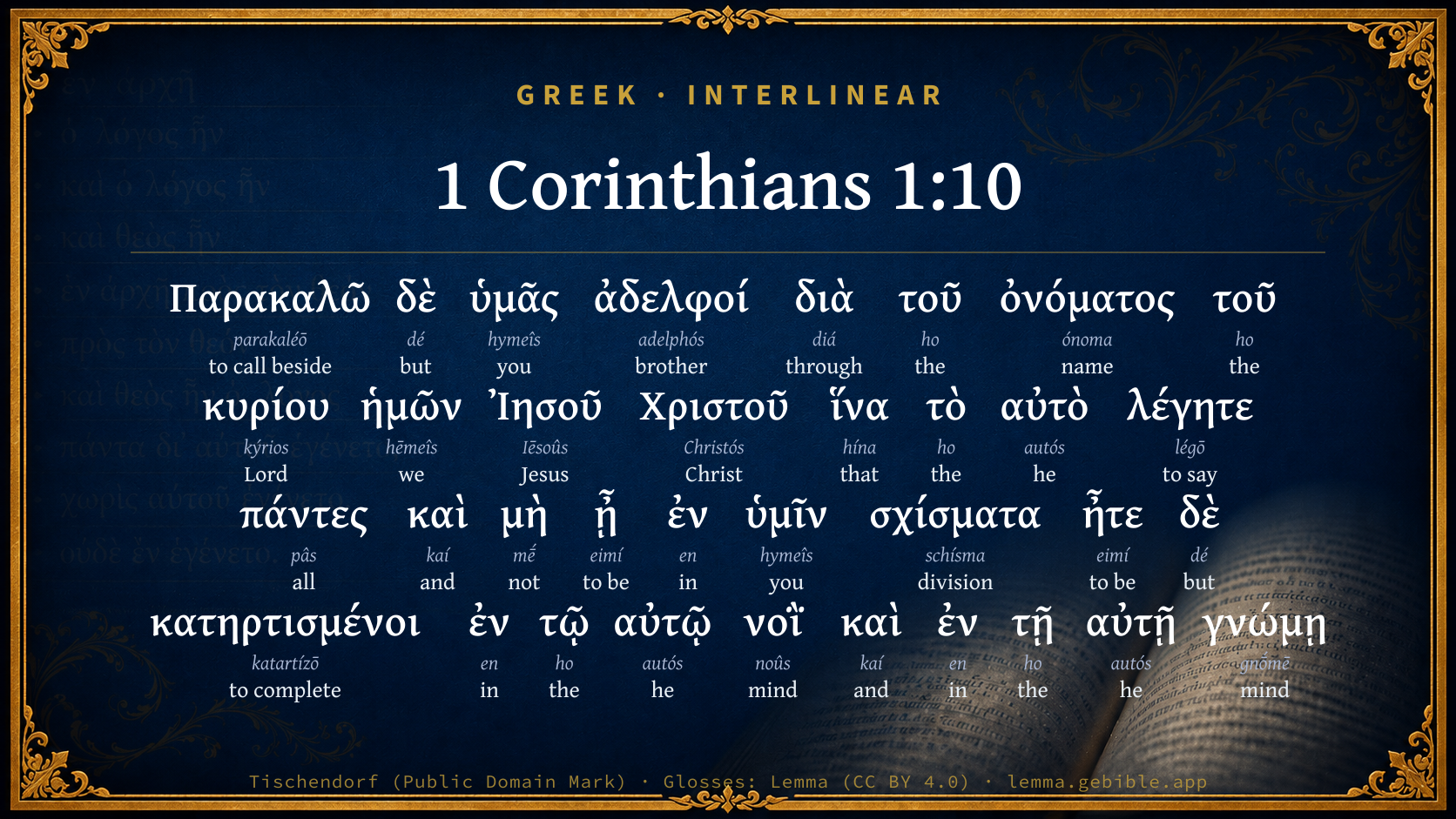
Now I beg you, brothers, through the name of our Lord, Jesus Christ, that you all speak the same thing and that there be no divisions among you, but that you be perfected together in the same mind and in the same judgment.
Download a study sheet
One document with this verse’s original text, its word-by-word gloss line, the meaning frame, cross-references with their text, attributed commentary, and full source and license credits — printable, and it pastes into notes with its structure intact.
This verse Autodidact and up
A passage Seminary Student
Up to 50 verses in one chapter. A passage sheet keeps up to 6 commentary sources and 12 cross-references per verse, in the order this page ranks them, and says so on the sheet whenever that leaves anything out. Ask for a single verse and you get the Autodidact verse sheet above.
Everything on this page stays free to read, with no account — the sheet is a download of what is already on screen, not access to it.
Compare translations 3
The same verse in 3 English versions, stacked beneath the original-language interlinear above. Click any original word for its lexicon entry.
Each is an independent rendering of the whole verse — the interlinear is not word-aligned to these translations.
Highlighted words mark where these versions differ — a whole-verse word diff, not a word-by-word alignment.
-
World English Bible Public Domain
Now I beg you, brothers, through the name of our Lord, Jesus Christ, that you all speak the same thing and that there be no divisions among you, but that you be perfected together in the same mind and in the same judgment.
-
King James Version Public Domain
Now I beseech you, brethren, by the name of our Lord Jesus Christ, that ye all speak the same thing, and that there be no divisions among you; but that ye be perfectly joined together in the same mind and in the same judgment.
-
unfoldingWord Literal Text CC BY-SA 4.0
Now I urge you, brothers, through the name of our Lord Jesus Christ, that you all speak the same thing and that there might not be divisions among you, but that you might be joined together in the same mind and in the same purpose.
unfoldingWord Literal Text — © unfoldingWord, licensed CC BY-SA 4.0. Word-aligned USFM3 via Door43 (git.door43.org/unfoldingWord/en_ult).
Show all 19 translations
Every available English version of this verse, each an independent rendering of the whole verse.
-
World English Bible Public Domain
Now I beg you, brothers, through the name of our Lord, Jesus Christ, that you all speak the same thing and that there be no divisions among you, but that you be perfected together in the same mind and in the same judgment.
-
Berean Standard Bible Public Domain
I appeal to you, brothers, in the name of our Lord Jesus Christ, that all of you agree together, so that there may be no divisions among you and that you may be united in mind and conviction.
-
Majority Standard Bible Public Domain
I appeal to you, brothers, in the name of our Lord Jesus Christ, that all of you agree together, so that there may be no divisions among you and that you may be united in mind and conviction.
-
King James Version Public Domain
Now I beseech you, brethren, by the name of our Lord Jesus Christ, that ye all speak the same thing, and that there be no divisions among you; but that ye be perfectly joined together in the same mind and in the same judgment.
-
American Standard Version (1901) Public Domain
Now I beseech you, brethren, through the name of our Lord Jesus Christ, that ye all speak the same thing and `that' there be no divisions among you; but `that' ye be perfected together in the same mind and in the same judgment.
-
Revised Version (1885) Public Domain
Now I beseech you, brethren, through the name of our Lord Jesus Christ, that ye all speak the same thing, and that there be no divisions among you; but that ye be perfected together in the same mind and in the same judgment.
-
Geneva Bible (1599) Public Domain
Nowe I beseeche you, brethren, by the Name of our Lord Iesus Christ, that ye all speake one thing, and that there be no dissensions among you: but be ye knit together in one mind, and in one iudgement.
-
Douay-Rheims (1899) Public Domain
Now I beseech you, brethren, by the name of our Lord Jesus Christ, that you all speak the same thing, and that there be no schisms among you; but that you be perfect in the same mind, and in the same judgment.
-
Young's Literal Translation Public Domain
And I call upon you, brethren, through the name of our Lord Jesus Christ, that the same thing ye may all say, and there may not be divisions among you, and ye may be perfected in the same mind, and in the same judgment,
-
Literal Standard Version CC BY-SA 4.0
And I call on you, brothers, through the Name of our Lord Jesus Christ, that the same thing you may all say, and there may not be divisions among you, and you may be perfected in the same mind, and in the same judgment,
-
Unlocked Literal Bible CC BY-SA 4.0
Now I urge you, brothers, through the name of our Lord Jesus Christ, that you all agree, and that there be no divisions among you. I urge that you be joined together with the same mind and by the same purpose.
-
unfoldingWord Literal Text CC BY-SA 4.0
Now I urge you, brothers, through the name of our Lord Jesus Christ, that you all speak the same thing and that there might not be divisions among you, but that you might be joined together in the same mind and in the same purpose.
-
Darby Bible Public Domain
Now I exhort you, brethren, by the name of our Lord Jesus Christ, that ye all say the same thing, and that there be not among you divisions; but that ye be perfectly united in the same mind and in the same opinion.
-
World Messianic Bible Public Domain
Now I beg you, brothers, through the name of our Lord, Yeshua the Messiah, that you all speak the same thing, and that there be no divisions among you, but that you be perfected together in the same mind and in the same judgment.
-
Webster's Bible Public Domain
Now I beseech you, brethren, by the name of our Lord Jesus Christ, that ye all speak the same thing, and that there be no divisions among you; but that ye be perfectly joined together in the same mind, and in the same judgment.
-
Free Bible Version CC BY-SA 4.0
Brothers and sisters, I plead with you in the name of our Lord Jesus Christ that you all agree and that you're not divided. Instead develop a united attitude and purpose.
-
Bible in Basic English Public Domain
Now I make request to you, my brothers, in the name of our Lord Jesus Christ, that you will all say the same thing, and that there may be no divisions among you, so that you may be in complete agreement, in the same mind and in the same opinion.
-
Text-Critical English NT CC BY 4.0
Now I urge you, brothers, in the name of our Lord Jesus Christ, that you all agree in what you say and that there be no divisions among you, but that you be knit together in the same mind and in the same purpose.
-
Tyndale New Testament (1534) Public Domain
I beseche you brethren in the name of oure lorde Iesus Christ that ye all speake one thynge and that there be no dissencion amonge you: but be ye knyt together in one mynde and in one meaynge.
Literal Standard Version (2020), Covenant Press — licensed CC BY-SA 4.0. Text via the HelloAO Bible API (eBible.org). Unlocked Literal Bible (unfoldingWord) — licensed CC BY-SA 4.0. Text via the HelloAO Bible API (eBible.org). unfoldingWord Literal Text — © unfoldingWord, licensed CC BY-SA 4.0. Word-aligned USFM3 via Door43 (git.door43.org/unfoldingWord/en_ult). Free Bible Version, Dr. Jonathan Gallagher — licensed CC BY-SA 4.0. Text via the HelloAO Bible API (eBible.org).
Word by word
More ways to search: Search by grammar → Find every occurrence → Compare this word →
Practice this passage: Drill this verse → Learn its vocabulary →
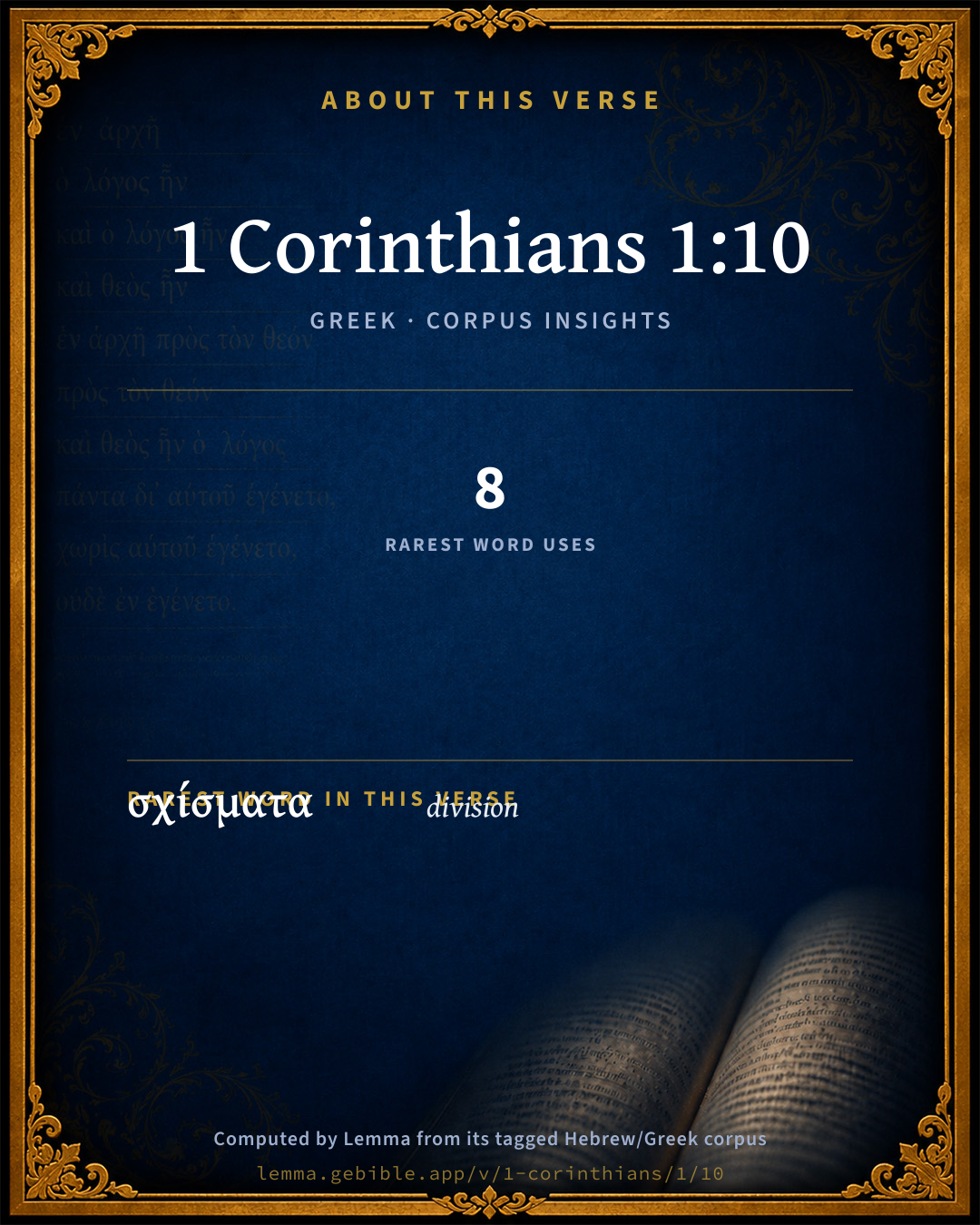
- Appears 8× in the Greek New Testament
- First appears at Matthew 9:16
- Part of Speech
- Noun
- Case
- Nominative
- Number
- Plural
- Gender
- Neuter
Full Thayer's Definition
- Παρακαλῶ parakaléō G3870 “to call beside” Verb, Present, Active, Indicative, 1st person, Singular
- δὲ dé G1161 “but” Conjunction
- ὑμᾶς hymeîs G5210 “you” Personal pronoun, 2nd person, Accusative, Plural
- ἀδελφοί adelphós G80 “brother” Noun, Vocative, Plural, Masculine
- διὰ diá G1223 “through” Preposition
- τοῦ ho G3588 “the” Article, Genitive, Singular, Neuter
- ὀνόματος ónoma G3686 “name” Noun, Genitive, Singular, Neuter
- τοῦ ho G3588 “the” Article, Genitive, Singular, Masculine
- κυρίου kýrios G2962 “Lord” Noun, Genitive, Singular, Masculine
- ἡμῶν hēmeîs G2249 “we” Personal pronoun, 1st person, Genitive, Plural
- Ἰησοῦ Iēsoûs G2424 “Jesus” Noun, Genitive, Singular, Masculine
- Χριστοῦ Christós G5547 “Christ” Noun, Genitive, Singular, Masculine
- ἵνα hína G2443 “that” Conjunction
- τὸ ho G3588 “the” Article, Accusative, Singular, Neuter
- αὐτὸ autós G846 “he” Personal pronoun, Accusative, Singular, Neuter
- λέγητε légō G3004 “to say” Verb, Present, Active, Subjunctive, 2nd person, Plural
- πάντες pâs G3956 “all” Adjective, Nominative, Plural, Masculine
- καὶ kaí G2532 “and” Conjunction
- μὴ mḗ G3361 “not” Particle, Negative
- ᾖ eimí G1510 “to be” Verb, Present, Active, Subjunctive, 3rd person, Singular
- ἐν en G1722 “in” Preposition
- ὑμῖν hymeîs G5210 “you” Personal pronoun, 2nd person, Dative, Plural
- σχίσματα schísma G4978 “division” Noun, Nominative, Plural, Neuter
- ἦτε eimí G1510 “to be” Verb, Present, Active, Subjunctive, 2nd person, Plural
- δὲ dé G1161 “but” Conjunction
- κατηρτισμένοι katartízō G2675 “to complete” Verb, Perfect, Passive, Participle, Nominative, Plural, Masculine
- ἐν en G1722 “in” Preposition
- τῷ ho G3588 “the” Article, Dative, Singular, Masculine
- αὐτῷ autós G846 “he” Personal pronoun, Dative, Singular, Masculine
- νοῒ noûs G3563 “mind” Noun, Dative, Singular, Masculine
- καὶ kaí G2532 “and” Conjunction
- ἐν en G1722 “in” Preposition
- τῇ ho G3588 “the” Article, Dative, Singular, Feminine
- αὐτῇ autós G846 “he” Personal pronoun, Dative, Singular, Feminine
- γνώμῃ gnṓmē G1106 “mind” Noun, Dative, Singular, Feminine
About this verse
These counts appear in no published source. They are computed here, from the morphology-tagged text and Lemma’s own curated glosses. What Lemma adds →
- 35
- words
- 23
- distinct lemmas
- Pauline Epistles
- section
Cross-references
37Topical passages linked to 1 Corinthians 1:10 in the Treasury of Scripture Knowledge — connected by theme and wording, ordered by reader-vote popularity; previews shown in the World English Bible.
- Philippians 2:1–4 If there is therefore any exhortation in Christ, if any consolation of love, if any fellowship of the Spirit, if any tender mercies and compassion,
- Ephesians 4:1–7 I therefore, the prisoner in the Lord, beg you to walk worthily of the calling with which you were called,
- 1 Corinthians 12:25 that there should be no division in the body, but that the members should have the same care for one another.
- Romans 12:16 Be of the same mind one toward another. Don't set your mind on high things, but associate with the humble. Don't be wise in your own conceits.
- James 3:13–18 Who is wise and understanding among you? Let him show by his good conduct that his deeds are done in gentleness of wisdom.
- 2 Corinthians 13:11 Finally, brothers, rejoice. Be perfected, be comforted, be of the same mind, live in peace, and the God of love and peace will be with you.
- Ephesians 4:31–32 Let all bitterness, wrath, anger, outcry, and slander, be put away from you, with all malice.
- Psalms 133:1 See how good and how pleasant it is For brothers to live together in unity!
- Philippians 1:27 Only let your manner of life be worthy of the Gospel of Christ, that, whether I come and see you or am absent, I may hear of your state, that you stand firm in one spirit, with one soul striving for the faith of the Gospel;
- 1 Corinthians 11:18 For first of all, when you come together in the assembly, I hear that divisions exist among you, and I partly believe it.
- Romans 16:17 Now I beg you, brothers, look out for those who are causing the divisions and occasions of stumbling, contrary to the doctrine which you learned, and turn away from them.
- 1 Peter 3:8–9 Finally, be all like-minded, compassionate, loving as brothers, tenderhearted, courteous,
- 1 Corinthians 4:16 I beg you therefore, be imitators of me.
- 2 Corinthians 5:20 We are therefore ambassadors on behalf of Christ, as though God were entreating by us. We beg you on behalf of Christ, be reconciled to God.
- Jeremiah 32:39 and I will give them one heart and one way, that they may fear me forever, for the good of them, and of their children after them:
- Acts 4:32 The multitude of those who believed were of one heart and soul. Not one of them claimed that anything of the things which he possessed was his own, but they had all things in common.
- Romans 15:5–6 Now the God of patience and of encouragement grant you to be of the same mind one with another according to Christ Jesus,
- 1 Thessalonians 4:1–2 Finally then, brothers, we beg and exhort you in the Lord Jesus, that as you received from us how you ought to walk and to please God, that you abound more and more.
- John 17:23 I in them, and you in me, that they may be perfected into one; that the world may know that you sent me, and loved them, even as you loved me.
- 1 Thessalonians 5:13 and to respect and honor them in love for their work's sake. Be at peace among yourselves.
- Romans 12:1 Therefore I urge you, brothers, by the mercies of God, to present your bodies a living sacrifice, holy, acceptable to God, which is your spiritual service.
- John 10:19 Therefore a division arose again among the Jews because of these words.
- Mark 2:21 No one sews a piece of unshrunk cloth on an old garment, or else the patch shrinks and the new tears away from the old, and a worse hole is made.
- John 7:43 So there arose a division in the multitude because of him.
- John 13:34–35 A new commandment I give to you, that you love one another, just like I have loved you; that you also love one another.
- 2 Corinthians 10:1 Now I Paul, myself, entreat you by the humility and gentleness of Christ; I who in your presence am lowly among you, but being absent am of good courage toward you.
- Philippians 3:16 Nevertheless, to the extent that we have already attained, let us walk by the same rule. Let us be of the same mind.
- 2 Timothy 4:1 I charge you therefore before God and the Lord Jesus Christ, who will judge the living and the dead at his appearing and his Kingdom:
- Philemon 1:9–10 yet for love's sake I rather beg, being such a one as Paul, the aged, but also a prisoner of Jesus Christ.
- 1 Peter 2:11 Beloved, I beg you as foreigners and pilgrims, to abstain from fleshly lusts, which war against the soul;
- Matthew 9:16 No one puts a piece of unshrunk cloth on an old garment; for the patch would tear away from the garment, and a worse hole is made.
- John 9:16 Some therefore of the Pharisees said, "This man is not from God, because he doesn't keep the Sabbath." Others said, "How can a man who is a sinner do such signs?" There was division among them.
- Romans 15:30 Now I beg you, brothers, by our Lord Jesus Christ, and by the love of the Spirit, that you strive together with me in your prayers to God for me,
- 2 Corinthians 6:1 Working together, we entreat also that you not receive the grace of God in vain,
- Galatians 4:12 I beg you, brothers, become as I am, for I also have become as you are. You did me no wrong,
- 2 Thessalonians 2:1 Now, brothers, concerning the coming of our Lord Jesus Christ, and our gathering together to him, we ask you
- 1 Timothy 5:21 I charge you in the sight of God, and Christ Jesus, and the chosen angels, that you observe these things without prejudice, doing nothing by partiality.
Cross-references courtesy of OpenBible.info (CC BY 4.0).
Lesson kit
Teaching starters — assembled from the data on this page, not authored interpretation. Every prompt links to the verse data it draws on. Edit before teaching.
1 Corinthians, in the Pauline Epistles, opens this verse with 35 words (23 distinct Greek lemmas). Its most distinctive word is schísma (“division”). A historical commentator’s framing appears above. Read the whole chapter for the surrounding context.
Discussion questions
- The word schísma carries the sense “division.” How does it shape the verse?
- How does Matthew 9:16, which shares the word «division», read alongside this verse?
- What does the repetition of “to be” (2× in this one verse) do in this verse?
- The translations on this page render this verse differently — a whole-verse word diff, not a word-by-word alignment. What might account for the different wordings?
- Compare how The Biblical Illustrator and Joseph Benson's Commentary read this verse. Where do they agree or differ?
Things to notice
- These translations choose different wording for 12 words in this verse.
- “to be” occurs 2× in this single verse.
- 23 distinct Greek lemmas span 35 words in this verse.
Commentary
Notes on 1 Corinthians 1:10 from classic Christian and Jewish commentators (each source and its license shown beneath its notes). The classic Christian expositions comment on the surrounding passage and are grouped to its opening verse, so a note may address several verses; the Jewish commentaries on the Tanakh (Rashi and others) are per-verse, so they appear only where the commentator wrote on this verse.
Lemma curates 59 commentaries, every one of them public domain or Creative Commons licensed, each selected and text-cleaned for this edition rather than reprinted as found. About our sources →
The Biblical Illustrator
Joseph S. Exell
The Biblical Illustrator, edited by Joseph S. Exell (c. 1880s–1900s) — public domain. Text from a community e-Sword module.
Joseph Benson's Commentary
Joseph Benson's Commentary on the Old and New Testaments (1811–1818) — public domain. Text from a community e-Sword module.
The Preacher's Complete Homiletical Commentary
Joseph S. Exell (gen. ed.)
The Preacher's Complete Homiletical Commentary (gen. ed. Joseph S. Exell; Funk & Wagnalls, c. 1892) — public domain (pre-1929). A full-Bible homiletical/sermon-outline anthology covering 65 of 66 books (2 John is absent from the source module). Text from a community e-Sword module.
Lange's Commentary on the Holy Scriptures
Lange's Commentary on the Holy Scriptures (Critical, Doctrinal, and Homiletical), ed. John Peter Lange, English translation edited by Philip Schaff (1864–1880) — public domain. Text from a community e-Sword module.
The Annotated Bible
Arno C. Gaebelein
Arno C. Gaebelein, The Annotated Bible (1913–1922) — public domain. Text from a community e-Sword module.
Kretzmann's Popular Commentary
Paul E. Kretzmann
Paul E. Kretzmann, Popular Commentary of the Bible (1921–1924) — public domain. Text from a community e-Sword module.
Tyndale Open Study Notes
Tyndale Open Resources
Tyndale Open Study Notes — © Tyndale Open Resources, licensed CC BY-SA 4.0. Text via the HelloAO Bible API.
Bengel's Gnomon
Johann Albrecht Bengel
Bengel's Gnomon of the New Testament — English translation (T&T Clark, Edinburgh, 1860) — public domain. Text from a community e-Sword module.
Meyer's Critical & Exegetical Commentary
Heinrich August Wilhelm Meyer
Meyer — Critical and Exegetical Commentary on the New Testament — English translation by Peter Christie, edited by Frederick Crombie (T&T Clark, 1880) — public domain. Text from a community e-Sword module.
Expositor's Greek Testament
ed. W. Robertson Nicoll
The Expositor's Greek Testament, edited by W. Robertson Nicoll (1897–1910) — public domain. Text from a community e-Sword module.
Godet's Commentaries
Frédéric Louis Godet
Frédéric Louis Godet — Commentaries on Luke, John, Romans, and 1 Corinthians — English translation (T&T Clark, Edinburgh, 1870s–1890s) — public domain. Text from a community e-Sword module.
Hodge's Commentary on Romans, Ephesians & First Corinthians
Charles Hodge
Charles Hodge — Commentary on Romans (1835), First Corinthians (1857), and Ephesians (1856) — public domain. Text from a community e-Sword module.
Geneva Bible (1599)
Geneva Bible translators
Geneva Bible (1599) marginal notes — public domain. Text via Bolls.life.
Matthew Henry's Commentary
Matthew Henry's Commentary on the Whole Bible (1708–1710) — public domain (CC PDM 1.0). Text via the HelloAO Bible API.
Jamieson, Fausset & Brown
Robert Jamieson, A. R. Fausset & David Brown
Jamieson, Fausset & Brown — Commentary Critical and Explanatory on the Whole Bible (1871) — public domain (CC PDM 1.0). Text via the HelloAO Bible API.
Adam Clarke's Commentary
Adam Clarke's Commentary on the Bible (1810–1826) — public domain. Text from a community e-Sword/MySword module.
John Calvin's Commentaries
John Calvin's Commentaries (1540-1563) — public domain. Text from the Calvin Translation Society English edition (1840s-50s) via the Christian Classics Ethereal Library (ccel.org). Calvin's coverage is partial (roughly two-thirds of the Bible); uncommented books and verses are honest gaps, never fabricated. The 19th-century editor's footnotes and remarks are omitted so the notes are faithfully Calvin's own voice.
Ellicott's Commentary for English Readers
A Bible Commentary for English Readers, edited by Charles John Ellicott (1878–1897) — public domain. Text from a community e-Sword module.
The Cambridge Bible for Schools and Colleges
gen. ed. J. J. S. Perowne
The Cambridge Bible for Schools and Colleges (gen. ed. J. J. S. Perowne; Cambridge University Press, 1878–1918) — public domain. Text from a community e-Sword module.
John Gill's Exposition
John Gill's Exposition of the Whole Bible (1746–1763) — public domain (CC PDM 1.0). Text via the HelloAO Bible API.
Trapp's Complete Commentary
John Trapp
John Trapp, A Commentary or Exposition upon All the Books of the Old and New Testament (1647–1656) — public domain. Text from a community e-Sword module.
Albert Barnes' Notes on the Bible
Albert Barnes' Notes on the Bible (1834–1885) — public domain. Text from a community e-Sword/MySword module.
Haydock's Catholic Bible Commentary
George Leo Haydock (1774–1849), Haydock's Catholic Family Bible and Commentary, 1859 edition — public domain. Excludes Psalms (Douay-Rheims chapter numbering differs from Protestant) and Deuterocanonical books (Catholic canon only).
Matthew Poole's English Annotations
Matthew Poole's English Annotations on the Holy Bible (1683–1685) — public domain. Text from a community e-Sword/MySword module.
Whedon's Commentary on the Bible
Daniel D. Whedon
Daniel D. Whedon (gen. ed.), Commentary on the Old and New Testaments (1874–1909) — public domain. Text from a community e-Sword module.
The Pulpit Commentary
The Pulpit Commentary (1880–1919), ed. H.D.M. Spence-Jones & Joseph S. Exell — public domain. Text from a community e-Sword module.
John Wesley's Explanatory Notes
John Wesley, Explanatory Notes Upon the Whole Bible (1754–1765) — public domain. Text via the GEBible commentary corpus.
Scofield Reference Notes
C. I. Scofield
The Scofield Reference Bible (1917 edition), notes by C. I. Scofield — public domain. Text from a community e-Sword module.
Burkitt's Expository Notes on the New Testament
William Burkitt
William Burkitt's Expository Notes on the New Testament (1700–1703) — public domain. Text from a community e-Sword module.
Godbey's Commentary on the New Testament
William B. Godbey
William B. Godbey, Commentary on the New Testament (1896–1900) — public domain. Text from a community e-Sword module.
McGarvey & Pendleton's Commentaries
J. W. McGarvey
J. W. McGarvey (with Philip Y. Pendleton), Commentaries on the New Testament (The Fourfold Gospel, 1914; Acts; and the epistles) — public domain. Text from a community e-Sword/MySword module.
The People's New Testament
B. W. Johnson
B. W. Johnson's The People's New Testament with Notes (1889–1891) — public domain. Electronic text from the Christian Classics Ethereal Library (CCEL) ThML edition.
unfoldingWord translationNotes
Door43 World Missions Community
unfoldingWord translationNotes — © Distant Shores Media and the Door43 World Missions Community, licensed CC BY-SA 4.0. Source: git.door43.org/Door43/en_tn.
Cambridge Greek Testament for Schools and Colleges
Cambridge Greek Testament for Schools and Colleges (Cambridge University Press, 1896; 21 vols, various authors incl. Carr, Maclear, Plummer, Farrar, Lumby, Moule, M. R. James, Simcox) — public domain. Text from a community e-Sword module.
Alford’s Greek Testament
Henry Alford
Henry Alford, The Greek Testament (1849–1861) — public domain. Text from a community e-Sword module.
International Critical Commentary
International Critical Commentary — older volumes (1896–1929), various authors — public domain. Text from a community e-Sword module.
Vincent's Word Studies in the New Testament
Marvin R. Vincent
Marvin R. Vincent, Word Studies in the New Testament (1887–1900) — public domain. Text from a community e-Sword/MySword module.