
1 Corinthians 10:4

Greek (Tischendorf 8th ed.) 1 Corinthians 10:4 appears in the Greek New Testament. The text above is from the Tischendorf 8th edition. Each word links to its Strong’s number and a concise gloss. Click any word for its full Thayer’s Greek Lexicon entry.
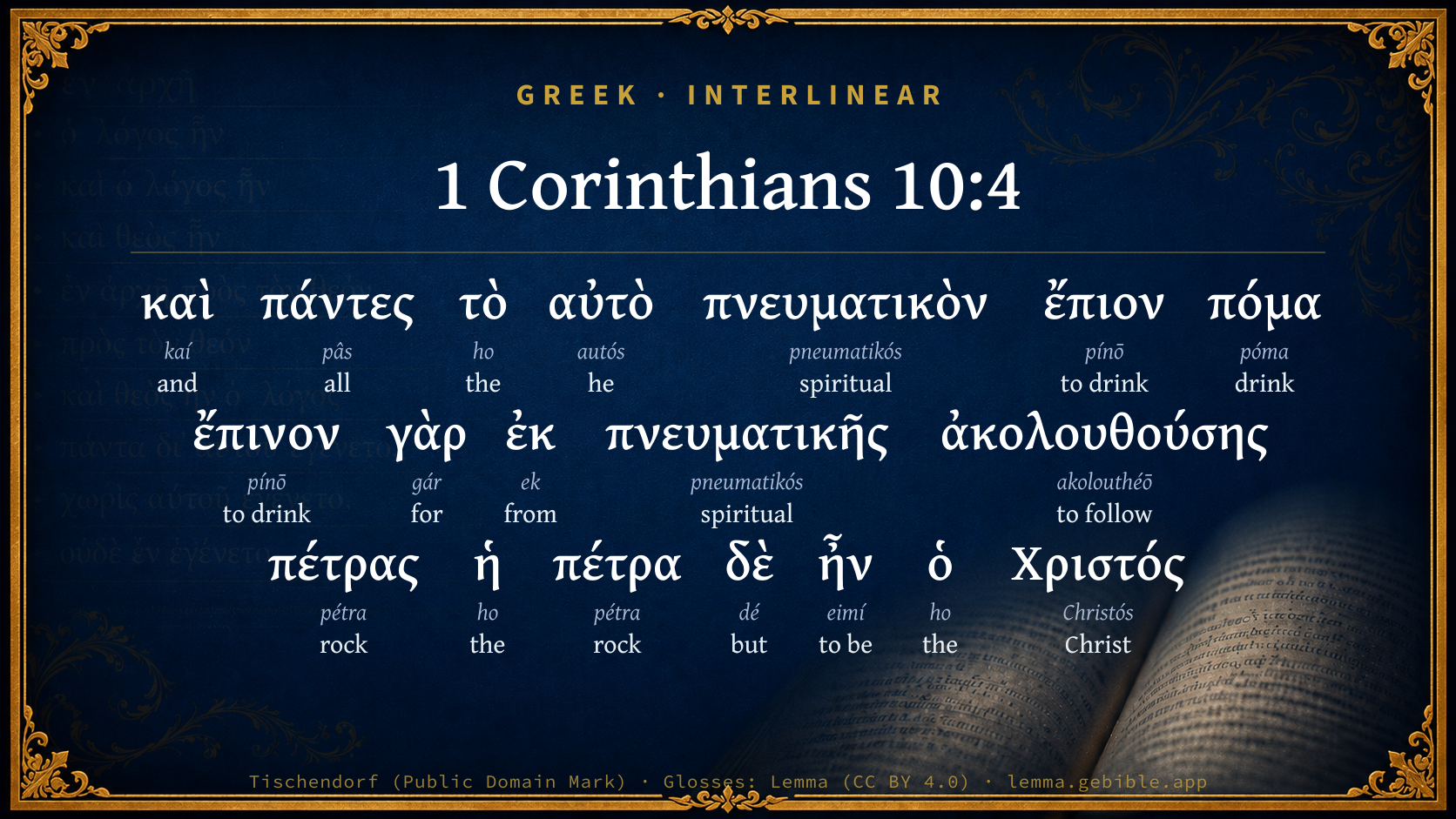
Download image
Cite this verse

1 Corinthians 10:4 (World English Bible). Public Domain. Lemma interlinear Bible study tool, https://lemma.gebible.app/v/1-corinthians/10/4.

Show BibTeX & RIS
BibTeX
RIS
English Translation
and all drank the same spiritual drink. For they drank of a spiritual rock that followed them, and the rock was Christ.
World English Bible · Public Domain
Highlights
  • 1 first appearance in the Greek New Testament
Full analysis ↓
Download a study sheet

One document with this verse’s original text, its word-by-word gloss line, the meaning frame, cross-references with their text, attributed commentary, and full source and license credits — printable, and it pastes into notes with its structure intact.

This verse Autodidact and up

Study sheet (.html) Plain text (.txt)

A passage Seminary Student

Up to 50 verses in one chapter. A passage sheet keeps up to 6 commentary sources and 12 cross-references per verse, in the order this page ranks them, and says so on the sheet whenever that leaves anything out. Ask for a single verse and you get the Autodidact verse sheet above.

Everything on this page stays free to read, with no account — the sheet is a download of what is already on screen, not access to it.

Want to remove ads? Support Godless Engineer
Compare translations 3

The same verse in 3 English versions, stacked beneath the original-language interlinear above. Click any original word for its lexicon entry.

Each is an independent rendering of the whole verse — the interlinear is not word-aligned to these translations.

Highlighted words mark where these versions differ — a whole-verse word diff, not a word-by-word alignment.

  • World English Bible Public Domain
    and all drank the same spiritual drink. For they drank of a spiritual rock that followed them, and the rock was Christ.
  • King James Version Public Domain
    And did all drink the same spiritual drink: for they drank of that spiritual Rock that followed them: and that Rock was Christ.
  • unfoldingWord Literal Text CC BY-SA 4.0
    and they all drank the same spiritual drink, for they drank from a spiritual rock following, and the rock was Christ.

unfoldingWord Literal Text — © unfoldingWord, licensed CC BY-SA 4.0. Word-aligned USFM3 via Door43 (git.door43.org/unfoldingWord/en_ult).

Versions to compare (up to 4)

3 of 4 selected

Show all 19 translations

Every available English version of this verse, each an independent rendering of the whole verse.

  • World English Bible Public Domain
    and all drank the same spiritual drink. For they drank of a spiritual rock that followed them, and the rock was Christ.
  • Berean Standard Bible Public Domain
    and drank the same spiritual drink; for they drank from the spiritual rock that accompanied them, and that rock was Christ.
  • Majority Standard Bible Public Domain
    and drank the same spiritual drink; for they drank from the spiritual rock that accompanied them, and that rock was Christ.
  • King James Version Public Domain
    And did all drink the same spiritual drink: for they drank of that spiritual Rock that followed them: and that Rock was Christ.
  • American Standard Version (1901) Public Domain
    and did all drink the same spiritual drink: for they drank of a spiritual rock that followed them: and the rock was Christ.
  • Revised Version (1885) Public Domain
    and did all drink the same spiritual drink: for they drank of a spiritual rock that followed them: and the rock was Christ.
  • Geneva Bible (1599) Public Domain
    And did all drinke the same spirituall drinke (for they dranke of the spiritual Rocke that folowed them: and the Rocke was Christ)
  • Douay-Rheims (1899) Public Domain
    And all drank the same spiritual drink; (and they drank of the spiritual rock that followed them, and the rock was Christ.)
  • Young's Literal Translation Public Domain
    and all the same spiritual drink did drink, for they were drinking of a spiritual rock following them, and the rock was the Christ;
  • Literal Standard Version CC BY-SA 4.0
    and all drank the same spiritual drink, for they were drinking of a spiritual rock following them, and the rock was the Christ;
  • Unlocked Literal Bible CC BY-SA 4.0
    All drank the same spiritual drink. For they drank from a spiritual rock that followed them, and that rock was Christ.
  • unfoldingWord Literal Text CC BY-SA 4.0
    and they all drank the same spiritual drink, for they drank from a spiritual rock following, and the rock was Christ.
  • Darby Bible Public Domain
    and all drank the same spiritual drink, for they drank of a spiritual rock which followed [them]: (now the rock was the Christ;)
  • World Messianic Bible Public Domain
    and all drank the same spiritual drink. For they drank of a spiritual rock that followed them, and the rock was Messiah.
  • Webster's Bible Public Domain
    And all drank the same spiritual drink: (for they drank of that spiritual Rock that followed them: and that Rock was Christ.)
  • Free Bible Version CC BY-SA 4.0
    and drank the same spiritual drink, for they “drank from a spiritual rock” that accompanied them. That rock was Christ.
  • Bible in Basic English Public Domain
    And the same holy drink: for they all took of the water from the holy rock which came after them: and the rock was Christ.
  • Text-Critical English NT CC BY 4.0
    and all drank the same spiritual drink. For they were drinking from the spiritual rock that followed them, and that rock was Christ.
  • Tyndale New Testament (1534) Public Domain
    and did all drincke of one maner of spirituall drincke. And they dranke of that spretuall rocke that folowed them which rocke was Christ.

Literal Standard Version (2020), Covenant Press — licensed CC BY-SA 4.0. Text via the HelloAO Bible API (eBible.org). Unlocked Literal Bible (unfoldingWord) — licensed CC BY-SA 4.0. Text via the HelloAO Bible API (eBible.org). unfoldingWord Literal Text — © unfoldingWord, licensed CC BY-SA 4.0. Word-aligned USFM3 via Door43 (git.door43.org/unfoldingWord/en_ult). Free Bible Version, Dr. Jonathan Gallagher — licensed CC BY-SA 4.0. Text via the HelloAO Bible API (eBible.org).

Word by word

More ways to search: Search by grammar → Find every occurrence → Compare this word →

Practice this passage: Drill this verse → Learn its vocabulary →

πόμα
póma
G4188
“drink”
Noun, Accusative, Singular, Neuter
Part of Speech
Noun
Case
Accusative
Number
Singular
Gender
Neuter
Full Thayer's Definition

Origin: from the alternate of G4095

TDNT: 08:25,8

1. drink
  1. καὶ kaí G2532 “and” Conjunction
  2. πάντες pâs G3956 “all” Adjective, Nominative, Plural, Masculine
  3. τὸ ho G3588 “the” Article, Accusative, Singular, Neuter
  4. αὐτὸ autós G846 “he” Personal pronoun, Accusative, Singular, Neuter
  5. πνευματικὸν pneumatikós G4152 “spiritual” Adjective, Accusative, Singular, Neuter
  6. ἔπιον pínō G4095 “to drink” Verb, Aorist, Active, Indicative, 3rd person, Plural
  7. ἔπινον pínō G4095 “to drink” Verb, Imperfect, Active, Indicative, 3rd person, Plural
  8. γὰρ gár G1063 “for” Conjunction
  9. ἐκ ek G1537 “from” Preposition
  10. πνευματικῆς pneumatikós G4152 “spiritual” Adjective, Genitive, Singular, Feminine
  11. ἀκολουθούσης akolouthéō G190 “to follow” Verb, Present, Active, Participle, Genitive, Singular, Feminine
  12. πέτρας pétra G4073 “rock” Noun, Genitive, Singular, Feminine
  13. ἡ ho G3588 “the” Article, Nominative, Singular, Feminine
  14. πέτρα pétra G4073 “rock” Noun, Nominative, Singular, Feminine
  15. δὲ dé G1161 “but” Conjunction
  16. ἦν eimí G1510 “to be” Verb, Imperfect, Active, Indicative, 3rd person, Singular
  17. ὁ ho G3588 “the” Article, Nominative, Singular, Masculine
  18. Χριστός Christós G5547 “Christ” Noun, Nominative, Singular, Masculine

About this verse

These counts appear in no published source. They are computed here, from the morphology-tagged text and Lemma’s own curated glosses. What Lemma adds →

19
words
14
distinct lemmas
Pauline Epistles
section

Notable vocabulary

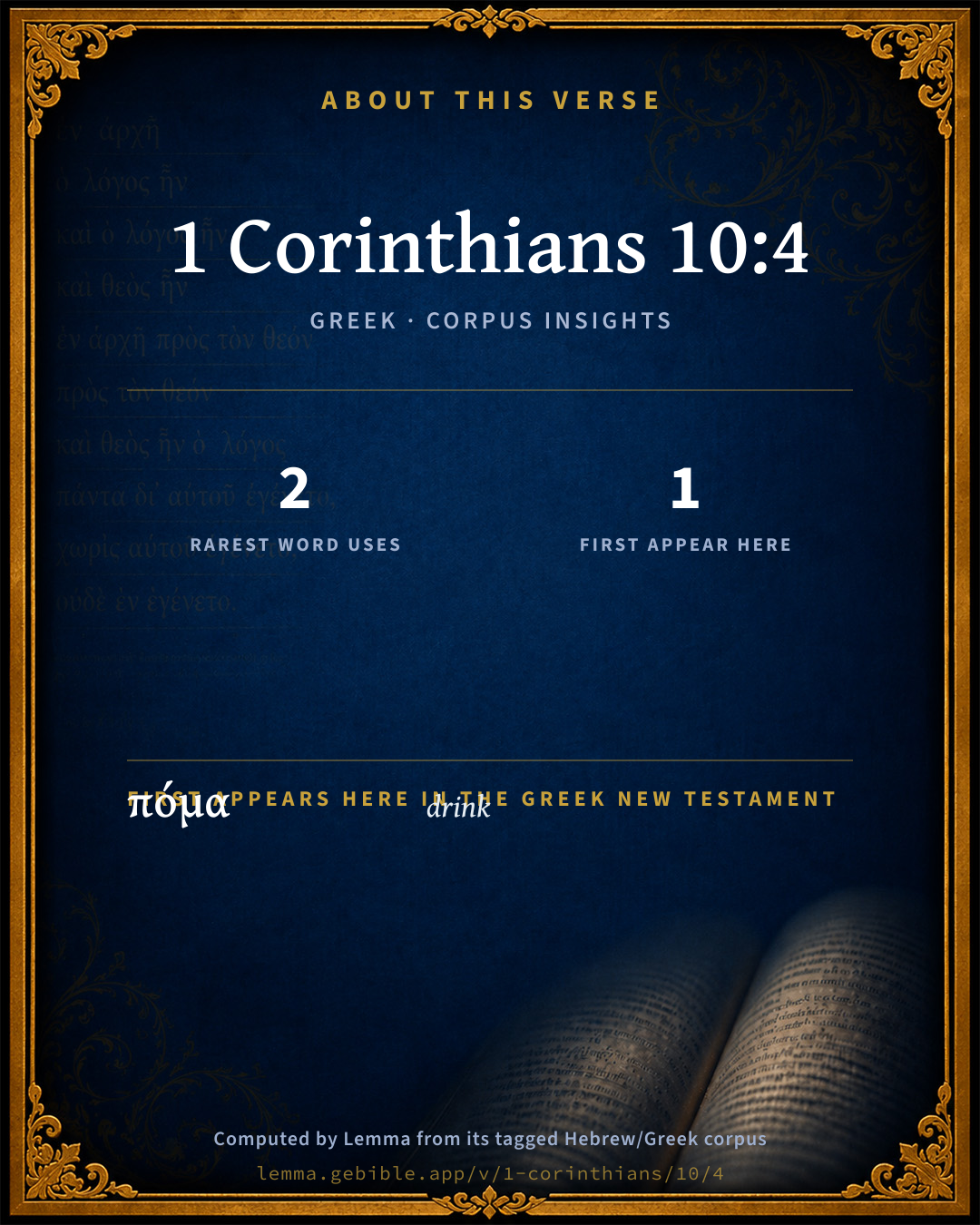
The rarest word here is πόμα drink G4188 — appearing just 2 times in the whole Greek New Testament.

First appearance in Scripture

This word makes its first canonical appearance in the Greek New Testament here:

Shared distinctive vocabulary

πόμα drink G4188 occurs in 2 verses of the Greek New Testament. Also found in:
Repetition

Words recur within this verse:

  • πνευματικὸν spiritual G4152 ×2
  • ἔπιον to drink G4095 ×2
  • πέτρας rock G4073 ×2
  • τὸ the G3588 ×3

Cross-references

15

Topical passages linked to 1 Corinthians 10:4 in the Treasury of Scripture Knowledge — connected by theme and wording, ordered by reader-vote popularity; previews shown in the World English Bible.

  • Exodus 17:6 Behold, I will stand before you there on the rock in Horeb. You shall strike the rock, and water will come out of it, that the people may drink." Moses did so in the sight of the elders of Israel.
  • John 7:37 Now on the last and greatest day of the feast, Jesus stood and cried out, "If anyone is thirsty, let him come to me and drink!
  • Isaiah 48:21 They didn't thirst when he led them through the deserts; he caused the waters to flow out of the rock for them; he split the rock also, and the waters gushed out.
  • Psalms 105:41 He opened the rock, and waters gushed out. They ran as a river in the dry places.
  • John 4:14 but whoever drinks of the water that I will give him will never thirst again; but the water that I will give him will become in him a well of water springing up to eternal life."
  • Numbers 20:11 Moses lifted up his hand, and struck the rock with his rod twice: and water came forth abundantly, and the congregation drank, and their cattle.
  • Psalms 78:15 He split rocks in the wilderness, And gave them drink abundantly as out of the depths.
  • Psalms 78:20 Behold, he struck the rock, so that waters gushed out, Streams overflowed. Can he give bread also? Will he provide flesh for his people?"
  • John 4:10 Jesus answered her, "If you knew the gift of God, and who it is who says to you, 'Give me a drink,' you would have asked him, and he would have given you living water."
  • Isaiah 43:20 The animals of the field shall honor me, the jackals and the ostriches; because I give waters in the wilderness, and rivers in the desert, to give drink to my people, my chosen,
  • Colossians 2:17 which are a shadow of the things to come; but the body is Christ's.
  • Revelation 22:17 The Spirit and the bride say, "Come!" He who hears, let him say, "Come!" He who is thirsty, let him come. He who desires, let him take the water of life freely.
  • Matthew 26:26–28 As they were eating, Jesus took bread, gave thanks for it, and broke it. He gave to the disciples, and said, "Take, eat; this is my body."
  • 1 Corinthians 11:24–25 When he had given thanks, he broke it, and said, "Take, eat. This is my body, which is broken for you. Do this in memory of me."
  • Hebrews 10:1 For the law, having a shadow of the good to come, not the very image of the things, can never with the same sacrifices year by year, which they offer continually, make perfect those who draw near.

Cross-references courtesy of OpenBible.info (CC BY 4.0).

Commentary

Notes on 1 Corinthians 10:4 from classic Christian and Jewish commentators (each source and its license shown beneath its notes). The classic Christian expositions comment on the surrounding passage and are grouped to its opening verse, so a note may address several verses; the Jewish commentaries on the Tanakh (Rashi and others) are per-verse, so they appear only where the commentator wrote on this verse.

Lemma curates 59 commentaries, every one of them public domain or Creative Commons licensed, each selected and text-cleaned for this edition rather than reprinted as found. About our sources →

Joseph Benson's Commentary

1Co 10:4. And did all drink the same spiritual — That is, typical; drink — Namely, typical of Christ and of the living water, the divine influence derived from him, Joh 8:37. For they drank of that spiritual — Or mysterious; rock — The wonderful streams of which followed them in their several journeyings for many years through the wilderness. It must be observed, water was twice brought from a rock by a miracle, for the Israelites in the wilderness; once in Rephidim, which was their eleventh station, and in the first year after they came out of Egypt; of which miracle we have an account, Exodus 17.; the second time was at Kadesh, which was their thirty-third station, and in the fortieth year after their leaving Egypt, Num 20:1. To both places the name of Meribah was given; but the latter was called Meribah-Kadesh, to distinguish it from Meribah of Rephidim. It is the miracle performed in Rephidim of which the apostle here speaks. The water, it appears, that issued from this rock formed a brook, which (Deu 9:21) is said to have descended out of the mount, that is, out of Horeb; (Exo 17:5-6;) for before that miracle there was no brook in these parts. And it issued in such abundance as to be termed a river, Psa 78:16; Psa 105:41. Indeed, six hundred thousand men, with their women and children, and cattle, required a river to supply them with drink. And Horeb being a high mountain, there seems to have been a descent from it to the sea; and the Israelites, during the thirty-seven years of their journeying, appear to have gone by those tracts of country in which the waters from Horeb could follow them, till in the thirty-ninth year they came to Ezion-Gaber, (Num 33:36,) a port of the Red sea, far down the Arabian side, where it is supposed the water from Horeb went into that sea. The country through which the Israelites journeyed so long a time, being watered by this river, produced, no doubt, herbage for the cattle of the Israelites, which, in this desert, must otherwise have perished. And that Rock was Christ — A manifest type of him, the Rock of ages, who, being smitten in his death and sufferings, poured forth streams of redemption, grace, and heavenly blessings, which follow his people through all this wilderness, and will end in rivers of pleasure at the right hand of God for ever.

Joseph Benson's Commentary on the Old and New Testaments (1811–1818) — public domain. Text from a community e-Sword module.

Bengel's Gnomon

Johann Albrecht Bengel

1Co 10:4. Πόμα, drink) This relates rather to Exo 17:6, than to Num 20:8, where mention is made also of cattle.—γὰρ, for) Such as is the rock, such is the water.—ἐκ πνευματικῆς ἀκολουθούσης πέτρας, from the spiritual rock, that followed them) The article τῆς is not added. The people did not know, what the rock was; therefore Paul long after adds, but the rock was Christ. This spiritual rock is spoken of as following them, not on account of its following the people; for it rather went before them; but because, although at that time it was really present with them, 1Co 10:9, yet it was only in after ages that at length it was made known to them; comp. on the word ἀκολουθεῖν, to follow, 1Ti 5:24; on the order of natural and spiritual things, 1Co 15:46.

Bengel's Gnomon of the New Testament — English translation (T&T Clark, Edinburgh, 1860) — public domain. Text from a community e-Sword module.

Hodge's Commentary on Romans, Ephesians & First Corinthians

Charles Hodge

1Co_10:4

And did all drink the same spiritual drink; for they drank of that spiritual Rock that followed them: and that Rock was Christ.

The water which they drank was spiritual, because derived from the Spirit, i.e. by the special intervention of God. They all drank (ἔπιον) of it once when first provided, and they continued to drink (ἔπινον) of it, for it followed them. Whatever difficulties may be connected with the interpretation of this verse, two things are therein plainly taught. First, that the Israelites were constantly supplied in a miraculous manner with water; and secondly, that the source of that supply was Christ. The principal difficulties in the passage are, the declaration that the Rock followed the Israelites; and that the rock was Christ. How are these statements to be understood?

1. Some take the passage literally, and assume that the rock smitten by Moses actually rolled after the Israelites during all their journey. Such was the tradition of the Jews, as is abundantly proved by the quotations from their writings, by Wetstein, Schoettgen and Lightfoot.‹15› According to the local tradition, as old at least as the Koran, the rock smitten by Moses was not part of the mountain, but a detached rock, pierced with holes whence the water is said to have flowed. This view of the passage makes the apostle responsible for a Jewish fable, and is inconsistent with his divine authority. Those who adopt this interpretation do not suppose that the rock actually followed the Israelites, but that the apostle was misled by the tradition of his times.

2. Others say that by the rock following them is meant that the water out of the rock followed them. There is nothing unnatural in this. To say that the vines of France follow the people wherever they go, would be no violent figure to express the fact that the wine produced by those vines followed them. No man at least would be disposed to understand the expression literally. In Psa_105:41 it is said, He opened the rock, and the waters gushed out; they ran in dry places like a river, which at least proves that the supply of water was very copious, and flowed to a considerable distance.

3. It is not necessary, however, to assume that either the rock or the water out of the rock followed them. The rock that followed them was Christ. The Logos, the manifested Jehovah, who attended the Israelites in their journey, was the Son of God who assumed our nature, and was the Christ. It was he who supplied their wants. He was to them the fountain of living waters. He was the spiritual rock of which they drank. The word spiritual may have the same general force here as in the preceding clauses.

The bread and water are called spiritual because supernatural. So the rock was a supernatural rock, though in a somewhat different sense. The manna was supernatural as to its origin; the rock, as to its nature. It is not uncommon for a word to be taken in the same connection in different, though nearly allied senses. Compare the use of this word spiritual in 1Co_2:15 and 1Co_3:1; and φθέιρει and φθερεῖ in 1Co_3:17. But in what sense was the rock Christ? Not that Christ appeared under the form of a rock; nor that the rock was a type of Christ, for that does not suit the connection. The idea is not that they drank of the typical rock; it was not the type but the anti-type that supplied their wants. The expression is simply figurative. Christ was the rock in the same sense that he is the vine. He was the source of all the support which the Israelites enjoyed during their journey in the wilderness.

This passage distinctly asserts not only the preexistence of our Lord, but also that he was the Jehovah of the Old Testament. He who appeared to Moses and announced himself as Jehovah, the God of Abraham, who commissioned him to go to Pharaoh, who delivered the people out of Egypt, who appeared on Horeb, who led the people through the wilderness, who dwelt in the temple, who manifested himself to Isaiah, who was to appear personally in the fullness of time, is the person who was born of a virgin, and manifested himself in the flesh. He is called, therefore, in the Old Testament, an angel the angel of Jehovah, Jehovah, the Supreme Lord, the Mighty God, the Son of God one whom God sent one with him, therefore, as to substance, but a distinct person. Our Lord said, Abraham saw his day, for he was before Abraham, Joh_8:58; John says, Joh_12:41, Isaiah beheld his glory in the temple; Paul says, the Israelites tempted him in the wilderness, 1Co_10:9 and that Moses suffered his reproach, Heb_11:26; Jud_1:5, says, the Lord, or (as Lachmann, after the ancient MSS. and versions, reads) Jesus, saved his people out of Egypt. This truth early impressed itself on the mind of the Christian church, as appears from the prayer in the ancient Liturgies, O Adonai (Supreme Lord), et Dux Domus Israel, qui Mosi in igne flammeo rubi apparuisti, et ei in Sina aquam dedisti, veni ad redimendum nos in brachio extracto.

Charles Hodge — Commentary on Romans (1835), First Corinthians (1857), and Ephesians (1856) — public domain. Text from a community e-Sword module.

Geneva Bible (1599)

Geneva Bible translators

Did sacramentally signify Christ, so that together with the sign, there was the thing signified, and the truth itself: for God doth not offer a bare sign, but the thing signifieth by the sign, together with it which is to be received with faith.

Of the river and running Rock, which followed the people.

Geneva Bible (1599) marginal notes — public domain. Text via Bolls.life.

Jamieson, Fausset & Brown

Robert Jamieson, A. R. Fausset & David Brown

drink-- (Exo 17:6). In Num 20:8, "the beasts" also are mentioned as having drunk. The literal water typified "spiritual drink," and is therefore so called.

spiritual Rock that followed them--rather, "accompanied them." Not the literal rock (or its water) "followed" them, as ALFORD explains, as if Paul sanctioned the Jews' tradition (Rabbi Solomon on Num 20:2) that the rock itself, or at least the stream from it, followed the Israelites from place to place (compare Deu 9:21). But Christ, the "Spiritual Rock" (Psa 78:20, Psa 78:35; Deu 32:4, Deu 32:15, Deu 32:18, Deu 32:30-31, Deu 32:37; Isa 28:16; Pe1 2:6), accompanied them (Exo 33:15). "Followed" implies His attending on them to minister to them; thus, though mostly going before them, He, when occasion required it, followed "behind" (Exo 14:19). He satisfied all alike as to their bodily thirst whenever they needed it; as on three occasions is expressly recorded (Exo 15:24-25; Exo 17:6; Num 20:8); and this drink for the body symbolized the spiritual drink from the Spiritual Rock (compare Joh 4:13-14; see on Co1 10:3).

Jamieson, Fausset & Brown — Commentary Critical and Explanatory on the Whole Bible (1871) — public domain (CC PDM 1.0). Text via the HelloAO Bible API.

Adam Clarke's Commentary

Verse 4. Spiritual drink] By the βρωμα πνευματικον spiritual meat, and πομα πνευματικον, spiritual drink, the apostle certainly means both meat and drink, which were furnished to the Israelitish assembly miraculously, as well as typically: and he appears to borrow his expression from the Jews themselves, who expressly say הלחם הלז רוחני hallechem hallaz ruchani, that bread was spiritual, and מיים רוחניים היו meyim ruchainiyim haiu, the waters were spiritual. Alschech in legem. fol. 238, to which opinion the apostle seems particularly to refer. See Schoettgen.

The spiritual rock that followed them] There is some difficulty in this verse. How could the rock follow them? It does not appear that the rock ever moved from the place where Moses struck it. But to solve this difficulty, it is said that rock here is put, by metonymy, for the water of the rock; and that this water did follow them through the wilderness. This is more likely; but we have not direct proof of it. The ancient Jews, however, were of this opinion, and state that the streams followed them in all their journeyings, up the mountains, down the valleys, c., c. and that when they came to encamp, the waters formed themselves into cisterns and pools and that the rulers of the people guided them, by their staves, in rivulets to the different tribes and families. And this is the sense they give to Nu 21:17: Spring up, O well, c. See the places in Schoettgen.

Others contend, that by the rock following them we are to understand their having carried of its waters with them on their journeyings. This we know is a common custom in these deserts to the present day and that the Greek verb ακολουθεω, to follow, has this sense, Bishop Pearce has amply proved in his note on this place. The Jews suppose that the rock itself went with the Israelites, and was present with them in their thirty-eight stations, for only so many are mentioned. See Alschech in legem. fol. 236. And see Schoettgen.

Now, though of all the senses already given that of Bishop Pearce is the best, yet it does appear that the apostle does not speak about the rock itself, but of Him whom it represented; namely, Christ: this was the Rock that followed them, and ministered to them; and this view of the subject is rendered more probable by what is said 1Co 10:9, that they tempted Christ, and were destroyed by serpents. The same rock is in the vale of Rephidim to the present day; and it bears aboriginal marks of the water that flowed from it in the fissures that appear on its sides. It is one block of fine granite, about seven yards long, five broad, and - high. A fragment of this typical rock now lies before me, brought by a relative of my own, who broke it off, and did not let it pass into any hand till he placed it in mine. See Clarke on Ex 17:6.

Adam Clarke's Commentary on the Bible (1810–1826) — public domain. Text from a community e-Sword/MySword module.

John Calvin's Commentaries

4. That rock was Christ Some absurdly pervert these words of Paul, as if he had said, that Christ was the spiritual rock, and as if he were not speaking of that rock which was a visible sign, for we see that he is expressly treating of outward signs. The objection that they make — that the rock is spoken of as spiritual, is a frivolous one, inasmuch as that epithet is applied to it simply that we may know that it was a token of a spiritual mystery. In the mean time, there is no doubt, that he compares our sacraments with the ancient ones. Their second objection is more foolish and more childish — “How could a rock,” say they, “that stood firm in its place, follow the Israelites?” — as if it were not abundantly manifest, that by the word rock is meant the stream of water, which never ceased to accompany the people. For Paul extols the grace of God, on this account, that he commanded the water that was drawn out from the rock to flow forth wherever the people journeyed, as if the rock itself had followed them. Now if Paul’s meaning were, that Christ is the spiritual foundation of the Church, what occasion were there for his using the past tense? It is abundantly manifest, that something is here expressed that was peculiar to the fathers. Away, then, with that foolish fancy by which contentious men choose rather to show their impudence, than admit that they are sacramental forms of expression!

I have, however, already stated, that the reality of the things signified was exhibited in connection with the ancient sacraments. As, therefore, they were emblems of Christ, it follows, that Christ was connected with them, not locally, nor by a natural or substantial union, but sacramentally. On this principle the Apostle says, that the rock was Christ, for nothing is more common than metonymy in speaking of sacraments. The name of the thing, therefore, is transferred here to the sign — not as if it were strictly applicable, but figuratively, on the ground of that connection which I have mentioned. I touch upon this, however, the more slightly, because it will be more largely treated of when we come to the 11th Chapter.

There remains another question. “Seeing that we now in the Supper eat the body of Christ, and drink his blood, how could the Jews be partakers of the same spiritual meat and drink, when there was as yet no flesh of Christ that they could eat?” I answer, that though his flesh did not as yet exist, it was, nevertheless, food for them. Nor is this an empty or sophistical subtilty, for their salvation depended on the benefit of his death and resurrection. Hence, they required to receive the flesh and the blood of Christ, that they might participate in the benefit of redemption. This reception of it was the secret work of the Holy Spirit, who wrought in them in such a manner, that Christ’s flesh, though not yet created, was made efficacious in them. He means, however, that they ate in their own way, which was different from ours, and this is what I have previously stated, that Christ is now presented to us more fully, according to the measure of the revelation. For, in the present day, the eating is substantial, which it could not have been then — that is, Christ feeds us with his flesh, which has been sacrificed for us, and appointed as our food, and from this we derive life.

John Calvin's Commentaries (1540-1563) — public domain. Text from the Calvin Translation Society English edition (1840s-50s) via the Christian Classics Ethereal Library (ccel.org). Calvin's coverage is partial (roughly two-thirds of the Bible); uncommented books and verses are honest gaps, never fabricated. The 19th-century editor's footnotes and remarks are omitted so the notes are faithfully Calvin's own voice.

Ellicott's Commentary for English Readers

(4) That spiritual Rock that followed them.—There was a Jewish tradition that the Rock—i.e., a fragment broken off from the rock smitten by Moses—followed the Israelites through their journey, and St. Paul, for the purpose of illustration, adopts that account instead of the statement in Num_20:11. The emphatic repetition of the word “spiritual” before “drink” and “rock” reminds the reader that it is the spiritual and not the historic aspect of the fact which is present to St. Paul’s mind. The traditional account of the Rock was a more complete illustration of the abiding presence of God, which was the point that the Apostle here desires to bring forward.

And that Rock was Christ.—As Christ was “God manifest in the flesh” in the New Dispensation, so God manifest in the Rock (the source of sustaining life) was the Christ of the Old Dispensation. The Jews had become familiar with the thought of God as a Rock. (See 1Sa_2:2; Psa_91:12; Isa_32:2.) Though the Jews may have recognised the Rock poetically as God, they knew not that it was, as a manifestation of God’s presence, typical of the manifestation which was yet to be given in the Incarnation. Such seems to be the force of the statement and of the word “But” which emphatically introduces it. But though they thought it only a Rock, or applied the word poetically to Jehovah, that Rock was Christ.

A Bible Commentary for English Readers, edited by Charles John Ellicott (1878–1897) — public domain. Text from a community e-Sword module.

The Cambridge Bible for Schools and Colleges

gen. ed. J. J. S. Perowne

4. and did all drink the same spiritual drink] This miraculous supply of water, vouchsafed on two occasions (Exo_17:1-6; Num_20:1-11) belonged, like the manna, not to the natural, but to the spiritual order of God’s Providence, which has its necessary points of contact with the lower and more contracted natural order, and issues in what we call miracles. Hence they were types of still greater miracles, which belong however more exclusively to the spiritual order of things, namely, the nourishing the Christian Church with the “spiritual food of the Body and Blood of Christ” In this sense, St Augustine (Tract. 26 super Joannem) says well, “Sacramenta illa fuerunt, in signis diversa fed in re quæ significatur paria,” because it was Christ who was the miraculous support and preservation of the Israelites in the wilderness, as well as of Christians in their pilgrimage through the world.

for they drank of that spiritual Rock that followed them] The Targums of Onkelos and Jonathan speak of a ‘well’ which followed the Israelites in their wanderings. In the Bemidbar Rabbah (c. i.) it is a Rock, in shape like a bee-hive, which rolled. continually forward to accompany the Israelites on their way (for the tradition consult Wetstein, or Schöttgen). Our great Rabbinical scholar Lightfoot rejects this interpretation, and believes that the expression refers, not to the rock, but the streams which issued from it, and which were gathered into pools wherever they encamped. It was to this, and not to the rock, that the words in Num_21:17 are supposed to be addressed. Estius cites Psa_78:16; Psa_105:41 in support of the same view. See also Deu_9:21, ‘the brook that descended from the mount.’ Meyer thinks that the tradition was a later invention of the Rabbis, since the Targums in their present shape cannot be traced back farther than the second century. It possibly grew out of an older tradition, here referred to, that a spiritual power invisibly accompanied the Israelites, and ministered to their temporal wants.

and that Rock was Christ] See last note but one. Christ was the true source of all their nourishment, and He went with them whithersoever they went He, the Angel of the Covenant (Exo_23:20-21; Exo_23:23; Exo_32:34; Jos_5:13) was their guide and their support. Cf. St Joh_4:10; Joh_4:14; Joh_7:37-38. For the term Rock, as applied to God, see Deu_32:4; Deu_32:15; Deu_32:18; Deu_32:30-31; Deu_32:37; Psa_18:1, and many other passages in the Psalms too numerous to quote. We can hardly dismiss this passage without quoting Bengel’s remark; “Had there been more than two Sacraments, St Paul would have pointed out some spiritual resemblance to them.”

The Cambridge Bible for Schools and Colleges (gen. ed. J. J. S. Perowne; Cambridge University Press, 1878–1918) — public domain. Text from a community e-Sword module.

John Gill's Exposition

And did all drink the same spiritual drink,.... By which is meant the water out of the rock, which was typical of the blood of Christ, which is drink indeed, and not figurative, as this was, for which reason it is called spiritual; or of the grace of Christ, often signified by water, both in the Old and New Testament; and is what Moses and the law could not give; for righteousness and life, grace and salvation, could never be had by the works of the law: and very unpromising it was, and is to carnal men, that these should come by a crucified Christ, as it was to the Israelites, that water, in such plenty, should gush out of the rock in Horeb; but as those waters did not flow from thence without the rock being stricken by the rod of Moses, so the communication of the blessings of grace from Christ is through his being smitten by divine justice with the rod of the law; through his being, stricken for the transgressions of his people, and and being made sin, and a curse of the law in their room and stead. And as those waters continued through the wilderness as a constant supply for them, so the grace of Christ is always sufficient for his people; a continual supply is afforded them; goodness and mercy follow them all the days of their lives:

for they drank, of that spiritual rock that followed them; by which the apostle means not Christ himself, for he went before them as the angel of God's presence, but the rock that typified him; not that the rock itself removed out of its place, and went after them, but the waters out of the rock ran like rivers, and followed them in the wilderness wherever they went, for the space of eight and thirty years, or thereabout, and then were stopped, to make trial of their faith once more; this was at Kadesh when the rock was struck again, and gave forth its waters, which, as the continual raining of the manna, was a constant miracle wrought for them. And this sense of the apostle is entirely agreeable to the sentiments of the Jews, who say, that the Israelites had the well of water all the forty years (k). The Jerusalem Targum (l) says of the

"well given at Mattanah, that it again became unto them violent overflowing brooks, and again ascended to the tops of the mountains, and descended with them into the ancient valleys.''

And to the same purpose the Targum of Jonathan ben Uzziel (m),

"that it again ascended with them to the highest mountains, and from the highest mountains it descended with them to the hills, and encompassed the whole camp of Israel, and gave drink to everyone at the gate of his own dwelling place; and from the high mountains it descended with them into the deep valleys.''

Yea, they speak of the rock in much the same language the apostle does, and seem to understand it of the rock itself, as if that really went along with the Israelites in the wilderness. Thus one of their writers (n) on those words, "must we fetch you water out of this rock?" makes this remark:

"for they knew it not, , "for that rock went", and remained among the rocks.''

And in another place it is said (o),

"that the rock became in the form of a beehive; (elsewhere (p) it is said to be round as a sieve;) and rolled along, , "and came with them", in their journeys; and when the standard bearers encamped, and the tabernacle stood still, the rock came, and remained in the court of the tent of the congregation; and the princes came and stood upon the top of it, and said, ascend, O well, and it ascended.''

Now, though in this account there is a mixture of fable, yet there appears something of the old true tradition received in the Jewish church, which the apostle has here respect to.

And the rock was Christ: that is, it signified Christ, it was a type of him. So the Jews (q) say, that the Shekinah is called , "the holy rock"; and Philo the Jew says (r) of this rock, that the broken rock is , "the wisdom of God". Christ may be compared to the rock for his outward meanness in his parentage and education, in his ministry and audience, in his life and death; and for his height also, being made higher than the kings of the earth, than the angels in heaven, and than the heavens themselves; and for shelter and safety from the wrath of God, and from the rage of men; and for firmness, solidity, and strength, which are seen in his upholding all things by his power, in bearing the sins of his people, and the punishment due unto them, in the support of his church, and bearing up his people under all afflictions and temptations, and in preserving them from a total and final falling away: and a rock he appears to be, as he is the foundation of his church and every believer, against which hell and earth can never prevail; and to it he may be likened for duration, his love being immovable, his righteousness everlasting, his salvation eternal, and he, as the foundation of his church, abiding for ever.

(k) Jarchi in Numb. xx. 2. (l) In Numb. xxi. 20. (m) In ib. (n) Jarchi in Numb. xx. 10. (o) Bemidbar Rabba, sect. 1. fol. 177. 2. (p) Gloss. in T. Bab. Pesach. fol. 54. 1. (q) Zohar in Num. fol. 87. 4. & Imre Binah in ib. (r) Lib. Allegor. l. 3. p. 1103.

John Gill's Exposition of the Whole Bible (1746–1763) — public domain (CC PDM 1.0). Text via the HelloAO Bible API.

Trapp's Complete Commentary

John Trapp

4 And did all drink the same spiritual drink: for they drank of that spiritual Rock that followed them: and that Rock was Christ.

Ver. 4. The same spiritual drink] Here was no dry communion.

That spiritual rock that followed them] The waters of the rock, the virtue and benefit, went along with them. See Psa 105:41; Deu 9:21. So should the efficacy of the Lord’s supper with us. We should walk in the strength of it, as Elijah did of his cake.

John Trapp, A Commentary or Exposition upon All the Books of the Old and New Testament (1647–1656) — public domain. Text from a community e-Sword module.

Albert Barnes' Notes on the Bible

And did all drink the same spiritual drink - The idea here is essentially the same as in the previous verse, that they had been highly favored of God, and enjoyed tokens of the divine care and guardianship. That was manifested in the miraculous supply of water in the desert, thus showing that they were under the divine protection, and were objects of the divine favor. There can be no doubt that by “spiritual drink” here, the apostle refers to the water that was made to gush from the rock that was smitten by Moses. Exo 17:6; Num 20:11. Why this is called “spiritual” has been a subject on which there has been much difference of opinion. It cannot be because there was anything special in the nature of the water, for it was evidently real water, suited to allay their thirst. There is no evidence, as many have supposed, that there was a reference in this to the drink used in the Lord’s Supper. But it must mean that it was bestowed in a miraculous and supernatural manner; and the word “spiritual” must be used in the sense of supernatural, or that which is immediately given by God. Spiritual blessings thus stand opposed to natural and temporal blessings, and the former denote those which are immediately given by God as an evidence of the divine favor. That the Jews used the word “spiritual” in this manner is evident from the writings of the Rabbis. Thus, they called the manna “spiritual food” (Yade Mose in Shemor Rabba, fol. 109. 3); and their sacrifices they called “spiritual bread” (Tzeror Hammer, fol. 93. 2). - Gill. The drink, therefore, here referred to was that bestowed in a supernatural manner and as a proof of the divine favor.

For they drank of that spiritual Rock - Of the waters which flowed from that Rock. The Rock here is called “spiritual,” not from anything special in the nature of the rock, but because it was the source to them of supernatural mercies, and became thus the emblem and demonstration of the divine favor, and of spiritual mercies conferred upon them by God.

That followed them - Margin. “Went with” ἀκολουθούσης akolouthousēs. This evidently cannot mean that the rock itself literally followed them, any more than that they literally drank the rock, for one is as expressly affirmed, if it is taken literally, as the other. But as when it is said they “drank of the rock,” it must mean that they drank of the water that flowed from the rock; so when it is said that the “rock followed” or accompanied them, it must mean that the water that flowed from the rock accompanied them. This figure of speech is common everywhere. Thus, the Saviour said 1Co 11:25, “This cup is the new testament,” that is, the wine in this cup represents my blood, etc.; and Paul says 1Co 11:25, 1Co 11:27, “whosoever shall drink this cup of the Lord unworthily,” that is, the wine in the cup, etc., and “as often as ye drink this cup,” etc., that is, the wine contained in the cup. It would be absurd to suppose that the rock that was smitten by Moses literally followed them in the wilderness; and there is not the slightest evidence in the Old Testament that it did. Water was twice brought out of a rock to supply the needs of the children of Israel. Once at Mount Horeb, as recorded in Exo 17:6, in the wilderness of Sin, in the first year of their departure from Egypt. The second time water was brought from a rock about the time of the death of Miriam at Kadesh, and probably in the 40th year of their departure from Egypt, Num 20:1. It was to the former of these occasions that the apostle evidently refers. In regard to this we may observe:

(1) That there must have been furnished a large quantity of water to have supplied the needs of more than two million people.

(2) It is expressly stated Deu 9:21), that “the brook נחל nachal, stream, torrent, or river, see Num 34:5; Jos 15:4, Jos 15:47; 1Ki 8:65; 2Ki 24:7) descended out of the mount,” and was evidently a stream of considerable size.

(3) Mount Horeb was higher than the adjacent country, and the water that thus gushed from the rock, instead of collecting into a pool and becoming stagnant, would flow off in the direction of the sea.

(4) The sea to which it would naturally flow would be the Red Sea, in the direction of the Eastern or Elanitic branch of that sea.

(5) The Israelites would doubtless, in their journeyings, be influenced by the natural direction of the water, or would not wander far from it, as it was daily needful for the supply of their needs.

(6) At the end of thirty-seven years we find the Israelites at Ezion-geber, a seaport on the eastern branch of the Red Sea, where the waters probably flowed into the sea; Num 33:36. In the 40th year of their departure from Egypt, they left this place to go into Canaan by the country of Edom, and were immediately in distress again by the lack of water. It is thus probable that the water from the rock continued to flow, and that it constituted a stream, or river; that it was near their camp all the time until they came to Ezion-geber; and that thus, together with the daily supply of manna, it was a proof of the protection of God, and an emblem of their dependence. If it be said that there is now no such stream to be found there, it is to be observed that it is represented as miraculous, and that it would be just as reasonable to look for the daily descent of manna there in quantities sufficient to supply more than two million people, as to expect to find the gushing and running river of water. The only question is, whether God can work a miracle, and whether there is evidence that he has done it. This is not the place to examine that question. But the evidence is as strong that he performed this miracle as that he gave the manna, and neither of them is inconsistent with the power, the wisdom, or the benevolence of God.

And that Rock was Christ - This cannot be intended to be understood literally, for it was not literally true. The rock from which the water flowed was evidently an ordinary rock, a part of Mount Horeb; and all that this can mean is, that that rock, with the stream of water thus gushing from it, was a representation of the Messiah. The word was is thus often used to denote similarity or representation, and is not to be taken literally. Thus, in the institution of the Lord’s Supper, the Saviour says of the bread, “This is my body,” that is, it represents my body. Thus, also of the cup, “This cup is the new testament in my blood,” that is, it represents my blood, 1Co 11:24-25. Thus, the gushing fountain of water might be regarded as a representation of the Messiah, and of the blessings which result from him. The apostle does not say that the Israelites knew that this was designed to be a representation of the Messiah, and of the blessings which flow from him, though there is nothing improbable in the supposition that they so understood and regarded it, since all their institutions were probably regarded as typical. But he evidently does mean to say that the rock was a vivid and affecting representation of the Messiah; that the Jews did partake of the mercies that flow from him; and that even in the desert they were under his care, and had in fact among them a vivid representation of him in some sense corresponding with the emblematic representation of the same favors which the Corinthian and other Christians had in the Lord’s Supper. This representation of the Messiah, perhaps, was understood by Paul to consist in the following things:

(1) Christians, like the children of Israel, are passing through the world as pilgrims, and to them that world is a wilderness - a desert.

(2) They need continued supplies, as the Israelites did, in their journey. The world, like that wilderness, does not meet their necessities, or supply their needs.

(3) That rock was a striking representation of the fulness of the Messiah, of the abundant grace which he imparts to his people.

(4) It was an illustration of their continued and constant dependence on him for the daily supply of their needs. It should be observed that many expositors understand this literally. Bloomfield translates it: “and they were supplied with drink from the spiritual Rock which followed them, even Christ.” So Rosenmuller, Calvin, Glass, etc. In defense of this interpretation, it is said, that the Messiah is often called “a rock” in the Scriptures; that the Jews believe that the “angel of Jehovah” who who attended them (Exo 3:2, and other places) was the Messiah; and that the design of the apostle was, to show that this “attending Rock,” the Messiah, was the source of all their blessings, and particularly of the water that gushed from the rock. But the interpretation suggested above seems to me to be most natural. The design of the apostle is apparent. It is to show to the Corinthians, who relied so much on their privileges, and felt themselves so secure, that the Jews had the very same privileges - had the highest tokens of the divine favor and protection, were under the guidance and grace of God, and were partakers constantly of that which adumbrated or typified the Messiah, in a manner as real, and in a form as much suited to keep up the remembrance of their dependence, as even the bread and wine in the Lord’s Supper.

Albert Barnes' Notes on the Bible (1834–1885) — public domain. Text from a community e-Sword/MySword module.

Matthew Poole's English Annotations

And all the Jews, as well those that perished in the wilderness, as those that were preserved to go into Canaan, they drank of the water which came out of the rock, of which we read, Exo 17:6; Num 20:11; which water was

spiritual drink in the same respects that the manna was spiritual meat, being miraculously produced, and being a figure of Christ. For, saith the apostle, that rock was Christ; that is, that rock did signify or prefigure Christ; the rock was Christ in the same sense that the bread in the Lord’s supper is the body of Christ, that is, a sign which by Divine institution did signify Christ. Here ariseth a question in what sense it is said, that the

rock followed them? That by the rock is to be understood the water that God made to flow out of the rock, is evident; but though we read of water twice fetched out of the rock upon Moses smiting of it; once at Rephidim, before they came so far as Mount Sinai, Exo 17:6; another time at Kadesh, Num 20:7,8; yet we no where read in the history of the Jewish journeyings to Canaan, that the rock followed them. But this is not the only thing that we read in the New Testament relating to the history of the Old Testament, with some circumstances which we do not find recorded there; it is enough that it is plainly asserted here, and it must be presumed, or how can we imagine that the Israelites were supplied with water for forty years together? Whereas some object, that if the water, which came out of the rock at Rephidim, had followed them, there would have been no need of Moses striking the rock at Kadesh; it is answered, that God, to try them, probably caused the water to stop. For the analogy between the rock and Christ, divines make it to lie in these particulars:

1. That Christ is the firm and unmovable foundation of his church, called therefore a stone, a tried stone, Isa 28:16; Rom 9:33; 1Pe 2:6.

2. As this rock sent out no water for the refreshment of the Israelites, till Moses had struck it; so all the benefit we have from Christ as Mediator, floweth from him as smitten of God, and afflicted.

3. As the water of the rock served both for cleansing, and upholding life in satisfying thirst; so the blood of Christ is useful to the soul, both for washing from the guilt of sin, and the upholding spiritual life in a soul.

4. As the rock that followed the Israelites afforded water not only to that generation that were alive and present when the rock was smitten, but to all the succeeding generations, until the Israelites came into Canaan; so the blood of Christ is useful not only to his people in this or that place or age, but to all that shall believe in him, and that till they shall come into the heavenly Canaan.

Matthew Poole's English Annotations on the Holy Bible (1683–1685) — public domain. Text from a community e-Sword/MySword module.

The Pulpit Commentary

The same spiritual drink. The water from the smitten rock (Exo_17:6; Num_20:11) be called a "spiritual" drink, both as being a miraculous gift. (comp., Gal_4:29, where Isaac is said to be "born after the spirit) and as being a type of that "living water" which "springs up into everlasting life", (Joh_4:14 Joh_7:37) and of the blood of Christ in the Eucharist. (Joh_6:55) These "waters in the wilderness" and "rivers in the desert" were a natural symbol of the grace of God, (Isa_43:23 Isa_55:1) especially as bestowed in thesacrament through material signs. They drank; literally, they were drinking, implying a continuous gift. Of that spiritual Rock that followed them; rather, literally, of a spiritual following Rock. This is explained

(1) as a mere figure of speech, in which the natural rock which Moses smote is left out of sight altogether; and

(2) as meaning that not the rock, but the water from the rock, followed after them in their wanderings. (Deu_9:21) There can, however, be little or no doubt that St. Paul refers to the common Jewish Hagadah, that the actual material rock did follow the Israelites in their wanderings. The rabbis said that it was round, and rolled itself up like a swarm of bees, and that, when the tabernacle was pitched, this rock came and settled in its vestibule, and began to flow when the princes came to it and sang, "Spring up, O well; sing ye unto it". (Num_21:17) It does not, of course, follow from this allusion that St. Paul, or even the rabbis, believed their Hagadah in other than a metaphorical sense. The Jewish Hagadoth legends and illustrations and inferences of an imaginative Oriental people are not to be taken au pied de la lettre. St. Paul obviates the laying of any stress on the mere legend by the qualifying word, "a spiritual Rock." And that Rock was Christ. The writings of Philo, and the Alexandrian school of thought in general, had familiarized all Jewish readers with language of this kind. They were accustomed to see types of God, or of the Word (Logos), in almost every incident of the deliverance from Egypt and the wanderings in the wilderness. Thus in RAPC Wis 10:15 11:4 it is Wisdom another form of the Loges who leads and supports the Israelites. The frequent comparison, of God to a Rock in the Old Testament. (Deuteronomy 32., passim; 1Sa_2:2; Psa_91:12, etc.) would render the symbolism more easy, especially as in Exo_17:6 we find, "Behold, I Jehovah will stand before thee there upon therock in Horeb.

HOMILIES BY J.R. THOMSON Ver. 4.

That spiritual Rock.

There is no need, in explaining this passage, to suppose a reference on the part of the writer to the Jewish fable that the rock in question was rolled along with the advancing camp of Israel through the wilderness of wandering, and that upon the chant of the chiefs," Spring up, O well!" the water gushed forth for the supply of the thirsting tribes. There seems to be no need. even to adopt the common supposition that water sprang miraculously from rocks at every station of the wonderful journey. It is enough to accept the plain record that the miraculous event did happen, once at the commencement and once towards the close of the pilgrimage of the chosen people. The apostle"s mind was filled with memories of the consecrated nation, and so clear before that mind was the unity of the two dispensations, that it seemed most natural to him, in drawing a parallel between the Israelites and the Corinthian Christians, to assert that the spiritual Rock was Christ the Source and Author of all blessings in every period of history and in all circumstances of humanity. The assertion may be regarded

I HISTORICALLY. As a matter of fact, the Word, the Wisdom of God, was the Angel of the Church in the wilderness. It is the privilege of the Christian to trace his Saviour"s presence throughout the whole of human history. He who was the Rock of salvation to the tribes ready to die from thirst, is the same to all mankind in every age. His presence never removes and. his grace never fails. He is Jehovah, the Rock of eternal ages.

II SPIRITUALLY. Evidently the apostle draws his readers" attention to the supply of ether than physical necessities. To Israel and to the Church of this dispensation of grace the Lord Christ is the all sufficient channel of Divine mercy and blessing.

1. Generally speaking, there is an obvious aptness in the similitude.

(1) As a Rock, Christ is distinguished by stability, and is not to be shaken or removed.

(2) He has heights for refuge into which his people can flee, a stronghold and security to all who put their trust in him.

(3) As the rock has cliffs and clefts for shadow and for shelter from the great heat in a dry and thirsty land where no water is, so Christ screens the soul from fiery temptations and distresses.

2. Specially, and upon the suggestion of the incident referred to, it must be remarked that Christ is the Rock because he is the Source of living waters. This is no doubt the central thought of the passage, and the resemblance is very striking and very full and rich. Thus it is apparent:

(1) That Christ supplies an urgent need. It was in the sorest extremity of the nation that the rock was smitten and yielded the streams which the dry desert knew not; and, in like manner, the need of humanity was distressing and urgent when the Divine Rock gave forth the springs of life eternal.

(2) The supply came from an unexpected source. What so unlikely as the hard rock of the desert to yield rivulets of limpid water? And who that saw Christ in his humiliation, who grew up "as a root out of a dry ground," could imagine what stores of blessing were in his sacred being?

(3) From Christ proceeds satisfaction for all spiritual wants. These are the thirst of the soul, which desires knowledge, favour, peace, refreshment, and joy, all which is included in the phrase "eternal life." "If any man thirst," says Jesus, "let him come unto me, and drink? He has promised "living water, of which whoso drinks shall not thirst again." The dying revive, the thirsting are satisfied, the weary are refreshed, the labourers are cheered, as they together draw near to the spiritual fountains which flow from Christ.

(4) The blessings which proceed from Jesus proceed in an enduring and unfailing stream of supply. Generations drink at the same/spring, and quench their thirst, only to commend the living fountain to all succeeding ages.

III SACRAMENTALLY. The allusion is unmistakable to the communion of the Lord"s Supper. Both the streams in the wilderness and the cup of the Eucharist symbolize the spiritual participation, which is the privilege of those to whom the Word of the Lord. is addressed, in the supply afforded by the Divine and living Rock. The voice of heaven reaches our grateful ear: "Eat, O friends; drink, O beloved!" The superiority of the new covenant is manifest: the Israelites drank of water; Christ is not only the Stream of water in the desert, he is the Cup of wine at the banqueting table. "The cup of blessing which we bless, is it not the communion of the blood of Christ? T.

The Pulpit Commentary (1880–1919), ed. H.D.M. Spence-Jones & Joseph S. Exell — public domain. Text from a community e-Sword module.

John Wesley's Explanatory Notes

And all drank the same spiritual drink - Typical of Christ, and of that cup which we drink. For they drank out of the spiritual or mysterious rock, the wonderful streams of which followed them in their several journeyings, for many years, through the wilderness. And that rock was a manifest type of Christ - The Rock of Eternity, from whom his people derive those streams of blessings which follow them through all this wilderness. Exod. xvii, 6.

John Wesley, Explanatory Notes Upon the Whole Bible (1754–1765) — public domain. Text via the GEBible commentary corpus.

Godbey's Commentary on the New Testament

William B. Godbey

4. “And they all drank that spiritual drink: for they drank of that spiritual Rock which followed them, and Christ was the Rock.” Moses was but a man representing Christ, who had not yet come incarnate, consequently types and symbols were necessary to represent Him and His kingdom. Yet we see He was there in their midst, as He preached the first gospel sermon to the fallen race in Eden, was with His people before the flood, and in all the patriarchal ages. So Christ is as real in the Old Testament as in the New; the Prophet, Priest, and King of His true people in all ages.

William B. Godbey, Commentary on the New Testament (1896–1900) — public domain. Text from a community e-Sword module.

McGarvey & Pendleton's Commentaries

J. W. McGarvey

and did all drink the same spiritual drink: for they drank of a spiritual rock that followed them: and the rock was Christ . [As Israel had an experience answering to baptism, so it also enjoyed privileges similar to the two parts of the Lord's Supper; viz.: the manna ( Exo_16:13-22 ), which lasted throughout the wilderness journey ( Jos_5:12 ), and which answered to the loaf; and water from the rock, which was given at least twice ( Exo_17:5-7 ; Num_20:7-13 ), and which answered to the wine. Some think that the manna and the water are called spiritual because they had a spiritual origin, being produced of God directly, and not by the ordinary means of nature; and others think that they are thus described because they were typical of Christ. But neither of these views is suited to the context, for Paul is here speaking of benefits enjoyed by the children of Israel which ministered to their spiritual strength, and which should have kept them from falling. But miraculous food is, of itself, no more strengthening to the spirit than ordinary food ( Joh_6:26-27 ; Joh_6:49 ); and a type confers no benefit upon those who do not understand it and are not conscious of it. The true idea is that the manna and the water were so miraculously and providentially supplied that the people could scarcely fail to see the presence and the goodness of God in them, and hence they were spiritual food and drink to the people because they would waken such thoughts, thanksgivings and aspirations as would give spiritual strength. Paul does not assert that the literal rock or the literal water followed the children of Israel on their journey, and hence there is no occasion for saying, as do Alford and others, that Paul even referred to, much less accepted, Jewish fables and traditions to that effect. The fact that water was twice supplied by Christ at different periods would be sufficient to suggest his continual presence ( Exo_33:14 ), and thus continually revive their thirsty souls. The Catholics assert that there are seven sacraments, but Paul knew only two ordinances. "The whole passage," says Alford, "is a standing testimony, incidentally, but most providentially, given by the great apostle to the importance of the Christian sacraments, as necessary to membership of Christ, and not mere signs or remembrances: and an inspired protest against those who, whether as individuals or sects, would lower their dignity, or deny their necessity." But Paul also guards against that other extreme which trusts to mere ordinances for salvation.]

J. W. McGarvey (with Philip Y. Pendleton), Commentaries on the New Testament (The Fourfold Gospel, 1914; Acts; and the epistles) — public domain. Text from a community e-Sword/MySword module.

The People's New Testament

B. W. Johnson

4. Did all drink the same spiritual drink. The water supernaturally supplied (Exod. 17:6; Num. 20:11) called “spiritual,” for the same reason. That spiritual Rock that followed them. The waters at Rephidim and Kadesh gushed from a rock. The rock did not itself supply them, but the Power behind, the “spiritual Rock,” even Christ. The rock of Rephidim did not follow them, but the “spiritual Rock” did, and supplied their necessities whenever they were in need. As the rock of Rephidim became a fountain, so Christ is the fountain of living waters to the world.

B. W. Johnson's The People's New Testament with Notes (1889–1891) — public domain. Electronic text from the Christian Classics Ethereal Library (CCEL) ThML edition.

Cambridge Greek Testament for Schools and Colleges

4. πνευματικὸν πόμα. This miraculous supply of water, vouchsafed on two occasions (Exo 17:1-6; Num 20:2-11), belonged, like the manna, not to the natural, but to the spiritual order of God’s Providence, which has its necessary points of contact with the lower and more contracted natural order, and issues in what we call miracles. Hence they were types of still greater miracles, which belong however more exclusively to the spiritual order of things, namely, the nourishing the Christian Church with the ‘spiritual food of the Body and Blood of Christ.’ In this sense, St Augustine (Tract. 26 super Joannem) says well, ‘Sacramenta illa fuerunt, in signis diversa sed in re quae significatur paria,’ because it was Christ who was the miraculous support and preservation of the Israelites in the wilderness, as well as of Christians in their pilgrimage through the world.

ἔπινον. Observe the change of tense. The aorist refers to the whole action as past. The imperfect points out its continuance while it lasted.

ἐκ πνευματικῆς. The A.V. gives a wrong impression here. πνευματικῆς has not the article, and should not, therefore, be translated ‘that spiritual rock.’ The true sense is, ‘for they were drinking from a spiritual rock which followed them as they went.’ St Paul follows no tradition here. He is spiritualising the whole history. ‘I say spiritual food and drink. For during the whole of their wanderings in the wilderness the Israelites were spiritually sustained by a never-failing source of refreshment, a very Rock, indeed, from which waters were ever flowing. And the Rock was Christ.’

ἀκολουθούσης πἐτρας. The Targums of Onkelos and Jonathan speak of a ‘well’ which followed the Israelites in their wanderings. In the Bemidbar Rabbah (c. i.) it is a Rock, in shape like a bee-hive, which rolled continually forward to accompany the Israelites on their way (for the tradition consult Wetstein, or Schöttgen). Our great Rabbinical scholar Lightfoot rejects this interpretation, and believes that the expression refers, not to the Rock, but the streams which issued from it, and which were gathered into pools wherever they encamped. It was to this, and not to the rock, that the words in Num 21:17 are supposed to be addressed. Estius cites Psa 78:16; Psa 105:41 in support of the same view. See also Deu 9:21, ‘the brook that descended from the mount.’ Meyer thinks that the tradition was a later invention of the Rabbis, since the Targum of Onkelos in its present shape cannot be traced back farther than the third century.

ἡ πέτρα δὲ ἦν ὁ Χριστός. See last note but one. Christ was the true source of all their nourishment, and He went with them whithersoever they went. He, the Angel of the Covenant (Exo 23:20-21; Exo 23:23; Exo 32:34; Jos 5:13), was their guide and their support. Cf. Joh 4:10; Joh 4:14; Joh 7:37-38. For the term Rock, as applied to God, see Deu 32:4; Deu 32:15; Deu 32:18; Deu 32:30-31; Deu 32:37; Psa 18:1, and many other passages in the Psalms too numerous to quote. We can hardly dismiss this passage without quoting Bengel’s remark: ‘Had there been more than two Sacraments, St Paul would have pointed out some spiritual resemblance to them.’

Cambridge Greek Testament for Schools and Colleges (Cambridge University Press, 1896; 21 vols, various authors incl. Carr, Maclear, Plummer, Farrar, Lumby, Moule, M. R. James, Simcox) — public domain. Text from a community e-Sword module.

Alford’s Greek Testament

Henry Alford

4.] It is hardly possible here, without doing violence to the words and construction, to deny that the Apostle has adopted the tradition current among the Jews, that the rock followed the Israelites in their journeyings, and gave forth water all the way. Thus Rabbi Solomon on Num 20:2: “Per omnes quadraginta annos erat iis puteus” (Lightf.): and Schöttgen cites from the Bammidbar Rabba, “Quomodo comparatus fuit ille puteus (de quo Num 21:16)? Resp. Fuit sicut petra, sicut alveus apum, et globosus, et volutavit se, et ivit cum ipsis in itineribus ipsorum. Cum vexilla castra ponerent, et tabernaculum staret, illa petra venit, et consedit in atrio tentorii. Tunc venerunt Principes, et juxta illum steterunt, dicentes,’ Ascende, putee, &c.’ (Num 21:17) et ascendit.” See other testimonies in Schöttgen.

The only ways of escaping this inference are, (1) by setting aside the natural sense altogether, as Chrys. (οὐ γὰρ ἡ τῆς πέτρας φύσις τὸ ὕδωρ ἠφίει, … ἀλλʼ ἑτέρα τις πέτρα πνευματικὴ τὸ πᾶν εἰργάζετο, τουτέστιν ὁ χριστός, ὁ παρὼν αὐτοῖς πανταχοῦ, καὶ πάντα θαυματουργῶν· διὰ γὰρ τοῦτο εἶπεν, ἀκολουθούσης. p. 203), Theophyl.,—or (2) by taking πέτρα = τὸ ἐκ τῆς πέτρας ὕδωρ, as Erasm., Beza, Grot., Estius, Lightf.—and so Calvin, who says: “Quomodo, inquiunt, rupes quæ suo loco fixa stetit, comitata esset Israelitas? Quasi vero non palam sit sub petræ voce notari aquæ fluxum, qui nunquam populum deseruit.” But against both of these we have the plain assertion, representing matter of physical fact, ἔπινον ἐκ πνευματικῆς ἀκολουθούσης πέτρας, they drank from a (or, after a preposition, the) [spiritual, or] miraculous rock which followed them: and I cannot consent to depart from what appears to me the only admissible sense of these words. How extensively the traditionary reliques of unrecorded Jewish history were adopted by apostolic men under the inspiration of the Holy Spirit, the apology of Stephen may bear witness.

ἡ πέτρα δὲ ἦν ὁ χριστός] But (distinction between what they saw in the rock and what we see in it: they drank from it and knew not its dignity: but the Rock was Christ. In these words there appear to be three allusions: (1) to the ideas of the Jews themselves: so the Targum on Isa 16:1: “Afferent dona Messiæ Israelitarum, qui robustus crit, propterea quod in deserto fuit rupes ecclesia Zionis:” so also in Wisd. 10:15 ff., the σοφία θεοῦ (see note on Joh 1:1) is said to have been present in Moses, to have led them through the wilderness, &c. That the Messiah, the Angel of the Covenant, was present with the church of the Fathers, and that His upholding power was manifested in miraculous interferences for their welfare, was a truth acknowledged no less by the Jew than by the Christian. (2) To the frequent use of this appellation, a Rock, for the God of Israel. See, inter alia, Deu 32:4, Deu 32:15, Deu 32:18, Deu 32:30, Deu 32:31, Deu 32:37; 1Sa 2:2; 2Sa 22:2, and passim; 23:3, &c.; Psalms passim, and especially 78:20, compared with ver. 35: see also Rom 9:33; 1Pe 2:8. Hence it became more natural to apply the term directly to Christ, as the ever-present God of Israel. (3) To the sacramental import of the water which flowed from the rock, which is the point here immediately in the Apostle’s mind. As well in sacramental import as in upholding physical agency, that rock was Christ. The miraculous (spiritual) food was (sacramentally) the flesh of Christ: the miraculous (spiritual) drink was the blood of Christ: so that the Jews’ miraculous supplies of food and drink were sacramentally significant of the Body and Blood of Christ, in kind analogous to the two great parts of the Christian Supper of the Lord.

In the contents prefixed to the chapters in the E. V., we read as the import of these verses, “The sacraments of the Jews are types of ours,” which though perhaps correctly meant, is liable to be erroneously understood; inasmuch as no sacramental ordinance can be a type of another, but all alike, though in different degrees of approximation, and by different representations, types of Him, who is the fountain of all grace. The difference between their case and ours, is generally, that they were unconscious of the sacramental import, whereas we are conscious of it: “they knew not that I healed them,” Hos 11:3: and in this particular case, that Christ has come to us “not by water only, but by water and blood,” 1Jn 5:6: His Death having invested our sacramental ordinance with another and more deeply significant character. To enter more minutely into the import of the words, ‘the rock was Christ,’ would be waste of time and labour. The above reasons abundantly justify the assertion, without either pressing the verb ἦν beyond its ordinary acceptation, or presuming to fix on the Apostle a definiteness of meaning which his argument does not require. See in Meyer’s note an example of the proceeding which I blame.

Henry Alford, The Greek Testament (1849–1861) — public domain. Text from a community e-Sword module.

International Critical Commentary

4. ἔπινον γὰρ ἐκ πν. ἀκολουθούσης πέτρας. ‘For they used to drink from a spiritual rock accompanying them’, or ‘from a spiritual accompanying rock.’ The change to the imperfect is here quite intelligible: they habitually made use of a source which was always at hand. It is not so easy to determine the thought which lies at the back of this statement. That the wording of the passage has been influenced by the Jewish legend about a rock following the Israelites in their wanderings and supplying them with water, is hardly doubtful; but that the Apostle believed the legend is very doubtful. In its oldest form, the legend made the well of Beer (Num 21:16 f.) follow the Israelites; afterwards it was the rock of Kadesh (Num 20:1 f.) which did so, or a stream flowing from the rock. St Paul seems to take up this Rabbinic fancy and give it a spiritual meaning. The origin of the allusion is interesting, but not of great importance: further discussion by Driver (Expositor, 3rd series, ix. pp. 15. f); Thackeray, pp. 195, 204 f.; Selbie (Hastings, DB. art. ‘Rock’); Abbott (The Son of Man, pp. 648 f., 762).

Of much more importance is the unquestionable evidence of the Apostle’s belief in the pre-existence of Christ. He does not say, ‘And the rock is Christ,’ which might mean no more than, ‘And the rock is a type of Christ,’ but, ‘And the rock was Christ.’ In Gal 4:24, Gal 4:25 he uses the present tense, Hagar and Sarah ‘are two covenants,’ i.e. represent them, are typical of them. Similarly, in the interpretation of parables (Mat 13:19-23, Mat 13:37-38) we have ‘is’ throughout. The ἦν implies that Christ was the source of the water which saved the Israelites from perishing of thirst; there was a real Presence of Christ in the element which revived their bodies and strengthened their faith. The comment of Herveius, Sic solet loqui Scriptura, res significantes tanqam illas quae significantur appellans, is true, but inadequate; it overlooks the difference between ἐστι and ἦν. We have an approach to this in Wisd. 11:4, where the Israelites are represented as calling on the Divine Wisdom in their thirst, and it is Wisdom which grants the water. Philo (Quod deterius potiori, p. 176) speaks of the Divine Wisdom as a solid rock which gives imperishable sustenance to those who desired it; and he then goes on to identify the rock with the manna. The pre-existence of Christ is implied in ἐπτώχευσεν (2Co 8:9), in ἐξαπέστειλεν ὁ Θεὸς τὸν υἱὸν αὐτοῦ (Gal 4:4), and in ὁ Θεὸς τὸν ἑαντοῦ υἱὸν πέμψας (Rom 8:3). Cf. Php 2:5, Php 2:6, and see Jülicher, Paulus u. Jesus, p. 31; J. Kaftan, Jesus u. Paulus, p. 64; Walther, Pauli Christentum Jesu Evangelium, p. 24. Justin (Try. 114) probably had this passage in his mind when he wrote of dying for the name τῆς καλῆς πέτρας, καὶ ζῶν ὕδωρ ταῖς καρδίαις βρυούσης, καὶ ποτιζούσης τοὺς βουλομένους τὸ τῆς ζωῆς ὔδωρ πιεῖν. By the statement that the life-saving rock was a manifestation of the power of Christ, present with the Israelites, the Apostle indicates that the legend, at which he seems to glance in ἀκολουθούσης, is not to be believed literally. What clearly emerges is that, as the Israelites had something analogous to Baptism, so also they had something analogous to the Eucharist; and this is the only passage in N.T. in which the two sacraments are mentioned together.

MSS. vary between ἡ πέτρα δε (א B D*3, ) ἡ δὲ πέτρα A C D2 K L P), and πἕτρα δέ (F G).

International Critical Commentary — older volumes (1896–1929), various authors — public domain. Text from a community e-Sword module.

Vincent's Word Studies in the New Testament

Marvin R. Vincent

Drink - spiritual drink. Spiritual, like the meat, in being supernaturally given. The aorist tense denotes something past, yet without limiting it to a particular occasion. They drank at Rephidim (Exo 17:6), but they continued to drink spiritual drink, for - They drank [επινον] . The imperfect tense denoting continued action - throughout their journey.

That spiritual rock. For that read a. Paul appears to recall a rabbinic tradition that there was a well formed out of the spring in Horeb, which gathered itself up into a rock like a swarm of bees, and followed the people for forty years; sometimes rolling itself, sometimes carried by Miriam, and always addressed by the elders, when they encamped, with the words, "Spring up, O well!" Num 21:17. Stanley says : "In accordance with this notion, the Rock of Moses, as pointed out by the local tradition of Mt. Sinai, is not a cleft in the mountain, but a detached fragment of rock about fifteen feet high, with twelve or more fissures in its surface, from which the water is said to have gushed out for the twelve tribes. This local tradition is as old as the Koran, which mentions this very stone." 108 Was Christ. Showing that he does not believe the legend, but only uses it allegorically. The important point is that Christ the Word was with His people under the old covenant. "In each case we recognize the mystery of a 'real presence" ' (Ellicott). "God was in Christ" here, as from the beginning. The mosaic and the christian economies are only different sides of one dispensation, which is a gospel dispensation throughout. The Jewish sacraments are not mere types of ours. They are identical.

Marvin R. Vincent, Word Studies in the New Testament (1887–1900) — public domain. Text from a community e-Sword/MySword module.

Lesson kit

Teaching starters — assembled from the data on this page, not authored interpretation. Every prompt links to the verse data it draws on. Edit before teaching.

1 Corinthians, in the Pauline Epistles, opens this verse with 19 words (14 distinct Greek lemmas). Its most distinctive word is póma (“drink”). A historical commentator’s framing appears above. Read the whole chapter for the surrounding context.

Discussion questions

  1. How does “drink” (póma) shape what this verse is saying?
  2. The word “drink” first appears here in Scripture. What is being introduced at this debut?
  3. Hebrews 9:10 shares the word «drink» with this verse. How do the two illuminate each other?
  4. “spiritual” occurs 2× in this one verse. What is the effect of the repetition?
  5. The translations on this page render this verse differently — a whole-verse word diff, not a word-by-word alignment. What might account for the different wordings?
  6. Reading how Joseph Benson's Commentary and Bengel's Gnomon read this verse, where do the two commentators agree and where do they part?

Things to notice

  • 1 word makes its first canonical appearance in Scripture here.
  • These translations choose different wording for 3 words in this verse.
  • “spiritual” occurs 2× in this single verse.
  • 14 distinct Greek lemmas span 19 words in this verse.

Reading settings

Reading text

Shown beneath each verse's original-language words.

Old Testament
Old Testament edition

Read the OT as the Masoretic Hebrew (MT) or the Greek Septuagint (LXX).

English shown for the Greek Septuagint (in the Hebrew ↔ Greek comparison).

Comparing translations? Open the Compare panel on any verse page to stack up to four side by side.