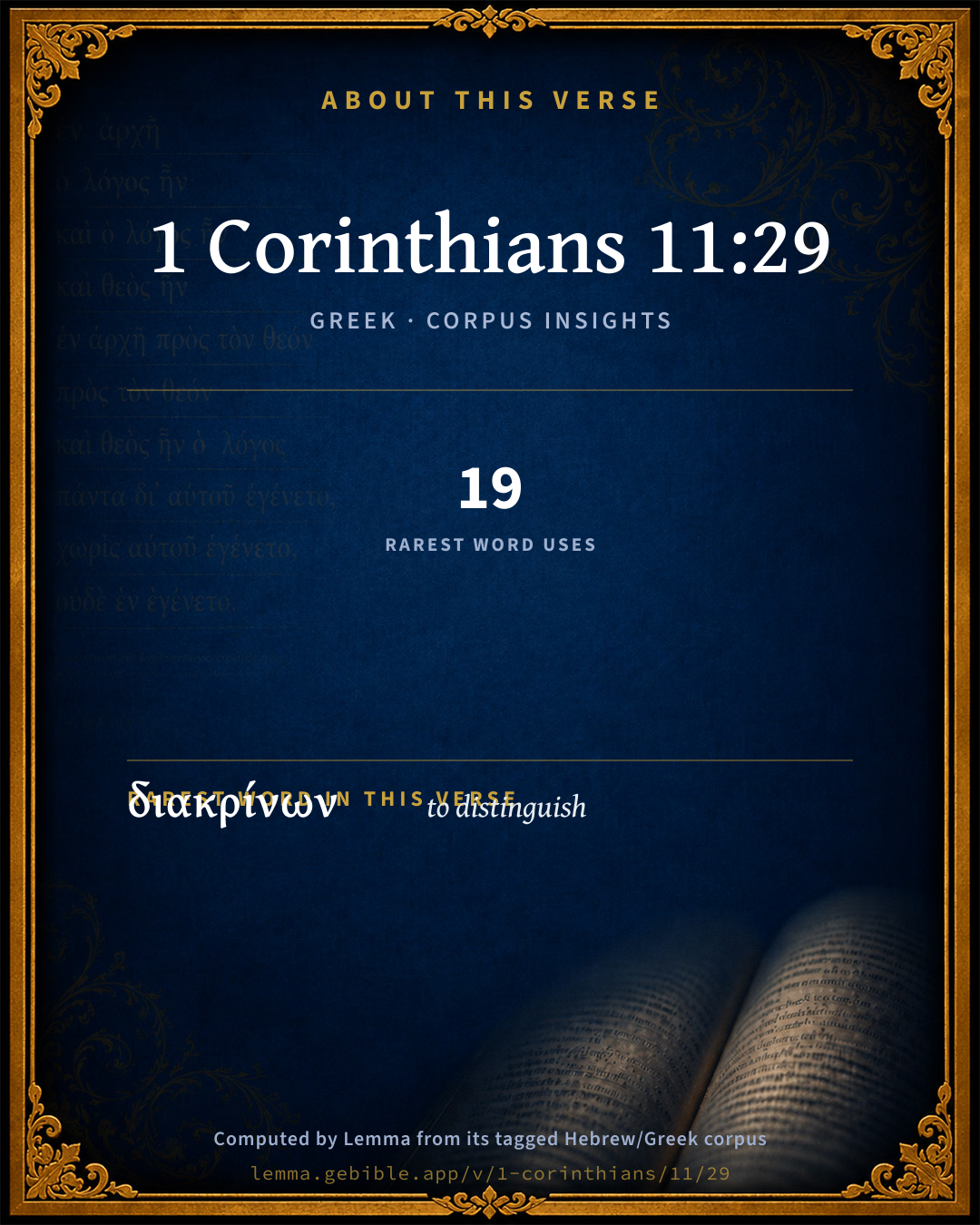
1 Corinthians 11:29

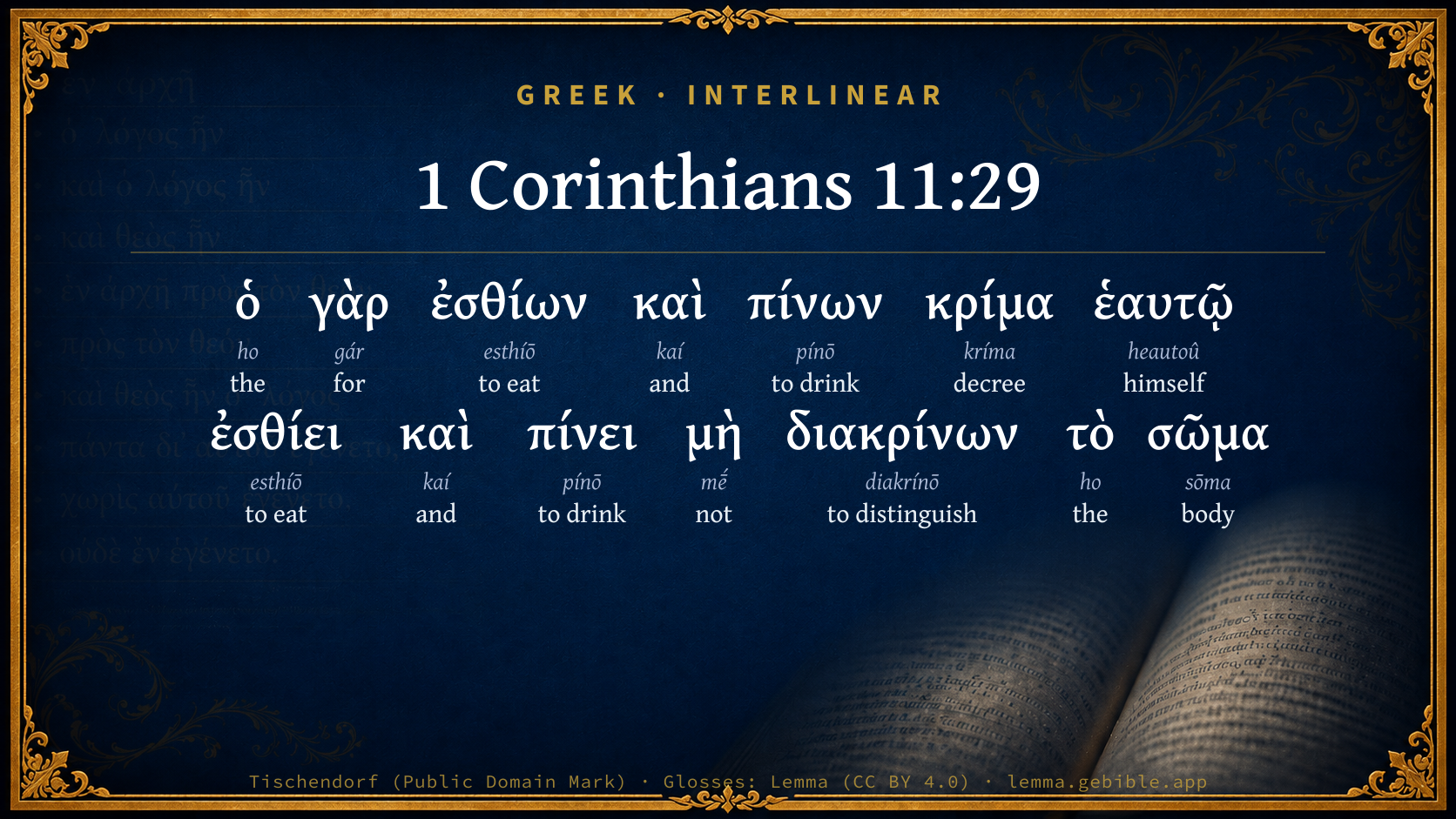
Greek (Tischendorf 8th ed.) 1 Corinthians 11:29 appears in the Greek New Testament. The text above is from the Tischendorf 8th edition. Each word links to its Strong’s number and a concise gloss. Click any word for its full Thayer’s Greek Lexicon entry.
Download image
Cite this verse

1 Corinthians 11:29 (World English Bible). Public Domain. Lemma interlinear Bible study tool, https://lemma.gebible.app/v/1-corinthians/11/29.

Show BibTeX & RIS
BibTeX
RIS
English Translation
For he who eats and drinks in an unworthy manner eats and drinks judgment to himself, if he doesn't discern the Lord's body.
World English Bible · Public Domain
Download a study sheet

One document with this verse’s original text, its word-by-word gloss line, the meaning frame, cross-references with their text, attributed commentary, and full source and license credits — printable, and it pastes into notes with its structure intact.

This verse Autodidact and up

Study sheet (.html) Plain text (.txt)

A passage Seminary Student

Up to 50 verses in one chapter. A passage sheet keeps up to 6 commentary sources and 12 cross-references per verse, in the order this page ranks them, and says so on the sheet whenever that leaves anything out. Ask for a single verse and you get the Autodidact verse sheet above.

Everything on this page stays free to read, with no account — the sheet is a download of what is already on screen, not access to it.

Want to remove ads? Support Godless Engineer
Compare translations 3

The same verse in 3 English versions, stacked beneath the original-language interlinear above. Click any original word for its lexicon entry.

Each is an independent rendering of the whole verse — the interlinear is not word-aligned to these translations.

Highlighted words mark where these versions differ — a whole-verse word diff, not a word-by-word alignment.

  • World English Bible Public Domain
    For he who eats and drinks in an unworthy manner eats and drinks judgment to himself, if he doesn't discern the Lord's body.
  • King James Version Public Domain
    For he that eateth and drinketh unworthily, eateth and drinketh damnation to himself, not discerning the Lord's body.
  • unfoldingWord Literal Text CC BY-SA 4.0
    For the one eating and drinking without discerning the body eats and drinks judgment to himself.

unfoldingWord Literal Text — © unfoldingWord, licensed CC BY-SA 4.0. Word-aligned USFM3 via Door43 (git.door43.org/unfoldingWord/en_ult).

Versions to compare (up to 4)

3 of 4 selected

Show all 19 translations

Every available English version of this verse, each an independent rendering of the whole verse.

  • World English Bible Public Domain
    For he who eats and drinks in an unworthy manner eats and drinks judgment to himself, if he doesn't discern the Lord's body.
  • Berean Standard Bible Public Domain
    For anyone who eats and drinks without recognizing the body eats and drinks judgment on himself.
  • Majority Standard Bible Public Domain
    For anyone who eats and drinks unworthily, without recognizing the body of the Lord, eats and drinks judgment on himself.
  • King James Version Public Domain
    For he that eateth and drinketh unworthily, eateth and drinketh damnation to himself, not discerning the Lord's body.
  • American Standard Version (1901) Public Domain
    For he that eateth and drinketh, eateth and drinketh judgment unto himself, if he discern not the body.
  • Revised Version (1885) Public Domain
    For he that eateth and drinketh, eateth and drinketh judgment unto himself, if he discern not the body.
  • Geneva Bible (1599) Public Domain
    For he that eateth and drinketh vnworthily, eateth and drinketh his owne damnation, because he discerneth not the Lords body.
  • Douay-Rheims (1899) Public Domain
    For he that eateth and drinketh unworthily, eateth and drinketh judgment to himself, not discerning the body of the Lord.
  • Young's Literal Translation Public Domain
    for he who is eating and drinking unworthily, judgment to himself he doth eat and drink -- not discerning the body of the Lord.
  • Literal Standard Version CC BY-SA 4.0
    for he who is eating and drinking unworthily, he eats and drinks judgment to himself—not discerning the body of the LORD.
  • Unlocked Literal Bible CC BY-SA 4.0
    For he who eats and drinks without discerning the body, eats and drinks judgment to himself.
  • unfoldingWord Literal Text CC BY-SA 4.0
    For the one eating and drinking without discerning the body eats and drinks judgment to himself.
  • Darby Bible Public Domain
    For [the] eater and drinker eats and drinks judgment to himself, not distinguishing the body.
  • World Messianic Bible Public Domain
    For he who eats and drinks in an unworthy way eats and drinks judgment to himself if he doesn’t discern the Lord’s body.
  • Webster's Bible Public Domain
    For he that eateth and drinketh unworthily, eateth and drinketh condemnation to himself, not discerning the Lord's body.
  • Free Bible Version CC BY-SA 4.0
    Those who eat and drink bring judgment on themselves if they don't recognize their relationship with the body of the Lord.
  • Bible in Basic English Public Domain
    For a man puts himself in danger, if he takes part in the holy meal without being conscious that it is the Lord's body.
  • Text-Critical English NT CC BY 4.0
    For he who eats and drinks in an unworthy manner eats and drinks judgment on himself, since he shows no regard for the body of the Lord.
  • Tyndale New Testament (1534) Public Domain
    For he that eateth or drinketh vnworthely eateth and drynketh his awne damnacion because he maketh no difference of the lordis body.

Literal Standard Version (2020), Covenant Press — licensed CC BY-SA 4.0. Text via the HelloAO Bible API (eBible.org). Unlocked Literal Bible (unfoldingWord) — licensed CC BY-SA 4.0. Text via the HelloAO Bible API (eBible.org). unfoldingWord Literal Text — © unfoldingWord, licensed CC BY-SA 4.0. Word-aligned USFM3 via Door43 (git.door43.org/unfoldingWord/en_ult). Free Bible Version, Dr. Jonathan Gallagher — licensed CC BY-SA 4.0. Text via the HelloAO Bible API (eBible.org).

Word by word

More ways to search: Search by grammar → Find every occurrence → Compare this word →

Practice this passage: Drill this verse → Learn its vocabulary →

διακρίνων
diakrínō
G1252
“to distinguish”
Verb, Present, Active, Participle, Nominative, Singular, Masculine
Part of Speech
Verb
Tense
Present
Voice
Active
Mood
Participle
Case
Nominative
Number
Singular
Gender
Masculine
Full Thayer's Definition

Origin: from G1223 and G2919

TDNT: 18:46,5

1. to separate, make a distinction, discriminate, to prefer 2. to learn by discrimination, to try, decide a. to determine, give judgment, decide a dispute 3. to withdraw from one, desert 4. to separate one's self in a hostile spirit, to oppose, strive with dispute, contend 5. to be at variance with one's self, hesitate, doubt
  1. ὁ ho G3588 “the” Article, Nominative, Singular, Masculine
  2. γὰρ gár G1063 “for” Conjunction
  3. ἐσθίων esthíō G2068 “to eat” Verb, Present, Active, Participle, Nominative, Singular, Masculine
  4. καὶ kaí G2532 “and” Conjunction
  5. πίνων pínō G4095 “to drink” Verb, Present, Active, Participle, Nominative, Singular, Masculine
  6. κρίμα kríma G2917 “decree” Noun, Accusative, Singular, Neuter
  7. ἑαυτῷ heautoû G1438 “himself” Reflexive pronoun, 3rd person, Dative, Singular, Masculine
  8. ἐσθίει esthíō G2068 “to eat” Verb, Present, Active, Indicative, 3rd person, Singular
  9. καὶ kaí G2532 “and” Conjunction
  10. πίνει pínō G4095 “to drink” Verb, Present, Active, Indicative, 3rd person, Singular
  11. μὴ mḗ G3361 “not” Particle, Negative
  12. τὸ ho G3588 “the” Article, Accusative, Singular, Neuter
  13. σῶμα sōma G4983 “body” Noun, Accusative, Singular, Neuter

About this verse

These counts appear in no published source. They are computed here, from the morphology-tagged text and Lemma’s own curated glosses. What Lemma adds →

14
words
10
distinct lemmas
Pauline Epistles
section

Notable vocabulary

The rarest word here is διακρίνων to distinguish G1252 — appearing just 19 times in the whole Greek New Testament.

Shared distinctive vocabulary

διακρίνων to distinguish G1252 occurs in 18 verses of the Greek New Testament. Also found in:

Repetition

Words recur within this verse:

  • ἐσθίων to eat G2068 ×2
  • πίνων to drink G4095 ×2
  • ὁ the G3588 ×2
  • καὶ and G2532 ×2

Cross-references

9

Topical passages linked to 1 Corinthians 11:29 in the Treasury of Scripture Knowledge — connected by theme and wording, ordered by reader-vote popularity; previews shown in the World English Bible.

  • 1 Corinthians 11:27 Therefore whoever eats this bread or drinks the Lord's cup in a manner unworthy of the Lord will be guilty of the body and the blood of the Lord.
  • Ecclesiastes 8:5 Whoever keeps the commandment shall not come to harm, and his wise heart will know the time and procedure.
  • 1 Corinthians 11:24 When he had given thanks, he broke it, and said, "Take, eat. This is my body, which is broken for you. Do this in memory of me."
  • 1 Corinthians 11:30 For this cause many among you are weak and sickly, and not a few sleep.
  • 1 Corinthians 11:32–34 But when we are judged, we are punished by the Lord, that we may not be condemned with the world.
  • Hebrews 5:14 But solid food is for those who are full grown, who by reason of use have their senses exercised to discern good and evil.
  • James 3:1 Let not many of you be teachers, my brothers, knowing that we will receive heavier judgment.
  • James 5:12 But above all things, my brothers, don't swear, neither by heaven, nor by the earth, nor by any other oath; but let your "yes" be "yes," and your "no," "no;" so that you don't fall into hypocrisy.
  • Romans 13:2 Therefore he who resists the authority, withstands the ordinance of God; and those who withstand will receive to themselves judgment.

Cross-references courtesy of OpenBible.info (CC BY 4.0).

Where the printed editions differ

2 variants

Places in this verse where the major printed Greek editions disagree on the wording in a way that affects the translation — a comparison of editions, not a manuscript-by-manuscript collation. The editions are the modern critical texts (Nestlé-Aland 28/27, SBL, Westcott-Hort, Tregelles, Tyndale House) and the traditional texts behind the KJV (the Textus Receptus and the Byzantine/Majority text). It is not a claim about which reading is original.

  1. Extra text
    ἀναξίως

    “unworthily”

    In TRByz Not in NA28NA27TynSBLWHTreg

    ἀναξίως (anaxiōs) 'unworthily' is only in traditional manuscripts (TR+Byz)

  2. Extra text
    κυρίου.

    “Lord.”

    In TRByz Not in NA28NA27TynSBLWHTreg

    κυρίου. (kuriou) 'Lord.' is only in traditional manuscripts (TR+Byz)

Textual data: Translators Amalgamated Greek New Testament (STEPBible TAGNT) · CC BY 4.0.

Commentary

Notes on 1 Corinthians 11:29 from classic Christian and Jewish commentators (each source and its license shown beneath its notes). The classic Christian expositions comment on the surrounding passage and are grouped to its opening verse, so a note may address several verses; the Jewish commentaries on the Tanakh (Rashi and others) are per-verse, so they appear only where the commentator wrote on this verse.

Lemma curates 59 commentaries, every one of them public domain or Creative Commons licensed, each selected and text-cleaned for this edition rather than reprinted as found. About our sources →

The Biblical Illustrator

Joseph S. Exell

1Co_11:29

For he that eateth and drinketh unworthily, eateth and drinketh damnation to himself.

Eating and drinking unworthily

I. Explication.

1. What is meant by eating and drinking? Not the body and blood of Christ, but sacramental bread and wine.

2. What by unworthily? Not according to Christs institution.

3. What by damnation? Judgment. He sins, and so must expect punishment.

II. Doctrine. It behoves every one to have a great care he doth not receive unworthily. Who are unworthy receivers?

1. The ignorant receivers.

(1) Such as know not the fundamentals of religion, that is (Mat_28:19)--

(a) God the Father (Joh_17:3).

(b) God the Son. Who He was; what He became; what He suffered; what He did; what He is; for whom He undertook these things; what benefit we receive from them.

(c) The Holy Ghost.

(2) Such as know not the state of their own souls.

(3) That know not the nature of the sacrament, even that it is an ordinance instituted by God, wherein, under the outward signs of bread and wine, Christ, with all the benefits of His death and passion, is represented, sealed, and conveyed to the worthy receiver.

(4) Examine--

(a) How may we know whether we know God? By our love to Him, trust on Him (Psa_9:10), desire for Him, joy in Him, fear of Him.

(b) Ourselves. By our thoughts of ourselves, and our constant endeavour to get ourselves bettered.

(c) The sacrament. By our desire of it, and preparation:for it.

2. The impenitent (Act_2:33).

(1) What is repentance?

(a) To sorrow for the sins we have committed.

(i.) Heartily (Joe_2:13).

(ii.) Sincerely.

(iii.) Universally.

(iv.) Constantly.

(b) To turn from the sins for which we sorrowed--

(i.) With full purpose of heart.

(ii.) In obedience to God.

(iii.) From all sin.

(iv.) To a right end.

(2) How appears it that the impenitent is unworthy?

(a) They cannot discern the Lords body.

(b) They mock the ordinance by acting and living contrary to it, and provoke God.

3. Examine--

(1) Your heart, thoughts, affections.

(2) Your life, words, actions (Jer_9:17-18). (Bp. Beveridge.)

Eating and drinking unworthily

I. The sin. Thoughtless, impenitent, irreverent participation of the holy communion.

II. The cause.

1. Not discerning the Lords body.

2. Through ignorance and unbelief.

III. The consequences. Not necessarily eternal damnation, but condemnation, entailing, it may be, temporal chastisement (1Co_11:30), yet with a merciful design. (J. Lyth, D.D.)

The danger of unworthy communicating

I. The necessity of communicating suitably, and in a right manner.

1. God commands it (1Co_11:28). The matter and manner of all duties are linked together in the command of God. What God hath joined, let no man put asunder.

2. No duty is pleasing to God, unless it be done in a right manner.

3. Nothing is a work theologically good but what is done in a right manner (Heb_11:6). There was a vast difference betwixt Cain and Abels offering (Gen_4:4-5; cf. Heb_11:4). Cloth may be good, and yet the coat base, if it be marred in the making.

4. Though the work be in itself good, yet if it be done not in a right manner, it provokes God to inflict heavy strokes on the doer (1Co_11:31).

5. Only the duty done in a right manner prospers and gets the blessing. Our meat can do us no good, and our clothes cannot warm us, if we do not use them in the right manner.

6. If we communicate not in a right manner, we do no more than hypocrites actually do, and pagans may do.

7. God gets no glory otherwise from us in our duty (Mat_5:16).

II. Why it is, that though the right manner of communicating be the main thing, yet many content themselves with the bare doing of it, neglecting the doing of it suitably, and in a right manner.

1. Because to communicate is easy, but to communicate in a right manner is very difficult.

2. Because they obtain their end by the bare performance of the duty. As--

(1) Peace of mind. Many consciences are not so far awakened as to give men no rest without doing duty in a right manner, yet they will not hold their peace should a man neglect duties altogether.

(2) Credit in the world. It is no small matter to have a name, and to seem good.

3. Men may get duties done, and their lust kept too; they may go to a communion table, and to the table of devils too; but to do duties in the right manner is inconsistent with peace with our lusts (Psa_66:18).

4. Because men mostly have low and mean thoughts of God and His service (Mal_1:6-8; cf Heb_12:28-29).

5. Because men mostly are acquainted with fellowship with God to be had in duties; they know not the necessity of it, nor the excellency of it. Hence they are not at pains about it. (T. Boston, D.D.)

Of the subjects of the Lords Supper

1. A trial of grace, whether it be inherent or no. It is a showing the death of Christ: there must be therefore a search, whether those graces which suit the death of Christ, and answer to the ends of it, be in the subject.

2. A trial of the state wherein those graces are. Since the Supper is not worthily received but by an exercise of repentance, faith, and love, it is necessary to inquire into the state of those graces and their vigor or languor in the soul. By this are excluded from this ordinance--

(1) All persons incapable of performing this antecedent duty. Either in regard of natural inability, as children, infants. And in regard of a negligent inability, as ignorant persons, who neglect the means of knowledge, or improve them not.

(2) All persons who cannot find upon examination anything of a Divine stamp upon them in the lowest degree. This command of self-examination evidenceth to us--

(a) That a Christian may come to the knowledge of his state in grace; otherwise it would be wholly fruitless to examine ourselves.

(b) No necessity of auricular confession: to tell all the secrets of the life to a priest. So let a man eat of this bread and drink of this cup. So, not otherwise, it is a hedge planted against every intrusion, so not without examination, and a fitness upon it. For the first. All men outwardly professing Christianity are not in a capacity to come to the great ordinance of the Supper. If all men were capable, pre-examination were not then necessary. In prosecution of this doctrine we shall lay down some propositions.

1. Only regenerate men are fit to come to the Lords Supper. No man in a natural state but must needs eat and drink unworthily, for he retains his enmity against God and Christ. Sanctified persons only are the proper guests. An unregenerate man cannot perform the duties necessary. It is bread belonging to children; unrenewed men are not yet in a state of sonship.

(1) Faith is a necessary qualification, but unrenewed men have not faith. An unbeliever receives the elements, not the life and spirit of a sacrament.

(2) An unrenewed man is not in covenant, and therefore no capable subject.

(3) This sacrament is a sacrament of nourishment; unrenewed men therefore are not fit for it. They are dead (Eph_2:1), and what hath a dead man to do with a feast? Men must be alive before they be nourished. Dead branches receive no sap from the vine.

(4) This sacrament is an ordinance of inward communion with Christ. But unrenewed men can have no inward communion with Him. They cannot have that joy which ought to be in a converse with Christ. Bosom communion belongs only to bosom friends: others are but intruders, and will receive no countenance from Christ.

(5) This ordinance is to be received by true Christians only. But renewed men only are such. Christianity is an inward powerful work, not a paint, an image. The form of godliness doth not constitute a man a Christian, but the power of it (2Ti_3:5). Freemen only have a right to the privileges of the city, and true, Christians to the privileges of the Church.

2. Men guilty of a course of sin, though secret and unknown to others, are unfit for this ordinance. What sins debar a man from this ordinance?

(1) Not such which are infirmities incident to human nature. Every sin doth not impede the operation of faith about the proper object.

(2) But a course in wilful and frequent breaches of a known command debars a man.

(3) Such cannot in that state perform the duties requisite in this ordinance. Faith is a necessary qualification; but a denial of subjection to Christ is an evidence of a gross infidelity. Practices are the clearest indexes of faith or unbelief, evil works deny God in His promises and precepts.

(4) Such contemptuously undervalue the blood of Christ, and therefore are unfit for this heavenly ordinance. It is no better than a mocking of God to come to His table with a professed enmity in the heart against Him.

(5) Such cannot receive any good from this ordinance. He can design no good to himself with a resolution to continue in his sin. Doctrine second: It is every mans duty solemnly and seriously to examine himself about his interest in Christ, his habitual grace, his actual right and fitness for the Lords Supper before his approach to it. Every ordinance hath a preparative: meditation is to usher in prayer, prayer is to sanctify the Word, the Word and prayer to sanctify other ordinances.

This institution hath examination for its harbinger to prepare the way of its access to us, and our access to it.

1. This self-examination or preparation is necessary. God required it in all duties. Purification went before sacrificing. The preparation and examination of themselves as to ceremonial uncleanness was strict before the passover, which was inferior to this ordinance, as the legal state was to the evangelical. The mercy to be now remembered is greater, the duties of preparation and devotion ought not to be less. Sanctify yourselves, and come with me to the sacrifice, and eat of the part appointed for the feast (1Sa_16:5).

(1) It is necessary to clear up a right. There is an outward acceptation of Christ and His laws without a true and inward change of heart.

(2) It is necessary for the exciting of grace. That the soul may be excited before; that there may not be an ebb in our affections, when there is a flood of our Saviours blood; that we may not have little thoughts in the presence of great and adorable objects.

(3) It is necessary to prevent sin. The apostles direction to them to examine themselves implies the want of it to be the cause of those miscarriages among them, which he taxeth in the preceding verses.

2. As it is necessary, so it is universal. Let a man examine himself. Not some men, but every man; the most substantial Christian, as well as the weakest. I shall only mention two things.

(1) Let a man examine himself as to his sentiments concerning the nature of the institution.

(2) Let a man examine himself what soil he hath contracted since the last time he was with God, whether the interest of God hath prevailed in our hearts above the interest of the flesh. Do we invite Christ into our souls, and shall we not examine every corner and search out the dirt and cobwebs which may be offensive to Him? The Spirit of Christ is a dove, and doves love clean places. But--

3. We should inquire whether we have habitual grace or no; whether there be those uniting, gluing graces--faith and love. The second grace to examine ourselves about and to exercise at this ordinance is sorrow for sin. This is necessary to the Supper. The way to an heavenly repast, as well as the way to heavenly mansions, is through the valley of Baca. Since repentance is necessary, let us examine ourselves what of this grace there is in us.

(1) What is the spring of our sorrow?

(2) What is the subject of the sorrow? Is it the sin of nature? do we judge that the greatest sin, and not regard it, as the common people do the stars, imagining them no bigger than a candle, when they are of a vast bigness?

(3) What are the adjuncts of the grief? Is it in some measure proportionable to our sin, proportionable not to the law, but to the gospel? The first cannot be attained by us, because the injury done to God is infinte. Is the league between sin and the soul broken?

4. Love to God is another grace we are to examine ourselves about.

(1) Spiritual affections to God are required in all duties, much more in this. The highest representation of a loving Saviour suffering, ought to have a suitable return of affection. Now for the trial of this love.

(a) Let us not judge ourselves by a general love.

(b) Nor let us judge ourselves to be lovers of God because of our education.

(c) Nor let us judge ourselves by any passionate fits of love which may sometimes stir in our souls. But let us examine--

(1) The motives and object of our affection.

(2) What is the nature of our love?

(a) In regard to the prevalency of it. Do we love Christ solely?

(b) In regard to the restlessness of it. Can nothing but Christ and the enjoyment of Him content us?

(c) What are the effects and concomitants of our love? Are we careful to please Him, though with our own shame?

5. Another grace to be examined is love of Gods people. This is the badge of a disciple (Joh_8:34-35).

(1) This is necesssary in all duties. Would we pray, our hands must be lifted up without wrath and doubting (1Ti_2:8).

(2) But more necessary in this ordinance.

(a) It represents the union of believers together. The bread being made up of several grains compacted together (1Co_10:16). For we being many are one bread and one body. This ordinance was instituted to solder believers together. They have the same nourishment, and therefore should have the same affection.

(b) No benefit of the ordinance without this grace.

Let us examine ourselves as to this grace. And that we may not mistake, every difference in judgment is not a sign of the want of this grace. But this love is true--

(1) When it is founded upon the grace of a person.

(2) It must be a fervent love. With a pure heart fervently (1Pe_1:22), not in appearance and faintly.

(3) A love manifested most in their persecutions. To be ashamed of believers in their sufferings is, in Christs interpretation, to be ashamed of Christ Himself.

6. Another grace to be examined and acted is desire, a holy appetite.

(1) This is necessary in all duties. In hearing the Word the desire must be as insatiable as the infants cry for milk (1Pe_2:2).

(2) But in this ordinary more necessary.

(a) It is a feast, and appetite is proper to that.

(b) The greater the longings, the greater the satisfaction.

(c) This is the noblest affection we can bestow upon God. (Bp. Hacket.)

Mystical bread and wine

Like as if a rebellious subject should no more regard his kings seal than other common wax, it might rightly be said that he doth no more esteem him than other men; so when we come to the Lords table, if we take irreverently the mystical bread and wine as common food, we make the Lords body and life to be like the common body and life of humanity. (Cawdray.)

Unworthy communicating

It was a smart and piercing speech of St. Ambrose to Theodosius, offering himself to the table of the Lord, What, wilt thou reach forth those hands of thine, yet dropping with the blood of innocents, slaughtered at Thessalonica, and with them lay hold upon the most holy body of the Lord? Or wilt thou offer to put that precious blood in thy mouth? etc. The like may be said to many coming to the sacrament, that instead of washing their hands in innocency, they rinse them in the blood of innocents. What! will they reach forth those hands of theirs, defiled with blood, with the blood of oppression, those fingers of theirs defiled with iniquity and with those hands and fingers touch those holy mysteries? with those lips of theirs, that have drivelled out such a deal of filthy communication, with those mouths which have drunk of the cup of devils; with those mouths and lips, will they offer to drink the precious blood of Christ? is it not sin enough that with their sins they have already defiled their hands, fingers, lips, mouths, but that now also they will needs come and defile the Lords table? and impudently crowd into the sacrament, when they come piping hot out of their sins and provocations? (R. Skinner.)

Worthy receiving

A man is not said to be worthy in regard of any worthiness in himself, but in respect of his affection and preparation, and in regard of his fit and seemly receiving. As we used to say the king received worthy entertainment in such a gentlemans house, not for that he was worthy to receive him, but because he omitted no compliments and service in his power fit to entertain him; even so I say, we are not worthy of Christ, that He should enter into our houses, that He should come under our roof. But, notwithstanding, we are said to be worthy when we do all things which are in our power fit for the entertainment of Him. If we come not in pride and in our rags, but with repentance, joy, comfort, and humility, then are we worthy. (R. Sibbes, D.D.)

The worthy receiving of the Lords Supper

Consider--

I. What worthiness to partake is.

1. What is meant by worthiness to partake.

(1) Not a legal worthiness, as if we could deserve it at the hands of God (Luk_17:10). Those who are that way worthy in their own eyes, are altogether unworthy.

(2) But it is a gospel-meetness and fitness (Mat_3:8). And much of that lies in coming with a deep sense of our vileness and emptiness (Isa_4:1).

2. Wherein does this worthiness to partake consist?

(1) In habitual meetness for it, in respect of a gracious state. A dead man is not fit for a feast nor a dead soul for the Lords table.

(2) In actual meetness, in respect of a gracious frame. Not only life, but liveliness is requisite (Psa_80:18), A sleeping man is not fit for a feast; and therefore even a true believer may communicate unworthily, as some in Corinth did (1Co_11:30; 1Co_11:32).

II. The duty of self-examination necessary for worthy receiving of the Lords Supper.

1. The rule or touchstone by which we must examine.

(1) Beware of false ones.

(a) The common guise of the world. It is not enough that ye are like, aye, and better than many (Luk_18:11).

(b) Ones being better than sometime before (2Co_10:12).

(c) The letter of the law. The Pharisee (Luk_18:11); and Paul before his conversion (Rom_7:9).

(d) The seen practice of the godly, which is an unsafe rule, because you cannot see the principle, motives, and ends of their actions.

(2) The only true rule or touchstone in this case is the Word of God (Isa_8:20). God hath given us marks in the Word, by which one may know whether he be in Christ or not (2Co_5:17); whether born of God or not (1Jn_3:9), and the like.

2. The matter about which we are to examine ourselves--the state of our souls before the Lord.

(1) The reason is, this sacrament is not a converting, but a confirming ordinance. It is a seal of the covenant, and so supposes the covenant entered into before by the party. It is appointed for nourishment, which presupposes life. And if it were not so, what need of self-examination?

(2) But more particularly, because there are some graces, namely, knowledge, faith, repentance, love, and new obedience, which in a particular manner are sacramental graces--these are to be examined.

III. The necessity of self-examination.

1. To prevent the sin of coming unworthily to the Lords table. If we rush on this ordinance without previous examining ourselves, how can we miss of communicating unworthily?

2. To prevent the danger of coming so, which is eating and drinking damnation to ones self. The danger is great--

(1) To the soul (1Co_11:29).

(2) To the body (1Co_11:30). (T. Boston, D.D.)

Not discerning the Lords body.

Discernment of the Lords body

The Saviour is here making a spiritual feast for His people, presenting Himself to them under the form of bread and wine; you are, therefore, not to look on these as mere dumb signs, but as objects which speak most distinctly to your spiritual ear. It behoves every Church, that is, every company of believers--

I. To realise the presence of the Lord among them as His guests and friends. At His table you are to meditate of His love--to sit down and commemorate His sufferings on your behalf; His object is to make you happy; He commands you to take this as a pledge of His friendship; you must not stop short at the mere symbol; this is, in effect, His body that was broken for you, and this is His blood which was poured out for you on the accursed tree. His hands, His feet were pierced for you--His side, too, was pierced, after He had given up the ghost: His sufferings were such as no tongue can tell, and such as cannot be known to mortal man. His affection for you was written in blood, and that blood was His own! That bread and that wine tell you that He died for you; and that in so doing He made an end of sin, and brought in an everlasting righteousness. He is now able to save unto the uttermost all that come unto God by Him. Eat, then, oh! friends, and drink, oh! beloved, is His language. As He died for you, so He now lives for you: and at the close He will come again, and take you unto Himself, that you may be for ever with the Lord.

II. To reciprocate the feelings of the Lord Jesus. The soul must and will speak to the praise of sovereign mercy. That we may properly discern the Lords body, we must--

1. Discern the evil of sin. Where is sin painted in colours so dreadful as here?

2. Discern the relation of man. What is the depraved creature man worth to his Maker? He is lost for all the ends which he ought to answer. Divine mercy could not reach him, apart from a proper Mediator and an atonement for sin. After this redemption he needed the exercise of Divine power to create him anew. The Cross, clearly seen, is death to human glorying. There is no room for it there! Go then, Christian, to His table, and take a fresh lesson from your Lord, who, with all His perfections, was made lowly in heart, since the more you share of this, the more abundantly will you possess rest to your own soul.

3. Discern the beauty of holiness and the necessity of cultivating it. Can you have a more impressive lesson on the evil of sin than the table of the Lord affords you? Will you prepare a second Cross for Christ, and with your own hands nail Him to it? Is there anything in the universe so full of beauty as holiness? Is it not the interest of every creature to press after a close resemblance to our Judge and our Creator?

4. Discern His sovereign and unutterable love. Were we not all enemies, full of selfishness, a god to ourselves, and a rule to ourselves, living without God, and having no hope in the world? Yet He came to die for these very enemies. (The Christian Witness.)

The Biblical Illustrator, edited by Joseph S. Exell (c. 1880s–1900s) — public domain. Text from a community e-Sword module.

Tyndale Open Study Notes

Tyndale Open Resources

11:29-30 In light of 11:27, the body of Christ is probably to be understood here as a reference to the death of Christ, not to the church, though some interpret it that way. • Those who eat the bread or drink the cup unworthily thereby invoke God’s judgment upon themselves. Such judgment may be expressed in infirmities, sickness, and even death (cp. Acts 5:5, 10).

Tyndale Open Study Notes — © Tyndale Open Resources, licensed CC BY-SA 4.0. Text via the HelloAO Bible API.

Bengel's Gnomon

Johann Albrecht Bengel

1Co 11:29. Κρίμα) [without the article, comp. v. 32.—Not. crit.] some judgment, a disease, or the death of the body; see next verse; so that those who do not discern the Lord’s body have to atone for it in their bodies. He does not say to τὸ κατάκριμα, the condemnation.—μἠ διακρίνων, not judging as to [discerning]) Comp. Heb 10:29.—τὸ σῶμα, the body) supply, and the blood.—τοῦ Κυρίου, of the Lord) An Antonomasia [an appellative instead of the proper name], i.e. Jesus. The Church is not called the body of Jesus, or the body of the Lord; but the body of Christ: The question here then is about the proper body of the Lord Jesus.

Bengel's Gnomon of the New Testament — English translation (T&T Clark, Edinburgh, 1860) — public domain. Text from a community e-Sword module.

Meyer's Critical & Exegetical Commentary

Heinrich August Wilhelm Meyer

1Co_11:29. Since ἀναξίως is spurious (see the critical remarks), ὁ ἐσθίων κ. πίνων might be understood absolutely: the eater and drinker, who turns the Supper, as was actually done at Corinth, 1Co_11:22; 1Co_11:34, into a banquet and carousal. This was the view I held myself formerly, taking μὴ διακρίνων in the sense: because he does not, etc., as in Rom_4:19. But after 1Co_11:28, whose ἐσθίειν κ. πίνειν finds expression here again, it is simpler and most in accordance with the text to render: He who eats and drinks (the bread and the cup), eats and drinks a judgment to himself, if he does not, etc., so that in this way μὴ διακρίνων κ.τ.λ[1884] conditions the predicate, and is not a modal definition of the subject. The apostle might have written simply κρῖμα γὰρ ἑαυτῷ ἐσθίει κ. πίνει, μὴ διακρ. τ. σ.; but the circumstantial description of the subject of the sentence for the second time by ὁ γὰρ ἐσθίων κ. πίνων carries a certain solemnity with it, making one feel the risk incurred by going on to eat and drink.

κρῖμα ἑαυτῷ κ.τ.λ[1885]] a concrete expression (comp 2Co_2:16) of the thought: he draws down judicial sentence upon himself by his eating and drinking. The power to effect this turns on the ἔνοχος ἔσται Κ.Τ.Λ[1887], 1Co_11:27; and therefore nothing is decided here against the symbolical interpretation of the words of institution. That the κρῖμα is a penal one, is implied in the context (Rom_2:2; Rom_3:8; Rom_13:2; Gal_5:10). The absence of the article, again, denotes not eternal condemnation, but penal judgment in general without any limiting definition. From 1Co_11:30-31 we see that Paul was thinking, in the first place, of temporal judgments as the penalty of unworthy communicating, and that such judgments appeared to him as chastisements employed by God to avert from the offender eternal condemnation. With respect to the dativus incommodi ἑαντῷ, comp Rom_13:2.

μὴ διακρίνων τὸ σῶμα] if he does not form a judgment upon (so διακρ., Vulgate, Chrysostom, Theophylact, Bengel, de Wette, Weiss) the body, i.e. the body, κατʼ ἐξοχήν, the sacred body, into communion with which he enters by partaking of the Supper, and respecting which, therefore, he ought to form a judgment of the most careful kind, such as may bring him into full and deep consciousness of its sacredness and saving significance (on διακρ., comp 1Co_14:29; Mat_16:3). Comp Chrysostom: μὴ ἐξετάζων, μὴ ἐννοῶν, ὡς χρὴ, τὸ μέγεθος τῶν προκειμένων, μὴ λογιζόμενος τὸν ὄγκον τῆς δωρεᾶς. Usually (so too Ewald, Kahnis, Hofmann) commentators have taken διακρ. in the sense of to distinguish (1Co_4:7), and have rendered accordingly: if he (or, following the reading which puts ἀναξίως after πίνων: because he) does not distinguish the body of Christ from common food.[1891] Hofmann, again, seeing that we have not τοῦ Κυρίου along with τὸ σῶμα, holds it more correct to render: if he does not distinguish the body, which he who eats this bread partakes of, from the mere bread itself. Both these ways of explaining the word, which come in substance to the same thing, proceed upon the supposition either that the body of Christ is that with which we enter into fellowship by partaking of the symbol (which is the true view), or that it is partaken of in, with, and under the bread (Lutheran doctrine), or by means of the transubstantiation of the bread (Roman Catholic doctrine). But in 1Co_11:31, where διεκρίνομεν is taken up again from our passage, the word means to judge, not to distinguish, and we must therefore keep to that meaning[1892] here also.

It was needless to add καὶ τὸ αἶμα to ΤῸ ΣῶΜΑ because the ΣῶΜΑ is regarded as that which had suffered death by the shedding of its blood; comp 1Co_11:26, also 1Co_10:17. The twofoldness of the elements has its significance to thought only in the equal symbolism of the two; apart from that symbolism, reference to it would be inappropriate, since, objectively, they cannot be separated.

[1884] .τ.λ. καὶ τὰ λοιπά.

[1885] .τ.λ. καὶ τὰ λοιπά.

[1887] .τ.λ. καὶ τὰ λοιπά.

[1891] So Luthers gloss: who handles and deals with Christs body as if he cared no more for it than for common food.

[1892] Which stands in significant correspondence with κρίμα (comp. too, the oxymoron in ver. 31): a judgment … if he does not form a judgment. Hence there is the less warrant in the text for the meaning distinguish.

Meyer — Critical and Exegetical Commentary on the New Testament — English translation by Peter Christie, edited by Frederick Crombie (T&T Clark, 1880) — public domain. Text from a community e-Sword module.

Expositor's Greek Testament

ed. W. Robertson Nicoll

1Co 11:29 . Participation in the bread and cup is itself a δοκιμασία : “For he that eats and drinks, a judgment for himself (sentence on himself) he eats and drinks”. The single art [1782] of ὁ ἐσθίων καὶ πίνων , combining the acts, negatives the R.C [1783] inference from the ἢ of 1Co 11:27 (see note). Contact with Christ in this ordinance probes each man to the depths ( cf. Joh 3:18 f., Joh 9:39 ); it is true of the Lord’s verbum visibile , as of His verbum audibile , that he who receives it ἔχει τὸν κρίνοντα αὐτόν (Joh 12:48 ). His attitude toward the Lord at His table revealed with shocking evidence the spiritual condition of many a Cor [1784] Christian his carnality and blindness as one “not distinguishing the body”. The two senses given by interpreters to διακρίνω are, as Hn [1785] says, somewhat blended here (“Beruht jedes Urtheilen auf Ent scheiden und Unter scheiden”), as in dijudicans (Vg [1786] ): one “discerns (judges clearly and rightly of) the (Lord’s) body” in the sacrament and therein “discriminates” the rite from all other eating and drinking precisely what the Cor [1787] failed to do (1Co 11:20 ff.). They did not descry the signified in the sign, the Incarnate and Crucified in His memorial loaf and cup, and their Supper became a mere vulgar matter of meat and drink. This ordinance exposed them for what they were σαρκικοί (1Co 3:3 ). τὸ σῶμα ( cf. 1Co 11:24 ff.) a reverent aposiopesis , resembling ἡ ἡμέρα in 1Co 3:13 (see note); the explanation of some Lutherans, that τὸ σῶμα means “the substance” underlying the material element, is foreign to the context and to Apostolic times. On “the serious doctrinal question” as to what the unfaithful receive in the sacrament, see El [1788] ad loc [1789] Distinguish κρίμα (unhappily rendered “damnation” in A.V.), a judicial sentence of any kind, from κατάκριμα , the final condemnation of the sinner (32; Rom 5:16 ).

[1782] grammatical article.

[1783] Roman Catholic.

[1784] Corinth, Corinthian or Corinthians.

[1785] C. F. G. Heinrici’s Erklärung der Korintherbriefe (1880), or 1 Korinther in Meyer’s krit.-exegetisches Kommentar (1896).

[1786] Latin Vulgate Translation.

[1787] Corinth, Corinthian or Corinthians.

[1788] C. J. Ellicott’s St. Paul’s First Epistle to the Corinthians .

[1789] ad locum , on this passage.

The Expositor's Greek Testament, edited by W. Robertson Nicoll (1897–1910) — public domain. Text from a community e-Sword module.

Cambridge Greek Testament for Schools and Colleges

29. [ἀναξίως] rec. with DEFG Vetus Lat. Vulg. Peshito. Text אABC. The authority of the ancient versions is strong. But on the whole it appears more probable that the word was introduced from 1Co 11:27. Origen has the word, but his citation is loose. See note on 1Co 11:29 below.

[τοῦ κυρίου] at end of verse, rec. with DEFG Vulg. Peshito. Text אABC and some copies of Vulg.

29. κρίμα. Judgment, as in A.V., margin. Wiclif, dome (as in ch. 1Co 6:4). Luther, gericht. Vulgate, judicium. ‘The mistranslation in our version has,’ says Dean Alford, ‘done infinite mischief.’ Olshausen reminds us how in Germany a translation (see above) less strong than this, yet interpreted to. mean the same thing, drove Goethe from ‘Church and altar.’ Of what kind the judgment is the next verse explains. That it is not final condemnation that is threatened, 1Co 11:32 clearly shews (Alford, De Wette). But the word has an unfavourable sense everywhere in N. T. except perhaps Rev 20:4. It is therefore equivalent to our word ‘condemnation.’ Some MSS. and editors omit ‘unworthily’ here. See Critical Note. It may have been introduced from 1Co 11:27. If it be omitted, the sense is that he who eats and drinks without discerning (see next note) the Body of Christ, invites an unfavourable judgment on himself. If it be retained, we are to understand that he who partakes unworthily, invites God’s judgment on him because he does not discern the Lord’s Body.

μὴ διακρίνων τὸ σῶμα. Because (or rather almost when) he does not discern the body. μὴ ἐξετάζων, μὴ ἐννοῶν, ὡς χρή, τὸ μέγεθος τῶν προκειμένων, μὴ λογιζόμενος τὸν ὄγκον τῆς δωρεᾶς. Chrysostom. μή denotes the condition which produces the κρίμα. The meaning of διακρίνω here, as in 1Co 6:5, is to come to a correct decision after examination. The believer has discerned the fact that it is no ordinary meal in which he is invited to participate, but that in the rite there is a feeding on the Body of Christ. Some interpret ‘not discriminating between the Body of the Lord and other kinds of food.’ But the interpretation above is confirmed by 1Co 11:31, where διεκρίνομεν cannot mean ‘distinguish between ourselves and others,’ but must mean ‘come to a right conclusion about ourselves.’ See note on 1Co 4:7 and cf. Mat 16:3.

Cambridge Greek Testament for Schools and Colleges (Cambridge University Press, 1896; 21 vols, various authors incl. Carr, Maclear, Plummer, Farrar, Lumby, Moule, M. R. James, Simcox) — public domain. Text from a community e-Sword module.

Hodge's Commentary on Romans, Ephesians & First Corinthians

Charles Hodge

1Co_11:29

For he that eateth and drinketh unworthily,‹20› eateth and drinketh damnation to himself, not discerning the Lords body.

This verse assigns the reason why self-examination in preparation for the Lords supper is necessary. It is because he that eateth and drinketh unworthily (in the sense before explained), eateth and drinketh judgment to himself. That is, he incurs the manifestation of Gods displeasure by the act of eating. The word damnation, used in our version, originally and properly means simply condemnation, and not hopeless and final perdition, which is its modern and popular sense. In the original the word is κρίμα without the article, and therefore simply judgment, not the judgment. The meaning obviously is, that the unworthy eater contracts guilt; he exposes himself to the judgments of God. What kind of judgments the apostle had in his mind is plain from the next verse, where he refers to sickness and death.‹21› This verse is only a repetition of the sentiment expressed in 1Co_11:27, where he who cast unworthily is said to contract guilt in reference to the body of the Lord. Not discerning, i.e. because he does not discern the Lords body. The word διακρίνω, translated to discern, means to separate, men to cause to differ, as 1Co_4:7; and also, judge of, either in the sense of discriminating one thing from another, or in the sense of estimating aright. This passage may therefore mean, not discriminating the Lords body, i.e. making no difference between the bread in the sacrament and ordinary food; or, it may mean, not estimating it aright, not reverencing it as the appointed symbol of the body of the Lord. In either case the offense is the same. The ground of the condemnation incurred is, regarding and treating the elements in the Lords supper as though there was nothing to distinguish them from ordinary bread and wine. Here, as before, it is the careless and profane who are warned. There is, therefore, nothing in these passages which should surround the Lords table with gloom. We are not called unto the mount covered with clouds and darkness, from which issue the signs of wrath, but unto Mount Zion, to the abode of mercy and grace, where all is love the dying love of him who never breaks the bruised reed.

Charles Hodge — Commentary on Romans (1835), First Corinthians (1857), and Ephesians (1856) — public domain. Text from a community e-Sword module.

Geneva Bible (1599)

Geneva Bible translators

He is said to discern the Lord’s body, that hath consideration of the worthiness of it, and therefore cometh to eat of this meat with great reverence.

Geneva Bible (1599) marginal notes — public domain. Text via Bolls.life.

Jamieson, Fausset & Brown

Robert Jamieson, A. R. Fausset & David Brown

damnation--A mistranslation which has put a stumbling-block in the way of many in respect to communicating. The right translation is "judgment." The judgment is described (Co1 11:30-32) as temporal.

not discerning--not duty judging: not distinguishing in judgment (so the Greek: the sin and its punishment thus being marked as corresponding) from common food, the sacramental pledges of the Lord's body. Most of the oldest manuscripts omit "Lord's" (see Co1 11:27). Omitting also "unworthily," with most of the oldest manuscripts, we must translate, "He that eateth and drinketh, eateth and drinketh judgment to himself, IF he discern not the body" (Heb 10:29). The Church is "the body of Christ" (Co1 12:27). The Lord's body is His literal body appreciated and discerned by the soul in the faithful receiving, and not present in the elements themselves.

Jamieson, Fausset & Brown — Commentary Critical and Explanatory on the Whole Bible (1871) — public domain (CC PDM 1.0). Text via the HelloAO Bible API.

Adam Clarke's Commentary

Verse 29. Eateth and drinketh damnation] κριμα, Judgment, punishment; and yet this is not unto damnation, for the judgment or punishment inflicted upon the disorderly and the profane was intended for their emendation; for in 1Co 11:32, it is said, then we are judged, κρινομενοι, we are chastened, παιδευμεθα, corrected as a father does his children, that we should not be condemned with the world.

Adam Clarke's Commentary on the Bible (1810–1826) — public domain. Text from a community e-Sword/MySword module.

John Calvin's Commentaries

29. He who shall eat unworthily, eateth judgment to himself. He had previously pointed out in express terms the heinousness of the crime, when he said that those who should eat unworthily would be guilty of the body and blood of the Lord Now he alarms them, by denouncing punishment; for there are many that are not affected with the sin itself; unless they are struck down by the judgment of God. This, then, he does, when he declares that this food, otherwise health-giving, will turn out to their destruction, and will be converted into poison to those that eat unworthily

He adds the reasons because they distinguish not the Lord’s body, that is, as a sacred thing from a profane. “They handle the sacred body of Christ with unwashed hands, (Mark 7:2,) nay more, as if it were a thing of nought, they consider not how great is the value of it. They will therefore pay the penalty of so dreadful a profanation.” Let my readers keep in mind what I stated a little ago, that the body is presented to them, though their unworthiness deprives them of a participation in it.

John Calvin's Commentaries (1540-1563) — public domain. Text from the Calvin Translation Society English edition (1840s-50s) via the Christian Classics Ethereal Library (ccel.org). Calvin's coverage is partial (roughly two-thirds of the Bible); uncommented books and verses are honest gaps, never fabricated. The 19th-century editor's footnotes and remarks are omitted so the notes are faithfully Calvin's own voice.

Ellicott's Commentary for English Readers

(29) Unworthily.—This word is not in the best Greek MSS.

Damnation to himself.—The Greek word hero does not imply final condemnation. On the contrary, it only means such temporal judgments as the sickness and weakness subsequently mentioned, and which are to save the man from sharing the final damnation of the heathen.

Not discerning the Lord’s body.—The words “the Lord’s” are to be omitted, the weight of MS. evidence being altogether against their authenticity. 1Co_11:30 is a parenthesis, and 1Co_11:31 re-opens with this same verb. The force of the passage is, “He who eats and drinks without discerning the Body (i.e., the Church) in that assembly, eats and drinks a judgment to himself; for if we would discern ourselves we should not be judged.”

There are some important points to be borne in mind regarding this interpretation of the passage. (1) The Greek word, which we render “discerning,” “discern,” signifies to arrive at a right estimate of the character or quality of a thing. (2) The fault which St. Paul was condemning was the practice which the Corinthians had fallen into of regarding these gatherings as opportunities for individual indulgence, and not as Church assemblies. They did not rightly estimate such gatherings as being corporate meetings; they did not rightly estimate themselves as not now isolated individuals, but members of the common Body. They ought to discern in these meetings of the Church a body; they ought to discern in themselves parts of a body. Not only is this interpretation, I venture to think, the most accurate and literal interpretation of the Greek, but it is the only view which seems to me to make the passage bear intelligibly on the point which St. Paul is considering, and the real evil which he seeks to counteract. (3) To refer these words directly or indirectly to the question of a physical presence in the Lord’s Supper, is to divorce them violently from their surroundings, and to make them allude to some evil for which the explicit and practical remedy commended in 1Co_11:33-34 would be no remedy at all. Moreover. if the word “body” means the Lord’s physical body, surely the word “Lord’s” would have been added, and the words, “and the blood,” for the non-recognition of the blood would be just as great an offence. (4) St. Paul never uses the word “body” in reference to our Lord’s physical body, without some clear indication that such is meant. (See Rom_7:4; Php_3:21; Col_1:22.) On the other hand, the use of the word “Body,” or “Body of Christ,” meaning the Church, is frequent. We have had it but a few verses before, in reference to this very subject (1Co_10:16). It is also to be found in Rom_12:5; Eph_1:22; Eph_5:23; Eph_5:30. (In this last passage, “of His flesh and of His bones,” are not in the best MSS., and destroy the real force of the “Body,” which means “Church.”)

A Bible Commentary for English Readers, edited by Charles John Ellicott (1878–1897) — public domain. Text from a community e-Sword module.

The Cambridge Bible for Schools and Colleges

gen. ed. J. J. S. Perowne

29. damnation] Rather judgment, as in the margin. Wiclif, dome (as in ch. 1Co_6:4). Luther, gericht. Vulgate, judicium, “The mistranslation in our version has, says Dean Alford, “done infinite mischief.” Olshausen reminds us how in Germany a translation (see above) less strong than this, yet interpreted to mean the same thing, drove Goethe from “Church and altar.” Of what kind the judgment is the next verse explains. That it is not final condemnation that is threatened, 1Co_11:33 clearly shews (Alford, De Wette). Some MSS. and editors omit “unworthily” here. It may have been introduced from 1Co_11:27. If it be omitted, the sense is that he who eats and drinks without discerning (see next note) the Body of Christ, invites judgment on himself. If it be retained, we are to understand that he who partakes unworthily, invites God’s judgment on him because he does not discern the Lord’s Body. The latter is the reading of the ancient versions.

discerning] Dijudicans, Vulgate. Discernens, Calvin. Dass er nicht unterscheidet, Luther. Wiseli demynge, Wiclif. Because he maketh no difference of, Tyndale (after Luther). The word discern properly signifies to perceive distinctions, to distinguish. Thus Shakspeare,

“No discerner durst wag his tongue in censure,”

Henry VIII. Act i. Sc. 1,

i.e. no one who might have been inclined to exalt one king at the expense of the other. So the word discreet originally meant one who had the power of rightly distinguishing. The Greek word sometimes means to distinguish, or even to cause to differ (ch. 1Co_4:7). In the passive, in which it most frequently occurs in the N. T., it signifies to be made to differ, to doubt. Here, however, the word is used in its primary signification (cf. St Mat_16:3, where the same word is used with the same translation), and means to decide after a thorough inquiry (search out, Chrysostom) to pierce through the impediments opposed by sense, and thus to come to a right conclusion of what is actually offered to faith in the Sacrament of the Lord’s Supper, rather than with some, to discriminate between the Body of the Lord and other kinds of food.

the Lord’s body] Some MSS. and editors read the body.

The Cambridge Bible for Schools and Colleges (gen. ed. J. J. S. Perowne; Cambridge University Press, 1878–1918) — public domain. Text from a community e-Sword module.

John Gill's Exposition

For this cause many are weak and sickly,.... Because of their unworthy participation of the Lord's supper, many in the Corinthian church were attended with bodily infirmities and diseases; either by way of fatherly chastisement and correction in such who were truly the Lord's people, though they had behaved unworthily; or by way of punishment to such who were not, and had sinned very grossly:

and many sleep; that is, die a corporeal death, which is often in Scripture signified by sleep, and frequently used of the saints, and their death, and may intend and include some of them here; for though the Lord might resent so far their unworthy conduct and behaviour at his table, as to remove them out of this world by death, yet their souls may be saved in the day of the Lord Jesus.

John Gill's Exposition of the Whole Bible (1746–1763) — public domain (CC PDM 1.0). Text via the HelloAO Bible API.

Trapp's Complete Commentary

John Trapp

29 For he that eateth and drinketh unworthily, eateth and drinketh damnation to himself, not discerning the Lord’s body.

Ver. 29. For he that eateth and drinketh unworthily] He saith not unworthy (for so we are all), but unworthily, that is, unpreparedly, for a good work may be spoiled in the doing, as many a good tale is marred in the telling, and many a good garment in the making.

Eateth and drinketh damnation] He that came in without a wedding garment on his back, went not away without fetters on his feet. He was taken from the table to the tormentors. God’s table becomes a snare to unworthy receivers; they eat their bane, they drink their poison. Henry VII, emperor of Germany, was poisoned in the sacramental bread by a monk; Pope Victor II by his sub-deacon in the chalice; and one of our bishops of York by poison put into the wine at sacrament. God will deal with ill communicants as Job 20:23. They will speed no better than Amnon did at Absalom’s feast; or than Haman did at Esther’s. Sin brought to the sacrament, picks out that time to petition against them, as Esther did against Haman at the banquet of wine, Ezr 7:2; Ezr 7:6. So that they shall cry out as that emperor beforementioned did, Calix vitae calix mortis, The cup of life is to us a cup of poison.

John Trapp, A Commentary or Exposition upon All the Books of the Old and New Testament (1647–1656) — public domain. Text from a community e-Sword module.

Albert Barnes' Notes on the Bible

For he that eateth ... - In order to excite them to a deeper reverence for this ordinance, and to a more solemn mode of observing it, Paul in this verse states another consequence of partaking of it in an improper and irreverent manner; compare 1Co 11:27.

Eateth and drinketh damnation - This is evidently a figurative expression, meaning that by eating and drinking improperly he incurs condemnation; which is here expressed by eating and drinking condemnation itself. The word “damnation” we now apply, in common language, exclusively to the future and final punishment of the wicked in hell. But the word used here does not of necessity refer to that; and according to our use of the word now, there is a harshness and severity in our translation which the Greek does not require, and which probably was not conveyed by the word “damnation” when the translation was made. In the margin it is correctly rendered “judgment.” The word here used (κρῖμα krima) properly denotes judgment; the result of judging, that is, a sentence; then a sentence by which one is condemned, or condemnation; and then punishment; see Rom 3:8; Rom 13:2. It has evidently the sense of judgment here; and means, that by their improper manner of observing this ordinance, they would expose themselves to the divine displeasure, and to punishment. And it refers, I think, to the punishment or judgment which the apostle immediately specifies, 1Co 11:30, 1Co 11:32. It means a manifestation of the divine displeasure which might be evinced in this life; and which, in the case of the Corinthians, was manifested in the judgments which God had brought upon them. It cannot be denied, however, that a profane and intentionally irreverent manner of observing the Lord’s Supper will meet with the divine displeasure in the eternal world, and aggravate the doom of those who are guilty of it. But it is clear that this was not the punishment which the apostle had here in his eye. This is apparent:

Because the Corinthians did eat unworthily, and yet the judgments inflicted on them were only temporal, that is, weakness, sickness, and temporal death 1Co 11:30; and, Because the reason assigned for these judgments is, that they might not be condemned with the wicked; that is, as the wicked are in hell, 1Co 11:32. Whitby. Compare 1Pe 4:17.

Not discerning the Lord’s body - Not discriminating” μὴ διακρίνων mē diakrinōn between the bread which is used on this occasion and common and ordinary food. Not making the proper difference and distinction between this and common meals. It is evident that this was the leading offence of the Corinthians (see the notes at 1Co 11:20-21), and this is the proper idea which the original conveys. It does not refer to any intellectual or physical power to perceive that that bread represented the body of the Lord; not to any spiritual perception which it is often supposed that piety has to distinguish this; not to any view which faith may be supposed to have to discern the body of the Lord through the elements; but to the fact that they did not “distinguish” or “discriminate” between this and common meals. They did not regard it in a proper manner, but supposed it to be simply an historical commemoration of an event, such as they were in the habit of observing in honor of an idol or a hero by a public celebration. They, therefore, are able to “discern the Lord’s body” in the sense intended here, who with a serious mind, regard it as an institution appointed by the Lord Jesus to commemorate his death; and who “distinguish” thus between this and ordinary meals and all festivals and feasts designed to commemorate other events. In other words, who deem it to be designed to show forth the fact that his body was broken for sin, and who desire to observe it as such. It is evident that all true Christians may have ability of this kind, and need not incur condemnation by any error in regard to this. The humblest and obscurest follower of the Saviour, with the feeblest faith and love, may regard it as designed to set forth the death of his Redeemer; and observing it thus, will meet with the divine approbation.

Albert Barnes' Notes on the Bible (1834–1885) — public domain. Text from a community e-Sword/MySword module.

Matthew Poole's English Annotations

He that eateth and drinketh unworthily; in the sense before mentioned, either having no remote right or no present right to partake in that ordinance, being an unbeliever, or a resolved unholy or ignorant person; or irreverently and irreligiously. He

eateth and drinketh κριμα, damnation, or judgment, it is no matter which we translate it; for if he brings God’s judgments upon him in this life, they will end in eternal damnation, without a timely repentance; but it is

to himself, not to him that is at the same table with him, unless he hath been guilty of some neglect of his duty to him.

Not discerning the Lord’s body; and his guilt lieth here, that he doth not discern and distinguish between ordinary and common bread, and that bread which is the representation of the Lord’s body, but useth the one as carelessly, and with as little preparation and regard to what he doth, as he uses the other.

Matthew Poole's English Annotations on the Holy Bible (1683–1685) — public domain. Text from a community e-Sword/MySword module.

Whedon's Commentary on the Bible

Daniel D. Whedon

29. Damnation—Not eternal perdition; but, literally, judgment. And that judgment Paul seems to have considered as likely to be inflicted upon the body of the Christian offender, as intimated in the next verse.

Discerning… body—Treating the elements as if they were mere bread and wine in disregard of their holy symbolism.

Daniel D. Whedon (gen. ed.), Commentary on the Old and New Testaments (1874–1909) — public domain. Text from a community e-Sword module.

The Pulpit Commentary

Unworthily. The word is not genuine here, being repeated from ver. 27; it is omitted by a, A, B, C. Eateth and drinketh damnation to himself; rather, eateth and drinketh judgment to himself There is reason to believe that the word "damnation" once had a much milder meaning in English than that which it now popularly bears. In King James"s time it probably did not of necessity mean more than "an unfavourable verdict." Otherwise this would be the most unfortunate mistranslation in the whole Bible. It has probably kept thousands, as it kept Goethe, from Holy Communion. We see from ver. 32 that this "judgment" had a purely merciful and disciplinary character. Not discerning; rather, if he discern not, the Lord"s body, Any one who approach? the Lord"s Supper in a spirit of levity or defiance, not discriminating between it and common food, draws on himself, by so eating and drinking, a judgment which is defined in the next verse.

The Pulpit Commentary (1880–1919), ed. H.D.M. Spence-Jones & Joseph S. Exell — public domain. Text from a community e-Sword module.

John Wesley's Explanatory Notes

For he that eateth and drinketh so unworthily as those Corinthians did, eateth and drinketh judgment to himself - Temporal judgments of various kinds, ver. 30. Not distinguishing the sacred tokens of the Lord's body - From his common food.

John Wesley, Explanatory Notes Upon the Whole Bible (1754–1765) — public domain. Text via the GEBible commentary corpus.

Scofield Reference Notes

C. I. Scofield

damnation

judgment, in the sense of 1Co 11:32.

The Scofield Reference Bible (1917 edition), notes by C. I. Scofield — public domain. Text from a community e-Sword module.

Burkitt's Expository Notes on the New Testament

William Burkitt

What it is to eat and drink unworthily, we find explained before, at 1Co 11:27.

Note here farther, That many persons of honest hearts, but weak heads, have sadly misunderstood the words of St. Paul, about unworthy receiving, thinking that such an excess of reverence and preparation is required, that either they dare not come at all, or they come with so much dread and fear upon their minds, that they are more terrified than comforted.

Observe farther, The unworthy person eats and drinks judgment; that is, temporal judgment will follow him in his life; and, without repentance, eternal damnation in the next.

Yet note, It is judgment to himself that receives not to another that receives with him. If a wicked man’s presence at the sacrament pollutes the ordinanace to a worthy receiver, then Christ and his eleven apostles were defiled by the company of Judas at the passover; for at that he certainly was, and as many think, at the Lord’s supper also.

Learn, then, that unworthy receivers of the Lord’s supper do contract great guilt, and incur great danger, to themselves. The design of the apostle in these two last verses is this, that we should not sinfully omit the duty, because of the command; nor carelssly undertake it, because of the threatened judgment.

William Burkitt's Expository Notes on the New Testament (1700–1703) — public domain. Text from a community e-Sword module.

Godbey's Commentary on the New Testament

William B. Godbey

29. “For he that eateth and drinketh not discerning the body, eateth and drinketh condemnation to himself.” We need the light and truth of the Holy Ghost to enable us spiritually to discern the Lord’s body broken in the bread and His blood flowing in the wine. “Damnation,” as in E.V., does not occur in this life. The Greek krima means “condemnation” here and “damnation” hereafter. Oh! What a wholesale damnation work Satan is doing! Deluding millions of poor unsaved, wicked, worldly, carnal people, to crowd the sacramental board, without the light of the Holy Ghost shining in their hearts, to discern the Lord’s body in the holy sacrament, and thus eating condemnation now and damnation in the world to come. Thus multitudes of proud, carnal church members, who in their hearts despise the humiliation of the cross, and could not be induced to come to the altar to consecrate themselves to God and get His blessing in their poor lost souls, are ready to crowd around the chancel and partake of the holy sacrament.

William B. Godbey, Commentary on the New Testament (1896–1900) — public domain. Text from a community e-Sword module.

McGarvey & Pendleton's Commentaries

J. W. McGarvey

For he that eateth and drinketh, eateth and drinketh judgment unto himself, if he discern not the body . [The Corinthians were eating the supper in a spirit of levity, as though it were common food; not keeping in mind what it memorialized.]

J. W. McGarvey (with Philip Y. Pendleton), Commentaries on the New Testament (The Fourfold Gospel, 1914; Acts; and the epistles) — public domain. Text from a community e-Sword/MySword module.

The People's New Testament

B. W. Johnson

29. Eateth … unworthily. With light, worldly thoughts, as though eating common food. That this is a sin is shown in verse 27. Here it is added, “he eateth and drinketh damnation;” that is, subjects himself to condemnation. Not discerning the Lord's body. Not distinguishing it, keeping in mind that these are memorials.

B. W. Johnson's The People's New Testament with Notes (1889–1891) — public domain. Electronic text from the Christian Classics Ethereal Library (CCEL) ThML edition.

Alford’s Greek Testament

Henry Alford

29.] For he who eats and drinks (scil. of the bread and of the cup: certainly not, as Meyer, ‘the mere eater and drinker, he who partakes as a mere act of eating and drinking,’ which is harsh to the last degree, and refuted by the parallel, ver. 27. ἀναξίως is spurious, see var. readd.) eats and drinks judgment to himself (i.e. brings on himself judgment by eating and drinking. κρῖμα, as is evident by vv. 30-32, is not ‘damnation’ (κατάκριμα), as rendered in our E. V., a mistranslation, which has done infinite mischief), not appreciating (dijudicans, Vulg. μὴ ἐξετάζων, μὴ ἐννοῶν ὡς χρή, τὸ μέγεθος τῶν προκειμένων, μὴ λογιζόμενος τὸν ὄγκον τῆς δωρεᾶς. Chrys. Hom. xxviii. p. 251) the Body (scil. of the Lord: here standing for the whole of that which is symbolized by the Bread and the Cup, the Body and Blood. The mystery of these, spiritually present in the elements, he, not being spiritual, does not appreciate: and therefore, as in ver. 27, falls under the divine judgment, as trifling with the death of Christ. The interpretation of Stanley, “not discerning that the body of the Lord is in himself and in the Christian society, and that it is as the body of the Lord, or as a member of that body, that ha partakes of the bread,” is surely somewhat farfetched, after τοῦτό μου ἐστὶν τὸ σῶμα, ver. 24).

Henry Alford, The Greek Testament (1849–1861) — public domain. Text from a community e-Sword module.

International Critical Commentary

29. It is impossible to reproduce in English the play upon words which is manifest in these verses (29-34), in which changes are rung upon κρίμα and κρίνω with its compounds: Blass, Gr. § 82. 4. Such things are very common in 2 Cor. (1:13, 3:2, 4:8, 6:10, 10:6, 12, 12:4). The exact meaning of this verse is uncertain. Either (1) ‘For the (mere) eater and drinker,’ who turns the Supper into an ordinary meal; or, (2) ‘For he who eats and drinks (unworthily, or without testing himself).’ There is not much difference between these two, and in either case μὴ διακρίνων must mean ‘because he does not rightly judge,’ or ‘without rightly judging.’ Or else, (3) ‘He who eats and drinks, eats and drinks judgment to himself, if he does not rightly judge.’ In any case κρίμα is a neutral word, ‘judgment’ or ‘sentence,’ not ‘condemnation,’ still less ‘damnation.’ The context implies that the judgment is adverse and penal (v. 30); but it also implies that the punishments are temporal, not eternal. These temporal chastisements are sent to save offenders from eternal condemnation. For κρίμα, not κρίοσις, comp. Rom 3:8, Rom 3:5:16; Gal 5:10; and see Thayer’s Grimm.

It seems to be safe to assume that διακρίνω has the same meaning in vv. 29 and 31. In that case ‘discern’ or ‘discriminate’ (RV. and marg.) can hardly be right, for this meaning makes poor sense in v. 31. ‘Judge rightly’ makes good sense in both places. Of course one who forms a right judgment will discern and discriminate (in this case, will distinguish the Body from ordinary food), but ‘distinguish’ is not the primary idea. Chrysostom paraphrases, μὴ ἐννοῶν, ὡς χρή τὸ μέγεθος τῶν προκειμένων, μὴ λογιζόμενος. It is not likely that, because the bread symbolizes the many grains of Christian souls united in one Church, τὸ σῶμα here means the body of Christians;*. still less that it means ‘the substance’ which is veiled in the bread, as some Lutherans interpret.

The addition of ἀναξίως after πίνων, and of τοῦ Κυρίου afterτὸ σῶμα in a number of texts, are obvious interpolations. Why should א* A B C* and other authorities omit in both cases, if the additions were genuine?

Editors differ as to the accent of κρίμα In classical Greek κρῖμα is right, but in this later Greek the earlier witnesses for accents give κρίμα. Much the same difference is found with regard to στύλος which Tisch. accents στῦλος. See Lightfoot on Gal 2:9, Gal 5:10.

On the insoluble as to what it is that the wicked receive in the Lord’s Supper, see E. H. Browne and E. C. S. Gibson on article xxix; the correspondence between Keble and Pusey at the end of vol. 3. of The Life of Pusey; and J. B Mozley, Lectures and other Theological papers, P. 205. “ If he receive unworthy, he vrily rejects the Body and Blood of Christ” (Khomiakoff, Essay on the Church, in Birkbeck. Russia and the English P.207). Some problems respecting the Eucharist are the result of theories (which may be erroneous) respecting the manner of christ’s Presence in the Eucharist: if the theory is relinquished, the diffcuilty disappears. It is clear from vv. 28, 29. which have καί and not between ἐσθ. and πιν., that communion in both kinds ws usual, and there is no mention of special ministers who distributed the bread and the wine. But these abuses might suggests the employment of ministers.

International Critical Commentary — older volumes (1896–1929), various authors — public domain. Text from a community e-Sword module.

Vincent's Word Studies in the New Testament

Marvin R. Vincent

Unworthily. Omit.

Damnation [κριμα] . See on Mr 16:16; Joh 9:39. This false and horrible rendering has destroyed the peace of more sincere and earnest souls than any other misread passage in the New Testament. It has kept hundreds from the Lord 's table. Krima is a temporary judgment, and so is distinguished from katakrima condemnation, from which this temporary judgment is intended to save the participant. The distinction appears in ver. 32 (see note). The A. V. of the whole passage, 28 - 34, is marked by a confusion of the renderings of krinein to judge and its compounds. 120 Not discerning [μη διακρινων] . Rev., if he discern not, bringing out the conditional force of the negative particle. The verb primarily means to separate, and hence to make a distinction, discriminate. Rev., in margin, discriminating. Such also is the primary meaning of discern (discernere to part or separate), so that discerning implies a mental act of discriminating between different things. So Bacon : "Nothing more variable than voices, yet men can likewise discern these personally." This sense has possibly become a little obscured in popular usage. From this the transition is easy and natural to the sense of doubting, disputing, judging, all of these involving the recognition of differences. The object of the discrimination here referred to, may, I think, be regarded as complex. After Paul 's words (vers. 20, 22), about the degradation of the Lord 's Supper, the discrimination between the Lord 's body and common food may naturally be contemplated; but further, such discernment of the peculiar significance and sacredness of the Lord 's body as shall make him shrink from profanation and shall stimulate him to penitence and faith.

The Lord 's body. Omit Lord 's and read the body. This adds force to discerning.

Marvin R. Vincent, Word Studies in the New Testament (1887–1900) — public domain. Text from a community e-Sword/MySword module.

Lesson kit

Teaching starters — assembled from the data on this page, not authored interpretation. Every prompt links to the verse data it draws on. Edit before teaching.

1 Corinthians, in the Pauline Epistles, opens this verse with 14 words (10 distinct Greek lemmas). Its most distinctive word is diakrínō (“to distinguish”). A historical commentator’s framing appears above. Read the whole chapter for the surrounding context.

Discussion questions

  1. What does “to distinguish” (diakrínō) contribute to the verse as a whole?
  2. Matthew 16:3 shares the word «to distinguish» with this verse. How do the two illuminate each other?
  3. “to eat” occurs 2× in this one verse. What is the effect of the repetition?
  4. The translations on this page render this verse differently — a whole-verse word diff, not a word-by-word alignment. What might account for the different wordings?
  5. Reading how The Biblical Illustrator and Tyndale Open Study Notes read this verse, where do the two commentators agree and where do they part?

Things to notice

Reading settings

Reading text

Shown beneath each verse's original-language words.

Old Testament
Old Testament edition

Read the OT as the Masoretic Hebrew (MT) or the Greek Septuagint (LXX).

English shown for the Greek Septuagint (in the Hebrew ↔ Greek comparison).

Comparing translations? Open the Compare panel on any verse page to stack up to four side by side.