1 Corinthians 8:7

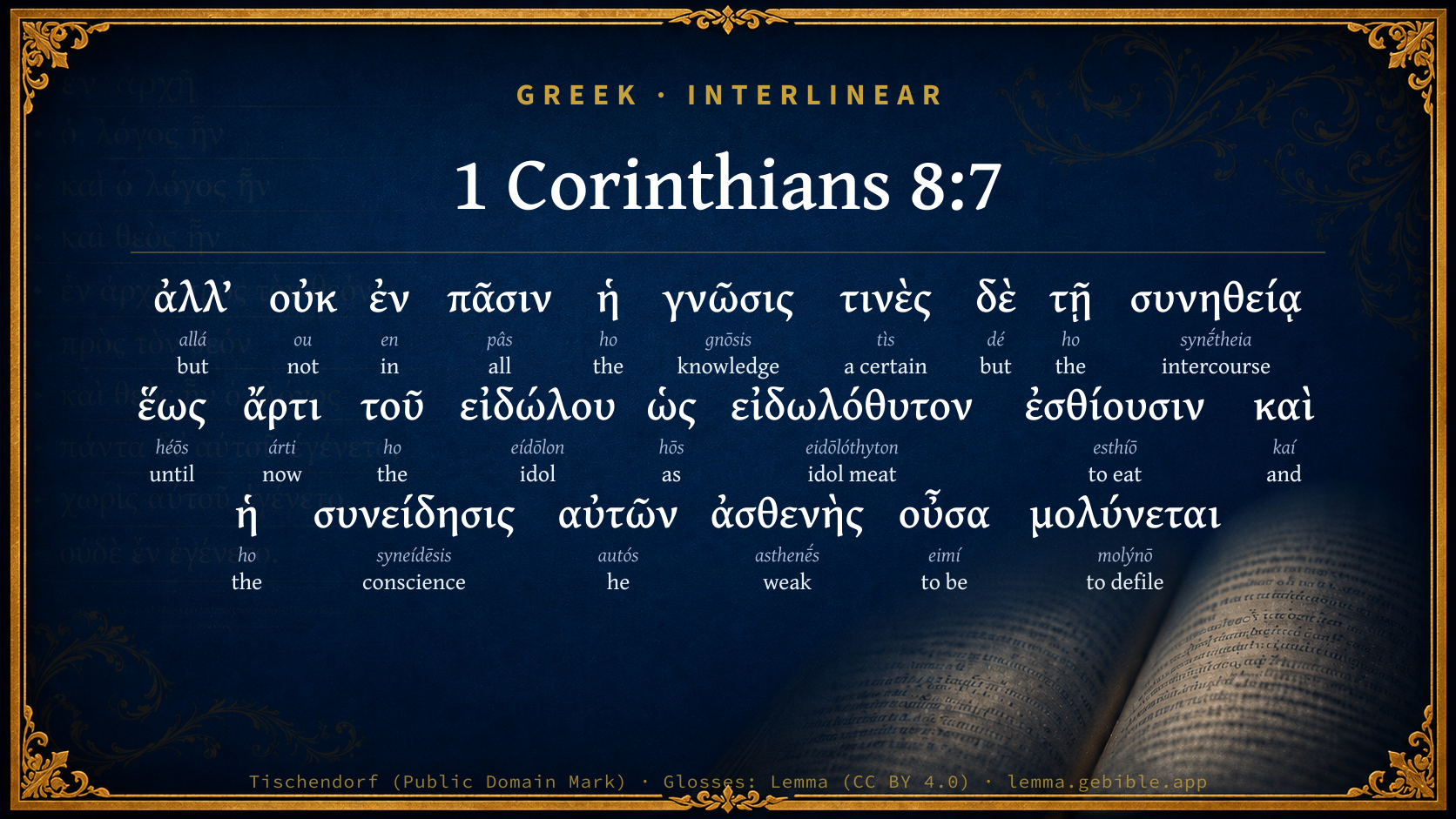
Greek (Tischendorf 8th ed.) 1 Corinthians 8:7 appears in the Greek New Testament. The text above is from the Tischendorf 8th edition. Each word links to its Strong’s number and a concise gloss. Click any word for its full Thayer’s Greek Lexicon entry.
Download image
Cite this verse

1 Corinthians 8:7 (World English Bible). Public Domain. Lemma interlinear Bible study tool, https://lemma.gebible.app/v/1-corinthians/8/7.

Show BibTeX & RIS
BibTeX
RIS
English Translation
However, that knowledge isn't in all men. But some, with consciousness of the idol until now, eat as of a thing sacrificed to an idol, and their conscience, being weak, is defiled.
World English Bible · Public Domain
Highlights
  • 1 first appearance in the Greek New Testament
Full analysis ↓
Download a study sheet

One document with this verse’s original text, its word-by-word gloss line, the meaning frame, cross-references with their text, attributed commentary, and full source and license credits — printable, and it pastes into notes with its structure intact.

This verse Autodidact and up

Study sheet (.html) Plain text (.txt)

A passage Seminary Student

Up to 50 verses in one chapter. A passage sheet keeps up to 6 commentary sources and 12 cross-references per verse, in the order this page ranks them, and says so on the sheet whenever that leaves anything out. Ask for a single verse and you get the Autodidact verse sheet above.

Everything on this page stays free to read, with no account — the sheet is a download of what is already on screen, not access to it.

Want to remove ads? Support Godless Engineer
Compare translations 3

The same verse in 3 English versions, stacked beneath the original-language interlinear above. Click any original word for its lexicon entry.

Each is an independent rendering of the whole verse — the interlinear is not word-aligned to these translations.

Highlighted words mark where these versions differ — a whole-verse word diff, not a word-by-word alignment.

  • World English Bible Public Domain
    However, that knowledge isn't in all men. But some, with consciousness of the idol until now, eat as of a thing sacrificed to an idol, and their conscience, being weak, is defiled.
  • King James Version Public Domain
    Howbeit there is not in every man that knowledge: for some with conscience of the idol unto this hour eat it as a thing offered unto an idol; and their conscience being weak is defiled.
  • unfoldingWord Literal Text CC BY-SA 4.0
    However, this knowledge not in everyone. Instead, some, in the custom of the idols until now, eat things as sacrificed to idols, and their conscience, being weak, is defiled.

unfoldingWord Literal Text — © unfoldingWord, licensed CC BY-SA 4.0. Word-aligned USFM3 via Door43 (git.door43.org/unfoldingWord/en_ult).

Versions to compare (up to 4)

3 of 4 selected

Show all 19 translations

Every available English version of this verse, each an independent rendering of the whole verse.

  • World English Bible Public Domain
    However, that knowledge isn't in all men. But some, with consciousness of the idol until now, eat as of a thing sacrificed to an idol, and their conscience, being weak, is defiled.
  • Berean Standard Bible Public Domain
    But not everyone has this knowledge. Some people are still so accustomed to idols that they eat such food as if it were sacrificed to an idol. And since their conscience is weak, it is defiled.
  • Majority Standard Bible Public Domain
    But not everyone has this knowledge. Some people with consciousness of the idol still eat such food as if it were sacrificed to an idol. And since their conscience is weak, it is defiled.
  • King James Version Public Domain
    Howbeit there is not in every man that knowledge: for some with conscience of the idol unto this hour eat it as a thing offered unto an idol; and their conscience being weak is defiled.
  • American Standard Version (1901) Public Domain
    Howbeit there is not in all men that knowledge: but some, being used until now to the idol, eat as `of' a thing sacrificed to an idol; and their conscience being weak is defiled.
  • Revised Version (1885) Public Domain
    Howbeit in all men there is not that knowledge: but some, being used until now to the idol, eat as of a thing sacrificed to an idol; and their conscience being weak is defiled.
  • Geneva Bible (1599) Public Domain
    But euery man hath not that knowledge: for many hauing conscience of the idole, vntill this houre, eate as a thing sacrificed vnto the idole, and so their conscience being weake, is defiled.
  • Douay-Rheims (1899) Public Domain
    But there is not knowledge in every one. For some until this present, with conscience of the idol: eat as a thing sacrificed to an idol, and their conscience, being weak, is defiled.
  • Young's Literal Translation Public Domain
    but not in all men `is' the knowledge, and certain with conscience of the idol, till now, as a thing sacrificed to an idol do eat `it', and their conscience, being weak, is defiled.
  • Literal Standard Version CC BY-SA 4.0
    but not in all men [is] the knowledge, and certain with conscience of the idol, until now, eat [it] as a thing sacrificed to an idol, and their conscience, being weak, is defiled.
  • Unlocked Literal Bible CC BY-SA 4.0
    However, this knowledge is not in everyone. Instead, some previously practiced idol worship, and they eat this food as if it were something sacrificed to an idol. Their conscience is thereby corrupted because it is weak.
  • unfoldingWord Literal Text CC BY-SA 4.0
    However, this knowledge not in everyone. Instead, some, in the custom of the idols until now, eat things as sacrificed to idols, and their conscience, being weak, is defiled.
  • Darby Bible Public Domain
    But knowledge [is] not in all: but some, with conscience of the idol, until now eat as of a thing sacrificed to idols; and their conscience, being weak, is defiled.
  • World Messianic Bible Public Domain
    However, that knowledge isn’t in all men. But some, with consciousness of an idol until now, eat as of a thing sacrificed to an idol, and their conscience, being weak, is defiled.
  • Webster's Bible Public Domain
    But there is not in every man that knowledge: for some with conscience of the idol to this hour eat it as a thing offered to an idol; and their conscience, being weak, is defiled.
  • Free Bible Version CC BY-SA 4.0
    But not everyone has this “knowledge.” Some who up to now have been so used to idols as a reality that when they eat food sacrificed to an idol, their conscience (which is weak) tells them they have defiled themselves.
  • Bible in Basic English Public Domain
    Still, all men have not that knowledge: but some, being used till now to the image, are conscious that they are taking food which has been offered to the image; and because they are not strong in the faith, their minds are troubled.
  • Text-Critical English NT CC BY 4.0
    However, not everyone possesses this knowledge. But some have idols in their conscience even now and eat such food as something sacrificed to idols, and since their conscience is weak, it is defiled.
  • Tyndale New Testament (1534) Public Domain
    But every man hath not knowledge. For some suppose that ther is an ydoll vntyll this houre and eate as of a thinge offered vnto the ydole and so their consciences beynge yet weake are defyled.

Literal Standard Version (2020), Covenant Press — licensed CC BY-SA 4.0. Text via the HelloAO Bible API (eBible.org). Unlocked Literal Bible (unfoldingWord) — licensed CC BY-SA 4.0. Text via the HelloAO Bible API (eBible.org). unfoldingWord Literal Text — © unfoldingWord, licensed CC BY-SA 4.0. Word-aligned USFM3 via Door43 (git.door43.org/unfoldingWord/en_ult). Free Bible Version, Dr. Jonathan Gallagher — licensed CC BY-SA 4.0. Text via the HelloAO Bible API (eBible.org).

Word by word

More ways to search: Search by grammar → Find every occurrence → Compare this word →

Practice this passage: Drill this verse → Learn its vocabulary →

συνηθείᾳ
synḗtheia
G4914
“intercourse”
Noun, Dative, Singular, Feminine
Part of Speech
Noun
Case
Dative
Number
Singular
Gender
Feminine
Full Thayer's Definition

Origin: from a compound of G4862 and G2239

TDNT: None

1. intercourse (with one), intimacy 2. custom 3. a being used to, accustomed
  1. ἀλλ’ allá G235 “but” Conjunction
  2. οὐκ ou G3756 “not” Particle, Negative
  3. ἐν en G1722 “in” Preposition
  4. πᾶσιν pâs G3956 “all” Adjective, Dative, Plural, Masculine
  5. ἡ ho G3588 “the” Article, Nominative, Singular, Feminine
  6. γνῶσις gnōsis G1108 “knowledge” Noun, Nominative, Singular, Feminine
  7. τινὲς tìs G5100 “a certain” Indefinite pronoun, Nominative, Plural, Masculine
  8. δὲ dé G1161 “but” Conjunction
  9. τῇ ho G3588 “the” Article, Dative, Singular, Feminine
  10. ἕως héōs G2193 “until” Adverb
  11. ἄρτι árti G737 “now” Adverb
  12. τοῦ ho G3588 “the” Article, Genitive, Singular, Neuter
  13. εἰδώλου eídōlon G1497 “idol” Noun, Genitive, Singular, Neuter
  14. ὡς hōs G5613 “as” Adverb
  15. εἰδωλόθυτον eidōlóthyton G1494 “idol meat” Adjective, Nominative, Singular, Neuter
  16. ἐσθίουσιν esthíō G2068 “to eat” Verb, Present, Active, Indicative, 3rd person, Plural
  17. καὶ kaí G2532 “and” Conjunction
  18. ἡ ho G3588 “the” Article, Nominative, Singular, Feminine
  19. συνείδησις syneídēsis G4893 “conscience” Noun, Nominative, Singular, Feminine
  20. αὐτῶν autós G846 “he” Personal pronoun, Genitive, Plural, Masculine
  21. ἀσθενὴς asthenḗs G772 “weak” Adjective, Nominative, Singular, Feminine
  22. οὖσα eimí G1510 “to be” Verb, Present, Active, Participle, Nominative, Singular, Feminine
  23. μολύνεται molýnō G3435 “to defile” Verb, Present, Passive, Indicative, 3rd person, Singular

About this verse

These counts appear in no published source. They are computed here, from the morphology-tagged text and Lemma’s own curated glosses. What Lemma adds →

24
words
21
distinct lemmas
Pauline Epistles
section

Notable vocabulary

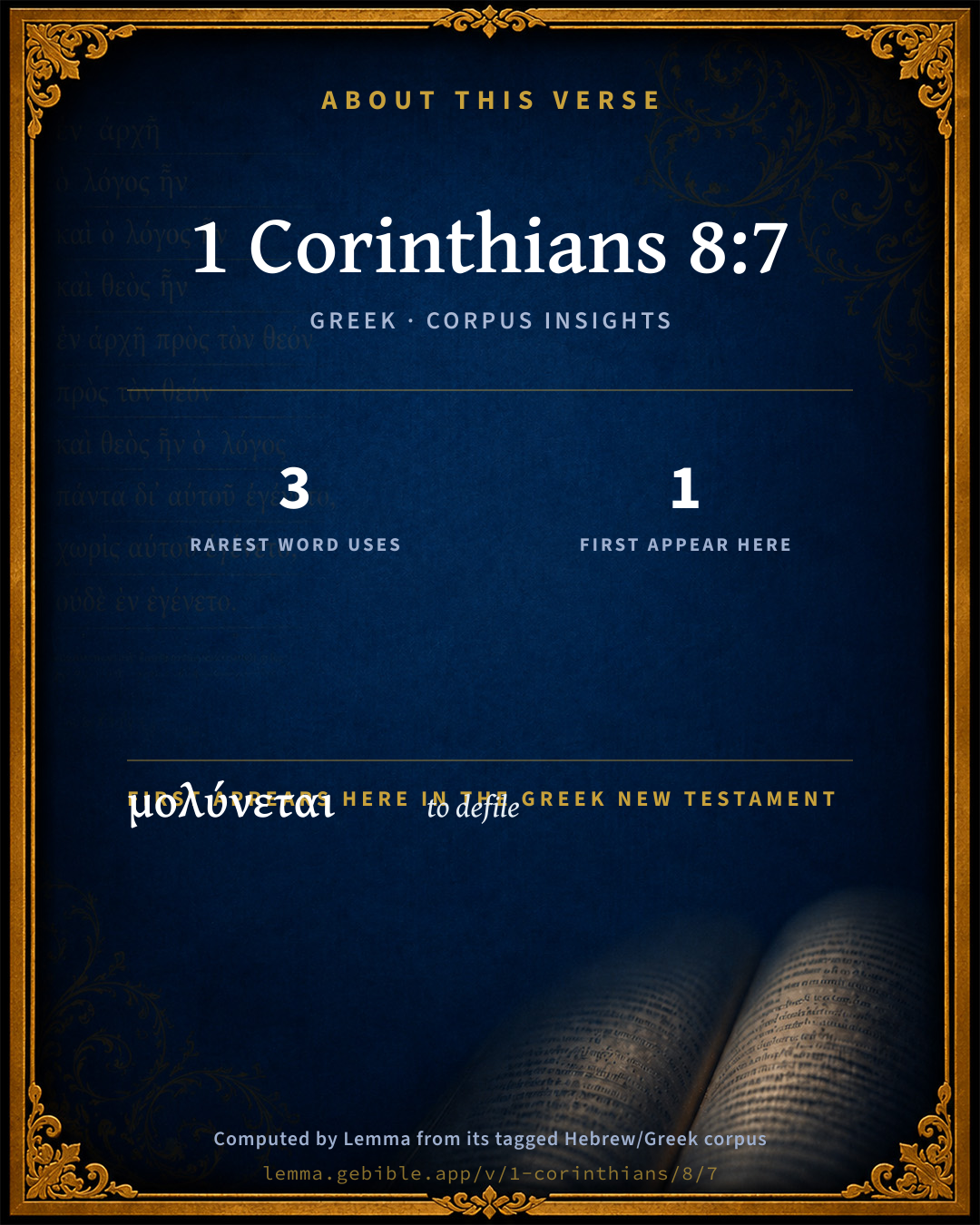
The rarest word here is συνηθείᾳ intercourse G4914 — appearing just 3 times in the whole Greek New Testament.

First appearance in Scripture

This word makes its first canonical appearance in the Greek New Testament here:

  • μολύνεται to defile G3435

Shared distinctive vocabulary

συνηθείᾳ intercourse G4914 occurs in 3 verses of the Greek New Testament. Also found in:

Repetition

A word recurs within this verse:

Cross-references

5

Topical passages linked to 1 Corinthians 8:7 in the Treasury of Scripture Knowledge — connected by theme and wording, ordered by reader-vote popularity; previews shown in the World English Bible.

  • Romans 14:14 I know, and am persuaded in the Lord Jesus, that nothing is unclean of itself; except that to him who considers anything to be unclean, to him it is unclean.
  • 1 Corinthians 10:28–29 But if anyone says to you, "This was offered to idols," don't eat it for the sake of the one who told you, and for the sake of conscience. For "the earth is the Lord's, and all its fullness."
  • Romans 14:22–23 Do you have faith? Have it to yourself before God. Happy is he who doesn't judge himself in that which he approves.
  • 1 Corinthians 8:9–10 But be careful that by no means does this liberty of yours become a stumbling block to the weak.
  • 1 Corinthians 1:10–11 Now I beg you, brothers, through the name of our Lord, Jesus Christ, that you all speak the same thing and that there be no divisions among you, but that you be perfected together in the same mind and in the same judgment.

Cross-references courtesy of OpenBible.info (CC BY 4.0).

Where the printed editions differ

1 variant

Places in this verse where the major printed Greek editions disagree on the wording in a way that affects the translation — a comparison of editions, not a manuscript-by-manuscript collation. The editions are the modern critical texts (Nestlé-Aland 28/27, SBL, Westcott-Hort, Tregelles, Tyndale House) and the traditional texts behind the KJV (the Textus Receptus and the Byzantine/Majority text). It is not a claim about which reading is original.

  1. Different wording
    συνηθείᾳ

    “by custom”

    In NA28NA27TynSBLWHTreg Not in TRByz

    συνειδήσει (suneidēsei) 'by conscience' occurs in traditional manuscripts (TR+Byz) instead of συνηθείᾳ (sunētheia) 'by custom' in older manuscripts (NA28+NA27+Tyn+SBL+WH+Treg)

Textual data: Translators Amalgamated Greek New Testament (STEPBible TAGNT) · CC BY 4.0.

Commentary

Notes on 1 Corinthians 8:7 from classic Christian and Jewish commentators (each source and its license shown beneath its notes). The classic Christian expositions comment on the surrounding passage and are grouped to its opening verse, so a note may address several verses; the Jewish commentaries on the Tanakh (Rashi and others) are per-verse, so they appear only where the commentator wrote on this verse.

Lemma curates 59 commentaries, every one of them public domain or Creative Commons licensed, each selected and text-cleaned for this edition rather than reprinted as found. About our sources →

The Biblical Illustrator

Joseph S. Exell

1Co_8:7-13

Howbeit there is not in every man that knowledge.

Ignorance

1. Great ignorance may consist with genuine piety.

2. Is a source of much unnecessary anxiety and peril.

3. Is to be deplored and pitied.

4. May find relief in the study of Divine truth. (J. Lyth, D. D.)

Christian liberty

I. Its nature.

1. Implies freedom of action in things indifferent.

2. Depends on knowledge.

3. Requires conscientious conviction.

II. Its limits--

1. Defined by a brothers weakness.

2. By love to Christ.

3. By self-sacrificing love. (J. Lyth, D. D.)

For some with conscience of the idol … eat … and their conscience being weak is defiled.--

The law of Christian conscience

I. The exposition of the law itself (1Co_8:7-8). The apostle tells the strong-minded Corinthians that the superstitious of their weaker brethren are unquestionably wrong (1Co_8:8); but he also tells them that there is not in every man that knowledge, &c. (1Co_8:7), i.e., some have an ignorant, mistaken conscience; and yet he insists that this conscience, so ill-informed, yet binds the possessor of it: and their conscience being weak, is defiled. Here, then, we have the distinction between absolute and relative right and wrong. Absolute right and wrong are unalterable. But the right or wrong of any action done by any particular man is a matter relative to his particular circumstances. That charity and self-denial, e.g., are right--this we see recognised in almost every nation. But when and how far self-denial is right, and what are the bounds of charity, this is for different circumstances to determine. And so it will be found that there is a different standard among different nations and in different ages, e.g., the standard among the Israelites in the early ages was very different from that recognised by the later prophets. And the standard in the third and fourth centuries was an entirely different one from that recognised among ourselves. The principle laid down by the apostle is this. That which seems to a man to be right is, in a certain sense, right to him; and that which seems to a man to be wrong, in a certain sense is wrong to him (Rom_5:14; Rom_14:14).

II. The applications which arise out of it.

1. Personally. Do what seems to you to be right: it is only so that you will at last learn by the grace of God to see clearly what is right. A man is responsible for the opinions he holds, and still more for the way in which he arrived at them--whether in a slothful and selfish, or in an honest and truth-seeking manner; but being now his souls convictions, you can give no other law than this--You must obey your conscience. For no mans conscience gets so seared by doing what is wrong unknowingly as by doing that which appears to be wrong to his conscience.

2. To others. To the large, free, enlightened mind of Paul, all these scruples and superstitions must have seemed mean and trivial. But conscience was far more sacred to him than even liberty. The scruple may he small and foolish, but it may be impossible to uproot it without tearing up the feeling of the sanctity of conscience, and of reverence to the law of God, associated with this scruple. And therefore the Apostle Paul counsels these men to abridge their Christian liberty, and not to eat of those things which had been sacrificed to idols, hut to have compassion upon the scruples of their weaker brethren. And this for two reasons.

(1) Christian feeling. It might cause exquisite pain to sensitive minds to see those things which appeared to them to be wrong done by Christian brethren. Take a parallel case. There is no doubt that it causes much pain to many Christians to see a carriage used on the Lords day. But you, with higher views of the spirit of Christianity, can exercise your liberty. But is it not your duty to abridge your Christian liberty, and to go through rain, and mud, and snow, rather than give pain to one Christian conscience?

(2) It might even lead their brethren into sin. If any man should eat of the flesh offered to an idol, feeling himself justified by his conscience, it were well: but if any man, overborne by authority or interest, were to do this against conscience, his compliance would as much damage his moral sense as if the act had been wrong in itself.

Conclusion:

1. Distinguish between this tenderness for a brothers conscience and mere time-serving. This same apostle whom we here see so gracefully giving way upon the ground of expediency, stood firm as a rock when anything was demanded which trenched upon Christian principle (Gal_2:5).

2. This abridgment of liberty is a duty especially incumbent upon all who are possessed of influence. If the landlord uses his authority and influence to induce his tenant to vote against his conscience, it may be he has secured one voice to the principle which is right; but he has gained that single voice at the sacrifice and expense of a brothers soul. Or again, if for the sake of ensuring personal attention, the rich man puts a gratuity into the hand of a servant of some company which has forbidden him to receive it, he gains the attention at the expense of a man and a Christian brother.

3. How possible it is to mix manliness with charity! No man ever breathed so freely the atmosphere of heaven as Paul--no man ever soared so high above all scruples as he: and yet no man ever bound himself as St. Paul bound himself to the scruples of his brethren. So that, what in other cases was infirmity, imbecility, and superstition, gathered round it in his case the pure high spirit of Christian delicacy. And now, out of the sayings of those who loudly proclaim the rights of man and the rights of liberty, match us if you can with one sentence so sublime as 1Co_8:13. (F. W. Robertson, M. A.)

A weak conscience, i.e.,

as we might say diseased, incapable of forming a sound healthy judgment. As we speak of weak nerves the apostle speaks of a weak conscience. A person who has been taught when a child to believe in ghosts, will sometimes be seized with dread if he is alone at night, though his reason has long since convinced him that spectres do not appear. Similarly, though the moral reason of a Christian tells him that the heathen deities which he formerly worshipped do not exist, yet it requires spiritual knowledge of the true God to allay his dread. Cf. 1Ti_1:5, where the apostle joins a good conscience with faith unfeigned. (Principal Edwards.)

Abstinence for the sake of others

Of the flesh of beasts slain by the heathen priests in the service of their gods only a portion being required for the religious rites, the remainder was consumed as food by the priests or exposed for sale in the public markets. Entertainments were sometimes given in localities more or less closely associated with the idolatrous worship, and these meats were offered to the guests. Was it right to partake of such food? There may be at least four different methods of treating a question of that sort. It may be determined merely upon considerations of personal inclination and enjoyment. Those are the only considerations, some might say. If the meat is good, and I want it, why refuse it? With others the case would be at once submitted to the judgment of society: What is the custom? How do my associates dispose of the problem? A third and manifestly higher method asks, What is right? What does an enlightened conscience approve? Here are three entirely distinct methods of dealing with a question of practical morality. But neither of these schemes suit Paul. There is a larger question of charity: How might my habit affect others, and especially my religious associates?

I. In this golden sentence is seen the sensitiveness of Christianity with regard to the weak and the obscure. Such a sentiment was practically new. Christianity for the first time made charity a rudimentary virtue, says Lecky, the historian of European morals. How strange was this method is apparent also from the early criticisms of Christianity--that of Celsus, for example. Why, said he, woollen-manufacturers, shoemakers, and curriers, the most uneducated and boorish of men, are zealous advocates of this religion! By the apostle, however, the opprobrium was turned into a sort of boast: Ye see your calling, brethren … God hath chosen the weak things to confound the mighty. These weak things Paul never made the mistake of despising. We, too, shall deal most successfully with similar cases of conscience when we are nearest to Pauls Master and ours, having most of his life in us, his mind of love. Many a boy proudly drops his bat and ball to run and serve his mother or his sister. Such surrenders love counts among its privileges and joys. And if the earthly affection can easily do this, is it likely that a mightier passion will fail?

II. We are taught, further, that the individual is of less consequence than society. That seems too plain to need reiteration. But practically it is not always acknowledged. Writers like Mill put the stress upon personal liberty. They are slow to justify legal measures or social laws which in any degree abridge the privileges of the individual. Such invasion of rights they would condemn, except under the greatest necessity. They seem to estimate a man too high, and mankind too low. But Providence does not make such estimates. What we call the laws of nature constantly subordinate us to the general good. The progress of history is achieved through suffering and martyrdom. Father and mother must deny themselves for the family. Sons and brothers die that the republic may live. Science and invention go forward through unrequited sacrifices. In the fact that men have so often tried to reverse Gods computations, and make the one to be worth more than the many, lies the secret of much of the misery of the human race. Along the lines of this vicious calculation rivers of blood have flowed. Think of the kings and princes who from thrones of gold have looked down upon the millions of their subjects only as the small dust of the balance.

III. It is also to be remembered that in the comparison of thess opposite methods, and in determining the issues which they involve, is to be found an important element of education. The settlement of moral questions to which we are daily summoned is designed for our discipline, a means both of testing and increasing our love for the Master and for His people. With a child we are best satisfied not when he promptly obeys an express command, but when, left to choose for himself, he deliberately prefers anothers pleasure to his own. That shows, and at the same time develops, the kindness of his heart. It is often objected, however, that the requirements of such a charity may become unreasonable, and oppressive--that there are narrow-minded and captious persons who, upon any pretext, will seek to obstruct our freedom and spoil our innocent pleasures. Where, then, shall the line be drawn? The only answer must be that a line cannot be definitely drawn. We are left to the impulses of our natural or gracious hearts. They will put their own constructions upon every principle laid down for guidance. The problem is not, Who is technically right? nor, Who has the better head and the more enlightened conscience? nor, Who is more prominent in the worlds work? This is not a matter of pride, but of self-forgetting charity. The stress and point lie in the question, What will save this brother whom my liberty might offend.? The more unreasonable the prejudice, likewise, to which we yield, the weaker the opinion to which we make our offering of peace and goodwill, the more tenderly will God be sure to regard it. We may be thankful if instead of being among those who ask for concessions, we have reached the high place of those who are delighted to grant them.

IV. The superiority of love as a law is manifest, therefore. Such a force is not only disciplinary, but it is in the highest degree disciplinary; it secures the best advantage and growth. This law is not arbitrary. It is no law of fanaticism or enthusiasm or self-torture. In preferring it we only surrender a lower, because we seek a manifestly higher, good. To work from fear is slavery; to work under the compulsion of animal want is a hardship, and if not a positive yet a relative curse; to work for personal ends, as for pride or ambition or the accumulation of property, either for its own sake or our own sake, is compatible with freedom, but has in it nothing either purifying or ennobling; it finds and leaves the soul dry and hard. But activity from love is the perfection of freedom and of joy. We are never so high and great as when for love we can easily make sacrifices to advance the unity and power of Christs Church or the welfare of those for whom He died.

V. How various are the problems of our modern life which this lesson touches we may readily discover. Shall I drink wine? What shall be my attitude toward the theatre and the opera? How shall I deal with the question as to promiscuous dancing? Shall I on Sunday patronise the street-railway? What games shall I approve? How far may I indulge a taste for personal adornment, particularly in places of public worship? What principles and limitations of expenditure are to be preferred in building, beautifying, and administering a home? These and a thousand like inquiries are to be treated in the spirit with which Paul approached the Corinthian problem about meat. They are not merely ethical, but Christian, problems. (H. A. Edson, D. D.)

Abstinence for the sake of others

Slight acts may loose vast forces, as a shout starts an Alpine avalanche. Insignificant questions may involve great principles. So was it with the Corinthian Church. The body of Christ was torn about a piece of meat; but the strife involved solemn matters--love for Christ and dying souls.

I. The law of knowledge. We commonly reckon knowledge to be a product of the intellect, including the powers by which we learn facts, reason upon them, and draw conclusions. The kind of knowledge determines the instrument by which we are to acquire it. Pure mathematics, abstract logic, may seem to use only the seeing eye and reasoning mind. But really to know a thing, the student must have some affinity for the object. It must find him, must stir a response in his nature. True of nature and art, this is more commandingly true of our fellow man. We cannot know him or any truth concerning his life and character except as we love him. This is the only way to get Gods way of looking at him, Gods ideal for him. Love is the discoverer, love is the interpreter, love the guide. Knowledge without love is the turbine without waterfall, wire without electricity. Love without knowledge is cataract minus wheel, loose lightning in the heavens. Love with knowledge is the servant and benefactor of mankind. Love has chemic tests, microscope, clairvoyance. It is the expert picking up the pebble a settlers child is playing with and telling the man he is farming over a gold mine. Knowledge despises his ignorance and leaves him to its poverty. The characteristic of modern charity is the combination of scientific method with personal devotion. It studies the case with minute pains, then helps it with cool head and steady hand as well as warm heart. The worst enemy of true charity is indiscriminate giving; and true giving means personal contact. It is so much cheaper to give money than to give ones self, and the reward is correspondingly small. This is the law: True knowledge includes love; it comes through head and heart together.

II. The law of conscience. But what law can there be to a faculty divided against itself, that, seeing two men doing the same thing, smiles upon one and smites the other? Which of them is right? How can any one ever be sure he is right? Conscience is called the voice of God in the soul of man; but can God say Yea and Nay together? The faculty we name conscience is not simple, but complex. It includes the impulse which commands, Do right; when you know the light, do it, whatever the cost. But back of this lies the judgment which tells us what is right. Not attempting the philosophical definitions, call the one moral impulse, the other moral judgment. The first of these is essentially the same in all sound souls, while differing in force and accepted control. The second differs according to birth, training, personal experience. Plainly, then, persons equally anxious to do right may differ as to the right or wrong of a specific act. Equally conscientious, they conscientiously disagree. Each, trying to do right, does what the other condemns. They agree in moral impulse, but disagree in moral judgment. The difficulty is great, and to recognise its occasion does not remove it. Two precepts are to be urged--

1. Cultivate the moral impulse, which insists upon obedience to known right. Guard this high conception of the majesty of righteousness. Listen to the whispers of conscience rather than to the shouts of interest or songs of pleasure. Protect the sensitiveness of moral discernment as a piano tuner guards the accuracy of his ear. Recur constantly to the invariable standard. Crowd forward conviction into action.

2. Train the moral judgment, which decides whether a specific act is right or wrong. Extend the control of conscience to the formation of opinions. Educators of the moral judgment are--

(1) Revelation. A clear word from God is end of debate.

(2) The teachings of reason, vitalised by love.

(3) Experience; our own, that of the wise and good, and the broad testimony of history.

(4) A spiritual life. Constant fellowship with Christ, effort to grow like Him and to win others to Him, furnish the finest tests and incitements to right moral decisions. We can have Gods wisdom for the asking, the especial illumination of the Holy Spirit. Changes of conviction will issue in changes of practice, and with these may come a period of unrest, while the moral sense is becoming adjusted to the judgment. The immorality of false opinions and virtue of right convictions are often discredited; but they make life, character, destiny. This is the law of conscience: Cultivate a sensitive and positive moral impulse; train the moral judgment to clear and spiritual views.

III. The law of conduct. Conduct has two relations--between myself and God, and between myself and my neighbour. An act done in the sight of others becomes example, and what is innocent kept to myself alone may be hurtful if indiscriminately followed. Unfortunately, doing in secret what is condemned in public savours of insincerity and hurts a delicate honour. As a rule, what is good for me is good for my neighbour, and what hurts him is bad for me. Which of us has suffered much from giving the weak brother, the holy Christ, the benefit of the doubt? That weak brother, he is ever with us; what shall we do about him? Would that he were strong! How we admire the well-poised man, clear head at the top and firmly set feet beneath; physical passions and temper and tongue following obediently at the heel of sound reason; warm heart and positive will, handmaids of a sensitive and proud conscience! Such there are, and how simple to them is life! But they are as rare as admirable. The weak brother, whose claim is mainly his weakness--he ought to train his moral judgment, be fully persuaded in his own mind, then be content to stand or fall to his own Master; but it is not so with him. He keeps looking to see what we do, putting us on a pedestal we have no wish to occupy. Have not we rights also? Yes; and what right higher than to surrender rights to gain blessings? To hesitate between tickling ones palate and saving a soul from death would be worse than brutish. Grant that this means surrender of what we might claim but for this weak brother, are we losers? Am I impoverished by putting helpfulness above self-assertion? What is self-denial but choosing the nobler and better part? Give the weak brother and the spiritual life the benefit of the doubt. The example of abstinence involves no risks. Grow rich by giving up, gain life by dying to self and the world. While this law is general, its application in a temperance lesson is peculiarly clear. Here, of all cases, abstinence involves no risks; and appeals to the weaker without example of abstinence come to nothing. (Charles M. Southgate.)

Abstinence for the sake of others

Not a few of the church members in Corinth reserved the right to purchase and partake of these meats. Where is the flaw in their argument? The apostle meets and controverts it with great clearness.

I. He alleges that charity is better than knowledge. We all, says he, have knowledge. We are all able to make a showing of reasonableness for our foibles and prejudices. The poorest cause may be bolstered by an argument. Knowledge puffeth up, but charity edifieth, literally buildeth up. Self-vindication makes us conceited and dogmatic; but charity helps both us and others. The charity here referred to is the largest of the Christian graces. It is the Greek ἀγάπη, the Vulgate charitas; it is love in its broadest and deepest sense. It includes love towards God as well as towards men. It is like the constant commerce which is going on between the waters of the heavens and the earth; the rills trickle into the brooks, the brooks murmur towards the rivers, the rivers roll onward to the sea, and the seas are exhaled into the clouds above to distil again in grateful showers and morning dews. So love is the constant means and communion between God and His children. We know our franchise, said the Christian banqueters of Corinth; we have knowledge as to the true character of idols and idol-worship, and are therefore in no danger of being led astray. Knowledge! knowledge! replies the apostle, but what about love? If any man love God the same is known unto Him, and that is the knowledge worth having. All the wisdom of the schools is not to be valued with the assurance that we love God; and the same may be known unto us.

II. The Apostle Turns, Secondly, To A Consideration Of Individual Freedom. For these Corinthian Christians were disposed to stand upon their rights. They said in effect, There is no specific injunction as to these idol-meats in Scripture. The question is left to the individual conscience. Our consciences are clear; the meats do not injure us. We therefore propose to do as we please about them. Granted, says Paul, I do not dispute your rights in these premises; but there are some important facts which you are in danger of losing sight of. He then reminds them--

1. That the mere matter of eating or abstaining is in itself of slight consequence; for meat commendeth us not to God; neither if we eat are we the better, nor if we eat not are we the worse. So small a matter therefore as a dish upon ones table should not be permitted to jeopardise the spiritual interests of any.

2. There are some weaker brethren who have less knowledge. These weaker brethren must not be left out of the reckoning. We are in a measure responsible for them. Am I, then, my brothers keeper? Aye, and if he fall over a stumbling-block of my making, I shall be held responsible for it.

3. Rights are relative. Some of them must bow down to others, as did the lesser stars to the greater in the patriarchs dream. A mans lowest right is to please himself; his highest is to deny himself for others. Rights may conflict, but duties never; and duty always has the highest and uttermost claim.

4. As to individual freedom there is no such thing. If there were only one man in the universe he might be absolutely free to serve his own pleasure, but the moment you introduce another man there is a mutual restriction. Each is now free only so far as his freedom does not infringe upon the other. It is a mistake to think of freedom as license. There is, in fact, nothing in the world more circumscribed than true freedom. It is not lawlessness nor deliverance from restraint. Its best definition is, Perfect obedience to perfect law. True, we are no longer children of the bond-woman, but of the free. He who comes forth from the bondage of the law into the liberty of the gospel bows down, at the very threshold of his new life, and gives himself as a slave to serve the interests of his fellow men.

III. This leads us, thirdly, to consider with the apostle the example of Christ Himself. Through thy knowledge shall the weak brother perish for whom Christ died? For whom Christ died! Is it true, then, that Jesus stooped to the infirmity of the least of His little ones? Aye, and here are we, followers of His, haggling about meats and drinks! God forgive us, that we fall so far short of the mind that was in Christ Jesus our Lord. In Php_2:7 occurs a word about which there is much controversy. The word is kenosis; it means an utter emptying, and is applied to Christs humiliation. When He crossed the threshold of heaven to undertake His redemptive work He laid aside crown, royal robes, heavenly retinue, everything, that He might restore the race of fallen men. He was free to remain where He was; but He put away His freedom and took upon Himself the form of a servant for our sake. Oh, by the love and devotion of our Lord, let us cease our clamouring for rights, and begin to ask, How may we empty ourselves as He did for the uplifting of the children of men? The point at which humanity comes nearest to Deity is self-denial. Its best illustration is at Calvary, where God stoops down to embrace His penitent children. The summit of human character is reached when a man gives himself for others. Christ did it. We also, for Christs sake, must do it. (D. J. Burrell, D. D.)

The Biblical Illustrator, edited by Joseph S. Exell (c. 1880s–1900s) — public domain. Text from a community e-Sword module.

Joseph Benson's Commentary

1Co 8:7-8. Howbeit, there is not in every man — In every professing Christian; that knowledge — Namely, that there is but one God, and one Lord, and that an idol is nothing, and has no power to defile the meat: some Christian converts may not sufficiently apprehend this, but may imagine there is really some invisible spirit present in the idol, and acting by and upon it: for some with conscience of the idol — Out of some respect to it, as if it were a kind of deity; unto this hour — Even since their embracing of Christianity; eat it — The meat; as a thing offered unto an idol — With some religious regard to the idol, intending thereby to pay some kind of homage to it; and their conscience being weak, is defiled — “The weakness of their conscience,” says Macknight, “consisted in their believing that idols had a real existence as gods, and were employed by God in the government of particular countries and cities. And the defiling of their conscience consisted in their hoping to receive benefit from the idol, or at least to avoid the effects of his wrath, by joining in the sacrifice that was offered to him.” Others interpret the verse more consistently with the context, thus: Some eat with consciousness of the idol, that is, fancying it is something, and that it makes the meat unlawful to be eaten; and their conscience being weak — That is, not rightly informed; is defiled — Contracts guilt by so doing. But — Why should we occasion this inconvenience? for we know that meat commendeth us not in any degree to the acceptance and favour of God — Abstracted from circumstances; neither by our eating, nor by our refraining from it: eating and not eating are in themselves things merely indifferent. For neither if we eat — What has been offered to an idol, are we the better, more holy in God’s sight; neither if we eat not — But conscientiously abstain from such meat; are we the worse — Disapproved of by him, and exposed to his displeasure. “The great God does not so much esteem a man for being, or disapprove of him for not being, superior to such little scruples: but the tenderness of his conscience, together with the zeal and charity of his heart, are the grand qualities he regards.” — Doddridge.

Joseph Benson's Commentary on the Old and New Testaments (1811–1818) — public domain. Text from a community e-Sword module.

Tyndale Open Study Notes

Tyndale Open Resources

8:7 Many of the Corinthian believers, having grown up in the pagan world, viewed eating such meat as an expression of devotion to the god to whom the meat had been sacrificed. For such Christians, to eat meat presented to an idol would violate their weak consciences (see 8:10-12; 10:28-29; Rom 14:13-23).

Tyndale Open Study Notes — © Tyndale Open Resources, licensed CC BY-SA 4.0. Text via the HelloAO Bible API.

Meyer's Critical & Exegetical Commentary

Heinrich August Wilhelm Meyer

1Co_8:7. We know that there is no idol, etc.; however, this γνῶσις that we speak of (ἡ) is not in all; but doubtless (the δέ as in 1Co_7:37, and very oftenso 1Co_8:9after a negative clause) there are many who, etc.

τῇ συνειδήσει ἕως ἄρτι τοῦ εἰδώλου] in virtue of their conscience till now regarding the idol, i.e. through this, that their moral consciousness is still burdened with the conception of an actual existence of the heathen gods as such. The opposite of the συνείδησις τοῦ εἰδώλου is: οἴδαμεν, ὅτι οὐδὲν εἴδωλον ἐν κόσμῳ, 1Co_8:4. Because those who are weak in the faith have not risen to this conviction, but still remain under the belief that the idols really exist, therefore they eat the meat offered to idols as meat offered to idols, i.e. their conception in eating it is, not that it is the same as other meat, and consequently to be partaken of without scruple and without receiving any idolatrous defilement, but that it is really meat consecrated to an idol which is assumed to exist, and hence that to eat of it is sinful.

συνείδησις[1347]] means simply conscience (neither judicium, as many maintain, nor obscure conception, as Schulz would have it; Billroths rendering is better, though still inexact: conviction that there are εἴδωλα; so also Reiche, Maier), and ΤΟῦ ΕἸΔΏΛΟΥ is the object of the moral consciousness, the article indicating the idol in a generic way. As to the gen. with συνείδ., comp Heb_10:2; 1Pe_2:19; so also frequently in Greek writers. The context shows what the relation is as regards meaning (here it is that which is inherent in the consciousness as its contents).

ἝΩς ἌΡΤΙ] marks off the time more sharply than always as yet (Hofmann), which would be ἜΤΙ; it means, up to this very hour (1Co_4:13, 1Co_15:6, and in all other passages). Taking the usual order of the words, it would most naturally attach itself to ἐσθίουσι; but since the place which on critical grounds must be assigned to it is before ΕἸΔΏΛΟΥ (see the critical remarks), it must be joined to Τῇ ΣΥΝΕΙΔΉΣΕΙ. We might have expected Τῇ ἝΩς ἌΡΤΙ ΣΥΝΕΙΔΉΣΕΙ ΤΟῦ ΕἸΔΏΛΟΥ or Τῇ ΣΥΝΕΙΔΉΣΕΙ ΤΟῦ ΕἸΔΏΛΟΥ Τῇ ἝΩς ἌΡΤΙ; even in Greek authors, however, one finds adverbial attributives used in this loose adjectival way without any connecting article; and Paul himself in other places employs this mode of expression (see on 1Co_12:28; 2Co_11:23; Php_1:26; Gal_1:13).

It is an artificial construction, and without sufficient ground, to supply a second ΣΥΝΕΙΔΉΣΕΙ (without the article) after Τῇ ΣΥΝΕΙΔ., and connect ἝΩς ἌΡΤΙ ΤΟῦ ΕἸΔΏΛΟΥ with this.

ἈΣΘΕΝῊς ΟὖΣΑ] because it is weak; for were it strong, it would no longer have suffered itself to be morally bound by the conception of idols, and hence would not have been defiled (made conscious of guilt) by eating, because in that case the eating would be ἐκ πίστεως (Rom_14:23). ΜΟΛΎΝΕΙΝ (comp 2Co_7:1), of ethical defilement; also in Sir_21:28; Porphyr. de Abstin. i. 42; Synesius, Ephesians 5. Comp Tit_1:15 : ΜΙΑΊΝΕΙΝ. Observe there the two sides of the conscience: it was weak to begin with, and afterwards it is defiled as well.

[1347] See generally, besides von Zezschwitz (Profangräcit. pp. 52 ff., 75), Köhler, Schriftgemässe Lehre vom Gew., 1864; Delitzsch, Psychol. p. 133 ff.; Lindes, de vi et ratione συνειδήσεως ex. N. T., Lund, 1866; R. Hofmann, Lehre vom Gew., Leipz. 1866.

NOTE.

The ἕως ἄρτι, which points back to their state before conversion, puts it beyond question that the weak brethren are not to be conceived of as Jewish-Christians, but as Gentiles, whose conscience was still burdened with the belief, brought with them from the heathen period of their lives, that the idol was a divine reality. They must have supposed the idols to be subordinate divine being (not demons, as Neander thought, which, according to 1Co_10:20, would have been the correct conception), from whose worship they had been brought to that of the one Supreme God; so that they could not look upon the consumption of sacrificial flesh as a mere harmless eating of meat, but had their conscience always hampered with the thought that by so eating they were brought into contact with those idol-deities. Theophylact puts it rightly (comp Chrysostom): ἮΣΑΝ ΓᾺΡ ΠΟΛΛΟῚ ἘΞ ΕἸΔΩΛΟΛΑΤΡΊΑς Τῇ ΠΊΣΤΕΙ ΠΡΟΣΕΛΘΌΝΤΕς ΟἻ ἝΩς ἌΡΤΙ, ΤΟΥΤΈΣΤΙ ΚΑῚ ΜΕΤᾺ ΤῸ ΠΙΣΤΕῦΣΑΙ, ΤᾺ ΕἸΔΩΛΌΘΥΤΑ ἘΣΘΊΟΥΣΙΝ Ὠς ΕἸΔΩΛΌΘΥΤΑ. Theodoret says: ΟὐΧ Ἡ ΒΡῶΣΙς ΜΟΛΎΝΕΙ, ἉΛΛᾺ Ἡ ΣΥΝΕΊΔΗΣΙς ΤῊΝ ΤΕΛΕΊΑΝ Οὐ ΔΕΞΑΜΈΝΗ ΓΥῶΣΙΝ, ἜΤΙ ΔῈ Τῇ ΠΛΆΝῌ ΤῶΝ ΕἸΔΏΛΩΝ ΚΑΤΕΧΟΜΈΝΗ. This in opposition to the common view, that the weak brethren are to be sought among the Petrine party. Schenkel even goes the length of explaining the name of that party from the abstinence of the members from sacrificial flesh; therein they held strictly, he thinks, to the Apostolic Council, whose decree had been arrived at specially through the influence of Peter (?). The correct view, that the weak brethren were Gentile-Christians, is advocated also by Hofmann, and finds expression in Lachmanns reading of συνηθείᾳ.

Meyer — Critical and Exegetical Commentary on the New Testament — English translation by Peter Christie, edited by Frederick Crombie (T&T Clark, 1880) — public domain. Text from a community e-Sword module.

Expositor's Greek Testament

ed. W. Robertson Nicoll

1Co 8:7-13 . § 26. THE WEAK CONSCIENCE OF THE OLD IDOLATER. The knowledge of the one Father and Lord upon which the Cor [1251] Church prided itself, had not released all its members from fears respecting the idolothyta ; in some the intellect outran the heart, in others it lagged behind. With the latter, through weakness of understanding or force of habit, the influence of the heathen god still attached to objects associated with his worship (1Co 8:7 ). For a man in this state of mind to partake of the consecrated flesh would be an act of compliance with heathenism; and if the example of some less scrupulous brother should lead him thus to violate his conscience and to fall into idolatry, heavy blame will lie at the door of his virtual tempter (1Co 8:10-12 ). Such blame P. declares that he will himself on no account incur (1Co 8:13 ).

[1251] Corinth, Corinthian or Corinthians.

1Co 8:7 . “But not in all is there the knowledge”( ἡ γνῶσις ) which you and I claim to have (1Co 8:1 ; 1Co 8:10 ), expressed just now in the terms of the Church confession (1Co 8:4 ff.). τῇ συνηθείᾳ ἕως ἄρτι τοῦ εἰδώλου , “by reason of their habituation up till now to the idol”: for this dat [1252] of defining cause, cf . Eph 2:1 . ἕως ἄρτι ( cf. 1Co 4:8 ; 1Co 4:11 ) qualifies the quasi-vbl. noun συνηθεία , actively used, which, as in 4Ma 13:21 and cl [1253] Gr [1254] , signifies with the objective gen [1255] (= συνηθεία πρὸς or μετά ) intercourse, familiarity with ; the other, passive sense is seen in 1Co 11:16 . The Western reading, συνειδήσει , preferred by some critics as the lectio ardua , gives the sense, “through relation of conscience to the idol” (Hf [1256] , Hn [1257] ). ὡς εἰδωλόθυτον ἐσθίουσι , “as an idol-sacrifice eat (the meat in question)” under the consciousness that it is such, with the sense haunting them that what they eat belongs to the idol and associates them with it; cf. 1Co 10:18 ff. and notes. “And their conscience, since it is weak (unable to get rid of this feeling), is soiled”(opp [1258] of the καθαρὰ συνείδησις of 1Ti 3:9 , 2Ti 1:3 ). The consciousness of sharing in idol-worship is defiling to the spirit of a Christian; to taste knowingly of idolothyta, under any circumstances, thus affects converts from heathenism who have not the full faith that the earth is the Lord’s and the fulness thereof; now, “whatsoever is not of faith is sin”(Rom 14:23 ).

[1252] dative case.

[1253] classical.

[1254] Greek, or Grotius’ Annotationes in N.T.

[1255] genitive case.

[1256] J. C. K. von Hofmann’s Die heilige Schrift N.T. untersucht , ii. 2 (2te Auflage, 1874).

[1257] C. F. G. Heinrici’s Erklärung der Korintherbriefe (1880), or 1 Korinther in Meyer’s krit.-exegetisches Kommentar (1896).

[1258] opposite, opposition.

The Expositor's Greek Testament, edited by W. Robertson Nicoll (1897–1910) — public domain. Text from a community e-Sword module.

Godet's Commentaries

Frédéric Louis Godet

Vv. 7. “Howbeit there is not in every man that knowledge. Some, through the habit which they have to this hour of [believing in] the idol, eat the meats as offered to the idol, and their conscience being weak is defiled.”

The strong contrast indicated by the ἀλλ᾿ οὐκ, but not, and by the place given at the opening of the sentence to the ἐν πᾶσιν, in all (opposed to ἡμῖν, to us, 1Co 8:6), may be paraphrased as follows: “But this monotheistic knowledge possessed by us all has not yet unfolded in the consciousness of all its full consequences.” At the first glance the opening words of this verse seem to contradict the assertion of 1Co 8:1 (“we know that we all have knowledge”), and it was this supposed contradiction which led several critics to refer the words of 1Co 8:1 only to the enlightened Christians of Corinth (Beza, Flatt, etc.), or to these with the addition of the apostle (Meyer). 1Co 8:7 in this case would refer to the weak Christians only, and would agree without difficulty with 1Co 8:1. But in thus escaping from one contradiction, we fall into another. How, on this view, can we explain the πάντες, all, of 1Co 8:1, having regard to the οὐκ ἐν πᾶσιν, not in all, of 1Co 8:7? The all of 1Co 8:1 would necessarily require to have been qualified by some restriction. Besides this, as de Wette observes, the apostle has just unfolded in 1Co 8:6 the contents of the knowledge, and he has done so as speaking not in the name of some, but of all Christians (we, in opposition to the heathen). The apparent contradiction between 1Co 8:1; 1Co 8:7 must therefore be resolved differently. Account must be taken of two differences of expression. In 1Co 8:1: we all have; here: in all there is not; in 1Co 8:1: [some] knowledge, a certain knowledge (γνῶσις without article); in 1Co 8:7, [the] knowledge (γνῶσις with the article): “All have the monotheistie knowledge in general (a certain knowledge, 1Co 8:1); but the precise knowledge which is in question here (to wit, that heathen deities do not exist, and consequently cannot contaminate either the meats offered to them or those who eat them), this knowledge is not in all, has not yet penetrated the conscience of all to the quick, so as to free them from every scruple.” How many truths do we possess, from having learned our catechism, the practical conclusions of which we are yet far from having drawn! How many people ridicule belief in ghosts, whom the fear of spirits terrifies when they find themselves alone in the night! The idolatrous superstitions are numerous which still exercise their influence on our monotheistic Christendom.

The strong among the Corinthians did not make this distinction between theoretic knowledge and its practical application; and hence it was that they thought themselves entitled to set aside all consideration for the weak: “Freedom to eat meats offered to idols follows logically from the monotheistic principle common to all; so much the worse for those of us who want logic! We are not called to put ourselves about for a brother who reasons badly.” This was strong in logic, but weak in ἀγάπη (love). And hence it was that the apostle had introduced at the beginning of this chapter the short digression on the emptiness of knowledge without love.

There is room for hesitating between the reading of the T. R.: τῇ συνειδήσει, through conscience, after the Byz. and Greco-Lat.’s, the Itala and the Peschito, and that of the Alex. and of a later Syriac translation: τῇ συνηθείᾳ, through habit. Meyer, Heinrici, Holsten have returned, contrary to Tischendorf’s authority (8th edition), to the received reading. They allege its difficulty. But is it not very improbable that the word συνήθεια, so rare in the New Testament (it is found only twice), has been substituted for the term συνείδησις, which occurs in this same verse and twice besides in this chapter? (1Co 8:10; 1Co 8:12). As to the sense. συνείδησις, conscience, would denote the inward conviction of the reality of the idol, which in such persons has survived their conversion. The term συνήθεια denotes the habit which they have of regarding the idol as a real being. The words ἕως ἄρτι, till now, especially placed, as they are in most Mjj., before τοῦ εἰδώλου, apply naturally, not to the verb, but to the substantive which precedes, and agree perfectly with the notion of habit: a habit (which lasts) till now even after the new faith should have put an end to it. If this is the true reading, the conclusion is almost necessary that the persons in question were of heathen origin. The old prejudice, under the dominion of which they had lived, resisted logic. They could not imagine that the powers they had so long revered under the names of Zeus, Mars, Minerva, etc., had not some reality. Hence the meats offered on their altar could no longer be simple meats; they must have taken something of the malignant character of those beings themselves. And therefore the Christian who eats them in this character (ὡς εἰδωλόθυτον, as sacrificed) is ipso facto polluted.

What does the apostle mean by the expression weak conscience? The term συνείδησις, conscience, strictly denotes the knowledge which the Ego has of itself, as willing and doing good or evil (the moral conscience), and of itself in what it thinks and knows (the theoretical conscience). It is the moral conscience which is here in question. It is weak, because a religious scruple, from which the gospel should have set it free, still binds it to beings which have no existence and hinders it from acting normally. Probably those former heathen, while adhering to belief in one God, still regarded their deities of other days, if not as gods, at least as terrible powers. The apostle adds that this conscience will be defiled, if the person eats of those meats in this state. In fact, this act remains upon it as a stain which separates from the holy God the man who has committed it while himself disapproving of it.

Frédéric Louis Godet — Commentaries on Luke, John, Romans, and 1 Corinthians — English translation (T&T Clark, Edinburgh, 1870s–1890s) — public domain. Text from a community e-Sword module.

Hodge's Commentary on Romans, Ephesians & First Corinthians

Charles Hodge

1Co_8:7

Howbeit (there is) not in every man that knowledge: for some with conscience of the idol unto this hour eat (it) as a thing offered unto an idol; and their conscience being weak is defiled.

The context shows that (ἡ γνῶσις), the knowledge, means the particular kind of knowledge of which he had been speaking, viz. the knowledge that there is no idol in the world, or that the gods of the heathen are imaginary beings. Though the weaker believers knew that there is but one true God, they were still not fully persuaded that the gods of the heathen had no existence. With conscience of an idol. The word συνείδησις unites the meanings of our words conscience and consciousness, being sometimes the one and sometimes the other. Here the former meaning is better suited to the context. Conscience of an idol means a conscience under the influence of an idol; as in 1Pe_2:19 conscience of God means a conscience under the influence of God.‹9› The moral judgments and feelings of the persons referred to, were still influenced by the apprehension that the heathen gods might be real beings. Unto this hour. The words (ἕως ἄρτι) until now, in the common Text stand after the word for idol; most modern editors of the Greek Testament, on the authority of the older MSS., place them before that word. In the one position, they naturally qualify the word to eat; until now they eat, i.e. they continue to eat. In the other, they qualify the word conscience; with a conscience still under the inpuence of an idol, which gives a better sense. Having this persuasion, or at least this apprehension of the reality of the idol, they eat the sacrifice as a sacrifice. That is, they do not regard it as ordinary meat, but as something which had a religious character and influence, from the fact of its having been offered in sacrifice. Hence their conscience being weak was defiled. A weak conscience is one which either regards as wrong what is not in fact so; or one which is not clear and decided in its judgments. According to the Scriptures, whatever is not of faith is sin, Rom_14:23; therefore whatever a man does, thinking it is wrong, or doubtful whether it be wrong or not, to him it is sin. Thus the man who eats an idol-sacrifice, uncertain whether he is doing right or not, defiles his conscience. The conscience is said to be defiled, either when it approves or cherishes sin or when it is burdened by a sense of guilt. The latter form of pollution is that here intended. The man who acts in the way supposed feels guilty, and is really guilty.

Charles Hodge — Commentary on Romans (1835), First Corinthians (1857), and Ephesians (1856) — public domain. Text from a community e-Sword module.

Geneva Bible (1599)

Geneva Bible translators

By conscience of the idol, he meaneth the secret judgment that they had within themselves,whereby they thought all things unclean, that were offered to idols, and therefore they could not use them with good conscience. For this force hath conscience, that if it be good, it maketh things indifferent good, and if it be evil, it maketh them evil.

The reason why that followeth not, is this: because there are many men which do not know that which you know. Now the judgments of outward things depend not only upon your conscience, but upon the conscience of them that behold you, and therefore your actions must be applied not only to your knowledge, but also to the ignorance of your brethren.

An applying of the reason, There are many which cannot eat of things offered to idols, but with a wavering conscience, because they think them to be unclean: therefore if by thy example they enterprise to do that which inwardly they thinketh displeaseth God, their conscience is defiled with this eating, and thou hast been the occasion of this mischief.

Geneva Bible (1599) marginal notes — public domain. Text via Bolls.life.

Matthew Henry's Commentary

The apostle, having granted, and indeed confirmed, the opinion of some among the Corinthians, that idols were nothing, proceeds now to show them that their inference from this assumption was not just, namely, that therefore they might go into the idol-temple, and eat of the sacrifices, and feast there with their heathen neighbours. He does not indeed here so much insist upon the unlawfulness of the thing in itself as the mischief such freedom might do to weaker Christians, persons that had not the same measure of knowledge with these pretenders. And here,

I. He informs them that every Christian man, at that time, was not so fully convinced and persuaded that an idol was nothing. Howbeit, there is not in every man this knowledge; for some, with conscience of the idol, unto this hour, eat it as a thing offered unto an idol; with conscience of the idol; that is, some confused veneration for it. Though they were converts to Christianity, and professed the true religion, they were not perfectly cured of the old leaven, but retained an unaccountable respect for the idols they had worshipped before. Note, Weak Christians may be ignorant, or have but a confused knowledge of the greatest and plainest truths. Such were those of the one God and one Mediator. And yet some of those who were turned form heathenism to Christianity among the Corinthians seem to have retained a veneration for their idols, utterly irreconcilable with those great principles; so that when an opportunity offered to eat things offered to idols they did not abstain, to testify their abhorrence of idolatry, nor eat with a professed contempt of the idol, by declaring they looked upon it to be nothing; and so their conscience, being weak, was defiled; that is, they contracted guilt; they ate out of respect to the idol, with an imagination that it had something divine in it, and so committed idolatry: whereas the design of the gospel was to turn men from dumb idols to the living God. They were weak in their understanding, not thoroughly apprized of the vanity of idols; and, while they ate what was sacrificed to them out of veneration for them, contracted the guilt of idolatry, and so greatly polluted themselves. This seems to be the sense of the place; though some understand it of weak Christians defiling themselves by eating what was offered to an idol with an apprehension that thereby it became unclean, and made those so in a moral sense who should eat it, every one not having a knowledge that the idol was nothing, and therefore that it could not render what was offered to it in this sense unclean. Note, We should be careful to do nothing that may occasion weak Christians to defile their consciences.

II. He tells them that mere eating and drinking had nothing in them virtuous nor criminal, nothing that could make them better nor worse, pleasing nor displeasing to God: Meat commendeth us not to God; for neither if we eat are we the better, nor if we eat not are we the worse, Co1 8:8. It looks as if some of the Corinthians made a merit of their eating what had been offered to idols, and that in their very temples too (Co1 8:10), because it plainly showed that they thought the idols nothing. But eating and drinking are in themselves actions indifferent. It matters little what we eat. What goes into the man of this sort neither purifies nor defiles. Flesh offered to idols may in itself be as proper for food as any other; and the bare eating, or forbearing to eat, has no virtue in it. Note, It is a gross mistake to think that distinction of food will make any distinction between men in God's account. Eating this food, and forbearing that, having nothing in them to recommend a person to God.

III. He cautions them against abusing their liberty, the liberty they thought they had in this matter. For that they mistook this matter, and had no allowance to sit at meat in the idol's temple, seems plain from Co1 10:20, etc. But the apostle argues here that, even upon the supposition that they had such power, they must be cautious how they use it; it might be a stumbling-block to the weak (Co1 10:9), it might occasion their falling into idolatrous actions, perhaps their falling off from Christianity and revolting again to heathenism. "If a man see thee, who hast knowledge (hast superior understanding to his, and hereupon concedest that thou hast a liberty to sit at meat, or feast, in an idol's temple, because an idol, thou sayest, is nothing), shall not one who is less thoroughly informed in this matter, and thinks an idol something, be emboldened to eat what was offered to the idol, not as common food, but sacrifice, and thereby be guilty of idolatry?" Such an occasion of falling they should be careful of laying before their weak brethren, whatever liberty or power they themselves had. The apostle backs this caution with two considerations: - 1. The danger that might accrue to weak brethren, even those weak brethren for whom Christ died. We must deny ourselves even what is lawful rather than occasion their stumbling, and endanger their souls (Co1 10:11): Through thy knowledge shall thy weak brother perish, for whom Christ died? Note, Those whom Christ hath redeemed with his most precious blood should be very precious and dear to us. If he had such compassion as to die for them, that they might not perish, we should have so much compassion for them as to deny ourselves, for their sakes, in various instances, and not use our liberty to their hurt, to occasion their stumbling, or hazard their ruin. That man has very little of the spirit of the Redeemer who had rather his brother should perish than himself be abridged, in any respect, of his liberty. He who hath the Spirit of Christ in him will love those whom Christ loved, so as to die for them, and will study to promote their spiritual and eternal warfare, and shun every thing that would unnecessarily grieve them, and much more every thing that would be likely to occasion their stumbling, or falling into sin. 2. The hurt done to them Christ takes as done to himself: When you sin so against the weak brethren and wound their consciences, you sin against Christ, Co1 10:12. Note, Injuries done to Christians are injuries to Christ, especially to babes in Christ, to weak Christians; and most of all, involving them in guilt: wounding their consciences is wounding him. He has a particular care of the lambs of the flock: He gathers them in his arm and carries them in his bosom, Isa 60:11. Strong Christians should be very careful to avoid what will offend weak ones, or lay a stumbling-block in their way. Shall we be void of compassion for those to whom Christ has shown so much? Shall we sin against Christ who suffered for us? Shall we set ourselves to defeat his gracious designs, and help to ruin those whom he died to save?

IV. He enforces all with his own example (Co1 8:13): Wherefore if meat make my brother to offend I will eat no flesh while the world standeth, lest I make my brother to offend. He does not say that he will never eat more. This were to destroy himself, and to commit a heinous sin, to prevent the sin and fall of a brother. Such evil must not be done that good may come of it. But, though it was necessary to eat, it was not necessary to eat flesh. And therefore, rather than occasion sin in a brother, he would abstain from it as long as he lived. He had such a value for the soul of his brother that he would willingly deny himself in a matter of liberty, and forbear any particular food, which he might have lawfully eaten and might like to eat, rather than lay a stumbling-block in a weak brother's way, and occasion him to sin, by following his example, without being clear in his mind whether it were lawful or no. Note, We should be very tender of doing any thing that may be an occasion of stumbling to others, though it may be innocent in itself. Liberty is valuable, but the weakness of a brother should induce, and sometimes bind, us to waive it. We must not rigorously claim nor use our own rights, to the hurt and ruin of a brother's soul, and so to the injury of our Redeemer, who died for him. When it is certainly foreseen that my doing what I may forbear will occasion a fellow-christian to do what he ought to forbear, I shall offend, scandalize, or lay a stumbling-block in his way, which to do is a sin, however lawful the thing itself be which is done. And, if we must be so careful not to occasion other men's sins, how careful should we be to avoid sin ourselves! If we must not endanger other men's souls, how much should we be concerned not to destroy our own!

Matthew Henry's Commentary on the Whole Bible (1708–1710) — public domain (CC PDM 1.0). Text via the HelloAO Bible API.

Jamieson, Fausset & Brown

Robert Jamieson, A. R. Fausset & David Brown

Howbeit--Though to us who "have knowledge" (Co1 8:1, Co1 8:4-6) all meats are indifferent, yet "this knowledge is not in all" in the same degree as we have it. Paul had admitted to the Corinthians that "we all have knowledge" (Co1 8:1), that is, so far as Christian theory goes; but practically some have it not in the same degree.

with conscience--an ancient reading; but other very old manuscripts read "association" or "habit." In either reading the meaning is: Some Gentile Christians, whether from old association of ideas or misdirected conscience, when they ate such meats, ate them with some feeling as if the idol were something real (Co1 8:4), and had changed the meats by the fact of the consecration into something either holy or else polluted.

unto this hour--after they have embraced Christianity; an implied censure, that they are not further advanced by this time in Christian "knowledge."

their conscience . . . is defiled--by their eating it "as a thing offered to idols." If they ate it unconscious at the time that it had been offered to idols, there would be no defilement of conscience. But conscious of what it was, and not having such knowledge as other Corinthians boasted of, namely, that an idol is nothing and can therefore neither pollute nor sanctify meats, they by eating them sin against conscience (compare Rom 14:15-23). It was on the ground of Christian expediency, not to cause a stumbling-block to "weak" brethren, that the Jerusalem decree against partaking of such meats (though indifferent in themselves) was passed (Acts 15:1-29). Hence he here vindicates it against the Corinthian asserters of an inexpedient liberty.

Jamieson, Fausset & Brown — Commentary Critical and Explanatory on the Whole Bible (1871) — public domain (CC PDM 1.0). Text via the HelloAO Bible API.

Adam Clarke's Commentary

Verse 7. There is not in every man that knowledge] This is spoken in reference to what is said, 1Co 8:4: We know that an idol is nothing in the world; for some with a conscience of the idol, viz. that it is something, eat it-the flesh that was offered to the idol, as a thing thus offered, considering the feast as a sacred banquet, by which they have fellowship with the idol. And their conscience being weak-not properly instructed in Divine things, is defiled-he performs what he does as an act of religious worship, and thus his conscience contracts guilt through this idolatry.

As in the commencement of Christianity, among the Jews that were converted, there were many found who incorporated the rites of the law with the principles of the Gospel; so, doubtless, among the Gentiles, there were several who did not at once throw aside all their idolatry or idolatrous notions, but preserved some of its more spiritual and imposing parts, and might think it necessary to mingle idolatrous feasts with the rites of Christianity; as the sacrament of the Lord's supper was certainly considered as a feast upon a sacrifice, as I have proved in my Discourse on the Nature and Design of the Eucharist. As the minds of many of these young Gentile converts could not, as yet, have been deeply endued with spiritual knowledge, they might incorporate these feasts, and confound their nature and properties.

Adam Clarke's Commentary on the Bible (1810–1826) — public domain. Text from a community e-Sword/MySword module.

John Calvin's Commentaries

7. But there is not in all that knowledge. He refutes, in a single word, all that he had previously brought forward in their name, showing that it is not enough that they know that what, they do is right, if they have not at the same time a regard to their brethren. When he said above — We know that we all have knowledge, (1 Corinthians 8:1,) he referred to those whom he reproved for abusing their liberty. Now, on the other hand, he calls them to consider, that there are many weak and ignorant persons associated with them, to whom they ought to accommodate themselves. “You have, it is true, a correct judgment in the sight of God, and if you were alone in the world, it would be as lawful for you to eat of things offered to idols, as of any other kinds of food. But consider your brethren, to whom you are debtors. You have knowledge; they are ignorant,. Your actions ought to be regulated not merely according to your knowledge, but also according to their ignorance.” This reply is particularly deserving of notice; for there is nothing to which we are more prone than this, that every one follows his own advantage, to the neglect of that of others. Hence we feel prepared to rest in our own judgment, and do not consider, that the propriety of those works that we do in the sight of men depends not merely on our own conscience, but also on that of our brethren.

Some with conscience of the idol This is their ignorance, that they were still under the influence of some superstitious notion, as if there were some virtue in the idol, or some virtue in a wicked and idolatrous consecration. Paul, however, does not speak of idolaters, who were entire strangers to pure religion, but of ignorant persons who had not been sufficiently instructed, to understand that an idol is nothing, and therefore that the consecration, which was gone through in name of the idol, is of no importance. Their idea, therefore, was this: “As an idol is something, the consecration which is gone through in its name is not altogether vain, and hence those meats are not pure, that have been once dedicated to idols.” Hence they thought, that, if they ate of them, they contracted some degree of pollution, and were, in a manner, partakers with the idol. This is the kind of offense that Paul reproves in the Corinthians — when we induce weak brethren, by our example, to venture upon anything against their conscience.

And their conscience God would have us try or attempt nothing but what we know for certain is agreeable to him. Whatever, therefore, is done with a doubting conscience, is, in consequence of doubts of that kind, faulty in the sight of God. And this is what he says, (Romans 14:23,) Whatsoever is not of faith is sin Hence the truth of the common saying, that “those build for hell, who build against their conscience.” For as the excellence of actions depends on the fear of God and integrity of conscience, so, on the other hand, there is no action, that is so good in appearance, as not to be polluted by a corrupt affection of the mind. For the man, who ventures upon anything in opposition to conscience, does thereby discover some contempt of God; for it is a token that we fear God, when we have respect to his will in all things. Hence you are not without contempt of God, if you so much as move a finger while uncertain, whether it may not be displeasing to him. As to meats, there is another thing to be considered, for they are not sanctified to us otherwise than by the word (1 Timothy 4:5.) If that word is wanting, there remains nothing but pollution — not that the creatures of God are polluted, but because man’s use of them is impure. In fine, as men’s hearts are purified by faith, so without faith there is nothing that is pure in the sight of God.

John Calvin's Commentaries (1540-1563) — public domain. Text from the Calvin Translation Society English edition (1840s-50s) via the Christian Classics Ethereal Library (ccel.org). Calvin's coverage is partial (roughly two-thirds of the Bible); uncommented books and verses are honest gaps, never fabricated. The 19th-century editor's footnotes and remarks are omitted so the notes are faithfully Calvin's own voice.

Ellicott's Commentary for English Readers

(7) Howbeit there is not in every man that knowledge.—The Apostle had admitted that in theory all have knowledge which should render the eating of things offered to idols a matter beyond question; but there are some who, as a matter of fact, are not fully grown—have not practically attained that knowledge.

Some with conscience of the idol unto this hour eat it as a thing offered unto an idol.—Better, some, through their familiarity with the idol, even up to this time eat it as offered to an idol.

The weight of MSS. evidence is in favour of the word “familiarity” instead of the word “conscience,” and joins “even up to this time,” not with “eat,” but with the previous words. Thus the allusion is to heathen converts who, from their previous lifelong belief in the reality of the idol as representing a god, have not been able fully to realise the non-existence of the person thus represented, though they have come to believe that it is not God; and therefore, they regard the meat as offered to some kind of reality, even though it be a demon. (See 1Co_10:20-21.) The Apostle admits that this is a sign of a weak conscience; and the defilement arises from its being weak.

A Bible Commentary for English Readers, edited by Charles John Ellicott (1878–1897) — public domain. Text from a community e-Sword module.

The Cambridge Bible for Schools and Colleges

gen. ed. J. J. S. Perowne

7. Howbeit there is not in every man that knowledge] See note on 1Co_8:1.

for some with conscience of the idol] Some editors read by familiarity with instead of with conscience of. If so, we must understand the passage of Gentile converts, who by long habit had become so accustomed to the idea of the personality of the idol that they could not shake it off. The words unto this hour confirm this reading. It was very difficult for Gentile converts to shake off their heathen notions. Many of the heresies of early times were due to these invincible prepossessions, as is also the belief in magic and witchcraft, which in all nations has long survived their conversion to Christianity. If, on the other hand, we read conscience, it means either (1) conscientious dread of becoming in any way connected with the idol, or (2) conscientious apprehension of his personality, as though the meat were in some sense his property, and the eating of it an act of worship.

and their conscience being weak is defiled] He is mistaken in his idea that the idol has a real existence, but as long as he entertains that idea, he is bound to act up to it. Cf. Rom_15:14, ‘To him that esteemeth anything to be unclean, to him it is unclean. See also Rom_15:20; Rom_15:23 of the same chapter.

The Cambridge Bible for Schools and Colleges (gen. ed. J. J. S. Perowne; Cambridge University Press, 1878–1918) — public domain. Text from a community e-Sword module.

John Gill's Exposition

Howbeit, there is not in every man that knowledge,.... The apostle is not speaking of Heathens, in whom there was no knowledge of the one true God, the author of all things, and of the one Lord Jesus, the only saviour and Redeemer; but of Christians, in whom there was the knowledge of these things, but not in all of them; the knowledge of this, that an idol was nothing; for though they knew that an idol was not God, and had no true deity in it, nor was it any true representation of God, yet fancied that it had an influence upon food that was offered to it, to defile it, and render it unclean, so that it ought not to be eaten; and since there were such persons that were so ignorant and weak, it became those who had more knowledge to be careful how they laid stumblingblocks in the way of such, to the prejudice of their consciences: that there were such, the apostle affirms,

for some with conscience of the idol unto this hour, eat it as a thing offered unto an idol; that is, there were some persons even at that very time, though they had been so long converted from Heathenism to Christianity, yet had such an opinion of an idol, that they really thought in their own consciences, that there were something in an idol, they could not well tell what, that defiled meats offered to it, and made them unlawful to be eaten; and yet, through the influence of the example of others, were prevailed upon to eat of them, having at the same time a notion of such food, as if it was not common food, but had received some virtue from the idol; and not without some regret, and uneasiness of mind, as being polluted with it. The Alexandrian copy, and some others, read, "through custom of the idol"; and so the Ethiopic version seems to have read: and the sense is, that some having been formerly accustomed to worship idols, and to eat things offered to them, as having received some virtue from them, still retained an opinion, that there was some difference between such meats and others.

And their conscience being weak is defiled; because such act against the dictates of their own conscience; which, though weak, is binding, and sinned against, defiles, according to the rules given by the apostle, Rom 14:14.

John Gill's Exposition of the Whole Bible (1746–1763) — public domain (CC PDM 1.0). Text via the HelloAO Bible API.

Trapp's Complete Commentary

John Trapp

7 Howbeit there is not in every man that knowledge: for some with conscience of the idol unto this hour eat it as a thing offered unto an idol; and their conscience being weak is defiled.

Ver. 7. Unto this hour] Though they have been better taught and clearly convinced, yet they stiffly retain, at least, some tincture of their old odd superstitious conceits. No man’s speech, whether he be learned or unlearned (saith Cicero), shall ever persuade me from that opinion which I have taken up from mine ancestors concerning the worship of the immortal gods. (De Nat. Deor. iii.)

Their conscience being weak] That is, not rightly informed of the true nature of things indifferent.

Is defiled] By doing what they doubt of.

John Trapp, A Commentary or Exposition upon All the Books of the Old and New Testament (1647–1656) — public domain. Text from a community e-Sword module.

Albert Barnes' Notes on the Bible

Howbeit - But. In the previous verses Paul had stated the argument of the Corinthians - that they all knew that an idol was nothing; that they worshipped but one God; and that there could be no danger of their falling into idolatry, even should they partake of the meat offered in sacrifice to idols. Here he replies, that though this might be generally true, yet it was not universally; for that some were ignorant on this subject, and supposed that an idol had a real existence, and that to partake of that meat would be to confirm them in their superstition. The inference therefore is, that on their account they should abstain; see 1Co 8:11-13.

There is not ... - There are some who are weak and ignorant; who have still remains of pagan opinions and superstitious feelings.

That knowledge - That there is but one God; and that an idol is nothing.

For some with conscience of the idol - From conscientious regard to the idol; believing that an idol god has a real existence; and that his favor should be sought, and his wrath be deprecated. It is not to be supposed that converted people would regard idols as the only God; but they might suppose that they were intermediate beings, good or bad angels, and that it was proper to seek their favor or avert their wrath. We are to bear in mind that the pagan were exceedingly ignorant; and that their former notions and superstitious feelings about the gods whom their fathers worshipped, and whom they had adored, would not soon leave them even on their conversion to Christianity. This is just one instance, like thousands, in which former erroneous opinions, prejudices, or superstitious views may influence those who are truly converted to God, and greatly mar and disfigure the beauty and symmetry of their religious character.

Eat it as a thing ... - As offered to an idol who was entitled to adoration; or as having a right to their homage. They supposed that some invisible spirit was present with the idol; and that his favor should be sought, or his wrath averted by sacrifice.

And their conscience being weak - Being unenlightened on this subject; and being too weak to withstand the temptation in such a case. Not having a conscience sufficiently clear and strong to enable them to resist the temptation; to overcome all their former prejudices and superstitious feelings; and to act in an independent manner, as if an idol were nothing. Or their conscience was morbidly sensitive and delicate on this subject, they might be disposed to do right, and yet not have sufficient knowledge to convince them that an idol was nothing, and that they ought not to regard it.

Is defiled - Polluted; contaminated. By thus countenancing idolatry he is led into sin, and contracts guilt that will give him pain when his conscience becomes more enlightened; 1Co 8:11, 1Co 8:13. From superstitious reverence of the idol, he might think that he was doing right; but the effect would be to lead him to conformity to idol worship that would defile his conscience, pollute his mind, and ultimately produce the deep and painful conviction of guilt. The general reply, therefore, of Paul to the first argument in favor of partaking of the meat offered in sacrifice to idols is, that all Christians have not full knowledge on the subject; and that to partake of that might lead them into the sin of idolatry, and corrupt and destroy their souls.

Albert Barnes' Notes on the Bible (1834–1885) — public domain. Text from a community e-Sword/MySword module.

Haydock's Catholic Bible Commentary

But knowledge is not in every one, &c. The new converts, who had been Jews, thought that things which had been offered to idols were defiled, unclean, and could not be lawfully eaten: they who had been Gentiles looked upon them as victims offered to idols, in which there was some virtue of enchantment, &c. Their weak consciences judged they could not be lawfully eaten: and when they were induced to eat them by the example of others, it was still against their consciences. The infidels also might sometimes think that the Christians, in eating such things, honoured their idols; in such cases, they who were better instructed, were to abstain, not to give offence to weak consciences, and lest they should make them sin. And a weak brother shall perish, for whom Christ died; where we may learn, that Christ died also for those the shall perish, and not only for the predestinate. (Witham)

George Leo Haydock (1774–1849), Haydock's Catholic Family Bible and Commentary, 1859 edition — public domain. Excludes Psalms (Douay-Rheims chapter numbering differs from Protestant) and Deuterocanonical books (Catholic canon only).

Matthew Poole's English Annotations

Though some of you know that there is but one living and true God, and that an idol is nothing in the world, and meat is neither sanctified nor polluted by being set before it; yet every one doth not know so much: and though the gospel have been a long time preached amongst them, yet to this day they may have some superstitions opinion of the idol, and then their conscience will be defiled or polluted. It is much the same case at this day as to the business of image worship, or veneration of images, and invocation of saints, amongst the papists. The wisest and most knowing of them will declaim against giving Divine adoration to the image, or to the saint, and tell us that they worship the true and living God upon the sight of the image only, and make use of the name of the saint only to desire him, or her, to pray to God for them. Now not to meddle with that question: Whether in our worshipping the true God, it be lawful to set a creature before us as our motive or incitement to worship, or use any Mediator but Christ? Yet the things are unlawful, upon the same account that the apostle here determines it unlawful for stronger Christians to eat meat offered to idols, though they knew and professed that an idol was nothing; for all people that come so to worship have not that knowledge; there are, without doubt, multitudes of simple people amongst the papists, that, plainly, in this kind of veneration and adoration venerate and adore the creature; and so their consciences are defiled by idolatry, because they have not such knowledge as others have, supposing that what those others did were lawful as to their practice, which indeed it is not.

Matthew Poole's English Annotations on the Holy Bible (1683–1685) — public domain. Text from a community e-Sword/MySword module.

Whedon's Commentary on the Bible

Daniel D. Whedon

7-13. The two preliminaries, the knowledge and the monotheism, now being settled, St. Paul takes up the vital topic of sacrificial eating. He denies that all possess the true gnosis, affirming that there is, on the contrary, a class of tremulous Christians with whose weakness it is a bounden Christian duty to sympathize.

7. Howbeit—Nevertheless. Whatever you Corinthians may say in your letter, (1Co_8:1,) it is certain that not in every man is that gnosis. He denies the full accuracy of their statement.

Some—Who were doubtless Gentile converts, who could not expel their old habits of thought so but that the impression of the reality of the idol-god would impress their minds.

This was, doubtless, a large class of persons. It was impossible for the more sound-minded Christians to eradicate their lifelong tendencies; and to trample upon them with cool philosophic indifference might be a desolating course.

Conscience of the idol—One reading with a habituation of the idol: that is, with their habitual view of the idol, contracted from paganism.

Conscience—With a consciousness, intellectual and moral, that recognises it as an idol-god, and not a mere nothing.

Being weak—Still under the power of old pagan associations of thought.

Defiled—Induced by Christian example to eat, and yet trembling with fear for the imaginary guilt of their own act, they really transgress their own conscience, and are thus condemned; and, perhaps, learn to brave conscience and thus become wicked. Note on Rom_14:23.

Daniel D. Whedon (gen. ed.), Commentary on the Old and New Testaments (1874–1909) — public domain. Text from a community e-Sword module.

The Pulpit Commentary

There is not in every man that knowledge. A correction of the somewhat haughty assertion of the Corinthians in ver. 1. With conscience of the idol; literally, by their consciousness of the idol. In eating meat offered to any god whom they had been accustomed to worship, "being used to the idol," as the Revised Version renders it (reading "by familiarity with," sunhqeia for suneidhsei) cannot dismiss from their minds the palatal sense that, in eating the idol sacrifice, they are participating in the idol worship. Their conscience being weak is defiled. Being Gentiles who till recently had been idolaters, the apparent participation in their old idolatry wore to them the semblance of apostacy. The thing which they were eating was, in its own essence, indifferent or clean, but since they could not help esteeming it unclean, they defied a conscientious doubt, and so their conduct, not being of faith, became sinful. (Rom_14:14, Rom_14:23) St Paul admits that this was the sign of a conscience intellectually weak; but the weakness was the result of past habit and imperfect enlightenment, and it was entitled to forbearance and respect.

The Pulpit Commentary (1880–1919), ed. H.D.M. Spence-Jones & Joseph S. Exell — public domain. Text from a community e-Sword module.

John Wesley's Explanatory Notes

Some eat, with consciousness of the idol - That is, fancying it is something, and that it makes the meat unlawful to be eaten. And their conscience, being weak - Not rightly informed. Is defiled - contracts guilt by doing it.

John Wesley, Explanatory Notes Upon the Whole Bible (1754–1765) — public domain. Text via the GEBible commentary corpus.

Kretzmann's Popular Commentary

Paul E. Kretzmann

The weak in faith defile their conscience:

v. 7. Howbeit there is not in every man that knowledge; for some with conscience of the idol unto this hour eat it as a thing offered unto an idol; and their conscience, being weak, is defiled.

v. 8. But meat commendeth us not to God; for neither, if we eat, are we the better; neither, if we eat not, are we the worse.

All the believers of Corinth agreed with Paul in his great confession concerning the true God; in this respect their knowledge was sound. But not all of them had the knowledge that there was no such thing as a false god, an idol, in existence, and that therefore the meat offered to the idols was like any other meat, uncontaminated by the consecration to a thing which did not really exist except in the imagination of the heathen. Some of them, by reason of the fact that they were used to the idol, since that was the familiar way of speaking of the idol, as they had always made use of it, could not get rid of the notion that there was something real about the idol. And therefore, as Paul writes, to the present time they ate the meat as an idol sacrifice, and thus their conscience, since it was weak, was polluted, Rom 14:23. "The consciousness of sharing in idol-worship is defiling to the spirit of a Christian. " The idea that the idol was, after all, a real being gave them a bad conscience, and for that reason their eating, though in itself not wrong, became sinful. "Their conscience was cleansed through the blood of Christ, Heb 9:14, in whom they believed; but it was weak, because the confirming Word of God had not yet worked the knowledge in them by which a Christian knows and is certain in the Lord Jesus that nothing in itself is unclean, Rom 14:14."

For the sake of the weak, therefore, Paul writes: But food will not commend us to God, will not affect our relation toward God; the food that we eat cannot influence our spiritual life. When we are presented to God for judgment on the last day, He will not judge and condemn us on the basis of the food that we subsisted on in this world, just as we do not lose our standing before Him at the present time for that reason. For neither if we eat are we the better off, nor if we eat not are we the worse off; it makes no difference before the Lord; these external matters do not affect our standing with Him. In either case our observance or non-observance of eating will not promote us in spiritual grace, nor will it detract from the blessings which we may be enjoying.

Paul E. Kretzmann, Popular Commentary of the Bible (1921–1924) — public domain. Text from a community e-Sword module.

Burkitt's Expository Notes on the New Testament

William Burkitt

These words are brought in as a reason by the apostle why strong Christians should not eat meat offered unto idols, with respect to those that are weak; as if he had said, "Though many of you know that an idol is nothing, and that meat is neither sanctified nor polluted which is set before it, and therefore you can eat or not eat without any scruple as to yourselves, yet you should consider what is safest to be done with respect to others; for every man has not this knowledge that an idol is nothing, but some persons having a conceit of the idol’s being something, eat what is offered to it as a thing offered to an idol; that is, not as common meat, but as a sacred banquet in honour of the idol; and so his conscience, being weak, that is, erroneous, is defiled."

Learn hence, That an action which is lawful in respect of ourselves, may yet be a sin if done by us with respect to others; another, encouraged by our example, may do the same act, but not do it with the same intent, as in the case before us. The sight of one Christian’s eating things offered unto idols, who knows that an idol is nothing in the world, may harden, embolden, and encourage others to do the same, who really intend some honour by it to the idol: the outward action is the same, but the opinion and intention widely different.

William Burkitt's Expository Notes on the New Testament (1700–1703) — public domain. Text from a community e-Sword module.

Godbey's Commentary on the New Testament

William B. Godbey

7. “But there is not knowledge in all: but some with a conscience of the idol even unto this day eat as if it were offered to the idol, and their conscience being weak is polluted.” We are bound to keep a clear conscience under all circumstances, though an enlightened conscience may many a time subject us to great inconvenience and expense. Whenever you violate your conscience you fall under condemnation at the tribunal of your own heart.

William B. Godbey, Commentary on the New Testament (1896–1900) — public domain. Text from a community e-Sword module.

McGarvey & Pendleton's Commentaries

J. W. McGarvey

Howbeit there is not in all men that knowledge [the apostle limits and corrects their statement found in 1Co_8:1 ]: but some, being used until now [being but recently converted from paganism] to the idol, eat as of a thing sacrificed to an idol; and their conscience being weak is defiled .

J. W. McGarvey (with Philip Y. Pendleton), Commentaries on the New Testament (The Fourfold Gospel, 1914; Acts; and the epistles) — public domain. Text from a community e-Sword/MySword module.

The People's New Testament

B. W. Johnson

7–9. There is not in every man that knowledge. While “we,” the better informed, know better, still there were some in the church who had not entirely outgrown their former superstitions. They could not realize that an “idol was nothing.” Meat that came from idol sacrifice was to them the meat of the idol. They could not eat it without their conscience being defiled.

B. W. Johnson's The People's New Testament with Notes (1889–1891) — public domain. Electronic text from the Christian Classics Ethereal Library (CCEL) ThML edition.

unfoldingWord translationNotes

Door43 World Missions Community

General Information:

Paul is speaking here of "weak" brothers, people who cannot separate food sacrificed to idols from the worship of those idols. If a Christian eats food that has been sacrificed to an idol, weak brothers might think that God will allow them to worship the idol by eating the food. Even if the eater has not worshiped the idol and is simply eating the food, he has still corrupted his weak brothers' conscience.

everyone ... some

"all people ... some people who are now Christians"

corrupted

ruined or harmed

translationWords

know

false god

worship

sacrifice

conscience

corrupt

unfoldingWord translationNotes — © Distant Shores Media and the Door43 World Missions Community, licensed CC BY-SA 4.0. Source: git.door43.org/Door43/en_tn.

Cambridge Greek Testament for Schools and Colleges

7. συνηθείᾳ אAB. Rec. συνειδήσει DEFG Vetus Lat. Vulg. Peshito, Tertullian (De Pudicitia c. 14). It is very difficult here to tell which is likely to be the original reading and which the gloss. The early authority of Tertullian will weigh with many in favour of the rec. text, and the fact that the citation is not verbal proves that his text has not been corrected to agree with the copies of the N. T. συνήθεια, however, only occurs once again in St Paul’s writings (ch. 1Co 11:16) and then in a slightly different sense.

7. ἡ γνῶσις. The knowledge of which we have just spoken, 1Co 8:4-6. It cannot be knowledge in the abstract, for St Paul, however ironically, has said (1Co 8:1) that ‘all’ had that. It must therefore mean the knowledge regarding the true nature of an idol spoken of in 1Co 8:4.

συνηθείᾳ. See Critical Note. συνήθεια means (1) intimacy, (2) custom (as in ch. 1Co 11:16). The meaning here is the familiarity with the idea of the idol as the representative of a certain deity, an ideal from which the worshipper, from long habit, could not shake himself free. It was very difficult for Gentile converts to shake off their heathen notions. Many of the heresies of early times were due to these invincible prepossessions, as is also the belief in magic and witchcraft, which in all nations has long survived their conversion to Christianity. If, on the other hand, we read συνειδήσει it means either (1) conscientious dread of becoming in any way connected with the idol, or (2) conscientious apprehension of his personality, as though the meat were in some sense his property, and the eating of it an act of worship.

καὶ ἡ συνείδησις αὐτῶν ἀσθενὴς οὖσα. He is mistaken in his idea that the idol, or rather the being it represents, has a real existence, but as long as he entertains that idea, he is bound to act up to it. Cf. Rom 14:14, ‘To him that esteemeth anything to be unclean, to him it is unclean.’ See also Rom 8:20; Rom 8:23 of the same chapter.

μολύνεται. The conscience may be said to be defiled when it conveys to the man the feeling that he has incurred defilement by his conduct.

Cambridge Greek Testament for Schools and Colleges (Cambridge University Press, 1896; 21 vols, various authors incl. Carr, Maclear, Plummer, Farrar, Lumby, Moule, M. R. James, Simcox) — public domain. Text from a community e-Sword module.

Alford’s Greek Testament

Henry Alford

7.] But (sondern) not in all is the knowledge (of which we have been speaking: i.e. see above, is not in them in their individual apprehension, though it is by their profession as Christians): but (aber) some through their consciousness (or, according to the other reading, habituation) to this day, of the (particular) idol (i.e. through their having an apprehension to this day of the reality of the idol, and so being conscientiously afraid of the meat offered, as belonging to him: not wishing to be connected with him. τῇ συνειδήσει ἕως ἄρτι is not = τῇ ἕως ἄρτι συν., but ἕως ἄρτι stands separate, as above: so διὰ τῆς ἐμῆς παρουσίας πάλιν πρὸς ὑμᾶς, Php 1:26) eat it as offered to an idol, and their conscience, in that it is weak, is defiled. By ἕως ἄρτι, it is shewn that these ἀσθενεῖς must have belonged to the Gentile part of the Corinthian church: to those who had once, before their conversion, held these idols to be veritable gods. Had they been Jewish converts, it would not have been συνείδησις τοῦ εἰδώλου which would have troubled them, but apparent violation of the Mosaic law.

Henry Alford, The Greek Testament (1849–1861) — public domain. Text from a community e-Sword module.

International Critical Commentary

7. Ἀλλʼ οὐκ ἐν πᾶσιν ἡ γνῶσις. ‘But not in all people is there the knowledge’ which is necessary for eating idol-meats without harm. They do not know the principle on which the more enlightened do this. Non omnes sciunt quod proptler contemptum hoc faciatis, sed putant vos propter venerationem hoc facere (Primasius); and they know that any veneration of an idol must be wrong. There is perhaps a difference intended between having knowledge (v. 1) and its being in them as an effective and illuminating principle.

τινὲς δὲ τῇ συνηθείᾳ ἕως ἄρτι τοῦ εἰδώλου. To take ἕως ἄρτι with ἐσθίουσιν, ‘continue the practice of eating such food even until now,’ simplifies the translation, but it is not correct: τῇ ς. ἕως ἄρτι τ. εἰδ. is all one expression, in which ἕως ἄρτι (4:13, 15:6) qualifies τῇ ς. It is the force of habit which lasts even until now. They have been so accustomed to regard an idol as a reality, as representing a god that exists, that even now, in spite of their conversion, they cannot get rid of the feeling that, by eating food which has been offered to an idol, they are taking part in the worship of heathen gods; they cannot eat ἐκ πίστεως (Rom 14:23). Consequently, when the example of other Christians encourages them to eat meat of this kind, they do what they feel to be wrong. ‘But some, through the force of habit which still clings to them respecting the idol, eat the meat as being an idol sacrifice.’ Missionaries at the present day have similar experiences. A belief in witchcraft long continues to lurk in otherwise well-instructed Christians, and (against their reason and their conscience) they allow themselves to be influenced by it. Note the emphasis on τῇ συνηθείᾳ ἕως ἄρτι, and compare the datives in Gal 6:12 and Rom 11:31.

καὶ ἡ συνείδησις αὐτῶν ἀσθενὴς οὗσα μολύνεται. ‘And so their conscience, being weak, is defiled.’ It is defiled, not by the partaking of polluted food, for food cannot pollute (Mar 7:18, Mar 7:19; Luk 11:41), but by the doing of something which the unenlightened conscience does not allow. Cf. 2Co 7:1. An uninstructed conscience may condemn what is not wrong, or allow what is; but even in such cases it ought to be obeyed. See notes on Rom 14:23. It is not quite clear what is meant by ἀσθενής. It may mean ‘too weak to resist the temptation of following the example of others,’ or ‘weak through being unilluminated.’* In either case it is defiled by a consciousness of guilt. The man feels that he is doing what is wrong; and, until he knows the real merits of the case, he is doing what is wrong. For συνηθεία see 11:16; Joh 18:39; Joh_4 Mal 2:12 (ὁ γὰρ νόμος καὶ τῆς φίλων συνηθείας δεσπόζει, διὰ πονηρίας αὐτοὺς ἐξελέγχων), 6:13, 13:22, 27; and for συνίδησις see notes on Rom 2:15 and Westcott on Heb 9:9, p. 293: συνείδησις is rare in LXX, frequent in the Pauline Epistles and Hebrews. See Hastings, DB. 1. pp. 468 f. The ‘weakness’ consists in giving moral value to things that are morally indifferent. That must lessen the power of conscience.

συνηθείᾳ (א* A B P 17, Copt. Aeth.) is to be preferred to συνειδήσει (א 3 D E F G L, Vulg. Arm.), and ἕως ἄρτι shoul precede τοῦ είδώλου (א B D E F G, Latt.), not follow it (A L P). ‘With conscience of the idol’ (AV.) is hardly intelligible, and ‘with consciousness of the idol’ is not much better. If συνειδὴσει be adopted, we must expand the meaning; ‘with the scruple of conscience which they feel about the idol’ (Evans).

International Critical Commentary — older volumes (1896–1929), various authors — public domain. Text from a community e-Sword module.

Vincent's Word Studies in the New Testament

Marvin R. Vincent

With conscience of the idol [τη συνειδησει του ειδωλου] . The best texts read sunhqeia custom, which occurs only here and Joh 18:39; see note. Lit., with custom of the idol; i e., as Rev., being used to the idol. Their long habit previous to their conversion made them still regard their offering as made to something really existent, and consequently to feel that it was sinful to eat of meat thus offered.

Is defiled [μολυνεται] . See on Rev 14:4.

Marvin R. Vincent, Word Studies in the New Testament (1887–1900) — public domain. Text from a community e-Sword/MySword module.

Lesson kit

Teaching starters — assembled from the data on this page, not authored interpretation. Every prompt links to the verse data it draws on. Edit before teaching.

1 Corinthians, in the Pauline Epistles, opens this verse with 24 words (21 distinct Greek lemmas). Its most distinctive word is synḗtheia (“intercourse”). A historical commentator’s framing appears above. Read the whole chapter for the surrounding context.

Discussion questions

  1. How does “intercourse” (synḗtheia) shape what this verse is saying?
  2. The word “to defile” first appears here in Scripture. What is being introduced at this debut?
  3. John 18:39 shares the word «intercourse» with this verse. How do the two illuminate each other?
  4. “the” occurs 4× in this one verse. What is the effect of the repetition?
  5. These translations render this verse differently. What is at stake in choosing one wording over another?
  6. Reading how The Biblical Illustrator and Joseph Benson's Commentary read this verse, where do the two commentators agree and where do they part?

Things to notice

  • 1 word makes its first canonical appearance in Scripture here.
  • These translations choose different wording for 21 words in this verse.
  • “the” occurs 4× in this single verse.
  • 21 distinct Greek lemmas span 24 words in this verse.

Reading settings

Reading text

Shown beneath each verse's original-language words.

Old Testament
Old Testament edition

Read the OT as the Masoretic Hebrew (MT) or the Greek Septuagint (LXX).

English shown for the Greek Septuagint (in the Hebrew ↔ Greek comparison).

Comparing translations? Open the Compare panel on any verse page to stack up to four side by side.