1 Corinthians 7:13

Greek (Tischendorf 8th ed.) 1 Corinthians 7:13 appears in the Greek New Testament. The text above is from the Tischendorf 8th edition. Each word links to its Strong’s number and a concise gloss. Click any word for its full Thayer’s Greek Lexicon entry.
Download image
Cite this verse

1 Corinthians 7:13 (World English Bible). Public Domain. Lemma interlinear Bible study tool, https://lemma.gebible.app/v/1-corinthians/7/13.

Show BibTeX & RIS
BibTeX
RIS
English Translation
The woman who has an unbelieving husband, and he is content to live with her, let her not leave her husband.
World English Bible · Public Domain
Download a study sheet

One document with this verse’s original text, its word-by-word gloss line, the meaning frame, cross-references with their text, attributed commentary, and full source and license credits — printable, and it pastes into notes with its structure intact.

This verse Autodidact and up

Study sheet (.html) Plain text (.txt)

A passage Seminary Student

Up to 50 verses in one chapter. A passage sheet keeps up to 6 commentary sources and 12 cross-references per verse, in the order this page ranks them, and says so on the sheet whenever that leaves anything out. Ask for a single verse and you get the Autodidact verse sheet above.

Everything on this page stays free to read, with no account — the sheet is a download of what is already on screen, not access to it.

Want to remove ads? Support Godless Engineer
Compare translations 3

The same verse in 3 English versions, stacked beneath the original-language interlinear above. Click any original word for its lexicon entry.

Each is an independent rendering of the whole verse — the interlinear is not word-aligned to these translations.

Highlighted words mark where these versions differ — a whole-verse word diff, not a word-by-word alignment.

  • World English Bible Public Domain
    The woman who has an unbelieving husband, and he is content to live with her, let her not leave her husband.
  • King James Version Public Domain
    And the woman which hath an husband that believeth not, and if he be pleased to dwell with her, let her not leave him.
  • unfoldingWord Literal Text CC BY-SA 4.0
    And if any woman has an unbelieving husband, and he agrees to live with her, let her not divorce the husband.

unfoldingWord Literal Text — © unfoldingWord, licensed CC BY-SA 4.0. Word-aligned USFM3 via Door43 (git.door43.org/unfoldingWord/en_ult).

Versions to compare (up to 4)

3 of 4 selected

Show all 19 translations

Every available English version of this verse, each an independent rendering of the whole verse.

  • World English Bible Public Domain
    The woman who has an unbelieving husband, and he is content to live with her, let her not leave her husband.
  • Berean Standard Bible Public Domain
    And if a woman has an unbelieving husband and he is willing to live with her, she must not divorce him.
  • Majority Standard Bible Public Domain
    And if a woman has an unbelieving husband and he is willing to live with her, she must not divorce him.
  • King James Version Public Domain
    And the woman which hath an husband that believeth not, and if he be pleased to dwell with her, let her not leave him.
  • American Standard Version (1901) Public Domain
    And the woman that hath an unbelieving husband, and he is content to dwell with her, let her not leave her husband.
  • Revised Version (1885) Public Domain
    And the woman which hath an unbelieving husband, and he is content to dwell with her, let her not leave her husband.
  • Geneva Bible (1599) Public Domain
    And the woman which hath an husband that beleeueth not, if he be content to dwell with her, let her not forsake him.
  • Douay-Rheims (1899) Public Domain
    And if any woman hath a husband that believeth not, and he consent to dwell with her, let her not put away her husband.
  • Young's Literal Translation Public Domain
    and a woman who hath a husband unbelieving, and he is pleased to dwell with her, let her not send him away;
  • Literal Standard Version CC BY-SA 4.0
    and a woman who has an unbelieving husband, and he is pleased to dwell with her, do not let her send him away;
  • Unlocked Literal Bible CC BY-SA 4.0
    If a woman has an unbelieving husband, and if he is content to live with her, she should not divorce him.
  • unfoldingWord Literal Text CC BY-SA 4.0
    And if any woman has an unbelieving husband, and he agrees to live with her, let her not divorce the husband.
  • Darby Bible Public Domain
    And a woman who has an unbelieving husband, and he consents to dwell with her, let her not leave [her] husband.
  • World Messianic Bible Public Domain
    The woman who has an unbelieving husband, and he is content to live with her, let her not leave her husband.
  • Webster's Bible Public Domain
    And the woman who hath a husband that believeth not, and if he is pleased to dwell with her, let her not leave him.
  • Free Bible Version CC BY-SA 4.0
    And if a Christian woman has a non-Christian husband, and he is willing to stay with her, she should not leave her husband.
  • Bible in Basic English Public Domain
    And if a woman has a husband who is not a Christian, and it is his desire to go on living with her, let her not go away from her husband.
  • Text-Critical English NT CC BY 4.0
    And if a woman has an unbelieving husband and he consents to dwell with her, she must not divorce him.
  • Tyndale New Testament (1534) Public Domain
    And the woman which hath to her husbande an infidell yf he consent to dwell with her let her not put him awaye.

Literal Standard Version (2020), Covenant Press — licensed CC BY-SA 4.0. Text via the HelloAO Bible API (eBible.org). Unlocked Literal Bible (unfoldingWord) — licensed CC BY-SA 4.0. Text via the HelloAO Bible API (eBible.org). unfoldingWord Literal Text — © unfoldingWord, licensed CC BY-SA 4.0. Word-aligned USFM3 via Door43 (git.door43.org/unfoldingWord/en_ult). Free Bible Version, Dr. Jonathan Gallagher — licensed CC BY-SA 4.0. Text via the HelloAO Bible API (eBible.org).

Word by word

More ways to search: Search by grammar → Find every occurrence → Compare this word →

Practice this passage: Drill this verse → Learn its vocabulary →

συνευδοκεῖ
syneudokéō
G4909
“to approve together”
Verb, Present, Active, Indicative, 3rd person, Singular
Part of Speech
Verb
Tense
Present
Voice
Active
Mood
Indicative
Person
3rd person
Number
Singular
Full Thayer's Definition

Origin: from G4862 and G2106

TDNT: None

1. to be pleased together with, to approve together (with others) 2. to be pleased at the same time with, consent, agree to a. to applaud
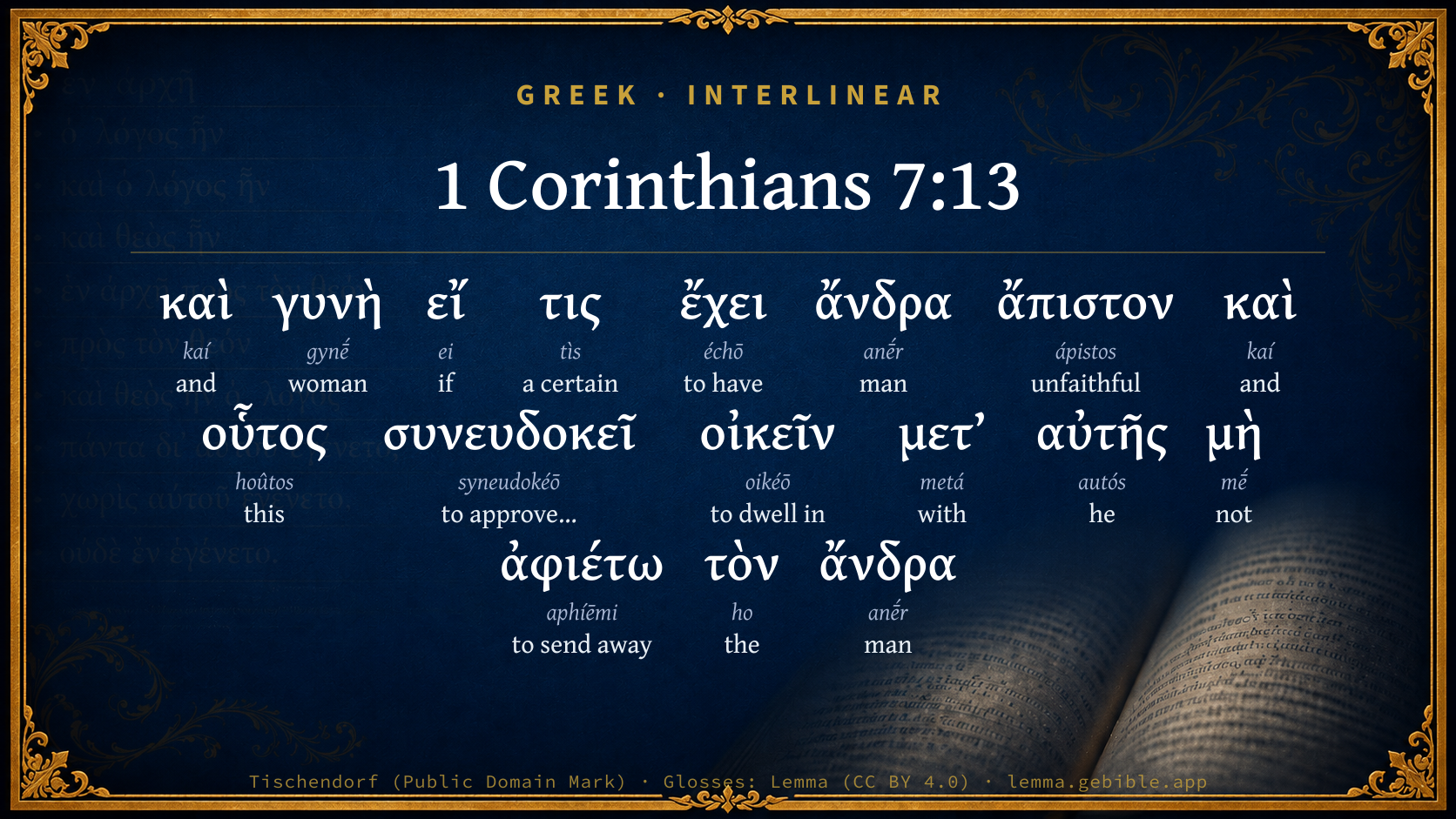
  1. καὶ kaí G2532 “and” Conjunction
  2. γυνὴ gynḗ G1135 “woman” Noun, Nominative, Singular, Feminine
  3. εἴ ei G1487 “if” Conditional
  4. τις tìs G5100 “a certain” Indefinite pronoun, Nominative, Singular, Feminine
  5. ἔχει échō G2192 “to have” Verb, Present, Active, Indicative, 3rd person, Singular
  6. ἄνδρα anḗr G435 “man” Noun, Accusative, Singular, Masculine
  7. ἄπιστον ápistos G571 “unfaithful” Adjective, Accusative, Singular, Masculine
  8. καὶ kaí G2532 “and” Conjunction
  9. οὗτος hoûtos G3778 “this” Demonstrative pronoun, Nominative, Singular, Masculine
  10. οἰκεῖν oikéō G3611 “to dwell in” Verb, Present, Active, Infinitive
  11. μετ’ metá G3326 “with” Preposition
  12. αὐτῆς autós G846 “he” Personal pronoun, Genitive, Singular, Feminine
  13. μὴ mḗ G3361 “not” Particle, Negative
  14. ἀφιέτω aphíēmi G863 “to send away” Verb, Present, Active, Imperative, 3rd person, Singular
  15. τὸν ho G3588 “the” Article, Accusative, Singular, Masculine
  16. ἄνδρα anḗr G435 “man” Noun, Accusative, Singular, Masculine

About this verse

These counts appear in no published source. They are computed here, from the morphology-tagged text and Lemma’s own curated glosses. What Lemma adds →

17
words
15
distinct lemmas
Pauline Epistles
section

Notable vocabulary

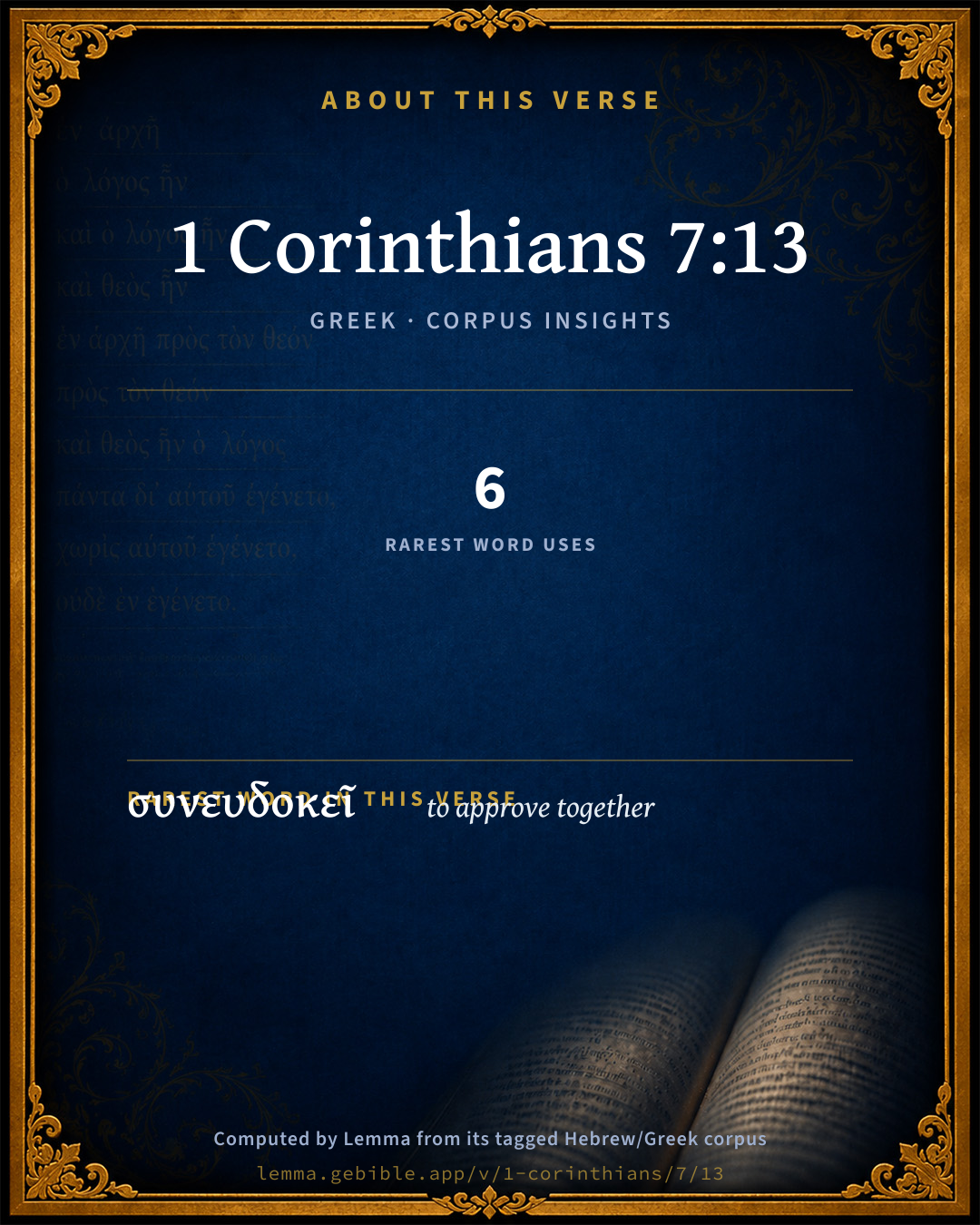
The rarest word here is συνευδοκεῖ to approve together G4909 — appearing just 6 times in the whole Greek New Testament.

Shared distinctive vocabulary

συνευδοκεῖ to approve together G4909 occurs in 6 verses of the Greek New Testament. Also found in:

Repetition

Words recur within this verse:

  • ἄνδρα man G435 ×2
  • καὶ and G2532 ×2

Where the printed editions differ

1 variant

Places in this verse where the major printed Greek editions disagree on the wording in a way that affects the translation — a comparison of editions, not a manuscript-by-manuscript collation. The editions are the modern critical texts (Nestlé-Aland 28/27, SBL, Westcott-Hort, Tregelles, Tyndale House) and the traditional texts behind the KJV (the Textus Receptus and the Byzantine/Majority text). It is not a claim about which reading is original.

  1. Extra text
    εἴ

    “if”

    In NA28NA27SBL Not in TynWHTregTRByz

    εἴ (ei) 'if' is only in older manuscripts (NA28+NA27+SBL)

Textual data: Translators Amalgamated Greek New Testament (STEPBible TAGNT) · CC BY 4.0.

Commentary

Notes on 1 Corinthians 7:13 from classic Christian and Jewish commentators (each source and its license shown beneath its notes). The classic Christian expositions comment on the surrounding passage and are grouped to its opening verse, so a note may address several verses; the Jewish commentaries on the Tanakh (Rashi and others) are per-verse, so they appear only where the commentator wrote on this verse.

Lemma curates 59 commentaries, every one of them public domain or Creative Commons licensed, each selected and text-cleaned for this edition rather than reprinted as found. About our sources →

Bengel's Gnomon

Johann Albrecht Bengel

1Co 7:13. Γυνὴ, the woman) a sister.

Bengel's Gnomon of the New Testament — English translation (T&T Clark, Edinburgh, 1860) — public domain. Text from a community e-Sword module.

Meyer's Critical & Exegetical Commentary

Heinrich August Wilhelm Meyer

1Co_7:13. Καὶ οὗτος] a common turn of expression (instead of ὃς κ.τ.λ[1114]) in connection with ΚΑΊ. See on Luk_10:8 and Kühner II. p. 526.

ΜῊ ἈΦΙΈΤΩ Τ. ἌΝΔΡΑ] let her not put away her husband, not send him from her. To translate otherwise (let her not leave him) is, in view of 1Co_7:12, altogether arbitrary. The Vulgate renders correctly: non dimittat virum. The apparent unsuitableness of the expression is happily explained by Bengel (on 1Co_7:10): Separatur pars ignobilior, mulier; dimittit nobilior, vir; inde conversa ratione etiam mulier fidelis dicitur dimittere, et vir infidelis separari, 1Co_7:13; 1Co_7:15. In the mixed marriage Paul regards the Christian partner, even when it is the wife, as the one who, for the sake of Christianity, would have to send away the non-believer, were this in accordance with Christian principles. But these do not permit of it, and so the Christian wife is not to send away the non-believing husband, if he is willing to dwell with her; that would be on her part a presumptuous violation of duty. Comp Harless, Ehescheidungsfr. p. 85. This view of the apostles has no connection with the right conceded even to wives among the Greeks and Romans of divorcing themselves from their husbands (loose principles on this subject were held also among the Rabbins; see Lightfoot, Hor. p. 191). But certainly Paul did not regard the Christian partner in a mixed marriage as the one who was to rule in general (in opposition to Olshausen); the head in every marriage, if it was to continue at all, was, in his view, according to Gen_3:16, the husband. 1Co_11:3; 1Co_14:34; Eph_5:22; Col_3:18; 1Ti_2:11 f.

[1114] .τ.λ. καὶ τὰ λοιπά.

Meyer — Critical and Exegetical Commentary on the New Testament — English translation by Peter Christie, edited by Frederick Crombie (T&T Clark, 1880) — public domain. Text from a community e-Sword module.

Hodge's Commentary on Romans, Ephesians & First Corinthians

Charles Hodge

1Co_7:12, 1Co_7:13

But to the rest speak I, not the Lord: If any brother hath a wife that believeth not, and she be pleased to dwell with him, let him not put her away. And the woman which hath an husband that believeth not, and if he be pleased to dwell with her, let her not leave him.

But to the rest; i.e. to those married persons not contemplated in the preceding class. The Context makes it clear, that the distinction between the two classes was, that in the former, both parties were Christians; and in the latter, one was a Christian, and the other a Jew or heathen. With regard to these mixed marriages our Lord had given no specific command; therefore Paul says, I speak, not the Lord. The rule which the apostle lays down is, that such marriages are lawful, and therefore there is no obligation on the Christian party to dissolve the connection. And if he is not bound to do it, he has no right to do it. If, therefore, the unbelieving party consent (συνευδοκεῖ) to remain, the marriage may not be dissolved. The Christian husband is forbidden to repudiate (ἀφιέναι) his heathen wife; and the Christian wife is forbidden to repudiate her heathen husband. The same word is used in both cases, because, by the laws both of the Greeks and of the Romans, the woman as well as the man, had, on legal grounds, the right of divorce. Having said that these mixed marriages might be lawfully continued, he proceeds to remove the scruples which the Christian party might entertain on that point. He shows there is nothing unholy in such a connection.

Charles Hodge — Commentary on Romans (1835), First Corinthians (1857), and Ephesians (1856) — public domain. Text from a community e-Sword module.

Jamieson, Fausset & Brown

Robert Jamieson, A. R. Fausset & David Brown

the woman--a believer.

let her not leave him--"her husband," instead of "him," is the reading of the oldest manuscripts The Greek for "leave" is the same as in Co1 7:12, "put away"; translate, "Let her not put away [that is, part with] her husband." The wife had the power of effecting a divorce by Greek and Roman law.

Jamieson, Fausset & Brown — Commentary Critical and Explanatory on the Whole Bible (1871) — public domain (CC PDM 1.0). Text via the HelloAO Bible API.

Adam Clarke's Commentary

Verse 13. And the woman] Converted from heathenism to the Christian faith; which hath a husband, who still abides in heathenism; if he be pleased to dwell with her, notwithstanding she has become a Christian since their marriage; let her not leave him because he still continues a heathen.

Adam Clarke's Commentary on the Bible (1810–1826) — public domain. Text from a community e-Sword/MySword module.

Ellicott's Commentary for English Readers

(13) Let her not leave him.—Better, let her not put him away; the Greek being the same as is applied to the husband in 1Co_7:12. Under Roman law—and St. Paul was writing to those who were under such law—the wife, as well as the husband, was permitted to obtain a divorce. It is therefore probable that St. Paul uses the stronger term here in reference to the woman’s action in the matter, instead of repeating the same word as in 1Co_7:10. Some have suggested that the reason St. Paul applies this word to the action of the woman in the matter is that, in the case under consideration, the fact of the wife being a Christian inverts, in St. Paul’s opinion, the natural order, and makes her the superior. This is wholly inadmissible, and quite contrary to St. Paul’s view of the absolute superiority of the | husband. (See 1Co_11:3; Eph_5:22; 1Ti_2:11.)

A Bible Commentary for English Readers, edited by Charles John Ellicott (1878–1897) — public domain. Text from a community e-Sword module.

The Cambridge Bible for Schools and Colleges

gen. ed. J. J. S. Perowne

13. let her not leave him] The word here is the same which in the last verse is translated ‘put away.’

The Cambridge Bible for Schools and Colleges (gen. ed. J. J. S. Perowne; Cambridge University Press, 1878–1918) — public domain. Text from a community e-Sword module.

John Gill's Exposition

And the woman which hath an husband that believeth,.... The apostle puts the case both ways, there being the same reason for one as for another; that if she that was a sister, who was partaker of the grace of God, and a member of the church, had a husband to whom she was married before her conversion; who was an unbeliever, had no faith in Christ, nor any notion of the Gospel, but an infidel to both:

and if he be pleased to dwell with her; loves her, and is willing to continue with her; neither puts her away from him, nor departs from her on account of her Christianity:

let her not leave him; but continue, and cohabit with him as man and wife; this is the advice the apostle gives, as agreeably to the light of nature and reason; as becoming the Gospel of Christ, and as what might serve to recommend it, and spread the knowledge of it.

John Gill's Exposition of the Whole Bible (1746–1763) — public domain (CC PDM 1.0). Text via the HelloAO Bible API.

Trapp's Complete Commentary

John Trapp

13 And the woman which hath an husband that believeth not, and if he be pleased to dwell with her, let her not leave him.

Ver. 13. If he be pleased, &c.] If he blaspheme not Christ, force her not to deny the faith, &c., as that king of Denmark that would have compelled his wife to go to mass, who was therefore forced to flee for her life to her brother the elector of Brandenburg (as Luther relateth,) where she died Christianly.

John Trapp, A Commentary or Exposition upon All the Books of the Old and New Testament (1647–1656) — public domain. Text from a community e-Sword module.

Albert Barnes' Notes on the Bible

Let her not leave him - A change of phraseology from the last verse, to suit the circumstances. The wife did not have power to “put away” the husband, and expel him from his own home; but she might think it her duty to be separated from him. The apostle counsels her not to do this; and this advice should still be followed. She should still love her husband and seek his welfare; she should be still a kind, affectionate, and faithful wife; and all the more so that she may show him the excellence of religion, and win him to love it. She should even bear much, and bear it long; nor should she leave him unless her life is rendered miserable, or in danger; or unless he wholly neglects to make provision for her, and leaves her to suffering, to want, and to tears. In such a case no precept of religion forbids her to return to her father’s house, or to seek a place of safety and of comfort. But even then it is not to be a separation on account of a difference of religious sentiment, but for brutal treatment. Even then the marriage tie is not dissolved, and neither party is at liberty to marry again.

Albert Barnes' Notes on the Bible (1834–1885) — public domain. Text from a community e-Sword/MySword module.

Matthew Poole's English Annotations

Sanctifying, in holy writ, generally signifieth the separation or setting apart of a person or thing from a common, to and for a holy use, whether it be by some external rites and ceremonies, or by the infusing of some inward spiritual habits. In this place it seemeth to have a different sense from what it usually hath in holy writ; for it can neither signify the sanctification of the person by infused habits of grace; for neither is the unbelieving husband thus sanctified by the believing wife, neither is the unbelieving wife thus sanctified by the believing husband; nor are either of them thus set apart for the service of God by any legal rites: which hath made a great difference in the notions of interpreters, how the unbelieving husband is sanctified by the believing wife, or the unbelieving wife, by the believing husband. Some think it signifies no more than prepared for God, as sanctified signifies, Isa 13:3. Others think they are sanctified by a moral denomination. I rather think it signifies, brought into such a state, that the believer, without offence to the law of God, may continue in a married estate with such a yoke-fellow; and the state of marriage is a holy state, notwithstanding the disparity with reference to religion.

Else were your children unclean; otherwise, he saith, the children begotten and born of such parents would be unclean, in the same state that the children of pagan parents are without the church, not within the covenant, not under the promise. In one sense all children are unclean, i.e. children of wrath, born in sin, and brought forth in iniquity; but all are not in this sense unclean, some are within the covenant of grace, within the church, capable of baptism.

But now are they holy; these are those that are called holy; not as inwardly renewed and sanctified, but relatively, in the same sense that all the Jewish nation are called a holy people: and possibly this may give us a further light to understand the term sanctifed, in the former part of the verse. The unbelieving husband is so far sanctified by the believing wife, and the unbelieving wife so far sanctified by the believing husband, that as they may lawfully continue in their married relation, and live together as man and wife, so the issue coming from them both shall be by God counted in covenant with him, and have a right to baptism, which is one of the seals of that covenant, as well as those children both whose parents are believers.

Matthew Poole's English Annotations on the Holy Bible (1683–1685) — public domain. Text from a community e-Sword/MySword module.

The Pulpit Commentary

Let her not leave him. The verb is the same as in the clause rendered "let him not put her away.

The Pulpit Commentary (1880–1919), ed. H.D.M. Spence-Jones & Joseph S. Exell — public domain. Text from a community e-Sword module.

McGarvey & Pendleton's Commentaries

J. W. McGarvey

And the woman that hath an unbelieving husband, and he is content to dwell with her, let her not leave her husband .

J. W. McGarvey (with Philip Y. Pendleton), Commentaries on the New Testament (The Fourfold Gospel, 1914; Acts; and the epistles) — public domain. Text from a community e-Sword/MySword module.

Cambridge Greek Testament for Schools and Colleges

13. τὸν ἄνδρα. אABCDEFG, Vet. Lat., Vulg., Peshito. Rec. αὐτόν.

Cambridge Greek Testament for Schools and Colleges (Cambridge University Press, 1896; 21 vols, various authors incl. Carr, Maclear, Plummer, Farrar, Lumby, Moule, M. R. James, Simcox) — public domain. Text from a community e-Sword module.

Alford’s Greek Testament

Henry Alford

13.] The change of construction καὶ γυνὴ ἥτις … καὶ οὗτος …, is found frequently with καί: so Il. α. 78, ἦ γὰρ ὀΐομαι ἄνδρα χολωσέμεν, ὃς μέγα πάντων | Ἀργείων κρατέει καί οἱ πείθονται Ἀχαιοί. See reff., and Kühner, ii. 526 (§ 799).

Meyer remarks, that the Apostle uses the vox media ἀφιέναι here, of both parties, the husband and wife, not ἀπολύειν (as Mat 5:31, &c.), which would apply only to the husband. In the E. V. this identity of terms is unfortunately neglected. The same word, part from, would well have expressed ἀφιέτω in both cases.

By the Greek as well as Roman customs the wife had the power of effecting a divorce. At Athens,—when the divorce originated with the wife, she was said ἀπολείπειν the house of her husband: when with the husband, ἀποπεμπέσθαι. At Rome, the only exception to the wife’s liberty of effecting a divorce appears to have been in the case of a freedwoman who had married her patronus. See Smith’s Dict, of Gr. and Rom. Antt. artt. Divortium, and ἀπολείψεως δίκη. Olsh. thinks that Paul puts both alternatives, because he regards the Christian party as the superior one in the marriage. But, as Meyer remarks, this would be inconsistent with the fundamental law of marriage, Gen 3:16, and with the Apostle’s own view of it, ch. 11:3, 14:34; Eph 5:22, Eph 5:23; 1Ti 2:11, 1Ti 2:12.

Henry Alford, The Greek Testament (1849–1861) — public domain. Text from a community e-Sword module.

International Critical Commentary

13. καὶ οὗτος. The pronoun shows that αὕτη, is the right accentuation in v. 12. Here some inferior texts read αὐτός instead of οὗτος, and αὐτόν instead of τὸν ἄνδρα. The latter term has point, because it was a strong measure for a wife to try to divorce her husband. But the Apostle puts both sexes on a level by using ἀφιέτω, which is more commonly used of the husband, of both.

International Critical Commentary — older volumes (1896–1929), various authors — public domain. Text from a community e-Sword module.

Lesson kit

Teaching starters — assembled from the data on this page, not authored interpretation. Every prompt links to the verse data it draws on. Edit before teaching.

1 Corinthians, in the Pauline Epistles, opens this verse with 17 words (15 distinct Greek lemmas). Its most distinctive word is syneudokéō (“to approve together”). A historical commentator’s framing appears above. Read the whole chapter for the surrounding context.

Discussion questions

  1. The word syneudokéō carries the sense “to approve together.” How does it shape the verse?
  2. Luke 11:48 shares the word «to approve together» with this verse. How do the two illuminate each other?
  3. “man” occurs 2× in this one verse. What is the effect of the repetition?
  4. These translations render this verse differently. What is at stake in choosing one wording over another?
  5. Reading how Bengel's Gnomon and Meyer's Critical & Exegetical Commentary read this verse, where do the two commentators agree and where do they part?

Things to notice

Reading settings

Reading text

Shown beneath each verse's original-language words.

Old Testament
Old Testament edition

Read the OT as the Masoretic Hebrew (MT) or the Greek Septuagint (LXX).

English shown for the Greek Septuagint (in the Hebrew ↔ Greek comparison).

Comparing translations? Open the Compare panel on any verse page to stack up to four side by side.