1 Corinthians 10:21

Greek (Tischendorf 8th ed.) 1 Corinthians 10:21 appears in the Greek New Testament. The text above is from the Tischendorf 8th edition. Each word links to its Strong’s number and a concise gloss. Click any word for its full Thayer’s Greek Lexicon entry.
Download image
Cite this verse

1 Corinthians 10:21 (World English Bible). Public Domain. Lemma interlinear Bible study tool, https://lemma.gebible.app/v/1-corinthians/10/21.

Show BibTeX & RIS
BibTeX
RIS
English Translation
You can't both drink the cup of the Lord and the cup of demons. You can't both partake of the table of the Lord, and of the table of demons.
World English Bible · Public Domain
Download a study sheet

One document with this verse’s original text, its word-by-word gloss line, the meaning frame, cross-references with their text, attributed commentary, and full source and license credits — printable, and it pastes into notes with its structure intact.

This verse Autodidact and up

Study sheet (.html) Plain text (.txt)

A passage Seminary Student

Up to 50 verses in one chapter. A passage sheet keeps up to 6 commentary sources and 12 cross-references per verse, in the order this page ranks them, and says so on the sheet whenever that leaves anything out. Ask for a single verse and you get the Autodidact verse sheet above.

Everything on this page stays free to read, with no account — the sheet is a download of what is already on screen, not access to it.

Want to remove ads? Support Godless Engineer
Compare translations 3

The same verse in 3 English versions, stacked beneath the original-language interlinear above. Click any original word for its lexicon entry.

Each is an independent rendering of the whole verse — the interlinear is not word-aligned to these translations.

Highlighted words mark where these versions differ — a whole-verse word diff, not a word-by-word alignment.

  • World English Bible Public Domain
    You can't both drink the cup of the Lord and the cup of demons. You can't both partake of the table of the Lord, and of the table of demons.
  • King James Version Public Domain
    Ye cannot drink the cup of the Lord, and the cup of devils: ye cannot be partakers of the Lord's table, and of the table of devils.
  • unfoldingWord Literal Text CC BY-SA 4.0
    You are not able to drink the cup of the Lord and the cup of demons. You are not able to partake of the table of the Lord and of the table of demons.

unfoldingWord Literal Text — © unfoldingWord, licensed CC BY-SA 4.0. Word-aligned USFM3 via Door43 (git.door43.org/unfoldingWord/en_ult).

Versions to compare (up to 4)

3 of 4 selected

Show all 19 translations

Every available English version of this verse, each an independent rendering of the whole verse.

  • World English Bible Public Domain
    You can't both drink the cup of the Lord and the cup of demons. You can't both partake of the table of the Lord, and of the table of demons.
  • Berean Standard Bible Public Domain
    You cannot drink the cup of the Lord and the cup of demons too; you cannot partake in the table of the Lord and the table of demons too.
  • Majority Standard Bible Public Domain
    You cannot drink the cup of the Lord and the cup of demons too; you cannot partake in the table of the Lord and the table of demons too.
  • King James Version Public Domain
    Ye cannot drink the cup of the Lord, and the cup of devils: ye cannot be partakers of the Lord's table, and of the table of devils.
  • American Standard Version (1901) Public Domain
    Ye cannot drink the cup of the Lord, and the cup of demons: ye cannot partake of the table of the Lord, and of the table of demons.
  • Revised Version (1885) Public Domain
    Ye cannot drink the cup of the Lord, and the cup of devils: ye cannot partake of the table of the Lord, and of the table of devils.
  • Geneva Bible (1599) Public Domain
    Ye can not drinke the cup of the Lord, and the cup of the deuils. Ye can not be partakers of the Lords table, and of the table of the deuils.
  • Douay-Rheims (1899) Public Domain
    You cannot drink the chalice of the Lord, and the chalice of devils: you cannot be partakers of the table of the Lord, and of the table of devils.
  • Young's Literal Translation Public Domain
    Ye are not able the cup of the Lord to drink, and the cup of demons; ye are not able of the table of the Lord to partake, and of the table of demons;
  • Literal Standard Version CC BY-SA 4.0
    You are not able to drink the cup of the LORD and the cup of demons; you are not able to partake of the table of the LORD and of the table of demons;
  • Unlocked Literal Bible CC BY-SA 4.0
    You cannot drink the cup of the Lord and the cup of demons. You cannot have fellowship at the table of the Lord and the table of demons.
  • unfoldingWord Literal Text CC BY-SA 4.0
    You are not able to drink the cup of the Lord and the cup of demons. You are not able to partake of the table of the Lord and of the table of demons.
  • Darby Bible Public Domain
    Ye cannot drink [the] Lord's cup, and [the] cup of demons: ye cannot partake of [the] Lord's table, and of [the] table of demons.
  • World Messianic Bible Public Domain
    You can’t both drink the cup of the Lord and the cup of demons. You can’t both partake of the table of the Lord and of the table of demons.
  • Webster's Bible Public Domain
    Ye cannot drink the cup of the Lord, and the cup of demons: ye cannot be partakers of the Lord's table, and of the table of demons.
  • Free Bible Version CC BY-SA 4.0
    You can't drink the Lord's cup as well as the cup of demons; you can't eat from the Lord's table as well as the table of demons.
  • Bible in Basic English Public Domain
    It is not possible for you, at the same time, to take the cup of the Lord and the cup of evil spirits; you may not take part in the table of the Lord and the table of evil spirits.
  • Text-Critical English NT CC BY 4.0
    You cannot drink both the cup of the Lord and the cup of demons. You cannot share in both the table of the Lord and the table of demons.
  • Tyndale New Testament (1534) Public Domain
    Ye cannot drincke of the cup of the lorde and of that cup of the deuyls. Ye cannot be partetakers of the lordes table and of the table of deuelles.

Literal Standard Version (2020), Covenant Press — licensed CC BY-SA 4.0. Text via the HelloAO Bible API (eBible.org). Unlocked Literal Bible (unfoldingWord) — licensed CC BY-SA 4.0. Text via the HelloAO Bible API (eBible.org). unfoldingWord Literal Text — © unfoldingWord, licensed CC BY-SA 4.0. Word-aligned USFM3 via Door43 (git.door43.org/unfoldingWord/en_ult). Free Bible Version, Dr. Jonathan Gallagher — licensed CC BY-SA 4.0. Text via the HelloAO Bible API (eBible.org).

Word by word

More ways to search: Search by grammar → Find every occurrence → Compare this word →

Practice this passage: Drill this verse → Learn its vocabulary →

μετέχειν
metéchō
G3348
“to partake”
Verb, Present, Active, Infinitive
Part of Speech
Verb
Tense
Present
Voice
Active
Mood
Infinitive
Full Thayer's Definition

Origin: from G3326 and G2192

TDNT: 15:50,3

1. to be or become partaker 2. to partake
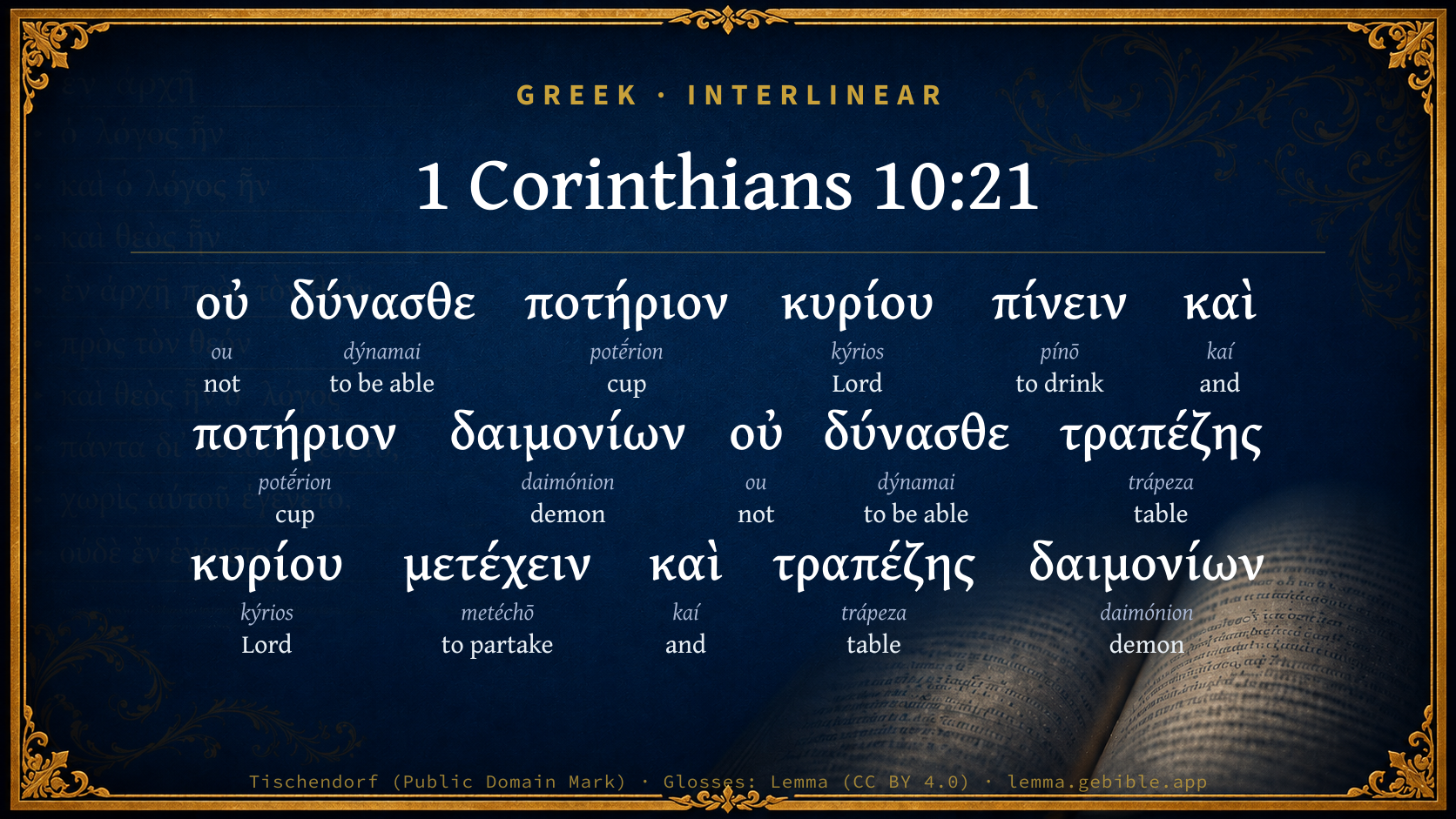
  1. οὐ ou G3756 “not” Particle, Negative
  2. δύνασθε dýnamai G1410 “to be able” Verb, Present, Middle or Passive deponent, Indicative, 2nd person, Plural
  3. ποτήριον potḗrion G4221 “cup” Noun, Accusative, Singular, Neuter
  4. κυρίου kýrios G2962 “Lord” Noun, Genitive, Singular, Masculine
  5. πίνειν pínō G4095 “to drink” Verb, Present, Active, Infinitive
  6. καὶ kaí G2532 “and” Conjunction
  7. ποτήριον potḗrion G4221 “cup” Noun, Accusative, Singular, Neuter
  8. δαιμονίων daimónion G1140 “demon” Noun, Genitive, Plural, Neuter
  9. οὐ ou G3756 “not” Particle, Negative
  10. δύνασθε dýnamai G1410 “to be able” Verb, Present, Middle or Passive deponent, Indicative, 2nd person, Plural
  11. τραπέζης trápeza G5132 “table” Noun, Genitive, Singular, Feminine
  12. κυρίου kýrios G2962 “Lord” Noun, Genitive, Singular, Masculine
  13. καὶ kaí G2532 “and” Conjunction
  14. τραπέζης trápeza G5132 “table” Noun, Genitive, Singular, Feminine
  15. δαιμονίων daimónion G1140 “demon” Noun, Genitive, Plural, Neuter

About this verse

These counts appear in no published source. They are computed here, from the morphology-tagged text and Lemma’s own curated glosses. What Lemma adds →

16
words
9
distinct lemmas
Pauline Epistles
section

Notable vocabulary

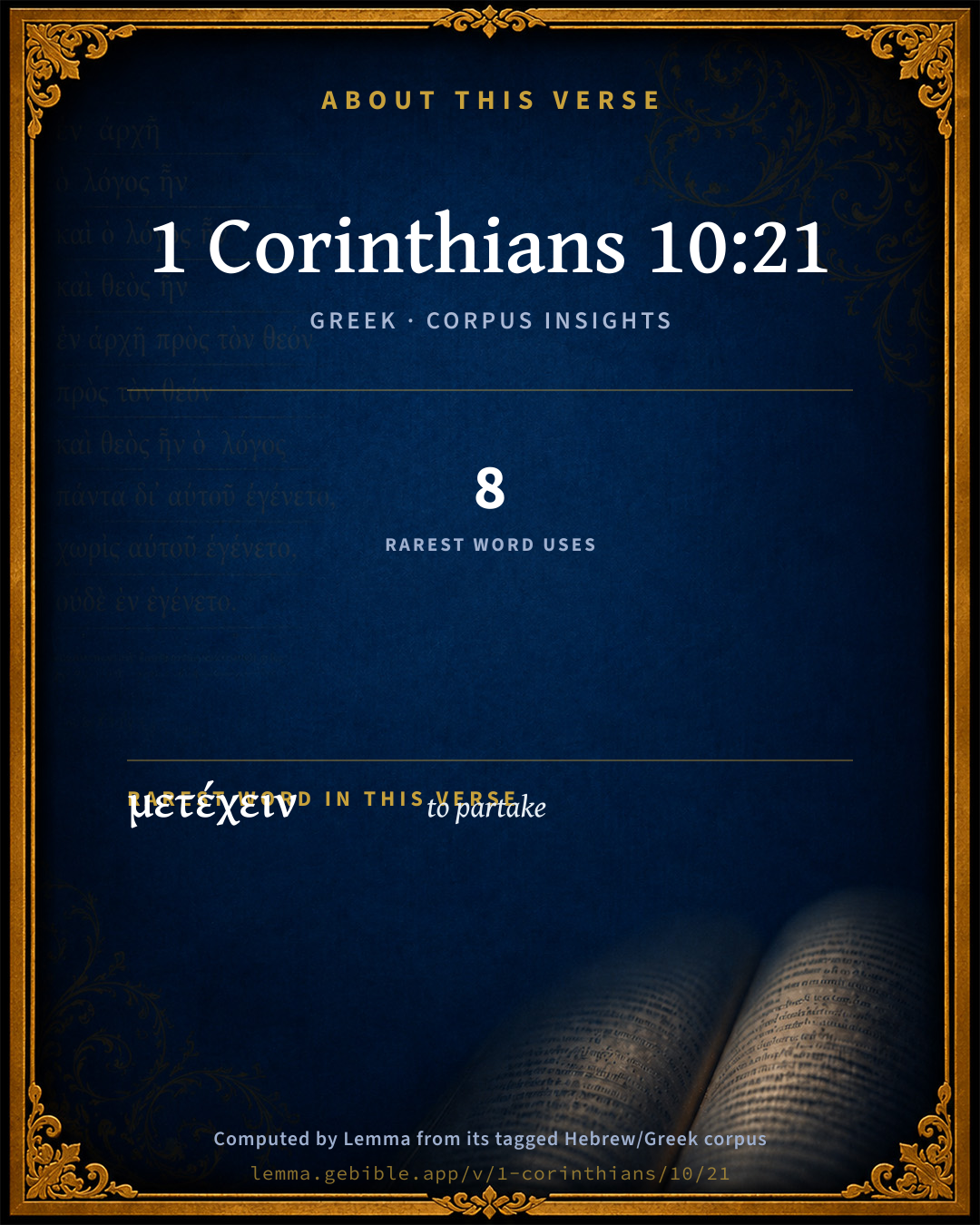
The rarest word here is μετέχειν to partake G3348 — appearing just 8 times in the whole Greek New Testament.

Shared distinctive vocabulary

μετέχειν to partake G3348 occurs in 8 verses of the Greek New Testament. Also found in:

Repetition

Words recur within this verse:

  • δύνασθε to be able G1410 ×2
  • ποτήριον cup G4221 ×2
  • κυρίου Lord G2962 ×2
  • δαιμονίων demon G1140 ×2
  • τραπέζης table G5132 ×2
  • οὐ not G3756 ×2
  • καὶ and G2532 ×2

Cross-references

7

Topical passages linked to 1 Corinthians 10:21 in the Treasury of Scripture Knowledge — connected by theme and wording, ordered by reader-vote popularity; previews shown in the World English Bible.

  • Matthew 6:24 "No one can serve two masters, for either he will hate the one and love the other; or else he will be devoted to one and despise the other. You can't serve both God and Mammon.
  • 1 Kings 18:21 Elijah came near to all the people, and said, "How long will you waver between the two sides? If Yahweh is God, follow him; but if Baal, then follow him." The people answered him not a word.
  • 2 Corinthians 6:15–17 What agreement has Christ with Belial? Or what portion has a believer with an unbeliever?
  • Isaiah 65:11 But you who forsake Yahweh, who forget my holy mountain, who prepare a table for Fortune, and who fill up mixed wine to Destiny;
  • 1 Corinthians 10:16 The cup of blessing which we bless, isn't it a communion of the blood of Christ? The bread which we break, isn't it a communion of the body of Christ?
  • Deuteronomy 32:37–38 He will say, Where are their gods, The rock in which they took refuge;
  • 1 Corinthians 8:10 For if a man sees you who have knowledge sitting in an idol's temple, won't his conscience, if he is weak, be emboldened to eat things sacrificed to idols?

Cross-references courtesy of OpenBible.info (CC BY 4.0).

Commentary

Notes on 1 Corinthians 10:21 from classic Christian and Jewish commentators (each source and its license shown beneath its notes). The classic Christian expositions comment on the surrounding passage and are grouped to its opening verse, so a note may address several verses; the Jewish commentaries on the Tanakh (Rashi and others) are per-verse, so they appear only where the commentator wrote on this verse.

Lemma curates 59 commentaries, every one of them public domain or Creative Commons licensed, each selected and text-cleaned for this edition rather than reprinted as found. About our sources →

Tyndale Open Study Notes

Tyndale Open Resources

10:21 Believers should avoid participating in religious meals eaten in a pagan temple (see 8:10), because those united to the Lord (Christ) cannot simultaneously be united to demons (see 2 Cor 6:14-16).

Tyndale Open Study Notes — © Tyndale Open Resources, licensed CC BY-SA 4.0. Text via the HelloAO Bible API.

Bengel's Gnomon

Johann Albrecht Bengel

1Co 10:21. Οὐ δύνασθε) ye cannot, without very great sin.—Κυρίου, of the Lord) Christ.—τραπέζης Κυρίου, of the Lord’s table) The Lord’s Supper is a feast, not a sacrifice; on a table, not on an altar.

Bengel's Gnomon of the New Testament — English translation (T&T Clark, Edinburgh, 1860) — public domain. Text from a community e-Sword module.

Meyer's Critical & Exegetical Commentary

Heinrich August Wilhelm Meyer

1Co_10:21 gives the ground of the foregoing οὐ θέλω δὲ ὑμᾶς κ.τ.λ[1692]

οὐ δύνασθε] of moral impossibility. Nihil convenit inter Christum et impios daemones; utrisque serviri simul non potest nisi cum insigni contumelia Christi, Erasmus, Paraph. Comp 2Co_6:15.

ποτήριον Κυρίου] a cup having reference to the Lord, i.e. according to 1Co_10:16 : a cup which brings into communion with Christ. Its analogue is a ποτήριον δαιμονίων; the latter was quoad eventum, according to 1Co_10:20, the cup out of which men drank at the sacrificial feast, inasmuch as the whole feast, and therefore also the wine used at it, even apart from the libation (which Grotius, Munthe, Michaelis, de Wette, and others suppose to be meant), made the partakers to be κοινωνοὺς τῶν δαιμον. (1Co_10:20).

τραπέζης Κυρίου] refers to the whole κυριακὸν δεῖπνον, 1Co_11:20. Instances of μετέχειν with τραπέζης, and like expressions, may be seen in Loesner, Obss. p. 288.

[1692] .τ.λ. καὶ τὰ λοιπά.

Meyer — Critical and Exegetical Commentary on the New Testament — English translation by Peter Christie, edited by Frederick Crombie (T&T Clark, 1880) — public domain. Text from a community e-Sword module.

Expositor's Greek Testament

ed. W. Robertson Nicoll

1Co 10:21-22 . This lively apostrophe sets in the strongest light the inconsistency of Cor [1537] Christians who conform to idolatry, the untenability of their position. “You cannot drink the Lord’s cup and the cup of demons ” the two together! “You cannot partake of the Lord’s table and the table of demons !” cf. the τίς μετοχή , κοινωνία , κ . τ . λ .; of. 2Co 6:14 ff., and other parls. The nouns forming the obj [1538] are anarthrous as being qualitative, the impossibility lying in the kind of the two cups; cf. note on 1Co 2:5 . “The Lord’s cup” is that received at His direction and signifying allegiance to Him; in 1Co 10:16 , “the cup of (His) blessing.” Possibly, P. alludes here to Mal 1:7 ; Mal 1:12 , where ‘the table” signifies “the altar of Jehovah”; but the expression is borrowed without this identification. In this context table and altar are essentially distinguished; the altar supplies the table ( cf. Heb 13:10 ). “S. Coena convivium, non sacrificium; in mensa, non in altari” (Bg [1539] ). The τράπεζα includes the ποτήριον and ἄρτος of 1Co 10:16 together. This passage gives its name of “the Lord’s Table” to the Eucharist. “Or (is it that) we provoke the Lord to jealousy?” is this what we mean by eating at both tables? Paul includes himself in this question; such conduct is conceivable in his case, since he had no scruple against the idolothyta on their own account (see 1Co 10:8 , 1Co 9:1 ). Deu 32:21 (neighbouring the previous allusion of 20) sufficiently indicates the result of such insolence: see other O.T. parls. For this argumentative ἢ in Paul’s questions, cf. 1Co 6:9 , etc., 1Co 9:6 . If the Cor [1540] are daring Christ’s sovereign displeasure by coquetting with idolatry, they must suppose themselves “stronger than He”! As sensible and prudent men they must see the absurdity, as well as the awful peril, of such double-dealing: cf. Deu 32:6 ; Deu 32:28 f. ἰσχυρός (1Co 1:25 ) implies inherent, personal strength. Of the δύναμις τ . κυρ . Ἰησοῦ Ρ . had given a solemn impression in ch. 1Co 5:4 f.; cf. 2Co 13:3 f.

[1537] Corinth, Corinthian or Corinthians.

[1538] grammatical object.

[1539] Bengel’s Gnomon Novi Testamenti.

[1540] Corinth, Corinthian or Corinthians.

The Expositor's Greek Testament, edited by W. Robertson Nicoll (1897–1910) — public domain. Text from a community e-Sword module.

Godet's Commentaries

Frédéric Louis Godet

Vv. 21, 22. “Ye cannot drink the cup of the Lord, and the cup of demons: ye cannot be partakers of the Lord’s table, and of the table of demons; 22. or do we provoke the Lord to jealousy? are we stronger than He?”

Edwards thinks that the matter in question here is an impossibility in point of fact. The heart cannot at the same time receive the holy inspirations of Christ and the impure influences of demons. But in that case the apostle would have used words of a more inward and spiritual character than cup and table. The impossibility is rather one of right: “You cannot morally, that is to say, without self-contradiction, and drawing down on you a terrible judgment, take part at the same time in two worships so opposite to one another.” The cup of demons is an expression easily understood, when we remember that in the solemn feasts of the ancients the consecration of the banquet took place with that of the cup, accompanied by the libation in honour of the gods. The first cup was offered to Jupiter; the second to Jupiter and the Nymphs; the third to Jupiter Soter. To participate in these three cups which circulated among the guests, was not this to do an act of idolatry, and to put oneself under the power of the spirit of evil, as really as the Jew by sacrificing put himself under the influence of Jehovah, and the Christian by communicating under that of Christ? Materially, no doubt, it was possible to act thus, but not without criminal inconsistency. And what proves that this is the meaning of the: Ye cannot, is the fact that, in the sequel, Paul expressly states that the Corinthians already venture to act thus; for he declares the fate which awaits them if they persist (1Co 10:22).

Vv. 22. The ἤ is taken in its usual sense in Paul’s writings: “Or if, notwithstanding.” In other words: “Or if you will persist in acting thus, do you know what you are doing, and to what you expose yourselves? You provoke in the heart of God that more terrible fire than the fire of wrath, which is called jealousy!” What is the hatred vowed against a declared enemy in comparison with the fury which falls on an unfaithful spouse? The term παραζηλοῦν, to excite to jealousy, is taken from Deu 32:21: “They have provoked me to jealousy by that which is not God” (idols put in the place of God). The text says briefly: “Do we provoke to jealousy?” Holsten regards this indicative as inadmissible, and thinks the meaning of the subjunctive to be indispensable: “Would we provoke (παραζηλῶμεν)?” He therefore takes the termination ουμεν to be an irregular subjunctive form, like that which is supposed to be found in 1Co 4:6 and Gal 4:17 (see on the first of these passages). But the supposition seems to me unnecessary. The indicative signifies: “Are we truly acting thus?” The form supposes that it was really being done; and this is certainly what is proved by the saying 1Co 8:10, which has by no means the effect of a supposition without reality.

The apostle alludes to the maxim whereby the strong Corinthians justified their carnal conduct: “All things are lawful for us.” — The communicative form: Do we go the length of...? Are we...? serves to soften the severity of the merciless irony: stronger than God...? The term κύριος, Lord, might be applied to God, as is usually the case in passages quoted from the Old Testament. But I rather think, with de Wette, Meyer, Hofmann, following the 1Co 10:4; 1Co 10:9; 1Co 10:21, that in this case Paul applies it to Christ.

And now, after having adjusted this burning question, the apostle reverts in a calmer tone to the less difficult one, of the use of offered meats, giving a few very simple and precise practical rules on the subject, which flow from the principles laid down in the foregoing chapters. 1Co 10:23-24; 1Co 10:32-33, prove that these injunctions are specially addressed to the strong (see Heinrici and Holsten).

Frédéric Louis Godet — Commentaries on Luke, John, Romans, and 1 Corinthians — English translation (T&T Clark, Edinburgh, 1870s–1890s) — public domain. Text from a community e-Sword module.

Hodge's Commentary on Romans, Ephesians & First Corinthians

Charles Hodge

1Co_10:21

Ye cannot drink the cup of the Lord, and the cup of devils: ye cannot be partakers of the Lords table, and of the table of devils.

The cup of the Lord is that cup which brings us into communion with the Lord, 1Co_10:16; the cup of devils is that cup which brings us into communion with devils. The reference is not exclusively or specially to the cup of libation, or to the wine poured out as an offering to the gods, but to the cup from which the guests drank at these sacrificial feasts. The whole service had a religious character; all the provisions, the wine as well as the meat, were blessed in the name of the idol, and thereby consecrated to him, in a manner analogous to that in which the bread and the wine on the Lords table were consecrated to him; comp. 1Sa_9:12, 1Sa_9:13. The table of the Lord is the table at which the Lord presides, and at which his people are his guests. The table of devils is the table at which devils preside, and at which all present are their guests. What the apostle means to say is, that there is not merely an in congruity and inconsistency in a mans being the guest and friend of Christ and the guest and friend of evil spirits, but that the thing is impossible. It is as impossible as that the same man should be black and white, wicked and holy at the same time. In neither case is this attendance an empty, ineffective service. A man cannot eat of the table of demons without being brought under their power and influence; nor can we eat of the table of the Lord, without being brought into contact with him, either to our salvation or condemnation. If we come thoughtlessly, without any desire after communion with Christ, we eat and drink judgment to ourselves. But if we come with a humble desire to obey our divine master and to seek his presence, we cannot fail to be welcomed and blessed. Compare, in reference to this verse, 2Co_6:14-18.

Charles Hodge — Commentary on Romans (1835), First Corinthians (1857), and Ephesians (1856) — public domain. Text from a community e-Sword module.

Geneva Bible (1599)

Geneva Bible translators

The heathen and profane people were wont to shut up and make an end of their feasts which they kept to the honor of their gods, in offering meat offerings and drink offerings to them, with banquets and feastings.

Geneva Bible (1599) marginal notes — public domain. Text via Bolls.life.

Jamieson, Fausset & Brown

Robert Jamieson, A. R. Fausset & David Brown

Ye cannot drink the cup of the Lord--really and spiritually; though ye may outwardly (Kg1 18:21).

cup of devils--in contrast to the cup of the Lord. At idol feasts libations were usually made from the cup to the idol first, and then the guests drank; so that in drinking they had fellowship with the idol.

the Lord's table--The Lord's Supper is a feast on a table, not a sacrifice on an altar. Our only altar is the cross, our only sacrifice that of Christ once for all. The Lord's Supper stands, however, in the same relation, analogically, to Christ's sacrifice, as the Jews' sacrificial feasts did to their sacrifices (compare Mal 1:7, "altar . . . table of the Lord"), and the heathen idol feasts to their idolatrous sacrifices (Isa 65:11). The heathen sacrifices were offered to idol nonentities, behind which Satan lurked. The Jews' sacrifice was but a shadow of the substance which was to come. Our one sacrifice of Christ is the only substantial reality; therefore, while the partaker of the Jew's sacrificial feast partook rather "of the altar" (Co1 10:18) than of GOD manifested fully, and the heathen idol-feaster had fellowship really with demons, the communicant in the Lord's Supper has in it a real communion of, or fellowship in, the body of Christ once sacrificed, and now exalted as the Head of redeemed humanity.

Jamieson, Fausset & Brown — Commentary Critical and Explanatory on the Whole Bible (1871) — public domain (CC PDM 1.0). Text via the HelloAO Bible API.

Adam Clarke's Commentary

Verse 21. Ye cannot drink the cup of the Lord] It is in vain that you who frequent these idol festivals profess the religion of Christ, and commemorate his death and passion in the holy eucharist; for you can not have that fellowship with Christ which this ordinance implies, while you are partakers of the table of demons. That the Gentiles, in their sacrifices, fed on the slain beasts, and ate bread and drank wine in honour of their gods, is sufficiently clear from various accounts. See my Discourse on the Holy Eucharist, where many examples are produced. The following from Virgil, AEn. viii, verse 179-273, is proof in point:-

Tum lecti juvenes certatim araeque sacerdos

Viscera tosta ferunt taurorum, onerantque canistris

Dona laboratae Cereris, Bacchumque ministrant.

Vescitur AEneas simul et Trojana juventus

Perpetui tergo bovis et lustralibus extis.-----

Quare agite, O juvenes, tantarum in munere laudum,

Cingite fronde comas, et pocula porgite dextris,

Communemque vocate Deum, et date vina volentes.

The loaves were served in canisters; the wine

In bowls; the priests renewed the rites divine:

Broiled entrails are their food, and beef's continued chine

Ye warlike youths, your heads with garlands crown,

Fill high the goblets with a sparkling flood,

And with deep draughts invoke our common god.

Adam Clarke's Commentary on the Bible (1810–1826) — public domain. Text from a community e-Sword/MySword module.

Ellicott's Commentary for English Readers

(21, 22) Ye cannot . . .—Here follows the special reason why the Apostle desires them not to partake of the wine poured forth in libation to devils, or the table on which meat sacrificed to these devils was spread out as food. Such would deprive them of their participation in the cup of the Lord and the table on which the Lord’s Supper was placed. Of course the impossibility was moral, not physical. So the Apostle adds the warning question, Do you in fact do so? Do you do that which is morally impossible, and so provoke the jealousy of our jealous God, who will have no divided allegiance? Surely we are not stronger than He? To such a question there can be but one answer. These words, which are the climax of the argument, are naturally suggested by the passage in Deuteronomy (Deu_32:15-18), which was evidently in the Apostle’s mind all through this argument, containing as it does the striking words, “Rock of his salvation.” “They sacrifice unto devils and not to God,” and “they provoked Him to jealousy.”

A Bible Commentary for English Readers, edited by Charles John Ellicott (1878–1897) — public domain. Text from a community e-Sword module.

The Cambridge Bible for Schools and Colleges

gen. ed. J. J. S. Perowne

21. Ye cannot drink the cup of the Lord, and the cup of devils] See note on 1Co_10:18, and for the nature of heathen sacrifices note on 1Co_8:1. The cup of devils was the libation with which the meal commenced. It was the cup of devils (1) because it was the cup of worship to beings other than God, which He Whose name was Jealous (Exo_34:14; cf. Exo_20:5) and Who ‘will not give His glory to another’ (Isa_42:8) had forbidden, and (2) because the worship of many of the gods was a distinct homage to the powers of evil, by reason of its polluting nature. Such worship obviously unfitted those who took part in it for fellowship with Christ. Cf. also 2Co_6:15-16.

The Cambridge Bible for Schools and Colleges (gen. ed. J. J. S. Perowne; Cambridge University Press, 1878–1918) — public domain. Text from a community e-Sword module.

John Gill's Exposition

Ye cannot drink the cup of the Lord, and the cup of devils,.... Not only they ought not, but they could not rightly, truly, and really drink the cup of wine in the Lord's supper, in the true faith of Christ's bloodshed, and his sacrifice offered up for them, in remembrance of his love, and to the honour of his name; and also the cup of wine of libations, poured out and drank to the honour of the Heathen deities; these things are utterly inconsistent; no man can serve two masters, God and mammon, or God and Baal; nor is there any concord between Christ and Belial, or agreement between the temple of God and idols:

ye cannot be partakers of the Lord's table, and of the table of devils; no man can spiritually, however he may externally partake of the entertainment provided, on the table of the Lord, at his supper instituted and kept in commemoration of him; and also with gust and pleasure, and without any concern for the peace of weak minds, and the honour of God, eat things set upon a table in an idol's temple, and before the idol, and as sacrificed unto it.

John Gill's Exposition of the Whole Bible (1746–1763) — public domain (CC PDM 1.0). Text via the HelloAO Bible API.

Trapp's Complete Commentary

John Trapp

21 Ye cannot drink the cup of the Lord, and the cup of devils: ye cannot be partakers of the Lord’s table, and of the table of devils.

Ver. 21. Partakers of the Lord’s table] Name and thing. The Popish opinion of mass was, that it might not be celebrated but upon an altar, or at least upon a superaltare, which must have its prints and carects, or else the thing was not thought to be lawfully done. Our communion table they call an oyster board. (Acts and Mon.)

And the table of devils] Redwald, king of East Saxons, had in the same church one altar for Christian religion, and another for sacrifice to devils. (Camden.)

John Trapp, A Commentary or Exposition upon All the Books of the Old and New Testament (1647–1656) — public domain. Text from a community e-Sword module.

Albert Barnes' Notes on the Bible

Ye cannot drink the cup of the Lord ... - This does not mean that they had no physical ability to do this, or that it was a natural impossibility; for they certainly had power to do it. But it must mean that they could not “consistently” do it. It was not fit, proper, decent. They were solemnly bound to serve and obey Christ, they had devoted themselves to him, and they could not, consistently with these obligations, join in the worship of demons. This is a striking instance in which the word “cannot” is used to denote not natural but moral inability.

And the cup of devils - Demons; 1Co 10:20. In the feasts in honor of the gods, wine was poured out as a libation, or drank by the worshippers; see Virgil, Aeneas viii. 273. The custom of drinking “toasts” at feasts and celebrations arose from this practice of pouring out wine, or drinking in honor of the pagan gods; and is a practice that still partakes of the nature of paganism. It was one of the abominations of paganism to suppose that their gods would be pleased with the intoxicating drink. Such a pouring out of a libation was usually accompanied with a prayer to the idol god, that he would accept the offering; that he would be propitious; and that he would grant the desire of the worshipper. From that custom the habit of expressing a sentiment, or proposing a toast, uttered in drinking wine, has been derived. The toast or sentiment which now usually accompanies the drinking of a glass in this manner, if it means anything, is now also a “prayer.” But to whom? To the god of wine? To a pagan deity? Can it be supposed that it is a prayer offered to the true God; the God of purity? Has Yahweh directed that prayer should be offered to Him in such a manner? Can it be acceptable to Him? Either the sentiment is unmeaning, or it is a prayer offered to a pagan god, or it is mockery of Yahweh; and in either case it is improper and wicked. And it may as truly be said now of Christians as in the time of Paul. “Ye cannot consistently drink the cup of the Lord at the communion table, and the cup where a prayer is offered to a false god, or to the dead, or to the air; or when, if it means anything, it is a mockery of Jehovah.” Now can a Christian with any more consistency or propriety join in such celebrations, and in such unmeaning or profane libations, than he could go into the temple of an idol, and partake of the idolatrous celebrations there?

And of the table of devils - Demons. It is not needful to the force of this that we should suppose that the word means necessarily evil spirits. They were not God; and to worship them was idolatry. The apostle means that Christians could not consistently join in the worship that was offered to them, or in the feasts celebrated in honor of them.

Albert Barnes' Notes on the Bible (1834–1885) — public domain. Text from a community e-Sword/MySword module.

Haydock's Catholic Bible Commentary

In all this discourse, a comparison is instituted between the Christian host and oblation, its effects, conditions and properties, with the altars, hosts, sacrifices and immolations of the Jews and Gentiles; which the apostle could not have done, had there not been a proper sacrifice in the Christian worship. The holy Fathers teach the same with the ancient Councils. This in the council of Nice: The lamb of God laid upon the altar. Conc. Ephes., The unbloody service of the sacrifice. In St. Cyril of Alexandria, in Conc. Ephes., Anath. 11, The quickening holy sacrifice; the unbloody host and victim. Tertullian, de coron. milit., The propitiatory sacrifice both for the living and the dead. This Melchisedech did most singularly prefigure in his mystical oblation of bread and wine; this also according to the prophecy of Malachias, shall continue from the rising to the setting sun, a perpetual substitute for all the Jewish sacrifices; and this, in plain terms, is called the Mass, by St. Augustine, Serm. ccli. 91.; Conc. Cartha. ii. chap. 3. 4. chap. 84. Milevit. 12.; St. Leo, ep. 81. 88. chap. 2.; St. Gregory, lib. ii. ep. 9. 92. &c. &c. See next chapter ver. 24.

George Leo Haydock (1774–1849), Haydock's Catholic Family Bible and Commentary, 1859 edition — public domain. Excludes Psalms (Douay-Rheims chapter numbering differs from Protestant) and Deuterocanonical books (Catholic canon only).

Matthew Poole's English Annotations

The cup of the Lord: we may either take the phrase as signifying all religious communion under one great act of religion, or as particularly signifying having a communion with Christ in the ordinance of the Lord’s supper, which is called

the cup of the Lord, either because God hath instituted and appointed the drinking of it, or because it is done for the honour, glory, and remembrance of our Lord Christ, to remember his death until he come, as the apostle speaketh, 1Co 11:26. This the apostle tells them they could not drink of, that is, not rightly, and with a good conscience; or not really; no man that is an idolater, or hath communion with idolaters in their idolatrous acts, can have communion with Christ. The same is meant by

the Lord’s table, and the table of devils. So as I cannot see how either an idolatrous church can be a true church, or an idolater a true Christian, unless we will assert, that a body of people may be a true church, that can have no communion with Christ; or a man may be a true Christian, and yet have no communion with Christ. Idolatry, doubtless, both divides the soul from Christ, as he is the Head of a believer, and as he is the Head of the church. To call any body of idolaters a true church, either morally, or metaphysically, is to say to those: Ammi, You are the Lord’s people, to whom God hath said, Lo-ammi. Let them be what they will, the name of a church belongeth not to them, if (as the apostle affirmeth) they can have no communion with Christ.

Matthew Poole's English Annotations on the Holy Bible (1683–1685) — public domain. Text from a community e-Sword/MySword module.

Whedon's Commentary on the Bible

Daniel D. Whedon

21. Cannot—Ye can do one or the other; but ye cannot do both. It is a cannot arising from the incompatibility of the two things. It was the contrariety of the kingdoms of light and of darkness, and the apostle solemnly warns them to beware on which side they stand.

Cup of the Lord—The Jehovah of the Old Testament, who was at war with all idolatries, the Christ of the New Testament, who is establishing the kingdom of light on earth.

Cup of devils—This refers to the festal cup at the pagan sacrifices, from which the libations were poured forth, symbolizing the treating the god with wine. “Wherefore,” says Eneas in Virgil, “come forth, O youths, and in honour of so much excellence, wreath your foreheads, bring forth the cups, invoke the common deity, and present your wines.” Whatsoever Jew drank of these cups or ate the meats was denounced as an apostate.

Lord’s table—The Rhemish (Romanistic) commentator makes here a desperate effort to show that St. Paul sustains the doctrine that in the sacrament of the Lord’s supper there is a living victim, Christ, repeatedly and literally sacrificed upon an altar. His opponent, Dr. Fulke, very truly replied that neither the word victim, sacrifice, or altar is once used. The Christian holy sacrament is simply selected as the opposite image to the heathen sacrificial feasts, to present strongly the contrast by which the Christian is forbidden to be sharer in the other.

Doubtless as being the successor of, and substitute for, the sacrifices of the old covenant to figure one real sacrifice, once and for evermore offered, the sacrament may be viewed as a symbolic sacrifice. It sustains the same relation that baptism does to circumcision, and that our Sunday holy-day does to the Jewish sabbath. Hence very beautifully did the Council of Ephesus say, “We celebrate in the Churches the un-bloody service of the sacrifice.” And here, as the Council by the word “un-bloody” recognises that the wine is no literal blood, so it follows that the sacrifice is of no literal victim.

Daniel D. Whedon (gen. ed.), Commentary on the Old and New Testaments (1874–1909) — public domain. Text from a community e-Sword module.

The Pulpit Commentary

Ye cannot. It is a moral impossibility that you should. The Lord"s table. This is the first instance in which this expression is used, and it has originated the name. The table of devils. (see Deu_32:37) In the fine legend of Persephone, she might have been altogether liberated from the nether world if she had eaten nothing since her sojourn there; but unhappily she had eaten something, though it was only the few grains of a pomegranate; and hence she must leave the upper air, and become the Queen of Hades.

The Pulpit Commentary (1880–1919), ed. H.D.M. Spence-Jones & Joseph S. Exell — public domain. Text from a community e-Sword module.

John Wesley's Explanatory Notes

Ye cannot drink the cup of the Lord, and the cup of devils - You cannot have communion with both.

John Wesley, Explanatory Notes Upon the Whole Bible (1754–1765) — public domain. Text via the GEBible commentary corpus.

Burkitt's Expository Notes on the New Testament

William Burkitt

That is, "Ye cannot have communion with Christ and with idolaters too: your comminicating with Christ in the Lord’s supper is utterly inconsistent with communicating with devils in the idol’s feasts, for this were to do homage to two contrary lords, God and Satan, and to profess service to both."

Here observe, 1. A sacramental table described: it is the table of the Lord; so called, because he that is Lord of lords did institute it for the remembrance of his own death.

Observe, 2. An impossibility declared, that none can be worthy partakers at the Lord’s table that hold communion with sin: true, idolatry is the sin here specified, or sacrificing unto devils; but it holds true of all sin in general, and of having fellowship with Satan in any of the unfruitful works of darkness.

Learn hence, That no person can really enjoy any fellowship and communion with Christ at his holy table, who maintains correspondence with sin, and holds communion with Satan.

William Burkitt's Expository Notes on the New Testament (1700–1703) — public domain. Text from a community e-Sword module.

McGarvey & Pendleton's Commentaries

J. W. McGarvey

Ye cannot drink the cup of the Lord, and the cup of demons: ye cannot partake of the table of the Lord, and of the table of demons . [At the sacrificial feasts of the pagans the provisions and wine were both blessed in the name of the idol, and thereby consecrated to him. Part of the festal cup was poured out as a libation to the idol, after which the guests drank of the cup and thus had fellowship with the idol. See Æneid 8:273. Outwardly, Christians might partake of both feasts, but it was a moral impossibility for them to do so inwardly and spiritually. We can not be wicked and holy any more than we can be black and white at the same time. We may also note that there were tables in the temples of the idols on which feasts were prepared.]

J. W. McGarvey (with Philip Y. Pendleton), Commentaries on the New Testament (The Fourfold Gospel, 1914; Acts; and the epistles) — public domain. Text from a community e-Sword/MySword module.

The People's New Testament

B. W. Johnson

21. Ye cannot drink, etc. So inconsistent are the two with each other that no man can commune with Christ who partakes of the feast of the demon. Cup of devils. The libations offered at the idol sacrifices. A part of the cup was poured on the altar, and a part drunk by the offerers. See Æneid 8:273. Table of devils. The table in the idol temple where a feast was spread.

B. W. Johnson's The People's New Testament with Notes (1889–1891) — public domain. Electronic text from the Christian Classics Ethereal Library (CCEL) ThML edition.

Cambridge Greek Testament for Schools and Colleges

21. οὐ δύνασθε … πίνειν. See note on 1Co 10:18, and for the nature of heathen sacrifices note on 1Co 8:1. The cup of daemons was the libation with which the meal commenced. It was the cup of daemons (1) because it was the cup of worship to beings other than God, which He Whose name was Jealous (Exo 34:14; cf. Exo 20:5) and Who ‘will not give His glory to another’ (Isa 42:8) had forbidden, and (2) because the worship of many of the gods was a distinct homage to the powers of evil, by reason of its polluting nature. Such worship obviously unfitted those who took part in it for fellowship with Christ. Cf. also 2Co 6:15-16.

Cambridge Greek Testament for Schools and Colleges (Cambridge University Press, 1896; 21 vols, various authors incl. Carr, Maclear, Plummer, Farrar, Lumby, Moule, M. R. James, Simcox) — public domain. Text from a community e-Sword module.

Alford’s Greek Testament

Henry Alford

21.] Reason of the οὐ θέλω,—sententiously expressed without γάρ.

οὐ δύνασθε applies of course to the real spiritual participation of the table of the Lord so as to profit by it: to moral possibility. The ποτήριον δαιμονίων is said as corresponding to the cup of which mention has been already made, not as Grot., al., and De Wette fancy, referring to the libation at an idol feast.

τράπεζα is said by Pollux vi. 12 (Suicer) to be used in the sense of τὰ σιτία τὰ ἐπʼ αὐτῶν τῶν τραπεζῶν τιθέμενα. Compare the description in Herod. iii. 18, of the Ἡλίου τράπεζα,—Polyb. iv. 35. 4, ὥστε περὶ τὸν βωμὸν κ. τὴν τράπεζαν τῆς θεοῦ κατασφαγῆναι τοὺς Ἐφόρους ἅπαντας,—and ref. Isa.

From this passage probably, the τράπεζα κυρίου became an expression current in all ages of the Christian Church: see Suicer in voc.

Henry Alford, The Greek Testament (1849–1861) — public domain. Text from a community e-Sword module.

International Critical Commentary

21. οὐ δύνασθε. Of course it is not meant that there is any impossibility in going to the Lord’s Supper, and then going to an idol-feast: but it is morally impossible for one who has real fellowship with Christ to consent to have fellowship with demons. For one who does so consent οὐκ ἔστιν κυριακὸν δεῖπνον φαγεῖν. Only those who do not realize what the Supper is, or do not realize what an idol-feast is, could think of taking part in both: cf. 2Co 6:15; Mat 6:24. The genitives may be possessive genitives, but the context indicates that they mean ‘the cup which brings you into fellowship with,’ genitives of relation.

τραπέζης Κυρίου. In Mal 1:7, Mal 1:12, ‘My table,’ i.e. the Lord’s table, means the altar; see also Eze 41:22, Eze 44:16. Here it can only mean the Lord’s Supper, ‘table’ (as often) including what was on it, especially food; hence the expression, τραπέζης μετέχειν. Wetstein quotes Diod. 4:74, μετασχὼν κοινῆς τραπέζης. Deissmann (New Light on the N.T., p. 83; see also Light, p. 355) quotes the invitation to “dine at the κλίνη of the Lord Serapis in the house of Cl. Serapion.” Probably from this passage, and perhaps also from Luk 22:30, ‘the Lord’s Table’ came to mean the Lord’s Supper. Augustine calls it ‘the table of Christ’ and ‘that great table’; Ambrose and Gregory Nazianzen, ‘the mystical table’; etc.

International Critical Commentary — older volumes (1896–1929), various authors — public domain. Text from a community e-Sword module.

Vincent's Word Studies in the New Testament

Marvin R. Vincent

The cup of devils. Representing the heathen feast. The special reference may be either to the drinking - cup, or to that used for pouring libations.

The Lord 's table. Representing the Lord 's Supper. See ch. 1Co 11:20 sqq. The Greeks and Romans, on extraordinary occasions, placed images of the gods reclining on couches, with tables and food beside them, as if really partakers of the things offered in sacrifice. 113 Diodorus, describing the temple of Bel at Babylon, mentions a large table of beaten gold, forty feet by fifteen, standing before the colossal statues of three deities. Upon it were two drinking - cups. See, also, the story of "Bel and the Dragon," vers. 10 - 15. 114 The sacredness of the table in heathen worship is apparent from the manner in which it is combined with the altar in solemn formulae; as ara et mensa. Allusions to the table or to food and drink - offerings in honor of heathen deities occur in the Old Testament : Isa 65:11; Jer 7:18; Eze 16:18, 19; Eze 23:41. In Mal 1:7, the altar of burnt - offering is called "the table of the Lord." 115

Marvin R. Vincent, Word Studies in the New Testament (1887–1900) — public domain. Text from a community e-Sword/MySword module.

Lesson kit

Teaching starters — assembled from the data on this page, not authored interpretation. Every prompt links to the verse data it draws on. Edit before teaching.

1 Corinthians, in the Pauline Epistles, opens this verse with 16 words (9 distinct Greek lemmas). Its most distinctive word is metéchō (“to partake”). A historical commentator’s framing appears above. Read the whole chapter for the surrounding context.

Discussion questions

  1. What does “to partake” (metéchō) contribute to the verse as a whole?
  2. How does 1 Corinthians 9:10, which shares the word «to partake», read alongside this verse?
  3. What does the repetition of “to be able” (2× in this one verse) do in this verse?
  4. These translations render this verse differently. What is at stake in choosing one wording over another?
  5. Compare how Tyndale Open Study Notes and Bengel's Gnomon read this verse. Where do they agree or differ?

Things to notice

  • These translations choose different wording for 10 words in this verse.
  • “to be able” occurs 2× in this single verse.
  • 9 distinct Greek lemmas span 16 words in this verse.

Reading settings

Reading text

Shown beneath each verse's original-language words.

Old Testament
Old Testament edition

Read the OT as the Masoretic Hebrew (MT) or the Greek Septuagint (LXX).

English shown for the Greek Septuagint (in the Hebrew ↔ Greek comparison).

Comparing translations? Open the Compare panel on any verse page to stack up to four side by side.